




Abstract
Resource integration is essential for supply chain innovation ecosystems to achieve value co-creation and ensure efficient operations. However, these ecosystems often face challenges such as underutilization of internal and external resources and fragmented resource-sharing networks. Establishing effective mechanisms for resource integration has become a critical priority. Given the complexity of decision-making among various participants—shaped by dynamic interactions and multiple uncertainties—this study employs evolutionary game theory to model the integration management of innovative resources among a supply chain’s core enterprise, cooperative enterprise A, and cooperative enterprise B. The model analyzes the behavioral dynamics of these entities and conducts stability assessments. Through numerical simulations, the study explores the system’s evolutionary trajectory and equilibrium states. Our findings indicate that resource integration is the realization process and catalytic mechanism of value co-creation, the synergistic benefit parameters constitute the potential space and distribution rules for value co-creation, and the incentive and punishment mechanisms are the strategic levers that guide the evolution of the system. Finally, from a mechanism design perspective, this study examines the role of core enterprises in fostering value co-creation within the innovation ecosystem and proposes policy recommendations to enhance the effectiveness of resource integration.
Plain Language Summary
Resource integration is essential for supply chain innovation ecosystems to achieve value co-creation and ensure efficient operations. However, these ecosystems often face challenges such as underutilization of internal and external resources and fragmented resource-sharing networks. Establishing effective mechanisms for resource integration has become a critical priority. Given the complexity of decision-making among various participants shaped by dynamic interactions and multiple uncertainties this study employs evolutionary game theory to model the integration management of innovative resources among a supply chains core enterprise, cooperative enterprise A, and cooperative enterprise B. The model analyzes the behavioral dynamics of these entities and conducts stability assessments. Through numerical simulations, the study explores the systems evolutionary trajectory and equilibrium states. Our findings indicate that resource integration is the realization process and catalytic mechanism of value co-creation, the synergistic benefit parameters constitute the potential space and distribution rules for value co-creation, and the incentive and punishment mechanisms are the strategic levers that guide the evolution of the system. Finally, from a mechanism design perspective, this study examines the role of core enterprises in fostering value cocreation within the innovation ecosystem and proposes policy recommendations to enhance the effectiveness of resource integration.
Keywords
Introduction
In the current era of uncertainty, supply chain competition is increasingly replacing enterprise-to-enterprise competition as the core battlefield for determining business success or failure. On the macro level, digital transformation, the in-depth development of globalization, and the ultimate personalization of customer needs have jointly driven supply chain innovation from a competitive advantage to a necessity for survival. The traditional linear innovation model led by core enterprises has been challenging to cope with this complexity. The operating paradigm of the supply chain is undergoing a fundamental change (Chen et al., 2024), from a closed, chain-like structure to an open, collaborative innovation ecosystem (Fait et al., 2024; Ketchen et al., 2014). Companies are no longer just independent competitors, but co-creators who must depend on each other. At the micro level, although managers generally agree that value co-creation with supply chain partners is the key to driving breakthrough innovation, they are in a deep predicament in practice. When enterprises try to deeply integrate resources to realize the value of co-creation, they often find it difficult to move forward due to limited rationality, information asymmetry, and inherent competitive relationships. Faced with the risk of sunk costs from specific investments, the uncertainty in the distribution of collaborative benefits, and the threat of opportunistic behavior such as “free riding,” companies often waver between the strategies of “open cooperation” and “closed self-preservation,” Therefore, in the supply chain innovation ecosystem composed of self-interested, limited-rational subjects, what conditions should the cooperative behavior that drives value co-creation meet to spontaneously emerge, persist, and ultimately lead the entire system to a high-level equilibrium of collaborative innovation? This real dilemma urgently needs a theoretical answer that can reveal its internal mechanism of evolution.
The academic community has produced fruitful results on supply chain innovation, laying a solid theoretical foundation for this study. The service-dominant logic theory profoundly expounds the basic paradigm of value co-creation by users and producers (Caridà et al., 2019; Vargo et al., 2017), and believes that heterogeneous innovation resources are the core of value co-creation in the innovation ecosystem (Bocconcelli et al., 2020). The dynamic capability theory demonstrates the necessity for enterprises to obtain a competitive advantage by integrating and restructuring internal and external resources at the strategic level (Chatterjee et al., 2024). These studies reveal the driving factors of value co-creation and the macro importance of resource integration. However, most studies tend to conduct static and isolated conceptual analysis of value co-creation and resource integration (Caridà et al., 2019; Peters, 2016; Prenkert et al., 2022), treating them as relatively independent stages or elements, and failing to effectively connect the two into a dynamic, mutually feedback organic whole. Therefore, it is impossible to answer the core process questions such as “how the initial willingness to cooperate is formed” and “how the cooperation norms evolve dynamically,” In terms of methodology, existing studies rely more on case studies (Kanyoma et al., 2021) or cross-sectional data models (Fianko et al., 2023; Rodríguez et al., 2024; Shah et al., 2020; Tarifa Fernández, 2022; Xu et al., 2023). While these methods can effectively elucidate correlation and static configuration, they struggle to capture the dynamic processes of behavioral synergy and system evolution among supply chain innovation members, which occur through strategic interaction and learning imitation under conditions of bounded rationality. This limitation of theory and method directly leads to the lack of practical guidance. Although managers recognize the importance of value co-creation and resource integration, they lack a decision-support tool that can predict how different policies and parameters (such as cost sharing, profit distribution, and trust mechanisms) will affect the long-term collaborative evolution of the system. Therefore, this paper will propose an analytical framework that integrates micro-behavior and macro-emergence (Peters, 2016) and analyzes the dynamic process.
In the innovation ecosystem, due to the uneven distribution of innovation resources, such as information, technology, and data, innovation entities face many development challenges (de Vasconcelos et al., 2018; Oh et al., 2016; Xie & Wang, 2021). The effective integration of resources in the innovation ecosystem has become the key to improving innovation efficiency (Granstrand & Holgersson, 2020). Therefore, the direction of resource integration should be guided by the goal of value co-creation, and efficient resource integration should serve as the material basis for realizing it. In the face of the dynamic changes in the market environment, the core enterprises of the supply chain should make full use of external resources in combination with customer needs and their own production and operation activities, strengthen cooperation with partners, and efficiently integrate the heterogeneous innovation resources of partners with the support of digital platforms such as the industrial Internet, and co-create supply chain value with innovative partners. Resource integration is a complex and dynamic process that cannot be achieved overnight. The innovation subjects in the supply chain innovation ecosystem are limited in rationality, their decision-making behaviors are affected by various uncertain factors, and there are dynamic interactions. Therefore, this paper will introduce evolutionary game theory as the core analytical perspective, replace complete ideal with limited rationality, depict the decision-making behavior of gradually adjusting strategies in a complex environment, to reveal the emergence law of cooperative order at the macro level, and accurately analyze the evolutionary path and stable conditions of resource integration behavior in the “coopetition” game in the process of value co-creation, which is beyond the reach of traditional game models. Therefore, this paper constructs a dynamic evolutionary game model between the core enterprise of the supply chain and the cooperative innovation subjects for the innovation resource integration problem of the supply chain innovation ecosystem, and discusses how the core enterprise of the supply chain promotes the cooperative innovation subjects to actively cooperate with resource integration and the stable conditions for reaching a stable state. Numerical simulation analysis is carried out to discuss the influence of various factors on the evolutionary stable state, and further put forward operable management enlightenment, and provide specific strategic guidance and policy suggestions for how the core enterprise designs incentive mechanisms, optimizes benefit distribution, and builds a trust environment to guide the value co-creation of the supply chain.
This study aims to make the following contributions by constructing and analyzing the evolutionary game model of supply chain resource integration: First, this study realizes the innovation of perspective, dynamically unifies the two core concepts of value co-creation and resource integration into an evolutionary analysis framework, reveals the symbiotic evolutionary relationship between the two “goal-process,” and makes up for the fragmentation of static research. Second, this study provides a deeper methodological grounding. By embedding micro parameters such as “integration cost” and “excess profit” into the profit function of the evolutionary game, and using replicator dynamics and evolutionary stable strategy for analysis, it provides a precise micro mechanism and mathematical basis for understanding the emergence and stability of cooperative behavior in a group with limited rationality. Finally, this study systematically reveals the regulatory role of key parameters, clarifies the critical conditions and path dependence that affect the evolution of the system to the ideal state, deepens the understanding of the complexity of the supply chain innovation ecosystem, and provides a clear decision-making basis for managers.
Literature Review
Research on Supply Chain Innovation
Supply chain innovation is a critical means to enhance supply chain operational performance and sustainable competitiveness (Malacina, 2022; Wong & Ngai, 2019). Schumpeter and Drucker’s theories have provided an important theoretical foundation for the concept of supply chain innovation. Scholars mainly study the relevant content of supply chain innovation from the perspectives of its content and output. These include collaborative networks for new product and service development and innovation diffusion (Amini et al., 2015; Bellamy et al., 2020), green supply chain innovation (Ahmadi et al., 2020; D. Geng et al., 2021), supply chain knowledge management and collaboration (Nasr et al., 2015), supply chain integration (Flynn, 2010; Yao, 2010), and supply chain financial innovation (Du et al., 2020; Yu et al., 2024).
The research trajectory on supply chain innovation reveals a clear evolution, moving from an early emphasis on process innovation (Munksgaard et al., 2014) and technology-driven approaches (Chiu & Lin, 2022; Hamidu et al., 2023; H. H. J. Li & Tan, 2019; Luo & Choi, 2022) toward contemporary paradigms centered on collaboration. These newer models encompass collaborative innovation (Gu, 2025; R. Li et al., 2024; Y. F. Wang et al., 2024) and open innovation (Le & Behl, 2024; Perotti et al., 2025), then frame innovation as a multi-actor process involving customers, suppliers, and even competitors.
This shift has been accelerated by digital transformation. Core technologies such as digital twins (Rahmanzadeh et al., 2023; Singh, 2025), the Internet of Things (C. Wang et al., 2025), and blockchain (Lotfi et al., 2024; K. N. Zhang et al., 2025; Zhen & Yao, 2025) now serve as central drivers of innovation. By reducing collaboration barriers and unlocking new value spaces, these digital tools underpin a modern understanding of supply chain innovation as a dynamic, networked process involving multiple stakeholders. Consequently, the success of innovation increasingly depends on effective cross-entity interaction and the mobilization of decentralized knowledge and resources across the entire network (Brandao et al., 2025; Y. Geng et al., 2024).
This networked perspective naturally directs scholarly focus to two enabling mechanisms: value co-creation and resource integration. Scholars suggest that digital platform firms, in particular, should cultivate capabilities in opportunity identification, resource integration, and the management of symbiotic relationships to build robust ecosystems (Chi et al., 2024). The theme of value co-creation has been explored from multiple viewpoints (Ju et al., 2021; Meynhardt et al., 2016; Ren et al., 2015), with the service ecosystem lens emerging as an up-and-coming framework for understanding how manufacturing enterprises can foster value co-creation within their supply chain ecosystems.
Research on Value Co-Creation and Resource Integration
Value co-creation and resource integration are interdependent concepts that form a cohesive theoretical framework for this study, with the former defining the objective and the latter providing the means. Value co-creation fundamentally challenges the conventional linear model, in which firms unilaterally produce value and deliver it to customers. This paradigm shift originates in service-dominant logic (Michel et al., 2008; Vargo & Lusch, 2011, 2016), which asserts that value is always co-created with and determined by users. In a supply chain context, this means innovation value emerges not from any single core enterprise, but through multi-layered interactions, spanning the technical collaboration of suppliers, the operational flexibility of manufacturers, the market intelligence of distributors, and the experiential feedback of end users (Mukhtar et al., 2023; Ou et al., 2025). To understand how such co-creation is realized, we must examine the underlying mechanism: resource integration.
From the perspective of dynamic capability theory, resource integration refers to a firm’s capacity to continuously reconfigure internal and external resources in response to environmental change (Lyu et al., 2024). In supply chain networks, this process crosses organizational boundaries, involving the identification of heterogeneous (Ding et al., 2025) and complementary (Plugge et al., 2024) resources, followed by their absorption and deployment (Baraldi et al., 2024; Zhou & Zhao, 2024). Such resources include not only physical assets but also critical intangibles like knowledge (Javed et al., 2025), technology (B. Wang et al., 2024), analytical capabilities (Jiang et al., 2024), production flexibility (Niroomand et al., 2023), and market access (Zhu & Tang, 2023). Through ongoing integration, firms transform distributed network resources into concrete innovation and competitive advantage.
A dialectical relationship binds these two concepts. Value co-creation establishes the strategic direction, while resource integration enables its execution. Integration goes beyond simple resource accumulation (Yao & Deng, 2016); it aims to generate synergistic value that no single actor could achieve on their own. Without effective integration, co-creation remains an unrealized ideal. Thus, in supply chain innovation, a clear vision of co-created value guides resource integration, while the coordinated deployment of those resources makes the vision attainable. Ignoring either element or the dynamic between them obstructs a complete understanding of collaborative innovation.
Research on Evolutionary Game Theory
In supply chain innovation networks comprised of self-interested entities, value co-creation serves as the ultimate objective, while resource integration functions as the primary mechanism. However, this idealized state of collaboration is neither spontaneously attainable nor free from fluctuations. It is therefore essential to account for the inherent co-opetitive relationships among supply chain members. In this context, evolutionary game theory offers a particularly suitable and robust analytical framework for examining such complex interactions (G. Wang et al., 2022).
Traditional game-theoretic models, built on assumptions of “complete rationality” and “common knowledge,” prove inadequate for analyzing long-term and dynamic supply chain relationships. While such models may predict outcomes in one-off transactions, they fall short in explaining how cooperative norms gradually emerge, diffuse, and sometimes collapse across a population of boundedly rational firms through processes of trial and error, imitation, and learning over time (Traulsen & Glynatsi, 2023).
In contrast, evolutionary game theory shifts the analytical focus from static equilibria to dynamic evolutionary pathways. Its core strengths lie in several aspects: First, it adopts the “bounded rationality” assumption, which aligns more closely with real-world managerial decision-making. Firms are not always able to make optimal choices; instead, they incrementally adjust their behaviors by emulating successful strategies or drawing on accumulated experience. Second, the replicator dynamic equation effectively captures how the distribution of strategies within a firm population evolves over time, thereby revealing macro-level patterns in collective behavior. Finally, its central concept of the evolutionarily stable strategy provides a rigorous criterion for identifying which forms of cooperation can endure minor disturbances and persist in the long run (Smith, 1982).
Existing studies offer valuable methodological insights. For instance, evolutionary game theory has been successfully applied to identify key parameters—such as cost-benefit ratios and government incentive-penalty mechanisms—that influence the evolution of cooperative behaviors in domains like green supply chain management (Yang et al., 2021) and information sharing (Gao et al., 2023; Zou et al., 2021). Nevertheless, these studies have not systematically incorporated the intrinsic motivations for value co-creation or the specific costs associated with resource integration into their payoff function designs. This omission creates a clear theoretical gap that the present study aims to address.
Therefore, it is both appropriate and necessary to develop a dynamic evolutionary game model that captures the interaction between a core firm and its innovation partners within a supply chain innovation ecosystem. Such a model can deeply illuminate the internal mechanisms driving the collaborative evolution of supply chain innovation networks, particularly under the dual constraints of bounded rationality and co-opetitive dynamics.
Through a systematic review of the existing literature, it is found that although the academic community has achieved fruitful results in the fields of value co-creation, resource integration, and evolutionary game analysis, there are still significant research deficiencies in placing these three in a unified framework of supply chain innovation for dynamic and systematic investigation. First of all, there is a gap in perspective: most existing studies statically analyze the motivation for value co-creation or the mode of resource integration and lack a dynamic theoretical lens that can capture the symbiotic and co-evolutionary relationship. Value co-creation and resource integration are not regarded as an organic whole, and the conditions for spontaneous origin and dynamic stability in the interaction of enterprise groups are not explored. Secondly, there is a gap in the mechanism: although some studies have begun to apply evolutionary game theory, they often focus on relatively macro cooperative behavior, and fail to deeply deconstruct the revenue structure under the specific goal of value co-creation, and fail to accurately portray the specific costs, risks and proprietary investment involved in “resource integration” as key parameters, and how to effectively guide the system to evolve to the ideal value co-creation equilibrium. The internal mechanism still lacks a strict mathematical model derivation and parameter sensitivity analysis. In addition, there is room for expansion in the application of emerging situations. In the context of digital transformation or sustainable development, how the new co-creation model of data-driven, green-oriented reshapes the rules of the evolutionary game is still in its infancy. Through theoretical derivation and numerical simulation, this paper systematically reveals the key factors influencing the enterprise’s choice of integration strategy and its dynamic interaction mechanism. It does this by focusing on the value co-creation of the supply chain innovation ecosystem and building a dynamic evolutionary game model of resource integration between the cooperative innovation subjects and the supply chain’s core enterprise. It provides businesses with a sound theoretical foundation and helpful guidance for fostering innovation in intricate networks of cooperation and competition, and for directing the system’s evolution toward a higher-order equilibrium by elucidating the managerial significance of key parameters.
Model
Problem Description
The main supply chain businesses and their partners in the manufacturing supply chain innovation ecosystem are focused on meeting customer needs, generating value through cooperative innovation, and working together to deliver goods and services to clients. To focus on the research problem, this paper defines the innovation resource integration process as follows: it assumes there are three key participants in the system, with the core supply chain enterprise serving as the leader of innovation resource integration. The cooperative enterprise A and the cooperative enterprise B are the participants of the innovation resources. Resource integration is essentially a complex value realization process (Bocconcelli et al., 2020). The marginal benefits obtained by participating enterprises in deep resource integration are often difficult to cover the management costs and risks arising therefrom. If the core enterprise fails to perform its integration function, the partners will exhibit spontaneous, inconsistent resource-sharing levels due to strategic heterogeneity, resulting in significant differentiation in their final benefits and risk bearing. It can be seen that the core enterprise actively initiates and promotes resource integration, which is the key mechanism for realizing optimal allocation of innovation resources and achieving value co-creation at the system level. Based on this, this paper constructs an evolutionary game model composed of core enterprises and multiple cooperative enterprises. Since multiple cooperative enterprises face the same game structure and strategy space, in order to simplify the analysis, this study sets them as two representative participants, cooperative enterprise A and cooperative enterprise B, and assumes that their decision-making behavior patterns are homogeneous, but their own income and management costs under the two strategies of “complete resource sharing” and “partial resource sharing” are different, so as to reflect the individual differences at the micro level.
Symbolic Hypothesis
This paper conducts a repeated dynamic evolutionary game to examine the innovation resource integration process among the core supply chain enterprise, cooperative enterprise A, and cooperative enterprise B in the supply chain innovation ecosystem. The modeling assumptions of this paper are as follows:
Game Payoff Matrix
According to the principle of profit maximization and the hypotheses, write out the three-party game payoff matrix for the core enterprise integrating and not integrating resources, and the cooperative enterprise choosing to fully share and partially share innovative resources, with the results shown in Table 1.
Payoff Matrix of the Game.

Analysis of the Evolutionary Game Model
The Expected Profit Function and Replication Dynamic Equation of Core Enterprises
Assuming the expected return for the core enterprise from active resource integration is


Therefore, the replication dynamic equation for the core enterprise is:

The Expected Profit Function and Replication Dynamic Equation of Cooperative Enterprise A
Assuming that the expected benefit for cooperative enterprise A when choosing to fully share innovative resources is
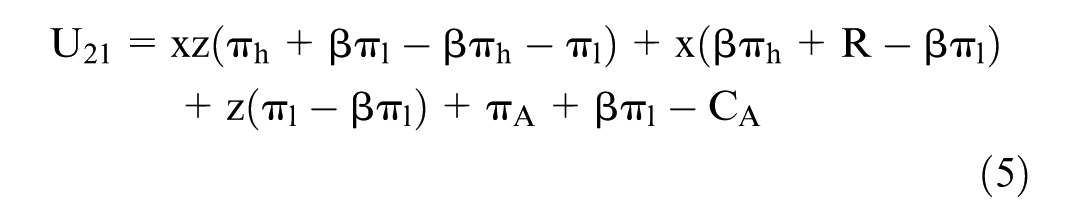


Therefore, the replication dynamic equation for partner enterprise A is:

The Expected Profit Function and Replication Dynamic Equation of Cooperative Enterprise B
Assuming that the expected profit for cooperative enterprise B when choosing to fully share innovative resources is


Therefore, the replication dynamic equation for partner enterprise B is:

Stability Analysis of the Three-Party Evolutionary Games
For the strategy choice evolution process of the three parties: the core enterprise, cooperative enterprise A, and cooperative enterprise B, it is not possible to intuitively determine which equilibrium point the system will ultimately converge to. The equilibrium points obtained from the replicator dynamic equations are not necessarily stable equilibrium points; that is, they are not necessarily evolutionarily stable strategies (ESS). The stability of each equilibrium point can be judged by the eigenvalues of the Jacobian matrix corresponding to the dynamic system. An equilibrium point is asymptotically stable only when all eigenvalues of the matrix are negative.
Based on the analysis of the above theoretical foundation, the replicator dynamic system of the game is as follows:

The Jacobian matrix of the dynamic system can be expressed as:

When the rate of change in the dynamic system’s strategy selection is 0, there are
Stability Analysis of Equilibrium Points.

Conditions①
Conditions②
Below, we take point

The eigenvalue of the matrix is:
Similarly, the analysis of other points is the same, so the following only analyzes the conditions required for the stable state.
For point
For point M3 (0, 1, 0), when
For point
For point
For point
For point
For point
Numerical Simulation of Innovation Resource Integration
In order to verify the results of the evolutionary stability analysis, this paper selects
Influence of Different Initial Strategy Selection Probabilities on the Evolutionary Path of Participating Subjects
When the stability condition of the point
From the simulation diagrams in Figures 1 and 2, it can be seen that the strategy point

Three-dimensional diagram of the evolution of the subject under different initial states. (a) Evolutionary graph under the state of medium cooperation intention, (b) Evolutionary graph under high cooperation intention, (c) Evolutionary graph under asymmetric willingness to cooperate, (d) Evolutionary graph under the state of reverse asymmetric cooperation willingness, (e) Evolution diagram in mixed state, (f) Evolutionary diagram under the state of low willingness to cooperate.

Evolutionary trend of strategy selection under different initial states. (a) Core Enterprise, (b) Cooperative Enterprise A, (c) Cooperative Enterprise B.
Influence of Main Parameters on the Evolution Strategy of Participants
Impact of Incentive and Punishment Mechanisms
When the initial state is fixed at
The simulation results are shown in Figure 3, which reveal the asymmetry in the incentive and punishment mechanisms. The evolution curves of cooperative enterprises A and B coincide, indicating that as innovation followers, their strategy selection mainly depends on the relative income difference (that is, the net income gap between full sharing and partial sharing). When the R/P ratio is different, this relative gap remains unchanged, so the behavior is consistent, but it can also be seen from Figure 3b and c that the reward-led combination
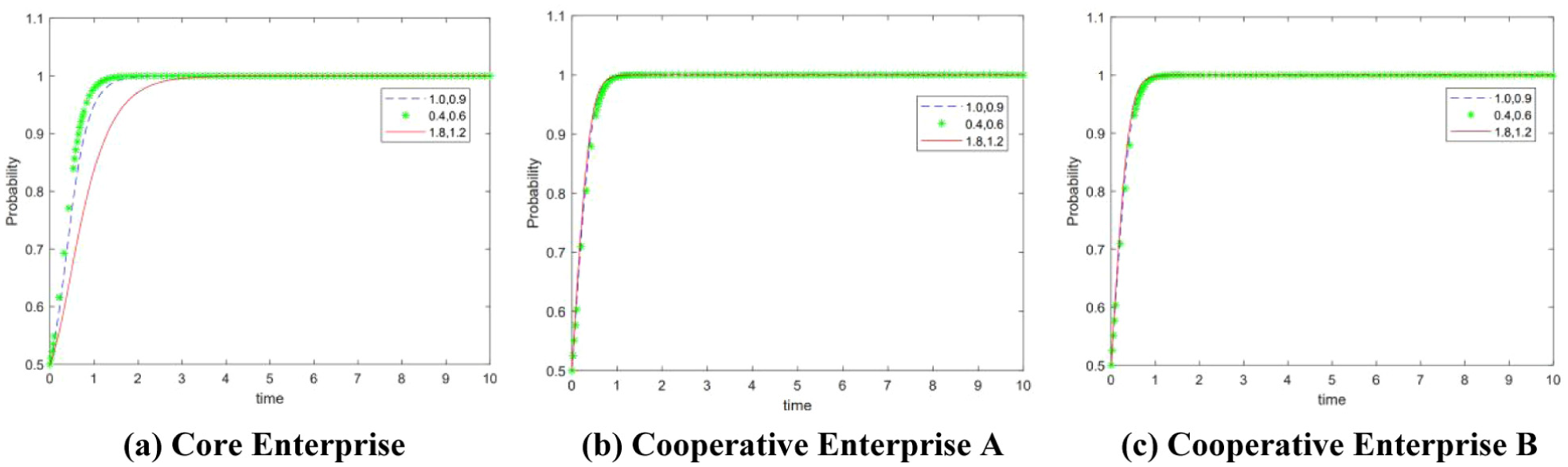
The impact of reward and punishment mechanisms on the evolution of participants. (a) Core Enterprise, (b) Cooperative Enterprise A, (c) Cooperative Enterprise B.
Impact on Costs
When the initial state is fixed at
The simulation results are shown in Figure 4, which reveals the dual influence mechanism of cost structure on the evolution of supply chain cooperation. In the low-cost scenario (0.8,1.3,0.5), the cooperative enterprises respond quickly due to the obvious advantages of the net income of complete sharing, forming a positive cycle and promoting the rapid convergence of the system. In the high-cost scenario (4.0,5.0,2.2), the cooperative enterprises face the heavy cost burden of complete sharing, and the initial willingness to cooperate is frustrated, resulting in the core enterprises’ strategic shake in the early stage due to the failure of coordination input to obtain timely returns. However, with the continuous effect of the incentive mechanism and the gradual emergence of synergistic benefits, the system can eventually overcome the cost obstacles and achieve deep cooperation, as shown in Figure 4a, the curve first decreases and then rises. This demonstrates that the cost level influences both the rate of convergence and the evolution path’s complexity. It takes longer to build trust and accumulate collaborative capital in a high-cost setting, but a well-crafted incentive scheme can still help the system overcome financial limitations and achieve an optimal balance.

The impact of cost changes on the evolution of participants. (a) Core Enterprise, (b) Cooperative Enterprise A, (c) Cooperative Enterprise B.
Impact of Synergy
When the initial state is fixed at
The simulation results are shown in Figure 5, which reveals the global acceleration effect of the synergistic benefit parameters. Although the evolution curves of each subject are similar under the four sets of parameters, the comprehensive improvement of the synergistic level significantly accelerates the convergence speed, from the low coordination level and high sensitivity state of

The impact of changes in synergistic benefits on the evolution of participating subjects. (a) Core Enterprise, (b) Cooperative Enterprise A, (c) Cooperative Enterprise B.
Conclusions and Management Implications
Conclusion
The global industrial chain and supply chain are undergoing profound reconstruction under the dual challenges of slowing growth momentum and rising geopolitical conflicts facing the current global economy. In this context, building an ecosystem with collaborative innovation as the core has become a key path for enterprises to cope with uncertainty and build sustainable competitive advantages. The innovation ecosystem integrates multiple subjects, reconstructs resources and co-creates value around common value propositions, in order to maximize the overall benefits of the system. In order to deeply analyze the strategy interaction mechanism of innovation subjects in this process, this paper constructs a three-party evolutionary game model composed of core enterprises, cooperative enterprise A and cooperative enterprise B, aiming to reveal the key factors affecting the resource integration strategy selection of all parties in the value co-creation process and its dynamic evolution law. The following key findings are reached by this study using numerical simulation and methodical model analysis:
Resource integration is the realization process and catalytic mechanism of value co-creation. Value co-creation theory emphasizes its target attributes, but lacks micro-explanation of its realization path. This study reveals that the stability of value co-creation highly depends on the rational allocation and compensation of integration costs by operationalizing resource integration into the coordination cost C of the core enterprise and the complete sharing cost
The synergistic benefit parameters
The incentive and punishment mechanisms R and P are the strategic levers that guide the evolution of the system. Numerical simulations have confirmed that the incentive R and the punishment P do not work in isolation. The R/P ratio is used to define the governance model of different intensities. The reward-led type is suitable for stimulating innovation, the punishment-led type is conducive to maintaining order, and the balanced reward and punishment type can achieve the best balance between efficiency and stability in most cases. This discovery has pushed management practice from the debate on whether to incentivize to the scientific decision-making on how to finely design the incentive and punishment combination, providing core enterprises with an adjustable policy toolbox to cope with the needs of different cooperation stages and situations.
Practical Implications
Core enterprises should become builders of innovation ecosystems. Core enterprises not only need to invest resources, but also need to design a mechanism that can spontaneously guide cooperation. Research shows that the active integration strategy of core enterprises is a necessary condition for the system to move toward efficient equilibrium. First, managers must realize that their core responsibility is not to do everything by themselves, but to bear the coordination cost (C) and reduce the transaction cost of the entire system by building platforms, setting standards, and promoting information flow. Second, managers should establish a governance model based on positive incentives and supplemented by negative deterrence. In the early stage of cooperation or when facing high-cost partners, rewards can be appropriately increased. When the system tends to be stable or there are signs of opportunism, the penalty clauses should be clarified and implemented to maintain the seriousness of the rules. Third, core enterprises must focus on establishing a robust collaborative platform through technical empowerment, data sharing, and process integration, enabling partners to genuinely experience the advantages of co-creation. This approach will fundamentally enhance the resilience and stability of cooperative relationships by implementing a transparent information-sharing mechanism and an equitable profit distribution strategy.
Cooperative enterprises should transform from passive participants to active co-creators. The strategic choices of cooperative enterprises directly affect their own benefits and the overall efficiency of the system. The illusion of “free riding” should be abandoned. The model proves that the long-term benefits of the “full sharing” strategy are much higher than those of the “partial sharing” strategy under the premise of active resource integration by core enterprises. Therefore, managers should take a long-term view and first regard resource input as a strategic investment from a marginal cost, and embed the core link of the value co-creation network by actively sharing core resources and knowledge. Secondly, it must adeptly manage its total costs and consistently reduce them through technology innovation, process optimization, and other strategies. At the same time, it is necessary to keenly identify and actively respond to the rewards provided by core enterprises, and regard them as key levers to reduce their full sharing costs and accelerate investment returns.
This study is subject to certain limitations: (a) This study is based on the assumptions of complete information and limited rationality, and sets fixed parameters. However, real-world supply chain cooperation is often carried out in the context of information asymmetry, environmental uncertainty, and dynamic changes in parameters; (b) The model in this study assumes that the two cooperative enterprises are symmetrical, and only considers the three-party game. However, the real supply chain network is usually composed of a large number of heterogeneous enterprises, and presents a complex multi-level and multi-dimensional network structure; (c) This study regards incentives (R) and penalties (P) as exogenous parameters that are given and perfectly executed. However, the design of the incentive scheme itself is a complex contract issue, and its implementation and supervision will also generate significant costs; therefore, future research can be deepened and expanded from the following aspects: (a) Future models can explore the situation where parameters change dynamically with time or cooperative experience, and introduce more complex reinforcement learning or belief update algorithms to make the decision-making process of the subject closer to reality, so as to study the adaptive evolution path of long-term cooperative relationships; (b) In the future, multi-agent simulation methods can be used to construct supply chain network models containing dozens or even hundreds of heterogeneous subjects; (c) In the future, game models can be combined with contract theory to transform the incentive (R) and punishment (P) of the incentive and punishment mechanism from exogenous parameters to endogenous decision variables.
Footnotes

Funding
The authors disclosed receipt of the following financial support for the research, authorship, and/or publication of this article: This work is supported by Zhejiang Province Philosophy and Social Science Planning Project under Grant 24NDQN109YB. This work is supported by the Key Research Center of Philosophy and Social Sciences in Zhejiang Province - Research Center for Modern Port Service Industry and Creative Culture. This work is supported by the New Key Specialized Think Tank of Ningbo Municipality-Ningbo Digital-Intelligence Supply Chain Innovation Research Institute.
Declaration of Conflicting Interests
The authors declared no potential conflicts of interest with respect to the research, authorship, and/or publication of this article.
Data Availability Statement
Data sharing is not applicable to this article, as no datasets were generated or analyzed during the current study.