




Abstract
Research on individual social responsibility is lacking. This study evaluates the psychological capital (PsyCap), personal social responsibility (PSR), and job satisfaction (JobSat) among 775 Saudi private and public sector workers, married and single. Data was collected electronically using a random and secure sampling and analyzed by SPSS and Amos to test the study’s hypotheses. The study lasted from March through October 2022. This study used structural equation modeling, confirmatory factor analysis, and descriptive analysis. Harman’s single-factor test showed that six factors had eigenvalues more than 1, and the initial factor’s variance explained was 27.88%, far below the 40% threshold. The results presented showed that PsyCap had a significant positive predictive influence on JobSat and PSR. Amos’s analysis shows that PSR mediated the association between JobSat and PsyCap. The Bootstrap mediation effect test findings showed that the 95% confidence interval for PsyCap on JobSat extended from 0.18 to 0.34. The study also illuminates processes that mediate the association between PsyCap and JobSat and examines newer concepts like social responsibility and the workplace.
Plain Language Summary
Individual social responsibility is understudied. This study evaluates psychological capital (PsyCap), personal social responsibility (PSR), and job satisfaction of 775 Saudi private and public sector employees, both sexes, married and single. The SPSS and Amos programs tested the study’s hypotheses after randomly and securely sampling data. March to October 2022 saw the research. SEM, CFA, and descriptive analysis were utilized. PSR mediation effect was tested via bootstrapping. All scales and constructs have Cronbach’s alpha values over 0.7, indicating reliability. Harman’s single-factor test found six factors with eigenvalues greater than 1, and the first factor’s variance explained was 27.88%, much below 40%. PsyCap predicted job satisfaction and PSR positively. Amos found that PSR mediated the job satisfaction-PsyCap relationship. The Bootstrap mediation effect test found a 95% confidence interval for PsyCap on job satisfaction of 0.18 to 0.34. The study also explores social responsibility in the workplace and the processes that mediate the relationship between PsyCap and job happiness.
Introduction
Psychological capital (PsyCap) is one of the most significant individual characteristics among many other personal and organizational factors influencing JobSat. According to Luthans et al. (2005), PsyCap, which includes self-efficacy, resilience, optimism, and hope, is the primary psychological component of personal motivation. Self-efficacy is the belief that a person can use their cognitive capacity, inspiration, and action plan to successfully finish a particular activity (Stajkovic & Luthans, 1998). It is based mainly on Bandura’s (2009) social cognition theory and discusses the idea that someone might conduct themselves wisely to accomplish a goal (Bandura, 2009). According to the definition of resilience, it is the ability to recover or bounce back from difficulty, conflict, failure, or even successful events with more improvement and accountability (Luthans, 2002). It is an innate ability that helps people defend themselves against the damaging effects of the pressures they experience by altering how they react to difficulty (Fletcher & Sarkar, 2013). Optimism is a positive causal attitude that evaluates positive events in light of external or environmental factors and credits favorable outcomes to pervasive and personal factors (Luthans & Youssef-Morgan, 2017). “A positive motivational state based on an interactively derived sense of effective agency and routes” is what hope is described as (Snyder et al., 1991). It primarily focuses on one’s willingness to work toward aims and their capacity to develop creative ways to get there. When the four resources are put together, they make up a higher-order core domain called PsyCap (Loghman et al., 2023; Luthans, 2002; Luthans et al., 2005, 2007; Luthans, Avey, & Patera, 2008).
When combined with work-related stress, research have revealed that PsyCap shows a significant protective role in the work environment (Khalid et al., 2020; Zhang et al., 2021). Additionally, individuals with higher PsyCap levels displayed more organizational nationality behavior (Gupta et al., 2017) and voice behavior (Jin et al., 2022) in the work environment, as well as being happier and more motivated (Luthans et al., 2008). Evidence also suggests that PsyCap has a more noteworthy effect on employees’ views toward their jobs than human and social capital (Larson & Luthans, 2006). Employees need to learn much practical knowledge because of the pressure of the job and their lack of experience, and self-efficacy can aid them quickly pick up the necessary knowledge and abilities. Additionally, happy workers are better able to control their emotions, enhancing their work performance. It was anticipated in the present study that workers with higher PsyCap scores would be happier with their work.
As societies’ demands for more accountable, moral, open, and respectable public and commercial institutions grow, corporate social responsibility has evolved as a reaction (Joyner & Payne, 2002). However, for these corporate strategies to succeed, there must be a parallel development of personal ethical conduct consistent with the ideals and presumptions that are gaining ground in the social and economic spheres (Mitchell, 2008). Even though the literature on personal behavior has not satisfactorily answered the new ethical conduct trends over the past few decades, citizens must be accountable for both their behavior and the effects of their actions, behaviors, and decisions on the economic, social, and environmental life spheres. The idea of “citizen social responsibility” has many facets, including how much people try to lessen their negative effects on others, the advantages they bring to their communities and society at large, the positive steps they take to lessen their impact on the environment, adhering to a code of ethics, and putting others before themselves (Fatma et al., 2022; Janeway et al., 2022).
The globalization of society has prompted an individual, organizational, and global examination of the human being as a citizen of a globalization era (Reimers, 2006). The economic and financial crises, the crisis of developed countries, the crisis of policy, and the crisis of values have prompted this analysis. People are becoming more aware of, interested in, knowledgeable about, and skeptical of how the system functions, perhaps to identify the offender (Gärling et al., 2009). The need for more accountable, moral, honest, and respected corporations has grown significantly due to all this knowledge. However, what about us? What about our actions as citizens, employees, neighbors, or members of a particular group or community? All of these factors prompted us to discuss Personal Social Responsibility (PSR) as a novel concept that encompasses not only what earlier works in the field of ethics or good citizenship have accepted but also how various behavioral aspects related to additional issues not previously taken into account determine PSR (Chickering & Braskamp, 2009; Cooper, 2012; Davis et al., 2017; Resnik, 2007).
Only the government and enterprises are placed above citizens in terms of fulfilling societal obligations, protecting the environment, and assisting in the issue’s resolution. The corporate system is not independent of this notion of people’s responsibilities in creating a sustainable society, and it aids in coevolution. This essay’s primary contribution is to clarify and rationalize the idea of PSR through research. While the current study concentrated on PSR, future research can look at the connection between PSR and the level of CSR of the businesses in a nation or region, as well as the connection with the degree of education or general development (Davis et al., 2017; Resnik, 2007).
As a result, PSR should be practiced in everyday activities by the individual, as a member of society, to generate positive effects on his or her social, environmental, and economic settings. How we define PSR and how CSR patterns are established are similar. PSR should explain an individual’s conduct toward and the impacts on his or her social and ecological surroundings as a result of their everyday decisions, just as CSR describes the interaction between business and society (Snider et al., 2003). This implies that, similar to what occurs with businesses that seek better relationships with their stakeholders through their socially responsible practices (Sen et al., 2006), decisions made by individuals will also be based on seeking more lasting relationships with their stakeholders—in this case, their family members, peers, coworkers, or the community.
PSR, according to Anderson and Cunningham (1972), is the willingness of a person to assist others even when doing so will not benefit that person personally (Anderson & Cunningham, 1972). These obligations on the part of businesses are “society-defined expectations of activity that are not part of formal legislation but are expected of the company by society’s members.” PSR’s ethical obligations also cover conduct that is deemed to be “fair” and “moral,” as opposed to merely legal (Acar et al., 2001).
Last but not least, philanthropic duties are those personal deeds done to assist others, that is, the level to which people invest their time, energy, or resources in aiding others (i.e., through collaboration with NGOs, donations, or support for social activities). This dimension is compatible with the subject matter. Some of the conclusions the researchers had previously drawn was that all agreed that all charitable acts should be counted among important personal commitments to society (Davis et al., 2017; Mohr et al., 2001).
Our research is significant because it has been able to pinpoint several factors that affect JobSat the most among employees in the public and private sectors, formulate those factors into a structural model that depicts their direct and indirect relationships and interactions, and test those models using cutting-edge statistical techniques. The importance of the study comes from the characteristics of the sample and the plan to use the findings to create organizational counseling programs based on the variables to make workers happier and more integrated with their work. The study is also important because it sheds light on some processes that mediate the association between PsyCap and JobSat and looks at newer ideas like social responsibility and the job.
Several context-specific factors in Saudi Arabia are the driving force behind the study of PsyCap’s impact on employee JobSat. First, understanding the influence of PsyCap on JobSat is crucial for promoting employee well-being in Saudi Arabia. Researchers can help create supportive work environments that enhance employees’ happiness and contentment by identifying the positive psychological resources that contribute to JobSat. Second, improving organizational performance is a crucial motivation. Satisfied employees are more likely to be engaged, productive, and committed to their organizations. By studying the influence of PsyCap on JobSat, researchers can provide insights into how organizations in Saudi Arabia can foster positive psychological states among employees, leading to improved performance, productivity, and retention. Third, cultural considerations play a significant role. Saudi Arabia has a unique cultural context that influences employees’ attitudes and expectations. By examining the relationship between PsyCap and JobSat, researchers can uncover how cultural factors interact with psychological resources, allowing organizations to adapt their practices and procedures to meet the specific needs of the Saudi Arabian workforce. Lastly, there is a practical motive to inform human resource practices. Understanding the effect of PsyCap on JobSat can guide recruitment and selection processes to identify candidates with high levels of these resources. It can also inform training, development, and employee engagement strategies, enabling organizations to create a workplace that fosters JobSat and supports the growth and success of employees in Saudi Arabia.
The theoretical foundation of research on the influence of psychological capital on JobSat among employees with individual social responsibility as a mediator variable can be based on multiple theories. A related theoretical framework posits that psychological capital is a personal source that helps individuals deal with the job’s demands, leading to increased JobSat. Additionally, social exchange theory suggests that individual social responsibility may serve as a mediator, as employees who perceive a sense of responsibility towards society may feel more satisfied when their work aligns with ethical and socially responsible practices. These theories provide a basis for understanding the relations among psychological capital, individual social responsibility, and JobSat, highlighting the potential mediating role of individual social responsibility in the relationship between psychological capital and JobSat.
It was discovered that a positive association exists between corporate social responsibility and employee satisfaction, as well as that numerous elements can moderate the connection between PsyCap and JobSat. On the other hand, no previous research has quantified the strength of the relationship between an individual’s social responsibility, PsyCap, and JobSat. This is the first study of its sort to investigate the connection between them. The study’s main objective is to develop a structural model of the links between PsyCap, social responsibility, and JobSat among public and private sector employees. Based on this, as well as the findings of the studies and theoretical investigations mentioned above, the following research hypotheses were made:
Hypotheses:
The present study addresses two significant research gaps by examining the influence of PsyCap on JobSat among employees in the Kingdom of Saudi Arabia, with individual social responsibility serving as a mediator. To begin with, it is imperative to do further research that investigates the correlation between PsyCap and work satisfaction within the specific context of Saudi Arabia. Furthermore, the extent to which individual social responsibility functions as a mediator in this particular connection remains largely unexplored in current scholarship. The comprehension of these gaps has significant importance in acquiring knowledge about the distinctive cultural and organizational elements in Saudi Arabia. This understanding may offer valuable assistance to companies and policymakers in their efforts to improve employee work satisfaction and overall well-being.
Methods
Subjects and Procedures
This is a quantitative study. The investigation was conducted in Jazan region of southwest of Saudi Arabia. Those between the ages of 25 and 65 who employed in the public or private sector were categorized as the “active population.” Based on the table of sampling produced by Krejcie and Morgan, it was determined that the sample size would be 775 (Krejcie & Morgan, 1970). The samples were selected using a method of random sampling. The study population comprised all employees residing in the Jazan region. This survey includes all male and female staff working at varying hours in the public and commercial sectors. Individuals with special requirements, juveniles, and self-employed workers were excluded from the study. All employees who could not read or refused to join the study were also excluded. The research was performed from March to October 2022.
Measures
The information for the study was collected through the use of secured online questionnaire that was divided into four sections. The first part of the questionnaire was all about the respondent’s background (gender, shift, marital status, and sector). The following component focused on the variable known as PsyCap. The items in this area were lifted word-for-word from the scale developed by Luthans (Luthans et al., 2005; Luthans, Norman, et al., 2008; Luthans & Youssef-Morgan, 2017). This variable consisted of four constructs (resilience, optimism, hope, and self-efficacy). A five-point Likert-type scale, ranging from one, “disagree,” to five, “agree,” was used to rate each issue. The individuals’ positive PsyCap status improved with higher test results. Third, there was a question about how satisfied they were with their current job. Four factors were considered in developing this scale: job duties, specialty, coworkers, and workplace setting. A five-point Likert-type scale, ranging from one, “disagree,” to five, “agree,” was used to rate each issue. The fourth section of the questionnaire focused on a person’s social responsibility, which included 16 items (comprising workplace self-sufficiency, specialization, the quality of the work environment and relationships with coworkers, the preservation of public assets, neighborliness, community service, positive social relationships, a willingness to help others, participation in social events, and respect for legal rights). The researcher developed this section’s resources. After constructing the study tool, a group of experts assessed the face and content validity of the measures. Each component of the three significant variables was examined using a five-item scale. Each item was graded using a maximum five-point Likert scale. To determine the reliability and validity of the research instruments, a pilot study was conducted. After applying them to the survey sample, correlation coefficients between the individual score and the scales’ aggregate scores were calculated. The statistical significance of 0.01 for the aggregate degree of the three scales demonstrates the scale’s internal consistency. Cronbach’s alpha values for all scales and the constructs they represent are greater than 0.7, which indicates reliability (Tavakol & Dennick, 2011). Before beginning the analysis, all nonserious responses with zero variance or absent data were eliminated. The final size of the sample was 775.
Data Analysis
The data were analyzed using AMOS version 24 and SPSS version 23. Additionally used were correlation coefficients, descriptive statistics, and structural equation modeling. At 0.05, the significance level was established. The output of AMOS was used to derive model fit indices as well as direct and indirect effects. In order to evaluate whether the mediation effects are statistically significant, we utilized the bootstrapping approach.
Results
According to the findings, out of the 775 respondents, 469 (60.5%) were females. The response rate was 100%. When the participant’s marital status was analyzed, the results indicated that 68% were married. Regarding the different shifts, the majority of the participants in the survey worked during the day (68.1%) and was employed by the government sector (71.2%). Table 1 contains information on the respondents’ personal information and demographics.
Demographic Characteristics of the Respondents.

Common Method Bias
Process control and the single-factor test developed by Harman are examples of two prevalent types of technique biases. By utilizing the questionnaire, we ensure that the standards of confidentiality and anonymity are adhered to and that the data findings are only utilized for the purpose of academic research. The results of the single-factor test conducted by Harman revealed that six of the factors obtained eigenvalues that were more than 1, and the first factor regarding the amount of variance explained was determined to be 27.88%, which was much lower than 40% of the crucial threshold. The results displayed that the KMO value was 0.917 (p < .001), demonstrating that the study scales were appropriate for factor analysis. As a result, the common technique bias present in this investigation needed to be more substantial to significantly affect the association between the variables. As a further assurance of the quality procedure, we affirm that the upcoming findings were derived using analyses that did not rely on any missing data, as those were excluded by manual scanning at the start of the analysis step.
Descriptive Indicators and Correlation Analyses
Table 2 contains the correlation coefficient and the mean, standard deviation, Cronbach’s alpha, and composite reliability (CR). Also included are the square roots of the average variance extracted (AVE). The consistency coefficients ranged from 0.78 to 0.93, indicating a satisfactory reliability level. The composite reliability index (CR) was higher than the cutoff of 0.7, and the average variance extracted (AVE) was higher than 0.5, which indicated a worthy level of internal consistency (references). The analysis showed that PsyCap possesses a positive association with JobSat (r = 0.30, p = .01) and personal satisfaction (r = 0.39, p = .01). The PSR was found to have a positive relationship with JobSat (r = 0.27, p = .01), which supports the current study’s stated hypotheses.
Descriptive Statistics, Composite Reliability, Extracted Variance, and the Correlation.

Note. AVE = average variance extracted; CR = composite reliability.*Significance level at 0.05. **Significance level at 0.01.
Confirmatory Factor Analysis
In order to assess the measurement models for the PsyCap, JobSat (JSA), and social responsibility (PSR) measures (CFA), AMOS 23.0 was used. The CFA outcomes, which are shown in Table 3, show that the model’s fit index was the overall goodness-of-fit chi-square. The goodness of fit (GFI), comparative fit index (CFI), adjusted goodness of fit (AGFI), chi-squared/df (cmin/df), PCLOSE, and root mean square error of approximation (RMSEA) all pass the test for model fit. All goods were preserved since the factor loadings for each item were determined to be appropriate as part of the CFA. The factor loading between the items and the relevant constructions was greater than the recommended value (>0.5).
CFA Using AMOS to Assess Construct Validity.

Note. PsyCap = psychological capital; PSR = personal social responsibility; JSA = JobSat.
Path Analysis Using AMOS
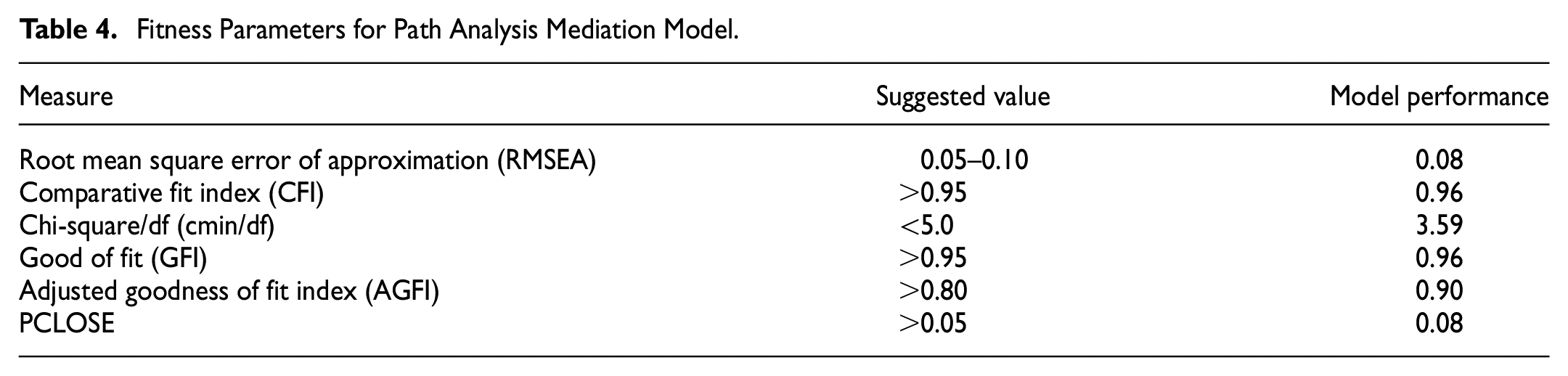
Our AMOS-based analysis, which we created, used the bootstrapping technique. All model values fall within the suggested range, as shown in Table 4. In order to understand how psychiatric capacity and JobSat are related, we looked into the role that PSR performs as a mediator (Figure 1). The findings (Table 5) supported Hypothesis 1 by demonstrating that PsyCap significantly improved JobSat (=0.26, p < .001) without mediating variables. Additionally, PsyCap significantly improved PSR (0.42, p < .001), supporting the validity of the second hypothesis. The Bootstrap mediation effect test findings showed that the 95% C.I. for PsyCap on JobSat are ranging from 0.18 to 0.34. The positive influence of PsyCap on JobSat remained significant (0.064, p < .001) after correcting for the mediating variable of PSR. PsyCap has a standardized 0.064 indirect (mediated) influence on JobSat. This means that when PsyCap increases by one standard deviation, JobSat increases by 0.063 standard deviations as a result of the indirect (mediated) influence of PsyCap on JobSat. Along with any potential direct (unmediated) effects that PsyCap may have on JobSat, this is also true.
Fitness Parameters for Path Analysis Mediation Model.

Path analysis.
Standardized Total, Direct, and Indirect Effects.

Note. Bootstrap results are shown as 95% confidence intervals (C.I.). PsyCap = psychological capital; PSR = personal social RESPONSIBILITY; JobSat = JobSat.
Discussion
This study examines the relationship between PsyCap, PSR, JobSat, and the process of mediation. A mediation model was constructed in order to ascertain the indirect relationship between PsyCap and JobSat through PSR. The results indicated that the concept of PSR could provide insights into understanding the relationship between PsyCap and JobSat. Numerous academic investigations have yielded empirical data substantiating the existence of favorable associations between PsyCap and JobSat (Alan et al., 2022; Fu et al., 2013; Hansen et al., 2015; Larson & Luthans, 2006; Liu et al., 2018; Loghman et al., 2023; Luthans et al., 2007; Zhang et al., 2021). These results are a good reminder of how important a worker’s psychological resources and level of JobSat is. According to the literature review, CSR significantly affects JobSat. To learn how to increase PSR among employees, more study is necessary. The results of the present study shed new light on this issue by presenting PsyCap as a useful psychological tool. Through the mediating effect of PSR, PsyCap has an impact on JobSat both directly and indirectly. It is widely acknowledged that PsyCap has a serious negative effect on a person’s view on life and in work. Lower PsyCap makes workers more prone to experience negative emotions at work, such as helplessness, anxiety, depression, and frustration. Additionally, it might make individuals disapprove of and distrust society. Higher PsyCap scores, however, are associated with happier people. Positive feelings help to grow and expand. The “broadening function” of positive emotions is the ability to increase the scope of attention, thought, and action. The capacity for happy emotions to produce persistent resources for people is known as building function (Fredrickson, 2001; Stifter et al., 2020). Therefore, employees would be more receptive and make an effort to be more socially responsible, thanks to the positive emotions brought on by high levels of PsyCap. Even though they will inevitably experience impediments, their positive psychological capitals will act as a buffer against stress and pressure. They would assess their workplace more objectively or favorably and, as a result, be better able to serve their society.
Implications
Our findings add to the body of knowledge and further the investigation into PsyCap. First, by examining the connection between PsyCap and JobSat, our study adds to the knowledge on PsyCap. Our findings strongly support this hypothesis when considering PsyCap and PSR to explain their impact on JobSat. Therefore, it is important to take into account both the idea of explanation and the enhancement of employees’ JobSat. Second, to demonstrate how PsyCap influences JobSat through PSR, our research combined the broaden-and-build theory of positive emotion and resource conservation theory. While doing so, we examine in depth how low-income levels impact the relationship between PSR and JobSat and conduct additional research on positive organizational behavior in the employee population. Second, our study combined the development and expansion of a theory of positive emotion with the theory of social responsibility to examine the connection between PsyCap and JobSat via PSR. We concentrated our efforts on conducting additional research on the subjects of individual social responsibility and JobSat during this time. Third, only a few studies have been done to look into the mechanisms underlying the effects of PSR on the degree of JobSat that employees experience. The PSR’s incorporation allows us to demonstrate mediation, which aids in our efforts to close this gap.
This study makes a valuable academic contribution by investigating the correlation between PsyCap, JobSat, and individual social responsibility in the specific context of the Kingdom of Saudi Arabia. By examining these factors and their interactions, this study enhances our comprehension of the impact of PsyCap and individual social responsibility on work satisfaction, specifically within a cultural and organizational context that may deviate from prior research environments. The present research has the potential to establish a fundamental basis for further investigations that aim to explore the intricate relationships among these factors, hence facilitating the development of more extensive theoretical frameworks. The practical implications of the research findings have significance for organizations and politicians in Saudi Arabia. Examining the influence of PsyCap and individual social responsibility on JobSat might provide valuable insights for human resource management strategies to improve employee well-being and organizational performance. Organizations possess the capacity to implement interventions and programs aimed at cultivating PsyCap within their workforce. These efforts involve the promotion of pleasant work environments, the provision of training and development opportunities, and the support of employee well-being initiatives. Furthermore, acknowledging the significance of individual social responsibility as an intermediary implies that enterprises can promote and provide avenues for workers to participate in socially responsible endeavors within the workplace and beyond. These activities have the potential to augment work happiness, foster engagement, and ultimately improve overall organizational performance. Overall, this study can provide valuable insights for evidence-based strategies and policies aimed at enhancing employee well-being and organizational efficacy, both within the specific setting of Saudi Arabia and in a broader global context.
Organizations can cultivate psychological capital within their workforce by implementing various strategies. These strategies encompass the provision of training and development programs, the establishment of a positive work environment, the provision of leadership support, the granting of autonomy and involvement in decision-making processes to employees, the promotion of work–life balance initiatives, the offering of employee well-being programs, and the provision of career development opportunities. These tactics facilitate the cultivation of optimism, hope, self-efficacy, and resilience among employees, making a valuable contribution to their psychological capital. These tactics can potentially boost employee well-being, job happiness, engagement, and overall organizational performance inside organizations.
Limitations
First off, because this research was cross-sectional, it was impossible to determine whether the variables were related causally. The use of self-report measures was the only method that was included in this research, which is the second limitation. In future research, it is essential to consider peer reports and evaluation indices. Third, the generalization of the construct and related measurements in the cultural context of Arabic is something that our sample choice must consider. There are drawbacks to random sampling, such as the possibility of sampling error leading to an inadequate representation of the population, cost and time restraints, non-response bias, limited generalizability, difficulties reaching specific demographics, and impracticality in some research circumstances. Despite the study’s exploratory nature, it is possible to glean some information about the connection between PsyCap, PSR, and JobSat. It will be essential to perform further longitudinal studies to validate their connection.
Conclusion
No previous research has quantified the strength of the connection between an individual’s level of social responsibility, PsyCap, and JobSat. This is the first study of its sort to investigate the connection between them. Based on this, as well as the results of the current study several implications were suggested. The findings of this study have significant repercussions, both in terms of theory and practice, for those who formulate public policy. This study emphasizes how crucial PsyCap is for JobSat. It has been established that PSR serves as a lone mediator in this interaction. Interventions to boost PsyCap should be planned with their JobSat in mind. These tactics facilitate the cultivation of optimism, hope, self-efficacy, and resilience among employees, making a valuable contribution to their psychological capital. These tactics can potentially boost employee well-being, job happiness, engagement, and overall organizational performance inside organizations.
Footnotes
Author’s Contribution
HDHK, HES, AHO, and OAR designed the study and manage the research project. HDHK, HES, and OAR collected the data. HDHK and OAR run the analysis. HDHK draft the first version of the manuscript. HDHK was in charge for ethical approval, funding, and administrative communication. HDHK, HES, AHO, MEIM, and OAR approved the final version.
Declaration of Conflicting Interests
The author(s) declared no potential conflicts of interest with respect to the research, authorship, and/or publication of this article.
Funding
The author(s) disclosed receipt of the following financial support for the research, authorship, and/or publication of this article: The authors extend their appreciation to the Deputyship for Research & Innovation, Ministry of Education in Saudi Arabia for funding this research work through the project number ISP20-31.
Ethics Statement
The Institutional Review Board of Jazan University examined and authorized the studies using human subjects. In order to take part in this study, the patients/participants gave their written informed consent.

Data Availability Statement
The authors will freely share the authentic raw data that underlies the conclusions of this article.