




Abstract
Manufacturers increasingly recycle end-of-life products to realize residual economic value and mitigate environmental impacts on the economic system. Concurrently, with the burgeoning growth of the product-service system, leasing models offer an alternative method to complete the material loop without direct collection. While prior research has delved into recycling channels, incentive mechanisms, and remanufacturing within closed-loop supply chain management, a comparative analysis between recycling and leasing strategies remains under-explored. This study seeks to bridge this gap by elucidating the manufacturer’s strategic decision-making process, factoring in consumers’ product ownership perceptions. We propose a manufacturer decision model anchored on consumer choices and segment it into three scenarios based on varying ownership perceptions. Our analysis contrasts market demand and profit outcomes across these scenarios. Notably, we discern that a hybrid strategy is optimal when ownership perception is low; however, when such perception is heightened, a dedicated recycling strategy proves more advantageous. Importantly, introducing a leasing option does not entirely overshadow the conventional sales market but is susceptible to being overshadowed itself. From a managerial standpoint, while integrating a leasing program might augment revenue streams, sole reliance on it is inadvisable. Furthermore, reshaping consumption paradigms to emphasize product functionality over ownership can pave the way for more expansive leasing strategies, optimizing revenue generation within a closed-loop framework.
Plain Language Summary
This paper uses the consumer choice model and the decision model to analyze the two approaches for closing the loop, leasing and recycling. In contrast to previous studies of closed-loop supply chains, this paper considers leasing as another way of closing the loop and takes into account its cannibalization effect on the market for new products and its priming effect on consumers with lower willingness to pay. The paper concludes that the leasing strategy cannot completely cannibalize the selling market and is conditional on implementation, while the recycling strategy can completely cannibalize the leasing market and is always effective. This paper has some applications for closed-loop decision making for manufacturers to improve economic and environmental gains. Manufacturers and policy makers should advocate new forms of consumption that encourage consumers to care more about product function than property rights, thus leaving more room for the rental market to acquire greater benefits. This paper does not consider the supply of P2P platforms when portraying the leasing program and does not use empirical studies to verify the conclusions.
Keywords
Introduction
Amidst growing concerns over global resource scarcity and environmental challenges, the circular economy has emerged as a topic of pronounced interest across both industrial and academic landscapes. Although the circular economy paradigm inherently emphasizes resource and energy conservation, it does not stifle the prospects for economic growth and vitality (Agrawal et al., 2019). In this light, the product-service system serves as an effective embodiment of the circular economy’s principles. The evolution of the product-service system not only conserves resources and curtails environmental impacts by prolonging product lifespans, but also engenders supplementary economic gains by delivering enhanced value to consumers and catalyzing business model innovation (Kuo et al., 2019). Within the realm of the circular economy, leasing and sharing stand out as quintessential business models derived from the product-service system. In such models, product ownership gravitates up the supply chain, transitioning from consumers toward manufacturers or third-party intermediaries, suggesting a shift where consumers prioritize product functionality over mere ownership.
Numerous firms across diverse sectors have ventured into various rental service modalities, encompassing the sharing economy, e-commerce platforms, and more. For example, Mobike (2019), an emblem of China’s sharing economy, offers bike rental services. Leveraging smartphone technology, consumers can seamlessly book, access, utilize, and return bikes. This innovative bike-sharing model expands the accessibility range of metro stations from a mere 800-m walk to a 2–3 km cycling radius, significantly enhancing urban mobility. This product-service paradigm not only alleviates traffic congestion but also curtails environmental degradation by promoting sustainable consumption practices. Similarly, Kaiyo (2020), the predecessor of Furnishare, is an online furniture rental platform in a dual-sided marketplace whose core concept is to provide consumers with high-quality furniture. Kaiyo recycles used furniture to be abandoned from consumers on one side, refurbishes and repairs it, then rents it to consumers on the other side to acquire higher economic performance, rather than only selling it directly. MUD, a Dutch manufacturer and seller of jeans, launched a clothing rental business for consumers including various choices to cater to the fast-fashion concept that began to emerge in 2000 and address the volatility of cotton raw material prices. MUD (2019) generates 75% of its revenue from sales and 25% from rental programs. Such a leasing model encapsulates a closed-loop material system, mandating product recycling post-service.
Incorporating leasing options inevitably prompts dual market effects (Xiao & Zhou, 2020). “Cannibalization effect” emerges when potential buyers opt for leasing due to its availability; “induction effect” signifies the market where consumers who would not have purchased the product choose to lease with the availability of leasing services. These two effects constitute the lease market, and kinds of literature discuss the trade-off between the two effects (Agrawal et al., 2012; P. Desai & Purohit, 1998; P. S. Desai & Purohit, 1999; K. J. Li & Xu, 2015). Applying the one-dimensional vertical-differentiation model, they analyze the interplay between the leasing and selling markets and optimal pricing strategies. The marketing strategies are also influenced by the residual value of the used products or the durability of the products and different types of products placed in the two segmentation markets. In addition, from the perspective of behavioral economics, many empirical studies found that the psychological ownership perception of consumers to the products has a significant impact on the intention for using the product-service system (Liao et al., 2019; Paundra et al., 2017; Rousseau, 2020), which can be qualified for different product types and industries. Therefore, the ownership perception of consumers will affect the marketing decisions of the manufacturer, which is the basis for explaining the other market performances of the product-service system in various industries. Closing the loop is one of the blocks of the circular economy, which is highlighted in the economy and environmental superiority. Traditionally, manufacturers have gravitated toward trade-ins for recycling, while some have ventured into developing product-service systems. In previous literature, leasing as a closed-loop approach has been notably underrepresented. Most studies predominantly focus on traditional closed-loop methods, such as trade-ins or refurbishing, overlooking the potential of the leasing model. This omission presents a gap in understanding, as leasing offers unique benefits and challenges distinct from conventional methods for closing the materials loop. There is a pressing need for comparative analyses to discern the efficacy and profitability of leasing versus traditional closed-loop strategies such as trade-ins.
To investigate the above problem, we developed the consumer choice model of vertical differentiation, considering the impact of the consumers’ ownership perception on consumption choices. Based on the relationship between the ownership perception and residual value of the used products, including the recycled cash or trade-in rebate for the consumers, we obtained three possible market segmentation scenarios and derived the optimal decisions of the manufacturer in each scenario. Then, we extend the model by establishing a two-dimensional consumer choice model where ownership perception is a random variable. We further prove the relationship between the market segmentation of the selling program and the leasing program. Drawing from the equilibrium outcomes of our proposed model, we examine the influence of product residual value and ownership perception on the marketing decisions associated with the product-service system. Our analysis indicates that industries with high residual product value benefit from introducing the product-service system, while those with products of lower durability find the recycling program more fitting. This paper offers the following contributions to the research on closed-loop supply chain management:
First, we are the first to consider the impact of consumers’ ownership perception on the consumption decisions in the consumer choice model. Based on empirical research findings, we establish the vertical-differentiation model with the ownership perception of consumers corresponding to the specific product or industry, from which we acquire the market segments under three scenarios based on the numerical relationship between the residual value of used products and ownership perception. In fact, the residual value includes the depreciation of the product itself, the durability of the product, and the price at which the manufacturer retrieves it such as recycling cash and trade-in rebate.
Second, to our best knowledge, we are the first to establish the two-dimensional consumer choice model in the model extension. In order to acquire the market segments of the leasing program and the purchasing program, we separately used consumers’ perceptions of quality and psychological ownership as random variables. Furthermore, the performance of each market segment is captured in terms of area. The two-dimensional consumer choice model corroborates the quantitively relationship between the market demand for the two marketing programs in the one-dimensional model through the numerical example.
Third, this paper is the first to consider leasing, a shared business model, as a type of closed-loop system, contrasting it with traditional closed-loop methods such as trade-ins. This aspect remains unexplored in previous literature. Drawing from insights in information systems and marketing regarding the influence of ownership perceptions on consumer behavior in both purchasing and leasing, this study conducts a comparative economic profit analysis of the two approaches. This enriches the research in closed-loop supply chain management and offers direct guidance for business managers innovating with new business models.
The rest of this article is organized as follows. We review the relevant literature in Section “Literature.” In Section “Model Description,” we establish the one-dimensional consumer choice model and acquire the market segments under three scenarios with the valuation of consumers’ ownership perception. Then, we derive the optimal decisions of the manufacturer in each scenario in Section “Model Development.” Section “Model Analysis and Numerical Example” analyzes and compares the equilibrium results, from which we obtain managerial insights about the manufacturer’s marketing strategies. To make the study findings more general, we extend the proposed model by the two-dimensional consumer choice model in Section “Extension of the Proposed Model.” The conclusions and limitations are summarized in Section “Conclusion.”
Literature
Our research is related to three main streams of studies in the literature on operation management: leasing versus selling, sustainable use of product-service systems, and closed-loop supply chain management.
First, the topic of lease versus selling mainly refers to the pricing decisions and the cannibalization effect between the two programs. P. Desai and Purohit (1998) establish a market segmentation model to analyze the impact of the relationship between sales depreciation and lease depreciation on the market performance of the monopolistic enterprises, assuming that the depreciation rates of the two marketing programs are different. Compared to this research, we analyze what kinds of product or industry is suitable for the manufacturer to develop the lease model to enhance the market and economic performance. P. S. Desai and Purohit (1999) analyzed the impact of the differences between products in the sales market and lease market as well as competition intensity on the pricing decisions and the market performance of the lease program and found that the higher the similarity of products, the lower the share of the lease market. Based on the manufacturer’s incentive to lower the price of the durable products, Bhaskaran and Gilbert (2005) investigated the manufacturer’s lease and sales decisions considering the complementary market. In fact, they point out that introducing rental services would eliminate the problem of pricing durable products. Chien and Chu (2008) studied the influence of network effects on the marketing decisions between the sales strategy and lease strategy. They found that the network effects are beneficial for the sales program of the durable-goods monopolist. Bhaskaran and Gilbert (2009) analyze how the channel structure affects the manufacturer and dealers’ pricing and marketing strategies decisions, considering the competition among the dealers. Assessing the impact of the residual value of the products at the end of use on the consumers’ purchasing decisions, Tilson et al. (2009) investigated the optimal pricing decisions and each market segment’s performance under the different settings of the channel and transactions cost. Agrawal et al. (2012) are more concerned about the environmental impact of developing lease services, and developed the consumer choice model under Markov equilibrium and analyzed the cannibalization effect among different market segments. Rai and Sigrin (2013) studied the sales and lease market of rooftop photovoltaic technology based on the data from Texas. They found that developing the lease service for the manufacturer can effectively solve the problems of information asymmetry and tight capital flow of consumers, which is essential for brand promotion and economic benefits improvement. Bhaskaran and Gilbert (2015) also investigated the impact of durability on the channel structure and operational mode. They concluded that the lease program prefers higher durability than the selling program is consistent with our research. Moreover, we point out that the durability of products is relative to consumers’ perception of ownership and is the residual value of the used products, which is a necessary complement to marketing strategies for different industries and products. K. J. Li and Xu (2015) investigated the interplay effect between the two marketing methods, the trade-in program and the lease program. They derived the optimal pricing decisions and market performance of the two programs. They argued that the trade-in program and lease program are determined to promote the economic performance of the manufacturer through acquiring the residual value from the recycled products and price discrimination, respectively. Instead, we assume that the residual value of the used products, including the trade-in rebate provided by the manufacturer, will affect the consumers’ decisions and the ownership perception and formulate this effect in the consumer choice model. Dou et al. (2017) investigated the manufacturer’s marketing decisions regarding the lease and selling strategies of the information service and products, considering vintage depreciation and individual depreciation of consumers in the proposed game model. Jia et al. (2018) analyzed the choice of leasing program and selling program for the manufacturer, under three price discrimination strategies, intertemporal, behavior-based, and hybrid strategies. Steeneck and Sarin (2018) considered the cannibalization effect between the new products and remanufactured products and analyzed how the product design affects the leasing strategy of the manufacturer. Liu et al. (2019) studied how the green product design affects the marketing decisions of the leasing program and the selling program and considered the impact of the economic system on the environment. van Loon et al. (2020) studied the leasing model, simultaneously considering the economic benefits to consumers and manufacturers. Indeed, previous literature focused on the pricing and strategy choices for the leasing program and the selling program. Other studies investigated the operation management of sharing economy, which refers to the comparisons of B2C and P2P platforms in marketing and environmental performance (Agrawal & Bellos, 2017; Jia et al., 2018; Ladas et al., 2022; Mensah et al., 2019). Although they have considered the impact of the used products’ residual value on the manufacturers’ marketing strategies, they ignore the discussion about what industries and products are applicable to conducting product service system rather than two types of products from the same enterprises. Therefore, considering the influence of consumers’ ownership perception on purchasing decisions, we concentrate on the conditions under which manufacturers carry out the marketing services of the product-service system and explain why the marketing performance of the product-service system varies across industries.
Second, our work also refers to the research on influencing factors of the product-service system. Dasgupta et al. (2007) established a contractual model to analyze what affects the consumers’ decisions of leasing and purchasing, and they found that consumers are more likely to purchase the style with low cash flow payments. Demyttenaere et al. (2016) reported the research on the impact of the psychology of ownership on the willingness of consumers to use the product-service system, mainly including product attachment, non-ownership access consumption modes, and experience design. Paundra et al. (2017) investigated consumers’ willingness to use car-sharing services and found that consumers’ ownership has a significant negative effect on the intention for using sharing services, which indicates that the manufacturer should also pay attention to the consumers’ psychological disposition in the sharing program to incentive marketing performance. Aspara and Wittkowski (2019) investigated the impact of consumers’ intelligence on attitudes toward the sharing economy, and found that the higher the consumers’ intelligence score, the higher their acceptance of the business model of leasing and sharing. Kuo et al. (2019) studied the combination of the leasing model and the selling model for the manufacturer, considering the residual value of the used products at the end of use from consumers in the product-service system. Liao et al. (2019) analyzed consumer preference for electric vehicle business models, and found that vehicle type and ownership perception have a significant impact on the choice of business models for the consumers. However, they ignore the reasons why vehicle type influences the choice of manufacturer’s marketing strategy, which is the focus of our research. Rousseau (2020) studied the consumer’s preference for smartphone leasing models using the method of discrete choice experiment, and he found that the key factors affecting consumers’ acceptance of the product-service system are environmental concerns, the financial constraint, and the access of the ownership of the business model. Sattari et al. (2020) highlighted the effect of the product-service system on the sustainability development, and they concluded that the desire to own, trust, economic value, flexibility, and peer influence have a significant impact on the consumers’ intention for adopting the product-service system. The aforementioned empirical studies found that consumers’ ownership perception significantly impacts consumption decisions between leasing and purchasing. In other words, the utility of consumers when they purchase and lease a product is influenced not only by the function and price of the product, but also by the consumers’ psychological ownership perception. Therefore, we develop the consumer choice model considering the ownership perception to formulate this impact and derive the market segmentations between the purchasing program and the lease program. Furthermore, we also extend the vertical differentiation model to include both willingness to pay and ownership perception of consumers as random variables for the heterogeneous consumers. From the equilibrium results of the proposed model, we analyze the impact of the residual value of the used products and ownership perception on the marketing strategies for the manufacturer.
Third, the research of the closed-loop supply chain focuses on the topics of the structures of the closed-loop supply chain, the recycling modes and mechanism incentive considering the cooperation of collecting used products. Previous literature investigated who should collect the used products for closing the loop, and they compare the structures that different supply members entrust to collect the used products from consumers (H. Chen et al., 2021; Shekarian, 2020; Shekarian & Flapper, 2021). Meanwhile, some other researchers studied the network of recycling agents in the closed-loop supply chain and the approaches to closing the loop, such as trade-in for cash, trade-in for upgrade, or trade-in for a new one (Cao & Choi, 2022; H. Chen et al., 2020; De Giovanni & Zaccour, 2022; Demirel et al., 2014; Özceylan et al., 2017; Xiao & Zhou, 2020). They do not consider that leasing can also close the loop of the used product because the manufacturer has the ownership of the products, so there is no additional cost for recycling. Therefore, it is necessary to analyze the difference between the leasing strategy and the traditional recycling strategy in terms of market demand and profit from a closing the loop perspective. Then, other studies investigate the incentive mechanism between the manufacturers and other agents, which refers to how to increase the effort of the corresponding agents in recycling activities using game theory (Y. Chen & Chen, 2019; Y. J. Li et al., 2019; Miao et al., 2017; Timoumi et al., 2021; Wang & Huang, 2021). This paper differs from this literature because it does not follow the game between the manufacturer and other supply chain members, but rather the comparison of closed-loop approaches. In addition, combining the findings of behavioral science, this paper considers the impact of consumers’ ownership perception on consumption behavior and then analyzes the effects of two closed-loop strategies, leasing and recycling, on manufacturer’ market performance and profits, which extends the study of the combination of recycling approaches and behavioral science in closed-loop supply chains.
We contribute to the literature by comparing the different approaches for closing the loop, leasing and recycling, considering the behavioral factors related to consumer consumption and the market segmentations. We combine three main aspects in this study separately from the previous literature. First, we expanded the research framework of leasing and purchasing, examining the superiority of leasing and trade-in strategies from a closed-loop perspective. Second, in the realm of closed-loop supply chain management, our study uniquely integrates both leasing and recycling modes. By treating leasing as an alternative mechanism for material loop closure, we set it apart from the conventional recycling channels. Drawing from empirical research, we evaluate the behavioral aspect—specifically, consumers’ ownership perceptions of products—and how it influences their leasing versus purchasing decisions. We then incorporate this understanding into utility functions to formulate the market demand for each segment. To the best of our knowledge, we are the pioneer to consider such a combination in closed-loop supply chain management research.
Model Description
In this study, we examine a scenario involving a single firm (the manufacturer) operating in one market, where the manufacturer either sells or leases a particular product. The primary focus of this paper is to compare the economic viability and market performance of closed-loop, recycling, leasing, and their combined strategies, rather than delving into the game and incentive mechanisms between the manufacturer and other members of the closed-loop supply chain. It is noteworthy that the involvement of retailers and third-party institutions merely serves as an intermediary in product sales and recycling and does not alter the central conclusions of this study. Still, the interpretability and complexity of the model. Therefore, this paper only considers the profit problem of the manufacturer and the optimal choice of closed-loop strategies. We consider three strategies of closing the loop for the manufacturer to incentivize the marketing and economic performance, which we refer to as pure trade-in strategy for recycling, pure leasing strategy, and their hybrid strategy. We do not formulate the process of the manufacturing and remanufacturing, and instead focus on the market performance of the two programs in this research. In reality, whether from leasing or the trade-in program, the end-of-life products will be recycled by the manufacturer and used for refurbishment or remanufacturing, which indicates that the difference in the processing of the reverse channel between the two programs is not the focus of this paper. We consider the case where the consumers have two potential choices to achieve products, to lease or to buy, which is consistent with the practice.
Using the vertical-differentiation model, we formulate the consumers’ perception behavior. Without loss of generality, we consider that the consumers’ perception consists of two dimensions, willingness to pay and ownership perception. To the best of our knowledge, we are the first to assume that the consumers are heterogeneous in ownership perception to the products in the research of closed-loop supply chain management. As proved by the empirical research as listed in Section “Literature,” we consider the effect of ownership perception of consumers on the consumption choices between leasing and buying. In order to simplify the model and generate more practical insights, we first formulate the consumption behavior with the ownership as a parameter; and then extended the model by considering it as a random variable in the consumer choice model. Without loss of generality, we first describe the consumers’ willingness to pay for the products, denoted by
We also set


Based on the relationship among
Related Parameters Throughout this Paper.

(1) When
(2) When
(3) When
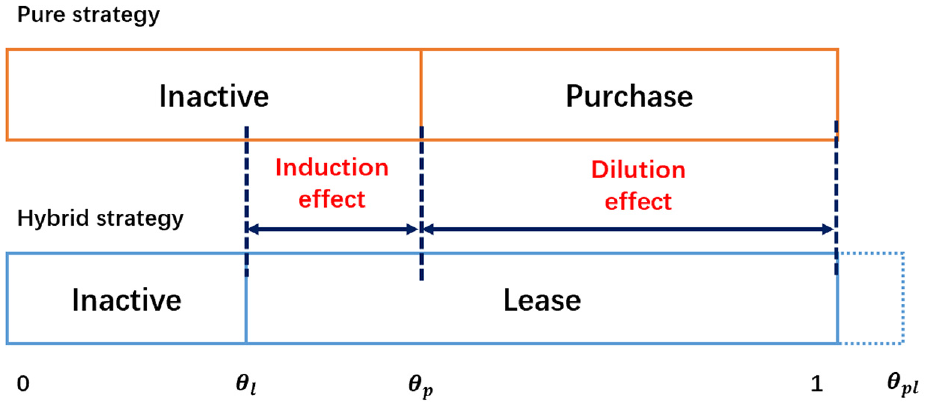
Low-ownership scenario.

Moderate-ownership scenario.
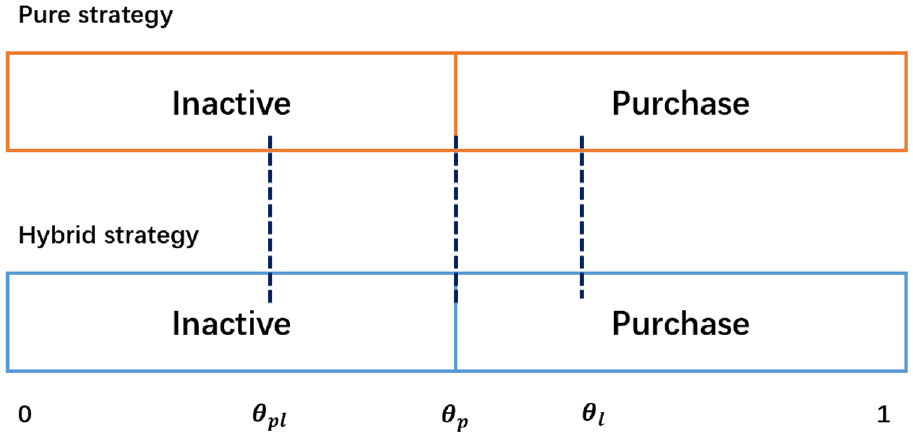
High-ownership scenario.
Model Development
Moderate-Ownership Scenario
When

Maximizing



From Proposition 1, we find that the selling price and rental price of products have nothing to do with consumers’ perception of ownership under the moderate-ownership scenario. Moreover, we also obtain that
High-Ownership Scenario
In this subsection, we also establish the decision model of the manufacturer under the high-ownership scenario, when

Similarly, by deriving the optimal decisions of the manufacturer under a high-ownership scenario, we can obtain Proposition 2.




From proposition 2, we find that the valuation of
Model Analysis and Numerical Example
In this section, we investigate and compare the profits, market performance, and pricing decisions of the manufacturer in the moderate-ownership scenario, high-ownership scenario, and pure strategy scenario. And we also develop the numerical example to describe our findings.
In order to compare the pricing decisions of the manufacturer in different scenarios, we get Proposition 3.
In order to visually describe the managerial insights from Proposition 3, we also develop the numerical example as shown in Figure 4, with the data of

Pricing decisions with respect to
Figure 4 and Proposition 3 indicate that moderate-ownership is always going to have a higher selling price than in the pure strategy scenario. In fact, when the manufacturer introduces the lease service, the market will be segmented, which will allow the manufacturer to set a higher selling price to obtain more profits. Moreover, the price of lease service is always less than the purchasing price, because it contains the residual value of the used products. It is surprising to conclude that when
Moreover, by comparing the manufacturer’s market performance under different scenarios, we can acquire Proposition 4.
From Proposition 4 and Figure 5, the region formed by

Market performance with respect to
We also investigate the optimal profits of the manufacturer and obtain Proposition 5.
From Proposition 5 and Figure 6, we find that it is always profitable for the manufacturer to introduce the lease service. And the smaller the ownership of consumers and the larger the residual value of the used products, the more obvious the advantage of the hybrid strategy. In addition,
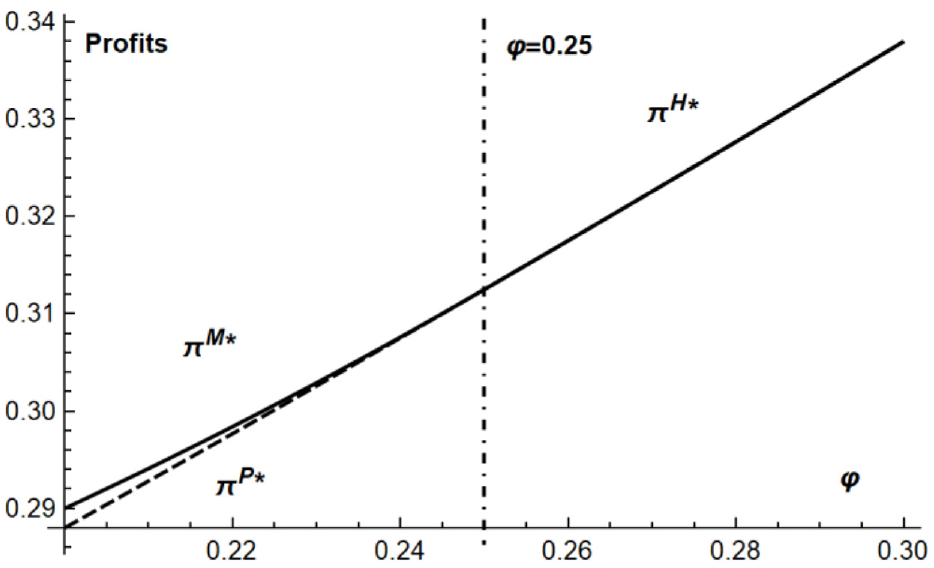
Profits with respect to
Extension of the Proposed Model
The model above proposed actually formulates the consumer choice and the impact of product-service system on the market with the increased utility of the purchasing program due to the consumers’ perception of ownership compared with the lease program. In order to analyze more general case of developing the product and service system, we extend the model considering that the consumers in the market are heterogeneous with ownership perception. In this section, we establish a double-dimension consumer choice model, which indicates that consumers’ perception of ownership is a random variable. To the best of our knowledge, we are the first to consider the consumers’ ownership perception for the products between the leasing and buying model and present an interesting case concluding double dimensions in the vertical-differentiation model. That is to say, this model takes into account the simultaneously in the market. we assume that the consumers are differentiated in their ownership perception of the products, denoted as


Based on the different valuations of
(1) When


(2) When


High residual value of the used products scenario.
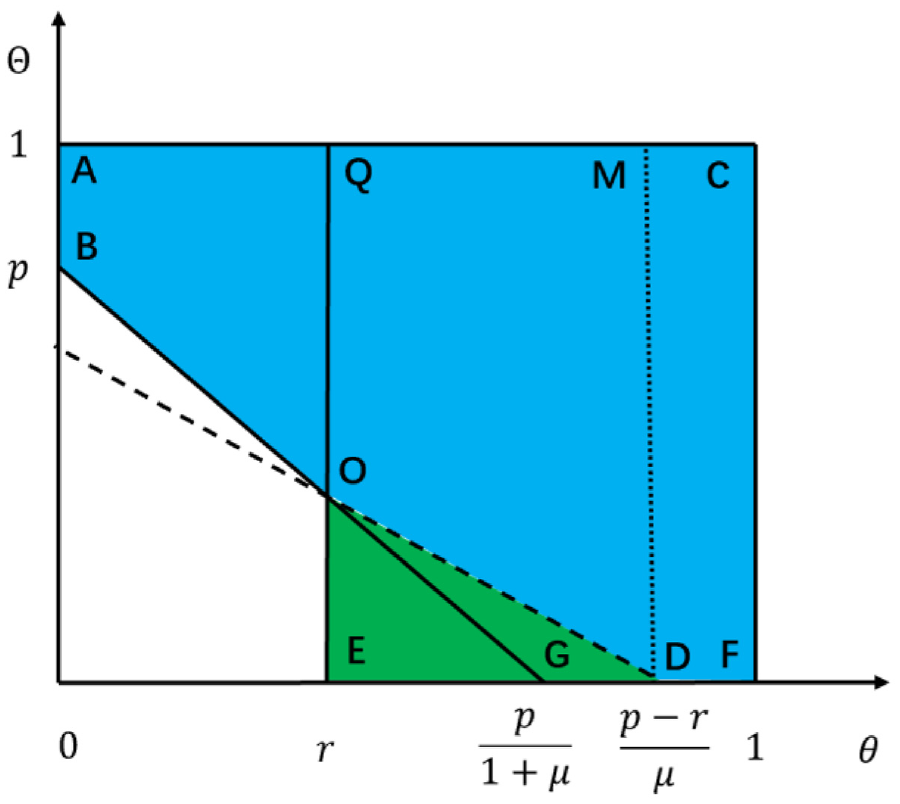
Low residual value of the used products scenario.
Based on the market demand functions proposed above, we establish the manufacturer’s decision model in the high residual value scenario and low residual value scenario respectively as follows. In reality, the manufacturer will determine the rebate or cash based on the quality of the used products when recycling them, that is to say, the manufacturer’s recycling cost is decided by the quality of used products. Therefore, we have to express the profit of the manufacturer in terms of definite integral with respect to
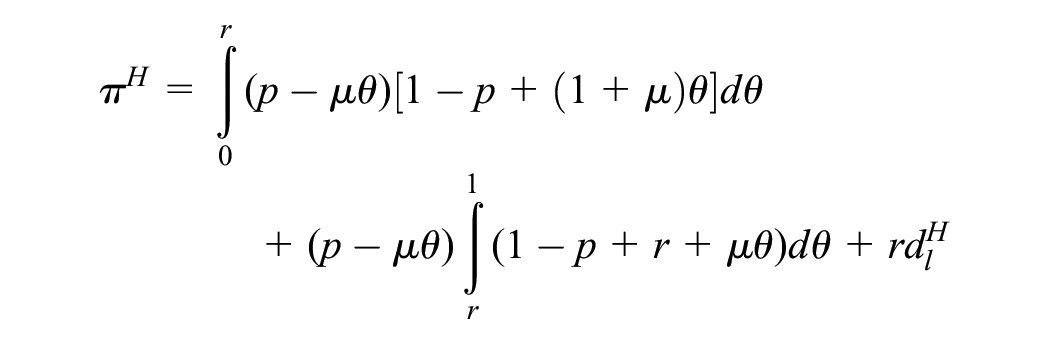
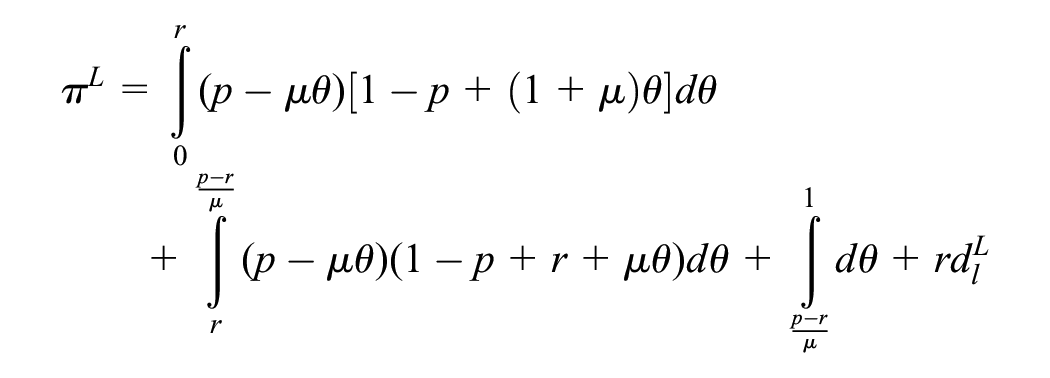
It is complicated to derive the optimal analytical solutions of the manufacturer’s decision model. Thus, in order to obtain some interesting managerial insights, we develop the numerical examples as shown in Table 2.
Numerical Results Under the Double-Dimension Consumers’ Choice Model.

From Table 2, we find that the monotony of the manufacturer’s profit, market performance, and pricing decisions in both scenarios is consistent with the variation of the residual value of the used products. The profit, market demand of the purchasing program, and lease price decrease with respect to
Conclusion
Concluding Remarks
In this paper, we examine the economic and market performance of the two potential approaches to closing the loop for the manufacturers, the recycling strategy and the leasing strategy. Our goal is to determine which approach—whether one of these two or a hybrid of both—offers the most advantages to manufacturers. To do this, we constructed three models reflecting varying consumer ownership perceptions of products.
Leveraging the vertical differentiation model, we identify three consumer choice scenarios based on different market segmentations, determined by consumers’ ownership perceptions of products. This categorization offers a broader strategic palette tailored to various industries. From the equilibrium results of the manufacturer and the comparison of different scenarios, we acquire three interesting conclusions. First, the leasing market will not cannibalize the market share of new product sales, even if the ownership perception of the used products is low. And the numerical example analysis of the extended model also confirms this. It explains that many manufacturers who do leasing transformation also end up back on product sales in business practice. Second, leasing is more beneficial when the residual value of the product is low; while the residual value of the used products is high, the recycling program is more profitable. Thus, to effectively close the loop, manufacturers should anchor their marketing decisions on products’ residual or depreciated values. Third, even though introducing a leasing strategy might erode new product sales, a hybrid approach outperforms a singular strategy, maintaining its superiority even when no demand exists in the leasing market. Lastly, in industries where consumers either exhibit lower ownership perceptions or prioritize product functionality, launching a leasing program can be advantageous.
Managerial Insights
Based on the above results of our research, we provide some managerial insights for the manufacturer and policymakers concerning the approach of closing the loop. First, while establishing a leasing program can tap into a broader market, catering to consumers with lower willingness to pay, manufacturers should not entirely forsake new product sales, as this could severely undercut their profitability. This implies that, for manufacturers, the product-service system framed around leasing should be viewed as an enhancement rather than the foundational structure. Although both strategies effectively close the material loop, the recycling approach consistently boosts the demand for new products. In contrast, the leasing strategy tends to be most suited for industries where consumers exhibit a lower ownership perception of products. Second, in sectors where consumers demonstrate a lesser emphasis on product ownership, signaling a heightened focus on product functionality, manufacturers are advised to concurrently adopt recycling and leasing strategies. This hybrid strategy ensures material sustainability and optimizes profits. Industries such as gaming consoles, video players, automobiles, and luxury furniture stand to gain significantly from integrating product-service systems alongside traditional product sales, thereby realizing enhanced profitability and environmental advantages. Third, from a behavioral operations management perspective, our study advocates for manufacturers and policymakers to initiate efforts aimed at diminishing consumers’ attachment to product ownership. By championing innovative consumer paradigms and accentuating the merits of product service environments, there is potential to carve out a larger market niche for product-service frameworks like leasing and sharing. Such strategies not only bolster manufacturers’ profit margins but also mitigate environmental repercussions.
Limitations and Future Directions
In this paper, we use the vertical-differentiation choice model to formulate consumer behavior in purchasing and leasing, based on the willingness to pay, which is relatively crude for operation management issues related to the sharing economy, but is limited by the fact that the focus of this paper is on the comparison of closed-loop approaches rather than the sharing economy choices. Future research could employ consumers’ product usage instead of willingness to pay to formulate the consumer behavior in per-per-use and purchasing, and consider the impact of polling effect on products launching strategies. It can generate more interesting and valuable discussions, such as the fact that the demand of product usage created by the sharing economy service does not necessarily lead to the increase in demand for products, which entails different production costs, market performance, and even environmental impact. Moreover, this paper does not take into account the problem of disposal of used products after closing the loop, such as remanufacturing, refurbishing, and disassembly. We suggest that future research can focus on combining the multi-period decision-making problems of consumers and manufacturers, considering the issues of renting out refurbished products and selling the remanufactured products to extend our proposed model in a deeper way.
Footnotes
Declaration of Conflicting Interests
The author(s) declared no potential conflicts of interest with respect to the research, authorship, and/or publication of this article.
Funding
The author(s) received no financial support for the research, authorship, and/or publication of this article.

Data Availability Statement
Data sharing not applicable to this article as no datasets were generated or analyzed during the current study.