




Abstract
Face ubiquitous demand uncertainty and channel cross-influence, how to make price decision to improve profits has become an issue faced by decision makers. This paper concerns multichannel price optimization for a closed-loop supply chain and constructs the deterministic and uncertain models. Taking a real closed-loop clothing supply chain as an example, we carry out parameter assumptions and numerical experiments and analyze the simulation results. Our analysis reveals: (1) The supply chain is more profitable under centralized policy. The company can maximize profits by expanding upstream and downstream. (2) When experienced experts give more accurate error terms, the companies can accurately predict the demand and make price decisions. (3) Raising wholesale price will not maintain manufacturer’s profits growing. Beyond the threshold, the manufacturer’s profit will decrease. (4) The channel cross-influence is beneficial to the supply chain. When other factors remain unchanged, the greater the cross price-demand sensitivity coefficient in a channel, the higher the retailing price and the total profit of the supply chain will be. Decision makers can adjust pricing in time to adapt to changes of cross-influence and uncertain demand. The findings provide theoretical guidance for each player in the closed-loop supply chain.
Plain Language Summary
Face ubiquitous demand uncertainty and channel cross-influence, how to make price decision to improve profits has become an issue faced by decision makers. This paper concerns multichannel price optimization for a closed-loop supply chain and constructs the deterministic and uncertain models. Taking a real closed-loop clothing supply chain as an example, we carry out parameter assumptions and numerical experiments and analyze the simulation results. Decision makers can adjust pricing in time to adapt to changes of cross-influence and uncertain demand. The findings provide theoretical guidance for each player in the closed-loop supply chain.
Keywords
Introduction
Closed-loop supply chain (CLSC) is the complete cycle from purchase to final sale of enterprises, which integrates the traditional forward supply chain and reverse supply chain. Efficient CLSC management will bring direct benefits, such as the decrease of resource input, inventory costs, and distribution costs. In addition, the realization of the recycling of wasted goods and returned products can indirectly bring new profit opportunities, like the improvement of customer satisfaction and the close relationship with customers. On the other hand, it’s of great significance to circular economy and sustainable development.
Uncertainties prevail in the CLSC. In general, uncertain parameters of a given CLSC can be divided into two categories: one is uncertainty in the mathematical sense, which refers to the difference among measurements, estimates, and true values, including errors in observations or calculations. The other is caused by the sources of uncertainty, including quality of recovered products, quantity of recovered products, recovered time, consumer acceptance of remanufactured products, supply chain disruption caused by an emergency, etc. The combined action of these uncertain parameters leads to the demand uncertainty of CLSC. It is important for decision-makers to consider these uncertainties.
By now, different uncertainty CLSC models have been well developed. The existing uncertainty modeling techniques in CLSC area cover a wide range such as probabilistic approaches (Larrain et al., 2020), possibilistic approaches (G. H. Wu et al., 2018), and robust optimization (Atabaki et al., 2020). The probabilistic approaches usually need to obtain the relevant variable information with the help of historical data, while robust optimization methods can only obtain the most conservative solution. This paper uses the additive demand function with fuzzy error variable to describe the uncertainty demand. The additive demand function is a function of retailing price, which describes the demand in a fuzzy form while preserving the main effect of retailing price on the demand.
In practice, in addition to uncertainty, there are many factors that affect CLSC, such as recycling mode and government subsidy. Miao et al. (2017) discusses the impact on the sales rate and market share of the recycling model by third-party enterprises. Ma (2022) considers the impacts of demand disruption and different government subsidy recipients on CLSC members. Another key factor that has been overlooked is cross-influence in channels. The cross influence between channels in models is verified to be important in improving profits of the supply chain. One CLSC generally in reality has a complex composition, especially the competitions among supply chain channels, which will also cause cross-influences and demand changes. Scholars have paid attention to the practical phenomenon of multi-channel competitions in CLSC, such as consumers’ purchase channel preference (Niranjan et al., 2019), reducing CLSC risks (A. Liu et al., 2020), and recovery rates (Sergeevna et al., 2021). However, the cross-influences in demand are still ignored. This paper exactly considers the cross impacts in multi-channel competitions.
As discussed above, we will focus on the following research questions.
Research question 1: How to make price decision for CLSC members to maximize their profits in different situations? And which scenario is most profitable?
Research question 2: Can considering the fuzzy error term in additive demand form benefit the multichannel CLSC supply chain and members?
Research question 3: How the channel cross-influence affect the multichannel CLSC supply chain and members?
In order to explore the research questions, this paper considers a multichannel CLSC system consisting of a manufacturer, multiple sub-retailers of a chain retailer, and a third-party recycling company, and establishes profit models of each player to determine the optimal pricing decision with uncertain demand under multi-channel cross influence. As for multichannel retailing, one of the difficulties is to solve the model and there are some mature solution algorithms at present (Nia et al., 2014; Niranjan & Parthiban, 2019; Sadeghi et al., 2014). Different from them, considering the robustness of the solution results, CPLEX optimizer is used in this paper.
And the novelty of our study are as follows. Firstly, one-to-many CLSC models are constructed in this paper, which are more suitable for complex reality and more significative to the development of sustainable level compared to one-to-one CLSC. The cross price-demand sensitivity in different retailing channels is considered, which is more realistic and has a stronger guiding significance. In addition, the CPLEX optimizer is used to solve the multi-channel CLSC models due to its robustness and accuracy.
Secondly, fuzzy error term is used to describe the uncertainty of demand in this paper. The uncertainty of supply chain environment causes many changes in the game result, which affects the prediction. Using fuzzy theory to describe the uncertainty of demand and analyze the supply chain game under this environment will be more in line with the actual situation. The retailing price and fuzzy error variable are considered simultaneously when modeling consumer demand in this paper, which is more consistent with the situation where different variables have different impacts on demand. Moreover, we consider the comparison between the deterministic and uncertain models to show the value of considering the uncertainty.
The remainder of the article is organized as follows. A brief review of literature is presented in Section 2. In section 3, we briefly describe the problem and make some necessary assumptions clear. In section 4, two models are established, which are deterministic model and uncertain model. And numerical example and the results are presented in section 5. Finally, section 6 concludes the paper by discussing the contributions, limitations, and future research issues.
Literature Review
This paper mainly takes the modeling and decision-making of pricing in the CLSC as a reference to study the multichannel CLSC members’ price decision-making. There are two streams of research related to this study: (1) Uncertain demand in supply chain, and (2) Closed-loop supply chain.
Uncertain Demand in Supply Chain
In the study of CLSC management, an important challenge is the uncertainty of consumer demand (Dong et al., 2021; Ke et al., 2018). Actual, the forms of uncertainty demand greatly affect the strategies adopted by the decision makers (Chen et al., 2020).
Some scholars use the classical linear form to describe the demand, in which consumer demand is inversely proportional to the retailing price (Giri & Glock, 2017; Pervin et al., 2019; Tang et al., 2018; Zand et al., 2019). However, this form of demand characterization is too absolute, because the real demand is an uncertain variable rather than a definite form. In reality, the uncertain demand can be caused by many factors. For example, some scholars consider the demand for deteriorative items to be time-dependent (Barman et al., 2021; Pervin et al., 2020).
Some scholars use random variable or fuzzy variable forms to describe uncertain demand (Z. M. Liu et al., 2019; Mawandiya et al., 2020). He (2015) studied the manufacturer’s acquisition pricing and remanufacturing decisions in a stochastic demand environment. Latpate and Bhosale (2020) helped perishable bakery retailers overcome uncertain ordering problems by using fuzzy demand. However, this form of demand characterization ignores the main impact of decision variables such as the retailing price on consumer demand.
Some scholars construct additive or multiplicative price-dependent demand functions. For example, an error variable is considered to obey the random probability function distribution, and the impact of this error variable on consumer demand is considered together with the price factor (Chen et al., 2020; Kyparisis & Koulamas, 2018). This description form is better than the methods mentioned. It not only considers the main impact of retailing price on consumer demand, but also considers the impact of random error. However, the probability density function of the error variable needs to be obtained based on the previous error data. And it’s obtained under several independent and equally distributed experiments.
Assuming we use the additive demand function with a probabilistic error variable to solve the multi-channel supply chain problem constructed in this paper. Through the Bernoulli process, which is a sequence of independent identically distributed Bernoulli trials, we can get the probability density function of the error variable under decision variable “retailing price”p. Since the decision variable p is continuous and can take different values, an infinite number of probability density functions can be obtained theoretically. If the decision variable p is discretized equidistant, it is difficult to realize considering that each interval corresponds to a probability density function in practice. Because in practice, retailers will constantly adjust the price p according to the changes of market conditions. It is impossible to keep p unchanged. Further, it’s impossible to obtain the probability density function of the error variable under the decision variable p. Therefore, we give up the random error form in this paper. Moreover, error can be judged roughly by seasoned experts, that is, the error form of fuzzy numbers. Based on experience, the membership function and fuzzy number of error variables can be given by expert collective decision when p is in a certain range.
Hence, we consider using error variables in the form of fuzzy numbers instead of random variables to express uncertain demand. Besides, errors exist in each constructed mathematical model, the innovation point can be applied to other models. Considering decision variables and fuzzy error variables simultaneously will make the modeling more accurate and in line with reality.
Closed-loop Supply Chain
Remanufacturing activities have been carried out by many enterprises to recycle used products. In addition, the seven-day no-reason policy in many e-commerce platforms leads to abundant return phenomenon. In these activities, CLSC management is critical. Many scholars focus on the field of CLSC (Hong et al., 2021; Jian et al., 2021; S. Liu et al., 2021).
Some scholars concern the source of the CLSC and help decision-makers to select sustainable suppliers. For example, combining the fuzzy best-worst method and the interval VIKOR technique for the first time, Kannan et al. (2020) helps to evaluate and prioritize sustainable suppliers in CLSCs. Other studies have addressed the key issue of decision-making in CLSC management. Alegoz et al. (2021) focuses on production and sustainability level decisions in pure manufacturing and hybrid manufacturing-remanufacturing systems. By comparing the systemwide performances and the performances of supply chain actors under different settings in terms of economic and environmental performance measures, hybrid manufacturing-remanufacturing system is concluded to be more economical. Emamian et al. (2021) proposes a three-objective mathematical CLSC model to help enterprises make decisions to minimize supply chain costs, maximize social responsibility or social benefits, and finally, minimize environmental emissions.
Some researchers focus on the design of CLSC coordination mechanism aimed at improving the benefits of participants. For instance, B. R. Zheng et al. (2021) designs coordination mechanisms in CLSCs with dual competitive sales channels. Jian et al. (2021) verifies the profit-sharing contract could improve the relationship between CLSC members to achieve sustainable economic and environmental development. From the perspective of government intervention and subsidies, scholars also make deep researches. C. H. Wu (2021) proposes a baseline model without government intervention and six different policies in a dynamic CLSC. Most cases are single or dual channels, a few consider the multi-channel problem in CLSC. For instance, Fu et al. (2021) develops a coupled CLSC network model in which multiple agents compete and coordinate, dealing with heterogeneous products facing different market demands and achieves network equilibrium. Similarly, Modak et al. (2019) deals with a closed-loop distribution channel, including multiple retailers. Yang et al. (2013) uses three optimization methods to analyze a closed-loop logistics system considering price-sensitive demand and deterioration.
Few literatures take account the interaction among channels, especially the cross-influences among the chain retailer’s sub-retailers. This interaction actually has great impacts on demand fluctuations. The mostly related literature and our differences are shown in Table 1. This paper exactly concerns the cross price-demand sensitivity among multiple sub-retailing channels in the CLSC, which is more in line with the social reality and has more real management inspiration for enterprises.
The Mostly Related Literature and Our Differences.

Problem Description
This research considers a multichannel supply chain included one manufacturer, I sub-retailers of a chain retailer, and one third-party recycling company, which collects used products from customers and sells them to manufacturers for making profit. The supply chain network structure is presented in Figure 1. The chronology of events is described as follows. At the beginning of the first selling season, members determine their own optimal price decisions. The manufacturer only produces a kind of product and sells them to sub-retailers at a same wholesale price w. Chain retailer has multiple sales channels, uniformly determines the retailing price of each sub-retailer, and places an order with the manufacturer. It’s worth noting that the consumer demand faced by each sub-retailer is not only affected by the retailing pricing, but also affected by the pricing cross-influences of other retail channels. Of course, in general, the pricing cross-influences in other channels have smaller impacts on the consumer demand than its own price-demand sensitivity factor (Yan et al., 2016).

The supply chain network structure.
In fact, both deterministic demand and uncertain demand are discussed in the problem. And we assume the form of demand function is the same in each retailing channel. The third-party recycling company will begin its recycling activities from the consumers at recycling price
Notations.
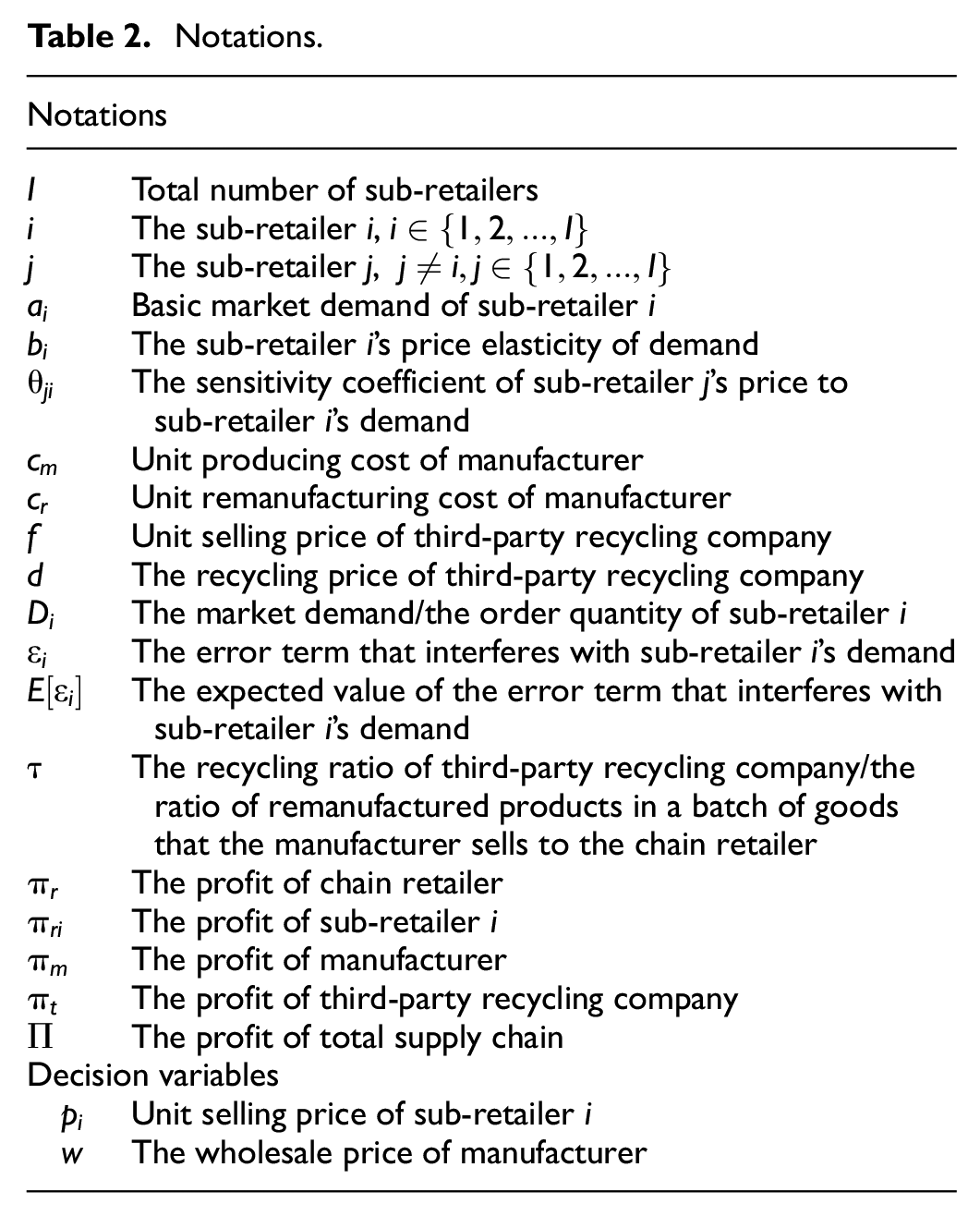
In order to ensure the reasonability of the models, there are some assumptions as follows.
Modeling
In this section, we construct the CLSC models for two cases: deterministic model and uncertain model.
Deterministic Model
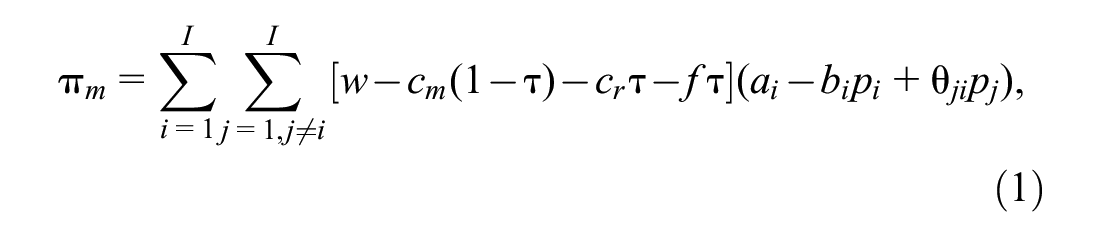
Firstly, deterministic model is considered as a benchmark. In deterministic model, the price of each channel and the impact of cross-price on demand are considered. From second selling season, the manufacturer’s profit, each sub-retailer’s profit, and the third-party recycling company’s profit can be written as Equations 1 to 3.


The sum of multi-retailer’ profits, that is, chain retailer’s profit, is

Under decentralized policy, the manufacturer and the chain retailer try to make decisions to maximize their own profits. At this time, profit of the total supply chain can be expressed as Equation 5.

Under centralized policy, the manufacturer and the chain retailer will choose the optimal prices to maximize the supply chain’s total profit, that is, Equation 6. The first constraint ensures that the retailing price of product is greater than the production cost of new product. The second constraint ensures that the demand in each channel is non-negative.

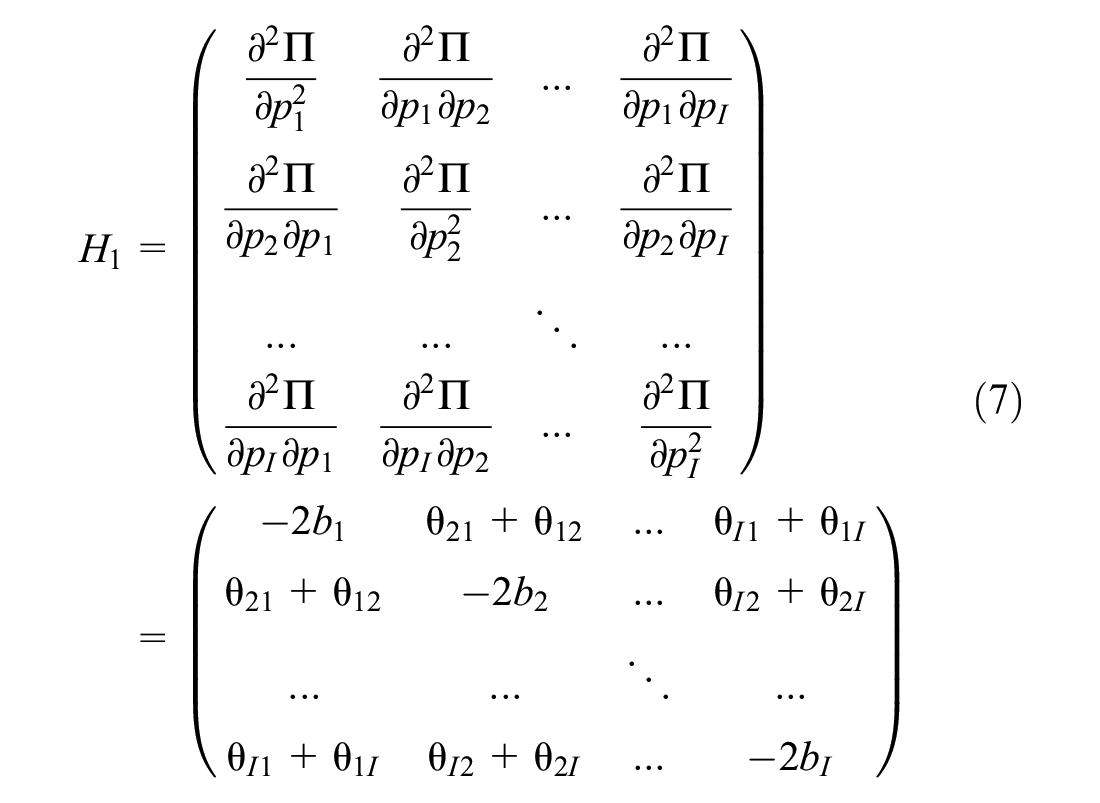
We judge the convexity of profit functions Equations 4 and 6 by Hessian matrix H1, shown as Equation (7). If the Hessian matrix is positively definite, the objective function is convex. Some parameters are uncertain in H1, we can’t judge if H1 is a positive definite matrix. Equations 4 and 6 may be either convex or non-convex, so we use CPLEX optimizer to solve them.
Uncertain Model
In deterministic model, the consumer demand in each sub-retailing channel is deterministic. In reality various factors affect demand except the retailing price, resulting in demand uncertainty. For example, the income level of consumers and their expectations for the future, the government’s consumption policies, and the systematic errors in modeling. Companies should consider these issues when making decisions, and fuzzy numbers can help solve these problems. Based on deterministic model, we construct the uncertain model with fuzzy random error term, called uncertain model, the manufacturer’s profit, each sub-retailer’s profit, chain retailer’s profit, and the third-party recycling company’s profit can be written as Equations 8–11.


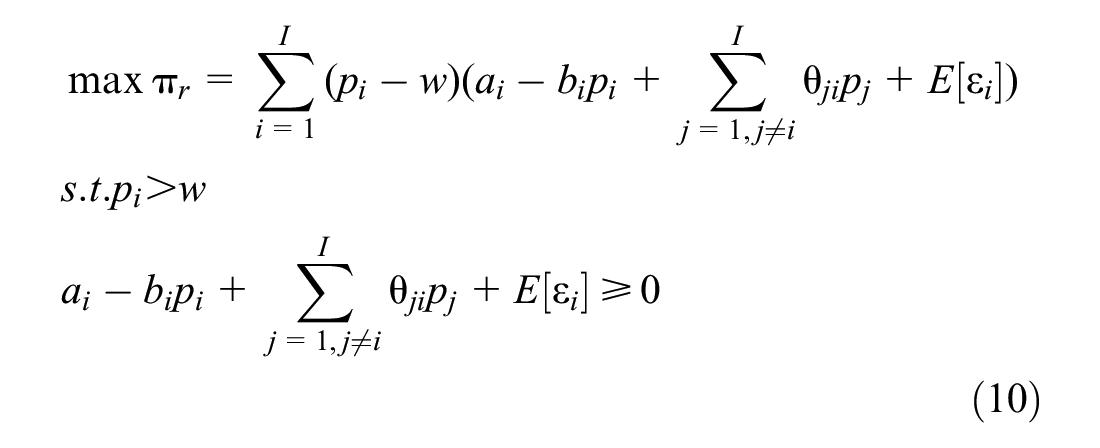

In Equation 10, the first constraint ensures that each sub-retailer’s retailing price of product is greater than the wholesale price. The second constraint ensures that the demand in each channel is non-negative. Under decentralized policy, the manufacturer and the chain retailer try to make decisions to maximize their own profits. At this time, profit of the total supply chain can be expressed as Equation 12.

In centralized supply chain, the manufacturer and the chain retailer will choose the optimal prices to maximize the supply chain’s total profit, that is, Equation 13. The first constraint ensures that the retailing price of product is greater than the production cost of new product. The second constraint ensures that the demand in each channel is non-negative.
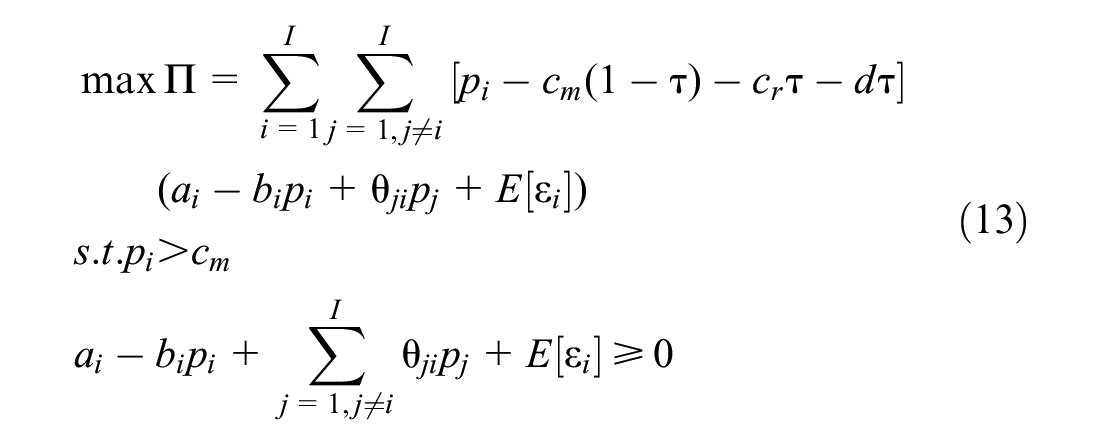
We judge the convexity of profit functions Equations 10 and 13, by Hessian matrix H2, shown as Equation 14. Since some parameters are uncertain in H2, we can’t judge if H2 is a positive definite matrix, Equations 10 and 13 may be either convex or non-convex, so we use CPLEX optimizer to solve them.

Numerical Analysis
In this section, we apply the CPLEX optimizer to solve the numerical examples based on constructed models and discuss the results. All the program codes are written on MATLAB R2018a, running on the RedmiBook 14 computer (INTELi5-10210U; RAM: 8.00 GB DDR4; OS: Windows 10).
Example Assumptions
In this subsection, we will give one example based on a real closed-loop clothing supply chain. Textiles rely on non-renewable resources, and big retail brands such as Adidas, Decathlon and Uniqlo recycle used clothing. Some is used for remanufacturing, some is donated directly, and some is used for production in other industries. Take clothing chain retailer UNIQLO’s “RE.UNIQLO” program (http://www.uniqlo.com/) which promotes recycling, recycling clothing into new goods, such as “recycled down jackets,” to be resold to customers.
An ordinary new down jacket costs about 70 yuan, and the cost of reprocessing from old clothes is about 32 yuan. Therefore, it’s assumed that unit producing cost is 70 yuan per suit, and unit reproducing cost is 32 yuan per suit. UNIQLO is willing to pay a coupon of about 28 yuan for each used down jacket. Suppose that the used clothing price that the enterprise is willing to pay to the third-party company f is 28 yuan per suit. According to the data of UNIQLO’s flagship store from Taobao in January 2023, a certain type of down jacket sold 4,000 pieces a month. We take one year as the sales unit and consider the fluctuation of demand, assuming that the annual basic sales volume of this down jacket is within the range of 49,000 to 51,000.
Based on the rule that the recycling price of used clothes by “Huanma Technology” (http://www.miaohuanba.com/) is in the range of 10 to 80 yuan per suit, we assume that the price of a down jacket recycled by a third-party recycling company d is 20 yuan per suit.
Through “Implementation opinions on accelerating the recycling of waste textiles” issued by Chinese government, we learned that the recycling rate of waste textiles in China will reach 25% by 2025. We assume the recovery rate
In the following numerical analysis of deterministic and uncertain models, the corresponding parameters are designed based on the actual data above.
Numerical Analysis of Deterministic Model
In this subsection, we firstly give the numerical analysis of deterministic model. Firstly, we consider the situation under decentralized policy. According to the subsection 5.1, basic parameters are set as
Parameters for Four Sub-Retailers in Four Experiments.

Optimal Solutions Under Decentralized Policy in Deterministic Model.

Observing Table 4, it can be seen that as the wholesale price is set higher, manufacturer’s profit first increases and then decreases, while the profits of retailers, the third-party recycling company, and total supply chain are all dwindling. In addition, Figure 2, which drawn from Table 4, clearly presents the impacts of w on the profits of the players and the total chain and fits the above finding. It is worth noting that changes in the wholesale price leads to changes in the optimal retailing price of each sub-retailer.

The impacts of w on the profits under decentralized policy in deterministic model.
Next, we consider the situation under centralized policy. As in the case of the decentralized policy, basic parameters are set as
Optimal Solutions Under Centralized Policy in Deterministic Model.

By the above comparison, we find that under the centralized policy, an enterprise expanding upward and downstream will form an industrial group and gain greater profits. And then we study the influence of parameter changes under centralized policy. We discuss the impacts of different price elasticity of demand and cross price-demand sensitivity coefficients on the overall profit in Tables 6 and 7 respectively. To make it better to compare the results, we set the basic demand of each sub-retailer as 50,000, that is,
The Impacts of

The Impacts of
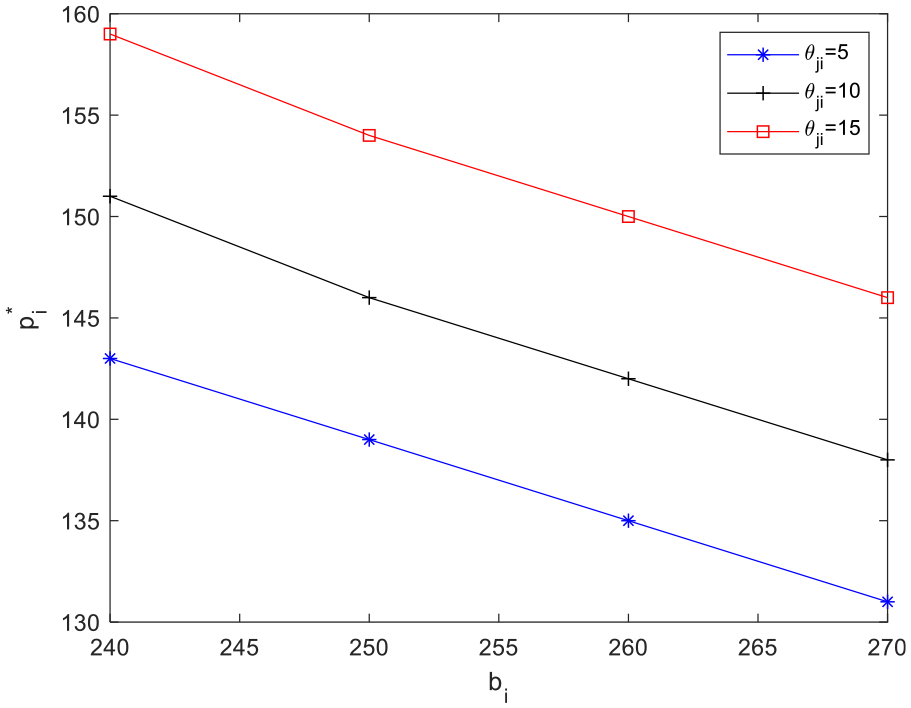
In Table 6, to study the effects of cross price-demand sensitivity coefficients on the supply chain, this paper conducts some experiments for selected values of price elasticity of demand ranging from 240 to 270 in each retailing channel and cross price-demand sensitivity coefficient from 5 to 15 when run the program randomly for three times. By comparing the results of each time, an interesting conclusion is that when the basic demand and price elasticity of demand
The impacts of
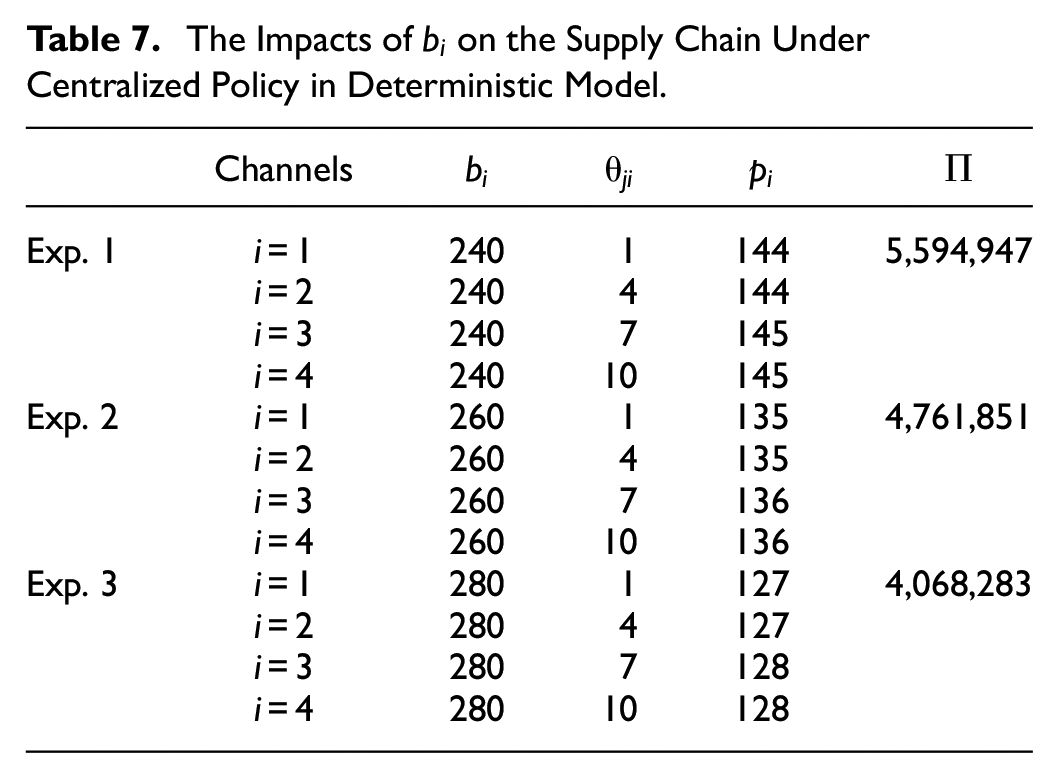
In Table 7, to study the effects of price elasticity of demand on the supply chain, this paper similarly conducts some experiments for selected values of cross price-demand sensitivity coefficient ranging from 1 to 10 in each retailing channel and price elasticity of demand from 240 to 280 when run the program randomly for three times. However, the results are different from the results in Table 6. The optimal retailing prices in each channel are decreasing with the increase of price elasticity of demand when basic demand and cross price-demand sensitivity coefficient in each channel keep unchanged. Besides, the total profits are decreasing when price elasticity of demand is incremental. The changing trend of the retail price of each channel in Figure 4, which is drawn from Table 7, is consistent with the above finding.

The impacts of
Numerical Analysis of Uncertain Model
Based on numerical analysis of deterministic model, we further consider the influence of different parameters on the uncertain model with fuzzy error term. Let the error term


In real life, the value of the parameter
The Expected Value of the Error Term for Four Sub-Retailers in Four Experiments.

At first, we only consider the impacts of the fuzzy error term on the supply chain. All other parameters are the same as those in Table 3, including basic demand, the price elasticity of demand, and cross price-demand sensitivity coefficients. Substitute the basic parameters, parameters in Table 3, and parameters in Table 8 into Equations 8 to 13. We can get the optimal solutions under decentralized policy and centralized policy in uncertain model respectively, which are presented in Tables 9 and 10. By comparing to Tables 4 and 5, it can be found that in each experiment, members and the total supply chain made very different decisions under deterministic and uncertain situations. This result shows that it is worthwhile for supply chain members to consider the fuzzy error term given by experienced experts. If the error term is close enough to the truth, it can help accurately describe the channel demand and make reasonable price decisions.
Optimal Solutions Under Decentralized Policy in Uncertain Model When Only the Fuzzy Error Terms are Different.

Optimal Solutions Under Centralized Policy in Uncertain Model When Only the Fuzzy Error Terms are Different.

In the following part, we redesigned basic demand, the price elasticity of demand, and cross price-demand sensitivity coefficients as shown in Table 11, which is different from Table 3. Based on redesigned parameters, we discuss the effects on the supply chain in an uncertain model. First, we consider the situation under decentralized policy. In each experiment, when the wholesale price decided by the manufacturer is 100, 110, 120, 130 and 140, Equation (10) is solved by CPLEX optimizer. The optimal retailing prices for each sub-retailer can be get. Then, the optimal wholesale price and the retailing prices of each sub-retailer are substituted into Equations 8 to 11 to obtain the profits of the manufacturer, the chain retailer, and the third-party recycling company respectively. The manufacturer can decide the proper wholesale price that makes it the most profitable. Further, the total profit of supply chain under decentralized policy can be obtained based on Equation 12. The solutions of four experiments are shown as Table 12.
Parameters for four Sub-R in Four Experiments.

Optimal Solutions Under Decentralized Policy in Uncertain Model.
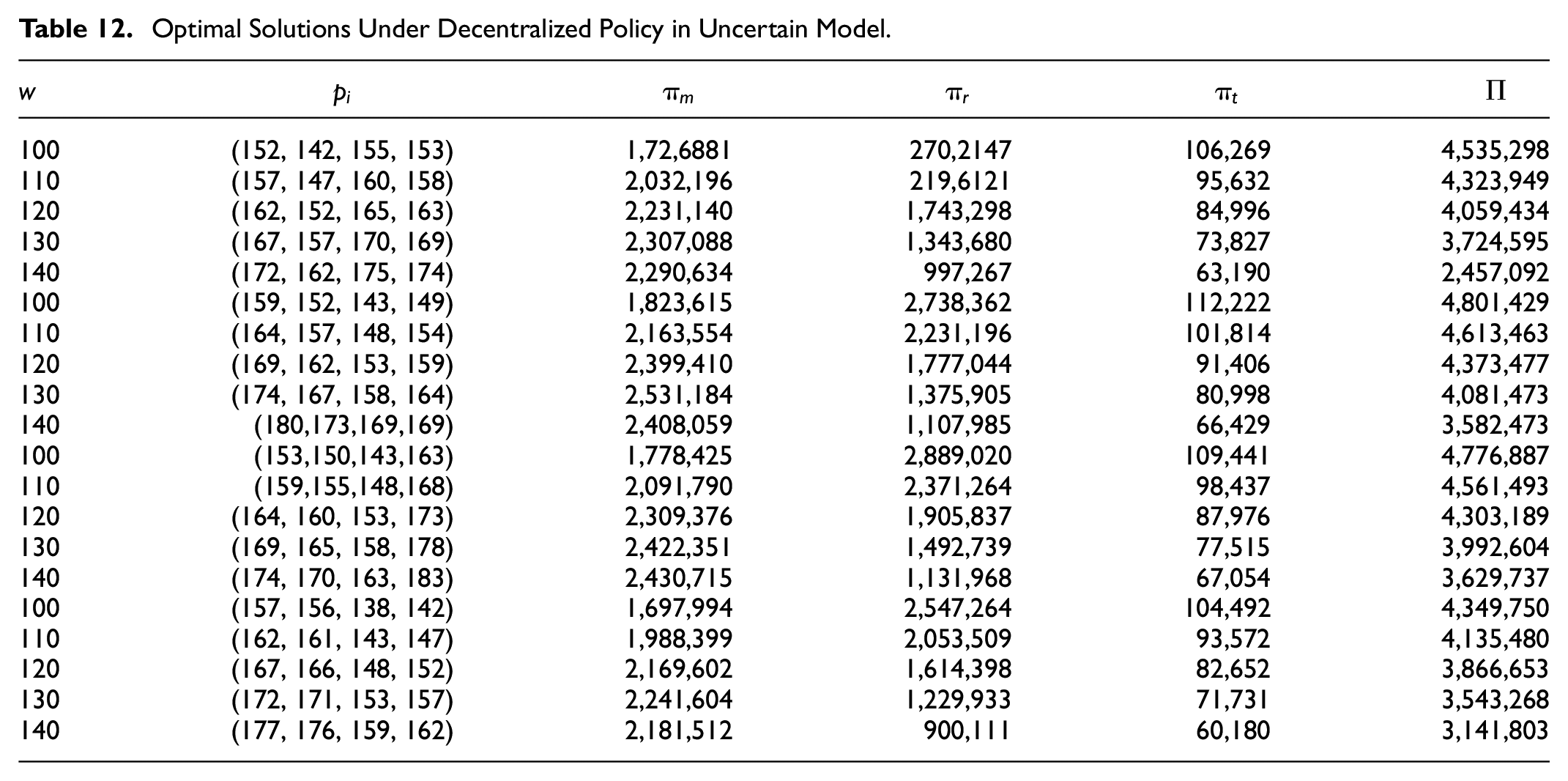
From Table 12, we can find that with the increasing of the wholesale price, the profit of the manufacturer first rises and then falls, while the profits of total retailers, the third-party recycling company, and the total supply chain are all decreasing. The results are the same as in deterministic model and easily understood. The existence of the fuzzy random error term changes the consumer demand without changing other parameters. Hence the profit rules of the three players have not changed. But it is worth noting that the profit of overall supply chain is far greater than the deterministic situation. In addition, the trend of w’s influence on the chain in Figure 5 confirms the above findings.

The impacts of w on the profits under decentralized policy in uncertain model.
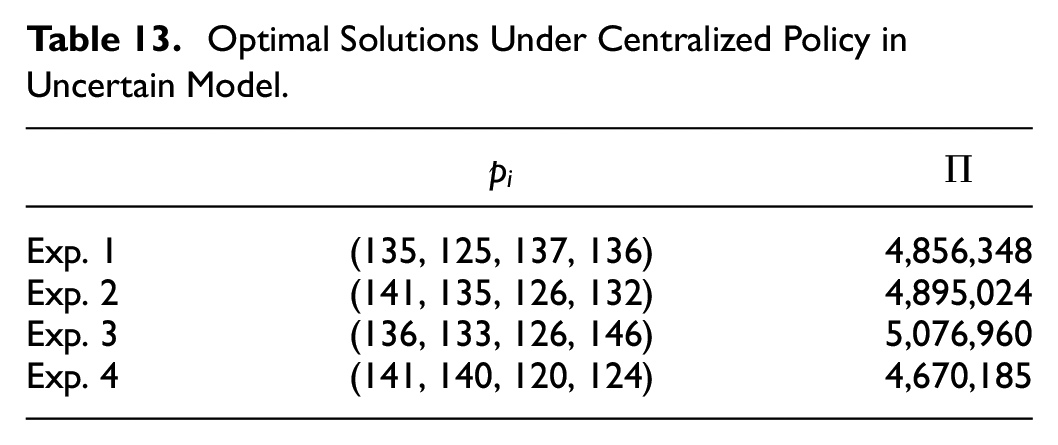
Then, we consider the situation under centralized policy. Parameters for 4 sub-retailers in four experiments are the same set as those under decentralize policy, which are shown in Table 11. Substitute these parameters into Equation 13, through the CPLEX optimizer, we can get the optimal retailing prices of each retailing channel and the optimal profits of total supply chain under the centralized policy in uncertain model respectively, which are shown in Table 13. Through comparing optimal solutions with Table 12, we can find that the supply chain under centralized policy has higher profits than that in decentralized policy, and the chain retailer sets lower sub-channel retailing prices. By comparing Table 13 with Table 5, a directly observed phenomenon is that the optimal retailing prices in four channels and the total profit of supply chain in uncertain model are greater than those in deterministic model. It is clear that the two models make a wide range of decisions.
Optimal Solutions Under Centralized Policy in Uncertain Model.
Through the above analysis, it is proved that supply chain profit maximizes under centralized policy. Then we discuss the impacts of different price elasticity of demand and cross price-demand sensitivity coefficients on the overall profit under centralized policy respectively. Similar to Tables 6 and 7, to make it better to compare the results, we set the basic demand of each sub-retailer as 50,000, that is,
Tables 14 and 15 show the impacts of different cross price-demand sensitivity coefficients and price elasticity of demand on the overall profit respectively. From Table 14 and Figure 6, the retailer will set higher retailing prices with the increasing of cross price-demand sensitivity coefficients when other parameters remain unchanged. At the same time, the overall profit of the supply chain also gets increased. Another finding is that in each experiment, for sub-retailing channel with high price elasticity of demand, retailer will decide on a lower retailing price. Compared Table 14 with Table 6, two interesting results can be shown. One is that whether it is the deterministic or the uncertain situation, they share the same changing trend. The other is that under the uncertain situation with fuzzy random error term, the optimal retailing prices in all channels are bigger than those under basic situation, while the other parameters are set unchanged. In the uncertain model, the increase in pricing brings about the overall profit which is quite different from that in the deterministic model.
The Impacts of

The Impacts of


The impacts of
From Table 15 and Figure 7, the retailer will set lower retailing prices with the increasing of price elasticity of demand when other parameters remain unchanged. Meanwhile, the overall profit of the supply chain also gets decreased. Compared with Table 7, the impacts of

The impacts of
Conclusion and Discussion
In retrospect, supply chain networks in real life are becoming more and more complex, and it is not uncommon to have multi-manufacturer versus multi-retailer. Simple one-to-one model is no longer suitable for supply chain management in real life. Moreover, pricing among various retailing channels will cross-influence the consumer demand of other channels. In addition to pricing strategy, the random error term also affects the demand uncertainty. The literature that takes these factors into account is urgently needed.
This paper exactly considers a complex multichannel CLSC included one manufacturer, one chain retailer, and one third-party recycling company, considering the influences of price elasticity of demand and cross price-demand sensitivity coefficient upon the demand function. We construct price models, which is deterministic model and uncertainty model respectively, and study the optimization of pricing strategy in channels. In this paper, CPLEX optimizer helps to solve the optimal solutions quickly and accurately either under the decentralized policy or under the centralized policy. Furthermore, taking a real closed-loop clothing supply chain as an example, the impacts of price elasticity of demand and cross price-demand sensitivity coefficient on the supply chain are analyzed respectively in two situations.
The results show that higher wholesale prices are not always better for manufacturers. Within a certain range, the higher the wholesale price set by the manufacturer, the higher the profit, but beyond a certain threshold, the profit of the manufacturer will be damaged. Therefore, manufacturers need to conduct market research and make reasonable wholesale price decisions based on their own reality. For the chain retailer, when other factors remain unchanged, the greater the price elasticity of demand in a channel, the smaller the retailing price of the retailer’s decision on that channel. Nevertheless, the higher the cross price-demand sensitivity coefficient is, the higher the sub-channel retailing price preferred by the chain retailer, which is conductive to the supply chain. Therefore, it is important for chain retailer to fully understand the relevant parameters of each sub-channel. As for the third-party recycling company, its profit is relevant to the manufacturer. When the wholesale price set by the manufacturer is higher, the third-party recycling company’s profit is lower. The possible reason is that the recycling and selling prices of the third party considered in section 5 are fixed, and the increase of the wholesale price will reduce the profit margin of the third-party recycling company. For the total supply chain, it is confirmed that supply chain profit maximizes under centralized policy. An enterprise can achieve vertical integration by expanding upstream and downstream, when the supply chain is most profitable. In addition, we compare the numerical of two models and discuss the differences. The results imply that while considering the fuzzy random error term, it can help the chain retailer make better price decisions. In another word, with the help of fuzzy error term given by experienced experts with high accuracy, fully considering the uncertainty of demand in decision-making is conducive to improving the supply chain.
This research provides some managerial insights to the business managers in the CLSC parties. Our study reveals the importance of involving the uncertainty in the consumer demand. Accurate demand estimates can help the chain retailer make price decisions and achieve more profits. This means that companies can invite multiple experts in fields to predict the error term and improve the accuracy of their forecasts as soon as possible. In addition, the supply chain is full of competition and cooperation. The chain retailer should pay attention to all sub-retailers’ channel information and make overall decisions, so as to better formulate strategies suitable for each sub-channel and its own development. For example, focus on the price elasticity of demand and the cross-effects between channels. When the prices of other channels have great impacts on sales, the price should be raised in time. Moreover, the company can consider to integrate the upstream and downstream of the supply chain to form a comprehensive group company, which can obtain higher centralized profit than the decentralized decision-making of the supply chain members.
This research can be extended in several directions in future work. First, in this work, the CLSC only includes one manufacturer. Multi-manufacturer can be considered in complicated supply chain structure. Second, our research only considers the linear demand function with the effects of retailing prices. In reality, the demand function may be more complex. These issues need to be further studied and discussed in practice.
Footnotes
Declaration of Conflicting Interests
The author(s) declared no potential conflicts of interest with respect to the research, authorship, and/or publication of this article.
Funding
The author(s) disclosed receipt of the following financial support for the research, authorship, and/or publication of this article: This work is supported by the Natural Science Foundation of Sichuan Province (2023NSFSC1023).
Ethics Statement for Animal and Human Studies
There are no animal and human subjects in this article and Ethics Statement is not applicable.

Data Availability Statement
Data sharing not applicable to this article as no datasets were generated or analyzed during the current study.