




Abstract
As an emerging game category, in-vehicle games have great development potential, but the factors influencing users’ acceptance and continuance intention of in-car games were still not determined. This study used the three perceived attributes of Diffusion of Innovations Theory, compatibility, complexity, and relative advantage, as basis and introduced perceived habits, fit, interaction quality, experience, play value, and continuous use intention to establish the users’ continuance intention model of in-vehicle games. The results of 305 valid questionnaires indicate that compatibility and play value have significant positive influence on continuance intention, of which fit shows stronger effect; perceived habits have significant influence on fit and interaction quality; both fit and quality have significant influence on experience; experience have significant influence on play value. The results of this study can provide reference for promotion design of in-vehicle games and important guidance for future development for in-vehicle game industry.
Plain Language Summary
In the emerging field of in-vehicle games, a sector showing significant developmental promise, understanding the determinants of users’ acceptance and sustained engagement is crucial. This study applied the three perceived attributes of the Diffusion of Innovations Theorycompatibility, complexity, and relative advantageto establish a model for users’ continuance intention in in-vehicle games. Analysis of 305 valid questionnaires revealed that compatibility and play value significantly influence continuance intention, with fit showing a stronger effect. Perceived habits influence fit and interaction quality; both fit and quality affect the overall experience, which, in turn, impacts play value. This study provides valuable insights for in-vehicle game design and promotion, emphasizing the importance of compatibility. The findings offer critical guidance for industry practitioners, providing a nuanced perspective to inform strategic decisions and foster the future development of the in-vehicle gaming industry.
Keywords
Introduction
Games now play a crucial role in people’s lives and well-being because they are an essential part of people’s daily lives and are played by billions of people every day worldwide (Entertainment Software Association, 2022). With the development of technology, the platforms of digital games have evolved from their original standalone consoles and computers to various ones, including mobile phones, virtual reality (VR) devices, and portable mobile devices (Marchand & Hennig-Thurau, 2013). The improvement in autonomous driving and in-vehicle infotainment (IVI) systems makes it possible for passengers and drivers to play games in the vehicle interior space (Pfleging et al., 2016).
In the current experience era, users are no longer satisfied with simple radio and music listening, but expect to obtain more rich entertainment services (J. Kim et al., 2016; Wei et al., 2016; Yu et al., 2020) and better ride experience (Lu & Shi, 2023) through IVI systems. This also means that in the upcoming market competition, IVI systems will become one of the decisive factors for the success or failure of automotive companies (Ji, 2020; J. Kim et al., 2016; Telefonica, 2014). Hence, many automobile companies, such as Audi, Daimler, Tesla, XPeng, and Li Auto, have begun to try to integrate in-vehicle games into their IVI systems to enhance the added value of their vehicles. Lean In Consulting (2022) believes that there is a high degree of overlap between the game players and automobile consumer groups, and if the barriers between the two can be broken down, the opportunities and economies of scale for both the gaming and automotive markets will show an exponential increase. Therefore, the integration of games into IVI systems is of great significance and value for the development strategy of automotive enterprises.
Although many people currently hold a positive attitude toward in-vehicle gaming, such as Elon Reeve Musk, who believes that in-car entertainment will become crucial when vehicles gains autonomous driving capability(Wen, 2022). The poll launched by Elon Musk on Twitter showed that 85.4% of respondents chose to play “The Witcher” game on a Tesla (Lean In Consulting, 2022). Many automobile manufacturers have also promoted in-vehicle gaming as a highlight at various auto shows and events. However, actual usage data shows that the usage rate of in-vehicle gaming among all entertainment functions in IVI systems is the lowest, with daily active users accounting for less than 1% (We, 2021).
Although there has been a considerable amount of academic research on IVI systems and in-vehicle gaming, the issue of low usage rates of in-vehicle gaming has not been well addressed so far. Many scholars have conducted research on the acceptance and promotion of IVI, such as Stiegemeier et al. (2022), who analyzed the factors that influence user acceptance of vehicle technology, including “preference,”“distrust,”“safety,”“knowledge,” and “habit”; D.-H. Kim and Lee (2016) and J. Kim et al. (2016) explored the resistance factors that affect user acceptance or use of IVI systems. However, these studies are mainly focused on IVI systems and do not specifically concentrate on in-vehicle gaming, making it difficult to provide targeted development recommendations for in-vehicle gaming. Besides, research on in-vehicle gaming has mainly focused on the design of in-vehicle games. For example, Krome et al. (2017) designed a fitness game called AutoGym, which turns the frustrating gap in traffic jams into a fun exercise game; Hock et al. (2017) explored the design of in-vehicle VR games using a real vehicle’s motion; Lakier et al. (2019) designed three cross-car multiplayer games from the perspective of crossing different vehicles and social groups; Togwell et al. (2022) designed an AR game that combines AR HMDs and vehicle-based reality perception and conducted preliminary research on how AR in-vehicle games can improve travel experiences. However, there is a lack of research on the usage rate, acceptance level, and promotion of in-vehicle games in these relevant literature.
To explain the low usage rate of in-vehicle games and promote their development and popularization, this study adopts the Diffusion of Innovations Theory and explores the factors that influence user use of in-vehicle games, as well as their relationships, through the perception attributes of compatibility, relative advantage, and complexity, and six factors of perceived habits, interaction quality, fit, experience, play value, and continuous use intention. By establishing a behavioral model, this study provides insights for the promotion and popularization of in-vehicle games, and aims to improve their usage rate.
Theoretical Framework, Research Hypotheses and Model Establishment
Theoretical Framework
Diffusion of Innovations (DOI) Theory is one of the classic theories used to study the acceptance and dissemination of innovations. The theory was proposed by the American sociologist E. Rogers (2003) and mainly explains how new ideas, products, or technologies are accepted and spread over time within a society or social system. E. Rogers (2003) identified that the adoption of innovations goes through five stages: Awareness, Interest, Evaluation, Trial, and Adoption. During this process, the decision of consumers to adopt the innovation is influenced by five perceived attributes, including Relative Advantage, Compatibility, Complexity, Trialability, and Observability (E. M. Rogers et al., 2014). By understanding these factors, innovators, producers, and businesses can make their new technologies, products, or services more easily accepted and spread more quickly in society.
The Diffusion of Innovations Theory provides a theoretical basis for understanding the factors that influence individuals’ acceptance or rejection during the process of adopting innovation (Kouki et al., 2006). It can effectively provide basic concepts and methodological guidance for the dissemination of innovative technologies, methods, and things. Therefore, it has been widely applied in various fields, such as marketing, public health, information systems, and product and media lifecycle research (Ahmad et al., 2023; Min et al., 2019; Oyelana et al., 2021; Talebian & Mishra, 2018; Vrain & Wilson, 2021; Yi & Bae, 2017).
In-vehicle games belong to the intersection of IT systems and game research, and both fields have had a large number of DOI application studies, providing a theoretical basis for this study. DOI theory has been widely applied in IT system research due to its ability to analyze adoption intentions of specific user groups (Menzli et al., 2022; Vrain & Wilson, 2021). Therefore, many studies on IT innovations have adopted DOI as their theoretical framework (Okour et al., 2021; Rhein & Rhein, 2021; Tsai & Chen, 2022). In the gaming field, many scholars have also used the Diffusion of Innovations theory to study the acceptance and spread of new forms, contents, carriers, and technological innovations of games. For example, Skalski et al. (2008) applied the diffusion of innovations theory to explore how the relative advantages of electronic games in terms of form, content, and technology meet human needs, leading to their commercial acceptance and adoption. Robertson (2009) studied the possibility of using digital games in library instruction through the Diffusion of Innovations Theory. Ayudhaya (2015) developed a model based on the Diffusion of Innovations Theory to explore the factors influencing users’ mobile game downloads and the spread of mobile games.
In addition, many scholars emphasize the importance of collecting opinions from early adopters and non-adopters in the early stages of innovation promotion, as the factors that determine adoption may become the main driving force of the consumer market for innovation, while the factors that reduce adoption may become potential barriers to innovation diffusion (A. Hong et al., 2020; Moore, 2014; Shin et al., 2018). Currently, in-vehicle games are at the initial stage of promotion and popularization. Therefore, this study believes that using the Diffusion of Innovations Theory as a research framework can help the automobile industry clarify the relevant factors that affect the adoption or rejection of in-vehicle games. These factors have significant reference value for the optimization and promotion of in-vehicle games in the future.
Research Hypotheses
Due to the heterogeneity of research objects, many scholars modify the DOI theory model to better fit their research needs. For example, Jia et al. (2022) proposed a compatibility research model based on the combination of compatibility with the characteristics of social network technology to study how compatibility affects the value of enterprise social media through employees’ intrinsic motivation; Talebian and Mishra (2018) proposed corresponding incentives and barriers in the DOI model based on the characteristics of autonomous vehicles; Bharadwaj and Deka (2021) integrated DOI Theory with the technology acceptance model in their study.
Based on the characteristics of the research object of in-vehicle games, three perceived attributes of the DOI Theory are selected, including compatibility, complexity, and relative advantage. Additionally, six related variables were further considered, including perceived habits, fit, interaction quality, experience, play value, and continuous use intention. The operational definitions of these six variables are shown in Table 1. Based on the relationships among these six variables, the research hypotheses and framework are presented in Figure 1. Among them, habit and fit belong to the compatibility dimension, interaction quality belongs to the complexity dimension, and experience and value of quality belong to the relative advantage dimension. The following content will elaborate on the three perceived attributes and six variables and propose research hypotheses.
Operational Definitions of Constructs.


Theoretical model of structural equation.
Compatibility
Compatibility is regarded as the degree to which an innovation is perceived as consistent with the existing values, past experiences, and anticipated needs of potential adopters, indicating the extent to which the innovation can currently coexist with the needs and understanding of adopters (E. Rogers, 2003; Tanye, 2016). The compatibility perception dimension in the context of this study contains two specific variables, perceived habits and fit. The concept “past experience” involved in the compatibility dimension refers to the users’ previous experience of in-vehicle gaming in this study. Gamers gradually turn playing games into a habit of their life in their relationship with games (Bhattacherjee et al., 2012; Teng, 2018), that is, perceived habits, which has also been confirmed as an influencing factor of innovation acceptance (Venkatesh et al., 2012). The “consistency with the existing values and expected needs of potential acceptors” emphasized by compatibility is mainly reflected in the degree of matching between vehicle-mounted games and users’ personal characteristics, that is, adaptability. The “consistency with the existing values and expected needs of potential acceptors” emphasized by compatibility is mainly reflected in the degree of matching between in-vehicle games and users’ personal characteristics, that is, fit.
Habits are psychological structures that develop through behavioral repetition (LaRose, 2010; Verplanken & Orbell, 2003), which is often regarded as an individual’s life characteristic (Wood & Rünger, 2016). Personal life characteristics have been shown to affect the fitting effect of specific technologies (Erskine et al., 2019; H. Sun et al., 2016). Ashfaq et al. (2023) confirmed in their study that in the context of a green environmental game (ant forest), green habit is positively correlated with perceived green task-technology fit; Gerhart et al. (2015) also pointed out that in the context of e-textbooks, habits have a positive impact on the fit between users and e-textbooks. Consistent with previous studies, this study conjects that gaming habits as an individual characteristic also affect the degree of fit between in-vehicle games and user needs.
Existing studies have shown that there is a strong correlation between perceived habits and interaction quality. Habit can be considered as unconscious and automatic responses to stimuli (Ajzen, 2011; LaRose, 2010), while habits have been proved to be positively related to interaction quality, because they can trigger efficient interaction effects (Badke-Schaub & Eris, 2014; Hua & Fei, 2009; Pang et al., 2022; L. Sun, 2019). Conversely, the lack of corresponding habits may be negatively related to interaction quality because of the additional learning cost for users (P.-Y. Chen & Hitt, 2002; Jones et al., 2002; Ray et al., 2012). Therefore, this study believes that users with gaming experience and operating habits can gain better interaction quality with in-vehicle games. Based on the above discussion, the following hypotheses are proposed:
H1: Perceived habits in in-vehicle games has a significant positive influence on fit.
H2: Perceived habits in in-vehicle games has a significant positive influence on interaction quality.
Complexity
Complexity refers to the degree to which an innovation can be easily understood and used (E. Rogers, 2003). The easier an innovation is to understand, the more likely it is to be accepted. Innovation requires constant adjustment, modification, and optimization to meet up the skill capabilities of potential users (Menzli et al., 2022). For in-vehicle game users, complexity is mainly reflected in the ease and difficulty of interactive operation when users play the game, such as whether they can easily start playing the game, whether the game interaction is ergonomic, etc., so it can be specified as interaction quality. Interaction quality, as an important indicator in human-computer interaction, usually refers to “what makes interaction good” (Mekler & Hornbæk, 2019; Oulasvirta, 2017). Previous studies have confirmed a positive association between interaction quality and fit (Hsin Chang, 2010). For example, Fang (2017) confirmed that interactivity is positively correlated with task-service fit in the research on brand applications. G. H. Harman (2005) also confirmed in his research that when the game’s view and controller operation mode are consistent with the user’s interaction expectation, his or her sense of fit will be greatly enhanced. In terms of in-vehicle games, the uniqueness of the cabin space makes the interaction of in-vehicle games different from the traditional mouse-keyboard or touch-screen operation (Song & Zinkhan, 2008). Therefore, this study speculates that there is a positive relationship between interaction quality and fit.
Interaction quality is closely related to experience, and all aspects of user-product interaction will affect the user experience (D. A. Norman, 1988; D. Norman & Nielsen, 2016). Vyas and van der Veer (2005) pointed out that the core of user experience with information systems is the quality of interaction. Barajas Portas (2015) found that the interaction between consumers and brands has a positive impact on brand experience. Costello (2018) also confirmed that high-quality game interaction can enhance the player ’s computer game experience. Therefore, this study believes that the interaction quality of in-vehicle games will affect user experience, and the following hypotheses are proposed:
H3: Interaction quality in in-vehicle games has a positive influence on fit.
H4: Interaction quality in in-vehicle games has a positive influence on experience.
Relative Advantage
Relative advantage refers to the degree to which something (technology or concept) considered innovative is superior to the existing concept or technology (E. Rogers, 2003). In the era of experience economy (Pine & Gilmore, 2013), brilliant game experience has become an important symbol of comparative advantage and one of the core factors to measure the success of a game (Budi et al., 2021; Molinillo et al., 2020). Gamer experience includes enjoyment-related dimensions, such as enjoyment, flow, emotion, participation, immersion, and presence (Boyle et al., 2012; Caroux, 2023; De Byl, 2015; Díaz et al., 2022; Khoshnoud et al., 2020). Compared with other forms of games, the advantages of in-vehicle games are mainly reflected in the unique experience brought by the sense of presence and immersion created by the digital cabin, and the play valuing that other traditional game methods cannot achieve.
Previous studies have shown that there is a close relationship between experience and fit. For example, Caroux et al. (2015) pointed out that gamer experience is affected by the matching degree of various hardware and software in video games. C. H. Wang et al. (2018) confirmed that fit between tourists and the environment can positively affect their experience. Hock et al. (2017) matched the kinesthetic force of the driving car with the visual information in VR games, which significantly increased the sense of presence and immersion, thereby improving the game experience (Caroux et al., 2015; Terkildsen & Makransky, 2019). In general, play value is a subjective assessment of the game utility after playing the game, as well as a view of the “gain” and “give” processes (Hirschman & Holbrook, 1982b). When users get satisfied with game experience, they will have a positive evaluation of the game (Setiono et al., 2021), and feel worthy of their energy, time and financial resources (Buchanan-Oliver & Seo, 2012). Cui et al. (2022) believe that a good gaming experience can have a positive influence on perceived value. In the context of brand trust research, Xingyuan et al. (2010) also confirmed the positive relationship between user experience and perceived value. To conclude, this study believes that the fit of in-vehicle games has a positive influence on experience, and experience has a positive influence on play value. The following hypotheses are proposed based on the above literature:
H5: Fit of in-vehicle games has a significant positive influence on experience
H6: The experience of in-vehicle games has a significant positive influence on play value
Continuous use intention is the user ’s willingness to use the product or service in the future based on their previous use experience (Z. Wang et al., 2023). Studies have shown that the more suitable information technology and features are for the user “s interactive environment, the more motivated potential users will continue to use it (Ouyang et al., 2017; Petter et al., 2012). Ouyang et al. (2017) confirmed that students ” perceived fit has a positive influence on the continuous use intention of MOOCs. Karpinskyj et al. (2014) pointed out that the degree of personalized fit of the game will affect the willingness and experience of gamers. Therefore, this study believes that the better the fit of in-vehicle games, the higher the user ’s continuous use intention.
Previous studies have pointed out that play value is a key prerequisite for game loyalty, which increases the possibility of users continuing to play games (L. S.-L. Chen, 2010; Molinillo et al., 2020). Turel et al. (2010) pointed out that the play value promotes the user ’s intention to continue to use in the future by affecting the overall value of digital enjoyment. The study of J.-C. Hong et al. (2017) confirms that there is a positive relationship between hedonic value and practical value and the continuous intention to use smart watches. Therefore, this study believes that the play value of in-vehicle games has a positive influence on continuous use intention. The following hypotheses are proposed:
H7: Fit of in-vehicle games has a significant positive influence on users ’ continuous use intention.
H8: Play value of in-vehicle games has a significant positive influence on continuous use intention.
Research Design and Methods
Questionnaire Design
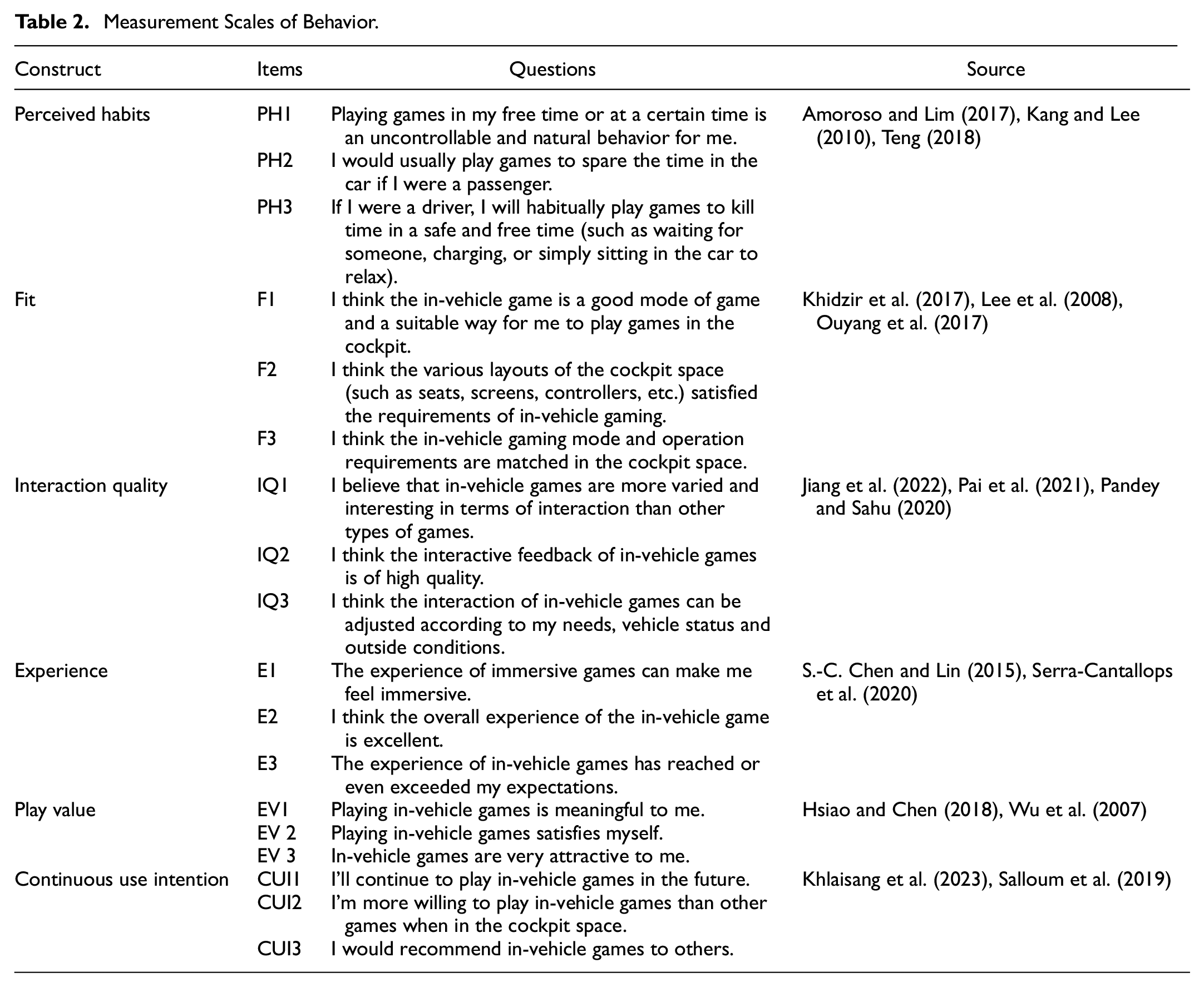
The scales and items used in this study were all derived and verified from relevant literature to ensure the reliability. The final questionnaire was designed based on the research purpose of this study after modification and optimization. The questionnaire is divided into two parts: the first part is to collect the basic information of the respondents, and the second part is the behavior measurement of the users who have played in-vehicle games, as shown in Table 2. The variables listed in Table 2 all adopted Likert’s 7-point level, of which “1” represents completely disagreed, “2” represents disagreed, “3” represents relatively disagreed, “4” represents general, “5” represents relatively agreed, “6” represents agreed, and “7” represents completely agreed. The respondents were asked to choose answers according to their actual use experience.
Measurement Scales of Behavior.
Data Collection
The questionnaire survey was conducted between September and December 2022 and was collected from both offline and online platforms. We invited users with in-vehicle gaming experience from Tesla, Xpeng, and Li Auto shops in Wuxi, Xiamen, Fuzhou, and Tianjin, China. All respondents (both drivers or passengers) were confirmed to have in-vehicle gaming experience before they filling in the questionnaire. A total of 334 samples were received. After eliminating invalid questionnaires, the sample size was 305, which was 10 times more than the number of analysis items (18), and the sample size met the requirements for SEM. The demographic statistics of respondents are shown in Table 3.
Demographic Statistics of Respondents.

Data Analysis
Unidimensionality Test
Exploratory factor analysis was used to verify the unidimensionality of the latent variables. Principal component analysis and varimax rotation method was used to extract new factors with eigenvalues greater than 1. Previous studies have pointed out that the appropriate threshold for factor analysis is KMO greater than 0.6 and Bartlett ’s sphericity test significance less than 0.05 (Kaiser, 1974; Norusis, 1992). The results show that there is a partial correlation between items, and reject the null hypothesis that the correlation matrix is an identity matrix. Hence, the data in this study are suitable for factor analysis (Table 4). All the items of each latent variable are involved in the extraction of new factors, and all latent variables can only extract one new factor and the eigenvalue of the factor is greater than 1(H. Harman, 1960), which means that each latent variable has good unidimensionality.
Results of Unidimensionality Test.

Confirmatory Factor Analysis
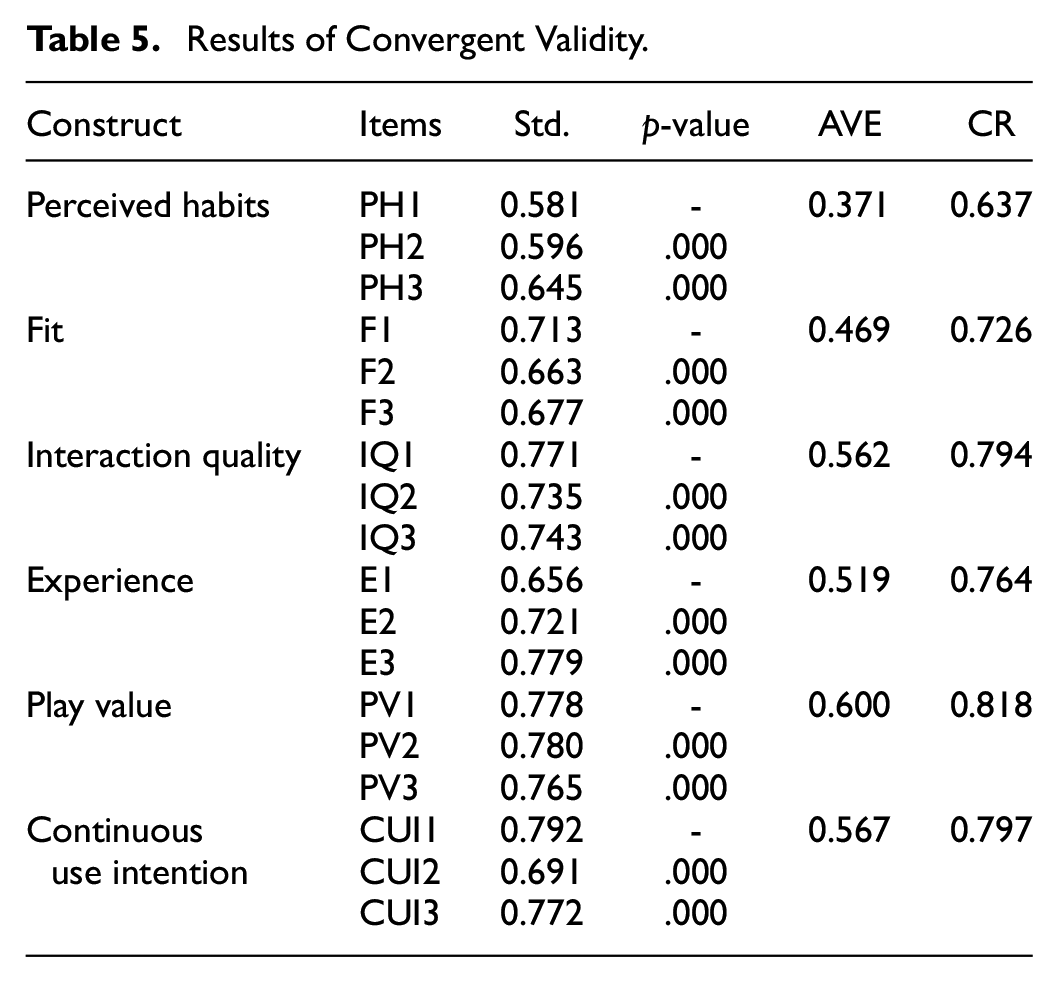
The convergent validity and discriminant validity were tested by confirmatory factor analysis (CFA). The results (Table 5) showed that the significance of all the latent variables and measurement items meet the required threshold The factor loading coefficients of all the measured items were greater than 0.5 (Shevlin & Miles, 1998), and the average variance extracted (AVE) of each factor was not lower than the standard of 0.36 (Jiang et al., 2021), indicating that there was good convergent validity within each latent variable. The correlation coefficients between each pair of variables were less than the square root of the AVE of each variable (the bold numbers on the diagonal of Table 6), indicating that the latent variables have good discriminant validity.
Results of Convergent Validity.
Results of Discriminant Validity.

Note. The bold numbers on the diagonal represent the square roots of the AVE value.
Model Fit Test
As shown in Table 7, this study conducted a path analysis of each latent variable and found that all fit indices, including χ2/df, GFI, RMSEA, RMR, CFI, NFI, NNFI, TLI, AGFI, and IFI, were within a reasonable range. These results suggest that the model proposed in this study has good fit.
Model Fit Indices.

Note. χ2/DF = normed chi-square; GFI = goodness of fit index; RMSEA = Root mean square error approximation; RMR = root mean square residual; CFI = comparative fit index; NFI = normative fit index; TLI = Tucker-Lewis index; AGFI = adjusted goodness of fit index; IFI = incremental fit index.
The results of the path analysis are presented in Table 8 and Figure 2. All eight hypotheses of this study were supported.
Regression Coefficients of the Model.

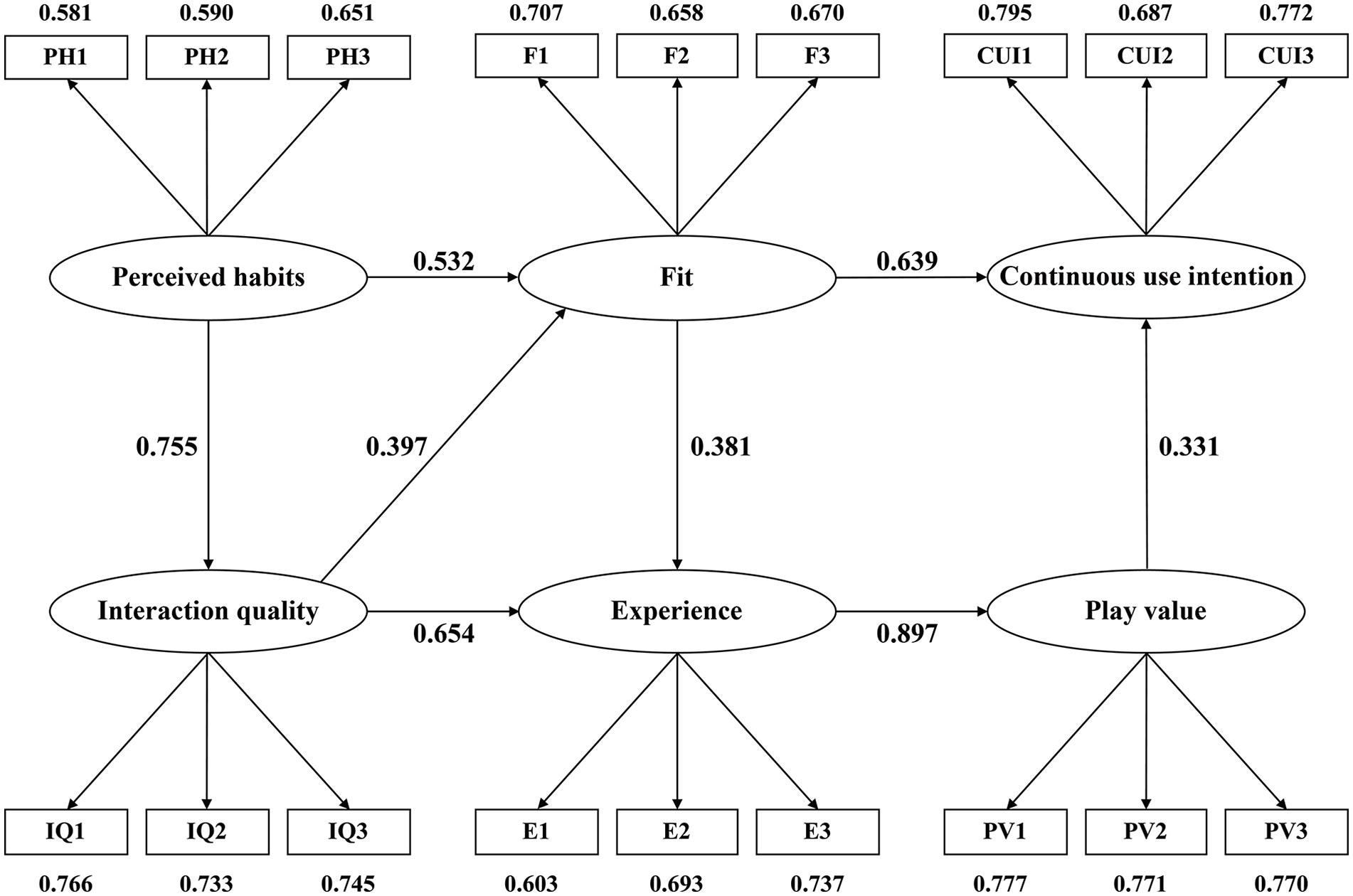
Results of path analysis.
Discussion
The results of this study indicate that all eight hypotheses were supported. The following discussion will focus on the analysis results. Firstly, both fit and play value had a significant impact on continuous use intention, supporting H7 and H8. The influence of fit was found to be greater (0.639 > 0.331). This indicates that users value the compatibility of in-vehicle games with their usage needs, including various aspects such as functionality and interaction. This result is consistent with previous studies. Users typically consciously choose new technological products that are suitable for them (H. Sun et al., 2016). The adoption of new products depends not only on views and attitudes toward the technology but also on good fit, as only innovations that fit well with users are more frequently used (Goodhue & Thompson, 1995; Marikyan et al., 2023; Zhou et al., 2010). Chang et al. (2015) stated that only by enhancing the technological features to meet users’ needs, can higher usability, satisfaction, and performance impact be achieved, thereby motivating users to continue using information systems. Li et al. (2019) also pointed out in their study that the match between task and technology is an important prerequisite for use intention. For in-vehicle game users, fit is a powerful driver for their selection and acceptance because it is seen as a match with potential adopters’ needs, values, and abilities, or in other words, the degree of adaptation to users’ basic needs. Thus, it can be said that fit is the prerequisite for users to play in-vehicle games. On the other hand, play value is relatively more focused on perceived activities on the mental and meaningful level (Engl & Nacke, 2013), and its influence on user intention is mainly reflected in the continuous use of in-vehicle games after they become mature. Therefore, in the initial stage of the development of in-vehicle games, Fit has a greater impact on user intention to use the in-vehicle games. In-vehicle games cannot simply copy the game mode of traditional electronic games, but need to optimize the game play, content, control, and other aspects to adapt to the cockpit space and user needs.
Secondly, both interaction quality and fit have a significant influence on experience (supporting H4 and H5), with interaction quality having a greater influence (0.654 > 0.381). This is because interaction quality has a more direct correlation with experience compared to fit. This is consistent with previous research on IVI, which showed a strong correlation between interaction and experience (Graichen et al., 2019; Murali et al., 2022). Wiemeyer et al. (2016) have pointed out that player experience is a personal experience that players immediately have while playing and after games, which is usually composed of interactions that occur within the game (Setiono et al., 2021). Users engage in various interactive behaviors and actions in multi-sensory interactive stimuli, leading to a more enjoyable experience that is meaningful, pleasurable and leaves a profound impression (J. Cai et al., 2018; Xu et al., 2020). Therefore, the impact of interaction quality on user experience is more direct. Furthermore, interaction quality affects the experiential aspects in many ways, as it encompasses both technical and non-technical factors (Mahlke, 2002). Technical factors include usability and ease of use, while non-technical factors are related to emotional and meaningful experiences (Mekler & Hornbæk, 2019). Both of these aspects can have a direct impact on the user’s experience (Koivumäki et al., 2008; Verhagen & Bloemers, 2018). The impact of fit on user experience is relatively more indirect. While one of the goals of interaction design is to create excellent user experiences, the goal of fit is merely to enhance the fitness between technical functionality and user use. Although various psychological feelings that arise from fit can also affect the experience, this is only an additional outcome beyond the goal. Therefore, its impact is relatively more indirect compared to interaction quality.
In addition, perceived habits had a significant impact on both interaction quality and fit, supporting H1 and H2. This suggests that habits are an important factor influencing users’ engagement with in-vehicle games, and also serve as a sustained motivation for users to choose to engage in this behavior. This finding is consistent with previous research on the significant impact of habits on behavior (LaRose, 2010; LaRose & Eastin, 2004; Limayem et al., 2007). Habits have been proven to have a strong impact on various aspects, such as food waste (Riverso et al., 2017), safety behavior (Hamilton et al., 2019), and mobile application usage (Amoroso & Lim, 2017). In innovation adoption research, habit has also been identified as one of the important factors in the UTAUT2 model (Venkatesh et al., 2012). In the context of in-vehicle games, habit reflects a synthesis of users’ past experiences and values, and is also an aspect that in-vehicle games need to align with. However, the cognitive and skill that users gain from traditional games may accelerate or impede their adaptation to new interaction methods in in-vehicle games (X. Cai et al., 2022). Thus, the more the interaction logic of in-vehicle games aligns with users’ gaming habits, the better users can leverage their previous gaming experience to adapt to the new game more quickly.
Overall, perceived habit is the sustained driving force of users in-vehicle gaming behavior, while fit has the greatest impact on users’ willingness to continue playing in-vehicle games. Complexity, on the other hand, plays a mediating and moderating role in this process, while relative advantage, although currently having a relatively small impact, cannot be ignored, as the importance of game content, quality, experience, and value will become increasingly crucial as car games continue to improve.
Conclusions and Future Research
The findings of this study suggest that current in-vehicle game users are more concerned with the game’s implementation effects, and believe that in-vehicle games need to be compatible with users’ personal needs and the cockpit environment in order to achieve a good gaming experience. Complexity does not directly affect the user’s intention to continue using a product or service. Rather, it serves as an intermediary factor that influences user intent through compatibility and relative advantage. Experience and play value can enhance the playability of in-vehicle games, indicating that relative advantage is also an important influencing factor for users to play in-vehicle games. These research findings clearly identify the factors that influence the intention to use in-vehicle games, providing design ideas for the optimization and promotion of in-vehicle games. They also serve as a research foundation for in-depth analysis of the market development trends, demands, and dynamics of in-vehicle games.
Based on the above results analysis, this study proposes the following design recommendations for in-vehicle games:
As a new game mode, the compatibility design of in-vehicle games should be the primary focus of attention at present. From the perspective of demand matching, developers should increase the variety of in-vehicle game types to match users’ personal entertainment needs and habits. This can not only meet the fragmented entertainment needs and habits of drivers, but also satisfy the amusement, immersion, and other needs of passengers during gameplay. From the perspective of interaction matching, all function keys, indicator keys, and control devices should be adapted to the layout of the cockpit space and the user’s abilities. In addition, the personalization and flexibility of in-vehicle games should be improved, allowing users to customize the game’s controls and interaction methods according to their own habits. From the perspective of scenario matching, the design of in-vehicle games needs to conform to the unique situational characteristics of the vehicle, enhance the matching degree of game content with the outer and inner situation or environmental features, and increase the entertainment value of the game.
Unique interactivity is one of the characteristics of in-vehicle games. Therefore, the interaction quality of in-vehicle games is crucial. In-vehicle games need to have a user-friendly and straightforward guidance interface, simplify the interaction process as much as possible, and reasonably utilize the situational characteristics of the cockpit space to design unique interaction methods. This ensures good usability and ease of use while providing users with a unique interactive experience through flexible interaction methods.
Although relative advantage currently has a weak impact on the continuous use intention of in-vehicle games, this may be due to the fact that in-vehicle games are currently in a transitional phase. In the future, once in-vehicle games establish their own independent game structure and modes, the influence of experience and play value is likely to increase significantly. Hence, while prioritizing compatibility, we cannot overlook the crucial indicators of experience and play value. Currently, the implementation of in-vehicle games is confined to the IVI screen, thereby limiting players to a mere change in the gaming environment. This does not fundamentally differentiate it from other terminal products such as gaming consoles or PCs. To establish differentiation, it is imperative to create a digital cockpit with distinctive vehicular characteristics, integrating virtual reality (VR), extended reality (XR), and other related technologies. This will entail developing corresponding gaming scenarios and content and enabling real-time synchronization with the vehicle itself, thus realizing authentic physical feedback and generating gaming experiences and value that traditional games cannot provide.
Undoubtedly, this research still has certain limitations. On the one hand, due to the early stage of development in in-vehicle gaming, it is difficult to identify a broader target audience. On the other hand, the number of automobile brands that offer in-vehicle games is limited, with most being electric vehicles. Therefore, the sample is constrained and may not be representative of all in-vehicle gaming experiences. Future research should consider more detailed aspects, such as further exploring the relationship between in-vehicle gaming and motion sickness (Diels et al., 2016). Scholars have also suggested investigating how to better integrate VR/AR technology with in-vehicle gaming (Hock et al., 2017; Togwell et al., 2022). In addition, while there have been many studies on in-vehicle gaming for the driver and front passenger, there is still a gap in research regarding entertainment system design for rear-seat passengers (Berger et al., 2021). Furthermore, the level of acceptance of in-vehicle games among different age groups, as well as the differences in effectiveness between different types of in-vehicle game designs, and how collaborative games within the same or across vehicles should be designed, are all promising avenues for further research in the future.
Footnotes
Acknowledgements
Thanks to Jiangnan University School of Design for providing related support.
Declaration of Conflicting Interests
The author(s) declared no potential conflicts of interest with respect to the research, authorship, and/or publication of this article.
Funding
The author(s) received no financial support for the research, authorship, and/or publication of this article.
Ethics Statement for Animal and Human Studies
This article does not apply to the ethics statement for animal and human studies

Data Availability Statement
Data sharing not applicable to this article as no datasets were generated or analyzed during the current study.