



Abstract
This study, grounded in Innovation Diffusion Theory and Trust Theory, examines the factors influencing college students’ intention to adopt generative AI. A survey of 586 randomly selected students gathered self-reported data on eight factors: relative advantage, compatibility, complexity, observability, trialability, perceived usefulness, trust, and behavioral intention. Using structural equation modeling (SEM), the study analyzed the relationships among these factors. The results showed that relative advantage did not significantly impact perceived usefulness or behavioral intention. Complexity negatively affected behavioral intention but no significant impact on perceived usefulness. Compatibility, observability, and trialability positively influenced both perceived usefulness and behavioral intention. Perceived usefulness positively affected trust and behavioral intention, and trust also positively influenced behavioral intention. Mediation analysis showed that trust partially mediated the relationship between perceived usefulness and behavioral intention. Additionally, perceived usefulness acted as a partial mediator in the relationships between compatibility, observability, trialability, and behavioral intention. Gender moderated the relationship between perceived usefulness and trust, indicating gender differences in trust-building. The study offers valuable insights into students’ behavioral intention to use generative AI and offers practical recommendations for promoting the technology in education.
Introduction
Generative artificial intelligence (GAI), as a cutting-edge technology in modern learning, is rapidly transforming teaching and learning methods (Gu et al., 2024). In the field of educational sciences, GAI can be used to assist in textbook writing and editing, research support, grading assignments, and deliver tailored learning opportunities (S. T. S. Chan et al., 2024; Kalota, 2024; Strzelecki et al., 2024). Especially AI-generated feedback can significantly enhance students’ writing ability, engagement, and motivation, all of which are strongly linked to their intention to adopt GAI (S. T. S. Chan et al., 2024). These functions enhance learning effectiveness and broaden access to educational resources, overcoming the limitations of traditional teaching methods (Bhatia et al., 2024). For college students, early exposure to GAI helps cultivate core competencies and workplace skills (Bae et al., 2024; T. J. Wu et al., 2024). However, studies show that various factors influence college students’ behavioral intention (BI) to adopt GAI (Arora et al., 2024; Topsakal, 2025). Identifying these influencing factors is essential for advancing GAI implementation in higher education, especially given the limited study on the sustained BI of college students within the existing literature.
Existing research shows that theoretical frameworks, like the Innovation Diffusion Theory (IDT) and Trust Theory (TT), are widely used to explain how individuals adopt emerging technologies. The IDT directly or indirectly influences users’ BI through its five key dimensions: relative advantage (RA), compatibility (CO), complexity (CP), trialability (TR), and observability (OB) (Ayanwale & Ndlovu, 2024; Y. Wang, Sani, et al., 2024; W. W. Zhang & Hou, 2024). For example, Ayanwale and Ndlovu (2024) used the IDT to explore the BI to utilize chatbots among 842 undergraduate students, revealing that the model accounted for 73.7% of the variance in BI. Although the IDT has been widely applied, the mechanisms through which its dimensions specifically influence BI have not been fully explored. Research has found that IDT can serve as a precursor to perceived usefulness (PU). PU refers to the degree to which an individual believes that a particular technology can enhance work or learning efficiency (Davis et al., 1989). This concept is especially important in relation to GAI applications. For students, the belief that technology can effectively enhance learning efficiency and quality is a crucial factor affecting their BI. Nevertheless, PU of technology alone is insufficient to explain students’ intention to use it. Trust, as another mediating factor, further influences the formation of BI. Specifically, when students perceive the technology as useful, they tend to trust it more, particularly regarding its reliability, security, and accuracy (J. Z. Wang et al., 2021). TT emphasizes that trust is a key driver for users to overcome uncertainty and adopt new technologies (Ding & Najaf, 2024; Yuen, Wong, et al., 2020). To illustrate, Yuen, Wong, et al. (2020), grounded in the IDT, TT, and Perceived Value Theory (PVT), studied users’ BI to use autonomous vehicles, with the model explaining 69% of the variance in BI. Therefore, the aim of this study is to further examine how IDT influences university students’ intention to use GAI by affecting PU and trust. By integrating IDT and TT, this study will reveal how these factors interact during the technology adoption process, providing both theoretical foundations and practical guidance for future educational technology applications.
This study addresses three key gaps in current research on GAI adoption among college students. First, while IDT and TT are commonly used in technology adoption studies, their combined use in the context of GAI remains rare. By introducing PU as a mediator, this research builds a novel interdisciplinary framework to explain students’ BI to use GAI. Second, previous studies often overlook moderating variables such as gender. This study incorporates gender to explore its moderating role between PU and trust, uncovering gender-based differences in trust formation. Third, using Structural equation modeling (SEM), the study empirically validates the sequential mediating roles of PU and trust between key IDT constructs (RA, CO, TR, CP, OB) and BI, revealing both direct and indirect influence paths. By bridging theoretical models, considering gender dynamics, and validating complex mediation mechanisms, this study offers a thorough understanding of GAI adoption and provides actionable recommendations for educators and developers promoting its integration in higher education.
Literature Review
Generative Artificial Intelligence
GAI denotes algorithms designed to generate unique content, like audio, code, and more (Lao & You, 2024). Recently, GAI has attracted considerable attention, especially in education, for its capacity to produce content with fluency, coherence, and rapid responsiveness (Bandi et al., 2023). However, through the utilization of this technology, controversies have arisen regarding the boundaries between originality and plagiarism (Lao & You, 2024). For example, some schools have restricted the utilization of AI tools due to concerns about students cheating with the assistance of these technologies (Lim et al., 2023). Therefore, because of the multifaceted nature of GAI, there has been increasing academic attention on issues such as its underlying principles, development trends, evaluation criteria, and users’ BI to use it (Kalota, 2024; Strzelecki et al., 2024; W. C. Zhang et al., 2024).
In studies exploring BI to use AI, various theoretical frameworks have been widely applied. Among them, the Technology Acceptance Model (TAM) (Pan et al., 2024; W. T. Wu et al., 2022), Expectancy-Value Theory (EVT) (C. K. Y. Chan & Zhou, 2023), Unified Theory of Acceptance and Use of Technology (UTAUT) (W. T. Wu et al., 2022), Self-Determination Theory (SDT) (Zheng et al., 2024), Theory of Planned Behavior (TPB) (C. L. Wang et al., 2025), Fear of Evaluation Theory (FET) (M. K. Wang, Chen, et al., 2024), and Perceived Risk Theory (PRT) (W. T. Wu et al., 2022) are some of the most widely used frameworks. For example, W. T. Wu et al. (2022) explored the factors affecting college students’ BI to use AI based on the UTAUT and PRT. Existing research primarily explores the determinants impacting the BI to adopt GAI utilizing both qualitative and quantitative methods. In qualitative studies, scholars have used interviews to deeply analyze the specific factors affecting the use of GAI (C. L. Wang et al., 2025). Quantitative research, on the flip side, often employs methods such as multiple linear regression, hierarchical regression, confirmatory factor analysis, SEM, and artificial neural networks to empirically examine the factors related to the BI to use GAI (Jain & Raghuram, 2024; Kang et al., 2024; Tao et al., 2024; Xia & Chen, 2024; Zheng et al., 2024). Research findings indicate that BI toward GAI is mainly shaped by four categories of factors: personal factors, social factors, technological factors, and quality factors. Specifically, personal factors include motivation, trust, acceptance attitude, performance expectancy, and AI literacy (Kang et al., 2024; Topsakal, 2025; C. L. Wang et al., 2025; T. J. Wu & Zhang, 2024; Zheng et al., 2024). Social factors include social influence and subjective norms (C. L. Wang et al., 2025; Zheng et al., 2024). Technological factors include CO, PU, and perceived ease of use (Arora et al., 2024; Topsakal, 2025). Quality factors include satisfaction and perceived authenticity (Alshammari & Babu, 2025; C. K. Y. Chan & Zhou, 2023; Marjerison et al., 2025). These studies offer theoretical support for understanding GAI usage and practical guidance for its future promotion.
Innovation Diffusion Theory
IDT, proposed by Rogers (2003), is widely regarded as a theoretical framework explaining how innovations spread and are adopted within social systems. It includes five core constructs: RA, CO, TR, CP, and OB (Ayanwale & Molefi, 2024). RA denotes the perceived benefits of a new technology in comparison to existing alternatives. CO assesses alignment with users’ values and experiences. TR captures the extent to which users can test the technology before fully adopting it. CP measures perceived difficulty in use or understanding, while OB relates to the visibility and communicability of the technology’s benefits (Rogers, 2003; Yuen, Wong, et al., 2020; Zhan et al., 2025). These constructs influence BI both directly and indirectly via PU. In recent years, the IDT has been extensively tested and utilized in the domain of AI, including robot advisors (Tsai & Chen, 2022), chatbots (Ayanwale & Ndlovu, 2024), GAI (Raman et al., 2024). Previous studies have highlighted that the core dimensions of the IDT exert a considerable influence the intention to adopt AI. For example, Ayanwale (2024), in their study on chatbots in higher education, found that RA, CO, TR, CP, and OB are all key determinants of users’ BI to use these technologies. The IDT can also be combined with other theoretical frameworks to offer a deeper explanation of the factors that shape the intention to use AI. For example, W. W. Zhang and Hou (2024) combined the DIT with the TAM to examine how perceived ease of use, PU, and social norms influence the intention to use AI-assisted teaching systems. Their findings further revealed that core dimensions such as RA and CO can indirectly influence users’ BI through PU. In summary, the IDT offers a structured framework for understanding AI user behavior.
Trust Theory
TT, proposed by Mayer et al. (1995), is used to describe how much individuals depend on emerging technologies when faced with uncertainty. The theory posits that trust is composed of three core dimensions: expertise, competence, and goodwill. In the application of GAI, TT provides an important theoretical framework for understanding users’ sense of trust when interacting with AI technology (Yuen, Wong, et al., 2020). Specifically, trust plays a critical role in determining whether users embrace new technologies, significantly influencing their usage decisions. When users have higher levels of trust in the technology, they are more likely to overcome the uncertainty associated with it, thereby enhancing their BI (Lukyanenko et al., 2022). In recent years, TT has been widely applied in AI research, including areas like diagnostic tools (Tran et al., 2021), AI chatbots (Ding & Najaf, 2024), AI-driven autonomous vehicles (Meyer-Waarden & Cloarec, 2022), AI teaching assistants (Peng & Wan, 2024). Research has demonstrated that trust has a strong positive impact on BI. For example, Ding and Najaf (2024) examined the BI to use chatbots in e-commerce and found that trust significantly enhances users’ intention to adopt chatbots. Additionally, TT is frequently combined with other theoretical models, offering a multi-layered view of how trust affects technology acceptance. For instance, Yuen, Wong, et al. (2020) integrated TT and PVT to demonstrate that trust is essential in promoting adoption of autonomous vehicles. In summary, TT offers a structured approach to understanding GAI user behavior and, when integrated with other theories, reveals how various factors shape trust.
Hypotheses
IDT and BI
The IDT plays a significant role in explaining the process by which individuals adopt GAI. Existing research suggests that RA, CO, CP, TR, and OB are key factors in promoting the adoption of such technologies (Raman et al., 2024; Torres Urdan & Marson, 2024). For instance, Raman et al. (2024) conducted an empirical study involving 288 university students and found that RA, CO, TR, and OB significantly influenced students’ BI to use GAI. Specifically, students perceived that GAI, compared to traditional tools, was easier to learn and had broader applicability. Additionally, students can explore the features of ChatGPT through repeated trials, gradually experiencing its application value. This makes the learning process more effortless and efficient, significantly enhancing their BI to use it. Torres Urdan and Marson (2024) found that the CP of GAI can, to some extent, limit users’ intention to adopt it. The lower the technological CP, the stronger the users’ inclination to adopt it. Additionally, S. Y. Wang et al. (2020), applying the IDT, explored teachers’ BI to adopt intelligent tutoring systems. Their findings revealed that RA and CO were crucial in influencing teachers’ intention to adopt these systems, further validating the significant effect of the IDT on BI. The results indicate that RA, CO, TR, OB, and CP of GAI could significantly affect university students’ BI to utilize it. Consequently, the study puts forward the following hypotheses:
IDT, PU, and BI
PU represents the degree to which a person perceives that using a particular technology can improve their work performance (Davis et al., 1989). This idea is frequently considered a key element affecting users’ BI to embrace new technologies (Alyoussef, 2023; Cano & Nunez, 2024; Chin et al., 2022). For example, Al-Abdullatif and Alsubaie (2024) conducted a survey of 676 undergraduate and graduate students and discovered that PU has a significant impact on users’ continued intention to utilize GPT. When students recognized GPT’s efficiency in learning and research, their intention to adopt the technology increased significantly. Similarly, Yao and Wang (2024) investigated the determinants influencing pre-service special education teachers’ willingness to adopt AI-assisted teaching and identified PU as a key driver for the adoption of AI-assisted teaching. The study by S. T. S. Chan et al. (2024) shows that providing university students with feedback on paper revisions through GAI significantly improves paper quality. In this process, students not only perceive the usefulness of GAI but are also more inclined to continue using the technology in the future. Furthermore, K. Li (2023), based on the TAM, examined university students’ BI and actual use of AI systems. The findings showed that PU directly enhances users’ BI and indirectly improves technology acceptance through learning motivation.
Additionally, prior research suggests that the various dimensions of IDT significantly influence users’ PU of new technologies (Al-Bashayreh et al., 2022; Y. Wang, Sani, et al., 2024; Zahrani, 2021). For example, W. W. Zhang and Hou (2024) found that RA and OB significantly enhanced teachers’ PU of AI-assisted teaching systems. When new technologies effectively improve teaching efficiency and their advantages are clearly observable, educators tend to consider the technology advantageous. Similarly, L. T. T. Pham et al. (2023) combined the TAM and IDT to study the BI to adopt smart home technologies. Their research revealed that CO and TR increased users’ PU, which subsequently had a positive effect on their willingness to adopt the technology. Additionally, Al-Rahmi, Yahaya, Aldraiweesh, et al. (2019), in a study integrating IDT and the TAM, analyzed the BI of undergraduate, master’s, and doctoral students regarding the use of e-learning systems. It was discovered that RA, CP, TR, and OB were key factors influencing PU. In summary, this study posits that the various dimensions of GAI indirectly influence BI by affecting PU. Consequently, the study puts forward the following hypotheses:
PU, Trust, and BI
TT is widely applied to explore users’ BI to adopt new technologies. Research indicates that users’ trust in new technologies can significantly and positively predict their BI to use them (Baek & Kim, 2023; Yuen, Wong, et al., 2020). As an illustration, Chi et al. (2023), according to the AI device adoption framework, examined BI to adopt AI robots within cross-cultural contexts. They found that trust formed during interactions with AI robots was a key factor affecting users’ willingness to embrace them. Similarly, Kelly et al. (2022), integrating TT and the TAM, conducted a study of 360 users on their willingness to use AI chatbots. The results revealed that both trust and PU significantly and positively predicted users’ BI. Moreover, M. Wang, Kang, et al. (2024) explored university students’ acceptance intention for innovative facial recognition technologies, finding a significant positive correlation between trust and BI. Individuals were more inclined to adopt new technologies when the technological system demonstrated higher levels of trust.
Empirical studies also support the positive affect of PU on trust. Research indicates that PU enhances users’ positive evaluations of new technologies, thereby increasing their trust in these technologies (Ma et al., 2020; Sari et al., 2021; J. Z. Wang et al., 2021; Zuo et al., 2025). For instance, Ma et al. (2020) conducted a survey of 133 users and found that PU was the sole predictor of trust in autonomous vehicles. Similarly, J. Z. Wang et al. (2021), using the TAM and TT, explored factors influencing user acceptance of smart transportation services. Their findings revealed that stronger perceptions of usefulness correlated with higher levels of trust in the technology. The study by Zuo et al. (2025) found that PU can enhance university teachers’ trust in artificial intelligence tools, which in turn indirectly increases their intention to use these tools. Based on these findings, this study posits that when university students perceive GAI as highly useful, their trust in the technology increases, thereby strengthens their BI to use it. Consequently, the study puts forward the following hypotheses:
Moderating Effect of Gender
Users’ individual characteristics may alter the strength of the link between PU and trust. Gender, a key demographic variable, is widely recognized for its significant moderating role in shaping trust in new technologies (Alshurideh et al., 2021). Social Role Theory (SRT) suggests that males and females exhibit distinct information-processing styles. Males typically focus more on the practicality and efficiency of technology, while females are more inclined to value emotion-related factors (Aldasoro et al., 2024; Kim et al., 2023). Gender might influence the link between PU and trust by serving as a moderating variable. As an example, Odusanya et al. (2020) investigated how gender affects trust in e-retail platforms and found that gender significantly affects users’ trust. Additionally, Kim et al. (2023) indicated that males are more influenced by PU, while females are more affected by social influences. This further suggests that male users tend to prioritize the functionality of technology as a key factor in trust formation, whereas female users may rely more on emotional factors. Building on these results, this research posits that gender moderates the link between PU and trust regarding university students’ use of GAI, with the influence of PU on trust being stronger for male users. Consequently, the study puts forward the following hypotheses:
The research model can be visually represented as Figure 1.

Research model.
Methods
Participants and Procedures
Questionnaires were distributed and collected using a random sampling approach in this study, aiming to minimize selection bias and ensure sample representativeness. This method improves the research findings’ external validity and generalizability. The data collection tool used was Wenjuanxing (https://www.wjx.cn/), with participants being students from three universities in China. Participants participated in the study voluntarily and provided consent prior to completing the survey. A total of 603 questionnaires were collected, yielding 586 valid responses, which corresponds to a response rate of 97.18%. Data collection took place from January to March 2025. Table 1 provides a detailed overview of the participants’ demographic characteristics.
Demographic Characteristics of the Sample.

Measures
The questionnaire was structured into two primary sections. The first section gathered demographic details of the participants, while the second section included items measuring key dimensions. All measurement items were based on validated scales, with necessary adjustments made to align with the context and objectives of this study. In the adaptation process of the scales, we followed the bilingual translation method (Brislin, 1970) to ensure that the content and meaning of the measurement tools remained consistent across different language contexts. Specifically, the scale translation was first completed by two native Chinese translators, who translated the original scale from English to Chinese. Subsequently, another group of bilingual experts performed a back-translation, converting the Chinese version back into English, to verify the accuracy and consistency of the translation process. Building on this, to ensure that the scale better fits the context, objectives, and needs of the research participants, we made adaptive modifications to the original scale. For example, we adjusted some sentences to align more closely with the language habits and real-life situations of the target group. Taking the items from the RA dimension as an example, the original item “Chatbots would be more time-saving than other methods of searching for information for my academics” was modified to “Compared to other methods of searching for information, GAI can save me time in academic information search.” This modification makes the sentence more suitable for the daily learning context of students and easier to understand. In addition, some terms in the scale were adjusted based on the cultural background of the target group to ensure that students could accurately understand and respond to the related questions. To further validate the cultural appropriateness of the questionnaire, we conducted a pilot test with 30 Chinese university students. Participants were asked to provide feedback on the clarity, naturalness, and cultural relevance of the questionnaire. Based on the feedback, we adjusted items that were phrased unnaturally or could potentially cause ambiguity, resulting in a Chinese version that was culturally adapted. This adaptation process ensured that the questionnaire accurately reflected the language and cultural needs of the target group, thereby enhancing the validity and applicability of the measurement tool.
Responses were measured using a 7-point Likert scale, spanning from (1) “strongly disagree” to (7) “strongly agree.” Specifically, RA, CO, TR, PU, and BI were measured using scales adapted from Ayanwale and Molefi (2024), each dimension including four items, with Cronbach’s alpha of .917, .857, .868, .870, and .896, demonstrating good reliability. CP was assessed with a scale adapted from Yuen, Wong, et al. (2020), comprising five items, with Cronbach’s alpha of .881. OB was assessed using a scale adapted from Alyoussef (2023), consisting of five items, with Cronbach’s alpha of .894. Trust was evaluated using a scale adapted from J. Z. Wang et al. (2021), containing four items, with Cronbach’s alpha of .873, showing good reliability.
Statistical Analysis
Data analysis in this study was conducted using Smart PLS 4.0 software. Smart PLS was chosen for its unique advantages in addressing various analytical challenges, particularly its ability to handle non-normal data distributions, moderate sample sizes, and optimize the explanatory capacity of endogenous latent variables in intricate models (Hair et al. et al., 2021). The study involves 8 constructs and 34 measurement items, with a model built from data collected from 586 participants, classifying it as a complex model. In this context, employing Smart PLS for data analysis is a logical and efficient choice, guaranteeing the reliability and explanatory power of the results (Shang & Ma, 2024).
Results
Common Method Bias (CMB)
The Harman single-factor test extracted three factors, with the first factor explaining 37.962% of the variance, falling below the 40% threshold (Podsakoff & Organ, 1986). In addition, we employed the latent variable method by introducing a latent variable in the measurement model and associating it with all observed variables. We then compared this model with a model that did not include the latent variable (Podsakoff et al., 2003). The results showed that the baseline model had χ2 = 767.328 (df = 499), while the control model had χ2 = 766.287 (df = 498), with a difference of 1.041 (df = 1), which was not statistically significant (p > .05). These results imply that CMB does not significantly affect the findings of this study.
Confirmatory Factor Analysis (CFA)
This study conducted a CFA on the overall measurement model, which included eight variables: RA, CO, CP, TR, OB, PU, trust, and BI. The factor loadings for the observed variables ranged between 0.69 and 0.93, all surpassing the 0.50 threshold. The indices of the measurement model met acceptable levels (Table 2) (Ji et al., 2024).
Model Fit Indices.

Measurement Model
This study assessed the measurement model through reliability and validity assessments. The reliability assessment indicators included indicator loadings, composite reliability (CR), and Cronbach’s alpha. According to Byrne (2013), indicator loadings above 0.70 indicate high reliability of the variables. Additionally, as per the criteria of Hair et al. (2021), CR values above 0.70 are generally considered satisfactory. Cronbach’s alpha scores above .7 indicate acceptable reliability. As presented in Table 3, the indicator loadings for all items in this study above 0.70, the CR for all constructs was above 0.8, and Cronbach’s alpha values ranged from .857 to .917. These results meet the above standards, indicating that the reliability of this study is excellent.
Reliability and Validity.

The validity assessment covers two aspects: convergent validity and discriminant validity. Convergent validity is assessed through the average variance extracted (AVE). In this study, the AVE ranged from 0.678 to 0.802, all exceeding the threshold of 0.5 (Fornell & Larcker, 1981). Indicating that the results of this study have successfully met the criteria for convergent validity.
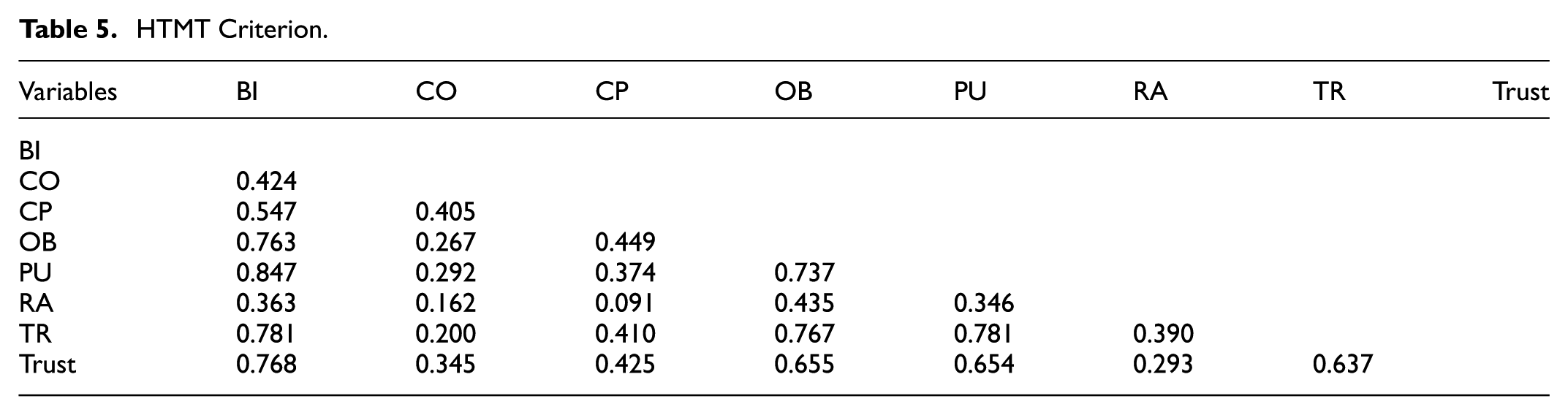
Discriminant validity is typically assessed through the Heterotrait-Monotrait ratio (HTMT) and the Fornell-Larcker criterion. As stated by Gefen et al. (2011), HTMT should be below 0.90. Additionally, the Fornell-Larcker criterion requires that the square root of the AVE for each construct should exceed its highest correlation with any other construct (Henseler et al., 2015). The results satisfying the Fornell-Larcker criterion (Table 4). Table 5 indicates that the HTMT also meet the requirements.
Fornell-Larcker Criteria.

Note. The bolded diagonal values in the table represent the square root of the AVE for each construct.
HTMT Criterion.
Structural Model
Multicollinearity Test
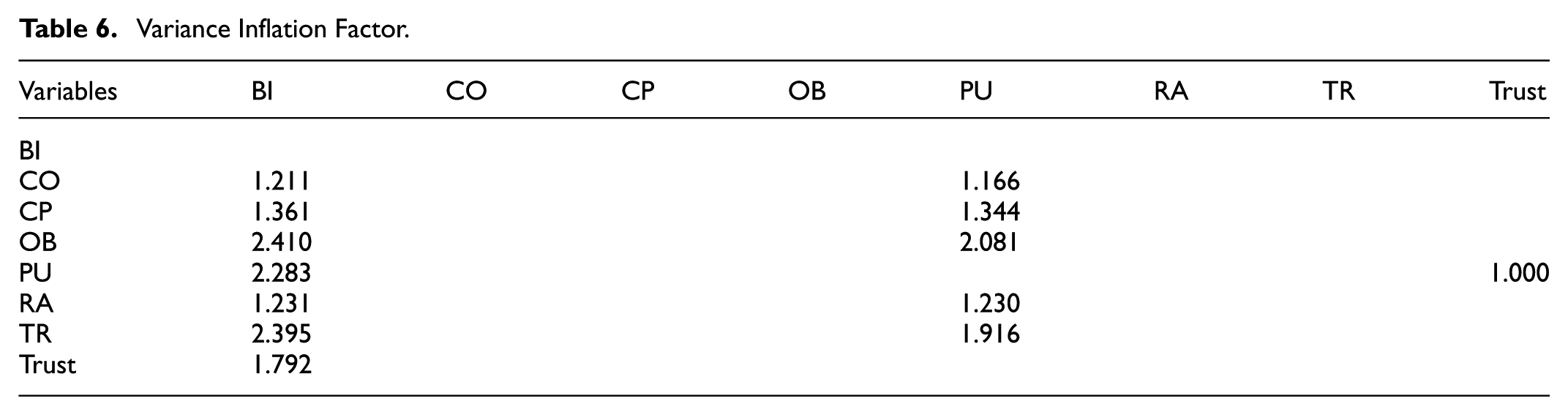
This study tested for multicollinearity in the model using the Variance Inflation Factor (VIF). According to the rule of thumb, all VIF values should be below 3.3 (Hair et al., 2021). As shown in Table 6, the VIF values for all variables in this study were below 3.3, which suggests that multicollinearity is not a significant issue in the model.
Variance Inflation Factor.
Hypothesis Testing
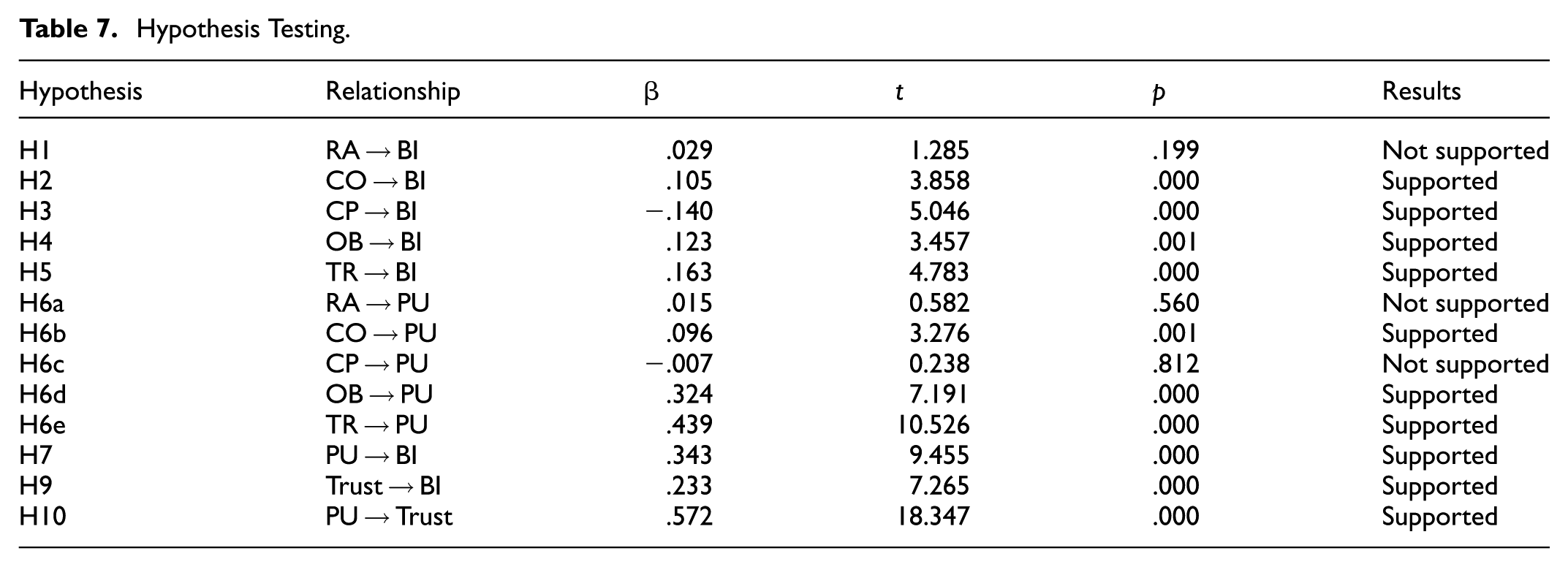
As shown in Table 7, the findings of this study are categorized into three aspects based on the endogenous variables: (1) the impact of predictors on BI, (2) the effect of predictors on PU, and (3) the effect of predictors on trust. Specifically, among the key direct predictors of BI, PU (β = .343; t = 9.455; p = .000) emerged as the most influential, with trust (β = .233; t = 7.265; p = .000), TR (β = .163; t = 4.783; p = .000), CP (β = −.140; t = 5.046; p = .000), OB (β = .123; t = 3.457; p = .001), and CO (β = .105; t = 3.858; p = .000). However, RA (β = .029; t = 1.285; p = .199) did not significantly impact BI. For the key direct predictors of PU, TR (β = .439; t = 10.526; p = .000) was the most influential, with OB (β = .324; t = 7.191; p = .000) and CO (β = .096; t = 3.276; p = .001). In contrast, RA (β = .015; t = 0.582; p = .560) and CP (β = −.007; t = 0.238; p = .812) did not significantly influence PU. For the key direct predictors of trust, PU (β = .572; t = 18.347; p = .000) was the most influential, highlighting the critical role of PU in the formation of trust.
Hypothesis Testing.
Coefficient of Determination
The R2 is used to measure the extent to which the variance of dependent variables is explained by independent variables. As shown in Table 8, PU has an R2 of .54 (moderate), trust has an R2 of .33 (moderate), and BI has an R2 of .73 (strong).
Explanatory Power of the Model.

Mediation Analysis
This study employed bootstrapping based on the PLS-SEM method (Nitzl et al., 2016) to conduct mediation analysis. The analysis aimed to explore whether trust mediates the link between PU and BI, as well as whether PU mediates the effects of RA, CO, CP, OB, and TR on BI. To validate the reliability of the findings, this study used the bias-corrected bootstrap method to calculate confidence intervals, as this method has been shown to effectively estimate mediation effects and control for potential biases (Preacher & Hayes, 2008).
In distinguishing between full mediation and partial mediation, this study strictly followed statistical significance and theoretical support. Full mediation refers to a situation where the mediator fully explains the link between the independent variable and the dependent variable, evidenced by the non-significance of the direct effect and the significance of the indirect effect. Partial mediation indicates that the mediator plays a partial role in the influence between the independent variable and the dependent variable, while still maintaining a significant direct effect (Preacher & Hayes, 2008).
As presented in Table 9, both the direct and indirect effects of PU on BI are significant, indicating that trust acts as a complementary partial mediating role between PU and BI. Additionally, PU exhibits significant indirect effects in the relationships between CO, OB, and TR with BI, while the direct effects are also significant. This demonstrates that PU acts as a complementary partial mediator between these factors and BI. However, for the effects of RA and CP on BI, the indirect effects of PU are not significant, suggesting that PU does not mediate the relationships between these factors and BI. The distinction of all mediation effects relies on the significance of the direct and indirect effects, and the robustness of these paths was further validated through bootstrap confidence intervals.
Mediation Analysis.

Note. NM = no mediation; CPM = complementary partial mediation.
Moderation Effect Analysis
Measurement Invariance Test Across Groups
Due to the gender imbalance in the sample, this study first tested for potential measurement invariance issues using the Measurement Invariance of Composite Models (MICOM) procedure before examining the moderating effect of gender (Henseler et al., 2016). According to Hair et al. (2021), conducting multigroup analysis requires establishing both structural invariance (i.e., the same parameters and estimation methods) and composite invariance (i.e., the same indicator weights). In Smart PLS 4.0, structural invariance is automatically set, while composite invariance is assessed using the permutation algorithm (Hair et al., 2021). The path models and data processing used in this study for different gender groups are the same, which is a necessary requirement for establishing structural invariance. Additionally, since the models for both groups are estimated using identical algorithm settings, structural invariance is confirmed. Composite invariance is confirmed if the correlation values of the calculated scores exceed the 5th percentile of the empirical distribution (Henseler et al., 2016). The original correlations between the composite scores exceed the 5th percentile of the empirical distribution (Table 10), strongly supporting the establishment of composite invariance (Hair et al., 2021). Overall, measurement invariance between the two groups is confirmed.
MICOM Step 2_Compositional Invariance: Across Males Versus Females.

Moderation Analysis
Without considering the moderating effect, the R2 for trust was 0.33, indicating that PU accounted for 33% of the variance in trust. After incorporating the interaction term, the R2 value rose to 0.36, representing an improvement of 3% in the variance explained for trust. This result indicates that gender, as a moderating variable, enhances the explanatory capacity of the model. The analysis showed that PU has a strong positive impact on trust (β = .768, SE = 0.054, t = 14.191, p < .001). Additionally, gender significantly moderates the link between PU and trust (β = −.302, SE = 0.075, t = 4.036, p < .001). Specifically, the influence of PU on trust is stronger for male participants, supporting H12 and confirming that gender significantly moderates the link between PU and trust. Table 11 provides a detailed summary of the moderation analysis results.
Moderation Analysis.

Furthermore, to better understand the specific pattern of the moderating effect, a simple slopes analysis was conducted (see Figure 2). Figure 2 illustrates that under conditions of low PU, female university students exhibit higher levels of trust in GAI compared to male students. However, under conditions of high PU, the effect of PU on trust is more pronounced for male students. This indicates that gender not only moderates the relationship between PU and trust but also exhibits different moderation patterns at varying levels of PU. This analysis provides further empirical evidence for the role of gender in the process of trust formation toward technology.
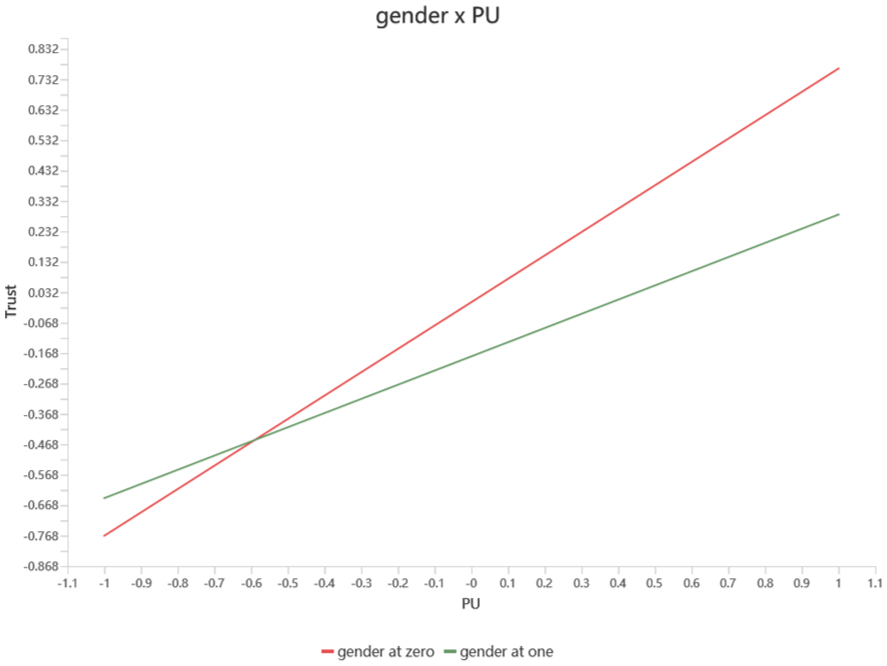
Simple slopes analysis.
Discussion
IDT and BI
The RA of GAI does not show a significant correlation with university students’ BI, this result contradicts the findings of S. Y. Wang et al. (2020). S. Y. Wang et al. (2020) surveyed 178 teachers’ BI to use AI tutoring systems and found that RA and CO significantly influenced BI. However, in this study, the RA of GAI did not significantly affect university students’ BI. The reason for this may lie in the varying influence of RA in different contexts. Although university students recognize that GAI outperforms other learning tools in certain areas, they may suppress their intention to use such tools, especially those requiring higher technical skills, due to concerns about plagiarism and ethical issues (Cotton et al., 2023; Rasul et al., 2024). Therefore, although GAI has technical advantages, students may fail to translate these advantages into BI when faced with ethical and academic integrity concerns, thereby affecting the role of RA in influencing BI. Secondly, the extent to which students understand GAI may also be a key factor influencing their BI. The technological advantages of GAI in certain areas may not necessarily match the actual learning requirements of university students (Koutromanos et al., 2023). For example, students may be more in need of basic learning tools rather than high-tech writing or programming assistance tools. If students fail to recognize the potential application value of GAI in their daily learning, the RA are unlikely to translate into BI. Additionally, individual differences may play a moderating role in the relationship between RA and BI (Abulail et al., 2025). For example, students’ familiarity with technology and their openness to innovative tools may influence their perception of the advantages of GAI. Technologically proficient students, or those in disciplines that rely more on digital tools, may be more likely to recognize the advantages of GAI and, therefore, be more inclined to form a positive intention to use it. Consequently, future research should further explore how individual differences impact the relationship between RA and BI to gain a more comprehensive understanding of GAI’s role across different student groups.
The CO of GAI positively influences university students’ BI, aligning with the results reported by Raman et al. (2024). Raman et al. (2024) adopted a mixed-methods approach, integrating qualitative and quantitative research, to comprehensively examine the factors affecting university students’ BI to adopt GAI. Their findings highlighted the significant influence of CO, CP, and TR on students’ BI. Specifically, when GAI aligns with university students’ beliefs, values, and needs, their BI to use it is significantly enhanced (Shin et al., 2022). For university students, the ability of GAI to support quick transitions between different subjects enhances learning efficiency while preventing disruption to their existing learning habits, thereby increasing their BI (S. Y. Wang et al., 2020).
The CP of GAI negatively impacts university students’ BI to adopt it, consistent with the findings of Torres Urdan and Marson (2024). Through interviews, Torres Urdan and Marson (2024) demonstrated that technological CP is a major obstacle to users’ acceptance of new technologies. As the CP of technology increases, users’ willingness to adopt it decreases. When university students are required to master additional skills or abilities to use new technology, their BI to use it often declines significantly (Raman et al., 2023). Therefore, if the CP of GAI is too high, it may directly reduce students’ BI to use it. The added operational difficulty and learning costs could make them hesitant to adopt the technology, thereby decreasing its acceptability.
The OB of GAI positively impacts university students’ BI to adopt it, aligning with the findings of Al-Rahmi, Yahaya, Aldraiweesh, et al. (2019). Al-Rahmi, Yahaya, Aldraiweesh, et al. (2019) examined the critical factors influencing university students’ adoption of e-learning systems and found that OB played a significant role in this process. Specifically, when university students observe that their peers are widely using GAI to assist in learning, social influence can drive them to develop a strong interest in the technology, thus encouraging them to adopt it (Raman et al., 2024). Moreover, the visibility of GAI’s functionalities and advantages in real-world applications, such as quickly generating learning resources or solving academic problems, further enhances its appeal, motivating more university students to explore and adopt this emerging technology (Ayanwale & Molefi, 2024).
The TR of GAI positively impacts university students’ BI to adopt it, aligning with the findings of Ayanwale and Ndlovu (2024). Ayanwale and Ndlovu (2024) studied the main determinants influencing university students’ adoption of chatbots and revealed that TR significantly boosts users’ BI to adopt the technology. Specifically, when university students can have the opportunity to try out new technology before fully adopting it, they can more intuitively experience its functionalities and advantages and recognize its potential benefits for learning. This not only helps alleviate their concerns about unfamiliar technology but also boosts their confidence in using it, which in turn raises the chances of continued use in the future (Pinho et al., 2021). For GAI, its flexible TR provides students with opportunities to explore and familiarize themselves with its core features, significantly increasing their BI to use it.
IDT, PU, and BI
University students’ PU of GAI significantly positively influences their BI to adopt it, aligning with the findings of K. Li (2023). K. Li (2023) conducted a survey of 279 university students’ willingness to use AI systems and revealed that PU is a strong positive predictor of users’ BI to adopt the technology. When university students recognize that some core functions of GAI, such as providing personalized services and instant feedback, can significantly enhance their learning efficiency, they tend to exhibit a higher intention to adopt it (Ayanwale & Molefi, 2024). In other words, when students perceive GAI as having practical value for their academic or personal goals, this perception further strengthens their tendency to adopt the technology over the long term (Al-Abdullatif & Alsubaie, 2024).
The RA of GAI does not show a significant correlation with university students’ PU, which is inconsistent with the findings of Zahrani (2021). Zahrani (2021) studied business students’ attitudes toward using MOOCs and found that RA significantly enhances users’ PU. However, this research did not find evidence supporting that RA significantly impacts PU. A possible reason for this is that the RA of GAI may be particularly apparent in certain contexts, but if these advantages do not align with university students’ actual needs, even with clear technological advantages, students may not perceive its usefulness. According to the IDT (Rogers, 2003), RA only exerts an effect when it aligns with the needs of the user. For example, if the advantages of GAI are mainly in areas requiring high technical skills (such as professional writing or programming), in contrast, students’ actual needs are more inclined toward basic learning support or everyday writing tasks, the technological RA may not translate into PU (C. Wang, 2024). Furthermore, factors like individual differences, including students’ technology acceptance and academic background, could moderate the link between RA and PU (L. Pham et al., 2025). For example, technologically proficient students may be more likely to perceive the advantages of GAI, while students in disciplines with lower technological requirements may overlook these advantages. Future studies could investigate these moderating factors to provide a deeper insight into how RA impacts PU in different contexts.
The CO of GAI positively influences university students’ PU, aligning with L. T. T. Pham et al. (2023). L. T. T. Pham et al. (2023) investigated determinants of smart home technology adoption in Vietnam and found that both CO and TR significantly enhance users’ PU. Within university students’ learning environments when the information provided by GAI aligns with the knowledge they typically acquire in their daily academic studies and can seamlessly integrate into their learning processes, students are more inclined to recognize the technology as beneficia (W. W. Zhang & Hou, 2024). For example, if students are accustomed to using specific tools for learning, the CO of GAI allows them to unlock additional features on these tools (such as automatic content generation, rapid information retrieval, etc.), which greatly enhances university students’ PU of the technology (Zahrani, 2021).
There is no significant correlation between the CP of GAI and university students’ PU, contradicting the findings of Al-Rahmi, Yahaya, Alamri, et al. (2019) in their study on university students’ adoption of MOOCs. Al-Rahmi, Yahaya, Alamri, et al. (2019) discovered that CP significantly impacts users’ PU of technology. However, this study did not confirm this association. A possible explanation is that university students often have a weaker perception of technological CP, and operational CP is insufficient to significantly influence their judgment of a technology’s usefulness. As a research population, university students generally possess high levels of technological literacy and extensive experience with complex technologies, making them more tolerant of the CP of GAI. Furthermore, they tend to focus more on the practical advantages of the technology, like enhancing learning efficiency or streamlining tasks, where its functionality and utility often take precedence over the influence of CP on PU (Al-Rahmi, Yahaya, Aldraiweesh, et al., 2019; S. Y. Wang et al., 2020).
The OB of GAI positively influences university students’ PU, aligning with W. W. Zhang and Hou (2024). W. W. Zhang and Hou (2024) in their study on the willingness of 529 university teachers to use AI-assisted teaching systems, highlighted that both OB and RA significantly enhance users’ PU of the technology. When students can visually observe the application results of GAI (such as automatically generated articles, images, code, etc.), they are more likely to understand its practical functions and potential. This intuitive demonstration helps students perceive the actual value and usefulness of the technology, thereby increasing their BI and sense of identification with it (Al-Rahmi, Yahaya, Aldraiweesh, et al., 2019; Y. Wang, Sani, et al., 2024).
The TR of GAI positively affects university students’ PU, consistent with the findings of Y. Wang, Sani, et al. (2024). Y. Wang, Sani, et al. (2024) found in their study on the acceptance of smart homes by 387 elderly users that TR is a strong predictor of PU. Before any new technology is used, its understanding typically remains at a theoretical level. However, through hands-on experimentation with GAI, students can directly experience the value and practicality of the technology. Successful applications during the trial process can enhance students’ identification with and trust in the technology, thereby increasing their PU of GAI. For example, when students use GAI to assist with writing, problem-solving, or completing other tasks, they can personally experience its efficiency and helpfulness, making it easier for them to perceive the technology as useful (C. K. Y. Chan & Hu, 2023; Yuen, Cai, et al., 2020).
PU does not show a significant mediating effect between the RA of GAI and university students’ BI to use it, contrary to W. W. Zhang and Hou (2024). W. W. Zhang and Hou (2024) found that RA significantly increased PU, which indirectly boosted university teachers’ BI to use AI-assisted teaching systems. However, this study did not validate this mediating effect. Possible reasons are as follows: first, if university students can directly perceive the obvious advantages of GAI over traditional tools or other technologies (e.g., more efficient content generation, smarter assistance features, etc.), they may develop a BI to use it directly based on these advantages, without necessarily going through PU as a mediator (S. Y. Wang et al., 2020). Second, RA can fully reflect the usefulness of the technology, thereby directly influencing BI, which reduces the necessity of PU as a mediator (Raman et al., 2024). Therefore, this study found no evidence of PU mediating the relationship between the RA of GAI and university students’ BI to adopt it.
PU does not show a significant mediating effect between the CP of GAI and university students’ BI to adopt it, this contradicts the findings of Al-Rahmi, Yahaya, Alamri, et al. (2019). Al-Rahmi, Yahaya, Alamri, et al. (2019) found that in the context of university students’ adoption of COOMS systems, CP can indirectly influence BI by either enhancing or diminishing PU. However, this study did not validate this mediating effect, and the possible reason lies in the weak association between CP and PU in the sample of this study. For example, students may perceive a complex GAI tool as highly effective for academic writing or data analysis, even if it is difficult to operate. On the other hand, for university students, CP may represent a short-term challenge rather than a fundamental factor influencing their BI. Given their generally high level of technological literacy and strong ability to accept complex technologies, students may initially feel confused when encountering CP, but as they learn and adapt, their BI is unlikely to be significantly affected (Torres Urdan & Marson, 2024; W. W. Zhang & Hou, 2024).
PU partially mediates the link between the CO and TR of GAI and university students’ BI, aligning with L. T. T. Pham et al. (2023). L. T. T. Pham et al. (2023), based on the TAM and Innovation Integration Theory, studied the BI of Vietnamese users to adopt smart home technologies. Their results indicated that PU as a vital mediator in explaining how CO and TR relate to BI. This study found that when GAI aligns with students’ learning habits and needs, and its ability to seamlessly integrate into their existing academic routines is confirmed through trial, it further strengthens students’ belief in the technology’s usefulness, thereby enhancing PU (Alshammari & Babu, 2025; Alyoussef, 2023; Ayanwale & Ndlovu, 2024; W. W. Zhang & Hou, 2024). At the same time, the enhancement of PU effectively alleviates students’ doubts about GAI, making it easier for them to translate positive experiences into BI (Y. Wang, Sani, et al., 2024; Yao & Wang, 2024).
PU acts as a complementary partial mediator in the relationship between the OB of GAI and university students’ BI, consistent with the findings of Al-Rahmi, Yahaya, Aldraiweesh, et al. (2019). Al-Rahmi, Yahaya, Aldraiweesh, et al. (2019) discovered that OB indirectly affects users’ BI by enhancing PU in their study on university students’ adoption of e-learning systems. In this study, OB indirectly promoted BI by enhancing university students’ perception of the technology’s usefulness. When students observed the actual application outcomes of GAI, they may interpret these external outcomes as evidence of the technology’s usefulness, such as realizing that GAI can improve learning efficiency or simplify tasks. This recognition not only reduced their doubts about the technology but also further enhanced PU (Yuen, Wong, et al., 2020). The increase in PU, in turn, directly facilitated students’ willingness to try GAI, ultimately driving an increase in their BI to use it (Yao & Wang, 2024; W. W. Zhang & Hou, 2024).
PU, Trust, and BI
The trust that university students have in GAI significantly boosts their BI, aligning with Chi et al. (2023). Chi et al. (2023) examined the factors affecting the BI to adopt AI robots among users in China and the United States, finding that trust is a significant predictor of BI. Firstly, the trust that university students place in GAI stems from their perceptions of the technology’s accuracy, privacy protection, and maturity. When students believe that GAI can provide accurate information and effectively protect personal privacy, they show stronger willingness to adopt and use it (Aoki, 2020; Kang et al., 2024). Furthermore, trust reduces uncertainty and the perception of risks during usage, making students more willing to try new technologies (Ding & Najaf, 2024). This result underscores the pivotal role of student trust in facilitating the adoption of GAI.
University students’ PU of GAI significantly positively influences their trust, which aligns with Ma et al. (2020). Ma et al. (2020), in their study on adult users’ trust in autonomous vehicles, highlighted that PU is the only significant predictor of trust. If students perceive that GAI has practical applications in academics, learning, or daily life and believing it can effectively improve efficiency, solve problems, or provide valuable information, they will develop a positive perception of the technology. This positive experience and expectation enhance their trust, as they are more inclined to trust technology that demonstrates practical utility. In other words, PU allows students to recognize the value of GAI, thereby building trust in the technology and fostering its further adoption and use (Viberg et al., 2024; J. Z. Wang et al., 2021).
The trust that college students place in GAI partially mediates the effect of PU on BI, aligning with J. Z. Wang et al. (2021). J. Z. Wang et al. (2021) found that in their study on the BI to use intelligent transportation services, PU indirectly influenced BI through its effect on trust. In this study, when university students have a higher PU of GAI, it enhances their favorable assessment of the technology and fosters the development of trust (Zuo et al., 2025). Trust not only alleviates students’ concerns about the uncertainty and potential risks associated of the technology, but also promotes their long-term recognition of its value, further increasing their BI (Benk et al., 2025; Viberg et al., 2024).
The Moderating Role of Gender
Gender significantly moderates the link between PU and trust in university students’ adoption of GAI, aligning with Odusanya et al. (2020) on user trust in e-retail platforms. Odusanya et al. (2020) highlighted that gender significantly influences the development of user trust. This study further validates the SRT, which suggests that male university students tend to focus more on the functionality and efficiency of technology. When they perceive the technology as useful, trust is significantly enhanced. Therefore, the improvement in PU serves as the primary driving force behind trust among male university students (Aldasoro et al., 2024; Kim et al., 2023). In contrast, for female university students, the path effect of PU on trust is weaker. Research suggests that female students tend to consider factors such as transparency, privacy protection, and platform security when building trust (Aldasoro et al., 2024; Kim et al., 2023). This difference indicates that while female university students also value PU, the formation of their trust relies on a broader set of trust mechanisms.
Implications
Theoretical Implications
Firstly, this study advances the development of both the IDT and TT by integrating them into the context of emerging technology adoption. The research validates the mediating role of PU between IDT and usage intention, further deepening the application of IDT in the technology adoption process. Especially in the field of GAI adoption, PU has been identified as a crucial determinant in influencing technology adoption decisions. This study broadens the scope of the IDT in technology adoption, offering a novel extension beyond previous research. For instance, Raman et al. (2024) emphasizes the impact of technological features on adoption decisions, whereas this study further validates the mediating role of PU, underscoring its central position in the adoption of emerging technologies. Meanwhile, the study reveals trust as a mediator between PU and usage intention, addressing a gap in the literature on trust within in technology adoption. As a key psychological factor, trust significantly influences students’ willingness to accept and use GAI technology, underscoring its importance in the technology adoption process. By integrating these two theoretical frameworks, this study offers a fresh lens on mediation mechanisms in emerging technology adoption and offers theoretical support for the promotion and application of GAI and similar technologies. This also contributes to the further development of IDT and TT in technology adoption research.
Secondly, this study reveals that gender moderates the link between PU and trust. By introducing gender as a moderator, the study explores the differences between male and female individuals in how PU affects trust. Results reveal that gender significantly affects the association between PU and trust. This finding addresses the limitations in current technology adoption research, which has often overlooked key demographic variables, and enriches the theoretical exploration of gender differences in the influence mechanisms within the new technology acceptance model. Existing literature tends to focus on the characteristics of the technology itself, often overlooking the potential impact of personal characteristics (such as gender, cultural background, etc.) on technology adoption (Al-Abdullatif & Alsubaie, 2024). This study provides a new perspective for theoretical development by incorporating gender differences, advancing the understanding of how demographic variables influence the technology acceptance process.
Finally, the study empirically verifies the mediating effects of PU and trust in BI. Through empirical investigation, this research confirms the mediating effects of PU and trust in college students’ willingness to use GAI, particularly the supplementary partial mediating effects of trust between PU and BI. This finding deepens understanding of how trust functions in technology adoption and offers fresh empirical support for the theoretical exploration of mediating variables in study for technical acceptance, enriching the theoretical understanding of the intrinsic processes behind technology adoption behaviors. Previous research has largely viewed technology adoption as a simple causal chain. In contrast, this study reveals the intricate and multi-faceted nature of technology adoption behavior by validating the mediating roles of PU and trust, emphasizing the interactive effects between different psychological variables (W. T. Wu et al., 2022).
Practical Implications
For educators, they should fully integrate GAI tools into classroom activities and demonstrate their advantages in enhancing learning efficiency and personalized learning pathways through specific applications. First, educators can design interactive classroom activities, such as having students use GAI tools for assignment grading, real-time feedback, grammar correction, etc., to help students better grasp the learning content. This approach has been shown to significantly enhance students’ learning outcomes in several studies. For example, the study by Zou et al. (2025) indicates that instant feedback can significantly improve students’ learning effectiveness, particularly in personalized learning. By leveraging the features of GAI tools, educators can also provide personalized learning paths for students through real-time data analysis. GAI tools can automatically modify the difficulty of learning content according to students’ performance and progress, helping them learn at an appropriate level of challenge and preventing the loss of motivation caused by tasks that are too simple or excessively challenging (Choi, 2025). This innovative application enhances the educational experience by making it more flexible and precise to individual differences and needs. Educators should also consider setting up low-risk pilot projects, allowing students to familiarize themselves with the features of GAI tools in a pressure-free environment and gradually build trust in the technology. The study by Y. Li et al. (2025) indicates that low-risk exposure environments help reduce students’ technology anxiety and resistance. In such environments, students can freely explore the use of tools, gradually adapt to new technologies, and thereby enhance their trust in and acceptance of the technology. Beyond the classroom, educators can create discussion groups or social platforms for students to discuss and exchange ideas on how to use GAI tools, further enhancing their recognition and trust in the technology. This approach aligns with Social Learning Theory (Bandura, 1977), which emphasizes deepening the understanding and acceptance of new technologies through peer interaction and shared experiences. Additionally, educators should consider the influence of gender differences on technology acceptance. Research indicates that gender moderates the relationship between PU and trust. Therefore, educators can design customized training content based on gender differences to help students overcome potential usage barriers and increase acceptance and engagement. For example, creating more interactive usage experiences for female students can help enhance their confidence and sense of identity in using GAI tools.
For developers of GAI, they should focus on optimizing the functionality and usability of their tools to enhance PU. For example, integrating features like personalized suggestions, smart learning analytics, and instant feedback would enable students customize their learning speed and content according to their individual needs, thereby improving learning efficiency and engagement. Developers should also ensure that the tool’s interface is simple and intuitive, allowing students to quickly get started and continue using the tool. Furthermore, developers should prioritize data privacy protection and algorithm transparency to increase students’ trust in the technology. For instance, J. Li et al. (2023) point out that consumers’ trust in technology is closely related to data privacy protection. Therefore, providing clear algorithm explanations and data usage terms will help students understand how their data is being used, thereby fostering trust. To help students better experience the practical value of GAI tools, developers can organize interactive online or offline activities and offer free trial periods, allowing students to experience the tool’s features without taking on any risks. According to the study by J. Zhang et al. (2025), experience-based promotional strategies can effectively enhance user acceptance and engagement. Developers should also regularly collect user feedback to identify pain points and needs from both students and educators during use, and continuously optimize the tool based on this feedback to enhance the user experience.
Limitations and Future Research
This study integrated the IDT and TT to construct an interdisciplinary model that explores university students’ BI to use GAI. This makes a notable contribution to the theoretical advancement in this field. However, the study carries some certain limitations, offering important opportunities for future research. First, this study mainly examines the mediating role of PU and trust, along with the moderating effect of gender on the link between PU and trust, without considering other potentially important variables such as learning environment or technical support. Future research could further incorporate these variables to refine the existing theoretical framework and deepen the understanding of the mechanisms underlying technology adoption. For example, the mixed-method design proposed by S. T. S. Chan et al. (2024) could be adopted, combining quantitative data (such as changes in BI) with qualitative data (such as user emotional responses and platform usage experiences) to comprehensively assess the adoption effects of GAI. This approach helps validate the theoretical framework of this study and offers additional empirical support to deepen the understanding of GAI’s practical applications in education and other fields. Secondly, this study employs a cross-sectional design, and the data only reflect students’ technology adoption behavior at one specific time, failing to capture the dynamic changes in BI. Future research should adopt a longitudinal design to explore the changes in BI to use GAI at different stages. Thirdly, the unequal gender distribution within the sample could affect the applicability of the study’s findings. In this study, females accounted for as much as 71.8% of the sample, which may be related to the characteristics of the participants’ majors and institutions. Specifically, students in the humanities and social sciences made up 68.6% of the sample, while students from science and engineering fields represented only 31.4%. Since the proportion of female students is typically higher in humanities and social sciences, this likely resulted in a noticeably higher number of females than males in the overall sample. Although this study analyzed the moderating effect of gender and conducted multigroup invariance analysis to address the potential impact of gender imbalance on the results, future research should consider using methods such as weighted analysis to further explore the impact of gender differences on moderating effects, thereby enhancing the validity and generalizability of the findings. Furthermore, future studies should strive to achieve a more balanced gender distribution to improve the representativeness and applicability of the research results. Finally, this study did not delve deeply into the applicability of PU and trust across different cultural contexts or educational fields. Future research could further validate the model’s universality across diverse cultural or disciplinary settings, providing more targeted guidance for technology adoption strategies.
Conclusion
This study systematically examines the main factors affecting university students’ BI to use GAI. It focuses on analyzing the mediating role of PU in how RA, CO, CP, OB, and TR influence BI, the mediating effect of trust between PU and BI, and the moderating influence of gender on the relationship between PU and trust. Self-reported data from 586 university students were gathered via the Wenjuanxing platform, and 12 hypotheses were empirically examined, with most of the results supporting the findings. The research findings reveal that among the factors affecting BI, PU is the strongest predictor, followed by trust, TR, CP, OB, and CO. RA does not exert a significant influence on BI. Among the predictors of PU, TR has the most significant direct effect, followed by OB and CO, while RA and CP have no significant impact on PU. Additionally, PU is found to be the only significant predictor of trust. Mediation analysis demonstrates that trust functions as a partial mediator between PU and BI. Meanwhile, PU also functions as a partial mediator for the effects of CO, OB, and TR on BI. However, PU does not mediate the effects of RA and CP on BI. Furthermore, Gender significantly moderates the link between PU and trust. After incorporating the interaction term, the variance explained by trust increased by 3%, further validating the significance of gender as a moderating variable. These findings offer theoretical insights into the mechanisms behind university students’ adoption of GAI, while also offering valuable guidance for advancing the application of related technologies in educational practices.
Footnotes

Ethical Considerations
The researchers confirms that all research was performed in accordance with relevant guidelines/regulations applicable when human participants are involved (e.g., Declaration of Helsinki or similar). This study was approved by the Ethics Committee of Guangdong Mechanical & Electrical Polytechnic (Approved no. 2025-0016).
Consent to Participate
The participants received oral and written information and provided written informed consent before participating in the study.
Author Contributions
Conceptualization: Tao Luo, Shuyan Cao; Methodology: Tao Luo; Formal analysis and investigation: Tao Luo; Writing—original draft preparation: Tao Luo; Writing—review and editing: Tao Luo; Supervision: Tao Luo. All the authors have read and agreed to the published version of the manuscript.
Funding
The authors disclosed receipt of the following financial support for the research, authorship, and/or publication of this article: This work was supported by the 2022 Guangdong Province Youth Research Co-construction Project (No. 2022GJ030).
Declaration of Conflicting Interests
The authors declared no potential conflicts of interest with respect to the research, authorship, and/or publication of this article.
Data Availability Statement
The data that support the findings of this study are available on request from the corresponding author.