




Abstract
This study explores the skill demand and supply of the current Moroccan urban labor workforce. It seeks to understand the experience of skill mismatch, and how it affects employability. Using semi-structured interviews and a phenomenological approach, the study explores the nature of job queues as informed by recruiters and educators. A total of 27 interviews were conducted with recruits, recruiters, and university professors, all of whom were selected using a criterion-based approach coupled with snowball sampling. Over-education was affirmed among employees, and the findings yielded a crossover of skill sets. The job queue for a balanced labor market is oriented towards personal attitudes and capabilities related to the field of study. Finally, responses from both recruiters’ and professors’ interviews yielded a framework of education-job matches for the demand-supply sides, and oriented workplace-based employability.
Introduction
Education investment determines the formation of human capital, which is crucial for sustainable economic growth. Against this backdrop, there are two key players, the industrial sector, and educational institutions. Recognized as a key factor in graduate employability, the industrial sector must work in partnership with other stakeholders to provide students with employment opportunities after graduation. Ideally, key players in the labor market should align industry requirements with the outcome of graduates’ education and training (Martin & Muñoz de Luna, 2023). For instance, educational institutions provide graduates with internships (Chen et al., 2018), work-integrated learning (WIL; Jackson, 2016), and curriculum development based on input from relevant stakeholders (Gu et al., 2018). These best practices notwithstanding, there continues to be a labor and skill mismatch.
While analyzing the origins and outcomes of this mismatch was previously deemed a labor market quandary, recent times have seen the appraisal of the inadequate skills obtained and cultivated by graduates as an important conversation. International organizations and governments are now prioritizing investing in studies on mismatched skills because of their negative cost on social welfare and overall fiscal performance (OECD & Canada Statistics, 2005; Organization for Economic Co-operation and Development, 2012; Pinheiro & Pillay, 2016). Skill mismatch occurs when personnel’s specific and overall capabilities are not concurrent with those expected by their jobs (Organization for Economic Co-operation and Development, 2012). Furthermore, the International Labour Organisation (ILO) defines this phenomenon as an inconsistency between labor market demands and educational graduates’ skills (European Centre for the Development of Vocational Training, 2015; McGuinness et al., 2017a).
Skill mismatch includes the elements of under- and over-qualification. Additionally, skill mismatches can manifest as vertical mismatches, skill shortages, skill gaps, and skill obsolescence. This phenomenon has led to a broad range of studies observing the association between skill mismatch and its effect on labor productivity (Figueiredo, 2019a; Flisi et al., 2017; Maslov & Zhong, 2020; Sloane, 2020).
Graduates who are over- or under-qualified for job requirements experience a vertical skill mismatch (Chevalier, 2003; Rudakov et al., 2019). In contrast, a horizontal skill mismatch occurs when an open job position cannot be filled with appropriately skilled employees (McGuinness et al., 2017b; Nordin et al., 2010; Robst, 2007).
Additionally, there are three approaches used to evaluate the concept of skills mismatch: subjective, objective, and based on existing facts (e.g., PIAAC, the World Bank database, and LFS). It is estimated that ‘if higher education systems do not align with labor market demands for skills, and if students do not anticipate the impact of poor education choices, then skills gaps will grow’ (Figueiredo, 2019b, p. 2). As such, a skill mismatch is detrimental to a country’s economic status.
Morocco ranks 5th in Africa among lower-middle-income countries in terms of GDP volume. Considered the most competitive economy in Northern Africa, its GDP per capita was estimated to have grown by 2.1% from 2010 to 2019, which is higher than the MENA average of 1.0% (Dadush, 2019). Between 2014 and 2019, its GDP grew by approximately 3%, a very respectable performance compared to its peers in the region. Consequently, some positions were formed, but it was still inadequate to address the influx of augmented labor supply. As in many other MENA countries, Morocco’s unemployment percentage (model ILO estimate) declined over this period, but remains near 9.01% (World Bank Group, 2018). Moreover, this provides only a partial picture of the country’s employment situation (Figure 1).
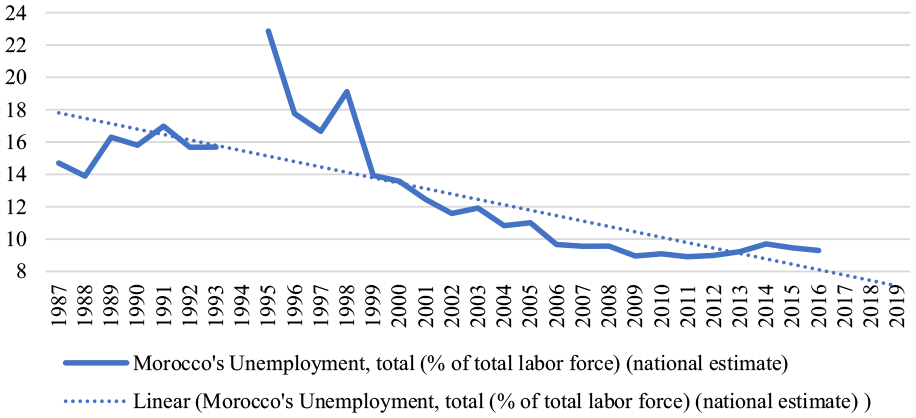
Morocco’s unemployment total rate (% of the total labor force).
Morocco’s skill gap deficiencies remain serious and require a more deliberate relationship between universities and labor market authorities. One way to bridge this disparity is to ensure that employees’ education level improves after entering the workforce (Eisenberg et al., 2013). For example, cultural training can cognitively and behaviorally increase employees’ cultural intelligence (Rehg et al., 2012), although this is not sufficient on its own. While the mismatch phenomenon has been widely acknowledged and reported in Morocco (Dadush, 2015, 2019), some questions remain without answer. Is the Moroccan urban worker overeducated or under-skilled? What skills are recruiters looking for? What are the characteristics of queued jobs? This study aims to answer these questions and thus contribute to the literature on employability and skills in Morocco.
Literature Review
Employability and Skills Mismatch
The skills gap between what graduates need in modern productive organizations, and what universities transfer to future workers has necessitated various policymakers to guide the processes and mechanisms of educational systems worldwide. In discussing this issue, scholars and practitioners have examined how to increase the human capital of new graduates, and ensure that their transitions into the workplace are smooth, while investigating whether increased education facilitates higher levels of human capital (Battu & Bender, 2020).
Examining the competencies of a newcomer in the labor market includes assessing whether the person is employable from the perspective of recruiters. An employer's view of employability extends beyond having particular knowledge, skills, and attributes, also including work readiness (Winterton & Turner, 2019). Work readiness requires graduates to possess specific degree competencies together with a set of “generic or transferrable skills” that can be applied to multiple occupations and industries (R. Bennett, 2002; Carter et al., 2019).
According to the literature, employability is a complex economic activity encompassing various aspects. The skill formation market has two sides: supply and demand. The supply side refers to everything offered to enable someone to learn, including teaching, training, learning resources, and learning environments (Green, 2013, p. 27). Academics propose that the notion of employability – encompassing cognitive and non-cognitive qualities such as abilities, information, comprehension, and potential–gives access to a job, and confirms success in the workplace. In contrast, the demand side refers to employers’ skill demands to describe skilled labor. Third, the demand-supply side combines two aspects of graduate employability: the micro aspect enhancing individual capabilities, and the macro aspect concerning structural factors. Equilibrium is achieved when both markets have equal supply and demand (Valiente et al., 2020).
The way scholars define employability has shifted from demand-led skill sets to a more holistic view of “graduate attributes (D. Bennett, 2019).” Employability includes softer transferable skills and person-centered qualities developed alongside subject-specific knowledge, skills, and competencies. These attributes also describe the collection of skills and competencies enabling individuals to navigate the labor market independently, and achieve their potential through sustained work. This is considered the main pillar of social and economic development for any country, and the key driver and measure of higher education outcomes (Lock, 2019).
An assessment of transnational corporation (TNC)’s skill policy produces many “highly educated” workers, only a few are talented enough to command the most desirable jobs. Zondag and Brink (2017) argues that university administrators have been preoccupied with the quality of teaching and research, rather than preparing individuals for the job market. As such, D. Bennett (2019) notes the importance of developing graduates’“capacity to locate, develop, and maintain meaningful employment throughout longer working lifetimes and diverse work contexts” (p. 4).
Workers’ potential for employment has been the focus of a growing literature, mostly addressing whether they are perceived as “employable” (Beaumont et al., 2016). In this regard, despite the increasing disparity in wealth between the “winners” (those who achieve higher positions) and the “losers” (those who do not), the knowledge-based economy holds out the hope that anyone “skilled enough” or “smart enough” or “committed enough” can make it to the top of their chosen field of work, and thus qualified as an employable (Brown & Hesketh, 2004). Recent research has highlighted the need to bridge the existing gap or misalignment between higher education providers and industry needs, highlighting policymakers' flawed interpretations of human capital and skill bias (Lauder & Mayhew, 2020).
Conceptual Framework
This study’s conceptual framework is based on human capital theory with qualifications and skills, proxies, and the labor queuing theory (Becker, 2009; Brown & Souto-Otero, 2020; Thurow, 1975b) as displayed in Figure 2.

Study’s conceptual framework.
Human capital theory assumes that a person’s agency is an investment that facilitates productivity. Given that education prepares an individual for employment, increases productivity, and facilitates economic growth (Maringe, 2015), educational institutions also drive societal changes (Salto, 2015). However, there is an inconsistency in the investment returns (Wahrenburg & Weldi, 2007). This is because the market does not always go with the demand side, which dictates a mismatch between qualifications and the kind of job a laborer gets. Human capital investment is wasted, as the market has a preference for laborers, while human capital believes that education and training make an individual more productive and concomitantly have higher earnings (Carneiro et al., 2010). One context that creates this contradiction is the queuing theory, as it orders workers and jobs, lifting some to the top and leaving some at the bottom of the continuum.
The Queue or queuing theory, also known as job competition theory, is based on Thurow’s (1975a) work. Thurow argues that employees do not sell their time to companies, but rather “rent” it from them in exchange for a salary and benefits. Therefore, queue theory describes the manner in which two queues match. The first is the “job queue,” or the order in which employers arrange available positions based on the level of their requirements and rewards. The second queue is the order in which workers are ranked according to their attractiveness to employers based on their expected training costs, the “labor queue.”
The ordering and composition of labor and job queues determine the matches between recruits and jobs. This theory of labor queuing is more concerned with the arrangement of queues and characteristics of the screening process. Thus, human capital theory is challenged in a more compelling manner. Accordingly, this indicates that there are two types of human capital to invest in, and concomitantly indicates dualism in the labor market. Additionally, it reveals the behavior of recruits resulting in excessive unemployment.
This phenomenological study provides an understanding of how the lived experiences of participants are situated in the dynamics of human capital theory and queuing theory. Education and productivity are directly or indirectly related to human capital and queueing theories, both of which are economic (Di Stasio & van de Werfhorst, 2016).
Methodology
Design
A phenomenological research method was adopted in this study to explore the skills considered important by human resources’ experts and taught in selected universities to inform the queue of jobs in the urban labor market (Giorgi, 2009; Moustakas, 1994). This interpretive inquiry (Creswell, 2013) was guided by human capital theory and job queuing theory (Burton-Jones, 2011; Di Stasio, 2017). Phenomenology emphasizes an individual's first-hand experiences, rather than the abstract experiences of others. Furthermore, it explains meaning from the perspective and experience of the individual (Tymieniecka, 1971, p. 57). As Cho (2001) stated, “from the perspective of the individual, phenomenology describes how human beings make sense of their everyday life” (p. 61). Moreover, to be eligible to participate in a phenomenological study, an individual must encounter the phenomenon in a significant way (Creswell et al., 2007; Moustakas, 1994). As workplaces change, Campbell (2018) used the phenomenological study to identify business graduates who are well-positioned to take advantage of new opportunities. We perceived that the reality of the job queue would ideally be interpreted by recruiters, personnel who develop competency profiles for jobs and evaluate candidates' competencies on a daily basis, persons whose main task is to train candidates towards recruitment, and graduates themselves.
Three rounds of semi-structured interviews were conducted to understand the participants’ lived experiences. Interviews were conducted from December 2020 to June 2021, and audio-recorded either face-to-face or via Zoom, transcribed verbatim, and checked for accuracy. The interviews lasted between 45 and 65 min. Auto-recordings were used to record the interviews for convenient storage of raw data. Permission to record was obtained with an informed consent form.
To establish the accuracy and reliability of the information gathered from the interviewees, the final themes were cross-checked with the participants to determine their accuracy (Creswell, 2013, p. 253).
Sampling
Purposeful sampling is used in qualitative research to identify and select cases with important information to maximize efficiency (Patton, 2002, 2015). The features of purposeful sampling are guided by expert judgment rather just random selection. It is designed to pursue depth and complexity (Teddlie & Yu, 2007). Understanding lived experiences marks phenomenology as a philosophy and the procedure involves studying a small number of key subjects through extensive and prolonged engagement to develop patterns and relationship (Bekele & Ago, 2022). The sample size depends on the research design. Generally, a qualitative sample size may best be determined by the study objectives, time allotted, and resources available (Patton, 1990). For phenomenological studies, Creswell (1998) recommends 5 to 25 participants.
The participants of this study are from three cohorts—graduates, human resource experts, and university professors. While purposeful sampling was used to recruit graduates, virtual snowball sampling was used to recruit human resources experts and professors through LinkedIn to reach our respondents effectively with low cost (Kozłowski et al., 2021).
Although it is possible to reach saturation in participant responses in qualitative research through 12 interviews, 6 interviews may be sufficient to provide a complete description of the concepts (Guest et al., 2006). This study interviewed nine key participants from each cohort–graduates, human resource experts, and university professors–and because we reached saturation from the seventh participant, we ensured that there were no newly emerging codes within the ninth interviewee.
Graduates
To determine the inclusion criteria for graduate participants, the researchers extracted the current transversal skills highly demanded by recruiters, and searched for those who qualified. They were identified with the help of senior managers. All participants were informed of the study purpose and nature during the recruitment phase and again at the start of each interview. In total, nine out of 12 selected graduates provided informed consent to participate (three males and six females; Table 1). This is considered a reasonable sample size in phenomenological studies (Trigwell & Richardson, 2003, p. 41).
Demographic and Basic Workplace Characteristics of Participants.

Note. GR = graduate pseudonym.
The inclusion criteria consisted of seven main skills that the best graduate should possess to be matched with a position in a work environment. These skills are transferable and crucial for employability, as follows:
i. Years of experience:
It is argued that the best workers have years of experience before they enter the labor market (2 years and above).
ii. Personal attributes:
Confidence, ‘Can do attitude’, Teach ability, ‘flexibility’, ‘being resilience in times of the crisis’, ‘willingness to learn.’
iii. Interpersonal skills:
‘communication attitude’, ‘ability to work effectively with heterogeneous team’, ‘ramifications for the workplace.’
iv. ‘Amicable personality’:
‘self-awareness’, ‘be passionate about the position’, ‘compassion towards others.’
v. Problem solving, creativity, flexibility, adaptability to changing demands.
vi. Technological skills
vii. Technical capabilities related to the position.
The selected participants were from four established finance companies that focused on trade, finance, consulting, and offshore industries. These industries have been chosen as they represent a high rate of recruitment in the urban area of Morocco.
The graduate sample was female dominated, with 60% female employees and only 30% males. The mean number of years of experience was three, which shows that the graduates were slightly seniors in the workforce.
Senior Human Resources Officers
Recruiters are people whose daily tasks comprise of assessing emerging capability profiles, jobs, and applicants’ skills (Gawrycka et al., 2020). The LinkedIn Sales Navigator (Professional) tool was used to send formal invitations to selected human resources professionals. A major advantage of the LinkedIn Sales Navigator (Professional) is that it quickly creates a vast network of potential respondents across industries. Contact invitations were sent out to persons who belonged to senior positions after checking their e-profiles and experience, followed with a personalized invitation letter and consent form (Yin, 2018). Nine HR experts were invited to participate in this study (Table 2).
Profile of Human Resources Experts.
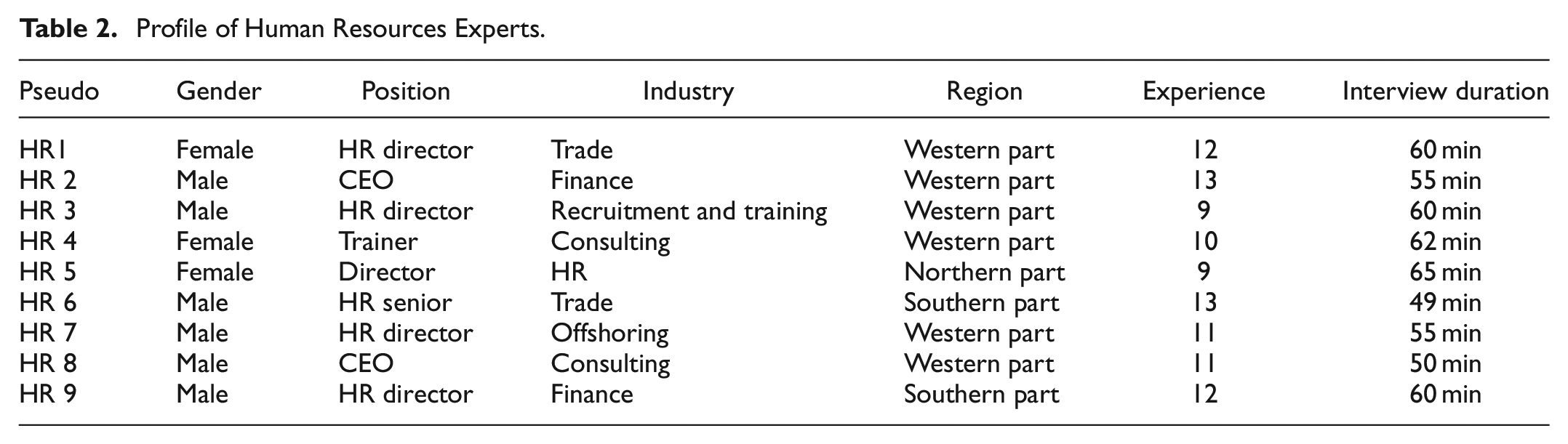
The sample appeared to be male-dominated. The mean number of years of experience was 10 in the recruitment and human resources profession as seniors or above. The mean shows the seniority of recruiters because of their proficiency in identifying recruits’ skills. The proficiency of the recruiters is ideally helpful in understanding the phenomenon and the recruiters’ lived experiences with skill mismatch. The interviews lasted from 49 to 65 min, with an average length of 57 min.
University Professors
Professors from four particular universities were purposefully selected to ensure coverage of urban areas. The universities that have the particularity to invite CEOs to discuss employability issues annually were selected.
The first university is an urban public university established in 1975, located in the eastern part of Morocco, with a total population per cycle of 56.65% bachelor’s degrees, 55.02% master’s degrees, and 45.54% doctoral degrees. The second university was established in 1979 and is located in the urban scientific city of Fes, with a total population of 51.47% bachelor’s degree, 40.90% master’s degrees, and 38.78% doctoral degrees. Established in 1989 in the northern part of the country, the third university has a total population of 52.21% bachelor’s degrees, 49.24% master’s degrees, and 43.28% doctoral programs. Also established in 1989, the fourth university in the southern part of the country has a total population per cycle of 48.86% bachelor’s degrees, 40.65% master’s degrees, and 32.25% doctoral programs. Nine university professors participated in the study (Table 3).
Profile of the Lecturers.

Note. PR = participant’s pseudonyms
The sample was dominated by women with a mean of 13 years of teaching experience, indicating their proficiency.
Instrumentation
In the phenomenological traditions, interviews are seen as in-depth questions and answer sessions that allow researchers to discover new relationships and patterns (Marshall & Rossman, 2010, p. 82). The researcher conducted in-depth, semi-structured interviews using broad, open-ended questions. An interview protocol was prepared to ensure the depth of the collected data.
Practically, the questions in the first few pilot interviews were inspired by the dominating phenomenological (hermeneutical) approach. Broad questions such as ‘Can you describe how you experienced entering the labor market after graduation over the past 2 years’ and ‘how was the transition from graduation to recruitment expressed in your career,’ all the graduate interviewees emphasized the challenging aspects of the workforce due to the types of skills required. Persistent and repetitive questioning made the descriptions of these challenges more concrete, such as the skills outputs recruited from them in real situations, dealing with a client’s issue, mastering new software, or speaking in a foreign language. In particular, asking open ‘how’ questions such as, ‘How do you experience the process of fulfilling your current position with specific skills,’ or ‘How would you describe the experience of adjustment to the workplace change,’ resulted in detailed answers, as seen in the Findings section.
For university professors and human resource experts, we concentrated more on their lived experiences of skill mismatches on a daily basis. We turned their attention away from the ‘why’ and ‘what’ of the mismatch, to the important ‘how’ of its existence. In other words, we shifted their attention from the narrow content to the complete act of consciousness, which is tantamount to phenomenological reduction. To abstain from the use of personal knowledge is what Husserl (1990) called “bracketing,”; setting aside what we already know about a given phenomenon (Table 4).
Phenomenological Interview Process Structure.

Source. Authors’ own conception based on Walton’s (2020) work.
Note. GR = graduates; HR = human resource experts; PR = professors.
Data Analysis
This qualitative inquiry was conducted following the phenomenological qualitative research method protocol. The analysis was performed after gathering data from all three cohorts. The hermeneutic cycle was pursued through text reading and re-reading, writing and reflecting on field notes, writing and reflecting in the analytic memos, cross-checking transcriptions, member-coding, and inter-rate agreement (Lincoln & Guba, 1985). An iterative process was performed until the initial and final codes and categories were identified. This process allowed the researcher to provide a contextually accurate portrayal of participants’ lived experiences of skill mismatches.
Results
The three rounds of interviews led us to understand the skill mismatch under study from the three groups of persons involved: those whose daily tasks include developing competency profiles for jobs, evaluating those competencies in candidates, and who handle employee recruitment and selection for large companies; those whose main tasks are to equip graduates with the skill set needed from the supply side; and lastly, the persons who are experiencing the skills mismatch.
Graduates’ Experience with Skills Mismatch
Graduates acknowledged the challenging aspects of the workforce and alluded to the types of skills they required. Six of the nine graduates expressed the non-relatedness of their studies to their actual jobs.
These were their responses when asked about their first impressions of their current positions. The participants acknowledged themselves as distinguishable and competing with other recruits to hold the same position, which helped us extract the skills and qualities making them standout and seen as compatible with their present job duties.
GR1, a financial trainer holding a master’s degree in finance who worked for different companies during his first two years, reported that he gained insufficient skills during his studies. In fact, he invested in extra training to cope with his assigned duties and deal with a client’s issues. In his words,
I have invested in myself by getting a computer science certificate that goes well with my field which is Finance; this certificate helped me to accumulate new knowledge and to be able to serve and manage clients’ cases and claims.
GR2, a coach trainer holding a bachelor’s degree in management, reported that her degree had nothing to do with her actual position; she was a quality trainer, and a quality manager, before being promoted to manage a team and hiring practices.
GR3, a female architect with a master’s degree in architecture and additional training, has 3 years of experience. She found her workplace quite challenging at the beginning, as it had a different ambiance to what she had expected:
I saw my teammates at the agency working so hard for many projects at the same time, even the jargon was new for me.
GR4, a female developer in the IT sector holding a bachelor’s degree in computer science, reported her difficulties in the first few months of becoming familiar with the jargon and company culture. She reported:
Listening to my teammates and taking notes during the meetings I was asked to attend was so fruitful for me to get myself involved into the culture of the company.
GR5, a male project manager holding a master’s degree in accounting with 4 years of experience, and GR7, responsible for clients’ accounts with 4 years of experience and a Master’s in logistics and international trade were both working in the banking sector. They both reported the smoothness of their transition into the labor market due to being well prepared. In particular, GR7/5 noted that his capacity to adapt to any new environment was helpful:
As I am the kind of person who easily adapts himself with any new situation, entering the labor market wasn’t a big deal for me. Although it has taken few weeks to collect all the information I will need in my work from my boss but…. it was quite easy to get familiarize with the culture, the process, and the teammates I am working with.
GR6, a female responsible for the marketing department with two years of experience, reported that the first few months in her company and dealing with the international market were challenging. She had to learn and use new jargon to answer client requests and emails. GR8, head of the communication department, holding an MBA with 5 years of experience, and GR9, responsible for production, holding a master’s in civil engineering with four years of experience, both emphasized how the transition from business school to the labor market was helped through training by his recruiting company. The company invested in their human capital and prepared new entrants to workplace values, helped them apprehend the new jargon, cope with their assigned duties, and understand the internal process.
Interestingly, seven out of the nine graduates were aware of the skills and qualities they were recruited for, and recognized themselves as distinguishable from others. During the interviews, graduates identified themselves as creative employees. Accordingly, this quality pushed them to innovate in the workplace and participate in decision-making processes, even though they were not highly experienced at the beginning.
Consequently, their employers solicited their insights in starting new projects. The employees were involved in heavy tasks because of their creativity and self-confidence noticed among their teammates and recruiters. Their responses included:
Find a better way to do things Optimize, and develop myself’, I often have a better plan to do things, “Most of the time, I might suggest a new strategy to convince our clients…
Recruits emphasized the importance of non-technical training. This study found that most interviewees participated in workplace-related training in their fields, but also engaged in management and general professional training (e.g., English for Business communication, customer care, and public speaking). Moreover, most graduates highlighted the importance of foreign languages, which enabled them to communicate more efficiently. Graduates’ responses included:
I was trained for customer care to deal with clients’ claims and serve them carefully, I participated in international conferences to open myself to what is done internationally in terms of architecture, that inspires me, The company organized a training related to quality management that enabled me to get promoted.
The recruits were also asked about their perceptions of how their managers viewed their performance. Seven of the nine candidates reported good feedback from their hierarchical bosses, and identified certain skills for which they were appreciated, such as being hardworking, ensuring better integration among teammates, and problem solving abilities:
I believe, he is seeing me doing well, He appreciates my work because I am a hardworking person, and I can meet clients’ deadlines.
The remaining candidates were uncertain about their boss’ perceptions.
Overeducation merely represents a substitution of skills. Our findings reported six of the nine graduates (rate of 67%) who expressed the non-relatedness of their studies to their actual jobs. A clear picture of a trade-off between their human capital acquired through formal schooling and human capital acquired through training and experience which refute the assumption of human capital theory. Nevertheless, this figure of graduates represents the overeducated worker who excess schooling since his human capital is not fully utilized in the job and/or it if the person requires additional schooling due to a lack of other forms of human capital (e.g., ability, training, experience) (Choi et al., 2020). Our findings shown that most of the graduates reported the needs of overinvesting in education as a defensive strategy to stay competitive and placed at the top of the labor queue. Because under the framework of the queuing theory, education is seen as potential good with relative value in the labor market (Bills, 2016).
then schooling provides necessary human capital, not excess human capital. Both figures of graduates yielded to an overeducated worker which is the case of our sample.
Overeducated applicants from the perspective of the recruiters are indeed placed ahead in labor queues—as the job queuing model predicts—if their field of specialization matched the occupational domain of the job (Di Stasio, 2017). Overeducation is certainly more important to employers when work experience is limited and alternative indicators of skills, trainability, or performance are not available.
Recruiters’ Experience with Skills Mismatch
According to our findings, all employers faced a skill mismatch during the recruitment process. The participants identified four overarching themes in the selection criteria for hiring new employees, along with their relative importance (see Table 5). Recruits can use these criteria to prepare for urban job queues. As seen in the quotations below, among the main factors leading to the persistent issue of mismatch are the adaptability of the recruits, the flexibility to integrate the culture of the company, and the stagnation of skills while the workplace is in perpetual change:
Extracted Codes and Themes from Recruits’ Interviews.

Source. Authors’ elaboration of extracted themes.
HR experts identified three sets of attributes when seeking recruits: personal attributes, interpersonal skills, and capacity related to the field of study. They primarily valued personal attributes and interpersonal skills, with capacities related to technical knowledge coming second. Regarding personal attributes, codes from recruiters’ interviews pointed out willingness to learn, openness to challenges, and flexibility in the workplace to handle tasks beyond daily ones. While these findings are not new, they reaffirm previous findings by both educational and human resources researchers.
Teachability was a key ability sought by recruiters, and related to the recruit’s ability to be flexible and moderately self-confident while dealing with tasks or involved in challenging projects. Compared to technical skills, recruiters were more interested in a recruit’s ability to learn quickly and efficiently, as indicated below:
Most recruiters tended to hire candidates who were lifelong learners and willing to be taught by their managers; teachability was an important personal attribute (Table 6 and Figure 3).
Desirable Attributes in Potential Recruits.

Note. Extracted themes reflect the spectrum of desirable attributes expressed by recruiters.
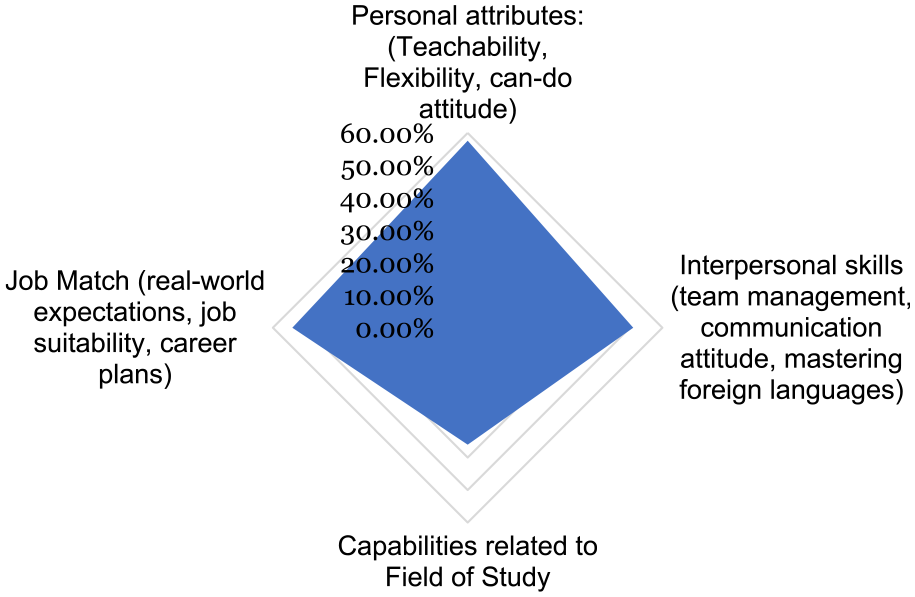
Percentage of recruiters’ comments pertaining to the extracted themes.
Personal attributes: This term refers to intrinsic characteristics related to the candidate’s character and personality, as seen through the employer’s lens.
Interpersonal skills: This comprises how candidates interact with others.
Capabilities related to the field of study: This incorporates vocational training-specific knowledge, problem solving, and skills related to one’s field of study.
Job match: The interaction between the candidate’s attitudes, interpersonal skills, and abilities related to the field of study is evaluated along with specific job requirements, workplace characteristics, and employer priorities. Additionally, it involves employees’ career plans.
Participants consistently stressed the significance of a candidate’s interpersonal skills and capacity to collaborate with peers in a team context. Graduates must demonstrate their capacity to communicate with various individuals, including employers. In addition, recruiters are more likely to recruit candidates with problem-solving skills. To test candidates’ ability to manage difficult tasks under pressure, recruiters often create a real situation where candidates are asked to manage a particular task, and assess their performance. Therefore, among the hire-able skills that interest recruiters is problem solving, which is associated with resilience. Due to insufficient practical professional experience, lack of awareness of work standards, and inability to undertake complex duties, more than half of the senior HR professionals responded negatively to this question.
Unfortunately, graduates are not applying the theoretical knowledge to the different situations they are confronting in their tasks. Few graduates have the self-reliance even though they are confronting new situations.
In conclusion, recruiters are requesting more adaptable and specialized forms of education and training in partnership with higher education institutions to meet complex professional requirements.
We focused on the demand side of the labor market by interviewing the recruiters, which empirical research on overeducation has largely overarched. Nonetheless, as the job queuing model (Thurow, 1975a) gives central place to employers and the hiring process, we collected data from a sample of human resource professionals in urban area of Morocco and studied how they lived the mismatch phenomenon, and by ranking the best applicants, we got our second sample of graduates. The shift in focus from employees to applicant pools was a necessary step to test the job queueing theory and understand the patterns that lead the recruiters to place the selected applicants at the top of the queue.
Workers acquire laboring skills exogenously in formal education and/or training and then bring these skills into the labor market. Possessing skills they bid for the jobs that use these skills. The data reported in this paper contradicts the conventional assumption regarding graduate employability for the Moroccan workplace, which is dominated by supply-side human capital arguments that investments in education, credentials and graduates’ acquisition of cognitive skills will lead to employment (Cappelli, 2015; Holmes, 2013). The results revealed that employees do not bring fully developed job skills into the labor market. Instead, the findings extend the importance of applicants’ possession (or lack thereof) of various forms of non-cognitive capital and their role in the matching processes (Coil, 1984; Dobbins & Plows, 2017). Because most cognitive job skills, general or specific, are acquired either formally or informally through on-the-job training after a worker finds an entry job. The labor queue theory postulates that employers rank workers based on their potential training costs. Hence, a recruiter moves down his labor queue until he fills the available job openings-training slots.
Our findings, typically, confirmed that recruiters are looking for the best possible employees with the least training costs.
Lecturers’ Experience with Skills Mismatch
Based on the interviews, we divided the professors into two groups. The first group (PR 1, PR 5, PR 6, and PR7) was scathing in its criticism of the educational system and the insufficient time dedicated to communication and transversal competencies. For these professors, students in public universities struggle to compete with their peers in the private sector because of the differences in programs and subjects taught. Graduates from local public universities are the products of an education system taught in French, as a language of scientific topics related to modernity and economics, while Arabic is the language of instruction for social and literary subjects linked with national and traditional identity. Therefore, bilingualism generates an issue for graduates when they arrive in the labor market if they do not speak French fluent enough to cope the language of the workplace. In fact, speaking foreign languages is highly recommended by the recruiters. As several interviewees noted:
“To be frank with you, we have to reconsider the language issue within our system; you cannot teach the scientific subjects in Arabic from primary until higher education, and then switch into French.” “It might be related also to the language issue our country has. In Morocco, there is a disconnection between the K12 and higher education in terms of the language of instruction.
However, the second group (PR 2, PR 3, PR 4, PR8, and PR9) were much more concerned with the compartmentalization of the disciplines in the universities they were working in, when asked, “How did you experience the skills mismatch phenomenon? In your opinion, what factors led to this phenomenon?” Asked if universities respond to the labor market, the interviewees reported their contribution through coursework, since they have a determinate margin to change the curriculum based on the relevance of labor market demands. In other words, professors are given room to adjust their courses. For some professors, the margin was between 20% and 30%, whereas for others it was between 40% and 50%. The adjustment was based on the benchmarks of their counterparts in the industry, based on an annual meeting held by the university. However, these adjustments represent the personal efforts of professors, rather than any formal university curriculum change. Moreover, the second category of professors were solicited for recommendations of graudate profiles, and even to participate in recruitment sessions.
Next, interviewees were asked questions related to aspects that can create a meaningful connection between education and industry, in order for university graduates to meet with supply side expectations. While various perspectives were given, they all converge at the same purpose of establishing an effective partnership between HEIs and representatives from relevant labor markets. While there are certain partnerships with some engineering schools and management and marketing faculties, these are not institutionalized in the form of a contractual partnership, simply leading to various policies annually after each partnership meeting. Interviewee responses included (Table 7):
Themes and Representative Lecturer Quotes (n = 9).

To summarize, our findings yielded a series of skill sets expected of graduates to enable their smooth integration into the workplace. We present a crossover of the skills expected from recruits, and those possessed by the interviewed recruits. Both yield the overarching skills required on the supply side. Furthermore, we proposed a framework of education-job matching from the generated interview themes, with the two main stakeholders responsible for developing competency profiles and equipping graduates with useful skills. This involves a partnership between the demand side and supplied labor (Figure 4).
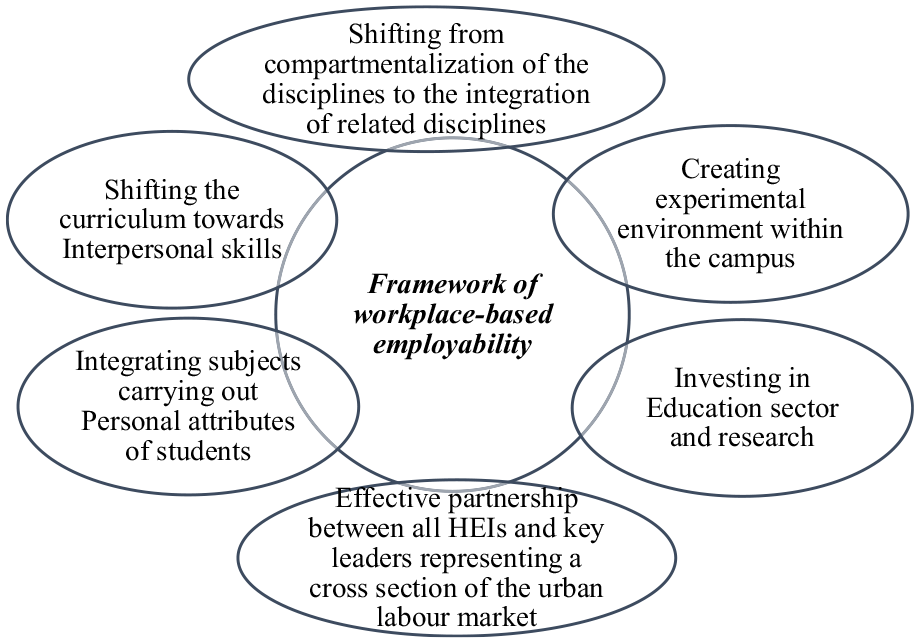
The framework of education-job matches from the generated interview themes with demand-supply sides.
There is a slight mismatch between stakeholders, although this mismatch not only lies between employers and academics, as discussed earlier, but also appears across all relevant stakeholders. In addition, several graduate attributes were not emphasized by either stakeholder. Teachability and “can do attitude” are a given, but graduates are found to be significantly lacking in terms of personal attributes and interpersonal skills which are attributes highly sought after by employers in today’s workplace (Figure 5).

Cross-over of the skills as judged by recruiters and recruits.
This framework is oriented towards enhancing graduates’ skills, which will lead them to become employable and productive in the urban workplace. It also aims to re-approach the connection between HEIs and labor market actors to increase the recruit’s chance of being at the top of the job queue, and reducing the skills mismatch faced by companies.
Discussion and Conclusion
Our research aimed to understand whether the Moroccan urban worker was overeducated or under-skilled, what skills recruiters are looking for, and the characteristics of queued jobs. Overeducation reported by graduates as their human capital acquired was exceeding the one required to fulfill the position. Our findings are consistent with the latest research, which suggests the changing value of university degrees, and highlights the efforts needed for the educational system to correct the imbalance in the supply and demand of work placements (Jackson & Tomlinson, 2020).
These findings also point to the diversity of capital and capabilities that the participants drew upon to successfully navigate the postgraduate market. Drawing upon human capital theory and labor queue theory, the study refutes the assumption of the human capital that suppose the absolute value of education, while job queuing theory assume that qualifications in the labor market depends on the distribution of educational attainment for an individual (Thurow, 1975a) pushing the person to overinvest to defend his position and stay employable across time. This study provides insights in which university stakeholders and policymakers can recognize and leverage the existing strengths of graduates to better prepare them to achieve their “fertile” functioning within the competitive labor market.
Previous studies have focused on the link between education and employability, and the typical skill sets requested by the labor market (Abelha et al., 2020; Al-Alawneh, 2009; Allen et al., 2013; Eta, 2018; Mgaiwa, 2021; Pereira, 2015; Sarkar et al., 2020). It is conceivable that recruiters would more likely associate education with acquiring skills relevant to the job if qualifications and occupational profiles were more closely coupled. It must be noted that the paucity of demand-side data to validate supply side conceptualization of the educational mismatch in urban Morocco has not been given adequate attention. Furthermore, collaboration between businesses and higher education leads to closing the skills gap; in other words, the more recruiters engage in curriculum development, the happier they are with the skills displayed by graduates (Lichy & Khvatova, 2019).
Human capital theory and labor queuing theory are well-established theories describing a link between education and employment. According to Pennington (2019), graduate employers should increase their expectations and benchmarks for skills, and shift the responsibility for training and development to the workers themselves. Although universities may adjust coursework in experimental situations within the campus, such initiatives to improve graduates’ abilities present significant obstacles due to flaws associated with job predictions, vulnerability to demographic shifts, and the changing nature of professions as a result of technological advancement. While the latter was not uncovered in this study, it is a factor to consider in further research. Overall, the findings are consistent with evidence regarding the value of higher education qualifications in enhancing employment opportunities (Jackson, 2021; Jackson & Tomlinson, 2020). Moreover, the importance of person-organization fit is prominently highlighted in recruitment literature, emphasizing the need for a positive attitude and personality to complement the relevant qualifications (Garavan, 2007).
Consideration should be given to strategies to improve higher education (HE) experiences and boost student readiness for work and employment outcomes, primarily through increased partnerships with industry. A balanced labor market is sustained by investing in higher education to reduce employment rates. An increase in the number of highly skilled graduates may become a cause of the increase of highly educated labor force unemployment, and the mismatch of the skillset (Dănăcică et al., 2023). The findings align with other studies indicated the increased potential for co-delivery by lecturers and employers in each discipline, which could be explored alongside training in the delivery of higher education training (O’Regan et al., 2022).
As the curriculum does not pay great attention to creativity and innovation, which are highly desirable to employers, institutions might consider group instruction and streaming to narrow mismatches or gaps (Mgaiwa, 2021).
This study provides a thorough understanding of the urban Moroccan skill set demanded by the labor market, and the urgent need to produce quality graduates who are competent and retainable for a challenging and sustainable workplace. In developing countries such as Morocco, the goal of employability is still farfetched (Silva, 2017; Tejan & Sabi, 2019). Most research claims that graduates are not adequately qualified as employable or professional. To address this issue, there is a need to overarch the content and experiences provided to graduates to handle labor market challenges efficiently, and to shed light on the skills that make some graduates figure at the top of the job queue, as affirmed in previous literature.
Practical Implications
Our research provides a mechanism for understanding the main stakeholders’—recruits, employers, professors– perspectives on the skills mismatch phenomenon, and, based on their lived experiences, a skillset from both participants representing the demand and supply sides of the labor market. This is valuable for informing jobseekers to adjust their recruitment strategies and invest in skills that offer hiring opportunities. Universities can use these results to adapt their educational programs to labor market needs. Graduates must be aware of the skills that are placed at the top of the labor queue.
Limitations
The study outcomes revealed the underlying importance of the non-cognitive skills identified within the phenomenological approach. These can be further investigated by using the Delphi method design to gather applicants’ skills from two groups of experts–recruiters and professors–and to assess whether these skills are judged and weighted in the same way. The interaction between the two skill sets can identify employable applicants who will succeed in transitioning to the labor market.
Footnotes
Acknowledgements

Author Contributions
All authors contributed substantially to this work. The first author wrote the manuscript, and the data analysis has been supported all co-authors. All authors read and approved the final version after several refinement.
Declaration of Conflicting Interests
The author(s) declared no potential conflicts of interest with respect to the research, authorship, and/or publication of this article.
Funding
The author(s) received no financial support for the research, authorship, and/or publication of this article.
Ethics Statement
For ethical purpose, a consent form alongside with the survey has been provided to ensure the respondents’ consent.
Data Availability Statement
Data sharing not applicable to this article as no datasets were generated or analyzed during the current study.