




Abstract
Skill mismatch, a manifestation of poor job matching quality, is becoming an essential factor that hinders workers from realizing their productive potential and obtaining reasonable remuneration. This study investigated the internal relation between skill mismatches and wages, including the influencing processes and mechanisms. Findings showed that excessive vertical mismatches and horizontal skill mismatches result in wage losses for workers. Both mismatches affect the final wage level by changing the degree of job negativity. Additionally, excessive vertical skill mismatches mitigate the wage penalty effect by increasing the degree of job control. The possibility of occurrence of both skill mismatch types increases as job competition becomes more intense and job prospects become more promising; taking these factors into account, the degree of wage impact will be weakened. These findings further clarify the relation between skill-matching status and wage return and provide value judgment for increasing workers’ job satisfaction.
Skill is the new “global currency of 21st-century economies.” Following the “skill-biased” technological change in the 1980s, workers’ skills have become a crucial engine of the healthy development of the economy. The increased demand for skilled talent is a significant evolution in the labor market (Cortes & Salvatori, 2019). In China, the government regards skills development as a strategic measure to cope with economic challenges. Skilled talents comprise an important force supporting the “Made in China” and “Created in China” branding. With the gradual improvement of the incentive system for upgrading workers’ skills, the role of job skills (especially emerging skills) in promoting and protecting workers’ employment and entrepreneurship, along with improving wages and benefits, is becoming increasingly prominent. As such, training of skill-oriented talents is likewise growing in significance.
The government of China has aimed to increase the proportion of labor remuneration in the primary distribution and improve the mechanism for reasonable wage growth, with the goal of ensuring that the benefits of economic development are shared by the common people. To improve the productivity of workers and their corresponding income, the government had considered the direct manner of increasing the human capital stock of workers, such as improving the investment in the teaching of knowledge and skills. However, this old approach ignores the key factor of skill matching. Only when workers use skills effectively can they can maximize their labor performance and improve their labor outcomes. A skill mismatch occurs when the workers cannot use skills effectively. This is also one of the typical conditions of job mismatch (other mismatches occur in individual education, qualifications, work hours, interests, and temperament), which will hinder the release of potential labor capacity. Specifically, skill mismatch is ascertained by comparing the relation between the skills of employed workers and the skill requirements of their jobs. The latter are distinguished by horizontal and vertical dimensions, adding layers to the definition of skill mismatch. A vertical skill mismatch (inadequate and excessive) occurs when workers possess skills that are consistent in domain and type with the skills required for the job but are below or above the level of skills required in the workplace. A horizontal skill mismatch is when workers possess skills that are in a different direction from the required job skills, regardless of skill level. From the perspective of skill utilization efficiency, horizontal skill mismatch can be regarded as a complete excessive vertical skill mismatch. In our study, vertical skill mismatch only refers to the condition of excessive vertical skill. The reason is that the causes and effects of inadequate vertical skill mismatch are unclear, and inadequate vertical skill mismatch would not bring terrible consequences. As such, we did not consider inadequate vertical skill mismatch in our research.
The frequent occurrence of skill mismatches has become an important factor hindering the wage growth of workers and economic development—a situation that merits attention. China is in a critical period of economic transformation characterized by the new normal of the economy and the fourth industrial revolution. As a typical situation of human capital mismatch, skill mismatch is regarded as a potential threat. The pressures of declining fertility rate and aging will impede the improvement of human capital stock. In this situation productivity release brought by the matching of human capital will play a critical role in improving the economic growth rate (Kim & Choi, 2018). The mismatch of skills is not only the loss of human resources for society but also the waste of individual human capital accumulation.
Given the above discussion, clarifying the relation between skill mismatch and wages is conducive to promoting workers’ career development. The insights can improve the overall labor production efficiency under the background of the slow growth of human capital stock. Therefore, our study focused on the micro level by elucidating the internal relation between skill mismatches and wages, and identifying the influencing processes and mechanisms. In the extension study, we further investigated the causal factors and governance issues related to skill mismatch. We expected to provide new evidence and knowledge at the empirical level for the field of job-matching research. Specifically, we aimed to address the following questions: What kind of wage effect will the skill mismatch of workers bring? What are the possible channels for the wage effect? When considering the causes of the mismatch, what will happen to the original wage effect?
Literature Review
The literature related to the research can be summarized into the following two aspects: one is the study on the causes of skill mismatch, and the other is the study on the labor market results of skill mismatch.
Causes of Skill Mismatch
Research on the causes of the formation of skill mismatch has focused on three aspects: the demand side of labor, the supply side of labor, and the interaction between these two sides of labor and the external environment. From the perspective of labor demand, the motivation of building a talent reserve is one of the reasons significantly affecting skill mismatch. With the expansion of a company’s scale and accumulation of material and financial resources, employers tend to “hoard” high-skilled talents through skill mismatch to cope with the impact of the external market, technology, or policy and to ensure the long-term sustainable supply of products or services (Cedefop, 2012), which will lead to the emergence of over-skilling. Notably, however, the human resources policy and the system will gradually improve with the expansion of an enterprise’s scale, which may make it easier for employees to be assigned to positions or jobs that are more suitable for their skills, thus reducing the occurrence of mismatch (Cedefop, 2015).
From the perspective of labor supply, previous studies considered the individual characteristics of workers and reported that relatively vulnerable groups, including women, young people, and part-time or temporary employees, are more likely to be assigned to inappropriate positions. Immigrants are also vulnerable to skills mismatch because their functional skills from their countries of origin cannot be thoroughly evaluated and are not recognized in their current country. Most scholars have tended to discuss the issue from the perspective of educational level. Previous studies have found that people with low educational levels are more likely to have excessive skills (Mavromaras et al., 2013). However, when considering the different types of education, skill mismatch shows different degrees. For example, individuals who have received professional training are less likely to experience horizontal mismatch (Levels et al., 2014). The proportion of skill mismatch among those with a vocational education background will be relatively lower, whereas the possibility of mismatch among graduates majoring in the humanities, arts, and social sciences is higher (Sellami et al., 2017). Scholars also emphasize the importance of practical training. In other words, regardless of the field of learning, increasing the practice and training in the learning process can reduce the incidence of mismatch (McGuinness et al., 2016).
From the perspective of the interaction between supply and demand, most studies have argued that skill mismatch comes from the imbalance of skill supply and demand in the labor market, which makes the price mechanism fail to play its role fully. A typical reason is the information asymmetry between employers and employees. Moreover, ability signals, such as diplomas and qualification certificates, may also be unable to play their roles sufficiently.
Labor Market Results of Skill Mismatch
Both horizontal and vertical skills mismatch will bring many consequences to workers, such as in terms of changes in satisfaction (Mahy et al., 2015), workplace harmony (Belfield, 2010), work–family conflict (Shevchuk et al., 2019), nature of the contract (Li et al., 2018), unemployment (Congregado et al., 2016), and opportunities for skill improvement (Cedefop, 2015). Nevertheless, salary and income are undoubtedly among the most concerning results of researchers.
Research in China generally indicates that education mismatch represents skill mismatch, and education mismatch is investigated from the vertical dimension of skills. Scholars have designed a research model and calculation to explore the educational field. Scholars have further expanded it and used it to investigate the income effect of educational matching. The results have indicated that over-education will bring wage loss compared with educational matching, whereas under-education will bring wage gain (Guo, 2019; Li & Zhou, 2021). However, in studies outside China, the research on the income effect of vertical skill mismatch has returned to the skills themselves. McGuinness (2018) summarized studies on skill mismatch and found that in a total of 38 estimation equations in 11 related literature, over-skilling brought an average salary penalty of 7.5% compared with skill matching.
Meanwhile, under-skilling has received less attention because it does not have serious consequences and the measures for later improvement are relatively simple and clear. A few studies have found that under-skilling has a positive wage effect on workers (Perry et al., 2014). The reason may be that these workers can fully apply their skills in their jobs, and as such, they can get more wages than those who have the same skills but need to be matched. Using data from 15 European countries, Sánchez-Sánchez and McGuinness (2015) proved that a lack of skills does not significantly impact personal income.
Recently, more researchers are paying attention to horizontal skill mismatch. Some studies have found that horizontal skill mismatch diminish workers’ wages, with stronger effects in more specialized fields (Bender & Roche, 2013). The reason is that acquiring skills is not like formal education, and mobility is limited. Kracke (2018) used German data to confirm that the skills brought by vocational education can only be partially used in unsuitable jobs. Because workers who receive vocational education or training are often gathered in jobs with low skill requirements, the horizontal mismatch has a more significant impact on wages compared with the vertical mismatch brought by formal education. Moreover, Li et al. (2018) also indirectly proved that professional mismatch, compared with general mismatch, in the realm of horizontal mismatch, brings stronger negative impacts on wages. In China, research on the impact of horizontal skill mismatch is scarce, and the degree of professional matching is typically used to assess the impact on the income of college graduates. For example, Yang (2018) found that professional matching can bring a higher average wage premium to college graduates.
The results of the aforementioned studies have broadened the current understanding of the formation and influence of skill mismatch. However, many areas remain poorly understood. For example, related research has mostly stayed in the field of over-education, and few studies have addressed job matching from the perspective of skills. As Quintini (2011) stated, the skills or abilities gained in formal education are likely to be lost over time (a typical case is that the skills are not used continuously), whereas new skills are likely to come from on-the-job learning or labor market experience. As such, from the perspective of educational matching represented by academic qualifications, it cannot reasonably reflect the vertical matching of workers’ skills, let alone horizontal matching. A few studies on skill matching have mainly examined it as a function variable to explain macroeconomic growth or discuss it with skill shortage. Research on skill mismatch involving individual workers is very scarce (Liu, 2018). Furthermore, few studies have explored the action path of skill mismatch via wage impact, which is not conducive to revealing its impact mechanism. Lastly, in the literature considering the wage effect of skill mismatch, the self-selection of job matching is not well considered, and the subjective choice of workers is also ignored, which may exaggerate the wage penalty caused by the apparent mismatch (Zhao & Jiang, 2021). The above reasons impede the accurate estimation of the real wage effect of skill mismatch. The above discussion supplies the research ideas and directions for our study.
Theoretical Analysis and Hypothesis Formulation
According to human capital theory, human capital can be regarded as a set of productive abilities, such as skills and knowledge embedded in workers formed through early investment and with the potential to be transformed into future personal income. The skill level is the main form or carrier of human capital, and the particular human capital can be regarded as “skilled human capital.” With the learning and mastering of knowledge, work skills can be cultivated and formed, such that work ability can also be improved. Work output and quality can also be improved, which would translate to higher completion of work tasks and higher earning of salary returns (Mincer, 1974). Within the analysis framework of neoclassical economics, marginal productivity can always obtain corresponding and ideal returns without considering friction. Human capital investment is effective and necessary as the primary source of marginal productivity. The prediction implies an assumption that the productivity release brought by the improvement of human capital is always complete, which requires that the labor market can always be in a state of total competition and individuals can permanently be assigned the best position for their human capital (in our work, skills). In turn, skills can always be used to the maximum extent.
Based on observations of skill mismatch over a long period, job assignment theory came into being on the core viewpoint of human capital allocation theory. The theory holds that the matching between workers and jobs is the core of human capital allocation, and the degree of release of labor productivity depends on the degree of matching between skills and jobs. As such, skill mismatch will distort the allocation structure of labor skills and affect the labor marginal return rate and productivity. Compared with workers with the same skill level but in suitable jobs, over-skilling will limit the productivity release of individual labor and reduce the average rate of return on skills (i.e., surplus skills are not realized). Amid an “overflow” in skill level, investment in skills has a front cost. Once this investment exceeds the actual need for jobs, then the upfront investment is not fully recovered and potential productivity is difficult to unlock. In most research settings, productivity is closely linked to wages, and this loss of productivity creates a wage penalty. Based on the above analysis and previous literature, we formulated the following hypothesis:
Hypothesis 1: Skill mismatches (both vertical and horizontal) result in wage penalties for workers compared with skill matches.
Under job demand–control theory, workers are “economic persons” who weigh between job demand and job control. Workers with low job demand and high job control preference may take the initiative to seek an over-skilled status in the process of job matching to obtain high autonomy in job content. With this strategy, they can be calmer and more confident in completing tasks, and accordingly complete tasks with higher quality, for which they can obtain high output returns. Alternatively, a number of studies have shown that some employees actively choose jobs with a low challenge (here, vertical skill mismatch) for individual reasons, such as physical health considerations and family responsibilities. The high job control degree under this path does not necessarily lead to higher wages (Dekker et al., 2002). We argue that the latter view is in the minority. Overall, the job control degree will likely serve as an indirect pathway for skill mismatches to affect wages and buffer against possible wage penalization effects.
In addition, skill mismatch will directly affect the individual’s salary not only through the distortion of productivity but also through the negative influence of psychological aspects. According to the theory of relative deprivation, the perceived “target entity” is inconsistent with the expected “generalized individual” when the over-skilled person completes the same or similar work as the skill-adapted person. Therefore, skill mismatch will lead to a sense of deprivation of rights and dissatisfaction with the perceived disadvantage (Peiró et al., 2010) or make the individual workers feel “wasted,” which will reduce their work positivity and then affect their production efficiency. Any kind of mismatch will bring workers to a negative state of work and then lead to deviant behaviors (e.g., absenteeism and poor work) in the workplace, thus spreading the adverse consequences to the labor market. Such deviation may hinder the release of production capacity and form a relative wage loss. Therefore, we hypothesized as follows:
Hypothesis 2: Over-skilling indirectly reduces wage penalties (masking effect) by offering higher autonomy in the work process.
Hypothesis 3: Skill mismatch (both vertical and horizontal) indirectly imposes wage penalties by increasing the degree of job negativity.
Further investigation of the causes of skill mismatch will help block its occurrence at the source, as well as help elucidate its wage effects. As revealed by the job competition theory, when there are both occupational and personal sequences, each position in the occupational sequence has its skill requirements, product characteristics, and salary standards, and the skill level in the personal sequence indirectly transmits to employers an adequate signal on candidates’ ranking in the personal sequence. If the skill level has the function of a “signal” similar to educational background, then workers will be motivated to improve their ranking in the labor market by using their higher-skill background, for employers to notice. Workers may also make up for their own “hard power,” which is easy to observe, such as their educational background. From the employer’s perspective, over-skilling may help screen high-skilled people and reduce employers’ recruitment and training costs. As such, the use of an over-skilled worker status or the possession of differentiated skills becomes a means for workers to compete for high-quality jobs. The occupational mobility hypothesis supports that skill mismatch (e.g., over-skilling) is a part of the career path or embedding process in the labor market. According to the view, workers may engage in jobs with lower skill requirements and then transfer to jobs matching their skills in a next labor cycle. However, such potential jobs tend to show lower salary returns in the current period (compensated by other hidden benefits in the current period or expected high returns in the future). A mismatch strategy in search of a future potential job only applies to the vertical matching dimension, as mismatching in the horizontal dimension does not provide any help in unlocking the future potential of the skill. Regardless of the theoretical explanation applied, a mismatch strategy predicts the attributes of the job itself. For instance, the difficulty of obtaining or competing for the job (implying higher hidden welfare) and the job’s potential are the antecedents that guide workers’ skill mismatch. In other words, the wage effect of skill mismatch in the self-selection behavior can be revised to make it closer to reality. Therefore, we formulated the following hypothesis:
Hypothesis 4: Competing for high-quality or promising jobs will cause skill mismatches among workers, and the wage penalization effect of skill mismatches will be weakened by accounting for this self-selection phenomenon.
In summary, our research covered the following three parts: First, identify the direct impact of two types of skill mismatch on wages; second, analyze whether skill mismatch can indirectly affect wage returns by increasing the degree of job control and bringing negative psychological impacts to workers; third, determine whether the phenomenon of job competition and expectation of job potential will lead to the emergence of skill mismatch and the appropriate correction of the resulting wage effect. According to the causal sequence of events, the above content can be briefly summarized as the antecedent, process, and result. Our framework is drawn in Figure 1.

Research theoretical framework.
Empirical Design and Statistical Description
Data Sources
We used public data of the 2018 China Labor-force Dynamics Survey (CLDS). Launched in 2012 by the Social Science Survey Center of Sun Yat-sen University, the CLDS systematically monitors the changes in and interactions of the social structure and the labor force and their families in villages/residential communities by tracking the entire labor force (family members aged 15 to 64 years old) in urban and rural communities every two years. The 2018 data represent the third tracking survey after 2014 and 2016; the 2018 survey is also the latest version of the CLDS. The survey content focuses on the current situation and changes in the labor force in China, covering many topics, such as education, work, migration, health, social participation, economic activities, and grass-roots organizations. It is an interdisciplinary large-scale follow-up survey, making it a suitable data source for our research.
To meet the needs of the research, we retained the samples of workers aged 16 to 60 years who could work and were employed. In addition, we considered the variety of reasons that respondents’ reporting of wages deviated from the true picture, such as misunderstanding of the unit of measurement, actual monthly salary being lower than the respondent’s local minimum wage, and privacy reasons. Therefore, based on the distribution of wage earnings, we winsorized the sample at 10% (generally covering the aforementioned abnormal samples) to eliminate the effect of outlier extremes.
Variable Selection
Core Independent Variables
The core variable was skill mismatch, which can be divided into vertical and horizontal skill mismatch. We adopted the indirect measurement method based on self-report. The self-report method is considered superior to the job analysis and actual matching methods because it is easy to be observed and can better solve the problem of missing variables caused by unit or individual heterogeneity, as well as reflect the latest trend of work (Meroni & Vera-Toscano, 2017). For specific methods, we referred to the research of Pellizzari and Fichen (2017). The existing questionnaire items in CLDS 2018 included “Please evaluate your current skill use in your job (Question 1)” and “In your opinion, do you need further specialized training to complete your tasks better (Question 2).” We then combined all results to determine categorization into one of the four states of vertical over-skilling, vertical under-skilling, horizontal mismatch, and adaptation. In addition, according to the requirements of the study, we excluded the samples with vertical under-skilling and ambiguous matching status. Finally, we constructed a categorical variable: 1 = skill fit, 2 = vertical skill mismatch (including only vertical over-skilling), and 3 = horizontal skill mismatch. Owing to data limitations, our method was indirect and different from the direct measurement of compatibility between workers’ self-reported skills and their jobs (Liu, 2021). Specific definitions are shown in Table 1.
Definition Standard of Skill Mismatch Variables.

Note. The sample that answered “neutral” to question 1 was not easy to divide because of the unclear attitude. We set their category as “-” and eliminated them in the actual screening process.
Core Dependent Variables
Our study used annual salaries as the explained variable. The CLDS determined wages from the individual annual salary income after deducting five insurance payments, one housing fund, and personal income tax, including bonuses, benefits, and subsidies. We took the logarithmic values to reduce the difficulty in explaining the results caused by the oversize dimension.
Control Variables
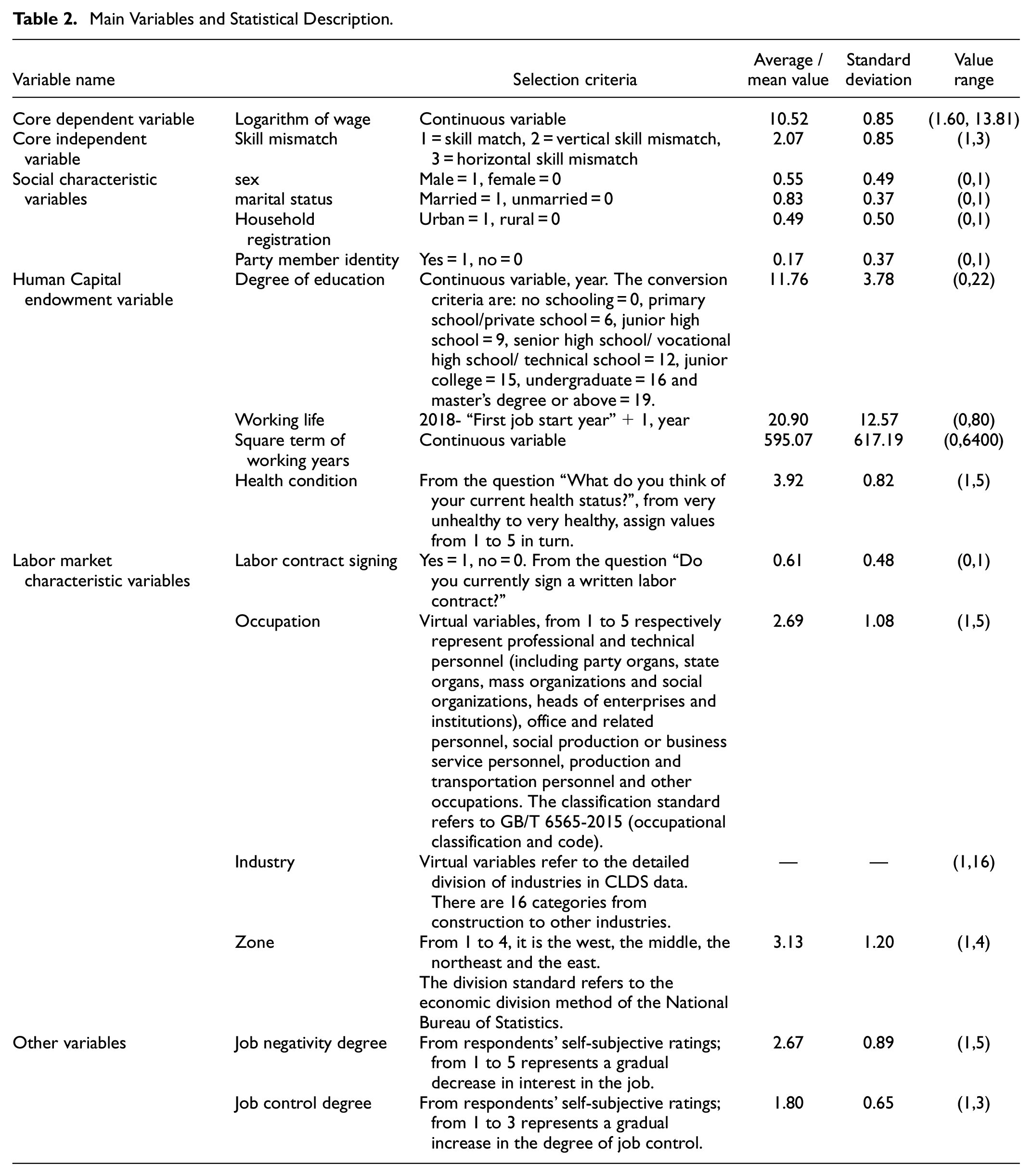
We selected a series of variables with reference to the wage equation created by Mincer based on human capital, as well as previous research (Li & You, 2020; Yuan & Du, 2021). We then selected socio-demographic characteristics (sex, age, marital status, party membership), human capital endowment (education level, working years and their squared terms, health status), and labor market-related variables (union participation, labor contract signing). The specific selection criteria are presented in Table 2.
Main Variables and Statistical Description.
Intermediary Variables
According to the analysis framework, we selected two variables, namely, degree of job negativity and degree of job control, as intermediary variables to investigate the influence mechanism of skill mismatch on wage income. The degree of job negativity was measured based on the responses to the question, “Please evaluate your degree of interest in your current job.” Responses from “very satisfied” to “very dissatisfied” were assigned values from 1 to 5, respectively. Higher values indicated stronger job negativity. As for work control, it was assessed by the question, “In your work, to what extent are the following things decided by yourself?” Respondents rated their self-control from three dimensions: work task, work progress, and work intensity/quantity. Each answer was assigned 1 to 3 points from “completely decided by others” to “completely decided by myself.” We took the average score as the characteristic variable of degree of job control. The higher the score, the stronger the degree of job control.
Descriptive Statistical Analysis
Table 2 briefly shows the selection criteria and statistical results for the main variables. Skill adaptation, vertical skill mismatch, and horizontal skill mismatch were reported by 33.15%, 26.4%, and 40.46% of the respondents, respectively. Horizontal mismatch, the least ideal matching state, accounted for the highest proportion, which demonstrated that the effective matching situation of skills was relatively severe in the survey samples. Regarding the other control variables, males and married groups accounted for a relatively high proportion. The distribution of registered permanent residents in rural areas was almost the same as that in urban areas, but the proportion of party members was low. The average education years of the samples was about 12 years, or close to the high school education level. The standard deviation was 3.78 years, indicating that most of the samples completed at least 9 years of compulsory education. The self-evaluation of per capita health status was close to 4, reflecting that the health status in the current sample was relatively optimistic. In terms of work experience, the average person had about 20.9 years, with a standard deviation of 12.57 years. If the samples generally approached the normal distribution, nearly 70% of the samples could be expected to fall within the range of the standard deviation. Thus, the proportion of fledgling employees was not high, and most of them had left the early stage of their careers. For skill-matched new workers, the comparison between the ability level embodied in formal education and the job requirements could better reflect the quality of actual employment matching. Meanwhile, in their long career, the skills themselves may be more important than academic qualifications. This indirectly confirmed the representativeness of our sample selection.
Measurement Model Setting
Benchmark Regression Model
Verdugo and Verdugo (1989) first used the V-V model to study educational mismatch. This model can also be used to reflect skill mismatch by including the skill mismatch variables in the wage equation (in the form of dummy variables, with skill matching as the reference group). The model, as shown in equation (1), is extended based on Mincer’s wage equation.

where W represents the wage income of workers, X is a set of controlled variables (including personal characteristics),
Intermediary Effect Model
By constructing an intermediary effect model, we examined the existence of job passivity and job control as the intermediary mechanism of the wage effect of skill mismatch. Taking vertical skill mismatch as an example, the basic model is shown in equation (2):

Where
For the significance test of the coefficient product, our study adopted the bootstrap method, instead of the conventional Sobel test. The significance test was expected to confirm the existence of mediating effects. The test is used to determine whether the confidence interval of the indirect effect (joint coefficient) under the bootstrap test contains 0; if not, then the mediating effect is significant. The above setup is equally applicable to the examination of horizontal skill mismatch.
Results: Wage Effect of Skill Mismatch
Regression Results
We compared the three types of mismatch state and skill adaptation state in pairs, and then conducted an average wage income t-test between categories. We found a significant wage gap between different matching categories. Using equation (1), we examined the influence of skill mismatch on workers’ wage income; the stepwise regression allowed us to further investigate the causal relation between the core variables. Model (1) excluded control variables. As shown in Table 3, vertical and horizontal skill mismatch had a noticeable wage penalty effect, whereas vertical deficiency showed the opposite effect. After adding human capital and labor market characteristic variables to Models (2) and (3) and adding the fixed effects of industries and regions to model (4), we found generally consistent results. Taking model (4) as the benchmark regression result of this study, it showed that workers with vertical and horizontal skill mismatch had wage losses of about 20.3% and 10.94%, respectively, compared with other workers with the same productivity characteristics and skill fit. Thus, hypothesis 1 is valid. Compared with workers with fully utilized skills of the same level, workers with mismatched skills failed to fully utilize their potential productivity, resulting in a corresponding reduction in work output, as reflected in wage penalties. Therefore, skill mismatch is a crucial factor affecting the wage return of workers. Furthermore, all participants in the labor market should not only consider the accumulation of human capital but also pay attention to the allocation.
Regression Results of the Wage Effect of Skill Mismatch.

Note.***and ** indicate significance at the levels of 1% and 5% respectively, and the standard errors are in brackets. Fixed effect variables include region and industry.
As predicted by Mincer’s wage equation, the improvement of education level, work experience, and health status—the core variables of human capital—proved conducive to the increase of wages. Workers with higher material and social capital, such as being male (discrimination phenomenon), married (they can gain family support), and having an urban household registration (reduction of discrimination and promotion of social capital), could obtain relatively higher incomes.
Endogenous Treatment
Groups with higher wages tend to have an advantage in the quality of their job matches, or at least gradually lose their original skill gaps in the course of their work. The specific aspect of skills is manifested in the fact that they are fully utilized. In other words, the causal relations between skill mismatches and wages may be bidirectional rather than unidirectional. Higher wages will significantly reduce the likelihood of skill mismatches occurring and cause the skill mismatch variable to become endogenous, thus biasing the estimates. In addition, although we controlled for the factors that may affect the wage return of workers to reduce the problems of missing variables, many unobservable factors could still affect the outcome variables. Therefore, we applied tool variables of skill mismatch to correct the benchmark regression coefficient.
We followed the tool variable selection strategy mentioned by Guvenen et al. (2020) and used the average tenure when individuals deviate from the profession as a tool variable of skill mismatch. This variable satisfied the exogenous premise. The average length of tenure of the occupations to which the sample belonged was measured in a three-level grid of region–industry–occupation. The actual tenure of an individual in the occupation was obtained from the survey year minus the current job start year plus 1. The current job start year was determined from the question “When did you start your current or recent job?” The range of the average tenure deviation was (−20.75, 43.40), and the standard deviation was 9.44 years. According to the theory of occupational mobility, with the continuous extension of work time, workers have enough time to adjust themselves in different positions and assignments to adapt to and give full play to their early redundant skills or to make up for their short skills to meet the needs of their jobs. Therefore, the possibility of skill mismatch will be restrained by the gradual increase in the deviation degree of the positive average tenure. In contrast, increasing the negative deviation degree will enhance the possibility of skill mismatch. Moreover, we used the negative value as a tool variable to facilitate the interpretation of the results. Higher value increases indicated a higher possibility of increased skill mismatch.
The results of the regression based on two-stage least squares are reported in Table 4. As presented in columns (1) and (2), the chi-squared value of Durbin’s test in the vertical skill matching dimension was 11.2953, which suggested an endogeneity problem with the vertical over-skilling variable; the F-test value of the weak instrumental variable was 16.2057, which exceeded the empirical value of 10, basically indicating that the tenure deviation distance (negative) was not a weak instrumental variable. As the tenure deviation distance (negative) continued to increase, the likelihood of the emergence of vertical over-skilling increased. After considering the endogeneity issue, the wage penalty from vertical over-skilling was 26.23%, which was higher than that in the baseline regression results, indicating that the OLS regression underestimated the impact of wage changes from vertical over-skilling.
Two-stage Least Squares Regression Results under Instrumental Variable Method.

Note.***, **, and * indicate significance at the levels of 1%, 5%, and 10% respectively, and the standard errors are in brackets. To meet the needs of the measurement modeling, we included only two states for the variable measures of skill-matching status under each model: skill-match state, and skill-mismatch state.
In addition, according to the first-stage regression results, the possibility of horizontal skill mismatch increased with the increasing job deviation distance (negative direction). After considering endogenous problems, the wage penalty caused by horizontal skill mismatch was 10.43%, lower than the 10.94% in the benchmark regression. Thus, OLS regression underestimated the negative consequences of horizontal mismatching.
Discussion
To confirm the influence paths in the theoretical analysis above, we investigated the existence of the influence paths of degrees of job negativity and job control under the setting of the intermediary model.
Mediating Effect of Job Negativity
As shown in column (1) in Table 5, vertical skill mismatch increased the degree of job negativity by 0.83 units compared with skill match. The results in column (3) showed that each unit increase in degree of job negativity led to a 1.47% decrease in wages. Thus, job negativity could lead to a decrease in workers’ wage returns and play an indirect role in the negative effect of vertical skill mismatch on wages; the mediation share was 3.71%. Oswald et al. (2015) demonstrated that happiness and job satisfaction affect workers’ productivity (a proxy for workers’ wages), whereas skill mismatch may lead to changes in workers’ job satisfaction, mostly in a negative way. Thus, vertical skill mismatch would undermine workers’ motivation to work, which would eventually have an impact on wages through lower productivity. We further investigated the horizontal skill matching dimension and found that, as shown in column (4), horizontal skill mismatch increased the negative degree of salary by 0.33 units on average compared with the skill match scenario. The results also showed (column (6)) that every 1 unit increase in job negativity led to a 5.35% decrease in wages. Moreover, job negativity played an indirect role in the negative impact of skill horizontal mismatch of wages, accounting for 11.9% of the mediating effect. Thus, horizontal skill mismatch had a greater negative impact on the motivation of workers than vertical skill mismatch, undermining productivity, as reflected in wage returns. Therefore, hypotheses 2 and 3 are valid.
Mechanism of Wage Effect of Skill Mismatches: Job Negativity Channel.

Note. Except for the skill matching samples, models (1) to (3) only retain the vertical skill mismatch samples, and models (4) to (6) only retain the horizontal skill mismatch samples. *** and * indicate significance at the levels of 1% and 10%, respectively, and the standard errors are in brackets.
Mediating Effect of Job Control
Under the dimension of vertical skill matching, the regression results verified the pathways (Table 6). The degree of job control under vertical over-skilling was higher compared with the skill-matched groups (column (1)). Increasing a unit of job control would bring about a relative increase of 3.46% in wages (column (3)). Thus, job control partially covered the wage penalty effect of excessive vertical skills, and the indirect effect accounted for about 2.25%, which could reduce the intensity of the initially high wage penalty. These results confirmed that better control of the work rhythm would enable workers to complete their given tasks efficiently and compensate for the production loss caused by the ineffective skills overflow with higher quality work results, which would then be conducive to the acquisition of labor remuneration. Meanwhile, the horizontal mismatch of the mismatch group had no apparent influence on job control compared with the skill match group (column (4)). Thus, the path of job control as a mediating variable may not exist in general. Mismatching separated workers from their familiar work fields, thereby bringing higher vocational skills conversion costs. When workers cannot skillfully complete familiar tasks, they may be confined to mechanical, repetitive work, lacking the ability to control their work progress and weakening their innovation ability. Consequently, the quality of the final work cannot be guaranteed, resulting in the loss of labor income. Therefore, hypothesis 3 is supported.
Mechanism of Wage Effect of Skill Mismatches: Job Control Channel.

Note. Same as Table 5.
Extension Research: Self-selection Phenomenon of Skill Mismatch
Workers’ current state of skill mismatch would have preconditions. The decision-making basis of workers may come from their judgment of the difference in the expected income between skill mismatch and skill match. For example, workers may assess whether the skill mismatch state can realize the purpose of improving work competitiveness and whether it is helpful for them to enter the “first-class labor market” (relatively stable, with high wage return and job security) or take jobs with development potential. At the level of econometric model design, this is a typical endogenous problem caused by self-selection. Given the difficulty in observing the difference in expected returns of different choices through data, we analyzed workers’ skill mismatch behavior with the help of the Treatment Effect Model (TEM). The TEM can avoid the choice bias of decision-making as much as possible and comprehensively investigate the influence of observable and unobservable factors on the occurrence of workers’ skill mismatch and the respective wage effect. It can not only be used to identify the causes of skill mismatch but also help correct the wage effect of skill mismatch under the background of overcoming self-selection bias. The average treatment effect (ATE) of the effect of skill mismatch on labor wages can be obtained according to equation (3):

Job Competition and Skill Mismatch
Table 7 shows the estimated effect of vertical skill mismatch on wage returns. Columns (1) and (4) show that the incidence of vertical and horizontal skill mismatch increases by about 15.66% and 16.11%, respectively, when employed in the public sector. In China, the public sector has potential employment advantages and the frequent occurrence of skill mismatch is not necessarily from the real-world matching friction caused by information asymmetry but may be attributed to the active choice of workers to cope with the increasingly fierce competition in the labor market. However, this seemingly rational choice represents the loss of actual social welfare and potential productivity, which can be considered as “by-products” of the fierce competition. When selection bias is considered, the results in columns (2) and (4) confirm that compared with skill matching, vertical and horizontal skill mismatch will respectively bring 17.52% and 4.39% of wage penalty to workers—both lower than the estimated coefficients in the baseline regression. Thus, the baseline regression overestimated the wage losses from skill mismatches. The reason for this is that the public sector tends to have fewer monetary wage returns than the private sector, all things being equal, but some non-monetary returns, such as prestige and stability, will compensate for the adverse consequences of the skill mismatch.
Processing Effect Model Results of Skill Mismatch: Job Competition.

Note.***, **, and * indicate significance at the levels of 1%, 5%, and 10% respectively, and the standard errors are in brackets. Except for the skills matching samples, models (1) to (2) only retain the vertical skill mismatch samples, and models (3) to (4) only retain the horizontal skill mismatch samples. The more efficient great likelihood estimation was used. The results of the likelihood ratio tests all rejected the original hypotheses, indicating that all had endogeneity problems.
Job Potential and Skill Mismatch
Under the dimension of vertical skill matching, the results of columns (1) and (2) in Table 8 show that increasing a unit of job potential will lead to an increase of 41.24% in the rate of vertical skill mismatch. Similar to the invisible benefits of public sector employment, job potential is also a crucial component of high-quality jobs, and the surplus skill reserve will be helpful for promotion in the future. Skill mismatch has become a factor that guides upward mobility and income increase, although the wage influence is not reflected in the current period. The wage penalty for vertical skill mismatch was about 19.56%, slightly lower than the benchmark regression result of 21.24%. To some extent, the concept of “exchange time for development” could lead workers in fierce employment competition to seek jobs with relatively low salaries but high promotion prospects, which would make up for the wage penalty degree caused by over-skilling. As a rational choice of workers, the employment decision also has a positive significance at the organizational level. Compared with relatively overflowing skills and abilities, it may become a potential reserve for the release of unit productivity in the future and play an essential role in the long-term development strategy of the organization.
Processing Effect Model Results of Skill Mismatch: Job Potential.

Note. Same as Table 7.
Columns (3) and (4) in Table 8 show that the probability of horizontal mismatch has not changed significantly, with the likelihood of promotion increasing in the future. These results introduce a critical point of view: workers who are confident of their job’s development potential are more likely to adopt matching strategies with surplus skills to distinguish them from competitors in the same position. Moreover, they will acquire more skills to stand out and complete the release of their production potential. However, the above strategies are based on the premise that the skills are consistent with the job requirements. If not, or if there is a horizontal mismatch, then the relation between the matching state and the job development potential becomes blurred. In this case, there is no spontaneous mismatch pathway aimed at job potential.
Conclusion
Our study discussed the different effects of workers’ different skill-matching states on wage returns and realization paths. First, over-skilling and horizontal skill mismatch (including the depth of mismatch) will bring wage losses to workers. This finding remained robust even after we replaced the core variable measurement method and used tenure deviation distance as an instrumental variable for endogenous processing. Second, vertical and horizontal skill mismatch will indirectly affect wage loss through causing job negativity (mediating effect). Vertical skill mismatch will reduce the higher wage loss (masking effect) by increasing the degree of job control, although job control is not the transmission path of the wage effect of horizontal skill mismatch. Third, job competition is an antecedent of vertical and horizontal skill mismatch, whereas job potential is an antecedent of only vertical skill mismatch. With consideration for the self-selection behavior of workers owing to employment preference (adding the selection equation), the benchmark wage effect of skill mismatch weakens.
To reduce the possibility of skill mismatch or its adverse influence on workers’ productivity (wage return), we formulated the following suggestions. First, given that skill mismatches can lead to serious productivity and wage losses, attempts should be made to guide workers toward skill adaptation that allows them to make the best use of their talents. From the labor demand side, employers should provide employees with jobs that can fully exploit their skills through setting tests and internship periods. These can avoid the input cost of skill training and improve the overall production efficiency of the employing department.
Second, given that the degrees of job enthusiasm and control are the channels through which skill mismatch affects wages, process interventions should be made in these two areas to create path blocking. Employers should conduct regular communication and interviews with employees (or unblock the upward communication channels of employees within the organization) or take regular questionnaire surveys to understand employees’ job negativity and burnout (or their reverse indicators, such as satisfaction). These efforts can realize reverse tracking and help identify the labor force in a mismatched state. Timely reconfiguring will reduce the negative perception or incorrect cognition of workers’ skill or ability mismatch, clarify their job orientation, create a harmonious and benign working atmosphere and corporate culture within the organization, and block the damage of skill mismatch to workers’ productivity and wage return (Cheng, 2015). Employers should also delegate power to employees with skill spillovers through the more scientific design of employees’ work contents and forms to increase their work autonomy. For instance, employers could provide workers with more challenging tasks to create a supportive organizational atmosphere and to guide employees with vertical skill spillovers to produce higher production efficiency, which will become a unique and vital asset of the organization (Cheng, 2019).
Third, our results confirmed that wage penalties from skill mismatches may be the observed dominant outcome. However, the actual cause of this effect may be the workers’ acceptance of lower current wages in order to gain access to better-potential jobs or employment in high-quality sectors. These two types of factors have different development paths. Job potential or future development may be considered compensation for over-skilling. The organization could reserve the skills that are not needed for the current job tasks to flexibly face the dynamic skill increment demand in future work. For example, when new production tools are invented, productivity can be released more quickly. Moreover, the excess stock of job skills is also the primary source of organizational innovation and progress. However, examples of engineering talents doing clerical work abound, and the “iron rice bowl” perception remains prevalent (such as the phenomenon of “civil service examination fever”), which is closely related to the dual characteristics of China’s labor market. Pursuing institutional or public sector jobs and ignoring or even sacrificing opportunities for good skills matching will not be conducive to the healthy allocation of human resources in society and the development of individuals. To reduce the occurrence of skill mismatch of “department preference,” the government should promote market-oriented reform and reduce or change the irrational wage premium caused by factors such as policy bias, resource monopoly, and factor market distortion (Yang, 2014), or caused by employment segmentation because of discrimination by sex and household registration (Li & You, 2020). These can reduce the mismatch between supply and demand of human capital characterized by blindness or passivity. Second, the government should further improve the protection of the labor rights and interests of employees in the non-public sector or non-monopoly industries and promote labor mobility inside and outside the system. These can reduce the skill mismatch motivated by department or system preference.
Nonetheless, our study had the following limitations. For one, the measurement of skill mismatch could be more transparent. Job tasks are the basic unit of production and ought to be measured at a finer level than occupations. By comparing the skill bundle required by the task with the skill state of the worker, the skill matching state will be more meaningful to discuss (Acemoglu & Restrepo, 2018; Guvenen et al., 2020). In the context of China, future research should strive toward forming a matching standard or guiding scheme between workers and job skills with China characteristics. Another limitation was in the data availability; we could not trace the perceptions of job competition and potential to the initial job-matching stage, as these were identified from the on-the-job period. This could diminish the value of our findings. Meanwhile, the data collection mode of the standardized questionnaire prevented us from conducting in-depth qualitative research, such as qualitative analysis relying on interviews and case material; we expect to complement this limitation in future studies. Lastly, apart from wage income, many labor market outcomes are also closely related to skill matching. For example, skill mismatch may increase the frequency of workers’ absences and make them change jobs more frequently; skill mismatch may reduce the training input (affecting the potential long-term productivity) or even lead to work–family conflict (Verhaest & Omey, 2006). Meanwhile, a better matching degree may bring better wage negotiation ability and higher participation in lifelong learning (McGowan & Andrews, 2015). Thus, the results of skill mismatch have a wide range of influence and vast room for further research.
Footnotes
Acknowledgements
We thank the editors and the reviewers for their useful feedback that improved this paper.
Declaration of Conflicting Interests
The author(s) declared no potential conflicts of interest with respect to the research, authorship, and/or publication of this article.
Funding
The author(s) disclosed receipt of the following financial support for the research, authorship, and/or publication of this article: This research is funded by the Humanities and Social Science Fund of the Ministry of Education in China “Research on the Formation Mechanism, Long-term Income Effect and Optimization of Work Mobility Trajectories for Flexible Employees under New Forms of Employment”(24YJC790241); the Philosophy and Social Sciences Research Project of the Education Department of Hubei Province “Research on the Impact of Workers’ Digital Skills on Gender Wage Gap in the Context of Digital Transformation: A Dual Perspective on Endowments and Compensation Differences”(23Q091); Hubei University of Technology Doctoral Research Startup Fund “The Wage Boost and Distributional Effects of Digital Skills among Migrant Workers in China”(XJ2022003501); the Social Science Fund of Hainan Province “Research on Rural Land Transfer and Peasants’ Income Increase in Hainan Province under the Background of Rural Revitalization” (HNSK(ZC)23-158).
Ethical Approval
It is not applicable.
