




Abstract
This study examines the impact of different factors on inflation in six regions of the world between 2002 and 2021, analyzing variables such as control of corruption, political stability, broad money growth, GDP growth, and imports to exports ratio. This study seeks to investigate the crucial factors that cause inflation and their significance in different regions. The feasible generalized least square (FGLS) results indicate that the determinants of inflation vary in different regions, but broad money growth consistently increases inflation across all six regions, while control of corruption and political stability reduce inflation in most regions. The study has business implications for political stability and its contribution to inflation control. This should be taken into account when making investment choices by businesses operating in politically insecure regions. The study also highlights how crucial it is to control the growth of broad money and comprehend how GDP growth and inflation are related. Policymakers should establish effective inflation control measures that take into consideration the unique elements driving inflation in their region.
Plain language summary
This study analyzes the impact of various factors on inflation in six regions of the world from 2002 to 2021. It investigates variables such as control of corruption, political stability, broad money growth, GDP growth, and imports to exports ratio. The study aims to identify the key factors influencing inflation and their significance across different regions. The results obtained using the feasible generalized least square (FGLS) method reveal that the determinants of inflation differ among regions. However, broad money growth consistently leads to increased inflation in all six regions, while control of corruption and political stability tend to reduce inflation in most regions. The study has important implications for businesses regarding the role of political stability in managing inflation. It suggests that businesses operating in politically unstable regions should consider this factor when making investment decisions. Additionally, the study emphasizes the importance of controlling the growth of broad money and understanding the relationship between GDP growth and inflation. Policymakers should develop effective measures to control inflation, considering the unique drivers of inflation in their respective regions.
Introduction
An increasing overall level of prices for goods and services that results in a decline in buying power is known as inflation. An increase in demand for goods and services and a supply shortage are the main drivers of inflation. The economy may be affected by inflation in both good and bad ways. It promotes economic growth by enticing consumers to purchase before prices increase further and lowering the cost of exports for other nations. On the other hand, both individuals and companies are less inclined to spend money when they anticipate a rise in costs, it can also result in decreased spending and investment. High inflation can also result in diminished buying power, which can cause individuals to cut down on their spending. This can slow down economic development and increase unemployment. The consumption cut in necessary items for lower income groups may lead to a fall in the standard of living and increase social unrest (Hassan et al., 2016; Yasmin et al., 2022).
Food and electricity costs, as well as consumer attitudes, have been impacted by the war in Ukraine’s disruption of the energy supply. Energy price shocks have slowed the global economy by pushing up inflation and tightening monetary policy worldwide. Acute food insecurity might spread to millions of people due to ongoing food shortages and high costs, escalating social instability. Many OECD nations have used up their strategic petroleum reserves in reaction to the crisis, which might result in a deficit and higher prices in 2023 (Neufeld, 2022).
The price trends in many categories have diverged for U.S. consumers since the beginning of the 21st century. While many consumer items, especially those that could be readily outsourced, witnessed price decreases, major “non-tradable” categories experienced large price hikes. Healthcare industry costs are increasing for various reasons, including escalating labor expenses, an older population, improved technology, and medical tourism. Another significant factor in price hikes is the cost of medical services and pharmaceuticals. For the past 20 years, software, cell phone services, and television have become more affordable (Routley, 2023).
In Asia, which includes Macau, China, Hong Kong, and Taiwan, several of the countries with the lowest inflation rates are found. Widespread lockdowns in this region reduced consumer spending and hampered economic progress. Many additional factors affected the region’s inflation rate. China and other Asian nations were less affected early in the pandemic than North America and Europe by increased food prices, services inflation, and supply-chain disruptions (Neufeld, 2023).
Figure 1 demonstrates inflation rates (2021) in different countries around the world. It is evident from the figure that eight countries are suffering from an inflation rate greater than 20%. Central banks frequently increase interest rates to combat inflation, which can increase the cost of borrowing. This may result in less spending and investment, hindering economic expansion. Due to the uncertainty created by inflation regarding future pricing, firms and individuals may be less motivated to invest or spend money. Higher unemployment and slower economic development may result from this uncertainty. Overall, the effects of inflation on the economy can be nuanced and diverse.

Inflation rate 2021.
The misuse of authority for personal advantages, such as bribery, theft, and nepotism, is referred to as corruption. Corruption may threaten economic stability and prosperity by distorting markets, preventing investment, and lowering government income. The cost of products and services can directly be impacted by corruption in an economy, which can raise inflation (Ayodeji, 2020). Businesses may be asked to pay bribes to corrupt authorities in exchange for contracts, licenses, or other permits. These bribes can raise the price of products and services by raising the expenses of manufacturing and delivery. Corrupt politicians could fix prices in conjunction with companies, increasing the cost of products and services for customers. As the general level of prices for goods and services in the economy rises, this might cause inflation. Misallocation of resources due to corruption may cause shortages of some commodities and services. As a result, the cost of these products and services may increase, adding to inflation.
As long as policies are carried out consistently and efficiently, a stable political environment marked by an effective and transparent government can maintain low inflation (Tran, 2023). On the other hand, political turmoil can cause economic unpredictability and volatility, which could raise inflation. Maintaining low inflation necessitates a stable political environment. Inflation may be managed by ensuring that economic policies are applied consistently and successfully in a stable political context. Businesses and consumers may make better decisions, which helps maintain a constant price level when the government can implement its policies clearly and predictably. Political stability may boost economic confidence because people tend to invest more in the economy when they feel that their money is safe and secure. Political stability lowers economic uncertainty, which can aid in managing inflation. Political stability is essential for preserving low inflation because it promotes the consistent and successful application of economic policies and lessens economic uncertainty (Telatar et al., 2010). On the other side, economic uncertainty and instability brought on by political instability may result in increased inflation. Through independent central banks that employ monetary policy instruments, encourage budgetary restraint, foster more competitive and effective markets, and ensure greater public engagement in decision-making processes, democracy may lower inflation (Fenira, 2014).
A key concept in macroeconomics is the connection between the money supply and inflation because it explains how variations in the money supply may impact the general level of prices for goods and services in an economy (Lim & Sek, 2015). When the money supply increases, a higher quantity of money is available to buy goods and services, which might stimulate demand. Inflation may occur if the supply of products and services does not increase at the same rate as demand. The link between the money supply and inflation also depends on the velocity of money circulation. Money is spent and reinvested more quickly as the velocity of money rises, which can result in higher prices and inflation. Monetary policy is a tool that central banks may employ to change the money supply and control inflation. Central banks may increase the money supply to encourage economic expansion or lower it to fight inflation. Central banks must comprehend this linkage to preserve price stability and foster economic progress.
When a country imports more than it exports, the demand for foreign currency rises. It can cause the value of the country’s local currency to fall. This may increase the cost of imported products and services and increase inflation. In contrast, a country’s currency may appreciate if it exports more products and services than it imports, which increases demand for the national currency. Keeping the cost of products and services low can make exports more affordable and competitive in overseas markets, assisting in the management of inflation. A country’s trade imbalance, which occurs when it buys more than it exports, can drive up the price of goods by driving up demand for foreign currency and driving down the value of the national currency. This may increase the cost of imported products and services and drive up inflation (Alsamara et al., 2020; Altunöz, 2022; Ibrahim, 2015). When a nation sells more than it buys, this is known as a trade surplus. By keeping the cost of products and services low, a trade surplus can assist in managing inflation. This is so that exports can become more affordable and competitive in international markets if exports expand and the home currency appreciates. Exchange rates, domestic economic circumstances, and global economic trends are only a few of the variables that might affect the complicated link between inflation and imports relative to exports.
Figure 2 shows the average regional inflation rate, the strength of inflation varies by region. Due to variables including demand growth, political instability, financial expansion, import reliance, corruption, and external events like natural catastrophes, various regions might experience varying inflation rates. Figure 2 shows the regional inflation rates, here it can be seen that generally, Sub Sahara Africa has a high level of inflation, and the world has witnessed synchronous inflation spikes in 2008, 2011, and 2016. But other than that, there is a heterogeneous pattern of inflation in different regions which calls for a comparison of major factors and their effects across regions.
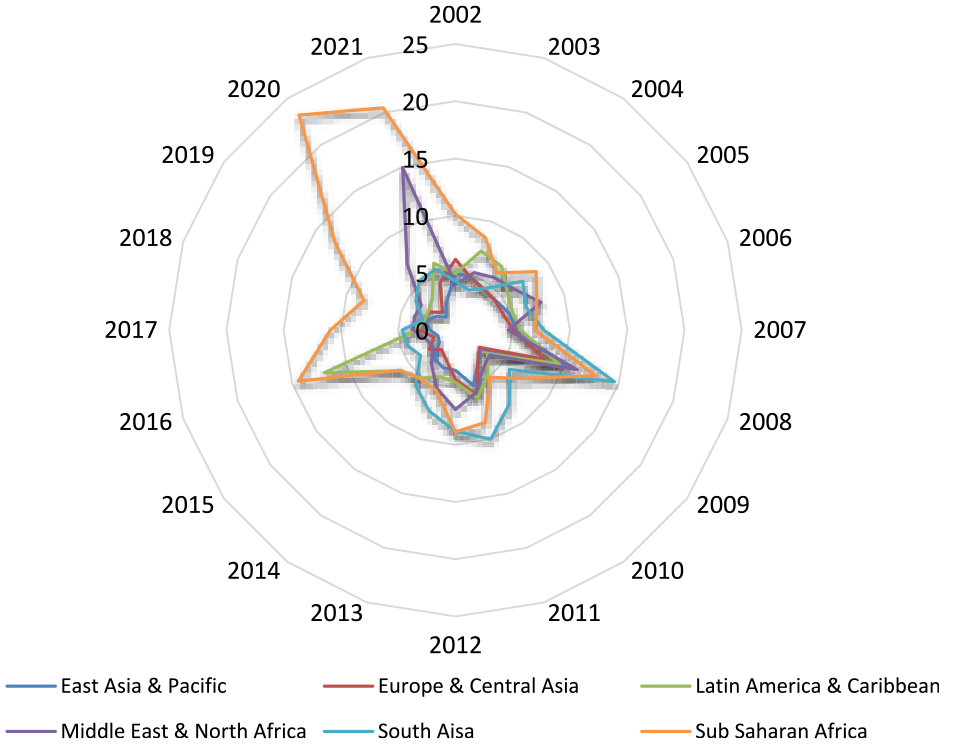
Average regional inflation rate.
Figure 3 represents the world GDP growth and inflation rates. After a brief decline in 2020, it is observed that GDP and inflation have both greatly grown in the more recent year 2021. Since 2012, there has not been such high inflation in the world.

World inflation and GDP growth.
The outcomes of this study have a variety of business implications. The present study first emphasizes how crucial political stability is for lowering inflation. This has ramifications for investors and companies that operate in politically unstable areas since instability can result in higher levels of uncertainty and risk, which can have a detrimental effect on investment and economic activity. The study places a strong emphasis on how broad money growth contributes to rising inflation, which has consequences for monetary policy. Central banks must carefully control the money supply to keep inflation from exceeding the limit and harming both businesses and customers. To understand how these policies may affect inflation and their operations, businesses should remain vigilant about the monetary policies of the regions in which they operate. This study highlights how crucial it is to comprehend how GDP growth and inflation are related. While GDP growth might boost economic activity, if it is not accompanied by a rise in the supply of goods and services, it can also cause inflation.
The authors of the present study observed that the existing literature ignores a regional comparison of the factors influencing inflation. This study investigates the factors influencing inflation and computes their statistical significance at the regional level. Additionally, it has been noted that because inflation varies among different regions, the impact of inflation determinants may not always have the same magnitude. Based on this, the overall hypothesis of the study is to find a set of indicators that are jointly significant in explaining the inflation in consolidated and individual samples. The present study fills this gap in the literature by using an appropriate econometric model to look at the regional factors that cause inflation and their heterogeneity across different regions.
Literature Review
Corruption is one of the most significant issues that negatively impact all facets of macroeconomic performance in all nations, particularly emerging nations. Inflation tax and corruption have a positive relation. Therefore, it is advised to implement anti-corruption policies (Samimi & Abedini, 2012). The degree of corruption and real GDP significantly cause inflation, and increased corruption raises the chance of high inflation (Al-Marhubi, 2000; Ayodeji, 2020). Estimated results for 20 developing nations showed that high levels of corruption boosted inflation (Özşahin & Üçler, 2017).
If a nation’s GDP rises, it indicates that its economy generates more products and services, resulting in increased income. The demand for products and services rises as a result, which may cause prices to rise if demand increases faster than production. Inflation may result if the money supply grows more quickly than the supply of goods and services. GDP growth usually positively affects inflation. Several studies have found a positive linkage between GDP and inflation (Bhat & Laskar, 2016; Durguti et al., 2021; Ijaz, 2021).
According to the Phillips curve, unemployment and inflation are inversely related. Low unemployment rates can result in better salaries and a rise in the demand for products and services when the economy expands, and the GDP rises. Price rises, and inflation may result from this. But, as the unemployment rate continues to decline, wage growth may slow down, and businesses may incur greater costs, which might cause the economy to weaken and GDP to decline. As a result, the link between GDP and inflation may become nonlinear. It is crucial to note that the real world’s relationship between GDP and inflation might be nonlinear. It indicates that the nature of this relation can change if it reaches a particular threshold level. Earlier studies have investigated a nonlinear relationship between GDP and inflation (Boujelbene, 2021; Burdekin et al., 2004; Eggoh & Khan, 2014; Phiri, 2018; Sarel, 1996).
When political freedom is taken into consideration, however, political instability appears to impact inflation for both developed and developing nations, but only for those with high inflation rates. This highlights how political stability, which depends on a democratic political system, lowers inflation. Only industrialized and low-inflation nations experience lower inflation due to political instability (Telatar et al., 2010). The degree of inflation declines as political stability increases (Tran, 2023). Political instability has a significant role in motivating decision-makers to strive for the adoption of inflation targeting in their nation (Samimi & Motameni, 2009).
Money supply has a considerable short-term and long-term influence on inflation. It was also observed that previous inflation might impact the current inflation (Mbongo et al., 2014). GDP growth and the money supply are the main long-term drivers of inflation in high-inflation countries (Lim & Sek, 2015). Several studies found a positive linkage between money growth and inflation (Banaian et al., 2008; Crowder, 1998; Farrokhi Balajadeh et al., 2019).
One explanation for the nonlinear relationship is that other elements, such as variations in the velocity of money, mediate the link between the money supply and inflation. The structure of the economy and the characteristics of monetary policy have an impact on how the money supply and inflation are related. A rise in the supply of goods and services can sometimes accompany an increase in the money supply, which can reduce inflation pressure. A self-fulfilling inflationary spiral, in which inflationary expectations become ingrained in the economy and drive up inflation, can result from a loose monetary policy and continual increases in the money supply by the central bank. Some earlier studies have also investigated a nonlinear linkage between money supply and inflation (Cooray & Khraief, 2019; Eltejaei & Montazeri Shoorekchali, 2021).
GDP growth and imports of goods and services significantly impacted inflation in low-inflation countries (Lim & Sek, 2015). Some studies have found imported items to be a significant determinant of inflation (Richard & Michael, 1980). Earlier studies found that imports and inflation had a cointegration relationship (Ulke & Ergun, 2011). Other studies established a causal linkage between inflation and imports (Muktadir-Al-Mukit et al., 2013). Imports and inflation relation is not always linear, a variety of factors might determine how changes in imports affect an economy’s total price level. These variables include the types of imports, the ability of domestic producers to compete, the currency rate, and the level of economic openness. Due to this, generalizations regarding the connection between imports and inflation are challenging to establish, and the effects of changes in imports on inflation might differ depending on the particulars of each economy. Many studies have investigated the nonlinear linkage between imports and inflation as well (Alsamara et al., 2020; Altunöz, 2022; Ibrahim, 2015).
It is represented in the above discussed literature review that several economic and non-economic variables influence inflation throughout the world. The causes of inflation are a popular issue in the economics literature, and many theories and models have been developed to try to explain the underlying causes of changes in the general price level. It is crucial to remember that inflation is a complicated phenomenon, and the relative significance of its determinants can change over time and between different nations.
Theoretical Framework
The control of corruption, political stability, broad money growth, GDP growth, and the ratio of imports to exports are the variables that can affect inflation. The quantity theory of money indicates that an increase in the money supply without a corresponding increase in goods and services can lead to inflation. Corruption can undermine the effectiveness of fiscal and monetary policy and increase inflation. GDP growth and a high imports to exports ratio can create inflationary pressures due to increased demand for goods and services. The demand-pull inflation theory indicates that when the increase in aggregate demand surpasses aggregate supply, it increases inflation. Furthermore, consistent policy implementation and investor confidence, both of which impact inflation, depend on political stability. However, it is important to consider that the relationship between these factors and inflation is complex and varies across countries and over time. These are the theoretical foundations that led us to the selection of regressors. Equation (1), presented in the “Estimation Method” section, represents a parameterized statistical equation for these variables.
Inflation and Control of Corruption
When corruption is pervasive in an economy, it can cause inefficiency, improper resource allocation, and a loss of trust in institutions and the government. Regarding inflation, corruption may raise prices by distorting resource allocation and causing fictitious shortages (Ayodeji, 2020). For instance, if dishonest officials agree to take bribes in exchange for contracts, this may result in higher pricing for products and services and a rise in inflation. Additionally, because dishonest officials may influence interest rates, exchange rates, or the money supply for personal gain, inflation may result from corruption’s effects on monetary policy. Corruption must be controlled to preserve a predictable and stable economic environment, which is necessary for containing inflation (Ali & Sassi, 2016). Corruption reduction initiatives can support accountability and transparency, boost productivity and eventually aid in limiting inflation.
Inflation and Political Stability
Political stability enables a nation to draw in investment, foster economic expansion and raise the standard of life for its people. Political stability is crucial for managing inflation (Telatar et al., 2010). A nation can employ inflation control measures, such as monetary and fiscal policies, that can assist in stabilizing prices and lessen uncertainty if its political environment is stable (Samimi & Motameni, 2009). On the other side, political unrest can interrupt economic activity and make it more challenging to implement sensible inflation control measures. Moreover, unstable political conditions might result from high levels of inflation. Economic disparity and declining living standards are two factors that might cause political turmoil and societal unhappiness as a result of inflation. In turn, this may threaten political stability and make it more challenging to implement inflation control measures. Economic growth and raising the standard of life depend on political stability and low inflation rates. Low inflation levels can support political stability, while a stable political environment can assist in limiting inflation and provide a more predictable economic environment.
Figure 4 shows that, for the 198 nations that were chosen, inflation has a negative relationship with both the control of corruption and political stability, represented by the linear fit line. Inflation may be managed by reducing corrupt practices. Political stability ensures the economy’s smooth operation and protects against the detrimental impacts of high inflation.

Inflation relation with control of corruption and political stability.
This leads to the development of the following hypothesis:
Ha1: There exists a significant relation between control of corruption and inflation
Ha2: There exists a significant relation between political stability and inflation
Inflation and Broad Money Growth
If the broad money supply grows faster than the economy as a whole, inflation may rise (Lim & Sek, 2015). In principle, inflation can occur when the broad money supply grows more quickly than the underlying economic growth rate. This is so that prices increase as a result of an excessive demand for goods and services brought on by the increased money supply. The expansion of the money supply can be limited by the central bank’s monetary policy, which will also limit inflation. For instance, the central bank can increase interest rates, decreasing borrowing demand and impeding the expansion of the money supply. The underlying pace of economic growth, monetary policy, and other variables all have a role in the complicated link between inflation and broad money growth. However, generally speaking, limiting the expansion of the total money supply can be a useful strategy for reducing inflation and fostering financial stability (Bahmani-Oskooee & Domac, 2003; Jiang et al., 2015).
Inflation and GDP Growth
A growing economy is consistent with improving citizens’ quality of life and standard of living. In general, several variables, including monetary and fiscal policies, supply-demand imbalances, and others, can impact the link between inflation and GDP growth. However, mild inflation, generally speaking, may help the economy flourish. For instance, since the value of money depreciates over time, moderate inflation can promote investment by offering a favorable return on investment. Encouraging consumers to acquire products and services before prices rise can also increase consumer expenditure. High inflation can inhibit economic growth by reducing consumer purchasing power, discouraging investment, and fostering economic uncertainty. Inflation and GDP growth have a complicated connection that depends on many different variables (Munir & Mansur, 2009). Economic growth may be aided by moderate inflation, while high inflation rates may hinder it. Inflation may be regulated, and sustained GDP growth can be encouraged with sound monetary and fiscal policy support.
Inflation Relation with Imports and Exports
Imports and exports can have a complicated relationship with inflation that is impacted by many different variables. By changing the relative pricing of products and services between nations, inflation can have an impact on both imports and exports. A country’s goods will become comparatively more costly if its inflation rate is higher than that of its trade partners. This might cause exports to decline and imports to rise. In contrast, a nation’s goods will become substantially less expensive if its inflation rate is lower than that of its trade partners. This might lead to a rise in exports and a decrease in imports (Jedidia et al., 2019). Additionally, inflation may impact a nation’s currency value, which can affect imports and exports. For instance, if a nation has inflation, it may result in a drop in the value of its currency, which might increase the competitiveness of exports and cut down on imports. On the other side, if a nation has low inflation, its currency may strengthen, raising the cost of exports while lowering the cost of imports. The demand for products and services by consumers can be directly impacted by inflation, which can influence imports and exports. High inflation, for instance, can lower consumer spending power (Tien, 2021), lowering demand for products and services, including imports and exports. The intricate link between inflation, imports, and exports depends on several variables, including consumer demand, currency exchange rates, and the relative inflation rates across nations.
Figure 5 illustrates the positive relationships between inflation and broad money growth, GDP growth, and imports relative to exports through the linear fit line. These three elements are driving up inflation in the 198 nations that have been chosen for analysis in the present study.

Inflation relation with broad money growth, GDP growth, and imports relative to exports.
This leads to the development of the following hypothesis:
Ha3: There exists a significant relation between broad money growth and inflation
Ha4: There exists a significant relation between GDP growth and inflation
Ha5: There exists a significant relation between imports relative to exports and inflation
Data Sources and Methodology
Data Sources
The present study investigated the impact of control of corruption, political stability, broad money growth, GDP growth, and imports relative to exports on inflation in six different regions. The data on these variables for the period from 2002 to 2021 has been collected from the World Bank, World Development Indicators (WDI), and World Governance Indicators (WGI).
Table 1 represents the variable names, measurements of variables, and their sources. All of the data has been obtained from two different databases of the World Bank (WDI & WGI).
Variables Description.

Source. Compiled by author.
Methodology
Feasible generalized least squares (FGLS) is an appropriate statistical method used in regression analysis when the errors in an Ordinary Least Squares (OLS) model are heteroscedastic or when there is the presence of autocorrelation, which indicates that the variance of the errors is not constant across all levels of the predictor variables or the error terms are autocorrelated. When heteroscedasticity and autocorrelation are present, FGLS is used to get accurate and reliable estimations of the regression coefficients (Javaid et al., 2022). To do this, FGLS employs weighted least squares regression, where the weights are selected to take into account heteroscedasticity and autocorrelation.
When the heteroscedasticity is unknown or difficult to anticipate, FGLS provides a flexible and reliable approach for modeling the variance structure of the errors. For this reason, it is very useful in these circumstances. Along with handling autocorrelation and measurement error, FGLS can handle several sorts of model misspecification. Due to its ability to manage heteroskedasticity and autocorrelation using a cross-sectional specific variance–covariance matrix, this panel data model has been utilized to estimate marginal effects in several empirical studies (Ahmad et al., 2022; Arshed et al., 2022; Huang et al., 2023; Iqbal et al., 2023). In general, FGLS is a useful and often used statistical approach for dealing with heteroscedasticity and autocorrelation in regression analysis, allowing for a more accurate and reliable assessment of the relationship between variables.
Estimation Method
This study investigated the determinants of inflation in six different regions of the world by using the feasible generalized least squares (FGLS) econometric model. The study used six FGLS models, one for each region. After investigating the determinants of inflation in six different regions separately, this study also fitted a consolidated FGLS model for 198 countries by (Table 4) summing all six regions investigated by this study. The estimated model is based on the theoretical relation between inflation and regressors.

This model specification form (equation (1)) aims to investigate the inflation determinants in all models this study fits. This study used a single equation model in the form of multiple regression. This study did not use the vector error correction (VECM) model because the data is stationary (Table 3), therefore a static model in a single equation without any lag effect is used, which rules out the use of simultaneous equations such as VECM.
The descriptive statistics for the variables examined in this study are shown in Table 2. The following table lists the mean, standard deviation, skewness, and kurtosis values of the variables utilized in this study.
Descriptive Statistics.

Source. Author’s estimation.
A dataset’s key characteristics are summarized by descriptive statistics (Table 2), which lay the groundwork for subsequent analysis by assisting researchers in comprehending and describing the fundamental characteristics of the data.
Results and Interpretation
Before utilizing the FGLS model, doing unit root tests ensures that the variables are stationary, prevents false regression, and permits reliable statistical inference. By confirming stationarity, the accuracy and reliability of the FGLS estimation results increase. The panel unit root test results of the variables used by the present study are mentioned in Table 3.
Table 3 represents the Augmented Dickey-Fuller unit root test results for the consolidated 6 regions’ data on variables. It is found that all variables are stationary at level. After presenting the descriptive statistics in Table 2 and unit root test results in Table 3, this study presents the FGLS results from different regions of the world in Table 4.
Panel Unit Root Test (Augmented Dickey-Fuller).

Source. Author’s estimation.
Determination of Inflation Through Cross-Sectional Time-Series FGLS Regression.

Source. Author’s estimations.
p <. 1 **p < .05. ***p < .01. (standard error in parentheses)
It is important to mention that the data set analyzed by this study suffered from heteroskedasticity and autocorrelation problems. Considering this fact, this study used robust FGLS models in Table 4 which are not susceptive to heteroskedasticity and autocorrelation. There was no evidence of multicollinearity in the estimated models. Table 4 represents the relation of regressors with inflation in six different regions of the world, as well as the consolidated data of these six regions comprising 198 countries. Most regions have shown a negative correlation between inflation and corruption control. This occurs because reducing corrupt practices can reduce inflation (Ayodeji, 2020). Stronger anti-corruption measures may reduce inflation by improving resource allocation and boosting economic efficiency. Only South Asia and sub-Saharan Africa positively linked inflation and corruption control. In some situations, fighting corruption could increase inflation by upending established patronage and power networks and jeopardizing the stability of the economy. For instance, if efforts to combat corruption result in a decline in the supply of products and services, this may result in higher prices and higher inflation. Similar to how it might boost government spending on anti-corruption initiatives or drive up corporate costs owing to higher regulatory compliance, corruption control could also contribute to inflation.
Political stability is found to be reducing inflation in most regions. The degree of political stability can significantly impact the inflation rate. Investors and firms are more inclined to make long-term investments when the political environment is stable and predictable, which can boost economic activity. This finding is in line with earlier investigations (Fenira, 2014; Telatar et al., 2010; Tran, 2023). Only Middle East and North Africa showed a positive linkage between inflation and political stability, but its coefficient is insignificant.
It is observed that broad money growth has a positive linkage with inflation throughout all the regions. Excessive growth in the money supply may cause prices to rise by raising demand for goods and services. Inflation is a result of suppliers raising their prices when consumer demand for products and services rises. In other words, rapid expansion in the money supply can cause an increase in aggregate demand, and if this increase in demand is not accompanied by an equal increase in the supply of goods and services, this can lead to inflation. This finding of broad money growth increasing inflation is similar to previous studies (Dancourt, 2015; Lim & Sek, 2015).
GDP growth is a determinant that can cause inflation to either rise or fall. If the increased economic activity is met by a rise in the supply of goods and services, significant GDP growth can coexist with low inflation, but this might not always be the case. This analysis found that GDP growth is increasing inflation in five regions, while the opposite is true in one region. The ideas of GDP increasing inflation (Durguti et al., 2021) and GDP decreasing inflation (Rehman & Khan, 2015) both are validated by earlier studies. The imports relative to exports are also found to be an important determinant of inflation. In most of the regions, it has a positive impact on inflation, however, in two regions, imports relative to exports are found to be decreasing inflation.
Conclusion and Policy Recommendations
This study investigates the impact of corruption control, political stability, broad money growth, GDP growth, and imports relative to exports on inflation in six different regions of the world. World Bank panel data from 2002 to 2021 is examined using FGLS analysis. According to the estimated results, controlling corruption can lower inflation in four different regions of the world. Control of corruption generally reduces inflation by eliminating corrupt practices, improving resource allocation, and increasing economic efficiency. In five regions, political stability has been found to lower inflation. Political stability lowers inflation by encouraging economic growth, luring investments, and offering companies a stable environment. This promotes the growth of productive capacity and aids in supplying the expanding demand for products and services without substantially raising prices. Stable governments may implement effective monetary and fiscal policies to reduce inflationary pressures. In all six regions, there is no doubt that broad money growth is raising inflation. There is surplus money in circulation when the money supply is increased more quickly than commodities and services are produced. This additional money increases demand for products and services, which raises prices and contributes to inflation. In five regions, GDP growth is driving up inflation, whereas, in only one region, the opposite is true. When demand outpaces supply and the economy is operating at near capacity, GDP can raise inflation. However, GDP growth can help reduce inflationary pressures and lower inflation if an increase in productive capacity accompanies it. In four regions, the imports relative to exports are driving up inflation, whereas, in the remaining two regions, the reverse is true. This study fills the gap in the existing literature by investigating the heterogeneous impact of regressors on inflation in different regions.
Policymakers should assess the specific influence of regressors on inflation in their particular region to develop an effective inflation control strategy. To control inflation effectively, (1) corruption must be under control. However, it is important to consider the cost of controlling corruption, which may also lead to increased inflation. (2) Policymakers should work to sustain and advance political stability since it can assist lower inflation. Promoting excellent governance, openness, and consistent regulations may foster an atmosphere conducive to investment and economic expansion. (3) Central banks must continuously monitor broad money growth, and management strategies must be put in place. They should achieve a balance between promoting economic growth and reducing inflationary pressures. Implementing efficient monetary policies, such as controlling liquidity and changing interest rates, can aid in preserving price stability. (4) The relationship between GDP and inflation must be thoroughly understood to utilize GDP information to reduce inflation. Policies that promote investments in productive capacity, such as those that promote infrastructural growth, educational improvements, and technical innovations, can assist in meeting growing demand without causing inflation. (5) When determining economic measures to limit inflation, imports relative to exports should be considered for a better inflation-controlling policy. This study is limited in that it does not analyze the spatial spillover effects of inflation in different regions. Further spatial investigation can be done to take into account the spatial spillover effects of inflation on neighboring countries by future researchers.
Footnotes
Author Contributions
Syed Jaffar Abbas: Conceptualization, Writing—Original draft preparation, Data curation, Methodology, Formal analysis, Investigation. Noman Arshed: Methodology, Formal analysis, Reviewing and Editing, Validation, Supervision.
Declaration of Conflicting Interests
The author(s) declared no potential conflicts of interest with respect to the research, authorship, and/or publication of this article.
Funding
The author(s) received no financial support for the research, authorship, and/or publication of this article.
Data Availability Statement
The Data used in present study will be available on a reasonable request.
Ethical Approval
Not applicable.
Consent to Participate
Not applicable.
Consent for Publication
The authors give permission for this paper to be published.
