




Abstract
The objective of this study is to explore the empirical impact of trade openness on gross domestic product (GDP) growth. Researchers have not given the externalities of trade openness the deserved scholarly attention. In this work, we propose to account for human capital accumulation (HCA) as an additional dimension of economic trade integration. To address the potential endogeneity issue, we use the system generalized method of moments (GMM) estimator developed for dynamic panel data models. The results outline an intriguing indirect relationship between trade openness and GDP growth. If HCA is taken into account as an intervening variable, trade may have a negative impact on GDP growth when countries exhibit a low level of HCA. Thus, the indirect relationship between trade openness and HCA was studied in depth, and to the best of our knowledge, this research is the first to examine this relationship in both developed and developing countries over a 34-year period (1980–2014). The established GMM-centric thresholds are robust to alternative estimation techniques and measurements of trade openness. Policy implications are discussed.
Introduction
One of the current economic debates is the relationship between trade openness and economic performance. With trade openness, researchers usually measure the degree to which countries are open to international trade with their imports and exports. In contrast, their economic performance is generally measured by gross domestic product (GDP) or productivity in different forms. The proposed hypothesis in the literature is that openness to trade does have an impact on economic performance, either across countries or over time. A landmark study from Frankel and Romer (1999), found a positive, significant, and weak relationship between the two underlying variables. Subsequent studies have not shown a clear-cut impact of trade openness on GDP growth due to potential concerns of endogeneity and estimation misspecifications.
The endogenous growth theories postulate that a higher pace of economic activity can raise the speed of the innovation process by giving firms more production experience through technology import (Sachs et al., 1995). The spread of knowledge and subsequent effects of technological progress depend on the spillover effects of human capital accumulation (HCA) in society. Romer (1986) clarified the idea of spillover effects by articulating that, compared with private return, investment in new knowledge, research, and development in HCA engenders more social return externalities. Moreover, the endogenous growth theories also suggest that an open attitude toward international trade increases economic growth in the long run by improving the available technology or knowledge spillovers (Coe & Helpman, 1995; Sala-i-Martin, 1996). The absorptive capacity and adoption of new technology support the idea of an increasing impact of trade openness on economic growth and HCA development (Nelson & Phelps, 1966).
In contrast, low investment in HCA prevents developing countries from reaping full rewards of technology diffusion through international trade. This phenomenon has led these countries toward a slow convergence process (Aghion et al., 2005). As argued by Romer (1986), most of the developing countries exhibit a low level of HCA that, as a result, causes their poor GDP growth. Developing countries suffer from insufficient incentives to invest in physical capital as well as in HCA, leading these economies toward decreased supply of savings, capital formation, and hence GDP growth. It is also worthwhile to note that the Romer model also suffers from a few shortcomings regarding the slow growth process of developing countries. For instance, during the transition phase, developing countries undergo the process of reallocation of resources, which is not efficient, particularly during the initial period of the underlying transition.
On the other hand, Lucas’ (1988) model of growth emphasizes the importance of HCA in the growth process economies. He states that it is the difference in the attainment of the HCA level that has led to global growth differentials. Furthermore, the model explains the process of the industrial revolution that developed countries went through. In developed countries, the incentives to earn more profit have led to investments in the creation of knowledge to obtain supernormal profits. In contrast, the misconceptions or incomplete understanding of the importance of HCA has led to lower investment in HCA over a long period of time in developing countries. Consequently, these economies lagged much behind the developed economies that are growing at a faster rate and becoming the most prosperous global economies (see Figure 1).

Total public expenditure on education as a share of GDP.
Many researchers have studied the relationship between trade openness and GDP growth through the relevance of HCA. These researchers include Hye (2012), Soukiazis and Antunes (2012), Haq and Luqman (2014), and Ibrahim and Sare (2018). However, studies from this strand of research have been country specific or focused exclusively on certain regions, namely, Africa, Europe, and Asia. In the light of these insights, it is apparent that the abovementioned relationship has not been simultaneously investigated in developed and developing countries. Given this identified gap, the purpose of this study is to revisit the nexus between trade openness and GDP growth contingent on the role of HCA in developed and developing countries. Hence, we use HCA as an intervening factor, which plays an essential part in the evaluation of the economic performance of sampled countries.
Moreover, we address a mechanism through which trade openness can affect the growth rate of economies using HCA as an intervening variable. Trade openness can transfer knowledge to the economies specialized in high-level HCA. This transfer suggests that a well-trained and highly skilled domestic labor force is required for the adoption of new technology through international trade with developed countries (David et al., 1999). This argument is in line with other seminal theoretical and empirical studies (Aghion & Howitt, 1990; Grossman & Helpman, 1991b). Compared with the earlier studies such as those from Hye (2012), Soukiazis and Antunes (2012), Haq and Luqman (2014), Ibrahim and Sare (2018), and Darku and Yeboah (2018), we exclusively focus on a large panel of countries to investigate the link between trade openness and GDP growth when HCA is taken on board as a moderating proxy. More specifically, we propose to account for the role of trade openness and HCA in supporting the quantitative mechanism of the economic development process.
In the light of the above, this study contributes significantly to the existing trade–growth debate and fills existing gaps in the literature in the following ways. First, we take into account a large set of countries by focusing on the GDP growth differences between developed and developing countries over the period between 1980 and 2014. Second, we explore whether the growth effect of trade is influenced by a higher or lower level of HCA by computing its threshold across different countries. Third, we try to tackle the potential endogeneity problem in a stepwise manner. As the initial step, we apply the lags of our right-hand side variables, followed by the application of robust fixed effects regressions. Finally, we use a system generalized method of moments (GMM) estimator developed for the dynamic panel data model. This estimator is a sophisticated econometrics technique that tackles some concerns of endogeneity by accounting for the unobserved heterogeneity in terms of time fixed effects and simultaneity with the use of internal instruments. The empirical findings of our study indicate that the direct impact of trade openness on GDP growth is negative, and the direct effect of HCA on GDP growth is positive. At the same time, the cross-effect or indirect impact of trade openness and HCA gives a significant positive impact. In other words, countries with a sufficiently higher level of HCA profit more from the effects of trade openness on GDP growth.
The rest of the study is structured as follows: Section “Literature Review” briefly reviews the existing literature; section “Method and Data” illustrates the theoretical framework, model design, identification strategy, and data; section “Results and Discussion” presents the results, discussion, and robustness checks; and section “Conclusion and Policy Recommendations” concludes the article with policy implications and recommendations for future research.
Literature Review
Direct Impact of Trade Openness on GDP Growth
The idea of neoclassical growth theories, for example, Solow’s (1957) growth model of technological progress being completely exogenous, was criticized by endogenous growth models of Coe and Helpman (1995), Grossman and Helpman (1991a), and Sala-i-Martin (1996). In the context of a long-term growth process, the endogenous growth models explain a positive correlation between the adoption of trade openness strategies and economic growth through knowledge spillovers and HCA. Several researchers have found a positive relationship between trade openness and GDP growth, notably, Frankel and Romer (1999), Balassa (1978), Harrison (1996), and Wacziarg (1999). Likewise, Romer (1990) conducted a cross-section study of 90 countries and concluded that trade openness was a source of innovation, productivity, and growth.
In contrast, some studies claim that trade openness is unfavorable to economic growth. For example, when Baliamoune-Lutz and Ndikumana (2007) investigated the relationship between trade openness and economic growth in African countries, they concluded that a higher degree of openness to trade has led to a detrimental effect on the economic growth of attendant countries. Moreover, Rodriguez and Rodrik (2000) and Levine and Renelt (1992) reported that it is difficult to find a robust positive relationship between trade openness and growth. Therefore, the net effect of trade openness on economic growth requires further research in the light of the apparent lack of a scholarly consensus. According to Rodriguez and Rodrik (2000), most of the related studies suffer from at least two serious limitations. First, the indices used to measure trade openness are problematic. Second, employing inappropriate estimation techniques generate biased estimates. Yanikkaya (2003) found a mixture of positive and negative effects or no connection. Foster (2008) investigated the relationship between trade openness and economic growth, employing the quantile regression technique. He concluded that trade openness has a negative impact on economic growth in the short term, whereas it has a positive effect in the long term. Eriṣ and Ulaṣan (2013) explored the trade–growth relationship in a cross-sectional study spanning 1960 to 2000, and found no direct linkage between trade openness and long-term economic growth.
Indirect or/and Nonlinear Impact of Trade Openness on GDP Growth
The extant literature is sparse with regard to empirical evidence on the nonlinear or indirect incidence of trade openness on GDP growth through intervening variables or varying mechanisms. For instance, the initial income level has been used by Darku and Yeboah (2018) as an intervening indicator in the examination of how trade openness affects the growth of income in developing countries from 1980 to 2010. The corresponding findings reveal that the investigated nexus is influenced by initial country-specific development levels. On another front, Huang and Chang (2014) have examined the effect of openness in trade on GDP growth when financial development is considered. The study, which is focused on 46 countries using data for the period 1983 to 2007, concludes that no direct effect on GDP growth from trade openness is apparent. However, it is established that the development of the stock market modulates the incidence of trade openness on GDP growth.
Özyurt and Daumal (2013) in another study have examined the incidence of trade openness and initial per capita income levels on economic growth per capita in 26 states of Brazil. The authors conclude that the net impact of trade openness on economic growth is favorable in states in which, per capita income levels are higher than a threshold of US$5,450 in terms of 2000 constant prices. It is also argued by the authors that below the underlying threshold, the overall effect of trade openness on economic growth is detrimental in the attendant states. In another study, Fetahi-Vehapi et al. (2015) have used the GMM approach to establish a positive effect of trade openness on the growth of GDP in countries that are characterized by higher HCA and per capita income. Greenaway et al. (2002) examine the incidence of openness in trade on economic growth in a sample of developing nations within an empirical framework of dynamic panel data analysis and conclude that economic growth is affected by trade openness when the modeling exercise takes into account a time lag.
The importance of financial development as a valuable mechanism through which economic growth is affected by trade openness has been articulated by T. Beck et al. (2003). Zahonogo (2016) assesses the effect of trade openness on economic growth in 42 countries in sub-Saharan Africa to conclude that during the period 1980 to 2012, trade openness had a positive and significant incidence on long-term economic prosperity, contingent on a certain threshold or critical mass above which, an opposite effect is apparent. Besides, Dowrick and Golley (2004) concluded that trade openness contributes to enhanced economic growth by boosting the level of domestic productivity growth. Dollar and Kraay (2004) explored the impact of trade openness and institutions on economic growth, reporting that countries that follow outward-oriented policies and have better institutions grow comparatively faster than closed economies.
One of the most prominent studies in this field was done by Kim et al. (2011). They examined the impact of trade openness on economic growth using data on 61 countries over a 40-year period (1960–2000). The authors established that openness in trade engenders a positive impact on economic prosperity in technically advanced countries, whereas the effect is considerably unfavorable in low-income nations. Notwithstanding, the results are robust to alternative trade openness indicators. Furthermore, the nexus between GDP growth and trade openness appears to work when HCA is considered. Edwards (1992) and Villanueva (1994) argued that trade openness engenders a positive impact on economic growth through its effect on HCA. Hye and Lau (2015) investigated the impact of trade openness on economic growth within the context of Pakistan, and concluded that trade tends to exert a negative effect on economic growth. However, the cross-effect of trade openness and HCA contributed to accelerated economic growth. The findings of the study suggested that the level of HCA must be improved through sustained investment in education and technical training to gain the full advantages of the positive trade–growth nexus. Although in the light of the attendant studies, it is apparent that the nexus between trade openness and economic growth can be both positive and negative, contingent on sampled countries and the moderating variable, more empirical studies are necessary to further the debate. In this direction, studies leveraging on different measures of trade openness and estimation techniques are worthwhile.
HCA and Its Positive Effect on Growth—An Overview
HCA is considered a significant factor in the determination of economic growth (Ahsan & Haque, 2017). According to Benhabib and Spiegel (2000), HCA may affect growth (per capita) via two different mechanisms. First, the level of HCA has a direct impact on the rate of domestic technological innovation. Second, HCA influences the speed of adoption of new technology transferred from developed to developing countries. Barro and Lee (1994) investigated the impact of HCA on growth in 116 countries between 1965 and 1985. They concluded that enhanced HCA (achieved via increased levels of the population with higher education) contributed to increased economic growth in the long term. In another study by Temple (1999b), GDP growth was found to correlate positively with the change in the level of education in 64 countries. Krueger and Lindahl (2001) examined the relationship between HCA and growth by studying the inconsistency between the micro and macro strands of the attendant literature. Their findings suggest that positive externalities from sustained investment in HCA at higher attainment levels seem more robust: A change in education level is positively correlated with GDP growth. These findings were also confirmed in the recent study by Ahmad and Khan (2018). They found a positive association between HCA and GDP growth in a panel of 67 developing countries for the period between 1960 and 2014. Moreover, Sulaiman et al. (2015) showed that HCA in the form of secondary and tertiary school enrolments have a significant positive impact on economic growth in Nigeria over the 1975 to 2010 period.
Method and Data
Theoretical Framework of This Study
The main objective of this study is to investigate how HCA modulates the impact of trade openness on GDP growth. To achieve this aim, we develop a dynamic model based on endogenous growth theories. According to the neoclassical growth model of Solow (1957), technological progress is exogenous and considered as a public property that creates spillovers around the globe. On the contrary, the new-endogenous growth theories have made remarkable modifications to neoclassical growth theories, overcoming the effects of trade and other policy factors on economic growth (Aghion & Howitt, 1990; Coe & Helpman, 1995; Edwards, 1992; Grossman & Helpman, 1991; Romer, 1990). These studies have made a key contribution by providing substantial support for the analysis of the relationship between trade openness and economic growth, notably, Romer (1989) and Romer (1994).
Although the importance of technological progress is recognized in neoclassical growth models, it is considered as an exogenous factor. Therefore, there is a corresponding failure to explain why a developed country compared with an emerging country grows at a higher rate in the long term. The answers to many of these questions can be found in the new endogenous growth theories. Hence, the spillovers’ effect of technology and increased HCA engender increasing returns to economic growth in the long term. In other words, the higher the rate of these spillovers, the higher the potential growth rate of the corresponding economy.
Similarly, countries that have sustained investment in HCA have been able to grow at a higher rate than countries that have invested less (Arrow, 1962). Therefore, in developing countries, availability and misallocation of resources have been primary issues of concern. Hence, endogenous growth models are important breakthroughs for studying cross-country economic growth dynamics in the world. The schematic model below illustrates the objective of this study, which is to assess how HCA modulates the nexus between trade openness and GDP growth (Figure 2).
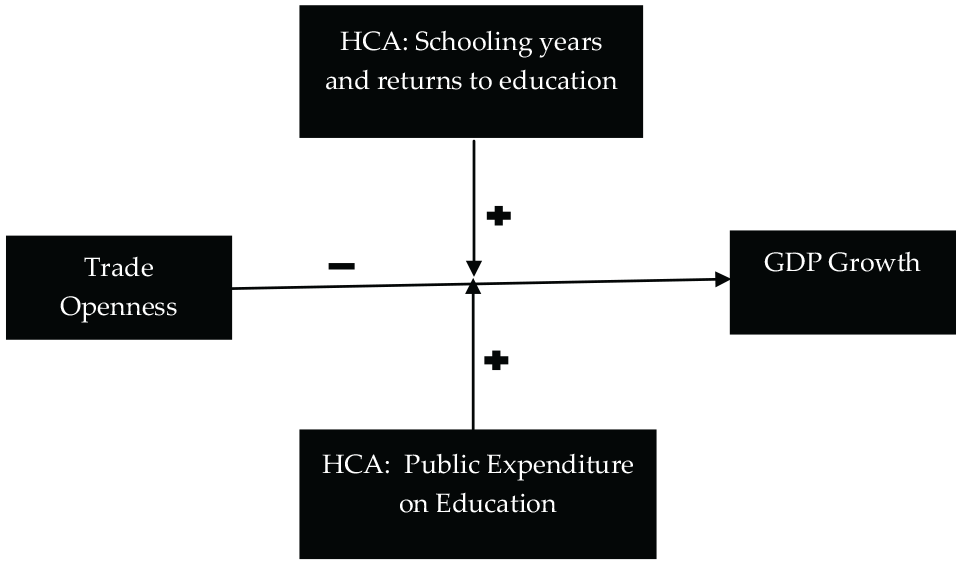
The theoretical framework of our study.
Model Design
To investigate the relationship between trade openness and GDP growth through its impact on HCA, we assume that an extended aggregate production function can be expressed as:

where 0 < α < 1,

The standard computation of growth rates using logs is based on taking the log difference between 2 years. Therefore, the dependent variable ∆
Moreover, in Equation 2, OPEN represents trade openness (i.e., exports plus imports of goods and services as a share of GDP). A plethora of varying trade openness indices have been constructed and employed in empirical literature to assess the nexus between openness in trade and economic growth. These numerous measures narrate diverse definitions of trade openness, notably, from the trade or global policy orientation to a broader perspective. According to the latter, the decision by a country to open to trade is contingent on not only the orientation of policy but also factors of nonpolicy nature such as infrastructure and geography (Huchet-Bourdon et al., 2011). This index has been used by several researchers to measure the trade integration of countries (Baltagi et al., 2009; Darku & Yeboah, 2018; Huang & Chang, 2014; Ibrahim & Sare, 2018; Kim et al., 2011; Kumi et al., 2017; Zahonogo, 2016).
In Equation 2, HCA represents human capital accumulation. Within the framework of growth accounting, several attempts have been made by researchers to shed light on the importance of HCA in the nexuses between trade, HCA, and economic performance. For instance, Nelson and Phelps (1966), followed by Benhabib and Spiegel (2000), suggest that HCA plays an important role in the development process of economic theories. HCA affects growth in different ways: (a) through the adaptation and implementation of new technology transferred from developed to the developing countries, (b) via international trade, and (c) through the creation of domestic technology. The importance of HCA through sustained investment in education and technological growth spillovers has also been discussed in the studies of Henderson and Russell (2005) and Vandenbussche et al. (2006). They conclude that HCA is a significant contributor to the rate of convergence.
In addition, issues regarding the measurement of HCA are widely discussed in the literature (Barro & Lee, 2013; Benhabib & Spiegel, 2000; Caselli, 2005; Cohen & Leker, 2014; Cohen & Soto, 2007; Mincer, 1974). The data on the average years of schooling have attracted considerable attention in the literature. Jones and Schneider (2006) argued that the quality of the HCA measurement should be taken into account. For this purpose, they have made two adjustments in total average years of schooling. First, they excluded the unemployed labor force from the data. Second, they used the HCA variable in level, difference, and lagged forms. Hence, in the existing empirical literature, several measures of HCA have been used to quantify their impact on GDP growth. The most commonly used measures are literacy rate (Benhabib & Spiegel, 2000), school enrolment rate (Mankiw et al., 1992), and average years of schooling (Barro & Lee, 1996).
This study relies on the data on HCA that are extracted from Version 9.0 of the Penn World Table (PWT), using years of schooling and returns to education. To check the robustness of our primary results, we also use an alternative proxy of HCA in terms of public expenditure on education. The direct impacts of trade openness and HCA are evaluated based on
The other control variables included in the model are (a) physical capital formation (KS) as a share of GDP to proxy fixed investment, (b) labor growth rate (L) as labor force and measured as the percentage of the population that is economically active and aged between 15 and 64 years, (c) the deflation of GDP is employed to measure inflation (INF) to appreciate how macroeconomic instability influences growth in terms of GDP, (d) expenditure of the government (GOV) is proxied in terms government consumption expenditure as a percentage of GDP, and (e) financial resources destined to the private sector from domestic money banks are used to measure financial development (FD). This last measure is also in terms of GDP. The effects of fixed capital formation, labor growth rate, and financial development are likely to be positively correlated with GDP growth. The impact of government size and inflation is anticipated to affect economic growth unfavorably, but in several studies, the effects of government expenditure on GDP growth are inconclusive. The model entails time-specific impacts (µt) such as variations in productivity that are similar across sampled countries. Fixed effects that are specific to sampled countries (
Finally, to test for the indirect or the cross-effect of trade openness and HCA, we introduce an interactive term between trade openness and HCA in our basic specification. Thus, our alternative econometric model is as follows:

where
Identification Strategy
The empirical analysis for the period 1980 to 2015 builds on a panel data set from 80 countries that is balanced and consists of 4-year averages. Given that most of the variables in the right-hand side can be jointly endogenous with GDP growth, using ordinary least squares (OLS) to estimate the model may lead to biased results if there is a potential endogeneity. As mentioned above, the endogeneity problem arises due to explanatory variables being endogenous and, therefore, likely correlated with the error term. Thus, in this case, we use the fixed effects method or least-squares dummy variable (LSDV) and GMM alternatives to OLS. As the initial step, following the study by Harrison (1996) and Wacziarg (1999), we performed the Hausman test that enables the study to choose between the fixed effects and random effects model. The fixed effects model is the more appropriate method when dealing with countries that are characterized by unique specificities and has a substantial advantage, in that, the intercept terms are allowed to vary over the individual units but are held constant over time.
According to existing literature reports, the endogeneity problem still relies for the most part on the findings of the method of fixed effects. It is probable that trade openness is significantly associated with the corresponding residuals. The factors that are unobserved could go beyond the features that influence the trade–growth relationship. For instance, although spillovers that influence knowledge and boost economic growth are driven by liberalization policies, sometimes however, nations characterized by high rates of economic growth often leverage on liberalization owing to their more advanced mastery of technological development. This underlying linkage according to Cavallo and Frankel (2008) potentially biased estimated coefficients due to identification issues. The contending narrative on the trade–growth nexus using growth models is thoroughly explained by attendant literature (Caselli et al., 1996; Dollar & Kraay, 2002). The corresponding studies have established that the system GMM estimator is a more sophisticated econometric technique to mitigate apparent concerns of endogeneity in growth model based on panel data.
GMM primarily was used by Arellano and Bond (1991) and Arellano and Bover (1995) for models that are based on dynamic panel data. Blundell and Bond (2000) afterward, used it for the first time to reduce the problem of potential endogeneity in growth regression models. Thus, we have used the system GMM model conceived for dynamic panel data sets. The principal advantage of the underlying technique is that it can be employed without external instruments. It can mitigate the potential endogeneity issues that are inherent in the explanatory variables by using internal instruments to avoid reverse causation or simultaneity (Blundell & Bond, 2000). The estimation technique also controls for the unobserved heterogeneity by accounting for year fixed effects.
As the lagged levels of explanatory variables turn to be weak instruments for the first difference equation, we used two-step system GMM estimators because they correct the residuals for heteroscedasticity and also generate consistent estimates in the presence of a lagged dependent variable. One concern is the number of additional instruments used in the model. Taking all variables on board in the light of the extant literature engenders instrument proliferation, which can lead to an overfit of endogenous explaining variables, and hence issues related to the endogenous components are not entirely addressed (Roodman, 2009). For this reason, besides, the lagged dependent variable, the results presented in this study treat all three measures of trade openness, HCA, and interactive terms between HCA and trade openness as instruments in all estimations. As argued by Lee et al. (2004), all measures of trade openness are closely linked to the economic growth rate. Being closely related to GDP growth, the endogeneity of measures of trade openness is greatly emphasized in the literature.
To check the validity of instruments, the validity of the moment conditions is tested by employing the conventional test of overidentifying restrictions. This test proposed by Sargan (1958) identifies the null hypothesis to which the error term is not second-order serially correlated. Furthermore, Arellano and Bond (1991) pointed out that the outcome in terms of the p value of the Sargan test appears comparatively higher in the two-step system compared with the one-step system GMM estimator. Thus, system GMM estimator runs a GMM procedure based on the following system of equations:

where Equation 4 can be transformed into the first difference equation:

We further take into account the long-term effects pointed out by T. Beck and Levine (2004), to estimate regressions with average variables and consider cyclical GDP growth. In this case, we split our sample of 36 years into nine nonoverlapping 4-year periods (1980–1983, 1984–1987, 1988–1991, . . ., and 2011–2014) for each country.
Data Illustration
Our model is based on dynamic panel data set for 80 countries over the 1980–2014 period. The sample choice is based on the availability of data. For the list of countries, please refer to the appendix, Table A1. Much of the data are taken from World Development Indicators (WDI; 2016) of the World Bank. The dependent variable ∆
Definitions, Abbreviations, Sources, and Summary Statistics for All Variables.

Note. GDP = gross domestic product; WDI = World Development Indicators; UNCTAD = United Nations Conference on Trade and Development; PWT = Penn World Table.
Results and Discussion
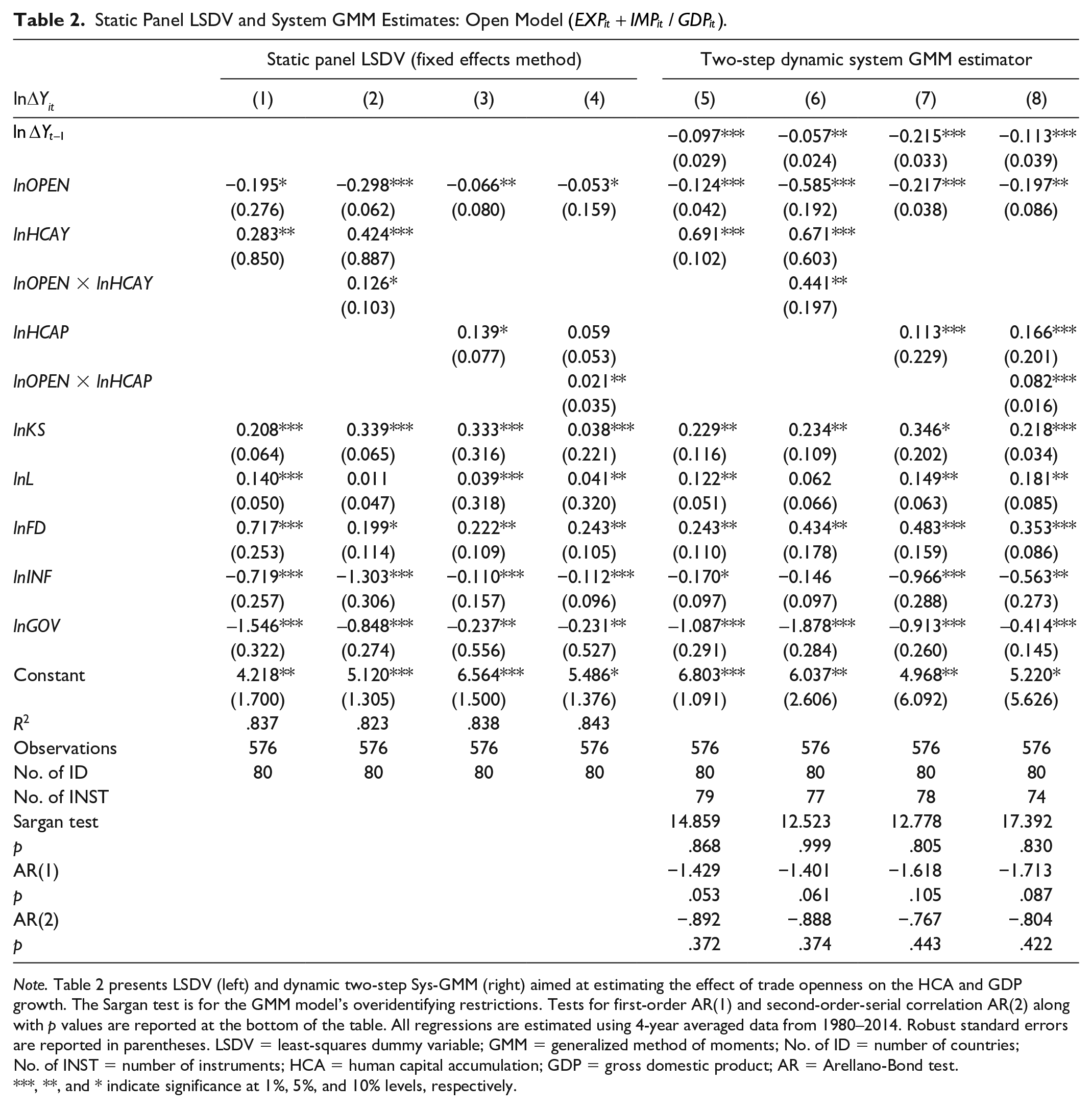
The main objective of this study is to explore how the relationship between trade openness and GDP growth depends on the HCA of a specific country. Using the fixed effects method, Columns 1 and 3 report the results without interactive terms, whereas Columns 2 and 4 present the findings with interactive terms between trade openness and first/second proxy of HCA, respectively. Similarly, using system GMM, Columns 5 and 7 report the results without interactive terms, whereas Columns 6 and 8 present the results with interactive terms between trade openness and the first and second proxies for HCA, respectively.
From Columns 1 and 2, the coefficients of trade openness are negative and statistically significant at 10% and 1% levels, respectively. This result indicates that the direct impact of trade openness
Using alternative proxies, we notice that the direct impact of HCA on GDP growth is positive and significant in all regressions. This result is in line with the majority of the existing studies, such as Temple (1999b) and Outreville (1999). In other words, these studies suggest that highly educated people have better access to high-quality information and, hence, more likely to behave in a rational way to avoid risk factors. Moreover, a higher level of HCA can also be associated with a higher savings rate, increasing GDP growth.
Our benchmark results are based on the system GMM estimator (the system GMM hereafter). From Columns 5 and 6, the coefficients of trade openness are negative and statistically significant at the 1% level, whereas, in Column 6, the coefficient of the interactive term between trade openness and the first proxy of HCA is positive and significant at the 5% level. This reveals an interesting nonlinear pattern between trade openness and GDP per capita growth, suggesting that trade may have a negative impact on growth when countries possess a low level of HCA. Trade clearly enhances growth when countries possess high HCA levels, and thus, there is a minimum threshold in HCA for trade to be beneficial in terms of economic growth. This finding is in line with previous studies (Haq & Luqman, 2014; Ibrahim & Sare, 2018; Soukiazis & Antunes, 2012).
Columns 6 and 8 reveal similar results for the alternative proxy of HCA (i.e., public expenditure on education). This suggests that the results hold true irrespective of model specification and estimation technique used. Moreover, when the system GMM was used, Table 2, Columns 6 and 8, show that the marginal effect of trade openness on 4-year average GDP per capita can be found by taking the partial derivative of the Equation 6 presented below:

Static Panel LSDV and System GMM Estimates: Open Model
Note. Table 2 presents LSDV (left) and dynamic two-step Sys-GMM (right) aimed at estimating the effect of trade openness on the HCA and GDP growth. The Sargan test is for the GMM model’s overidentifying restrictions. Tests for first-order AR(1) and second-order-serial correlation AR(2) along with p values are reported at the bottom of the table. All regressions are estimated using 4-year averaged data from 1980–2014. Robust standard errors are reported in parentheses. LSDV = least-squares dummy variable; GMM = generalized method of moments; No. of ID = number of countries; No. of INST = number of instruments; HCA = human capital accumulation; GDP = gross domestic product; AR = Arellano-Bond test.
, **, and * indicate significance at 1%, 5%, and 10% levels, respectively.
According to the Equation 6, using the system GMM, we calculated the threshold for the first and second proxies for HCA, above which the effect of the trade openness starts to be positive. In Table 2, from Column 6, the results show that the impact of trade openness on GDP growth is positive when the average years of schooling and returns to education are higher than the threshold of 1.327 (−0.585 + 0.441lnhc). As shown in Table 1, this threshold is lower than the average value of years of schooling and returns to education over the whole sample (2.204), suggesting that trade is likely to boost GDP growth for most of the countries. However, the impact of trade openness on GDP growth is found to be negative for the countries (see the appendix, Table A2) that fall behind this threshold. Thus, these countries need to improve their education system to benefit from the economic growth externalities of trade openness.
Similarly, from Column 8, the impact of trade openness on GDP growth becomes positive once the value of public expenditure on education is higher than the threshold of 2.402 (−0.197 + 0.082lnhc). This finding is in line with the study by Siddiqui et al. (2017) in which, a positive association between public expenditure on education and GDP growth was found in nine Asian countries. As shown in Table 1, this threshold is lower than the average value of public expenditure on education over the whole sample (3.551), suggesting that trade is likely to spur GDP growth for most of the sampled countries. At the same time, the impact of trade openness on GDP growth is found to be negative for the countries (see the appendix, Table A2) that fall below this threshold. This result suggests that these countries need to invest more in education to leverage on trade openness for returns in economic growth.
The results of the threshold effect support the idea of knowledge spillovers and technology diffusion, suggesting that technology transferred through trade can only be absorbed in the presence of higher levels of HCA. These countries include high-income countries, oil-rich, and upper middle-income countries. Countries below this threshold are mainly low-income countries, sharing specific structural characteristics and low levels of HCA.
The results for most of the control variables are within the expected signs. The coefficients of the lagged dependent variable show a negative sign for all model specifications, suggesting a conditional convergence toward a steady-state level of per capita growth (Mankiw et al., 1992). The coefficients of fixed capital investment are positive and statistically significant in most of the regression equations. This result suggests that fixed capital investment is positively associated with GDP growth, which is consistent with the findings of the previous studies (Barro & Lee, 1994; Zhao et al., 2018). The coefficients of labor growth are positive and statistically significant, while also in line with previous studies of Jouini (2015) and Sulaiman et al. (2015). The coefficients of financial development are positive and significant, which confirm the conventional view that financial development is a key driver for long-term growth. This result is consistent with the majority of the existing studies (Baltagi et al., 2009; T. Beck et al., 2003). The coefficients of inflation are found to be negative and statistically significant for most of the specifications. This finding is in line with the studies of Rousseau and Wachtel (2002) and Temple (1999b). Moreover, this finding also suggests that inflation tends to exert a negative impact on GDP growth because it is often a sign of macroeconomic instability and mismanagement, in contrast to some theoretical studies (Darku & Yeboah, 2018). The coefficients of government size are found to be negative in almost all models. This finding is consistent with the studies of Huang and Chang (2014) and Bajo-Rubio (2000), suggesting that results may differ depending on the econometric techniques, type of countries, time period considered, and proxy variables of government size used in the analysis. In Table 2, the Sargan test shows that the additional instruments associated with the system GMM estimator are valid and do not reject the specification of the null hypothesis. Moreover, although the test of AR(1) is rejected, the corresponding AR(2) test is not rejected, confirming the hypothesis that the residuals are not serially correlated in second order.
In summary, the results reveal that the growth effect of trade openness is conditional on the level of HCA in the sampled countries. In other words, according to our calculations, the total impact of trade openness on GDP growth is positive for the countries having HCA levels higher than the established threshold. In contrast, trade openness exerts a detrimental effect on GDP growth below this threshold. The empirical results are consistent with the theoretical assumption underpinning the study. Furthermore, the turning point or threshold tendency for the beneficial effects of trade openness contributes to the debate in the literature on the impact of trade openness on GDP growth. It follows that governments of developing countries should pay more attention to their HCA development to reap the full advantages of knowledge spillovers within the framework of economic growth returns from international trade.
Robustness Analysis and Further Discussion of Results
To evaluate the sensitivity of our findings to data and estimation techniques, we perform several robustness tests. First, we include other variables that can proxy for the trade openness index. More specifically, we use the export ratio
Static Panel LSDV and system GMM Estimates: Export Model

Note. Table 3 presents LSDV (left) and dynamic two-step Sys-GMM (right) aimed at estimating the effect of trade openness on the HCA and GDP growth. The Sargan test is for the GMM model’s overidentifying restrictions. Tests for first-order AR(1) and second-order serial correlation AR(2) along with p values are reported at the bottom of the table. All regressions are estimated using 4-year averaged data from 1980–2014. Robust standard errors are reported in parentheses. LSDV = least-squares dummy variable; GMM = generalized method of moments; No. of ID = number of countries; No. of INST = number of instruments; HCA = human capital accumulation; GDP = gross domestic product; AR = Arellano-Bond test.
, **, and * indicate significance at 1%, 5%, and 10% levels, respectively.
Static Panel LSDV and System GMM Estimates: Import Model

Note. Table 4 presents LSDV (left) and dynamic two-step Sys-GMM (right) aimed at estimating the effect of trade openness on the HCA and GDP growth. The Sargan test is for the GMM model’s overidentifying restrictions. Tests for first-order AR(1) and second-order serial correlation AR(2) along with p values are reported at the bottom of the table. All regressions are estimated using 4-year averaged data from 1980–2014. Robust standard errors are reported in parentheses. LSDV = least-squares dummy variable; GMM = generalized method of moments; No. of ID = number of countries; No. of INST = number of instruments; HCA = human capital accumulation; GDP = gross domestic product; AR = Arellano-Bond test.
, **, and * indicate significance at 1%, 5%, and 10% levels, respectively.
Robustness Test 1: Alternative proxy trade openness index
The effects of patterns of imports and exports as a percentage of GDP are established to be varying using different mechanisms via which trade (i.e., imports and exports) structures are linked to enhance output at the aggregate level. Concerning exports, knowledge spillovers improve, inter alia, technology, the allocation of resources as well as other positive spillovers that consolidate arguments for a hypothesis supporting a positive nexus between GDP and exports and by extension, the perspective that growth is driven by exports. Concerning imports, spillovers through established channels of knowledge as well as other assets are also advanced to support a favorable influence on economic prosperity. It is also worthwhile to note that learning by doing can also be mitigated by imports. Moreover, some microeconomic studies have established a positive nexus between enhanced exports and economic prosperity (Busse & Groizard, 2008). It is worth noting that these alternative measures also present the same nonlinear pattern.
When the threshold is calculated using the export ratio, we compute the limit (using Equation 6) for both proxies of HCA. From Column 6 of Table 3, the threshold of the first proxy of HCA (average years of schooling and returns to education) is required to be 1.761 (−0.081 + 0.046lnhc) for the impact of the export ratio to be positive. This result is consistent with several studies, where a higher export activity contributes to enhanced GDP growth (Aw et al., 2000; Feenstra & Kee, 2008; Huchet-Bourdon et al., 2011). These studies also have emphasized the role of export activity in international knowledge and technology diffusion. The authors argued that potential benefits related to export activity include knowledge spillovers from exporters that play a significant role in the growth process of developing countries. Similarly, from Column 8, pertaining to the second proxy of HCA (public expenditure on education), the impact of exports on GDP growth becomes positive once the value of public expenditure on education is higher than the threshold of 2.226 (−0.750 + 0.337lnhc). According to Table 1, this threshold is lower than the average value of public expenditure on education over the entire sample (3.551), suggesting that export is likely to boost GDP growth for most of the countries. However, the impact of export on GDP growth is found to be negative for the countries (see the appendix, Table A2) that fall behind this threshold. These findings suggest that the sampled countries need to invest more on education to achieve economic growth advantages of trade openness.
Similarly, the obtained results produce the nonlinear pattern when the cross-effect of import ratio
Robustness Test 2: Results of the extended threshold
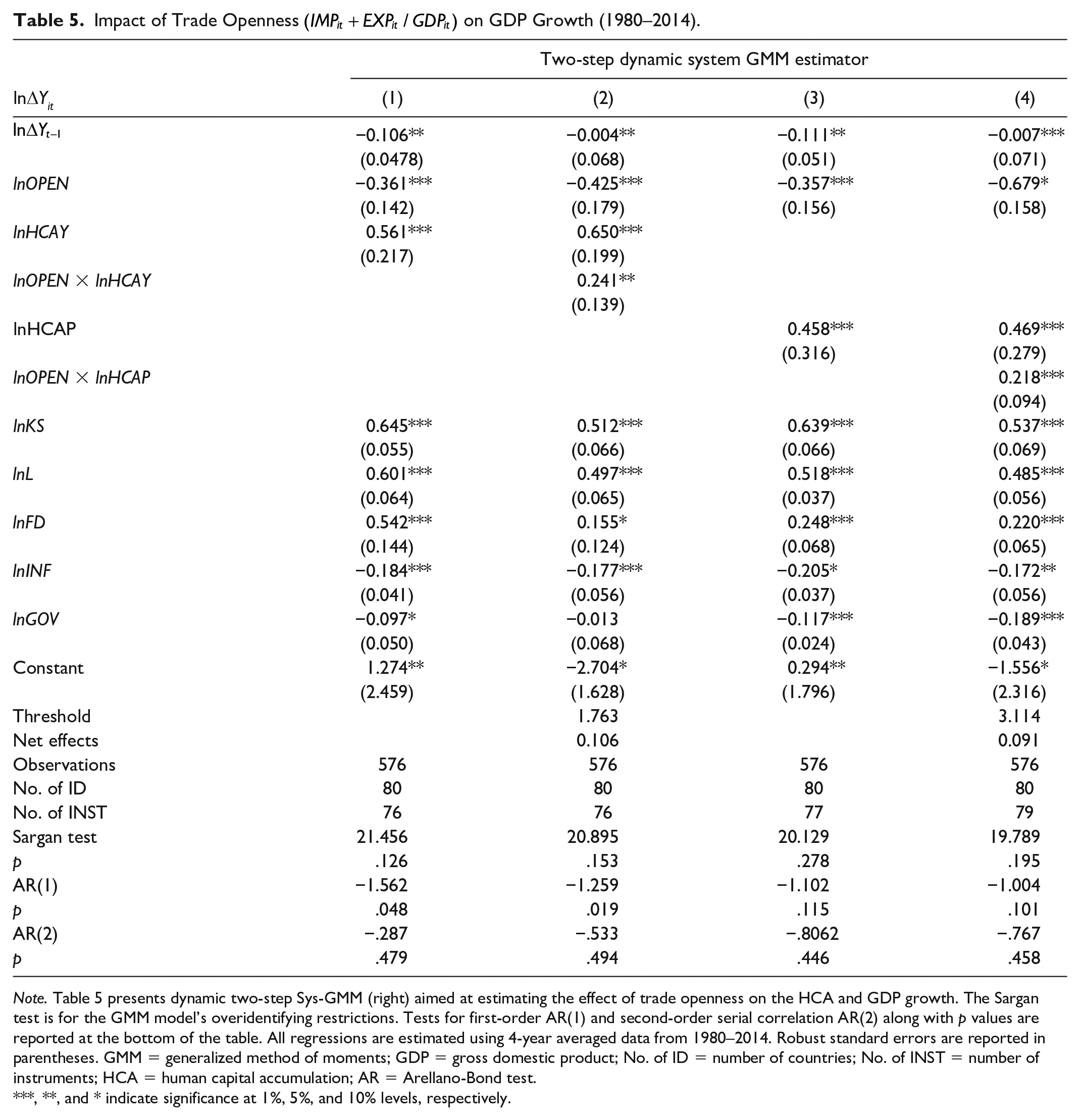
Following contemporary GMM-centric studies (Asongu & Odhiambo, 2020c, 2020d; Tchamyou, 2019d) in this subsection, we report the results of the extended threshold analysis, which is alternative to our basic computation method employed so far. Hence, this extended analysis aims to make our basic findings more robust. The results are reported in Table 5. To measure the overall relevance of the growth increasing effect of HCA, the net effects from the unconditional, marginal, or conditional impacts of both proxies of HCA are calculated. For instance, from the second column of Table 5, the net impact on GDP growth of average years of schooling and returns to education is 0.106 (0.241 × 2.204 + (−0.425)). According to the calculation, 0.241 is the conditional effect from the cross-effect of trade openness and average years of schooling and returns to education, whereas 2.204 is the mean value of average years of schooling and returns to education from the summary statistics, and −0.425 is the unconditional effect of trade openness on GDP growth.
Impact of Trade Openness
Note. Table 5 presents dynamic two-step Sys-GMM (right) aimed at estimating the effect of trade openness on the HCA and GDP growth. The Sargan test is for the GMM model’s overidentifying restrictions. Tests for first-order AR(1) and second-order serial correlation AR(2) along with p values are reported at the bottom of the table. All regressions are estimated using 4-year averaged data from 1980–2014. Robust standard errors are reported in parentheses. GMM = generalized method of moments; GDP = gross domestic product; No. of ID = number of countries; No. of INST = number of instruments; HCA = human capital accumulation; AR = Arellano-Bond test.
, **, and * indicate significance at 1%, 5%, and 10% levels, respectively.
Likewise, from the fourth column of the same table, the net effect of the increasing public expenditure on education is 0.091 (0.218 × 3.55 + (−0.679)). According to the calculation, 0.218 is the conditional effect from the cross-effect of trade openness and public expenditure on education, whereas 3.551 is the mean value of public expenditure on education disclosed in the statistics summary, and −0.679 is the unconditional effect of trade openness on GDP growth. The calculation is consistent with the contemporary literature on interactive regressions (Asongu & Odhiambo, 2020c, 2020d; Tchamyou et al., 2019d). Furthermore, considering the two different specifications of cross-effects between trade openness and both proxies of HCA, the positive net effect is consistently more apparent in average years of schooling and returns to education compared with public expenditure on education as threshold variables. The similar results are found while computing thresholds using exports and imports as alternative proxies for the trade openness index (exports plus imports as a share of GDP). In this article, we only report the results of the trade openness index in relevance to the mentioned threshold variables.
According to Asongu and Odhiambo (2020a, 2020b), the established thresholds can make economic sense and have policy relevance if they are within the statistical range (i.e., from minimum to maximum values), which is disclosed in the statistics summary. Hence, in the light of the above explanation, the positive threshold of average years of schooling and returns to education is 1.763 (0.425 ÷ 0.241), which is close to the threshold computed for the trade openness index in section “Robustness Analysis and Further Discussion of Results” of the main results (1.327). Hence, the threshold of 1.763 is the minimum value required for the positive impact of trade openness on GDP growth. This threshold makes economic sense and has policy relevance because it is within the statistical range (1.017–3.719) of average years of schooling and returns to education imposed by the statistics summary. Likewise, the positive threshold of public expenditure on education is 3.114 (0.679 ÷ 0.218). Hence, 3.114 is the minimum value required for the positive impact of trade openness on GDP growth. This threshold is also within the statistical range (0.08–7.819), implying the established public expenditure on education threshold makes economic sense and is policy relevant.
Robustness Test 3: Results of the PTR
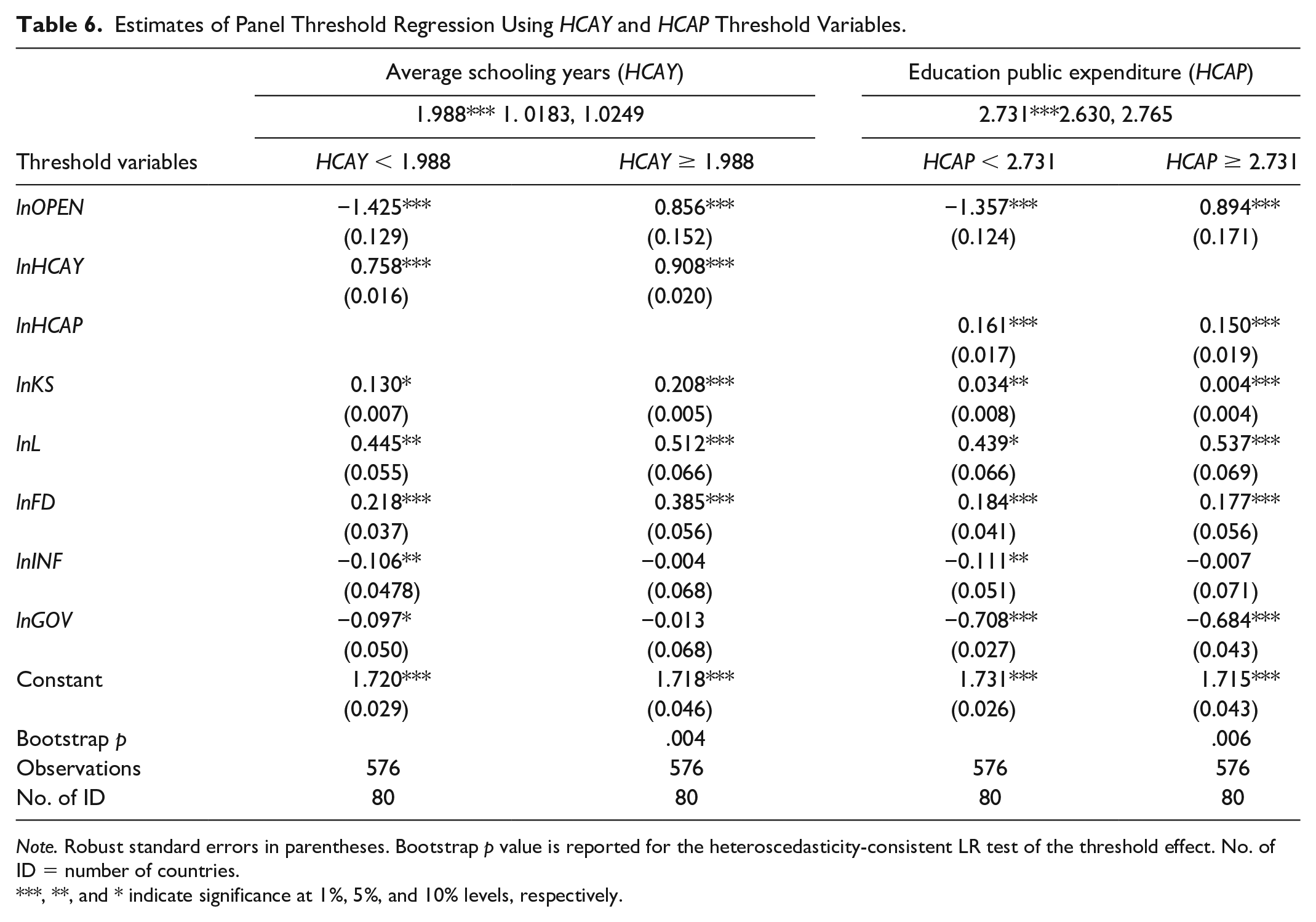
Following Asongu and Odhiambo (2019) and contrary to GMM-centric studies that have not used the PTR method for robustness purposes owing to associated unbalanced data sets (Asongu & Odhiambo, 2020a, 2020b; Tchamyou, 2019, 2020; Tchamyou et al., 2019b), the robustness of findings provided so far are further assessed with the PTR technique that is consistent with balanced panel data sets. Using specification insights reported by Wang (2015), the GMM regressions are replicated within the framework of the underlying panel threshold model. Considering 95% of confidence intervals, we obtained thresholds of both proxies of HCA as 1.988, 1.0183, 1.0249 and 2.731 2.630, 2.765, respectively. It is important to note that the thresholds were calculated using Equation 6.
Based on the results of the linear analysis, Hansen’s PTR model (Hansen, 1999) is applied to the specification of model 3 to validate our basic threshold results. Our linear analysis of interactive regressions (Tables 2–5) indicates the statistical significance of the interactive terms of trade openness and both the proxies of HCA. Hence, both the variables are suitable for selection as the threshold variable in the robustness section of the panel threshold. As the first requirement is to verify that there is indeed evidence for a threshold effect, the Hansen’s LR test of the threshold effect (Hansen, 1999) is employed to determine the existence of a threshold. The obtained results are reported in Table 6.
Estimates of Panel Threshold Regression Using HCAY and HCAP Threshold Variables.
Note. Robust standard errors in parentheses. Bootstrap p value is reported for the heteroscedasticity-consistent LR test of the threshold effect. No. of ID = number of countries.
, **, and * indicate significance at 1%, 5%, and 10% levels, respectively.
From Columns 1 and 3 of Table 6, the coefficients of trade openness are significantly negative. The point estimates suggest that economic growth is negative relative to the trade openness for the countries having their proxies of HCA lower than the thresholds. In this case, the impact of trade openness on economic growth is the opposite of both threshold variables. This finding indicates that more trade engenders an insignificant or even an adverse effect on economic growth for countries with a low level of HCA. The possible interpretation of the results is that these countries are still in the process of integration of new technology acquired during international trade. In this case, more trade openness may increase competition and decrease business profits, thereby discouraging innovation. Therefore, in countries with a low level of HCA, greater trade openness can have an adverse effect on their long-term economic growth rates.
From the second and the fourth columns of Table 6, when bootstrap replications in the proxies of HCA were used, the LR test witnesses the presence of threshold having p values of .004 and .006, respectively. These values oppose the no-threshold null hypothesis. Therefore, it can be concluded that there is strong evidence for the presence of a single threshold in the said specification regression. The point estimates of the single threshold of the first and second proxies of HCA are 1.988 and 2.731, respectively. Notably, these thresholds are closer to the mean value of the empirical distribution disclosed in Table 1, as well as to the statistics summary of both proxies of HCA and their threshold variables. These threshold values are also similar to the thresholds computed through linear interactive regressions.
Conclusion and Policy Recommendations
Contemporary tendencies of global economic integration have substantially promoted openness in trade. The empirical literature shows conflicting outcomes on the incidence of openness in trade on GDP growth. This study contributes to the extant literature by assessing the underlying relationship on the premise that trade liberalization cannot be comprehensively measured by means of mainstream indicators. To this end, our study takes on board another dimension of integration in trade, in particular, HCA as an intervening variable. The empirical study is based on 4-year average balanced panel data from 80 countries over the period 1980 to 2014.
Our empirical findings are consistent with insights from the modern global economy. In essence, knowledge spillover affects the relationship between trade openness and GDP growth, as well as different measures of trade openness. When HCA is taken into account, our results suggest an intriguing nonlinear pattern between trade openness and GDP growth: Trade may have a negative impact on GDP growth when countries exhibit a low level of HCA. In contrast, trade clearly contributes to enhanced economic growth once a country exhibits a minimum HCA threshold. Therefore, trade effects and HCA are complimentary; hence, the higher the level of HCA, the greater the impact of trade openness on GDP growth.
We also performed two robustness tests to compute thresholds of both proxies of HCA. Moreover, per contemporary economic development literature, the extended interactive threshold regression estimation technique is also criticized. To the best of our knowledge, the reported nonlinear techniques are more appropriate for balanced data structures. Owing to the balanced nature of the data set used in this study, alternative estimation methods that particularly emphasize nonlinear regressions were used, specifically, the PTR.
From a policy viewpoint, this study has emphasized the importance of recognizing and employing policies that are complementary to trade openness to boost GDP growth in the sampled countries. The developing countries in our sample size strive to take advantage of the global market after opening their economies to trade. It is equally important that they implement socioeconomic policies equipped toward HCA. This implementation will support the integration of technological advantages obtained through trading with developed countries. The developing countries are advised to implement the policies that stimulate macroeconomic stability, which will help them increase their competitive edge in the global economy. The governments of developing countries are also advised to enhance their capacities to access capital flows that are favorable to knowledge transfers to improve trade–growth performance.
The findings from this study obviously leave room for further research, especially as it pertains to the need for country-specific thresholds that are relevant for country-specific implications. To take this recommendation on board, relevant time-series estimation approaches are warranted on data that are not averaged in terms of nonoverlapping intervals as used in this study.
Footnotes
Appendix
List of Countries Below the HCA Threshold.

| Sierra Leone | Angola | Laos Rep. | Honduras |
| Burkina Faso | Bangladesh | Congo | India |
| Burundi | Benin | Côte d’Ivoire | Jamaica |
| Madagascar | Botswana | China | Zimbabwe |
| Malawi | Burkina Faso | Sri Lanka | Ghana |
| Mali | Nepal | Mongolia | Côte d’Ivoire |
| Mauritania | Pakistan | Togo | Lesotho |
| Cameroon | Zambia | Senegal | Mauritius |
Note. HCA = human capital accumulation.
Declaration of Conflicting Interests
The author(s) declared no potential conflicts of interest with respect to the research, authorship, and/or publication of this article.
Funding
The author(s) received no financial support for the research, authorship, and/or publication of this article.
