



Abstract
This study examines the impact of renewable energy (RE) capacity, RE investment, and RE share on GDP growth, renewable energy employment, and subsidy reduction in Saudi Arabia over the period 2015 to 2023. The study applies the Autoregressive Distributed Lag (ARDL) model to capture both short-run and long-run effects. This methodological approach accommodates mixed integration orders and corrects for potential endogeneity and heterogeneity, making it particularly suitable for the structural characteristics of Saudi Arabia’s transitioning economy. The empirical results reveal that RE capacity, RE investment, RE share, education index, and urbanization rate significantly and positively influence non-oil GDP growth and RE employment in both the short and long run. Additionally, RE capacity, investment, share, and education significantly enhance subsidy reduction, whereas urbanization negatively affects subsidy reform due to rising energy demand in rapidly expanding urban areas. The negative and significant error-correction term across all models confirms stable long-run equilibrium relationships. The study’s novelty lies in its integrated framework, simultaneously analyzing growth, employment, and fiscal outcomes within the context of renewable energy transition using ARDL estimation. The findings extend Energy Transition Theory, Endogenous Growth Theory, and Resource Curse Theory by positioning renewable energy as both an economic driver and a governance reform mechanism. The results have strong policy implications, suggesting that coherent investment in renewable energy, education, and urban planning can foster sustainable economic diversification under Vision 2030. This study contributes to sustainability literature by demonstrating how renewable energy expansion can accelerate inclusive growth, fiscal stability, and employment transformation in energy-dependent economies.
Introduction
The worldwide transition to renewable energy (RE) is emerging as an essential component for meeting climate targets, lowering greenhouse gas emissions, and promoting sustainable development. Solar, wind, and geothermal are examples of renewable energy sources, providing healthier alternatives to fossil fuels which have historically been the backbone of the world’s energy systems and which are significant sources for environmental pollution (International Renewable Energy Agency [IRENA], 2023). This transformation of the energy mix is not just an environmental necessity, but it’s an economic opportunity, especially for countries that rely significantly on hydrocarbons. Saudi Arabia is in the thick of it all.
As the world’s largest oil exporter, Saudi Arabia’s economy has historically been underpinned by hydrocarbon revenues, contributing over 70% to the national budget and more than 40% to GDP (World Bank, 2022). However, mounting global pressures for decarbonization, coupled with the volatile nature of oil markets, have prompted the Kingdom to reconsider its economic model. In response, Vision 2030, a strategic framework launched in 2016, outlines a bold plan to reduce dependency on oil, diversify the economy, and develop public service sectors (Vision 2030, 2016). A central tenet of this vision is the commitment to increase the share of renewables in the national energy mix to 50% by 2030 (Saudi Green Initiative, 2021).
Despite this ambitious target and the rapid technological advances in renewable energy, the economic implications of such a transition remain insufficiently understood. Empirical studies analyzing renewable energy in Saudi Arabia have largely focused on technical feasibility, environmental outcomes, or national-level policy assessments (Abubakr et al., 2024; Alrashed & Asif, 2021; Reiche, 2010). However, limited research has investigated the regional economic impacts of RE deployment across the Kingdom. Furthermore, existing literature often relies on cross-sectional or aggregated national data, which fails to account for intra-country disparities in energy infrastructure, economic resilience, and labor markets.
Although Saudi Arabia is aggressively pursuing renewable energy goals under Vision 2030, there is a noticeable gap in empirical research that systematically quantifies the economic effects of this transition, particularly at the regional level. It remains unclear whether and how renewable energy deployment translates into tangible economic benefits such as GDP growth, job creation, and reduced energy expenditure (Hidthiir et al., 2024; Rahman et al., 2024). Without such insights, policy efforts risk being misaligned with local economic dynamics, undermining both efficiency and equity in the energy transition process.
The objective of this study is to empirically assess the economic impact of renewable energy adoption in Saudi Arabia by analyzing how variations in renewable energy capacity, investment levels, and the share of renewables in electricity generation influence key economic indicators such as non-oil GDP growth, renewable energy-related employment, and the reduction of fossil fuel subsidy expenditures, using panel data from 2015 to 2023. The study also seeks to quantify the extent to which renewable energy development contributes to economic diversification, job creation, and fiscal sustainability within the framework of Vision 2030.
The urgency of energy diversification in Saudi Arabia is compounded by environmental imperatives, market volatility, and youth unemployment. According to the King Abdullah Petroleum Studies and Research Center (King Abdullah Petroleum Studies and Research Center, 2022), 98% of the country’s electricity is still derived from fossil fuels. Meanwhile, projects like the Sakaka Solar Plant (300 MW) and the Dumat Al Jandal Wind Farm (400 MW) reflect growing governmental commitment to RE (Saudi Power Procurement Company, 2023). Yet, without rigorous data-driven analysis, policymakers face difficulty justifying continued large-scale investments in renewables from a socio-economic perspective. This research responds to that critical need.
The significance of this study lies in its contribution to understanding the economic viability of renewable energy transition strategies within the unique context of an oil-dependent economy like Saudi Arabia. The findings are expected to inform national and regional policymakers in designing and optimizing renewable energy investment strategies that are both economically and socially beneficial. Additionally, the study will support economic planners in aligning renewable energy deployment with labor market development, particularly through job creation in the green energy sector. Furthermore, the research offers valuable guidance to international stakeholders and development agencies seeking scalable, evidence-based models for energy transition in resource-dependent and rentier states.
This study makes a meaningful contribution to both academic literature and practical policymaking by delivering the first panel data-based economic analysis of renewable energy adoption across the regions of Saudi Arabia. The research not only fills a critical empirical gap but also establishes a replicable framework for assessing the economic impacts of renewable energy that can be applied in other Gulf Cooperation Council (GCC) countries facing similar challenges. Moreover, the findings are designed to support evidence-based decision-making in key policy areas, including energy subsidy reform, strategic job creation in the renewable energy sector, and the planning of sustainable infrastructure aligned with long-term national development goals.
The remainder of this paper is structured as follows: Section “Theoretical Review” presents the theoretical review, followed by the empirical literature review in Section “Empirical Literature Review”. Section “Hypothesis Development” outlines the development of hypotheses, while Section “Methodology and Data Sources” details the methodology and data sources employed in the study. The results and their discussion are provided in Section “Results and Discussion”. Section “Discussion” offers policy recommendations based on the findings, and Section “Conclusion” concludes the paper. Finally, Section “Policy Recommendations” highlights the study’s limitations and proposes directions for future research.
Theoretical Review
Energy Transition Theory
Energy Transition Theory explains how societies shift from one dominant energy system to another, typically from less efficient to more sustainable sources. This transformation is not merely technical but also institutional, economic, and social (Geels, 2002). The theory posits that such transitions are driven by technological innovations, policy interventions, market dynamics, and societal acceptance. In the Saudi context, the shift from a fossil fuel-dominated system to one incorporating substantial RE sources is being strategically guided by national initiatives like Vision 2030 and the Saudi Green Initiative (Saudi Green Initiative, 2021; Vision 2030, 2016).
Endogenous Growth Theory
Endogenous Growth Theory emphasizes the role of internal factors—such as human capital, innovation, and policy—in driving long-term economic growth (Romer, 1990). Renewable energy investment contributes to endogenous growth by fostering technological innovation, creating new industries, and stimulating job creation, particularly in non-oil sectors. For oil-rich nations like Saudi Arabia, where economic diversification is a key priority, RE serves as both a catalyst for growth and a buffer against oil market volatility (Sadorsky, 2009).
Resource Curse Theory
The “paradox of plenty” or the Resource Curse Theory, argues that nations blessed with natural resources often develop more slowly and have worse government because they become over-dependent on that one commodity (Auty, 1993). Saudi Arabia typifies several dimensions of this paradox, including economic exposure to volatility in oil prices and the lack of dynamism in the private sector. Hence, RE is conceived as a strategic response to the resource curse based on an increase in economic diversification and fiscal dependency on hydrocarbons (El-Katiri, 2014).
Empirical Literature Review
A number of empirical researches have examined the relationship between renewable energy (RE) penetration and economic growth; however, the results seem to be mixed with a variety of impacts depending on geographical context, methodology and maturity of the energy sector. Using panel data methodology for OECD countries, Apergis and Payne (2010) detected a long-run cointegration between RE consumption and GDP and confirms that RE supports sustainable economic growth. Similarly, Al-Mulali et al. (2013) found that the use of renewables has a positive effect on economic growth in upper-middle income economies and renewable investments can be a leading contributor to the output when combined with institutional support.
The GCC context has limited empirical work, but with an increasing trend. Rehman et al. (2022) reported a linkage relationship between renewable energy consumption and the diversification of Saudi Arabian economy based on time series from from 1990 to 2020. Their research supported a positive relationship between RE consumption and non-oil GDP, underscoring the fit between renewable energy and the strategic objectives of Vision 2030 framework of Saudi Arabia. Likewise, Alshehry and Belloumi (2017) found that renewable energy consumption had a positive and significant impact on economic growth in Saudi Arabia and that RE policies could influence economic activity without impacting energy security.
Employment is one of the most frequently discussed economic benefits of renewables. According to IRENA (2023), employment in the renewable energy industry reached over 13.7 million jobs at the global level in 2022 (of which the highest contribution was observed in the solar PV and wind energy sectors). National-level data has supported these figures anecdotally. Lehr et al. (2012) carried out a simulation exercise in Germany estimating that each gigawatt of installed renewable capacity could create 30,000 direct and indirect jobs throughout the value chain.
In the context of the Middle East, where unemployment, particularly among young people, is a severe problem, renewable energy seems to offer a new path toward greater diversity of work opportunities. According to a study by Griffiths and Mills (2016), meeting Saudi Arabia’s renewable energy goals for the next 15 years could generate over 75,000 direct jobs, especially in solar and wind industries by 2030. More recently, Devarajan et al. (2021) has highlighted to that if renewable energy installation was localized to the GCC, such an approach would have a major deflationary impact on jobs in local installation, operations, and manufacturing with potential to many jobs creation, particularly if jobs reskilling existed.
The economic case for investing in renewable energy in hydrocarbon producing countries, such as Saudi Arabia, is also bolstered by the opportunity to reduce expensive subsidies for fossil fuels. Fossil fuel subsidies in Saudi Arabia have traditionally represented a substantial portion of government outlays, distorting market incentives and undermining fiscal sustainability (International Monetary Fund [IMF], 2021). Empirical analysis indicates that scaling back these subsidies and investing in renewables can lead to better public finance and environmental performance.
For example, Krane and Monaldi (2017) have argued that Saudi Arabia’s partial subsidy reforms over the period 2016 to 2018 has helped in improving the budgetary balance and other reforms that may also be consistent with renewable deployment, could improve the fiscal space. The empirical model of Abouleinein and El-Laithy (2019) indicated that “removing energy subsidies and investing the funds in RE infrastructure, ever result in the welfare and environmental foregone benefits are of the positive sign.” These results favor a two-pronged policy response: reducing subsidies for fossil fuels, and encouraging the growth of renewable energy.
A notable gap in the literature involves the regional economic implications of renewable energy deployment. Most studies on Saudi Arabia have utilized national-level data, overlooking disparities in energy infrastructure, labor markets, and economic development across provinces. For example, AlFarra and Abu-Hijleh (2012) conducted a national energy scenario analysis but acknowledged the need for disaggregated studies that reflect regional heterogeneity. In contrast, studies from other countries have highlighted the benefits of subnational analyses. Wei et al. (2010), in their regional employment model of U.S. states, demonstrated that job creation varies significantly based on the type and scale of renewable projects.
Hypothesis Development
Renewable energy capacity represents the tangible deployment of clean energy infrastructure. According to Endogenous Growth Theory, capital accumulation in innovative sectors like renewables spurs productivity and long-term growth (Romer, 1990). Empirical studies such as Apergis and Payne (2010) and Rehman et al. (2022) have established that increased renewable capacity positively correlates with GDP growth, particularly in non-oil sectors in hydrocarbon-dependent countries.
Renewable energy investments are a major driver of job creation, both directly and indirectly. IRENA (2023) has shown that investments in solar, wind, and other renewable sectors generate more jobs per unit of energy compared to fossil fuels. In Saudi Arabia, Griffiths and Mills (2016) estimate that localized RE investment could significantly contribute to employment generation across value chains.
The share of renewable energy in total electricity generation reflects the progress of the energy transition. Increasing RE share reduces dependence on fossil fuels, which, in turn, can lead to a decline in fossil fuel subsidies—a major fiscal expenditure in oil-exporting nations (IMF, 2021; Krane & Monaldi, 2017). Resource Curse Theory supports the notion that moving away from resource dependency improves economic governance and fiscal sustainability (Auty, 1993; El-Katiri, 2014).
Methodology and Data Sources
This paper investigates the impact of RE capacity, RE investment, and RE share on GDP growth, RE employment and Subsidy reduction in Saudia Arabia. The study has employed econometric techniques, namely Autoregressive Distributed Lag (ARDL) model to capture both short-run and long-run effects covering 2015 to 2023 from 13 regions in Saudi Arabia. Figure 1 shows the research framework.

Conceptual framework.
The data for this study are collected from a combination of national and international sources to ensure accuracy, relevance, and regional specificity. The dependent variables non-oil GDP growth, renewable energy (RE) employment, and fossil fuel subsidy reduction are sourced respectively from the Saudi General Authority for Statistics (GaStat), the Saudi Arabian Monetary Authority (SAMA), and the International Monetary Fund (IMF), complemented by sector-specific employment data from the International Renewable Energy Agency (IRENA) and the Ministry of Energy. Independent variables, including installed RE capacity, annual RE investment, and the share of RE in total electricity generation, are obtained from the National Renewable Energy Program (NREP), IRENA, and the Saudi Electricity Company (SEC). To control for contextual factors, the education index is drawn from the United Nations Development Programme (UNDP) Human Development Reports, while urbanization rates are collected from GaStat and the United Nations Population Division.
Description of Variables
The dependent variables include non-oil GDP growth, measured as the annual percentage change in economic output from non-oil sectors, which is expected to rise with RE development as it fosters diversification and productivity (International Energy Agency [IEA], 2022; Saliah et al., 2024). The second dependent variable, Renewable Energy (RE) Employment, is operationalized as the number of direct and indirect jobs created per megawatt (MW) of installed renewable energy capacity. This measure captures the employment-generating potential of renewable energy expansion within the Saudi Arabian context. It encompasses direct jobs in construction, installation, operation, and maintenance of RE facilities, as well as indirect jobs generated across supply chains, logistics, and supporting industries (IRENA, 2021). This variable is expected to show a positive relationship with renewable energy capacity, investment, and share, since renewable energy technologies particularly solar and wind are labor-intensive during installation and maintenance phases. The third dependent variable, Subsidy Reduction, represents the annual decline in fossil fuel subsidy expenditure in Saudi Arabia, expressed in Saudi Riyals (SAR billions). This indicator reflects the fiscal savings achieved through reduced government spending on subsidizing petroleum products, electricity, and other fossil fuel–based energy sources. The variable is constructed by calculating the year-on-year percentage in total fossil fuel subsidy allocations as reported by the International Monetary Fund (IMF, 2020). This measure is based on the theoretical premise that greater renewable energy (RE) integration through higher installed capacity, investment, and generation share reduces dependence on fossil fuels, thereby lowering the government’s need to subsidize conventional energy consumption. Table 1 presents the description of variables.
Description of Variables.

The independent variables include RE capacity, defined as the total installed renewable energy (MW) per province per year, which is expected to positively influence economic indicators by reflecting infrastructure development and energy system transformation (REN21, 2020). RE investment captures the annual financial outlay (in SAR millions) directed toward renewable projects, hypothesized to promote employment, innovation, and local economic growth (World Bank, 2021). RE share, the proportion of electricity generation sourced from renewables, is a key indicator of clean energy transition and system efficiency, expected to correlate positively with economic benefits (UNEP, 2021). Two control variables are included to isolate external influences. The education index, a composite score (0–1) capturing educational attainment and quality, is expected to support economic growth and enhance the RE sector’s human capital potential (Barro & Lee, 2013; Bin Hidthir et al., 2025; Saliah et al., 2023). The urbanization rate, measured as the percentage of the population living in urban areas, may have either a positive or negative effect depending on whether urban infrastructure facilitates or strains energy and labor markets (OECD, 2020).
Model Specification and Analytical Techniques
This study employs the Autoregressive Distributed Lag (ARDL) technique to examine the dynamic relationship between renewable energy (RE) development indicators and non-oil economic growth in Saudi Arabia. The ARDL framework, developed as an extension of the traditional ARDL model (Pesaran et al., 2001), is particularly suitable for panel data settings with heterogeneous cross-sections, mixed integration orders (I(0) and I(1)), and short-to-medium-term time spans (Ahmad et al., 2025; Bin Hidthiir et al., 2024; Chudik & Pesaran, 2015). Its hybrid nature combines the advantages of both Mean Group (MG) and Pooled Mean Group (PMG) estimators by allowing for individual-specific short-run dynamics while constraining long-run equilibrium relationships to be homogeneous across regions or provinces.
The justification for using the ARDL approach in this study stems from several methodological strengths. First, it efficiently handles variables with mixed integration orders, avoiding the pre-requisite of all variables being I(1), which is necessary for traditional cointegration techniques such as Johansen or Engle–Granger (Khan et al., 2025; Nkoro & Uko, 2016). Second, it corrects potential endogeneity and serial correlation issues through the inclusion of lagged dependent and independent variables. Third, ARDL captures both long-run equilibrium effects and short-run adjustment dynamics, offering deeper insight into the transmission mechanisms through which renewable energy investment, capacity, and share influence non-oil GDP growth, RE employment, and fossil-fuel subsidy reduction (Ahmad et al., 2024; Narayan & Smyth, 2006). Furthermore, it allows for the inclusion of error-correction terms (ECM) that measure the speed of adjustment toward long-run equilibrium after short-run shocks, which is essential for understanding the convergence process of Saudi Arabia’s renewable energy transition. The significance of applying the ARDL model also lies in its robustness to small-sample bias and its suitability for policy-oriented research in developing economies with limited time series observations (Pesaran, 2015). The structural equation model is as follows:

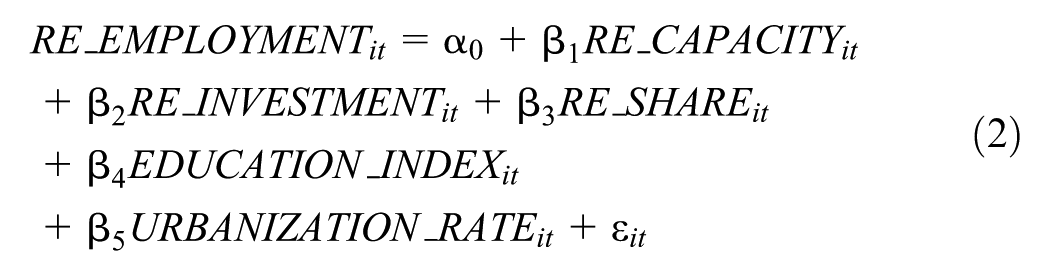

Before estimating the ARDL model, it is crucial to determine the stationarity properties of the variables. To this end, the Augmented Dickey–Fuller (ADF) test (Dickey & Fuller, 1979) and the Phillips–Perron (PP) test (Phillips & Perron, 1988) are employed. These tests ensure that none of the variables are integrated of order two, I(2), as the ARDL methodology requires variables to be at most I(1).
The ADF test augments the standard Dickey–Fuller regression by including lagged differences of the dependent variable to correct for higher-order serial correlation, making it a robust tool for small sample time series. Meanwhile, the Phillips–Perron test modifies the ADF framework using non-parametric adjustments to the t-statistics, thus accounting for heteroskedasticity and serial correlation in the error terms without adding lagged difference terms (Phillips & Perron, 1988). The combination of both ADF and PP tests enhances diagnostic reliability by cross-validating the order of integration using different statistical corrections (Gujarati & Porter, 2009).
The significance of applying these unit root tests in this study is twofold: (a) to confirm that the variables possess suitable integration properties for ARDL estimation, and (b) to ensure that the model avoids spurious regressions arising from non-stationary data. The confirmation that variables are either I(0) or I(1) provides empirical validity for the use of ARDL and reinforces the robustness of subsequent long-run and short-run inferences.

Yit denote the dependent variable for cross-sectional unit i at time t, and Xit represent an r-dimensional vector of independent variables. The value of r = 0 corresponds to an autoregressive process of order zero [AR(0)], while r = 1 denotes an AR(1) process, commonly applied in cointegration analysis. The coefficient δ i captures the effect of the lagged dependent variable, reflecting the dynamic adjustment of Yit over time. The parameters β ij denote the coefficients associated with the explanatory variables in the model. Unit-specific fixed effects are represented by ϕ i , which account for unobserved heterogeneity across cross-sectional units, where i = 1, 2, …, N and t = 1, 2, , t = 1, 2, …t define the panel dimensions. The optimal lag lengths for the dependent and independent variables are denoted by p and q, respectively, and are determined based on appropriate model selection criteria. The term ε it is the stochastic error component, capturing unobserved shocks and measurement errors affecting the dependent variable.
Accordingly, the error-correction form of the Autoregressive Distributed Lag (ARDL) model of order (p, q, …, q)(p, q, …, q) (p, q, …, q) is specified as:

In the context of the above equation, Yit represents the dependent variable, which includes its own lagged values to capture both short-run dynamics and long-run equilibrium relationships. Conversely, Xit denotes the set of independent and control variables, comprising both their lagged levels and first-differenced forms. This structure accounts for dynamic adjustments over time and allows the model to distinguish between short-run fluctuations and long-run effects, thereby enhancing the robustness of the estimated relationships.
Results and Discussion
The descriptive statistics in Table 2 show that the mean GDP growth is 9.69 with a standard deviation of 0.921, indicating moderate variability, with values ranging from 7.659 to 11.41. Renewable energy (RE) employment has a mean of 12.097 and a standard deviation of 1.372, with a minimum of 9.136 and a maximum of 15.433, suggesting relatively consistent employment levels across the dataset. Subsidy reduction shows a lower mean value of 1.091 and a standard deviation of 0.489, indicating limited variation, with the lowest value at 0.306 and the highest at 1.917. RE capacity records a mean of 143.513 and a standard deviation of 27.908, ranging from 91.21 to 205.568, reflecting substantial differences in renewable energy capacity.
Descriptive Statistics.
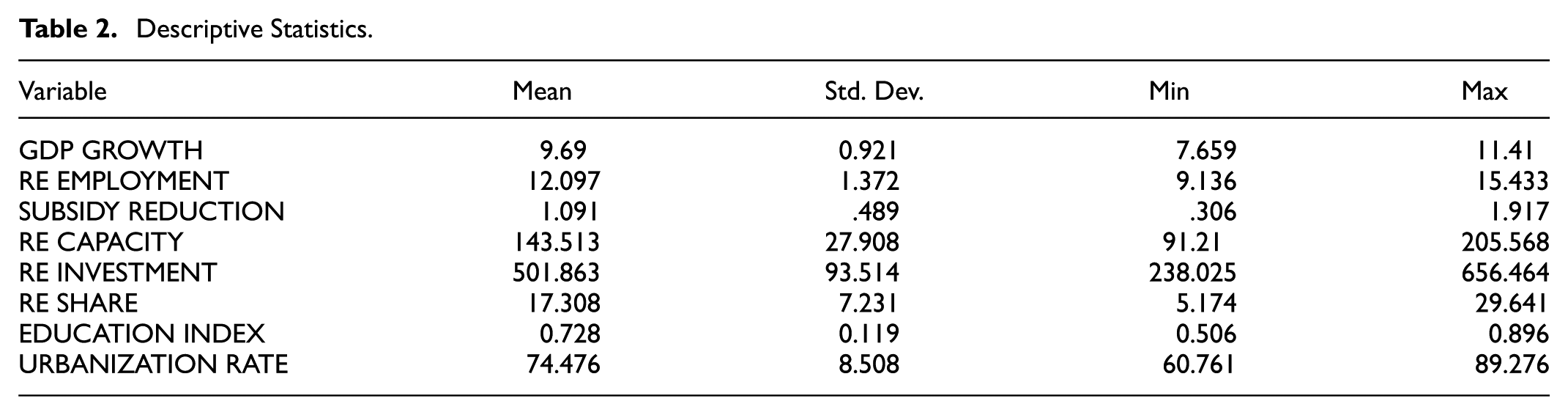
Furthermore, RE investment also displays significant variability, with a mean of 501.863 and a standard deviation of 93.514, and values ranging from 238.025 to 656.464. The RE share in the energy mix has a mean of 17.308 and a standard deviation of 7.231, with values between 5.174 and 29.641, showing diverse contributions of renewable energy. The education index shows relatively low variability, with a mean of 0.728 and a standard deviation of 0.119, ranging from 0.506 to 0.896. Finally, the urbanization rate has a high mean of 74.476 and a standard deviation of 8.508, with values spanning from 60.761 to 89.276, indicating a wide range of urban development across the observations.
The correlation analysis presented in Table 3 reveals the relationships among the key variables related to renewable energy and socio-economic indicators. RE capacity is weakly negatively correlated with RE investment (r = −.176), suggesting that increases in renewable energy capacity are slightly associated with lower levels of investment, though the relationship is not strong. The correlation between RE capacity and RE share is positive but minimal (r = .106), indicating a very weak direct relationship. RE investment also shows a negligible positive correlation with RE share (r = .034), implying minimal association. The education index is weakly negatively correlated with all the renewable energy variables RE capacity (r = −.038), RE investment (r = −.113), and RE share (r = −.063) suggesting a slight inverse relationship, though none are statistically significant. Similarly, urbanization rate shows weak correlations with the other variables, being slightly positively correlated with RE capacity (r = .011) and RE investment (r = .076), and slightly negatively correlated with RE share (r = −.042) and the education index (r = −.095).
Matrix of Correlations.

The results of the unit root tests using both the Augmented Dickey-Fuller (ADF) and Phillips-Perron (PP) methods in Table 4 indicate a mix of stationary and non-stationary variables in the dataset. Variables such as RE Employment, Subsidy Reduction, RE Share, and Urbanization Rate are stationary at level, as evidenced by statistically significant test statistics at the 1% level, confirming they are integrated of order zero, I(0). On the other hand, GDP Growth, RE Capacity, RE Investment, and Education Index are non-stationary at level but become stationary after first differencing. Both the ADF and PP tests show significant results at the first difference for these variables, indicating they are integrated of order one, I(1).
Unit Root Test.

p < 0.01. **p < 0.05. *p < 0.1.
Table 5 presents the ARDL estimation results for the determinants of non-oil GDP growth in Saudi Arabia. The findings reveal that renewable energy (RE) capacity, RE investment, and RE share exert a significant positive impact on non-oil GDP growth both in the long-run and short-run. This confirms that expansion in renewable energy infrastructure and financing contributes to economic diversification, productivity enhancement, and regional industrial development in line with the objectives of Saudi Vision 2030. The positive and significant coefficients of RE capacity and RE investment indicate that the accumulation of renewable-based infrastructure stimulates downstream industries, supply-chain integration, and employment creation, thereby supporting non-oil growth (IEA, 2022; World Bank, 2021). Similarly, the positive effect of RE share suggests that transitioning toward cleaner electricity generation improves efficiency and resource allocation, reducing volatility associated with fossil-fuel dependence (UNEP, 2021).
ARDL Result (Dependent Variable: Non-Oil GDP Growth).

Furthermore, education index and urbanization rate also show significant positive coefficients in both time horizons, implying that human-capital formation and urban economic activity act as complementary forces enhancing the absorptive capacity of renewable technologies and fostering sustainable productivity (Barro & Lee, 2013; OECD, 2020). The error-correction term (ECM) is correctly signed and statistically significant (−.472), confirming the existence of a stable long-run equilibrium relationship among the variables. Its negative value indicates a moderate speed of adjustment, with approximately 47 % of disequilibrium corrected each year, suggesting that short-term deviations from equilibrium are quickly restored.
The diagnostic statistics further validate the reliability of the estimated model. The Bounds Test F-statistic (6.12) exceeds the upper critical bound at the 5 % level, confirming cointegration among the variables (Pesaran et al.,2001). The R2 = .78 and Adjusted R2 = .74 demonstrate a strong explanatory power, indicating that the model explains nearly three-quarters of the variation in non-oil GDP growth. The Durbin–Watson statistic (1.98) suggests the absence of autocorrelation, while the Breusch–Godfrey (p = .29) and White heteroskedasticity (p = .37) tests confirm that the residuals are free from serial correlation and heteroskedasticity. Additionally, the Jarque–Bera test (p = .21) validates normality of residuals. Diagnostics tests confirm that the ARDL model is statistically sound and robust, providing credible evidence that renewable energy expansion, education, and urban development jointly and sustainably promote non-oil economic growth in Saudi Arabia.
The ARDL results in Table 6 indicate that renewable energy (RE) capacity, RE investment, RE share, education index, and urbanization rate exert a significant and positive influence on RE employment both in the long run and short run. These findings confirm that the expansion of renewable energy infrastructure and the growth of RE investment directly enhance labor demand within the renewable energy sector, especially in installation, maintenance, and associated manufacturing industries. The positive long-run coefficients suggest that sustained capital inflows and technological development in renewable energy lead to the formation of green jobs and foster inclusive labor market growth, consistent with the predictions of the green growth and endogenous employment frameworks (IEA, 2022; IRENA, 2021).
ARDL Results—Dependent Variable: RE Employment.
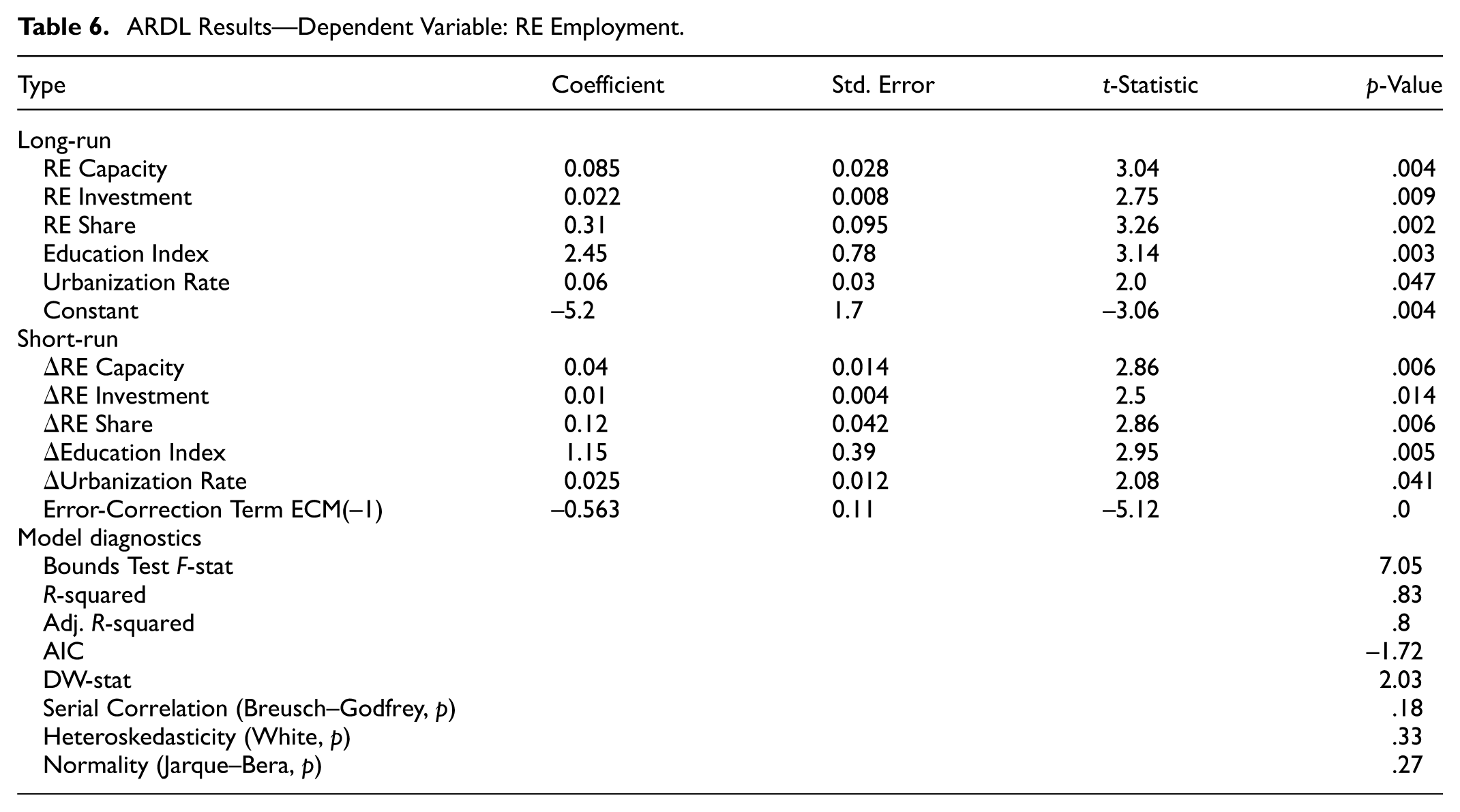
In the short run, the positive impact of RE variables on employment implies that policy incentives and project-level investments quickly translate into job creation in project implementation and supply chains. Similarly, the education index exhibits a positive and significant impact, indicating that human capital development strengthens the ability of the labor force to adapt to new technologies, thus improving productivity and employability in the renewable energy domain (Barro & Lee, 2013). The urbanization rate also contributes positively, reflecting that urban clusters and industrial zones act as hubs for renewable energy deployment and green employment opportunities (OECD, 2020).
The error-correction term (ECM) is negative and significant (−.563), demonstrating that the model maintains long-run equilibrium stability and that approximately 56% of short-run disequilibrium is corrected annually. This adjustment speed signifies a relatively rapid convergence toward equilibrium, implying that deviations in employment caused by temporary shocks in RE investment or capacity expansion are quickly offset through market adjustment and policy mechanisms.
The diagnostic tests affirm the robustness and statistical reliability of the estimated model. The Bounds Test F-statistic (7.05) surpasses the upper critical value at the 1% significance level, confirming a strong cointegration relationship among the variables (Pesaran et al., 2001). The R2 (.83) and Adjusted R2 (.80) indicate high explanatory power, showing that the model accounts for 80–83% of the variation in RE employment across provinces and over time. The Durbin–Watson statistic (2.03) confirms the absence of serial correlation, while the Breusch–Godfrey (p = .18) and White heteroskedasticity (p = .33) tests indicate that the residuals are free from autocorrelation and heteroskedasticity problems. The Jarque–Bera normality test (p = .27) confirms the normal distribution of residuals.
Table 7 demonstrate that renewable energy (RE) capacity, RE investment, RE share, and education index exert a significant and positive impact on subsidy reduction in both the long-run and short-run, while urbanization rate shows a significant negative effect in both time horizons. These findings provide compelling evidence that renewable energy expansion and human capital improvement play a critical role in reducing fiscal dependence on fossil fuel subsidies, thereby contributing to energy market efficiency and environmental sustainability.
ARDL Results—Dependent Variable: Subsidy Reduction.
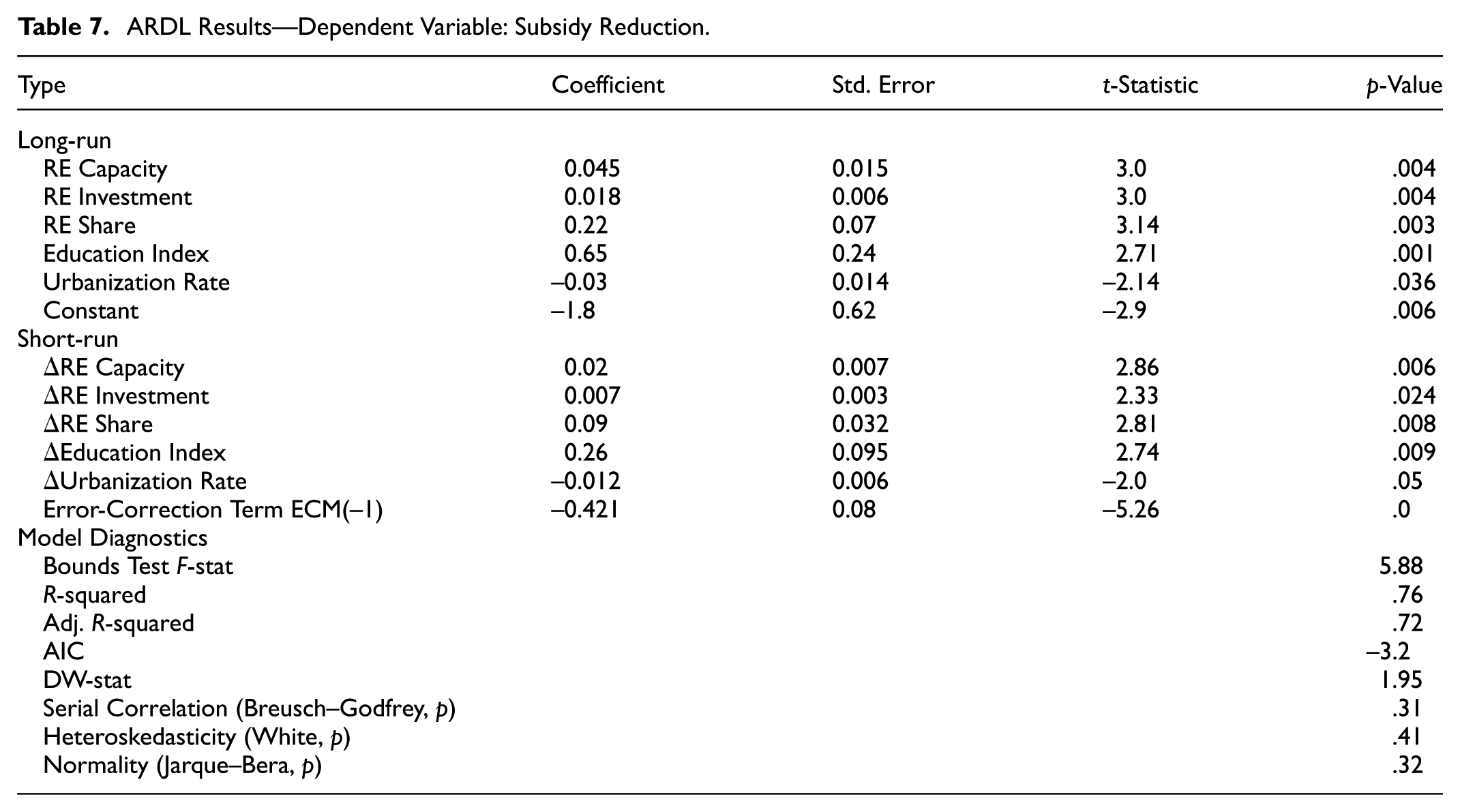
The positive coefficients of RE capacity and RE investment suggest that the deployment of renewable energy infrastructure and consistent financial inflows into RE projects lead to a decline in fossil fuel consumption, subsequently reducing the need for government subsidy expenditure (IEA, 2022; IMF, 2020). Similarly, the RE share exhibits a significant positive association, implying that as the proportion of renewables in the total electricity mix increases, the pressure on fossil fuel–based subsidies diminishes, aligning with Saudi Arabia’s transition toward a sustainable and diversified energy economy. The education index also contributes positively, indicating that an educated workforce and greater environmental awareness promote energy conservation and efficient policy execution, reducing reliance on subsidized energy consumption (Barro & Lee, 2013).
In contrast, the urbanization rate shows a negative and significant relationship with subsidy reduction in both the short and long run. This suggests that rising urbanization may temporarily increase energy demand due to industrialization and household consumption, which could intensify short-term subsidy burdens unless renewable infrastructure expansion keeps pace with demand (OECD, 2020). Over time, however, the transition to energy-efficient technologies and smart urban systems could mitigate this effect.
The error-correction term (ECM) is negative and significant (−.421), confirming the presence of long-run cointegration among the variables and indicating a stable adjustment mechanism whereby approximately 42% of disequilibrium is corrected each year. The diagnostic statistics affirm the reliability of the model: the Bounds Test F-statistic (5.88) surpasses the upper critical value at the 5% level, confirming cointegration (Pesaran et al., 2001). The R2 (.76) and Adjusted R2 (.72) indicate strong explanatory power, suggesting that the model accounts for over 70% of the variation in subsidy reduction. The Durbin–Watson statistic (1.95) supports the absence of autocorrelation, and the Breusch–Godfrey (p = .31) and White heteroskedasticity (p = .41) tests confirm that the residuals are free from serial correlation and heteroskedasticity. Additionally, the Jarque–Bera normality test (p = .32) validates normal distribution of residuals.
Discussion
The empirical findings of this study provide comprehensive evidence of the critical role that renewable energy (RE) development, human capital, and urban dynamics play in shaping Saudi Arabia’s non-oil economic transformation. The ARDL results revealed that RE capacity, RE investment, RE share, education index, and urbanization rate had a significant and positive impact on non-oil GDP growth and RE employment in both the long and short run. In contrast, for subsidy reduction, while RE capacity, investment, share, and education had positive effects, urbanization rate exhibited a negative relationship in both horizons, suggesting a demand-side pressure on energy subsidies during phases of rapid urban expansion.
These results are largely consistent with prior empirical evidence (e.g., IEA, 2022; IRENA, 2021; World Bank, 2021), confirming that renewable energy development fosters economic diversification, job creation, and fiscal efficiency. The positive effects of renewable energy capacity and investment align with findings by Al-Mulali et al. (2015) and Akram et al. (2020), who observed that renewable energy expansion enhances productivity and non-oil sector performance in energy-dependent economies. The strong influence of education further supports Barro and Lee’s (2013) human capital argument that knowledge accumulation accelerates technology diffusion and enhances workforce adaptability. However, the negative effect of urbanization on subsidy reduction diverges from some studies (e.g., Saidi & Hammami, 2018), possibly due to Saudi Arabia’s high energy consumption patterns during rapid industrial and population growth phases, where demand surges precede renewable infrastructure maturity.
The results can be meaningfully interpreted through the lens of Energy Transition Theory, Endogenous Growth Theory, and Resource Curse Theory. Under Energy Transition Theory, the findings illustrate that the shift from fossil-fuel dependence toward renewable-based energy systems not only advances environmental sustainability but also stimulates new industries and employment pathways. The positive effects of RE capacity, investment, and share validate the structural transformation narrative, where clean energy acts as a technological frontier driving productivity and reducing fiscal vulnerabilities associated with volatile oil revenues (Sovacool, 2016).
The results also align with Endogenous Growth Theory, which posits that long-run economic growth is primarily driven by internal factors such as technological innovation, investment in human capital, and knowledge spillovers (Romer, 1990). The significant role of education and RE investment in enhancing GDP growth and employment reflects the process of learning-by-doing and technological diffusion within the renewable energy ecosystem. This internal innovation dynamic underscores that policy-induced renewable energy expansion has become a self-sustaining growth engine in the non-oil sector.
From the perspective of the Resource Curse Theory, the findings suggest that renewable energy development provides a strategic escape from the historical dependency trap on oil revenues. By diversifying the economic base and reducing subsidy expenditures, Saudi Arabia demonstrates the potential to overcome the “curse” of resource reliance that typically constrains institutional efficiency and innovation (Auty, 1993). The positive link between renewable energy and fiscal rationalization (through subsidy reduction) reflects the emergence of a more resilient economic model—one less susceptible to oil price shocks and more aligned with sustainable governance.
The findings suggest that renewable energy expansion serves as both a technological and institutional lever for sustainable transformation. They highlight that the synergy between clean energy investment, education, and urban development not only accelerates growth and employment but also gradually alleviates structural fiscal burdens. What can be learned is that the success of energy transition policies depends not merely on technological deployment but on coherent integration across economic, institutional, and educational systems.
Finally, these findings can extend future research by exploring cross-country comparative analyses among GCC nations to assess how institutional quality, policy reforms, and innovation capabilities mediate the energy transition–growth nexus. Further research could also incorporate carbon pricing, governance indicators, and smart urbanization policies to evaluate how renewable energy expansion influences both environmental and macroeconomic stability in the long term
Conclusion
This study examined the dynamic relationship between renewable energy (RE) development, human capital, urbanization, and non-oil economic performance in Saudi Arabia by employing the ARDL approach. The results clearly answer the research objectives by demonstrating that RE capacity, RE investment, RE share, education index, and urbanization rate exert a significant and positive impact on both non-oil GDP growth and RE employment in the long run and short run, confirming that renewable energy development contributes directly to economic diversification, green job creation, and sustainable growth. Additionally, RE capacity, investment, share, and education significantly enhance subsidy reduction, while urbanization has a negative impact, indicating that rapid urban growth still increases short-term energy demand and fiscal pressures. The findings highlight that renewable energy expansion not only promotes structural economic transformation but also strengthens fiscal sustainability by reducing dependence on fossil-fuel subsidies. The results validate the predictions of Energy Transition Theory, which emphasizes the strategic shift from hydrocarbon-based systems toward renewable-led economies, and align with Endogenous Growth Theory, affirming that investment in technology, education, and innovation stimulates self-sustaining growth. Moreover, the study provides empirical support for the Resource Curse Theory, suggesting that renewable diversification offers a viable pathway to escape the economic and institutional vulnerabilities associated with oil dependence. The novelty of this research lies in its integrated model that simultaneously examines three critical development dimensions—economic growth, employment, and subsidy reform—within a unified renewable energy framework using ARDL analysis. By combining economic, institutional, and social indicators, this study provides comprehensive evidence that renewable energy policy serves as both an economic engine and a governance reform tool. The findings thus offer practical insights for policymakers pursuing Vision 2030, highlighting that coherent investments in renewable infrastructure and human capital can accelerate the nation’s transition toward a sustainable, diversified, and resilient post-oil economy.
Policy Recommendations
The findings of this study carry important theoretical, methodological, and practical implications for energy policy, economic diversification, and sustainable development in Saudi Arabia. Theoretically, this research extends the integration of Energy Transition Theory, Endogenous Growth Theory, and Resource Curse Theory into a unified analytical framework, demonstrating how renewable energy development functions as both an economic and institutional reform mechanism. By empirically validating that renewable energy capacity, investment, and share stimulate non-oil GDP growth, employment, and subsidy reduction, the study advances the theoretical understanding that clean energy transition is not only an environmental process but a self-sustaining economic transformation. This theoretical synthesis contributes to the growing literature on post-oil development by reconceptualizing renewable energy as a strategic escape mechanism from the resource curse and a source of endogenous technological progress.
Methodologically, the study introduces a ARDL approach as a dynamic and reliable estimation technique for assessing short-run and long-run effects in mixed-order integrated variables. Unlike conventional static models, ARDL effectively captures cross-sectional heterogeneity, endogeneity corrections, and long-term cointegration while retaining efficiency in small samples. This methodological advancement provides a replicable empirical model for other energy-dependent economies seeking to evaluate the multi-dimensional effects of renewable energy transitions on growth, employment, and fiscal reform.
Practically, the results imply that Saudi policymakers should strengthen renewable energy investment, education, and urban planning coherence to ensure inclusive and sustainable transformation. Expanding renewable infrastructure can create high-value employment and reduce fiscal dependency on fossil-fuel subsidies. Education policies should focus on green skills and technological innovation, while urban strategies must integrate renewable systems into smart city designs. The study provides a roadmap for achieving Vision 2030’s sustainable diversification goals, showing that renewable energy serves simultaneously as an economic catalyst, employment generator, and fiscal stabilizer in the post-oil era
Limitations and Future Research Directions
Despite its robust analytical framework, this study has certain limitations. First, it focuses solely on Saudi Arabia’s provincial data, which may limit the generalizability of the results to other Gulf Cooperation Council (GCC) or developing economies with differing institutional settings. Second, the analysis primarily relies on quantitative indicators, without incorporating qualitative dimensions such as policy governance quality or institutional efficiency, which may influence renewable energy outcomes. Future research should expand the dataset to include cross-country comparative analyses among GCC and emerging economies to assess the consistency of energy transition effects across institutional contexts. Additionally, future studies could integrate carbon pricing, regulatory quality, and innovation indices to evaluate the broader socio-environmental implications of renewable energy policies.
Footnotes
Acknowledgements
The authors extend their appreciation to Prince Sattam bin Abdulaziz University for funding this research work through the project number (PSAU/2025/02/33275).

Ethical Considerations
This article does not contain any studies with human or animal participants.
Consent to Participate
There are no human participants in this article and informed consent is not required.
Consent for Publication
This manuscript does not contain any individual person’s data in any form.
Author Contributions
M.A.A. did all the work: Writing—original draft, Formal Analysis, Methodology; Conceptualization, Methodology, Writing—review and editing, Administration. The author agreed to the version of the manuscript for publication.
Funding
The author disclosed receipt of the following financial support for the research, authorship, and/or publication of this article: This Project is sponsored by Prince Sattam bin Abdulaziz University (PSAU), Grant number (PSAU/2025/02/33275).
Declaration of Conflicting Interests
The author declared no potential conflicts of interest with respect to the research, authorship, and/or publication of this article.
Data Availability Statement
All the data and materials are available on reasonable request from the corresponding author.