




Abstract
This study focused on college students’ attitudes toward the relationship between online civic responsibility and online civic engagement and its impacts. It also investigated the mediating roles of online civic learning and online civic expression in this relationship. A survey was conducted in Taiwan, testing for indirect effects with mediated variables using a structural equation model. The study tested hypotheses about the mediations of online civic learning and online civic expression on this relationship between online civic responsibility and online civic engagement for college students. The results indicate that the mediators of online civic learning and online civic expression fully mediate the relationship between online civic responsibility and online civic engagement.
Keywords
Introduction
Being a member of a community, college students take an active role to their community and to society. College students are identifying social problems and coming up with solutions of these problems (Brammer & Morton, 2014; Veeh et al., 2019). They can help the disadvantaged and put in place sympathetically civic actions. College students have experienced the innovative development driven by online technology. These tools help them to vote and play the citizen in the civic life and democratic society. The online technology provides college students more opportunities to learn civic affairs and political issues (Chae et al., 2019; Metzger et al., 2015). They can use this tool to interact with others, engage in civic society, and improve their political efficacy.
The civic responsibility influences college students’ civic engagement. It also helps them understand the role of the citizens, democratic values, and political behaviors (Iyer et al., 2018; York & Fernandez, 2018). Some factors have mediating effects in the relationship between civic responsibility and civic engagement via online technology. Civic learning is a factor that affects college students’ civic cognition and social participation with the reflections of unfair problems in our society. Civic expression is another factor that affects their perceptions about political discussions and social engagement in civic issues (Kahne et al., 2016; N. Zhang & Skoric, 2018). College students use online technology to communicate their political perceptions and actions to engage their civic affairs. They post online messages to interact with and reflect their civic expression via social media.
It is important to clarify the mediating roles of college students’ attitudes concerning online civic responsibility (OCR) and online civic engagement (OCEN). It is also important to explore the related impacts that affect their civic performance of online behaviors. Therefore, this study explores college students’ attitudes toward the mediating effects of online civic learning (OCL) and online civic expression (OCEX) on the relationship between OCR and OCEN in Taiwan.
The Relationship Between OCR and OCEN
Social or civic responsibility means that the individuals consider the social implications of their civic actions for the welfare of others, and perform the feelings or consciousness of their civic actions of transcending themselves for community involvement (Putnam, 2000; Wray et al., 2011). Bresinger et al. (2014) indicated the civic responsibility as one’s feeling about their personal and social responsibility for helping those people in need. The person with civic responsibility preferred helping others who needed. Rafique et al. (2016) pointed civic responsibility as the critical factor to the democratic society. The ones with civic responsibility can endorse the value of the citizens and contact in social affairs to protest civic advantages via online technology.
Civic responsibility has been referred to as the democratic ideas, beliefs, and attitudes required for being a good citizen. It also means the social duties to involve people and engage in resolving their disadvantaged statuses (Ahrari et al., 2014; Zhao et al., 2017). Citizens have perceptions about social responsibility for helping those people in need or working for worthy causes. College students who exhibit civic responsibility prefer helping others in need and do their best to resolve the problems of the needy in society.
The presentation of civic responsibility is an indicator of effective student adaptation to democratic society (Liu & Chang, 2014). College students considered civic responsibility as a belief to take civic actions and help those who are disadvantaged in a democratic society (Fleck et al., 2017; Torney-Purta et al., 2015). They regarded civic responsibility as making an effort to public good. They also cooperate with the others on disadvantaged minorities and resolve these problems.
College students can employ online technology to recognize their civic affairs and activities to present the responsibilities about the democratic affections and attitudes toward the disadvantaged groups (Li & Zhao, 2020; Nelson et al., 2017). They can contact and understand the multiple living experiences of different social groups through online technology and enlighten and construct their democratic perspectives for others.
College students considered the experiences of online technology with local community be helpful to their social literacy and civic responsibility (Gleason & Von Gillern, 2018). They employ online technology or social media to perceive awareness and civic consciousness of the disadvantaged situations for different social groups not only affect their willingness to participate in social work but also influence their civic attitudes toward helping the minority a playing the civic role in democratic society.
In Taiwan, many universities and colleges provide service learning courses as the as the social curriculum that embeds the learning of civic engagement and social issues for students. Service learning courses in higher education focus on the social justice issues and civic pedagogy. These courses help college students take social responsibility in line with the social justice approach to promote the situations of the disadvantaged minorities, such as the indigenous peoples, new immigrants from Southeast Asian countries, and economic disadvantage groups. They can employ service learning courses construct the professional identification, and establish partnership with the real society based on reflective practice so as to ensure that college students have the perceptions of helping others and taking care of the disadvantaged.
Civic engagement is referred to as democratic interest, political efficacy, civic information, and strength of political party identification (Kim & Khang, 2014). A citizen’s interest in civic participation tends to motivate young people to engage in political activities and social affairs. They employ online technology to express political attitudes toward social activity (Castellanos & Cole, 2015). College students use civic engagement to express their beliefs about democratic values and social commitments to perform political actions.
de Zúñiga et al. (2014) indicated that civic engagement is the preferences of volunteering for civic groups or attending meetings to discuss social affairs. The term of civic engagement described as the involvement in social or informal community political activities, such as the political elections and political organizational participations for social or benevolent purposes (Gil de Zúñiga & Valenzuela, 2011). Civic engagement comprises the various activities of working or volunteering for social groups or attending or participating the meeting to discuss social problems (Gil de Zúñiga et al., 2012).
Civic engagement refers to take part in volunteer activities through working with others within social organizations or communities to achieve the social good (Zukin et al., 2006). College students employ online technology to express civic engagement with preferences for volunteering for civic groups or attending meetings to discuss social affairs (Ferrucci et al., 2020). They perform acts of OCEN to access online political content, discussing issues with others in online community, and corresponding using online messages or materials.
Online technology opens college students’ considerations for the disadvantaged groups and connects different resources and organizational initiatives to beyond the traditional social isolation of social prejudices and stereotypes (Chen, 2018). They engage with others in a way that is educational equity and social justice, and establish appropriate and positive social interactions to transcend inequality (Hutchison & White, 2020). Online technology opens up the intersection of social connections and belonging with different social groups for college students and helps them to face the disadvantaged groups in a more fair and respectful attitudes to help others.
However, false information, propaganda, and echo chambers are massive and uniform in online society, college students may demonstrate the strong inappropriate interests and opinions on the specific issues (Hobbs, 2020). They have to pay more attentions to become more cognitive competences and social awareness about and engaged in the democratic society via online technology (Garcia & Cuellar, 2018). They play the prosocial citizen to help the disadvantaged groups and participate in a broader context of civil society in online society and strengthen their engagement of social and political issues with the assistance of disadvantaged groups to resolve their social injustice situations.
College students’ attitudes toward caring of the disadvantaged groups via online engagement influence their responsibility to reflect their existing considerations about social injustice and educational reproduction, and take actions to recognize and respect the disadvantaged group with difficulties encountered (Nelson et al., 2016; Paulsen & McCormick, 2020). They employ online engagement to expand the broadly consciousness and reflection of civic responsibility to take efforts to improve our democratic society.
OCEN helps them improve their democratic involvement in the community and act in an appropriate manner to participate in and debate political affairs (Park & Kaye, 2017). The attitudes toward OCEN among college students are not only related to their willingness to help others and social concern for the disadvantaged groups but also to influence their civic responsibility about the social participation and practical intentions of social servicing. Based on this situation, the researchers propose the following hypothesis:
The Mediating Role of OCL
Young people should understand their own society and take action to resolve social or political oppression and inequalities (Barnhardt et al., 2019; Gordon et al., 2016). They discuss and learn about the causes of social biases or stereotypes via online technology and use it to consider possible interventions to challenge social problems through OCL activities. Civic learning is referred to as the development of citizenship and civic knowledge as well as civic social interaction by college students.
Croddy and Levine (2014) saw civic learning as the activities of service learning at the base of civic affairs and democratic value. The project-based civic learning focused on the solving of social problems. College students learn to concern the causes and effects of the social inequalities, and practice critical thinking and take civic action to help them. They experienced the online and offline civic engagement to resolve the social unfair problems, and construct their empowerment in the civic learning activities in colleges.
Gordon and Baldwin-Philippi (2014) indicated the civic learning as the form of engagement that constructs the cognition in the social action of reflecting the unfair problems. College students should learn to argue about, debate, and discuss the disadvantaged situations to take civic actions into learning experiences (Hufford, 2016). OCL fostered college students to understand civic life and social affairs through reflection, dedication, and multiple considerations.
The literature indicated the importance of civic responsibility for college students to construct their considerations of civic learning and promote the appropriate outcomes by civic pedagogical practices via online technology (Coelho & Menezes, 2021; Langhout & Gordon, 2019; Schwehm et al., 2017). OCL activities play an important role in educational curriculum to help college students engage in our society via online technology (Barnhardt et al., 2019; Bowyer & Kahne, 2020; Reichert & Print, 2018). They employ OCL to implement activities about action civics, service learning, experiential learning, and project-based learning for solving social problems on the basis of civic and democratic values. College students learn to be concerned about the causes and effects of social inequalities for disadvantaged people via online technology and practice critical thinking and take civic action to help those people. Therefore, the researchers propose the following hypothesis:
The Mediating Role of OCEX
OCEX is referred to as an individual’s self-expression with others via online technology (Moffett & Rice, 2018; Weinstein, 2014). Young people share their images, posts, or messages to engage in civic participation. Citizens employ online technology to communicate their civic expressions about social viewpoints, interests, participations, and engagements with social groups on the basis of their civic lives (Weinstein et al., 2015). They employ online technology to express their attitudes toward social affairs and unjust situations facing the disadvantaged.
College students employ a variety of types of online technology to express their perceptions and articulate opinions on public issues (Lee et al., 2017; C. Zhang & Fagan, 2016). Through the use of OCEX, they have positive attitudes toward civic participation and social trust required to perform their citizenship duties. Such technology provides more possibilities for using a civic voice and participation for college students (James et al., 2016). They can actively participate in civic society to engage the democratic and public sphere and to express their civic dialogues and discussions.
Online spaces provide anonymous commenting and dialogue opportunities for free expressions to build civic responsibility and empowerment (Silke et al., 2020). They have more opportunities to use social media to engage in social or political discussions for civic expression via online communities and consider more practical alternatives to help disadvantaged people.
OCEX learning can not only influence college students’ civic responsibility about the diverse situations of disadvantaged groups to help them improve their living conditions via online technology (Hollstein & Smith, 2020; Hylton, 2018) but also support them to engage with social partners in the online community to conduct social action plans and actions together for college students (Keegan, 2021; MacPhee et al., 2017; Middaugh, 2019). Therefore, the researchers form the following hypothesis:
Methods
Sample Characteristics
This study collected college students from 14 schools in northern Taiwan, including of six universities and eight universities of science and technology. Based on the researching considerations of different grades of college students and their academic majors, researchers asked for and received the consent of college teachers and students, and enter the classroom to send out questionnaires to collect sample.
According to the parameters of the latent constructs and observed variables, we used an initial sample of 600 college students in Taiwan. After excluding college students with nonresponses or missing values, the valid sample size consisted of 536 anonymous college students with a response rate of 89.33%. All of the respondents were informed about the purposes of this study and the procedures for informed consent and that their privacy and confidentiality would be protected.
The study sample was composed of college students with diverse academic statuses and majors. The percentages of male and female respondents were 49.38% and 50.62%, respectively. Most of the respondents were third or fourth year students (67.55%), whereas 32.45% were in their second year of academic study or younger. The academic major of 35.26% of the respondents was in the area of social sciences, 30.65% in the areas of computer science or technology, and 28.33% in the area of management and commercial administration. Most of the sample had more than 10 years of experiences of using online technology, and only 5.25% of the respondents had fewer than 5 years of using such tools. The sample adequately represented the characteristics of the target population in Taiwan.
Measurement Instrument
This study focused on college students’ attitudes toward the relationship between OCR and OCEN and its impacts. It also investigated the mediating roles of OCL and OCEX in this relationship. A Chinese questionnaire, the “Online Civic Responsibility and Engagement Attitude (OCREA),” was administered. Based on the literature review and the theoretical assumptions of this study, the researchers developed the observed variables of the OCREA and consulted and assessed with scholars and experts in the field of civic engagement, online technology, and higher education.
The OCREA was comprised of four factors: “online civic responsibility,” “online civic engagement,” “online civic learning,” and “online civic expression.” The original survey instrument was comprised of 20 observed variables (five variables for each latent construct) presented with statements for which the respondents indicated their degree of agreement/disagreement on a 5-point Likert-type scale (1 = most strongly disagree and 5 = most strongly agree). A description of the four latent constructs is presented as follows:
1. OCR: assessing attitudes on the extent to which college students have responsibility for using online technology to understand the disadvantaged situation of social minorities and helping disadvantaged groups to solve their social problems. The latent construct and observed variables for satisfaction were based on and derived from Ahrari et al. (2014), Bresinger et al. (2014), and Rafique et al. (2016).
2. OCEN: investigating the extent of college students’ perceptions of participating in online communities to discuss political actions to help minorities and cooperate with their friends to participate in civic affairs via online technology. The latent construct and observed variables for satisfaction were based on and derived from Castellanos and Cole (2015), de Zúñiga et al. (2014), and Kim and Khang (2014).
3. OCL: assessing attitudes on the extent to which college students think online technology can enhance their awareness and understanding of disadvantaged groups and construct learning efficiently with civic affairs. The latent construct and observed variables for satisfaction were based on and derived from Croddy and Levine (2014), Gordon and Baldwin-Philippi (2014), and Gordon et al. (2016).
4. OCEX: investigating the extent of college students’ perceptions of expressing their perceptions about civic issues and sharing their viewpoints about social inequality via online technology. The latent construct and observed variables for satisfaction were based on and derived from Weinstein (2014), Weinstein et al. (2015), and C. Zhang and Fagan (2016).
The researchers used confirmatory factor analysis to evaluate the observed variables and latent constructs. According to the results of factor loadings and model fit indices per latent construct, a reflective variable retained only when its loading was greater than .70 on the relevant construct. The initial 20 observed variables were reduced to 16 variables for the OCREA. The means of the retained 16 observed variables ranged from 3.69 to 3.93, and the standard deviations ranged from .70 to .78. The measures of skewness ranged from −0.28 to 0.11, and the kurtosis for these variables ranged from −0.25 to 0.14. The measurements adequately followed the assumption of normal distribution (as shown in Table 1).
The Confirmatory Factor Analysis Summary on the Questionnaire.

Note. SD = standard deviation.
The standardized factor loadings for each variable ranged from .70 to .90, and the measurement errors ranged from .19 to .51. The researchers used the bootstrapping method based on 5,000 samples to test the level of significance of the standardized factor loadings. The results showed that the 95% confidence interval of the standardized factor loadings for all selected variables did not include zero, and indicated statistical significance.
Table 2 showed the principle component analysis with varimax rotation in OCREA. The eigenvalues of the four constructs from principle component analysis were all larger than 1. In the Table 2, the bold numbers indicate the variables with high factor loadings on each latent construct. The cross-loading for each construct is very low and indicates the good discriminant validity. The observed variables with four latent constructs accounted for 20.35%, 17.70%, 20.15%, and 17.50% of variances, respectively.
The Rotated Factor Loadings and Cross Loadings of the OCREA.

Data Analysis
The survey data were analyzed using structural equation modeling. The researchers employed a two-stage approach to test the theoretical hypothesized model (Bollen, 1989; Byrne, 2010; Kline, 2010; Schumacker & Lomax, 2010). Structural equation modeling encompasses the confirmatory factor analysis and path analysis. This method deals with the modeling of measurement errors of the latent factors in the measurement model, and simultaneous test the hypothesized relationships in the structural model.
At the first stage, the researchers used Amos 20.0 to analyze the sample data in the measurement model by confirmatory factor analysis. Maximum likelihood estimation was employed to examine the latent constructs and their statistical parameters. After estimating individual variable factor loadings and calculating the statistical significance and measurement errors, we can find the extent to which the sample data of college students in Taiwan support the hypothesized pattern of relationships between observed variables and latent constructs of the OCREA.
At the second stage, the researchers assessed the estimations of model fit, path coefficients, and measures of explained variances. This study tested the research hypotheses by examining the hypothesized relationships between the latent constructs. The multiple mediation hypotheses in performing structural equation modeling simultaneously examine the direct and indirect effects about multiple latent factors, mediators, or outcomes (Gunzler et al., 2013; MacKinnon et al., 2007). With mediation analysis, the researchers can find the psychological mechanism by which the latent factor influences another one. The mediator transmits the effect of one latent factor to another one. Statistics of the total effect, direct effect, and indirect effects between latent constructs were used. Based on MacKinnon (2008) and Preacher and Hayes (2008), the researchers used the bootstrap estimation to evaluate the significances of indirect effects with multiple mediators to examine the research hypotheses.
Results
Measurement Model
The researchers used confirmatory factor analysis to evaluate the OCREA measurement model and assessed the model fitness indices of the sample data.
Figure 1 presented the analysis of latent constructs for this model with the standardized parameter estimates in measurement model. The model fit statistics support the measurement model: χ2 (chi square) = 320.12 (p < .001), χ2/df (chi-square per degree of freedom) = 3.27, RMSEA (root mean square error of approximation) = .07, SRMR (standardized root mean square residual) = .05, CFI (comparative fit index) = .96, NFI (normed fit index) = .95, GFI (goodness of fit index) = .96, TLI (Tucker–Lewis index) = .95, and IFI (incremental fit index) = .96. The types of goodness of fit index obtained using confirmatory factor analysis (CFA) indicated that the measurement model was an acceptable fitting model. According to the structural equation modeling (SEM) power analysis based on RMSEA (MacCallum et al.,1996), the statistical power of the model is 1.00 by setting null and alternative RMSEA values of .05 and .08.
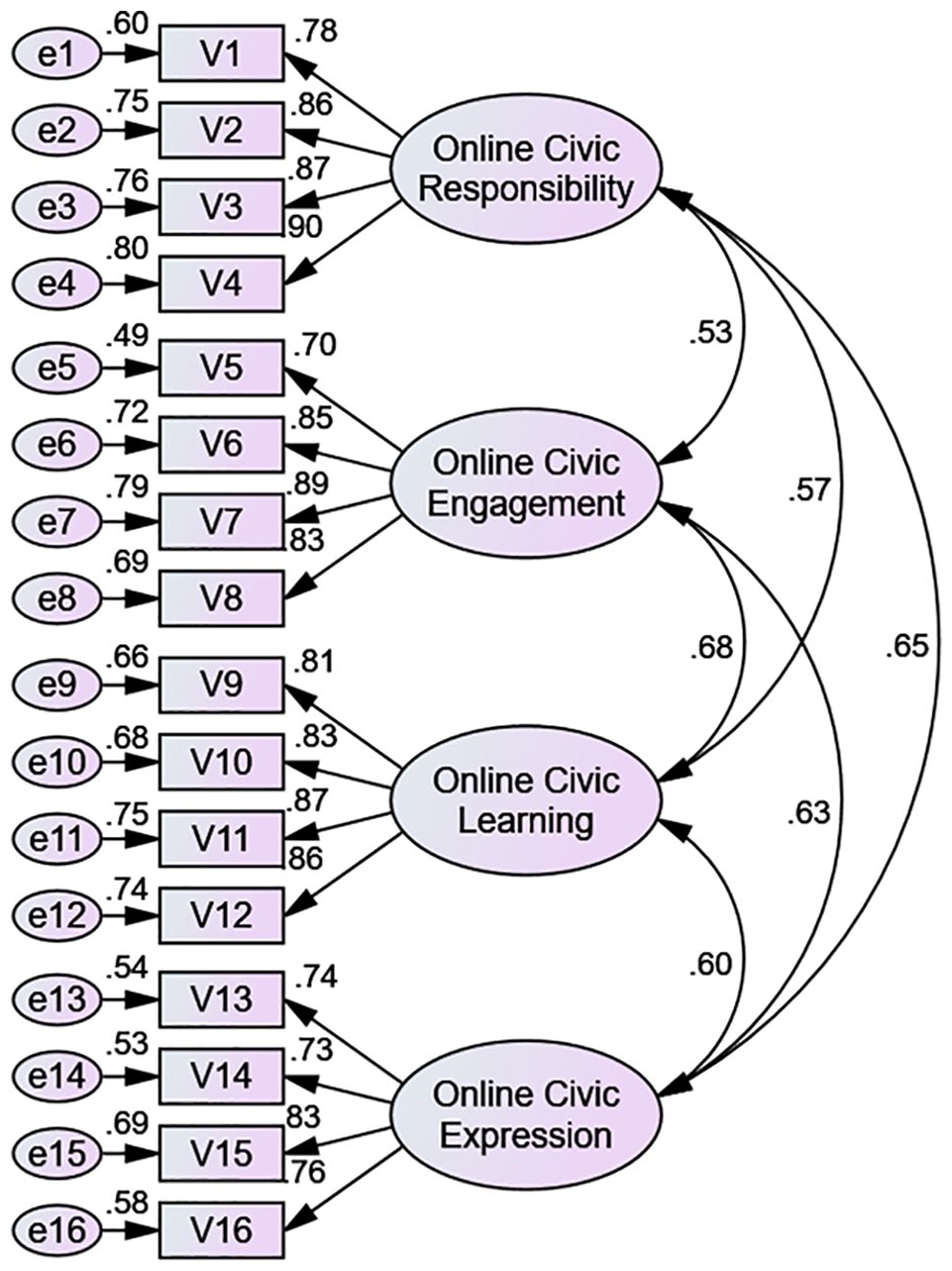
Measurement model.
The Cronbach’s alpha, CR (composite reliability), and AVE (average variance extracted) values of each latent construct of the OCREA ranged from .85 to .91, from .85 to .91, and from .60 to .69, respectively, as shown in Table 3. The correlation of the latent constructs ranged from .42 to .70, and the 95% confidence interval of the correlations did not include zero by performing a bootstrap with 5,000 resampling. The correlation coefficient between each construct pair was less than the respective square root of the AVE, ranging from .59 to .73. These measurements depict a reasonable degree of reliability, convergent validity, and discriminant validity of the latent constructs. The results suggest that the OCREA measurement model has a high reliability of internal consistency.
The Cronbach’s Alpha, CR, AVE, and Correlation Matrix.

Note. The square root of the AVE of two latent constructs is given on the diagonal, and the correlation coefficient is given on the below diagonal. CR = composite reliability; AVE = average variance extracted.
Structural Model
Figure 2 provides the structural path of latent constructs and path coefficients in the structural model of the ISSAS with the standardized parameter estimates. The model fit indices demonstrate an acceptable fit with the sample data: χ2 = 366.45 (p < .001), χ2/df = 3.70, RMSEA = .07, RMR = .04, SRMR = .07, CFI = .96, NFI = .94, GFI = .92, TLI = .95, IFI =. 96. The results indicate that the model fit statistics provide acceptable support of the structural model.

Structural model.
Figure 2 also presents the standardized regression coefficients and the direct effects and measures of the explained variance. The OCR construct explains 34% of the proportion variance of the OCL value construct, corresponding to a standardized regression coefficient of .59. The OCR construct explains 45% of the proportion variance of the OCEX value construct, corresponding to a standardized regression coefficient of .67. The constructs of OCR, OCL, and OCEX value jointly explain 53% of the variance in the proportion of the OCEN construct, corresponding to standardized regression coefficients of .04, .49, and .34, respectively. All path coefficients of the 95% confidence interval did not include zero and were highly statistically significant by performing a bootstrap with 5,000 resamples, with the exception of the direct path of OCR to OCEN.
The Multiple Mediator Models
As Table 4 shows, the total effect of OCR on OCEN without the mediators of OCL and OCEX is .53 (t value = 10.60, p <.001), thus supporting H1. After adding the mediators of OCL and OCEX to the relationship between OCR and OCEN, the direct effect of OCR on OCEN decreased to .04 (t value =.57, p >.05).
The Tests of Mediating Effects.

Note. 5,000 bootstrap samples. SE = standard error.
p < .001.
To test the significance of the indirect effects in multiple mediator models, the standard error of each path coefficient was calculated by bootstrapping 5,000 resamples. The indirect effects of OCL and OCEX on the relationship between OCR and OCEN are .27 and .22, respectively. The total and individual indirect effects of the bias-corrected and percentile 95% confidence interval did not include 0 by bootstrapping 5,000 resamples, thus supporting H2 and H3. OCL and OCEX fully mediated the relationship between OCR and OCEN.
According to the results, the relationship between OCR and OCEN for college students was mediated by the constructs of OCL and OCEX. College students’ attitudes toward civic engagement was influenced by their perceptions of civic learning and civic expression via online technology. Their considerations of OCL and OCEX support their participations in online communities to take political activities and collaborate with the civic groups to help the disadvantaged via online technology.
The digital space created by online technology provides more opportunities to implement civic learning and democratic discussions of political issues. College students have experienced innovative development driven by online technology, and it helps them to perform the act of choosing to be an active citizen in a democratic society and create change based on their beliefs in human rights. They use such tools and their applications to interact with others or engage in civic society and, thus, improve their political efficacy or behavior. They can express themselves online and offline, using civic engagement to resolve social problems of inequality and construct empowered and conscientious civic engagement activities in colleges.
Discussion and Conclusion
This study explored college students’ attitudes toward OCR and OCEN, and fully indicated their mediations with regards to OCL and OCEX. The SEM results of the OCREA tested the path coefficients and supported hypotheses H1 to H3.
The results showed that online technology helped college students take responsibility for the disadvantaged. They can engage in civic affairs and take part in their civic duties to strengthen their social identifications as civic actors. They employ online technology to express their civic perceptions to share civic cognitions with the effective alternatives to help the disadvantaged. College students are able to understand the social lives of disadvantaged people by engaged learning used to find out possible alternatives that promote social equity through online community.
College educators can encourage college students to participate in and discuss the situations of disadvantaged people. We also can design friendly and game-based curriculum to foster OCL to understand civic affairs. With the multidiscipline curriculum of online knowledge exploration and digital teamwork, college students have more consciousness and power to help the disadvantaged groups to empower them and establish cross-disciplinary civic actions between colleges and communities.
College students could discuss and interact with social issues to improve their political efficacy. Online technology supports them to behave with prosocial civic actions. They can communicate with others via online technology to construct effective civic alternatives to resolve the social inequality. College educators can construct the online community to help students to participate in online society to convey social justice orientation. This online community can friendly communicate with others on pedagogical approaches to intercultural understanding and social values in order to promote their perceptions and actions for social justice.
The self-reporting scales of the OCREA developed by the researchers have been reviewed by scholars and experts. All the statistical results indicated the OCREA passing the criteria of the validity and reliability. However, it has still possible restrictions that the subjects’ interpretation of the questionnaires, falsification, and social expectations may affect the validity of the results. The limitations can be reduced by the subjects being sensitive and conscious that these questionnaires can be influenced by social bias and their cognitive competence for future research.
Due to differences in college students’ academic backgrounds, majors of study, and experiences of using online technology, this study did not conduct a statistical analysis of differences in individual background variables. Future research can employ this research hypothesis and paths of the OCREA to further compare the differences of individual background variables and path coefficients.
Future research could reuse or revise the OCREA developed in this study to test college students’ attitudes toward OCR, OCEN, and related factors about OCL and expression. New latent factors or other mediating effects could also be considered to explore these civic perceptions further. The researchers also can adopt the qualitative analysis of observations and interviews to collect more information and integrate multiple methods to enrich the theoretical foundations and practical strategies of this topic.
Footnotes
Declaration of Conflicting Interests
The author(s) declared no potential conflicts of interest with respect to the research, authorship, and/or publication of this article.
Funding
The author(s) received no financial support for the research, authorship, and/or publication of this article.
