




Abstract
The flipped classroom (FC) is a pedagogical model with an active learning concept and a hybrid course design that reverses the typical lecture process. Given the widespread use of online delivery methods, there is a need to explore the FC in delivering statistics courses. This study employs a prospective quasi-experimental study design to evaluate the effectiveness of the flipped method and to compare it with the traditional method of teaching statistical data analysis software. Each of the 71 students enrolled in a medicine program was allocated to either a traditional classroom or a FC. The difference between the two teaching methods is evaluated using overall assessment performance as the main outcome measure. Our results show that the teaching method had a large and significant effect on assessment performance, with the FC method exhibiting a higher student overall performance than the traditional classroom. The data suggest integrating the FC in teaching statistical data analysis software is a helpful alternative to the traditional classroom. This study may serve as a guide and inspiration for educators in statistics courses to incorporate the concept of flipped learning, so as to engage students in a more active learning experience.
Plain Language Summary
The purpose of this study was to compare the effectiveness of the flipped classroom method to the traditional classroom in teaching statistical data analysis software. -A prospective quasi-experimental study design was used that included 71 students in a medicine program. -Students were divided into traditional and flipped classroom groups. - The flipped classroom method led to significantly higher student performance compared to traditional classroom. - Flipped learning can be a beneficial alternative to traditional classroom methods in teaching statistics. Educators can consider incorporating flipped learning to actively engage students and enhance their learning experience. - It is important to note that our study focused specifically on a group of medical students, and further research is needed to validate these findings in different educational settings.
Introduction
Undergraduate students in allied health majors are often required to study statistics as part of a research methodology course. However, many of them report negative attitudes and anxiety toward statistics (Althubaiti, 2021; Mustafa & Yilmaz, 1996), which in turn have been shown to negatively impact students’ achievements in research methodology and statistics courses (Onwuegbuzie et al., 2000; Onwuegbuzie & Seaman, 1995). Academic and interpersonal factors could contribute to this, such as perceiving statistics as a difficult subject unrelated to their studies, poor previous performance in mathematics courses, and academic undergraduate grade point average (GPA) (Harrington, 1999; Liau & Kiat, 2009).
To address these challenges and enhance students’ engagement, innovations in both teaching strategies and classroom settings have been explored (Abramson, 2010; Marantz et al., 1991; Mustafa & Yilmaz, 1996). One promising approach is the Flipped Classroom (FC) method, where students access course content and assignments before class, allowing in-class time for active learning and collaboration (Hew & Lo, 2018). This paper explores the impacts of the flipped learning method on students’ experience in statistics courses. By adopting this approach, we seek to understand how it influences students’ overall performance and their level of satisfaction with the learning process.
Flipped Classroom
The FC approach, which emphasizes active learning strategies, has proven to be highly effective in increasing teaching efficiency and encouraging collaborative student participation (Freeman et al., 2014; Prober & Heath, 2012). The rationale behind flipped learning is to optimize the use of valuable face-to-face class time. By flipping the traditional lecture-based format, students have the flexibility to access course materials before class, giving them more time for active learning and collaborative work during class time (Hew & Lo, 2018). The instructor’s role transforms into that of a coach or advisor, facilitating interactive activities, monitoring progress, and providing feedback, while students engage in the practical application of knowledge (Muir & Geiger, 2016). The crucial element in an FC is that students watch pre-recorded video lectures, generated, and posted by the instructor, which present the course contents traditionally given during lectures. Student’s access to the instructional materials enables them to increase their understanding of the subject on their own time before the class and gives them more time to apply their knowledge during the class, using collaborative work for a better learning experience than that of the traditional class approach (Herreid et al., 2014). By eliminating the need for lectures, teachers can actively interact with students through engaging activities such as discussions, problem-solving, hands-on experiences, and guidance (Lai & Hwang, 2016; McLean & Attardi, 2023). This shift in teaching methodology has been shown to increase student engagement and motivation (Khan & Watson, 2018; Liu et al., 2023). For example, a study comparing flipped classroom instruction to traditional lecturing found that students who experienced the flipped classroom approach displayed higher levels of academic passion and responsibility (Liu et al., 2023). These findings suggest that the flipped classroom approach is more effective in promoting student motivation and engagement compared to traditional lecture-based instruction.
The flipped classroom concept is still an ongoing subject of discussion and development, as researchers continue to investigate its effectiveness and suitability in various teaching contexts (Pozo-Sánchez et al., 2022; Spotts & Gutierrez de Blume, 2020; Vitta & Al-Hoorie, 2023; Wei et al., 2020). This becomes particularly significant during the shift from in-person to online course delivery (Diaz-Infante et al., 2022), emphasizing the urgent necessity to explore and assess how practical and hands-on aspects of a statistics course can be effectively taught in the online environment (Mills & Raju, 2011). Consequently, this supports the significance of the present study.
Flipped Classroom and Statistics Education
Statistics education plays a vital role in equipping students with the necessary skills to interpret and analyze data, making informed decisions in various disciplines. As an integral part of STEM (Science, Technology, Engineering, and Mathematics) education, statistics fosters critical thinking, problem-solving, and quantitative reasoning abilities. Traditional teaching methods in statistics education often involve instructor-led lectures, followed by problem-solving exercises.
The flipped classroom model has gained significant attention in recent years as a promising approach to enhancing student learning experiences in statistics education. There are several reasons for its growing popularity and adoption in educational settings. In statistics, repetition and practice are essential for mastering concepts. With the FC approach, students have access to pre-recorded lectures, enabling them to revisit difficult topics multiple times, and reinforcing their understanding (Winquist & Carlson, 2014). In addition, statistics often involve group work and collaborative problem-solving. The FC model fosters a collaborative learning environment where students can work together to solve statistical problems, share ideas, and learn from each other’s experiences (Farmus et al., 2020). The effectiveness of the FC model in statistics classes has been supported by research and positive student feedback. Numerous studies have demonstrated that the FC approach leads to better learning outcomes, higher student engagement, and increased satisfaction compared to traditional lecture-based formats (Lynne Nielsen et al., 2018; Peterson, 2016; Wilson, 2013; Winquist & Carlson, 2014). In this dynamic educational environment, the flipped classroom and statistics education work hand in hand to create a more engaged and empowered learning experience. By embracing this innovative combination, educators can transform the way statistics is taught, empowering students to become confident and competent data analysts. However, as the educational landscape continues to evolve, it remains crucial to conduct further research on the comparative impact of traditional classrooms and FCs to effectively integrate the FC method (Farmus et al., 2020).
Teaching statistics courses, particularly to students in health specialties, can be a challenging task for instructors (Goldmann et al., 2018; Marantz et al., 1991). Hence, investigating the integration of online FC in teaching statistics to medical students helps identify the associated challenges and opportunities of this pedagogical approach.
Aim and Research Questions
The primary goal of this study is to evaluate the impact of the FC approach when teaching statistics to medical students. We will assess this impact based on students’ assessment performance, their overall satisfaction with the course, and their ratings of the course.
This study is unique because it focuses on applying the FC model to teach statistics to medical students in an online setting. By emphasizing active engagement, application, and problem-solving during class time, the FC approach aims to enhance learning effectiveness. Investigating the effectiveness of the FC model in this specific context adds value to the existing knowledge on flipped learning and its potential to improve statistics education in the medical field.
To address our aim, we explored the following research questions:
(RQ1) Is there a significant difference in the assessment performance of students in the flipped classroom compared to those in the traditional classroom?
(RQ2) What is the overall satisfaction level of learners with the flipped and traditional classroom approaches?
(RQ3) Is there a significant difference in the course ratings of students in the flipped classroom compared to those in the traditional classroom?
Based on these research questions, we hypothesize that implementing the flipped classroom approach will lead to an enhanced student experience in statistics classes and improved assessment performance.
Methods
Design and Sample
This is a prospective quasi-experimental study that divided students into two groups: The experimental group had an online FC experience, and the control group had an online traditional classroom experience. This study was conducted in a large public health university over a 4-week period.
An announcement with information about the time interval of the study, and requirements (including the focus on the main outcomes) was posted to all students enrolled in the medicine program. Participation was completely voluntarily, as explained to the students, and it was made clear that their academic grades would not be affected. Randomization was not feasible at the time, due to constraints in the availability of students, and a convenient sampling was used; hence, no sample size calculation was performed (Althubaiti, 2023). Initially, 37 students were allocated to the control group, and another 37 were allocated to the experimental group. However, two students withdrew from the class, and one student was excluded due to missing information. So, in total, 71 students were enrolled (36 in the traditional classroom vs. 35 in the FC). Allocation to a group was based on student characteristics and numbers, so as to guarantee as much balance between the groups as possible. The characteristics of study participants were assessed at baseline, with questions about sex, age, GPA, and high school mathematics scores. The types of demographic information were selected based on results of previous research (Althubaiti, 2021; Dutton & Dutton, 2005; Huang et al., 2000; Loux et al., 2016), as they were found to be important confounders, and were collected using an administered survey.
Data Collection and Design of the Flipped Course
A partial FC was applied here. Only the data analysis part using statistical software (i.e., JMP®, Version 15, SAS Institute Inc., Cary, NC, 1989–2022) was flipped, to minimize the challenges related to the FC preparation (Marantz et al., 1991). For example, while designing the flipped course, we aimed to include (in the flipped part) learning content that can provide opportunities for problem-solving. Therefore, both groups were given two online sessions on descriptive and inferential statistics.
The main purpose of the statistics sessions is to practice data analysis using statistical software for research, as part of a longitudinal research methodology program (Althubaiti, 2015 ; ; Althubaiti, 2021). Content within this data analysis uses software covering basic inferential statistics, including normal probability distributions, random variables, measures of central tendency/variability, the hypothesis testing of one or two sample means and proportions, chi-square tests of contingencies, confidence intervals, correlation, and analysis of variance.
Students in the experimental group were instructed to download a pre-specified dataset, and then import the dataset to JMP® software, to analyze and report the output results. Feedback on the output was provided during class time. The JMP® Help pages and PowerPoint slides to show how to interpret the output were provided to students. The same instructor handled both groups. Figure 1 provides a summary of both teaching methods examined in this study.

Framework for the traditional classroom and the FC.
In the control group, the traditional classroom method was employed to teach students how to analyze the data and how to transfer output to the results section of a research manuscript. In the experiment group, each student was asked to read and preview—in advance—materials provided to them relating to the above subjects. Those materials consisted of a recorded video (15 min long) and PowerPoint slides with pictures capturing the analysis steps of importing data to statistical software and running the analysis, as validated by a content expert in the field and the JMP® software manual. Following that, students were given a data file and asked to analyze the data and write a report of their findings. An example of a written results section was provided to aid them in the writing stage.
Both groups were asked to complete an assignment with a score of 0 to 15. They were also asked to attend a class and present the results of their data analysis in front of their peers. An open discussion was conducted in the classroom on the data analysis and results obtained. During that discussion, the lecturer answered any questions related to the data analysis and results. At the end, the lecturer provided an overall evaluation and summary concerning the given materials.
The students were required to complete a summative statistics exam, assessing their academic performance. The exam comprised 10 multiple-choice questions, and scores were compared between the two groups. To gather comprehensive feedback and insights on their course experiences, an electronic questionnaire was administered. The questionnaire consisted of both closed-ended and open-ended questions, aligning with commonly used questions in the University’s assessment office and previous research (see e.g., Johnson & Onwuegbuzie, 2004). All students completed the questionnaire, ensuring no missing data was recorded. The students were asked to rate their overall classroom experience using a scale of 1 to 7, with options ranging from “1 = very poor” to “7 = exceptional.” Additionally, three open-ended questions were included to encourage students to provide their thoughts on course strengths, weaknesses, and suggestions for improvement. Course ratings play a crucial role in gaining valuable insights into students’ perceptions of the learning experience and the effectiveness of the teaching methods employed.
Outcome variables in this study are the assessment performance: quiz score, which is calculated on a scale from 0 to 10 points, and assignment score, which is calculated on a scale from 0 to 15. To examine the impact of the teaching method on assessment performance, our main outcome (dependent variable) was the overall score, as it is included in all the assessments. In addition, the students’ course ratings were analyzed and compared between the two groups. Each student was requested to enter a serial number which was matched to the student’s assessment scores and responses to the course rating survey.
In addition, measures were taken to minimize noise from possible confounding variables on students’ assessment performance and to increase the internal validity of the design (Maciejewski, 2020; Ross et al., 2005; Shadish et al., 2002; Stuart & Rubin, 2008). When choosing participants, we aimed to ensure that the demographic and academic characteristics between the two groups were as similar as possible, by applying strict inclusion and exclusion criteria. All participants were close in age (mean age was 19.3 years, with a standard deviation of 0.57 years), so age was not considered relevant to the outcomes of teaching methods in this study. In addition, we applied a statistical regression analysis, as explained in the next section. There was no need to include an instructor variable, to adjust for content delivery and assessment style, as the same instructor taught both the flipped and traditional classes, which is one of the advantages of our study design.
Data Analysis
The data is mainly described as means ± standard deviation for continuous variables and as percentages for categorical variables. No outliers were identified. To assess the validity of the matching approach between the two groups, differences in baseline characteristics between the control and experimental groups were evaluated using an independent sample t-test or chi-square test. To examine the normality of data, the Shapiro-Wilk test was applied.
The correlation between the overall assessment scores and continuous measures is evaluated using the Pearson correlation coefficient (r). The overall assessment performance is adjusted for students’ cumulative GPAs, high school mathematics scores, and sex. The adjustments and statistical comparisons of the two groups are generated via the general linear model (Brown & Forsythe, 1974). Our explanatory variable of interest is the teaching method (flipped or traditional). Effect sizes are reported as partial eta2 (η2) (partial η2: small = 0.01–0.059, medium = 0.06–0.139, large ≥ 0.14). To estimate the effect size for the independent sample t-test, Hedges’g was calculated, where effect sizes of large (=0.8), medium (=0.5) and small (=0.2) were used (Cohen, 1988). A statistical discernibility (significance) level of .05 was assumed, and all tests were two-sided. Analysis was performed using JMP® (Version 15, SAS Institute Inc., Cary, NC, 1989–2021).
Results
Baseline Characteristics
Descriptive analyses of students’ baseline characteristics and assessment performance are shown in Table 1. Participants had a cumulative average GPA of 4.69 (with a standard deviation of 0.19), and the majority were female (60.6%). No statistical differences were found between the control and experimental groups on sex distribution or GPA (all p-values ≥.05), except that average high school mathematics scores for students in the flipped class were statistically significantly different between the groups, with a medium effect size (Hedges’g = 0.59).
Descriptive Statistics for Participants’ Demographic Data, Academic Data, and Assessments’ Performance.

Note. All p-values were calculated with independent samples t-test. n = number of participants; SD = standard deviation; GPA = grade point average.
The p-value was calculated with Chi-square test.
The subsequent sections present the research findings, addressing the three research questions.
Results for RQ1: Assessment Performance Comparison
Academic information (course assessments based on assignment scores, final quiz scores, and overall scores) of the students are also summarized in Table 1. The average assignment score was 12.9 for the FC students versus 9.81 for the traditional classroom students. The difference is statistically significant. Similarly, the average quiz score for the FC students was statistically and significantly higher, compared to the average score for the traditional classroom students (9.71 vs. 8.80, respectively). We also derived an overall measure of performance, which is the combination of the assignment score and quiz score. The FC students performed better on that measure as well, with an average score of 22.6 versus 18.6—another statistically significant difference.
The difference in average scores of assessment performance between the two groups in our sample demonstrates the promising and positive effects of the FC on enhancing performance. However, to control for the effect of other variables that may have impacted assessment performance, a general linear model analysis is used. GPA and high school mathematics scores were significantly correlated with total assessment scores (r = .24, p = .041; r = .26, p = .031, respectively), and we chose to enter these variables in the model because they correlated with the outcome measure. Sex was not significantly associated with total score (p = .19), but female students yielded a higher average total score (Mean = 20.9 vs. Mean = 19.9). Although there were no statistically significant differences in sex distribution between the control and experimental groups, we chose to control for sex in the model.
Table 2 shows the results of the final analysis of the performance assessment. The assumption of homogeneity of variances is met (F(3,67) = 1.97, p < .13), so the analysis of covariance analysis could proceed. The results show a significant main effect of the teaching approach: F(1, 70), p < .001, partial eta2 = 0.364. This effect indicates differences in assessment performance between the two types of teaching approaches (flipped or traditional). Students in the traditional class had significantly lower scores than students in the FC (see Figure 2). The main effects of sex, GPA, and high school mathematics scores were not significant (p > .05).
General Linear Model Results. Outcome is Participants’ Performance on Assessment Using the Overall Mark.

Note. The dependent variable is overall mark. The assignment mark and quiz exam mark did not enter in the model.
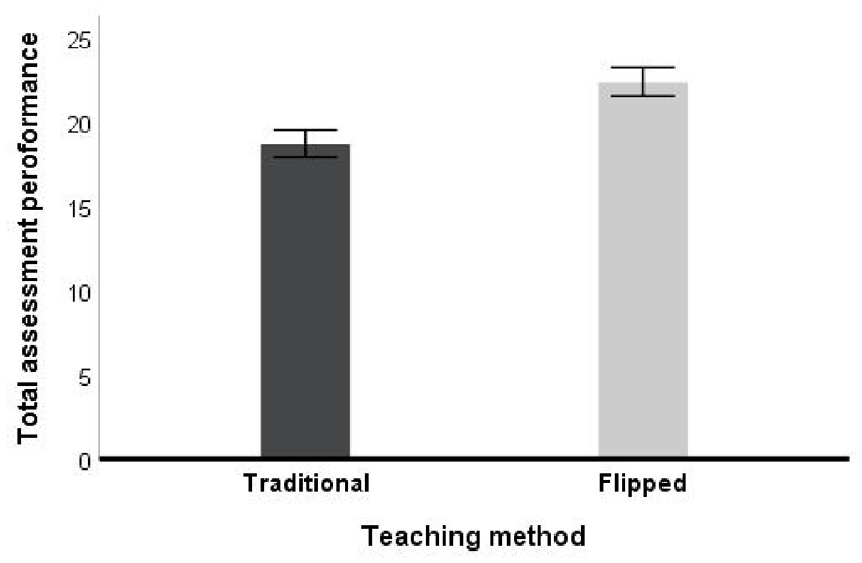
The total assessment score in each teaching method after accounting for the GPA and high school math performance. Error bars represent 95% confidence intervals.
Results for RQ2: Satisfaction Level of Learners With the Flipped and Traditional Classroom Approaches
Course feedback was collected from students using the three open-ended questions, for more in-depth feedback on students’ perceptions of the course. In total, 21 students provided comments in response to those questions. Comments were related to the contents and delivery format. Other general comments with no specific suggestions were also noted. Table 3 summarizes students’ comments and suggestions.
Answers to Open Ended Questions.

There seems to be dissatisfaction with the delivery format of the traditional course. Comments such as, “Lectures are too long,” and, “Why not make one hands-on session of 2–3 hr long in-campus to explain all course materials,” were noted in students’ feedback. On the other hand, students gave positive feedback about the delivery format of the flipped course, with statements such as, “The time spent in the class was very efficient.” The student-centered learning style introduced by the nature of the FC was also noted, for example, “there is a huge responsibility on me to learn and practice the contents.” In the FC, students had the ability to preview the content of the class and actively engage with it prior to class time; this led to a deeper learning experience. Regarding the content of the course, students from both groups implied that the course was difficult with statements such as, “Statistics is really hard,” but no specific suggestions for improvement were offered. In addition, a couple of comments from students requested advanced multivariate regression analysis to be added to the course. The course contents were chosen in a way that facilitates data analysis, as part of the research project and to cover essential descriptive and inferential methods needed for most undergraduate projects. Students were advised to consult with the course instructor if advanced statistical analysis was needed for their data. When asked about areas needing improvement, the feedback in the traditional class generally suggested the use of video recording: “why not record a short video of 10 min long to explain JMP,”“Some struggled to attend the sessions on time, I recommend using short video recording” and “I suggest using short video recording, and tutorial in-campus session.”
One notable suggestion for improvement of the course’s delivery format—as noted in responses from both groups—is the preference for face-to-face hands-on sessions in the computer lab, with statements such as, “if possible, conduct one long tutorial in-campus.” Our investigation was conducted with the objective of delivering traditional and flipped classes in learning environments similar to those previously implemented in the course delivery. Given the shift to online learning during the COVID-19 pandemic, practical sessions were conducted using Blackboard Collaborate Ultra and MS Teams, which facilitated the delivery of the course. Students were asked to download the statistical software prior to class time and to follow the steps given during the class. Most of the class time was allocated to lectures on the steps of analysis and output, instead of interactive sessions.
Results for RQ3: Course Rating Comparison
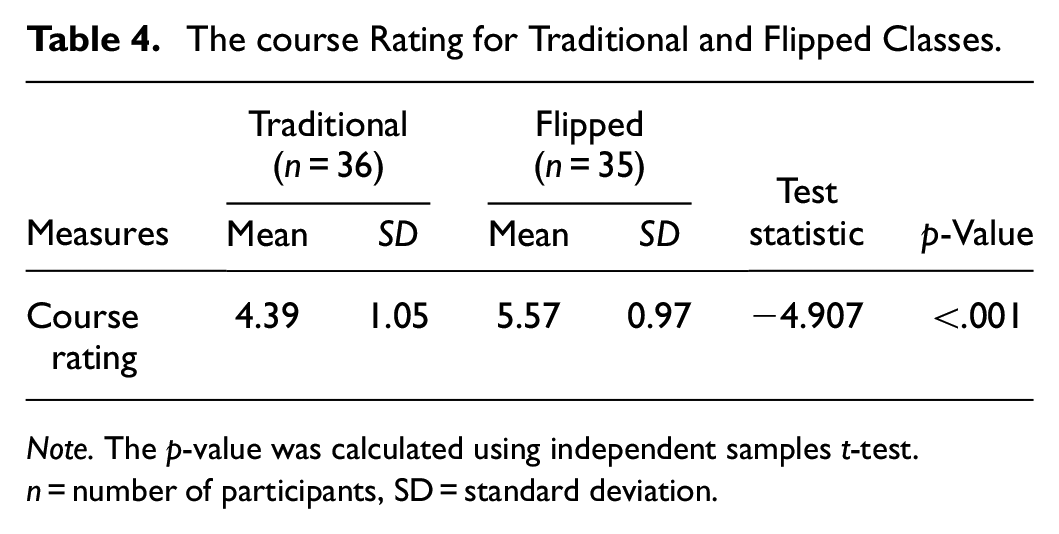
Table 4 reports descriptive statistics of students’ ratings of the course. There were statistically discernible differences between the traditional learning group and the flipped group, in terms of the course rating scores (Hedges’g = 1.16, p < .001).
The course Rating for Traditional and Flipped Classes.
Note. The p-value was calculated using independent samples t-test. n = number of participants, SD = standard deviation.
Discussion
This study implemented an online flipped classroom in a statistics course, to investigate possible differences in assessment performance, compared to the traditional online learning environment. One of the strengths of this study is that it was done prospectively and used a quasi-experimental design; this allowed us to control the enrollment of students. Our investigation included common confounders as well and were adjusted for using the regression analysis. In addition to students’ assessment performance, we also assessed students’ course ratings and collected opinions using open-ended questions as indicators of students’ experiences and levels of satisfaction.
Results were promising regarding the application of the FC in teaching statistics. The teaching approach influenced assessment performance scores. The differences in the students’ scores were statistically significant between the two teaching methods. These findings are consistent with a systematic review that reported a positive effect of the flipped classroom on students’ exams, tests, and grades (Låg & Sæle, 2019). Furthermore, a meta-analysis comparing the FC and the traditional classroom in terms of academic performance for non-mathematics students in introductory statistics courses found that students in the FC achieved statistically higher final performance (Farmus et al., 2020).
Our study revealed statistically discernible differences between the traditional learning group and the flipped group concerning the course rating scores. These differences suggest that students’ perceptions and satisfaction with the two teaching methods significantly varied. A meta-analysis study (see Hew & Lo, 2018) comparing FC to traditional classrooms showed that, among studies, most students indicated preferences for the FC approach. However, students who preferred traditional classes, view FCs as a liability in terms of time. Authors have recommended that before conducting a flipped class, the instructor needs to explain the process and its benefits to students and also needs to consider setting limits on the combined pre-class videos not to exceed 20 min (Hew & Lo, 2018). Further analysis of these statistically significant differences in course rating scores could provide valuable insights into the effectiveness and suitability of each teaching method. Understanding the specific aspects that contributed to higher satisfaction in one group compared to the other could help educators refine their instructional practices and create more engaging and effective learning environments.
Students from both groups in our sample expressed preferences for face-to-face sessions. These results are consistent with published literature (Abdelkader & Barbagallo, 2021; Bingen et al., 2020). In a previous study, that applied an online FC in an introductory mathematics course, results showed that on-campus activities are important to the success of an FC (Foldnes, 2017). Online statistics hands-on sessions can also be seen favorably, compared to in-class practical courses. In a previous study conducted in a business statistics class, undergraduate students enrolled online attained higher assessment performance scores compared to students in a traditional class (Dutton & Dutton, 2005). Perhaps integrating on-campus activities in the FC approach can provide a better student experience. Harrington (1999) compared distance learning and the traditional classroom-based approach based on assessment performance in a statistics course. Results showed that students can learn statistics electronically using distance learning, but previous academic performance (i.e., GPA) is an important predictor of their performance. Students with high GPAs enrolled in the online class performed as well as those in the traditional classroom approach; however, those with low GPAs who enrolled in the online class performed lower. Further research is needed to more reliably assess the effectiveness of online FCs in teaching statistics versus face-to-face classes, in terms of assessment performance and students’ satisfaction.
Limitations
This study admits to certain limitations. Our findings are based on a sample of students from a single institution, which affects the external validity of the study. Moreover, while this study assessed important confounders and explanatory variables that may influence students’ performance for causal effect, it must be conceded that covering all possible measures that might explain variations in an outcome is rarely, if ever, possible in educational research (Rosenbaum & Rubin, 1983). For instance, one limitation of our study was that we did not measure student engagement levels or consider it as a moderating variable. Also, this study did not evaluate the attitude of medical students prior to the start of the course and after the course’s completion, to assess whether positive attitudes toward statistics increased/decreased between the two study groups. In previous studies, students’ attitudes toward statistics have proven to be a positive predictor of student performance and course evaluation and can vary according to student characteristics (Althubaiti, 2021; Garfield & Ben-Zvi, 2007; Zhang et al., 2012). More research is needed to determine if student-centered learning environments when teaching statistics can improve students’ attitudes toward statistics.
Another limitation of this study is that high school mathematics scores, in addition to other variables were self-reported, using a questionnaire; thus, a reporting bias may have been introduced in the data (Althubaiti, 2016). In addition, all participants responded to a call for volunteers, which may have introduced a non-trivial degree of selection bias, as students interested in statistics or the FC may have been disproportionately attracted.
It is essential to highlight that FCs heavily rely on technology for effective implementation (Holmes et al., 2015; Hung, 2015). In our study, the course was conducted online, prompting us to consider students’ digital readiness and its potential impact on their perception of learning and course evaluation (López-Belmonte et al., 2022; Witherby & Carpenter, 2022). In similar settings, digital readiness has been found to vary based on student’s characteristics, such as the amount of time spent online outside of class (Althubaiti et al., 2022). Understanding students’ digital readiness becomes crucial in assessing their preparedness for an online learning environment and can shed light on how they interact with the technology-enabled components of a FC approach.
While acknowledging the study’s limitations, it’s important to note that the chosen design is robust. The study utilized a quasi-experimental design while accounting for common confounders, enhancing the internal validity of the results compared to non-experimental designs (Cahit, 2015).
Implication for Research and Practice
This study provides valuable insights into the effectiveness and applicability of the flipped classroom method in teaching statistical analysis. However, there are still areas that require further research. Future studies could explore the impact of the flipped classroom approach on students’ long-term retention of statistical concepts and their ability to apply these concepts in real-world settings. Additionally, investigating the influence of students’ prior knowledge and learning styles on their performance in a flipped classroom environment would contribute to a deeper understanding of the factors that contribute to successful implementation. Furthermore, examining the role of instructor support and guidance in the flipped classroom model could help identify strategies for optimizing students’ learning outcomes.
The practical implications of our findings are twofold: firstly, educators can leverage the findings of this study to enhance the delivery of statistics courses in online settings. The flipped classroom model can help maximize the efficient utilization of class time by engaging students and instructors in meaningful discussions and activities. To ensure the success of the flipped classroom approach, careful planning and implementation are necessary. Educators should consider various instructional media, such as videos, slides, podcasts, and other multimedia content, and choose the most suitable format for their lectures. Preparing questions in advance and addressing them effectively can foster an interactive and collaborative learning environment (Wei et al., 2020). Additionally, pre-assessment methods at the beginning of class can encourage student preparation and allow instructors to identify and correct any misconceptions (Hew & Lo, 2018). Overall, implementing the flipped classroom method has the potential to enhance students’ comprehension and retention of statistical concepts, equipping them with the necessary skills for successful application in future medical research endeavors.
Secondly, our research contributes to the overall improvement of statistics education in medical research programs. By implementing the flipped classroom method, instructors can offer a more dynamic and engaging learning experience. This has the potential to enhance students’ comprehension of statistical concepts, ultimately equipping them with the skills necessary for successful application in their future medical research endeavors.
Despite the potential benefits, it is important to acknowledge the challenges associated with employing a flipped classroom approach (Cevikbas & Kaiser, 2020; Wilson, 2013). Educators must carefully design and implement the course to maximize its benefits. Factors such as the preparation of materials, selection of appropriate instructional media, and determination of class activities all play a crucial role in the effectiveness of the flipped classroom model. Ongoing assessment and feedback from students can also help identify areas for improvement and make adjustments accordingly. By considering these factors and addressing the challenges, educators can successfully implement the flipped classroom method in statistics instruction, leading to enhanced learning outcomes and better preparation of students for their future medical research pursuits.
Conclusion
In conclusion, the results of this study suggest that implementing the online FC approach is an effective teaching strategy for improving students’ assessment performance in statistics. Compared to traditional online learning, the FC group demonstrated significantly higher scores on assessments, suggesting a higher level of understanding of the material. Moreover, the FC approach was also associated with higher course ratings and a greater level of satisfaction among students. This suggests that the interactive and engaging nature of the flipped classroom, which allows for active learning and collaboration, was well-received by students. Notably, the findings of this study further underscore the significance of integrating on-campus activities in the flipped classroom approach. The preference for face-to-face sessions expressed by students highlights the value of in-person interactions and the benefits of having the opportunity to engage with the instructor and peers directly. Overall, these results suggest that this pedagogical approach holds promise for improving student outcomes and satisfaction in statistics education.
Footnotes
Acknowledgements
None.
Declaration of Conflicting Interests
The author(s) declared no potential conflicts of interest with respect to the research, authorship, and/or publication of this article.
Funding
The author(s) received no financial support for the research, authorship, and/or publication of this article.
Ethics Approval
The study was performed in accordance with the declaration of Helsinki and approved by the respective Institution’s Research Ethics Board of King Abdullah International Medical Research Centre (Approval No.: 0807/22, Study Number: NRC22R/159/03).
Consent to Participate
Informed consent was obtained from all individual participants in the study. The study was explained to the participants, who were also informed that their participation is completely voluntarily and confidentially is maintained throughout the study.

Data Availability Statement
Data will be shared upon reasonable request, addressed to the corresponding author.