




Abstract
An Indonesian MOOC (Massive Online Open Course) aimed to give pre- and in-service English teachers a new online learning experience and equip them to master technological applications for teaching English in class. It has not always been easy for facilitators to assist students to complete MOOC programs. This paper sketches how Indonesian facilitators faced challenges in motivating MOOC students. The experience of facilitators with low and high dropout rates is shown to sharpen and deepen the differences in managing the MOOC program. This study found a relationship between facilitator performance and student retention rates.
A MOOC is a Massive Online Open Course. MOOCs were initially intended to be massive, that is, cater to vast numbers of students. MOOCs have become a strategic educational medium as they are broadly affordable to all social levels of people interested in learning (Czerniewicz et al., 2017; Gershon et al., 2021; Yu et al., 2019). It was online, that is, provided over the internet. It was open to anyone who wanted to join, and it was a course of study. Baturay (2015) explains three characteristics of MOOCs: open, participatory, and distributed. Open means that the online learning platform is open to anyone interested in learning, joining in discussions, and contributing to a body of knowledge. The second characteristic is participatory, that is, students voluntarily share information shared during the learning period. Third, distributed means that knowledge or information should be distributed in the network of the online learning community. In short, the term MOOC refers to any learning experience provided free to anyone via the internet (McAndrew & Jones, 2012).
In 2007 George Siemens and Stephen Downes initiated a MOOC program at the University of Manitoba (Blackmon & Major, 2017; Daniel, 2012). Siemens (2017) believes that MOOCs provide a platform for people to learn by interacting through networks and sharing information on the internet. Since then, the term MOOC has become much more well-known.
Over time, MOOCs developed and were divided into two types, the “cMOOC” and the “xMOOC” (Loizzo et al., 2017). The letter c in cMOOC refers to connectivism. In essence, the cMOOC facilitates members of an online learning community to explore knowledge through information sharing (connectivity) in online interactions such as discussion forums, and its scope of content is broad. The xMOOC, on the other hand, generally refers specifically to the content of university courses.
MOOCs are relatively new to Indonesia. They began to run in 2013 at the initiative of several providers (Belawati, 2019), one of which was the Indonesian MOOC, also called IMOOC that stands for Indonesian Massive Open Online Course, entitled “Technology for Autonomous Learning.” It was an online program supported by Regional English Language Officer (RELO) intended for prospective and pre-service English teachers. It comprised five modules to be completed over 11 weeks. The five modules introduced the participants to digital applications for teaching English. At the end of the program, it was expected that the participants could integrate technology into their English classrooms. To help program students, the IMOOC had 15 facilitators from cities in Indonesia, from Banda Aceh in the northwest to Ambon in the east.
This research seeks to answer the question: How did Indonesian facilitators face challenges in motivating MOOC students? This includes several other subquestions:
To what extent were they successful in recruiting prospective students and what are the reasons for their level of success?
To what extent were they successful in tutoring and retaining students, and what are the reasons for their level of success?
How willing were they to help participants in difficulty?
Insight into facilitators’ MOOC experiences has the potential to impact forthcoming instructional designs and pedagogical approaches applied to MOOCs. To provide the clarity of the performance, the facilitators were further divided into some groups, and their behavior was investigated based on each stage of the MOOC implementation.
Literature Review
In Indonesia, the MOOC is seen as a new learning model, beginning less than a decade ago (Beny et al., 2014; Berliyanto & Santoso, 2018; Hewindati & Belawati, 2017). Indonesian MOOCs began in 2013 with a mandate from the Indonesian government through the Minister of Education and Culture (Ministry of Education and Culture, 2013). Only two universities in Indonesia actively conducted their own MOOCs as individual institutions (Berliyanto & Santoso, 2018; Hewindati & Belawati, 2017). In addition, as Berliyanto and Santoso (2018) found, Indonesian MOOCs have not been massive, despite the suggestion of the abbreviation. They found that no single Indonesian MOOC had served more than 10,000 students.
Numerous studies related to Indonesian MOOCs mentioned that internet access in Indonesia is unequal (Beny et al., 2014; Hollands & Thirthali, 2014). Consequently, most MOOC students come from only one Indonesian island, the island of Java. Other islands might have internet networks, but the connections are not as good as those on Java, and poor internet connectivity affects Indonesian students’ use of the internet (Firmansyah & Timmis, 2016).
In addition, digital literacy related to internet use was found to be low in Indonesia. Indonesians used the internet for popular social media, but they did have other digital literacy competencies. For example, they did not know about internet information searches nor online learning, such as MOOCs. Consequently, MOOC providers found it challenging to recruit Indonesian students, and MOOC programs in Indonesia can expect to have less than 10,000 students (Berliyanto & Santoso, 2018).
Based on the performance of Indonesian MOOCs, delivery techniques and interaction activities need to be improved compared to non-Indonesian MOOCs (Pribadi, 2018; Putra, 2017). Indonesian MOOCs were considered to have less engaging learning activities for students and mostly adopted traditional styles of teaching presentation (Putra, 2017). Moreover, video content and social learning features were found to need improvement compared to non-Indonesian MOOCs.
To achieve the best MOOC learning and facilitation, the facilitators’ roles and behaviors should differ between xMOOCs and cMOOCs (Beaven et al., 2014). The type investigated in this paper, the cMOOC, views learners as self-determining, described as experiencing “. . . a sense of freedom to do what is interesting, personally important, and vitalizing. Thus, self-determination signifies the experience of choice and endorsement of the actions in which one is engaged” said Salkind (2008) (as cited in Beaven et al., 2014). Consequently, students intentionally and voluntarily join MOOCs because they consider the skills and knowledge taught in MOOC important for them. Meanwhile, the xMOOC reflects “the pedagogical end of the framework” essential to drive the course structure and students’ learning (Blaschke, 2012). Facilitators have more authority in xMOOCs than in cMOOCs, since cMOOCs depend on high levels of learner maturity and autonomy.
The differences in the facilitator’s roles also affect the facilitator’s behavior. Facilitators in cMOOCs do not need to be concerned about responding to the needs of individual students because students acknowledge their learning styles and background knowledge before engaging in the specific subject (McAuley et al., 2010). However, these characteristics do not eliminate the facilitator’s role. As the students increase their understanding of the materials through continuing online discussions, facilitators must drive the students’ discussion toward the specific learning goals (Loizzo et al., 2017; Siemens, 2017).
Online learning usually uses an online learning platform, also known as learning management systems (LMS). These are specifically designed to provide a range of interactions between instructors and students and support assessment and student records (Hui et al., 2019). The other main kind of online learning platform is social media, sometimes with add-on software, such as WhatsApp. These apps are generally more familiar to students and easier to use but are less sophisticated. These apps enable interactions to occur outside the online learning platform and maintain high levels of engagement (Hui et al., 2019; Mercado-Varela et al., 2017; Park & Kim, 2020). The use of these online applications can promote social presence in online learning because it forms the social knowledge constructs, peer review, and students’ learning (Skrypnyk et al., 2015).
Students who had cMOOC learner characteristics found the online applications or social media, such as Facebook or Twitter, helpful to construct knowledge that suits their learning environments (Saadatmand & Kumpulainen, 2014). Consequently, both xMOOC and cMOOC depend on online applications and social media to support direct communications that are not available within the LMS.
Method
Context
The Indonesian MOOC mentioned above is the focus of this research. It lasted for 10 weeks, from February 20, 2018, to April 29, 2018. The first week was pre-course orientation: navigating the Canvas platform, the instructional objectives, and graduation requirements. In the following weeks, all students were required to complete all assignments in five modules: Autonomous Learning (Module One), Digital Literacy (Module Two), Mobile Devices (Module Three), Video Use for Autonomous Learning (Module Four), and Making Videos for Teaching (Module Five). Module tasks included discussions (40%), movies (25%), projects (15%), peer reviews (10%), and multiple-choice questions (10%). These percentages show the distribution of these tasks in the whole module. These tasks formed the basis for assessing students’ performances during the MOOC.
Subjects
The subjects of this study were MOOC facilitators who also worked as lecturers in various public and private universities in Indonesia. The MOOC had 15 facilitators and 537 students, giving facilitators an average of about 36 students each. They assisted English teachers from Indonesia and other Asian countries, including Thailand, the Philippines, India, and Burma. They had experience in teaching online. The primary data of this research are their discussions and self-reports after conducting the MOOC. In self-reports, the facilitators explained their experiences and constraints during the program.
In general, MOOC 2018 had a relatively high completion rate (see Table 1). About 69% of students completed the MOOC, and only 31% failed to do so. The percentage of MOOC completion in 2018 was higher than other MOOCs, such as Open University MOOCs (Belawati, 2019) and Coursera MOOCs (Daniel, 2012).
Dropout Rates in the MOOC 2018.

Before implementing the MOOC, the facilitators identified a variety of problems, ranging from technical issues (relevance of module content, problems with broken links) to issues of managing online programs such as facilitating discussions, managing peer reviews, and making objective assessments of the results of discussions and participant’s projects. Solving problems through discussion was essential. They held most meetings by video conferences because they lived far from one another and rarely had face-to-face discussions.
This study divided facilitators into two groups: those with low dropout rates and high dropout rates. The R (Range) score was twenty-two (22), obtained by reducing the highest completion rate (22) with the lowest completion rate (0). The interval value for facilitators with a low dropout rate was 0 to 12. Meanwhile, the interval values for facilitators with high dropout rates were 13 to 22. Based on this benchmark, about seven facilitators were identified as low dropout rate facilitators (LDRI), and eight were high dropout rate facilitators (HDRI).
Instruments
Based on Table 2, the writers interviewed two instructors from the low dropout rate group (LDRI) and two from the high dropout rate instructor group. In this study, we have labeled these selected four instructors using pseudonyms for ethical reasons. Anna and Benny were low dropout rate instructors (LDRI). Meanwhile, Charles and Ann are high dropout rate facilitators (HDRI). In addition to the reports, the writers also conducted several interviews with key informants using an open-ended question format.
Facilitators and Dropouts in MOOC.

Findings
Challenges in Recruiting Students
Before implementing the IMOOC, facilitators had to recruit IMOOC students, and they had several ways to do so. Some facilitators used conventional methods such as contacting friends or sending invitations via mail to schools. Some also put up posters on campus walls, hoping that students would be interested. Others used social media such as Facebook.
Interestingly, their attitudes and efforts were quite different from each other. For example, as an LDRI (low dropout rate facilitator), Anna did not easily give in to obstacles. She facilitated the IMOOC for ASEAN countries and reported that she did not promote the IMOOC through social media because she had been given a list of potential students from an associated partner in each prospective country. However, only a few of them joined the course. When this approach did not produce satisfactory results, she started uploading the flier onto Facebook, but this was also unsuccessful. She then posted a flier on an English teacher Facebook group but only recruited four registrants. She then contacted her colleagues who had networks in those targeted countries, and they helped her promote the IMOOC. In this way, she was finally overwhelmed with far more applicants than she had ever expected. She then had to select eligible applicants for acceptance as IMOOC students. She had no substantial technical obstacles helping students log on to Canvas, and her technical skills made the initial IMOOC program run smoothly. She reported that she gained her skills through independent learning; she read manuals, watched tutorial videos, and experimented.
Charles, a high drop rate facilitator (HDRI), was lucky. Unlike Anna, who had used various methods to get her students, he sent some invitation letters to several school principals in his hometown. Most of them responded positively to his invitations and asked their English teachers to attend the IMOOC. Even though this conventional approach effectively recruited students, Charles found it difficult to get his students to log on to Canvas. Charles did not know how to solve his problem even though all manuals dealing with Canvas had been practically demonstrated and extensively discussed and later distributed to all facilitators. He panicked in this confusion. He tried to get other facilitators to help him, sending messages on WhatsApp and making calls. At the same time, other facilitators were also busy managing the IMOOC in their respective locations. Charles admitted that he was fortunate that other facilitators finally offered him some step-by-step guidance for logging on.
The same thing happened to Debby, another high dropout rate facilitator. She mentioned that her position on campus limited her freedom to manage the IMOOC. She tried various efforts to recruit students, including talking directly with potential students, sending messages via WhatsApp, and uploading the flier on Facebook. She had no response. Finally, she tried to persuade her master’s students and had very few applicants.
Charles and Debby represent facilitators with high dropout rates. Their problems with managing an online program were utterly unrelated to their academic backgrounds. Both had an ELT master’s degree. Their problems were rooted in their perceptions of the IMOOC in comparison with their work responsibilities. Independent learning was a big challenge for them, involving reading manuals about the learning management system, experimenting with new software applications, and navigating the LMS. As a result, they had difficulty getting applicants and managing the LMS during the initial orientation phase.
Managing Interactions
Online facilitators had to help students with various difficulties by providing information and direction. While students came from different cultural backgrounds and had different personalities, they also had different motivation levels. Many kept asking facilitators for help on various issues, from overcoming technical obstacles on LMS navigation to working on project assignments in modules. Some students tended to be so passive that they neglected these tasks. Willingness to help students with problems was one of the most critical issues for facilitators in online programs; it distinguished the more effective facilitators from the others.
Anna claimed that she always tried to be ready 24 hours to help students to solve problems. Question after question came to her, especially during the orientation period since many students did not know how to operate the tools on Canvas. She patiently answered all questions from the students. Unlike other facilitators, social media did not apply to her site. She said:
The first week of module one was really tough. I had to be ready 24x7 to answer participant’s questions since they were in the process of getting familiar with canvas and posting their very first task . . . I have tried to encourage them and guided them step by step . . . To keep the students, I had to be very active in encouraging them merely through email because the students were not willing to respond through text messages owing to different time zones in their countries.
As a low drop rate facilitator, Benny also mentioned that the first week of the module was tough. He had to put much effort into managing the course. He stated:
To be honest, I had to and did risk spending a lot more time because it required me to read and comment on all (if not most) discussion threads, reviewing their tasks earlier and giving them individual revision notes in their every submission, updating the grading progress on WhatsApp group regularly, etc. It sounded exhausting as well as time-consuming, but the final result and outcome were worth the hard efforts.
Charles and Debby had less interaction with their students than Anna and Benny. From the beginning, both Charles and Debby told the students which days they were doing the activities online. They also had WhatsApp groups that guaranteed communication with students. However, both of them were stressed that WhatsApp was only intended to remind students of the assignments and address all students’ problems through email or a discussion thread on Canvas. All the parties could express their problems freely with emails, and emails were a good record of all interactions.
Interaction between facilitator and students served as an influential variable on the difference in performances between LDRI and HDRI, measured in numbers of discussion posts and the hours spent managing online programs, which indicated a strong commitment to assisting students to achieve the learning objectives (Tables 3 and 4) .
LDRI’s Discussion Post.

HDRI’s Discussion Posts.

Figure 1 is attractive, showing that performance patterns of the two facilitator groups resemble the shape of a hill. Both have a bend downward and a bend upward. For example, in discussions 1, 3, and 5, both groups began in a relatively higher position than the 2, 4, and 6. There was a similar pattern in the following discussion tasks, indicating that students in the two facilitator groups had similar attitudes when involved in the discussions. One cause of the pattern was the level of difficulty of tasks. The task of discussion 1, for example, was to require students to introduce themselves by writing introductions to the discussion and uploading video clips. These tasks were much more manageable than those in the second discussion.

The performance of two facilitator groups (LDRI and HDRI) in the discussions.
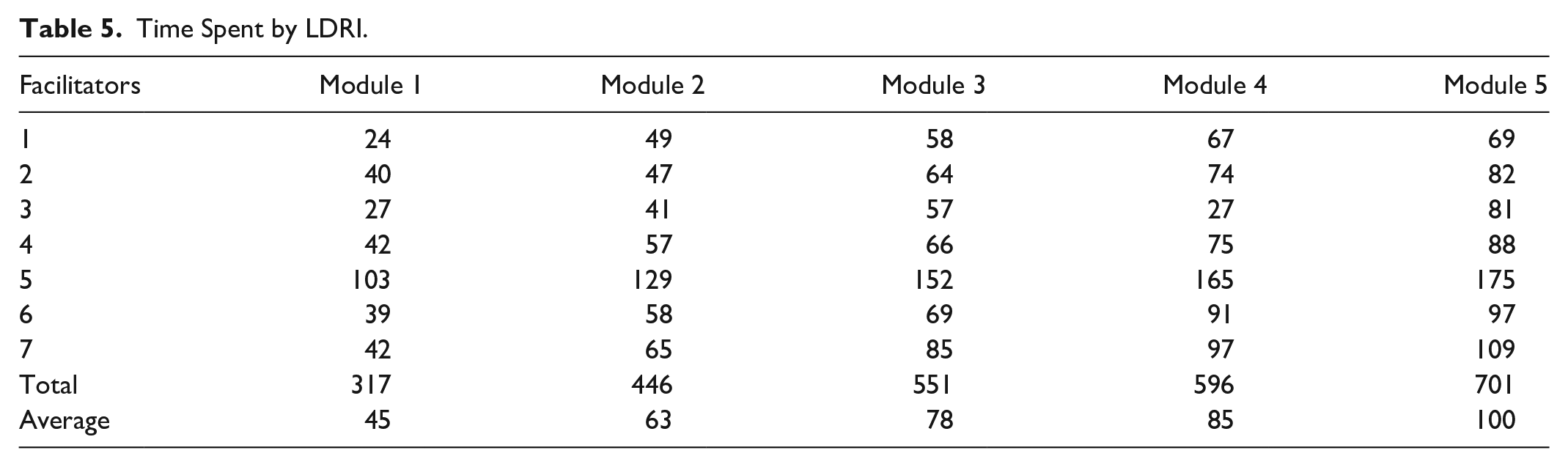
The number of hours recorded on the LMS also indicated facilitators’ performances. As with the number of posts in the discussion, the two groups of facilitators had different total hours, with the HDRI group spending more time than the LDRI group.
The hour totals in Tables 5 and 6 reflect facilitators’ time with students during the IMOOC program. The more hours, the greater the number of students completing the program. The difference between LDRI and HDRI implies that the intensity of facilitator interaction affected graduation rates, and their performances are visualized below (Figure 2).
Time Spent by LDRI.
Time Spent by HDRI.


Time spent by LDRI and HDRI in all modules.
Handling the Problems
Some problems were academic (late submissions, grasping the content of tasks), and others were not, such as technical problems and challenges in building a social presence. LDRI and HDRI facilitators performed differently in their strategies for handling problems. IMOOC also faced dropouts, late submissions, no submissions, and technical issues similar to other online courses.
Facilitators had to make considerable effort to retain their students. Anna mentioned that it was a big challenge to keep students in the course and on track to finish. It was even more complicated for her because, unlike others, she could only contact students through email. Despite this limitation, Anna made the best use of email to communicate with her students. To be closer and form an emotional bond with them, she mostly sent individual emails to each participant instead of sending group emails. She required students to submit assignments on time, but, aware of the workload of the assignments and the due dates, she gave students a grace period if they requested extensions before the due dates. Anna also sent gentle reminders by group email 3 days before the deadline and individual emails a day before the deadline. Anna was successful in keeping students actively engaged throughout the course.
Benny reported that he lost five students early in module one; they did no more than two tasks. He said it was primarily due to time management or students overestimating their abilities; they thought modules and activities were too challenging. Benny created a WhatsApp group to communicate with the students, using it to update them on the progress of the course, inform them of assignment deadlines, and discuss their difficulties in the modules. He also gave a grace period for students on the condition that he penalized their grades daily if they had not given prior notification. He always gave detailed individual feedback to students and required them to revise and resubmit the assignment to ensure high-quality work. By actively engaging and communicating with students, Benny was successful in minimizing the dropout rate.
Apart from dropouts and late submissions, Anna and Benny had many technical difficulties. Most technical problems related to logging in to the LMS and uploading a video, but they solved them quickly through good communication and the technological skills of facilitators and students.
Interpersonal interaction and social presence were also significant challenges in online courses. LDRI facilitators made the best use of discussion forums to establish interpersonal interactions. Besides using email and WhatsApp, Anna and Benny tried to respond to each thread in the discussion session to show appreciation, boost motivation, and encourage further questions to make the discussion more fruitful and exciting. They paid attention to students with minor responses and attempted to increase their engagement in discussions. They also encouraged students to comment on each other’s inputs to get students to know each other better.
Besides the strategies carried out by LDRI, HDRI facilitators such as Charles and Debby also put considerable effort into engaging students during the course. However, dropouts occurred at different times between sites. Charles mentioned that he had lost students drastically after the pre-module course because students had difficulties uploading the photo and video to introduce themselves. Meanwhile, Debby lost her students in the middle of the course; her students lost their motivation because they found materials repetitive. These factors might have affected the performances of the students and HDRI facilitators’ behavior throughout the IMOOC.
To minimize the dropout rate, almost all HDRI facilitators used social media to reach their students. They claimed that social media could close their virtual distances where the LMS could not.
Charles used social media to inform students about the quiz features, send reminders of the publication of modules, guide them in the reading materials, and express appreciation to students who had already joined the learning activities. Another facilitator had a similar strategy. Debby employed social media to remind students of the learning schedule, point out learning activities that should be done, and encourage students. In addition, Charles depended on the students’ responses when dealing with late submissions. He did not give feedback and scores and hoped that the students would willingly complete their delayed work and continued their learning progress. Nonetheless, the other facilitator, Debby, gave gentle reminders through social media lines and told them that late submission could impact their final grade. Furthermore, she provided continuous encouragement, saying that the material was very beneficial so that students needed to complete their learning activities.
HDRI facilitators also had a different approach to technical problems in the online learning platform. For example, Charles preferred to provide examples, create his video guidance, and then send them through the LMS and social media. Despite a high dropout rate, he believed these helped students participate in the pre-course module and further discussions and tasks. Debby, however, depended on her interactions with her students through social media. When her students had difficulties, she gave step-by-step guidance, advised on the benefits of the course, and persuaded them to complete the course.
All HDRI facilitators also attempted to build an online social presence. In the pre-module course, they provided a model for how to introduce oneself. They believed that when the facilitator and students all introduce themselves, it will create a more personal relationship in the virtual environment. In addition, at the end of each module, the facilitators expressed appreciation to their students for contributing to discussion forums and assignments. The appreciation took positive feedback, thanking or providing screenshots of the first discussion post and posted on social media. They claimed that they could express appreciation to students who gave the first responses in discussion forums and remind them that the discussion forum had started.
Creating an online group in social media had greatly helped the facilitators to create a social presence. They thought that students could more easily access social media and that it was better than depending solely on the LMS. Students mainly used social media every time, and it was very convenient for them to receive any information, including their online course progress. Unfortunately, the LMS had no feature for a mobile version.
Discussion
Indonesian facilitators faced challenges in motivating MOOC students in generally similar ways even though some had much higher dropout rates than others. The extent of their success in recruiting prospective students varied greatly. The main reasons for success were simply being willing to keep trying other avenues when previous avenues were unsuccessful.
Facilitators perceived MOOC motivation largely in terms of personal relationships, but some were much more successful than others in tutoring and retaining students. As far as can be identified, the factors resulting in success were the ability to create an online community, maintain personal contact, give encouragement, and resolve students’ difficulties.
The use of media varied. For example, the LMS was difficult to use and many resorted to other easier media such as WhatsApp and email. Some reasons for low retention were not the fault of facilitators, such as technical difficulties and repetitive materials.
Several other factors might explain the unequal quality of facilitators. First, facilitators had different motivation levels. Some were motivated by a sense of intrigue or the desire to gain a personal reward (Cf. Hew, 2014). MOOC facilitators do have a sense of intrigue. In 2018, MOOC was a relatively new online learning media in Indonesia (Belawati, 2019), so they were curious to learn about MOOCs. Other personal motivations were recognition to become well-known academics (Eshet-Alkalai, 2004) and hopes of collaborative activities such as research (Zheng et al., 2016). Doo et al. (2020) have stated that these facilitators have a relatively strong intrinsic motivation due to their responsibilities as part of the MOOCs program. However, the unequal quality of their performance was also affected by the unequal quantity of their online teaching experience. According to Doo et al. (2020), most MOOCs facilitators learn how to teach MOOCs informally and individually; nevertheless, many have perceived that MOOC teaching affects their professional development. Meanwhile, others hold the view that teaching MOOCs is the exploration of new ways of teaching (Zhu et al., 2019).
Second, the quality of the performance was very dependent on their online teaching skills as motivators, not primarily as instructors. Although they were also concerned with learning outcomes (Ginting et al., 2020; Tsinakos, 2006) and ensured that students master learning, their role as motivators determined success. The more effective facilitators continually motivated students to interact and enjoy the MOOC learning process, aware that their intense presence was crucial because students could not see and have the kind of direct interaction that they could in traditional classes (Baisley-Nodine et al., 2018; Kilis & Yildirim, 2019; Park & Kim, 2020). The more effective facilitators tended to put more significant effort into establishing a clear presence in the virtual classroom and regarded students as persons of influence (Perry & Edwards, 2005). Positive interaction between facilitators and students was reflected in the frequency of discussion posts and learning hours to exchange ideas and explore the material.
One of the most influential factors in dropout rates was facilitators’ willingness to help students in difficulty. It involved being constantly available to help, and to give encouragement, feedback, and step-by-step guidance (Doo et al., 2020). To some extent, this was measured in terms of the numbers of discussion posts and the hours spent online in the online platform. The more hours, the greater the number of students completing the program, although these statistics do not measure the quality of the interactions. This interaction statistic also indicated facilitators’ different levels of motivation.
Akin to a willingness to help is personal attention and a social presence. Individualized feedback and posts in discussion forums were aimed at developing a personal relationship with students (Baisley-Nodine et al., 2018). In particular, they paid attention to students with minor responses and attempted to engage them more in the discussion forum.
Several aspects of the facilitators’ task are concerning. First, to be successful, facilitators had to spend large amounts of time coaching their students, indicating that this approach has more in common with LMS-mediated instruction than an actual MOOC. Students were heavily dependent on facilitators, and it is doubtful that a MOOC that depended so heavily on facilitator interactions could scale up to massive numbers of students.
Second, besides teaching, facilitators carried the troubling burden of providing essential technical support (Mercado-Varela et al., 2017). Navigating Canvas as a MOOC platform was indeed new for most facilitators. Unfortunately, technical problems such as logging in arose rather often. In some cases, it might have been participants’ reluctance to log in, and not at all the fault of the facilitator, but some facilitators successfully overcame that reluctance. In other cases, it was a technical difficulty for which facilitators had to provide solutions. The facilitators read manuals, watched tutorial videos, and experimented (Doo et al., 2020). Successful facilitators usually took the initiative to collaborate with other facilitators to solve technical problems (Mercado-Varela et al., 2017). These facilitators independently learned about new issues and were willing to take the initiative to facilitate a MOOC much better than others.
A third challenge was that the IMOOC facilitators had to recruit their own participants. It was unusual for facilitators to be responsible for recruitment. In a typical higher education context, student recruitment and instruction are separate because they require different skills. In “open campus” days, instructors are required to present a positive image to prospective students but are not expected to have strategic skills in marketing and recruitment.
Implications
The present study has three main implications. First, it would be better to prevent technical difficulties rather than improve ways of resolving them. MOOCs would be easier for both facilitators and students if the online platform was as easy to use as social media and could be used in a mobile format, especially a cellphone. Second, the burden of student recruitment should probably be delegated to specialists. Third, the training of facilitators is a matter of obvious priority, especially their skills in creating an online community.
The study also points to several matters needing further research. First, the motivations and incentives for students to complete MOOCs need more careful examination. The case discussed had no disincentive to drop out. The topic is not new, with some universities using MOOCs for degree credit and charging fees, assuming that students will be less likely to drop out if they pay for the MOOC and gain degree credit.
Second, the motivations and incentives of facilitators need more careful analysis. This includes approaches to payment and career paths and status as a peer within the academic community.
Third, the notion of facilitators giving a 24-7 commitment is unsustainable. Attention must be given to establishing more reasonable facilitator time commitments while maintaining the same effectiveness and scaling up capacity to increase student numbers without increasing dropout rates.
Fourth, the strategies of more successful and less successful facilitators in this study were often quite similar. Consequently, more research is necessary to create a more fine-grained methodology for measuring the factors of tutor effectiveness.
Footnotes
Declaration of Conflicting Interests
The author(s) declared no potential conflicts of interest with respect to the research, authorship, and/or publication of this article.
Funding
The author(s) received no financial support for the research, authorship, and/or publication of this article.
