



Abstract
Customer complaint or customer voice has been recognized as a key response to service failure that activates service recovery. This study aims at investigating how managing customer voice affects service recovery evaluation. Building on the concept of initiation, this study conceptualizes three conditions of service recovery, namely, service recovery based on customer-initiated voice, service recovery based on firm-initiated voice, and service recovery based on no voice. Using an experimental design, the present study investigates how customer evaluations of service recovery vary across voice initiation conditions. The multivariate analysis of covariance (MANCOVA) reveals that firm-initiated voice, compared with customer-initiated voice, elevates customer perceived justice and satisfaction while diminishing negative word-of-mouth intention. The research findings emphasize the necessity to activate customer’s voice following a service encounter so that service failure can be identified and addressed, which helps in improving customer evaluation of service recovery attempts.
Introduction
A considerable body of service literature has recognized service failure as a major issue in service business as it is unavoidable and invariably causes customer dissatisfaction (Berry, 2016; Hart et al., 1989; Tax & Brown, 2012). In addition, the unresolved or inappropriately resolved service failure can definitely lead to negative behavioral outcomes, for example, negative word-of-mouth, switching behavior (Cai, 2014; Kerr, 2004; Lin, 2010; Wan, 2013). On the other side, an appropriate response can promote customer’s service recovery cooperation intention, satisfaction, engagement, and positive behavioral outcomes, for example, positive word-of-mouth, electronic word-of-mouth revisions, and repurchasing behavior (e.g., Cambra-Fierro et al., 2016; de Matos et al., 2011; Harun et al., 2019; Hennig-Thurau et al., 2004; Huang et al., 2020; Huang & Ha, 2020; Komunda & Osarenkhoe, 2012; Yoo, 2020), thus suggesting it is essential for service organizations to be aware of service failure when it occurs.
Extant literature provides considerable insight into the necessity of customer complaint or customer voice following service failure, and customer response logic suggests that customer voice offers a service recovery opportunity to the service provider to restore the customer–firm relationship and improve service quality (e.g., Kim et al., 2010; Lovelock et al., 2001; Ro, 2014; Tax & Brown, 2012). However, a service recovery opportunity prompted by customer complaint is relatively low due to the majority nonresponse rate: up to 95% of dissatisfied customers are found not to voice to the service provider (Tax & Brown, 2012) because of perceived difficulty and perceived time and effort to voice complaint (Lu et al., 2018). The present study strives to uncover how service organizations can handle service failure experiences of customers in a way that lessens their perceived complaining difficulty, time, and effort, together with enhancing their positive experience of service recovery.
In service recovery literature, customers evaluate the service provider’s recovery efforts through the lens of perceived justice. Prior research suggested that when customers perceive they provide less input in the social exchange, their sense of justice is improved (Adams, 1963). This principle holds true for the service recovery context; when customers received service recovery without voicing (input), they reported greater positive evaluation of service recovery (Patterson et al., 2006; Smith et al., 1999; Voorhees et al., 2006). On the contrary, research on voice opportunity argues that customer voice is crucial in the service recovery process because when customers are offered a chance to voice in the service recovery process, they reported higher perceived procedural justice, overall satisfaction, and repurchase intention (Karande et al., 2007; Park & Ha, 2016; Roggeveen et al., 2012), thus indicating that the role of customer voice and customer effort in service recovery remains unclear. However, the existing literature of service recovery is only limited to service recovery based on customer voice and service recovery based on unvoiced complaint.
To address this research gap, the current study takes the initiation concept into account by examining how service recovery evaluation varies across different voice initiation conditions.
Drawing on the role of voice effect and initiation, the aim of this study is to develop a voice initiation concept and to test its effects on customer evaluation of service recovery. Specifically, while the present literature addresses service recovery based on customer complaint and service recovery despite an absence of customer complaint, it overlooks service recovery based on customer complaint invited by the firm. Hence, the current study sheds light on the firm-initiated voice as a mechanism to motivate the dissatisfied customer to engage in voiced complaint to the firm. Altogether, the effects of three types of customer complaints in service recovery are compared in terms of perceived justice, satisfaction, and negative word-of-mouth intention.
The next section provides theoretical background of consumer complaint behavior and introduces the customer voice initiation in service recovery, followed by the development of hypotheses. Next follows the description of research methodology, analysis, and findings. This article concludes with a discussion of relevant theoretical and managerial implications and limitations.
Theoretical Background
Consumer Complaint Behavior
Consumer complaint behavior comprises a series of behavioral and nonbehavioral responses to perceived dissatisfaction within the consumption experience (Singh, 1988, p. 94). Koussaifi et al. (2020) pointed out that customer complaints are dynamic, on-going, nuanced and embedded in a complex multi-layered social fabric, comprising of multiple touchpoints between the complainant and other social actors, and that emotions and behaviours both drive and are driven by the specifics of the incident. (p. 8)
Previous studies have attempted to explain complaint behavior, using different classifications of individuals’ responses to unsatisfactory experience. Hirschman (1970) has established the exit, voice, and loyalty model to explain people’s responses to a decline in firms, organizations, and states. In consumption contexts, “exit” refers to an intention to terminate a business relationship by switching to another firm; “voice” is an expression of dissatisfaction, which is directly made to the firm’s authority; and “loyalty” is the extent to which customers “are willing to trade off the certainty of exit against the uncertainties of an improvement in the deteriorated product” (Hirschman, 1970, p. 77). Day and Landon (1977) have classified complaining behavior into two categories, namely, action and inaction. If a customer takes action, this could be either public or private action. Among public actions, customers can make direct complaint to the firm, make third-party complaint, or take legal actions. The private action can be, for example, personal boycott and word-of-mouth. Inaction means the customer does not take action and is assumed to return. Under their taxonomy, customers who do not take action are assumed to return (Ro & Mattila, 2015).
Singh (1988) further developed the taxonomy of consumer complaint behavior based on two criteria, namely, external or not external to consumers’ social network, and involved or not involved in dissatisfying experience. Singh’s taxonomy classified three different types of response, that is, voiced response, private response, and third-party response. Voiced response refers to responses that “are external to customers’ social circle (e.g., informal relationships) and are directly involved in the dissatisfying exchange (e.g., retailer, manufacturer)” (Singh, 1988, p. 104). As a result, voice response can be direct voice to the firm and no action response. Private response means the actions that “are not external to consumer’s social net and are also not directly involved in the dissatisfying experience (e.g., friends, relatives, etc.)” (Singh, 1988, p. 104). Customers who take private response may engage in negative word-of-mouth. Finally, third-party response is the actions that are external to the consumer’s social net but are not directly involved in the dissatisfying experience, such as complaining to the third party and taking legal action. Recent research suggested that, apart from service provider and customer, the third party outside the traditional service dyad can play a critical role in consumer complaint behaviors (Koussaifi et al., 2020).
Direct Voice
Direct voice or direct complaint is one form of complaining behavior that the customer uses to respond to unsatisfactory experiences. Service failure touchpoints present the moments of truth that are assessed by customers (Koussaifi et al., 2020). Previous research suggested that customers’ decision to voice directly to the firm depends on perceptions of the firm’s ability to address the problem (McKee et al., 2006) and the efforts to voice (Cai & Chi, 2018).
In service recovery study, direct voice serves as an opportunity for service firms to recover a failed service (e.g., Kim et al., 2010; Ro, 2014; Voorhees et al., 2006). Previous research suggested that a successful service recovery can lead to greater favorable outcomes, such as customer satisfaction, trust, and positive word-of-mouth intention (e.g., de Matos et al., 2011; Gelbrich & Roschk, 2010; Hennig-Thurau et al., 2004; Morgeson et al., 2020). For this reason, service recovery studies have suggested managers encourage customers to voice poor service experiences directly to the company.
Unfortunately, only a small portion of customers who experience poor service voice directly to the firm (Tax & Brown, 2012). Lu et al. (2018) explained that the decision to engage in direct voiced complaint involved four effort dimensions: procedural effort, cognitive confusion, time-related effort, and affective effort. Cai and Chi (2018) identified that customer efforts exerted during the voicing process can further result in less satisfaction. For this reason, the firm-initiated recovery leads to less customer effort and yields the positive aforementioned recovery outcomes, that is, customer satisfaction, positive word-of-mouth, and repurchase intention (e.g., Smith et al., 1999; Voorhees et al., 2006).
Customer-Voice Initiation
As discussed above, the current understanding of service recovery satisfaction regarding types of complaint is limited to service recovery based on customer voice and service recovery based on unvoiced complaint (the company initiates service recovery). However, a limited number of studies have explored the effects of service recovery based on customer voicing initiated by the company.
This study aims to test the effect of three different conditions of customer-voice initiations, namely, customer-initiated voice, firm-initiated voice, and no voice on service recovery evaluations. Table 1 illustrates the definitions of customer-voice initiation conditions.
Definitions of Customer-Voice Initiation Conditions.

Perceived Justice
Perceived justice is an individual’s perception of fairness of the opponent’s reactions to conflict situations (Goodwin & Ross, 1990). In the context of service recovery, perceived justice has been used as a key theoretical context to explain customer evaluations of a service provider’s recovery effort (e.g., Crisafulli & Singh, 2016; Dong et al., 2008; Mody et al., 2020; Nikbin et al., 2013; Yani-de-Soriano et al., 2019; Yoo, 2020). Typically, customers evaluate service recovery on three dimensions of perceived fairness of service recovery efforts, that is, service recovery outcomes (perceived distributive justice), procedure and policy of service recovery (perceived procedural justice), and interpersonal treatment during service recovery process (perceived interactional justice; Goodwin & Ross, 1990; Maxham & Netemeyer, 2002; Smith et al., 1999). The result of justice evaluation subsequently influences both customers’ psychological (e.g., satisfaction, loyalty) and behavioral responses (e.g., repurchase, word-of-mouth) (e.g., Blodgett et al., 1997; Carrillo et al., 2019; del Río-Lanza et al., 2009; Mostafa et al., 2015).
Perceived distributive justice refers to perceived fairness of distribution or allocation (Rawls, 1971). In service recovery contexts, distributive justice is perceived fairness of exchange regarding proportion of perceived loss from service failure and final recovery outcome (McCollough, 1995). It is the representation of fairness of the received compensation or recovery outcomes as compared with customer input (Blodgett et al., 1997; McCollough, 1995), which involves customers’ perceived losses, for example, time, money, energy, whereas recovery outcomes refer to benefits received as service recovery.
Perceived procedural justice is defined as perceived fairness of procedure and those policies used in providing resolution (Blodgett et al., 1997; Maxham & Netemeyer, 2002). Tax et al. (1998) suggested five elements that considerably contribute to fair procedure: accessibility of process, speed, process control, decision control, and flexibility. The first element, accessibility of the process, involves the ease of engaging or participating in a process. Speed, the second element, refers to the perceived amount of time to respond to the problem. Third, process control, involves freedom to communicate views on the decision process. Fourth, decision control, refers to the extent to which a person is free to accept or reject a decision outcome. Furthermore, perceived decision control for service recovery depends on how probable it is a customer can influence the outcome of the recovery. And fifth, flexibility refers to the adaptability of procedures so that they reflect individual circumstances.
In the context of service consumer complaint, interactional justice involves manners and interactions that the service provider demonstrates with the customer during a service recovery encounter (McColl-Kennedy & Sparks, 2003). Tax et al. (1998) proposed five elements customers use to interpret interactional justice: causal account, honesty, politeness, effort, and empathy. Maxham and Netemeyer (2002, p. 241) further refined perception of interactional justice into four elements that include courtesy, honesty, interest in fairness, and the efforts of the service provider. The first element, courtesy, refers to the manner in which the problem-resolving process occurs. Second, honesty involves the real interest in fixing the problem. Third, interest in fairness can be perceived through the service provider’s attempts to get input before handling the problem. And fourth, effort is the extent to which the service employee considers the customer’s view. The current study defines perceived interactional justice as the customer’s perceived fairness regarding a firm representative’s interaction during the recovery process (Maxham & Netemeyer, 2002).
Post-Recovery Satisfaction
Customer satisfaction has been recognized as the indicator of service recovery performance (e.g., Jin et al., 2020; McCollough, 2009; Yoo, 2020). Post-recovery satisfaction reflects service recovery performance through a variety of theoretical perspectives. According to the expectation-disconfirmation concept, post-recovery satisfaction is developed when service recovery performance exceeds service recovery expectation (McCollough et al., 2000; Oliver, 1981). A large number of service recovery studies evaluate post-recovery satisfaction through the mediation of perceived justice (e.g., Balaji et al., 2017; Cheung & To, 2017; Smith et al., 1999; Sparks & McColl-Kennedy, 2001; Tektas, 2017; Yani-de-Soriano et al., 2019; Yoo, 2020). These studies collectively suggest that service recovery results in satisfaction when customers perceived fair resolution.
Customer satisfaction has been conceptualized as transaction-specific satisfaction and overall satisfaction (Johnson et al., 1995, 2001). Vázquez-Casielles et al. (2010) describe transaction-specific satisfaction as an evaluation of current service encounter or service recovery and overall satisfaction as a culminating satisfaction derived from all preceding transactions and other experiences. Consistent with previous studies, the current study tests the effects of service recovery on overall satisfaction (Maxham & Netemeyer, 2002).
Negative Word-of-Mouth
Word-of-mouth refers to “informal communications directed at other consumers about the ownership, usage, or characteristics of particular goods and services and/or their sellers” (Westbrook, 1987, p. 261). In general, word-of-mouth can be in both negative and positive valence. Balaji et al. (2016, p. 529) specified negative word-of-mouth as a customer’s communication of negative or unfavorable feedback or opinion with friends, family, and others.
It is suggested that negative word-of-mouth intention is triggered by poor experience of service consumption (Singh, 1990; Wan, 2013) and perception of feeling unfairly treated from the service provider (Heyes & Kapur, 2012). Some customers never allowed the service provider to be informed of the service problem; rather, they expressed their dissatisfaction to other parties (Richins, 1983), for example, with unknown audiences using social media, or with family and friends using direct negative word-of-mouth communication (Berry et al., 2018). However, this cannot exclusively ascertain that dissatisfied customers will choose only one type of response among voice or negative word-of-mouth. One who made a direct complaint to the service provider may still spread negative word-of-mouth. In other words, negative word-of-mouth can be communicated as an additional form of complaint (Halstead, 2002). Subsequently, the perceived fair service recovery may lead to customer intention to revise negative word-of-mouth (Yoo, 2020).
Figure 1 displays the contributions and conceptual model of this study; the continuous arrows show the relationship established in the previous studies while the dotted arrows indicate the unresolved issues that will be addressed in this study as well.

Research contributions and conceptual model.
Research Hypotheses
Based on the theories discussed in the previous section, the effects of three different conditions of voice initiation on perceived justice, post-recovery satisfaction, and negative word-of-mouth are examined.
Voice Initiation and Perceived Distributive Justice
Distributive justice perception relates to fairness of received outcomes (Maxham & Netemeyer, 2002). The customer evaluates tangible outcome fairness based on equity rule (Blodgett et al., 1997). According to equity rule, the individual perceives fairness when those outcomes relative to the inputs are in balance (Adams, 1965). Following this logic, less input, for example, monetary loss, time loss in service failure, including complaining efforts, can lead to a higher equity ratio.
Lu et al. (2015) explained that the decision to voice direct complaint involved four effort dimensions: procedural effort, cognitive confusion, time-related effort, and affective effort. In addition, the effort to voice can lead to less satisfaction (Cai & Chi, 2018). However, according to Lind et al. (1990), a customer’s sense of control over the outcome is higher when having voice opportunity, thereby indicating that the firm-initiated recovery requires less customer effort; meanwhile, voice can result in more positive recovery outcomes, that is, customer satisfaction, positive word-of-mouth, and repurchase intention (e.g., Smith et al., 1999; Voorhees et al., 2006).
Building upon the literature, the current study contends that customers who receive service recovery based on firm-initiated voice and no voice show higher perceived distributive justice. Thus, the hypotheses propose the following:
Voice Initiation and Perceived Procedural Justice
Procedural justice is formed by perception toward fairness of a firm’s procedure and policy to arrive at service recovery (Blodgett et al., 1997; Maxham & Netemeyer, 2002). Previous research has documented that individuals given opportunities to voice will perceive higher control over the outcomes, resulting in higher perception of procedural justice (Lind et al., 1990; Wei et al., 2019). This logic is also reflected in the recovery voice study by Karande et al. (2007), as well as in Park and Ha (2016), who indicated that individuals perceived the recovery process as more fair when they were asked to express what the firm can do to address the service problem.
With regard to the procedural justice element, customer voice contributes to a fair procedure as it is linked to process control and flexibility. In terms of process control, customers who have a chance to voice can communicate their view and opinion about the problem and resolution, which ultimately enhances their perception of procedural justice (Mody et al., 2020). Similarly, in a co-created service recovery study, Wei et al. (2019) suggested that customers perceive higher procedural justice when they participate in the service recovery process. Flexibility can be perceived when customers provide suggestions for specific problems (Karande et al., 2007). In addition to customer voice, which is expressed by the firm’s initiation, this study contends that it helps in supporting the accessibility element because the customer easily involves in engaging or participating in the service recovery process.
Taking the above discussions together, the present study proposes the following:
Voice Initiation and Perceived Interactional Justice
Interactional justice is affected by customers’ perception toward employee’s interactions throughout the service recovery process (Maxham & Netemeyer, 2002). This study posits how customer voice is initiated influences customer perception of interactional justice because different types of initiation signal different levels of effort on the part of the firm. In support of this rationale, Xu et al. (2014) suggested co-creation recovery whereby the customer perceives a higher effort on the part of the employee when the co-creation is initiated by the employee.
In addition to positive effect of firm-initiated resolution, Smith et al. (1999), as well as Voorhees et al. (2006), suggested that when a firm provides service recovery without customer complaint, the customer positively evaluates those recovery efforts involving interactional justice and repurchase intention. Furthermore, it has been suggested that firm-initiated actions bring about higher perceived interactional justice (Jin et al., 2020; Wei et al., 2019). Following this rationale, the current study postulates that a customer who has not voiced their complaint following the service failure will recognize the firm’s effort and concerns, thereby leading to higher perceived interactional justice. Therefore, the following hypotheses are proposed:
Voice Initiation and Post-Recovery Satisfaction
Prior studies suggested that dissatisfied customers exhibit less dissatisfaction after expressing their comments and complaints to service providers. Complaining to service providers induces increases in satisfaction and product evaluation not only for dissatisfied customers, but also for those who were initially moderately satisfied with a normal service transaction (Nyer, 2000). In addition to customer voice, which is expressed by the customer’s initiation, this study contends that customer participation, which can enhance overall satisfaction of service recovery, is also involved (Van Vaerenbergh et al., 2018).
Prior study of the role of initiation in service recovery has indicated that employee-initiated co-created recovery influences customer perceptions of employee’s efforts, sincerity, and willingness to help. As a result, employee-initiated, co-created recovery enhances justice perception and post-recovery satisfaction (Wei et al., 2019; Xu et al., 2014). In addition, Sparks and McColl-Kennedy (2001) indicated that under the voice condition with neutral stance of the firms, a firm’s concern makes a difference in satisfaction. Following this logic, the current study proposes that when the firm initiates customer voice, the customer perceives the firm’s concern, which then increases satisfaction. Therefore, this study hypothesizes the following:
Voice Initiation and Negative Word-of-Mouth Intention
Previous research suggested that dissatisfied customers who complain are more likely to engage in negative word-of-mouth than those who did not (Halstead, 2002). On the contrary, other studies insist that many customers spread negative word-of-mouth without any active complaint made to the firm (e.g., Richins, 1983).
Voorhees et al. (2006) further investigated this relationship in the service recovery context, hypothesizing that dissatisfied customers who voiced complaint were more likely to engage in negative word-of-mouth than customers who received recovery without complaint. The result presented in the proposed direction; however, no evidence supported the hypothesis. Based on voice initiation, this study predicts that how customer voice is initiated leads to differences in word-of-mouth intention. That is, if the chance to speak up before receiving service recovery was given by the firm, the intention to engage in negative word-of-mouth would be less than when the chance was not given. Relatedly, the intention to revise negative word-of-mouth is more likely when the customer perceives fair service recovery responses (Choo, 2020). The next hypotheses proposed the following:
Method
A scenario-based experiment in the banking industry was employed in this study to investigate whether different conditions of voice initiation (customer-initiated voice, no voice, and firm-initiated voice) have a different impact on service recovery responses. This section discusses the method undertaken to achieve the study objectives.
Study Design
A scenario-based experiment was conducted to test the research hypotheses. The scenario-based approach is consistent with previous studies on service failure and service recovery (e.g., Crisafulli & Singh, 2016; Sengupta et al., 2015; Xu et al., 2014; Yagil & Luria, 2016). In addition, a scenario-based experiment allows costly and difficult manipulations to be more easily operationalized. Furthermore, this approach can eliminate recall bias, which is common in retrospective self-reporting of actual situations (Smith et al., 1999).
The experiment follows a between-subject design with three experimental conditions (firm-initiated voice, customer-initiated voice, and no voice). A bank service was chosen as the research context, as it was widely used in previous research to examine customer evaluation of service recovery (e.g., Chebat & Slusarczyk, 2005; Wang et al., 2014). In addition, Office of the Consumer Protection Board (2018), Thailand, reported that banking service is one of the most common services (top five) that are complained about by Thai consumers.
Scenario Development
Scenario development was conducted following procedures used by Sparks and McColl-Kennedy (2001). First, the service failure situation was generated based on online customer review and semi-structured interviews with bank managers, frontline employees, and bank customers. Next, the scenarios were drafted and validated with target participants. Finally, the scenarios were refined, and the final versions were completed.
The scenario described a customer who went to the bank to apply for a debit card. The frontline staff provided all the necessary documents, and when the process was complete, the staff provided the debit card to the customer, explaining the debit card had complimentary accidental insurance coverage, which would start to protect the customer henceforth. Thereafter, the staff had the customer pay the card’s annual fee, which was slightly more expensive than that for the card without the accidental insurance coverage. At this point, the customer has detected a service mistake. To test the research hypotheses, the experiment has been manipulated across three conditions, regarding customer complaint, namely, firm-initiated voice, customer-initiated voice, and no voice.
First, in the firm-initiated voice condition, after the transaction was done, another staff person came to ask whether the transaction was processed correctly and if the customer were satisfied with the service. The customer then complained that they did not intend to apply for the card with insurance for which the annual fee was more expensive. The staff apologized and offered that if the customer wanted the chance to change to the normal card, they (the staff) could arrange it. The customer decided to change, and the staff proceeded accordingly.
Second, in the customer-initiated voice condition, when the transaction was complete, the customer decided to go back to the staff and complain that they had not intended to apply for the card with insurance for which the annual fee was more expensive. The staff apologized and inquired if the customer wanted to change to the normal card, and if so, the staff could arrange it. The customer decided to change, and the staff completed the change accordingly.
Finally, the no voice condition describes that after the transaction was complete, the staff came to the customer to inform them of the error and apologize for it. In this iteration, the staff has corrected and changed the card type for customer. All conditions are recovered by the same service recovery; that is, the card has been changed to normal type and a refund was made back to the customer.
Measurement of Variables
The scales used to measure the constructs were adapted from previous studies. The four items of distributive justice, the four items of interactional justice, and the three items of satisfaction were adapted from Maxham and Netemeyer (2002). Procedural justice was measured using seven items adapted from Karande et al. (2007). Finally, negative word-of-mouth intentions were measured on three items adapted from Blodgett et al. (1997). All justice items and negative word-of-mouth intentions were measured on a 7-point scale, anchored by “1 = strongly disagree” and “7 = strongly agree.” Satisfaction items were measured on a 7-point scale ranging from “1 = not at all satisfied” to “7 = very satisfied.”
As the measurement items were originally developed in English, this study uses a collaborative translation technique to assure the conceptual equivalence (Douglas & Craig, 2007). First, the authors and a professional translator simultaneously and independently translated the scale items into Thai. Then, another researcher fluent in both Thai and English used a back-to-back translation technique to evaluate whether the two translated scales maintained the meaning of the original measurement scales. A pretest was conducted with 25 respondents; the scales were then modified and finalized based on the feedback received. This group of pretested respondents was not included in the main study.
Manipulation and Realism Checks
To check whether the experimental manipulations worked as intended, the participants were asked to report the perceptions of the scenarios. The manipulation check items were measured using a 7-point scale anchored by “1 = strongly disagree” and “7 = strongly agree.” The realism of the scenario was checked by asking the participants the extent to which they thought the situation described in the scenario could happen in real life. Realism was measured on a 7-point scale ranging from “1 = not at all realistic” to “7 = very realistic.”
Participants
The sample consists of 258 undergraduate students (39% men, aged 20–29 years) from two universities in Thailand. Using undergraduate students as participants is consistent with previous research in service recovery (Bonifield & Cole, 2007; Grewal et al., 2008; Lastner et al., 2016; Prasongsukarn & Patterson, 2012). Furthermore, a student sample is appropriate for this study as students are familiar with the service domain. Moreover, a study using student participants provides nondifferent results when compared with non-student participants (e.g., Martin et al., 2009). Among them, 100% were currently bank customers, 85.74% had heard about service failure, and 15.70% had encountered a similar type of failure.
Procedures
Data collection was conducted by a marketing professor and a PhD student, in a classroom setting. The experimenters first greeted and gave information and instructions for the experiment. Then, each participant was randomly assigned one of the three scenarios. The participants were asked to imagine they were the customers in the scenario and answer a series of questions about their responses to the scenario, the manipulation check, and demographic information. All participants in each scenario encountered the same service failure, encountered different voice initiation conditions, and received the same service recovery outcome. The experiment took approximately 45 min to complete.
Control Variables
Attitudes toward complaining, external blame attribution, gender, and past experience were included as control variables of the analysis as they were indicated to influence evaluation of service recovery in previous studies. External blame attribution was measured for three items adopted from Gelbrich (2010). Participants were asked to measure their responses on a 7-point scale, anchored by “1= not at all” and “7 = very much.” Attitudes toward complaining was measured by four items adopted from Bodey and Grace (2006), and these measurement items were assessed on a 7-point scale ranging from “1 = strongly disagree” to “7 = strongly agree.” Gender and past experience with service failure were measured by a single item.
Common Method Bias
This study collected the data using a self-reporting questionnaire for which independent and dependent variables were collected from the same source; this may lead to a common method variance problem. As suggested by Podsakoff et al. (2003), this study used both procedural and statistical remedies to control the common method bias. For procedural remedies, the participants were assured of anonymity and that there were no right or wrong answers. In addition, the order of measurement of independent and dependent variables was counterbalanced to control for priming effects. In the statistical control stage, Harman’s single factor test was conducted to identify the presence of common method variance. The exploratory factor analysis result reports that the largest variance explained by a single factor was 29.49%, indicating that the study was not compromised by the common method bias issue.
Analysis and Results
Manipulation and Realism Check Results
The manipulation was checked by asking three questions for the firm-initiated voice condition and two questions for the customer-initiated voice condition. The results confirmed that participants perceived experimental conditions correctly. Participants in the firm-initiated voice condition had significantly higher scores, in all three questions, than those not given a firm-initiated voice. In the customer-initiated voice condition, participants indicated significantly higher scores in both questions than those in other conditions. The perceived realism of scenario was satisfied with the mean score higher than 5 on the 7-point scale (M = 5.31, SD = 0.07). The manipulation and realism check results are shown in Table 2.
Manipulation Check and Realism Check Results.

p < .001.
Construct Validity
Prior to conducting multivariate analysis, confirmatory factor analysis (CFA) was carried out using LISREL 9.30 to assess validity and reliability of constructs. In total, 28 items of dependent variables and control variables were included in the measurement model. The CFA shows a good model fit (Hair et al., 2010 p. 672), with χ2 = 825.34, df = 330, χ2/df = 2.50, comparative fit index (CFI) = .90, standardized root mean square residual (SRMR) = .068, and root mean square error of approximation (RMSEA) = .076. Table 3 shows CFA results.
Confirmatory Factor Analysis Results.
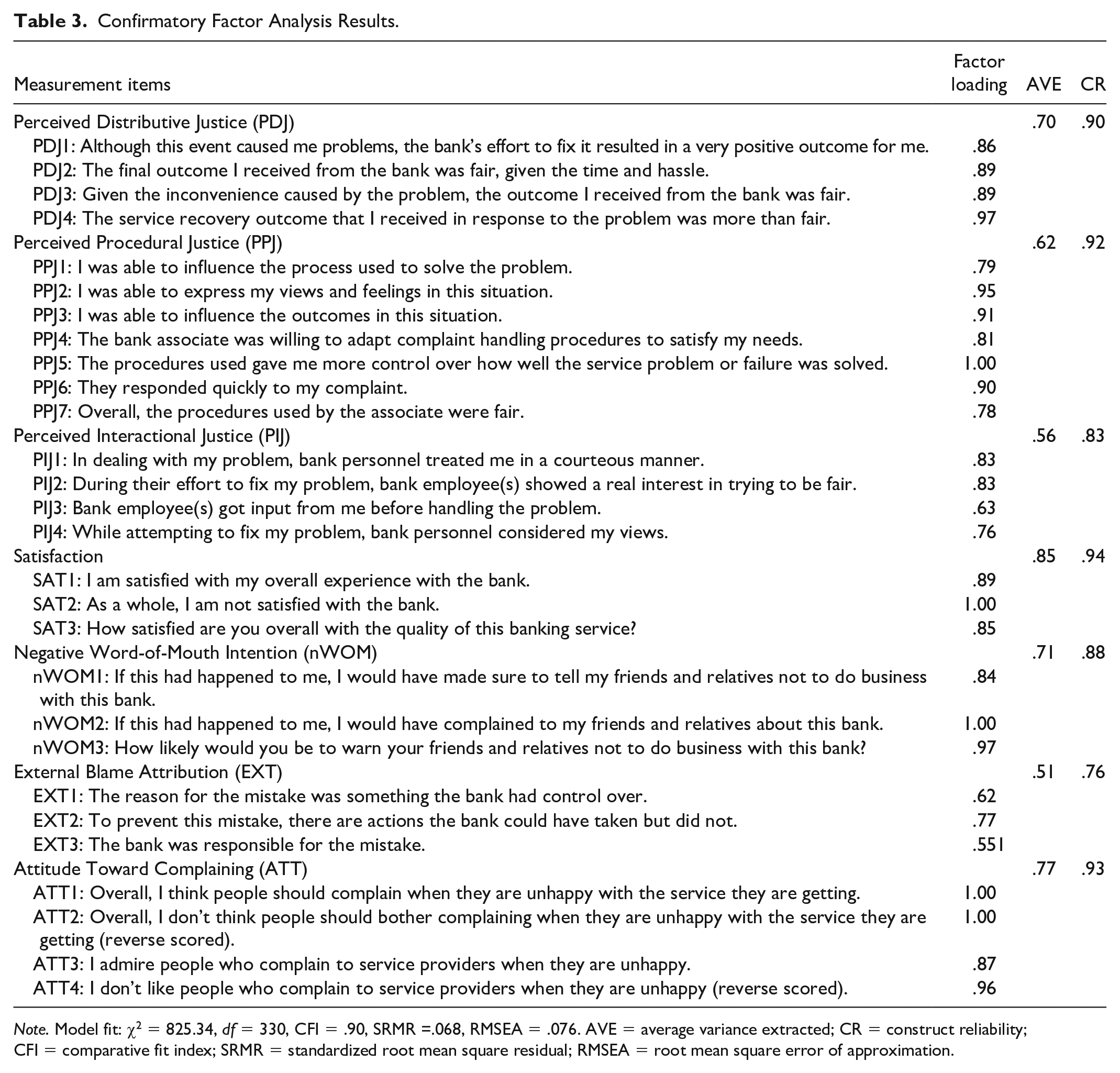
Note. Model fit: χ2 = 825.34, df = 330, CFI = .90, SRMR =.068, RMSEA = .076. AVE = average variance extracted; CR = construct reliability; CFI = comparative fit index; SRMR = standardized root mean square residual; RMSEA = root mean square error of approximation.
Convergent validity of construct was satisfactory with all factor loadings presenting as significant, greater than.7, except for one item of perceived interactional justice and two items of external blame attribution presenting loadings greater than.5, which exceeded minimum requirement as suggested by Hair et al. (2010). Construct reliability (CR) ranged from .76 (external blame attribution) to .94 (satisfaction), all above the recommended threshold. Average variance extracted (AVE) for all constructs exceeded .5, and discriminant validity provided evidence that each construct differed from the others. AVE of each construct was higher than square correlations between corresponding construct and all other constructs (Fornell & Larcker, 1981). Descriptive statistics, correlation, and discriminant validity of variables are shown in Table 4.
Descriptive Statistics, Correlation, and Discriminant Validity of Variables.

Note. The square roots of AVEs for each construct are presented in diagonal of correlation matrix with bolded text. The values in the lower diagonal present correlations between constructs. SD = standard deviation; PPJ = perceived procedural justice; PDJ = perceived distributive justice; PIJ = perceived interactional justice; SAT = satisfaction; nWOM = negative word-of-mouth intention; EXT = external blame attribution; ATT = attitude toward complaining.
Preliminary Analysis
One-way multivariate analysis of covariance (MANCOVA) was carried out with five dependent variables: perceived procedural justice, perceived interactional justice, perceived distributive justice, customer satisfaction, and negative word-of-mouth. The adjustment was performed for four covariates: external blame attribution, attitudes toward complaining, gender, and past experience with service failure. The independent variable comprised conditions of voice initiation: firm-initiated voice, customer-initiated voice, and no voice.
Prior to performing the main analysis, assumptions of MANCOVA were tested. The test showed that the data had a multivariate normal distribution unaffected by outliers (Tabachnick et al., 2007). The preliminary analysis suggested that external blame attribution and past experience did not significantly affect dependent variables, so these two covariates were dropped from the final model. The test of homogeneity of regression slope reported no significant interactions between complaint types and covariates on dependent variables, indicating that the effects of covariates on dependent variables were constant across groups. Thus, covariates were reliable for covariance analysis. Finally, Levene’s test for the homogeneity of variances of the dependent variables across voice initiation types revealed moderate violation (p > .02) for one dependent variable (negative word-of-mouth). However, MANCOVA is robust toward this violation when the proportions of group sizes do not exceed 1.5:1 (Hair et al., 2010). Therefore, the MANCOVA analysis proceeded.
MANCOVA Results
Based on preliminary analysis results, two control variables were retained for MANCOVA analysis. Attitudes toward complaining (Wilks’s λ = .76, F = 16.12, p < .001) and gender (Wilks’s λ = .96, F = 2.36, p = .04) significantly affected combined dependent variables. Table 5 shows the effects of the covariates and effects of voice initiation types on dependent variables.
Results of Multivariate and Univariate Analysis of Covariance.

Note. PPJ = perceived procedural justice; PDJ = perceived distributive justice; PIJ = perceived interactional justice; SAT = satisfaction; nWOM = negative word-of-mouth intention.
p < .05.
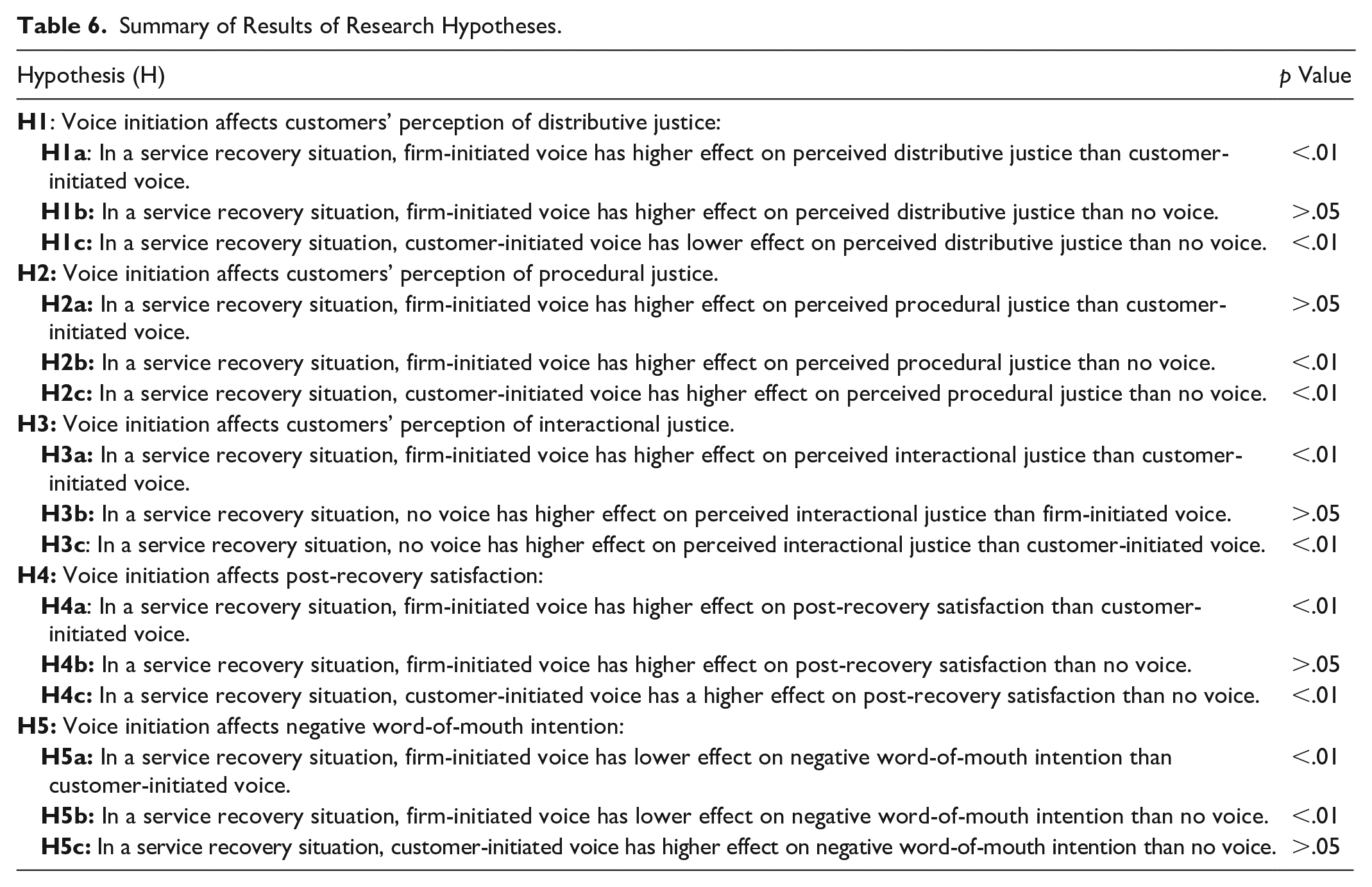
The results of MANCOVA revealed a significant effect of voice initiation types across the multiple dependent variables, that is, procedural justice, interactional justice, distributive justice, satisfaction, and negative word-of-mouth (Wilks’s λ = .60, F = 14.30, p < .001). As hypothesized, voice initiation types individually affected procedural justice (F = 26.43, p < .001), distributive justice (F = 15.33, p < .001), interactional justice (F = 13.88, p < .001), satisfaction (F = 10.19, p < .001), and negative word-of-mouth (F = 51.80, p < .001). Results of multivariate and univariate analyses are shown in Table 5. Table 6 provides an overview of the hypotheses evaluation, and a graphical depiction of the effects of the voice initiation across dependent variables is presented in Figure 2.
Summary of Results of Research Hypotheses.
Perceived distributive justice
The results of cell means examination indicated that customers in the firm-initiated voice group reported the highest levels of perceived distributive justice (M = 5.14), followed by the no voice group (M = 5.08) and customer-initiated voice group (M = 4.50). The results of the multiple comparison tests indicated that perceived distributive justice for customers in firm-initiated voice group and no voice group were significantly higher than that of customers in the customer-initiated voice group (p < .01). This provides support for H1a and 1c. However, there was no significant difference between firm-initiated voice group and no voice group (p > .05). Hence, H1b is not supported. The eta-squared statistic indicated that 10.80% of the variance in perceived distributive justice was explained by the voice initiation types, above and beyond the effects explained by the control variables.
Perceived procedural justice
An examination of cell means reveals that respondents in the customer-initiated voice group reported the highest levels of perceived procedural justice (M = 5.09), followed by those in the firm-initiated voice group (M = 5.06) and no voice group (M = 4.22). The results of the multiple comparison tests indicated that perceived procedural justice for customers in the firm-initiated voice group and customer-initiated voice group were significantly higher than customers in the no voice group (p < .01), providing support for H2b and 2c. However, there was no significant difference between the firm-initiated voice group and customer-initiated voice group (p > .05). Hence, H2a is not supported. The eta-squared statistic indicated that 17.3% of the variance in perceived procedural justice was explained by the voice initiation types, above and beyond the effects explained by the control variables.
Perceived interactional justice
The cell means examination results showed that respondents in the firm-initiated voice group reported the highest levels of perceived interactional justice (M = 5.07), followed by the no voice group (M = 4.84) and customer-initiated voice group (M = 4.43). The results of multiple comparison tests indicated that perceived interactional justice for customers in the firm-initiated voice group and no voice group were significantly higher than those of customers in the customer-initiated voice group (p < .01). This provides support for H3a and 3c. However, there was no significant difference between the firm-initiated voice group and no voice group (p > .05). Hence, H3b is not supported. The eta-squared statistic indicated that 9.90% of the variance in perceived interactional justice was explained by the voice initiation types, above and beyond the effects explained by the control variables.
Customer satisfaction
An examination of cell means reported that respondents in the firm-initiated voice group reported the highest levels of satisfaction (M = 4.92), followed by the no voice group (M = 4.84) and customer-initiated voice group (M = 4.31). The results of multiple comparison tests indicated that satisfaction for customers in the firm-initiated voice group and no voice group were significantly higher than customers in the customer-initiated voice group (p < .01), supporting H4a and 4c. However, there was no significant difference between the firm-initiated voice group and no voice group (p > .05). Hence, H4b is not supported. The eta-squared statistic indicated that 7.5% of the variance in satisfaction was explained by the voice initiation types, above and beyond the effects explained by the control variables.
Negative word-of-mouth intention
The cell means examination results revealed that respondents in the firm-initiated voice group reported the lowest levels of negative word-of-mouth intention (M = 2.88), followed by the no voice group (M = 4.02) and customer-initiated voice group (M = 4.19). The results of multiple comparison tests indicated that negative word-of-mouth intention for customers in the firm-initiated voice group was significantly lower than customers in the customer-initiated voice group and no voice group (p < .01). This result provides support for H5a and 5b. However, there was no significant difference between the customer-initiated voice group and no voice group (p > .05). Hence, there is no evidence to support H5c. The eta-squared statistic indicated that 29.10% of the variance in negative word-of-mouth intention was explained by the voice initiation types, above and beyond the effects explained by the control variables.

Plots of the estimated marginal means for each voice initiation condition in service recovery across dependent variables.
Overall, hypotheses testing results show that voice initiation condition predicts service recovery evaluations. Specifically, perceived distributive justice, perceived interactional justice, and satisfaction for customers in the firm-initiated voice group and no voice group were significantly higher than for customers in the customer-initiated voice group. However, there was no significant difference between the firm-initiated voice group and no voice group.
In addition, perceived procedural justice for customers in the firm-initiated voice group and customer-initiated voice group were significantly higher than for customers in the no voice group. However, there was no significant difference between the firm-initiated voice group and customer-initiated voice group. Finally, negative word-of-mouth intention for customers in the firm-initiated voice group was significantly lower than for customers in the customer-initiated voice group and no voice group. However, there was no evidence to support the difference between the customer-initiated voice group and no voice group.
Discussion and Implications
Discussion
Investigating the effects of managing customer voice on service recovery evaluation was the central focus in this study. Building on the concept of initiation, this study examines how service recovery evaluation varies depending on different voice initiation conditions. The results confirm that service recovery evaluations are affected by voiced initiation conditions. Specifically, service recovery based on firm-initiated voice can promote higher positive evaluations of perceived distributive justice, perceived interactional justice, satisfaction, and negative word-of-mouth intention compared with service recovery based on customer-initiated voice and service recovery based on no voice. As expected, service recovery based on customer-initiated voice results in highest perception of procedural justice.
The findings of this study are in line with the earlier studies on the role of initiation in service recovery evaluation (Patterson et al., 2006; Smith et al., 1999; Voorhees et al., 2006; Xu et al., 2014). This research supported that customers who experienced firm-initiated actions related to service recovery report higher service recovery evaluations. Specifically, the current study extends the concept of initiation to customer complaint and demonstrates that service recovery based on firm-initiated voice has higher effects on favorable recovery evaluations, that is, perceived justice, post-recovery satisfaction, and negative word-of-mouth than service recovery based on customer-initiated voice.
This study provides support for voice opportunity study. It is indicating that by having their voice in the service recovery process, customers perceived process control and control over the outcomes leading to a perception of procedural justice (Bellavance et al., 2013; Bies & Shapiro, 1988; Karande et al., 2007; Lind et al., 1990; Mody et al., 2020; Wei et al., 2019).
Voice initiation not only provides voice opportunity for customers but also requires less customer effort in service recovery. Based on the equity rule, this study is consistent with previous recovery studies suggesting that less input in the exchange brings about perception of distributive justice (Llosa et al., 2007). The findings supported research hypotheses positing that customers who received service recovery based on firm-initiated voice and no voice had higher perceived distributive justice than other customers who received service recovery based on customer-initiated voice. However, customers who experienced firm-initiated voice and no voice had a similar perception of distributive justice, indicating that both firm-initiated voice and firm-initiated recovery similarly affect customer perceived distributive justice.
In addition, this study confirmed that firm-initiated actions have an effect on customer perception of recovery efforts, which leads to perceived interactional justice and post-recovery satisfaction (Jin et al., 2020; Patterson et al., 2006; Smith et al., 1999; Wei et al., 2019; Xu et al., 2014). The present study also suggested that firm-initiated actions can decrease negative word-of-mouth intention. Furthermore, previous research suggested that negative word-of-mouth intention is higher for customers who have voiced (Halstead, 2002). The findings of this study extend previous knowledge by demonstrating that customers who have voiced based on firm initiation were less likely to spread negative word-of-mouth.
Theoretical Contributions
The current study makes some contributions to the literature on service recovery. First, it demonstrates that customers’ evaluations of service recovery can vary within different complaint initiators. Until now, most studies overwhelmingly focused on enhancing customer experience of service recovery, and the empirical research exploring service recovery is largely limited to service recovery based on customer-initiated complaint instead of various complaint initiators.
Second, this study contributes to the literature by shedding light on non-direct complaint behavior (Chebat et al., 2005; Koussaifi et al., 2020; Ro & Mattila, 2015; Voorhees et al., 2006). More specifically, this work extends the customer complaint literature by introducing the firm-initiated complaint approach as a means to motivate otherwise silent dissatisfied customers to complain before the service recovery is rendered. The results of an experiment indicated that when customers receive service recovery following their complaint solicited by the staff, as opposed to receiving service recovery without complaint, customers perceive higher justice, satisfaction, and lower negative word-of-mouth intention. But if the customer initiates such a complaint, deterioration on these outcomes is found as compared with a customer complaint initiated by the firm. Specifically, service recovery based on firm-initiated voice can result in the highest positive evaluations of perceived distributive justice, perceived interactional justice, satisfaction, and negative word-of-mouth intention. Meanwhile, service recovery based on customer-initiated voice leads to the highest perception of procedural justice.
Managerial Implications
The results of this study provide important takeaways for service managers. The findings suggest that firms benefit from inviting customers to give feedback following service encounters. Previous research indicated that offering voice opportunity for customers allows the service provider a chance to restore the customer–firm relationship and improve service quality (Kim et al., 2010; Koussaifi et al., 2020; Lovelock et al., 2001; Tax & Brown, 2012). The current study supports this notion by showing that offering customers a voice opportunity is an effective strategy to identify service problems, thereby leading to higher service recovery outcomes. Therefore, service firms should train frontline staff to offer customers an opportunity to provide feedback following service encounters.
In addition, the current study demonstrates that customers are more satisfied if service recovery is provided based on firm-initiated voice than customer-initiated voice. These findings suggest that frontline employees should seek customer voice and feedback after service encounters, instead of waiting until dissatisfied customers start to voice complaint (Koussaifi et al., 2020). In their intention to spread negative word-of-mouth, service providers should encourage customers to speak about their dissatisfying service experience. This is important, as their negative word-of-mouth intention is lower under this condition than when service recovery is provided without their feedback or when they raise the complaint independently. In addition, the appropriate service recovery can lead customers to consider revising word-of-mouth intention (Yoo, 2020).
Limitation and Future Research Directions
The current study contributes to service recovery literature; although acknowledging limitations, it can provide avenues for future study. First, this study collected data from undergraduate students. Although using student participants is consistent with prior studies on service recovery (e.g., Grewal et al., 2008; Lastner et al., 2016) and while many studies revealed that student participants have reported nonsignificant different results as compared with non-student participants (e.g., Martin et al., 2009), investigating non-student data would further enhance external validity. Second, the data were collected only from Thai respondents; this might impact the generalization of the results.
Third, because the present study uses a written-scenario experiment that allows for experimental control and elimination of confounding effects, it leaves out actual experiences. Future study using other approaches, such as a critical incident technique to recall customer behavior, would further increase generalizability. Fourth, according to the experimental design, participants in firm-initiated voice and customer-initiated voice were forced to share opinions. Hence, the results may slightly deviate from reality where some customers may not share opinions when facing service failure. Future research should consider grouping participants based on their voluntariness to voice complaint.
Fifth, this study examined customer complaint in the service failure context but did not explore emotional response resulting from a service failure situation. Bonifield and Cole (2007) pointed out that people make appraisals about service problems after a service failure, which in turn influence the way they respond emotionally. Future research should consider the effects of emotions in examining the effectiveness of a complaint initiation on evaluative outcomes.
Sixth, future study should consider exploring more service recovery outcomes based on different complaint initiation conditions. This study suggests that a firm-initiated complaint can improve customers’ perceived justice and satisfaction and reduce the chance of negative word-of-mouth. Further research should investigate how the complaint invitation can prevent a customer from voicing to a third party and switching service providers. Seventh, the online communication has become important in today’s business. It would be valuable to examine whether the effects of voice initiation hold with electronic word-of-mouth. Eighth, the current study found that gender moderates the effects of voice initiation conditions on post-recovery satisfaction and negative word-of-mouth. Future research should consider exploring whether the effects of voice initiation vary depending on different aspects, for example, age, gender, and emotional states.
Finally, while this research takes initial steps to demonstrate that the complaint initiator contributes to service recovery literature, more research that moves away from global customer complaint toward different complaint initiation conditions is required to more comprehensively understand how complaint initiation shapes service recovery outcomes.
Footnotes
Declaration of Conflicting Interests
The author(s) declared no potential conflicts of interest with respect to the research, authorship, and/or publication of this article.
Funding
The author(s) received no financial support for the research, authorship, and/or publication of this article.
