




Abstract
The development of firm employees may not be sufficient without simultaneous development of business founders’ intellectual capital because of the role business founders play in business strategy decisions and their increasing involvement in business operations. Prior studies seem to have ignored this important role of business founders in ascertaining the effects of human capital development in corporate performance by focusing solely on firm’s employees. This study proposed and tested human capital development from both business founders’ and employees’ perspective and determined how such simultaneous intellectual development can enhance firms’ productivity in garment industry in Nigeria. A survey research design method was employed and the data collected from 100 individuals who either owned or belonged to the top management team of Garment Industries in Nigeria was empirically tested using regression analysis. The result indicated that human capital development of business founders and employees positively affect firms’ productivity suggesting that firms that engage in simultaneous training of employees and founders performed better than those focusing solely on employees. Simultaneous training, educating, mentoring and learning capacity of both business founders and their employees can generate substantial returns to garment firms that can revitalize the industry while making them internationally competitive. The positive effect associated with simultaneous human capital development of founders and employees depends on good management efficiency as training the founders requires effective human development strategy. Generally, this effect suggests that human capital development should be given adequate attention and may not be value adding if business owners are not connected in the model of organizational human capital development.
Plain Language Summary
Human capital development is vital to corporate success. Firms have withstood adverse situations because of the quality of their staff. However, it is not enough to develop only employees of corporate organization. The business owners are increasingly playing key roles in organizational management. Thus, human capital development activities should include the business owners. This study examines how training and developing both employees and employers could affect the performance of garment firms in Nigeria. A survey research design method was employed and the data was collected from 100 individuals who either owned/belonged to the top management team of Garment Industries in Nigeria. We empirically tested the data we obtained using regression analysis. We found that training and mentoring both business owners and their employees enhanced firms’ productivity. By implication, garment industry in Nigeria would be much more efficient and productive if they engage in the simultaneous training and development the principals and the agents. Our findings have implication for managerial decision. Firms should not focus on employees’ development only. Emphasis should be placed on including the business owners especially when ownership is not totally divorced from control. However, our study was limited in scope. As such, we recommend multi-industry study.
Keywords
Introduction
The contemporary era of technology and multiculturalism with ever changing environment, developing creativity and innovation as a unique quality in workplace is becoming a conventional direction for organizations (Nasifoglu Elidemir et al., 2020). The process of business organizations in this era is rapidly changing, employees and business owners’ expectations are shifting and also their participation in value formation procedure of the organization as a result of environmental volatility. With these environmental dynamisms comes a frightening rate of economic and increasingly ferocious competition, which demands human capital capabilities development as a basis for organizational sustainability (Nasifoglu Elidemir et al., 2020).
Several researches show that human capital development affects organizations performance. Studies on the role of human capital development on firms’ performance majorly focused on employee intellectual advancement as a human capital development (Tran & Vo, 2020). While such studies are contributing, it does seem, however, that the human capital construct has not been adequately captured. Those studies ignored the founder intellectual capital development in the human capital development model. Human capital was thus viewed from only employee perspective (Elnaga & Imran, 2013). The increasing role of business founders in the business operation and the important role they play in business strategic development suggest that their intellectual capital should not be ignored.
This present study views human capital development from employees and business owners’ perspective (Bruderl et al., 1992). Human capital development should be considered beyond the employees. As founders contribute financial capital toward the development of the organization, they can also contribute their intellectual capital. Developing such capital could leverage firms’ financial performance. On the other hand, organizations’ stock of capital is beyond financial capital contribution of business owners; it encompasses both employees and business owners’ intellectual contributions. In a weak industry like garment companies, performance level would most likely change if both founders and employees pool their enhanced intellectual resources together. Thus, our study would explore the role of founder-employee capital development in shaping Nigerian moribund garment, textile and fashion industry as revitalization strategy.
Generally, human capital development is vital part of business organization that can influence firms’ operational performance. The high-performance of a firm absorbs effective management of its human capital. Human capital development can be achieved in the course of tutoring, further education, leadership training, mentoring, learning, qualities assessments, psychometric teaching, and workshops (Kucharčíková & Mičiak, 2018; Ogujiuba, 2013). In an economy driven by technology advancement, rapid development and the spread of inventive technologies means that in order to continue with the trend and remain sustainable, people must co-evolve, that is, build up the skills, values and perspectives showing that understanding of these technological requirements is evident. The ever-rising automation of low-skilled jobs and increasing reliance on high-skilled jobs in rapidly changing technologies, the jobs of the stagnant, underdeveloped people will all be gone forever. Therefore, human capital needs a high level nurturing, development and control mechanisms, due to its dynamism and complexity (Ehnert et al., 2014; Halidu, 2015; Jena & Pradhan, 2017).
Human capital development of business owners could be of immense profit to the organization survival in the sense that it is long lasting asset of the firm which does not suffer from subsequent withdrawal commonly seen with employee as a result of job mobility. That notwithstanding, there could be problem in a situation whereby ownership is separated from control in which business owners only contribute their financial capital but everyday management of the operation is committed to the employees of the organization. In such case, in order to mitigate this problem there may be need to equally develop human capital from employees’ perspective, whereby the employees are given adequate training, education, mentoring and exposure to learning activities that will improve their human intellectual capital and, in turn, enhance organizational performance.
Nigeria garment, textile and fashion industry has been badly affected by different factors ranging from corruption, mismanagement, lack of strategic direction to poor human capital development. This industry requires strategic renewal for effective revitalization of its business operation. There is need for adequate reorganization of this industry focusing on simultaneous human capital development of the business owners and employees leading to the new products and technologies combination (Guth & Ginsberg, 1990; Zahra, 1996). And the rising failure of these firms has thus required the authority to review their operational models in terms of human capital development combinations. Funds have been pumped into the sector over the years as a financial capital. Yet, survival has remained a fantasy suggesting that financing may not constitute a major factor to the growth of the sector. Thus, as financial capital seems not to be a success factor, it becomes necessary to examine how the garment and fashion firms’ owners and employees’ contribution to intellectual capital development can drive their performance. Therefore, this study views the problem of Nigerian Garment and Textile industry from the perspective of human capital theory. Our interest in this study is human capital development.
Regardless of the increasing research dealing with human capital development and performance, there is relatively promising stream of investigation that considers both employees and owners human capital development performance effect pertaining to human capital in business organization (Li & Hsu, 2016a, 2016b; Bäckström & Bengtsson, 2019). Several studies focus on human capital development and the organizations performance relationship, but were based on only employee perspective (Li & Hsu, 2016a, 2016b, Danaei & Farzaneh, 2016). Moreover, although research has consistently examined the result of human capital development on firms’ performance in Nigeria, there are few studies that focused on garment, textile and fashion industry. Philip and Ikechukwu (2018) examined the impact of human capital development on employee performance in oil services firms’ in River state Nigeria. They found that the employee training was positively associated with their performance. However the study did not connect business owners’ human capital development effect on performance. Also, it did not focus on textile, garment and fashion industry in Nigeria. Chigozie et al. (2018) focused on the outcome of human capital development on the performance of manufacturing firms in South-east Nigeria. The study found that skill and knowledge of employee positively affected firms’ performance. However, the study did not also examine human capital development from business owners’ perspectives. Thus, it was not clear in the study how employees and business owners’ development can affect organizational performance.
This study extends the human capital development and organizational performance body of knowledge in the following dimensions. First, researchers have converse that increasing and executing human resources management practices are significant (Sanders & Lin, 2016) and enhance employees’ capabilities, skills and creative work behaviors. Extant literatures in this dimension were principally carried out in higher educational institutions, hospitality services, manufacturing and healthcare firms in Nigeria. Even with their remarkable results, these studies fell within the conclusions of recent methodical reviews, stressing that scholars adjudge human capital development majorly only on employees’ perspective. In disparity to these studies, our study represents human capital development from both employees and business owners’ development perspectives and organizational performance.
The other parts of the paper are organized as follows. Section 2 deals with theoretical review. Section 3 deals with hypotheses development. In Section 4, research methods were discussed while results and discussion are done in Section 5.
Theoretical Review
The prevailing theoretical findings are got from related literature and the theory explained in this section is human capital theory.
Human Capital Theory
The term Human Capital Theory (HCT) was initiated by Schultz (1961) who detailed his concept in 1981 and it is suggested that individual and society derive economic benefits from investment in people. Human capital theory was also discovered in the work of Mincer (1958), G. S. Becker (1964), and Barro (1991), Mincer (1958) developed the theory of investing in education as a way to add value to humanity. This was then based on Schultz (1961) and G. S. Becker (1964) as they promoted education or training as a useful tool for imparting knowledge and skills to employees. The concept of human capital is linked to the broader concept of intellectual capital, which is reflected in the accumulation and increase of knowledge available to the organization. These can similarly be viewed as the indefinable assets associated with individuals who along with material assets contain the complete worth of the business (Bontis, 1998). The extra worth that individuals can add to an organization is featured by human resources theory. It considers individuals as assets and emphasizes that significant investments in individuals through an organization will bring significant returns. Human resource theory is linked to the concept of asset base perspective in organizations as developed by Barney (1991). This recommends that the potential competitive advantage is achieved when a company has a set of human resources that can be doubled or acquired by its competitors. Boxall (1996) views this as an advantage over employees. In any case, he equally recognizes human resources bit of flexibility and human process advantage. The previous outcomes from procuring individuals with seriously important skills and aptitudes, individuals with extraordinary ability to pick up advantage while human process advantage, conversely, trails from the foundation of hard to emulate, extremely advanced procedures inside the firm, for instance cross-departmental participation and leader improvement. Consequently, human capital advantage, the dominance of one firm’s labor management above another can be considered as the result of its human capital and human process advantage.
The universal idea of the human capital theory is that the intellectual capital of business owner enhances firm’s chances of survival and revitalization (Bruderl et al., 1992). Thus, a business owner experience can change corporate organizations from low-performance firms to capable conglomerate. This means that companies could engage the stock of founder experience and intellectual capability to revitalize dying firms. The joint empowering, improving, training and developing of employee and business owners’ intellectual capital can play a fundamental role in business administration as they expose everybody in the organization to modernize way of doing business. Such human capital development strategy can also readily equip them with necessary capabilities and skills to mitigate the change as a result of globalization. And this could allow a firm to decide a direction of action and ascertain how to achieve the firm goals.
However, Kadiresan et al. (2015) and Longoni and Cagliano (2016) see human capital development as a component of human resource management that makes available a learning opportunity for superior growth, productivity and high-performance in organizations. Human capital development is enhanced by organization learning orientation, whereby people in the organization are committed to learning, open-minded, intra-organizational knowledge sharing, innovativeness and vision sharing (Sinkula et al., 1997). The proactive organization regards learning as a significant venture that is central for continued existence and most importantly, organization commitment to human capital development is linked with enduring strategic direction. Short-range investment will yield enduring gains (Calantone et al., 2002). For instance, a committed organization expects everyone in the organization to use company time to seek knowledge beyond the current environment of their work (Slater & Narver, 1994). If firm refuses to encourage the improvement of knowledge, capabilities and skills by the act of business owners’ lackadaisical behavior to intellectual capital development, the employees may not be motivated to seek after learning behaviors; thereby hindering high-performance.
Generally, human capital theory is extensively centered on the understanding and experience of small-scale business proprietors (Frese & Rauch, 2001). Nevertheless, the theory can be applied to large business owners because of the growing role shareholders play in the management of corporate organizations. The universal assumption of the human capital theory is that the intellectual capital of the business owners develops firm’s likelihood of survival and revitalization (Bruderl et al., 1992). Consequently, a business owner experience can transform distressed organizations to promising corporations. This means that corporations could engage the stock of business owners’ experience and knowledge to revitalize dying firms. A product innovation due to owners’ intellectual capital contribution can lead a firm to achieve a competitive advantage in an industry, which could, in turn, translate into higher market shares. In addition, owner experience and length of education can enable innovation product commercialization, which could translate into company higher profitability, when such products are sold competitively by means of efficient pricing policies. However, for any organization to acquire higher level of intellectual capital that will impact the firms’ performance and enhance transformation the human capital development and consistent knowledge management must occur (Bruderl et al., 1992; Cooper et al., 1988; Gimeno et al., 1997).
Furthermore, human capital development advocates frequent exposure of the business owners and firms’ employees to substantial trainings that will enhance their innovative capability. Since the human capital theory has to do with knowledge and capacities, it entails procedures that can train and improve human capital. This shows that human capacity development is expected to be a long lasting experience from diverse sources. It will be regarded as blunder if business owners should limit their experience to the present sectors of their business while also failing to expand their academic knowledge base. Business organization is going global, conglomerate and competitive, thus requiring experience from diverse sectors to withstand competitive pressure and mitigate being crowded out. In this case, business owners and employees’ intellectual capital should not be limited to a first degree academic exposure; multiple knowledge bases could be a better sustainable tool.
Human capital development involves mentoring. Szabó et al. (2019) see mentoring as a tool that can create value that enhances human performance. It has the same connotation with training, which overall involves process usually aimed at giving a supportive approach to changing and developing a participant process focus on the future goal most encouraged to be achieved (Szabó et al., 2019). Human capital development should be put into operation through a variety of Human Resources Management processes, with training activities, aimed at developing long-term capacities, for steady sustainable performance according to Savanevičienė and Stankevičiūtė (2017) Other researchers such as Smith (2001), Morley et al. (2016) found that training increase productivity and ultimately increase organizational performance articulated by service value, efficiency, effectiveness and rate of novelties. Essentially, training is connected to firm survival and success (Bates, 1990) and better penchant to higher performance (Goetz & Hu, 1996; Savanevičienė & Stankevičiūtė, 2017; Szabó et al., 2019).Training and development of organizations workers signifies very important and fundamental functions of HR, which is the source of sustaining change in employee ethics and knowledge. With the new knowledge, skills and abilities acquisition, employees are more likely to be more productive and get better results (Antonietti, 2016; De Grip & Sauermann, 2013; Slavić & Berber, 2019). Thus, it also aims at providing individual leadership and instruction that enhance knowledge, skills and performance (Szabó et al., 2019).
W. Lin et al. (2016) stresses that superior levels of instruction afford employees with better insight vis-à-vis how to situate occupation goals, structure occupation goals in the perspective of existing managerial demands and control, as well as how to realize these goals. Mentoring of the employees by the supervisor facilitates personal growth and career advancement, raises employee desires, provides motivation and positively affects employee work attitudes, goal-oriented and self-control, indicating that training plays a significant role in aligning employee and organizational goals. Generally, Human resource development (HCD) is an important step toward supporting and sustaining socio-economic growth. The learning and training program is a major platform for HCD intervention. In order to develop and achieve goals, long-term survival, competitive advantage, and sustainability, employees are developed with full HCD involvement to provide the necessary knowledge and skills to work successfully in a fast changing and multifaceted environment (Azizan et al., 2021).
Another important aspect of human capital development strategies is learning. Reynolds et al. (2002) see learning as the process by which new knowledge, skills and abilities are developed by people. As a human capital development tool, learning motivation uses a process model, which is about simplifying individual learning activities and providing learning resources for them to use. Learning takes place when individuals can show that they know what they did not know before and when they can do something they could not do before. Learning is a continuous process that not only develops existing skills but also leads to the development of skills, knowledge, and attitudes that prepare people for greater achievements and responsibilities in the future. Sloman (2003) distinguished between learning within an individual domain and training within an organizational domain. The approach is to focus on individual learning and making sure that it takes place when required just-for-you and just–in-time learning.
Organizational learning theory is concerned about how learning happens in an organization. It focuses on shared learning but considers the proposition made by Argyris (1992) that an organization does not perform an action that generates learning, each of its members behaves in a way that leads to, although, organization can create a situation which aid in such learning. Organizational learning can be seen as a complex three-phase process that combines information acquisition, dissemination and shared implementation (Dale, 1994). Knowledge can be gleaned from specific experiences, the experience of others, or the memory of an organization.
Owners of businesses are good at giving their workers mental training. A firm with adequate manpower and developmental mental capacities is bound to succeed in the business world. Workers who receive good training and are committed to duties tend to be productive and speedy in managing certain complex assignments without any inspection. Development of mental capacity is a sure way of enhancing workers’ intellectual ability. Such training enables an employee to adapt to new knowledge thereby sharpening his or her memory and inner perceptions of ideas. Learning is enhanced when internal and external factors play a vital role on a person’s psychological processes as is evident in the theory of cognitive learning, Jerome Bruner focused on how mental processes are linked to pedagogical activities while Jean Piaget a believer in environmental influences focused on the changes that occurred in the structure of the inner mind.
Hypotheses Development
Training and Organizational Performance
Extant research studies from both explanatory and dogmatic studies, centering on numerous distinctiveness of preparation programs just as their expenses and advantages for business organizations (B. Becker & Gerhart, 1996). Accordingly, business organizations have come to better comprehension of the importance of training and development for their feasible advancement in knowledge-intensive and unstable business environment of this contemporary time, and consequently have progressively valued the productivity of building up their human resources through different types of training programs (Salas & Cannon-Bowers, 2001). Training involves adequate use of effective guidelines to disseminate information, and knowledge required for effectiveness in carrying out the assigned task in an organization (CIPM, 2018; Falola et al., 2018). Human capital resource of any organization plays a vital role, hence training and retraining helps in stimulating business owners and employees for an enhanced capacity (Khan et al., 2011). Training of human capital provides employees with adequate knowledge, skills development, and learning that encourage employee incomparable tacit, unique human capital that bring development of potential innovative competence, and thus inventive work output (Chowhan, 2016). The human capital theory has witnessed a rapid development in such that greater concentration has been on training related aspects. Human capital development is any deed which develops the quality of the workforce. Consequently, training is a vital part of human capital development. Several extant literatures show the significance of employee training to organizational productivity. Seleim et al. (2007) established that the human capital development had a positive connection on organizational performances. Also, was upheld by Dooley (2000) who recognized a critical positive connection between the nature of developers and volume of market shares. Bontis and Fitz-enz (2002) recognized the resultant effects of human capital management and set up the connection between human capital management, economic and business results. Smith (2001) found that training increase productivity and ultimately increase organizational performance. Elnaga and Imran (2013) build up that training is one of the most critical and reliable human asset methods to improve firms and workers effectiveness. This shows that lack of workforce training is related to low performance (Green, 1993). Better human resources stock is associated with high profitability and strategic footings (Mincer, 1997). Essentially, training is connected to firm survival and success (Bates, 1990) and better penchant to higher performance (Goetz & Hu, 1996). To this end, investment in training of both business founders and employees is an enviable way of developing human capital of any organization and in turn achieves organizational objectives. Training hence can be clarified as a planned and systematic effort by organization leaders pointed toward adjusting conduct of labor force toward achievement of organizational goals. Based on this crucial connection between training and organizational performance, we state the following proposition:
Learning and Organizational Performance
Learning represents the method an organization assumes in ensuring that presently and in future time, learning and development activities sustain the attainment of its goals by enhancing the skills and capabilities of individuals and teams. Learning could be seen as organizational assets which focus on the overall ability to learn, adjust, innovates, and constantly developing the capability of the organizational workforce. Asiyai (2013) posit that learning is the way business owners and their employees are able to discover, understand and use knowledge. Business owners and employees learning ability is of great significant to business organization for the reason that it is the foundation of developing operational competence, inspiring creativity and growing organizational awareness (Adelowokan, 2012). Bontis and Serenko (2007) assert that this awareness is fundamentally focuses on the extent to which innovation, training, and development, value, support and systems influence workforce capabilities. Any organization void of learning is bound to go on extinction because there can be no capacity development. Only learned business owners and employees are the better performer (Bontis and Serenko (2007). The learning openness impacts a person’s desire for vocation achievement which thus impacts person’s convictions about his capacity and eventually prompts profession choice, objective accomplishment of high-performance (Sosik et al., 2004). The goal of learning is for founders and employees to absorb the culture, attitude, knowledge, behaviors and skill highlighted in learning programs and to relate them to their real-life dealings. Cooke and Meyer (2007) associate the workforce productivity to the workplace where employees undertake learning of skills and improving their competence. The business founders have to promote learning by offer demanding assignments, stimulating the employees as well serve as role model, coaching for vocational skills, build up the workforce identity, assist workforce to set profession goals and assist them to accomplish balance in their work-life (Scandura & Pellegrini, 2007).
The idea of organizational learning arose within the system of learning abilities which was seen as to catch the errors and fixing it process, to transform the organization’s knowledge base and values in order to engender new critical thinking aptitudes and a new competence for action (Argyris & Schön, 1996; Daft & Weick, 1984; Probst & Büchel, 1997). Senge (1990) describes learning organization as organization in which people constantly build up their capability to realize their desired results, novel models of idea are nurtured, joint aspiration are not tied up and people discover collaborative learning. Rebelo and Duarte Gomes (2011) equally identify learning as a procedure or capacity in an organization which allows it to get right of entry and modify organizational memory consequently giving guidelines for managerial action (H. Lin, 2008). Even though a study found that learning organization constantly explore on how to capture learned thoughts to perform always (Alipour et al., 2011). Norliya Ahmad and Nor (2007) suggested that a fundamental element of building a knowledge organization is collaborative learning. Furthermore, Hussein et al. (2006) also discover that learning facilitate and enhanced organization’s competitive advantage and sensitivity to change, then igniting curiosity to increase organizations that encourage and advance knowledge. Therefore we hypothesize that:
Education and Organizational Performance
The major key factor of human capital theory is Education base on the fact it serves as a means of increasing understanding and ability and because level of education is a way of measuring the worth of business founders and their employees. Many research studies around the human asset development and education is found on Mincer’s human capital earnings role, which envisages that compensations are a function of educational achievement and work practice. Human capital theory holds that the goal attainment of an organization is a capacity not just of the conventional supplies of financial capital, work and normal assets yet additionally of the information and abilities of people. This hypothesis visualize that improved information and aptitude will yield improved monetary outcomes for the two people and social orders, particularly in this contemporary social orders, where it is universally held that information and expertise pass on a more prominent financial and social premium than previously.
The connection between education and human capital development is a popular phenomenal in literature, the link factor between education and high performance is the knowledge and skills it produces in the labor-force (Brown, 2014). Education empowers individuals to have clear understanding of themselves and the relationship with the environment Education is one of the conclusive components in the existence changes, equivalent chance and advancement. It is the most impressive instrument for creating and engaging both the entrepreneurs and workers to ace their social and social climate and make progress toward survival. It has been contended that without a well prepared, all around developed, very much valued, and very well managed HR, most firms can’t address the difficulties of progress, development and innovation headway in the globe. Education upgrades enhance people’s knowledge from networks that help improve both their intra-relationship and interrelationship inside and outside the organization framework. Ranis and Stewart (2010) posit that human resources improvement is exceptionally essential and should be appropriately tended to by the ventures that need to stay informed concerning worldwide challenges.
Researchers have amicably concurred that education is the most powerful instrument for the general improvement of human resources of any country who thus prompts high profitability (Abolade et al., 2011). Human resources efficiency will be an illusion without utilitarian instruction; thus Van Den Berg (2001) believed that nations that are at the bleeding edge of mechanical progression similarly have the most taught populace. This supposition that is likely borne out of the view that the reason for quality education is to make unequivocal contemplations that achieves the improvement of new innovations and new techniques for creation in accordance with the new clients desires. Taught individuals had more abilities and can play out their positions viably. In view of this pivotal connection between education of entrepreneurs and their representatives and organizational productivity, we express the following hypothesis:
Mentoring and Organizational Performance
Mentoring is referred to human capital development tool that involves transferring of skills and knowledge needed in the organization. It is the way in which talents of an individual can be realized and cultivated (Osibanjo et al., 2020). Lisa (2011) argues that employee development through mentoring process guarantees that a mentor transfers skills and knowledge to the mentee(s) via formal or informal programs to ensure development of employees’ performance. Thomas (2011) opined that the experienced staff is expected to promote relationship with inexperience staff that will enhance passing of knowledge and skills. Mentoring is one of human capital development tools used for future capable workforce preparation and is also used to build up organizational competence, astuteness, develop organization knowledge, and uphold the organization competitive advantage (Adeyemi, 2011). Moreover, mentoring could be viewed as formal or informal dealing where more experienced staff share their aptitudes and encounters about business with the less experienced workers to accomplish organizational objectives goals as well as goal of the labor force. In this situation a mentor ought to have comprehensive perceptive and knowledge about the organization or the business and can help or guide others in the work environment (Dessler, 2011). Firms need efficient managers and employees to attain its set goals and cannot prevail without their work force endeavors and better performance. Strategies for building up the abilities of workers are a significant piece of any association’s general strategy. Organizations need to mentor their workforce, enthuse them, and give them maximum support to constantly develop their performance. Therefore, mentoring is an act of facilitating individual and specialized development of an individual through collective exchange of understanding and insight that have been learned both within and outside the organizational environment. Mentoring is consequently a cycle in which develop and more experienced directors share their intelligence and involvement with the inexperience workers on a one on one premise. Bandura (1986) clarifies that conduct, perception and individual components communicate to deliver the ideal conduct. The mentoring connection is subsequently an impression of how perception, impersonation and distinguishing proof of the guide by the protégé are coordinated expertly to achieve an adjustment in disposition, standpoint and qualities in the protégé. We therefore, hypothesize as follows:
Research Method
This study adopted a survey research method. The variables set out for measurement were only properly constructed around the responses rendered subjectively by the respondents poised to give their opinions. Our targets were those individuals who either owned or belonged to the top management team of the firm. This was very important to us because issues of strategy and the process of making one were more of a top-level activity. We also made sure that all firms participating in this exercise were from the same industrial cluster. For ease of definition and access, we used the firms that belonged to the garment, textile, and fashion manufacturing cluster. We actually applied judgmental sampling technique but reach out to firms across a large geographical spectrum. In all we distributed this questionnaire instrument through e-mail as the research was done during world pandemic-COVID 19. The judgmental choice was as regards manufacturing events, but the number of firms we selected were all the firms from garments, textile and fashion industries, and the numbers of respondents were those that either owned or belonged to the top management. Our definition of top management was in a snowballing nature, where we had to ask a third party employee to confirm that the individual we approached actually belonged to the said category. The test instrument was validated with content methods whereby questionnaire was tested by presenting it to the expert and competence of academic professors, in order to express their opinion regarding the construct, content, clarity and coherence of the questionnaire and their validity to collect data on study. The remarks and suggestion of the arbitrators were considered; the instrument of the study was validated for measuring what it was designed for. To establish the reliability of the questionnaire, it was sent to all garments and textile firms’ founders and managers. The questionnaire was filled out by the research community two times within the space of 20 days. And after the said questionnaire had been filled out, the reliability of the questionnaire was established using Cronbach’s alpha method of reliability. The results indicate a score of 0.91, which showed that the test instrument is above the recommended reliability of 0.70, thus signifying high reliability and validity. It should be added that there were individuals who declined to respond, but of those that did, we were able to get 50 firms, and 100 respondents indicating one founder and one top management manager from each of the firms.
For the instruments we used in this survey exercise, we had an instrument with 19 question items, which addressed the questions raised on employees and business founders’ capital development. These items measured the size of the firm, which was a control variable that targeted the number of employees as well as organizational age.
Conclusively, all constructs in the model were estimated with different item scales. Generally, well-validated measures reported in previous study were used. Each one of the variables was considered by a five-point Likert-type scale, varying from 1 (Strong Disagree) to 5 (Strongly Agree). Most items were gotten from the extant literature. Training was measured using five items from Galanou and Priporas (2009). Learning was measured using five items from Galer and van der Heijden (1992) and Sinkula et al. (1997). Education and Mentoring were measured using five items generated from field research. Firm performance was measured by organizational productivity.
Model Specification
We use the following model to test our hypotheses,

where Y represent dependent variable (productivity) α is constant, βs are coefficient of regression, T is training, Lg represents learning, Ed represents education, Mg represents mentoring, age represents firms age, size represents firm size and
Ti = training that constitutes the following variables: TQ1, TQ2, TQ3, and TQ4
TQ1 represents questions on on-the-job training for both the founders and employee, TQ2 represents question on research on the movement of technology relevant to the way firms business operates, TQ3 represents question on necessity of training for guarantee organizational survival and, TQ4 represents question on how training helps the management in identifying, analyzing, forecasting and planning changes needed in the organization.
Lgi = learning that constitutes the following variables: LQ1, LQ2, LQ3, and LQ4
LQ1 represents questions on organization’s capability to learn as the key survival tool, LQ2 represents question on learning as the key to the improvement of firms, LQ3 represents question on organization investment on learning and, LQ4 represents question on founders and employees participation in courses and informal learning.
Edi = education that constitutes the following variables EQ1, EQ2, EQ3, and EQ4
EQ1 represents questions on encouragement to go for further studies, EQ2, represents question on education about the business environment, EQ3 represents question on enriching and growth oriented educational programs and, EQ4 represents question on Career advancement of founders and employees
Mgi = mentoring that constitutes the following variables: MQ1, MQ2, MQ3, and MQ4
MQ1 represents questions on Mentorship relationship between managers and founder, MQ2 represents question on mentorship as a tool for professionalism development, MQ3 represents question on organizational supports for mentorship program, and MQ4 represents question on skills transfer from experience to inexperience personnel.
The final model is

Results and Discussion
Scale Reliability Test Results
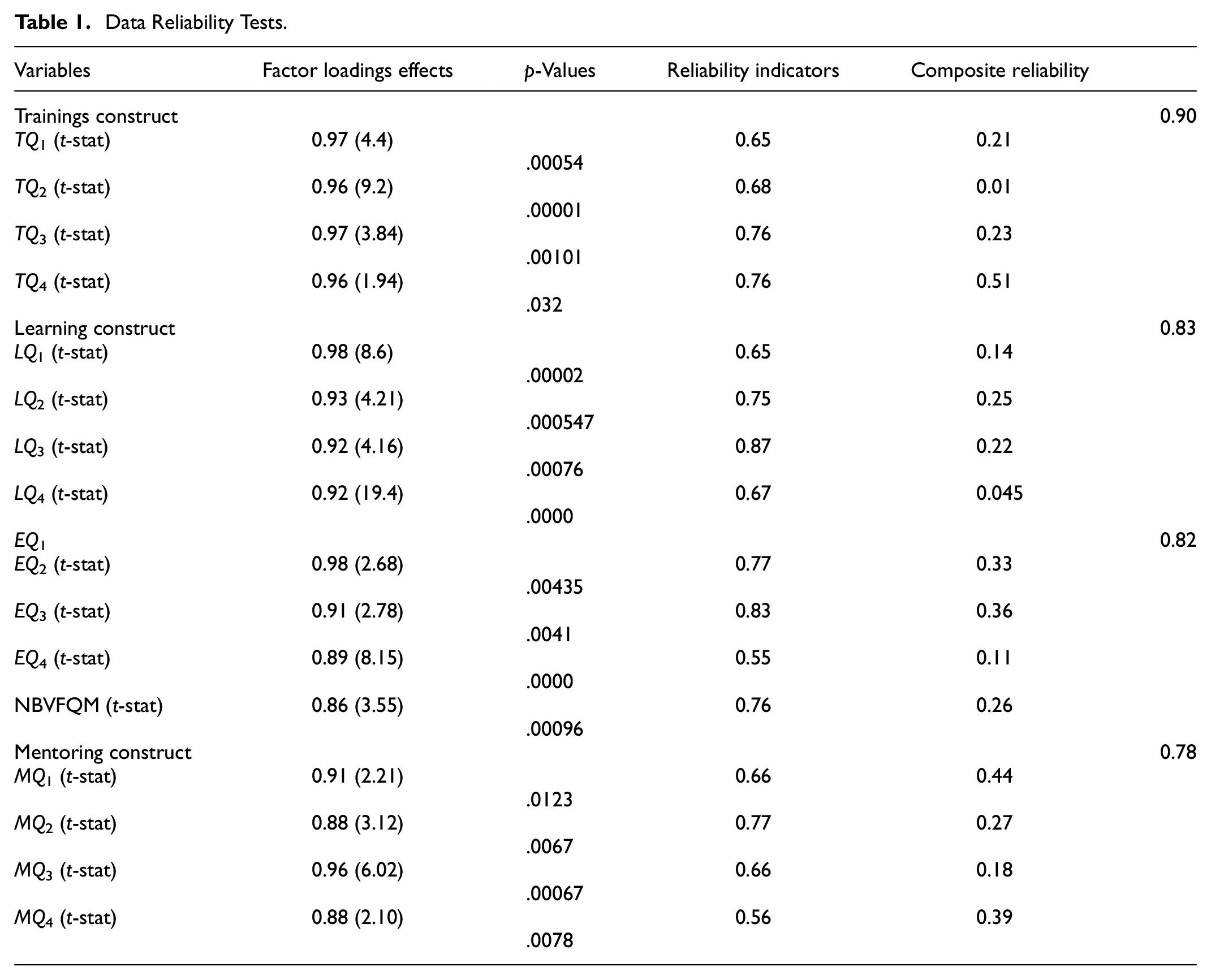
In Table 1 below, we show the result of data reliability test. We used SPSSAMOS for a one-dimensionality test of all data quantified in scales using a confirmatory factor analysis (CFA). Based on the analysis, we confirmed the negativity of the normalities of the model data. Likewise, the asymptotic covariance matrix failed to converge (Ylinen & Gullkvist, 2014). The study also displayed the composite reliability indicators, which helped us to determine the convergence between a set employee-employer dimensions and performance effects of the garment sectors (Ambad & Abdul Wahab, 2017). In determination of this, we calculated the factor loading of each human development items. Our estimation achieved statistically significant factor loading. The factor loading for all exceeded 0.7 for the composite reliabilities. For the latent variables, the reliability factors are above 0.5. This indicated higher data reliability. According to research, composite reliability value of 0.7 is higher than the expected minimum value of 0.4 (Bagozzi & Yi, 1988). We can now show that the CFA produced the results that are reliable and admissible results for decision making.
Data Reliability Tests.
Descriptive Statistics
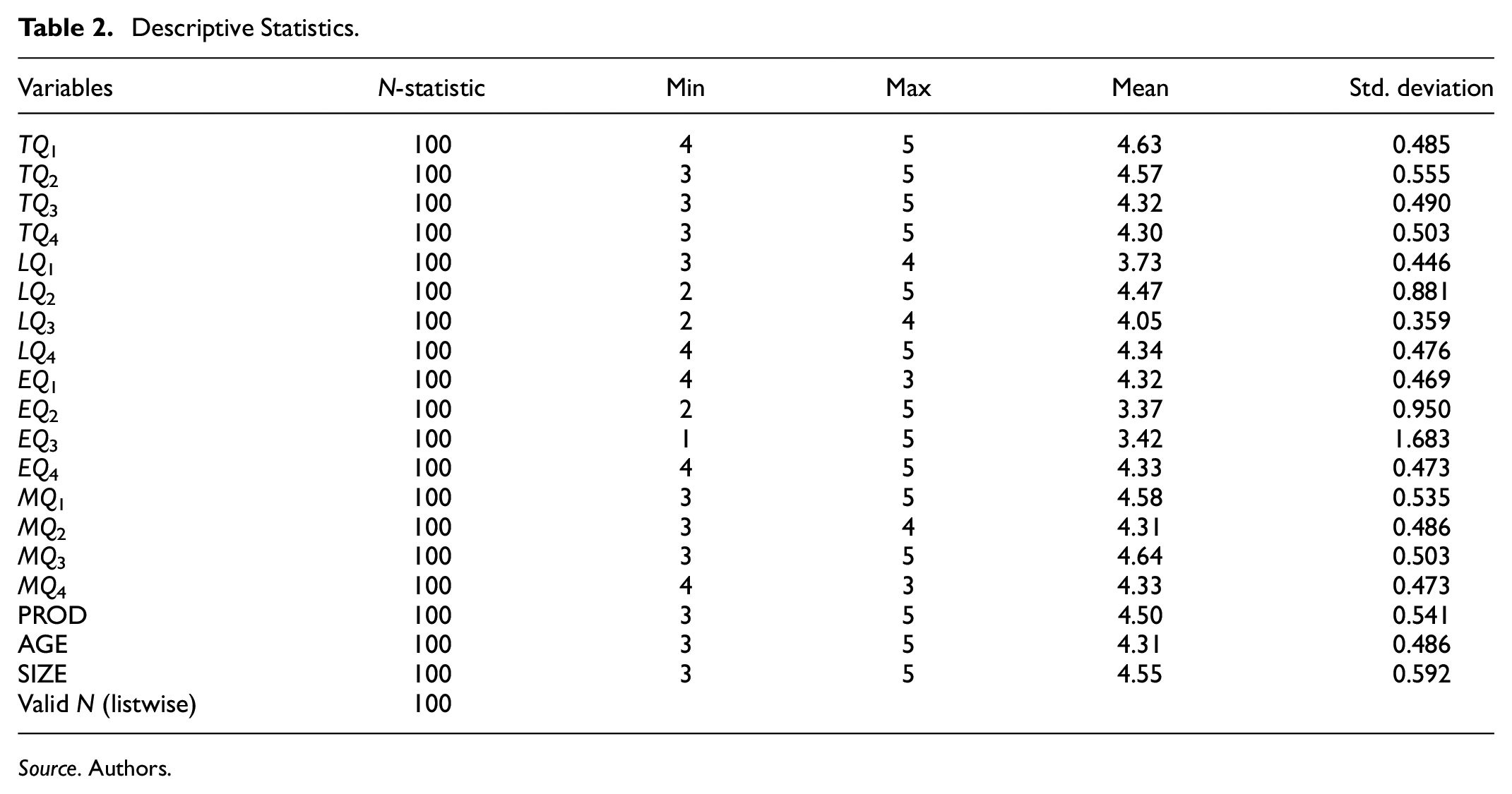
Table 2 below shows that the standard deviations (SD) of the variables in Table 1 are not >1. The disparity among the minimum and maximum values shows that the data used are not fixed and therefore, are appropriate for regression analysis.
Descriptive Statistics.
Source. Authors.
The correlation as revealed in Table 2 between independent variables is insignificant, which proposes that multi-collinearity is not a concern that could influence the outcome of the regression analysis.
Interpretation of Key Regression Statistics
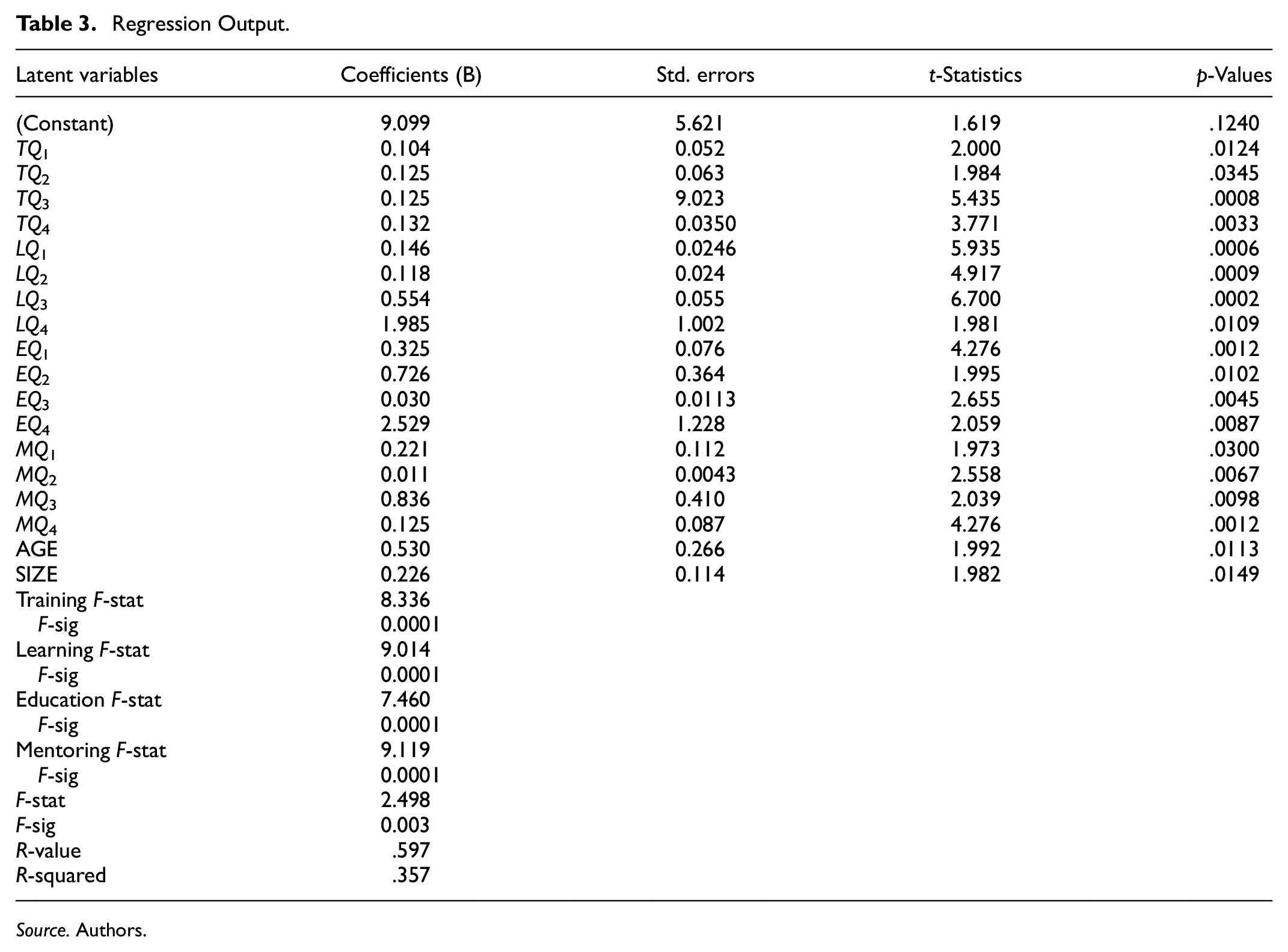
The regression analyses represented in Table 3 indicates that the model is of high quality and the human capital development sufficiently elucidated variation in firms’ productivity. The R-square value is .357, while the Durbin Watson value is 2.302 for productivity model, which proposes that there is no hitch concerning the auto-regression of residuals. Thus, there is a possible danger concerning model misspecifications. In general, an F-stat is significant at 5%, which indicates that human capital development is significant. Nevertheless, this shows that at the variable level the effect is statistically shown. As such the hypotheses tests and the conclusion will be based on the particular variables and their influence on firms’ productivity.
Regression Output.
Source. Authors.
Discussion of Findings
Based on the analysis as shown in Table 3 above, we found that all the dimensions of trainings namely TQ1 (0.104), TQ2 (0.125), TQ3 (0.125), and TQ4 (0.132) yielded positive and significant impact s on productivity of garment firms in Nigeria. TQ1 yielded coefficient 0.104 with p-value <5%. TQ2 and TQ3 also yielded positive coefficient of value 0.125, which enhanced the productivity of garment firms. Te effect is also positive for TQ4 as coefficient is 0.132. By implication each of the questions on training of both employers and employees yielded relatively higher positive effect on garment firms in Nigeria.
When combined, the effect of training of business owners and employees effect on productivity is statistically is significant at 1% (F-stat = 8.33; p < .01). Since the p-value is >1, we accept the hypothesis that training of business owners and employees simultaneously significantly enhances productivity of garment and textile firms in Nigeria. This implies that employee, and business founders continual development activities could enhance firms’ productivity. First, this result is consistent with the evidence that human capital development has a strong positive effect on a firm’s productivity, as found by Seleim et al. (2007). Secondly, it confirms our theory that when both employees and business founders are trained simultaneously, the productivity efficiency would increase.
Thus, we also found that garment and textile firms that focus on training of both the business owners and employees experienced high productivity. The finding is consistent with that of Mincer (1997) that found that better human capital stock is connected with high productivity and strategic footings. Goetz and Hu (1996) and Bates (1990) also agree with our finding that training is connected to firm survival and success and higher performance. The finding of this study is in agreement with the study of Dang et al. (2018) who found the more frequent a firm provides training to her workforce, the greater the productivity is.
As shown in Table 4, the test for the effect of learning of both employees and business owners indicates that higher productivity could be achieved. The dimensions of learning namely LQ1, LQ2, LQ3, and LQ4 all yielded positive coefficients on garment firms productivity (LQ1 = 0.146; LQ2 = 0.118; LQ3 = 0.554; LQ4 = 1.985). Specifically, learning increases garment firms’ productivity when considered from the perspective of both employees and business owners.
Correlation Matrix.

Source. SPSS authors.
Correlation is significant at the .05 level (two-tailed). **Correlation is significant at the .01 level (two-tailed).
For hypothesis 2 which relates to this analysis, we consider the joint effect in reaching a conclusion as regards whether creating learning environment for both employees and business owners enhances their productivity. The coefficients of the learning capacity on productivity questions are as F-statistic equals 9.014 and the p-value is <.01 (p < .01). This shows that the effect is significant and could advance productivity. Thus, we accept the hypothesis and conclude that learning capacity of business owners and employees is positive and significantly affect garment firms productivity.
The analysis in this study is unswerving with numerous research studies. For instance, Hussein et al. (2006) found that learning have significant impact on the improvement of organization’s competitive edge and awareness to adjustment as a result of environmental dynamism. This implies that the level of learning capacity in an organization determine the extent of its competitiveness and reaction to technology advancement in this contemporary era. Evidence has shown that both business owners and employees are well rewarded when the firm experience high productivity as result of their value-adding. This means that when organization workforces develop their learning capability productivity is enhanced and reward is inevitable. We confirm the finding of Rebelo and Duarte Gomes (2011), that learning helps organization to get access and modify organizational memory and consequently providing guidelines for organizational action. The result about the core outcome of learning capability on firm productivity is in agreement with and extends research by Baker and Sinkula (1999), who established a positive connection between learning and firm productivity in terms of market share, new product development and general performance.
In hypothesis 3, the study tests how education of business owners and employees influence firm productivity. Taking the effect in individually, we discovered that all the dimensions of education namely EQ1, EQ2, EQ3, and EQ4 resulted in positive and significant impact on productivity of garment firms in Nigeria. EQ1 yielded coefficient 0.325 with p-value <5%. EQ2 and EQ3 also yielded positive coefficient of value 0.726 and 0.30 respectively, which enhanced the productivity of garment firms. The effect is also positive for EQ4 as coefficient equals 0.2529. By implication each of the questions on education of both employers and employees yielded positive effect on garment firms’ productivity in Nigeria.
When the joint effect of the dimension is considered, as shown in Table 4, the study found that the coefficient of education of business founders and employees of garment and textile firms is both positive and significant. This is as the F-statistic is 7.460 and p-value is <.01. For that reason, the researchers accept the hypothesis and conclude that the education of both employee and employers would yield positive productivity.
This has serious implication for human capital development and productivity. Firms that pursue human capital development should not just focus on educating only the employees but rather get the founders educated as well. This suggests that further education of the business owners and their employees will enhance their total performance in the organization. One factor that predicts business success has been training and education of the business owners and employee- such training has come from continuing education programs. We therefore show that firms should invest more on education and training of the founders and the workforce. Scholars have unanimously agreed that education is the most powerful instrument for the total development of human capital of any nation which in turn leads to high productivity (Abolade et al., 2011).
Finally, mentoring relationship among employees and business founders was found to be positive for productivity in garment firms in Nigeria. As shown in Table 4, the dimensions of mentoring questions namely MQ1, MQ2, MQ3, and MQ4 all sow tat mentoring is required for productivity enhancement on garment firms (MQ1 = 0.221; MQ2 = 0.011; MQ3 = 0.836; MQ4 = 0.125). Specifically, mentoring increases garment firms’ productivity when considered from the perspective of both employees and business owners.
Based on this effect, we take the combined effect to test the hypothesis 4 if mentoring relationship between business founders and employees advances on garment firms’ productivity. The F-statistic which is the measure of the joint effect yielded 9.119 with p-value <.01. Based on this, we accept the hypothesis 4 and conclude that mentoring activity between founders and employees enhance firms’ productivity.
This finding implies that firms should create an atmosphere whereby mentoring relationship is enhanced. This requires that employees select expert managers and supervisors who are not necessarily top quality workers in the organization but have what it takes to guide, inspire and support others to grow. And this is support of DeLong and DeYoung (2004) who found knowledge transfer as a key mechanism for organizational success.
Conclusions
The significance of human capital development to firm productivity of garment and textile firms in Nigeria has mostly been overlooked in literature. We have examined the effect of human capital development. We analyzed the data using a regression model, and the results indicated that the model adequately explained the variables. The results are, therefore, consistent and did not suffer from any known bias.
The results ascertained that human capital development is a significant determinant of firms’ productivity. By implication, the results reveal that providing continuous training and development, creating an enabling learning environment, continuous education and mentoring programs is a formidable strategy for revitalization of performance of garments and textile firms in Nigeria. In line with these findings, several studies have shown a noteworthy connection between human capital development and productivity, which is typically positive and important (Choudhury & Nayak, 2011; Fadel & Groff, 2019; Osibanjo et al., 2020). The finding that training of business owners and employees enhance garments and textile firms’ productivity is unswerving with previous studies carried out by Dang et al. (2018), Goetz and Hu (1996), and Bates (1990) among others. When business owners and employees are trained, developed, and educated, they can acquire, and improve their skills that help them do well in the workplace and in doing so gain the confidence they need to participate in decision-making processes at various levels of organization. The result that learning capability of business owners and employees has significant effect on firms’ productivity confirms the conclusion of other researchers, such as Rebelo and Duarte Gomes (2011), Hussein et al. (2006), and Baker and Sinkula (1999). Our finding that education of firms’ workforce enhances their high productivity is consistent with the results of Abolade et al. (2011) and Burns and Stalker (1994), among others. The finding is consistent with the work of Aleksic and Jelavic (2017) and Aagaard (2016) who reported that organizations seeking business sustainability must ensure that all the parties/actors must socialize and interdependently relate/interact with one another. Previous studies on human capital development components (particularly training and development, education, and mentoring) are used as antecedents, drivers or factors of organization productivity and sustainability.
Our study is relevant in the field of human capital development and knowledge management because it brings new insight into human capital development and employee productivity. By theoretical and practical implication, modeling productivity through human capital development should involve business owners. This is plausible because of their increasing role in business management. Thus model of human capital development that focuses on only employee is not an ideal model if the target is to increase productivity especially as it affects garment firms in Nigeria. Until now, business owners are seen as only financial capital contributors and as such their trainings, education, learning and mentoring relationship are not treated with seriousness. But this business model does not seem to address the peculiarity of certain business were the owners play key parts in strategies. Thus this study advocates models in business organizations human capital development that would factor both employees and business owners in running organizations.
Footnotes
Declaration of Conflicting Interests
The author(s) declared no potential conflicts of interest with respect to the research, authorship, and/or publication of this article.
Funding
The author(s) received no financial support for the research, authorship, and/or publication of this article.
