




Abstract
Integrating the developed-market resources after acquisitions is a crucial tool for Chinese multinational enterprises (CMNEs) to accelerate industrial high-quality development. However, existing theories have scarce thorough explanations of the dynamic mechanism of CMNEs’ post-merger integrating resources. Our research aims at disclosing CMNEs’ post-merger integration (PMI) long-term dynamics under resource relatedness changes. We applied a multiple-case study with four typical CMNEs’ German-market PMI cases and proposed a theoretical framework based on a coding analysis of 38 interviews. Our findings highlight that: CMNEs change initial gentle integrations (partnering/preservation) to balance dependence when pre-merger resources complementary decreases with similarity increasing, or to extreme dependence when pre-merger resources similarity continually increases to extremely high. Pre-merger resource relatedness basics and later changes and CMNEs’ dynamic capability (threat and development potentials’ perception capabilities and utilization capability) are crucial factors in promoting CMNEs’ PMI changes. Our originality lies in that we consider the interactions resource relatedness changes and CMNEs’ PMI dynamics, strongly replenishing the deficiency of current PMI dynamic studies that lack considerations of resource relatedness changing; also, we simultaneously consider the two facets of dependence asymmetry and joint dependence such that broadened the application of resource dependence theory (RDT) in PMI studies. Our study offers managerial insights into CMNEs’ development leapfrog through acquisitions in developed markets that CMNEs should focus on the vital role of inter-firm resource relatedness changing. Initial gentle integration can be deepened when original resource backgrounds become more similar but should be cautious of the effect of power imbalance and selfish actions.
Plain Language Summary
Purpose—Our study aims to disclose the post-merger integration (PMI) long-term dynamics of Chinese multinational enterprises (CMNEs) under resource relatedness changes from a lens of resource dependence theory (RDT). Methods—We applied a multiple-case study with four typical CMNEs PMI cases and proposed a theoretical framework by a coding analysis of 38 interviews. Conclusions—CMNEs change initial gentle integrations (partnering/preservation) to balance dependence when pre-merger resources complementary decreases with similarity increasing, or to extreme dependence when pre-merger resources similarity continually increases to extremely high. Pre-merger resource relatedness basics and later changes and CMNEs dynamic capability (threat and development potentials perception capabilities and utilization capability) are crucial factors in promoting CMNEs PMI changes. Implications—Our theoretical implication lies in that we strongly replenish the deficiency of current PMI dynamic studies that lack considerations of resource relatedness changing by considering the interactions resource relatedness changes and CMNEs PMI dynamics, and broaden the application of RDT in PMI studies by simultaneously considering the two RDT facets of dependence asymmetry and joint dependence. Our study offers managerial implications for CMNEs to focus on the vital role of inter-firm resource relatedness changing. Gentle integration is not the only choice but can be deepened when original resource backgrounds become more similar. Meanwhile, CMNEs should be cautious of the effect of power imbalance and selfish actions. Limitations—Our case study is relatively small-sized so a large-sample quantitative investigation is needed to verify and test the generalizability of our theoretical framework empirically.
Introduction
In recent decades, there has been a rapid rise in leading resources-seeking for the foreign direct investments (FDI) of CMNEs into the developed markets, in which mergers and acquisitions (M&As) are regarded as a prime tool for CMNEs accessing developed economies such as the USA and Europe, given their lucrative markets and leading technologies (Rottig & de Oliveira, 2019). However, acquisitions’ strategic goals were often not met (Steigenberger, 2016). Increasingly scholars argued that PMI is key for explaining acquisition failures (Kroon et al., 2021). Existing studies stated that CMNEs tend to adopt gentle integrations owning to reasons like significant cultural differences, identities asymmetries, insufficient learning or absorptive capabilities, granting the targets ample autonomy and independent operations to decrease conflicts and safeguard the acquired resources (Kroon et al., 2021). “Partnering” or “preservation” is typical of CMNEs’ gentle integrations (de Oliveira & Rottig, 2018; Kale & Singh, 2012). However, PMI commonly takes many years to complete. Recent studies have clarified that the PMI process shows as an interactive and gradual process (Jonsson & Vahlne, 2023). Some meaningful initial integration approaches could prove ineffective or sometimes even counter-productive after a period, which requires acquirers to take adjustment initiatives (Steigenberger, 2016). Therefore, whether CMNEs’ gentle integrations could shed light on the long-term integration phenomenon looks pretty problematic and might only be a temporary static snapshot (Sun, 2018). Solely emphasizing these temporary initiatives may exist as a downside of procrastinating real integrations.
Given such a possibility, more recent scholarship turns close attention to CMNEs’ PMI dynamics and argues that PMI changes root in coevolving with the changes in an organizational context (Rouzies et al., 2019). For example, Marchand (2015) theorized CMNEs’ integration evolvements with two sides’ initial activities coordination; F. Chen et al. (2023) proposed the parallel coevolution of PMI with dual knowledge networks. Despite a growing body of work on CMNEs’ PMI dynamics, current studies failed to account for the context of the changes of resource relatedness (i.e., resource similarity or complementary) in the PMI dynamic process. Reviewing the current debate can see that scholars have been emphasizing the effects of two sides’ pre-merger resource similarity or complementary basics on post-merger integration degrees from a static view (F. Chen, Zhu, & Wang 2021; Li et al., 2019) but taking no consideration of potential changes of post-merger resource relatedness, which is, however, very vital. As time goes by, the two sides’ resource endowment can vary from pre-merger resource backgrounds. Prior static-view studies articulated that pre-merger resource similarity or complementary leads to different integration degrees and targets’ autonomy levels (F. Chen et al., 2017); given that, integration degree should not be constant but could change with bilateral resource relatedness varying when PMI is unfolding with time elapsing. Arguably, the understanding of dynamic resource interactions during the post-merger period remains an under-appreciated topic with a necessity for further theory exploration. Therefore, we tied resource relatedness changes to the time horizons of CMNEs’ PMI and summarized our general research questions as “How and why CMNEs’ developed-market PMI change under resource relatedness changes?” Specifically, how does pre-merger resource relatedness change during the post-merger period? Will CMNEs’ PMI change because of resource relatedness changes? If so, how they will coevolve? What factors influence CMNEs’ PMI changes? We attempt to respond to these questions based on RDT. RDT has become a dominant theoretical lens explaining a firm’s acquisitions of managing its dependence on the acquired external resources and the uncertainty of bilateral resources flow (Pfeffer & Salancik, 1978; Wu et al., 2021).
We propose a theoretical framework by handling two groups of four CMNEs’ PMI contrasting cases in the German market and present two contributions. First, our study extends two dimensions of resource dependence to the contexts of PMI dynamics under different resource relatedness backgrounds. We build on this distinct theoretical logic of distinguishing two dimensions of RDT (i.e., dependency asymmetry and joint dependence) to develop the arguments concerning the PMI mechanisms reconstructions from short to long-term. The dual dimensions of RDT offer a complete framework that provides a broader understanding of the richness of CMNEs’ PMI changes. Second, our work contributes to the studies of PMI’s dynamic nature. We stress the roles of resource relatedness changes in long-term PMI dynamics. Although prior studies from a static perspective have offered rich insights on the influence of resource relatedness on integration degrees, they ignored that resource relatedness could vary with time. Our study fills the current PMI dynamics research gap by connecting the changes in resource relatedness and PMI dynamics to fully explain how PMI degrees change along with resource relatedness changes over the long run. Our results show that CMNEs’ traditional gentle integrations are not always efficient but may increase over time in different directions under different conditions of resource relatedness changes: CMNEs change initial gentle partnering to balance dependence by decreasing dependence asymmetry and increasing joint dependence (joint action, share resource, and trust formation) where pre-merger complementary resources decrease while similarity gradually increasing; CMNEs change initial gentle preservation to extreme dependence by aggravating dependence asymmetry and undermining joint dependence (auxiliary action, resource limitation, and trust damage) where pre-merger similarity resources keep increasing to extremely high. Except for resource relatedness (changes), CMNEs’ dynamic capability (threat and development potentials’ perception capabilities and utilization capability) is a crucial mediator in promoting PMI changing directions to balanced dependence or extreme dependence. Our findings provide new insights into CMNEs who engaged in developed-market acquisitions flexibly adjust their integrations in various integration periods according to the resource relationship changes with their acquired targets.
The paper’s structure is as follows: The following chapter reviews the literature on CMNEs’ PMI, resource relatedness, and RDT. Then the next chapter describes our research methods, including cases selection, data collection, and data analysis, with the next section analyzing the findings in detail. The last two chapters discuss the data analysis results, propose theoretical and practical implications of this study, and summarize the whole study.
Literature Review
CMNEs’ Post-Merger Integration in Developed Markets
The PMI refers to a series of managerial actions combining acquirers and targets to be a new unified unit (Haspeslagh & Jemison, 1991) and is recognized as the key to M&As value creation (Kroon et al., 2021). Most previous studies were common in a static perspective about how acquirers unfold structural decisions to balance the challenge of integration (absorbing the targets) and preservation (leaving the targets autonomy) (Safavi, 2021). Haspeslagh and Jemison (1991) portrayed four general modes to trade-off the integration dilemma: “absorption” (one-way forced full control) that developed multinational enterprises (DMNEs) acquirers mostly prefer, “preservation” (keeping all as original), “symbiosis” (the best balance with mutual share and learn), and “holding” (financial acquisitions without integrations). Unlike DMNEs’ preferred absorption mode, CMNEs acquirers favor gentle actions like granting the developed-market targets high autonomy with the retention of executives and talents (Liang et al., 2021). Kale and Singh (2012) proposed a “partnering” concept based on two dimensions of “structural integration” and “activities coordination” to describe CMNEs’ gentle approach: keeping targets’ all original resources and structures, granting targets great autonomy, selectively coordinating activities, and frequent communication. Subsequent studies enriched CMNEs’ such archetypical gentle mode with various terms: for example, Liu and Woywode (2013) developed a “light-touch” mode as a combination of symbiosis and preservation; Marchand (2017) further subcategorized “partnering” into three facets: transfer-partnering, springboard-partnering and synergy-partnering; de Oliveira and Rottig (2018) put forward a notion of “supporting partnering” building on institutional theory; Sun (2018) proposed a “Wu-Wei” paradigm of the two sides’ partnering attempts.
However, the traditional static perspective largely neglected the time effects of PMI. As Haspeslagh and Jemison (1991) stressed, integration modes are not independent close-ended categories but multistage dynamic cross-continuum among each other. It is questionable whether CMNEs’ initial gentle modes (partnering/preservation) could uncover the long-term PMI picture (Sun, 2018). Having access to sophisticated resources through gentle approaches, CMNEs may reevaluate their integrations in order to amply utilize the acquired resources (F. Chen et al., 2023). For example, Kale and Singh (2012) deduced that CMNEs merely take partnering as a temporary strategy to ease targets’ acquisition anxieties and might fully absorb the targets in the mid-term once removed all obstacles. Most recent research started to emphasize the importance of timing for understanding the PMI process and outcomes (F. Chen et al., 2023). Marchand (2015) discovered that CMNEs would initiate more activities until symbiosis if initial activities coordination goes smoothly, otherwise reduce activities until leave targets in complete preservation. Graebner et al. (2017) redefined PMI as a multifaceted dynamic process; Schriber et al. (2018) further pointed out the importance of flexible integration; Colman (2020) conceptualized acquirers’ dynamics during the post-merger capability transference process; Daoa and Bauerb (2020) focused on an integrative perspective on humans in acquisitions and analyzed the human integration evolvement over time; Safavi (2021) traced organizational routines’ variations across the integration process; F. Chen et al. (2023) highlighted the internal and external knowledge networks changes during Chinese acquirers’ PMI.
Resource Relatedness in Post-Merger Integration
The aforementioned CMNEs’ dynamic PMI studies suggested that a more dynamic perspective can significantly enrich CMNEs’ PMI research; however, empirical evidence remains scant, especially from a resource perspective. Many studies have attempted to figure out the influencing factors of CMNEs’ PMI, including cultural differences, institutional elements, or social capital views (de Oliveira & Rottig, 2018). Currently, static integration literature has contained some considerations relevant to resources. For instance, scholars have noted that integration decisions depend on pre-merger resource relatedness between acquirers and targets (F. Chen, Zhu, & Wang 2021). Resource similarity hints at overlapping knowledge and business areas that can facilitate resource exchange so higher standardized integration can foster mutual network embeddedness and enrich resource bases; resource complementary refers to mutual information support and can enhance the synergy that one firm cannot create alone so lower integration can earn trust and cooperation willingness (F. Chen, Zhu, & Wang et al., 2021). In short, integrations should match the two sides’ resource relatedness: more resource similarities should match higher integration degrees while more resource complementariness matches lower integration degrees (Li et al., 2019). Recent scholarship in the context of technological M&As empirically verified that appropriate integrations matched with the overlapping of resources could promote post-merger technological innovation performance (Wu et al., 2021).
However, integration decisions are not unchanging, as resource elements underlying integration decisions may continuously change over the PMI time along with acquirers accessing and reorganizing targets’ internal resource pool. Considering these changes, flexible integrations would be beneficial for generating greater acquisition synergy value. However, traditional static studies largely neglected these potential dynamics; thus, they did not reveal integration decisions’ evolvements with bilateral resources changes of combination or re-configuration, such that miss on studying the dynamic differentiations of PMI under the conditions of different resource relatedness changes. Different resource relatedness is the starting point of PMI mechanism analysis. Most current studies observe cases of complementary resource-seeking of CMNEs’ developed-market acquisitions (Edacherian & Panicker, 2021); however, with the Chinese economy developing rapidly, CMNEs’ acquisition needs of developed markets’ higher homogeneity resources might be vastly growing once Chinese enterprises complete industrial upgrading.
Resource Dependence Theory and Post-Merger Integration
RDT widely accepts the idea that the two organizations are constrained by an interdependencies network, where the side that controls more vital resources retains strategic control; in contrast, the side with a relatively weaker power is dependent on the stronger side (Hillman et al., 2009). Casciaro and Piskorski (2005) divided resource dependence into two sub-dimensions of “mutual dependence” and “power imbalance.” In the restructuring dependencies process, power imbalance makes the side with resource advantage more likely to resist the less powerful side to claim greater value at the sacrifice of the benefits of the weaker side (Casciaro & Piskorski, 2005). Further considering the two facets of mutual dependence, Gulati and Sytch (2007) examined organizational interdependence into two dimensions: “dependence asymmetry” and “joint dependence.” Not solely focusing on dependence advantage and the concomitant power logic, Gulati and Sytch (2007) examined that joint dependence operating through a logic of embeddedness (i.e., joint action, trust, and information exchange) can also influence the performance of inter-organizational interdependence. Mediated by the degrees of joint action, information exchange, and trust, joint dependence influences the integration outcomes (Gulati & Sytch, 2007). However, most studies have been drawn solely to the integration adjustment of dependence asymmetry and its related logic of power (Wu et al., 2021) but omitted the implications of joint dependence for dependence restructuring. In fact, organizations can reconstrue resources by simultaneously mediating the two facets of “dependence asymmetry” by a logic of power and “joint dependence” by a logic of embeddedness.
A resource dependence perspective could offer a promising avenue to reveal CMNEs’ developed-market PMI processual dynamics under resource relatedness changes. In the scenario of M&As, resources’ mutual dependence is identified as a vital M&As driver, while power imbalance is usually an acquisition obstacle (Du et al., 2020). During PMI, CMNEs are confronted with the problematic issue of balancing the need to access the acquired resources with the need to manage organizational relationships to mitigate resource dependencies (Gaffney et al., 2013). Most CMNEs’ acquisitions in developed markets are driven by the fact that the developed-market targets usually possess the advanced resources that CMNEs are short of, which forms a kind of “resource asymmetry” (Du et al., 2020). Hence, CMNEs’ PMI is not a simple asset augmentation, but rather a reconstitution of dependent relations under a dependence asymmetry to generate maximum synergy (Du et al., 2020). CMNEs must take initiatives of resource reconstitution to reduce resource dependence on the developed-market targets meanwhile makes the targets rely more on them so that they can gain a solid foothold in the global markets.
We focus on how CMNEs’ PMI decisions change over the time span in different scenarios of resources relatedness changes from the two dimensions of RDT: dependence asymmetry (the logic of power) and joint dependence (the logic of embeddedness). We define CMNEs’ integration from the two aspects based on Kale and Singh (2012) that structural integration refers to resources’ structural unity and targets’ autonomy (how well targets retain original operational ability) and activities coordination that the two sides’ formal or informal activities cooperation and exchanges. We adopt the definition of resources relatedness (similarity/complementarity) of Wei and Clegg (2014): the overlapping features of products (products and product-related capabilities) and networks (intra-networks of organizational structures and inter-networks of sales channels, production sites, and suppliers). The conceptual framework shows in Figure 1.
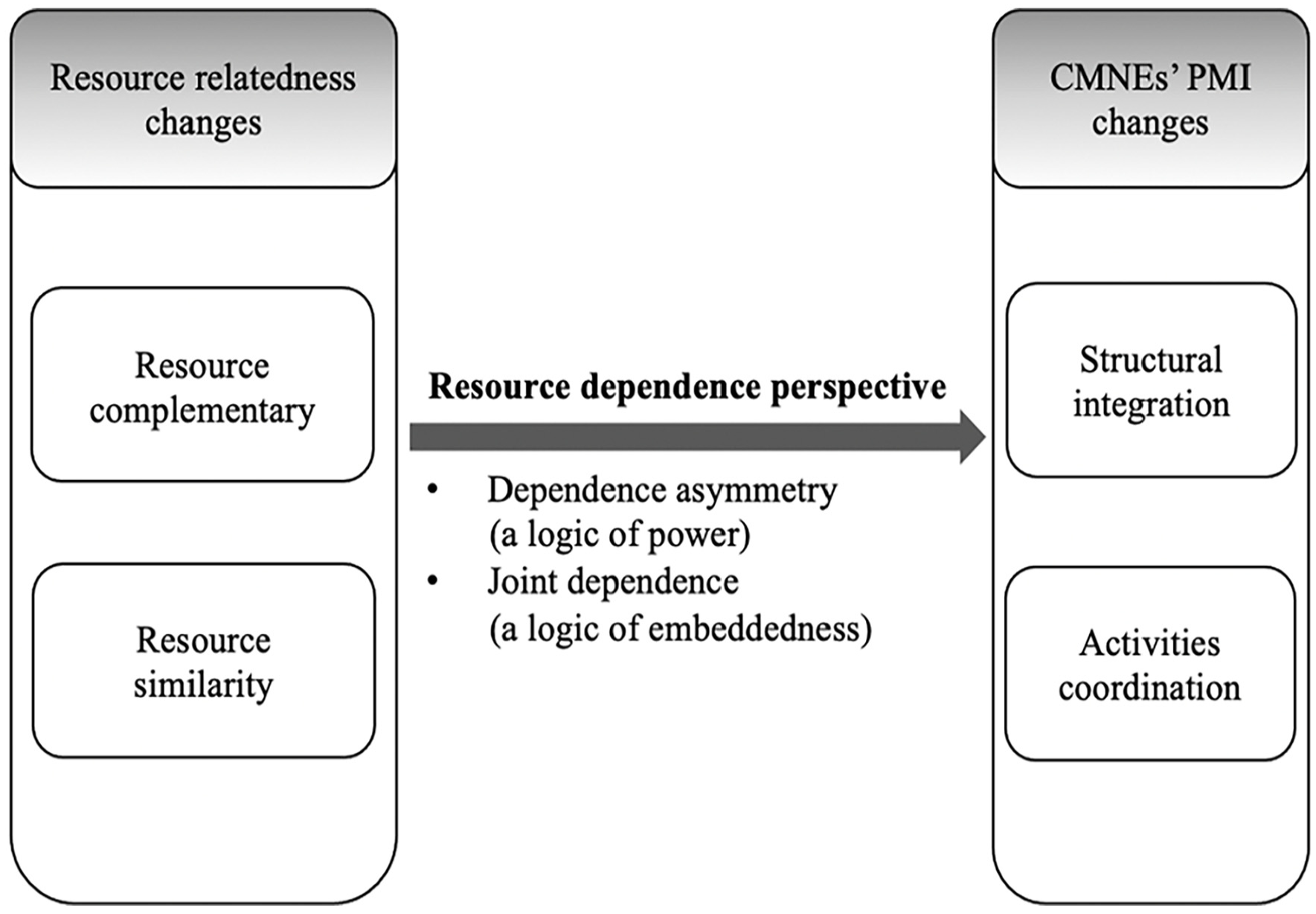
Conceptual framework of this research.
Methodology
Case Selection
We utilized a longitudinal multi-case study to compare four attempts of CMNEs’ temporal integration adjustments in the German market. We first used purposive multilevel sampling case selections (Wei & Clegg, 2014). Level 1 concerns nations’ selection. In recent decades, Chinese international competitiveness has been leading in other emerging economies; simultaneously, Chinese acquiring developed-market firms is a comparably new phenomenon such that the research concerning CMNEs’ PMI behaviors remains nascent. Refining extant theories or building new propositions is primarily appropriate in such circumstances. Then, the German market gives a proper empiric environment for this research. As the top Chinese cross-border acquisition destination, German firms possess internationally highly acknowledged know-how and brands. The strategic resource-seeking acquisitions of Chinese investors in Germany keep proportionately high. We treat a German target as being acquired on the condition that the Chinese purchase over 50.01% of the shares and obtain the German firm’s control and decision-making power. Also, we further narrowed the samples to the manufacturing industry because it is the representative target in the German market for Chinese investors. It is reasonable to concentrate on one typical sector to explore a phenomenon, as yielding results that fit all sectors is hard (Schweizer, 2005).
Level 2 considers the acquired strategic resources because our intention is to figure out the dynamics of CMNEs’ PMI under different resource relatedness changes. Level 3 discusses that the selected cases should have completed the majority of integration practices as our focus is on PMI adjustments. The cases within the first post-acquisition year are still at the early nonformal integration stage, where the pattern is hardly visible (Zheng et al., 2016) and formal integration usually appears in the next 2 years (Hoffman, 2013; Stendahl et al., 2021). Thus, prolonging the PMI timespan to at least 4 years ago should observe more changes. We first extracted the samples before 2015 that qualified with the above criteria through Zephyr and further checked that more than 50% of the targets’ shares have been acquired to exclude those financial acquisitions without integrations. We purposively selected four cases (see. Table 1) with distinct resources-seeking orientations that can allow us a systematical comparison. These cases are suitable as they both underwent long-term strategic adjustments, allowing us to transparently observe PMI adjusting practices and investigate the saying, doings, and interpretations of the participants engaged in PMI evolutionary processes.
Description of the Cases.
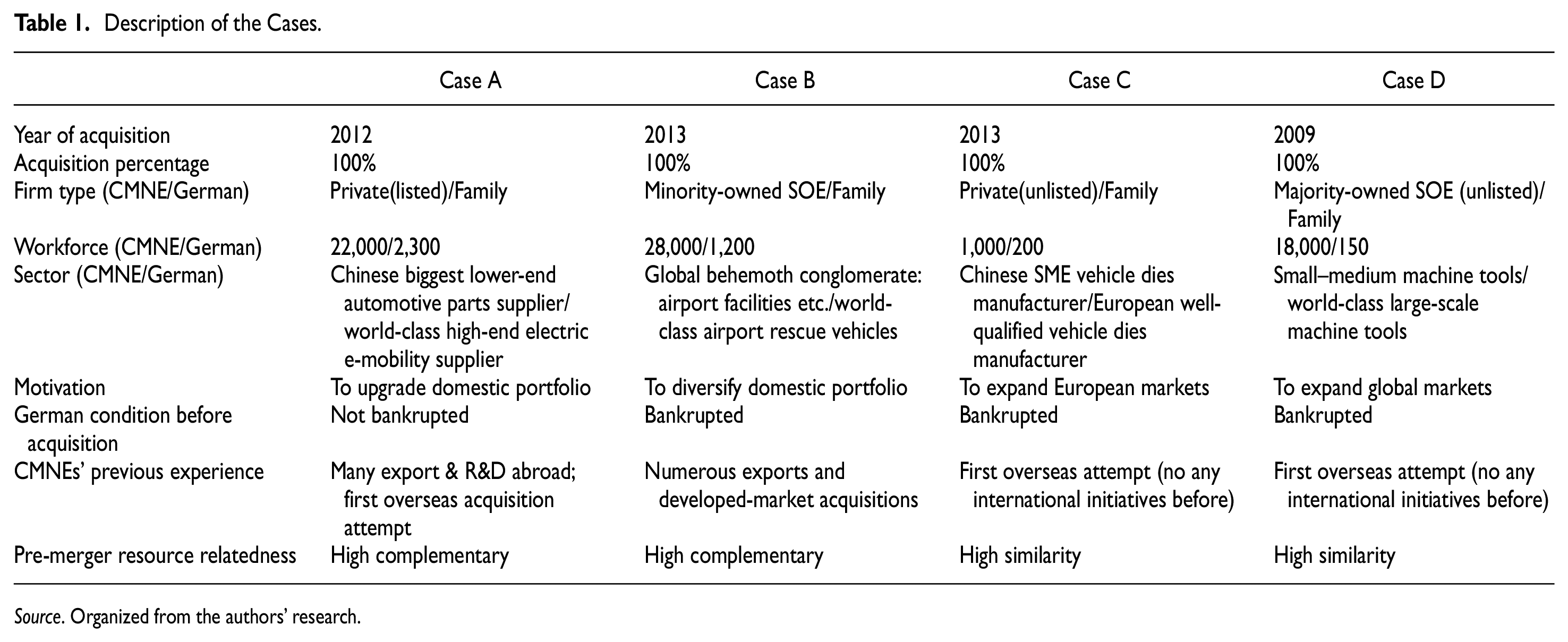
Source. Organized from the authors’ research.
Data Collection
We collected a data set mainly from semi-structured interview sources. From March 2017 to November 2022, we took place 38 interviews through face-to-face, telephone, or online video meetings with 32 key informants of Chinese and German managers and employees who could provide us with in-depth insights into their PMI initiatives and considerations behind their minds. All interviews were semi-structured questions to enhance cross-case comparability, adding customized questions according to the informants’ specific backgrounds. Each interview lasted 1 to 2 hours and was fully recorded and transcribed. Interview questions followed a list of topics requiring informants’ detailed descriptions of CMNEs’ integration initiatives and implementation processes, like key events, main actors’ responsibilities and interactions, the changes they experienced, and their perceptions. Specifically, we are concerned with PMI issues. For example, how CMNEs manage German organizational structures and operational business after acquisitions? How, when and why CMNEs changed their integrations over time? We also broadened more questions, especially on resources aspects. For instance, how about the two sides’ resources like products, markets, and business networks? Have bilateral resources changed over time? If so, how has bilateral resource relatedness changed, and how the changes influence CMNEs’ integration initiatives? All interviews remained open such that exhaustive accounts could be encouraged. We also followed up on interviews to fetch missed or ambiguous details or expand more necessary questions. We also collected company archival materials like annual reports, policy brochures, and manuals to allow the confirmation or disconfirmation of interview impressions and data triangulation. We attempted to gather multiple opinions from both the Chinese and German departments and hierarchical levels to cross-check different informants’ information to reduce retrospective bias. The overview of the informants and conversations lists in Table 2.
Interviews’ Information.

Source. Organized from authors’ research.
Note. Some interviewees are German-born Chinese or Chinese who directly work at German targets after graduating from German universities. So, their opinions can represent the opinions of the German side.
Data Analysis
Our research aims at analyzing data inductively by constructivism’s grounded theory techniques to construct theoretical framework (Gioia et al., 2013). We follow the typical content analysis process of qualitative data with the software of MAXQDA for computer-supported: reading the data line-by-line to uncover threads from the data segments, identifying main events with codes to frame them within meaningful units consisting of short stories with beginning, middle, and end, then building an orderly unified whole represented chronologically whereby creating coherent stories, and lastly analyzing the underlying insights of the stories illustrate (Consoli, 2021). As a systematic tool for working with a multitude of fragmented qualitative datasets with various data sources, MAXQDA offers a single platform for facilitating multiple narrative data analytic activities like coding, interpreting, and integrating multiple formats of data (textual, graphic, or video) and improves the rigor of qualitative studies by maximizing transparency (Oswald, 2017). Compared with other software like NVivo, the coding procedure of MAXQDA is intuitive that makes Gioia et al. (2013)’s constructivist grounded theory could generate emerging theories through recursively establishing strong analytic categories and visualizing relationships among datasets (Kalpokas & Radivojevic, 2021).
We subjected the interview data to qualitative content analysis by a coding procedure for “narrative themes” (Gioia et al., 2013). In the first phase, two main thematic code sets of PMI and antecedents were primarily identified after throughout reading the interview contents. Then we deepened the thematic areas analysis by extrapolating the text segments of interview transcripts. Each text segment related to the thematic areas was (re)coded to more accurately around the specific narrative themes and identified the corresponding codes and sub-codes for each theme. For example, we created a sub-theme of “dynamic capability” when noting that some participants’ views on key antecedents foregrounded the concepts of different capabilities. We first developed emerging themes from case A with an open-coding approach. We coded structural integration and activities coordination of the first code set “PMI” from a resource dependence perspective to track the key events’ sequences on the two dimensions of dependence asymmetry (a logic of power) and joint dependence (a logic of embeddedness) (Gulati & Sytch, 2007). We summarized informants’ language descriptions like CMNEs’ structural embeddedness, conflicts, and responses as mutually exclusive descriptive phrases as the first order constructs to capture CMNEs’ micro-level integration initiatives and behaviors (Gioia et al., 2013). We afterward inspected these constructs’ logic relationships and aggregated them into the second order themes with more abstract academic terms referring to RDT literature (Gioia & Thomas, 1996). We therefrom figured out the sequences of PMI changes on the two dimensions of resource dependence and further aggregated these themes into the third dimensions with more abstract academic terms, thus spinning off integration timelines into two distinct changing periods of an initial period of gentle integration (partnering/preservation) and a mid-late period of balance dependence or extreme dependence. By discovering tentative relationships of data, we theorized an initial basic framework of CMNEs’ PMI dynamics from a lens of resource dependence. Then we focus on addressing the second code set of “key antecedents.” Based on the same coding logic, we especially dissected the antecedents from resource relatedness perspective, such as the overlapping features of the two sides’ product and intra-networks and inter-networks, and initiated another coding round. During the coding process, we found CMNEs’ capabilities also exert indispensable influence so that labeled corresponding theoretical codes. We then observed these codes’ relationships, ordered their sequences, and further analyzed the causation of the codes of PMI and key antecedents, preliminary building theoretical relationships of resource relatedness, PMI, and resource dependence.
In the second phase, we coded the other three cases individually, according to the first pilot case coding process. Then in the third phase, we moved forward with cross-case analysis to detect more refined codes. The replication logic can discern whether the pilot case’s theoretical relationships could be verified by using other cases as independent experiments (Eisenhardt, 1989). By comparing the logic across cases’ codes, we arranged similar practices, views, and issues among cases and tried to identify differences. We observed that CMNEs’ initial gentle integrations in all cases were strengthened with time elapsing but to different degrees, in which different resources relatedness changes and CMNEs’ capabilities exert significant influence. In other words, theoretical relationships of CMNEs’ PMI dynamics and resource relatedness changes from a resource dependence perspective had been confirmed repeatedly and had achieved theoretical saturation. We respectively paired cases with similar or consistent patterns. Brown and Eisenhardt (1997) stressed that finite cases could enable researchers to appropriately balance considerable data and generate reasonable theories. We, therefore, finished the study with four cases. Key graphic representations of the MAXQDA coding system display in Appendix A1, B1, and C1, and the final output of the MAXQDA data coding presents in Table 3.
The Output of the MAXQDA Data Coding.

Source. Organized from authors’ research.
Findings
Identified CMNEs’ PMI Dynamics: A Resource Dependence Lens
Cases AB: Partnering—Balanced Dependence
Partnering (initial period: 0 ∼ the first year)
Dependence Asymmetry—The Logic of Power
Structural independence: CMNEs maintained all German resources and business. None of the German top management team (TMT) was replaced or layoff, maintaining great autonomy as before; insider seniors were promoted when old ones retired. By doing so, the turnover of top executives and talents was prevented and the existing German workforce was motivated. Based on the German original financial system, a Chinese-standard financial reporting system was set to report to Chinese-headquarter. An influx of money was invested in supporting the resumption of German operations by rebuilding offices, staff canteens, and factories.
Joint Dependence—The Logic of Embeddedness
Few activities coordination: One Chinese senior was dispatched as a “communication bridge” to Germany for coordinating bilateral needs, yet he was required not to intervene in German operations but merely to provide strategic suggestions for the Germans to reference. Having a Chinese background person inside the German target and having the chance to learn German managerial ideas, project coordination concern is a crucial component in such a partnering approach. Chinese communicator elaborated that: “When our Chinese shareholder has conflicts with the target, I explain to the German from the China point of view why the shareholder gives them such instructions or show such concerns to make the German easier to understand; or if the German does something that is hardly understood for Chinese shareholder, I will explain to shareholder about the ideas of Western people to let shareholder easier to accept.” Frequent communication and constant personnel rotations promoted mutual comprehension, with an active bilateral co-creation of weekly and monthly three-hour meetings with Chinese shareholders and seniors and all German managers participated online virtually or at the German head office physically. German complimented the timely feedback of the Chinese on meetings and private conversations, “They expressly conveyed the next five-year development blueprint to us at the outset after the deal. The Chinese shareholder and the communicator are both amiable and often inquire about our thinking and opinions, even the ideas of our factory workers. Their office door opens to us at all times.” Additional ten Chinese employees were dispatched in succession to Germany to provide support activities.
Balanced dependence (mid-late period: since the second year)
Decrease Dependence Asymmetry—The Logic of Power
Structural dependence: Not merely restricted to the minimal control over the financial reports, the Chinese gradually penetrated to strike for more power. Afterward the first year’s “wait and see,” the Chinese communicator of acquirer A was promoted to the director of the German Department of Purchasing and Supply Chain to intervene in German operations proactively. With equal decision power as German TMT, the issues of purchasing and supply need his scepters for final permission. In the same year, the German listed on the A-share market in China by injecting its assets into China Group; German TMT joined the China Board of Directors to make decisions on the benefit of the China Group. Acquirer B replaced the German flat management system with a typical Chinese executive committee structure (one Chinese-controlled seat and six European rotating seats) and Chinese standardized “group rules” that centralized German previously dispersed European branches. However, CMNEs did not attempt to integrate all of the targets; it is a non-intrusive lean formal structural integration for decreasing dependence asymmetry by combining unities based on structural ties and balancing the relationship within a budget approval and monitoring of shared vision achievement.
Increase Joint Dependence—The Logic of Embeddedness
Joint action: Acquirer A selectively standardized German purchasing and supply chain with the ones of China headquarters, adjusted from previous dispersed purchasing with dissimilar purchasing standards in the name of German brand to global and overall purchasing in the name of China Group, same as other Chinese subsidiaries do. There is a focus with a high margin on the combination of two-sided productions. Acquirer B promoted Asian suppliers of Chinese and Koreans to replace the prior European suppliers. Asian suppliers could provide reliable raw materials at lower costs so that decreased German purchasing costs meanwhile keeping German products’ quality. With a deliberate strategy of creating an international upper-scale supplier, CMNEs aim at obtaining German products and R&D capabilities, “We combined their product with ours to expand our service scope. Our cooperation accesses us to the fastest-needed, more profitable focus field. We are on one boat with different sails, yet both sails push the boat to go ahead.” A joint factory space was built in China for the Germans to start local Chinese operations within a short 2 years. Larger savings have been made by combining the sales forces and portfolios of the two sides.
Resources share: CMNEs strategically shared resources with the Germans in several crucial ways, such as market image support and financial support. Apart from the first year’s physical building investment, acquirer A further offered €54 million to German R&D operations to develop new portfolios, which is much more than the available funds of the German R&D department ever had. CMNEs’ market image support is crucial for the Germans to overcome physical distances and mitigate the considerable costs of doing business in China. CMNEs offered market operation support and managed everything to navigate the complicated Chinese institutional environment, such as significant bureaucracy, so that German could concentrate on its best practice of high-quality technology with high work efficiency. A continued market connect share was provided to the German as well through connecting German to the Chinese social network and sharing location-specific information, which brought the German tangible benefits and entailed the German could deal with China local assemblers teams by quickly understanding special Chinese requirements.
Trust formation: With helping the Germans open up the China market, the image and reputation of the Chinese acquirers also considerably increased in German social media and public and deep trust and reciprocal relationships with local German key actors and authorities were established. The tight dependence afforded the two sides reaped superior economic returns. It results in shifting the dispositions of the participators and the two sides offering heightened attention to the necessity and responses of each other so that a satisfactory tie is formed. High dependence might capture high affective commitment and cohesion, thereby leading to a long-term orientation for conflict resolution and a willingness to forego self-interest for mutualistic benefits. Higher-volume exchange and behavioral solidarity carried out more coordinated activities to capture greater strategic overlap and create an environment of pursuing joint development.
Cases CD: Preservation—Extreme Dependence
Preservation (initial period: 0 ∼ the first year)
Dependence Asymmetry—The Logic of Power
Structural independence: Except for the immediately merged German brand, all German resources were maintained as before, with German TMT retained having great discretion, and all German staff continued their work. Considering this acquisition as a “promising revival,” the Germans expressed a great passionate welcome to the Chinese who brought fresh money in both cases.
Joint Dependence—The Logic of Embeddedness
No activities coordination: However, the actual reality is not what it seems. The China side’s poor communication and feedback puzzled the Germans: no Chinese was dispatched or joined Germany to coordinate mutual needs; even Chinese shareholders rarely came in both cases. The German of case A complained that “our shareholder came to us at a glance only when she came to visit European customers. Even though she came, she ignored what we said. We had to repeat our situation and needs again and again. She did not treat us seriously.” Information in these two cases was often nontransparent. “It seems she has no clear planning. We have no idea what she is going to do. She often changed her mind and her actions usually differ from what she announced.” Acquirer D also deployed no activities coordination and explained that: “German brand is highly recognized in global markets. Their European customers presumed that the German brand becomes not pure once acquired by the Chinese. We intended to keep their brand as before. Therefore, we keep them as original to prevent brand dilution.”
Extreme dependence (mid-late period: since the second year)
Aggravate Dependence Asymmetry—The Logic of Power
Structural control: Aggravate dependence asymmetry combines a strict control of the Chinese acquirer over the German target. In the second year, CMNEs suddenly introduced a so-called “two-tier” management system to the German structure. They sent a Chinese controller to be the German CEO to control everything while German TMT was deprived of all autonomy. Nevertheless, there was nonformal integration of the German entities, but rather a severe Chinese shareholders’ grip with an extreme subordination dependence. “We have become a controlled economy. Chinese shareholder controls everything. We need her authorization before we do anything. They leave no autonomy to us.” All German documents have to be signed by the Chinese CEO before being operated while the Chinese CEO, like a puppet, also has to wait for the permission of Chinese shareholders for every issue, such as the material purchase or even the implementation steps of specific projects. Soon, the Chinese CEO in case C was sacked one morning without being notified because of managerial idea conflicts, and a crony of the shareholder who has no business and managerial knowledge replaced this position quickly. The Chinese CEOs in case D were replaced very frequently with five CEOs appointed and left back and forth. Sometimes germen TMT was the last to be informed of Chinese managers’ transfer. Decisions were made exclusively by the Chinese shareholder. Control seems to be going on without considering consequences. Meanwhile, much ordinary staff in other departments were fired with nonsensical excuses.
Undermine Joint Dependence—The Logic of Embeddedness
Auxiliary action: The severe losses in German performance in the first year were of great concern. Acquirer C, who was initially keen on obtaining European sales channels, began to see no value in German product lines. Without the mindset of retriggering profitable German capability, acquirer C regarded the German as a production function site with a low profit, such that he began to divest the German site as an auxiliary center to assist the manufacturing of China headquarters. Nevertheless, even these kinds of unilateral assisting efforts failed, “Ratifications of Chinese shareholders lasted very long, and most were blocked. We are truly in a black box in that we don’t have any Chinese side interlocutors. Also, we are not allowed to enter the China market, either, to protect the market share of the Chinese Group.” In case D, the Chinese acquirer requested the Germans to back the Chinese production by mass-producing parts. However, German factories could not mass produce small-size parts because their manual workshops are specially for large-size productions. German production was dragged down to chaos and became muddled.
Resources limitation: One of the main old die-casting machinery was broken because of a long history; however, instead of investing capital expenditures in repairing it or buying a new one, acquirer C divested the main business of die-casting of the German target but required them to focus on the low-profit ancillary business of mechanical parts machining. In terms of practical knowledge transfers, some German well-planned projects were “forgotten.” Technological cooperation was very limited and personnel rotation was ineffective. The Chinese visiting team in case D had yet to take action after visiting German factories and totally ignored the suggestions of German to establish a special team in China headquarters to transfer German practices into Chinese factories. “We don’t understand why they come to visit us. It seems they came to travel rather than learn.”
Trust damage: The heavy-dependence the Germans tend to interpret the behavior of the CMNEs in a negative light. The resulting adversarial animosity limited CMNEs’ behavioral flexibility in resolving frictions and aggravated attendant financial costs and reputational losses. The relationship turned out to be an irritated bargaining tug-of-war. Adversarial engagement irritated an unstable business relationship and opportunistic behavior, leading to a prohibitive cost sacrifice. This trust damage increased operational frictions and relational conflicts caused by personality incompatibilities, which are more severe and persistent and make confrontations more detrimental.
Key Antecedents: Cross-Case Analysis
Pre-Merger Resource Relatedness (Initial Stage)
Reexamined these two group cases, we found that initial integration choices closely correlate with the two sides’ pre-merger resource relatedness basic. In the first group, the pre-merger resources of the two sides are all highly complementary with different product categories and customer bases. German sides have mature businesses and are leading suppliers of high-ended manufacturing equipment and serve European markets, spreading manufacturing sites and suppliers in the German market and sales channels across the European mainland. CMNEs sides offer low-end products and serve primarily the Chinese market, whose manufacturing sites, suppliers, and sales channels are mainly in mainland China. Aiming at a portfolio of German products to upgrade existing Chinese products, the integration objective of CMNEs focuses on maintaining original German business continuously profitable as much as possible. Especially the two sides were in a resource dependence asymmetry: the German sides were in relative resource advantage with sophisticated products and globally recognized brands while CMNEs were at a disadvantage. The resources advantage side usually resists the weak side (Wu et al., 2021). Under such conditions, it is wise to adopt a compromised partnering attitude to ease German adversarial feelings and increase bilateral understanding. Comparatively, in the second group, although serving different countries’ inter-networks (the two sides focus on respective markets), the two sides were highly overlapped concerning product resources: their product categories lie in the complete same business area. In other words, the two sides are relatively higher similarity. CMNEs mainly regard Germens as a bridgehead for accessing European market networks to cover bigger markets. Hence, they have no necessity to adjust or interfere in German business but simply need to maintain them continuing to serve original European customers. Meanwhile, compared with CMNEs’ employee numbers, the German sides seem small. Generally, the resources disadvantaged side commonly relies more on the stronger ones (Wu et al., 2021). Compared with the first group’s large-sized acquisitions, Germans in the second group were at a resource disadvantage and represented a relatively lower strategic position in CMNEs’ networks, thus receiving less attention from CMNEs. As the German complained, “We seem not to deserve much attention from her (the Chinese shareholder).”
Dynamic Capability and Resource Relatedness Changes (Mid-Late Stage)
We suggest that the mid-late period PMI was adjusted along with the time that seems primarily triggered by the interactions of CMNEs’ dynamic capability, including threat and development perception capabilities and utilization capability, and bilateral resource relatedness changes. The premise of the first group conducting appropriate structural integration in the mid-stage lies in that, except that the initial-period partnering laid a mutual understanding foundation, CMNEs did well in threat prevention before acquisitions. In M&As, targets commonly conceal poor situations for a higher bargain. Acquirer A stressed, “We only buy the targets obviously in good condition but not those bankrupted no matter how cheap.” Another acquisition principle is acquiring the targets whose management teams positively support CMNEs’ values, which paved the way for post-merger power penetration and reduced the obstacles when adjusting the dependence asymmetry of bilateral powers. “We won’t buy the target if its managers don’t support us, no matter how complementary.” Mid-stage structural dependence increased the overlapping of two sides’ intra-networks like decision-making procedures and inter-networks like global supplier channels that resource similarity gradually increased. CMNEs’ perception of future developments and utilization capability promotes late-stage joint dependence. Complementary potentials of bilateral products and market coverage can introduce the combined new products into the China market, where low-end products are oversaturated with a tremendous demand for high-end equipment instead. “The German is also willing to enter into China market. Our product portfolios can serve new Chinese customer groups who need high-end products so that we earn more China market shares.” Despite lacking experience in overseas acquisitions, CMNEs had initiated several international export deals and captured rich managerial knowledge of administering diversified global business: Chinese executives and key technicians mastered fluent English and high professionalism in effectively interacting with managerial and technical issues with German managers and engineers. All these capabilities bolstered CMNEs to help the Germans quickly adapt to the rapidly changing China market through joint actions and resource share. Creating product portfolios made bilateral trust increase with the similarity of products and market coverages further increased.
Relatively, in the second case group, although having a conscious of utilizing resources, CMNEs lacked the dynamic capability to manage. Typically, when two sides’ products are highly similar, acquirers should remove as much suppliers’ duplication as possible to reduce production costs and realize economies of scale; when market network resource is complimentary, acquirers should choose lower integration to maximize market shares (F. Chen et al., 2017). However, CMNEs ignoring targets’ threats made the thing go to another way. When the first-year German profits dramatically declined, German departments shirked responsibilities to each other. The CEO complained, “No one was responsible for budgeting; our salesmen even don’t know the orders they signed were profitable or not. Many inexplicable losses.” In fact, these managerial defects were apparent before acquisitions. For example, these German staff once viciously increased the minimum wage for defrauding government subsidies and nobody cared about the firms’ life or death. CMNEs ignored to scrutinize German personalities and attitudes to Chinese acquisition but were simply complacent about cheap bargains. During PMI, many projects were procrastinated by German excuses like the Chinese do not understand German business laws. Unthinkable time and money were spent on discussion and brawl, causing CMNEs serious doubt that the Germans were cheating money and thus had to control everything, which made intra-network organizational structures become highly alignment and exacerbated Germens’ further emotional resistance to CMNEs’ supply chains adjustments. In addition, these CMNEs’ business capabilities seem relatively weak. Chinese domestic businesses suffered continuous profitable losses so they also cannot correctly perceive the German targets’ development direction. In China’s headquarter, these CMNEs mainly survived depending on local government support of subsidies and forbearance lending. Chinese CEO confessed, “We experienced a few times of insolvency but survived by our local officials’ blood (money) transfusion. We had already bankrupted without them.” Thus, when managing the Germans, the problem became more severe. The scarcity of talented managers and technicians severely undermined joint dependence potentials: the Chinese CEO was a young master’s graduate who majored in chemistry and did not understand die-casting technology; the Chinese rotating staff cannot speak English or German. CMNEs cannot see the expected values of German product lines, thus divested it through auxiliary actions and resource limitation and transferred attention back to Chinese sites, wrongly transforming the German target into a supporting center. Relinquished German brands let bilateral networks (sales channels and suppliers) change to be the same Chinese market network coverage and the customer base and missed the values of European markets. The overlapping features of bilateral products, intra-networks, and inter-networks became extremely high.
Discussion and Implications
Discussion of Data Analysis Results
Theoretically rooted in the resource dependence perspective (Gulati & Sytch, 2007), we studied the nature of CMNEs’ developed-market PMI temporal dynamics under different resources relatedness changes by adopting multi-case comparisons and proposed a theoretical framework (see Figure 2), identifying resource relatedness (pre-merger basics and later changes) and CMNEs’ dynamic capability as main explanatory factors influencing integration changes. We argue that dependence asymmetry (the logic of power) and joint dependence (the logic embeddedness) of resources are two crucial theoretical constructs that grab the various aspects of interdependence between CMNEs and targets, incarnating the two sides’ resources relatedness changes and PMIs dynamics. Pre-merger resource relatedness lays the fundamental tone of PMI. However, PMI and resource relatedness are not fixed constants but vary by periods. Acquiring complementary resources usually points to fill resource gaps (Wei & Clegg, 2014). CMNEs access complementary resources to upgrade product portfolios and extend service scopes. Creating joint types of balance dependence could traject integration to a beneficial structural tie. Governed by logics of balancing power and reasonable embeddedness, balance dependence through appropriate structural alignment, joint action, share resources, and trust formation could elevate mutual identification, with bilateral attitudes, goals, and values gradually tending to converge and developing mutual empathy and a focus of joint success, such that making communication fewer conflicts and frictions, reducing unnecessary integration costs and ensuring bilateral critical resources stably and reasonably flows.

CMNEs’ PMI dynamics under resource relatedness changes: a resource dependence perspective.
In comparison, resource similarity can bring acquirers synergetic benefits of the economics of scales and confer upon acquirers the opportunity of repositioning brands, but it also may generate conflicts of power struggle (Wei & Clegg, 2014). Governed by the logic of coercing power and extreme embeddedness, CMNEs trajected integrations to a top-down hierarchical tie through extreme dependence like coercive and punitive tactics (e.g., extreme structural control, auxiliary action, resource limitation, and trust damage), sacrificed the targets into a kind of asymmetric value distribution to benefit themselves a bigger share of the pie. Appropriate severing redundant similar business ties could boom synergy; however, coercive severing comes at a hefty cost. Extreme dependence on bullying targets may pose serious coordination issues, generating insurmountable integration cost burdens and relational hazards. For example, too high resource homogeneity caused by coercive business alignment may lead to bilateral brand contention, causing the original customers’ brand perception confused. Facing coercion, the targets are likely to resist restructuring changes and hinder acquirers from utilizing the targets’ resources.
Theoretical Implications
Our theoretical contributions are twofold. First, this study expanded the observation dimensions of the temporal dynamics of CMNEs’ PMI process by distinguishing the two RDT facets of dependence asymmetry and joint dependence. RDT helps to explain how organizations actively strive to weaken environmental interdependence or uncertainty through strategies of enacting their environment (Gulati & Sytch, 2007). Acquirers can theoretically restructure dependence relations by adjusting the two facets of dependence asymmetry and joint dependence at the same time; however, the center of most previous work is the adjustment of dependence asymmetry with a logic of power (Wu et al., 2021) but neglects the mediation possibilities of joint dependence with a logic of embeddedness. Simultaneously combining RDT’s two dimensions of dependence asymmetry and joint dependence, this study developed theoretical arguments for CMNEs’ integration dynamic changes under different resource relatedness changes. In doing so, our study contributed to gaining a nuanced understanding of resource integrations during CMNEs PMI in the developed market.
More importantly, this study contributes to CMNEs’ PMI dynamics literature by emphasizing the organizational environment of different resources relatedness changes. Existing studies have long argued on CMNEs’ integration degrees influenced by pre-merger resources relatedness from a static view (Li et al., 2019), but lack the observations of long-term PMI dynamics with resource relatedness changes. Compared with previous counterparts, our findings not only summarized CMNEs’ integration changes more comprehensively rather than prior studies that only discuss the static conception of “one-size-fits-all” high autonomy (Liu & Woywode, 2013), but also broadened the theoretical implications of CMNEs’ PMI dynamics with regard to two sorts of different resource-relatedness changes. Static-view scholars believe having similar resource bases eases PMI-related challenges and enriches the mutual resource pools, while dissimilar resource bases exacerbate integration dilemmas (F. Chen, Liu, & Ge 2021). Our findings refute this point with more subdivided explanations: initial-stage situation indeed as static scholars claim that a high integration will lead to friction and sever valuable resources networks when initial complementary resources are not familiar to acquirers, so gentle integration is more conducive to creating the targets’ goodwill and collaboration atmosphere and mitigate risks of uncertain conditions; however, CMNEs’ dynamic capability plays a crucial mediation role in the long-term integration performance: acquirers with solid dynamic capabilities could turn unfavorable resource situation round while weak acquirers might screw up the chance of enriching resource pools although resources are highly similar. Recent work suggests that attempts to control interdependencies might generate unintended consequences or dilemmas, such as creating a power imbalance such that the organizations will become less stable (Gaffney et al., 2013). Meanwhile, Li et al. (2019) pointed out that with the complex resources changing trend, CMNEs must coordinate the two sides’ resources by structuring the merged business while gaining the target’s trust. Our findings further support these claims by articulating that final integration outcomes could vary from an initial gentle approach to mutual dependence or extreme resistance with serendipitous chances or unanticipated obstacles. In short, by dividing the PMI process into the initial period of the adaptation stage and the mid-late period of building consensus and deepening cooperation stage, our study incorporated PMI temporal dynamics into the observation to dig out how CMNEs change their integration decisions with resource relatedness changes so that strongly compensated for the deficiency of current PMI dynamic studies that lack consider resources relatedness changes.
Managerial Implications
Acquiring the targets from developed markets is an effective way that CMNEs could rapidly access valuable leading resources. Our findings provide critical insights to CMNEs practitioners in developed markets. One crucial implication is paying attention to the vital role of inter-firm resources. In integrating the developed-market targets, CMNEs should not only evaluate bilateral pre-merger resource relatedness like similar or different customer coverage or technologies. Still, they should also observe the later changing conditions of resource relatedness. Gentle integration with granting high autonomy is not the only choice during the post-merger management process. Deeper integration can be gradually carried out with time elapsing when the original complementary resources become more similar. Especially, CMNEs could redeploy bilateral resources by adjusting mutual resources’ dependence asymmetry and joint dependence to culminate a rebalance of operational control through decreasing dependence asymmetry and increasing joint dependence like joint action, share resource, and trust formation. Balance dependence is beneficial for building mutual trust and increasing interaction quality, such that accentuating the effect on knowledge transference and value creation. Meanwhile, CMNEs should also be cautious of the negative influence of extreme dependence because of power imbalance and selfish actions, which might weaken the effect on knowledge transference and value creation. As such, CMNEs should not only improve their capability of precepting the target’s managerial threats and potential developments by making efforts to be aware of the targets’ personalities and shared interests but also enhance their utilization capability to make full use of the acquired resources so that cultivating a cooperative and mutual-beneficial environment.
Limitations and Future Research Direction
Similar to other qualitative case studies, this study has certain unavoidable limitations, which in turn could offer important directions for future research. First, our framework reveals the dynamic nature and logic of CMNEs’ decision-making integrations in the developed market; however, restricted by time and cost, this case study is relatively small-sized. Being based on only four cases cannot validate our framework robustly. Therefore, moving forward, a large-sample quantitative investigation is needed to verify and test the generalizability of our framework empirically. This can be realized by distributing questionnaires in the German market or investigating more CMNEs’ acquisition cases from other developed economies. Nevertheless, according to Yin (2003), a small sample aims to generate new theories rather than test theoretical generalizability. Hence, our intention of building conceptual theory has been realized. Second, we identified the effect of the internal environments, such as resource relatedness and CMNEs’ capabilities on CMNEs’ PMI changes; future research could further explore the effect of the external environments like political or environmental dynamism. Lastly, future studies can further expand the temporal scopes and elements like acquisition timing or integration cycles to further reconcile with CMNEs’ PMI dynamic resource dependence interactions.
Conclusion
This paper analyzes the problems of CMNEs’ developed-market PMI dynamics based on resource dependence backgrounds by distinguishing two sorts of resource relatedness changes and draws the following conclusions: CMNEs might take different integration adjustments to integrate the acquired different resources, despite the duly planned in the initial stage. CMNEs will change initial gentle integrations (partnering/preservation) to balance dependence, along with pre-merger resources complementary decreases while similarity increases, or to extreme dependence, along with pre-merger resources similarity continually increases to extremely high. Pre-merger resource relatedness basics and later changes and CMNEs’ dynamic capability (threats and developments perception capabilities and utilization capability) constitute the dynamic decision-making foundations of CMNEs’ multistage developed-market PMI. Our originality lies in that we take the interactions of resource relatedness changes and CMNEs’ PMI dynamics into consideration such that strongly compensated for the deficiency that current static-view studies merely consider acquirers’ PMI degrees influenced by pre-merger resources relatedness features while current dynamic PMI studies neglect considering the potential changes of resource relatedness; also, we simultaneously considered the two facets of resource dependence that dependence asymmetry and joint dependence so that broadened the RDT application in PMI literature.
Footnotes
Appendix
Acknowledgements
The authors sincerely appreciate the Editor Prof. Rishabh Yadav for the work on this paper. The authors would like to thank all anonymous reviewers for their efforts and valuable suggestions that helped us to improve this paper significantly. The authors are sincerely grateful to all interview respondents in this study for providing insightful data for our research and to the Beijing Municipal Education Commission and the North China University of Technology for their financial support.
Declaration of Conflicting Interests
The author(s) declared no potential conflicts of interest with respect to the research, authorship, and/or publication of this article.
Funding
The author(s) disclosed receipt of the following financial support for the research, authorship, and/or publication of this article: This article is funded by the R&D Program of Beijing Municipal Education Commission (Grant No. SM202310009002) and the Newly Introduced Teachers’ Scientific Research Start-up Funding of North China University of Technology (Grant No. 110051360002).
Ethical Standard
This paper complied with the code of ethics.
