



Abstract
Chinese multinational enterprises (CMNEs) are increasingly initiating risky mergers and acquisitions (M&As) in developed markets to obtain strategic assets, which necessitates long-term integration that often takes years. Drawing on knowledge management literature, this study explores CMNEs’ dynamic post-merger integration (PMI) changes, the role of knowledge, and coevolutionary relationships. Based on 41 conversations concerning five Chinese acquisitions in Germany, this study develops a spiral-forward framework, determining that CMNEs’ PMI changes proceed through three phases of access, adjustment, and growth, moving from autonomy to systemic integration to business integration in a forward spiral with evolving knowledge needs. The efficiency of previous integration and knowledge needs has an influence in the following periods’ degree of integration via balanced integration, over-integration, or delayed integration. This study stresses the crucial role of knowledge types and knowledge processes in CMNEs’ PMI changes, offering a valuable framework for understanding CMNEs’ PMI dynamics and the role of knowledge management.
Plain language summary
Drawing on knowledge management literature, this study explores CMNEs dynamic post-merger integration (PMI) changes, the role of knowledge, and coevolutionary relationships. Through conducting a qualitative multi-case research with 41 interview conversations concerning five Chinese acquisitions in Germany, this study develops a spiral-forward framework, determining that CMNEs PMI changes proceed through three phases of access, adjustment, and growth, moving from autonomy to systemic integration to business integration in a forward spiral with evolving knowledge needs. The efficiency of previous integration and knowledge needs has an influence in the following periods degree of integration via balanced integration, over-integration, or delayed integration. This study stresses the crucial role of knowledge types and knowledge processes in CMNEs PMI changes, offering a valuable framework for understanding CMNEs PMI dynamics and the role of knowledge management.
Introduction
Advocated by the Chinese government’s “go global” call, Chinese multinational enterprises (CMNEs) have assumed an essential role in China’s foreign direct investment (FDI) (Q. Zheng et al., 2022). A crucial direction of Chinese FDI in recent years has increasingly moved toward acquiring strategic assets in developed markets (Chen et al., 2023), which reflects CMNEs’ desire to obtain superior assets (e.g., sophisticated technologies, managerial capabilities, and human capital) to compensate for competitive disadvantages (Deng, 2009). Such audacious acquisitions hold risk for CMNEs that lack acquisition experience and ownership advantages (Q. Zheng et al., 2022). Previous research has demonstrated that many CMNEs are in unfavorable positions such as negative public sentiment and power struggles and it can be hard to achieve synergy owning to insufficient absorptive capability, cultural differences, identity and information asymmetries. Consequently, CMNEs tend to allow the acquired targets to retain high autonomy, maintaining all local resources and rights (Liu & Woywode, 2013; Torres de Oliveira & Rottig, 2018). However, the complete post-merger integration (PMI) process commonly requires years, perhaps initiating minimal, or no actions at first but eventually facilitating synergy, which requires intensive interaction (Chen et al., 2023). Previous studies fall short of theoretical and empirical insights to explain CMNEs’ long-term PMI development (Thelisson et al., 2019).
Previous research has considered firms as knowledge-processing institutions, hypothesizing that firms would select operation modes that enable maximum knowledge-flowing efficiency (Kogut & Zander, 1993; O’Higgins et al., 2022). From the knowledge perspective, multinationals generally confront a far more complex knowledge management environment, resulting in significant complications in organizing the integration process (R. Grant & Phene, 2022), Meaning that organizational design emphasizing high autonomy is not a long-term solution. Although high autonomy can protect existing knowledge, integrating knowledge requires the imposition of rules or directives through a certain degree of hierarchy (R. Grant & Phene, 2022). Multinationals must address challenging knowledge management environments across geographic boundaries, including power struggles, possible values conflicts, and inconsistent routines and interests (Kostova et al., 2008). Therefore, establishing hierarchical decision making processes is a central concern during the integration process for multinationals (R. Grant & Phene, 2022). Notably, knowledge management priorities change with the evolution of firms’ goals and activities, making CMNEs’ high autonomy strategy less appropriate over time. We posit that an evolutionary relationship exists between PMI changes and knowledge management priorities and a closer examination of this phenomenon from a knowledge management perspective could provide valuable insights into understanding CMNEs’ PMI changes (e.g., continuation, or conversion of the high autonomy approach).
Despite a growing number of studies on CMNEs’ integration dynamics, two questions remain. First, although researchers have contributed valuable insights regarding CMNEs’ PMI dynamic tendencies, empirical evidence remains minimal, and how these dynamic mechanisms operate is largely unknown. Moreover, current studies have lacked an understanding of the relationship between CMNEs’ PMI design choices and knowledge management priorities, limiting an appreciation of CMNEs’ PMI changes. It is essential to emphasize the role of knowledge management in stimulating the evolutionary PMI process; therefore, the research questions of this study concentrate on exploring the transitions of CMNEs’ autonomy-based PMI approach and uncovering the evolutionary relationship between PMI changes and knowledge management. We focus on combining knowledge types (i.e., strategic, systemic, and technical knowledge) and knowledge processes (knowledge access, transfer, and combination) into a single framework to facilitate a more complete comprehension of CMNEs’ PMI changes. To address our research questions, we conducted in-depth qualitative research regarding five CMNEs acquisitions in Germany, examining how CMNEs navigated autonomy integration changes to determine the dynamic relationship of CMNEs’ knowledge management with integration changes. In doing so, this study offers several novel contributions. First, in terms of CMNEs PMI dynamics, the study theorizes the processes by which CMNEs transition autonomy mode to higher integration levels over time. More importantly, the research reveals the various causal relationships of the spiral forward between PMI changes with knowledge management needs. The results present a new perspective regarding how CMNEs foster knowledge management by flexibly engaging PMI strategies.
The remainder of this paper first reviews the relevant literature on CMNEs’ PMI strategies and knowledge management. The following section details the research methodology prior to presenting research findings regarding how and why CMNEs’ PMI changed strategies. The Discussion section illustrates the resulting conceptual framework of CMNEs’ PMI changes and knowledge management priorities and identifies the study’s theoretical contributions and managerial implications. The final section presents to conclusions, study limitations, and several recommendations for future studies.
Literature Review
CMNEs’ Post-Merger Integration
PMI refers to the managerial practices and actions that acquirers take to combine the two separated firms into one unit, which is generally acknowledged as the crux of successful mergers and acquisitions (M&As) (Chen et al., 2023). Most early studies concentrated on exploring acquirers’ optional integration modes (Chen et al., 2023). For example, Angwin et al. (2015) proposed five approaches of intensive care, preservation, absorption, symbiosis, and reorientation. Based on the need for strategic interdependence and organizational autonomy, Haspeslagh and Jemison (1991) defined multinationals’ four most typical strategies, which included absorption (quickly integrating targets with nearly no autonomy), preservation (granting targets full autonomy with absolute minimum changes), symbiosis (cooperatively exploring innovative practices), and holding (merely benefiting from dividends with no integration). Previous research has determined that CMNEs aiming to access targets’ superior resources tend to cautiously avoid changing targets to maintain the utmost learning potential. Kale and Singh (2012) called this integration action “partnering,” which refers to minimum structural integration and a high degree of collaboration. This approach includes strategies such as keeping remaining structures separated, retaining the targets’ resources, granting targets immense autonomy, and selectively coordinating activities. Subsequent studies have confirmed these high autonomy integration traits using various terms; for example, “light-touch” (Cogman & Tan, 2010; Liu & Woywode, 2013), “supporting partnering” (Torres de Oliveira & Rottig, 2018), the “Wu-Wei” paradigm (Sun, 2018), and three sub-divided versions of partnering (Marchand, 2017). Table 1 presents a comparison of multinationals’ PMI mode approaches. Later studies have examined the managerial challenge of the autonomy-integration balance between whether an acquirer should absorb the target entirely or leave it fully autonomous. Schweizer (2005) observed that M&A performance improves when the acquirer quickly integrates the target’s functional areas while preserving research and development (R&D) autonomy. Other studies have concentrated on revealing the underlying factors that influence acquirers’ PMI choices based on resource-seeking, managerial capabilities, cultural differences, and previous experience (Chen et al., 2023). For instance, the resources-seeking perspective stresses resource heterogeneity (i.e., similar or complementary resources), arguing that higher resource similarity results in a higher degree of integration (Bauer & Matzler, 2014).
An Overview Comparison of Multinationals’ PMI Modes.

Source. Adapted from Haspeslagh and Jemison (1991) and Kale and Singh (2012).
However, majority of previous studies have commonly employed static perspective that overlooked PMI’s temporal effects. It is essential to recognize that integration decisions are not static and may change based on the underlying internal and external environmental changes. Haspeslagh and Jemison (1991) emphasized that PMI is a multi-stage process whereby various integration strategies are neither independent nor close-ended but unfold in a dynamic cross-continuum that continuously varies from short- to long-term trajectories. Multinationals may reevaluate and revise integration strategies to achieve longer-term acquisition value when the initial short-term strategic intentions of high autonomy are met (Chen et al., 2023). Kale and Singh (2012) surmised that CMNEs initially grant targets high autonomy to mitigate targets’ concerns and may fully absorb targets later once obstacles have been removed and potential synergies have been uncovered. Recent studies have emphasized the importance of timing dynamics in the PMI process. Graebner et al. (2017) redefined PMI as a multifaceted and dynamic process. Safavi (2021) traced the changes in organizational routines during the PMI process. Colman (2020) focused on the role of acquirers’ executives in the PMI capability transfer process. Tang and Zhao (2017) posited that CMNEs increase integration levels when identity or information asymmetries dissipate. Marchand (2015) observed that CMNEs’ subsequent integration actions depend on whether initial activity coordination proceeds smoothly. All these insights indicate that as progress deepens along with PMI, high autonomy must make a place for actual integration, which will require additional mandatory initiatives. Hence, a more dynamic perspective will enrich PMI research. Nevertheless, relevant empirical evidence remains scant and the knowledge management perspective has attracted limited research attention but presents a promising prism from which to explicate PMI dynamics. Previous PMI dynamics literature has produced minimal considerations from this perspective. For example, Chen et al. (2023) verified the influence of dual knowledge network combinations (internal network coupling and external network embeddedness) on improving CMNEs’ integration. However, remarkably little has been revealed regarding how CMNEs’ integration dynamics and knowledge flows occur in reality. More specifically, despite disclosed CMNEs’ general strengthening integration trend, previous quantitative studies based on large-scale panel datasets lack foundationally grounded micro level qualitative explorations and largely neglect considering how such integration-changing outcomes perform and unfold at the micro level. Extremely limited information is available regarding how CMNEs gradually or sharply enhance the integration of the targets’ actors and system mechanisms. Hence, we conduct cognitive investigation to of explore CMNEs’ evolutionary PMI changing mechanisms through the lens of knowledge management via qualitative research to fully illustrate the dynamic and complex picture.
Knowledge Process and PMI
The knowledge management perspective defines knowledge as a key strategic resource for firms, in which firms convert knowledge into products or services through a set of organizational designs (R. Grant & Phene, 2022). This perspective conceptualizes organizations as knowledge-processing institutions that strive to efficiently enable knowledge flow (R. M. Grant, 1996). As a spatial resource form, knowledge can flow along with firms’ organizational management process (Almeida et al., 2002). From this perspective, firms’ decision making regarding organizational designs are driven by the need to manage knowledge flow to expand competitive advantages. Knowledge flow tends to be reciprocal across geographic boundaries (R. Grant & Phene, 2022). Multinationals access and incorporate knowledge from abroad into existing domestic knowledge stock to build codified products and expand future service markets (R. Grant & Phene, 2022). Knowledge flow emphasizes that knowledge is continuously constructed and refined, recognizing the nature of firms’ evolution (O’Higgins et al., 2022). The concept involves a set of knowledge processes, including knowledge access, transfer, replication, and combination (R. M. Grant, 1997). Previous research has tended to conflate different knowledge processes; for example, regarding “knowledge transfer” including practice replication and organizational learning (R. Grant & Phene, 2022). However, multinationals’ knowledge processes involve more than simply knowledge transfer to replicate and apply abroad firms’ knowledge but is a far more complex process involving diverse activities. For example, knowledge transfer includes understanding local practices, innovating products, integrating human resources into headquarters (HQ) groups, co-developing distinctive capabilities, and even returning multinationals’ knowledge back to targets to establish global resource networks (R. Grant & Phene, 2022). Therefore, the entire process of knowledge building generates complicated managerial challenges (Cantwell, 1992). Suppose that CMNEs initially design or choose an integration mode to allow specific steps of knowledge flows to occur most efficiently. CMNEs’ knowledge stock and knowledge needs will naturally evolve once the knowledge flow steps are fully integrated in practice (O’Higgins et al., 2022). The subsequent integration mode is then likely to be changed (Mudambi, 2011).
Knowledge Types and PMI
Firms must integrate various types of knowledge in production practices (R. Grant & Phene, 2022). Multinationals can access diversified knowledge when exposed to various regional environments through M&As (Hong & Nguyen, 2009). Hong and Nguyen (2009) categorized multinationals’ knowledge into three general types. First, strategic knowledge relates to senior managers’ cognitive structures (Child & Rodrigues, 1996), wherein top executives obtain strategic knowledge when leading firms with unique national and institutional rules and environments. This knowledge helps executives to better understand domestic and international strategic issues that exert great influence on multinationals’ operations in competitive understanding of international landscapes (Hong & Nguyen, 2009). Second, systemic knowledge refers to knowledge of organizational systems and standard procedures that concerns the structural relationships within various departments and units. Systemic knowledge sharing usually occurs through social interaction or the institutionalization of management systems and policies (Hong & Nguyen, 2009). Introducing new managerial systems or procedures requires a comprehensive understanding of the social relations and routines within and between departments, and fundamental insights regarding the organizational cultural dynamics embedded in a unit’s social systems. Without this understanding, systematically implementing tasks would be challenging (Hong & Nguyen, 2009). Third, technical knowledge regards task-oriented, functional skills and expertise, such as acquiring or implementing the latest foreign technological skills or frontline technical concepts (Hong & Nguyen, 2009). This knowledge type is relatively straightforward and may encounter fewer transfer difficulties.
The flow of different knowledge types requires different organizational designs. Multinationals must differentiate or adjust structures to match the complex flow circumstances of various knowledge types (R. Grant & Phene, 2022). Management priorities regarding knowledge type continuously change along with the multi-stage organizational evolution, which requires multinationals to transition integration approaches at different evolutionary knowledge management stages to advance synergy effects. For example, to maintain specialized technical knowledge, multinationals must consider centralizing or decentralizing subsidiaries abroad (Sanchez & Mahoney, 1996). Therefore, comprehensively examining CMNEs’ PMI mode changes by combining knowledge types and knowledge processes could yield useful insights.
Methodology
We endeavored to address our research questions using a qualitative method, which suits investigations of organizations’ dynamic processes as it focuses onfirms’ context and activity sequences (Maitlis, 2005; Pettigrew, 1992). The research endeavors toward build theory through embedded, multi-case research (Eisenhardt, 1989). As an inductive, exploratory inquiry, embedded designs including several analysis units enhance the possibility of generating more accurate theories (Martin & Eisenhardt, 2010; Yin, 2003). The central embedded analysis units in this study include organizational structure, business operations, knowledge types, and knowledge processes. The multi-case design allowed for following replication logic, regarding each case as an independent experiment to identify and analyze emerging theoretical concepts and replicate these insights across cases to investigate data structure fit (Gehman et al., 2018). This approach can yield more generalizable and robust theories than single-case design (Eisenhardt & Graebner, 2007).
Case Selection
This study is based in Germany. One rational for selecting the Germany is that CMNEs have been attracted to famous German brands and advanced techniques, regarding Germany as a top destination for conducting global acquisitions. Selecting case sites is based on theoretical sampling with polar types that might benefit extending emergent theories (Eisenhardt, 1989). Another reason is that samples are limited to a confined geographical area to control the location-based effect of minimizing unstable environmental factors such as social or political context. A case is considered an acquisition when a CMNE purchased over 50.01% of a German organizations’ shares. We focused on manufacturing industry cases. Recently, the Chinese government has been proactive in introducing policies to support the manufacturing industry’s overseas acquisitions to benefit from acquiring technologies from firms in developed markets. This has resulted in a considerable increase of CMNEs’ acquisitions in developed markets, opening numerous protentional research opportunities. According to Schweizer (2005), it is difficult to generate results to fit all industries; thus, concentrating on a selected representative sector is beneficial for exploring a broader potential phenomenon. Another reason for choosing the manufacturing industry is that sample from one industry helps control for extraneous variations (Eisenhardt, 1989; Gilbert, 2005). Finally, given that integration patterns within the first year of an acquisition are usually hard to discern but appear in the subsequent 2 to 3 years (Hoffman, 2003; N. Zheng et al., 2016), prolonging the timespan was expected to potentially yield more valuable and accurate observations. Therefore, cases were selected that were at least 4 years after acquisition deal closed to represent the ideal cases.
We extracted 191 major Sino-Germany acquisition samples between 2005 and 2017 that qualified with the above criteria through MergerMarket database (SMB Consultants, 2017). To ensure data accuracy, the database was manually reviewed to exclude cases that did not meet the study’s criteria, first identifying 94 acquisition cases before 2014, then excluding financial acquisitions or material assets (30 cases) and including real-firm acquisitions, further removing another eight cases of permanently closed firms. The final sample includes 56 cases. According to Eisenhardt (1989), intense investigation of 4 to 10 cases is a typical and suitable approach for a comparative case study to generate useful observations. Four suitable samples involving two clusters of state-owned and private-owned CMNEs were first contacted and data were continuously analyzed during data collection. The resulting evidence indicated that the need for more cases and we subsequently contacted two additional cases of state-owned and private CMNEs. The identified codes started to become repetitive when analyzing the sixth case, and we subsequently ended the data acquisition for the study with the first five cases (Table 2). The data collection and analysis process are presented in the following section.
An Overview of the Cases.
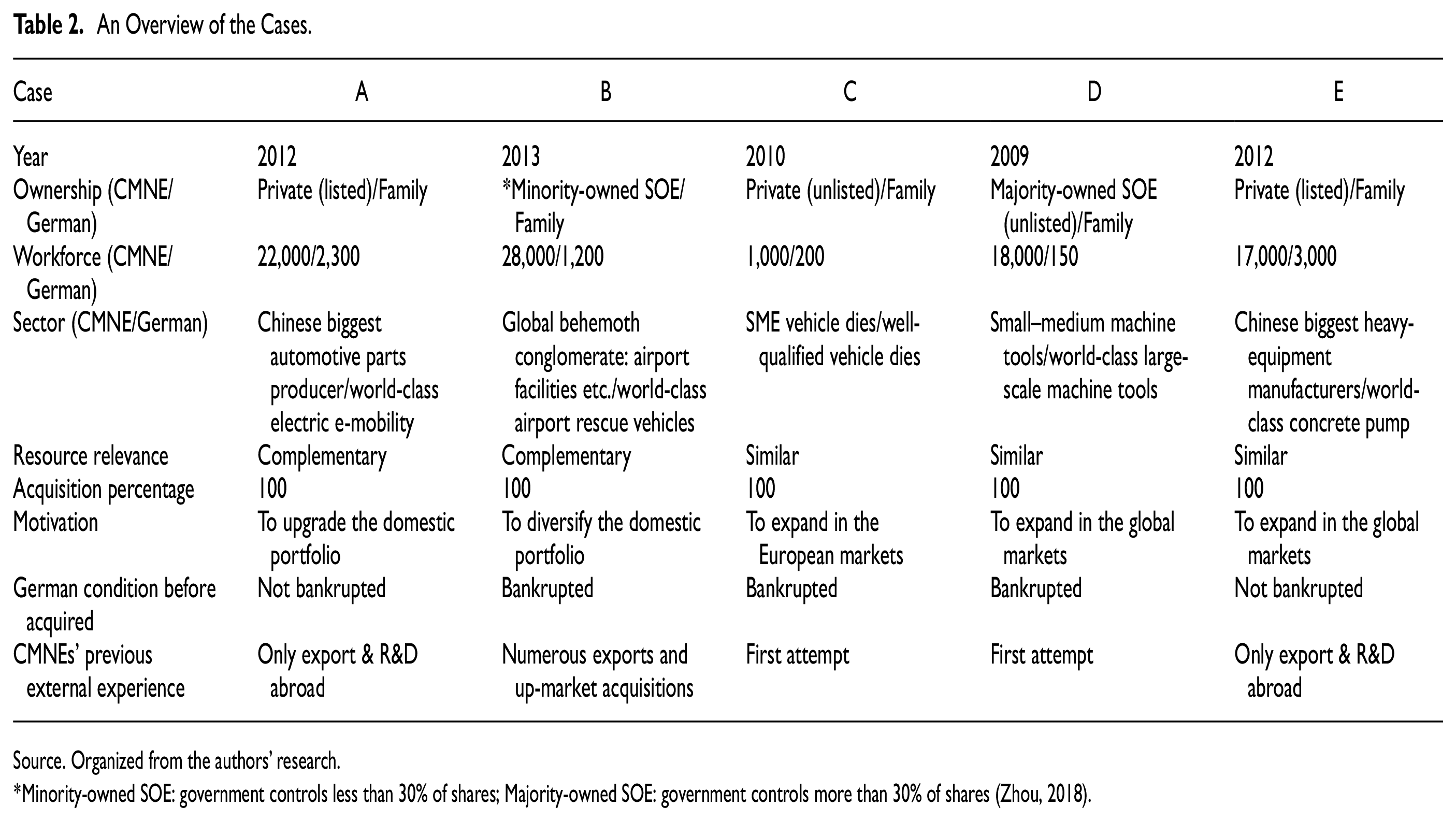
Source. Organized from the authors’ research.
Minority-owned SOE: government controls less than 30% of shares; Majority-owned SOE: government controls more than 30% of shares (Zhou, 2018).
Data Collection
We collected data using highly flexible, semi-structured interviews (Easton, 2010) and secondary archival files such as media press releases, analyst reports, firms’ annual reports, and previously published literature (Yin, 1994). We mainly interviewed highly knowledgeable top managers and staff who had worked in German targets over 4 years and were the most likely to determine strategic directions and have crucial insights and unique access to acquisition strategies and events. We then identified more interviewees through snowball sampling based on informants’ recommendations. To enhance cross-case comparability, interviews employed structured question outlines and customized questions according to the informants’ personal backgrounds. We first examined specific integration questions, such as how did CMNEs initially manage German targets’ structures and business following acquisitions? Did CMNEs adjust integration strategies over time? If so, when, why, and how did they change? We then introduced more questions regarding particular knowledge aspects. For example, how do you think about the two parties’ knowledge resources, such as managerial mindset and techniques? Does establishing mutual knowledge require CMNEs’ influence to integrate changes? In addition, follow up questions posed in repeated interviews sought to clarify missing or ambiguous details or expand more specific questions. Finally, 41 conversations were conducted with 37 informants via face-to-face, Skype, and other online video formats from March 2017 to November 2022. Each conversation lasted around 30 min to 2 hr. Referencing the interview data saturation principle of Guest et al. (2006) asserting that additional interviews could be curtailed when they only reveal knowledge that the researcher already gained from previous interviews, we reached this point with interview number 41. We applied several techniques to address informant bias. First, informants from multiple departments, and hierarchical levels were included in interviews, eliciting evidence from different vantage points. Second, we primarily focused on questioning key informants using open-ended questions to avoid recall bias. Third, we concentrated on factual events that were initiated to avoid informants’ speculation and improve accuracy (Maitlis, 2005). Fourth, interviews were anonymous, which encouraged informants’ candor, and motivation to offer us accurate information. Finally, we triangulated the resulting data by cross-checking multiple information sources such as archival files to minimize interview bias (Eisenhardt, 1989). Table 3 presents an overview of the informants and conversations.
An Overview of Informants and Interviews.

Source. Organized from authors’ research.
10+: refers to more than 10 years.
Data Analysis
We inductively analyzed the data to generate theoratical insights using grounded theory techniques, closely adhering to coding guidelines to examine and compare informants’ information and answer research questions (Gioia et al., 2013). Referencing the two dimensions of structural interdependence and activities coordination proposed by Kale and Singh (2012), we considered structural, or operational separations as autonomy and actual alignment or embeddedness as integration. First, we analyzed single case stories, treating one case with noticeable symbolic actions as a pilot case and coding its interview data and archival documents using the following three steps (Anand et al., 2007; Gioia & Thomas, 1996). Step 1. Constructing theoretical labels for the informants’ descriptions of CMNEs’ integration actions and events to ascertain how CMNEs advance integration. Based on our concentration on processes, we also focused on tracking the sequences of key events. We developed mutually exclusive categories using simple descriptive phrases (e.g., in vivo informants’ concrete expressions) as the first-order constructs (Gioia et al., 2013), then examined the relationships of these constructs to further aggregate them into robust second-order themes, synthetically considering informants’ expressions and referencing more abstract research terms (Gioia & Thomas, 1996). We next sought to identify relationships between themes and further developed labels to construct more abstract dimensions, referencing abstract terms from existing literature. We subsequently identified the elements that constitute integration-changing sequences and organized these process sequences. Based on the dominant mode of different processes, we spun off the timeline into three distinct changing periods of access, adjustment, and growth revealing tentative relationships between the dimensions and constructing a preliminary grounded model of how CMNEs’ integration changed. Step 2. After tracing how CMNEs’ PMI changed, we determined why strategies changed from the knowledge management perspective. Following the established coding logic, we conducted a new round of codingusing knowledge types and knowledge processes as analysis units, correspondingly labeled theoretical codes to reveal the relationships between the codes. Step 3. Finally, we further analyzed the causation of the codes of knowledge and integration and preliminary established theoretical relationships among knowledge types, knowledge processes, and integration processes.
Following the above pilot case analysis procedures, we preliminary coded the remaining cases in turn, transitioning to comparative case analysis using replication logic to compare and verify the replication of codes and theoretical relationships between cases (Eisenhardt, 1989; Zott & Huy, 2007), organizing similar, and discrepant views and practices among cases to replicate codes and theoretical relationships or propose new ones. We observed that all cases exhibited a consistent leitmotiv with common dimensions, wherein CMNEs changed modes in three periods, from autonomy to systemic integration to business integration, moving with different knowledge process needs in a forward spiral in which only some differences emerged in the aspects of integration degrees and completion efficiency that caused CMNEs across cases to stall different stages. The theoretical relationships between CMNEs’ PMI changes according to knowledge needs were confirmed repeatedly. We continued adding and analyzing more cases until the sixth case, when no further evidence suggested modification, contradicted the previously identified codes, or indicated new code categories or new insights. This process confirmed the dimensions that were previously coded, indicating that theoretical saturation was achieved. Finite cases enable researchers to balance managing considerable data and generate reasonable theories (Brown & Eisenhardt, 1997); therefore, we referenced the first five cases to finalize the study. We paired cases with similar or consistent patterns based on recurrent codes and temporal process changes to established a preliminary comprehensive theoretical relationship (Eisenhardt & Graebner, 2007). We then revisited the emergent codes, interview data, and extant literature to refine the preliminary theoretical relationships to ensure the transferability and replication of the final emergent theory. The repeated and constant iteration between data and theory helps sharpen the robustness of theoretical relationships among constructs (Ozcan & Eisenhardt, 2009). The coding data structure is presented in Figure 1.

Data structure.
Findings
How Did CMNEs’ Autonomy Integration Change?
Period 1 Access: Strategic Knowledge Accession Needs—High Autonomy
Strategic knowledge concerns the “dominant logical knowledge” that significantly influences an entire organization and production unit, including competitive domains, business landscape changes, and knowledge regarding industrial and organizational strategies and business models (Hong & Nguyen, 2009). Accessing this underlying knowledge requires top executives to become familiar with local mindsets and practices to further determine necessary strategic or operational changes. Granting German employees’ autonomy to observe German business circumstances helps CMNEs to understand local politics, culture, agents’ personalities, and perspectives regarding the acquisition to comprehend things holistically.
Cases A and B: Partnering
Cases A and B presented distinct features of immediately partnering after deals were closed. At the time, the Germans were concerned about a significant risk of technology theft and CMNEs shuttering firms and departing. They also doubted that CMNEs could lead them to a turnaround, so the tone was negative (“They seemed to lack experience”). The German targets were known worldwide, with high-quality focus and strong brand influence, and the CMNEs were newbies with less global brand recognition (“In terms of understanding car technology, we were much worse. We had a huge gap with the Germans”). Instead of forcing the Germans into Chinese HQ, the CMNEs expressed their sincerity by providing development funds to improve their financial predicaments. Chinese capital injection demonstrated that the CMNEs strongly supported the development of the Germans. Most German resources remained original, except that CMNEs built a new financial division, regularly reporting German financial performance to the Chinese HQ. A Chinese executive was placed in target A as the chair of the German advisory board. He often walked around factories to observe the Germans’ processes (“Integration might be a risk without knowing their philosophy”). Acquirer B directly nominated a Chinese executive as the German CEO, with two Chinese assistants to support the German recovery since target B had been compulsorily liquidated due to a malicious monopoly and its former German managers had been dismissed by the German court. However, none of these Chinese intervened in the daily operations except to offer strategic advice (“We do not oversee how many they produce or when they deliver. We keep watch over the general direction”). German executives continued to assume the responsibilities of supervising the original teams and managing businesses and clients as before. The Germans praised frequent mutual communication. “We have many formal meetings and informal talks face-to-face or online. Their feedback is quick” (case A). “They told us a clear blueprint for the next five-year-development at the beginning. They listened to our opinions” (case B). In addition, CMNEs frequently organized staff rotations to enhance mutual familiarity, placing some Chinese staff stationed in some German departments to support Germans in executing daily tasks.
Cases C, D, and E: Preservation
Cases C, D, and E exhibited preservation characteristics. CMNEs C and D had almost no impact other than quickly placing German brands behind Chinese brands. CMNEs did not dispatch any Chinese executives into German positions; hence, the original German management team (e.g., factory manager, marketing managers, and drawing designers) remained unchanged. German employees were euphoric regarding this acquisition, which symbolized the German brands’ promising revival to regain the original German market status. CMNEs deployed no further interactions regarding activities, with rare coordination beyond the promised continuous investment (“After the deal closed, the shareholder rarely visited us”). Target E also remained an original independent entity. All original German resources were maintained and the CMNE in case E explained:
Their (the Germans) brand has a high reputation and will benefit us in the European niche market. European customers assumed that the gene of the German brand would no longer be pure and premium after the acquisition, which is not our intention. We hope to keep the German brand’s high quality. Keeping German brands can prevent brand dilution and protect the high-end image of German products.
Like acquirers A and B, acquirer E merely proposed strategic suggestions that were coordinated through a delegated Chinese CLO and did not interfere with German daily operations. Financially, the CLO monthly reported German fiscal performance to the HQ in China (“The most important thing is to keep an eye on money to avoid misappropriation. All acquirers will do it. However, we generally return all profits and dividends to the Germans to support their future operations”). To resume German operations, the CMNE enlarged old German plants and invested additional funds in establishing new factories, office buildings, and canteens. Nonetheless, the CMNE realized that “preservation can be beneficial for retaining German talent and sophisticated technologies, but the Germans seem dissatisfied with us. It is not easy to communicate with them. They frequently ignored our orders and insisted on going their way.”
Period 2 Adjustment: Systemic Knowledge Transfer Needs—Systemic Integration
Systemic knowledge refers to the knowledge of organizational structures and systems, operational practices and improving system processes such as quality control procedures. Following the first period of strategic knowledge access, CMNEs determined that despite the Germans beginning to recovery, German financial status appeared weak with heavily weighted liabilities, which were largely caused by previous problematic German managerial structures and systems. Autonomy alone could not transition the acquisitions to profitability or a promising outlook, driving CMNEs into the next integration period.
Cases A and B: Systemic Absorption (Selective)
The products that German designers thought to be the best did not fit customers’ evolving tastes and demands; however, the proclivity toward pursuing high quality generated high procurement and development costs. The German manufacturing style of investing a lot to produce the best quality products has always been the predominant barrier to profitability. These challenges existed before acquisitions but had been hidden with unreliable information during due diligence.
After the initial period interactions, we gradually realized that the Germans over-focused on technology R&D. They all mastered excellent technique skills; however, they did not care about the constantly changing market conditions. German products are excellent, but the market does not need them. That is why they went bankrupt.
In short, Germans lacked a customer-oriented attitudes, and were weak in controlling costs and satisfying customers’ needs, necessitating the competitive advantage of CMNEs’ systemic structure. Therefore, CMNEs became actively involved in targets’ details, transferring Chinese efficacious systemic managerial mechanisms to the Germans to turn the targets around by adjusting or aligning traditional German organizational policies and structures with those of CMNEs. Target A was listed on the Chinese A-share market and German executives formally joined the Chinese HQ’s Board of Directors to contribute to decision making. The Chinese director of the procurement and supply chain department had equal decision making power and voting rights as German executives. The original German sales teams were entirely reorganized, and many young German salespersons were newly recruited, while stubborn former salespeople were dismissed. The CEO often invited all departments for beers and dinners together, during which he regularly praised and awarded the sales staff verbally and financially, so others recognized the importance of sales. He also called meetings with all German staff to impart the Chinese managerial ideology of “the customer is No.1” and hung wooden signs declaring “the market is the first” all over the factories and offices to remind the Germans of the anytime and anywhere ideology. In case B, the “concentration” seems more pronounced. A German technical staff noted, “unlike before, the Chinese CEO still listened to our opinions, yet would decisively make his own decisions in case he found ours were not right.” The CMNE beginning promoting a Sinicized Executive Committee structure with one Chinese-controlled seat and six rotating European branch seats replacing the flat German managerial system. In addition, standardized Chinese Group Rules were released to centralize the previously dispersed European branches. Supplier systems also went through large-scale reorganization. The CMNE replaced the previous European suppliers with Asian suppliers from China and Korea that offered reliable products at lower costs, lowering the targets’ purchasing costs without compromising product quality. European subsidiary managers who proved capable of handling this shift were promoted to Executive Committee members.
Transferring this knowledge type from CMNEs altered the traditional German approaches to performing their jobs and caused a considerable shift in the mindsets of the local German managers, cognitive orientations from technical focus to customer focus and from functional orientation to organizational orientation. Issues of production over-capacity were eased and cost structure was optimized by transitioning from production to sales focus as an operation driven by customer demand. Notably, the CMNEs’ absorption intent was not to entirely control targets but to selectively absorb the essential aspects (“It is imperative to adjust their unreasonable structures, which of course generated opposing voices for forcing them to give up their old habits. However, we solved these voices through adequate communication and sincerity, which increased our mutual emotional commitment”). For example, CMNEs often held various forums to share mutual best practices (“We do not force Germans to use the systems or materials we recommended but first let them try. It is the best way to change their opinions”). Germans usually received patient explanations or assistance from CMNEs, rather than being reprimanded for unintended work mistakes. In addition, although CMNEs selectively absorbed some parts, autonomy remained an overriding perspective. German original identity was maintained and the Germans kept self-control over production lines. Systemic knowledge transfer in period 2 achieved some cost and sales synergies and established the foundations for further integration.
Cases C and D: Systemic Absorption (Full)
In the first year, a severe profit downturn drove CMNEs to identify German structural and systemic flaws that high autonomy could not solve (“We had anticipated a possible financial loss because the Germans needed time to recover their operations; however, the loss was too much to go beyond our anticipation”). The severe profit downturn was considerable because of problematical former German systemic structure and practices prior to the acquisition. No budget department or staff was established to manage budget issues in target C, resulting in no one understanding an order would be profitable prior to production. In target D, many employees exhibited narrow perspectives of performing jobs and merely concentrating on fulfilling specific responsibilities. In particular, between the sales and production departments, salespersons obtained as many orders as they could to improve their own performance; however, colleagues in the production department complained that they were unable to fulfill the many orders on schedule (“We had to pay much compensation to clients because of the production delays”). Departments must act collaboratively with one another. However, the German work ethic of shirking additional responsibilities and departments’ structural flaws made CMNEs mistrust the Germans and CMNEs began to introduce Chinese-style bureaucratic centralization practices (“I thought centralization works in China, so it should work in Germany as well”). CMNEs arranged for a Chinese controller as CEO to supervise the Germans’ every move, and the German executives were downgraded and deprived of autonomy. A unique two-tier systemic structure arose in which the German executives were required to get the CEO’s signature on all documents before purchasing materials or conducting operations; however, the CEO first had to report to the Chinese shareholders and ask for permission and Chinese shareholders controlled everything rigidly (e.g., material procurement, and project implementation). Germans’ initial euphoria subsequently declined dramatically. The Germans first attempted to communicate within firms but later initiated litigation through the courts in an attempt to struggle for rights. From a knowledge management perspective, the CMNEs’ efforts did not compensate for successfully transferring systemic knowledge to targets because the centralization was not approved or absorbed by the targets but trapped the two sides in severe conflicts and tensions. The local managerial mindsets and cognition did not shift, and cost structure, and budget issues remained severe. Unlike acquirers A and B who made targeted adjustments according to existing circumstances and expertise, acquirers C and D did not employ adequate communication and support, instead authorizing increased dominance, which resulted in German pressure, damaged trust and impeded transitioning to the next period of technical knowledge combination.
Case E: Systemic Autonomy
Acquirer E faced enormous integration pressure as target E exhibited similar deficits in cost control and satisfying customer demands as targets A and B. The CMNE attempted to intervene in German structural arrangements but confronted strong negative public response (“German sides had bad attitudes and felt it was unnecessary, which made us embarrassed, and felt hurt”). The German staff had opposed this acquisition proposal in the deal’s early negotiation period, contending that there was a big gap between the two sides (“They did not want to cooperate or listen to us because they thought we were incapable”). In this period, target E had no significant structural changes other than the original German CEO’s departure because of managerial conflicts with the CMNE; a position that was quickly filled by a new German senior poached from another Asian firm. This new German CEO agreed with the Chinese culture and managerial mindset and the CMNE hoped that he would transfer Chinese strategic ideas; however, the process has been rather slow and is still underway. Some management teams in the German branches around the EU were slightly restructured, but this was based on the German internal executives’ decisions with no ties to the Chinese acquirer. In this period, the CMNE’s restraint, and German resistance made CMNE’s systemic knowledge transfer stall. The German managerial structure remains one of high autonomy, and German local managerial mindsets and cognition had not shifted, foreshadowing a much more challenging circumstance for the following technical knowledge combination period.
Period 3 Growth: Technical Knowledge Combination Needs—Business Integration
Technical knowledge concerns a series of knowledge regarding basic technologies (e.g., marketing positions research, and production operations) that represents organizations’ operational practices. The intensity of systemic knowledge transfer decreased when entering this period, while technical knowledge combination needs became the focus, which required CMNEs to adjust business operations across business and geographical boundaries.
Cases A and B: Business Symbiosis
Through the previous stage of systemic knowledge transfer, the new governance structures effectively accelerated the operations of German businesses. Cases A and B smoothly progressed to the next period of mutual technical cooperation. Acquirer A needed to obtain experience in German professional work methodologies; thus, they created a joint-project team, bringing the two sides’ professionals together to enable technical co-participation (“Customers need products and services with expert experience. We have to count on combined teams, so we built it”). Business combination activities continue to be performed in tandem, and such interactions and mutually supported teams have strengthened mutual business capacities and helped CMNEs develop the knowledge that they intended to expand. Similarly, acquirer B mixed Chinese, and German local expertise into multidisciplinary teams (“We aim at offering clients high-quality and diverse products with German experts in the project”). The two parties gained growing profit by developing and introducing the combined new products to global and Chinese markets. The Germans previously focused on mature European markets only, while understanding less of the vast Chinese market. The CMNEs vigorously promoted the Germans access to the Chinese market, such as building, and running a plant. The co-built plant symbolized a bridge linking China and Germany and led to mutual benefits through cooperation (“We design product planning, source materials, and discuss detailed prototype engineering together”). The two sides engaged in deeper cooperation, such as investing in future-oriented high-end technologies together such as driverless cars, intelligent vehicles, and new energy sources for electric automobiles. Production in this period continued to increase steadily and created more employment opportunities. The number of new employees and offices continuously grew. The Chinese market’s sales growth made a considerable contribution to German targets’ revenue, turning previous adverse losses into gains. The Germans exhibited a significant change in attitude, realizing that without CMNEs they would perhaps no longer exist. The business symbiosis in this period accelerated mutual technical knowledge combination with a promising development outlook. Acquirers A and B are on the road to rapid growth.
Cases C and D: Business Absorption
The failure of systemic knowledge transfer in the former stage had eroded the possibility of technical cooperation. When entering the third period, internal tensions of cases C and D were amplified more severely, further weakening trust, and communication. CMNEs’ strict centralization had heightened the German emotional boycott. Many opposing opinions on operations and business lines led to more conflicts. Many projects were set aside because of the German’s claims that the CMNEs lacked knowledge of German laws (“Countless quarrels. The hardest issue for us is handling cumbersome German law and operational procedures. Their legal regimes and regulatory frameworks are quite different. These Germans always regard their way as the best. I cannot manage them”). Further investment in the targets was not beneficial for CMNE, and the CMNEs decided to transfer their attention back to the Chinese market, requesting that the Germans abandon German production to support the Chinese HQ’s production. The German team was assigned a supporting role during this period (“Previously, we had a relatively high component of European market participation; but now it flipped”). German production lines at this moment were sunk. Acquirer C arranged the Germans’ many orders of ancillary machining to aid in die-casting production for China’s HQ; however, many projects were postponed as the machines were too old to work. Acquirer D required the Germans to mass-produce parts to back the Chinese site’s equipment production while prohibiting them from entering the Chinese market to avoid competition; however, the German factories were manual workshops that were particularly suited for producing large-size machine tools and could not perform mass production. In this period, German production was tightly controlled by CMNEs, and the German brand reputation was severely damaged. The need for technical knowledge combination was not accommodated as technical learning and support was ineffective. The Chinese rotating engineers and other staff had no further insights after visiting the German factories and did not put the technical training from what they learned in Germany into practice after returning to China.
We suggested the Chinese build a base or a team in China to show our German skills and technologies to Chinese domestic colleagues to support their future production; however, they did not build it. How to process mold-making? How do components fit together? They do not care much about variance and precision in the assembly process.
Currently, the Sino-German brand sample machines are only exhibited to clients but cannot be mass-produced.
Case E: Business Autonomy
The immersion failure of the former period’s systemic structure excluded acquirer E from outside Germany without gaining real power and authority. Acquirer E attempted to work in tandem with the German local know-hows and Chinese expertise; for instance, developing common technical platforms to expand European markets geographically. However, the German site refused to share knowledge, so acquirer E could not access European markets. The two sides remained as original in facing their respective original markets. Unifying the purchasing channel was also out of the question for the Germans, who claimed they would not use Chinese resources but continued purchasing resources from their original European suppliers to ensure product quality (“We cannot enter into global markets only relying on ourselves, but we do not have more choices in the case that the Germans do not cooperate with us”). Business autonomy facilitated an unsatisfied and compromised outcome for acquirer E attempting to collaborate with the target. In this period, German business operations maintained high autonomy, and the technical knowledge combination that acquirer E expected seems difficult to achieve.
Why Did CMNEs’ Autonomy Integration Change? An Analysis From the Knowledge Management Perspective
After identifying the dominant mode in each period and the form of changes, we next examined why CMNEs’ integration changed. The knowledge-based perspective allowed us to identify the crucial causes of changes, which has not yet been explored in extant literature. Analyzing how PMI modes changed revealed that the needs for different knowledge types processes also changed, affecting each stage, and leading to changes between periods. Different knowledge types are continuously being accessed, refined, discarded, or recombined during PMI, and the knowledge needs continuously change.
We determined that the constantly changing knowledge needs imply different knowledge types are the most crucial for CMNEs in different PMI periods. In period 1, CMNEs sought to access German local strategic knowledge regarding actual operations and potential development opportunities, which is where CMNEs’ autonomy strategy began. The process of accessing local strategic knowledge distinguished local actors’ knowledge and culture and cultivated awareness of local environmental changes, which facilitated CMNEs’ understanding of the integration priorities to determine the appropriate integration directions. In general, all cases assumed a high autonomy strategy in period 1 to systematically access local strategic knowledge. Working side by side with German locals allowed CMNEs to understand the distinct market dynamics of the German environment, business procedures, and stakeholders (e.g., the German staff, customer groups, local community and government) through first-hand experience. Granting high autonomy increased trust and generated certain reputational benefits for CMNEs. As acquirer A said, “Our Chinese brand became famous globally after the acquisition. We were unknown before, but now people recognize that we are German shareholders. It is truly beneficial for us to enter into the international market.” High autonomy also made the integration seem to be a rather slow process. Access to strategic local knowledge of business operations, culture, and employee attitudes in this period significantly influenced CMNEs’ subsequent alteration of practices of German work systems.
After gaining sufficient strategic knowledge to make decisions on integration adjustments, the strategic knowledge need of the first period has become obsolete. The second period primarily endeavors to transfer CMNEs’ systemic knowledge to the German targets. CMNEs continued advance familiarity with targets but the main objective shifted to adjusting problematic structures. In all cases, the purpose of the second period was to determine an appropriate match between CMNEs’ managerial principles and local idiosyncrasies and challenges. Transferring this knowledge type predominantly occurs through adjusting all necessary structures and procedures to navigate challenges within the idiosyncratic conditions of the local context. Although it is difficult to pinpoint the boundary between the first to second periods, in each case, each CMNE came to a point at which they shifted attention from access to adjustment. However, the systemic transfer completion and efficiency of these cases differed during this period. Effective CMNEs balanced autonomy and integration appropriately. For example, acquirers A and B recognized the necessity of facilitating hierarchical relationships while maintaining operational autonomy, concurrently adopting administrative centralization, and participatory operational decentralization. Balanced integration made it easier to alter problematic systems and structures. Effective structural changes in German local offices were achieved through systematization to integrate CMNEs’ advantaged systems, policies, and procedures. The need for systemic knowledge transfer then diminished accordingly, eventually becoming obsolete, which established a springboard that allowed CMNEs to enter the next growth period focusing on technology combinations. In comparison, CMNEs that were over- or less-integrated in this period can cause integration rigidities and systemic issues could not be (completely) solved; however, technical combination needs were still imminent and crucial. Technical knowledge combination requires the effective adjustment of targets’ operational procedures, which is inseparable from effective systemic and employee support. The over- or under-integrated CMNEs found it challenging to achieve technical synergy. Over-integration in the second period can transfer into the next period and negatively affect technical combination. In contrast, under-integration in the systemic adjustment period could trap CMNEs outside of targets, leading to a considerable delay in satisfying technical knowledge combination needs.
Taken together, changing knowledge needs appear to be a crucial driver of CMNEs’ PMI changes, more precisely speaking, and are interrelated in such a manner that can strengthen or weaken subsequent stages. Access, transfer, and combination of differing knowledge types are ongoing processes, but their relative importance changed in different periods, dominating CMNEs’ continuously changing integration modes. Once one knowledge need was satisfied, it was no longer a priority and ended at different periods. These finite changing knowledge needs enabled successful CMNEs’ PMI modes to gradually spiral forward to an ideal balance of autonomy and integration, while the completion, and efficiency of former periods’ integration and knowledge needs play roles in the next period.
Discussion
Building on the previous findings, we next construct a theoretical framework to illustrate the changes and evolutionary relationships of CMNEs’ PMI modes and knowledge (Figure 2). Our findings enable us to make both theoretical and managerial contributions to the field of CMNEs’ cross-border acquisitions in developed markets.

A spiral forward framework: a knowledge perspective of CMNEs’ post-merger autonomy integration changes.
Theoretical Implications: A Spiral Forward Framework
Our research has extended the existing literature in several aspects. One contribution is that recent publications have described and predicted a general changing trend in integration in which CMNEs decrease autonomy and improve the degree of integration over time (Chen et al., 2023; Tang & Zhao, 2017). A critical question arises as to what integration enhancement changes should specifically look like. This study revealed a processual understanding of CMNEs detailed PMI changes from autonomy to different degrees of integration (balanced integration, over-integration, and delayed integration), making up for the shortcomings of previous research that merely posited a general trend of strengthening integration. A more crucial contribution is that our research touched upon a vital discussion in PMI literature regarding the role of knowledge in advancing or hindering integration changes, which has not yet reached a consensus (Cantwell, 1992; R. Grant & Phene, 2022; Mudambi, 2011; O’Higgins et al., 2022). Our conceptual framework indicates that the answer is related to CMNEs’ PMI changes, which are related to the needs of different knowledge processes in a progressive spiral forward manner. We found that CMNEs changed one PMI mode to another in an incremental process that allowed different knowledge types to flow across boundaries. Changingknowledge needs facilitate changing integration goals and modes in different periods and are the consequence of specific processes being finite by nature. For example, strategic knowledge access that occurs through partnering with local targets is finite. Once this strategic knowledge was accessed, integration shifted toward the next period, confirming the predictions of Kale and Singh (2012). The next systemic knowledge transfer was also typically finite. Once recipients gained practical systemic knowledge, the process became less important and was no longer necessary, after which, technical knowledge combination needs triggered the integration changes of the following period. The mode that takes priority in a given period is associated with different knowledge types’ processes. This discovery appears to align with the knowledge-based perspective in which firms adopt the most needed mechanisms to maximize specific knowledge process efficiency (R. M. Grant, 1996; O’Higgins et al., 2022).
Our emphasis on CMNEs’ integration progression and knowledge management is similar to recent findings (Chen et al., 2023; O’Higgins et al., 2022), but with some notable additions. First, our findings shed light on the less focused area of the combination of knowledge types and knowledge processes in current literature (R. Grant & Phene, 2022) that has yet to be investigated. Additionally, our study brought to light the stages of access, transfer, and combination knowledge processes during PMI progression. Extant studies have predominantly focused on knowledge transfer examining how knowledge flows from targets to CMNEs to alter CMNEs’ knowledge base (Annosi et al., 2021; Chen et al., 2023). However, our study highlights that these circumstances are more complex at different PMI points. For example, in the initial knowledge access period, CMNEs must observe the targets’ knowledge base prudently. The subsequent knowledge transfer period requires CMNEs to “reverse” transfer systemic knowledge to optimize targets’ knowledge base rather than that of CMNEs, which seems to be against the current common sense. In the knowledge combination period, both parties’ professionals share knowledge, seeking to collaboratively develop mutual specialized knowledge to make internationalization more valuable rather than simply transferring targets’ knowledge to alter CMNEs’ knowledge base. In short, in contrast to existing literature, our framework offers a more comprehensive understanding of CMNEs’ PMI dynamics and knowledge management by uncovering insights regarding the evolution of the nature and changing knowledge needs of PMI dynamics.
Managerial Implications
Considering firms as a mechanism for promoting knowledge flow, the findings of this study have implications for managerial practices related to CMNEs’ acquisitions in developed markets. Although the high autonomy strategy seems appropriate for protecting targets’ resources, it delays actual integration, and synergy in the long run. This suggests that it is essential for acquirers to strive to balance short- and long-term integrations. We advise that acquirers understand and determine how to address integration dynamically following acquisitions. Acquirers should gradually and reasonably change the initial high autonomy strategy and promote integration mechanisms to foster knowledge flow. This study revealed a spiral-forward evolution of integration changes and knowledge needs, which could help CMNEs pursue the most appropriate long-term modes. We found that CMNEs’ PMI processes occur in multiple periods, which present value chains with interrelated activities, and acquirers must identify, and focus on all process periods. Choosing which mode is appropriate in a specific period requires strategies determination of when access, transfer, or combining knowledge is needed. Generally, in the early period, allocating supportive resources to initiate cooperative and supportive practices is essential for acquirers to access targets’ strategic knowledge, such as understanding employees’ attitudes and social culture to prepare for the following actual integrations. Once targets’ substandard structures are identified, acquirers must transfer robust, and efficient structural systems to targets. It is normal for targets to be concerned about domination. Addressing targets’ negative perceptions through adequate communication, support, and matching local routines is crucial. Acquirers should be mindful of initiating specific actions to avoid trust collapse and reflect on actions that could hinder progress. When unhealthy structures are corrected, acquirers can then smoothly shift attention to combining mutual technical practices to maximize the acquired practical knowledge and achieve synergy. In short, our findings generate a framework that acquirers can use to identify the current period in the PMI process and reflect on the best practices to advance the integration process according to specific knowledge needs in different periods.
Conclusion
We conducted qualitative research regarding five Chinese acquisitions in the German market that exemplify CMNEs’ strategic asset-seeking in the developed markets. The findings expanded the understanding of how different PMI periods build upon one another to deepen the relationship between CMNEs and targets to progressively achieve mutual benefits as well as why CMNEs change PMI modes from a knowledge management perspective. We determined that CMNEs’ PMI changes proceed through three periods of access, adjustment, and growth, from autonomy to systemic integration to business integration, moving in a forward spiral based on the needs of different knowledge types’ process. The completion efficiency of former periods’ integration and knowledge needs influences the subsequent periods, ultimately leading CMNEs’ PMI from autonomy to three potential degrees of integration that include balanced integration, over-integration, or delayed integration. Our research emphasized the role of knowledge as a crucial and influential driver in CMNEs’ changing modes of PMI exploration.
Limitations and Future Research Directions
Our research has three limitations that can be considered as future research directions. First, the samples of this study only focused on Chinese manufacturing industry firms and did not include other industries. Producing more generalized conclusions require examining whether our spiral-forward framework is equally suitable for application to other industries. Second, the generalizability of our findings based on a small sample multi-case study may be limited. Despite our sample presenting different outcomes regarding degrees of integration, other cases that differ from ours in many crucial aspects undoubtedly exist. However, we surmise that the spiral-forward relationship between the changes in PMI and knowledge needs is a universal phenomenon. With the continuous deepening of integration, changing knowledge needs will result in changing autonomy and integration over time. Therefore, we argue that our framework presents a theoretically sound generalization. Small sample case studies endeavor to generate new theories rather than generalize specific circumstances; hence, our intention to develop a general conceptual framework was achieved. Future research could investigate different evolutions for valuable comparison with our framework. Finally, although we accessed rich data, the informants’ perceptions, which were primarily acquired from the Chinese side, may still be influenced by bias. We endeavored to compensate for this limitation by including interviews with as many Germans as possible and including firms’ internal documents and published authorized articles. Future studies focusing on acquired targets to enhance our understanding are most welcome.
Footnotes
Acknowledgements
The author sincerely appreciates the editors for the work on this paper and thank all anonymous reviewers for their efforts and valuable suggestions that helped us to improve this paper significantly. The author is also sincerely grateful to all interview respondents in this study for providing insightful data for the research.
Declaration of Conflicting Interests
The author declared no potential conflicts of interest with respect to the research, authorship, and/or publication of this article.
Funding
The author disclosed receipt of the following financial support for the research, authorship, and/or publication of this article: this work was financially supported by the R&D Program of Beijing Municipal Education Commission (Grant No. SM202310009002) and the Newly Introduced Teachers’ Scientific Research Start-up Funding of North China University of Technology (Grant No.110051360023XN224-60). The author sincerely thanks the funder for providing financial support for the interview data collection of this study and the language proofreading services of this paper.
Ethical Standard
This paper complied with the code of ethics.

Data Availability Statement
The data that support the findings of this study are available from the corresponding author [Yanan Yang, Email: