




Abstract
The impact and changes due to sudden internal or external occurrence are difficult scenarios faced by many business organizations. The COVID-19 pandemic has wreaked havoc on the nation’s economic, social, and technological progressions. The effects of the sudden, extreme changes and uncertainty toward the environment require business organizations to further adapt and change to improve their survivability. Dynamic leadership requires leaders to make sudden changes improving adaptability or marketing capabilities to stay resilient and relevant to the mass market. Thus, the goal of the present study was to investigate the influence of dynamic leadership and marketing planning on organizational resilience in the context of Malaysian Private Higher Learning Institutions (PHLI). In this paper, the study performed PLS-SEM on the data collected using purposive sampling of 224 respondents, consisting of managers from colleges and universities in urban areas of Malaysia. The SEM was used to test on the levels of relation and whether there was any mediation between the tested variables. The study revealed that the dynamic leadership and marketing planning of Private Higher Learning Institutions’ (PHLI) managers can improve organizational resilience. It highlighted the impact of leadership values has on improving overall market plans and affecting their resilience. Marketing planning should not be neglected as it is one of the crucial factors in achieving resiliency. The study’s results are timely as they provide information for users to improve their overall survivability. The value of marketing planning should not be lightly treated as it has a serious impact toward organizational resilience. It is an important element for organizations in the current state of where survivability is essential in an unpredictable environment.
Introduction
The impact of COVID-19 pandemic is a global issue with serious outcomes on the society (Lengnick-Hall et al., 2011; Prayag et al., 2020; Suryaningtyas et al., 2019). The spread of the coronavirus causes severe and negative impact that resulted in stark dislocation among businesses in the world (Bartik et al., 2020). The pandemic has caused economic recessions, uncontrollable inflations, and societal instability around the world (Dev & Sengupta, 2020; Jackson et al., 2020; Karabag, 2020; Ryan et al., 2020). This provides a unique opportunity to study the impact of such external shocks on certain businesses or economy. The importance of organizational resilience in addressing this unprecedented situation would illustrate the effective methods in overcoming and maintaining organizations (Carmeli et al., 2020; Huang et al., 2020). Some businesses are focused on improving their resources to increase the survival rate throughout the pandemic (Beninger & Francis, 2022). The study explored the conditions of Private Higher Learning Institutions (PHLI) during the pandemic which focused on dynamic leadership and marketing planning that have enabled them to survive and become sustainable.
Organizational resilience comes from the initial development of general systems theory that relates the economic impact with the elements of experienced people in these areas that results in further understanding of the discussed research subject (Boulding, 1956). These discussions of resilience in the first instance was in the areas of ecological research that investigated its role in the ecosystem (Holling, 1973). Throughout the years, this had then been further developed in other fields of study such as organizational management that explores the resilience of business organizations toward external factors and environments (Carmeli et al., 2020). In this sense, organizational resilience in business organizations is their ability to sense, correct, and cope with unexpected situations in order to ensure that their business has sustainability (Gillespie et al., 2014; McManus et al., 2008). This study utilized the values of leadership and marketing to evaluate their impact on organizational resilience.
Previous works of literature in leadership have come a long way in terms of its theoretical development, trait-based, and styles (Huberts et al., 2007; Lok & Crawford, 2004). The question would be on how organizations are able to continue nurturing the value of their resilience (Barasa et al., 2018). There are opinions that through developing leadership and resilience, organizations become more sustainable (Moran & Tame, 2012). A case study conducted in New Zealand revealed that through proper identification and support of leadership values in management, the organization itself was able to improve its levels of organizational resilience (McManus et al., 2008). The study of a financial institution in Scandinavia exhibited that structure in leadership such as a decentralized structure and clear process flow enabled its leaders to achieve further in their organization and improve overall organizational resilience (Andersson et al., 2019). The above examples relate heavily on how such leadership values were able to influence overall organizational resilience.
Marketing planning would be the process of where an organization develops certain strategies, methods of achieving it, and when the desirable outcome can be obtained (M. McDonald, 2016). The researcher initially stated that marketing planning is when a business uses an approach to survive successfully (M. H. B. McDonald, 1992). Meanwhile, other authors stated that marketing planning is the use of critical planning for a business to have sufficient strategies in overcoming any unexpected events (Gilligan & Wilson, 2012). In other words, the interaction between leadership and marketing presents methods enables organizations to improve their levels of resilience (Lin Moe, 2012).
The present study examined the impact of leadership and marketing on organizational resilience during unexpected events. The leadership construct consisted of a dynamic leadership in terms of being corroborative and teamwork in a form of adaptive leadership where a leaders reacts and changes the construct of the team (Tucker & Lam, 2014). Whereas marketing planning was evaluated in terms of techniques and activities (Pulendran et al., 2003). It is believed that organizational resilience comes from the perceived ability that organizations would be able to overcome any unprecedented events and adopt changes (Prayag et al., 2018, 2020). Hence, the two key research questions this study sought to answer are: (i) how the values within a dynamic leadership influence the resilience of Private Higher Learning Institutions (PHLI) post-disaster; and (ii) how the influence that marketing planning would have on organizational performance.
Literature Review
The research in the areas of organizational resilience indicates that there is strong interest in this research subject (Brown et al., 2017; Denhardt & Denhardt, 2010; Duchek, 2020; Pal et al., 2014; Prayag et al., 2020). The same goes for research in the areas of dynamic leadership which stems from dynamic theory and leadership styles (Basham & Mathur, 2010; Bhattacharyya & Jha, 2018; Isaac Mostovicz et al., 2009; Shondrick & Lord, 2010; Von Lubitz & Wickramasinghe, 2006; Whittaker & Montgomery, 2022) Studies in these fields provide invaluable information toward understanding organizational behavior.
Theory
The sources of dynamic theory in the fields of mathematical and physics are often related to fields of calculation, motion, forces, and other related scientific fields of study (Maine & Iliff, 1985). Meanwhile, dynamic theory in the fields of social sciences is associated with the fields or organizational, strategic management, organizational management, and behavioral research (Bougon, 1992). Being part of systems theory, the dynamic theory is presented as a flexible emerging aspect of behavioral change (Thelen, 2005). Discussing dynamic theory can often lead to an evolutionary perspective, meaning that it takes into context the use of systems theory when conceptualizing the use of dynamic theory (Spender, 1996). Dynamic capabilities comes under organizational theory and strategic management that relate to the capability of an organization in changing and adapting its environment (Teece et al., 1997). This means that dynamic capabilities is part of systems management theory which takes into account the use of dynamic theory, especially from a perspective of dynamic systems theory (Flam & Powell, 2009). The dynamic systems theory is the conceptualization of changes in development with a complex system that involves interaction with multiple factors, which can affect the overall output (Newman & Newman, 2010). Similar studies have used resource advantage theory in examining marketing capabilities, leadership, and strategy (Hunt & Madhavaram, 2020). This study, on the other hand, utilized these dynamic capabilities and strategic management to develop a framework that analyzes its impact on organizational resilience.
Figure 1 shows the overall framework as strategic management and dynamic leadership are part of dynamic theory. The purpose of the study was to examine factors that contribute toward organizational resilience in Private Higher Learning Institutions (PHLI). The study investigated whether dynamic leadership and marketing planning would have any contributions toward organizational resilience. To this extent, the study aimed to
Examine the relationship between dynamic leadership toward organizational resilience,
Examine the relationship between marketing planning toward organizational resilience,
Examine the relationship between dynamic leadership toward marketing planning, and
Examine to a certain extent whether there are mediation effects between dynamic leadership and marketing planning toward organizational resilience.

Dynamic theory based framework.
Dynamic Leadership
Dynamic leadership in an organizational management refers to the style of organizational leadership based on collaboration, teamwork, and strategic planning (Tucker & Lam, 2014). The importance of a dynamic leader in the marketplace fosters innovation and creativity that enhances the organizations survival ability and market competitiveness (Hong et al., 2022). Leadership comes from a continuous process of confirming, granting influence, communicating, and interpreting actions that will result in different outcomes (Andersson et al., 2019). Dynamic leadership are leaders that not only influence their followers, but also interact and develop the growth of their employees together (Basham & Mathur, 2010). There is a need to have a balance in large organizations, especially in hierarchical and command-and-control style of organizational leadership that can contribute to larger gaps in communication and non-inclusive decision-making processes (Tucker & Lam, 2014). Prior work of literature has indicated that communication in the forms of mentor-and-mentee relationship can foster dynamic leadership (Crow & Matthews, 1998; Newman & Newman, 2010). The need of having a dynamic leadership ensures that the organization remains resilient in the current and future environments (Kerr, 2015). The collaboration in a dynamic leadership setting will also create trust and respect between employees that drives change in the organizations to become further resilient (Greenfield, 2007). Greenfield’s study of healthcare practitioners indicated that when there is a coercive and democratic leadership which is part of a dynamic leadership, it leads to improved performance and activities in their organization. The study of a higher learning institutions shows that through capable leadership, it positively affects the performance and goal accomplishment that results in improved organizational resilience (Lamm et al., 2021). These aspects warrant an organization which methods of leadership can contribute toward improving organizational resilience. Hence, this study presented the following hypothesis:
H1: There is a positive relationship between dynamic leadership and organizational resilience.
Leaders that practice strategic management are inclined to focus on marketing planning to improve organizational performance (Suryaningtyas et al., 2019). Leaders that have dynamic leadership in their management will also focus on marketing planning to create more value in their organization (Guo et al., 2008). The study of PHLI shows that through dynamic leadership, organizations are able to adapt their marketing capabilities and remain competitive with their products (Hong et al., 2022; Hunt & Madhavaram, 2020). The following hypothesis is as follows:
H2: There is a positive relationship between dynamic leadership and marketing planning.
Marketing Planning
Marketing planning is when an organization processes the aims and strategies to achieve the objectives and goals that are set out (MacInnis & Heslop, 1990). Marketing planning correlates with this as it is a process of using information based on opportunities and designing objectives to achieve these set out goals (Wilson, 2010). These are all similar terms, but when in use, they altogether adopt separate strategies to achieve the goals. Marketing planning is also associated with capabilities like planning in contexts that responds to environmental changes while involving, observing alternatives, and implementing the best course of action to strengthen the organization in its environment (Slotegraaf & Dickson, 2004). Previous discussions have stated that there are limitations to marketing planning that can arise, such as barriers, lack of in depth analysis, lack of knowledge, and lack of systematic approach (M. H. B. McDonald, 1989). Current scenario indicates that one of the limitations that organizations may have to face in terms of lacking of resources is procuring technologies (Pulendran et al., 2003). In the context of Private Higher Learning Institutions (PHLI), the use of technology in the current scenario during the pandemic season is one of organizations’ priorities (Gantasala et al., 2022). Through proper preparation and planning of marketing, organizations will be able to improve their resilience (Filimonau & De Coteau, 2020). Hence, the study presented the following hypothesis:
H3: There is a positive relationship between marketing planning and organizational resilience.
There are other research areas that have used marketing planning as a mediator subject of study. Business studies research has used marketing planning as the mediator between market orientation and business performance (Muis, 2020). Another study in the hotel industry has used market planning as the mediator between customer relationship and performance (Mohammed et al., 2017). A clear linkage between marketing and organizational resilience is the plan and techniques made by the organization as necessary to ensure the continuity of the organization (Trim & Lee, 2008). Previous studies of manufacturing companies in Malaysia showed that companies that have strong strategic plans in marketing are likely to achieve higher levels of resilience (Ismail et al., 2011).
H4: Marketing planning will mediate the relationship between dynamic leadership and organizational resilience.
Organizational Resilience
A resilient organization is when one is able to maintain function and structure in situations of sudden environmental changes and disruptions (Vogus & Sutcliffe, 2007). Emphasizing resilience on organizations in current environment is essential to ensure future sustainable developments (Moran & Tame, 2012). The context involving organizational resilience relates to how organizations are able to respond to unexpected business challenges and make decisions in which short-term or long-term decision-making process that they would like to adopt (Lengnick-Hall et al., 2011). This is needed to overcome the challenges that will suddenly emerge in the environment. Private Higher Learning Institutions (PHLI) are required to adapt to the change through other means such as the use of technological interface in order to connect with the students (Ferreira-Lopes et al., 2021). The pandemic is a clear cut example on how certain economic sectors such as airline industry and tourism industry are clearly affected by the sudden shift in their environment (Gössling et al., 2021). Private Higher Learning Institutions (PHLI) are also faced with such challenges of where these institutions are required to constantly review the skills taught to students and have institutional quality in order to prepare the graduates to unforeseen circumstances (Hauptman Komotar, 2020; Lomas, 2004; Mok et al., 2021). It can be said that these industries suffer long-term effects and are very slow to recover, which is why it is important to emphasis on organizations the need to improve organizational resilience.
Research Method
Sampling and Data Collection
The present study used a quantitative method for the primary data collection through the use of self-administrated questionnaires of 76 respondents. They were managers from colleges and universities in urban areas of Malaysia. Managers are employees that are responsible for managing the resources and people in the organization. Executive level employees were not surveyed in this study as the information to be obtained are targeted from managerial level positions. The colleges and universities were selected based on purposive sampling method according to the purpose stated earlier in the study, which is to investigate dynamic leadership, marketing planning, and organizational resilience of these Private Higher Learning Institutions (PHLI) (Tongco, 2007). The number of received responses was adequate to conduct a test as the required number of sample organizations was higher than 30 units (Bartlett et al., 2001). Furthermore, the requirement for structured equal modeling (SEM) and utilizing multivariate data analysis can be less than 100 to which the model contains five or fewer constructs (Hair et al., 2010).
The study is focused on organizational based collection of data rather than individual based information. The inquiry used in the questionnaire presented such formats of inquiry toward the leaders in the organization itself. In this study, the target population is comprised of 523 private university and colleges in urban areas of Malaysia (Bahagian Koordinasi dan Rujukan Jaminan Kualiti, 2014). Based on Table 1 listing of Malaysian qualifications agency, there are 83 Private Higher Learning Institutions (PHLI) with University Status, 67 with University College and 373 with college status (Malaysian Qualifications Agency, 2022). Private Higher Learning Educations also known as Private Higher Education Institutions are non-governmental aided organizations that are fully funded by private organizations or individuals. These private institutions offer services of higher education to students that seek to improve their knowledge and opportunities in the overall job market.
Number of Private Higher Learning Institutions (PHLI).

In terms of the sample size, PLS-SEM provides accurate estimate with small sample size and the amount of sample used in this study is sufficient due to the limited access of population such as using managers and organizational approach of study (Hair et al., 2019; Russo & Stol, 2022). The minimum sample for PLS-SEM analysis is 10 times the structural path directed at the particular latent construct of the structural model. As in Figure 2, three structural paths are directed to latent variable that indicate that 30 is the minimum sample sized used in the study. The use of PLS-SEM models are able to provide solutions based on smaller samples as compared in using the covariance-structural equation model (CB-SEM; Kock, 2019). A comparative study on Structured Equation Modeling techniques on 25 and 50 sample shows that similar results of data reliability was obtained (Rožman et al., 2020). Ultimately, the method of utilizing PLS-SEM in not only due to its ability to analyze sample size and data distribution, the approach of using it is focused on its underlining model used and predictive focus (Wong, 2013).
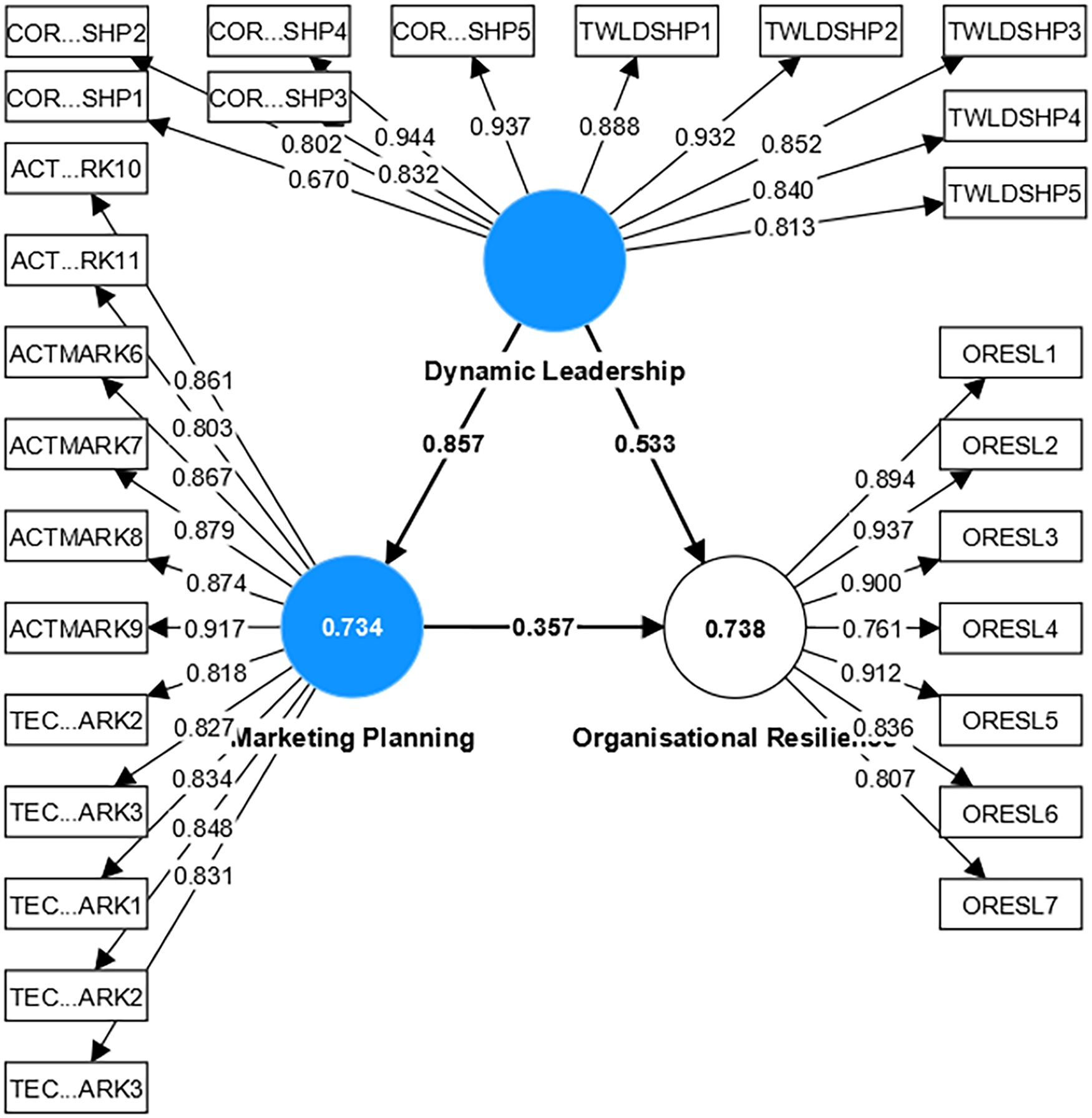
PLS path model.
The data collection process involved distribution of the questionnaires to the identified colleges and universities in Malaysia based on Malaysian Qualifications Agency records (Bahagian Koordinasi dan Rujukan Jaminan Kualiti, 2014). The selection of the target respondents was done according to the information obtained from the Malaysian Qualification Agency. The Malaysian Qualification Agency is a quality assurance body which functions to ensure that the higher education institutions and programs are within a set of standards and accreditation (Malaysian Quality Assurance, 2020). The samples were based on managerial level positions as they have decision-making capabilities and knowledge of the inquired questions. The data collection process was done through distribution of the questions to the identified managers in these organizations. There were a total of 523 units distributed and 224 returned questionnaires, making the return rate at 48.8%. The questionnaires were distributed on an organizational level basis and the return rate of these survey indicated satisfactory rate of returns. Table 2 shows the demographic profile of the respondents. A large number of respondents were female and organization size average was between 100 and 200 staff employees. The largest amounts of respondents were from college level organizations.
Demographic Profile.

Research Model
Figure 2 shows the research path of the model used in the study.
Research Questionnaires
The study adopted the scales of previous studies. The questionnaire consists of 28 items; three questions in the areas of dynamic leadership, marketing planning, and organizational resilience. The measurement items of dynamic leadership were based on corroborative and teamwork as stated in the earlier sections (Tucker & Lam, 2014). The items used to measure marketing planning was through technique and activities (Pulendran et al., 2003). The evaluation of organizational resilience were adopted using prior studies that had examined the different levels of organizational resilience (Rehman & Anwar, 2019). The items were scaled using a five-point likert scaling from 1 to 5 while 1 indicates “strongly disagree” and 5 is associated with “strongly agree.” A total of 10 respondents were randomly selected for the pilot survey in order to test out the initial measurements. The feedback from the respondents and academic experts were taken in order to further improve the items used in the survey. Academic experts in this context are individuals from other universities that have previously published in educations, organizational and leadership research. These academic experts hold no position in the research project or was not directly involved other that providing input on their feedback of the survey. The measurement of dynamic leadership and marketing planning is as shown in Table 3.
Measurement of Items.

Data Validity and Analysis
Reliability
The study evaluated the items’ reliability using composite reliability and the value of Cronbach alpha. It was important to ensure that the value of Cronbach alpha is within acceptable values. Common assumptions include that the value of Cronbach alpha must be above .80 in order to suggest that the data are reliable (Nunnally & Bernstein, 1994). Table 4 illustrates the overall result of the reliability testing.
Reliability Test.

The values indicated that they were within the acceptable range in terms of the composite reliability and the value of Cronbach alpha. As the study employed previous methods of evaluating these variables, the value of the reliability was expected. The value of composite reliability was also within the acceptable range of value which was above 0.60 for this type of research (Ringle et al., 2015).
The R Square in Table 4 indicated that the values were above 70%. This means that the variance in both marketing planning and organizational resilience could be explained by dynamic leadership.
Factor Analysis
The study used both Confirmatory-Factor-Analysis (CFA) and Explanatory-Factor-Analysis (EFA) to evaluate the underlying factor structure and verify the values of the structure (Field, 2013). The values of CFA and EFA were evaluated to examine the stability of the structure in the study. Through CFA using SPSS, the overall items used in the study were accepted as none of them had breached normality. The outer loading results indicated that the model fit the data set based on the items used in this study as indicated in Table 5 are within the acceptable values of >0.70 (Hair et al., 2019; Nunnally & Bernstein, 1994)
Outer Loadings.

Results
Through the statistical significance assessment, the study assessed path coefficients of the structural model that was then analyzed by the bootstrapping process. Based on the results in Table 6, dynamic leadership and marketing planning revealed a significant relationship toward organizational resilience (p-value < 5%). In addition, leadership and marketing planning also showed a significant relationship (p-value < 5%). The testing also exhibited that marketing planning mediated the relationship between dynamic leadership and organizational resilience (p-value < 1%). Thus H1, H2, H3, and H4 were supported.
Results of Structural Model.

Note. This table illustrates the results of the structural model using PLS version 4. The sample size was 224. The signs *, ** denoted significance at 5% and 1%, respectively. T-statistics is the size of the difference relative to the variation.
The results of the bootstrapping process indicated that dynamic leadership and marketing planning significantly influenced the levels of organizational resilience. The study was an attempt to explore the indirect impact of marketing planning between dynamic leadership and organizational resilience. The results suggested that dynamic leadership can be influenced by the values that the organization invests toward marketing planning in order to affect organizational resilience. The strength of an organization’s plans should not be taken lightly as it would have a significant value toward performance, as stated previously (Trim & Lee, 2008).
Discussion
In line with the current scenario to this date, there have been no visible studies that have examined the association between dynamic leadership, marketing planning, and organizational resilience. Prior works of literature have focused more on values of leadership themes such as charismatic, transformative, and bureaucratic leadership styles that are commonly used in the fields of literature (Brown et al., 2017; Greenfield, 2007; Levey & Levey, 2019; McManus et al., 2008; Lin Moe, 2012; Moran & Tame, 2012; Suryaningtyas et al., 2019). Using dynamic leadership toward resilience is important to ensure that there are steps taken at reinforcing the value in order to ensure the survivability, sustainability, and continuity that each organization must have and cultivate.
The results revealed that dynamic leadership significantly influenced organizational resilience. The role that the leaders have in term of dynamic values would have an impact in improving the likelihood that their organization will survive. Weak leaders that lack strong values in dynamic leadership will eventually lead to diminishing results that cause the cessation of the organization itself (Zahari et al., 2020). The values in dynamic leadership such as corroboration and teamwork should be considered essential in team planning and implemented widely in any organization. Prior studies that have examined teamwork in the beginning indicated that practiced values would improve performance (Ingram, 1996). For instance, a study of 14 organizations has shown that such leadership practice promotes business resilience and performance in line with this study’s results (Avery & Bergsteiner, 2011).
Marketing planning is important in ensuring that the correct strategies and approaches are implemented in any organization. As previous studies have illustrated, when organizations are well prepared and able to change their strategies on current market orientation, they are more likely to survive (Slotegraaf & Dickson, 2004). There are indeed some difficulties in marketing planning for companies in terms of having enough resources, knowledge, and skills whether in terms of the product used and comparisons with their competitors (M. H. B. McDonald, 1989). Through marketing planning, the organizations would able to pan out the activities that should be focused on in order for them to have a clear and marketable product. A sample of Australian organizations showed that marketing planning has a positive impact on business performance (Pulendran et al., 2003). This correlates with the findings of the present study which indicated that marketing planning has a significant impact on organizational resilience.
The importance of investigating the role of mediator is to examine whether marketing planning would have any impact toward organizational resilience through leadership. The results showed that dynamic leadership can be reinforced with marketing planning in order to ensure that that the organization is more resilient. The equation was partially mediated based on the results in Table 6. This means that when organizations focus on marketing planning, it can serve as a mediator between dynamic leadership and organizational resilience. Previous studies that examined market planning as a mediator had shown that it was able to significantly improve business performance (Mohammed et al., 2017). The organizations’ dependency on ensuring that these measures are taken would greatly impact their future and continuity.
The complex and difficult scenarios faced by many organizations have made the knowledge of knowing which part to focus on as an important factor in ensuring that they have a competitive advantage. Through dynamic leadership and marketing planning, they confirm the need of such values in ensuring higher levels of organizational resilience.
Practical Implications
The results of this study provide practical implications for CEOs, managers, and decision -makers that would want to improve the levels of organizational resilience through dynamic leadership and marketing planning. The results of this study not only assist Private Higher Learning Institutions (PHLI), but other fields of industry in identifying and modifying their priorities in business management to increase their possibility of becoming more sustainable and survivable. Prior studies indicated that management reforms has a positive impact toward organizational performance (Ansmann & Seyfried, 2022). There have been a number of industries that are hard pressed with the pandemic and unrecoverable, such as the tourism and airline industries (Gössling et al., 2021). The implications would be on the organizations where they are recommended to focus more on the values of dynamic leadership and marketing planning. The strength of this study is the period of which the research study was carried out during the stages of COVID-19 pandemic. Hence, the study dealt with first-hand results of companies that were resilient to such sudden change.
Significance of the Study
These findings support the concept and importance on what marketing planning would have toward organizational resilience. The distinctive result indicates that marketing planning would further reinforce organizational resilience. The implication would be that when managers are able to further improve organizational resilience through improving marketing planning. Another importance that could be highlighted is that marketing planning should not be neglected in any organizations, as this show in this study, the value it has on having a positive impact toward organizational resilience is key for survivability. They the managers are able to prepare to market their products in terms of having relevancy in the current market. For example of when Private Higher Learning Institution (PHLI) offer new products such as interactive online learning, they are able to improve on their returns as that is the current market demand.
Footnotes
Acknowledgements
The authors would like to thank the Universiti Poly-Tech Malaysia, grant code: 100-TNCPI/PRI 16/6/2 (064/2021), the Accounting Research Institute, and the Malaysian Ministry of Higher Education for providing the necessary financial assistance for this study. We would also like to thank our Principal Research Project Leader for this research Dr Siti Masitah binti Ashar for the unwavering support of the study. This study was made possible under the joint research grant between Accounting Research Institute UiTM and Universiti Poly-Tech Malaysia. We appreciate the reviews and comments made by academicians on earlier drafts of the paper. Special thanks to the participants that had been involved in the project. This study was made possible through the cooperation of private organizations in Malaysia. We would like to thank again the Accounting Research Institute (ARI) in supporting the research subject.
Declaration of Conflicting Interests
The author(s) declared no potential conflicts of interest with respect to the research, authorship, and/or publication of this article.
Funding
The authors wish to express their deepest gratitude to Universiti Poly-Tech MARA for funding the field study in this research: (Grant number KUPTM.DVCRI.RMC.17.MS (02)). Additionally, the authors are thankful to the Accounting Research Institute HICoE of Universiti Teknologi MARA and the Malaysian Ministry of Education for their support in the publication.
Statements on Compliance With Ethical Standards
All procedures performed in studies involving human participants were in accordance with the ethical standards of the institutional and/or national research committee and with the 1964 Helsinki declaration and its later amendments or comparable ethical standards. Informed consent was obtained from all individual participants included in the study.

Data Availability Statement
All data used for this project are available on request from the corresponding authors. The data are not publicly available due to involving sensitive information discussed during the interview. Selected sections can be requested in order to not compromise the privacy of the research participants.