




Abstract
The 21st century has seen a revival of populism in politics worldwide. Although scholars in different fields have extensively investigated populism, the term remains controversial and fragmentary. This article uses the bibliometric method to analyze the scientific production, critical points, and main trends of studies on populism from 2000 to 2020 based on the literature retrieved from the Web of Science Core Collection, to better understand relevant themes and issues and conduct a comparative study. Populism research shows a general upward trend in three stages and covers a wide range of disciplines, with political science contributing the largest number of publications and sociology sharing the closest links with other subjects. Two relatively large cooperation groups of institutions were found in European countries, but cross-region links between institutions are weak. No relatively stable and large academic teams have been formed between political scholars, and low cooperation exists between prolific scholars in different disciplines. Literature with high co-citation counts are mainly conceptual and comparative studies, and research hotspots include the relationship between populism and democracy, the polarization of populism, and national populism. We believe that future research may shift focus to polarization, European populism, and political trust.
Plain Language Summary
In this paper, we perform a bibliometric and visual analysis of populism research across disciplines by using CiteSpace (2000–2020). The aim of this study is not only to explore the field of knowledge, its evolution over time, its frontier, and a visualized presentation of results, but also to provide an example of conducting a literature review using quantitative methods. Populism research shows a general upward trend in three stages and covers a wide range of disciplines, with political science contributing the largest number of publications and sociology sharing the closest links with other subjects. Two relatively large cooperation groups of institutions were found in European countries, but cross-region links between institutions are weak. No relatively stable and large academic teams have been formed between political scholars, and low cooperation exists between prolific scholars in different disciplines. Research hotspots include the relationship between populism and democracy, polarization of populism, and national populism. We believe that future research may shift focus to polarization, European populism, and political trust.
Populism is a recurring sociopolitical phenomenon in the modernization of human society and has long attracted the interest and attention of researchers worldwide. In academic research, populism not only has been individually demonstrated numerous times, but also is frequently matched with other social thoughts, social movements, and government policies. It is challenging to choose populism as the research topic. For one thing, the concept of populism is ambiguous and uncertain. Since the 1870s, it has appeared during different historical periods and in several countries. Some scholars have tried to define populism in generalized terms, but their attempts made the concept vaguer and more amorphous. Because populism first appeared in Russia and the United States, there was what Giovanni Sartori called a “conceptual traveling” and “conceptual stretching” problem when the discussion extended to other regions (Sartori, 1970). For another, based on different cognitions, some believe that populism is of great value, while others regard it as a meaningless and empty term (Laclau, 2012; Taggart, 2000). In The Promise and Perils of Populism, edited by Carlos de la Torre, some authors argue that due to the lack of consensus and loose usage, the term “populism” has lost its significance and is therefore useless in academic studies. However, the political scientist Mudde (2015) pointed out that “the fact that a term is used so often and so broadly should rather be taken as an indication of the relevance of the concept for societies worldwide, and therefore for academic disciplines that study these societies (such as history, sociology, and political science)” (p. 431).
The 21st century has witnessed the proliferation of populism. From the European debt crisis to the refugee crisis, from Brexit to Occupy Wall Street, and from Trump winning the 2016 election to the landslide victory of Chavez in Venezuela, it is always the latest wave of populism that comes the strongest in America and Europe. Populism has thus never ceased being a research focus. Scholars in different fields are dedicated to the study of populism, expanding the scope of research and enriching theoretical viewpoints. Some progress has been visible over the last two decades. Nevertheless, an increasing number of academics and pundits are using it mainly as a buzzword (Mudde & Rovira Kaltwasser, 2018). This means that populism remains controversial in academia, making its conceptualization vague and fragmented. Under this situation, we want to analyze the development of populism over the century. This paper mainly aims to answer the following questions: What are the spatial and temporal distribution characteristics of scholars studying populism? What are the hotspots and frontiers of the research? What is the basis of research knowledge? To answer these questions, we carry out a meta-analysis by conducting a systematic literature review of populism research.
Given the vast number of publications and the massive amount of data, bibliometric methods become instrumental in tracing the evolution and trends of populism studies. When analyzing the literature collected, this paper applies the visualization software CiteSpace to elucidate the research status and hotspots from 2000 to 2020. We hope that by presenting the overall situation and basic research landscape, this paper can shed light on further populism studies. This paper is structured as follows. We first present an overview of previous studies on populism, analyzing the strengths and gaps of these studies, and put forward the research hypothesis of this paper. Then, we present the software tools and methodological steps that we employed in this paper. In the next section, the empirical results are demonstrated and interpreted using figures and tables. Important findings and their implications are further discussed in the final section.
Literature Review
With the continuous emergence of populism around the world and the increasing discussion on the topic in academia, the literature on populism has exploded during the last decades. In recent years, academic scholarship on populism not only has paid increasing attention to advancing a clear conceptualization but also produced solid comparative studies (Cosovschi, 2018; Mudde, 2017; Mudde & Kaltwasser, 2012). Meanwhile, scholars began to look for clear understanding and breakthroughs by surveying and synthesizing the existing academic literature about populism. Based on different perspectives and literature review methods, the research findings of these overviews have different focuses, which can inspire us to carry out further studies on populism. Nonetheless, there still exist biases and gaps in research. In this section, we will provide an overview of previous studies on populism based on different analysis themes and methods. On this basis, this paper puts forward the research hypothesis and points out the advantages of applying bibliometric and visual analysis to summarize populism studies.
Chronological and comparative analyses have been performed by several scholars in literature reviews concerning populism. Rooduijn (2019) summarized the focus of populism studies in the past half-century and pointed out some challenges that face the field based on the differences between new studies in the last decade and earlier works on populism. For example, it is easy to confuse populism with related concepts. Populism research remains relatively detached from adjacent fields, and a large research output remains rather uncommon. Different approaches are used to explore the characteristics and existing problems of current populism research. By surveying the five most significant recent works on populism, Abromeit (2017) compared the focuses in recent and previous research debates and argued for a return to early Frankfurt School Critical Theory to address some of the shortcomings of these studies.
In addition, some scholars examine populism through thematic analysis. As a contested concept, definitional debates in the study of populism are booming in the last decade. Evaluating how conceptual approaches (ideational, political-strategic, and sociocultural approaches) define populism is of interest to most scholars. They agree with each other much more strongly than before on how the term should be defined (Rooduijn, 2019). However, even when researchers share the same definition of populism, controversies exist. For example, scholars using the ideational approach have a similar understanding of populism but tend to disagree about the genus of the phenomenon (Mudde & Rovira Kaltwasser, 2018). When populism is understood as a specific type of political discourse, there are disputes about whether populism is “mere” discourse or populist discourse is a simple appendage of a more defining behavior (Aslanidis, 2017). Scholars also have devoted increasing attention to examining the existing literature on various topics related to populism, such as the relationship between populism and democracy, the relationship between populism and nationalism, and the relationship between populism and religion (Bonikowski et al., 2019; Gidron & Bonikowski, 2013; Yilmaz & Morieson, 2021).
The above literature reviews indicate an evolving focus and highlight the shortcomings in recent populism research. Nevertheless, they all lack a proper explanation of the methods, procedures, and criteria for how these related topics were chosen; thus, their results are challenging to completely verify. In comparison with the traditional literature review method, we argue that it could be more desirable and feasible to conduct a systematic literature review and explore the changing landscape of populism research over time. Hunger and Paxton (2021) carried out a systematic review of the state of populism research in political science through quantitative analysis of 884 abstracts and qualitative analysis of 50 articles. Their research offered a comprehensive assessment of populism studies in political science but made less contribution to interdisciplinary and frontier research of this concept. The literature can be viewed as a dataset containing various information, such as title, year of publication, author, journal, keywords, and references. We suggest that the intellectual structure of populism research can be identified through the quantitative analysis of this information and its interrelations. In this paper, we perform a bibliometric and visual analysis of populism research across disciplines by using CiteSpace. The aim is to explore the field of knowledge, its evolution over time, and its frontier and provide a visualized presentation of results.
Methods and Data
Research Methods
CiteSpace is a powerful visualization tool developed by Professor Chen Chaomei from the College of Information Science and Technology of Drexel University in the United States. It can demonstrate the interconnections and evolutionary paths of a domain’s documents through data mining, information processing, knowledge measurement, and mapping (Chen & Liu, 2005). The populism literature investigated in this paper is retrieved from the Web of Science Core Collection (WoSCC) through keyword search and manual selection. The results are then saved in plain text format and imported into CiteSpace. Within the software, the Time Slicing is set from January 2000 to December 2020, the Years Per Slice to one, and the Thresholds (the selection criteria for the objects analyzed) to 50. That is, only the top 50 articles with citation frequency or appearance frequency per year are studied. In network pruning, Pathfinder is selected to produce a clear and readable map.
In CiteSpace, four types of networks can be generated. The first network shows information about authors, countries, research institutions, or disciplines, which helps to locate the most influential researchers, research teams, and institutions. The second type of network is about keywords and their clusters and bursts to discover research hotspots, trends, and tipping points within a period. The third type reveals the relationship between co-cited references and authors that clarifies the knowledge framework. The fourth network concerns research funds. Node types are selectable during network generation to meet different research needs. The options available include category, country, institution, author, keyword, cited reference, cited author, and cited journal. In this paper, the first three networks will be employed to analyze the status, hotspots, trends, and distribution of disciplines in contemporary populism research according to the sequence shown in the analytical workflow (Figure 1).
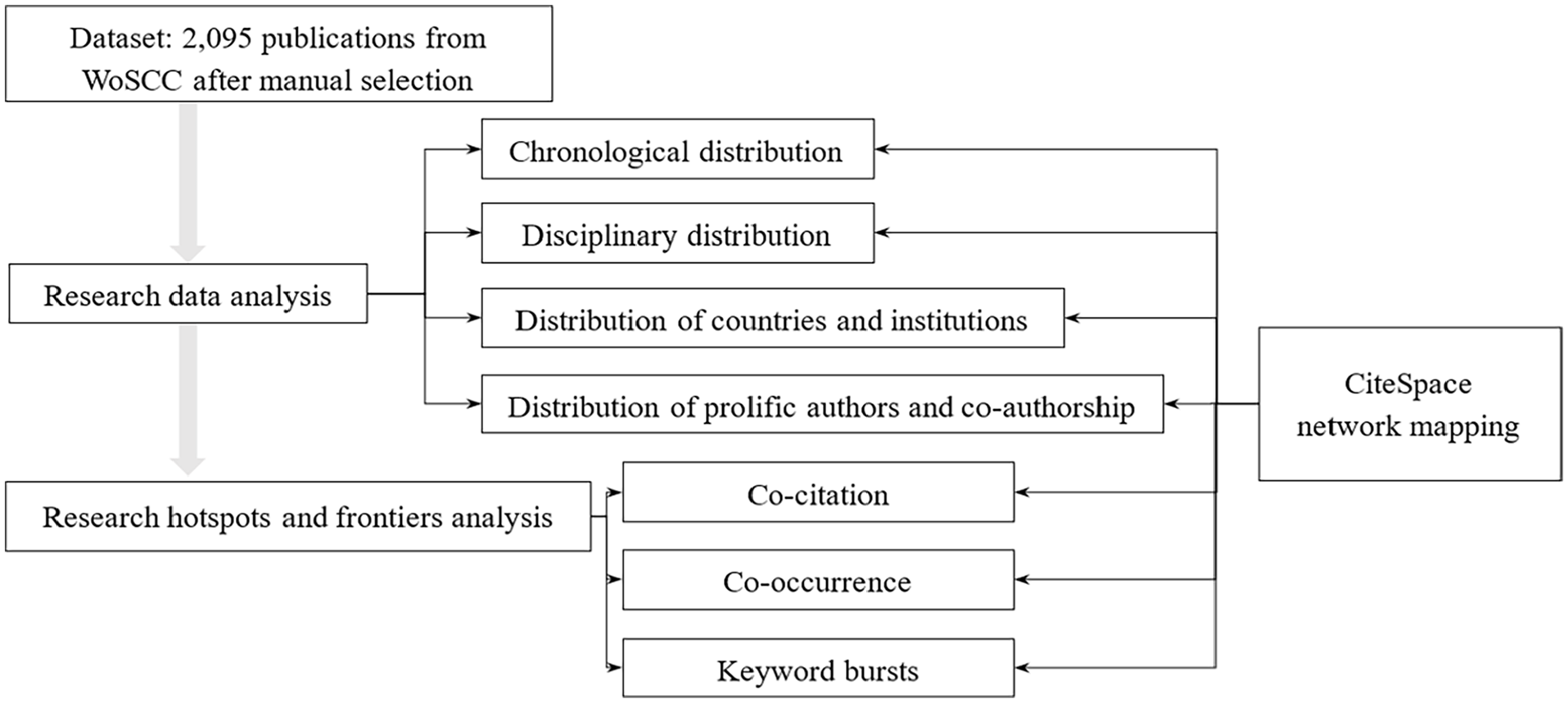
Analytical workflow.
Data Collection
With “populism” as the topic search term and document type set to “article” and “book chapter,” a total of 3,665 search results were found under the 16 research categories that have over 100 record counts in the WoSCC. The results are then manually sifted based on their titles, keywords, and abstracts to remove irrelevant texts, such as book reviews, interviews, reviews, and reports, in addition to those without information such as date and author. In the end, a database consisting of 2,095 analyzable documents was created.
Bibliometric Analysis and Results
Chronological Distribution
The trend of populism research publications over the past two decades has been plotted by analyzing the annual publication number of the database. As shown in Figure 2, three stages of development of this research can be identified. In the first stage, from 2000 to 2014, the research output on populism remained comparatively low, especially before 2008. Although the trend shows no significant increase in this period, this does not point to a lack of prominent and enlightening theoretical and practical research. By investigating some of the most cited literature at this stage, we know that after Mudde’s seminal definition was first published in 2004, many scholars were inspired to study populism from new theoretical approaches such as political mobilization, political style, and political communication (Hawkins, 2009; Jagers & Walgrave, 2007; Jansen, 2011; Mudde, 2004). In addition, clear conceptualizations of populism in the first stage have been employed in a large number of comparative studies.
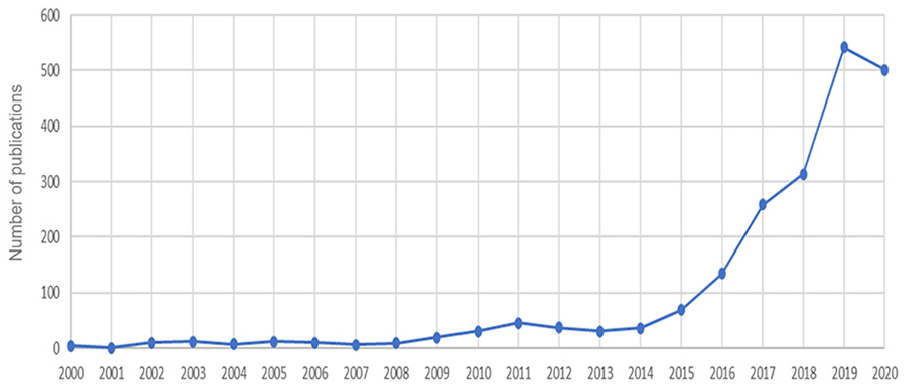
Chronological distribution of populism publications from 2000 to 2020.
After 2014, a significant increase in publications can be observed, signaling the start of the fast development stage of populism research. Such a rise in the number of publications may be related to a series of unexpected populist events around the world, such as the emergence of populist leaders in Latin America, Britain’s referendum on withdrawing from the EU, Trump’s election as president of the United States, and Italy’s referendum on constitutional reform, all of which have been widely reported in the media. Furthermore, the dramatic increase in the number of populism studies allows us to see the importance of the topic globally, in such a way that scientific journals try to disseminate, in the shortest possible time, the results of the studies and provide open access to a large number of these studies.
Peaking in 2016, the phenomenon of populism in most countries began to flatten or become internalized by political systems around 2018 and 2019. Against this background, the number of publications began to fall after 2019. Another possible reason for the change is that the market is oversupplied. Nonetheless, given that populism is expected to continue its growth in wave-like fluctuations, research attention will undoubtedly return to populism once it surges again.
Disciplinary Distribution
The research status of populism under various disciplines is reflected by the number of publications. Figure 3 shows the distribution of disciplines regarding populism research, where the node size is proportional to the total research output. According to Figure 3, the top 13 categories with over 40 publications are political science, business and economics, communication, sociology, international relations, philosophy, history, law, religion, geography, anthropology, ethnic studies, and cultural studies. Political science is the most dominant research field in populism studies. This implies that more researchers tend to define and analyze populism from a political perspective. According to a meta-analysis of populism in political science, researchers in this discipline are divided by geographical foci, methods, and host ideologies (Hunger & Paxton, 2021). The existence of specialties such as business and economics, communication, sociology, ethnic studies, and anthropology reveals that researchers’ attention is also drawn to the influence of populism on the economy and society itself, along with the overlapping issues of populism, nations, and racial groups.

Disciplinary distribution of populism publications from 2000 to 2020.
The purple ring in Figure 3 represents a node’s betweenness centrality that indicates the importance of the node in the network. The thicker the ring is, the more the literature with high centrality a discipline owns, and the more important the node is in linking two different fields of research. The lines connecting two nodes represent the cooperative relations between them. The larger the number of lines that two nodes share, the closer the relationship. As shown in Figure 3, sociology has the thickest purple ring and shares more lines with other nodes. That is, in comparison with other disciplines in the network, sociology outnumbers high-centrality literature and shares the closest connection with other disciplines. Sociology has long shied away from the problem of populism, perhaps because of suspicion about the concept or uncertainty about how to fit populist cases into broader comparison matrices (Jansen, 2011). However, the basic notion among scholars is that “just who the elites are varies across context, as do the boundaries of ‘the people’, but the binary structure of populist claims is largely invariant” (Bonikowski & Gidron, 2016). Consequently, sociology is critically important for understanding modern civic and political life in populism. For sociologists, in order to impose discipline on the populist concept without unduly undermining its richness, there should be an increased intersection with other approaches, such as political sociology, comparative-historical sociology, and cultural sociology (Jansen, 2011; Morgan, 2020; Ostiguy et al., 2017).
Distribution of Countries and Institutions
Analyzing productive countries and academic institutions in a research field aids understanding the academic resource distribution at a macro level. With CiteSpace, networks that display the spatial and institutional distribution of populism research are illustrated. In Figures 4 and 5, nodes represent countries and institutions, respectively, and the node size is determined by the number of publications. Tree rings surrounding a node are lined up in chronological order inside out and are presented in different colors that indicate the publication year. Located between the nodes are lines that visualize cooperative relations.
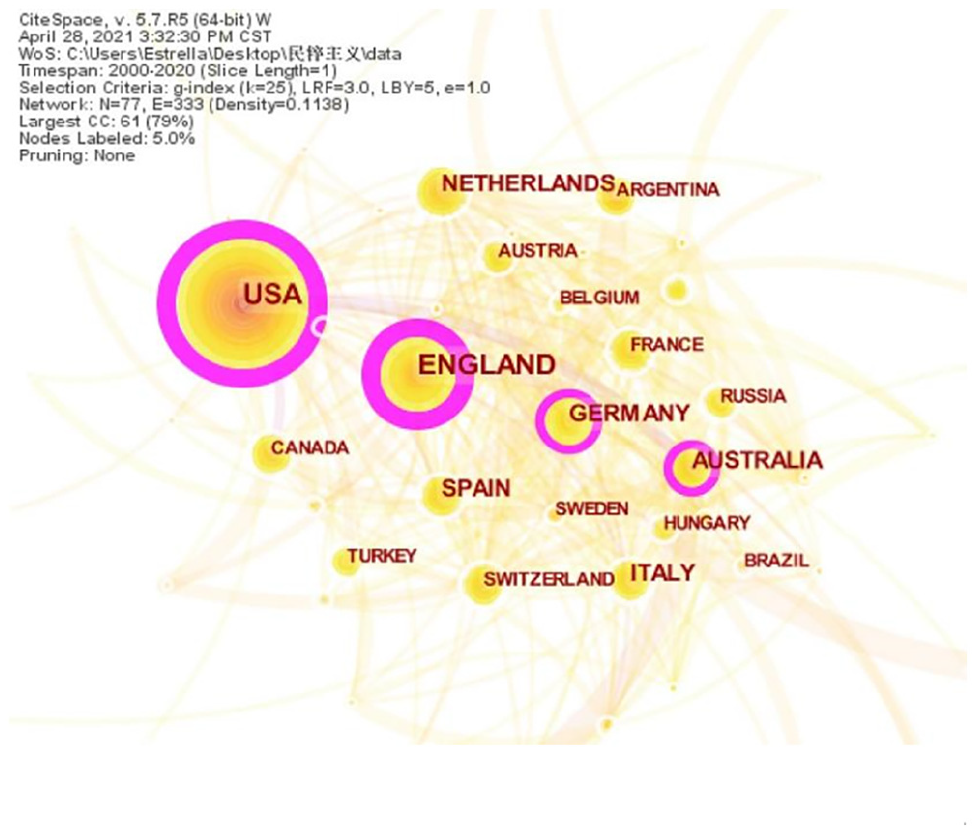
Geographical distribution of populism publications from 2000 to 2020.
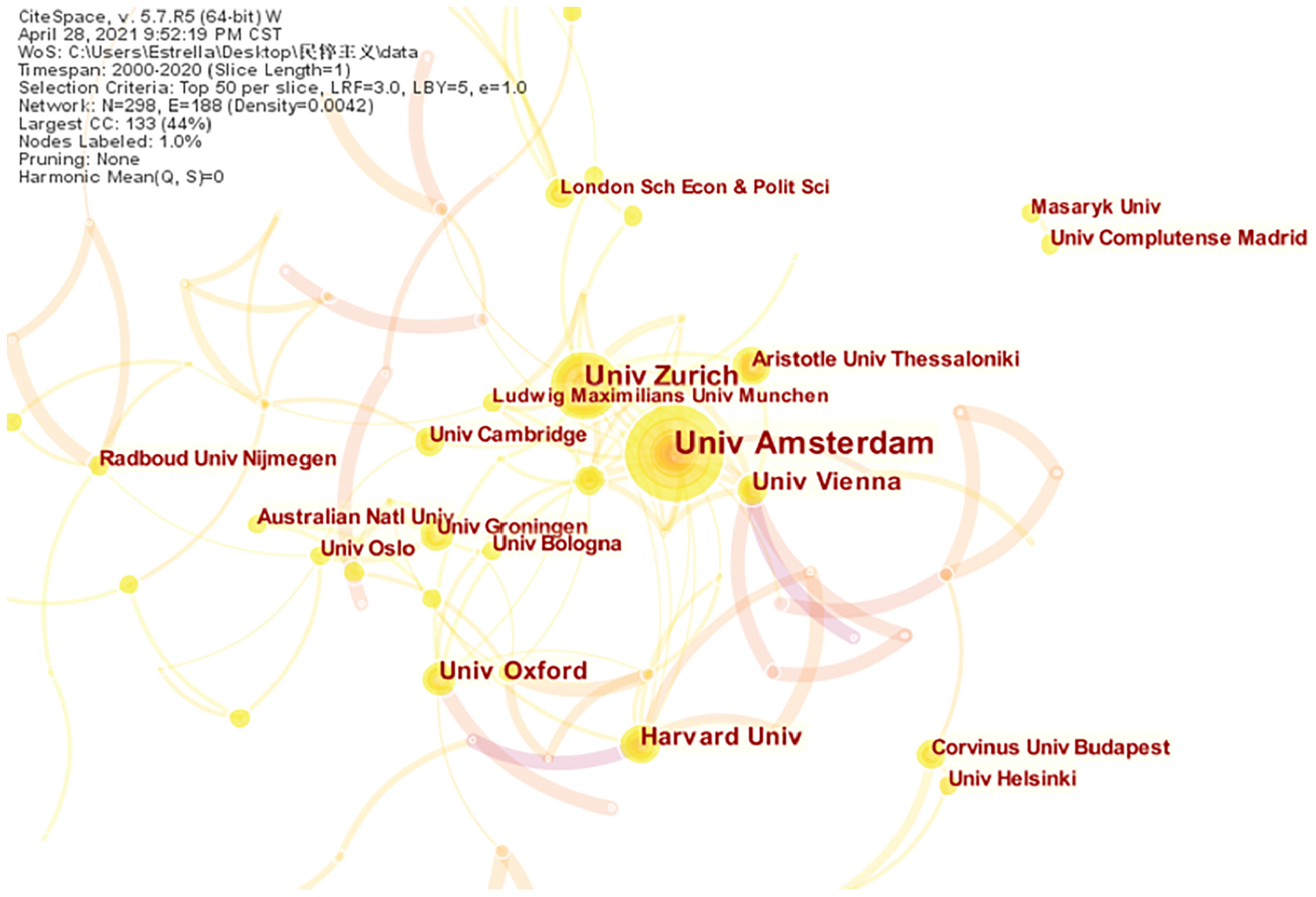
Institutional distribution of populism publications from 2000 to 2020.
Figure 4 shows that publications are concentrated in certain countries. The top 10 most productive countries are the United States, the United Kingdom, Germany, Italy, Netherlands, Spain, Australia, Canada, Switzerland, and Russia. Other countries with more than 30 publications include France, Turkey, Argentina, Austria, Sweden, Hungary, Belgium, and Brazil. The nodes of the United States, the United Kingdom, Germany, and Australia are presented with purple circles, suggesting that they have established more cooperative relations with other countries and have a strong influence on populism research around the world. It is worth pointing out that countries with more publications are where the tide of populism in the 21st century occurred the strongest.
The formation of research teams guarantees quality academic output and the establishment of academic exchange mechanisms. Figure 5 shows major research institutions, research teams led by core members, and their cooperative relations. The 10 institutions with the highest research output are the University of Amsterdam, Netherlands, the University of Zurich, Switzerland, Harvard University, USA, the University of Oxford, UK, the University of Vienna, Austria, the Aristotle University of Thessaloniki, Greece, the University of Cambridge, UK, Radboud University, Netherlands, the University of Groningen, Netherlands, and the Complutense University of Madrid, Spain.
In Figure 5, institutions having close cooperation are placed next to each other and connected by lines. Two groups of nodes are found to be closely linked in the network. The first is comprised of the University of Amsterdam, the University of Zurich, the University of Vienna, the University of Cambridge, the University of Munich, and the Aristotle University of Thessaloniki. The second group of institutions includes the University of Oslo, the Australian National University, the University of Groningen, and the University of Bologna. As shown in Figure 5, other institutions, such as Radboud University, the University of Oxford, and Harvard University, also have cooperative relations with the two groups mentioned above. Nevertheless, in general, the intensity of cross-region links between institutions is weak, indicating that cross-regional cooperation may be an attempt, but it is not stable enough. It is also worth noting that although the United States is the country with the largest number of publications, no cooperative network exists among its academic institutions.
Distribution of Prolific Authors and Co-Authorship
Prolific authors are the most active and productive scholars in a research field, as well as researchers who have made important contributions to the field within a certain period of time. Through the analysis results of CiteSpace, we know the top 10 authors in terms of academic production. Leading authors can thus be identified as Michael Hameleers from the University of Amsterdam, Rovira Kaltwasser from Diego Portales University, Linda Bos from the University of Amsterdam, Frank Esser from the University of Zurich, and Anne Schulz from the University of Oxford. By understanding their academic background and publications on populism, we know that most of their research orientation is political communication with an analytical focus on populist rhetoric and behavior, populist communication and its content, and the environment for the dissemination of populism. Other prolific authors are from different fields, such as comparative politics, political parties, and political sociology.
As shown in Figure 6, most prolific authors work in collaboration. These authors are widely distributed geographically while being closely connected in populism studies. Through the clusters in Figure 6, two teams in close cooperation can be identified. The first is led by Michael Hameleers from the University of Amsterdam with team members Desiree Schmuck, Claes De Vreese, Jörg Matthes, and Linda Bos. They tend to define populism as a communication phenomenon and suggest that comparative analysis is the only approach to reveal and explain the differences and similarities in populist political communication among countries. In order to improve the operationalization and measurement of empirical analysis in the study of populist political communication, they proposed a framework with three boundary conditions: political actors, media, and citizens (De Vreese et al., 2018).
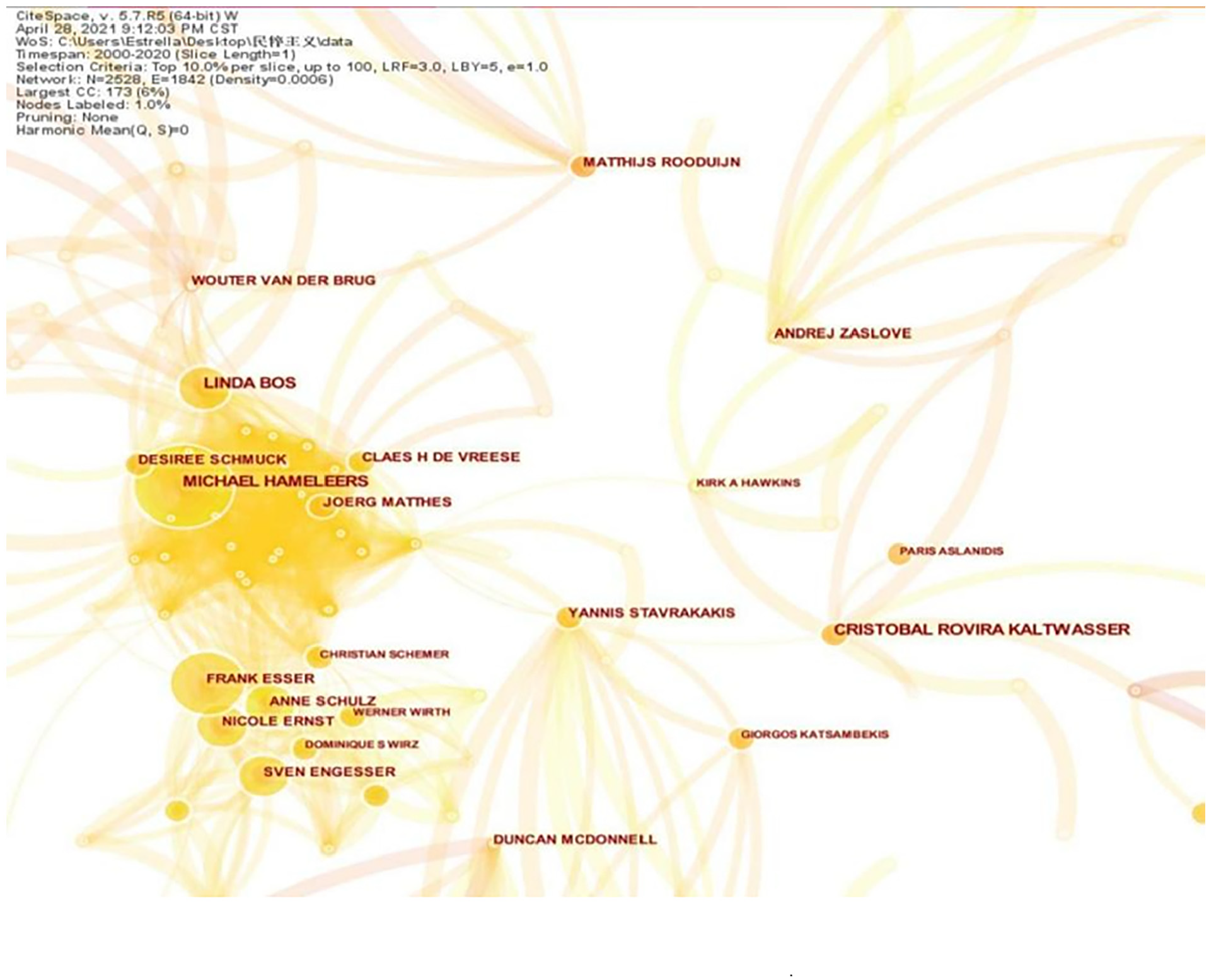
Co-authorship network from 2000 to 2020.
The second team is formed of Frank Esser, Anne Schulz, Nicole Ernst, Sven Engesser, Dominique S. Wirz, and Christian Schemer. In Figure 6 the connection lines show that although the second team possesses less productive authors than the first team, there is close cooperation between members of the two teams. Consequently, the research orientation of the second team is political communication as well. In addition, no relatively stable and large academic teams have been formed by prolific scholars in political science. The possible reasons include the following: firstly, there are great divides among scholars; secondly, populism research in this field is less done by empirical research or experimental analytical methods that require the collaboration of many people. It is also worth mentioning that there are few connection lines between scholars in different disciplines. This finding shows that whether it is team research or individual research, academic scholarship on populism tends to stay in the comfort zone.
Research Hotspots and Frontiers
Reference Co-Citation Analysis
To identify high-quality literature and trailblazing researchers in populism studies, the reference co-citation network is analyzed. As shown in Figure 7, these co-cited documents, which share theoretical or empirical similarities, are located close to each other on the map and grouped into one cluster. According to their content, these documents can be divided into two categories: the definition of populism and the comparative study of populism. For example, in his highly cited article, Mudde (2004) defines populism as “an ideology that considers society to be ultimately separated into two homogeneous and antagonistic groups, ‘the pure people’ versus ‘the corrupt elite’, (will) of the people.” Based on the inductive model he proposed, Moffitt (2014) defines contemporary populism as a political style and positions populism in the context of “an increasingly stylized and mediatized milieu of contemporary politics” that emphasizes its “performative dimension.” As researchers of political communication, Hameleers et al. (2017) argued that populism entails inciting and persuasive messages that assign emotionalized blame to elites.
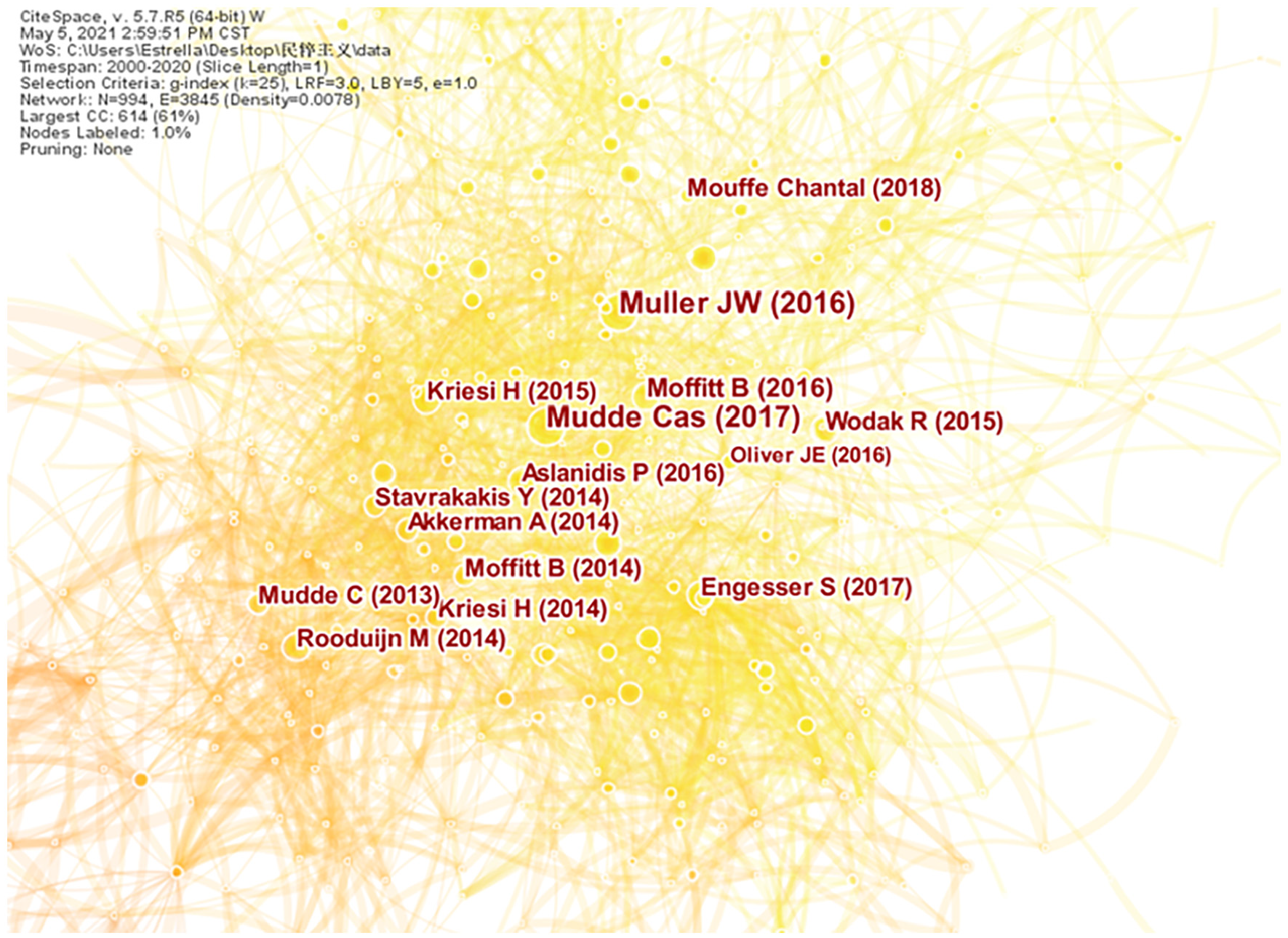
Reference co-citation network.
Figure 7 shows scholars who carried out comparative studies on populism: Nicole Ernst, Sven Engesser, and their colleagues who compare the populism communication strategies adopted by left-wing, centrist, and right-wing politicians across six countries on Twitter and Facebook. They found that populism on social media is presented in fragmentations, mainly employed by the extreme right and left politicians and opposition parties, and is more pervasive on Facebook (Ernst et al., 2017). Mudde and Rovira Kaltwasser (2013) compare exclusionary populism in Europe and inclusionary populism in Latin America through the analysis of four prototypical cases (Le Pen in France, Haider in Austria, Chávez in Venezuela, and Morales in Bolivia).
Keyword: Co-Occurrence Analysis
Keyword co-occurrence analysis is an effective method for elucidating the structure of scientific knowledge, exploring research hotspots, and discovering research trends. Figure 8 presents the keyword co-occurrence network produced by CiteSpace with the node type set to keyword and other parameters unchanged. The structural property of a network is measured by modularity Q (Q value) and mean silhouette (S value). Ranging from 0 to 1, scores above 0.3 for the Q value and scores above 0.5 for the S value suggest that clusters are well-structured and logically grouped, respectively (Chen et al., 2015). For both values, the higher the score, the better (Chen et al., 2015). According to the signature in the upper left corner of Figure 8, the clusters have a clear structure and are reasonably coupled with Q = 0.7512 and S = 0.9083. We can also extract bibliographic details related to each cluster through CiteSpace. Through literature reading and content analysis, clusters involving similar topics are aggregated into one category. Therefore, three categories of research hotspots are shown in Table 1: the relationship between populism and democracy, the polarization of populism, and national populism.
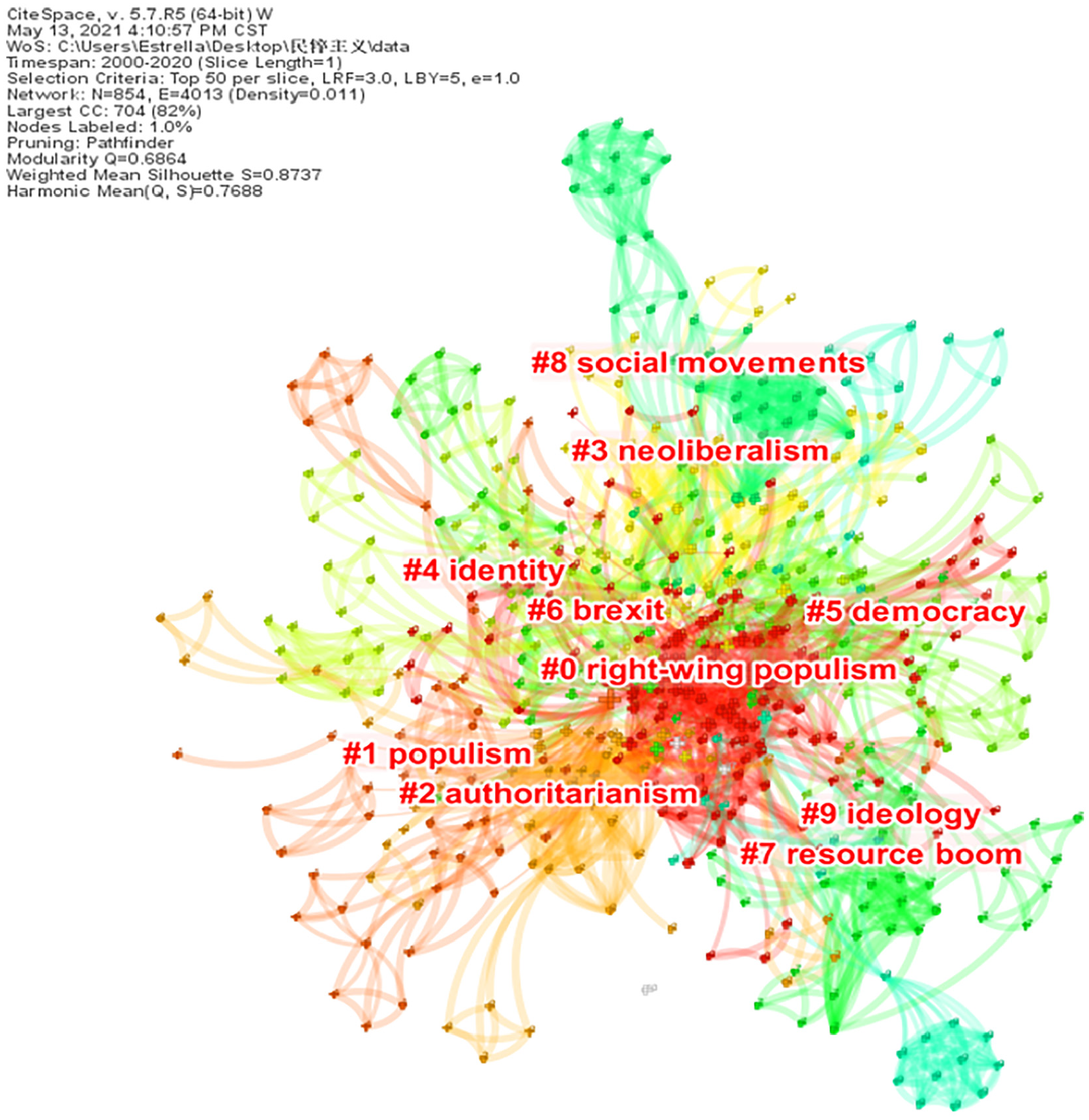
Keyword co-occurrence network.
Three Categories of Research Hotspots.
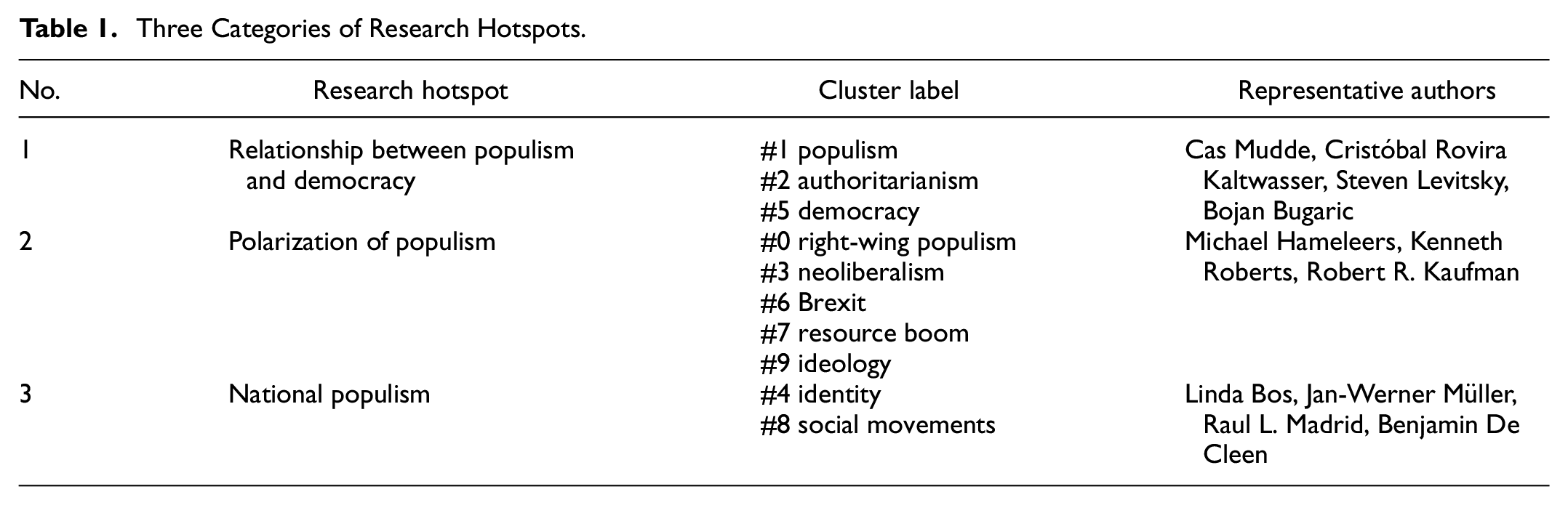
The first research hotspot is relationship between populism and democracy, including clusters such as “populism,”“authoritarianism,” and “democracy.” Populism emerges along with the democratization process of countries. It differs from the notion of democracy in terms of connotation and realization and exerts an uncertain influence on democratic politics. In light of this, the relationship between populism and democracy has drawn the attention of researchers, who focus on topics such as the connections and distinctions between the two concepts, the empirical analysis of populism in democratic practice, and the impact of populism on democratic politics. Scholars are widely divided in discussions about the relationship between populism and democracy. Plattner (2010) points out that the democratization process of most countries is eroded by populism. Similarly, Bugaric and Kuhelj (2018) take the rise of populism in Europe as a sign that the legal system and liberal democracy of the region have been dangerously undermined, while others believe in the ambivalent impact of populism on democracy that can be both a corrective and threatening force. For example, De la Torre stated that populism is neither the inherent danger nor the redeemer of democracy. While restoring democracy and politicizing social inequality and the daily humiliations of the poor and non-whites, populism can also produce forms of representation that deny the diversities of society in the anti-utopia of the unity of the people under the will of leaders (De la Torre, 2013).
The second research hotspot is the polarization of contemporary populism. Related clusters include “right-wing populism,”“neoliberalism,”“brexit,”“resource boom,” and “ideology.” Unlike an ideology, populism and its policy propositions can appear at any place along the political spectrum. As Kaufman and Haggard (2019) pointed out, although populists tend to make anti-establishment appeals in the name of “the people,” they cannot “be placed easily along a standard left/right continuum.” Consequently, populism was also less discussed from the perspective of the political left or right in older debates. Nevertheless, in contemporary societies, populism is endorsed by both the right and left flanks of the mainstream party system, such as the radical right-wing populist parties in Western Europe and the radical left-wing populist parties in Latin America. Sometimes it may also be found on both flanks at the same time, as in the case of the United States. Therefore, researchers divide and discuss contemporary populism according to the values or policies a populist individual or party upholds, and it is well-received that populists’ drifting toward the radical right or left wing is the trend that distinguishes current populism from that of the past. It is based on the comparative analysis of populism that some scholars discovered that the polarization of contemporary populism corresponds to a set of opposing concepts of national integration and exclusion (Hameleers & Fawzi, 2020; Kehrberg, 2015; Rooduijn et al., 2014). For example, right-wing populists oppose globalization but advocate nationalism and immigration restriction, while left-wing populists encourage redistribution rather than promoting austerity policies and emphasize national integration. In light of this, “failures of political representation” may help explain the interregional disparities in contemporary populist movements (Roberts, 2019).
The third focal point of research is the national populism, including clusters of “identity” and “social movements.” An important phenomenon in the contemporary populist movement is the upsurge of national populism marked by the sporadic spread of the inflammatory rhetoric of nationalism and xenophobia underpinned by nationalist ideology. The phenomenon makes the co-occurrence of populism and nationalism a natural field of interest for in-depth research on topics such as the relationship between populism and nationalism, the characteristics of nationalization in populist discourse and practice, and popularization in the development of nationalism. For example, De Cleen and Stavrakakis (2017) stated that the co-occurrence of populism and nationalism should be studied through “the prism of articulation.” On the basis of the post-structuralist discourse theory by Ernesto Laclau and Chantal Mouffe, they put forward a framework where populism and nationalism revolve around a vertical and horizontal axis, respectively, and shape the discursive construction of “the people.”
Identity politics is also a perspective adopted by some scholars in the discussion about the rise of European national populism. The notion in the United States first emerged from class struggle, where identity politics is used to describe the anti-discrimination and political incorporation efforts made by minority groups. Nonetheless, in Europe, identity politics focuses on elements of ascription, such as ethnicity, race, and religion, and aims to protect the “silent majority” from the problems of globalization, European integration, and immigration. Researchers believe that the rise of national populism will transform the “political cleavage” from the opposition between left and right to a new form (Noury & Roland, 2020). An example of this is the anti-Islamic sentiment that has become a key mobilizer of right-wing populism, facilitating the spread of negative images of the religious group. The results of a lab experiment with 145 young Muslims show that growing national populism has sensitized them to discrimination, thereby reducing their self-esteem and national identification and fostering hostility toward the majority population (Schmuck et al., 2017).
In addition to case studies across countries and regions, some scholars analyze the development of the nationalist-populist movement against the background of globalization. Miller-Idriss (Miller-Idriss, 2019) identified three trends of national populism worldwide: the imitation of populist tactics between nations, the framed conflict between local interests and national policies escalating into the framed opposition between national interests and global development, and the possibility of transnational populism.
Keyword: Burst Analysis
The sharp increase in keyword frequency reflects the development at a research frontier in a period. In this paper, burst detection of CiteSpace is used to observe the evolution of populism research and its shift of focus between 2000 and 2020. In Figure 9, “strength” represents the popularity of a keyword, “begin” and “end” record the start and end years of bursts, and the red lines illustrate the period when the burst occurred. The citation bursts start with “reform” and “Latin America” and end with “polarization,”“Turkey,”“trust,” and “Brexit,” which are the research hotspots in recent years. The word with the longest burst duration is “reform,” followed by “Latin America,”“Argentina,”“party system,”“anti-immigration party,” and “Laclau.” Overall, according to the results of the burst detection of keywords, populism research is dynamic, and the topics have evolved over the past two decades. The lack of more consistently dominant keywords also explains the complexity of conceptualizing populism and the existing divides in this field of research.
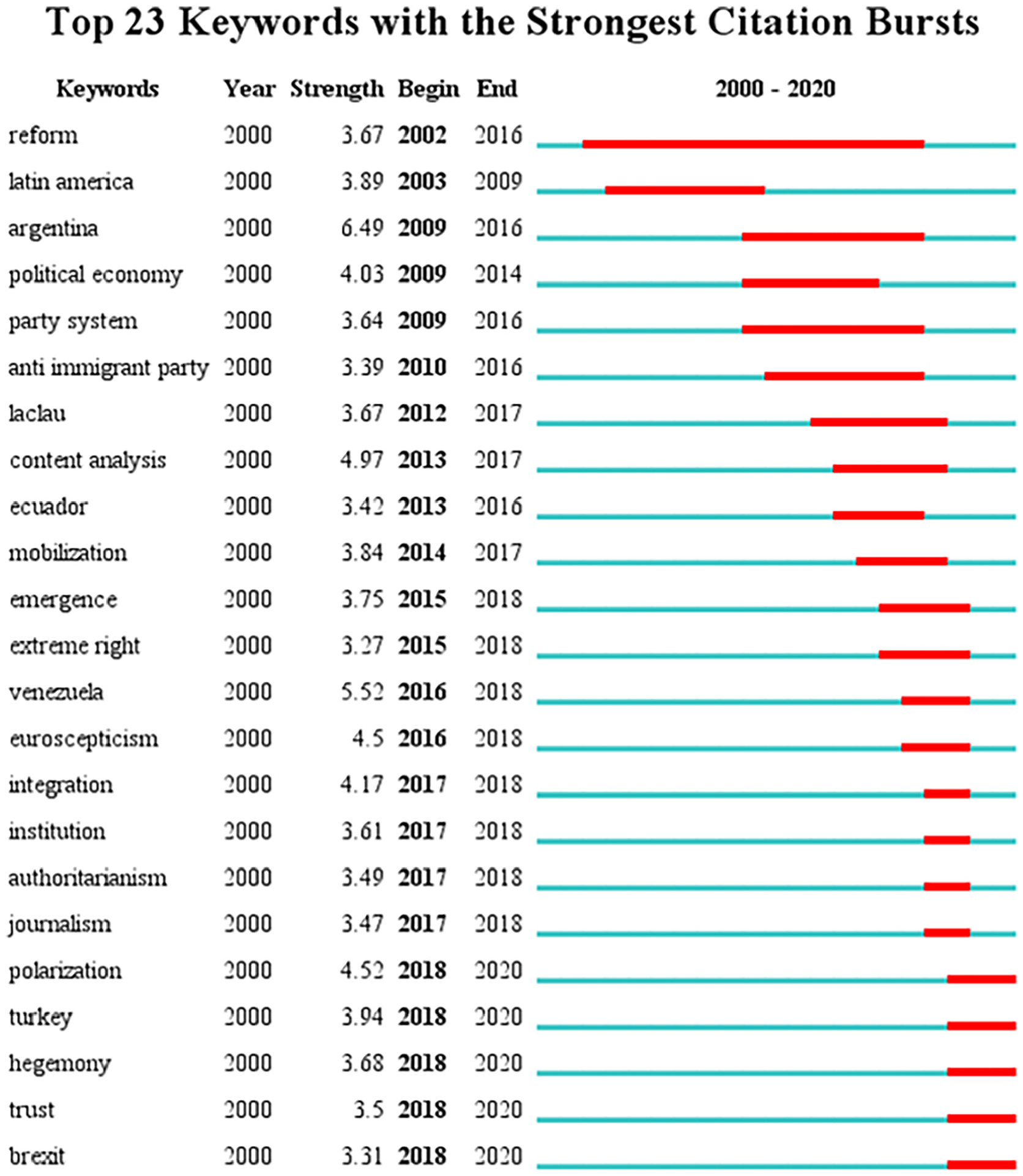
Keyword citation bursts from 2000 to 2020.
Specifically, “reform” is the keyword that scholars have discussed for the longest time. The literature corresponding to this word is the populist parties’ experience with government participation. The time zone of “reform” was almost consistent with the beginning and end of the wave of populist radical left leaders who came to power in countries such as Bolivia (Evo Morales), Ecuador (Rafael Correa), and Venezuela (Hugo Chávez). Like its predecessors, contemporary Left-wing Populism in Latin America has resulted in both economic failure and institutional deterioration. These populists carried out reforms according to the model of intervention state and economic nationalism. The related topics of “reform” include how to assess populism in power, what reforms the populist party promoted, how to maintain power once elected, and what impacts populist leaders posed on democracy (Prato & Wolton, 2018; R. Thompson, 2010; Weyland, 2020).
Keywords related to the rise of left-wing populism in Latin America also include “political party system,”“political economy,”“Laclau,”“Argentina,” and “Ecuador.” For example, “Argentina” has the highest burst strength, implying a surge in populism research on the country from 2009 to 2016, which coincides with the time frame of Cristina Fernandez de Kirchner’s left-wing populist government’s rise and fall in Argentina. Around 2015, most left-wing populists lost their government power, and the above keywords also disappeared from research hotspots. Meanwhile, due to Nicolas Maduro’s continuation of Hugo Chavez’s left-wing populist practices, “Venezuela” and “authoritarianism” became research hotspots in 2016 and 2017, respectively. For some scholars, critical engagement with the case of Chavismo in Venezuela still can offer valuable insights for a fuller understanding of contemporary populism in Latin America (Stavrakakis, etc., 2018).
On the other hand, many observers view 2016 (the landmark event of this year is the “Brxit” referendum) as the first year of the rise of right-wing populism in Europe. In fact, since the 2008 financial crisis, right-wing populism has emerged on a large scale in this region. Simultaneously, the refugee crisis began to erupt, with millions of refugees entering Europe, most of whom were Muslims. Almost all right-wing populist parties have shown a strong stance of resistance toward immigrants, especially Muslim immigrants. Therefore, since 2010, “anti-immigrant party” has become a popular keyword. But the large-scale research on European right-wing populism began around 2016, with related keywords including “extreme right,”“euroscience,”“brexit,”“turkey,”“hegemony,”“trust,” and so on. The main methodological choices in right-wing populist research, such as “content analysis” and “journalism,” have also become keywords during this period.
Conclusions
This paper uses CiteSpace as a visualization tool for bibliometric studies on the populism literature over the past two decades. The aim is to analyze the knowledge domain and its evolution. This study provides an example of conducting a literature review using quantitative methods. It can be useful to provide a quick and intuitional overview, especially when academics identify frontiers and gaps in a field of research, or when one is exposed to a new field. We propose to think of literature as a dataset containing various kinds of information. The dataset of this paper consists of 2,095 analyzable documents between 2000 and 2020 from WoSCC. The analysis units include years of publication, authors, references, and keywords.
The scientific output on populism recorded in the database is generally on the rise, which enables us to see the importance of this topic globally. In terms of the trends of publications, the first stage of the first decade, although less productive, has made important contributions to theoretical and practical research and laid the foundation for the large output of populist research in the second stage. We argue that the slight decline in the number of publications in the past 2 years may be related to the drop in populism in some regions and the excessive publications in the field.
We analyzed the disciplinary distribution of populism research and found that while political science is the most dominant research field, other disciplines also have important contributions, such as economics, communication, sociology, history, philosophy, and cultural studies. Another interesting finding is that sociology shares the closest connection with other disciplines, which illustrates that sociological perspectives and methods are most intersecting and applicable in populism research. Therefore, we could not agree with Abromeit (2017) who claims that in the new literature on populism sociologists and media scholars have less frequent contributions and historians are notably absent. Collaboration and exchange between scholars from different fields of research can stimulate new ideas. At the same time, challenges also exist. Differences in academic background can create barriers and bias in the dialogue between scholars. This also explains why there is no consensus on the definition. Consequently, there is a need for concepts or approaches that can help bridge the gaps and override disciplinary boundaries.
We also learn from the distribution of countries that the most productive countries are where populism appeared the most violent in the 21st century, such as the United States, the United Kingdom, the Netherlands, Spain, and Brazil. Two relatively large cooperation groups of institutions were found in European countries, but cross-region links between institutions are weak. This may be the reason for regional bias in populism research. That is to say, “scholars study cases that fit their regional stereotype of populism, failing to incorporate control groups in their analyses” (Aslanidis, 2017). Therefore, we argue that, on the one hand, researchers should avoid region-specific perspectives in generalizing the concept of populism and, on the other hand, that the complex contexts and diverse interpretations of populism should never be neglected.
The analysis of the distribution of prolific authors and co-authorship shows that the majority of leading authors working on populism are from the field of political communication, and they tend to work in collaboration. Other most active and productive scholars mainly come from the field of political science, but no relatively stable and large academic teams have been formed among them. This result shows the possibility of great differences among political scholars, and the collaborative research method is less frequently used (such as the experimental method of political science). In addition, we found that low cooperation also exists between prolific scholars in different disciplines. This finding is of great significance if scholars want to considerably increase the output of populism research and realize methodological breakthroughs in the medium and short term. We urge researchers to broaden the horizons of research on populism and deepen comparative research.
The reference co-citation analysis points out the most influential documents in populism studies, some of which are devoted to clear conceptualizations and others to comparative research. We also learn from the keyword co-occurrence analysis that the three categories of research hotspots are the relationship between populism and democracy, the polarization of populism, and national populism. Tracking and studying these important research hotspots of populism and their knowledge base can help researchers fully understand the progress in this field and lay a good foundation for future research. Finally, the burst detection of keywords shows that the focal point of populism research has evolved over the past two decades. The reforms of populists in power are the longest-lasting frontier. Except that, there is no other consistently dominant topic. Future research may pay attention to issues such as polarization, European populism, and political trust. It is foreseeable that when diverse approaches and multiple dimensions are employed in populism studies, related keywords will continue to be updated in the future.
Through the bibliometric and visual analysis of populism based on the database retrieved from the WoSCC, this paper hopes to provide useful references for future studies. As Canovan (1982) suggests, “Since the term ‘populism’ refers to a wide variety of apparently different things, any account that is to be useful must somehow reduce this diversity to order.” The investigation in this paper shows that scholars have conducted a multi-dimensional discussion on populism based on their research perspective and made significant academic contributions. Within the limitations of this paper, the diversity of keywords among some studies with the same research topic has influenced data collection and analysis to a degree. In addition, this study analyzes populism research as a whole when a comparison of research status across countries may be an interesting direction for further studies.
Footnotes
Acknowledgements
The authors would like to acknowledge the professionals who collaborated on this study. We would also like to thank all the reviewers who provided suggestions to improve this paper.
Author Contributions
All authors contributed equally to this work. All authors wrote, reviewed, and commented on the manuscript. All authors have read and approved the final manuscript.
Declaration of Conflicting Interests
The author(s) declared no potential conflicts of interest with respect to the research, authorship, and/or publication of this article.
Funding
The author(s) disclosed receipt of the following financial support for the research, authorship, and/or publication of this article: The research was funded by Area Studies Project of the Ministry of Education of the People’s Republic of China [2022-N54].
Ethical Approval
Ethics statement for animal and human studies: This article does not contain any studies involving animals and human performed by any of the authors.
