




Abstract
The purpose of this study is to reveal data on the trend of research publications on guidance and counseling services and their implications for the development of research and guidance and counseling services in the future. The method used is the bibliographical analysis by taking data from the Google Scholar database as the most popular indexer in Indonesia. The results found 962 publications of research results on guidance and counseling services. The most productive place for publication in producing research on guidance and counseling services is “Jurnal BK UNESA” with a total of 28 articles. The “Jurnal Bimbingan dan Konseling Indonesia” is most impact journal with H-Index: 24. The publication of Kadek Suhardita’s research results is the most referenced document with 95 citations, and Bahruddin Al Habsy is the researcher for guidance and counseling services with the most citations with a total of 163 citations. Counseling with models and techniques from the behavioristic approach is the most familiar among Indonesian researchers with 70 publications. The findings in the article mapping show that it is still possible for contextualization and integration between western counseling theory, especially developmental counseling within the scope and study of Indonesian culture, to be local wisdom, cultural perceptions to integrate with religious values (especially Islam as the majority religion). In addition, it is strongly encouraged to collaborate with researchers across institutions, cultures, and religious values because the results of this research map show that researchers are still working partially in their respective institutions, cultures, and religions.
Introduction
Guidance and Counseling in Indonesia have been going on for about six decades (more than 60 years since the 1960s) and have evolved to become Indonesian guidance and Counseling (Munandir, 2001; Setiadi et al., 2017). With the inclusion of guidance and counseling into the curriculum from 1975 until the inclusion of counselors in the educator category in Law no. 20 of 2003, the stipulation of Academic Qualification Standards and Counselor Competencies through the Minister of National Education Regulation no. 27 of 2008 and affirmed the implementation of its services at the Elementary and Secondary Education Levels through the Regulation of the Minister of Education and Culture number 111 of 2014 further confirms that guidance and counseling are part of education services to succeed national education goals (Wibowo, 2018). Until now, the guidance and counseling professional community continued to look for its Indonesian identity as a science that is “imported” from western countries and needs to be mixed and matched with the Indonesian context.
The term Guidance and Counseling Indonesia refers to guidance and counseling services in Indonesia which are an integral part of education services and are included as one of the supporters of the achievement of Education (Kartadinata, 2011; Wibowo, 2018). Therefore, the guidance and counseling profession (known as a counselor) is parallel to the teaching profession, lecturers, widyaiswara, and other teaching professions (Irmayanti, 2018; Kushendar et al., 2018). Guidance and counseling as a unit is a service process of assisting individuals for the optimum development of individuals to choose and make decisions on their responsibility, and optimum development is the development that follows the potential and the value system adopted (Kartadinata, 2011; Yusuf & Nurihsan, 2019). As a branch of science, guidance and counseling is born from the roots of philosophy, religion, culture, and even psychology as its foundation (Habsy, 2017; Lasan, 2015; Mappiare-AT, 2013).
As a science built from the foundations of psychology, religion, and culture, the character of science and guidance and counseling services in Indonesia has a unique characteristic that distinguishes it from guidance and counseling services in other countries. Guidance and Counseling in Indonesia have been in the education system and pathways since the beginning. However, there are few ideas to expand the scope of work of guidance and counseling services to align with other assistance practices in the community such as psychologists, doctors, and even psychiatrists (Adhiputra, 2006; Ahmad, 2014; Prayitno, 1997). Therefore, in its development, efforts have been made to develop guidance and counseling services outside of school in a community (Suryahadikusumah, 2016) and community groups to increase public trust in guidance and counseling services in the community (Hadiwinarto, 2020). There must be a collaborative effort with science and other agencies such as education outside of school, special education, and even the field of health sciences to expand the space for guidance and counseling services outside of school.
Guidance and counseling are a cultural product, a producer of culture, and an encounter of different cultures at one time (Mappiare-AT, 2017). Therefore, many Indonesian researchers mix and match counseling theory and practice with Indonesian culture. They were starting from developing based on religious concepts such as the Qur’an in Islam (Suherman, 2012; Sutoyo, 2009), Hindu values by incorporating the concept of Tri Hita Karana (Adhiputra, 2006), to values based on local wisdom such as community philosophy “using” (Rofiq, 2015); the teachings of RMP Sosrokartono (Habsy et al., 2017); GusJiGang religious philosophy of the Kudus community (Zamroni, 2016), and many others. On the other hand, efforts to ground the counseling techniques from conventional counseling approaches are also continuously carried out to ensure the effectiveness of these techniques for the benefit of counseling services in Indonesia.
Indonesian counseling is placed as one part of education services integrated with the national education system (ABKIN, 2007). The service’s design and character align with efforts to achieve national goals institutionally and achieve personal welfare. Counseling services are carried out uniquely and objectively according to the character of each counselee who needs services (Prayitno, 2007; Rofiq, 2012). Therefore, many researchers argue that it is necessary to develop a model of counseling services that follow the personality, culture, and needs of the counselee in Indonesia (Hidayat, 2019; Kartadinata, 2011; Mappiare-AT, 2017; Prayitno, 1997; Suherman, 2012; Sutoyo, 2009).
Indonesia is known to have diverse ethnicities and cultures (Meirawan, 2010). This diversity has implications for the habits, norms and values, and the individual personal character of each tribe (Syah, 2016). This is not a stereotyped view but rather an anticipatory effort to overcome cultural differences in guidance and counseling service activities. Counselors are advised to open themselves to efforts to learn a culture different from their own so that cultural encapsulation does not occur (Masturi, 2015). Therefore, counseling models and techniques should adapt to the conditions and cultural characteristics of the Indonesian people so that there is no bias in counseling services. The goal is to ensure that counselees receive professional services and avoid malpractice in counseling services.
The characteristics of the counselee are not only about culture but also about psychological conditions, tasks, and stages of development and even environmental conditions in influencing the psychological development of children (Baskin & Slaten, 2014). Many theories reveal that cultural factors greatly influence each individual’s personality in (Gerstein et al., 2012; Gudnanto et al., 2017; Leung & Chen, 2009). The challenges of the disruption period that increasingly disguise the cultural character require counselors to continue to be culturally sensitive, learn from many cultures while reducing cultural encapsulation that often occurs due to fanaticism in one particular culture (Wibowo, 2018). Several alternatives have been developed, starting with counseling approaches for children of elementary school age, middle school to college. Researchers suggest the use of play therapy (Cochran et al., 2010; Mora et al., 2018) and narrative Counseling for counseling services in primary schools (Di Fabio & Bernaud, 2018; Eppler et al., 2009). At the education and secondary levels, it is highly recommended to carry out evidence-based counseling that leads to comprehensive identification of ecological factors and intersectional social identities in students (Dimmitt & Zyromski, 2020; Zyromski et al., 2018).
Unlike the development of counseling in the world, Counseling in Indonesia is also developing to deal with the ecological and social changes in society. A systematic study on the development of Counseling in Indonesia shows a pattern of integration with local wisdom to implement Counseling (Marhamah et al., 2015; Zamroni, 2019). Other researchers have tried to modify counseling based on the counselee’s tasks and developmental stages (Irmayanti, 2018; Suryahadikusumah, 2016). However, there is still a need for a more comprehensive analysis of the guidance and counseling services researched and developed in Indonesia over the last decade.
Guidance and Counseling Services in Indonesia continue to grow. The development of guidance and counseling services is marked by the increasing number of researches on guidance and counseling services in various settings both at school and outside of school. For this reason, it is necessary to map the research trends of Guidance and Counseling services to find research patterns that are more focused and enrich the range of guidance and counseling services in Indonesia. The great opportunity for guidance and counseling research in Indonesia is cultural inclusion in every guidance and counseling service. Many researchers have attempted to explore western counseling theory, which is not necessarily compatible with the character of Indonesian society. It is hoped that the findings of this research will shed light on the research landscape for guidance and counseling services, the possibility of collaboration between researchers from diverse regions and cultural backgrounds, and the possibility of indigenous wisdom that is appropriate and relevant to the character of Indonesian counselees. The goal is for Guidance and Counseling Services to be more accessible to the community, grow professionally and adaptively in response to the counselee’s requirements, and remain current.
This research was conducted using bibliometric analysis to know the trend of research by the guidance and counseling professional community in implementing and developing guidance and counseling services in Indonesia. This article will reveal the trends in the development of guidance and counseling services research in Indonesia and the implications for the development of guidance and counseling services in general and guidance and counseling research in particular. This study will also reveal the impact factors of research publications in the field of guidance and counseling are as well as trends in the development and application of counseling techniques and models through diction choice analysis used in guidance and counseling research. This comprehensive analysis will be used as the basis for developing policies on the application of guidance and counseling services and adopting and adapting counseling models for guidance and counseling services in particular and education services in general. This research can also be a reference for developing collaborative research networks in guidance and counseling services that can improve the quality of models and techniques and resolve more guidance and counseling services issues in Indonesia. The results of this study can also be used as a reference to develop the scope of guidance and counseling services which are currently only in the formal education line. The development is carried out mainly in providing services in cultural settings that do not come out of local wisdom and the wisdom and religion of the counselee.
Research Methods
This study uses bibliometric analysis. Bibliometric analysis is a quantitative tool for examining bibliographic data and is used in many fields (Su et al., 2019). Bibliometric analysis is a quantitative method which is a bibliographic analysis study of scientific activities, which is based on the assumption that a researcher carries out his research and must communicate the results to colleagues (Tupan et al., 2018). There are three components of bibliometrics, namely: (a) bibliometrics, which is the primary domain of bibliometric research and is traditionally used as a research methodology; (b) bibliometrics for scientific disciplines (scientific information), considering that researchers work scientifically oriented, their interest is influential in their field of specialization and allows for a joint borderland with quantitative research in information retrieval; (c) bibliometrics for science policy and management (science policy), is the domain of research evaluation in various research topics (Ziegler, 2009). It is possible to conduct a performance analysis or science mapping exercise in this way (Kurniasih, Kuswarno, et al., 2020). Bibliometric studies were also carried out using software (Tupan et al., 2018), described in more detail below.
The central concept in a scientific paper is seen in keywords that represent the variables studied in a scientific paper (Kurniasih, Wanabuliandari, et al., 2020). Keyword or co-word analysis is based on co-accuracy analysis to analyze the content, patterns, and trends (trends) of a collection of documents by measuring the strength of the terms (Ziegler, 2009). The co-word analysis technique determines how many keywords from the research paper appear in the article under consideration. The author chose these essential terms. The more frequently a keyword appears in a group of documents, the more closely related these documents (Lei & Liu, 2019). Keyword maps based on co-accuracy, importance, or uniqueness can be found in the article title or abstract, where a shared word analysis map can be found. To get to this phrase, one must look at the subject matter that represents the concept (Su et al., 2019). Non-standardized keywords can result in non-uniform terms, so it’s essential to use a thesaurus to help standardize your terminology. This glossary of terminology covers specific fields, so the terms used are more precise. Thesaurus differs from a collection of subject titles in that it is specific to a particular area of study rather than being generic. A single concept is represented by indexing with descriptors. Thesaurus can help standardize keywords to have the same meaning across different texts and can be referred to by a single phrase. Bibliometric analysis is used to analyze scientific publications by examining their impact factors and citations, their collaboration patterns, their dissemination tactics, and their report on the production of scientific works (Aksnes, 2015). This study separates exposure to data consisting of publication sources, publication impact factors, keywords used, research networks, and productivity researchers to obtain this description.
Google Scholar was used to collecting information for this research, which consisted of articles on the development trends of guidance and counseling from all over Indonesia. As the leading search engine, Google Scholar is considered to accommodate more research results and scientific works from Indonesian academics, practitioners, and researchers in the field of guidance and counseling. Data collection was done by searching for Google Scholar publications with the keywords counseling, counseling techniques, counseling models, and guidance and counseling service programs in schools with article titles, abstracts, and keywords from 2010 to 2020 using publish and perish software. The information is presented in the form of total annual publications. Microsoft Excel presents the journal with articles on guidance and counseling services, authors, origins of authors, and topics. VosViewer software was used to examine publication trends in Indonesia in guidance and counseling services.
Results and Discussion
Results
Source publication
The bibliometric analysis in this study used the Google Scholar database, which was accessed on October 22, 2021. The Google Scholar database was chosen because most research publications in Indonesia, especially guidance and counseling research, could only be found in the Google Scholar database. The search was conducted using harzing’s publish or perish software with the keywords “counseling techniques,” “school counseling,” and “guidance and counseling services.” The results of the distribution of research each year can be observed in Table 1.
Distribution of the Number of Research “Guidance and Counseling Services” in the Google Scholar Database per Year.
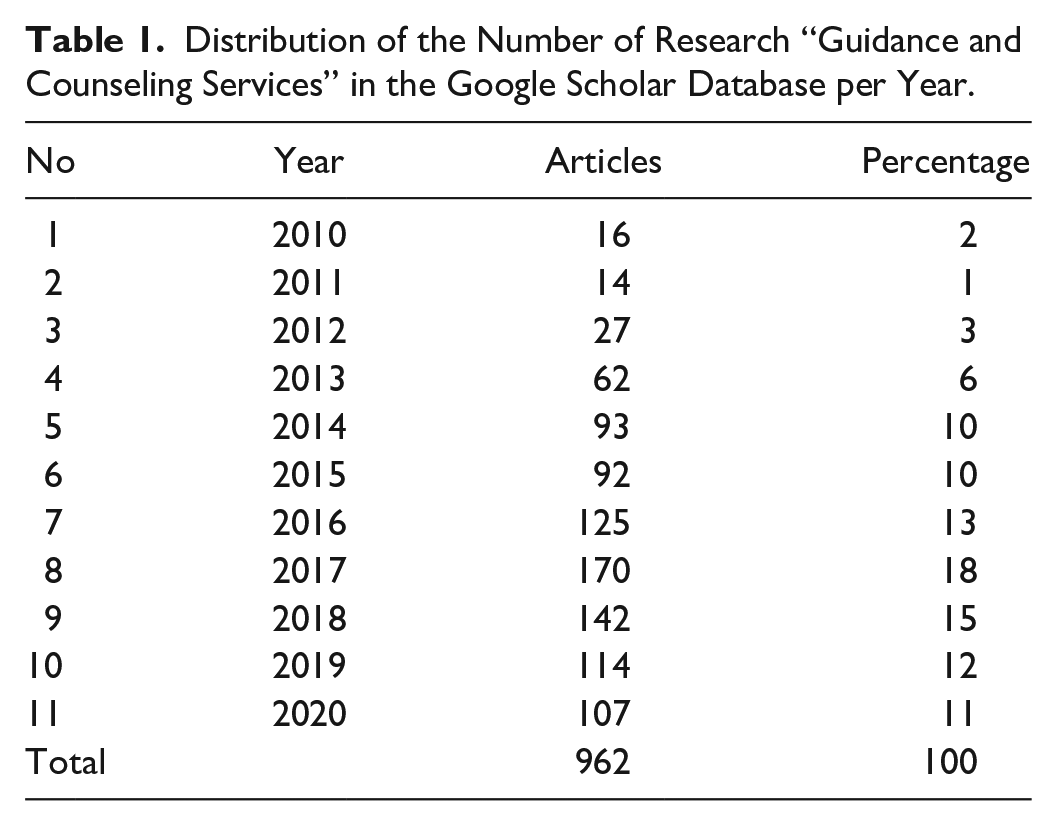
Table 1 shows that in the span between 2010 and 2020, there are 962 articles and publications of research results on guidance and counseling services in various scientific journals, proceedings, and university repositories. The distribution of documents in 20 journals with the highest number of articles can be seen in Figure 1. In 2017 was the year with the most publications, with 170 articles accounting for 18% of the overall article distribution. Although there was a reduction in publications from 2018 to 2020, the number of papers published was generally greater than 100.

Distribution of guidance and counseling service research documents various sources.
Based on Figure 1, it is known that “Jurnal BK UNESA” has the highest number of publications on guidance and counseling services research, with a total of 28 articles (3%). The journal is a publication of undergraduate student thesis research results as a graduation requirement. This means that in the academic realm, pre-service training dominates research for the development and implementation of guidance and counseling services.
Source impact
The impact of a publication media is measured by the number of citations obtained by a journal and an article and the H-Index of a scientific journal. This section describes the average citation of articles each year and the H-index of the scientific journal published. Figure 2 shows the average citation of articles every year on all scientific publications that have been published in the range of 2010 to 2020.

Average article citations from per year 2010 to 2020.
Based on Figure 2, it is known that the highest citation average occurred in 2010 with 131 citations in each article, while the lowest average occurred in 2019 and 2020 with 0 citations. This is understandable because the paper has just been published so that the legibility and probability of being quoted are still small. Furthermore, in Figure 3, it can be seen the impact on the publication media in 20 journals with the highest H-index in the range 2010 to 2020.

Top 20 source impact from 2010 to 2020.
Based on Figure 3, it is known that the “Jurnal Bimbingan dan Konseling Indonesia” published by STKIP Singkawang has the highest impact with an H-index of 24 then followed by “Jurnal Konseling Gusjigang” and “Jurnal Konseling dan Pendidikan” with an H-index of 19 each. Source impact is only taken based on journal publications because access to other sources such as university proceedings and repositories cannot yet be known for their H-index. Furthermore, Figure 4 will be presented the most influential articles with the highest number of citations.

Top 20 citations for documents of guidance and counseling services research.
Based on Figure 4, it is known that the most cited published articles in the 2010 to 2020 range were articles written by Kadek Suhardita, which were published in the “Jurnal Penelitian Pendidikan” published in 2011 with 95 citations. Drajat Edy Kurniawan’s article published in “Jurnal Konseling Gusjigang” in 2017 ranked second with 88 citations, and Sofwan Adiputra’s article published in “Jurnal Fokus Konseling” in 2015 took third place with 87 citations. Interestingly, the appearance of an article from Nurdjana Alamri, who is a school counselor (guidance and counseling practitioner) published in “Jurnal Konseling Gusjigang,” received a positive response by getting 51 quotes. This is a good trend because there is no author dichotomy between academics and practitioners.
Most keyword for research
To find out the trend of variables and keywords that are often studied by researchers of guidance and counseling services in Indonesia, VosViewer software is used. The results in Table 2 are presented with the most frequently used keywords by Indonesian researchers in their research.
The Most Keywords by Guidance and Counseling Service Researchers in Indonesia from 2010 to 2020.

Based on Table 2, it is known that research involving the keyword behavioral counseling is most often used 70 times, followed by guidance and Counseling 60 times and general counseling techniques 44 times. Interestingly, the emergence of Islamic terminology in the guidance and counseling services used in 26 studies shows an effort to integrate religion with guidance and counseling services. Furthermore, in Figure 5, a treemap of the research document of guidance and counseling services in Indonesia.
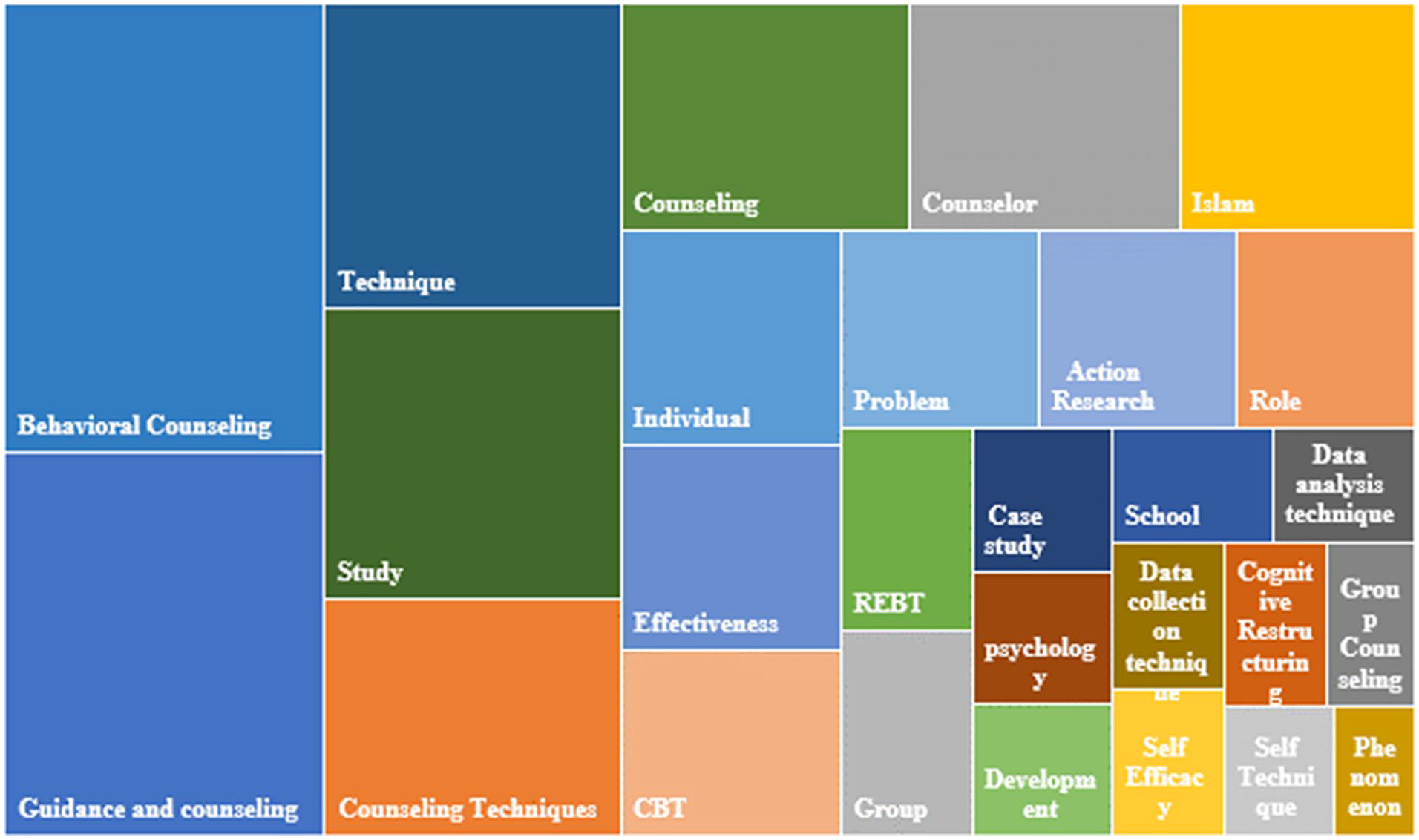
TreeMap of the document guidance and counseling research.
Figure 5 shows a TreeMap based on the frequency with which keywords are used that dominate research on guidance and counseling services. Based on the map, it is known that the behavioral counseling model terminology dominates the research on guidance and counseling services. This indicates that behavioral counseling is the most popular counseling model in Indonesia and is most often used by guidance and counseling practitioners and researchers. Despite being the most popular model, not all theories in behavioristic counseling match the character of Indonesian society (Mappiare-AT, 2017; Prayitno, 2007; Sutoyo, 2009). For that, further needs to be modified or adapted to the cultural characteristics of the Indonesian people (Habsy et al., 2017; Hidayat, 2019; Rofiq, 2015; Zamroni, 2019; Zamroni, Hanurawan, Hambali, et al., 2020). Furthermore, in Figure 6, a visualization of the description of the relationship between keywords in research conducted by guidance and counseling researchers in Indonesia is presented.

Guidance and counseling service research co-word map.
Based on Figure 5, it is known that the behavioristic counseling model most often appears in research in Indonesia, both in individual and group formats. In behavioristic counseling, it is also known the use of techniques and modifications with approaches such as rational use of emotive behavior therapy and cognitive behavior therapy. An emerging technique that is paired with behavioral counseling is cognitive restructuring. Once again, this confirms that behavioristic counseling with its various modifications and variants is still the most familiar counseling model in guidance and counseling services in Indonesia.
Author network and productivity
To find out the possibility of collaboration between authors in developing comprehensive guidance and counseling services and representing the natural character of the Indonesian nation, a mapping of cooperation and research productivity produced by each researcher was carried out. Figure 7 shows the top 20 most productive researchers researching guidance and counseling services in Indonesia.
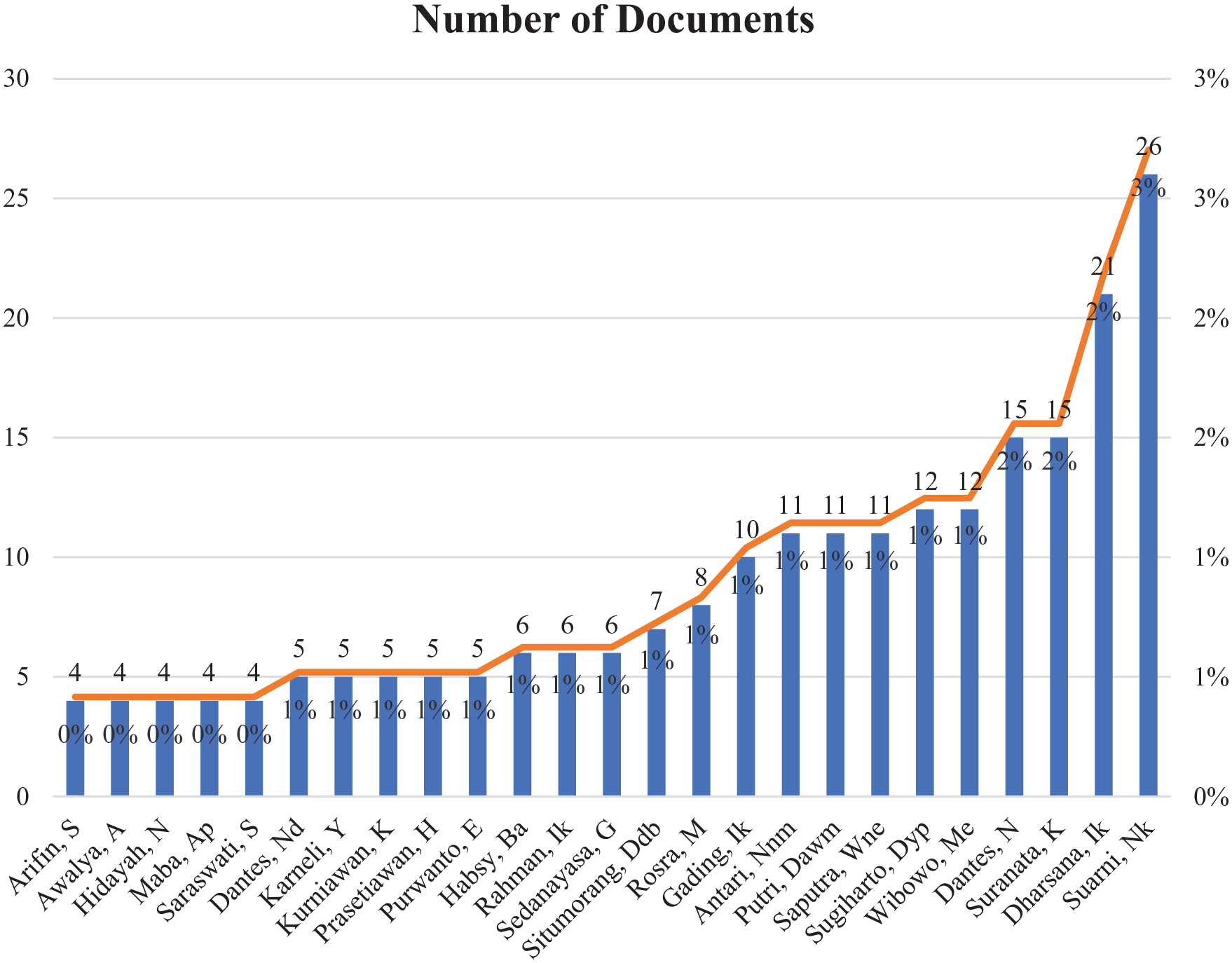
Most productive guidance and counseling service researchers.
Based on Figure 7, it is known that Ni Ketut Suarni is the most productive researcher in producing research on guidance and counseling services with 26 publications. I Ketut Dharsana is in second place with 21 publications, followed by Kadek Suranata and Nyoman Dantes with 15 publications each. After being traced, it is known that the researchers came from an institution of the Ganesha University of Education. Next, the impact of the authors’ articles on guidance and counseling services research is presented. The measure used is the number of citations in publications by the researchers. Figure 8 shows the number of citations for each article in the guidance and counseling services keyword.

Most impact guidance and counseling service researchers.
Based on Figure 8, it is known that the guidance and counseling service researcher who was most cited in the 2010 to 2020 range was Bahrudin Al Habsy from Darul Ulum University Jombang with 163 citations, followed by Kadek Suhardita from PGRI Mahadewa University Indonesia with 95 citations, Drajat Edi Kurniawan from PGRI University Yogyakarta with 88 citations, Wahyu Nanda Eka Saputra from Ahmad Dahlan University, DBD. Situmorang from Atmajaya University with 83 articles each and Kadek Suranata from Ganesha Education University with 71 citations. All of the authors mentioned are academics from universities that opened guidance and counseling study programs. What is surprising is the appearance of a practitioner (school counselor) from SMA 1 Gebog Kudus named Nurdjana Alamri, who occupies the top 10 authors with the most citations with a total of 51 references. This shows a good indication that guidance and Counseling research is also of interest to guidance and counseling practitioners in schools, and his writings have also received good responses from other researchers. Furthermore, to find out the publication collaboration network, a co-accuracy author analysis was carried out using VosViewer. Figure 9 shows collaborative publications in guidance and counseling services in Indonesia.

Co-author map guidance and counseling services publication.
Based on Figure 9, it is known that there are several co-authorship networks in several prominent groups. The first group was the group of Ni Ketut Suarni, I Ketut Dharsana, Kadek Suranata, Ketut Gading, and Nyoman Dantes. This research group is academics from the Ganesha Education University’s Guidance and Counseling Study Program. The second group consisted of Mungin Eddy Wibowo, DYP Sugiharto, Kusnarto Kurniawan, Mulawarman, and Anwar Sutoyo. This group is academics from the Guidance and Counseling Study Program, State University of Semarang. The third group consisted of Shinta Mayasari, Muswardi Rosra, and R. Widiastuti, academics from the Guidance and Counseling Study Program, University of Lampung. The fourth group consisted of Nur Hidayah and Adi Atmoko. This research group comes from the Guidance and Counseling Study Program, State University of Malang. The publication network, which is still dominated by internal institutional collaboration, actually closes the possibility of collaboration of new findings that may occur when inter-institutional research collaboration is carried out (Hasyim, 2021). Collaboration between institutions also opens the possibility of supplementing and complementing the status quo of knowledge that often occurs in research in the social sciences (Irawan et al., 2018). For this reason, massive research collaboration is needed to increase the quantity and quality of science in one field of science.
Discussion
Research trend guidance and counseling in Indonesia
The results of the bibliometric analysis in this study indicate that behavioristic keywords are the most widely used by researchers, with a total of 70 publications. This means that the behavioristic counseling model with various techniques remains the most familiar counseling for researchers in Indonesia. The advantages of behavioristic counseling determination in the problem-solving process are considered to be the most effective for dealing with the process of changing student behavior in schools, especially on the problem of violating norms in schools (Borges, 2007; Corey, 2017; Hergenhahn, 2009; Pyne, 2011; Zamroni, Hanurawan, Hambali, et al., 2020). The results of this study indicate that guidance and counseling services in schools are still dominated by the handling of visible behavior change, which slightly overrides the cognitive and affective domains (Baskin & Slaten, 2014). Normatively this is in line with the performance expectations of counselors as desired by principals and other school management (Kartadinata, 2011; Kushendar et al., 2018; Suryahadikusumah, 2016; Yusri, 2013), but this trend is somewhat worrying because it might trigger misunderstandings, they were related to Indonesian guidance and counseling, which only focuses on specific problems, as school police and various other misconceptions are getting stronger (Kravia & Pagliano, 2016; Prayitno, 2007). More complicated efforts are needed so that the stigma of guidance and counseling services that only focus on handling problems can change by optimizing individual development (Suherman, 2018; Sutoyo et al., 2017) to gain more public trust from the community.
The development of research in Indonesia is not always in line with the research development in ASIA Pacific. Counseling in Asia has recently led to the development of clinical treatment with a focus on treating mental conditions that are unhealthy and experiencing traumatic problems. In India and several West Asian countries, counseling deals with mental health problems due to economic issues (Kar et al., 2020). In Malaysia, problems are traumatic due to the COVID-19 pandemic (Marzo et al., 2021) and dealing with developmental problems in the Middle East. Children are at a certain stage of development (Abuhaloob et al., 2019). However, counseling aims to deal with issues caused by the impact of medical diseases on human psychology, such as cancer problems (Mohd-Sidik et al., 2018; Tan et al., 2021; Yoon et al., 2017), neurological and pediatric problems (Asadi-Pooya et al., 2022; Butler et al., 2021), problems with adult sleep disorders (Teigen et al., 2021), and issues with nicotine addiction disorders. problems (Blebil et al., 2013; Chen et al., 2021; Schnitzer et al., 2021). Research and development of counseling also lead to handling issues before and after childbirth (DeBlaere et al., 2019; Ghasemi et al., 2021; Nobel et al., 2021) and treating gifted children (Abu Bakar & Ishak, 2010; Ishak & Abu Bakar, 2010). Furthermore, in Malaysia, guidance and counseling research also leads to self-development of counselors starting from self-efficacy (Bagheri et al., 2011; Jaafar, 2011; Jaafar et al., 2011; Min, 2012; Ooi et al., 2018), and efforts to handle counseling through an approach online (Li et al., 2013; Zamani et al., 2010). Guidance and Counseling in Indonesia has a different orientation. From the beginning, it has ordained itself to focus on services for students in schools so that there has been no effort to handle non-educational problems (Kartadinata, 2011; Setiadi et al., 2017). However, some researchers also direct counseling research for handling issues outside of school (Habsy, 2020; Rofiq, 2012; Situmorang, 2018).
As a country with considerable cultural pluralism, counselors are very likely to face different cultural encounters between counselors and counselees. Unpreparedness to interact with a different culture with the counselee will lead to cultural encapsulation by the counselor, which will have a fatal impact on the counseling process (Garrett et al., 2004; Heslop et al., 2018; Masturi, 2015; Shen, 2015). Therefore, counselors are also required to master the competence of multicultural counseling so that counseling proceeds effectively and efficiently (Kazanjian, 2019; Mollen & Ridley, 2021; Ridley et al., 2021; Sahu et al., 2021). Suppose you look at the co-word map in Figure 6 and the number of articles in Table 2. In that case, it is known that the number of people who study the context of Indonesian culture with the implementation of the counseling process tends to be very small (the percentage of articles compared to the number of publications on guidance and counseling services is still low). For this reason, in the future, a massive movement is needed so that guidance and counseling services with Indonesian characteristics color the scientific repertoire of guidance and Counseling in Indonesia in particular and in the world in general.
The implication to future guidance and counseling research in Indonesia
The counseling model in Indonesia that is currently developing is very varied. Starting from counseling that is still original based on Western theory and modifications to Western counseling theory, which is integrated with the nobility of the Indonesian nation (Zamroni, 2019). Starting from the development of counseling based on Indonesian local wisdom from various regions (Habsy et al., 2019; Marhamah et al., 2015; Maulana et al., 2014; Riyanta & Tadjri, 2015) to the integration of Islamic values as the religion of the majority of Indonesian people (Fadhilah & Santoso, 2014; Suherman, 2012; Sutoyo, 2009; Tajiri, 2014). What is still very possible to do when analyzing the scientific map of research, as shown in Figure 6, is to seek to integrate the implementation of developmental guidance and counseling with local cultural wisdom in general and religion (especially Islam) in particular. These efforts are a form of endeavor to achieve Indonesian-character counseling or often referred to as Indonesian Counseling terminology.
Technological developments also require all researchers to adjust counseling services by utilizing technology. Several studies have shown that online counseling is an alternative that is considered the most relevant to overcome barriers to face-to-face meetings both due to distance and due to the COVID-19 pandemic (Awabil & Clifford, 2018; Fadhilah et al., 2019; Hidayah, 2015; Murphy et al., 2008). The development can be even more flexible by using android as the gadget that most Indonesians have (Amriiani et al., 2013; Prasetiawan, 2016; Zamroni, Hanurawan, Muslihati, et al., 2020; Zamroni, Muslihati, et al., 2020). Even so, the challenge of presenting a high-level touch and avoiding bias in the interpretation of psychological expressions must continue to be researched so that online counseling services are getting better.
Guidance and Counseling in Indonesia have been included in formal education since the beginning, although currently, there are efforts to strengthen and expand networks to non-formal education channels and the implementation of guidance and counseling in the community (Hadiwinarto, 2020). Even so, the world of formal education as the core activity of guidance and counseling services must be strongly organized, starting from policy, planning to implementation, and evaluation stages. Suppose you refer to the research map in Figure 6 with the popularity of behavioristic counseling which is very dominant. In that case, there needs to be an effort to increase the capacity of counselors by enriching the repertoire of counseling theories so that counseling is not only synonymous with changing behavior, but further changing the way of thinking, how to behave, and even changing the structure, a value that exists in the individual served. Comprehensive policies ranging from recruitment of guidance and counseling service resources, development of resources that have been involved in guidance and counseling services as well as the development of scientific dissemination networks need to be massively facilitated by policymakers so that guidance and counseling services can be more professional and gain more trust from the community. In addition, policymakers and professional associations of guidance and counseling must work together to re-establish Indonesian counseling, starting from the preparation of a grand design for the development of Indonesian counseling theory, formulation of policies on Indonesian Guidance and Counseling, to preparing standard operational guidelines that can be the primary reference for implementing guidance. And counseling in the field is steady in carrying out Guidance and Counseling services in general and Indonesian Counseling services in particular.
In counseling treasures in Asia, a cultural approach has entered and is an essential part of efforts to increase the effectiveness of counseling services. Research in Asia shows the trend of counseling developments toward using spiritual and religious values (DeBlaere et al., 2019; Pandya, 2018) and using a transformative approach in developing effective and efficient counseling services (Kravia & Pagliano, 2016). As a continent inhabited by most of the Muslim population, researchers in Asia have also transformed in developing counseling services for Muslims by incorporating Islamic values as a reference in applying counseling techniques (Cook-Masaud & Wiggins, 2011; Hamidi et al., 2010; Isgandarova, 2012). This trend is also developing in America and Europe, where the Muslim population receives special counseling services (Bentley et al., 2021). In line with this, as a country with a Muslim majority population, Indonesian researchers should also provide a form of service consistent with the values and beliefs adopted, especially the Islamic approach for Muslim counselees.
Research as the spearhead of scientific development of guidance and counseling must immediately improve. It starts from improving the integrity of research, expanding the field of study, to increasing the network of inter-institutional researchers to ensure that Indonesian counseling is genuinely realized. Guidance and Counseling research should be directed at developing research services based on Indonesia’s potential (starting from local wisdom, the repertoire of local Indonesian philosophy, to religious views such as Islam, Christianity, Hinduism, and others) to provide more varied alternatives for counseling services for the people of Indonesia, which is very famous for its pluralism. Modifying the concept of developmental guidance and counseling is also an alternative to guidance and counseling research, especially if it is related to the construction of human development in the context and understanding of Indonesian culture. Massive collaboration to mix and match local wisdom by involving researchers from various institutions is necessary to obtain the prismatic concept of Indonesian counseling, which is believed to be true and accurate in theory.
Conclusion
This bibliometric analysis found that services still dominate guidance and counseling services in Indonesia with behavioristic models and techniques. This can be seen from the 962 articles found, which are still dominated by the use of behavioristic keywords, which means that behavioristic models and techniques still dominate the mindset of Indonesian researchers. Judging from the researchers, it is known that academics and students from universities still dominate it. At the same time, researchers from practitioners (school counselors) are very few. Ni Ketut Suarni is known as the most productive researcher in researching guidance and counseling services with 26 publications. Meanwhile, Bahruddin Al Habsy is the researcher with the highest number of citations for research on guidance and counseling services, with a total of 163 citations. This study reveals that researchers still tend to work in groups in their respective institutions, and very few inter-institutional cooperation networks are found that allow cross-sectoral, cross-cultural, and inter-religious findings that will enrich the scientific repertoire of guidance and counseling. The minimum number of culture-based research shows that the trend of guidance and counseling research in Indonesia is still strongly influenced by the wealth of western-style guidance and counseling science, which does not necessarily have cultural characteristics compatibility with the Indonesian nation. Cross-ethnic, cross-cultural research is also very rare. The majority of culture-based guidance and counseling research is still dominated by researchers who adopt their local cultural wisdom to serve as a scientific basis for developing guidance and counseling services. In the future, inter-institutional, inter-cultural, and even inter-religious research collaboration is needed to enrich the repertoire of studies on guidance and counseling services and help facilitate policymakers’ considerations to formulate policies for more comprehensive guidance and counseling services.
Footnotes
Declaration of Conflicting Interests
The author(s) declared no potential conflicts of interest with respect to the research, authorship, and/or publication of this article.
Funding
The author(s) received no financial support for the research, authorship, and/or publication of this article.
