



Abstract
Academic mobility, given its importance in the dissemination of knowledge and globalization of research collaboration, has received growing attention over the past decades. Based on a bibliometric analysis of the literature on academic mobility (119) from 343 journal articles in Web of Science over the period of 2010 to 2020 with the use of CiteSpace, this paper outlines the research intellectual map, such as the most active contemporary institutions, journals, and popular regions/countries; dissects the network of categories and summarizes the emerging trends and future research opportunities for academic mobility. The results of the study are: (1) England is the most productive region followed by China and Netherlands in terms of publication; (2) Utrecht University, The Polytechnic University of Valencia, and Russian Academy of Science are the most productive institutions; (3) The publications are mainly in the subject categories of Education, Business and Economics, and Geography; (4) Gender, scientific practice, brain drain are the main keywords for discussion; and (5) Louise Ackers is the most influential author in this field and International Migration Journal is the most frequently cited journal over the past decade. Our paper contributes to the relevant body of literature by systematizing the literature on academic mobilities through CiteSpace, a visualized analytical tool for undertaking bibliometric analysis, providing valuable references for researchers and practitioners who want to further explore this knowledge area.
Introduction
The past decade has witnessed ever-increasing academic mobility worldwide (Czaika & Toma, 2017). This may be due to the deliberate policies in some countries, such as China which has galvanized academic mobility while at the same time addressing the ever-mounting disparities in related career opportunities (van der Wende, 2015). The ways for defining academic mobility are varied (Teichler, 2015) as the definition of academics can refer to teachers, researchers and scholars by excluding students (Pustelnikovaite, 2021), or teachers and students in general (e.g., Bilecen & Van Mol, 2017). When students are excluded, academics can refer to academics in higher education institutions, or be subdivided according to their employment sectors, disciplines, region, contract type, etc. The academic mobility in this article refers to the cross-country mobility of academics (teachers, researchers, and scholars) only in higher education, in line with the conceptualization of academic mobility in Pustelnikovaite (2021) and the research gap identified below. Given the rising importance of academics in the context of the globalization of research collaboration and their role in knowledge dissemination and innovation, academic mobility has attracted increasing attention from researchers of various disciplines, including scientometrics, economics, sociology, geography, and psychology (Gureyev et al., 2020). The studies on academic mobility analyzed the influence of mobility on academics’ research output, career progress, and research networks and collaborations (Abramo et al., 2019; Fernando & Cohen, 2016), the motivation factors of such mobility (e.g., Chen, 2017; Lee & Kuzhabekova, 2018; Li & Yang, 2018), or the influence of gender and nationality on mobility (Donato & Gabaccia, 2015; Mahler & Pessar, 2006). Given the increasing number of publications on academic mobility, a systematic review of the relevant literature identifying its general trends has become a necessity.
The review of related articles on academic mobility (including both students and academics) can be classified into the following categories: (1) International student mobility within specific regions (King et al., 2010) or the impacts and determinants of such mobility (Rodrigues, 2012); (2) The bearing of international academic mobility and innovative solutions on the countries of origin and destination (Siekierski et al., 2018); (3) Workforce mobility to examine how cross-cultural management defines subtle differences in cultural intelligence (Eisenberg et al., 2013); and (4) Cross-border academic mobility and international careers (Cerdin & Le Pargneux, 2014) or international collaborations (Kato & Ando, 2013).
However, a study using bibliometric and CiteSpace in performing a holistic and systematic review of the relevant body of literature on academic mobility (of academics only) has yet to be found, a gap this study aims to fill in. This paper presents a bibliometric analysis through a descriptive research lens to examine the volume, characteristics and capacity of global research publications that focus on academic mobility of teachers, researchers, and scholars in higher education. This study therefore is aimed at shedding lights on the development of research trends in this field through a bibliometric analysis using CiteSpace. The specific aims are: (1) to synthesize the existing literature and recognize the main authors, as well as their institutions and countries; (2) to distinguish keyword co-occurrence and main categories; (3) to map out the current circulation patterns of core journals; and (4) to detect emerging topics and hot spots in the field of academic mobility.
The methodology employed in this study presents a list of distinctive advantages. First, the paper showcases a network map of the related authors, publications, and countries. This enables the initial theoretical roots and historical context of this field to be traced more conveniently. Moreover, the keywords analysis approach adopted through time segmented evolution allows academics to track the development of the theme in the literature, providing opportunities for expanding the current body of research. Finally, the results of this study are not simply confined to mapping out academic theories and concepts—it also identifies journals, institutions and other references that can further the understanding of academic mobility.
Research Methods and Tools
Bibliometric Analysis and CiteSpace
Bibliometric analysis refers to a quantitative enquiry into the publications pertaining to a specific theme (Mayr & Scharnhorst, 2015). This method enables a better understanding of the knowledge and intellectual framework central to any given topic of research (Shafique, 2013). The analysis is conducive to dissecting information in articles with respect to keywords, authors, journals, countries references, and even potential trends in further research (Abramo et al., 2011). Via this intellectual process, academic researchers are able to perform a longitudinal meta-analysis of a particular domain to probe into its origin and development (Hérubel, 1999), as well as to predict the trend of future research (Chen, 2006).
The advantages of this bibliometric technique over traditional literature analysis techniques are: Firstly, it can perform quantitative statistical analysis of a large number of peer-reviewed articles in different disciplines (Zemigala, 2019). Secondly, the visualizing network analysis adopted in this approach can help to identify the main patterns of the selected publications, as well as the key clusters of the existing studies. The temporal analysis of document citation bursts, as well as a co-occurrence examination of the principal or most readily employed keywords can assist in pinpointing emergent themes and prospective trends. These findings are crucial for deciding the hotspots and understanding the developing trend in this area of study, and thus shedding further light on emerging research domains (Fahimnia et al., 2015).
CiteSpace is often used to conduct the bibliometric analysis, which has gained increasing popularity as it analyzes literature and yields a variety of metrics and indicators of evolving scientific fields, including the knowledge pattern, research collaborations, new developments, hotspots and unfolding trends that researchers consider fundamental to their research (Chen, 2017). Through visualizing the knowledge domain, this approach helps map, mine, investigate, organize and present said domain at an overarching macro level. It was not until recently that computer software has attracted widespread attention across a variety of research domains, such as those pertaining to social commerce (Cui et al., 2018), hospitality (Li et al., 2017) and research showing the intellectual landscape of pervasive and ubiquitous computing (Zhao & Wang, 2011). These studies illustrate the strengths of using CiteSpace to detect emerging topics, key trends, and focal points under a cognitive framework. In comparison with the conventional qualitative approach, the visualized method delivers a more comprehensive and objective analysis while lowering the cognitive burden of users. However, the visualized approach does not aim to supplant traditional systematic review mechanisms. Instead, it intends to deliver a computational method that can be readily employed with increased accuracy and efficiency.
Scope and Data Source
Using bibliometrics and the CiteSpace software, we analyzed a sample of 343 journal articles on academic mobility in Web of Science (WoS) between 2010 and 2020. The WoS database was used because of its far-reaching collection of leading publications covering overarching scholastic disciplines and for serving as one of the most comprehensive repositories spanning from 1900 to the present (Falagas et al., 2008). In addition, WoS have received enduring acknowledgment as the most credible and respected indexing tool for scientific and technological literature, providing insight into the most critical relevant research (Boyack et al., 2005) and is generally regarded as an ideal source of data for bibliometric inquiries (van Leeuwen, 2006). WoS, as a citation index, represents a conduit belt that connects diversified literature in different disciplines, therefore allowing researchers to navigate the such cross-disciplinary affiliations as they record their research progress.
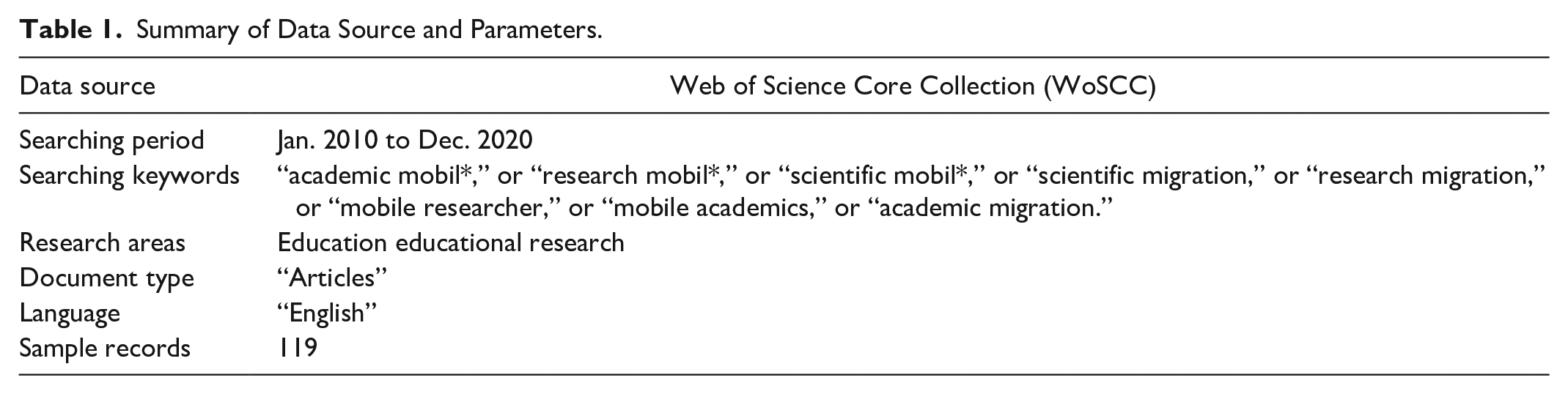
The data sources analyzed in this paper were primarily gathered from Citation Indexes referred to as WoS Core Collection (WoSCC) databases. As we aimed to explore the cross-country mobility of academics (teachers, researchers, and scholars) only in higher education, to ensure accuracy, we confined our search of keywords in educational research areas. The keywords for search by article titles, abstracts and keywords included the following items: “academic mobil*,” or “research mobil*,” or “scientific mobil*,” or “scientific migration,” or “research migration,” or “mobile researcher,” or “mobile academics,” or “academic migration.” Based on that, we obtained a total of 343 articles. It limits the data to peer-reviewed journal articles and does not include book reviews, meetings, editorials, and books. Publications appearing in commercial magazines and conferences were excluded as well. As this research only investigated the mobility of academics, we left aside the student mobility at the manual inspection phase. To guarantee the precision of the samples, the title and abstract of each article underwent screening to determine whether the outcome and the overarching theme of the paper were consistent. Irrelevant results were also not accounted for. Accordingly, we extracted a total of 119 articles from 343 in WoSCC databases over the period of 2010 to 2020. To ensure accuracy, after format conversion, the WoS data were screened to remove duplicates. Table 1 demonstrates the main parameters of this study.
Summary of Data Source and Parameters.
The authors mapped out the collected data with CiteSpace (5.7. R2), and the key steps in the analysis are presented as below. Firstly, the authors set up a new project named “academic mobility” and inputed the data with full records and citations presented via the plain text format. The number of yearly publications on academic mobility knowledge evolution was then calculated manually to present a whole picture of this field. Secondly, parameters were set for analysis, including time slicing (from Jan. 2010 to Dec. 2020, years per slice of 1 year), term source (title, abstract, author keywords, and keywords plus), node type (author, institution, country, keyword, category, reference citation, cited author, and cited journal), selection criteria (top 50%), pruning (pathfinder and pruning sliced networks), and visualization (cluster view-static and show merged network). Third, we mapped the networks, exhibiting the productive authors, institutions and countries, keywords occurring frequently, and documented instances of co-citation, author, and journal co-citation analyses. In addition, hotspot research themes and vanguard research in the academic mobility domain were highlighted after calculating the frequency of keywords adopted prevalently in journal articles. A spike in particular keywords was referenced as a metric for assessing the evolution of this area of academic inquiry and pinpoint the latest research trends. Finally, we adjusted the visualized knowledge map by using the control panel for the sake of presenting clear corresponding results.
Results and Discussion
Temporal Distribution of Published Papers
Figure 1 displays the quantity of publications in the academic mobility field annually, which shows the developmental trend of academic mobility from a macro perspective. Figure 1 reveals that the volume of relevant literature produced between 2010 and 2020 concerning academic mobility shows an increasing trend in general, from 6 in 2010 to 25 in 2020. This might be related to the effects of globalization and the emerging needs of the world labor market for internationally mobile academics equipped with diverse backgrounds, expertise, and connections (Nevra Seggie & Calikoglu, 2021).

Number of publications per year from Jan. 2010 to Dec. 2020.
Space Distribution of Published Papers
Institution and country distributions of published papers are indicators of the research productivity of individual institutions and countries.
Institutions distribution of published papers Figure 2 presents the institution time-zone distribution which shows a timeline of prominent research groups of academic mobility from 2010 to 2020.

Time zone of institution distribution map of published papers.
As can be seen from Figure 2, starting from 2010, there have been expanded institutions participating in research on academic mobility. However, this is only 1 decade so that considering publication cycles, this is not an absolute chronology of research hubs on academic mobility but a timeline on how prominent output on the topic was in different years in the decade under consideration. A qualitative analysis on when key publications of key authors appeared would show who shaped the emergence of international research on academic mobility. Table 2 below further illustrates the top 8 productive institutions in detail. Obviously, Utrecht University stands on the top as it has occupied the largest font size in 2011 with six publications. It is obvious that these institutions are productive institutions in academic research mainly because there are several authors who are active in the field, such as Cañibano and Woolley (2015) from The Polytechnic University of Valencia in Spain who developed a critical review of the brain drain by analyzing how scientific mobility affects developing countries.
Top 8 Productive Institutions (Frequency ≥ 3).

Note. Frequency here refers to the number of publications in the institutions.
Furthermore, according to the frequency, there is no big difference among these institutions, as each institution made roughly equal contributions to academic mobility research, as further explained by the country distribution analysis in the next section.
Country/Region distribution of published papers A breakdown of the geographic distribution of published articles can reflect the collaborative academic ties between countries/regions, providing novel insight for assessing a country or a region’s impact on scholastic development and enabling a macro-understanding of the concept of national spatial distribution in the academic mobility field of study. Figure 3 visualizes the map of the high productive research countries/regions of academic mobility.

Map of countries’/regions’ distribution of published papers.
Figure 3 and Table 3 evidently depict England as the top-ranked region in the number of published papers as size of the nodal circle for England far surpasses that of other countries with a frequency of 28, with China placed second at a frequency of 14, and the Netherlands with a frequency of 13.
Top 10 Productive Regions/Countries in Academic Mobility Field.

Moreover, Table 3 presents the 10 most productive countries/regions, showing that developed countries/regions including England and the United States are more active in conducting academic mobility research, while only two developing countries, China and Russia, are on the list. This might be because England and the United States are the two most popular regions for hiring academic staff, with great attention being paid to transnational academic mobility as evidenced by Locke et al. (2019). China is on the list as the Chinese government has been committed to attracting talented overseas scholars by implementing strong economic incentives and government policy (Zhang, 2019).
Apart from the frequency, betweenness centrality serves as another primary nodal index measuring the capacity of a node in associating itself with other nodes (Chen et al., 2010). Nodes characterized by high betweenness centrality (ranging between 0 and 1) serves as a key conduit between two or more groups that demonstrate a transition pattern, further indicating the principal themes and hot topics within a given network (Chen et al., 2010). In Table 3, China has the highest betweenness centrality of 0.38, indicating that China plays an important role in connecting and collaborating with researchers in other countries in the field of academic mobility (Cao et al., 2020).
Keyword Distribution of Published Papers
Cluster view of keyword analysis Analyzing keywords and indexed terms related to journals respectively (keyword plus) was aimed at revealing the hotspots in the academic mobility field. Keyword analysis is adopted to gain a deeper perspective on the substance of a field and to ascertain hotpots in the present research and potential directions going forward (Chen et al., 2012). To further merge the node, it is helpful to define a “cluster” as an aggregation of separate nodes into groups, signifying a distinctive domain or a concentration of themes. Cluster levels are chosen based on the noun phrases in each cluster, which are selected after screening the titles, keywords, and the abstracts of the articles. The highest ranked noun phrases were chosen to be the cluster labels. The values for Q and S ranged respectively between 0 and 1 and −1 to 1. Such indicators were referenced to evaluate how well the domain is classified into clusters (with each cluster referring to a certain research hotspot). A Q value nearing 1 suggests more clearly defined clusters, while an S value approaching 1 marks confidence in the way that the nodes are clustered. Modularity Q values ranging from 0.4 to 0.8 are reasonable, and an S value larger than 0.6 means the clusters are successful. Figure 4 displays the clusters produced in this study which are labeled. It can be deduced from this Figure that Modularity Q = 0.5483 and mean Silhouette = 0.8312 mean the clustering outcome is suitable for further analysis.
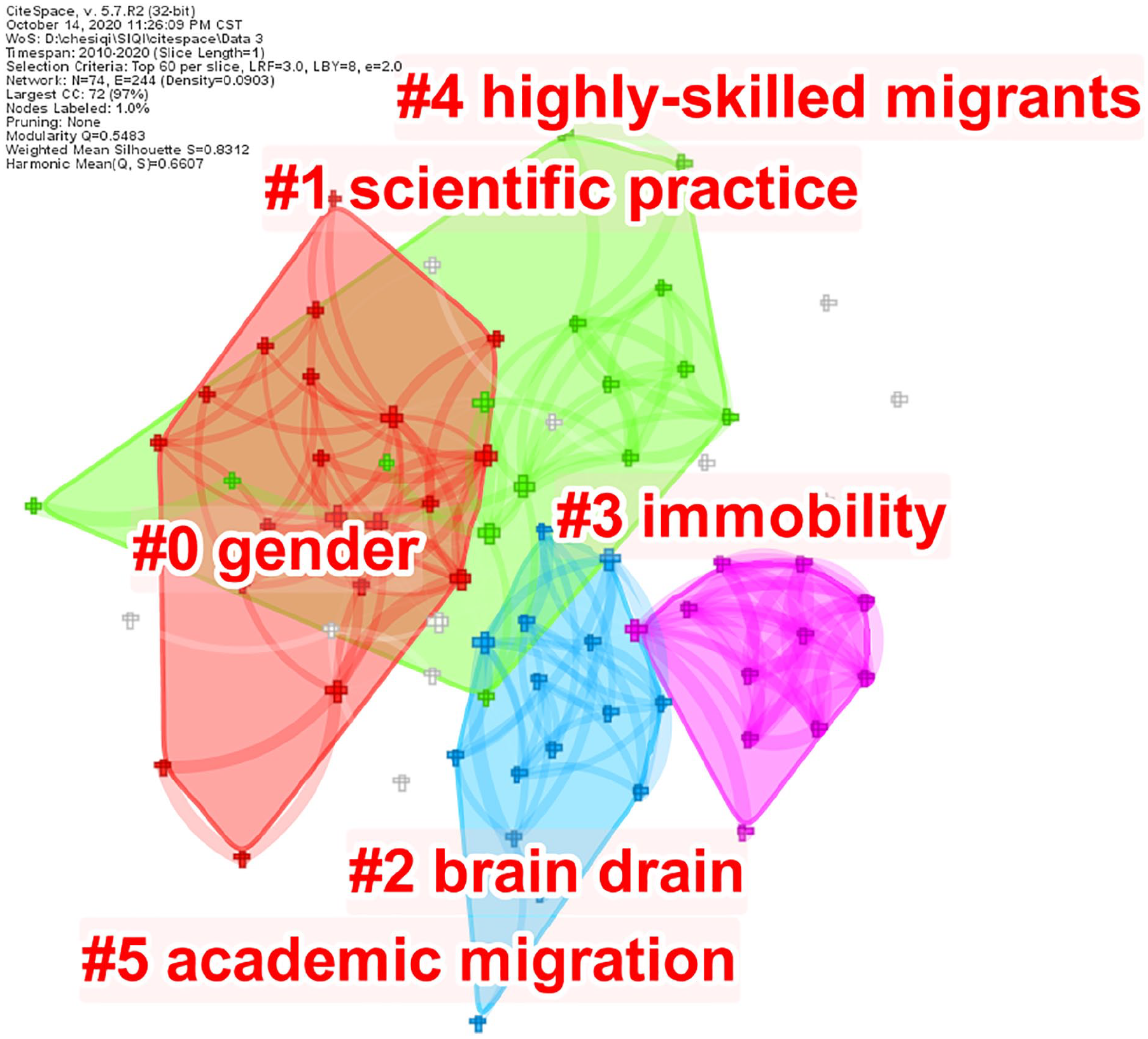
Map of the cluster view of keyword analysis.
In Figure 4, six clusters (gender, scientific practice, brain drain, immobility, highly skilled migrants, and academic migration) have been detected, which are numbered starting from 0 (Chen, 2017). The order is from No. 0 to No. 5, with the largest cluster numerated as No. 0 and the smallest cluster as No. 5. A smaller number signifies that the cluster contains more keywords. Each cluster comprises of multiple closely affiliated words. It is interesting to find that the largest cluster is “gender,” which indicates that the most popular research regarding academic mobility is on gender difference, as gender analysis can be undertaken in combination with any other clusters. Cluster 2 is around scientific practice, followed by brain drain, immobility, highly skilled migrants, and academic migration. The connection among these clusters might be that the scientific practice might be a major reason motivating the highly skilled migrants for academic migration or immobility, which often cause the brain drain of the sourcing countries (Siekierski, Lima, & Borini, 2018). In addition, Table 4 lists the top 20 high frequency keywords, showing that in the context of globalization, the international academic mobility of highly skilled scholars is gaining popularity (Marsh & Oyelere, 2018). The reasons for this could be explained by the keyword of “globalization” while the impact of this to the source countries can be mainly regarded as a “brain drain.” Some scholars decide to work in another country, which may lead to a brain drain in their home country (Zweig, 2006). Among all the top 20 keywords, China has been frequently mentioned in academic mobility, which reflects the internationalization of Chinese higher education through attracting foreign talent to build world-class universities (Larbi & Ashraf, 2020), and Chinese governments’ investment in academic mobility, such as the China Scholarship Council (CSC) scheme to promote academic exchanges between China and other countries (Liu et al., 2021).
Top 20 High Frequency Keywords in Academic Mobility Field.

Keywords citation bursts The burst presents the developmental trend in the value of a variable within a short time span. CiteSpace enables researchers to screen for and identify burst keywords and match the keywords based on the varying times they appear on different kinds of maps. This can assist researchers in portraying the knowledge pattern of focus and visualizing forecasts of further trends (Yang & Wei, 2011). CiteSpace was used to visually examine the keywords of papers in the academic mobility field and produce the maps of keyword co-citation in the time zone view for determining the evolution in research focus, as shown in Figure 5.

Top 3 keywords with the strongest citation bursts.
Figure 5 shows that “globalization” exhibited the most significant citation burst (3.63) commencing in 2013. This means that in 2013, globalization gradually became the research hotspot for academic mobility. It is with no doubt that globalization transforms higher education, which boosts flows of students and academics and increasing cooperation among governments, universities and so on (Marginson & van der Wende, 2007). Against this backdrop, limited academic mobility links have become increasingly intensified (Kim, 2010). “Science” is the second strongest (2.7) from 2013 to now, followed by the citation burst of “gender.”
Subject Categories of Published Papers
Academic mobility covers a wide range of subjects and disciplines. The 5 most popular subject in published papers were shown in Table 5. According to Table 5, academic mobility research is a multidimensional domain that encompasses a broad variety of themes and interests, from “Education” to “Business and Economics,” “Geography,” “Management,” “Information Science,” and so on, as echoed in Gureyev et al. (2020).
Top 5 Subject Categories of Published Papers.

In Table 5, the education subject occupies the largest proportion with approximately 36.97%, followed by the category of Business and Economics (19.33%) and Geography (15.97%). Without surprise, academic mobility is a primary focus of the educational field. Business and Economics is another area of attention, which might be because the driving force of academic mobility includes economic factors (Gill, 2010; Van Hear et al., 2018). Finally, geographers are also keen on academic movements because academic movements usually involve geographic migration from one country to another.
Co-citation Analysis
The co-citation analysis is a powerful tool to obtain the obvious information structure in a specific examination field (Yang et al., 2019). In the co-citation analysis, representative cited papers, authors, and journals were selected by frequency and centrality, representing the intellectual base in the field.
In the following sections, co-citation analysis of reference, author and journal are presented to reveal the intellectual base in the academic mobility field.
Reference co-citation analysis Reference co-citation occurs when two (or multiple) papers are cited by one or more later papers at the same time, and the two papers constitute a co-citation relationship. The degree of the co-citation relationship is therefore dependent on the number of citing authors (Small, 1973). Figure 6 displays the map of cited reference. The nodes represent co-cited references, and lines between the nodes represent co-citation relationships. The larger the node, the greater the number of co-citations.

Map of co-cited reference.
Table 6 portrays details of the six most co-cited references.
Top 6 Most Cited References (Frequency ≥ 8).

In Table 6, there are six frequently co-cited papers. It should be noted that several factors influence the frequencies of citations per paper, including paper related factors (such as quality of paper, novelty of subject, characteristics of fields, methodology and study design, references; journal related factors (such as journal impact factor, scope of journal, and language of journal); and author(s) related factors (such as authors’ reputation and productivity, and number of authors). However, the quality of the paper, journal impact factor, and accessibility and visibility of papers are the top valued predictors for citations (Tahamtan et al., 2016). The paper titled “The international mobility of academics: A labor market perspective” by Bauder (2015) was ranked first with sixteen citations, almost doubling that of the other five papers. This implies the great importance of this paper which proposed a labor market perspective to examine transnational academic mobility, which was rarely used in the previous literature. The other five papers have little difference in citation count. Jöns (2009), as the second most cited work, brought in “brain circulation” to explore academic mobility. Kim (2010) drew on “transnational identity capital” to examine the relationships and connections that mobile academic share, as well as the knowledge they embody and take on. Ackers (2008) discussed the relationship among internalization, mobility, quality, and equality under the context of European Research Area with its developments in research policy. Yang and Qiu (2010) used the concept of trans-national human capital to examine the lives, work and international research collaboration of Chinese migrants in an Australia university. Ackers (2005) examined the knowledge transfer of those highly skilled scientific migrants within the European Union.
Author co-citation analysis Different from reference co-citation analysis, author co-citation analysis occurs when two authors are cited together in a third author’s literature at the same time, regardless of which of their works are cited (White & McCain, 1998), and the two cited authors therefore have a co-citation relationship. A higher frequency of the two authors’ citations indicates a closer academic relationship between them, identifying the core authors of the subject field. The breakdown of cited authors based on citations can not only locate the most impactful and prolific authors, but also track the changes of the core authors’ attention over time. It is useful for analyzing the intellectual structure of scientific disciplines (Surwase et al., 2011). Figure 7 demonstrates the highly influential authors referenced.
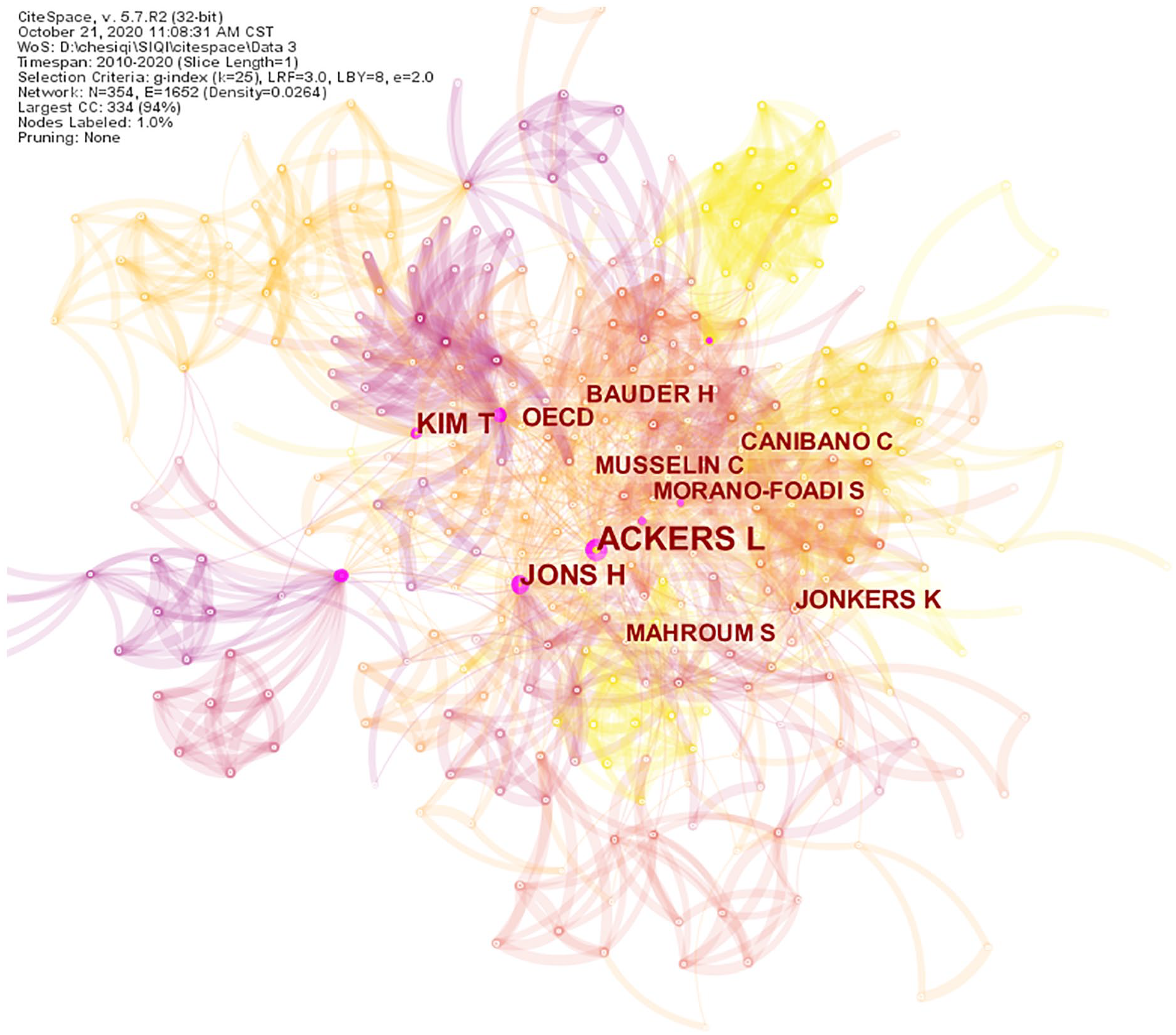
Map of co-cited author.
In Figure 7, each circle serves as a node, while each node stands for a particular author. The larger the node, the more frequently the author is cited. Table 7 depicts the top eight most co-cited authors.
Top 8 Cited Authors With Higher Citation Frequency.

Note. Year here refers to year when the author is most cited by the third author, for example, the author Louise Ackers published a paper in 2005, but the paper was cited most frequently in 2010.
As shown in Table 7, author Louise Ackers stands at the top of the most co-cited authors list. Louise Ackers has been frequently cited mainly because of her paper Moving People and Knowledge: Scientific Mobility in the European Union, which was published in 2005. In this paper, the author combined the analysis of structural and institutional changes to explain the process of disseminating scientific knowledge through international mobility.
The author Heike Jöns was ranked second for her article titled “Brain circulation” and transnational knowledge networks: studying long-term effects of academic mobility to Germany, 1954–2000. This article brings a buzzword of “brain circulation,” which implies the long-term effects of highly skilled migration. In this article, the author stresses the regional and disciplinary characteristics of forming a transnational knowledge network through mobile scholars, with detailed empirical analysis and innovative conceptual methods. Terri Kim, as the third-ranked author, has shown a longstanding research interest in transnational academic mobility. Her top cited article is “Transnational Academic Mobility, Internationalization and Interculturality in Higher Education,” which was published in 2009 in the journal Intercultural Education. This paper provided some critical reflections on the notion of “new strangers” in the university, especially in the new world of transnational academic mobility and internationalization.
Journal co-citation analysis Journal co-citation analysis occurs when two journal titles are jointly cited in later publications and the two cited journals form a co-citation relationship. Journals co-citation analysis reveals the interdependence and cross-relationship between journals. It is beneficial for developing core journal lists that might be of interest to the collection managers (Surwase et al., 2011). A journal co-citation analysis enables examination of the framework of an academic field whereby publications by scholars serve as the chief avenue of dialog. Figure 8 shows the nodes representing journals and the links representing the co-citation relationship that these journals bear. Furthermore, the size of a node signifies the number of citations received by a journal, while the distance apart between two nodes stands for the journal’s co-citation frequency. Generally, as the node grows, the journals’ co-citation frequency rises concomitantly. Journals of high citation counts are depicted in Figure 8.

Map of journal co-citation analysis.
“Core Journals” refers to the most critical journals that have higher citation index. Table 8 shows the ten journals with highest citation count and elucidates the distribution of core journals in academic mobility research and literature with counts and centrality. International Migration has the highest citation count (58), followed by Higher Education (55) and Research Policy (46), indicating that these journals represent the frontier of research on academic mobility.
Top 10 Core Journals with Higher Citation Frequency.

Based on the foregoing analysis, a co-citation inquiry into journals enabled the distribution of key knowledge sources of academic mobility research, which facilitated determination of the journals cited while helping identify the core journals, and the affiliations between these journals. At the same time, the results demonstrated the attributes of the salient interdisciplinary nature of academic mobility studies. Thus, none of the subject areas can holistically mirror academic mobility research with extensive discipline distribution. This is in line with the argument of Gureyev et al. (2020) that studies on academic mobility are becoming increasingly complex and interdisciplinary.
Conclusion and Implications for Future Research
This study investigated the current status quo and nascent trends in academic mobility studies using CiteSpace, and 119 papers published between 2010 and 2020 were retrieved from WoSCC. We generated temporal distribution, institution, and country co-authorship networks to map out and pinpoint the most productive institutions, and countries/regions, respectively, and the keywords co-occurrence network to detect research hotspots and frontier of research, subject categories to explore various fields, and the journal co-citation network to clarify the distribution of core journals.
The findings revealed that:
(1) Within the field of academic mobility research, the volume of publications has illustrated a purported rising trajectory with respect to temporal distribution since 2010.
(2) Utrecht University is the highest productive institution, and the top five most frequently cited countries/regions are England, China, Netherlands, the USA, and Spain, indicating that their high research productivity in academic mobility and providing references for scholars to undergo precise searches for journals and research network building.
(3) Gender, scientific practice, brain drain, immobility, highly skilled migrants, and academic migration are the top six academic mobility research hotspots. This reflects that gender analysis on academic mobility is receiving increasing popularity and the other research hotspots explain the main subjects (highly skilled migrants) who initiate academic migration and the impact of this (brain drain) to the source country.
(4) Academic mobility is a multifaceted field of combing various disciplines, including education, business, geography, management, information science, etc., while the different focus of each discipline warrants further research.
(5) The article titled “The international mobility of academics: A labor market perspective” is the most cited article, indicating its prominent influence in this field, while the specific reasons contributing to this deserves further investigation as varied factors influence the citation count of the published paper.
(6) Louise Ackers is the most influential author in this field, and the International Migration Journal is the most frequently cited journal over the past decade, indicating their influence in the frontier of this research field. Still, why this is the case and what influence does this journal bring to the academia needs to be further explored.
Such findings deliver extensive insight into research trends, topics, journals, and hotspots with regard to academic mobility through a diachronic lens. Visualizing the academic mobility literature through devising a graphical and explicit approach may be favorable for researchers and scholars in following and monitoring research progress.
With due reference to the above findings, we conclude the possible directions for the future development of research on academic mobility.
(1) Academic mobility is expected to be more frequent in the future as the world is becoming more culturally, economically and politically interconnected and thus, the international mobility of academics (researchers and scholars) should be further researched given the increasing scope of internationalization in higher education and the importance of academics in generating and disseminating systematic knowledge worldwide, but the paucity of studies on mobility of researchers, scholars and academics.
(2) The five highly cited countries/regions are England, China, Netherlands, the USA, and Spain, indicating their high productivity in academic mobility. Further research could explore the specific reasons for this, for example, is it because academic mobility is more likely to be seen in those countries/regions but less elsewhere?
(3) As academic mobility involves research from various disciplines, including education, business, geography, management, information science, etc., and current studies on academic mobility are conducted separately within individual disciplines, future studies theorizing academic mobility across disciplines are recommended.
(4) Louise Ackers, the most influential author in this field, together with the International Migration Journal, the most frequently cited journal over the previous decade, provides good references for future researchers and policy makers as they are leading the frontier of research. Other influential journals, such as Higher Education and Research Policy are also good references for related scholars in academic mobility. However, a careful examination of the specific contribution of the author and relevant influential journals are needed as varies factors contributes to the citation and rank of the journal.
Our paper contributes to the relevant body of literature by systematizing the literature on academic mobilities in applying CiteSpace as a visualized analytical tool for undertaking bibliometric analysis, providing valuable references for researchers and practitioners who want to further pursue this knowledge area. Additionally, it reflects the network maps and information tables of academic mobility research more comprehensively, which provides clear guidance for tracing the development and then recognizing emerging trends. Third, it demonstrates the most influential institutions, journals and countries/regions in the discipline, which allows scholars to undergo precise searches for journals, institutions and so on. Lastly, this may also provide guidance for researchers on how to approach a study involving knowledge mapping with the applicable analytic element of existing publications by using this technique.
Inevitably, this study has its limitations. The input data for CiteSpace downloaded from the chosen databases with more than 99% of the articles composed in the English language, reflecting a linguistic bias concerning articles written in other languages and neglection of other data sources elsewhere. Further study including various languages from a variation of academic databases in the field of academic mobility are therefore needed. In addition, as the sample in this paper is only captured by WoS, which might not be able to encompass the whole journals on the topic. Further, particular keywords and the search string used to optimize the literature might limit the dataset as well, as there may have been authors who explored the mobility of academics in their studies but were not reflected in the title, abstract or keyword lists. Finally, the dataset was confined to journal articles and hence, may not do full justice to the full collection of available literature on academic mobility. Future studies may consider expanding the application of data collection to other publications (e.g., conferences papers, working papers), which can potentially shed further insight for readers concerning the latest findings in the field of academic mobility.
Footnotes
Declaration of Conflicting Interests
The author(s) declared no potential conflicts of interest with respect to the research, authorship, and/or publication of this article.
Funding
The author(s) disclosed receipt of the following financial support for the research, authorship, and/or publication of this article: This work was supported by Humanities and Social Sciences Foundation of Ministry of Education of the People’s Republic of China (Project No.20YJCZH091), and Guangdong Basic and Applied Basic Research Foundation (Project No.2019A1515110873).
