




Abstract
The current study was undertaken to investigate how fresh graduates perform in English and why they were successful, reserved, or unsuccessful in job interviews from the perspective of the Systemic Functional Linguistics (SFL) Appraisal Theory namely from the Attitude subsystem. The theory focuses on the English language proficiency of the candidates in terms of their ability to express their stances in English. A qualitative method was employed in the present study. The data of the study comprised of walk-in interview transcripts of 10 fresh graduates for the post of Administrative Officer (s). An Appraisal analysis was conducted to reveal stances for the answers to the general interview question, “How do you face challenges?” and it was used as a theme to analyze the data. The findings revealed that the Appreciation subsystem of Attitude was used predominantly by candidates who were successful. The current study is expected to advance knowledge on the performance of graduates in job interviews and contribute to the field of SFL and Educational Linguistics.
Plain Language Summary
The employability of graduates remains a global concern, notably in Malaysia, where undergraduates struggle with English proficiency during job interviews. This study investigates the job interview performance of fresh graduates using Systemic Functional Linguistics’ Appraisal Theory, focusing on the Attitude subsystem. Analyzing walk-in interview transcripts of 10 Administrative Officer applicants, the study reveals that successful candidates predominantly utilized the Appreciation subsystem. This underscores the necessity for higher education institutions to offer more employability development opportunities. This research aims to advance understanding of graduate performance in job interviews within Systemic Functional Linguistics and Educational Linguistics realms.
Introduction
Graduate employability is broadly identified as basic skills and fundamental workplace knowledge (Yorke, 2006). Yorke (2006), Neuman (2017) and Zaharim et al. (2009) explained that graduate employability (GE) would grow if our institutions of higher education play an important role.
Owing to the lack of basic skills and fundamental knowledge of workplaces, fresh graduates today encounter numerous challenges in the competitive world. For many of them it is a struggle to be gainfully employed because they do not have the required skills that current employers need, in the present rapidly changing globalized world (Ministry of Education (MOE), 2016). A survey carried out by Sapaat et al. (2011) and Liew (2022) on the chances of new graduates being employed, categorized them as either having a job, unemployed, or uncertain. They obtained the information from the MOE (2009) research survey database. The information obtained in 2009 comprised of 12,830 exemplars and 20 traits related to the depictions of graduates from 19 public and 138 private universities.
In line with MOHE (2009), Sapaat et al. (2011), MOHE (2016), and Liew (2022), the issue of graduate employability has been of global concern for two decades as indicated by the caliber of employable graduates. In Malaysia, the concern is mainly the inability of the undergraduates to express themselves adequately in English during job interviews. Malaysian public universities require undergraduates to take a variety of English for Specific Purpose courses to prepare them for the work force. The National Graduate Employability Blue Print 2015–2025 disclosed that 60,000 graduates were unemployed due to their lack of proficiency to impress the interviewers in English.
In the Malaysian context, the primary problem among undergraduates is being unable to speak correctly in English during interviews. Many public universities in Malaysia make it a requirement for undergraduates to undertake various courses such as English for Professionals, Language for Employment, Business Writing, and Presentation Skills, English for Communication and Mastering English to equip them adequately or future employment. However, these new graduates’ presentation in interviews is still considered to be disappointing.
As noted by Davis and Herrera (2013, p. 48), “The most important aspect of a successful hire is getting the most suitable candidate who is competent for the job and company.” However, the statement by Davis and Herrera (2013) may be valid as one of the important issues which is faced by many employers is that candidates lack English language proficiency (hereafter proficiency).
In actual fact, candidates can be trained to acquire the basic abilities and one of them is proficiency needed for employment, although it may be difficult to overcome the preset notions about interview processes. For candidates, it is important to pay attention to their proficiency and become employed in the chosen fields. When candidates attending interview sessions, looking sullen, slouching, and behaving in a disinterested manner may indicate a lack of confidence to the interviewer (Maturo, 2008). Hence, the candidate should be attentive to the questions and think carefully before providing answers in proficiently increase their chances of employability. It is important for the candidate to be well-prepared with prior knowledge on how interviews are conducted to be able to handle questions effectively with minimal hesitation. Questions like how the interviewee can handle challenges are common and favorite among interviewers. A well-prepared candidate might respond by saying, “Sometimes it is a testing time for me to be patient, but I have always managed to handle issues in the work situation by staying focused” (Hansen, 2010; Matthew & Nanette, 2007).
Singh and Singh (2008), Sravani (2015), Selvaratnam (2018) and Rathakrishnan, Bikar Singh and Yahaya (2022). had mentioned that fresh graduates who seek jobs face difficulty in speaking properly when attending interviews. Others like Rajaendram (2016), Karim (2016) and Elankovan (2018) had noted that fresh graduates faced difficulty in interacting constructively in job interview settings because they were not proficient. Due to a lack of proficiency, it is hard to measure the employability skills of new graduates (Chau, 2021; MHEM, 2014).
Further, Mohd Noor, Md Tab and Kamarulzaman (2017), Christopher (2017), Abu Bakar (2018), Tanius et al. (2019), Abu Bakar (2020), Chau (2021), and Allison (2022) have also highlighted that fresh graduates face problems in securing employment because of their lack in proficiency as it has also been discussed widely in newspapers and the social media. This issue demands a coordinated effort as revealed by the National Graduate Employability Blue Print 2015–2025 that has stated 60,000 graduates are jobless primarily due to their poor language proficiency and inability to impress the interviewers (Zainuddin et al., 2019). The problem of unemployable graduates is a global issue as stated in Knight and Yorke’s (2001) research carried out 20 years ago.
Therefore, the objective of the study was to investigate the effectiveness of the proficiency among fresh graduates and also the reasons for the poor performance in interviews among those who are successful, reserved, and unsuccessful.
Literature Review
Graduate Employability
Scholars have defined that Graduate employability (GE) consists of workplace knowledge, skill sets, capabilities that should be portrayed by fresh graduates in job interviews. Based on the knowledge, skill sets and capabilities employers will choose the right candidates to empower their organizations based on the organizations’ visions and missions (Yorke, 2006; and Zaharim et al., 2009).
Further, Yorke (2006) noted that all students’ undergraduates, fresh graduates, and post graduates should be highly-skilled in order to get a better job and meet the current demands of job markets as well as employers. Zaharim et al. (2009) also noted that employers or stakeholders value undergraduates, fresh graduates, and post graduates employability skills that indicate good job performances in workplaces. There are several studies conducted on GE which is discussed below.
Studies on Graduate Employability
A number of research studies have been carried out on the skills needed for graduates to be employed and these focused on the reasons why graduates failed to be employed. One of the primary factors that led to employability was inadequate interaction skills rather than academic qualifications. Hence, the paucity of the required abilities that are needed to be employed is being proficient in English, that has to a great extent led new graduates face difficulties in securing their first job. A few constituents that have been shown to play an important role are soft skills that encompass presentation, proper attire, ambition, communication skills, versatility, confidence, body language, traits, and creativeness (Davis & Herrera, 2013; Devins & Hogarth, 2005; Holmes, 2013; Newton & Kusmierczyk, 2011).
There are a few opposing ideas regarding employability based on graduate recognition (Holmes, 2013), on employment control and societal assistance (De Cuyper et al., 2008), attitudes of recruiters and workers on work abilities (Singh & Singh, 2008 and on the efficacy of English language training for undergraduates and other groups Clement & Murugavel, 2015; Ting et al., 2017).
In recent years, Ergün and Şeşen (2021), Uddin (2021), and Kakepoto et al. (2022) conducted studies with similar objectives on employability. Their studies reported that employers were still disappointed with fresh graduates’ performance in job interviews as they lacked soft skills especially communication skills, workplace knowledge, and other employability skills. They also noted that these could be due to their proficiency and they should be sorted out by higher education institutions as soon as possible.
Further, based on the Malaysian contexts, Ahmad et al. (2017), Tanius et al. (2019), Azmi et al. (2018), Zainuddin et al. (2019), Abd Majid et al. (2020), Ismail et al. (2020), Nesaratnam et al. (2020), Nawai (2021), Nadarajah (2021), Krishnan et al. (2021), Omar and Rajoo (2016), and Narayanan et al. (2022) conducted studies on the employability and proficiency. They revealed that attention should be given to undergraduates as well as fresh graduates before attending the job interviews. They should be equipped with essential knowledge of workplace, basic soft skills such as communication, interpersonal, management, problem solving, and leadership qualities. They also revealed that basic soft skills could be determined based on the proficiency.
The above studies concluded that employability skills and proficiency play an important role in getting jobs among fresh graduates. Therefore, the present study explored the proficiency of fresh graduates using one linguistics theory which will be deliberated in the next heading.
Appraisal Theory
The Appraisal Theory Abroad System functional linguistics (SFL) are centered on the lexico-grammatical investigation of the three metafunctions namely ideational definition, relational denotation, and verbatim connotation by perceiving clause as depiction, reciprocity, and communication (Martin, 2008; Martin & White, 2005).
The theory encompasses a broad and comprehensive field, but it overlooks the denotations of interpretation. James Robert Martin observed this shortcoming early in the 1900s and suggested that the Appraisal Theory is based on SFL. Martin initially proposed the complete Appraisal Theory in his hypothesis Beyond Exchange: Appraisal Systems in English was released in 2000. Since its publication The Appraisal Theory has attracted wide interest around the world. Subsequently Martin (2007) formulated a comprehensive narrative of the Appraisal scheme in their publication work with Discourse to create a platform for the investigation of relational definition and various other definitions.
The Language of Evaluation: Appraisal in English (2005) gives a detailed explanation of the theory of appraisal in the book by Martin and White (2008) which developed a discussion group of Appraisal Theory on website that attracted a few scholars and graduates to participate in the relevant studies and activities. The discussion had greatly benefited the development of the Appraisal Theory. Meanwhile, Text (or Text & Talk), which is the specific Journal for Appraisal Theory, publishes the special issue for the application and development of the Appraisal Theory. The International Conference on Evaluation and Text Types sponsored by the University of Augsburg was convened from July 22 to 23, 2005. Since then, studies on appraisal theory in text have received more attention from scholars.
In the present study, the Appraisal Theory is an essential which is in line with issues highlighted by National Graduate Employability Blue Print 2015–2025 and also others; Chau (2021), Abu Bakar (2020), Chau (2021), and Allison (2022) on the proficiency. As the Appraisal Theory has three functions; (i) how a person or a speaker produces a written text and a spoken text which reveals ones identity, (ii) how a writer express or non-expresses to respondents, and (iii) how a speaker or a writer builds or impresses the audiences with the written or the spoken texts (Martin & White, 2008). In general, the Appraisal Theory evaluates the language used which expressed by speakers or writers directly or indirectly. Therefore, the Appraisal Theory explores how a speaker expresses thoughts, views, or ideas with the correct language to convey messages in an appropriate manner.
In line with the Appraisal Theory, Martin and White (2008) developed Attitude System via linguistic analysis of a text from a speaker and writer to evaluate the language use from three expression of attitude; engagement, attitude, and graduation. The Attitude System is discussion below.
Attitude System
According to Martin and White (2008, p.33), Attitude System is one of the three important treatise of the semantic which is supporting elucidating in a relational manner (besides participation and discussion). It primarily evaluates the way the presenter or writer articulates his individual observation in words. Appraisal theory is categorized into three complementary fields namely “attitude,”“engagement,” and “graduation.”
Attitude is linked with thoughts that incorporate emotive responses, perceptions of attitude, and interpretation of effects. Engagement concerns validating viewpoints and the tenor of speech in thoughts during the conversation. Graduation focuses on grading experience where thoughts are augmented, and classifications are tone downed (Martin & White, 2008, p. 35). The engagement scheme can be categorized into monogloss and heterogloss. The graduation structure can be separated into weight and concentration. Attitude is classified into three areas of standpoints that are “affect,”“judgment,” and “appreciation.”
Affect involves three groupings of stance and is focused on grading optimistic and pessimistic attitudes like are we content, happy or distressed, positive or apprehensive, attentive or uninterested? (Martin & White, 2008, p. 42). It is conceivable to classify Affect structure into effect as “quality,” affect as “process,” affect as “comment.” When Affect is applied it denotes “quality” adjectives or phrases that normally denote feelings. Affect when used as “process” applies process clauses to denote emotions, and primarily includes intellectual process and deportment. Affect when used as “comment” applies illustrative addition to analyze the clause method.
Judgment focus is on mindset with regards to comportment, which can be admired or criticized, praised or condemned (Martin & White, 2008.p. 42). It is feasible for judgment to be compartmentalized into societal respect and societal approval. “Judgments of respect is associated with ‘normality’ (how outstanding a person is), ‘capacity’ (how skilled a person is) and ‘tenacity’ (how determined a person is), while judgments of approval is concerned ‘veracity’ (the truthfulness of a person) and ‘propriety’ (the honesty of a person)” (Martin & White, 2008, p.52).
Appreciation entails analysis of semiotic and normal events that are considered significant or insignificant in a particular field (Martin & White, 2008, p.43). Normally appreciation can be classed into “reactions” to events and happenings (do they attract our interest; are we pleased?), their “composition” (poise and intricacy), and their “value” (how inventive, original, prompt) (Martin & White, 2008, p. 43). The assessment scheme primarily analyses the personal philosophy of the speaker or writer using the appraisal lexicon. The primary attributes of Attitude are dichotomy and openness. Polarity is the attribute to articulate the orator’s or author’s approach toward endorsing or disapproving. Explicitness concerns the methodology used for appraisal Polarity that could be an affirmative approach and a pessimistic approach while explicitness could be a frank approach and indirect approach, See Figure 1.
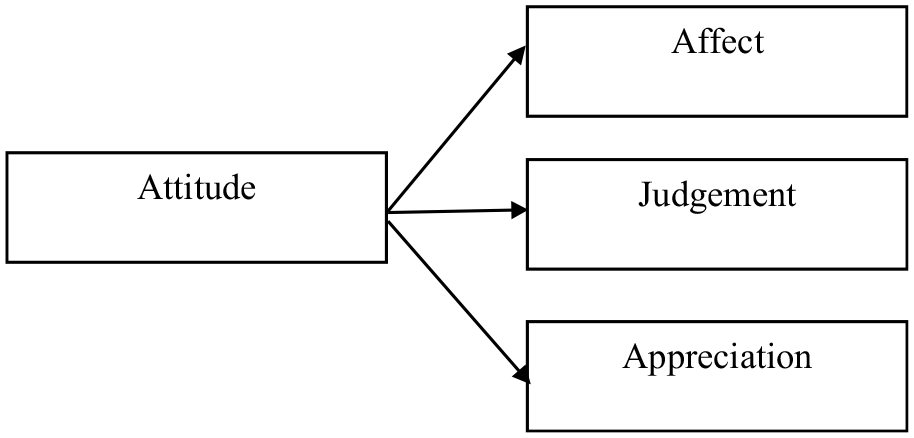
Appraisal theory of sub-system of attitude.
As an example, in an interview for a job, it is the manner in which the candidates speak and their utterances during the interviews that will provide a further evaluation to the interviewers. In the interview process, an interviewee who expresses his thoughts by saying “I’m nervous” will manifest the pessimistic affect. If candidates mentions, “I am independent and reliable,” then this is regarded as an affirmative judgment. Butt (2009) postulated that if the “content is too intense and passionate; the listeners could interpret the text as being sentimental, subjective or demanding” (p. 212).
Three types of attitude, namely affect, judgment, and appreciation commonly depend on the adjective form. Martin and White (2005, p. 58-59.) made each type different from the grammatical frames. Affect and judgment is relational clause and appreciation is a mental clause for readers on the written or the spoken texts. In affect, personal feeling affect something and it makes the person feel affected. For example: -I feel happy (about that/that they’ve come), -It makes me feel happy that they’ve come. For judgment, it is judgment of a person/for another person to do that and for person to do that was judgment, for example: -It was silly of/for them to do that—(For them) to do that was silly or appreciation, people consider something appreciation and people see something as appreciation, for examples: -I consider it beautiful -They see it as.
The three forms of attitude, namely affect, judgment, and appreciation normally appear in the adjective forms. ****Martin and White (2005, p. 58-59) differentiates each form from grammatical structures, where affect and judgment are comparative clauses while appreciation is a subjective clause. In affect an individual experience influences things and that makes an individual experience affect, for instance: -I am pleased (about that/that they’ve come), -I am pleased that they’ve come. For judgment, it was judgment for an individual/of an individual to do that and for an individual to do that was judgment, for instance; it was frivolous of/for them to do that (For them) to do that was frivolous or appreciation, persons regard something with appreciation and persons regard something with appreciation, for instance: -I regard it as attractive -They regard it as attractive.
Aside from the grammatical structure, it is possible to differentiate three areas of inclination from objectives of appraisals and areas of appraisals. For affect, the objects are person and cognizant being, the area of appraisals are sentiment, affections, and matters of the heart. For judgement, the objects are person and cognizant being, the area of appraisals are demeanor, behavior, and disposition. For appreciation, the objects are articles/occurrences; the object of appraisals is worth, structure, and the objects that have an effect on speakers. Following its introduction, appraisal theory has been used in multiple fields of conversation, namely media communication, secondary school English essential writing, history writing, legal communication, scholarly discussion, contrarian writing, preschooler communication, stories, etc. Martin and White (2005) mentioned that of various kinds studies have both hypothetical and functional meaning. The broad appeal of Appraisal Theory confirms that it is a very useful tool for evaluating viewpoints and social connotations. A few significant investigations are produced below, with emphasis on Judgment appraisal.
Coffin (1997) utilized Appraisal Theory to evaluate secondary school history scripts and discovered that the primary evaluation resource applied in narration was Judgment. Writers also apply added implied Judgment sources in the initial two phases (laying out the circumstances and noting down occurrences) and are more likely to apply more emphatic Judgments in the concluding phase. The purpose of this interaction of overt and implied Judgment sources is to create a notation of the earlier goal, realistic, and consistent, while framing a precise and hence personal outlook which is primarily delivered in the concluding phase.
Korner (2000) referenced the speech aspects of common law judgments centered on AT, especially on the Engagement structure and Graduation structure. When delivering judgments, the judges in general draw on Engagement and Graduation sources to “foreground some definitions and to background others.” This is to position themselves with different scripts and evaluate other scripts to institute levels of sameness and contrasts between earlier verdicts and ongoing verdicts.
A diachronic investigation of the progress of children’s Attitude sources was undertaken by Painter (2003), who studied and noted down her two sons’ speech progress in their early years. In relation to Judgment, she concluded that her two sons’ vocabulary usage was restricted and that the early verbal formations denoting Judgment were connected to the children’s behaviors. Though the two sub classifications of Judgment (societal respect and societal endorsement) do exist in child language progress, societal endorsement judgments emerge in only some areas. Furthermore, she additionally made a comparison between the aspect of attributed (clear) judgments and suggestive (implied) judgments by way of abstract statements. In summing up, to a certain degree, “studying one’s native language is inevitably a route of studying to identify skill in the appraisal expressions pertinent to the student’s meaning group” (Painter, 2003).
With the objective to investigate the disparity of Attitude resources among different genders, Page (2003) studied the appraisals provided by both sexes that focused on the subject of childbirth knowledge. There were 23 sets of appraisals that were derived from unofficial interviews of nine couples who lately had children and also five women who functioned as giving birth participants. In the study on Judgment, the author established there were less Judgment resources than the Affect and Appreciation resources in the descriptions of both sexes. They appeared to evaluate themselves more rather than other participants. The author also established that the entire Judgment resources applied to the societal respect group. Susan (2004) conducted a thorough examination of social definitions built on the Appraisal structure in order to develop a hypothetical structure to elucidate the appraisal procedures concealed in the opening segments of scholarly investigation documents, she selected both undergraduate essays and produced investigation documents to examine and contrast the evaluation resources that were applied. The conclusions revealed that both publishers and young authors individualized their writings by applying mindset utterances and also choose to apply greater Appreciation resources rather than Affect or Judgment resources.
In referencing Appraisal Theory, Wu and Desmond (2017) carried out a preliminary investigation of evaluation reservoirs in candidates’ contentious writings. This is a corpus-based investigation consisting of 40 compositions in three diverse classes that extended from highly-rated to lowly-rated. It was established that even though contrasts appeared between the extent and approach of resource application in evaluation, it was found to be insignificant in the general achievement of an essay. Further, Cordeiro (2018) conducted a study on the intercultural communication using one of the SFL theories. It was found that communications, and grammar play important roles either in a written or a spoken from which is similar to Halliday (2014) that in spoken contexts grammar plays an essential role. A study by Cordeiro (2018) may not relate to the attitude system, however, it indicated that the responses should use appropriate word/phrases based on the context in any interaction situations. Speakers may use words/phrases based on the culture or lack of proficiency, however, it may not be appropriate in professional contexts as in job interviews. Cordeiro’s (2018) study on appraisal analysis was also similar to Fitriati et al. (2018) and Wu and Zhao (2018) on the attitude expression in students’ narrative writing and attitude resources in Russian, Belt and Road Initiative. Their studies concluded that choice of words is essential in expressing comprehensive thoughts or ideas.
In line with Cordeiro (2018), Fitriati et al. (2018), and Wu and Zhao (2018), Nurdiyani et al. (2019) investigated the attitudinal perspective in texts written on mothers by the Indonesian migrants in Hong Kong using appraisal analysis. It was reported that lexical resources are very important in writing to create a deeper understanding for the reader. Further, Fan (2020) conducted a study on the analysis of English news reports from the perspective of graduation. The findings revealed that graduation sub-system was used at the highest level to adjust the attitude which assisted readers to improve their reading cognitive based on the choice and the functions of the words able to create deeper meanings of the content. Fan (2020) further noted that the attitude system could be crucial either in spoken or written.
In accordance with Fan (2020), Abbasi and Huang (2020) and Azlan et al. (2020) conducted studies on the social media news and public knowledge of the COVID-19. Both studies had similar objectives that are using appraisal theories. The findings revealed that the choice of words/phrases should be meticulous when conveying the message to the readers/public without creating anxiety or panic. Further, Prastikawatia (2021) conducted a study on the attitude perspective in BBC News’ Article using Appraisal Theory. The study reported that attitude subsystems, judgment, and appreciation were used predominantly in the news in terms of the use of words to show or express the feelings. This probably would be useful for students in reporting or writing news.
There was another study was conducted by Magfiroh (2021) which focused on the narrative text. It was found that the affect system was used predominantly for the communicative purpose where the author expressed feelings or emotion based on the characters and atmosphere of tales. This showed that the author’s ideas were more comprehensive which reflected the author’s proficiency. Magfiroh (2021) also noted that feelings and emotions can be expressed through words/phrases in a sensible manner to create favorable impressions to a listener in any interaction. This could be added on in job interviews. In line with Magfiroh (2021), Natalia (2022) reported that the theory of appraisal by Martin and White (2005) could be incorporated in any English course module to evaluate ones’ proficiency especially in professional contexts.
To conclude, the findings from the investigations above reveal, that there is still a lack of studies conducted in relation to job interviews, especially to integrate the attitude scheme to make job interviews more relevant and meaningful. Consequently, in the current investigation, the attitude scheme, affect, judgment, and appreciations will be applied as evaluation tools to interpret the job interview input. Figure 2 shows an overview of theoretical framework.

An overview of theoretical framework.
Methodology
Figure 3 shows the methodology in steps and each step has been explained in details.
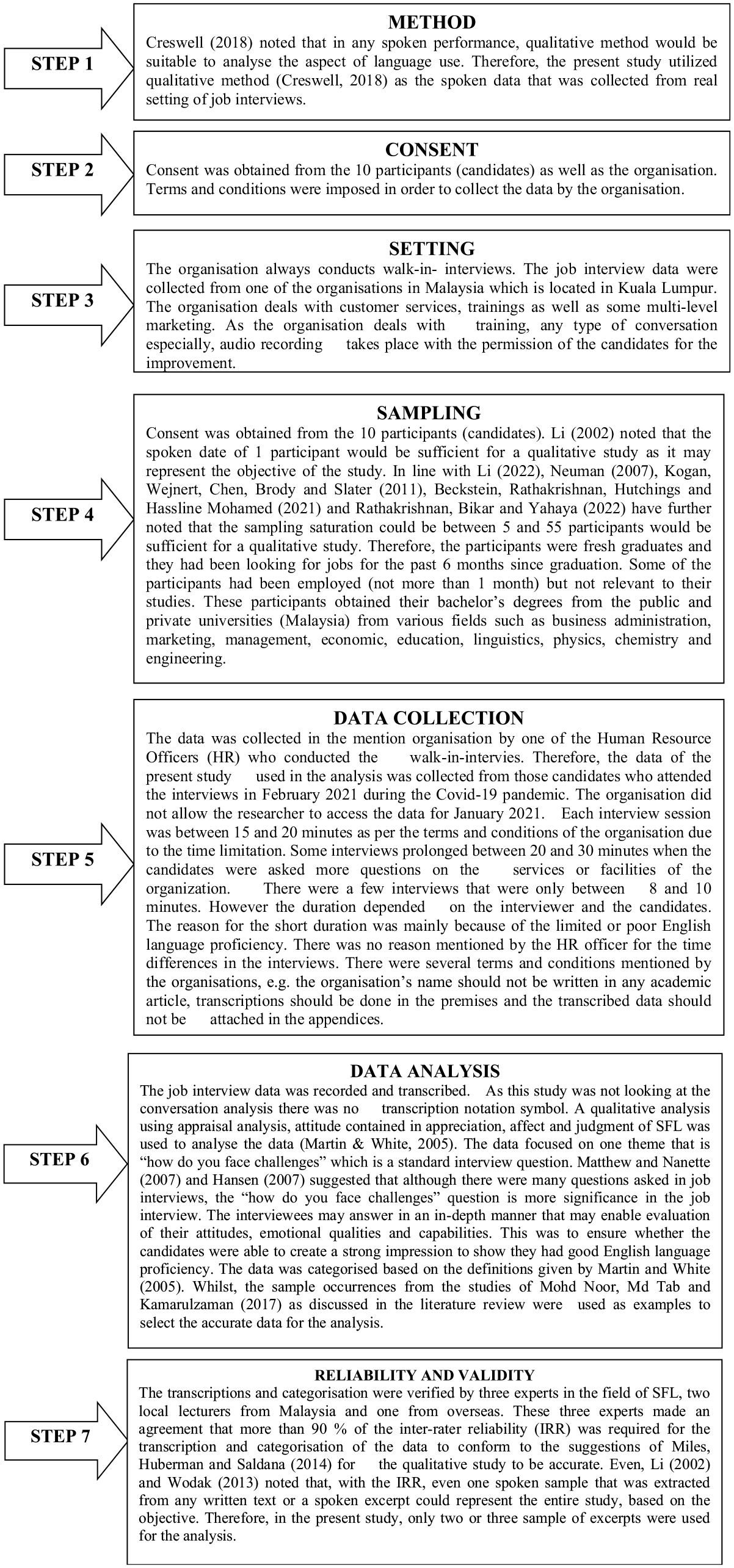
Methodology in steps.
Analysis and Discussion
The findings present the frequency of utterances of attitude based on the sub-system-appreciation, affect and judgement by successful, reserved, and unsuccessful candidates.
Figure 4 shows the frequency of utterances of appreciation, affect, and judgement utterances used by successful, reserved, and unsuccessful candidates. The most predominantly used utterance by successful candidates was appreciation which was 45%. Reserved candidates and unsuccessful candidates only used limited utterances of appreciation. It could be seen that successful candidates used a total of 40% utterances in the interview. However, unsuccessful candidates did not use more than 40% utterances. Moreover, a successful interviewee used positive appreciation, affect, and judgement. The successful candidates did not show negative attitudes to interviewer, much unlike the reserved and unsuccessful candidates. The successful candidates had the highest percentage of appreciation utterances followed by affect and judgment that had the lowest percentage. However, most of the reserved candidates used more affect utterances. The findings confirmed the studies by Page (2003) Cordeiro (2018) and Magfiroh (2021) that in spoken form, the use of words/phrases determined proficiency in any type of context especially in job interviews that portray the capabilities of speakers. Sample utterances of successful, reserved, and unsuccessful candidates are presented below based on the attitude sub-system.

Frequencies of utterances of attitude system.

The candidates convinced the interviewer of their qualities in the interview conversations. IE18, IE13, and IE12 had expressed well their qualities in handling different tasks in their previous jobs. They had shown their qualities of adaptability and change in environment. IE11 and IE6 reactions were to be flexible in the current company in accepting any tasks. However, the responses on their suitability or challenges revealed what they had gone through. Therefore, reserved candidates seem to be less convincing in the interview. This finding is consistent with that of Martin’s (2005) view words and phrases play important roles to convince a listener as in job interview.

IE12 uttered “skilled,”“good at,” and “managed to get” that portrayed stronger affect to the interview as they showed greater capabilities of the candidates. IE16 pointed out their capabilities that created a positive impression on the interviewers. These results corroborate the findings of a great deal of the previous work in Magfiroh (2021 and Natalia (2022 that feelings and emotions can be expressed via words/phrases in an intellectual manner in create a favorable impression in any types of interaction as in professional contexts.

IE12 and IE15 demonstrated their behavior in handling the tasks, with detailed elaborations. IE6 and IE7 expressed less in handling the tasks, while IE19 was unable to be independent, and required the assistance of the superior to solve the task. The candidates convinced the interviewers that he/she could be good examples to others. IE12 and IE 15 had expressed that they were ethically positive as in their behavior by being diligent in their tasks with detailed information. While the reserved candidates like IE6 and IE7 expressed in a different manner. IE6 answered without further elaboration and showed that listening to complaints alone is a positive trait. Likewise, IE7 showed that behavior like; listening to songs would help to resolve the situation. IE19 actually showed that he/she was unable to be independent as s/he needed the assistance of the supervisor or manager. This study supports evidence from previous observations of Cordeiro (2018), Fitriati et al. (2018), and Wu and Zhao (2018) that engagement with bother speakers are essential in relation to use of appropriate word/phrases to expression comprehensive ideas.
Discussion
The present study has revealed the various words/phrases that have been uttered by successful, reserved, and unsuccessful candidates. See Table 1.
Sample Utterances Used by Successful, Reserved and Unsuccessful Based on Questions “How do You Face Challenges”?

Table 1 shows the various phrases used by successful candidates based on their proficiency as compared to the reserved and unsuccessful candidates. The phrases which were used by successful candidates to answer “how do you handle face challenges” in work places probably had created a favorable impression on the interviewer. This was because in workplace there would be numerous challenges that had to be handled meticulously via interactions (Halliday, 2014). Therefore, the appropriate use of words or phrases should be convincing.
The successful candidates revealed in their utterances they had used phrases that indicated they could express proficiently as to how they could overcome challenges. Their utterances revealed they had a positive outlook when they faced problems and had the capability and confidence to overcome them. They could also work independently when they encountered problems and had to find solutions for them. They could also accept criticism to help them when they encountered problems. Another quality revealed in the utterance of the successful candidates was their adaptability to different situations that could help them to find solutions. They were also persuasive and convincing in their approach when they faced challenges. The findings confirmed the statements of Rajaendram (2016), Karim (2016), Abu Bakar (2020), Abu Bakar (2020), and Chau (2021) that good proficiency enhances the chances of getting jobs. Further, the uses of phrases or words appropriately show a candidate’s attitudes in job interviews for the question “how do you face the challenges.” Besides the utterances of the successful candidates, revealed they had the ability to work in a team to find solutions.
The reserved candidates used in their utterances short sentences and phrases that were not impressive. Their utterances revealed that they were desperate in getting the job. As such their utterances did not convince the interviewers. Moreover, they revealed in their utterances they were unable to work independently. The unsuccessful candidates used utterances that did not convince the interviewers because of their limited proficiency. They could not elaborate much on their previous tasks. Their utterances did not show they could work independently. The finding is consisted with the findings of Zainuddin et al. (2019) that due to poor proficiency most of the candidates are not able to perform well in job interviews and chances of getting jobs are limited. Further, the present study did not find any significant differences between reserved and unsuccessful in terms of using phrases or words in answering “how do face the challenges” question owing to poor proficiency. The findings of the present study have revealed that the use of the appraisal theory, attitude, affect, judgment, and appreciation in job interviews would determine ones proficiency. The above findings also in line with Magfiroh (2021) and Natalia (2022)s’ findings that the use of words/phrases may able to create favorable impression in job interviews with the understanding of attitude systems. In general, these findings reflect those of Christopher (2017), Abu Bakar (2018), Tanius et al. (2019), Abu Bakar (2020), Chau (2021), and Allison (2022) that fresh graduates were unemployed due to poor proficiency which is accordance to National Graduate Employability Blue Print 2015–2025.
Implications of the Study
The findings of the study contributed in various aspects. First, the appraisal theory, attitude, affect, judgment, and appreciation can be incorporated into existing course modules in colleges or universities. Probably, educational institutions should accept the research output pertaining to job interviews which could be helpful to train the undergraduates for job employment. Second, the use of attitude, affect, judgment, and appreciation elements in answering job interview interviews, especially the question “how do face the challenges.” The use of these elements in workplaces may be helpful as there are lots of challenges to be faced and interaction could be one of the important tools to handle these challenges. Looking at those phrases which were used by successful candidates (see Table 1) would be helpful for under graduates and fresh graduates in their job interviews in the future.
These findings may also help language instructors to use elements like the specific words and phrases in their teaching or mock teaching to answer the interview questions. This would be helpful for undergraduates to create a favorable impression in job interviews. The sampling size would be one of the limitations as the job interview was conducted during the COVID-19 pandemic and refrain from the contacts. A stringent procedure has been applied to shortlisted the candidates for the job interviews.
As for the theoretical implication, based on the findings, of the appraisal theory, the attitude system has been divided into grammar, especially on the lexical usages (words) to see one’s expression in written and spoken forms. The choice of words/phrases and sentence constructions should be applied in professional contexts as in job interviews to determine a candidate’s proficiency. Perhaps, one of the language elements could be added under the attitude systems as affect, judgement and appreciation play an important role in expressing/responding ones’ ideas where attitude could evaluate language (Martin & White, 2008; Pankovskyi, 2013). In line with Martin and White (2008) and Pankovskyi (2013), Radford (1990), Radford (1997), Halliday (2014), and Krishnan et al. (2021) have noted that in order to express comprehensive thoughts one needs good language proficiency. Therefore, the use of words and sentence constructions could be useful in professional context especially in job interviews to show that candidates are capable to be selected by organizations.
Conclusion
As highlighted the issue of graduate employability has been a global problem for two decades as indicated by the caliber of employable graduates. In Malaysia, the problem is mainly the inability of the undergraduates to express themselves correctly in English during job interviews. Malaysian public universities require undergraduates to take a variety of courses in English for Specific Purposes to prepare themselves for the work force. As disclosed by The National Graduate Employability Blue Print 2015–2025 that 60,000 graduates were unemployed because of their lack of proficiency to impress the interviewer in English.
Therefore, Appreciation subsystem of Attitude was used predominantly by candidates who were successful. More “employability-development-opportunities” (Harvey, 2001, p.1) need to be emphasized in institutions of higher learning. The current study hopes to advance knowledge on performance of graduates at job interviews and contribute to the field of SFL and Educational Linguistics. The present study shows the application of particular words and phrases to create a better understanding and perform well in job interview. The Appreciation subsystem of Attitude can be used amongst fresh graduates in Malaysia and also in other countries which use English as a second language. The present study is also linked to the issue which is mentioned earlier and the suggestions provided could be solutions to prevent unemployment issues. To reiterate, The National Graduate Employability Blue Print 2015–2025 that 60,000 fresh graduates were unemployed and the number would be lesser in the future if higher institutions of leaning play an important role to overcome the stated issues. Further research is required to establish the viability of the language management theory by Neustupný’s (1978) by having more participants or candidates. This theory reveals how speakers manage their language and be more systematic in expressing their thoughts in communicative events, especially in job interviews.
The present study focused on attitude systems not on other grammar aspects due to limitation of the sampling. The organization imposed several terms and conditions and this study had to adhere to them. Therefore, a further study can be done on the communicative competence to analyze the use of language competence especially on grammar.
Footnotes
Declaration of Conflicting Interests
The author(s) declared no potential conflicts of interest with respect to the research, authorship, and/or publication of this article.
Funding
The author(s) received no financial support for the research, authorship, and/or publication of this article.

Data Availability Statement
Data sharing not applicable to this article as no datasets were generated or analyzed during the current study.