




Abstract
Based on the individual difference and social network theory, this research proposed the mediation model, with job search networking behavior as a mediator in the links between six HEXACO personality dimensions and job search outcomes. A survey was implemented in a sample of 773 university graduates. The findings suggest that honesty-humility, extraversion, agreeableness, openness to experience were positively, while emotionality was negatively, related to networking behavior. In turn, networking behavior was positively related to number of job interviews obtained and number of job offers received. Furthermore, the results showed the mediating role of networking behavior in the personality traits-job search outcomes relationships. The findings are discussed in both theory and practical implications.
Keywords
Introduction
Literature has demonstrated that unemployment can lead to many negative consequences to unemployed individuals (Chatterji et al., 2007; Elbogen et al., 2020; Heponiemi et al., 2007; Lundin et al., 2012; Rözer et al., 2020; Thomas et al., 2005; Wanberg, 2012). Unemployment is likely to be related to reducing contact frequency, network size, and social support (Rözer et al., 2020). Besides, Elbogen et al. (2020) supported that long-term unemployed people can encounter financial strain which is associated with the high rate of suicide. Thus, there are is a growing body of studies that recognizes the factors contributing to the job search success of individuals (Aten et al., 2017; Kanfer et al., 2001; Koen et al., 2010; Obukhova & Lan, 2013; Saks, 2006; Saks & Ashforth, 1999; Wanberg et al., 2000).
Based on social network theory, networking behavior has been seen as an effective job search strategy of job seekers (Brown & Konrad, 2001; Forret, 2014; Franzen & Hangartner, 2006; Hoye et al., 2009; Lin & Le, 2019). Accordingly, networking behavior is not only associated with better job search outcomes but also helps job seekers to save time as well as finance in the job search process (Forret, 2014; Hoye et al., 2009; Lin & Le, 2019; Wanberg et al., 2000). Lin and Le (2019) indicated that job seekers who express a higher level of networking behavior for looking for job information tend to gain a greater number of job interviews and job offers. On the other hand, individual difference theory stated that personality is one of the most important factors influencing individual differences in terms of social network size as well as the level of networking behavior of job seekers (Forret, 2014; Lin & Le, 2019; Selden & Goodie, 2018; Wanberg et al., 2000). For example, more extraverted job seekers tend to have a higher networking intensity for finding a job, while people higher in neuroticism own a smaller level of networking behavior (Wanberg et al., 2000). Most of the previous studies have examined the effect of networking behavior on job search outcomes, or the relationship between personality traits and level of networking behavior. To date, however, there has been less implementation of the research on the mediating effect of networking behavior in the relationship between personality traits and job search outcomes that affect understanding the role of personality traits on job search outcomes.
This article aims to fill this gap by investigating how personality traits affect job search outcomes through job search networking behavior. Individual difference theory is applied to explain differences in terms of personality traits that lead to dissimilar intensities of networking behavior. Furthermore, networking behavior could be interpreted by social network theory, which theorizes the role of social relationships in transmitting information and opening different job opportunities, revealing that this theory is applicable in this research. By integrating these theories, the research examines the mediating effect of networking behavior in the relationships between personality traits and the number of job interviews and offers.
Literature Review and Theoretical Framework
Job Search Outcomes
Based on the results of job search behavior, an individual’s job search success can be conceptualized in several aspects (Brasher & Chen, 1999; Forret, 2014; Hoye et al., 2009; Saks, 2006; Wanberg et al., 2000) comprising of job-search outcomes (e.g., number of job interviews and offers) (van Den Hee et al., 2020; Vansteenkiste et al., 2016), employment outcomes (e.g., speed of employment, employment status, salary) (Urquijo et al., 2019; Valls et al., 2020; van Den Hee et al., 2020; Vansteenkiste et al., 2016), and quality of employment (e.g., job satisfaction, person-organization fit, person-job fit) (Dust et al., 2018). Job search outcomes, in particular, number of job interviews and job offers are more proximal to job search behavior than other variables. The greater number of job interviews a job seeker acquires, which results in increasing employment experience and interview success, the greater number of job offers he can get (Côté et al., 2006; Vansteenkiste et al., 2016). A job seeker with a more number of job interviews and offers is likely to have more opportunities to find the desired work that positively influence their employment status and quality of employment than counterparts with less number of job interviews and offers (Côté et al., 2006; van Den Hee et al., 2020; Vansteenkiste et al., 2016).
Previous works have illustrated the importance of job search behavior (intensity and effort) in the prediction of job search outcomes (Saks, 2006; Saks & Ashforth, 2000; van Den Hee et al., 2020; Vansteenkiste et al., 2016). As the effort of job search and the extent of preparatory and active job-searching behavior increases, job seekers are inclined to achieve a growing number of job interviews and recruitment offers (Saks, 2006). In this study, we will investigate the effect of personality traits on job seekers’ number of job interviews and job offers via level of networking behavior.
Social Network Theory
Social network theory states that social relationships present the role in transmitting information and enabling attitudinal and behavioral change (Liu, Sidhu, et al., 2017). In the job-search context, individuals can seek job opportunities via contact with others in their social network or networking behavior (Shen, 2015). Networking behavior for job search refers that individuals actively contact family, friends, or acquaintances to look for job information, advice, or lead for seeking the desired job (Wanberg et al., 2000). There has been a consensus that networking behavior is an informal job search method but effective (Batistic & Tymon, 2017; Forret, 2014; Hoye et al., 2009; Lin & Le, 2019; Mowbray & Hall, 2019; Mowbray et al., 2017, 2018; Wanberg et al., 2000) because social relationships not only provide much useful job information to job seekers (Mowbray & Hall, 2019; Mowbray et al., 2017, 2018) but also significantly give them in terms of social-emotional and instrumental supports (Brown & Konrad, 2001; Forret, 2014). According to Forret (2014), family or friends are job seekers’ social capital that can provide employment vacancies or job opportunities. Moreover, job seekers can find emotional and financial support from these close relationships when they face challenge in the job search process.
Individual Difference Theory
Individual difference theory explains that individual differences in terms of personality can make variability in work knowledge and skills that directly influence job performances (Fullarton et al., 2014; Motowildo et al., 1997), job search behavior (Boudreau et al., 2001), career success (Smidt et al., 2018). The Big Five model or Five-Factor model (Costa & McCrae, 1992) is one of the best-known models for interpreting personality traits including five major dimensions: extraversion, neuroticism, openness to experience, agreeableness, and conscientiousness (McCrae & Costa, 2004; Smidt et al., 2018). Recently, a viable alternative model to the Big Five model—the HEXACO—developed by Ashton et al. (2004) can explain consistently personality dimensions. Based on lexical research of personality structure in diverse languages, the HEXACO model consists of six personality dimensions (rather than five): honesty–humility (H), emotionality (E), extraversion (X), agreeableness (A), conscientiousness (C), and openness to experience (O) (Ashton & Lee, 2007; Ashton et al., 2019). A major difference between the model of HEXACO and Big Five is one specific factor in the HEXACO model, being Honesty-Humility, which was unexplored by the Big Five model. Honesty-humility is characterized by sincerity, fairness, greed avoidance, and modesty (Ashton et al., 2004). Furthermore, two HEXACO factors (agreeableness and emotionality) were derived from a re-rotation of two Big Five factors (agreeableness and neuroticism) (Ashton et al., 2019). Three factors (extraversion, conscientiousness, and openness to experience) of the HEXACO and Big Five framework were highly correlated.
Anglim et al. (2018) studied employees’ positive behavior and damaging behavior in the workplace, confirmed that employees with high honesty-humility, extraversion, agreeableness, and conscientiousness tend to express high organizational citizenship behavior (OCB) and low counterproductive work behavior (CWB). Besides, past research explored that honesty-humility is a key personality trait in predicting employees’ engagement and supervisor ratings of general job performance (Meskelis & Whittington, 2020; Shen et al., 2011). Researchers recognized the role of HEXACO traits on students’ adjustment and academic achievement. For example, Shu et al. (2017) evidenced extraverted international students are inclined to have better interaction adjustment, while those who are conscientious are positively associated with school-related adjustment. Furthermore, female students with high conscientiousness or low extraversion, and male students with low honesty-humility or high openness to experience are related to higher academic achievement (Janošević & Petrović, 2018). In the job search context, extraversion positively affects students’ interview results, while emotionality harms their results. However, little attention has been paid to the influence of HEXACO traits on job search networking behavior and job search outcomes.
Networking behavior and job search outcomes
The previous studies have evidenced that networking plays a vital role in increasing employment opportunities for both those who find reemployment and those who are new labors such as graduated students (Hoye et al., 2009; Lin & Le, 2019). The longitudinal research conducted by Van Hoye et al. (2009) demonstrated that the more time job seekers spend on networking behavior for finding a new employer, the more number of employment offers they can receive. While Lin and Le (2019) studied the job search outcomes of 773 graduated students within 3 months and confirmed that the level of networking behavior is positively related to their job search outcomes. Therefore, we expect that networking behavior significantly influences job seekers’ number of job interviews and job offers.
Hypothesis 1: Job seekers’ networking behavior is positively related to (a) their number of job interviews and (b) job offers.
HEXACO traits and networking behavior
There is a growing body of literature that recognizes the effect of Big Five dimensions on network structure as well as networking frequency (Huang et al., 2018; Selden & Goodie, 2018; Wolff & Kim, 2012; Wu et al., 2008). For example, in conducting a review of the role of Big Five model in the prediction of networking structure, Selden and Goodie (2018) identified that extraverted individuals tend to seek connections and develop their network size, whereas those who have conscientiousness traits are related to keeping certain social relationships. Wolff and Kim (2012) found that personality traits of extraversion and openness to experience are positively associated with building, maintaining, and using in both internal and external contacts of employees in an organization. However, little is known about the role of HEXACO traits in predicting the variability of job search networking behavior. The purpose of the present study is to examine the effect of HEXACO traits on job seekers’ networking behavior, in particular, in the process of looking for a job.
The specific scale of the HEXACO framework, being honesty-humility, is defined by honesty, sincerity, fairness, lack of greed, and modesty (Lee & Ashton, 2004). Although individuals in high honesty-humility can receive trust in relationships as well as emotional support from friends or acquaintances (Molho et al., 2016), they will likely avoid using personal relationships to acquire advantages compared to other individuals (Lee & Ashton, 2004). Therefore, we hypothesize that job seekers with honesty-humility can get the help of friends or acquaintances, but they will rarely use personal contacts as advantages in seeking employment.
Hypothesis 2: Job seekers with high honesty-humility traits are negatively related to job search networking behavior.
HEXACO emotionality trait is presented by fearfulness, anxiety, dependence, sentimentality (Ashton & Lee, 2007), which is quite similar to the neuroticism scale of the Big Five model (such as anxiety, depression, and anger) (Costa & McCrae, 1992). Previous studies have explained that neuroticism might cause people to be socially anxious and negatively influence their social skills (Argyle & Lu, 1990; Selden & Goodie, 2018). Compared to counterparts who are more emotionally stable, in particular, individuals high in neuroticism tend to encounter a growing number of friendship conflicts, and they are likely to have less initiate and effort in maintaining relationships, especially friendships (Berry et al., 2000; Demir & Weitekamp, 2007; Selden & Goodie, 2018). With similar characteristics such as anxiety, experience fear, and little emotion with others, we predict that job seekers with high emotionality seem to have less social skills and initiate to connect with others, which significantly decreases their networking behavior for looking for job information.
Hypothesis 3: Job seekers with high emotionality traits are negatively related to job search networking behavior.
The extraversion dimension of the HEXACO model is characterized by four facets such as expressiveness, social boldness, sociability, and liveliness (Lee & Ashton, 2004). People who are in high extraversion are inclined to seek out and connect social relationships; and they also have better social interaction skills, and feel less anxious than counterparts who are introverted (Argyle & Lu, 1990; Selden & Goodie, 2018). The existing body of research has shown evidence that the personality trait of extraversion is positively associated with networking behavior (Forret & Dougherty, 2001; Hoye et al., 2009; Wanberg et al., 2000; Wolff & Kim, 2012). We suppose that extraverted job seeker will initiate to connect others as well as keep interaction frequently to search for a job.
Hypothesis 4: Job seekers with high extraversion traits are positively related to job search networking behavior.
While extraversion refers to individuals being inclined to social situations, agreeableness is described as forgiveness, gentleness, flexibility, and patience (Ashton & Lee, 2009). People high in agreeableness were less likely to elicit conflict in others, and they tend to receive social connections and have better friendship quality (Selden & Goodie, 2018). It has previously been observed that agreeableness was related to communication frequency that is important in maintaining social relationships (Huang et al., 2018; Wu et al., 2008). Based on the underlying logic presented, we predict that job seekers high in agreeableness will have exchange frequency in others to look for a job.
Hypothesis 5: Job seekers with high agreeableness traits are positively related to job search networking behavior.
HEXACO conscientiousness that is positively correlated with Big Five conscientiousness is characterized by organization, diligence, perfectionism, prudence (Ashton & Lee, 2007, 2009). Like agreeableness, conscientiousness was related to friendship quality and decrease in relationship conflict (Selden & Goodie, 2018), but negatively associated with exchange frequency in terms of ideas, thoughts, and information (Huang et al., 2018). Some studies posit that conscientiousness did not predict the size or the number of new relationships in social support ego networks as well as friendship networks of college students (Selden & Goodie, 2018; Totterdell et al., 2008; Zhu et al., 2013). It appears that people with conscientiousness traits are associated with self-control, careful preparation to avoid mistakes (Lee & Ashton, 2004; Roberts et al., 2014). Thus, we anticipate that:
Hypothesis 6: Job seekers with high conscientiousness traits are negatively related to job search networking behavior.
Conscientiousness refers to prudence, organization, whereas openness to experience is presented by esthetic appreciation, inquisitiveness, creativity, and unconventionality (Lee & Ashton, 2004). Unlike other traits, openness to experience has been seen as the most controversial trait because of the different findings (Huang et al., 2018; Wu et al., 2008). Wu et al. (2008) found that people high in openness tend to relate negatively to communication frequency, while Huang et al. (2018) asserted that individuals with this trait preferred exchanging ideas, thoughts, and information frequently. Evidence from several studies suggested that openness to experience was positively proportional to number of new contacts or the size of the network (Wagner et al., 2014; Zhu et al., 2013). Albeit the contradictory evidence, openness to experience may likely influence network intensity and network size. Furthermore, when conducting tasks that need the creativity and ability to adapt to the change as well as diversity, openness to experience became a salient trait (Selden & Goodie, 2018). Job seeking is considered a challenge of work-life (Kanfer et al., 2001) that requires job seekers both adaptation of employment conditions and social support. Based on the logic explanations, we hypothesize that:
Hypothesis 7: Job seekers with high openness to experience traits are positively related to job search networking behavior.
HEXACO traits and job search outcomes via networking behavior
Accumulated research evidence also suggests that the effect of personality traits on work climate, supervisor support (Fullarton et al., 2014), job performances of both individual and group (Barrick & Mount, 1991; Fullarton et al., 2014; Kramer et al., 2014), job satisfaction and career success (Smidt et al., 2018; Sutin et al., 2009). In the job-search context, personality has been shown to make incremental improvements to the prediction of job search behavior (Boswell et al., 2006; Boudreau et al., 2001; Kanfer et al., 2001). However, the relationship between personality and job search outcomes has not yet been explored. The purpose of the study is to investigate the relationship between six personality traits of HEXACO and number of job interviews and job offers via networking behavior for finding a job.
Although the prior studies explained networking behavior as an effective job search strategy, which was positively related to number of job interviews and number of job offers (Lin & Le, 2019), individuals employed this method with different levels. As mentioned earlier, job seekers with high honesty-humility tend to prefer equality in terms of employment opportunities and avoid exploiting personal relationships as support in getting the job information. As a result, they have a low level of networking behavior in the job search process. While individuals who are highly emotionally unstable seem to have fewer social relationships because they lack social skills and often have conflicts with others (Berry et al., 2000; Demir & Weitekamp, 2007; Selden & Goodie, 2018). Consequently, they also have less social support when finding job information or advice. Unlike emotionality, conscientiousness was consistent with friendship quality. However, individuals with high conscientiousness are likely to rarely exchange with others ideas, information (Huang et al., 2018). Therefore, these individuals also have a low networking intensity for asking for employment information.
While people high in extraversion tend to have more social relationships because they often actively find out and add new friends (Argyle & Lu, 1990; Selden & Goodie, 2018), people high in agreeableness also own a large network size due to they often keep communication frequency, and seldom make conflict with others (Huang et al., 2018; Wu et al., 2008). Finally, job seekers with high openness to experience were positively related to a greater number of new friends or network size because they seem to be interested in new things, new friends (Wagner et al., 2014; Zhu et al., 2013). In keeping with these thinkings, we argue that job seekers who are high in honesty-humility, emotionality, and conscientiousness are likely to express a low level of networking behavior for job search, which in turn predict a fewer number of job interviews and job offers. In contrast, people with high extraversion, agreeableness, and openness to experience seem to have a high networking intensity, which in turn was positively related to the larger number of job interviews and job offers (Figure 1). Thus, we hypothesize that:
Hypothesis 8: Networking behavior mediates the relationship between honesty-humility and (a) number of job interviews and (b) number of job offers.
Hypothesis 9: Networking behavior mediates the relationship between emotionality and (a) number of job interviews and (b) number of job offers.
Hypothesis 10: Networking behavior mediates the relationship between extraversion and (a) number of job interviews and (b) number of job offers.
Hypothesis 11: Networking behavior mediates the relationship between agreeableness and (a) number of job interviews and (b) number of job offers.
Hypothesis 12: Networking behavior mediates the relationship between conscientiousness and (a) number of job interviews and (b) number of job offers.
Hypothesis 13: Networking behavior mediates the relationship between openness to experience and (a) number of job interviews and (b) number of job offers.

The research framework.
Method
Sample and Produce
The data for this study were obtained from three North Vietnamese universities by using a questionnaire survey. A total of 850 emails were sent to students who have graduated for 3 months. The email contained the link to online questionnaires and attached a consent letter assuring that provision of information was voluntary and the confidentiality of respondents. All the measures used and the instructions on the questionnaires were translated two times. The first time was translated into Vietnamese. The second was back-translated in English to verify the accuracy of the translation. We get a strong between the original English version and English back translation after comparison and revision carefully. We offered a pre-paid mobile card to all respondents who participated in the survey as a method to improve the response rate of the survey.
A total of 773 people responded to our study, which was a 91% response rate. We were surprised by the response rate. This can be the result of meetings held with students and student administrations to introduce the goal of the survey and to secure their acceptance before conducting the survey. Of the responses, the gender composition was 355 female (45.9%) and 418 male (54.1%). The average age of the participants was 23.22 years (SD = 0.52), with all ages ranging from 20 to over 25. The respondents were from engineering (28%), accounting (26%), business administration (23%), finance (18%), and other areas of study (5%) (Table 1).
Summary of the Sample Profile.

Measures
The quantitative research with a cross-sectional survey design was applied for the current study. The author used the self-administered questionnaire and divided it into four parts, consisting of Part 1, demographic question; Part 2, HEXACO personality trait scale, Part 3, networking behavior scale; Part 4, job search outcome scale. Respondents rated the extent to which each item described themselves on a 5-point Likert type scale ranging from 1 = strongly disagree to 5 = strongly agree. Table 2 shows the operational definitions of each construct and reference.
Operational Definition of Constructs.

HEXACO traits
We applied for the HEXACO-60 model, one short personality inventory established by Ashton and Lee (2009), consisting of honesty-humility (H), emotionality (E), extraversion (X), agreeableness (A), conscientiousness (C), and openness to experience (O). Each dimension included four facets and was measured by 10 items. The example statements for honesty-humility, emotionality, extraversion, agreeableness, conscientiousness, and openness to experience are respectively followed as “I would never accept a bribe, even if it were very large,” “I worry a lot less than most people do,” “The first thing that I always do in a new place is to make friends,” “I rarely hold a grudge, even against people who have badly wronged me,” “I often push myself very hard when trying to achieve a goal,” “People have often told me that I have a good imagination.” Ashton and Lee (2009) reported the Cronbach’ alpha of honesty-humility, emotionality, extraversion, agreeableness, conscientiousness, and openness to experience for college sample were .79, .78, .80, .77, .78, and .77, respectively.
Networking behavior
We used nine items of Wanberg et al. (2000) to measure the networking behavior scale. Some example statements are as follows “Talked with friends or relatives about possible job leads,” “I have asked people I know if they knew of someone who might have job leads or information for me.” The respondents used a 5-point Likert-type scale ranging from 1 (almost never) to 5 (very often) to indicate the extent to which they had contacted people to look for job information during the last 3 months. The reliability coefficient for this scale measured in the research of Wanberg et al. (2000) was .93.
Job search outcomes
To measure job search outcomes, we used two scales including number of job interviews and number of job offers. Number of job interviews was measured by two items developed by (Côté et al., 2006). An example statement is as follows “How many job interviews have you had in the last 3 months.” Côté et al. (2006) reported Cronbach’s alpha for this scale as .78. Number of job offers was measured by two items developed by Côté et al. (2006). An example statement is as follows “How many job offers have you had in the last 3 months.” The Cronbach’s alpha was reported by Côté et al. (2006) for this scale as .71.
Control variables
Gender, age, and occupation were used as control variables, which might influence results. Gender was coded 0 = male and 1 = female. Forret and Dougherty (2004) studied the relationship between participating in networking behavior and career outcomes and found that the level of participation for men is stronger than for women. We also controlled for occupation as levels of networking behavior differ between occupations (Wanberg et al., 2000). Besides, individuals at higher age level likely have better social skills and larger network size due to they have more time to develop their skills and social network than counterparts who are lower age level, which may contribute to increasing networking behavior (Kanfer et al., 2001; Wanberg et al., 2000). Therefore, age was used as a control variable.
Results
The present research examined the hypothesized model through two steps mentioned by Anderson and Gerbing (1988) with the implementation of AMOS 22. First, we tested the reliability (CR—composite reliability and α—Cronbach’s alpha) and the construct validity (including convergent and discriminant) of all the study items. Second, structural equation modeling (SEM) was applied to examine the fit and path coefficients (Jöreskog & Sörbom, 1982), and bootstrapping was employed to test the mediation effect. According to Kline (2011), indices fit the data well when: χ2/df ratio (the chi-square statistic divided by the degree of freedom) <3, CFI (comparative fit index) >.90, TLI (Tucker–Lewis index) >.90, RMSEA (root mean square errors of approximation) <.06, SRMR (standardized root mean square residual) <.08.
Assessment of Common Method Bias
The common method bias (CMB) of the research needs to be examined due to the data for HEXACO personality traits, networking behavior, and number of job interviews and offers that were self-reported by job seekers. Podsakoff and Organ (1986) explained that common method variance (CMV) is the most frequently tested issue in any individual reported because the validity of the research results may be threatened. Therefore, the CMB seems to affect the job search outcomes of job seekers. Based on the recommendation of Podsakoff and Organ (1986), Harman’s single factor was conducted to test CMB in this study. If the variance of a single factor was higher than 50% of the total variance, CMV exists.
To test CMB, we entered all items into an exploratory factor analysis (EFA) by applying for SPSS 22. As the results of the test, which show that a single factor did not account for the majority of the covariance. As the variance of a single factor was 16.6% (total variance: 60.9%). It indicates that there was no CMB in our study. Therefore, CMV was not a significant issue. Besides, the result shows that Kaiser-Meyer-Olkin (KMO) measure was acceptable (Tabachnick & State, 2007). Bartlett’s test of Sphericity was statistically significant because p-value = .000. Moreover, as recommendation of Xerri and Brunetto (2013), the sample size of this research was suitable because it was larger than 200 components. Therefore, the sample size was used to test the hypotheses.
Assessment of Reliability and Convergent and Discriminant Validity
Before running CFA to assess the model fit, the univariate normality is tested. According to (Kline, 2011), if the value of the skewness is lower than 3 and the value of the kurtosis is less than 8, univariate normality does not exist. The results indicated that the values of the skewness extend from .015 to .741, while the values of the kurtosis extend from .085 to 1.995. Thus, it is concluded that there was no evidence of univariate normality.
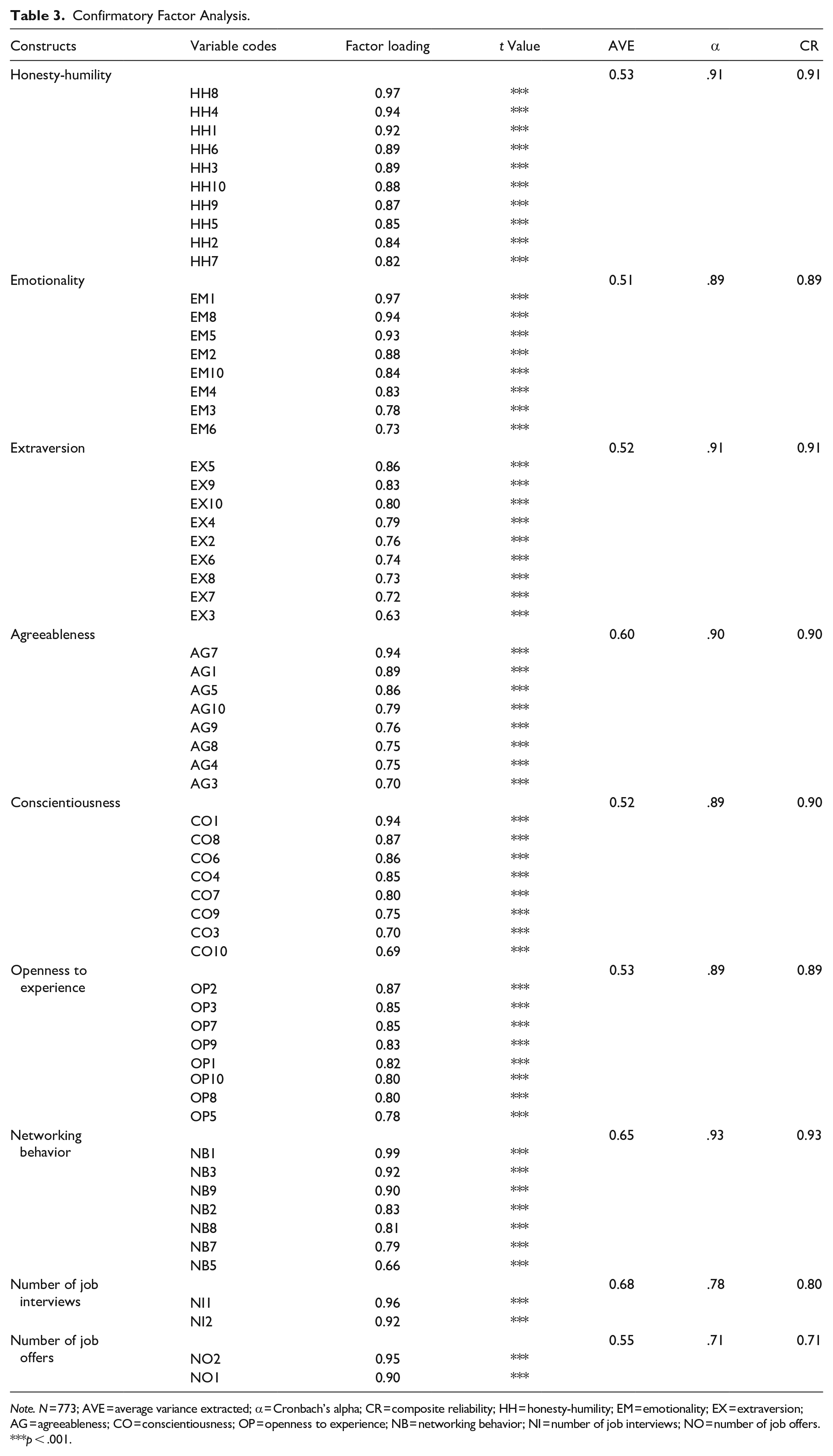
The model can be acceptable when it has a group of criteria of goodness-of-fit indices as follows: the value of χ2/df should be less than 3, a good fit for RMSEA is less than .08, and the cutoff value of CFI and TLI is higher than .90 (Hair et al., 2010). As the results of Table 3 showed that the factor loading of all items in the proposed model had p < .001. In addition, all indices fit the data well: χ2 = 2,440.49, df = 1,751, χ2/df = 1.394, RMSEA = .023, CFI = .974, TLI = .972.
Confirmatory Factor Analysis.
Note. N = 773; AVE = average variance extracted; α = Cronbach’s alpha; CR = composite reliability; HH = honesty-humility; EM = emotionality; EX = extraversion; AG = agreeableness; CO = conscientiousness; OP = openness to experience; NB = networking behavior; NI = number of job interviews; NO = number of job offers.
p < .001.
The consistency reliability of the factors is assessed by two values, consisting of Cronbach’s alpha (α) and composite reliability (CR). According to Hair et al. (2010), two values have been seen as substitutes for each other. Hair et al. (2016) suggested that the value of CR and Cronbach’s alpha should exceed .7. As shown in Table 3, all CR values were higher than the threshold value of .7 for honesty-humility (.91), emotionality, extraversion, agreeableness, conscientiousness, openness to experience, networking behavior, number of job interviews, and number of job offers, .91, .89, .91, .90, .90, .89, .93, .80, .71, respectively. Also, Cronbach’s alpha values of all items exceed the threshold value of .7 for honesty—humility, emotionality, extraversion, agreeableness, conscientiousness, openness to experience, networking behavior, number of job interviews, and number of job offers, .91, .89, .91, .90, .89, .89, .93, .78, .71, respectively (Table 3).
According to Fornell and Larcker (1981), the value of the average variance extracted (AVE) should be higher than 0.5. The results indicate that all AVE values of honesty-humility, emotionality, extraversion, agreeableness, conscientiousness, openness to experience, networking behavior, number of job interviews, and number of job offers were 0.53, 0.51, 0.52, 0.54, 0.52, 0.53, 0.65, 0.68, 0.55, respectively. The standard factor loadings of these items exceed 0.50 (range from 0.63 to 0.99) and are significant at p < .001 (Cheung & Wang, 2017). As a result, the convergent validity of all constructs was quite reliable.
As recommendation of Fornell and Larcker (1981), if the square root of AVE is higher than the inter-construct correlation coefficients of the model’s constructs, the model’s constructs have discriminant validity. Besides, the model of the study fit the data well. These results of the study indicated that the hypothesized model has discriminant validity.
Descriptive Statistics
The means, standard deviation for all study variables were exhibited in Table 4. The results showed that the means of the variables range from 3.27 to 4.02, and the standard deviation is from 0.47 to 0.86. Table 4 exhibited the correlation coefficients among variables. The results revealed that excepting emotionality that was negatively related to networking behavior (r = −.52, p < .01), other HEXACO traits, including honesty-humility, extraversion, agreeableness, conscientiousness, and openness to experience, had positive correlations with networking behavior (r = .26, p < .01), (r = .43, p < .01), (r = .28, p < .01), (r = .19, p < .01), (r = .26, p < .01), respectively. The results from Table 4 also indicated the positive relationship between personality dimensions of honesty-humility (r = .15, p < .01), agreeableness (r = .18, p < .01), conscientiousness (r = .09, p < .05), and openness to experience (r = .13, p < .01) and number of job interviews. Whereas there were only three dimensions correlated with number of job offers, consisting of honesty-humility (r = .20, p < .01), agreeableness (r = .18, p < .01), and openness to experience (r = .16, p < .01). Finally, the findings presented that networking behavior had a positive effect on the number of job interviews and job offers (r = .13, p < .01), (r = .10, p < .01), respectively.
Correlations Among Research Variables.

Note. N = 773; SD = standard deviation.
p < .05. **p < .01. ***p < .001.
Hypothesis Testing
Testing the direct effect
A structural equation model was constructed to investigate the direct effect of exogenous variables on endogenous variables through standardized coefficients by using AMOS 22.0 software. Figure 2 shows the estimated model, with the standardized path coefficients. The proposed model fits the data well: χ2 = 2,518.25, df = 1,752, χ2/df = 1.44, RMSEA = .024, CFI = .972, TLI = .970.
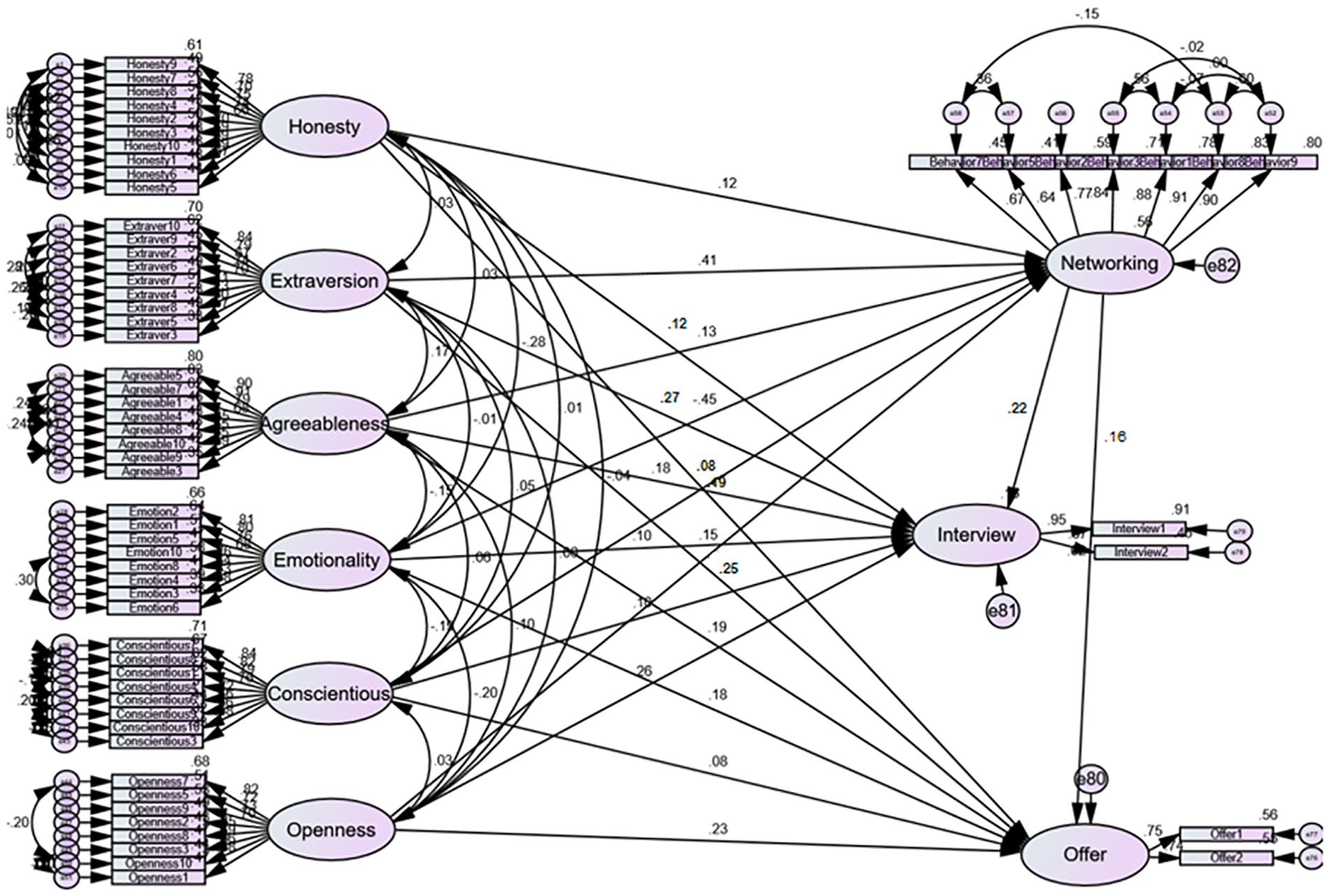
The standardized path coefficient of the hypothesized model.
The results from Table 5 indicated that networking behavior had the positive effects on both number of job interviews (r = .22, p < .001) and number of job offers (r = .16, p < .01). Therefore, hypothesis 1 was supported.
The Standardized Regression Weights.

Note. SE = standard error; CR = critical ratios.
p < .001.
We found evidence of the relationship between HEXACO traits and job search networking behavior. Whereas emotionality trait was negatively associated with networking behavior (r = −.45, p < .001), the personality traits of honesty-humility, extraversion, agreeableness, openness to experience were positively related to networking behavior (r = .12, p < .001), (r = .41, p < .001), (r = .13, p < .001), (r = .15, p < .001). There was only conscientiousness that did not influence networking behavior (r = .08, p > .05). Therefore, hypothesis 2, 3, 4, 5, and 7 were supported, excepting hypothesis 6.
Testing the mediating effect
The percentile bootstrap confidence interval was employed to investigate mediating effects. Bootstrapping is a popular method to examine the indirect effect, which is based on multiple replacement resampling (Bollen & Stine, 1990; Shrout & Bolger, 2002). A confidence interval is used to check if there is zero in the interval. If zero is not in the interval, the indirect effect is different from zero or exists (Kenny, 2018).
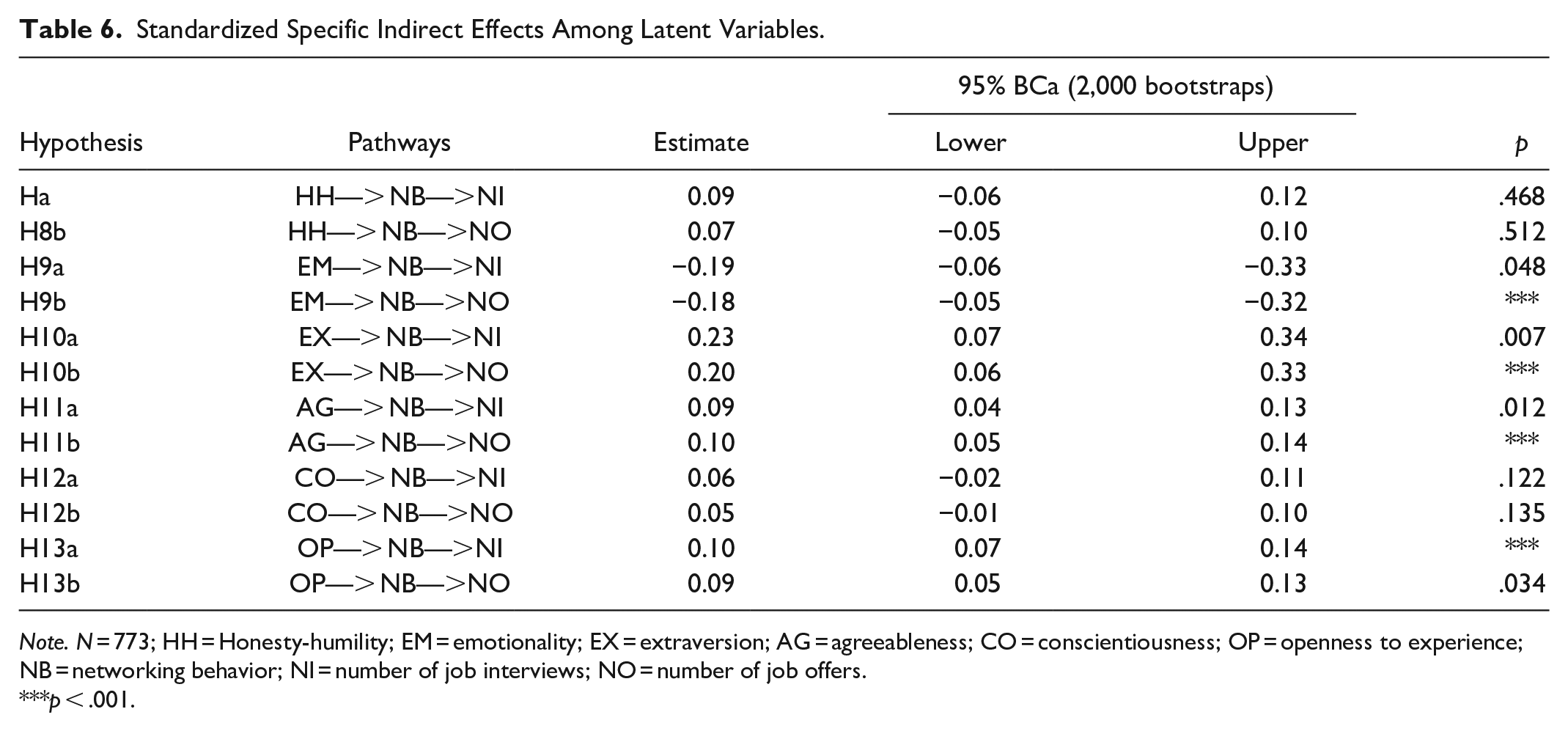
Networking behavior mediates HEXACO traits and number of job interviews. As is shown in Table 6, networking behavior did not mediate the relationship between honesty-humility and number of job interviews, and the relationship between conscientiousness and number of job interviews. The evidence showed that the p-value was not significant. Moreover, zero existed between the lower and upper confidence interval, honesty-humility (r = .09, p > .05) BCa [−0.06, 0.12], conscientiousness (r = .06, p > .05) BCa [−0.02, 0.11]. Thus, hypotheses 8a, 12a were rejected.
Standardized Specific Indirect Effects Among Latent Variables.
Note. N = 773; HH = Honesty-humility; EM = emotionality; EX = extraversion; AG = agreeableness; CO = conscientiousness; OP = openness to experience; NB = networking behavior; NI = number of job interviews; NO = number of job offers.
p < .001.
The evidence in Table 6 suggested that emotionality (r = −.19, p < .05) BCa [−0.06, −0.33], extraversion (r = .23, p < .01) BCa [0.07, 0.34], agreeableness (r = .09, p < .05) BCa [0.04, 0.13], and openness to experience (r = .10, p < .001) BCa [0.07, 0.14] had indirect effects on number of job interviews through networking behavior. Therefore, hypothesis 9a, 10a, 11a, and 13a were confirmed.
Networking behavior mediates HEXACO traits and number of job offers. The findings exhibited that the indirect effects of emotionality (r = −.18, p < .001) BCa [−0.05, −0.32], extraversion (r = .20, p < .001) BCa [0.06, 0.33], agreeableness (r = .10, p < .001) BCa [0.05, 0.14], openness to experience (r = .09, p < .05) BCa [0.05, 0.13] (Table 6). These effects met the criterions that the p-value were significant and the confidence intervals did contain zero. Therefore, hypothesis 9b, 10b, 11b, 13b were supported. Whereas the results indicated that networking behavior had no significant mediating effects on the relationship between honesty-humility (r = .07, p > .05) BCa [−0.05, 0.10], conscientiousness (r = .05, p > .05) BCa [−0.01, 0.10] and number of job offers. Thus, hypothesis 8b, 12b were rejected.
Discussion
The main goal of this research is to investigate the mediating role of job search networking behavior on the relationship between HEXACO personality traits and number of job interviews obtained and employment offers received by using two pertinent theories (individual difference theory and social network theory) to construct and test the research model. To do this, the study examined three groups of hypotheses: (1) the effects of networking behavior on graduated students’ number of job interviews and offers; (2) the role of HEXACO traits in predicting the level of networking behavior; and (3) finally the mediating effect of networking behavior on the relationship between HEXACO dimensions and number of job interviews and job offers.
Grounded in social network theory, our findings indicated the important role of job search networking behavior on a growing number of job interviews and job offers. Job seekers who display a higher level of networking behavior to their social relationships to look for job information can acquire a larger number of both job interviews and employment offers, which was consistent with prior research (Hoye et al., 2009; Wanberg et al., 2000). Based on individual difference theory, personality is one of the key factors affecting individuals’ job search behavior and job search outcomes. Our findings demonstrated that the effect of six HEXACO traits (Ashton et al., 2004) to job search networking behavior and number of job interviews and job offers. Our findings identified that emotionality was negatively related to job seekers’ level of networking behavior, while the other four personality dimensions (honesty-humility, extraversion, agreeableness, openness to experience) were positively associated with their networking behavior. Of the six personality traits, emotionality and extraversion had strongest correlations to networking behavior (r = −.45, p < .001), (r = .41, p < .001), respectively, and followed by openness to experience (r = .15, p < .001), agreeableness (r = .13, p < .001), and honesty-humility (r = .12, p < .001). However, there was no evidence of the link between conscientiousness and networking behavior (r = .08, p > .05).
Our study integrated two theories, consisting of social network theory and individual difference theory, to explain the mechanism linking HEXACO traits and the number of job interviews and job offers. Our results indicated that job seekers with high extraversion, agreeableness, and openness to experience seem to have high networking intensity, which in turn is positively related to the greater number of job interviews and job offers. On the other hand, people who are high in emotionality tend to express a low level of networking behavior, which results in a smaller number of job interviews and job offers.
Theoretical and Practical Implications
The present study contributes to theory and practice in various implications. First, our study has reaffirmed the role of networking behavior as a career management strategy of job seekers, which is consistent with prior studies (Forret, 2014; Hoye et al., 2009; Wanberg et al., 2000). Besides, our research not only supports the idea that personality is the factor influencing the level of networking behavior for finding a job (Wanberg et al., 2000), our research has also extended it by investigating another personality model—HEXACO model, and level of networking. Finally, the most important findings of this study are the evidence that the mediating effect of networking behavior on the relationships between HEXACO traits (emotionality, extraversion, agreeableness, and openness to experience) and number of job interviews and job offers. Our study explained the mechanism linking personality traits and job search outcomes through networking behavior, which is little known previously. The findings demonstrated that job seekers with high extraversion, agreeableness, openness to experience, or low emotionality are positively related to the level of networking behavior, and in turn networking intensity positively influences their number of job interviews and offers. Our study links individual difference theory to social network theory, providing novel knowledge on the sources of contacting ties in social network theory. Despite having a direct effect, honesty-humility did not have an indirect effect on the number of job interviews and job offers via networking behavior. Similarly, no indirect effect of conscientiousness appeared. One potential possible reason may be that honesty-humility and conscientiousness had weak correlations or no correlations with networking behavior in this context. Based on the results gained above, an important conclusion can be drawn that networking behavior plays a role in how job seekers’ personality traits influence their job search results.
Our findings provide education managers and career counselors with possible training ways for improving graduated students’ job search success. First, social relationships are useful in supplying employment opportunities by informing job positions or vacancies. Therefore, education managers can encourage job seekers in using their social relationships or networking behavior for finding job information, which can be combined with traditional methods (e.g., finding a job on the internet or career centers,…) to raise their employment opportunities. Second, our study finds that personality traits can predict job seekers’ number of job interviews and job offers. Specifically, the personality traits of emotionality and introversion are predictors of the decreasing number of job interviews and job offers. In contrast, extraversion, agreeableness, and openness to experience are positively related to the number of job interviews and job offers. Hence, education managers are encouraged to explain the role of personality to job seekers’ job-search success and provide the feasible method for mitigating the effect of emotionality and introversion and strengthening extraversion, agreeableness, and openness to experience. Third, our findings indicate the mediating effect of networking behavior on the relationship between personality traits and number of job interviews and job offers. Managers should give adjustments in terms of habits and beliefs to change the levels of personality traits contributing positively to their job search networking behavior. For example, increased social interaction frequency should lead introverted individuals to experience positive emotions, create social cohesion, and make strong social networks (Huang et al., 2018), which in turn contributes to the increasing level of networking behavior. Consequently, this positively affects job seekers’ job-search success.
Research Limitations and Direction for Future Researchers
There were several limitations to the present study. First, this study had a cross-sectional design which does not allow inferences about longitudinal, networking behavior-made changes, and causality. Bias may exist in this context because the data collection was conducted at the time graduated students were employed. In the future, researchers may investigate the causality of job search networking behavior by longitudinal and cohort-sequential designs. The popular issue with common method variance is the inflated empirical results because participants provide consistent answers to all survey questions. We restricted this problem by using a group of mixed items that were difficult to recognize which factors were associated with which items (Podsakoff et al., 2003). The second limitation is that the data relied exclusively on self-report measures and the sample was all online, which suggests future research combining multiple assessment methods and multiple data collecting methods to increase the validity of the findings. Third, in this study job search outcomes represented a chosen group of respondents who used both formal and informal job-finding methods as an understandable limitation because in a high competition environment nowadays, job seekers need to employ more than one job search method to look for the desired job instead of using solely networking method.
Conclusions
Based on social network theory and individual difference theory, this research investigated the mediating effect of job search networking behavior between HEXACO personality traits and job search outcomes. The results have been explored by building and testing the hypothesized model using sample data from 773 students and applying CFA—SEM for data analysis. The results showed that honesty-humility, extraversion, agreeableness, and openness to experience are positively related to networking behavior, while emotionality is negatively associated with networking intensity. Moreover, the level of networking behavior is positively proportional to both number of job interviews and job offers. Our findings indicated that networking behavior mediated the relationships between four personality traits (including emotionality, extraversion, agreeableness, and openness to experience) and job search outcomes (number of job interviews and job offers). Indeed, this study helps to validate social network theory and individual difference theory, and also provides a clear understanding of the mechanisms behind these theories in the context of North Vietnam.
Footnotes
Declaration of Conflicting Interests
The author(s) declared no potential conflicts of interest with respect to the research, authorship, and/or publication of this article.
Funding
The author(s) disclosed receipt of the following financial support for the research, authorship, and/or publication of this article: This research was funded by Vietnam Maritime University.
