




Abstract
This paper examines the ordeals actors of SMEs face in the adoption process of Emerging Digital Marketing Technology (EDMT). A conceptual framework was proposed to capture actors that participate in EMDT and the difficulties they (themselves) pose that hinder successful adoption. However, a purposive sample of 26 participants drawn from Crunch online database, Luton were interviewed on unstructured and semi-structured bases and analyzed using a thematic approach. The interviews on the problems were coded and classified based on the actors involved in the adoption process to extend the T-O-E framework. The findings revealed that while extant problems relate to the contexts of technology, organization, and environment, the extended T-O-E framework unraveled more critical problems that are linked to the in-grained human context. Implicit is that vendors should work on decision-makers, given that some of the adoption decisions are critically and continuously influenced by the actors.
Plain Language Summary
This paper examines the ordeals actors of SMEs face in the adoption process of Emerging Digital Marketing Technology (EDMT). A conceptual framework was proposed to capture actors that participate in EMDT and the difficulties they (themselves) pose that hinder successful adoption. However, a purposive sample of 26 participants drawn from Crunch online database, Luton were interviewed on unstructured and semi-structured bases and analyzed using a thematic approach. The interviews on the problems were coded and classified based on the actors involved in the adoption process to extend the T-O-E framework. The findings revealed that while extant problems relate to the contexts of technology, organization, and environment, the extended T-O-E framework unraveled more critical problems that are linked to the in-grained human context. Implicit is that vendors should work on decision-makers, given that some of the adoption decisions are critically and continuously influenced by the actors.
Introduction
Emerging Digital Marketing Technology (EDMT) is a broad term to include any new or emerging ICT or improved ICT applications (S. Eze et al., 2014). These applications in the IS domain are a critical enabler and/or driver of socio-economic growth and sustainability (S. Eze et al., 2012; Eze et al., 2019a; Kayisire & Wei, 2016; Samoilenko & Osei-Bryson, 2018; Tob-Ogu et al., 2018), that has earned a huge scholarship and global e-economy (Al-Natour & Benbasat, 2009; Venkatesh et al., 2007). Studies in this onerous area largely focus on large enterprises (Rantapuska & Ihanainen, 2008), and market saturation forces IT investors to divest to other segments, including SMEs which promise agility and buzzed socio-economic development in terms of employment, innovation, and flexibility (Awa, 2019; Taylor & Murphy, 2004; Tob-Ogu et al., 2018). Scholars (Awa, 2019; Awa et al., 2017) posit that the socio-economic potentials of IT innovations and their use by different categories of enterprises to build and/or strengthen competitive advantage are among the critical reasons for the juicy returns accruing to ICT vendors, especially in the knowledge economies. Fundamentally, the new ICT world or the improved ICT (otherwise referred to as emerging ICT) has constantly revolutionized business processes, changed value-chain power relations, granted quick access to the world market, and embraced the knowledge economy and of course new e-economy (Harvie, 2010; Lip-Sam & Hock-Eam, 2011). Hamilton (2002) posits that the new e-economy represents a dynamic system of integrated interactions that involves diverse actors or value-chain members (managers, individuals, governments, ICT experts, and vendors and customers) whose interests are individually and/or collectively captured in the choice of ICT innovations to adopt.
Similarly, ICT adoption involves a complex and unpredictable social process that often involves the interplay of different actors who reposition the users’ needs in conceptualizing, designing, and implementing its features (Jacobsson & Linderoth, 2010; Tyre & Orlikowski, 1994). Benamati and Lederer (2001a) posit that informed adoption decision is subject to understanding the multifaceted nature of internal and external actors, their specific needs and roles in emerging ICT adoption, and the challenges each brings to the decision-making board. The scholars further opined that the involvement of such diverse actors in the decision process is consequent upon the numerous responsibilities associated with a successful implementation of emerging ICT, which a single actor rarely controls. Other scholars (Fiore et al., 2001; Kaulio, 1998) argue that such involvement in the specification, conceptualization, engineering design, and prototyping phases of development promotes mass customization of the emerging ICT and its features, and minimizes the challenges that users may encounter at the use stage. Yet others posit that successful adoption is much more than educating the users; and involves a co-creation of values with active entities who are critical parts of the diffusion process (Kotler & Keller, 2009; Prahalad & Ramaswamy, 2004; Rogers, 1995), and who pose diverse challenges because of the meaning different actors attach to ICT’s features (Orlikowski, 1992).
Emerging ICTs are widely acknowledged by different institutions (e.g., large enterprises, governments, and SMEs) as critical tools for business strategies (Griffith & Northcraft, 1996), because they save time and cost and improve ubiquity, integration, and performance (Yen Teoh & Pan, 2008). However, because of limited resources and few number of actors who take decisions, Elie-Dit-Cosaque et al. (2011) posit that small businesses are more agile in doing environmental analysis and making decisions that address the issues of ICT anxiety, losing a sense of control, and ICT related negative cognition. Although studies (Beckinsale et al., 2006; S. C. Eze et al., 2013; S. C. Eze & Chinedu-Eze, 2018; Parker & Castleman, 2009) account that SMEs used ICT efficiently to develop communications, customer relationships, and business process integration, there is still a dearth of studies that considered the critical challenges faced by SMEs in adopting emerging ICT when diverse human actors are involved in the process. A critical examination of such issue exposes SMEs’ managers to a clear understanding of the dynamics of actors/users and challenges, as well as provides insights into proactive and tactical actions that will lead to successful adoption (Jacobsson & Linderoth, 2010; Kayisire & Wei, 2016; C. Mason et al., 2008; Ramdani et al., 2009).
Scholars (Jacobsson & Linderoth, 2010; Orlikowski, 1992; Orlikowski & Gash, 1994) posit that emerging ICTs may associate with functions recognized at a particular point and another point, disagreement results because of the perception of diverse actors precipitate differences in meaning attached to the emerging ICTs. Hence, to comprehend how SMEs navigate through certain adoption challenges presupposes an insightful framework that explains the multifaceted nature of the actors and factors in a giving setting, their strategic impact on organizations in terms of support for the right technology, and the challenges each poses to the successful adoption of emerging ICT. Benamati and Lederer (2001a) assert that the involvement of diverse internal and external actors in a proposed adoption process is critical because the responsibilities to ensure successful adoption are numerous and can rarely be handled or controlled by a single actor. Ample studies (Beckinsale et al., 2006; Jacobsson & Linderoth, 2010; Parker & Castleman, 2009) on this focus more extensively on large organizations when a more critical analysis should involve different categories of firms, including SMEs, to make more strategically integrated propositions. Thus, there is a need to articulate and integrate different actors and forces to understand the nature of the challenges of EDMT adoption, and to proactively remain active and tactical in sustaining and/or improving competitive advantage since EDMT are becoming more thought-provoking. Hence, the major question this paper seeks to address is: what challenges inhibit the implementation of EDMT in service SMEs when different actors are involved in the adoption and implementation process? To address the question, this paper attempt to explore the key challenges facing service SMEs’ managers in the adoption of EDMT when diverse actors are involved.
The T-O-E theoretical framework was adopted to provide insights into the actors’ interests and how the complex challenges faced by SMEs in the adoption process are linked to these actors. Drawing from the T-O-E framework to explore such challenges is to propose a more integrated framework that will surge the success trajectory of SMEs, especially given that extant studies (Al-Natour & Benbasat, 2009; Costello, 2009; Samoilenko & Osei-Bryson, 2018) rarely address, with clarity, how such issues are associated with satisfactory operational returns. T-O-E framework underpins the paper because, amongst others, it is confirmed to have a much more theoretical, analytical, and empirical validation (see Awa et al., 2012, 2017) than most other adoption frameworks. However, the inductive approach to the study provides more detailed accounts of the phenomena investigated and tends to make up for the shortcomings of most extant studies, especially those that adopt the deductive approach. The paper is structured as follows: first, it reviews and analyses the literature and explains the framework that underpinned the study; second, it presents the overall research and data analysis process; third, it highlights the findings and presents the proposed conceptual framework; and lastly conclusion, discussion, limitations, and suggestions for further studies.
Literature Review
Why Service SMEs
Globally, SMEs have the potential to drive balanced political and socio-economic independence (in terms of employment, innovation, and flexibility), and the service-oriented sector in particular plays a very significant role in the UK economy (Dahnil et al., 2014; Franco & Garcia, 2018; Parellada et al., 2011). The UK and many other economies have their small businesses swiftly expanding because of the various government support programs that enable them to grow in ICT (Lee, 2004; Ongori & Migiro, 2010). In Europe and North America, SMEs represent over 90% of all businesses, generate employment of about 70%, and contribute to innovation development, skills, and gross added value of over 65% (Castro et al., 2011). Similarly, in Australia, SMEs provide one-third of the GDP, and in most Organization for Economic Co-operation and Development (OECD) nations, they account for between 96% and 99% of the enterprises and provide approximately 80% of the socio-economic growth (Awa et al., 2015; Scupola, 2009). Studies (Lindermann et al., 2009; Martin & Halstead, 2004; Ritchie & Brindley, 2005; Tilley & Tonge, 2003) assert that since the 1971 Bolton Report in the UK, SMEs have been driving economic, regional, and local development, and contributed approximately 60% of the UK’s GDP. However, with the advent of globalization and the shift toward the adoption and use of emerging ICT, there has been variation between the past and the future of service-oriented businesses (Millar & Choi, 2011) which has increased the activities of service-oriented SMEs in the UK.
This study focused on UK service SMEs’ adoption of ICT services to satisfy external customers because, in recent times, S. C. Eze and Chinedu-Eze (2018) posit that this sector has expanded rapidly and represents over 18% of the UK’s national output. Besides, the UK economy is predominantly service-oriented, and the sector has remained the economic driver and extends its support to UK private and public sectors. Studies (Metaxiotis, 2009; Rantapuska & Ihanainen, 2008) observe that despite the significant efforts to improve the sector, it has repeatedly functioned in a difficult and volatile business environment; and confronted by challenges ranging from adoption to implementation and use of innovative technologies. Even when SMEs manage to adopt modern ICT solutions, a critical mass of them tends to neglect those associated with long-term profitability and pursue those that promise immediate, short-term, and/or ill-fated gains that undoubtedly raise costs and risks (Awa, 2019; Gban et al., 2014; Maduku et al., 2016; Metaxiotis, 2009; Shiau et al., 2009). They are often ignorant that any little change in their ICT adoption plans can result in a competitive advantage.
ICT Adoption and T-O-E Framework
EICT is considered crucial for most SMEs as small businesses are supposedly spending many resources to minimize costs and improve an organization’s performance (Tob-Ogu et al., 2018; Yen Teoh & Pan, 2008). However, a large number of small businesses are still confronted with such adoption barriers as poor education, poor adoption plans, poor management, and inadequate awareness of the benefits of ICT (Asongu & Le Roux, 2017; Kyem, 2012). Scholars submit that valuable contributions to ICT matters are the aftermath of poor preparation to adopt, which often gives rise to short-term decisions as the majority of SMEs allow ICT adoption decisions to be taken by few players within the organization (Kayisire & Wei, 2016; Rantapuska & Ihanainen, 2008), while others appear to be busy with the SMEs’ day-to-day business activities (Ocda, 2004). Strengthening the adoption preparation is critical because SMEs are key to socio-economic development (Dahnil et al., 2014; Girgin et al., 2011; Wonglimpiyarat, 2015), and though they are inhibited by limited resources (Shane & Venkataraman, 2000), their flexibility (justifying small is beautiful) reposition them ahead of large organizations (Costello et al., 2007; Tob-Ogu et al., 2018) in terms of the faster decision to adopt new ICT applications (Simmons et al., 2008) that improve organizational performance via saving time and cost (Harvie, 2010; Yen Teoh & Pan, 2008).
Scholars (Asongu & Le Roux, 2017; Rantapuska & Ihanainen, 2008) posit that besides the size barrier, some SMEs are almost unprepared to key into long-term plans and tactical benefits because they suffer poor administration, fewer individuals handling adoption issues, and issues of learning, education and enlightenment, and awareness of the significance of ICT. Often small businesses experience adoption failures because they rarely have the cognate knowledge to understand both the long and short-term demands of ICT (Costello et al., 2007). Ocda (2004) posits that the acquisition of valuable information for informed ICT decisions is often hindered by the supposed too-busy schedule of managers. Supposedly, executives show more commitment to assessing ICT innovations to adopt when there are some levels of sophistication in the use and management of such new technology (S. C. Eze et al., 2013; Remenyi et al., 1991). Therefore, more updated research is required to aid service SMEs to understand the major problems that confront them and ways to deal with them to gain the desired goal. This is critical given that majority of SMEs spend huge resources trying to adopt emerging ICT without cognate benefits (Costello, 2009; S. C. Eze et al., 2013) and for that, they fall back on automating extant ones. ICT adoption failure is not new and so, studies (Eze et al., 2019; Shiau et al., 2009; Tob-Ogu et al., 2018) explained it in terms of ICT complexity which had made it difficult to integrate traditional systems.
However, extant models (TRA, Ajzen & Fishbein, 1980; TAM, Davis, 1989; TPB, Ajzen, 1991; IDT, Rogers, 1995; UTAUT, Venkatesh et al., 2003; T-O-E, Tornatzky & Fleischer, 1990; D-T-O-E, Thong, 1999) rarely explain SMEs’ adoption issues because they predominantly took samples from large organizations. Large organizations differ predominantly from small organizations in terms of operational agility and capital lay-out; thus, the application of their research findings rarely cross-cut perfectly. Although much will lean on these extant models and studies, there is a need for an integrated framework that specifically takes into account the ICT adoption challenges and behavior as they relate to service SMEs. Specifically, in trying to deal with this objective, the populous and dominant conceptual taxonomies of the technology-organization-environment (T-O-E) framework underpins this study because most traditional adoption theories are deterministic, technology-based and offer limited explanation and prediction of any phenomena of interest.
Technology Context of Emerging Digital Marketing Technology
The technological dimension covers but is not limited to internal and external expertise that play significant roles in the organization which include tools and procedures. The technology dimension extends to technologies appropriate for the firm, present technologies utilized by the organization as well as those currently available in the marketplace. It also extends to those not tested or have undergone trials, adopted, or implementation by the organization (Eze et al., 2019a). According to Liao et al. (2003), knowledge acquired by any firm either internally or externally will encourage innovation and firms must consider changes such innovation will bring to the organization (Baker, 2012). For this study, the technology context includes internal variables small business managers consider before adopting EDMT. Studies (see Alshamaila et al., 2013; Grandon & Pearson, 2004; Markus & Tanis, 2000; Ramdani et al., 2013; To & Ngai, 2006; Zhu et al., 2003) have used these variables (e.g., compatibility, relative advantages and perceived affordability) in different studies and these variables provide a theoretical lens for many studies which are relevant in studying a firm’s new ICT adoption and factors shaping such new technology adoption.
Organization Context of Emerging Digital Marketing Technology
The organizational dimension looks at the structures, resources, as well as the size of the business, and degree of monopolization. Organizational context scrutinizes the characteristics, resources, business size, and intra-firm communication processes that influence EDMT adoption decisions. Baker (2012) observed that these variables have a huge impact on shaping the implementation and EDMT adoption in several ways. Studies (see Gutierrez et al., 2015; Ramdani et al., 2013; Thong, 1999) have surveyed the variables (e.g., perceived employee acceptance; owner support) related to the organizational context. Though a huge number of studies have focused on the adoption of EDMT most of these studies have not looked at how the opinion and perceptions of other actors have hindered or shaped SME managers’ choice of emerging ICT adoption resulting in challenges.
Environment Context of Emerging Digital Marketing Technology
The environmental dimensions focus on the size of the business, competitors, macroeconomic perspective, and regulatory background (S. C. Eze & Chinedu-Eze, 2018) Environmental context considers both internal and external factors that are likely to impact SMEs positively or negatively. It includes the business location as a result of government policy, globalization, and advances in EDMT (Chau & Tam, 1997; Mehrtens et al., 2001; Nguyen et al., 2015). The environmental context is vital because it assists in understanding both the internal and external information that is crucial when decisions for EDMT adoption are made (Andries & Debackere, 2006). The capacity of an organization to have a competitive advantage over its rivals via the examination of the internal environment variables shapes the adoption decision of EDMT. Thong et al. (1996) note that the support of top-level management influences the efficiency of the information systems but more importantly the quality of the external information systems an organization has played a crucial role in SMEs conducting their business activities in a highly sophisticated environment. Variables associated with environmental context and how it influences SME managers’ ICT adoption have also been discussed extensively in the literature. They include competitor intelligence gathering provider credibility (Nguyen, 2009), perceived technology market growth (Ramdani et al., 2013); information gathering on customers (Mehrtens et al., 2001; Premkumar & Roberts, 1999); and Government policy (Kuan & Chau, 2001). The TOE elements discussed above may help understand the all-inclusive challenges SME managers encounter and to reduce the uncertainty that is linked to EDMT adoption. According to Alshamaila et al. (2013) and Tornatzky and Fleischer (1990), these three dimensions provide both limitations and opportunities for the advancement of technological innovation and shape the manner SMEs implement new technology.
The T-O-E framework also takes the systems and supra-systems of innovation adoption; and deals with the utilitarian, attitudinal, techno-economic, and deterministic challenges of most traditional models (e.g., TRA, TAM, TPB, and IDT), when it captured the social and psychological explanatory and predictive parameters (Awa et al., 2015, 2017). IDT (Rogers, 1983). It explains and predicts adoption behavior via the proxies within technology and organization; whereas Tornatzky and Fleischer (1990) integrated environment as a supra-system to give rise to the T-O-E framework. The T-O-E framework provides a critical analytical tool that unravels the drivers and inherent features of innovation, proficiencies, and other environmental circumstances (Awa & Ojiabo, 2016). Similarly, the taxonomies provide both threats and opportunities for the advancement of technology innovation and shape the manner micro-businesses implement new technology (Alshamaila et al., 2013; Tornatzky & Fleischer, 1990).
Apart from the laudable strength of the T-O-E framework in explaining organizational-level adoption, it was specifically adopted for this study because of its empirical resilience in exploring issues of SMEs’ adoption behaviors (Maduku et al., 2016); and its more robust theoretical and empirical support (Alshamaila et al., 2013; Maduku et al., 2016; Ramdani et al., 2009; Zhu et al., 2003) in IS field than other adoption frameworks (e.g., TAM, IDT, TRA, TPB, and SM). Scholars (Alshamaila et al., 2013; Maduku et al., 2016) suggest that the T-O-E framework explains intra-firm adoption better than other frameworks, and can draw a large number of variables that may significantly provide analytical bases that shape the adoption of emerging ICT.
In addition, Glancey et al. (1998) posit that information is the backbone of any enterprise that helps to (re)shape and (re)design its products, corporate structure, and direction. Service-oriented businesses are information-intensive; they share corporate information with all stakeholders via ICT, given that ICT develops indigenous economies. Some SMEs effectively use ICT to advance their networks of communications and knowledge sharing with customers. However, a large number of SMEs have failed to take into account the circumstances that aid constant adoption (C. Mason et al., 2008) since a majority of them seem not to be versed in technological and human competencies (Khoumbati et al., 2006; Lip-Sam & Hock-Eam, 2011). Rantapuska and Ihanainen (2008) posit that some SME operators are less proactive and open-minded and thus, find it difficult to share information and implement emerging ICT. Also, the manner they exploit knowledge differs: at one end, the owner-manager solely manages ICT investment; and at another end, the adoption decision depends on tacit knowledge which includes the manager’s instincts, experiences, attitudes, and values (Rantapuska & Ihanainen, 2008). Employees’ tacit knowledge is recognized as a critical asset for competitive advantage (McCall et al., 2008), given the buzz of ICT which rejigs collaboration and interaction as well as informal knowledge sharing within and outside the organization. Scholars (Gagnon et al., 2000; Kyem, 2012; Newman & Thomas, 2008; Rantapuska & Ihanainen, 2008) posit that contemporary organizations believe that knowledge and ideas generated informally from diverse actors (those internal and external to the business) can either be much more innovative and satisfying when adopting emerging ICT or create challenges to SMEs managers since they are not vast in ICT implementation.
Actors are various users or members of society who directly or indirectly are an integral part of establishing and/or adopting ICT in organizations. These actors may act as a dictator for emerging ICT needs through a series of activities resulting in new ICT implementation in SMEs. They constitute an integral part of the development and/or adoption process throughout technology life history (Lindsay, 2005). However, these actors pose challenges to SMEs since they are not vast in ICT. On the other hand, Hanseth and Monterio (1997) contend that technology does not need to be institutionalized for it to exist instead, once it is conceived it is a force to reckon with, and it involves an actor delegating roles and influencing other human actors. Therefore, studying ICT adoption and understanding the challenges facing SMEs require taking into account the interactions of actors, technology, organization, and their environment. This may provide an in-depth understanding of the challenges faced by SME managers from the technology, organization, and environment point of view when the need for EICT adoption arises. Given these, the study’s conceptual framework is presented in Figure 1 below.

Proposed study framework.
Method
Most ICT adoption research has concentrated on confirmatory statistical techniques (S. Eze et al., 2012; Schwarz & Chin, 2007; Silva, 2007). Although these methods are well recognized, Silva (2007) argues that ICT adoption research requires more explanatory theories and methods that can help explain and understand the phenomena. Hence, this research is qualitative which is a useful alternative and provides rich insights and results (Lee et al., 2003). The researchers deployed a qualitative method to obtain an in-depth understanding of the critical issues facing SME actors in the adoption of EDMT in the UK service sector. SMEs in this context and as defined by the European Commission are businesses that have between 1 employee and <250 employees (https://single-market-economy.ec.europa.eu/smes/sme-definition_en).
The study focused on service SMEs in the UK because the sector has grown rapidly in recent years and is considered the main source of job creation, and often compensates for job losses in the manufacturing sector (S. Eze et al., 2014). The growing significance of the service sector suggests that efforts improve living standards, job creation, and boost the economy are increasingly dependent on the service sector (Eze et al., 2021).
The research began with a review to identify knowledge gaps and develop interview questions around the research objectives. The critical questions to collect the initial set of data bothered: who are the actors involved in the adoption of new ICT applications? Are there issues encountered when they are involved in the process? How do the activities of these actors impact you and your business? Prompts were used to elicit deeper meaning based on the relevant themes that emerged during the interview. The outcome of the interviews led to the preliminary study. Gilmore and Carson (2007) and Awa et al. (2021) posit that a preliminary study is conducted using data gathered during the first stage of the unstructured interview because using a quantitative approach may not generate the level of penetration required. The initial data were coded and analyzed based on the T-O-E framework and the raw data gathered at this stage helped the initial set of themes to emerge. This preliminary investigation helped to design semi-structured interviews which were conducted, followed by data analysis, confirmation, and interpretation as indicated in Figure 2 below.

The overall research process.
The Interviews
The research deployed unstructured and semi-structured interviews at the first and second stages of the data collection process with a sample drawn from Crunch online database. Since qualitative research deals with the discovery and description of participants’ views, purposive sampling was used to identify small service businesses that have adopted emerging ICT at the first stage of the interview. J. Mason (1996) posits that purposive sampling helps to select units of analysis that will assist in making a reasonable comparison and not for statistical generalization. The condition for selecting participants was that they must have used emerging ICT in the last 3 years. Of a sample of 65 invited, 26 indicated interest and were interviewed (see Table 1 below). The type of services they render is in Table 2 below. It is important to note that the research was conducted between January 2021 and February 2022 and the interviews were conducted between July 2021 and December 2021. The first stage of the unstructured interviews was carried out to know the present state of emerging ICT adoption to have a broad view (e.g., unveil the actors and their activities), and to apply the first set of codes (challenges) to the samples of the raw data for credibility check. Following Oates (2006) and Schultze and Avital (2011), the outcome of the preliminary investigation assisted in the design of semi-structured interview questions for validation of the outcome at the initial stage, and for the interviewees’ views to be understood by the investigators. Of note is that the data generated were participants’ narratives expressed in their own words.
Interviewee Profile.

Interviewees’ Positions.

Oates (2006) and Awa et al. (2021) suggest that interview questions should be sent to the interviewees a few days before the interview to give them the lee-way to think through and get prepared. By so doing credibility will be established. The semi-structured interview questions were accompanied by formal introductory letters and both were sent 2 days ahead of time to enable the interviewees to make decisions and feel comfortable before the interview. The content of the introductory letter included reasons for the interview, assurance of information confidentiality, and the length of time the interview will last. Tape and other recording devices were used in the interview process because error and bias may occur when we rely extensively on memory alone. All the interviews lasted for between 45 min and 1 hr.
Data Analysis
At stage 2 of the research process, analysis and interpretation of data were carried out in line with the initial codes generated from the theory-thematic analysis; thus, theory-driven thematic analysis was adopted. In keeping with Braun and Clarke (2006), the analysis and coding of data took into account the fundamental ideas, expectations, and conceptualization rather than focusing on the semantics or surface meaning of the data.
The description of these theoretical codes was written in simpler terms in a bid to know when the theme associated with each code occurs. These became the basis for categorizing the raw data. The practical guide for coding the raw data is depicted in Table 3. It is important to note that while the coding of the raw data was going on, an empirical code (Huma context) emerged and was incorporated into the study. Table 3 below describes a guide for coding both predefined and post-defined codes.
Below Describes a Guide for Coding the Predefined and Post-defined Codes.
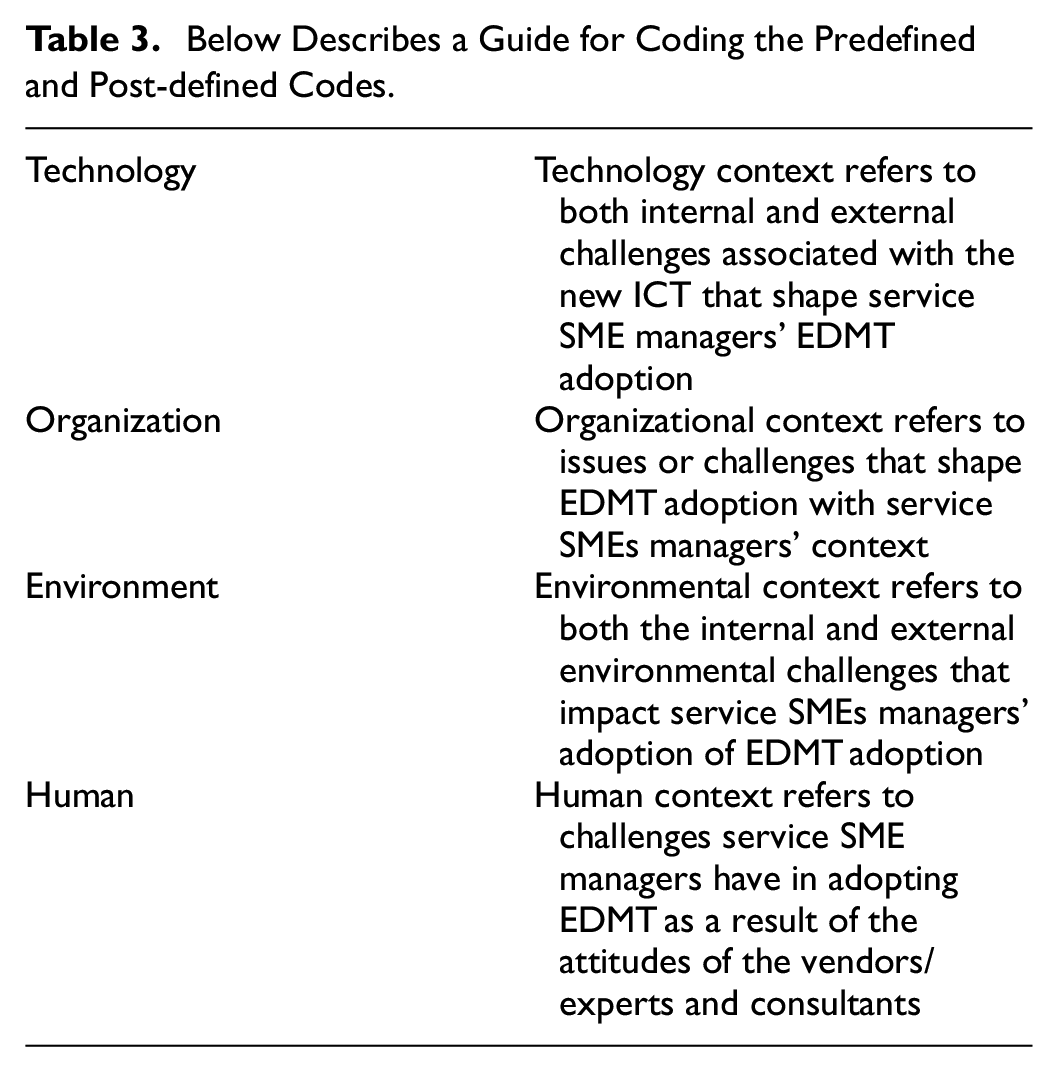
This approach was useful because it aided credibility and dependability checks, the application of codes to the raw data, and allows themes to also emerge inductively (Awa et al., 2021; Miles & &Huberman, 1994). Figure 3 reports the data analysis process. In the data analysis model, the codes generated from the interviews were applied to the sample of raw data to check their credibility in stages one to three, and all the transcribed data were imported into NVivo (version 10.2.2) in stage four. NVivo was used for analysis because of the huge data involved, which ordinarily requires categorization to make the analysis easier.

Data analysis process.
Consistencies in the data between identified groups and the quotes extracted from the interview transcripts using inter-coder reliability analysis were ascertained by four judges that cross-checked the quotes and themes and validated further via a cross-case analysis of supporting evidence. These judges were two Professors and two PhD holders whose areas of specialization are in digital marketing and E-Business respectively.
The results of the inter-coder analysis showed 78% which is higher than the 70% benchmark proposed by Miles and &Huberman (1994) (see Table 4 below). This process was developed to illustrate how the researchers analyzed and conveyed the findings (dependability check) and how well the raw data linked to the interpretation (conformability check) (Boyatzis, 1998). Before the analysis, the researchers developed a guide that aided the coding process based on the meaning attached to each theme.
Reliability Analysis.

Findings
The findings depicted in Tables 5 and 6 show the themes relating to the challenges faced by SMEs with various actors involved in emerging ICT adoption and their supporting cases and a shred of evidence. The theory-driven thematic analysis method was adopted because themes were clustered based on the T-O-E framework and revealed the challenges small businesses face. These findings were on the themes, interviewees’ explanations, and the literature.
Sample Supporting Cases on the Challenges of Emerging ICT Adoption.
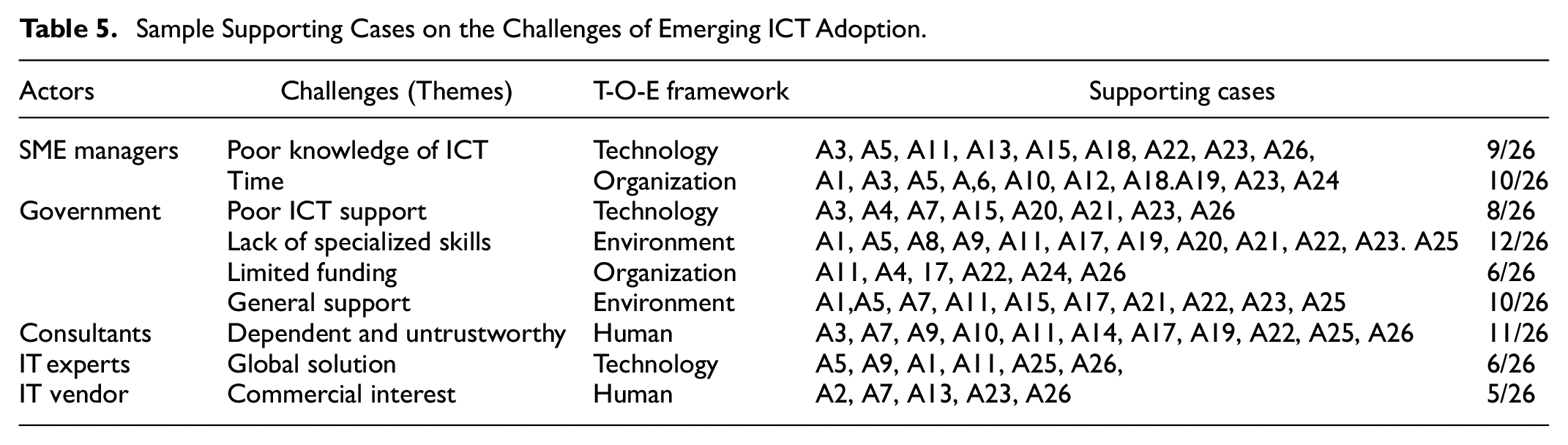
Themes and Sample Supporting Evidence on Challenges Associated With Actors in Emerging ICT Adoption.

Actors Associated With Emerging ICT Adoption Challenges
Strom et al. (2014) posit that consumers and other actors play vital roles in the co-creation of values; that is, they encourage or hinder ICT adoption success. The findings revealed that adoption challenges faced by SMEs are predominantly caused by numerous actors. SME managers are adopters and decision-makers; they often brainstorm with other actors (internal and external) to ensure that their claims of what solution to be adopted are supported (Sarker et al., 2006). The identification of SME managers as the main participants made it possible for other stakeholders to be identified as the cause of the study. However, the interviews with managers of small businesses helped to identify external persons such as IT experts, IT vendors, consultants, government agencies, and customers who are part of the development, and adoption process and may also impede SMEs from adopting emerging ICT successfully. To understand how small business managers encounter challenges that may hinder them from adopting ICT successfully, the study made effort to identify circumstances that led to such challenges from diverse actors’ perspectives otherwise the holistic views of the various actors and deep insight into the challenges.
The framework reveals that in most innovative SMEs for example, the attitudes and beliefs of the managers may not only be responsible for the challenges encountered but also such challenges from internal and external actors. These external entities include IT consultants and IT vendors whose main responsibilities span identifying, customizing, and creating interface and functional enhancement of the new ICT, as well as planning for the implementation of the new technology and providing ongoing support and problem-solving (Fang et al., 2011). Others including designers and developers, government and its agencies, as well as the internal actors (e.g., SME managers and staff with other external actors), may determine the impact or value of the emerging ICT and develop a procedure to assess and evaluate it. However, while SMEs believe that these actors play substantial roles in co-creating values with them, the study reveals that most challenges SMEs encounter during emerging ICT adoption come from external entities as shown in the framework. Drawing from the T-O-E framework, the themes were coded and classified, and as shown in Figure 4, it was made known that the actors are associated with emerging ICT adoption, the challenges they pose, and the classification of these challenges based on technology, organization, environment, and human contexts. The implication is that the challenges faced by SMEs in ICT adoption are not only shaped by the technology, organization, and environmental contexts but also by the human context; thus, SME managers should be tactical and proactive in dealing with these actors to avoid emerging ICT adoption failure.

Framework for emerging ICT adoption challenges in SMEs.
Discussion
There are numerous challenges facing SMEs’ adoption of modern ICT-based innovations that require scholarly attention. This study dealt with a few such challenges in the context of SMEs and still encourages further scholarships in different contexts and domains.
Sme Managers
Poor Knowledge of ICT and Time Constraints
Evidence suggests that the major challenge facing small business managers is that they lack the cognate skills and knowledge needed to make informed decisions on how to implement new ICT applications. In other words, participants specifically emphasized that one of the challenges facing SMEs is the limited understanding of ICT and the lack of skills and knowledge to make the right decision. Concerning Tables 4 and 5, this point was echoed by [M22] and [M26] across seven cases supports [A3], [A5], [A11], [A13], [A15], [A18], and [A23]. For instance, [M13] asserts that “SMEs have limited skill set;” whereas, [M23] observes that “)…businesses don’t have the )… knowledge; they are so busy running their business on a day-to-day basis.” This reveals that SMEs are much more interested in running their daily business and hardly had time to improve the skills that would assist them to adopt the right technology. The implicit is that for SMEs to make an informed evaluation of any new ICTs, they must pay attention to how the new ICT would meet the needs of the key stakeholders. Granted that some SMEs may handle some challenges occasioned by the environment, they still lack the time to do some research instead they prefer instant solutions to their problems.
In Tables 4 and 5, participants [M12], [M23], and [M5] raised this point and had strong cross-case supports: [A1], [A3], [A6], [A10], [A18], [A19], and [A24]. This reveals that the majority of small businesses do not spend time to learn and equip themselves before deciding on emerging ICT, because most times they are at a loss as to what they exactly want and expect. Unfortunately, this increases tension and hinders successful ICT adoption. One of the critical implications of this is that most times small businesses rely extensively on information gathered from external sources (e.g., the consultants) who represent the first point of contact to them. A dearth of time, skills, misleading advice from external context, and limited resources and understanding of ICT benefits (Duan et al., 2002; Esteves, 2009; Fincham, 2002; Ocda, 2004) are some of the challenges faced by small businesses in adopting new ICT platforms. Hence, SMEs are seen as the late majority in the Rogers’ model of adopters’ category.
Government
Poor ICT Support
The poor government-initiated IT support program(s) was one of the critical issues and hindrances encountered by SMEs in their bid to successfully adopt emerging ICT. Referring to Tables 4 and 5, the statements from [M21], [M26], and [M23] affirmed this with cross-context supports of [A3], [A4], [A7], [A15], and [A20]. Regardless of the huge socio-economic potentials of SMEs, the governments are not doing enough to support them; rather, they sign-post them to various independent businesses (e.g., consultants, Vendors, IT experts) whose supports are subject to meeting their commercial gains. Ordinarily, if such support services come from the government and its agencies, they are supposed to be cheap or free but when are handled by independent organizations, their high charges affect the cost of end-products and prices consumers pay. Simpson and Docherty (2004) observe that such poor ICT support has a negative influence on SMEs because most of them believe that such services when provided by the governments are free and positively affect the socio-economic activities of the nation.
Lack of Specialized Skills and Knowledge
Beckinsale et al. (2006) opine that regardless of the UK government’s center stage of supporting SMEs, their roles remain unclear. The general presumption is that the government has effectively supported SMEs, but the findings revealed that the government is yet to have the specialized skills necessary to support SMEs in emerging ICT adoption. What the government normally does is to sign-post or link SMEs to non-governmental organizations (NGOs) without constantly monitoring and evaluating them to ensure that they provide SMEs with the right support. Thus the majority of government agencies do not have the required skills to provide SMEs with the right information. [M25], [23], and [M22] raised these points, and had good cross-case supports: [A1], [A5], [A8], [A9], [A11], [A17], [A19], [A20], and [A21] (see Tables 4 and 5). This implies that most government agencies that support SMEs only come on board as facilitators whose job is to link SMEs to other organizations/agencies that can help provide the needed support because they lack the specific skills needed to support SMEs.
Limited Funding
Limited funding was a core challenge SMEs encountered. Although the government provided several grants and funding in the past, evidence suggests that they still encounter complex and dynamic challenges daily. Simpson and Docherty (2004) recalled that the UK government expended £67millon on several activities and programs to encourage ICT readiness for SMEs as a way of providing advice, training, and information as well as financial incentives from 2001 to 2004. Similarly, Costello (2009) observed that the government also provided grants worth £450,000 to help SMEs in implementing ICT effectively. Although many SMEs were able to benefit from the grants, Metaxiotis (2009) opines that the UK SMEs’ adoption rate of the internet was below average. This paper recognizes the limited funding from the government and revealed that a major reason SME managers still lean on government agencies is to gain access to public funds. In Tables 4 and 5, these were the positions of such participants as [M24], [M26], and [M22] with their cross-case supports of [A11], [A4], and [17]. These participants recognize that inadequate funding and support have continually discouraged most SMEs; and thus, widened the gap between the government and the SMEs. This attests that government support may not be exhaustive, and with the present difficulties, it will be even more difficult for SMEs to secure funding in the future.
General Support
Ocda (2004) asserts that Small Service Businesses (SSBs) vary in structure, size, culture, formation, and how they utilize business information. The study found that many government activities and support programs are general and would not specifically and successfully serve the needs of the majority of small businesses. A critical mass of activities carried out by these agencies are general and do not precisely meet the aspirations of many SMEs. This was raised in Tables 4 and 5 by [M23], [M21], and [M22] and supported across cases: [A1], [A5], [A7], [A11], [A15], [A17], and [A25]. Studies stress that the majority of government support agencies are not likely going to serve the general needs of SMEs (Simpson & Docherty, 2004) because a large number of projects designed to assist SMEs are directed toward the needs of the policymakers rather than addressing the precise needs of SMEs (Costello, 2009). Costello (2009) observes that most SMEs suffer insecurity when the need for such government support programs arises.
IT Consultants
Dependent and Untrustworthy
Unfortunately, consultants who are expected to help SMEs solve their problems, seem unreliable. Observations showed that for fear of losing their clients, the majority of the ICT consultants exhibit unethical practices by telling their clients what they want to hear, instead of telling them what will assist them to improve their business activities and processes. In Tables 4 and 5, M23, M11, M23, and M25, and cross-case supporters {[A3], [A7], [A9], [A10], [A14], [A17], [A19], [A22], [A26]} align in this position. The findings revealed that in most cases, consultants are neither independent nor trustworthy when dealing with SMEs. Chibelushi and Costello (2009) found that one of the biggest challenges facing SMEs is the untrustworthiness of the consultants and their non-proactive nature. The scholars proposed that nearly 47% of organizations still doubt the capabilities or the degree of specialist knowledge provided by consultants. The implication is that most activities of the consultants are not wholly in the interest of small businesses but more in the financial benefits accruing to them.
IT Experts
Global Solution
The analysis revealed that while IT experts may be playing a significant role in the emerging ICT adoption decision-making process, most of the time what they provide is a global solution rather than making available custom-made applications to the specific needs of a particular sector. This was echoed in Tables 4 and 5 by [M26] and [M25] and cross-supported by [A5], [A9], [A1], and [A11]. It was found that irrespective of the numerous roles played by IT experts they end up offering IT applications that are not context-specific. Thus, actors’ interests are difficult to align because experts do not often put into consideration the type of SMEs and the direction of the solutions, given that SMEs are classified into medium, small and micro and their structure, size, and formation differ (Simpson & Docherty, 2004). Also because of the limit to what these experts can provide, SMEs still find it difficult to adopt the right solution.
IT Vendors
Commercial Interests
While the role of the vendor is to ensure that the solution provided is flexible to the SMEs’ arrangement, the findings suggest that they were much more interested in selling the solution as noted by some of the participants: [M26], [M25], and [M13], and their cross-case supporters: [A2], [A7], and [A23] (see Tables 4 and 5). This implies that the vendors in most cases do not take into account the long-run benefits that would accrue to adopters of the new ICT. Evidence showed that there were limited services or information the vendors provided to SMEs. Scholars reported that several vendors were unable to satisfy SMEs’ desires because the services they rendered were general (Beaver, 2002; Simpson & Docherty, 2004); a number of these vendors provide ICT solutions based on location which appeared to be challenging to some small businesses since the acquisition and use may differ from one sector to another. Such encounters most times result in ICT adoption failure.
Conclusion and Implications
This paper examined the challenges that confront SMEs when diverse actors are involved in the decision to adopt emerging ICT. It sets to unveil actors involved in emerging ICT adoption and the challenges the activities of these actors pose to small businesses’ adoption decisions. Further, it drew on the theoretical underpinning of Tornatzky and Fleischer (1990) and clustered and categorized the observed challenges based on the codes associated with the T-O-E framework. From the conceptual framework, the paper proposed poor knowledge of ICT, poor ICT support and global solution to link technology-related challenges; time constraints and limited funding to relate organization-related challenges; general support and lack of specialized skills connect environment-related challenges; and dependent and untrustworthiness and commercial interests extended to human-related challenges. However, the paper found that certain challenges encountered in the process are linked to the decision-makers and other actors. The challenges faced by service SMEs are not only caused by themselves, but also by other entities involved in the process, whose idiosyncratic given shapes or influences adoption decisions. Rantapuska and Ihanainen (2008) observe that poor collaboration reduces face-to-face interactions both inside and outside of the organization. Further, how SMEs use knowledge differs; in most service SMEs, the owner-manager is the main person that manages and controls the ICT venture. Rantapuska and Ihanainen (2008) posit that in most cases, choices made are dependent on tacit knowledge which includes experience, attitude, values, and predisposition of the SME manager.
Although scholars (McCall et al., 2008; Newman & Thomas, 2008) argued that the tacit knowledge of the employees is a major asset that many businesses have overlooked, using instinct by a small business may not lead to a sound decision. Therefore, the findings are useful to service SMEs and other practitioners in gaining insight into how they can collaborate to co-create solutions for long-term benefits. The implications of these findings are quite enormous and revealing; first, the research approach and the extended T-O-E framework to human dichotomy provide a fame reference to guide the understanding of adoption challenges, the various actors involved in the process, and how these challenges originate and influence decisions. Thus, the adoption of emerging ICT is a complex task that involves numerous actors, and only organizations that understand the source of the challenges will be poised to achieve competitiveness subject to effective learning and corporation. The finding further implies that investing in new ICT should not be considered as another “purchasing event or one-off action” instead, it requires continuous co-creation, adjustment, and being proactive to meet the ever-volatile demands of the business environment. Second, the study provides strong justification for courses of action, given the adoption challenges faced. Managers and other actors could use the arguments and empirical insights about the challenges in the conceptual framework as a justification to raise employees’ awareness about the challenges arising from emerging ICT adoption. This exercise will help in the evaluation of situation-specific challenges that may shape adoption positively.
Third, the study contributes to the existing literature in diverse ways, because most studies conducted in this area mainly used deductive and quantitative methods. This paper used inductive and qualitative methods and specifically exploited the merits of the theory-driven approach of thematic analysis. The use of inductive data analysis and the number of actors and challenges identified show that thematic data analysis is well-suited to explore and understand the actors and challenges of service SMEs that influence adoption. Previous studies (S. Eze et al., 2014; S. C. Eze & Chinedu-Eze, 2018; Yen Teoh & Pan, 2008) applied this approach and achieved useful results. Finally, because of the interpretative and subjective nature of qualitative research, there is a limitation on the study sample. The relatively small number of interviewees is a setback for accurate prediction; thus, adequate generalization of findings is made possible with a larger population. Arguably, there are other actors as well as challenges that may be cut across other sectors that would help in providing more generalized findings.
Footnotes
Author Note
The initial preliminary finding of this study which benefited from the 10th European Conference on Information Systems Management: ECISM 2016 and published in IJMET helped to situate this research.
Declaration of Conflicting Interests
The author(s) declared no potential conflicts of interest with respect to the research, authorship, and/or publication of this article.
Funding
The author(s) received no financial support for the research, authorship, and/or publication of this article.
