




Abstract
Career guidance and counseling (CGC) is vital for smooth career development. Pakistan is a developing country having scarce CGC services; CGC is an emerging field in the country. CGC needs of undergraduates and the services available to them have not been explored extensively through research. This study explored it through 18 semi-structured in-depth interviews with undergraduates using a convenient and snowball sampling strategy. Data were analyzed by thematic analysis. Two main themes emerged, CGC needs of undergraduates and available CGC options for undergraduates, along with 10 subthemes in total. Undergraduates needed self-awareness, direction, decision-making skills, information and guidance, emotional management, job search skills, and practical exposure. Some CGC services like one-to-one sessions, job fairs, career seminars were available but seldom utilized by undergraduates. This study has potential implications for students and career service providers regarding utilization, assessment, planning, and execution of career services in developing countries as well as future research in CGC.
Career Guidance and Counseling Needs
Career guidance and counseling (CGC) is a common requirement of many people. CGC needs are diversified and might vary from individual to individual. Various CGC needs appear in the literature of the last two decades including awareness and development of personal abilities (Cojocariu & Puiu, 2014; Crisan et al., 2015; Richard, 2005; Sun & Yuen, 2012; Szilagyi, 2008), professional and career-related skills (Cojocariu & Puiu, 2014; Crisan et al., 2015), career planning (Chircu, 2014; Crisan et al., 2015; Litoiu & Oproiu, 2012; Sun & Yuen, 2012), decision making (Crisan et al., 2015; Sun & Yuen, 2012; Szilagyi, 2008), career information (Cojocariu & Puiu, 2014; Crisan et al., 2015; Litoiu & Oproiu, 2012; Szilagyi, 2008), academic information (Chircu, 2014; Sultana, 2004; Sun & Yuen, 2012), job hunting, job search skills (Chircu, 2014; Litoiu & Oproiu, 2012), and labor market information (Chircu, 2014).
CGC needs also include the need for career-related services like C.V. writing, interview skills (Litoiu & Oproiu, 2012), stress management (Sultana, 2004; Szilagyi, 2008), occupational guidance, and information about placements and internships (Sultana, 2004). Students also want to have a close connection with career service providers (CSPs) (Cojocariu & Cojocariu, 2015). Hence, CGC needs can be any needs felt by the individual for career-related choices, decisions, development, and growth.
CGC provision has multifold benefits in the short and long term (Maguire & Killeen, 2003). At the individual level, CGC can help with improved skills and knowledge (Hooley & Dodd, 2015), better participation in work, better learning, and enhanced well-being (Robertson, 2013). CGC consequently leads to positive outcomes at societal and economic levels (Maguire & Killeen, 2003) as it results in improved social capital, productivity, economic growth, and better living standards (Hooley & Dodd, 2015). Despite the benefits of CGC, it is largely an unexplored area in many parts of the world. This is further detailed in the next section.
Case of CGC in Developing Countries
CGC is still a new and emerging field in developing countries including Chile, Romania, Poland, The Philippines (Watts & Fretwell, 2004), and Pakistan (Zahid et al., 2020). Many different factors like political, infrastructural, economic, social, cultural, and policy-related factors influence the status of CGC (Watts & Fretwell, 2004; Zahid et al., 2020).
The political scenario is often precarious in developing countries. Many people do not have access to basic human rights as they are often violated. Democratic processes are easily hindered (Watts & Fretwell, 2004) and governments are occupied with surviving instead of thriving (Richard, 2005). Often CGC provision is not among their priorities (Watts & Fretwell, 2004); CGC planning is improper or absent; funds are scarce (Richard, 2005; Zahid et al., 2020).
Developing countries often lack the infrastructure required for the provision of CGC as required resources are scarce (Watts & Fretwell, 2004). Educational institutions are not enough for the population (Watts & Fretwell, 2004); CGC centers are hardly found; and CGC qualifications are rarely offered (Zahid et al., 2020).
Richard (2005) opines that the economic scenario of the country is also closely connected to the provision of CGC services. Developed countries with relatively stable economies like the United States (U.S. Department of Education, 2014), United Kingdom (Long & Hubble, 2017), and several European nations (Cedefop, 2009; National Guidance Forum in Education, Careers and Employment [NFB], 2006) have well planned and well-placed career assessment measures and corresponding career services. On the other hand, in developing countries, people are often willing to do whatever work they could find (Watts & Fretwell, 2004). Developing countries have recently started to look at the value, needs, and services of CGC (Richard, 2005; Zahid et al., 2020).
Social disparity is also common in these countries. Everyone in society does not have access to information and opportunities. Quality and literacy rate is low which puts the majority population at a disadvantage. Furthermore, the trend to migrate in pursuit of brighter prospects is a common sight that impacts the fabric of society (Watts & Fretwell, 2004).
Cultural factors also underpin the lack of CGC. Prevailing patriarchal and collectivistic culture (Watts & Fretwell, 2004) implies that a career is not simply an individual’s personal choice but it is often decided by society and family, particularly elders (Hofstede, 2001; Watts, 1978). Obedience to elders even at the cost of suppressing personal ambition is the norm (Fouad et al., 2008; Sharif et al., 2019; Zahid et al., 2020). People often follow traditional occupations or any work they could find as unemployment is common and the choices are limited. Adding the taboo of help-seeking to this cultural context means, CGC services are rarely consulted (Watts & Fretwell, 2004).
Suitable CGC policies (Watts & Fretwell, 2004) and indigenous CGC theories are not found (Zahid et al., 2020) in developing countries. Research from these countries is not a lot as CGC-related research is also linked to the economic situation of countries (Richard, 2005). CGC needs are not extensively studied in developing countries, particularly at the undergraduate level (Kavale, 2012; Sultana, 2004; Zahid et al., 2020). Owing to improper need assessment, their career-related needs are not well-understood. It is of high value to conduct such researches as CGC services should be offered according to the needs of service consumers (Kavale, 2012). It is necessary to carry out relevant need assessments to improve CGC-related interventions and programs in developing countries. The same applies to Pakistan as explained in the next section.
Case of CGC in Pakistan
Pakistan is similar to developing nations in terms of the infantile status of CGC (Zahid et al., 2020). There is no central body for providing or regulating CGC at any level of education or employment. A formal national or local policy for CGC is yet to be drafted and implemented, though some of the existing policies and plans make direct or indirect mentions of CGC needs like Pakistan Vision 2025 (Ministry of Planning, Development, and Reform, Government of Pakistan, 2014). Professional career service providers are rarely found and are not considered necessary as per the common public perception. Therefore, CGC services are not widespread. Only a few private schools and high-ranked universities are offering these services to their students for the past few years.
Consequently, research evidence regarding the status of CGC in educational institutions of Pakistan is extremely limited. Some studies have directly or indirectly explored career needs at the school level (Dogar et al., 2011; Khan, 2010; Qurrat-ul-Ain & Khattak, 2012; Yaqoob et al., 2017). A study conducted by Bilal and Malik (2014) with students and employees explored the significance, availability, and quality of career counseling; it revealed high value but low availability of CGC services. To the best of our knowledge, no indigenous study could be found regarding the CGC needs of students at the university level.
Overall, intertwined political, economic, social, and cultural factors lead to inadequate infrastructure and the dearth of CGC policies. These further lead to a lack of CGC services and unfulfilled CGC needs.
Theoretical Background
From a theoretical perspective, CGC is a necessity as careers are lifelong in nature. An individual passes through five stages in their life for their career development (Super, 1980). Individuals go to school and start focusing on the future during the first stage. The second stage of exploration begins around 15 years of age, individuals sift through various career options and try to fine-tune their choices. Exploration involves crystallization specification and implementation of careers. At approximately 24 years, the third stage, of establishment ensues. Individuals try to make space and prove their mettle. Then, the maintenance stage begins around 40 years, followed by the decline stage around 60 years of age.
Typically, students are in their exploration stage when they begin their university-level education. If their career development follows smoothly, they are likely to be in the establishment stage by the end of their university degree. Hence, university students are likely to be facing concerns like subject choice, choosing the area of specialization, skill development, internships, placements, job hunting, and workplace transitions among other possible CGC needs relevant to their exploration stage. Proper support and guidance along with the resolution of their needs will help them in discovering their choices and moving onto the establishment phase of their career. Contrarily, if their CGC needs are unmet, exploration might take very long or they might return to the exploration stage, again and again, consequently impacting their career development process.
Purpose of Study
Given the scenario of CGC in developing countries particularly Pakistan and GCC’s potential role for university students, there is a dire need to understand their CGC needs and services. Research on CGC policies by the European Commission, World Bank, and OECD also suggests establishing proper mechanisms for CGC provision in developing countries (Watts & Sultana, 2004). As already highlighted, need assessment is necessary for offering appropriate CGC services. Such research has not been conducted in Pakistan to the best of our knowledge. Therefore, a detailed qualitative investigation was needed to fully understand this untapped area. Hence, this study extensively explored the career needs of undergraduates. Furthermore, the career services available at their universities were also explored. Consequent to this research study further improvements in CGC could be meaningful and synchronized with students’ needs. This would be vital for informing about the career development of university students as well.
Method and Research Design
Proposed research questions were explored through open-ended, semi-structured interviews. Research had phenomenological orientation though not purely phenomenological in nature as (a) it focused on lived experiences of respondents but it did not follow specific data reduction techniques used in conventional phenomenological research (Wertz, 2005); (b) it focused on naturally arising meanings of various concepts like skills, interests, needs instead of their operational definitions (Lune & Berg, 2017; Wertz, 2005).
Sample
Eighteen undergraduates (10 males, 8 females) were included from six universities offering career services to their students (Table 1). Convenient and snowball sampling strategies were used. Some participants were selected based on their ease of availability (convenient sampling) while some were contacted through common links (snowball sampling). The sample consisted of students from different degree programs who were enrolled in their universities for at least 4 months. Admission in an undergraduate program implies that the student has already completed 12 years of formal education. The typical age range of undergraduates in the country is 18–23 years. Hence, the sample consisted of young literate participants. From the selected sample, only 4 male participants had visited their university’s career office mostly regarding internship letters or interviews, whereas no female had visited it. Respondents belonged to varied fields of study. The career seminars attended by respondents were mainly a chance-based occurrence rather than specifically seeking out seminars on specific topics. After 18 interviews, data saturation was achieved as new interviews were not resulting in unique information (Guest et al., 2011, 2020); therefore, further interviews were not carried out.
Demographics of Undergraduate Students.
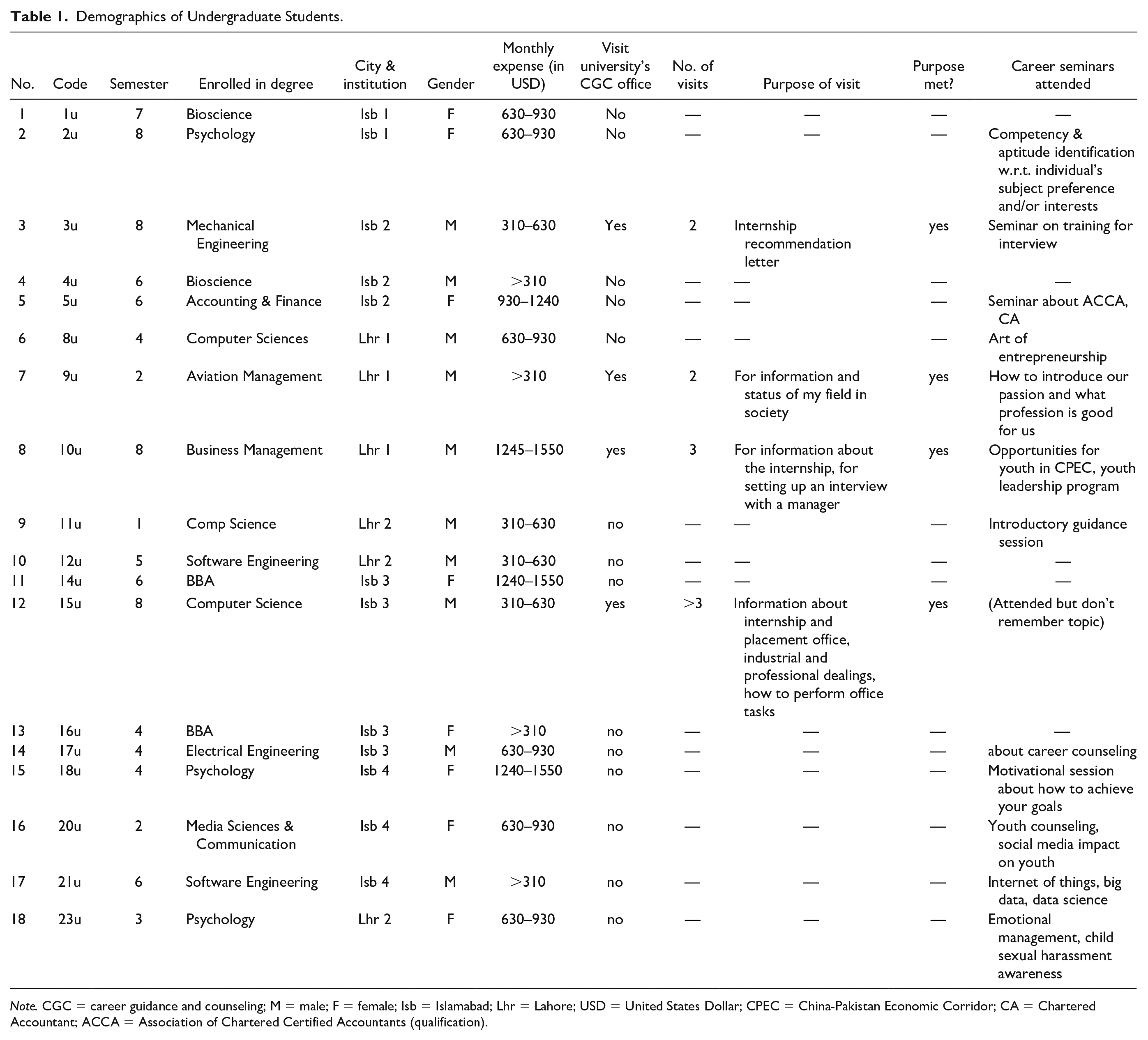
Note. CGC = career guidance and counseling; M = male; F = female; Isb = Islamabad; Lhr = Lahore; USD = United States Dollar; CPEC = China-Pakistan Economic Corridor; CA = Chartered Accountant; ACCA = Association of Chartered Certified Accountants (qualification).
Development of Interview Protocol
CGC needs were explored through interview protocol. Questions of interview protocol were devised in various ways. Initially, questions were written down by brainstorming about any potential issues an undergraduate might face. While brainstorming, the author kept in mind personally faced career concerns as well as those observed in close friends and family at the undergraduate level. Relevant literature was consulted to check which CGC areas, needs, and concerns were addressed in the researches available regarding CGC needs and to assure that none of that goes untapped in the interview protocol (Chircu, 2014; Cojocariu & Puiu, 2014; Crisan et al., 2015; Lent & Brown, 2012; Litoiu & Oproiu, 2012; Richard, 2005; Sultana, 2004; Sun & Yuen, 2012; Szilagyi, 2008). Finalized interview protocol comprised questions regarding understanding and awareness about CGC needs, CGC needs identified by university students, possible ways to satisfy those needs, and CGC services available at the university. The following two questions give a glimpse of the complete interview protocol.
Do you need any help or guidance currently or in the future regarding your career?
Are your current or future career goals in line with your skills, abilities, and interests?
Probing questions were included to explore the topics in detail wherever needed.
Procedure
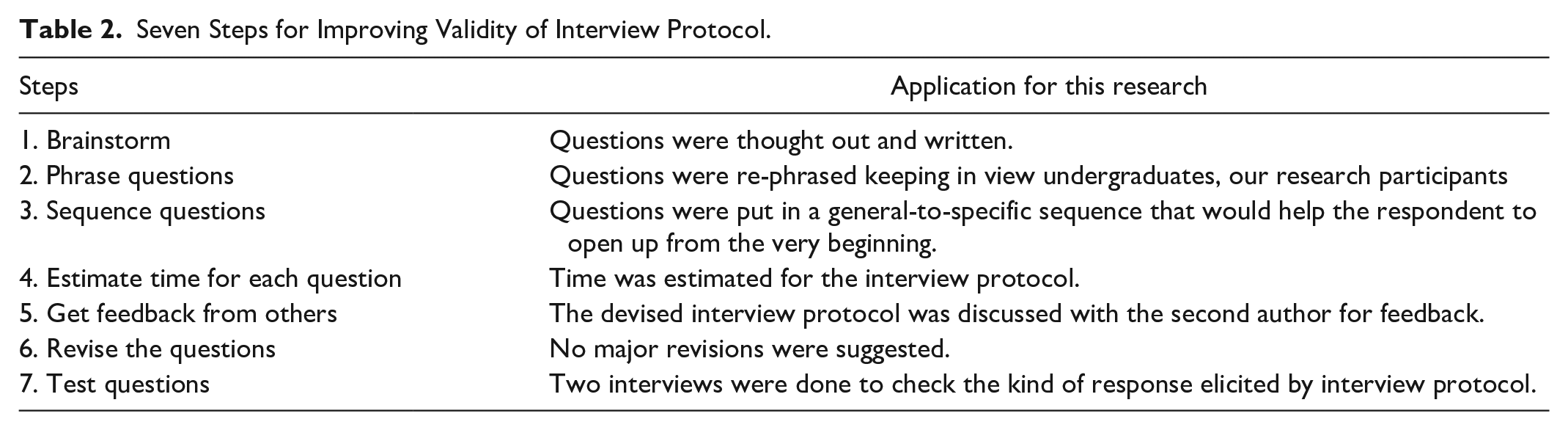
Pilot interviews were conducted with two undergraduate students. This helped in assessing approximate time, appropriateness, and understanding of the interview protocol. Feedback regarding any improvement needed in the interview protocol was also sought. As interview protocol passed on all accounts and no changes were suggested, hence, it was finalized. The study was then approved by the institution’s panel of researchers ensuring its value, practicality, and adherence to ethical standards regarding the use of human subjects. An informed consent form was signed by students before each interview to be aligned with APA’s ethical code. It contained information about research purpose, approximate interview time, the value of honest responses, right to withdraw, need to audio record while ensuring safe storage and anonymous reporting of data. Data were collected from January 2018 till April 2018. Students used both Urdu (the national language of Pakistan) and English (which is widely taught from early school years and hence students can converse in it with varying levels of proficiency) during the flow of communication. The average time for interviews was 30 min with a range of 17 to 59 min. After completion of each interview, non-monetary incentives were given to interviewees for their time and contribution. Then interviews were transcribed word to word. Verbatim included in this article have been translated to English while assuring that they retain their meaning.
Data Analysis
Transcribed data were analyzed manually by thematic analysis. Themes were generated inductively without using the pre-existing coding framework to present the rich description of data (Braun & Clarke, 2006).
Braun and Clarke’s (2006) six phases were followed for thematic analysis. The researcher got familiar with the data by transcribing it and reading the whole data twice (Phase 1). Initial codes were generated by reading each interview transcript line by line and noting potential codes on page margins. Intuitively arising codes were assigned to the data. For assigning codes, the focus was on the meaning of the response instead of the words used. Then coded data were collated by noting relevant verbatim under their respective codes (Phase2). Themes were searched by reviewing collated data and codes to see if they could possibly form an independent theme or they could merge with another theme (Phase 3). Themes were reviewed to check that (a) relevant data were gathered under each theme and (b) what each theme was presenting with respect to the entire data set. The thematic map was drawn in the next phase to see linkages among various themes (Phase 4). The themes were reviewed to see if the data were relevant to the theme it was gathered under and to also see what the themes showed with respect to the entire data set. Themes were defined by refining them continuously (Phase5). Thematic analysis was presented through thematic maps and verbatim (Phase 6).
Addressing trustworthiness
Four aspects of trustworthiness namely dependability, credibility, confirmability, transferability (Guba, 1981) were dealt with as follows.
To improve credibility (validity) and dependability (reliability), steps were taken as proposed by Guest et al. (2011). The whole research process was made transparent and simple to understand by reporting the procedure and analysis step by step. The credibility of the interview protocol was improved by following Krueger and Casey’s (2009) seven-step process (Table 2).
Seven Steps for Improving Validity of Interview Protocol.
The inter-coder agreement was calculated to check the dependability of the thematic analysis codes (Guest et al., 2011). Percent agreement between coder 1 and coder 2 was used to check the inter-coder agreement. (Primary author was coder 1. Coder 2 was independent; s/he was a lecturer of Psychology with prior experience of teaching and research as well as a specialized degree in research). The number of interviews was large so all interviews could not be re-coded by the independent coder. In such cases, at least every tenth transcript should be re-coded (Guest et al., 2011). Therefore, out of the 18 interviews of undergraduates, two interviews were sent for re-coding along with an initial codebook (generated after the primary author coded more than half of the total interviews). Then, percent agreement was calculated for individual codes as well as overall data set following the instructions provided by Guest et al. (2011). Percent agreement for some individual codes appeared low as the number of code applications was small. Overall percent agreement was 81% and conventionally 80% or more is considered good agreement (Guest et al., 2011). The whole process of coding was rechecked by the second author and consensus was achieved regarding codes. Therefore, the coding of interviews has good reliability.
All interviews were primarily conducted, transcribed, coded, and analyzed by the first author with detailed discussions, input, and consensus of the second author. To assure confirmability (objectivity), the primary author noted down the potential assumptions and biases before analysis to minimize subjectivity (Guba, 1981). The second author further reviewed all steps and stages thoroughly to control for subjectivity.
For improving transferability (generalizability), rich thick data were gathered during interviews and detailed descriptions with relevant contextual factors were presented in the results and discussion section (Guba, 1981).
Results
The study aimed to explore CGC needs and services at the undergraduate level. Two main themes emerged: CGC needs, available opportunities for CGC. They included seven and three subthemes, respectively. These themes and subthemes have been explained in detail and presented in the thematic maps.
CGC Needs
This was the first major theme. It had seven subthemes including the need to have self-awareness, need for information and guidance, need to have a sense of direction, need for practical exposure, need for informed decision making, need for emotional management, and academic needs. Undergraduates were facing multiple career-related needs during the course of their university education, each of which has been detailed further.

Figure shows first major theme, that is, CGC needs of undergraduates and its subthemes.
Need to have self-awareness
Undergraduate students were not adequately self-aware in terms of potentials, skills, strengths, abilities, and qualities they possessed. Some of them had rarely looked deep into themselves while others were simply blind to themselves, hence putting them at a disadvantage regarding their level of self-awareness. As one student stated, “there is no (self) awareness because we never tried much to understand ourselves” (9u) and another mentioned, “some have the potential but they are unable to see it either due to lack of confidence or social anxiety or fear” (12u).
Inadequate exposure and experience also limited self-awareness. When opportunities for exposure and experience were availed, self-awareness enhanced as an undergraduate said “in university, when I am getting the chance to explore then I am realizing what I am good at and what I should pursue” (15u). Those students who had widened their horizons in university by doing internships, participating in student societies, networking with seniors, and doing other practical work had developed better self-awareness. One such student stated, “Yeah (I am aware of skills) as I have been through a long process” (3u).
Need for information awareness and guidance
Students needed to have better information, awareness, and guidance. A student expressed this: There is only one year left (in my degree) then I would have to step into the (job) market and I would say that the extent of information a 3rd-year student should have; I only know 15 to 20 percent of that extent. And if I talk about my class fellows they are on the same page (as I am) . . . I know many people who were so brilliant . . . but just because of lack of information they were stranded. (5u)
This need for information, awareness, and guidance was two-pronged is regarding education and other future prospects and possibilities.
Need for information about education and degree
Undergraduate students needed to have better awareness about the stream of education they were getting into. Lack of information and guidance often led to poor decisions which resulted in disappointment as aptly expressed by a student “I chose the wrong degree as I didn’t have the facility or you can say the awareness about it” (14u). In the absence of proper information, they picked a degree based on an appealing name or term without putting much thought into what it would actually entail. A student stated, All the students in my degree program enrolled in it just as a (second or third) option. They didn’t know much about it. . . we don’t have much awareness and it is a dire need to have awareness about it. (23u)
Students’ need for educational or degree-related information and guidance continued as sometimes, despite the 4 years of undergraduate, they were unsure about the subjects to select for their specialization or the areas to pursue advanced studies. “I think I am confused that in which field/specialized area I should pursue my MS” (21u).
Other aspects related to education like financial aid options and available scholarships were also not thoroughly known by students as one of them particularly mentioned, “I have never seen the scholarships available in my own country” (18u).
Need for information about future prospects and avenues
In addition to education and degree, undergraduates were not fully aware of their future avenues. Many respondents were unsure whether to opt for further studies or a job after graduation. A student put it this way: “it is very vague. We know nothing about what we will do next” (5u), while another discussed the lack of information about future possibilities as “most people have no idea about it. What are people doing further in their field, what are the possibilities; they know nothing. Every field is quite vast and we know very little about it” (8u). The need to know about the current status of the job market and the available opportunities was also highlighted as a respondent quoted, “we don’t know at all where jobs are available in the market. So the information is lacking, we don’t have the information here” (5u).
Need to have a sense of direction
Another need of undergraduates was to have a sense of direction. Vague or nonexistent future planning led to a poor and ambiguous sense of direction. Some students needed clarity about their aims as a respondent said, “I will apply for masters and I have so many things in mind but I am not sure where I want to go” (14u). Some students had a goal in mind but were unsure about the path to follow: “I have seen my goal, I don’t know how to get there and I don’t know what channel is best for me” (2u). While other students simply did not plan anything for their future beforehand as a student highlighted the casual attitude of some students regarding their career and its planning: They keep on wasting time. Or they keep saying that they will do it but actually they don’t bother. They say they will see to it once they enter practical life, they will deal with it when the time comes. They don’t try to find ways (in advance). (12u)
In the absence of appropriate direction and relevant planning, they had nowhere to go after finishing their degrees, “You should know what else is going to happen after you graduate. Because if you graduate and you don’t know anything, so you are just sitting with degrees and nothing (will happen)” (16u).
Need for informed decision-making
Undergraduates needed to make decisions that were thought through. But they generally lacked decision-making skills and ability as a student remarked, “Our decision-making process is not developed” (14u). They didn’t know the steps to follow or the factors to consider: Consider strengths, merits, demerits of the field (while making a decision), then match his strengths with them whether he is capable (to pursue it), only then the decision should be taken, but no one takes a decision in this manner. (18u)
Hence their decisions lacked deep thought and often showed the influence of other impersonal factors.
Students often made random, superficial, and ill-informed decisions. They accidentally ended up in degrees without thinking about them in detail. An interviewee commented about such students: “if you ask them they will say that they just got in (to university) by chance or by luck and now they are pursuing their degree” (18u). Sometimes, they decided as per the best of their knowledge but that didn’t necessarily turn out to be right for them.
I feel at what stage I came to the university it was like I don’t know what is going to happen what will happen, what are options, maybe I could have chosen better but this was all I could do. (16u)
In addition, students often decided upon a degree by merely focusing on the potential growth in that field without considering whether they possessed the potential to pursue it. A student stated, “they are not deciding on the basis of their skills, they are deciding based on scope” (18u).
Many times, students made decisions based on a famous trend. The bandwagon effect, doing something because other people are doing it, was a major influencer for students’ decisions. An undergraduate explained the thought process of such students in these words: they say “my cousin or my friend is pursuing a field so I want to pursue it too.” We pursue a field without knowing about its pros and cons. And when we are stuck in the middle then we think and realize that we are at the wrong place, this is not the right field for us. (18u)
At times decisions were heavily influenced by familial and parental pressures: Sometimes there is lots of family pressure that you have to be a doctor or pursue engineering. (Parents) don’t listen to their kids . . . if the family is supporting you only then you can go to an educational institution. If not, then how can you apply to an institution or how can you decide that you want to pursue something? (23u)
Sometimes this led to abrupt career changes as a student said, “I just wanted to be a pilot but my mum didn’t allow me to participate in that . . . And then suddenly I had to make a quick change” (20u).
Societal pressures also affect their decisions as society exercises an undue influence on the individual regarding their career-related decisions: “society pressurizes you to take up power (a subspecialty of engineering) whereas the student is interested in telecom engineering” (17u).
Gender discrimination appeared to be another factor influencing CGC-related decisions as students might be forced to pick a field due to their gender. Parents were willing to spend more on their male child as compared with the female child as a student described the thinking of their parents in these words: “why would we waste our money on you because you are a girl? Why don’t we spend money on our boy as he is going to make us money back? That ‘spend’ and ‘waste’ money is a huge difference” (20u).
Need for practical exposure
Students needed to gain extensive practical experience in their field while being enrolled in their degree program. Due to the dearth of practical exposure, they experienced many issues when they had to apply theoretical concepts into practical work as merely learning theory is not the same as applying it. A student shared, “theoretically learning something from books is a different thing whereas implementing it along with other (team) members is a totally different thing” (8u). Difficulties also arose in practical work owing to the borrowed theories and concepts which were not a perfect fit to the local culture and society as it was mentioned the theories you learn they don’t rely on your culture. They don’t rely on your society, (when) you try to mold that into your culture and society, you waste time during that molding. So (it means) you are not capable of doing it. (2u)
The need for increased practical exposure was two-pronged as it emerged from the need for the increased practice of skills and the need to embed education with practice which is given as follows.
Need to embed education with practice
The curriculum and overall educational journeys of students were deprived of opportunities for practice. Education should be interlaced with practice so that students could gain more exposure as a student said: “My curriculum lacks in a bit of application of whatever we are taught. Practical application is not emphasized. We are not practically trained” (2u).
Need to increase the practice of skills
The practice led to improvement and optimization of their skills which was helpful for their careers. Poor skills caused students to question their abilities as a student mentioned, “I know how to go about those skills which I have practiced more, which I have tried and tested. But there is obviously hesitation and reluctance in (applying) those skills which I haven’t used much” (2u).
Need for emotional management
Degree-related tasks or job-related tasks often caused emotional upheavals and students needed to learn about emotional management.
Undergraduates faced multiple emotional troubles as they stumbled upon varied bumps like financial, academic, or psychological concerns. For some students, academic challenges caused emotional troubles: “there was a time when I entered my degree with a lot of enthusiasm but one or two difficult subjects upset me” (8u); for some students, financial challenges were the root cause: “there is definitely financial stress” (10u). For others, family’s expectations were causing emotional challenges: “often many students are under huge parental pressure as their parents are saying that you have to pursue this and not that (of your choice)” (23u). While another student mentioned stress and sleep troubles owing to societal pressures, “I think social pressures are the cause of stress. Nothing stresses you more than social pressures . . . We are stuck in between, like pressures, pressures, pressure. No one can sleep easily . . . sometimes even I cry myself to sleep” (20u). Such troubles often resulted in depression, anxiety, and mental pressures. “I think they definitely suffer from some degree of mental pressure. Some sort of anxiety” (4u), commented one respondent while another stated, “Many students when they fail, try suicide or some other (self-harming) thing. They get depressed” (23u).
The need for emotional management was also significant for work-related tasks. Finding a work opportunity, whether in the form of an internship during their degree or a full-time job after completion of the degree, often led to emotional problems. At times students were not prepared for the transition from university life to work life: 4 years of university are something else, and then stepping into the practical world is something else. Entering from one zone to a completely new zone is difficult; emotionally challenging. When we think that university is about to end and we have to do jobs (after graduation) and we need to think what we want to do further then it enhances our stress level. (14u)
Students were often ill-prepared to handle the job search process. Moreover, the wait-and-watch phase when their peers were finding work whereas they were still waiting for affirmative responses from employers was also emotionally troublesome for many students as a respondent described: sadly for us most of my batch mates realized the importance of depression management and anxiety management after we had gone through the depression phase . . . especially during the end of last year (3rd year) because that was the period when other people were getting internships and we were waiting for our internships. (3u)
Uncertain, competitive, and low-paying job market was another factor adding to the emotional troubles of undergraduates. Entry-level jobs were quite low-paying in many cases. In this scenario, high expectations were problematic as an undergraduate explained: If you are mentally prepared that market is tough and salaries are not up to the standard, then you are mentally capable (to deal with it). But if your expectations are high and you are not thinking about (the reality of) it and you jump into the industry after completion (of your degree) then you (will) get very tense. (10u)
In addition, emotional management at work was also a tough task for many “Some quickly get angry, some quickly feel like crying. . . you know you can’t afford (caving in to) them in the job. So there are emotional barriers and challenges which the students have to face” (14u).
Academic needs
Students experienced various needs regarding their education and academia as they were primarily involved with it. Academic needs present in the interview data are grouped into further two facets.
Need of choosing the best and credible university
Academic needs were not only limited to learning but they also branched out to figuring out the best university to grasp that learning opportunity. Before starting their undergraduate degree, students needed to find an appropriate and credible university for their next 4 years, and some found this very hard. An undergraduate expressed this common dilemma Now there are many different universities like electrical engineering is offered in four different institutions in the city. So you are unable to figure out whether this institution will be better or that institution will be better for pursuing that degree. So career counseling is needed at that point to figure out whose degree will be better. (17u)
Need for revision of old curriculum and syllabi
The textbooks, syllabi, and curriculum followed in universities were outdated and needed revision. To keep sources of knowledge fresh, continuous updates and reviews should be carried out. An undergraduate commented about the obsolete curriculums still followed in universities which offer an antique introduction of the subjects at best, “I think it is safe to say that the curriculums (that were) set 20 25 years ago, they are still going on. The awareness given about the subjects in those (curriculums), that is still the same” (2u), and another emphasized the need for up-gradation and revision: “mostly the books we read, the methods we study (in them) are now outdated. There is a dire need to revise the syllabus. Those (outdated) methods are no more (used) now” (17u).
Available CGC Options for Undergraduates
The second main theme identified from the interview data was about the options available to undergraduates for their guidance and career-related help. There were three subthemes in it including CGC services, guidance and information sources, skill development opportunities.
Students had different options which could be utilized for fulfilling their career-related needs. However, neither every university offered all opportunities, nor each student could avail all options due to resource constraints, practical and circumstantial factors, and individual differences. Moreover, the students were not utilizing the options provided by their institution because many of them lacked information about them.
Subthemes are shown in the thematic map and detail is provided.

Figure shows second major theme, that is, available CGC options for undergraduates and its subthemes.
CGC services
Students had several CGC services available to them in their respective universities which provided updated information and awareness. Career advisory service was available to most university students. A student pointed out the function of career service providers (CSPs) of their university, “they guide you, they advise you that you should do this, it would be better for you. So (CGC) is good here” (8u).
One-to-one sessions could also be availed by students in some universities. It was not explicitly discussed by any respondent in interviews, but the information in demographic forms pointed to it as student 9u mentioned that he went to university career office to get information and know about the status of his field in society. Student 15u stated that he went to the career office to know about industrial and professional dealings and how to perform office tasks.
Internships, jobs, and placements-related services were provided by CGC offices. Job fairs were often arranged by them as quoted by an undergraduate: “Job fair is conducted in the university. It (CGC office) is the one dealing with our careers and placements” (10u). Job fairs provided a platform where potential employers and aspiring students got a chance to connect with each other and many students benefit from it. Academia-industry links were also enhanced through these job fairs. “Every year the collaborations between university and the companies is increased” (14u), and hence the chance to get work offers increased.
Some of the university career offices kept the students up to date regarding upcoming career-related news and opportunities through email. “Email communication network of the placement department in the university is very strong” (10u), praised a student.
Seminars, sessions, talks, workshops, and conferences conducted as CGC services were also mentioned by students: “there are seminars, conferences, training sessions” (14u). However, these sessions also needed to be updated and advanced as per the upcoming trends instead of promoting aged and obsolete methods. A student talked about the sessions with industrial experts which were arranged in his or her university: “we have sessions here but those are (from) industries which work in very old and stereotypical manners” (3u).
Another service offered by CGC offices was the information and process of scholarships for students: “university office provides (information of) scholarship opportunities” (15u). This was of particular help for those who faced financial troubles regarding their ongoing or advanced education.
Guidance and information sources
Undergraduates got information and guidance on varied topics like general help and awareness, job search, and related information. Information sources also ranged from personal sources and contacts to the CSPs available in universities. Sometimes, information from one source would clash with that of another source, leaving the students confused instead of comforted.
A few days ago some people were here for (recruiting for) internship program of a big private company and they were saying they don’t accept such and such people. But at the same time, our teachers say that they have gone through all this (by following the route which the recruiters were dismissing). So we get different information from different places or different sources of information (5u),
explained a perplexed student.
Self-assessment was another source of information for students. When students compared and contrasted themselves against another person’s experience or their own experiences, their understanding was likely to enhance significantly: “we get to know from our experiences and when we get rejected from a particular company or industry. So after that we assess ourselves and realize about the things that should have been done” (3u).
Recruitment drives of different companies could help to know a lot about them: “what I have learned about these industries is through their recruitment drives. For example, this particular industry needs this, and this particular industry needs that, they hire this kind of people, etc.” (3u).
University-based activities like seminars and events arranged by student societies proved another valuable source of information for students. “There are many basic points which we don’t know; (we) are unaware of. But when we attend different seminars where those (points) are elaborated then we get to know the benefit and then we take those steps” (8u), explained an undergraduate while another stated, “the events arranged by societies are the maximum guidance we get in that respect” (3u).
Teachers were also identified as a huge source of information for some students. “There is a teacher of ours who often guides us” (12u), commented a student. But sometimes teachers appeared to have knowledge of their particular domain only and could not guide effectively as a student stated sorrowfully, “I am sorry to say that our faculty is not able to guide as (well as) someone from the industry would be able to” (3u). Although experts from relevant fields were also possible guidance sources but getting in touch with them could be hard. Students needed some help to be able to contact them as an interviewee stated, “(teachers) would link me up to other people they knew who were good at this field and they would be like you can go up and address your problems to them, which helped me a lot” (2u).
Senior students of the same department were also identified as a source of information. “Seniors are I think basically ideal for this because obviously, they have been there before” (4u), commented a student while another emphasized that those seniors who were already holding various positions in the job market could potentially link a fresh graduate with new openings, “if they are in contact with a senior who has some job openings then they (senior) will tell them that people are needed for this specific job so C.V.s should be forwarded to them” (15u).
Undergraduates also found their friends and peers as suitable means to get information, awareness, and guidance. “You get to know a lot of things by being with your friends” (8u), mentioned a respondent while another stated, “they might look to their peers. I think that is my basic first response” (4u). Similarly, siblings, parents, family members, or other relatives could be used as sources of information as a student said, “maybe go talk to people, with persons in your family who have done this before or they are in other careers you can go talk to them . . . maybe you can ask you parents” (16u).
Material information sources like newspapers were also used by undergraduates to gather relevant information: “if you read through the newspaper there are requirements mentioned in them” (17u). Some preferred internet, “nowadays the internet has everything” (16u), whereas others still found it inconclusive and not customized to their individual scenarios: “you cannot search such (career-related) things from the internet. If you search there, it is very vague. It shows you too many things and you are unable to understand. You cannot find a particular path from there” (5u).
Undergraduates found that intercession and personally approaching the employer were useful and common practices for job search. A student discreetly pointed to intercession, “the common conception is that if you have links, you will get the job” (12u), whereas another openly shared this thought, “you only need to have intercession. Only intercession works here (in the job market)” (11u).
Personally, reaching out to the employer for information was a possible method but not many students did this as there was too much reliance on approaching via some common connection. An undergraduate denounced this and shared his experience: no one dares to go to those software houses where they have no link or no relation (with any employee) . . . we randomly went to two or three software houses (without a prior link) and we got to meet very nice people there. (12u)
Skill development opportunities
Co-curricular participation, work experiences, relevant courses, or subjects could be various ways to develop skills. But students were usually unaware of their importance as a respondent mentioned, “We don’t have much awareness about these things. We are seldom told about these things” (9u).
Actively taking part in ongoing co-curricular activities of the university could be helpful for students as it polished their soft skills along with technical skills. A student from the final year shared, “we should join societies and everything (like student bodies) so that our personal skills develop. It helps you in interacting with people . . . it helps with increasing PR (public relations), it tests how well can you manage” (3u).
Having hands-on experience by taking up a job was another way to develop skills as a student mentioned, “you can only gain experience when you enter a company or when you start working. Then you explore (your skills) more and more” (8u). Initial hit and trials in the job search process also played their part in skill development: “everyone’s initial two or three interviews go wrong because that is the first attempt. So after learning from those two-three interviews, we get to know that how are we supposed to go, how are we supposed to present” (18u).
Strong job search skills could be developed with the help of a subject incorporating various job-related aspects like being in an interview, writing a resume, and cover letter. One of the undergraduates shared it: “we have a subject of communication skills. In that (subject) our instructor tells us that if we go for an interview how should we communicate and (how should we) sit” (17u). Another respondent said, “We have courses in which we are thoroughly taught about C.V.s, resume, video interviews and everything (related)” (14u).
Discussion
The research explored undergraduates’ career needs and the services available to meet their needs. Two main themes were explored which included some CGC services and seven major CGC needs namely need for information, self-awareness, decision making, practical exposure, direction, managing emotional challenges, and academic needs. The identified career needs are interconnected to a huge extent. When students are unaware of their interests, aspirations, strengths, and have insufficient information regarding available opportunities, then it becomes hard to choose a direction for their education and career. This, among others, further gives rise to problems like emotional disturbances and inappropriate decisions. Needs and their possible underlying reasons are overlapping. Yet we have attempted to discuss them separately to highlight their due importance.
Pakistani undergraduates need better self-awareness. Researchers report that self-awareness is the key to better career-related choices and career-related success (Guber, 2015; Hooley, 2014; Kuijpers & Scheerens, 2006; Raouna, 2017; Watkin, 2016) but unfortunately many undergraduates from developing countries lack it. To develop self-awareness, an individual should know who he or she is and what he or she wants (Warwick Wellbeing Support Services, 2019). Self-reflections, increased experience and exposure, identifying personal interests and mindfulness are some of the ways to develop self-awareness (Ackerman, 2020; Tjan, 2015). But these practices and opportunities are not commonly observed in Pakistan as well as other developing countries. Students seldom get the chance to explore themselves; there are limited educational, social, and leisure opportunities available for the public as per the human development report (United Nations Development Programme, 2018). Education mainly focuses on rote learning (Richmond, 2007). Thorough assessments focusing on various skills and abilities are not carried out, leaving students clueless about themselves.
Second, the development of self-awareness is suppressed in developing countries as most students are bound to follow and fulfill familial and societal expectations (Hofstede, 2001) owing to the prevailing collectivistic culture (Watts, 1978). The common expectation and practice in these countries including Pakistan is for the children to respect the opinions of their elders and hence surrender their personal ambitions in favor of the career path thrust upon them. Therefore, many a time they are unable to pick a subject of their choice. These factors limited the exposure of students. They couldn’t explore their likes, dislikes, and interests, consequently leading to a poor understanding of strengths, weaknesses, and overall self-awareness.
In developed countries, individualistic culture promotes ambitious thinking. Students usually consider personal ambitions and personal traits to be significant instead of preferring society over self (Carducci, 2012). Thus, they are likely to have better self-awareness.
Deciding upon their future direction is a colossal task for undergraduates and many of them are not clear about it. They don’t know where they are heading to; if they go for studies, they are unclear about the area of specialization; if they go for the job, they are unclear about the kind of work they should choose. Picking a domain of study is challenging (Vertsberger & Gati, 2015) and becomes even more difficult when reliable information is limited and the array of options is not completely visible. In such circumstances, CGC can be useful for students for deciding a direction and planning to achieve it (Grote, 2015; Vertsberger & Gati, 2015). However, Pakistani students seldom get professional career-related help as shown by the demographics table (Table 1) and discussed in Sample. In developing countries, it is difficult to find authentic career guidance but even if CGC is available, students seldom opt for it as CGC is undervalued and ill-accepted by the majority (Watts & Sultana, 2004; Zahid et al., 2020).
On the other hand, many developed countries around the world have career-related assessments for identifying possible career pathways (Open Colleges, 2014; The Princeton Review, 2021; UCAS, 2021). CGC services are also available in educational institutions according to their CGC-related policies (Cedefop, 2009; Long & Hubble, 2017; NFB, 2006; U.S. Department of Education, 2014). These help students in clarifying their career direction and smooth transition from education to work.
Informed decision-making is another major need of undergraduates. In Pakistan, it is commonly seen that career-related decisions are heavily influenced by familial advice particularly father’s advice (Sharif et al., 2019; Zubair, 2012). Social desirability is another major influencer; students tend to choose fields of study which majority is pursuing without having much knowledge of the emerging careers; they pursue careers that are perceived to have high scope in terms of a better job and better income without having detailed labor market information; they tend to pick career pathways which have higher esteem in the indigenous society like medicine and engineering (Abbasi & Sarwat, 2014; Sharif et al., 2019). They along with their families hope to elevate their status in society and lead a comfortable life by opting for prestigious careers without taking into account personal abilities, interests, and preferences (Sharif et al., 2019).
It is a consistent observation that in Pakistan’s collectivistic culture, children are financially and even emotionally dependent on their parents and families for an extended period of time. In a lot of cases, parental support is available for their children throughout life; children have excessive respect for elders; obedience to elders’ decisions is commonplace (Hofstede, 2001). These factors and authoritarian parenting styles (Rudy & Grusec, 2006) might be amalgamating to hijack decision-making authority from the children. Consequently, in many cases, decisions are made for the children instead of by the children. Weighing pros and cons before making a choice is not taught to them. Hence, many students have not the slightest idea regarding the direction they want to pursue, how to make a decision about it, and the factors to consider for it. Greater the variation between such influential factors, lesser is the career cohesiveness and poorer will be the decision making (Shimoni et al., 2019).
This is similar to the scenario of developing countries where career-related decisions are impacted by societal expectations, familial influence (Kochung & Migunde, 2011), and the hope of a better future (Shen, 2015). Interestingly, the career development of Asian-Americans also shows strong influences of familial and cultural expectations and perceived prestige of the subject (Fouad et al., 2008). But students from developed countries, particularly if they have individualistic culture, show significant improvement in their career decision making (Akosah-Twumasi et al., 2018; Arslan & Kılınç, 2019). Career decision-making should take into account personal interests, strengths, capabilities, and match them with available educational and occupational options. CGC services, if availed properly, can be helpful for making informed decisions in this manner (Hirschi & Läge, 2007; Lent & Brown, 2012; Perdrix et al., 2012). Such services are often available in the developed countries, unlike developing countries (Watts & Sultana, 2004).
The need for information, awareness, and guidance is another significant need, which if satisfied, can save students from several other troubles. Inadequate information can be the root cause of many problems, and CGC services can be helpful in gathering more and more information about prospective careers (Hooley, 2014; Moura et al., 2014). However, in Pakistan and other developing countries, professional CGC service providers with appropriate qualifications are very hard to find due to the lack of CGC-related policies. Usually, the students have to get guidance and information through personal efforts and resources. At times, institutions try to provide guidance through their career counselors or professionals invited from industries. However, a rampant non-serious attitude in students means that they don’t fully benefit from it. In addition, there is a lot of protocol students have to maintain before/while consulting a senior member of their university or the industry as open-door policies are hardly practiced here, making it very difficult and often discouraging for students to reach out to them for information. As a consequence, appropriate information often fails to reach to the student at the right time.
In developed countries, availability of CGC degree programs, CGC licensing and regulatory bodies, CGC policies, and supportive infrastructure imply that students have better access to CGC and consequently better career-related information (Cedefop, 2009; Long & Hubble, 2017; NFB, 2006; U.S. Department of Education, 2014). They can access virtual CGC services or on-campus CGC services as per their preference and convenience (Harris-Bowlsbey, 2013). Such easy access to appropriate and authentic career information is needed in developing countries.
Having job search skills is another particularly important need of students as they are ultimately destined for the job market. Finding the right job, approaching the employer, drafting a well-composed CV, and interviewing for a job are all important yet lesser-known steps. In Pakistan, a large majority of students are usually not involved in jobs during studies as part-time work and odd jobs are looked down upon. The requirement of internship or work placement at the university level might be the first exposure of many students to the world of work. This lack of exposure also contributes to the dearth of job search skills.
Job search skills could be enhanced through relevant sessions or seminars about students’ transition to the job market (Rehill et al., 2017). Such sessions should be arranged and students should actively take part in them. However, the frequency of such sessions is limited in Pakistan; lecture-based sessions are more common than interactive sessions. Hence, they often fail to hold students’ attention. At times, even if the students wish to attend the sessions they might be unable to do so as sessions often clash with their compulsory course lectures.
Contrarily, students from developed countries are often involved in part-time jobs during studies (Buddelmeyer et al., 2004). They are likely to have better experience regarding job search skills. The establishment of proper CGC centers and services implies that students are provided the required guidance on job search skills (Cedefop, 2009; Long & Hubble, 2017; NFB, 2006; Sultana, 2012; U.S. Department of Education, 2014). Extensive research evidence indicates the importance and benefits of practical experiences of workplace, in the form of internships, placements, work visits, and work shadowing which is common in developed countries as compared with developing countries (Buzzeo & Cifci, 2017; The Careers & Enterprise, 2016; Hooley, 2014). In Pakistan, students usually opt-out of such practical activities unless they are necessary for earning a grade or getting a degree.
There is also a dire need to update the obsolete curriculums as they put students in a dilemma because of old curriculums often contrasting with modern-day workplaces. An updated curriculum will establish the required foundation for undergraduates and they will be able to better understand the latest workplace trends and demands (Wang, 2012). It is commonly observed in Pakistan that weak coordination between educational systems and labor markets makes it difficult to update curriculum in accordance with the labor market demands. On the contrary, developed countries integrate new trends and research recommendations in their curriculum (Watts & Fretwell, 2004). They have data regarding the employability rates of their students which indicates the efficacy of curriculum in making the graduates well equipped with job market demands (International Labour Organization, 2018).
Managing emotions is also a significant need identified by undergraduates. Dealing with a competitive work environment, diverse professional relations, work–life imbalance, and other such factors might be overwhelming for them. Emotionally intelligent individuals are not only better in terms of work performance as emotions are a huge part of the modern-day career (Rexhepi & Berisha, 2017) but they are also less likely to face difficulties in career-related decisions (Santos et al., 2018). Pakistani students are less likely to have strong emotional management owing to the fact that students have little to no exposure and experience of professional work. Developed countries are not much different as emotional troubles are increasing around the world (United Nations, 2014). Hence, students need support to manage emotional challenges (Pertegal-Felices et al., 2017) which is more likely to be available in developed countries as compared with developing countries.
Multiple options including CGC services were identified in this research for meeting the CGC needs of undergraduates. CGC, though a relatively new domain in many developing countries including Pakistan, is being offered in some universities. Some services like one-to-one counseling are more impactful than others (Buzzeo & Cifci, 2017; The Careers & Enterprise, 2016; Cojocariu & Puiu, 2014; European Commission, n.d.; Hooley, 2014; Rehill et al., 2017). Well-curated career intervention programs offered to newly inducted students can also help in retaining more students in the universities (Clayton et al., 2019). Given the variety of CGC needs reiterated by students, a gap definitely exists between the services offered and the services availed. Although the explored needs are not starkly different from those previously studied in the literature, but the arising needs are not well managed owing to the possible causes discussed ahead.
There is no assurance of the quality of CGC services in Pakistan due to the absence of any official regulatory body. Universities independently provide these services without ensuring supervised training and practice, proper qualification, and the authenticity of services being offered. A university might be claiming about the availability of service without considering the worth and impact of the said service on students’ needs.
In addition, students might not be benefiting from career services as much as they should. A possible reason is the general lack of pro-activeness in many students. The demographic table also showed that few students approached CSPs in their universities and none of them were females.
It is commonly observed in Pakistan that females are considered docile creatures. They are usually not allowed to decide for themselves but are bound to follow the elder’s decisions without having any say in the matter. They are not provided with the required resources and support to pursue careers. They are expected to get married and be the primary home-maker.
For males, there is a cultural expectation to be the primary breadwinner. This might be a prominent factor that motivated male undergraduates to think about their future direction and pushed them to consult university CSPs. Contrarily, females are generally free from such economic obligations. Though some cultural shift has been observed and women are increasingly opting for typical careers for various reasons, such as to elevate the status of their family, to provide additional income, to make better use of their time, to get some experience, and to stay preoccupied before marriage.
The potential cause for not seeking CGC is the cultural taboo associated with help-seeking. It is not a norm to consult people for guidance, particularly about personal matters including therapy and CGC due to stigma and labeling. Another factor that adds to this gap is the avoidance of conversation or interaction between opposite genders. Therefore, undergraduates might refrain from reaching out to CGC if the service is provided by a person of the opposite gender.
Such reasons are likely to affect the fulfillment of students’ needs and hence their needs might manifest either continually or time and time again, hindering the career development process. Still, these CGC services are better than nothing, and some students though not all benefit from them to fulfill their CGC needs.
Implications
This study has multifold practical implications. It implies that undergraduates need to actively seek out the available CGC services in their respective educational institutions. They have to be careful and proactive in their career-related matters from the very beginning of their undergraduate program to reap maximum benefit from whatever services are being offered to them. They should actively approach all opportunities to enhance their self-awareness and other career-related needs. They could also approach the CSPs with their demands, needs, and recommendations for meeting their career needs.
CSPs could plan and polish their services in accordance with the career needs identified in this research. They could develop their current services and introduce new services. It is also important to figure out any other career needs in their undergraduates to widen their CGC services further.
Theoretically, this research provides extensive data and findings for informing and extending the existing career-related theories as it provides a vivid understanding of the career-related needs experienced by individuals during their tertiary education. Particularly, the career development of students can be better understood with the help of it.
Conclusion
This study explored several CGC needs identified by undergraduate students of Pakistan, primarily a developing country. Students feel the need to have self-awareness, a clear sense of direction, the ability to make informed decisions, appropriate awareness and information, better emotional management, practical opportunities in addition to theoretical education. Many CGC services can also be found in universities to fulfill the needs. The current study has important implications for the students and CSPs of developing nations. They should be proactive and committed to seeking and offering appropriate services, respectively. Career needs should be understood while crafting, planning, executing, and advancing their services accordingly. Assessment of these needs, provision of relevant services, and necessary utilization can lead to positive outcomes for undergraduates and service providers.
Limitations and Future Research
The study included participants from universities of two major cities of Pakistan. Given that opportunities and exposure in these cities are extensive and versatile, the CGC needs and the available services in other smaller cities might provide a bleaker picture.
In the future, experimental research designs investigating the impact of CGC services in the short and long run can be carried out. CGC needs and services at pre-university and post-university levels can also be assessed. In addition, quantitative measures can be formulated to evaluate the experience of CGC needs and utilization of services in larger samples.
Footnotes
Declaration of Conflicting Interests
The author(s) declared no potential conflicts of interest with respect to the research, authorship, and/or publication of this article.
Funding
The author(s) received no financial support for the research, authorship, and/or publication of this article.
Ethical Approval
Departmental research panel ethically approved the synopsis and finalized research.
