




Abstract
Universities around the world especially those in developing countries are faced with the problem of delivering the level of information and communications technology (ICT) needed to facilitate teaching, learning, research, and development activities ideal in a typical university, which is needed to meet educational needs in-line with advancement in technology and the growing dependence on IT. This is mainly due to the high cost involved in providing and maintaining the needed hardware and software. A technology such as cloud computing that delivers on demand provisioning of IT resources on a pay per use basis can be used to address this problem. Cloud computing promises better delivery of IT services as well as availability whenever and wherever needed at reduced costs with users paying only as much as they consume through the services of cloud service providers. The cloud technology reduces complexity while increasing speed and quality of IT services provided; however, despite these benefits the challenges that come with its adoption have left many sectors especially the higher education skeptical in committing to this technology. This article identifies the reasons for the slow rate of adoption of cloud computing at university level, discusses the challenges faced and proposes a cloud computing adoption model that contains strategic guidelines to overcome the major challenges identified and a roadmap for the successful adoption of cloud computing by universities. The model was tested in one of the universities and found to be both useful and appropriate for adopting cloud computing at university level.
Introduction
The popularity of cloud computing is increasing by the day, it is not just a promise or something only discussed at seminars and conferences anymore. It is the reality to fast, automated, and inexpensive management of IT resources that have combined to make information technology a compelling paradigm for greater efficiency and enhanced productivity. There is an increasing perceived vision that cloud computing will make computing the fifth utility after water, electricity, gas, and telephone that will provide the basic level of computing services considered essential for fulfilling daily life routines (Buyya, Yeo, & Venugopal, 2008). Cloud computing uses the Internet as its backbone to provide flexible on-demand and dynamically scalable computing infrastructure for many applications using any of its four deployment models: private, public, community, or hybrid cloud and its three-service delivery models: Software as a Service (SaaS), Platform as a Service (PaaS), and Infrastructure as a Service (IaaS).
The cloud technology harnesses the web as the ultimate platform to serve all kinds of users: individuals, businesses, institutions, the industry, and others. It provides computing resources on demand on a pay-per-use basis via a cloud service provider and is a powerful tool that can deliver sustainable advantage (Shimba, 2010). To simply say that cloud computing can increase productivity is an understatement; cloud computing can effectively re-design the way businesses and organizations approach and accomplish their tasks on daily basis, it is more of a comprehensive infrastructure that allows for increased streamlining of inter-office activities (Mell & Grance, 2010).
In the academia, cloud computing is a powerful tool that offers great scalability and flexibility, making it possible for students, staff, faculties, administrators, and other campus users access file storage, databases, and other university applications anywhere anytime (Jain and Pandey, 2013). The cloud computing technology has been termed as the “silver bullet” in the field of educational technology (Mell & Grance, 2010). Hence, some universities especially in more developed and advanced countries have adopted this technology for many reasons ranging from reduced cost of hardware acquisition and maintenance to greater access of web 2.0 applications for teachers and learners and ultimately better academic outputs (Ercan, 2010). Through the adoption of cloud computing to support their virtual computing lab, the North Carolina State University, United States, saves a lot on software licensing costs. Eastern Washington University in the United States and Lakehead University in Canada have also saved plenty of money by outsourcing their email services. Also, the University of Washington uses the cloud to effectively implement collaborative learning for students at different locations and the Pennsylvania State University, United States, uses cloud computing to share resources among its numerous campuses and colleges (Cappos, Beschastnikh, Krishnamurthy, & Anderson, 2009). According to James Holt, the vice president and chief information officer (CIO) of the University of Virginia, United States, cloud computing is the real opportunity for the academia to rethink and re-craft services (Thomas, 2011). The popularity, advancement in information and communications technology (ICT) and the use of the Internet has made computing resources more readily available, but the adoption and implementation level of the cloud technology especially in developing countries is still very low. Hence, this article explores into the area of cloud computing to identify the challenges and reasons for the slow rate of its adoption by universities and proffers solutions to the problems along with a roadmap for its successful adoption.
Problem Background
Advancement in technology is evolving at a very fast pace that is difficult to match, this puts universities around the world and those in developing countries in particular under pressure to meet up with latest IT trends such as cloud computing in the educational sector. Cloud technology is still evolving, and the use of ICT in some developing countries like Nigerian universities is growing at a rather slow rate, which is largely due to the cost involved in the purchase and maintenance of ICT equipments and the poor power supply in the country (Ume, Bassey, & Ibrahim, 2012). Adopting the cloud computing technology will help to manage the limitations to the slow pace of ICT growth better because the cloud technology reduces the cost of delivering IT services and takes away the burden of having to purchase and provide maintenance to the high tech equipment needed to meet the IT needs of students and staff, it is essential for better service delivery (Gital & Zambuk, 2011).
In the current system in most Nigerian universities, it is the responsibility of the IT department to meet the needs of all students as well as academic and administrative staff of the university, whatever service is needed is directed to the IT department. The department provides and manages students and staff email accounts, handles installations, and upgrades on PCs in the computer labs, cafes, and staff computers. Generally, all IT needs whether minor or major of students and staff of the university are met directly by the IT department (Ume et al., 2012). With the adoption of cloud computing, students and staff can meet their needs directly from their computers and other devices as long as they are connected to the Internet. Also, having such a technology provides a better way to handle disasters as it provides easy backup and recovery because everything may be thousands of miles away and will only be provided as a service by a cloud service provider who’s backup and recovery plans are way better than anything the universities can provide. Even though the concept of cloud computing is getting more popular in recent times and quite a number of research has been done on its benefits to higher institutions of learning, most of which involves the opportunity to save on the huge cost involved in the purchase and maintenance if IT devices and availability of resources housed in the cloud whenever wherever, its adoption rate is still very slow due to the challenges encountered and issues that come with adopting it.
Challenges of Cloud Computing and Reasons for Low Rate of Adoption by Universities
Despite the huge benefits of cloud computing; concerns on the security and confidentiality of data stored in the cloud, privacy and regulatory compliance, vendor lock-in, location of the data, legal jurisdiction, and reliability of the cloud service provider have been identified as the barriers to cloud adoption in higher education by Low, Chen, and Wu (2011) and Mircea and Andreescu (2011), which are similar to the findings of the survey carried out by researchers of Carnegie Mellon University. The survey further revealed that for higher institutions, the challenges of cloud adoption are not just limited to the risks listed above, but the relative newness and underdevelopment of cloud services is also one of major concerns for cloud adoption. (Sultan, 2010). Security and privacy is a major concern for cloud adopters because valuable data reside outside the institutions firewalls, therefore any hacking or other forms of attack on the cloud vendor’s infrastructure will affect all clients whose data are stored on the infrastructure. According to Rittinghouse and Ransome (2010), lack of compliance to the SLA (Service Level Agreements) by cloud service providers is another reason behind the slow rate of adoption, because if cloud vendors do not meet the requirements of the SLA and attend to downtimes prompt performance will be greatly affected.
Legal and jurisdiction issues also pose reasons for concern because legal issues can bind an institution into unwanted or unsatisfactory conditions, thereby, leading to legal disputes that can run into years due to laws of the location where the data are located. Once the services of cloud vendors are employed, the institutions no longer have control over the physical infrastructure where their data are stored; the average user may not be concerned with where their data are sitting, but universities hold very vital information of thousands of people and processes such as research results and findings that require high levels of confidentiality and privacy (Cegielski, Jones-Farmer, Wu, & Hazen, 2012). An example of an institution facing legal issues due to the adoption of Google’s public cloud is the Lakehead University, Canada. The faculty union of the university filed a grievance with the university complaining that the email system outsourced to Google does not protect their privacy and academic freedom because Google is a U.S. company and therefore subject to the American law which compels Google to hand data to the U.S. government if required even without informing the university (Todd, 2008). Issues like this pose threats to the privacy of data and hinder the interest of higher institutions of learning to migrate to the cloud. In developing countries, however, the rate of adoption of the cloud technology is still quite low; hence, universities in this part of the world will mostly work with copyright laws of the chosen cloud vendors and that of the location where the vendors’ infrastructures are located; therefore, one of the yardsticks of choosing vendors will be based on how favorable the copyright laws are to the universities.
Problem Statement
Quite a number of works have been done on the benefits, challenges, and adoption strategies of cloud computing; however, despite these works, the hype, and predictions on the increase in the rate of adoption of the cloud technology, the acceptance level is still very low. In a recent survey conducted by TechTarget from September 2012 to March 2013 on the actual rate of adoption and usage of cloud computing, the results show that the adoption rate is not rising as expected with security concerns being the most prominent reason for the reluctance in the acceptance of the cloud technology. In view of this, this article attempts to answer the following research questions:
Related Work
Saidhbi in the research Cloud Computing Framework for Ethiopian Higher Education Institutions proposed the implementation of a central hybrid cloud computing infrastructure that combines both the current local infrastructure of the universities as the private cloud and public cloud to enable the sharing of educational resources and collaboration within all universities in Ethiopia and the global educational community, so that Ethiopian higher institutions can enjoy the benefits of ICT in an efficient and affordable way (Saidhbi, 2012). The research further states that by deploying the proposed hybrid cloud model, the risks of privacy and other security challenges can be avoided as critical and sensitive data will be housed in a private cloud.
In a study on Cloud Computing in Higher Education in Jordan by Massadeh and Meslah (2013) suggested that Jordanian universities consider adopting cloud computing as a way of meeting the growing demands of IT services and managing the tight budget due to very limited financial support from the government. The researchers believe that implementing cloud computing will be a strategy to offer good business models for the Jordanian universities as they do not have sufficient resources to manage the required IT support for development, educational, and research activities that should be provided in an ideal higher education environment. Suryawanshi and Narkehde (2012) outlined a cloud implementation strategy for migrating from the traditional IT system to the cloud for higher technical institutions. Their strategy includes having a committee to supervise the implementation activities and to develop a knowledge base by attending cloud computing conferences and seminars and also discussing with cloud vendors.
Tout conducted a study on cloud computing adoption and transitioning to the cloud by higher institutions; in the study, the author outlined greater benefits of cloud computing beyond the traditional advantage of cost reduction of IT infrastructure and maintenance. Cloud computing adds value to capital expenses and services provided by universities and, at the same time, protects the environment through the use of green technologies (Tout, 2011). Mathew (2012) highlights that cloud computing is a revolution in the educational sector that makes it possible to migrate sensitive data either to private cloud by using existing resources or the educational cloud provided and managed by a service provider. The cloud technology enhances teaching, learning, quicker more reliable access to information, and gives the ability to focus more on strategic goals. Ercan (2010) has reviewed the concept of cloud computing in his study on the Effective use of Cloud Computing in Educational Institutions and proposed a model to meet the needs of students and staff. In the proposed model, the author identifies compute resources that can easily be accessed by users with any devices of their choice provided on a pay per use model to meet users’ demands as demands scale up and down with appropriate security that filters the contents being accessed by the users.
Babu, Sarma, Vijaylakshmi, and Kalyankar (2012) in their research on improving the confidentiality of data stored in the cloud proposed the master–slave paradigm that calls for end-to-end encryption and decryption of data to ensure its integrity from source-provider of the cloud service to the users’ destination to prevent privacy leakage and maintain the integrity of educational data. When the decision to adopt the cloud technology has been made, cloud adopters should consider creating a campus cloud computing roadmap to guide the institutions’ decisions on whether or not to operate on premises or off premises and a risk assessment guide to guide the policy makers through the risk assessment and analysis of cloud-based portfolios (Thomas, 2011).
Proposed Solution
The cloud technology is here to stay; despite its challenges, the benefits of its adoption greatly outweigh the risks. From the above discussions, it was very much obvious to develop a model for proper adoption of cloud computing to provide a safer and more enjoyable experience for users at the university level. To get the best of the cloud technology paradigm, this article proposes a cloud computing adoption model as shown in Figure 1, which consists of the following:
Strategic guidelines to overcome security and privacy concerns
Strategic guidelines to overcome reliability concerns of the Cloud Service Providers
A roadmap for the successful adoption of cloud computing
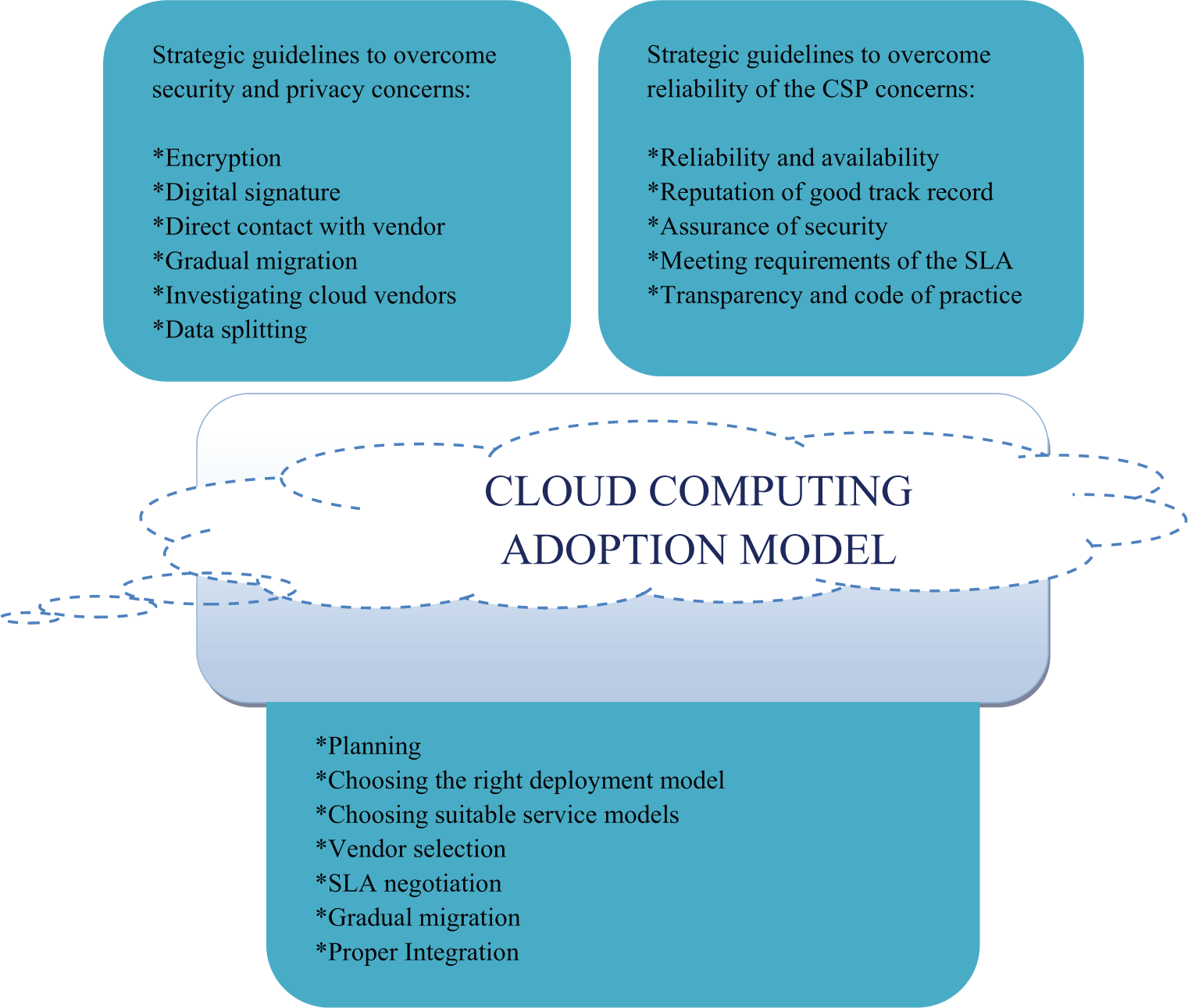
Proposed cloud computing adoption model.
The strategic guidelines should be followed when the decision to adopt the cloud technology has been made so as to reduce to the barest minimum the negative impact that comes with the adoption of the cloud technology of which security and privacy concerns and reliability of the cloud service provider concerns were top of the list in the survey conducted.
Overcoming the Barriers of Cloud Adoption
From both secondary and primary data collected, it was gathered that the main barriers to cloud computing adoption are security and confidentiality of data concerns, privacy and regulatory compliance concerns, and reliability of the service provider. Overcoming these concerns requires not just preventive and immediate solutions but also proactive and forward thinking approaches; therefore this article has put in place the following techniques to help in overcoming these challenges.
Strategic guidelines to overcome security and privacy concerns
Security and privacy concerns are two major issues that come with the adoption of cloud computing. Due to the importance and confidentiality of educational data, the following techniques and guideline should be implemented to help in overcoming these concerns:
Encryption
This is the process of changing or transforming information into a form that cannot be understood by any unauthorized person. By using this technique, the data are translated into a secret code that cannot be understood by anyone else except those who have the code or password to decrypt the encrypted information. This will protect the data and ensure its authenticity and integrity, and further prevent the improper disclosure of confidential educational data stored in the cloud. Encryption is the main method used to ensure the security of data stored in the cloud.
Digital signature
Security and privacy concerns can also be overcome by using digital signatures, an electronic signature used to authenticate the identity of the user of the services provided over the cloud, by using this technique, the user must provide the appropriate login or access credentials before they can have access to the information or application they want to use. This will help to ensure the authenticity, accountability, and integrity of data in the cloud.
Direct contact with the service provider
A direct contact should be created between the university and cloud service provider without the services of an intermediary, because the more the levels or stages that the data have to pass from the vendor to the user, the more the chances of the data being compromised. Direct contact will ensure that data are moved in one way direction, from the cloud vendor to the university.
Gradual sequence of migration
The migration toward cloud should not be done all at once, as much as the cloud offers cost savings, increased agility and efficiency caution should be taken and the movement gradual with low risks applications going first. This will give the university time to see whether the cloud project or the chosen vendor is worthy—if so, then the other applications can be moved step by step. In overcoming the barriers of security and privacy concerns, it is important to ensure compatibility between the university and cloud service providers’ systems; by moving gradually, the compatibility of both parties would have been ascertained before more sensitive data are moved to the cloud.
Investigating cloud vendors
The chosen cloud provider(s) security measures and the kind of security mechanisms, infrastructure and configuration in place to ensure the safety of data stored on their cloud, should be thoroughly investigated. Also, the plan for security events by the service provider detailing the responsibilities and actions to be taken in the event of a security breach should be understood, analyzed, and ensured to be in line with the required standards set by cloud computing bodies like the NIST (National Institute of Standards and Technology) and the CSA (Cloud Security Alliance) to ensure that the right level of security is provided by the cloud vendors to their clients and there are appropriate backups in place in case of any problems or the occurrences of disasters like fire, flood, or earthquake (CSA, 2010). This investigation is necessary by adopters of the cloud technology in the educational sector to ensure constant availability and confidentiality because of the level of privacy that is required to preserve research results and other confidential information.
Data splitting
This technique requires the use of more than one service provider; the data to be stored in the cloud should be split across different clouds, in a way, that preserves the confidentiality, availability, as well as integrity of the data. The use of two or more cloud services improves performance, avoids vendor lock-in, and reduces the risks of data loss and downtimes as security concerns such as data integrity, intrusion, and service availability can be controlled using fault-tolerant protocols across the multiple clouds. The data splitting technique avails the universities the opportunity to use different clouds for different purposes because some clouds are better than others for some applications; for example, the public cloud from Google might be best for email services whereas Microsoft Azure can be used to provide both PaaS and IaaS services. As the cloud technology advances, synchronizing data across multiple clouds is easier with the availability of migration solutions and the services of cloud-based service providers such as countability that make it easier to manage multiple cloud providers at the same time. Similarly, the cost of splitting data on multiple clouds should be carefully considered, the cost implications differ depending on the particular pricing scheme; applications frequently used and kept running for extended periods may have lower costs than those run for short periods.
Despite the emphasis to ensure that the right deployment and most suitable service delivery models along with reputable cloud service providers are chosen for a safe and reliable cloud, it is only natural that sometimes failures will occur; hence, using the multi-cloud strategy is a better and more reliable way to handle failures when they happen as it is most unlikely that services from different providers will be down at the same time. This technique also avails the universities the opportunity to shift easily; if suddenly any of the service providers decide to increase their prices or change their terms of business, the institutions will simply shut down from those providers and move to others with more favorable pricing and terms of business.
Strategic guidelines to overcome reliability of the service provider concerns
The reliability of the service provider, in other words trust, is a major obstacle and barrier to the adoption of cloud computing. Cloud service providers needed to be reliable and trusted so that adopters of the cloud technology can be confident to entrust their vital information to them for safekeeping. The need to look up, properly research, and make a comparison between different cloud vendors to ensure reliability of the chosen vendor(s) cannot be overemphasized. This is because information is the live wire of universities, and all efforts should be put in place to ensure that moving to the cloud brings true relief, solutions, and improved services. These can only be achieved, and the promises of the cloud enjoyed if the cloud vendor used is reliable and trustworthy. To achieve this and overcome the barrier posed by lack of trust and reliability of cloud service providers, the following guidelines should be followed:
Reliability and availability
To ensure that the services in the cloud are reliable and up and running well at all times, reliable cloud vendor is required. The chosen cloud service provider should be one that guarantees service level, uptime and availability 99% of the time. The chosen vendor should have redundancy of power, cooling systems, security system, servers, storage, excellent Internet connection, and fire suppression systems among other things to ensure that the required services are consistently and constantly available.
Reputation of good track record
The chosen cloud vendor should be one with good track record; this can be ascertained by how well their services function properly without frequent downtimes and when they occur, how long they last before service is fully restored. The reasons behind downtimes and frequency of occurrence should be considered, this information can be gotten by finding out who their customers are and how well they have enjoyed or not enjoyed the services of the vendor. This should be carefully considered before data are moved to any vendors’ data center.
Providing security in the cloud
The university must be assured of tight, well-defined security services in the cloud before they employ the services of any vendor. These security services include identity management, access control as well as authorization and authentication mechanisms to ensure the right level of control within the cloud environment and that only authorized personnel can make any changes or additions to the data and applications in the cloud as a way of ensuring the security, privacy, and confidentiality of data. The service provider should have a comprehensive security infrastructure in place at all levels of the services they provide.
SLA management
The cloud vendors should give guarantee by providing service levels for all services they are offering and ensure to meet the requirements of the SLA. The SLA should be negotiated to meet the expected level of service quality and should include refund guarantees or some kind of penalties if the promised service level is not delivered. This will keep the service providers on their toes to meet up with the terms and requirements of the SLA and the clients assured of quality service delivery. Also, the copyright laws as contained in the vendors’ SLA and that of the location where the vendors’ infrastructures are located should be carefully considered before commitments are made.
Transparency and code of practice
The choice of the cloud vendor should be one that is transparent in their dealings with clients and follow the code of practice unique to them as an organization and also that provided by cloud regulatory bodies to ensure the provision of highly secured and efficient services to their customers and be willing to explain any ambiguities and provide clarity to their clients when needed. The service provider’s chosen should be ones that are accountable and live up to their claims and promises.
Roadmap for the successful adoption of cloud computing
The proposed roadmap as shown in Figure 2 has seven stages: planning, choosing the right deployment model, choosing the most suitable service models, vendor selection, negotiating the SLA, migration, and integration.

Roadmap for successful adoption of cloud computing.
Stage 1: Planning
After the decision to adopt the cloud technology has been taken, the first step is to have a planning team in place to plan and oversee the cloud project. The team should have staff of the university’s IT department who will offer advise based on what is currently in place in the university and at least one external cloud expert who will give professional, expert, and practical advice as that is their area of expertise. Having the right people in place from the very beginning is necessary, because it will save a lot of costly mistakes from happening as the journey to the cloud continues. At the planning stage, the team should do a background study, identify the advantages and possible disadvantages of adopting cloud computing to the university, the university’s readiness to move to the cloud based on available infrastructure, and any other factors that may be considered important. Finally, the team should identify a system with best practices to benchmark against; this is because for any project or change to succeed, it has to be benchmarked against similar processes that have succeed; doing this will give a better reflection of the current processes, policies, and standards and how the best practices that have been identified can be achieved.
Stage 2: Choosing the right deployment model
Choosing the right deployment model is key to having a successful cloud platform, each of the four models of cloud computing have their strengths and weaknesses. For instance, the public cloud model offers full utilization of computing resources; it is more cost efficient and scalable than the other models but has greater security concerns whereas the private cloud though not as cost efficient as the public cloud offers better security. Therefore, to enjoy the full benefits and promises of adopting cloud computing, the hybrid model is recommended as the best deployment model because it combines the strengths of the public and private clouds and handles their weaknesses more efficiently. The hybrid cloud provides scalability without boundaries; it is more cost-effective, gives the needed security, and offers great flexibility by giving its users the opportunity to explore different operational avenues.
Stage 3: Choosing the most suitable service models
Just like the deployment model, it is important to know which of the service models is most suitable to meet the needs and achieve the objectives of migrating to the cloud. For instance, using IaaS delivers everything: servers, storage, space, and networking equipments as a service. PaaS provides the platform for application developers to build and host their applications whereas SaaS provides complete applications to the end user of the cloud service; it only requires that the user has a web browser and is connected to the Internet. The choice of the delivery model is dependent on need. For a typical university setting, each of these three models will be useful as they all have their unique features relevant to the needs of the university.
Stage 4: Vendor selection
As stated in “Strategic Guidelines to Overcome Reliability of the Service Provider Concerns” section above, the importance of choosing the right vendor cannot be overemphasized. This is because the success or failure of the cloud project lies strongly with the vendor delivering the service; hence, it is extremely important to investigate into the selected vendor before outsourcing. After investigating the reliability of the service provider, the next line of consideration is the location where the data will be stored; this is important because of legal compliance that comes with different locations. Different countries have different laws on the right to information in the land, information security, privacy, data protection, and different levels of restrictions; therefore, it is important to understand the local data protection requirement of the country or location where the data will be housed before commitments are made.
Stage 5: Negotiating the SLA
The SLA is a very important document; it is a binding contract between the university and the cloud service provider. The terms of the SLA should be negotiated and agreed upon by the university and chosen vendors before the deal is signed. Among other things, the agreements should include the following:
Planned downtimes by the vendor to check bugs, do maintenance, and updates should be scheduled at times when the impact will be least felt. For example, at midnight of the university’s location and preferably over the weekends; such times should be communicated to the university beforehand.
In the case of service transfer to another vendor, a seamless transfer without delay, downtime, and data loss should be assured.
Besides the service costs, all hidden costs within the documents for extra charges of any kind and terms and conditions written in tiny fonts should be made clear and properly understood by the university before the SLA is signed to avoid any misunderstandings in the future.
The chosen vendor should assure 99.9% availability and have an immediate data recovery plan in case of any disaster.
Stage 6: Migration
At this stage, the chosen deployment model and processes to be hosted on the service delivery models are mapped out.
The hybrid cloud
This article proposes the hybrid cloud as the most suitable deployment model for universities. Deploying the hybrid cloud will offer cost benefits to the management of the university; it will also make it easier for staff to share resources not just within the same university but also with other universities around the world. Likewise, lecturers do not have to carry their notes around as it can be easily accessed through any device because it is available in the cloud. Also with the hybrid model, the fear of privacy and other security-related issues are avoided, as very critical and sensitive data whose confidentiality cannot be compromised will be hosted on premise in the university’s data center, which serves as a private cloud. This article further proposes that the public cloud should combine the services of different cloud service providers to serve students and staff of the university more efficiently as well as avoid the problem of vendor lock-in.
The SaaS layer
The SaaS layer represents the top layer of the cloud. It offers its services in a software model of web-based applications and serves a large number of users. All that is required from the user of the application is a connection to the Internet. With SaaS, the user does not need to install or run any applications on their devices or worry about maintenance, upgrades, and support. Applications such as e-learning systems, admission process, research, faculty and student corners, admin, digital library, email, account and financial processes, student life cycle and information system, classroom management system, and other administrative processes can be hosted on the SaaS layer for easy access and convenience for students, academic as well administrative staff of the university. This can be on the public as well as a private cloud, the most sensitive applications such as the admission process, account and financial services, and any other services considered critical and requires very high confidentiality should be hosted on a private cloud. The SaaS services on the public cloud can be provided by cloud vendors such as Salesforce.com, Google, and SkyDrive. Using SaaS will help to overcome the problems of limited modern teaching and learning resources and lack of e-learning scalability.
The PaaS layer
The PaaS layer is the middle layer between the SaaS and IaaS. It is an environment for web developers to create, store, and host their applications over the Internet. The services on this layer eliminate the need to create and manage instances of virtual machines. The PaaS layer facilitates the development and deployment of applications without the developers worrying about the cost and complexity of buying, managing, or configuring the underlaying layers needed for developing applications because the development tools are already hosted in the cloud and provided by the cloud vendor. This layer provides access to different platforms and programming languages, thereby making it possible for developers and programming students to easily do their work by simply connecting to the cloud. This layer can be hosted on a public cloud using Force.com, Microsoft Azure, Google App Engine, and so on.
The IaaS layer
The IaaS also referred to everything as a service layer provides basic computing resources including servers, storage, hardware, and networking equipments. This layer delivers computing IaaS in a virtualized environment. It could also include the operating system, bandwidth, and virtualization technology needed to manage the resources. It all depends on need and negotiation with the cloud service provider. IaaS offers everything as a service; it helps to address the problem of limited learning resources and the e-learning scalability. One of the key players in the IaaS layer is Amazon E2C (Amazon Elastic Compute Cloud), it reduces the time needed to get and bootup new servers to minutes, it allows quick scaling capacity back and forth as demands change and provides a computing environment and resources that quickly and cost-effectively process large amounts of research data. Other providers of this service are HP, GoGrid, Rackspace, and so on.
Stage 7: Integration
A successful integration is the key to realizing the full potential of the entire cloud investment. Lack of proper integration of the cloud with existing on-premise applications has been identified as one of the key reasons why cloud projects fail in the survey conducted; therefore, to avoid this from happening, a proper integration is needed to harmonize processes across the hybrid model. Integration can be done using any of the three common traditional approaches like on-demand integration tools that connect multiple clouds together mainly adopted by small companies that have low-cost integration options or by implementing complex on-premise software platforms also called the traditional middleware solutions, which provide sophisticated functionalities and are mainly used to meet the integration needs of large enterprises; the third type of the traditional approach is by writing custom codes. Besides these traditional approaches, other approaches to integrating the cloud with on-premise applications is by using applications like WebSpace cast iron by IBM, Oracle cloud integration by Oracle, Boomi Atmosphere by Dell, or any of the other integration platforms available.
Testing of the Model
Both interview and questionnaire survey were conducted by this study as means of primary data collection. Table 1 shows the summary of the responses gotten from the questionnaire.
Summary of Data Collected.
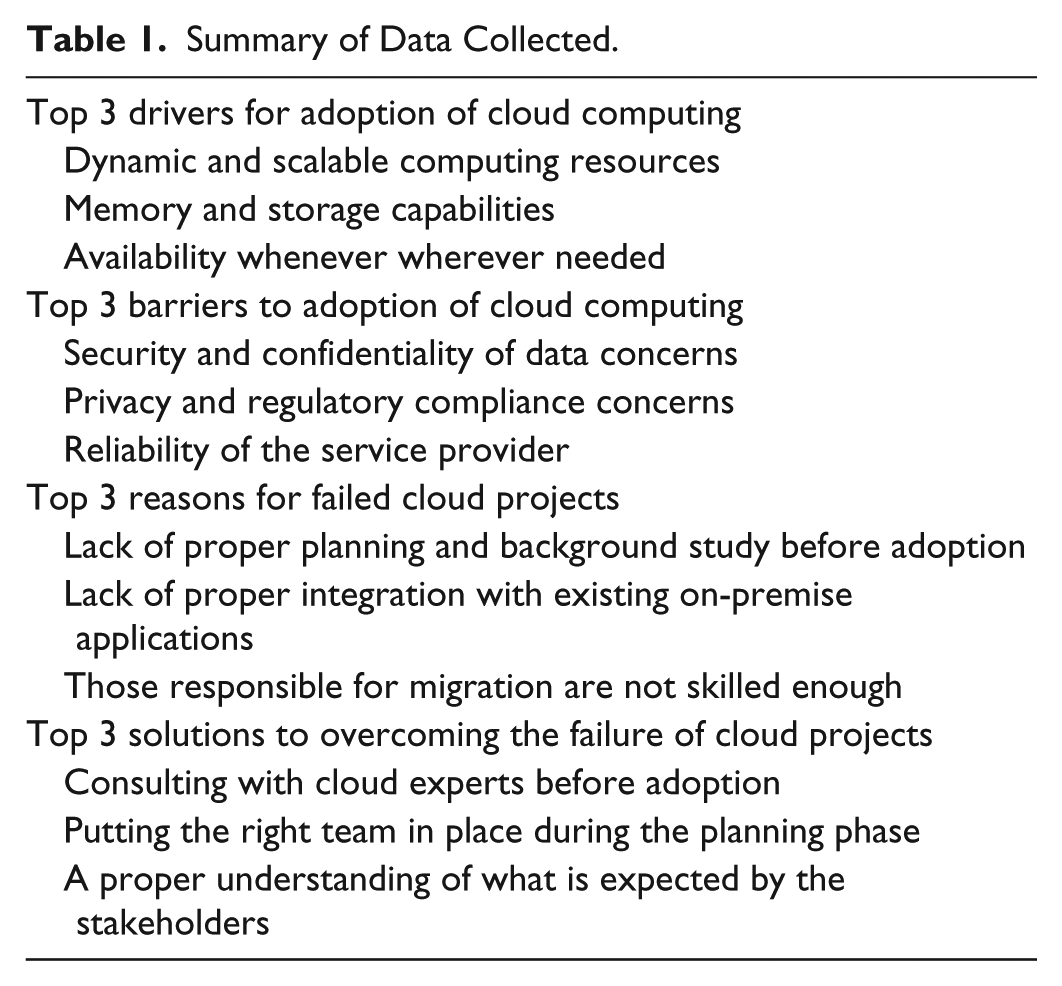
Based on the responses above, the model was created and sent to experts who have adopted and implemented the cloud technology in one of the renowned universities (Asia Pacific University of Technology and Innovation [APU], Malaysia) for testing, so as to evaluate the effectiveness of the model in meeting the needs of its users. APU has had a successful implementation of the cloud technology. The university uses the hybrid cloud model by combining a private cloud on campus and public clouds of external cloud service providers to meet the needs of its students and staff. By adopting the hybrid module, the university can deploy cloud services on varying scales on the three-service delivery models depending on need, frequency of access, and level of security needed. For instance, the university uses the SaaS services on both private and public clouds with more sensitive applications left behind the university’s firewalls on premises. Also, the researcher found that the university through its adoption of the cloud technology achieves savings of 95% in the number of servers used as 10 servers were effectively used to do the same job of 200 servers. Overall, the adoption of cloud computing not only saves APU from spending more in providing quality cloud services to her students and staff but also saves on storage space, cooling facilities, and reduction in the amount of carbon footprint generated as well as a more robust, secured, and high-performance network.
Conclusion
The advent of cloud computing sparked the interest of many universities around the world to opt for the cloud as an alternative means of delivering quality IT services to students, staff, and the educational community at reduced cost. However, the failures experienced by early adopters of the cloud technology and challenges that come with its adoption have left many skeptical in committing to it. This article discussed those challenges peculiar to higher institutions of learning and proffered solutions that can be followed to reduce to the barest minimum the issues of cloud computing adoption so as to ensure a safer and more reliable transition to the cloud for users at the university level.
Footnotes
Declaration of Conflicting Interests
The author(s) declared no potential conflicts of interest with respect to the research, authorship, and/or publication of this article.
Funding
The author(s) disclosed receipt of the following financial support for the research and/or authorship of this article: This research was supported in part by the Centre for Research and Instrumentation Management (CRIM), University Kebangsaan Malaysia; Grant FRGS/1/2012/SG05/UKM/02/7.