




Abstract
The study examined the perception and constraints of extension practitioners on utilization of communication technologies in southwestern Nigeria. This was necessitated by the need to ensure a practicable, vibrant, and efficient extension service delivery in the study area. 124 public and 41 non-public extension practitioners were selected through a three staged sampling procedure. Questionnaires were used to elicit vital information on their perceptions on ICT use, constraints faced during ICT use and other components. These were analyzed using descriptive statistics, mean difference, PPMC, and independent sample t-test. The results showed that (61.0%) of respondents from non-public organizations fell within those with favorable perception level. Also, (64.50%) of respondents had high level of constraints to ICT access. Moreover, (58.10%) of respondents from the public organizations’ encountered high level of constraint to ICT use. Result showed that respondents from the public extension organizations were more constrained in access to (14.10 ± 3.17) and use of ICT tools (10.84 ± 3.30) and were significant. The study has implications for providing functional ICT tools to the respondents for effective extension delivery. Agricultural extension service organizations should organize more frequent in-house trainings on the benefits of ICT use in relation to their extension work.
Plain Language Summary
The study investigated extension practitioners perception and constraints on use of ICT tools in their duties. The study employed both quantitative and qualitative method in the collection of data. The study found out that respondents from non-public organisations had better disposition to using ICT tools while those from non-public organisations encountered a higher level of constraints in access and use of ICT tools for their extension work. The study has implications for providing functional ICT tools to the respondents for effective extension delivery. It was observed that inadequate financial support from the government poses a great threat to use of ICT tools by respondents from public extension organisations in the course of performing their extension duties.
Introduction
Extension practitioners in this study connotes representatives or personnel of development organizations who are involved in agricultural extension service delivery to target audiences or farmers, for example, personnel of British American Tobacco (BAT), Agricultural Development Programmes (ADPs), and Justice Development and Peace Commission (JDPC) (Owolabi & Yekinni, 2022). These development organizations are either managed by state governments and mainly termed as (public extension organizations) or could also be managed by private, non-governmental, and inter-governmental agencies which are equally known as (non-public organizations)
Extension practitioners’ perception on information and communication technologies use in southwestern Nigeria oscillates from the two feasible points of favorable and unfavorable disposition as the case warrants. A vivid example from literature reviewed authenticated Yekinni’s finding that majority of researchers exhibited favorable disposition to ICT use while most extension personnel exhibited unfavorable disposition to ICT use (Yekinni & Akinbile, 2014). This seems to have originated from the limited knowledge exhibited on ICT use and inconsistent utilization of the communication technologies in their extension activities (Yekinni & Akinbile, 2014 and Sampath-Kumar & Kumar, 2010). Studies reviewed has also shown that few extension practitioners from southwest Nigeria who exhibited sharpened perception on ICT use are those who deemed some of the ICT tools relevant to their disseminating activities (DLEC, 2017). This is as a result of the applicability of these relevant communication tools to the target beneficiaries in their farming enterprises. Examples of these communication tools include radio, mobile phones, television, video, and computers. Another pre-requisite that projected few extension practitioners in southwestern Nigeria to having a sharpened perception on ICT use is the high level of knowledge possessed on using these tools well in their extension work (Ajayi et al., 2013). Similarly, it was found out that some extension officers had unfavorable perception that the quantity of agricultural messages that can be passed to farmers through the use of communication tools could be very limited (Sanjay, 2011). This perception could have probably risen as a result of the diverse dialects the farmers communicate with, which may not be easily interpreted by the extension personnel on communication tools for farmers use. Studies reviewed also showed that most extension practitioners’ perception on utilization of communication technologies relating to extension delivery can be enhanced through the use of communication technologies as it helps in raising the general awareness of opportunities available to farmers (Enwelu et al., 2017). Further studies by Cynthia and Nwabugwu (2016) revealed a number of challenges encountered by extension practitioners’ on ICT use which were lack of training on ICT use, inadequate access to internet facilities, epileptic power supply, and unavailability of ICT tools. Also, Faborode and Ajayi (2015) found out that restricted access to modern technologies decreased facilitation of networks among various agricultural stakeholders and vice versa.
Some of the problems that tends to limit extension practitioners’ access to ICTs according to Omotesho et al. (2012) revealed that non-affordability of communication tools and equipment, high cost rate of internet facilities were considered to be major challenges faced by extension officers and their Subject Matter Specialists in Kwara state. In addition, other limitations contributing to extension workers’ access to information and communication technologies in southwest Nigeria include low financial remuneration which originated from governments’ inconsistency in meeting the extension workers financial obligations; poor technical know-how of extension agents, lack of adequate exposure to internal and external training, as well as remote location of information and communication facilities for extension agents’ use (World Bank, 2017). These constraints pose serious threat to extension practitioners’ gaining of access to information and communication technologies in their disseminating activities. These constraints can be summarized further as
The Wane in National allocation to the Agricultural Sector in Nigeria.

Source.IFPRI (2018).
All of these constraints has limited the use of communication technologies by extension practitioners from various agricultural extension organizations. The extension practitioners’ relevance in rendering efficient extension service delivery is highly paramount toward agricultural rural development and farmers’ continuous productivity in recent times due to the dearth of extension personnel in agricultural sector. Therefore, the primary objective of this study is to examine the perceptions of the practitioners as regard the use of ICTs and assess the constraints that limit their access and use of ICTs in their extension duties in southwest, Nigeria.
Structuration Theory
This theory was authored by Desanctis and Poole (1990) and Orlikowski (1992). This theory showed that technology is not portrayed as an artefact, but rather examines how people interact with a technology in their current work practices, re-enact structures which mold their emergence and reliable use of that technology. Relating this theory to the current study, extension practitioners from the various actors in the Agricultural Knowledge and Information System (AKIS) system makes use of ICTs in the delivery of extension services to their target audience, with each actor being able to establish reliable structures thereby giving them a unique projection, identity and form that will automatically distinct each actors mode of operation for effective outcome of their extension delivery approach or system. For instance, extension organizations such as Non-Governmental Organizations, (NGOs), Agricultural Development Programmes, (ADPs), Farmers’ Development Union (FADU), Justice Development and Peace Commission (JDPC), British American Tobacco (BAT), have been able to create their own niche and extension outreaches effectively through the use of one or more technologies which have been able to have a permanent or lasting effect on their target beneficiaries. This shows that their perception toward these technologies could probably have a greater impact on the use of these tools in carrying out their extension work to farmers. This theory has been specifically chosen in the development of my research instrument because it clearly helps in uniquely identifying and effectively capturing the extent of ICT use by extension practitioners from public and non-public organizations. This has hitherto greatly aid in determining the overall disposition of the extension practitioners which could be a strong enhancement in using the tools efficiently in their extension activities. Moreover, it has equally aid in encapsulating the severity of constraints faced by extension practitioners in using the communication tools during the course of performing their extension duties for their various organizations.
Literature Review
Extension practitioners’ perception in helping farmers to be aware of latest technologies and opportunities has been greatly influenced by easy access to communication tools like mobile phones, radio, television, internet, computer, and audio recorder used in disseminating relevant agricultural messages to their target beneficiaries. Few extension practitioners have exhibited favorable perception in using communication tools to breaking gender restrictions of their clienteles in receiving agricultural messages (Agwu & Ogbonnah, 2014). In India, for instance, women have been enabled to receive instant SMS messages on their mobile phones about current prices of their farm produce, when and where to get their farm produce sold (Global Service for Mobile Agriculture, 2010). Likewise in Kenya, 43% of farmers who were enabled to put a call to Farmer helpline mainly known as M-kilmo were mostly women who were adequately assisted by female extension personnel on getting up to date information on various farming operations accessible to them. The information was packaged into various dialects that would be suitable to addressing the beneficiaries’ needs and problems in their native languages (Global Service for Mobile Agriculture, 2010). Majority of female extension practitioners in The Women in Agriculture (WIA) Department in Agricultural Development Programme in the North central zone of Nigeria were able to also use few communication tools in creating awareness and advising their target beneficiaries mostly women on fruit and food processing procedures, as well as booking appointments on when to meet with them during their women association meetings through the use of mobile phone (Agwu et al., 2014).
Another study by Sennuga (2019) used social cognitive theory propounded by Bandura (1986) in a related work on use of ICTs among smallholder farmers and extension workers in Nigeria. The theory was based on how reasoning capability of an individual affects the behavior of technology adoption alongside with interaction with the technology. The limitation of the theory was that it placed a greater relevance on the concept of self-efficacy (which emphasized on perception of an individual proficiency to using a technology to achieve a particular task at the initial stage of use). The theories used in relation to my work encapsulated the frequent use of ICTs by extension practitioners in performing their extension duties leads to greater proficiency in the long-run than at the initial stage before using the communication tools. A study on challenges to adoption of ICT tools by agricultural extension workers in Nigeria (Cynthia & Nwabugwu, 2016) was also reviewed. This study was carried out in Anambra State, Nigeria. It revealed that major constraints faced by extension workers were interrupted power supply (
This research work intended to make improvement in the method of data collection and analysis to what prior scholars have found out as regards the perception and constraints of extension practitioners on ICT use in promoting agricultural extension service delivery. Ogbonna and Agwu (2013) researched on access and use of ICT by rural farmers; Cynthia and Nwabugwu (2016) examined the challenges to adoption of ICT tools by agricultural extension workers. Ajayi et al. (2013) explored the knowledge and perception of extension agents on ICT use in extension service delivery, while Lawal-Adebowale and Akeredolu-Ale (2010) studied agricultural workers perception of ICT usage for agricultural development. Prior studies on use of ICTs concentrated more on either perception of extension practitioners or constraints to using these tools well in extension organizations that are public-based and how they use these technologies in their extension service delivery. However, there is need to broaden the scope of extension service delivery through the perception and constraints faced by extension practitioners on use of ICTs by examining the different groups of extension practitioners from public and non-public organizations.
Thus, there is need to examine the level of perception and constraints on use of ICTs by the practitioners of various extension organizations in order to have it distinctly validated so that there can be adequate information on use of ICTs for agricultural extension delivery in Nigeria. This current study has therefore gone further to provide the levels of perception and constraints faced on ICT use by extension practitioners across four out of the six states of southwestern Nigeria. Therefore, this research attempts to provide solution to the following study investigations:
a. What are the perceptions of the respondents’ about the use of these ICTs in carrying out their activities?
b. What are the constraints that limit the respondents’ access and use of these ICT tools in discharging their duties?
Research Methodology
The study was conducted in southwestern Nigeria which comprises of six states which are Ondo Lagoa, Oyo, Osun, Ekiti, and Ogun states. The latitudes and longitudes of the study area lie between 6°30′ to 9°0′ North and 3°0′ East to 5°30′ East of the Greenwich meridian respectively. The zone extend over the area ranging from everglade forest to western highlands. Savannah, mosaic, rain forests, and deciduous forests are equidistant in the zone. The weather in southwestern Nigeria is characterized primarily as humid with a rainfall mode of 1,500 to 3,000 mm per annum. The rainfall mode depicts a dual mode distribution exhibiting peaks in June, early July, and September, while the north eastern trade winds from the Sahara region propels harmattan mostly around November to February yearly. The cultivation of arable crops such as beans, rice, wheat, barley, nuts, cassava, melon, millet, maize, yam, soybeans along with tree crops such as rubber, cocoa, cotton, groundnuts, cashew, oil palm, coffee are usually supported by this climate. The unique choice of this area of study have been justified with high convergence of public and non-public organizations involved in agricultural extension services (Owolabi & Yekinni, 2022). Figure 1 shows the atlas of Nigeria denoting the selected states and zones in the southwestern region meant for the purpose of this study.

Atlas of Nigeria presenting selected states and zones used for non-public and public organizations in the southwestern region.
Sampling Technique
The study population incorporate all extension practitioners in the non-public organizations which consist of private (British American Tobacco), Non-Governmental Organization (Justice Development and Peace Commission) and Intergovernmental (United State Agency and International Development), and public (Agricultural Development Programme) extension organizations in southwestern, Nigeria. This study utilized a mixed method research design which comprised elements of qualitative and quantitative research to provide answer to my research questions. The qualitative research utilized in this study aimed at capturing information the quantitative approach could not cover in the two corporations. This helps in detailed documentation of their best managerial policies relating to practices on ICT use (Owolabi & Yekinni, 2022).
The quantitative aspect was carried out using surveys because all the respondents were well-educated. The qualitative technique was executed using surveys through in-depth interview (IDI) which tackled crucial questions about information on policies, practices, and standards in the use of ICT for each organization. The interview specifically targeted directors, managers, and supervisors who stand as key informants for the two organizations under study. These key informants who passed through the in-depth interview constituted about 5% of the sample size for public organization (41) and non-public organizations (124), respectively. Each interview conducted was within a period of 20 to 30 minutes and the whole exercise lasted for 2 hours for key informants from public organizations while for those from non-public organizations it lasted for a period of 1 hour.
A multi-stage sampling procedure was used in the selection of the respondents. There are four stages involved in the selection of respondents from public organizations. The first stage entails simple random sampling of four states (Ogun, Oyo, Ondo, and Ekiti states) out of the six states that makes up the southwestern geopolitical zone of Nigeria. The second stage entailed random selection of the zones from the designated states by sampling 50% of the zones within each state. The penultimate stage include verifying the actual number of extension agents from the corporation by obtaining a list of all their extension agents in the agency. The final stage comprised sampling of 30% of the extension personnel using simple random selection from each of the selected zones (this means 124 respondents were selected from the public organization in the 4 states). While for non-public extension organizations, the first stage involved purposive selection of four states where the organizations are mainly operational in the southwestern area while the next stage comprised the purposive selection of the zones where their extension outreaches were practically based. The final stage involved verifying the actual number of extension agents in the organizations by getting a list of all their extension personnel in the organization and selection of all the extension personnel in the organization (Owolabi & Yekinni, 2022) (that means a total number of 41 respondents were selected from non-public organizations). In summary, an overall sum of 165 extension practitioners were afterward interviewed from both organizations. The small number of extension practitioners sampled from these two main organizations were sequel to shortage in the number of extension agents in both organizations. Quantitative data was used using chats, percentages, and means. Inferential statistics such as Pearson product moment correlation (PPMC) and T-test were used. Respondents’ perception as regards the use of ICTs in carrying out their extension obligations was determined by ensuring that they react to 24 perceptional statements on a five Likert-type scale of Strongly agree (SA), Agree (A), Undecided (U), Disagree (D), and Strongly disagree (SD). Scores of 5, 4, 3, 2, and 1 were accorded to positively worded statements while the reverse holds for negatively worded statements. Respondents’ perception on ICT use was measured with 24 items of positive and negative statements. Most respondents who were undecided in their perception on ICT use in relation to their extension duties have been included under the unfavorable category because the frequency of respondents under the undecided were negligible. The minimum score was 24 while the maximum score was 120. Mean perception score was obtained and used to categorize respondents into favorable and unfavorable perception on ICT use with respect to their various organizations. Mean perception scores of (74.35 ± 12.44) and (68.76 ± 13.77) were obtained for respondents from public and non-public organizations respectively and used to categorize respondents into favorable and unfavorable perception on ICT use with respect to their various organizations. The constraint variables used in this study were constraints to access and constraints to use of ICTs. Respondents were required to specify how serious they have observed the constraints listed below to limiting their access to ICT use. Scores of 0, 1, and 2 were assigned to not a constraint, mild constraint, and serious constraint respectively. The constraints that limit their access were listed as epileptic power supply, inadequate financial resources, poor internet facilities, high-cost of hard ware, non-affordability, lack of technology appropriateness, and lack of relevant infrastructures. The minimum score was 0 while the maximum score was 18. The mean of each of the listed constraint was calculated and used to determine the order of severity of the constraints that limit their access to ICT. Also, respondents were required to specify how serious they have observed the constraints listed below to limiting their use of ICT. Scores of 0, 1, and 2 were assigned to not a constraint, mild constraint, and serious constraint respectively. The constraints limiting their access were listed as low financial resources, dearth of technical know-how, low level of computer education, gender restriction, inadequate investments, inconsistence in the payment of allowance or salary, inherent need in capacity building, and difficulty in integrating with existing media. The minimum score was 0 while the maximum score was 16. The mean of each of the listed constraint was calculated used to determine the order of severity of the constraints that limit their use of ICT. Both quantitative and qualitative methods of data gathering were employed for each of the research questions of this study respectively (Owolabi & Yekinni, 2022), this can be depicted through the flow diagram in Figure 2:

Research design on extension practitioners’ perception and constraints on ICT use in southwestern Nigeria.
Results and Discussion
Perceptions of Extension Practitioners on the Use of ICT Tools for Extension Activities
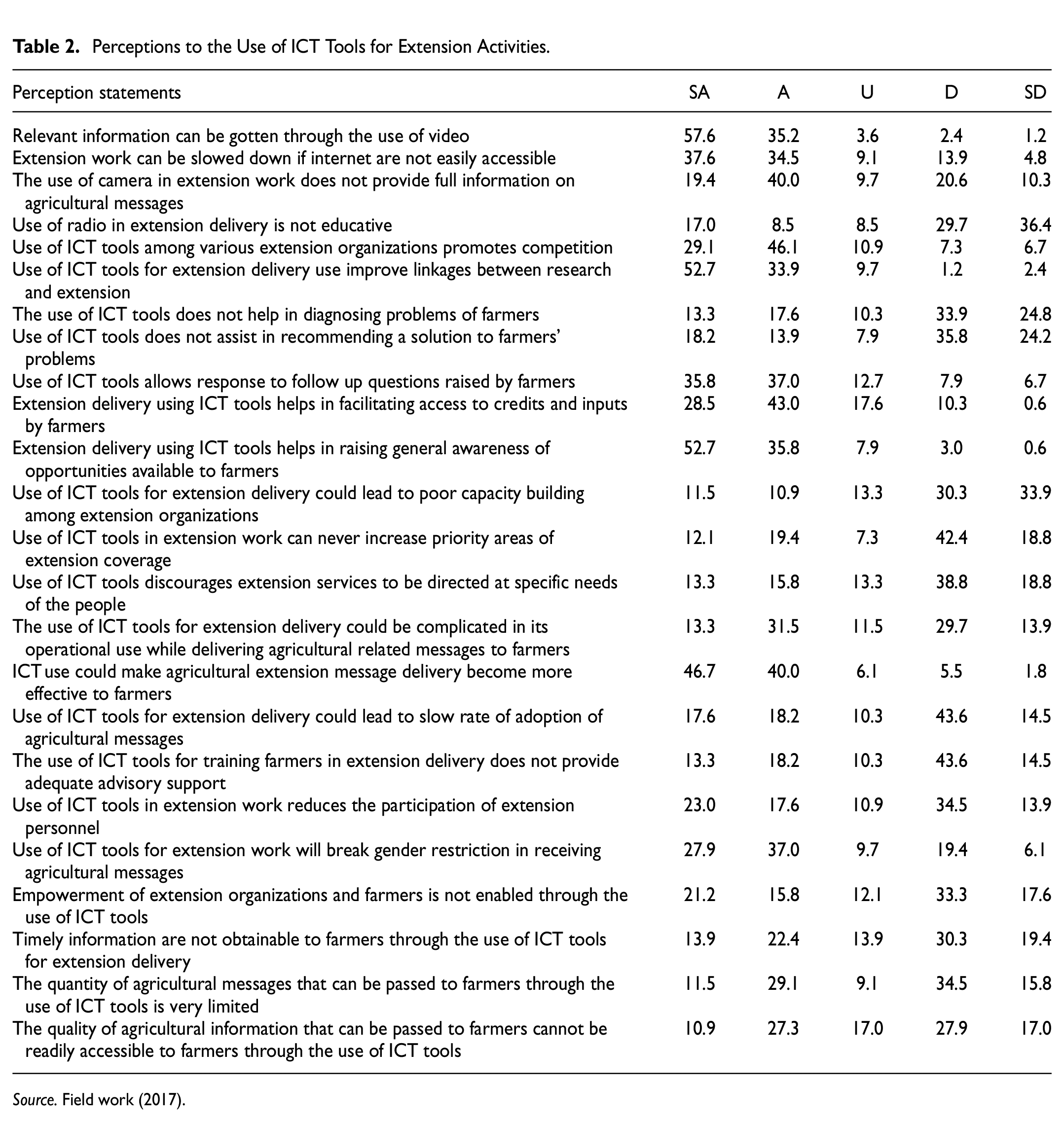
As indicated from Table 2, over half of the respondents (57.6%) strongly agreed that relevant information can be got through the use of video and also 35.2% did agree as well that relevant information can be got through the use of video. Also, 52.7% of the respondents strongly agreed that the use of ICT tools for extension delivery use improve linkages between research and extension, equally 33.9% of the respondents did agreed that the use of information and communication tools for extension delivery use improve linkages between research and extension. Concurrently, 52.7% of the respondents strongly agreed that extension delivery using ICT tools helps in raising general awareness of opportunities available to farmers, also 35.8% of the respondents did agreed that extension delivery using ICT tools helps in raising general awareness of opportunities available to farmers.
Perceptions to the Use of ICT Tools for Extension Activities.
Source. Field work (2017).
Moreover, 46.7% of extension practitioners strongly agreed that information and communication technology use could make agricultural extension message delivery become more effective to farmers, similarly 40.0% also did agreed that information and communication technology use could make agricultural extension message delivery become more effective to farmers. This result is an indication that the extension practitioners’ perception on the use of information and communication technology is positively inclined which can definitely be a strong enhancement to the respondent efficient extension delivery activities. This implies that extension workers better perception on technology usage may have risen due to the higher knowledge of communication tools they have acquired on the use of information and communication tools (Ajayi et al., 2013).
Meanwhile, 46.1% of the respondents agreed that use of information and communication tools among various extension organizations promotes competition, also 43.0% of the respondents also agreed that extension delivery using information and communication tools helps in facilitating access to credits and inputs by farmers. This infers that respondents’ use of ICT tools will act as a catalyst in duplicating information dissemination capacity of their various extension activities.
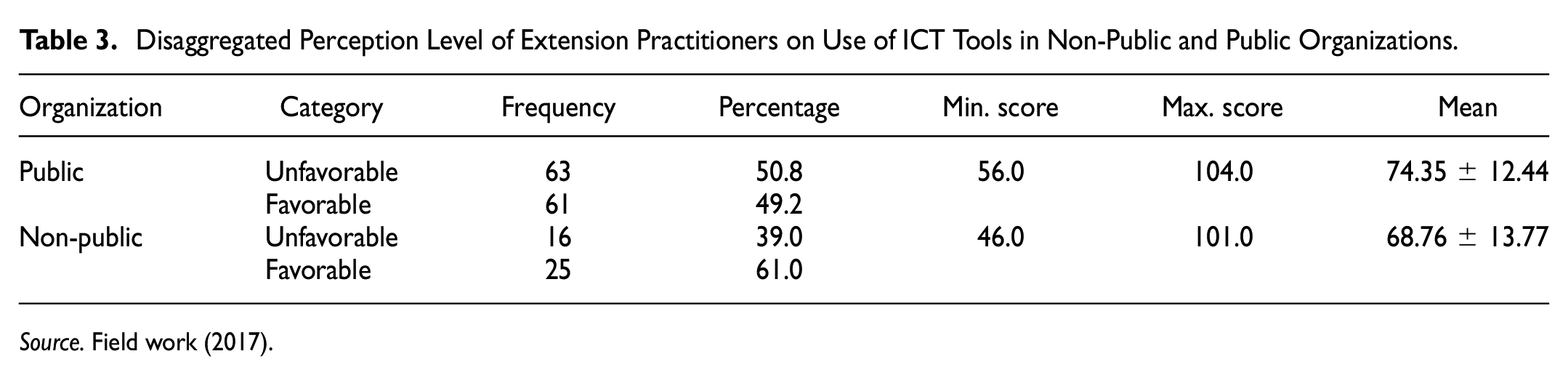
The study further categorized respondents into those of public organization and non-public organizations. Findings from Table 3 revealed the perception level between public extension practitioners and extension practitioners from non-public organizations in the use of ICTs. In public organization, 50.8% of respondents had unfavorable perception, while 49.2% fell within favorable perception toward the use of ICT tools for extension activities. Whereas 61.0% of respondents from non-public organizations fell within those with favorable perception level, while 39.0% of respondents fell within those with unfavorable perception level of ICTs. This implies that a greater proportion of extension practitioners from the non-public organizations (BAT, JDPC, and USAID) exhibited higher degree of perception on ICT use, while a lower proportion of extension practitioners from the public organization exhibited favorable perception level of ICT use. This implies that respondents from the non-public organizations favorable perception could have risen as a result of frequent exposure to trainings on ICT use within their organizations which pre-empt them to having a greater disposition to using these tools in their extension work (Aregbesola et al., 2019). This is further buttressed during an IDI with extension supervisors from other organization that are non-public: Consistent exposure to ICT trainings clearly informs the difference exhibited in perception levels between respondents categorised under public and non-public organisations. Deliberate measures are set out to ensure all the extension personnel in our organisations are regularly upgraded on their perception level through thorough enlightenment training programmes on ICTs so that they can effectively utilise it in their disseminating activities. (a senior personnel for human resource development, BAT, Iseyin)
Disaggregated Perception Level of Extension Practitioners on Use of ICT Tools in Non-Public and Public Organizations.
Source. Field work (2017).
This findings corroborated results from previous literatures reviewed in this study by Ajayi et al. (2013), which revealed that extension agents’ perception on ICT use was indifferent and unfavorable in their extension work. Conversely, Yekinni and Akinbile, (2014) revealed that agricultural researchers and extension agents exhibited favorable perception in their use of ICTs in their extension work. This implies that educational level of agricultural researchers and extension agents influenced their perception of use of ICTs in their extension work.
Constraints to Access of ICT Tools in Non-Public and Public Organizations
Notable constraints to respondents’ access to ICT tools were identified in for public and non-public organizations. Table 4 showed that interrupted power supply (
Constraints to Access of ICT Tools in Public Organizations.

Source. Field work (2017).
epileptic power supply constitute a major issue to accessing most of the available ICT tools in the organisation, as a result most of the extension activities are slowed down, as well as reducing personnel motivation to exploiting these ICT tools for extension purposes. (a senior personnel from ADP (public organization), from extension department, Ogun state).
Alternatively, notable constraints to respondents’ access to ICT tools are identified in Table 5 for non-public organization. Low financial resources (
sufficient financial resources are given to each personnel to facilitate effective extension service delivery to our clients. Most times access to these tools were inhibited if personnel had exhausted their allotted quota, which could result in low financial resource to access the tools at that point in time. (a senior personnel at BAT (non-public organization) from the human resource department, Oyo state).
Constraints of Respondents’ Access to ICT Tools in Non-Public Organizations.

Source. Field work (2017).
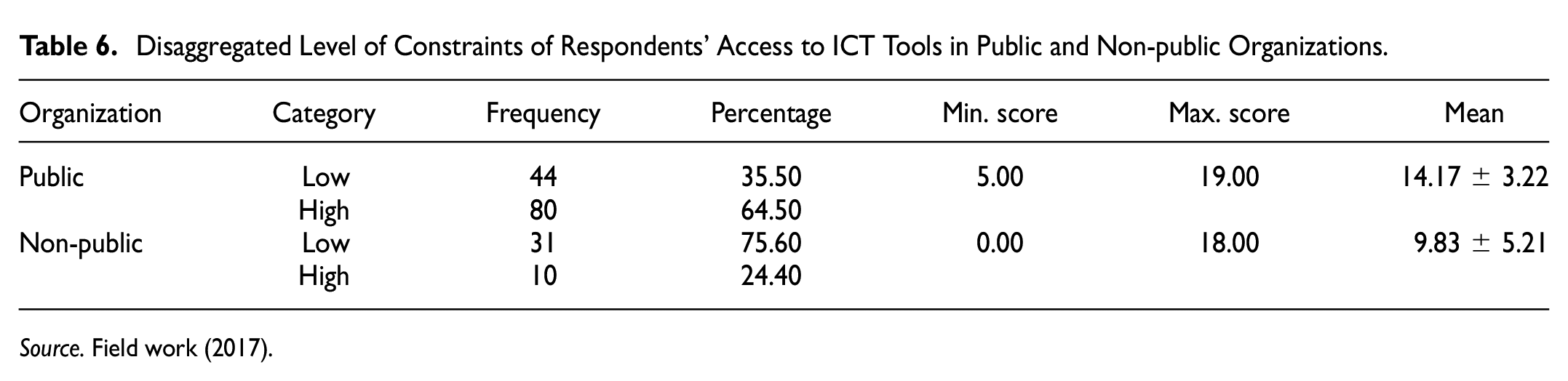
Moreover, the study categorized respondents into those of public and non-public extension organizations. Findings from Table 6 revealed the level of constraints to access between extension practitioners from public and non-public organizations in the use of ICTs. 64.50% fell within high level of constraint to ICT access. Whereas 75.60% of respondents from non-public organizations fell within those with low level of constraints to ICT access. This implies that a greater proportion of extension practitioners from the non-public organizations do encounter minimal constraints in accessing these ICTs in the course of rendering their extension duties to their target beneficiaries. This could be as a result of provision of relevant infrastructural facilities by the management of their organization in facilitating effective extension service delivery rendered by their personnel to the farmers. This finding is in consonance with Akpabio et al. (2007) who found out that electricity power problems was the major constraint faced by extension agents from public organizations while poor infrastructural development was the major constraint in accessing ICTs for their extension work in his study. This further implies the insufficient attention of the state government in managing public extension organizations in most developing countries (Cynthia & Nwabugwu, 2016).
Disaggregated Level of Constraints of Respondents’ Access to ICT Tools in Public and Non-public Organizations.
Source. Field work (2017).
Constraints to Use of ICT Tools
Constraints to respondents’ use of ICTs were identified for public and non-public organizations. These are revealed in Table 7 as lack of financial resources (
inadequate financial support from government serves as the major hitch to having relevant ICT facilities for the few extension personnel on ground, even the few available tools for use also require regular maintenance with limited financial resources to make them functional for extension work. (a senior personnel from ADP (public organization), extension department, Ekiti state).
Constraints to Respondents’ Use of ICT Tools in Public Organization.

Source. Field work (2017).
Moreover, specific constraints to respondents’ use of ICT tools are identified in Table 8 for non-public organization. Low level of computer education (
extension personnel display of low computer exposure rarely comes up in our extension activities, whenever this deficiency shows up in our extension personnel performance, regular in-house exposure to ICT training will promptly be organised to equip our staff output. (a senior personnel from BAT (non-public organization) from human resource department, Oyo state)
Constraints to Respondents’ Use of ICT Tools in Non-Public Organization.

Source. Field work (2017).
The study further categorized respondents into those of public organizations (PO) and non-public organizations (NPO). Findings from Table 9 revealed the level of constraints in the use of ICTs between extension practitioners from (PO) and (NPO). The level of constraints to ICT use showed that 58.10% of respondents fell within high level of constraint to ICT use. Whereas 75.60% of respondents from non-public organizations fell within those with low level of constraints to ICT use. This shows that a greater proportion of extension practitioners from the non-public organizations have minimal constraints in the use of ICTs compared with those from public organization who experience a higher level of constraints. This implies that respondents from non-public organizations tend to have minimal constraints to ICT use probably due to greater access they have to using these ICT tools in their various organizations for their extension activities. This finding authenticates (Imhonopi & Urim, 2011) who found out that inadequate funding of in using communication tools efficiently was the major challenge extension agents from public organizations faced in their extension work. This implies the inability of government to fully support and fund the advancement of extension services in Nigeria through the public sector has generally weaken the extension service delivery system.
Disaggregated Level of Constraints of Respondents’ Use of ICT Tools in Public Organization.

Source: Field work (2017).
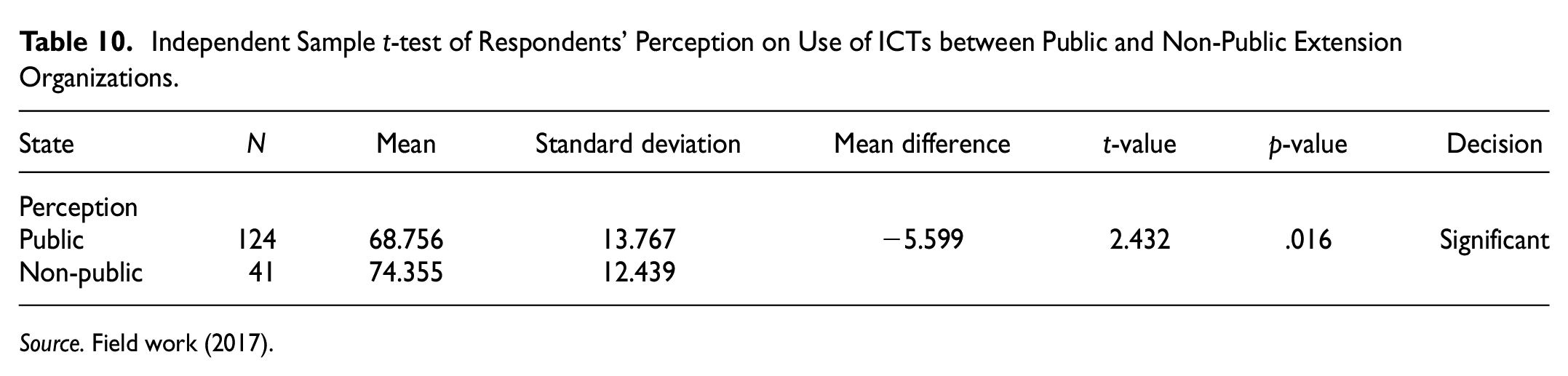
In conclusion, results from Table 10 shows that there was significant difference (
Independent Sample t-test of Respondents’ Perception on Use of ICTs between Public and Non-Public Extension Organizations.
Source. Field work (2017).
Test of Relationship Between Extension Practitioners’ Perception on ICT Use and Usage of Information and Communication Technologies
Result from Table 11 shows that there was no significant relationship between use of information and communication technologies and extension practitioners perception on ICTs (r = −0.123; p = .444) among respondents from public organizations. Alternatively, it further reveals that there is a significant relationship between utilization of information and communication technologies and extension practitioners perception on ICTs (r = 0.070; p = .001) among respondents from non-public organization. This implies that extension practitioners’ positive disposition to ICT use in non-public organizations tend to stimulate them better in rightly using these tools passionately in discharging their extension duties.
PPMC Relationship between Extension Practitioners’ Perception on the Use of ICTs and Their Usage of Information and Communication Technologies for Public and Non-Public Organizations.

Source. Field work (2017).
Significant at 0.01.
Furthermore, data from Table 12 reveal constraints to access and usage of information and communication technologies among extension practitioners from public organization (PO) and non-public organizations (NPO). Result shows that respondents from the public extension organization were more constrained in access to (14.10 ± 3.17) and use of ICT tools (10.84 ± 3.30) compared to access (9.80 ± 5.25) and use of ICT tools (5.31 ± 5.08) among respondents from non-public organizations and were significant. This implies that extension practitioners from public organization experiences more severe constraints in their organization in accessing and using ICT tools in discharging their duties than those from non-public organizations. This tends to consequently limit the efficacy of operating these ICT tools well in discharging their extension duties (Oladele, 2015).
Mean Difference in Constraints to Access and Use of ICT Tools between Public Extension Organization and Non-Public Extension Organizations.

Source. Field work (2017).
Conclusion of Findings
This study examined the perceptions of the practitioners as regard the use of ICTs and assess the constraints that limit their access and use of ICTs in their extension duties in southwestern Nigeria using both quantitative and qualitative data collection. The analysis revealed that respondents from public organization had unfavorable disposition to using ICTs while those from non-public organizations were favorable disposed to using ICT tools in their extension work. Moreover, respondents from public organizations were more constrained in their access and use of ICTs over those from non-public organizations. Perception of extension practitioners can be greatly enhanced by ensuring that respective agricultural extension service organizations organizes more or frequent in-house trainings on the benefits of ICT use in relation to their extension work. Public extension practitioners has been noted to exhibit unfavorable perception and greater constraints on using ICTs in their extension work, therefore it is crucial to ensure the optimal provision of functional ICT tools for effective extension delivery by the three tiers of government (Federal, state, and local) in southwestern Nigeria. This has a greater potential of advancing efficient extension service delivery among extension practitioners with a multipliers effect on the various enterprises of farmers and improving their standard of living. Moreover, program managers of both non-public and public agricultural extension service organizations have an obligation in ensuring frequent in-house trainings on the benefits of ICT use in relation to their extension work. This seems to help in rectifying the extension practitioners’ unfavorable perception of using these ICT tools well in their disseminating activities.
Footnotes
Declaration of Conflicting Interests
The author(s) declared no potential conflicts of interest with respect to the research, authorship, and/or publication of this article.
Funding
The author(s) disclosed receipt of the following financial support for the research, authorship, and/or publication of this article: The research work was solely funded by the correspondent researcher.
Ethics Statement
The authors have appropriately obtained the ethical approval reference.

Data Availability Statement
The data that has been used is confidential