



Abstract
The goals of the research were to inform whether the theory of planned behavior (TPB) is a valid model to explain Indonesian preservice teachers’ (PSTs) use of information and communication technology (UICT) during teaching practices, to report best factor affecting PSTs’ UICT during teaching practices, and to elaborate differences regarding UICT during teaching practices in terms of demographic information, gender, major, university, and information and communication technology (ICT)-based courses. The sample of this study was 1,133 PSTs from three Indonesian universities who completed a 24-item printed questionnaire of four constructs: behavioral beliefs (BB), normative beliefs (NB), control beliefs (CB), and UICT. Using partial least square–structural equation modeling (PLS-SEM), the results informed that the TPB is a valid model to help explain Indonesian PSTs’ UICT during teaching practices. All constructs (BB, NB, and CB) significantly predict UICT during teaching practices where NB is reported to be the strongest predictor (β = .354). There are no significant differences in terms of genders and ICT-based courses; however, significant differences are indicated in terms of majors and universities.
Introduction
Many systems in education across the world consider technology integration as a significant factor for the development of teaching and learning that triggers in charge governments to introduce policies and initiatives as well as investment to establish and maintain information and communication technology (ICT) tools and infrastructures in their educational institutions (Pelgrum, 2001). On the contrary, acceptance of technology integration has been a key topic informed by educational researchers in the 21st-century education. They have been interested in investigating the factors or conditions affecting technology acceptance in teaching and learning (Shaw et al., 2018).
Several models were validated and developed to help predict factors that affect technology acceptance and use. Among the models, theory of planned behavior (TPB) which was first introduced by Ajzen (1991) has been widely applied and validated. Overall, the TPB has recently gained many empirical research promotions to become robust in predicting technology acceptance with a variety of technologies and different contexts. However, limited studies were reported in the context of developing countries. Therefore, this article aimed at informing whether the TPB is a valid and reliable model to explain Indonesian preservice teachers’ (PSTs) use of ICT during teaching practices, reporting the best factor affecting the PSTs’ use of ICT during teaching practices, and elaborating differences regarding use of information and communication technology (UICT) during teaching practices in terms of four types of demographic information namely gender, major, university, and ICT-based courses.
Literature Review
Theory of Planned Behavior
This study adapted Ajzen’s (1985) TPB as the theoretical framework to understand PSTs’ underlying beliefs related to their UICT during teaching practices. This framework is a technology adoption framework that has been widely used and validated, relying on belief-based measurements to facilitate a fully comprehensive elaboration required in understanding intention or use of technology in a given behavior engagement (Ajzen, 1991). The TPB is an extending framework of the theory of reasoned action (TRA) that was also established by Fishbein and Ajzen (1975). TRA assumes that it is a rational decision for a teacher’s intention or actual use for instructional technology on the basis of personal and social factors. The personal factor, behavior based on attitudes, represents a teacher’s constructive or negative beliefs toward the use of technology in providing supportive outputs. The social factor, behavior based on subjective norms, reflects a teacher’s perception about other people’s significance in affecting technology use in his or her teaching processes. In addition, it suggests that behavioral intention to use technologies could be better when a teacher has control within the adoption. In this context, perceived control is affected by internal and external factors. For instance, when a teacher considers himself or herself to be in the qualification to deliver instructional activities using ICT tools and have fewer problems to use them, she or he will have a better control (Sadaf et al., 2012). In conclusion, the three kinds of beliefs (behavioral, normative, and control) in this study are mutually associated with attitudes, subjective norm, and perceived behavioral control (Ajzen, 1991).
Technology Integration Through TPB
In the last two decades, academics have applied TPB framework to study PSTs’ behavioral intentions to use ICT for instruction (e.g., Sadaf et al., 2012; Teo & Lee, 2010; Teo & Van Schaik, 2012; Valtonen et al., 2015). Using quantitative methods, the TPB framework has been used to describe the elements of PSTs’ TPB in the context of ICT (e.g., Teo & Lee, 2010; Teo & Van Schaik, 2012). The results of these studies suggested that attitudes or behavioral beliefs (BB) are the most significant factor predicting behavioral intentions or actual use of ICT; the roles of normative beliefs (NB) and control beliefs (CB) were reported in minor roles (Teo & Lee, 2010; Teo & Van Schaik, 2012). However, Valtonen et al. (2015) reported that NB was the strongest factor predicting the intention to use ICT for future teaching. In addition, Sadaf et al. (2012) qualitatively adopted the framework to study PSTs’ beliefs in using Web 2.0 technologies for teaching where they found positive attitudes toward its use. Also, the results informed that PSTs see their future students as a key factor predicting the use of Web 2.0 tools for teaching.
In this study, the TPB framework was used to study the direct possible effects on the actual use of ICT during teaching practices. Some studies have been conducted to measure actual use of ICT in education (Alzahrani et al., 2017; Aslan & Zhu, 2017; Fatima et al., 2019; Kreijns et al., 2013; Sang et al., 2010; Van Braak et al., 2004; Yucel et al., 2010). In addition, demographic information was also used to see the differences among UICT during teaching practices in terms of gender, age, university, and ICT-based courses (Kolodziejczyk, 2015; Yasmeen et al., 2015).
Hypotheses
The TPB theory helped us validate and examine in-depth information about the beliefs underlying PSTs’ UICT during teaching practices through seven hypotheses (Figure 1):

Model of the study.
Method
We applied a survey, non-experimental research (Fowler, 2013) to achieve the goals of the study. Some stages were done in confirming the study hypotheses: instrumentation, data collection and preparation, and data analysis.
Instrumentation
We adapted and constructed questionnaires from previous studies: TPB (Sadaf et al., 2012; Teo & Lee, 2010; Valtonen et al., 2015 and Yusop, 2015) and use of ICT during teaching practices (Aslan & Zhu, 2017). A pool of instrument (47 items) was validated through face and content validity; two sessions of discussion with users and experts. Content validity index (CVI) was done to further validate the instrument (Lynn, 1986). Three PSTs, a program staff, and a teacher educator attended the first discussion session for the process of face validity of the instrument to revise wordings, contexts, and terms used in the instrument. For content validity, the instrument was discussed with five Indonesian experts who were professors of educational technology and Indonesian educational policy in the second session of discussion. Through these processes, 17 items were dropped; 30 items remained for the next process of validation.
In addition, CVI was conducted to further validate the instruments. Ten experts were available to get involved; 27 experts were contacted and invited where 15 experts did not respond to the invitation and two others rejected the invitation. Each instrument item was assessed using scales of relevance, clarity, and simplicity (Halek et al., 2017; Lynn, 1986) rated on a 4-point scale (1 = not relevant/not clear/not simple to 4 = very relevant/very clear/very simple). We asked them to evaluate whether the instrument items covered all related aspects or whether missing components emerged. The CVI was assessed for the item levels (I-CVI) and scale levels (S-CVI). The assessment of I-CVI was conducted using a score of 3 or 4 divided by the total number of experts (Lynn, 1986). For this study, the I-CVI should not be less than .78 (Polit & Beck, 2009) for 10 experts. The assessment of S-CVI was done within the average portion of the items on one scale rated 3 or 4 (average agreement by experts = S-CVI/AVE) where the acceptable score is .8 (Halek et al., 2017; Polit & Beck, 2009). All I-CVI and S-CVI values were above the threshold.
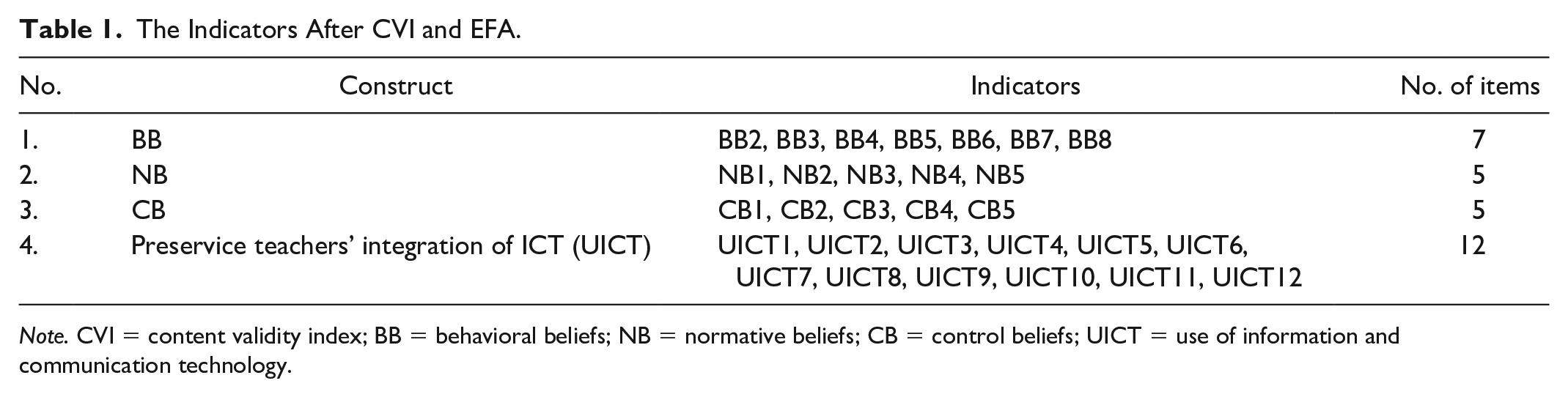
In the next stage after CVI, we distributed the questionnaire to more than 300 respondents for the pilot study. Two hundred eighty-seven measurable data were processed through exploratory factor analysis (EFA) as the factor analysis using SPSS 23. Measurements and the threshold values used in this EFA process were Sphericity Bartlett Test (p <.5), factor loading, Kaiser–Meyer–Olkin (KMO; >.8), Factor Loading (≥.5), Communalities (≥.3), and Eigenvalue (≥1.0) (Hair et al., 2010; Pallant, 2016). The value of KMO was .915 and the value of Bartlett’s Test of Sphericity was significant (p = .000). No issue emerged with the Communality where all values exceeded .3 that ranged from .474 to .787. One construct (BB1) was dropped because cross-loading was detected (Table 1). The dataset process for CVI and EFA can be accessed at 10.17632/s6brgxxktt.4. The analysis was conducted using SPSS 23.
The Indicators After CVI and EFA.
Note. CVI = content validity index; BB = behavioral beliefs; NB = normative beliefs; CB = control beliefs; UICT = use of information and communication technology.
Data Collection and Preparation
For the main study, we distributed the instrument to the participants from three Indonesian universities from September 2018 to February 2019. The letters of permission for the instrument distribution were obtained and approved by each university’s school of education dean. The distribution of the data was conducted through printed materials as it is suggested by the funder of this research. All responses were compiled into Microsoft Excel and SPSS.
The population was more or less 1.2 million PSTs of 374 teacher training institutes (MoRTHE, 2018). Stratified random sampling was applied for this research. As a result, the researchers distributed the questionnaire to 1,350 PSSTs in three universities using printed material. After the screening process, 1,133 sample data were measurable and analyzed (Table 2). The research was done from September 2018 to May 2019. A token appreciation was rewarded for 100 chosen participants (Dillman et al., 2014).
Demographic Information of the Participants.

Note. ICT = information and communication technology.
Data Analysis
Before the measurement model process of the study, the data preparation was conducted to gain the completeness and accuracy of the data assuring that the data were free from outliers, missing values, non-normal distributions, and/or errors inputting the data (Hair et al., 2010). Skewness, Kurtosis, Q-Q plot, and histogram were procedures for the assessment of the normality of the data and the data were indicated to be normal.
The examination process of the reliability and validity of the construct was done through four reflective measurement models (reflective indicator loadings, internal consistency reliability, convergent validity, and discriminant validity) for the measurement of the study. The reflective indicator was reported through partial least square–structural equation modeling (PLS-SEM). Internal consistency reliability was aimed at evaluating the consistency of results for all items; Cronbach’s alpha and composite reliability (CR) were examined in this stage (Hair et al., 2019). The values for internal consistency reliability are measured between 0 and 1, where the higher the value indicates a higher level of validity. The values of Cronbach’s alpha and CR should be higher than .700 and below .950 (Hair et al., 2019). Discriminant validity was assessed through Fornell–Larcker criterion, loading and cross-loading criterion, and Heterotrait–Monotrait (HTMT) (Hair et al., 2019).
The assessment of the structural model involved the examination of the model’s predictive capabilities. Some systematic approaches (Hair et al., 2019) were used. The examination process involved in this study was begun with the examination of Collinearity followed by the path coefficients (β), the coefficient of determination (R2), the effect size of f2, and the Q2 and its effect size (Hair et al., 2019). In addition, to understand the differences regarding UICT during teaching practices in terms of gender, major, university, and ICT-based courses, t-test and one-way analysis of variance (ANOVA) test were applied (Pallant, 2016).
Findings
Measurement Models of the Study for PLS-SEM
The results of the reflective indicator informed that few loading values were less than the threshold value of >.708 (Hair et al., 2019). All indicators having the value below .708 were dropped: UICT12 (.653), UICT1 (.656), UICT2 (.674), and UICT9 (.690). Table 3 shows the detail of Cronbach’s alpha and CR values informing good internal consistency reliability. The values exceeded the recommended value of .700 and were below the maximum value of .950.
Measurement Model.

Note. CR = composite reliability; BB = behavioral beliefs; NB = normative beliefs; CB = control beliefs; UICT = use of information and communication technology.
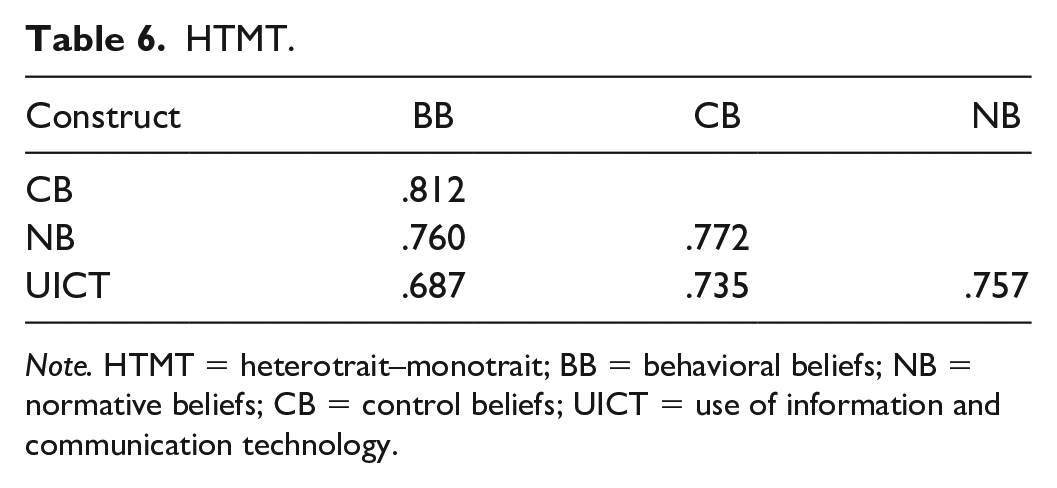
Tables 4 and 5 inform the discriminant validity values which are in accordance with Fornell–Larcker criterion and cross-loading criterion. The off-diagonal values are the relationship between the constructs and diagonal are square values of AVE. AVE values on its own construct are greater than all other construct values (Table 4). The information of cross-loading is informed in Table 5 where an indicator’s loading on its own construct is higher than its cross-loadings on other constructs. The values for HTMT are below .850 in this study and that all values are below the threshold (Table 6). Based on the results of discriminant validity procedure, the proposed model with the instruments is valid and reliable.
Fornell-Larcker Criterion.

Note. BB = behavioral beliefs; NB = normative beliefs; CB = control beliefs; UICT = use of information and communication technology.
Outer loading.

Note. BB = behavioral beliefs; NB = normative beliefs; CB = control beliefs; UICT = use of information and communication technology.
HTMT.
Note. HTMT = heterotrait–monotrait; BB = behavioral beliefs; NB = normative beliefs; CB = control beliefs; UICT = use of information and communication technology.
Assessment Model
Specifically, the sets of predictors, assessed for Collinearity for this study model, were BB, CB, and NB that affect UICT. All variance inflation factor (VIF) values are below the threshold (<3); BB → UICT (2.349), CB → UICT (2.313), NB → UICT (2.11). This information shows that the Collinearity is not an issue for this study model. Assuming a 5% significance level, all relationships informed in the structural model (Table 7) are significant. In predicting UICT, NB (β = .354) is the most significant construct followed by CB (β = .279). Finally, BB has also significant relationship to UICT (β = .166). The complete information of path coefficient (β), t value, and p value for the model is shown in Table 7.
Path Coefficient, t Value, and p Values.

Note. BB = behavioral beliefs; NB = normative beliefs; CB = control beliefs; UICT = use of information and communication technology.
The result of the coefficient determination (R2) was also informed. Based on the result, the R2 value for UICT in this model is .533 (moderate) which means that the data have the good level of predicting accuracy. All three exogenous constructs or predictors, BB, CB, and NB, have effect sizes to endogenous constructs (UICT). The value of f2 of BB → UICT is .025 (small). Similarly, for CB → UICT, the value is .072 resulting in a small effect size. NB → UICT’s value of f2 also shows a small effect size within the value of .143. Results for the predictive relevance are reported to support the model’s predictive relevance for the endogenous construct; the Q2 value of UICT is above 0 (.293).
Significance Differences Regarding UICT
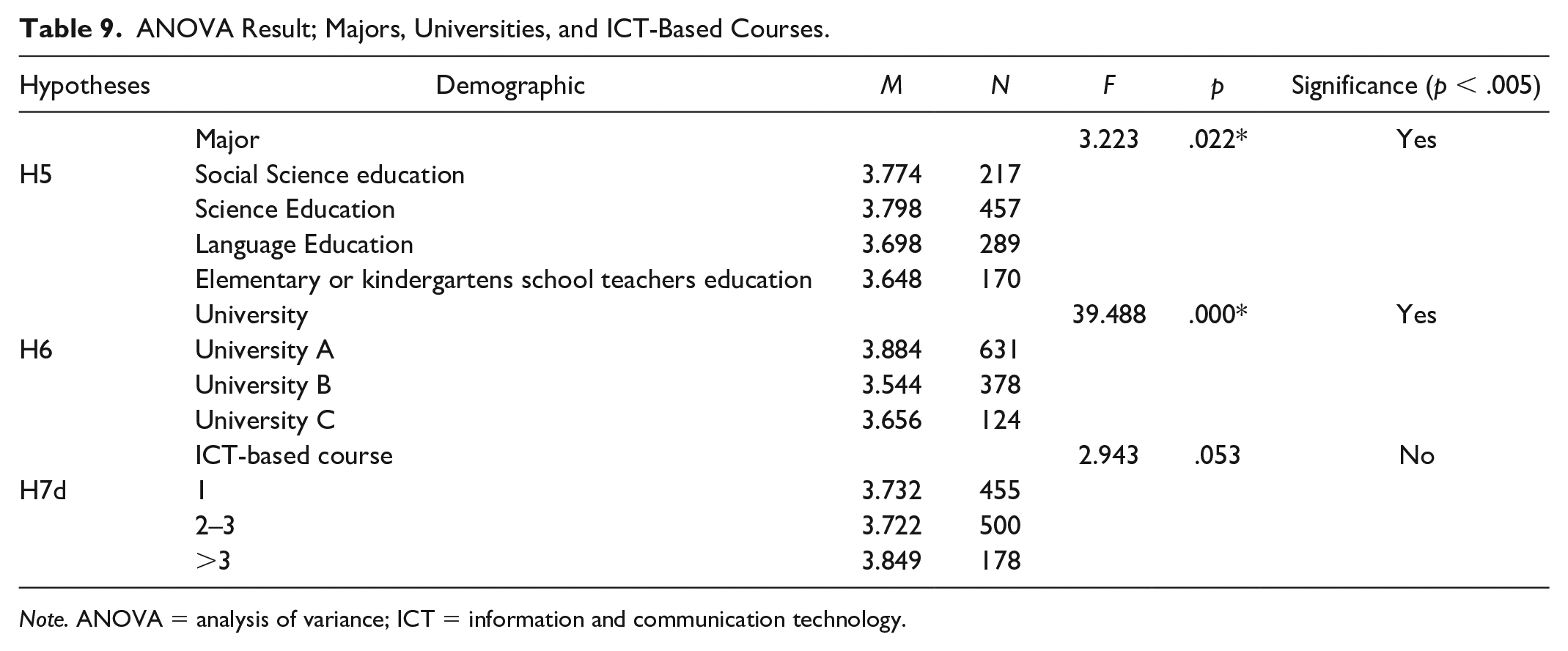
The study also investigated whether the demographic information (gender, major, university, and ICT-based courses) differs regarding UICT during teaching practices (Table 8). The t-test results showed that there is no significant difference between male and female teachers concerning UICT during teaching practices (p = .559). The results of the ANOVA test informed that there is a significant difference between majors (p = .22) and universities (p = .000) regarding UICT during teaching practices. However, it was found that there is no significant difference in ICT-based courses (p = .053). Complete information and comparison of the values across the demographic information regarding UICT during teaching practices can be seen in Tables 8 and 9.
t-Test Result; Gender.

ANOVA Result; Majors, Universities, and ICT-Based Courses.
Note. ANOVA = analysis of variance; ICT = information and communication technology.
Discussion
Model Development; Indonesian Context
Despite the rapid establishment of research conducted for factor affecting the intention or use of technology using various frameworks such as technology acceptance model, technological pedagogical and content knowledge, and unified theory of acceptance and use of technology, TPB remains to be widely applied and used that gained many empirical supports that is robust in predicting technology acceptance and use through different technologies and context (Sadaf et al., 2012). Few attempts were made to investigate the framework in the context of developing countries. Using PLS-SEM (Hair et al., 2019), we validated this study proposed model to find out whether the TPB constructs positively affected Indonesian PSTs’ use of ICT during teaching practices. Through the process, four items of UICT were dropped due to low reflective loading values; the elimination process was suggested by Hair et al. (2019). The remained items informed a valid and reliable model to measure Indonesian PSTs’ use of ICT during teaching practices.
Key Predicting Variables
The process confirmed the three main hypotheses which aimed at elaborating whether Indonesian PSTs’ use of ICT during teaching practices was affected by behavioral beliefs, normative beliefs, and control beliefs. Results showed that the three predictors positively affect the PSTs’ use of ICT during teaching practices. In predicting the PSTs’ use of ICT during teaching practices, normative beliefs which reflects subjective norm was reported to be the strongest construct followed by control beliefs and behavioral beliefs. The findings of the study confirmed the findings from previous studies reporting normative beliefs reflecting subjective norm as the strongest predictor for the intention or actual use of technology in teaching and learning process (Alzahrani et al., 2017; Valtonen et al., 2018).
Behavioral beliefs that refer to attitudes toward technology were reported to significantly affect Indonesian PSTs’ use of ICT during teaching practices. Similarly, Van Braak et al. (2004) reported that favorable attitudes emerge to strongly affect computer use in teaching. Another study by Kreijns, van Acker, Vermeulen, and van Buuren (2013) informed that attitudes have the strong correlation with behavioral intention to adopt materials of digital for teaching and learning purposes. Furthermore, Sang et al. (2010) investigated that primary teachers’ attitudes toward ICT in education reported that the participants are more willing to integrate ICT into their teaching. Finally, control beliefs which represent perceived behavioral control were also reported to be significant in affecting Indonesian PSTs’ use of ICT during teaching practices. Likewise, Teo and van Schaik (2012) also informed perceived behavioral control as the second strongest predictor after attitudes toward the use of computer. In addition, Fatima et al. (2019) also reported that perceived behavioral control positively affects the use of m-learning in tourism education.
Significance Regarding Use of ICT During Teaching Practices in Terms of Demographic Information
Besides elaborating the key predictors that affected the participants’ use of ICT during teaching practices, this study also reported a significant difference among gender on the use of ICT during teaching practices. The result informed that the teachers’ gender does not significantly affect the use of ICT during teaching practices which is similar to other previous studies (e.g., Aslan & Zhu, 2017; Celik et al., 2011; Kolodziejczyk, 2015; Pamuk & Peker, 2009). Likewise, Birgin et al. (2010) reported that the gap between genders is small in terms of computer ownership that more preservice mathematics teachers have, regardless of gender, use computers in their teaching, and learning. However, Yuen and Ma (2002) reported that there are significant differences in computer acceptance in terms of gender.
This study also investigated the differences regarding the PSTs’ use of ICT during teaching practices in terms of majors. It was found out that there are significant differences of Indonesian PSTs’ use of ICT during teaching practices in terms of majors. The results informed that the preservice science teachers’ average of mean is higher than the preservice social sciences, language, and elementary or kindergarten teachers. Moreover, the preservice social sciences teachers’ average was reported to be higher than the Indonesian preservice language and elementary or kindergarten teachers. The study by Hennessy et al. (2005) and Aslan and Zhu (2017) showed the use of ICT in terms of the major or subject. Hennessy et al. (2005) informed that their study result was more favorable for mathematics teachers, quite varied for English teachers, and less favorable for science teachers. In this respect, training is recommended to be appropriate and different for PSTs of different majors. To utilize ICT in education in an effective way, the subject curricula have to be considered.
This study also aimed at investigating whether there is a significant difference in terms of the participants’ universities regarding their use of ICT during teaching practices. This study found that there are significant differences among universities regarding the use of ICT during teaching practices. Similar results were reported by Aslan and Zhu (2017) and Yasmeen et al. (2015) who reported that infrastructure, human resources, and other factors might cause the differences. Population size and financial support should also be considered to justify the gap reported in this study regarding the use of ICT during teaching practices in terms of the participants’ universities.
The last demographic information reported from this study is the participants’ ICT-based courses. The result showed that there are no significant differences among the participants’ ICT-based course regarding the use of ICT during teaching practices. Similarly, Aslan and Zhu (2017) reported that prior experience on ICT course involvement does not positively affect the integration of ICT in Turkish schools. However, Beckers and Schmidt (2003) reported that the more experience that teachers attend ICT-based course, the better chance that they use technology into teaching.
Conclusion
The research model from this study gives a great contribution to investigating the factors affecting Indonesian PSTs’ use of ICT during teaching practices. In conclusion, the reported factors recognized as significant factors affecting the use of ICT during teaching practices are normative beliefs, control beliefs, and behavioral beliefs in which normative beliefs are found to be the strongest predictor. The results of this study have an indication that the program of teacher-training of different universities plays a significant role in facilitating Indonesian PSTs’ use of ICT during teaching practices. This study also informs that different majors should also be considered to have different certain measures in an attempt to foster PSTs’ competence in using or integrating ICT during their teaching practices. The research model for Indonesian context benefits future studies addressing the influencing factors with regard to the integration of ICT into teaching practices in the context of developing country. The model could also be replicated for in-service teachers of developing countries to further validate the results of this study.
This study is limited to 1,333 Indonesian PSTs from three universities of four majors of education: science, social science, language, and elementary or kindergarten teachers. PSTs studying in their fourth year, from the subject areas of Turkish language, social sciences, elementary mathematics, and science in six state universities. For better understanding the technology integration phenomenon in developing countries, the number of universities, the size of population, and the variety of majors, as well as other demographic factors, are recommended to extend for the future studies of technology integration. In future studies, interviews and observations are also encouraged to conduct to help understand teachers’ use of technology. Other new or established frameworks should also be applied in the research regarding technology integration with a variety of technological devices.
Footnotes
Acknowledgements
We thank the experts who provided insight and expertise that greatly assisted the development of the instrument of this study. We would also like to show our gratitude to all participants in this study for their time and effort.
Declaration of Conflicting Interests
The author(s) declared no potential conflicts of interest with respect to the research, authorship, and/or publication of this article.
Funding
The author(s) disclosed receipt of the following financial support for the research and/or authorship of this article: This study was supported by Universitas Jambi, Jambi, Indonesia.
