



Abstract
An understanding of the overall relationship between the work-related use of information and communication technology (ICT) and employees’ well-being is lacking as the rising number of studies has produced mixed results. We meta-analytically synthesize and integrate existing literature on the consequences of ICT use based on the job demands-resources model. By using meta-analytical structural equation modeling based on 63 independent studies (N = 26,295), we shed light on the relationship between ICT use and employees’ well-being (operationalized as burnout and engagement) in a model that incorporates the mediating role of ICT-related resources and demands. Results show that ICT use is opposingly related to burnout and engagement through autonomy, availability, and work-life conflict. Our study brings clarity into the contradictory results and highlights the importance of a simultaneous consideration of both positive and negative effects for a comprehensive understanding of the relationship. We further show that the time of use and managerial position, and methodological moderators can clarify heterogeneity in previous results.
Introduction
According to statistics of the International Telecommunication Union (ITU), global usage of information and communication technology (ICT)—indicated by individuals using the Internet, fixed-broadband, and mobile-broadband subscription—increased by almost 200% from 2007 to 2017 (International Telecommunication Union, 2009, 2017). The Corona crisis has further accelerated the development toward remote work and emphasized the importance of keeping pace with digitalization for a company’s success. ICT generally refers to all technological devices, networking components, applications, and systems that enable people to interact with each other (Steinmueller, 2000). Using ICT includes e-mails, texts, phone calls, video conferences, and particularly smartphones (Wright et al., 2014). The increasing use of ICT for work purposes changes how employees are connected as they can exchange information more quickly and more frequently. This intensified connectivity comes along with both advantages and disadvantages.
In light of the growing relevance of ICT for organizations and the accompanying changes in employees’ everyday work life, many studies have explored the relationship between intensified ICT use and employees’ well-being and related psychological processes. These studies have revealed mixed findings. A series of studies have indicated a positive relationship between ICT use and positive well-being indicators such as satisfaction, engagement, and commitment (e.g., Diaz et al., 2012; Ter Hoeven & van Zoonen, 2015). Other studies could not find any relationship with such positive outcomes (e.g., Ohly & Latour, 2014; Piszczek, 2017; van Zoonen et al., 2017) or even reported a negative relationship (e.g., Lanaj et al., 2014; Wright et al., 2014). Yet again, other studies supported an association of ICT use and negative indicators of well-being such as strain or exhaustion (e.g., Day et al., 2012; Park et al., 2018) and burnout (e.g., Aghaz & Sheikh, 2016; Beas & Salanova, 2006). Accordingly, the overall effect of ICT use on well-being remains unclear as qualitative and quantitative literature reviews on this topic are missing.
To shed light on this ongoing debate, this study aims to reconcile these contradictory empirical results by meta-analytically structuring and synthesizing findings of previous studies. In particular, we address two possible sources for these mixed results: (1) an isolated view on either positive or negative effects of ICT use with regard to the considered indicators of well-being, resources, and demands (Diener & Larsen, 1993; Ter Hoeven et al., 2016) and (2) differences in the studies’ contexts regarding when and by whom ICT was used (Boswell & Olson-Buchanan, 2007; Derks et al., 2016).
First, many empirical studies have focused on either positive relations or negative relations between ICT use and employees’ well-being. In line with Mäkikangas et al. (2016), we argue that simultaneously considering positive and negative well-being indicators is necessary to enable a holistic view. This is particularly relevant in the present context, as research has shown that ICT use is related to both resources (e.g., Mazmanian et al., 2013) and demands (e.g., Chesley, 2014; Fonner & Roloff, 2012 ). Thus, it can have opposing effects on well-being (Day et al., 2010; Diaz et al., 2012; Ter Hoeven et al., 2016).
While there is consensus that the use of ICT has a meaningful impact on employees, there is no overarching theory of its consequences (Gajendran et al., 2015). However, in practice and science, three significant ICT-related consequences, which have a far-reaching influence on employees’ well-being, are discussed. On the one hand, ICT enables employees to decide more autonomously when and where to work, which is associated with higher work engagement (e.g., Diaz et al., 2012; Ter Hoeven & van Zoonen, 2015; Turel et al., 2011). On the other hand, ICT use comes along with the possibility to be constantly connected. Thus, employees easily feel that they always have to be available, even after work hours, and the boundaries between work and private life blur, which is associated with exhaustion or even burnout (Aghaz & Sheikh, 2016; Beas & Salanova, 2006). To integrate both the negative and positive relations between ICT use and well-being, we draw on the differentiated job demands-resources model (JD-R) (Crawford et al., 2010). The model proposes that demands and resources are connected to employee engagement and burnout (i.e., positive and negative well-being indicators). According to the three main themes related to work-related ICT use elaborated above, we include autonomy as a resource and perceived availability and work-life conflict as demands in our model.
Second, we explore possible moderators as reasons for former mixed findings. As variances between studies can be due to differences in study settings (Wu et al., 2018), we study contexts regarding when and by whom ICT was used, and how ICT use was measured as possible moderators to clarify heterogeneity. In particular, the time of use (during or after work hours) and the managerial position of the respondent (manager or non-manager) are significant factors that can influence the impact of ICT use on employee well-being.
Taken together, this study aims to clarify two fundamental questions. First, how is work-related ICT use related to well-being considering indirect effects through resources and demands? Second, to what extent do conditions influence the magnitude of a positive or a negative relationship? To answer these research questions, this study meta-analytically integrates empirical findings from 63 studies (N = 26,295) (Borenstein et al., 2009; Cheung & Chan, 2005; Cooper et al., 2009). Therefore, a meta-analytical structural equation model (MASEM) was applied, which allows testing models that have not yet been investigated in primary studies. To test research question two, moderator analyses of content-related and methodological characteristics of primary studies were conducted (Eisend, 2020).
In the context of ICT use, best to our knowledge, only one meta-analysis by Karimikia and Singh (2019) exists, yet, with a narrow focus on the mediating role of the resource autonomy for the relationship between ICT use and burnout. With our study, we extend the findings of this meta-analysis and contribute to research in three important ways. First, we synthesize research examining the relationship of ICT use and well-being from differing perspectives through the lens of the differentiated JD-R model. With this, we contribute to understanding underlying effects by offering a higher-order classification of ICT-related consequences in resources and demands. Second, based on a more holistic view, we show that ICT use is indirectly related to well-being through motivational and energy-draining processes that counteract each other. Third, by testing time of ICT use and managerial position as moderators, we closely look at differences in study contexts as a possible explanation for the mixed findings and thereby provide promising avenues for further research.
Theoretical Background
The JD-R Model as Conceptual Framework
The differentiated JD-R model (Crawford et al., 2010) extends the JD-R model (Demerouti et al., 2001), which assumes that well-being is related to different job characteristics. This makes the model applicable across different jobs and organizational settings (Bakker & Demerouti, 2007). Job characteristics can be categorized into two general groups: job demands and job resources (Demerouti et al., 2001). Job demands comprehend physical, social, or organizational aspects of a job that are coherent with specific physiological and psychological costs (e.g., exhaustion or cynism) as they necessitate constant physical or mental effort or skills. Examples include work pressure, emotionally demanding tasks, and work-life conflict (Bakker & Demerouti, 2007, 2017). The other group, job resources, relates to those physical, social, or organizational aspects of a job that help to achieve work goals, decrease physiological and psychological costs, or encourage personal growth, learning, and development such as autonomy or supervisor and coworker support (Demerouti et al., 2001).
According to the JD-R model, these demands and resources induce two psychological processes related to well-being: a health-impairment process and a motivational process. Job demands are the main predictors of the health impairment process (Bakker & Demerouti, 2014; Bakker et al., 2005). Demanding aspects cause individuals to take performance-protection strategies (Hockey, 1993). These cost efforts and, as a long-term consequence, exhaust individuals leading to strain, exhaustion, and burnout (Bakker & Demerouti, 2007; Demerouti et al., 2001; Leiter, 2017). In contrast, job resources are the most important predictors of the motivational process (Bakker & Demerouti, 2007, 2014). By fulfilling basic human needs (e.g., autonomy, competence, and relatedness), job resources can enhance motivation, work enjoyment, and engagement (Bakker & Demerouti, 2007, 2014; Deci & Ryan, 1985).
Following a holistic view, burnout and engagement, as related but separate constructs, are indicators of well-being (Bakker et al., 2010; Mäkikangas et al., 2016; Schaufeli & Bakker, 2004). Engagement can be defined as a “positive, fulfilling, work-related state of mind that is characterized by vigor, dedication, and absorption” (Schaufeli et al., 2002). As follows, engagement goes along with fulfillment, high energy, and strong identification with one’s work (Bakker et al., 2014). In contrast, we refer to burnout as the negative indicator of well-being. Burnout is a state of mental and physical exhaustion characterized by emotional exhaustion, cynicism, and decreased efficacy (Maslach et al., 1986).
The differentiated JD-R model by Crawford et al. (2010) extends the original JD-R model by proposing additional relationships: between resources and burnout as well as between demands and engagement. Even though these cross-relationships are relatively weaker, they should not be neglected, as Crawford et al. (2010) found meta-analytic support for their extended model. Regarding resources, they show that besides being associated with increased engagement, resources have a negative relationship to burnout. According to Hobfoll’s (1989) conservation of resources theory, the loss of or threat of loss of resources is related to strain as fewer resources imply fewer coping capabilities (Crawford et al., 2010). This strain over time will lead to burnout (Hobfoll & Freedy, 1993).
Demands, in turn, are proposed to be related to engagement next to increased burnout (Crawford et al., 2010). The direction of the relationship between demands and engagement is dependent on the type of demand. Two groups of demands can be distinguished: challenge demands and hindrance demands (Cavanaugh et al., 2000; Lazarus & Folkman, 1984; O’Brien & Beehr, 2019). Demands that are perceived as pressure-laden but at the same time are associated with potential gains which can bring rewarding work experience are called challenge demands (e.g., high workload, time pressure) (Cavanaugh et al., 2000; Crawford et al., 2010; Lazarus & Folkman, 1984). Because of their potential to bring gains, challenge demands evoke positive emotions and an active, problem-oriented approach to solve problems (Crawford et al., 2010; Kahn, 1990; Lazarus & Folkman, 1984). In contrast, demands, such as role conflict that are perceived as pressure-laden and at the same time hinder employees from reaching their goals are called hindrance demands (Cavanaugh et al., 2000; Crawford et al., 2010; Lazarus & Folkman, 1984). Because of their potential to hinder employees from reaching their goals, the feeling of being unable to cope with as well as the associated waste of energy for dealing with such demands, hindrance demands evoke negative emotions and a passive, emotion-oriented approach to solve problems (Crawford et al., 2010; Kahn, 1990). Challenging demands are positively related to engagement, while hindrance demands are negatively related to engagement (Crawford et al., 2010).
ICT-Related Resources and Demands
A variety of consequences of ICT use on employees’ well-being have been discussed in previous studies (Ninaus et al., 2015; Patel et al., 2012). However, three consequences—autonomy, perceived availability, and work-life conflict—reflect central themes, of which one or more have been frequently highlighted in primary studies examining psychological processes and well-being associated with ICT use (Büchler et al., 2020; Wang et al., 2020; Zhang, Zhang et al., 2019). Accordingly, these consequences build the central ICT-related resources and demands of our framework. Further conceptual support for our framework, particularly for the central role of autonomy, work-family conflict, and perceived availability, is based on several key theoretical approaches from previous work (e.g., boundary theory; Andrade & Matias, 2021; Ashforth et al., 2000; self-determination theory; Ďuranová & Ohly, 2016). We thus provide, based on the JD-R model, a framework that integrates key intervening mechanisms of ICT use. Figure 1 illustrates our conceptual model.

Conceptual research model.
Hypothesis Development
The Relationships Between ICT Use, Demands and Resources, and Well-Being
The first theme, autonomy, reflects an employee’s “ability to exercise a degree of control over the content, timing, location, and performance of activities” (Mazmanian et al., 2013, p. 1). The use of ICT can be associated with increased autonomy as it enables employees to stay connected irrespective of their geographical location (Gajendran et al., 2015). As part of this development, employees often no longer need to be in the office at certain times but must complete certain tasks. This leaves them free to decide when and where they work on these tasks (Gajendran et al., 2015). Consequently, employees can structure their workdays more flexibly and adjust them to their individual preferences (Derks et al., 2016).
Autonomy has been suggested as a valuable job resource and a significant driver for engagement (Gajendran et al., 2015; Mauno et al., 2007). Greater autonomy implicates more control for employees to act upon their own decisions, for example, where, when, and how they want to work (Ter Hoeven & van Zoonen, 2015). Besides, autonomy can be associated with decreased burnout. Autonomy allows employees to decide how to handle stressful situations (Karasek, 1979). Further, it provides employees with the resources to structure their work according to their preferences and needs and thus can be associated with reduced strain (Bakker & Demerouti, 2007). In the lens of the JD-R model, autonomy acts as a resource and, as such, can enhance well-being, that is, is positively related to engagement and negatively to burnout.
Besides providing employees with resources, research has shown that ICT use can also accompany demands (Day et al., 2012; Park et al., 2018). The second psychological consequence of increased ICT use studied in this article is perceived availability. Perceived availability is an employee’s expectation of being accessible for others anywhere and anytime during work (Bergman & Gardiner, 2007) and even after work hours (Day et al., 2012). Wireless and transportable ICT devices enable work irrespective of place and time (Porter & Kakabadse, 2006). Consequently, using ICT facilitates employees to be more accessible for coworkers and supervisors during work hours (Porter & Kakabadse, 2006). At the same time, employees may feel obliged to be available even after work hours.
In the following, we argue that perceived availability represents a challenge demand as it is related to employees’ well-being in two opposing ways. On the one hand, permanent availability may result in some feeling of always being in the work environment (Middleton, 2007) and information overload, as workers feel overpowered by the around-the-clock accessibility via telephone and e-mail (Kolb et al., 2008). This can result in adverse outcomes, such as fatigue and negative mood (Day et al., 2012; Ohly & Latour, 2014). Hence, the challenges that perceived availability poses on employees can lead to a depletion of employees’ energy (Derks & Bakker, 2014) and, as a long-term consequence to burnout (Bakker & Demerouti, 2007).
On the other hand, even though constant availability is mostly negatively associated, increased perceived availability can also be helpful for employees (Dery & Maccormick, 2012). Some studies show that using ICT can, for example, save time and enhance communication (Ter Hoeven et al., 2016). This potential to bring gains can lead to an active problem-solving coping style and higher work engagement (Crawford et al., 2010; Kahn, 1990; Lazarus & Folkman, 1984). This argumentation is supported by findings of a meta-analysis by Zhang, Zhang et al. (2019), who found evidence for a positive relationship between challenge stressors and promotion-focused coping, resulting in increased psychological well-being.
These relationships make the construct comparable to other demands that are classified as challenging (e.g., workload, job responsibility, and time urgency; Crawford et al., 2010; job complexity; Tadić et al., 2015). As follows, we argue that perceived availability in the lens of the differentiated JD-R model is a challenging demand and, as such, is positively related to burnout and engagement.
The second demand in the context of ICT use and increased connectivity we want to address with this study is work-life conflict. Work-life conflict can be described as an inter-role conflict where role demands of work interfere with meeting demands of a role in life (Greenhaus & Beutell, 1985; Olson-Buchanan & Boswell, 2006). Through the possibility to stay connected through ICT, boundaries between work and nonwork domains become blurred and different roles of an individual more ambiguous and difficult to separate (Derks et al., 2015; Turel et al., 2011). In other words, the rise of ICT use results in a reduction of work-life segmentation (Diaz et al., 2012), in an imbalance of work and family life (Derks et al., 2015), rising work hours (Day et al., 2012) and, finally, in increasing work-life conflict (Turel et al., 2011).
Research has shown that most employees have problems handling permeable boundaries and managing different domains of life (Derks et al., 2016). The intrusion of work into private life can keep employees from mentally detaching from work and reenergizing (Diaz et al., 2012; Sonnentag et al., 2008). Following the argumentation of the JD-R model, this costs employees energy and can result in burnout (Demerouti et al., 2001). In addition, if employees cannot disengage and recover from work or work interrupts their leisure activities and private life, work engagement can decrease (Fonner & Roloff, 2012; Kossek & Lautsch, 2012; Mazmanian et al., 2013). This is because the feeling of not being able to cope with the lack of separation of the different roles can bring negative emotions and evoke a passive problem-solving style (Crawford et al., 2010; Kahn, 1990). As a consequence, employees may be less willing to engage at work. Work-life conflict can therefore be considered a hindrance demand and so is positively associated with burnout and negatively with engagement.
Time of Use and Managerial Position as Moderators
According to the JD-R model, job demands, and resources are specific to context and situation (Bakker & Demerouti, 2014). Correspondingly, the ambivalent consequences of ICT use suggest that effects vary between contexts or situations as different findings often point toward additional influences distorting the results. An important situational factor, which is implicitly or explicitly discussed in many former studies, is what we call time of ICT use: the use of work-related during vs. after working hours. The time of ICT use is associated with different functions, challenges, and opportunities of ICT use. Studies that look at use during working hours focus primarily on communication challenges between employees (e.g., Ter Hoeven et al., 2016; van Zoonen et al., 2017). Studies that consider use outside working hours focus on challenges related to boundary management (e.g., Boswell & Olson-Buchanan, 2007; Derks et al., 2016). Such studies found that harmful relations of ICT use are especially pronounced if ICT is used after regular work hours (Boswell & Olson-Buchanan, 2007; Derks, van Mierlo et al., 2014; Piszczek, 2017). For example, a late message or phone call can distract from ongoing family activities. This can relate to higher perceptions of work-life conflict and perceived availability. Concurrently, positive ICT use relations, to autonomy, are weakened when ICT is used after work hours. This line of reasoning may also be applied to the relationships between resources and demands with engagement and burnout. In this regard, studies, for example, found that work-related ICT use after work hours can keep employees from successfully engaging in recovery activities (Derks, Ten Brummelhuis et al., 2014) that are important for well-being (Sonnentag, 2001). In a nutshell, we propose that time of use shapes the relationship between ICT use and resources respectively demands and affects the relationships between resources and demands with engagement and burnout.
Research, which is based on the theoretical rationale of the JD-R model, provides evidence that the hierarchical position shapes the relationship of job characteristics and well-being (Giauque et al., 2013; Lundqvist et al., 2013). Concretely, it can be assumed that the hierarchical position influences the emergence of resources and demands as well as their consequences for well-being (Bakker & Demerouti, 2017). In this vein, a study by Lundqvist et al. (2013) found considerable differences between working conditions and burnout between managers and subordinates. In the context of ICT use, Gerten et al. (2019) have found that ICT use is only related to increased work autonomy for managers but not for non-managers. Due to higher power to manage aspects in their job and higher expectations regarding workloads (Boswell & Olson-Buchanan, 2007), managerial employees may more efficiently utilize the positive effects of ICT use and better safeguard themselves from negative consequences compared to non-managers. This means that positive relationships between ICT use and resources, here autonomy, are stronger for managers than non-managers. Respectively, managers may be less vulnerable to demands that accompany ICT use, implying that negative relationships between ICT use and demands, here perceived availability and work-life conflict, are weaker for managers. At the same time, managerial employees may more easily take advantage of positive effects of resources on their well-being, while negative effects of demands on employees’ well-being may be less pronounced. For example, autonomy is a more critical resource for the fulfillment of management tasks compared to tasks of non-managers. At the same time, managers expect greater availability due to their position and perceive it proportionately less exhausting.
Meta-analytic Procedure
Study Identification
This analysis aimed to aggregate all studies that investigate the relationship between ICT use and employees’ well-being. To systematically identify relevant studies, we followed the PRISMA statement (Moher et al., 2009). The search was conducted in November 2019. Two search strategies were applied. First, we searched the databases “EbscoHost,” “Social Sciences Research Network,” and complementary “Google Scholar” for potential primary studies. We used the following and related search terms using the Boolean operator “AND” to link “information communication technology” or “ICT” to “job demands-resources,” “connectivity,” “availability,” “satisfaction,” “engagement,” “commitment,” “autonomy,” “job stress,” “emotional exhaustion,” “burnout,” “technostress” and “work-life conflict.” We explicitly also included gray literature. Further, we conducted a backward search by screening the bibliographies of the already included studies to detect additional literature. After a first practical screen, 10,467 records were identified in this procedure.
We screened title, abstract and full text to identify relevant eligible studies. To be included, a study had to fulfill several criteria: (1) the study needed to compromise a correlation coefficient and the sample size, (2) the study needed to discuss some kind of work-related ICT use, and (3) the study needed to report an influence on a considered outcome. This implies that studies that examined non-work-related ICT use, for example, cyber-loafing (Askew et al., 2014), were excluded. We contacted the authors in case of missing information in studies (e.g., missing correlation table). For one article (Lanaj et al., 2014), for which only within-person correlations were reported, the authors kindly provided us with the between-person correlations.
We evaluated variables based on how they were defined and measured, not their label, for example, “work-home interference” (Derks et al., 2015) was coded as work-life conflict. This approach is advantageous as it proves a more coherent sample because the analysis is not dependent on the initial name of a specific variable. After excluding records, the final sample composes 60 articles with 63 studies. Figure 2 depicts the flow chart.

PRISMA flow chart of study search and selection process.
Coding
The coding was conducted following Cooper et al. (2009) and Borenstein et al. (2009). To ensure reliability of coding, all studies were examined by at least two independent, trained coders. In a first step, we created an initial codebook, which was then applied to categorize variables into groups. The codebook was continuously adapted during the process due to the appearance of other relevant variables while coding. In a final step, we reexamined our classification and adjusted all codes. Discrepancies in coding were solved by discussion until consensus was reached.
Studies were coded by firstly recording general information, such as the authors’ names, the year of the study conduct, country, and publication form. Secondly, we coded the sample sizes and effect sizes. Thirdly, potential moderator variables were added, including the time of ICT use, the managerial position, and additionally methodological moderators. The time of ICT use was differentiated in ICT use during work hours and ICT use during non-work hours. The moderator managerial position was differentiated into two subgroups: managerial and non-managerial. A study was coded as “managers” if more than 50% of the participants had a managerial position and “non-managers” if less than 50% had a managerial position.
We coded the methodological moderators study design (longitudinal vs. cross-sectional), whether a study examined ICT use as the use of the technology itself (e.g., smartphones, laptops) or as the use of a function (e.g., e-mails, calls), the measurement of ICT use in form of scales or concrete time data (e.g., average time of use, average number of incoming calls) as well as the reference value in ICT use (extent, amount, and frequency). If a study did not provide sufficient information to code a moderator, the moderator was coded as not applicable. For a more in-depth overview of the meta-analytic sample, see Table S1 in the Supplemental Material.
Meta-analyses often face the issue of multiple relevant correlations within a single study. We took several measures to avoid potentially biased results that could result from including more than one correlation of a single study. If a study reported different measures of ICT or different sub-dimensions of a specific outcome (e.g., burnout was often measured based on strain, exhaustion, strain, or cynism), we calculated an average effect size and included a single estimate in the study. Additionally, if a study reported correlation data based on two separate samples, we considered these correlations as independent and thus included both separately (Hedges & Olkin, 1985; Hunter & Schmidt, 2004). From the 63 studies, 182 effect sizes were extracted with a total sample size of 26,295.
Data Analysis
To test hypotheses 1a,b, 2a,b, and 3a,b, we followed the meta-analytical methodology as recommended by Borenstein et al. (2009) and Cooper et al. (2009) to obtain summary effects in a first step and a second step performed meta-analytic structural equation model (MASEM) (Cheung & Chan, 2005). Beforehand, correlations were transformed into Fisher’s z-values to minimize biases in the distribution of effect sizes (Cooper et al., 2009; Lipsey & Wilson, 2001). For the interpretation of the results, the z-values were converted back to Pearson’s r again.
We employed a random-effects model, which assumes true differences between studies that are not due to sampling error. In contrast to a fixed-effects model, the model does therefore include not only the “within-study-error” but also the “between-study-error.” This is more realistic as it considers that researchers have included factors and assumptions in their research design that are not identical to each other due to their different contexts. The computations for the meta-analysis were conducted with the statistic software R using the metaphor package. The model was fitted with a restricted maximum-likelihood estimator (REML). According to Borenstein et al. (2009) formulas, summary effects, and variances were computed. To obtain the overall effect size, each study was weighted with the inverse of its variance. Besides, we calculated 95%-confidence intervals. To further account for heterogeneity between studies, Q and I² statistics were computed. The Q statistic is a test of significance for the existence of heterogeneity. The I² statistic measures the proportion of “true variance,” meaning the variance that is based on true differences between effect sizes to the total variance. Significant results of the Q statistic and high values of the I² statistic indicate remaining unexplained variance in the model.
As recommended by Cooper et al. (2009), we examined the data for outliers. The identification and elimination of outliers is rather problematic, which is why we only excluded the most extreme outliers identified by various diagnostic measures (e.g., externally standardized residuals, DFFITS values, Cook’s distance, etc.). We further conducted a sensitivity analysis to test for possibly biased results due to publication bias (Borenstein et al., 2009). Publication bias was assessed by using the Fail-safe N, Egger’s Test (Egger et al., 1997), and the Trim and Fill method (Duval & Tweedie, 2000). All tests analyze whether a publication bias influences the results or not; the Trim and Fill method additionally remedies the bias and computes new values.
To test for indirect effects between ICT use and burnout and engagement through job demands and resources, we conducted MASEM. The MASEM was estimated in two steps: First, individual meta-analyses for each outcome variable and between the outcome variables were conducted to receive a pooled correlation matrix as described above. In a second step, the obtained matrix was used to analyze the relationships between the constructs (Cheung & Chan, 2005). The harmonic mean was used to compute the average sample size as it is a more conservative estimate than the arithmetic mean (Viswesvaran & Ones, 1995). The indirect effects were tested by applying Monte Carlo simulation, which is especially useful when only summary data are available (Preacher & Selig, 2012). Next to χ², Root Mean Squared Error of Approximation (RMSEA), and Comparative Fit Index (CFI) are reported to analyze the model fit.
Hypotheses 4 and 5 were tested by conducting a moderator analysis. Therefore, we included the time of use and managerial position as categorical moderators and performed subgroup analyses. Significant p-values of Qbetween indicate that the moderator can explain heterogeneity. We further report R2 (the percentage of heterogeneity accounted for) and I2 (the proportion of residual heterogeneity to unaccounted variability) (Borenstein et al., 2009). The same analysis was applied to test the additional methodological moderators.
Results
Meta-Analytic Correlations
Before conducting MASEM to test the indirect effects of ICT use through ICT-related resources and demands on engagement and burnout, we calculated individual meta-analyses for the single relations. Overall, ICT use is positively related to engagement (r = .16, p < .001) and also to burnout (r = .06, p < .05). With respect to the hypothesized relationships, the results show significant positive summary effects between ICT use and the demands perceived availability (r = .29, p < .001) and work-life conflict (r = .23, p < .001). The summary effect between ICT use and the resource autonomy is not significant (r = .05, p = .14). Autonomy is positively correlated with engagement (r = .33, p < .001) and negatively with burnout (r = −.12, p < .001). Besides, we find a positive summary effect for the relation between perceived availability and engagement (r = .18, p < .01), while the summary effect for the relation between perceived availability and burnout is not significant (r = −.01, p = .82). Work-life conflict is not significantly related to engagement (r = .01, p = .92) but positively related to burnout (r = .44, p < .001). The results are depicted in Table 1. To provide a comprehensive meta-analytic picture on the JD-R model in the context of ICT use, all relationships are reported.
Results of Meta-Analyses.
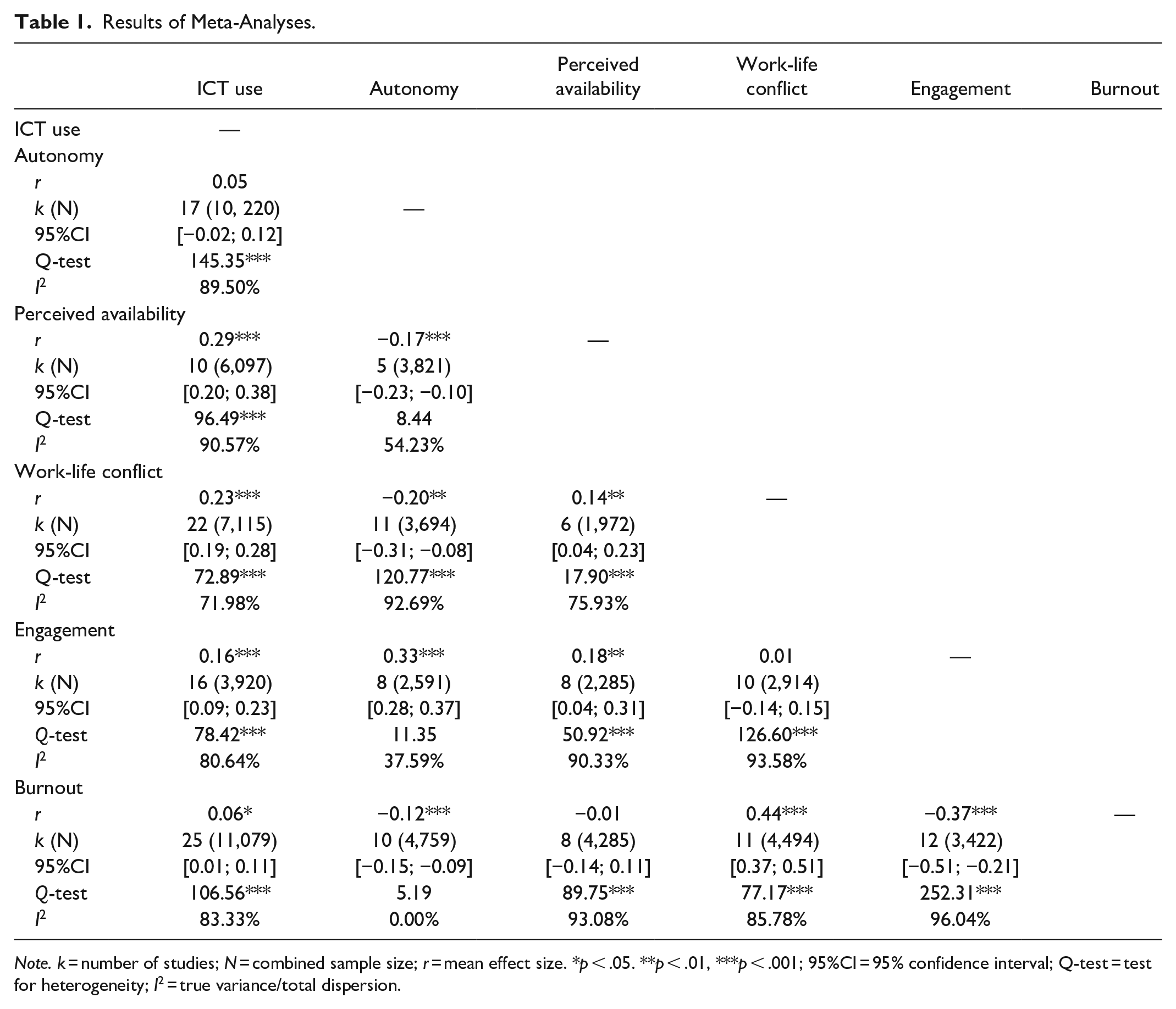
Note. k = number of studies; N = combined sample size; r = mean effect size. *p < .05. **p < .01, ***p < .001; 95%CI = 95% confidence interval; Q-test = test for heterogeneity; I2 = true variance/total dispersion.
Sensitivity Analyses
The sensitivity analyses show that the results are quite robust. The Egger regression test does not report a significant level of asymmetry for any relationship. Besides, the Fail-safe N analysis results indicate that for all significant relationships, a large number of studies would be required for the results not being significant at the 95% confidence level. The results of the Trim and Fill analysis also support that results are robust. Even though the Trim and Fill analysis suggests that for some relationships, some studies would need to be added to obtain unbiased effect sizes, the resulting new effect sizes are similar to those obtained without the correction. Detailed results can be found in Table 2.
Results of Sensitivity Analyses.
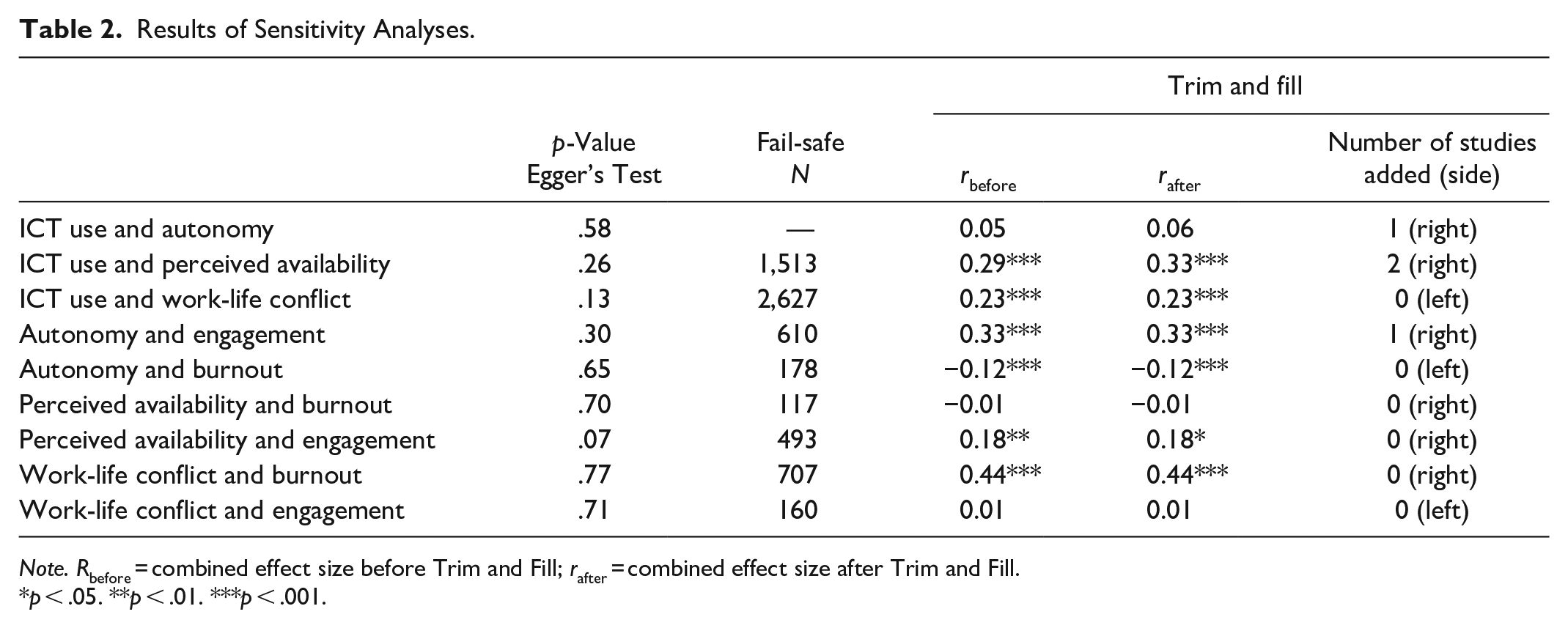
Note. Rbefore = combined effect size before Trim and Fill; rafter = combined effect size after Trim and Fill.
p < .05. **p < .01. ***p < .001.
Meta-analytic Structural Equation Modeling and Hypotheses Testing
We tested for indirect effects between ICT use and engagement respectively burnout through ICT-related resources and demands by conducting MASEM with the program AMOS. Fit indices show that the measurement model has a good fit to the data (χ²(2) = 17.28; CFI = .996; RMSEA = .05). Results of the MASEM are presented in Figure 3. Generally, the results of the MASEM are similar to those of the individual meta-analyses. Results show significant relationships between ICT use and the job demands perceived availability (β = .29, p < .001) and work-life conflict (β = .23, p < .001). The relationship between ICT use and the resource autonomy is positive and significant (β = .05, p < .01). The results of MASEM report a significant positive effect for the relationship between autonomy and engagement (β = .37, p < .001) and a significant negative relationship for autonomy and burnout (β = −.04, p < .01). The path analysis further shows that availability is negatively linked to burnout (β = −.09, p < .001) and positively to engagement (β = .24, p < .001). Work-life conflict has significant positive relationships to burnout (β = .45, p < .001) and engagement (β = .05, p < .001) in the path analysis.

Results of MASEM. *p < .05. **p < .01. ***p < .001.
In hypotheses 1 to 3, we proposed that ICT use is indirectly related to burnout and engagement through job demands and resources. Table 3 depicts the results of the proposed indirect effects. Hypothesis 1a suggested a positive indirect relationship between ICT use and engagement through autonomy. As the effect is significant (β = .02, p < .01), hypothesis 1a can be supported. Hypothesis 1b, which proposed a negative indirect effect between ICT use and burnout, can also be confirmed. However, the relationship shows a very small negative effect close to zero (β = −.002, p < .01). Hypothesis 2a proposed that availability positively mediates the relationship between ICT use and burnout. Other than expected, results show a significant negative effect (β = −.03, p < .01). Thus, hypothesis 2a cannot be supported. The positive relationship between ICT use and engagement through availability proposed in hypothesis 2b can be confirmed as the results show a significant positive effect (β = .07, p < .01). Hypothesis 3a, which suggested a positive indirect effect between ICT use and burnout through work-life conflict, can be confirmed as we found a significant positive effect (β = .11, p < .001). The hypothesized negative indirect effect between ICT use and engagement through work-life conflict (hypothesis 3b) cannot be confirmed as results show a significant positive effect (β = .01, p < .001).
Results of Tests for Indirect Effects.
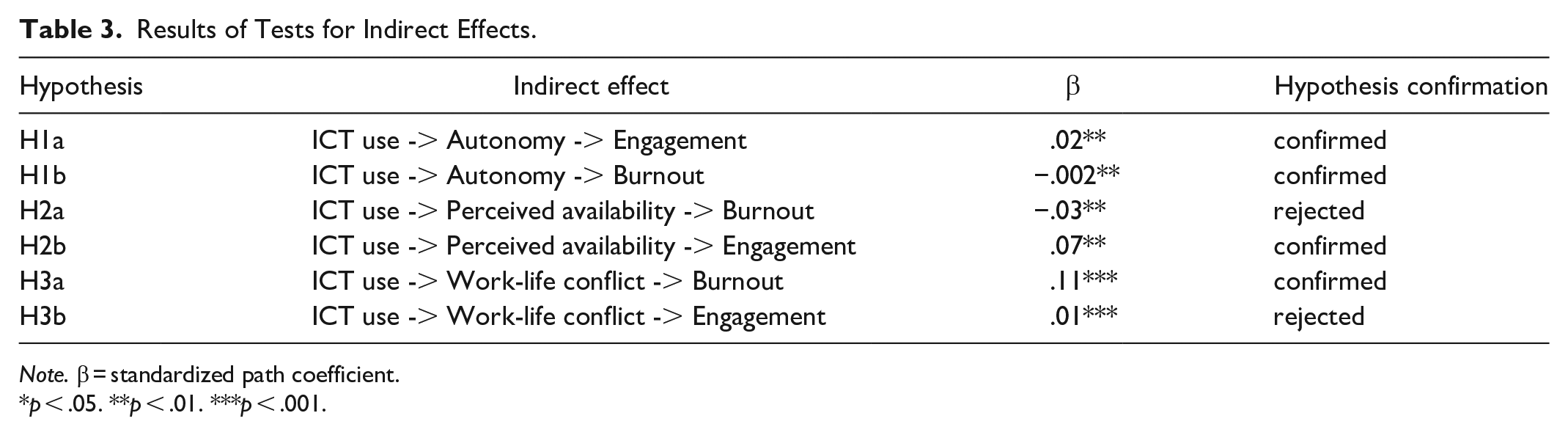
Note. β = standardized path coefficient.
p < .05. **p < .01. ***p < .001.
Moderator Analyses
As shown in Table 1, the tests for heterogeneity report Q-values that are statistically significantly different from zero (p < .001) for all relationships in focus (except for the relationships between autonomy and engagement and autonomy and burnout). This result indicates that the variance is not based on sampling issues but on systematic variance. The high I²-values point toward large amounts of heterogeneity. These findings show that additional influences exist that cause the remaining variance in these relationships (Hedges & Olkin, 1985). To investigate how the observed heterogeneity can be explained, we tested whether the time of use and managerial position serve as moderators as proposed in hypotheses 4 and 5. The results are depicted in Table 4. While the moderators fail to show significant results for most relationships, they can account for part of the heterogeneity (see R2 Table 3). Yet, in most cases, a large amount of unexplained heterogeneity (see I2 Table 4) remains.
Results of Conceptual Moderator Analyses.

Note. r = combined effect size. *p < .05, **p < .01, ***p < .001; Qbetween = test of moderator; R2 = amount of heterogeneity accounted for; I2 = residual heterogeneity/unaccounted variability.
The time of ICT use (during work hours vs. during non-work hours) shows significant differences for three relationships. We found a significantly stronger effect for the relationships between ICT use and availability (p < .05, R2 = 31.63%) as well as between ICT use and work-life conflict (p < .01, R2 = 43.43%) when the ICT use during non-work hours was examined (p < .05, R2 = 100%). Similar results are reported for the relationship between perceived availability and burnout. Also, for this relationship the effect of ICT use during non-work hours is stronger (p < .001, R2 = 85.56%). Generally, these results align with hypothesis 4, which suggested that negative effects intensify when ICT is used after work hours.
Concerning the moderator analysis of the managerial position (manager vs. non-managers), the results show significant moderating effects for two relationships. We find that the relationship between ICT use and autonomy is stronger for managers (p < .05, R2 = 39.38%). The overall correlation between autonomy and engagement is stronger for non-managers (p < .01, R2 = 100%). However, this result should be treated with caution as the summary effects for each subgroup are based only on a small number of studies. Overall, the ambiguous results do not fully support hypothesis 5, which suggests that negative effects are weaker and positive effects stronger for samples consisting mainly of managers.
In addition, we tested the methodological moderators study design (i.e., longitudinal vs. cross-sectional studies), understanding of ICT use as the use of technology (e.g., smartphones, laptops) versus as function (e.g., e-mails, calls), the measurement of ICT use in form of scales versus concrete time data (e.g., average time of use, average number of incoming calls) and the reference value in ICT use (extent vs. amount vs. frequency). The analysis of methodological moderators overall only shows significant results for four relationships (see Table SII in the Supplemental Material). More precisely, regarding the study design, we find a significant moderating influence only for the relationship between ICT use and autonomy. The summary effect is significantly (p < .05, R2 = 29.22%) stronger for cross-sectional studies as compared to longitudinal studies. Whether ICT use was considered as technology, as function or as both is significant for the relationships between ICT use and autonomy (p < .001, R2 = 67.03%), perceived availability and engagement (p < .01, R2 = 87.66%) as well as work-life conflict and engagement (p < .05, R2 = 46.38%). The moderating influences of ICT measurement method and reference value of ICT use were tested only for ICT use relationships with outcomes but not between outcomes.
Discussion
In the light of growing prevalence, research on ICT use has received considerable attention within the last years. Despite the rising number of studies investigating the influence of ICT use on employees’ well-being, results remain inconclusive, requiring a more integrative approach (Ter Hoeven et al., 2016). Accordingly, our meta-analysis aimed to shed light on this relationship by highlighting the indirect effects through ICT-related resources and demands. Founding on the JD-R model (Demerouti et al., 2001), we systematically synthesized existing literature on ICT use and well-being, important psychological ICT-related demands and resources, and summarized their results. By conceptualizing ICT use as a driver for resources (autonomy) and demands (perceived availability, work-life conflict), we show that ICT use is associated with these resources and demands, which in turn are contradictorily related to engagement and burnout as indicators of well-being. Thus, our meta-analytic results support the assumptions that a two-sided view is required to understand the relationship between ICT use and well-being.
Our results revealed a positive indirect relationship of ICT use with well-being through the resource autonomy. Although the found indirect effects are relatively small, the findings provide evidence for the assumed positive relationship with engagement and negative relationship with burnout. Taking a more detailed look at the specific paths, we find a marginal effect between ICT use and autonomy. The autonomy paradox provides a possible explanation. Accordingly, even though employees gain autonomy to work irrespective of time and place through ICT, they lose autonomy because of increased expectations to be responsive irrespective of time and place (Mazmanian et al., 2013). A second possible explanation could be that autonomy is enabled through ICT but is not primarily its result. Instead, corporate culture, tasks, and direct superiors determine autonomy (Kirkman et al., 2004). This argument is supported by the moderating influence of the managerial position on the relationship of ICT use and autonomy. We found that the positive relationship is stronger for samples consisting mainly of managers, which is in line with Gerten et al.’s (2019) results.
The demand perceived availability was categorized as challenge demand. Thus, we proposed a positive mediating effect for both: burnout and engagement. Looking at the single paths, our results show that perceived availability compared to autonomy and work-life conflict is most strongly correlated to ICT use. We can thus confirm that ICT use goes along with a perceived obligation to be available anywhere and anytime (Day et al., 2012; Kolb, 2008). We can further support our assumption that this does not necessarily have negative implications on employees’ well-being. As expected, we found that perceived availability positively mediates the relationship between ICT use and engagement. However, against our hypothesis, availability was negatively related to burnout. This finding is surprising, as following Crawford et al. (2010), we expected a partly negative relation to well-being and assumed a positive relationship with burnout. The results of our moderator analysis provide an explanation for the ambivalent results in primary studies, more precisely negative relationship between ICT use and burnout through availability. Accordingly, availability is positively related to burnout when ICT is used during nonwork hours, and vice versa is associated with a decrease in burnout when it is used during work hours. In this regard, Lanaj et al. (2014) found that late-night use of ICT depletes employees and negatively affects their regulatory resources, which affects engagement on the next workday. Overall, MASEM and moderator analysis results suggest that when used during work hours, perceived availability might rather act as a resource, and when used during non-workhours, perceived availability acts as a challenge demand.
We further confirmed the expected negative indirect effect of ICT use on burnout through work-life conflict. Moreover, the test of indirect effects underlined the assumption that handling different life domains more flexibly overstrains most employees (Derks et al., 2016). The mediating effect of work-life conflict on burnout is the strongest indirect effect of our path analysis. The indirect effect on engagement is close to zero but against our expectation positive. The small positive effect can be explained by taking a closer look at the relationship between work-life conflict and engagement. Our results are based on correlations, which implies that causal relationships are limited to theory. In this respect, a possible explanation for the positive relationship between work-life conflict and engagement is that highly engaged employees might perceive higher work-life conflict as they have difficulties detaching from work after work hours (Skurak et al., 2021). In summary, due to the relatively high indirect effect between ICT use and burnout, we conclude that work-life conflict is a major demand concerning ICT use, particularly when ICT is used after work hours, as our moderation analysis demonstrates. Yet, the results do not allow us to deduce that work-life conflict is a hindrance demand.
In addition to the time of ICT use and the managerial position, we took a closer look at how ICT use was measured as a methodological explanation for the mixed results. The analysis showed that the measurement of ICT use—in the form of scales or concrete time data (e.g., average time of use, average number of incoming calls) as well as the reference value in ICT use (extent, amount, and frequency)—could not clarify the heterogeneity in the results. Consequently, our results suggest that the way ICT use is measured has little impact on the observed relationship between ICT use and well-being. Besides differences in ICT use measurement, previous studies also differ in whether they refer to ICT use as the technology used (laptop, smartphone) or ICT functions (e.g., e-mail, chats). Our results indicate that this conceptualization may impact the findings of primary studies. Finally, we tested whether the study design (cross-sectional vs. longitudinal) is a moderator since there might be differences between cross-sectional studies due to causation in longitudinal studies (Pindek et al., 2019). We could only find a significantly stronger relationship between ICT use and autonomy and engagement in cross-sectional studies. This suggests that study design does not have an overarching effect on the analyzed relationships.
Theoretical Implications
This study contributes in three important ways to research regarding the consequences of ICT use on well-being. First, we contribute by integrating and structuring research that takes an isolated view on either the positive or negative effects of ICT use through the lens of the differentiated JD-R model (Mäkikangas et al., 2016). We offer a higher-order classification of ICT-related consequences in resources and demands. This allows a systematic assessment and theoretical classification of consequences of ICT use and investigation of the direct relationship of ICT use to resources and demands and the indirect relationship to well-being through these resources and demands. Hence, by applying the differentiated JD-R model to the ICT context, we can advance the debate on the relationship between ICT use and well-being and provide a possible explanation for previous ambiguous results based on an established theoretical framework.
Second, by performing MASEM, we confirmed the existence of cross-path relationships between resources/demands and engagement/burnout introduced by Crawford et al. (2010) for the context of ICT and show on a broad sample that ICT use can have opposing relationships to employees’ well-being. Doing so, we follow the recent calls by scientists (e.g., Mäkikangas et al., 2016), who stated that a comprehensive of ICT-related consequences is necessary to understand its relationship to employees’ well-being. We underline the consideration of ICT use as neither resource nor demand but as a trigger of both. Our findings show that the JD-R model is suitable for providing a comprehensive perspective. Further, they suggest that a one-sided view of the positive or negative consequences of ICT use can lead to underspecified models and distortions in the results. Future researchers should therefore take a more holistic approach and reflect on their findings against this background. While there are meta-analyses on the JD-R model in other contexts (e.g., Nahrgang et al., 2011), our meta-analysis is the first that introduces the framework to the context of ICT use. In this regard, our meta-analysis can be—based on its broad generalizability—a reference point for researchers to understand and compare results of previous and future studies. The broad generalizability is accountable to the diverse study settings of the meta-analytic sample that differ in a sample’s composition, type of ICT examined, analysis of the time of use, and methodological aspects.
Third, the results of our moderator-analysis highlight that researchers should take a more fine-grained look at the conditions under which ICT is used or from whom ICT is used to deepen the understanding of the overall effect on employees’ well-being. Notably, the time of use, which is not given considerable attention in a significant number of studies (e.g., Butts et al., 2015; Wright et al., 2014), can decisively shape the consequences of ICT use. Moreover, to increase the comparability of different studies, researchers should be clear about defining and operationalizing ICT use. Our results suggest that, in particular, a more differentiated view of the technology used (i.e., which device or communication function) can lead to more apparent results. In contrast, the measurement of ICT use does not lead to a significant distortion of results.
Most strikingly, the results of the moderating effect of time of use can contribute to the controversial debate about the impact of perceived availability (Büchler et al., 2020; Day et al., 2010), which is amplified by increased ICT use. The results imply that perceived availability is not necessarily either beneficial or harmful but depends on whether ICT is used during work hours or non-work hours. Thus, ambivalent results and contradictory conclusions (positive relationship with well-being, e.g., Ter Hoeven et al., 2016, negative relationship, e.g., Dettmers et al., 2016) might be attributed to different usage habits of the participants. Thus, we suggest that future studies be more specific regarding perceived availability during or after work hours.
Our results of moderator analysis further advise that the hierarchical position should be considered when selecting study participants. We find that the proportion of managers in a sample influences the relationship of ICT use and autonomy and autonomy and engagement. These findings are not new to the research area. For example, Gerten et al. (2019) have already suggested that there might be differences between managers and non-managers in the relationship between ICT use and autonomy. This also holds for the relationship between autonomy and engagement. Research based on self-determination theory found evidence that supervisor-supported autonomy increases subordinates’ (non-managers’) engagement (Deci et al., 2001; Lee et al., 2021). Although these considerations are not new to the research area, they have often been neglected.
Limitations and Future Research
As with any analysis, our study also faces several limitations. First, meta-analyses are based on correlations, and as such, they do not allow to derive causal conclusions. Besides, the meta-analytical sample includes cross-sectional studies (e.g., Boswell & Olson-Buchanan, 2007; Fujimoto et al., 2016), whereas the causal relationship between ICT use and employees’ well-being is properly analyzed with longitudinal analyses (Lesener et al., 2019; Mäkikangas et al., 2016). However, meta-analyses can only summarize and structure existing studies and thus depend on the underlying data (Borenstein et al., 2009). Future studies should integrate longitudinal effects to investigate potential differences and changes in the relationships over time. Notably, a comparison of longitudinal and cross-sectional primary studies included in this meta-analysis did not suggest an overarching difference.
Moreover, we miss on thoroughly clarifying the mixed results in the considered relationships as we only found moderating influences for a few relationships, while the results show a high remaining variance that could not be explained. Future studies should be more specific about research conditions and the type of technologies or communication channels used by participants. For example, personal attitudes, organizational, and job characteristics might be relevant for the relationship between ICT use and different outcomes (Day et al., 2010). As the perception of work-life conflict is related to the individual preferences to separate or integrate private and work domains, it could be interesting to examine if these preferences depend on factors such as age (Adkins & Premeaux, 2014; Derks et al., 2016). Furthermore, additional factors, such as the personal or organizational environment structure, might be interesting to investigate. So far, many studies focus on single aspects of ICT use without providing sufficient details on the participants’ attitudes, organizational and technological structures (e.g., Dettmers et al., 2016; Gaudioso et al., 2017).
Our results show that it is promising for future research to conduct nuanced studies which investigate the conditions and situations in which ICT is used. In this regard, scholars have started to take a more differentiated look at the use of ICT by analyzing the effects of specific media (van Zoonen et al., 2017). Still, more specified research is needed to understand which kind of ICT provides resources under which condition and for what task.
Practical Implications
Our results lead to several practical implications. Organiza-tions should be aware of the two-sided effect of ICT use. Advantages of ICT use include enabling employees to do their work more autonomously and efficiently. However, our results also show that ICT use is related to the job demand work-life conflict and indirectly to burnout. To mitigate the demands resulting from constant connectivity, companies need to understand how they can navigate their employees toward an appropriate ICT use to increase engaged behaviors toward the company (MacCormick et al., 2012) and protect their employees from negative consequences (Wright et al., 2014).
Concretely, our results suggest that the advantage of increased accessibility diminishes when ICT is used after work hours, and negative influences on employees’ well-being show up stronger. Additionally, demands such as work-life conflict and availability, which are linked to negative consequences for organizations such as turnover intention (Knudsen et al., 2009) and lower performance (Bakker & Demerouti, 2007), increase when ICT is used after work hours. Furthermore, our results show that the use of ICT among non-managers is more strongly related to autonomy. This suggests that, although ICT creates the technological prerequisite for employees to work more autonomously, this can only succeed if managers establish appropriate work routines and processes. Thus, managers should promote ICT use in a way that is favorable and at the same time create awareness of the possible negative effects that are especially coherent when ICT is used during nonwork hours.
This leads to a clear agenda for organizations: Organizations should aim to build a culture where it is accepted and encouraged to spend some time disconnected as our results reveal that the time of use is an important driver for the development of ICT-related demands. As follows, organizations should especially focus on preventing work-related ICT use during leisure. Further, managers need to establish and integrate guidelines in daily routines to spread the culture for the right amount of availability. However, organizations should refrain from establishing strict policies that restrict ICT use because such policies can reduce the positive effect of autonomy and accessibility on well-being. It is more important that employees can decide for themselves when they want to be available outside the office.
Supplemental Material
sj-docx-1-sgo-10.1177_21582440211061560 – Supplemental material for The Relationship of Work-Related ICT Use With Well-being, Incorporating the Role of Resources and Demands: A Meta-Analysis
Supplemental material, sj-docx-1-sgo-10.1177_21582440211061560 for The Relationship of Work-Related ICT Use With Well-being, Incorporating the Role of Resources and Demands: A Meta-Analysis by Viktoria Maria Baumeister, Leonie Petra Kuen, Maike Bruckes and Gerhard Schewe in SAGE Open
Footnotes
Declaration of Conflicting Interests
The author(s) declared no potential conflicts of interest with respect to the research, authorship, and/or publication of this article.
Funding
The author(s) disclosed receipt of the following financial support for the research, authorship, and/or publication of this article: We acknowledge support from the Open Access Publication Fund of the University of Muenster.
Ethic Statement
Due to the use of secondary data, an ethical statement is not applicable to our study.

Supplemental Material
Supplemental material for this article is available online.
References
Supplementary Material
Please find the following supplemental material available below.
For Open Access articles published under a Creative Commons License, all supplemental material carries the same license as the article it is associated with.
For non-Open Access articles published, all supplemental material carries a non-exclusive license, and permission requests for re-use of supplemental material or any part of supplemental material shall be sent directly to the copyright owner as specified in the copyright notice associated with the article.
