



Abstract
This study addresses the compelling need for emerging-market business organizations to excel in turbulent environments. Drawing upon a dynamic capability framework, we delve into organizational mindfulness, resilience, and performance dynamics within emerging-market contexts. Through a moderated mediation model, we investigate the impact of organizational mindfulness on organizational performance, which is mediated by organizational resilience. Additionally, we explore the moderating role of digitalized management accounting systems (MASs) use in enhancing the relationship between organizational mindfulness and organizational resilience. Utilizing partial least squares structural equation modeling (PLS-SEM), we analyze data from a two-phase survey involving 441 managers in Vietnamese organizations. Results confirm organizational resilience as a vital mediator between organizational mindfulness and organizational performance, and digitalized MAS use positively moderates the effect of organizational mindfulness on organizational resilience. This research adds to the literature on the interface between mindfulness and resilience and informs practical strategies for navigating uncertainty. By studying the interplay among mindfulness, resilience, and digitalization, we provide guidance for emerging-market organizations aiming to respond to environmental turbulence successfully.
Plain language summary
This study investigates how businesses in emerging markets, like Vietnam, can perform well even when the business environment is uncertain and tough. We focus on how being mindful as a company, which means being mindful and resilient, can help improve a business’s performance. We also examine how companies with resilience are in these challenging situations and how this affects their performance. We surveyed 441 managers from Vietnamese companies to test our hypotheses. We found that when a company is mindful, it tends to be more resilient, and this helps it perform better. We also discovered that using digital management accounting can make mindfulness even more effective in boosting resilience. This research helps us understand how being mindful and resilient can help businesses succeed despite difficult circumstances, especially in emerging markets. It gives practical advice for companies dealing with uncertainty, showing how mindfulness, resilience, and digital tools can work together for success.
Keywords
Introduction
The COVID-19 pandemic has been recognized by the World Health Organization as a significant public health emergency that has presented substantial challenges for individuals, organizations, communities, and nations. Despite this, some organizations have demonstrated the ability to recover quickly or even flourish in response to the crisis, while others have struggled or been compelled to cease operations (Li et al., 2023). In the context of a turbulent environment, organizational resilience can be a crucial internal attribute for organizations (Orchiston et al., 2016), enabling survival, adaptation, and growth, and has thus attracted attention in previous organizational research (e.g., Duchek, 2020; Hillmann & Guenther, 2021; Lengnick-Hall et al., 2011; Linnenluecke, 2017; Ye et al., 2024).
The capability for organizational resilience enables an organization to withstand significant disruptions to business caused by unpredicted, unforeseen, or catastrophic events, allowing organizational systems to exceed their planned service limits without suffering substantial losses (Annarelli & Nonino, 2016; Antunes, 2011). In addition, organizational resilience enables organizations to anticipate, avoid, and adjust to shocks in their environment, thereby helping them manage crises and survive in the long term (Ortiz-de-Mandojana & Bansal, 2016).
Given the importance of organizational resilience in responding to disruptions (Herbane, 2019), previous studies have examined its various antecedents. These include proactive risk management (Parker & Ameen, 2018), financial resources (Pal et al., 2014), strategic human resource management (Stokes et al., 2019), employee skills (Orchiston et al., 2016), and leadership (Dirani et al., 2020). Recently, several studies have also attempted to shed light on mindfulness as an antecedent of organizational resilience (e.g., Nguyen et al., 2020; Oredo & Dennehy, 2023). For example, Nguyen et al. (2020) discovered that enhancing organizational performance can be attributed to organizational mindfulness, which is mediated by organizational ethical behavior and corporate reputation, and moderated by a code of ethics. Furthermore, Oredo and Dennehy (2023) demonstrated that organizational performance is influenced directly by organizational mindfulness, and organizational mindfulness also plays a role in moderating the relationship between cloud computing adoption and organizational performance.
Although several studies from the accounting literature (e.g., Korhonen et al., 2020; Möller et al., 2020) indicate that digitalization can play a significant role in management accounting practices, little is known about how the digitalization of accounting practices can influence the effect of mindfulness on organizational resilience. In the context of the digital age, digitalization can be extraordinarily effective in navigating obstacles and preventing further harm to organizations during crises (Cybersecurity and Infrastructure Security Agency, 2020). In addition, it has been discovered that digitalization improves the adaptability of organizations in the business environment (Zhang et al., 2021). Arguably, mindful organizations with a high level of digitalization are more likely to successfully establish new digital infrastructures, digital technology-enabled relationships, and digital networking strategic alignments, which in turn strengthen their ability to adapt effectively to market volatility (Li et al., 2021). Therefore, how digitalized management accounting systems (MASs) use and organizational mindfulness can be combined to aid emerging market organizations in overcoming adversity is an exciting topic that remains to be explored. This research gap is significant because bridging it can provide managerial implications for organizations in emerging markets regarding how to configure their digital accounting practices to leverage the effect of organizational mindfulness on their resilience in turbulent business environments. Thus, our study aims to address this critical gap by exploring digitalized MAS use as a boundary condition for the relationship between mindfulness and resilience in the context of organizations in emerging markets.
Furthermore, increasing attention is given to organizational resilience as a performance outcome (He et al., 2023; Lengnick-Hall et al., 2011). In this regard, scholars have mainly studied the effect of supply chain resilience on supply chain performance (e.g., Abeysekara et al., 2019; Gölgeci & Kuivalainen, 2020; Iftikhar et al., 2021; Li et al., 2017). However, debates on the effect of organizational resilience on organizational performance remain inconclusive and require further investigation (Iftikhar et al., 2021). Therefore, another significant research gap exists in the understanding of the role of organizational resilience in achieving sustainable performance outcomes for emerging market organizations, and bridging this gap would enable these organizations to comprehend the importance of resilience and allocate sufficient resources to develop it, allowing them to navigate complex and unpredictable business environments more effectively.
To fill these research gaps, we developed and tested a moderated mediation model based on the dynamic capability framework (Teece, 2014; Teece et al., 1997). In doing so, our study provides insights into how mindfulness can enhance performance through the mediating role of resilience and how digitalized MAS influences this process. In this regard, our study adds to the extant literature on the interface between mindfulness and resilience (e.g., Liu et al., 2022), helping to explain the essential role of organizational mindfulness in promoting organizational resilience to enhance the performance of emerging-market organizations. In addition, our study demonstrates that organizational mindfulness substantially impacts organizational resilience when moderated by digitalized MAS use. Our empirical evidence on the interaction between digitalized MAS use and organizational mindfulness can assist emerging-market organizations in consolidating their resilience and improving performance.
The remainder of the paper is organized as follows. The next section discusses the development of a theoretical model based on the dynamic capability framework as a unique underlying theory, emphasizing the relationships among organizational mindfulness, organizational resilience, and organizational performance, as well as the moderating effect of digitalized MAS use. Following that, the research methodology and results are presented, and the theoretical and practical implications of the study are then discussed. Finally, the concluding section presents the limitations of this study and proposes directions for future research.
Theoretical Background, Model, and Hypothesis Development
Dynamic Capability Framework
The dynamic capability framework was initially inspired by Schumpeter’s concept of innovation-based competition (Schumpeter, 2017; Schumpeter & Backhaus, 2003). According to the concept, competitive advantage is based on the creative destruction of existing resources and the novel recombination of new ordinary capabilities (Teece, 2014; Teece et al., 1997). Dynamic capabilities are the capabilities of an organization to integrate, develop, and reconfigure internal and external competencies in response to rapidly changing contexts (Teece et al., 1997). In changing environments, organizations must frequently decide to replace existing resources and capabilities with new ones better suited to their new circumstances (Teece, 2007; Teece et al., 1997). Dynamic capabilities are essential for organizations looking to increase their flexibility in operations and achieve sustainable competitive advantages, particularly in highly volatile environments (Eisenhardt & Martin, 2000; Helfat et al., 2009). The greater the number of resources that align with an organization’s criteria for dynamic capabilities, the greater its opportunities to efficiently execute its operations.
We argue that organizational mindfulness is a dynamic capability that involves cognitive processes. It is upheld by five key cognitive dimensions, all nested within an organization’s ability to detect and effectively manage unexpected events. These processes encompass a preoccupation with failure, a reluctance to oversimplify, sensitivity to operational nuances, a commitment to resilience, and a deference to expertise (Wolf et al., 2012). Through these cognitive dimensions, organizational mindfulness can become a dynamic capability. It enables an organization to maintain unwavering focus during challenging circumstances, confidently harness its potential, and enhance its overall resilience. Given the well-established comprehension of mindfulness-resilience at the individual level in previous studies concerning COVID-19 (e.g., Liu et al., 2022; Vu et al., 2022), a critical scholarly pursuit emerges: to discern if mindfulness can foster enhanced resilience within the organizational level, drawing insights from the lens of dynamic capability framework.
Besides, organizational resilience is commonly defined as the capacity of an organization to effectively adapt and maintain optimal functioning before, during, and after encountering adversity (Ye et al., 2024). It plays a crucial role in ensuring the survival of organizations operating in markets characterized by unexpected shocks (Hillmann & Guenther, 2021). Therefore, organizational resilience is inherently considered a dynamic capability (Ma et al., 2018). This capability enables an organization to take the necessary actions to adapt to unanticipated events that may threaten its continued survival (Lengnick-Hall et al., 2011). The more resilient an organization is, the more often it can convert its dynamic resources into positive organizational outcomes. Furthermore, digitalized MAS use is presented and interpreted using the dynamic capability framework based on Eisenhardt and Martin’s (2000) assertion that digitalized MAS assists organizations in achieving information completeness and enhancing internal and external coordination. These results, in turn, enable organizations to sense and shape opportunities and respond to market dynamics, aligning with the concept of dynamic capabilities described by Teece (2007).
In summary, organizational resilience pertains to an organization’s capability to recover from disruptive events and adapt to evolving conditions (Ma et al., 2018), while organizational mindfulness focuses on nurturing a culture that is aware and attentive to internal organizational matters. Moreover, utilizing digitalized MAS is also a dynamic capability (Zhang et al., 2022), allowing the organization to continuously evolve and adapt its management practices in response to emerging technologies and changing business conditions. It can be argued that while not inherently hierarchical under the lens of dynamic capability, these capabilities (i.e., organizational mindfulness, organizational resilience, and digitalized MAS) can be crucial for an organization’s long-term success.
The Mindfulness–Resilience–Performance Chain in an Organizational Context
Organizational mindfulness refers to the willingness and capacity of an organization to attend to and capture discriminating details about its environment, continuously refine and differentiate these details based on new experiences, and make sense of unexpected events (Dernbecher & Beck, 2017; Weick & Sutcliffe, 2001, 2015). Consequently, organizational mindfulness assists organizations in recognizing potential threats and opportunities, thereby enhancing their response planning. Additionally, organizational mindfulness includes the capacity to recognize the nuances of threats and respond appropriately (Vogus & Sutcliffe, 2012). Based on organization members’ awareness of potential risks, the widespread agreement, solidarity of consciousness, and sense of responsibility (Valentine et al., 2010) among members will provide a solid foundation for the organization to navigate challenging periods.
Indeed, mindful organizations can interpret more subtle cues indicating significant phenomena from data, information, and reality (Lee, 2021). Accordingly, such organizations are more proactive in responding to adversity, thereby enhancing their resilience. It can also be argued that organizational mindfulness is a dynamic capability and a driver of organizational resilience (Peschl & Schüth, 2022; Wolf et al., 2012). For instance, mindfulness may help an organization become aware of the complexities of environmental degradation or unsustainable resource use and paint a clear picture of its role in/contribution to the problem and how it can contribute to its resolution (Ndubisi & Al-Shuridah, 2019). Mindfulness also enables managers to resist bandwagon pressure and adopt alternative ideas, eliminating adverse organizational outcomes (Fiol & O’Connor, 2003). If mindful organizing practices produce more excellent dependability, organizations that establish mindfulness will experience fewer crises and become more resilient over time than those that do not (Williams et al., 2017).
At higher levels of dynamism, turbulence tends to be unpredictable, with increased rates of change (Lee, 2021). Dynamic capabilities have been demonstrated to play a crucial role in helping organizations gain competitiveness (Peteraf et al., 2013). In this context, mindfulness is regarded as a dynamic capability and is anticipated to enhance an organization’s operations to attain competitiveness. Corresponding to the components of dynamic capability, an organization has a better chance of gaining a competitive advantage when adhering to the five cognitive dimensions of mindfulness (Wolf et al., 2012). Moreover, mindfulness should improve how organizations comprehend, manage, and respond to activities to boost workplace sense-making (Weick & Sutcliffe, 2006). Mindfulness enables organizations to proactively and subconsciously increase their attention to events, granting them the flexibility to adapt their structures and operations to respond to challenging situations and bolstering their resilience. In light of the preceding discussion, we hypothesize the following:
H1. Organizational mindfulness has a positive effect on organizational resilience.
Lengnick-Hall et al. (2011) stress the significance of organizations remaining adaptive, agile, and ruthlessly dynamic in tumultuous, unexpected, and continually changing settings. These characteristics relate to organizational resilience, which has two forms: planned and adaptive resilience (Prayag et al., 2018). Above all, organizational resilience is a dynamic capability that strengthens an organization’s competencies and resources, enhancing its ability to deal with uncertain and volatile settings (Iborra et al., 2020; Lee & Rha, 2016). Resilience is based on adaptability, renewal, and creativity achieved by employing various design principles, including diversity (Ortiz-de-Mandojana & Bansal, 2016). Generally, organizations use their dynamic adaptability when confronted with a dynamic environment (Kafetzopoulos, 2021).
Organizational resilience is crucial because it enables an organization to use its resources and competencies to solve urgent issues, seize opportunities, and build a promising future (Lengnick-Hall et al., 2011). More generally, resilience is the capacity to return to the original state, or a state of normalcy, after encountering unexpected and adverse circumstances (Dahles & Susilowati, 2015). This suggests that, even when faced with force majeure conditions, organizations may still be capable of reversing the situation and returning to the previous state using their internal resources. In addition, organizations can reconstruct markets by progressively adapting to the new market norms, resulting in new business models distinct from those that existed before the change (Dahles & Susilowati, 2015). In other words, unanticipated events can have significant effects on organizations. On the positive side, this can awaken an organization’s dormant capabilities and motivate them to aggressively design and implement ideal solutions to adapt to new circumstances quickly.
At the same time, organizational resilience entails implementing prevention action (Somers, 2009) and pushing toward innovation and transformation, allowing organizations to prosper despite adversity (Williams & Vorley, 2014). As a result, resilient organizations will emphasize management mechanisms to reform operations and endure hardship. According to Ortiz-de-Mandojana and Bansal (2016), resilient organizations are better able to attract and retain growth-critical resources, such as dedicated and motivated personnel. Furthermore, when an unanticipated crisis arises, a resilient organization can quickly recover from disruptions, adapt to changes, and drive future success (Lengnick-Hall et al., 2011). Therefore, the more resilient an organization is, the greater its ability to overcome obstacles and enhance performance. Based on the previous dynamic capability-driven reasoning, we propose the following hypothesis:
H2. Organizational resilience has a positive effect on organizational performance.
Organizational mindfulness relates to the preparedness and capacity of an organization to capture and refine discriminatory data about its environment (Lee, 2021; Weick & Sutcliffe, 2015). We argue that organizational mindfulness can aid organizations in paying deliberate attention to events in chaotic environments, thereby assisting in the disentanglement of these events and ultimately building resilience. This is because it essentially involves the quality of attention, that is, the ability to focus on an intended object while limiting distractions (Weick & Sutcliffe, 2006), which can help organizations direct their attention toward crucial aspects of the current situation. Organizational resilience is exhibited by organizations that maintain sufficient resources to absorb unanticipated changes and regularly monitor their activities to obtain early warnings of potential problems (Prayag et al., 2018). Organizational performance, which is connected with employee job satisfaction, productivity, product/service quality, growth prospects, and long-term profitability (Singh et al., 2021), will be more likely to flourish when supported by strong organizational resilience. Furthermore, within an environment characterized by volatility and uncertainty, organizational resilience emerges as a pivotal internal characteristic (Orchiston et al., 2016), facilitating survival and adaptation, expansion, and growth for the organization (Nguyen & Thanh Hoai, 2022).
Simultaneously, the literature suggests that organizational mindfulness has been identified as a distinguishing factor contributing to organizational performance (Eastburn, 2018; Oredo & Dennehy, 2023) and exerting an indirect positive influence on overall organizational performance (Nguyen et al., 2020). It can be argued that by cultivating mindfulness, organizations stand to enhance their capacity for perceiving, deliberating upon, assessing, and addressing challenges comprehensively, ultimately leading to advancements in their operational efficacy and overall performance.
H1 and H2 propose organizational resilience as a mediator between organizational mindfulness and performance, thereby indicating the mindfulness-resilience-performance chain. Investigating this chain within an organizational framework advances theory and offers practical implications for enhancing operational efficiency and strategic adaptability. Consequently, we propose the following hypothesis:
H3. Organizational resilience mediates the relationship between organizational mindfulness and organizational performance.
The Moderating Role of Digitalized MAS Use
Digitalization can potentially disrupt the management accounting domain (Möller et al., 2020), and digitalized capabilities can enhance organizational resilience (Ortiz-de-Mandojana & Bansal, 2016; Shi et al., 2023). Specifically, digitalized MAS have revolutionized decision-making processes by changing how knowledge is acquired and actions are taken, with technologies and algorithms replacing humans in producing and certifying knowledge and decision-making, as is the case in high-frequency trading (MacKenzie, 2014). In environments prone to change, organizations must continuously scan and explore their environments to identify threats and opportunities for dynamic capabilities (Teece, 2007). In the era of change, digitalization can be crucial for enhancing the resilience of organizations (Zhang et al., 2021). As a result, organizations require digitalized MAS to organize, process, analyze, and visualize information and make the right decisions to improve their operational effectiveness in a turbulent business environment.
In addition, disturbances are more likely to be anticipated by digitalized MAS, allowing organizations to recognize cues and respond appropriately (Ortiz-de-Mandojana & Bansal, 2016). To comprehensively understand the ever-evolving business landscape and adeptly manage the accompanying risks, it is essential to consolidate and synthesize information from various sources within MASs (Thanh Hoai & Nguyen, 2021). It can be contended that the digitalization of MASs can significantly facilitate these endeavors. In this turbulent business environment, digitalizing MASs allows organizations to pay more attention to financial and non-financial factors, as well as future events, social changes, and the external environment (Patiar & Mia, 2008). Digitalized MAS use can assist an organization in quickly capturing relevant and essential information to identify risks (Möller et al., 2020) and developing the most effective action plans to improve resilience. This indicates that digitalized MAS has gone above and beyond conventional accounting standards and plays a crucial moderating role in the effect of organizational mindfulness on organizational resilience.
Digitalized MAS use may lead to cost savings in data generation and time savings in data analysis and verification, resulting in improved reporting and decision-making capabilities (Korhonen et al., 2020). Thus, digitalized MAS use can result in a more decentralized, self-service-based reporting and decision-making environment, thereby creating the conditions for sound governance (Möller et al., 2020) and appropriate responses to market and business environment changes (Lee, 2021). When organizational mindfulness is high, organizations often have a heightened awareness of their susceptibility to unexpected events that could be detrimental to the organization, and they tend to be more concerned with managing the unexpected to achieve organizational goals (Valentine et al., 2010). Furthermore, the greater the organizational mindfulness, the more effective the organization’s responses, resulting in increased organizational resilience. We contend that increased digitalized MAS use enables organizations to collect financial and market data more efficiently and better understand the business environment. This allows organizations to make better-informed decisions and enables them to be more resilient and adaptable under adverse market conditions.
In addition, digitalized MAS can be viewed through the lens of dynamic capabilities, which rely increasingly on real-time data, cross-functional relationships, and intensive communication between process participants and the external market (Eisenhardt & Martin, 2000). This implies that organizations should rely on a flexible accounting information system that keeps their data up to date in real-time, allowing them to respond quickly to rapidly changing real-world situations (Prasad & Green, 2015). As such, we contend that increased utilization of digitalized MAS that provides real-time accounting information connected to the external market empowers organizations to comprehend and respond to evolving circumstances. It means digitalized MAS assists in enhancing their ability to promptly identify issues and opportunities, thereby instilling greater confidence in their decision-making process. Conversely, organizations relying on less digitally advanced MAS may encounter challenges in obtaining timely information necessary for decision-making in shifting business environments. In other words, the influence of organizational mindfulness on organizational resilience in turbulent environments will be strengthened as digitalized MAS use increases. Consequently, we propose the following hypothesis:
H4. Digitalized MAS use positively moderates the effect of organizational mindfulness on organizational resilience.
Figure 1 illustrates the proposed model and corresponding hypotheses.

Proposed model.
Methods
Research Site
Vietnam was chosen as the research site for this study. Although Vietnam was severely impacted by the COVID-19 pandemic (Chong et al., 2021), it is still one of the most dynamic emerging economies in Southeast Asia. In particular, the pandemic has exhausted Vietnamese organizations and severely weakened their resilience (Samuel, 2020). Recently, the World Bank published a series of policy notes on strategies to protect vulnerable groups (including Vietnam) from the adverse effects of COVID-19 and stimulate a broad economic recovery (World Bank Group, 2022). Following its publication, Vietnam’s economy began to recover and demonstrate resilience despite the heightened risks (World Bank Group, 2022). Currently, the Vietnamese government has prioritized the resolution of obstacles for organizations and streamlining procedures to facilitate organizations’ access to government support programs. This is also intended to stimulate the economy, increase labor demand, and strengthen the resilience of organizations. These measures not only assist organizations in avoiding bankruptcy and income loss but also serve as a springboard for promoting business, boosting production, and enhancing performance (General Statistics Office of Vietnam [GSO], 2021).
Despite the severe consequences of the COVID-19 pandemic, innovative and comprehensive measures have been taken at various levels in Vietnam to prevent a macroeconomic downgrade and fiscal policy reversal, thereby stabilizing the economy and restoring it to a new normal (GSO, 2021). Industries significantly impacted by COVID-19 have demonstrated signs of recovery (GSO, 2021), and Vietnam is poised to overcome the current crisis despite the difficulty. Therefore, the significance of technology adoption and innovation for organization resiliency and productivity growth in Vietnam has been heightened (World Bank, 2021). In particular, Vietnam can manage external risks by diversifying trade flows and enhancing competitiveness (Samuel, 2020) by effectively using internal resources and leveraging information technology. In addition, Vietnam was one of the first nations to launch a national digital transformation program and has increasingly prioritized digitalization in organizational management activities (Mai, 2021). These factors have created favorable conditions for Vietnamese organizations to enhance their mindfulness and resilience.
Furthermore, organizations in Vietnam are gradually becoming more aware of the importance of mindfulness in business (Hoai et al., 2023; Nguyen et al., 2020; Nguyen & Hoai, 2023), and digitalized MAS is anticipated to assist these organizations in providing more timely information of higher quality (Knudsen, 2020). In this context, Vietnamese organizations must increase the use of digitalized MAS to strengthen the positive relationship between organizational mindfulness and resilience and thereby enhance performance. Based on these factors, Vietnam was an ideal setting for our research.
Data Collection
We selected individuals from various business organizations in Vietnam to participate in our survey based on criteria to ensure their knowledgeability. Participants had to (1) work for an organization that operates an independent accounting department, (2) be a user of accounting information to make their decisions, (3) be top- or mid-level managers in their respective organizations, and (4) have at least 2 years of experience in their organizations. We used convenience sampling to collect the data. A list of 7,564 emails was constructed using our professional LinkedIn networks and other personal contacts from different sources, such as MBA students and alumni from a university with which the authors are affiliated.
We collected data in two phases to prevent common method bias (Podsakoff et al., 2003). Following Einarsen et al. (2009), a two-month interval between the phases was used to avoid a high dropout rate and memory bias. In October 2021, the survey was sent to the potential informants in the email list during the first phase, and 675 valid responses were received. In addition to providing their email addresses and demographic details, the respondents evaluated their organizations’ mindfulness and extent of digitalized MAS use. During phase two, conducted 2 months after the first phase, data on organizational resilience and performance were collected by sending the second phase of the survey questionnaire to the respondents from phase one. A participant-assigned identification number was a link between the two phases of data collection. In phase two, 441 valid responses were obtained.
Because the study was conducted at the organizational level, we carefully screened the sample for potential duplicate responses from individuals within the same organization. The scanning procedure included verifying company information (e.g., organization name, email address, and domain) to ensure that only one response was provided for each sampled organization. During the scanning process, no duplicate responses from a single organization were discovered. Following the recommendation of Armstrong and Overton (1977), we performed independent t-tests to detect potential non-response bias. The tests revealed no differences between the first and fourth quartiles of responses regarding demographic information and the main variables, indicating no non-response bias in our study. Table 1 summarizes the demographic characteristics of the informants and participating organizations.
Demographic Characteristics of the Informants and Participating Organizations.

Measurement Scales
Well-established scales from the literature were used to measure the main constructs in the proposed model (see Table 2). Organizational mindfulness was assessed using an eight-item scale developed initially by Weick and Sutcliffe (2001) and subsequently employed by Valentine et al. (2010). The scale items are closely aligned with the dimensions of dynamic capability proposed by Wolf et al. (2012), including preoccupation with failure, reluctance to simplify, sensitivity to operations, commitment to resilience, and deference to expertise. Specifically, item OM1 is related to “sensitivity to operations” and “reluctance to simplify,” items OM2 and OM4 are associated with “deference to expertise,” item OM3 corresponds to “commitment to resilience,” and items OM5, OM6, OM7, and OM8 are connected to “preoccupation with failure.”
Scale Items and Evaluations.

Note. CR = composite reliability; AVE = average variance extracted.
We adopted the seven-item scale that measured MAS information originated from Chenhall and Morris (1986) and was further used by Patiar and Mia (2008) to rate the use of digitalized MAS. Specifically, informants were asked to rate the level of use of digitalized information generated by MASs when making decisions according to various factors (e.g., the financial aspects of the operation, the non-financial aspects of the operation, and the markets, and future events; see Table 2). Organizational resilience, a second-order construct with two dimensions (planned resilience and adaptive resilience; Lee et al., 2013), was measured using the 10-item scale proposed by Prayag et al. (2018). As organizational performance is challenging to measure objectively using financial statements for non-listed organizations in Vietnam, we opted to use the six-item subjective organizational performance scale proposed by Singh et al. (2021). This scale evaluates organizational performance based on six factors (long-run profitability, growth prospects, employee job satisfaction, productivity, goodwill in the markets, and quality products or services). As control variables of organizational performance, we also used organizational size regarding assets and full-time equivalent employees, organizational age, and ownership structure (1 = without foreign capital; 2 = with foreign capital).
Results
Scale Evaluation
Table 2 shows the scale items associated with main constructs, the reliability of the evaluations in terms of the average variance extracted (AVE) and composite reliability (CR), and the outer loadings of the scale items and their t-values. These indicators were estimated using partial least squares structural equation modeling (PLS-SEM). The results indicate that the outer loadings were no lower than the cut-off value of 0.70 (range: 0.70–0.87), while their corresponding t-values were more significant than 1.96 (range: 20.01–73.55), making them significant at the 5% level and suggesting the scales had an acceptable level of reliability. Furthermore, all the constructs had a CR greater than 0.70 (range: 0.87–0.94) and an AVE greater than 0.50 (range: 0.64–0.71), indicating that all the scale items had a high level of reliability.
Table 3 shows the discriminant analysis results. Because the correlations between pairs of constructs (range: 0.05–0.35) were consistently lower than the square roots of the constructs’ AVE (range: 0.74–0.84), discriminant validity was established (Fornell & Larcker, 1981). In addition, the Heterotrait–Monotrait (HTMT) test, which is more rigorous than Fornell and Larcker’s approach, was employed. The HTMT values (range: 0.08–0.41) were all below 0.85, providing evidence of the constructs’ discriminant validity (Henseler et al., 2015).
Discriminant Validity Analysis.

Note. Bold diagonal number = square root of AVE; N/A = AVE is not applicable for formative constructs; first value = bootstrapped correlation between variables (off-diagonal); second value (italic) = Heterotrait–Monotrait ratio
Correlation significant at a 1% level (two-tailed t-test).
In addition, cross-loadings of indicators were calculated to assess discriminant validity (Fornell & Larcker, 1981). Indicators of factor loading on the assigned construct (bold numbers in Table 4) were greater than loadings on all other constructs, and these loadings were consistently equal to or above the cut-off value of 0.70 (Fornell & Larcker, 1981), further indicating that the measurement model has a satisfactory level of discriminant validity.
Cross-Loadings of Indicators.

Note. PR = planned resilience; AR = adaptive resilience; DMAS = digitalized MAS; OM = organizational mindfulness; OP = organizational performance; Bold numbers = loadings of the indicators of their corresponding constructs.
Common Method Bias and Multicollinearity Issues
Because we used a single-informant approach to collect data, common method bias could have distorted the study’s results regarding the hypothesized relationships (Podsakoff et al., 2003). To address this, we first employed the Harman single-factor test and found that the first factor accounted for 23.18% of the total variance of 63.37%, suggesting the risk of common method bias was low. Then, we used the marker variable technique, a more rigorous test for common method bias (Lindell & Whitney, 2001). The marker variable contains five indicators of general affectivity (i.e., “I am confident using Microsoft Word,”“I enjoy spending time with my family and friends,”“Overall, I feel that life is good,”“I am pleased with the telecommunications service provider I have chosen,” and “I am happy with my life in general”). When the effects of rM were partially removed, the average change in the correlations between the main constructs (rU–rA) was 0.03, indicating that common method bias was not a significant concern. To test for potential multicollinearity, we computed the inner variance inflation factor values of the endogenous variables (O’Brien, 2007) and determined that their highest value was only 1.88, far below the criterion of 10. This result indicates that the results had a low risk of multicollinearity.
Hypothesis Testing Results
We used PLS-SEM to test the proposed model and the corresponding hypotheses and established three hierarchical models: Model 1 shows the direct effect of organizational mindfulness on organizational performance; Model 2 introduces organizational resilience as the mediator in the relationship between organizational mindfulness and organizational performance; and model 3 (i.e., the proposed model) is an augmentation of Model 2 with digital MAS use introduced as a moderating variable in the effect of organizational mindfulness on organizational resilience. All the parameters (i.e., the β-coefficient correlations between variables and their corresponding t-values and the adjusted R2 values) were estimated using PLS-SEM with 5,000 bootstrapped runs.
Table 5 indicates that the variances of the endogenous variables (i.e., organizational resilience and organizational performance) were acceptable as their adjusted R2 values (range: .13–.28) were well above .10 (Falk & Miller, 1992). Furthermore, because the proposed model’s standardized root mean squared residual was 0.10, and therefore not above the threshold of 0.10 recommended by Kline (2005), it had an acceptable fit.
Hypothesis Testing Results.
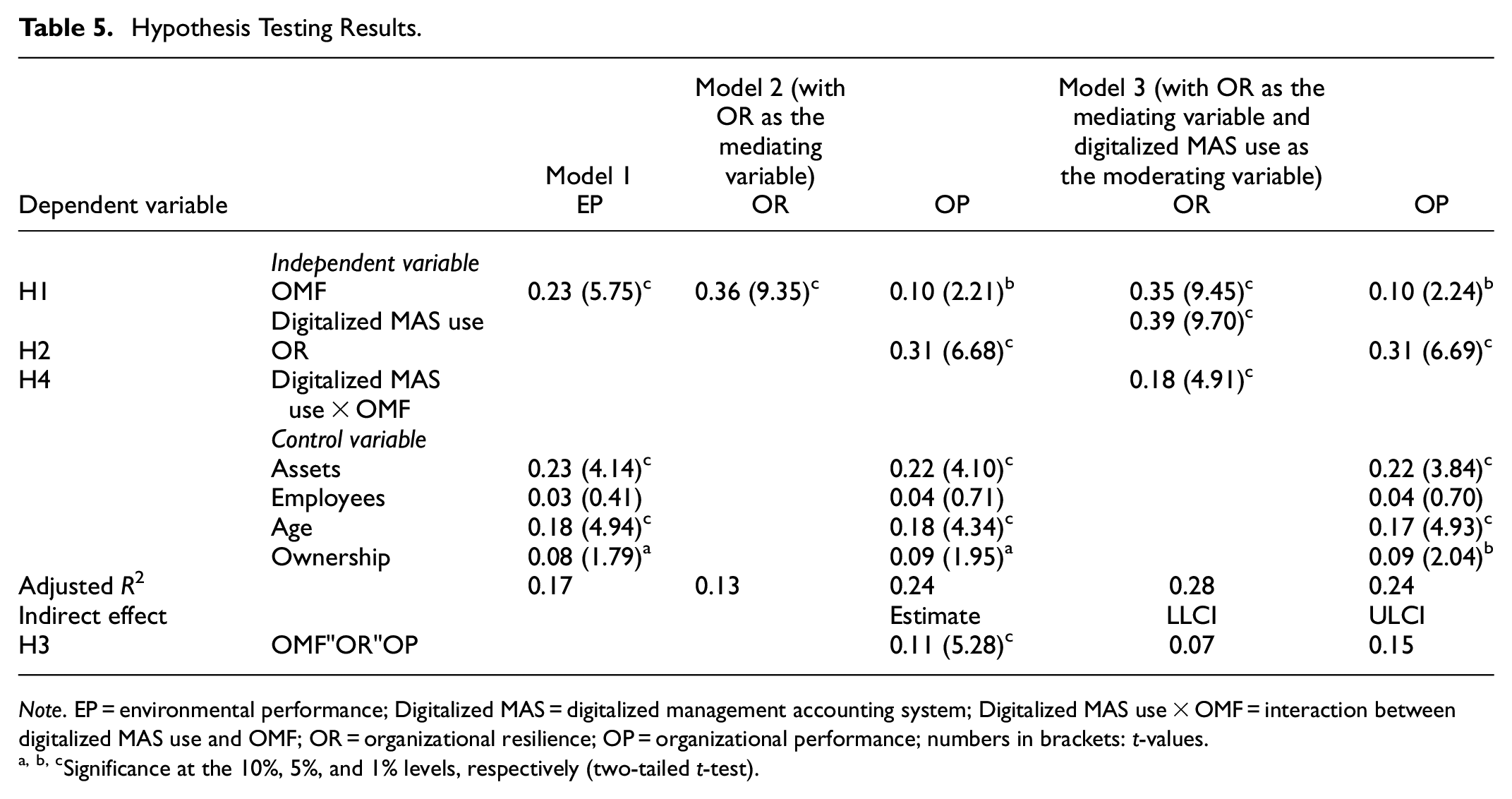
Note. EP = environmental performance; Digitalized MAS = digitalized management accounting system; Digitalized MAS use × OMF = interaction between digitalized MAS use and OMF; OR = organizational resilience; OP = organizational performance; numbers in brackets: t-values.
Significance at the 10%, 5%, and 1% levels, respectively (two-tailed t-test).
Our analysis supported H1, which proposes that organizational mindfulness positively affects organizational resilience (model 2: β = .36, t-value = 9.35; model 3: β = .35, t-value = 9.45). Hypothesis 2 regarding the positive effect of organizational resilience on organizational performance was also supported (model 2: β = .31, t-value = 6.88; model 3: β = .31, t-value = 6.69). The bootstrapped indirect effect of organizational mindfulness on organizational performance via organizational resilience was found to be positive and significant (β = .11; t-value = 5.28; confidence interval [95%] = [0.07; 0.15]), confirming H3 regarding the mediating role of organizational resilience in the organizational mindfulness–organizational performance linkage. In addition, the effect of organizational mindfulness on organizational performance decreased from 0.23 (model 1: β = .23, t-value = 5.75) to 0.10 when organizational resilience was added as a mediator (model 2: β = .10, t-value = 2.21). This result indicates the partial mediating role of organizational resilience in the relationship between organizational mindfulness and organizational performance, confirming H3.
To test H4 regarding the moderating effect of digitalized MAS use on the relationship between organizational mindfulness and organizational resilience, we formed an interaction term (digitalized MAS use × organizational mindfulness) after mean centering the two interacted variables to avoid multicollinearity issues (Aiken et al., 1991). The effect of the interaction term on organizational resilience was positive and significant (model 3: β = .18, t-value = 4.91), meaning H4 was supported. To further illustrate the interaction effect, we followed Aiken et al. (1991) in plotting the effects of organizational mindfulness on organizational resilience at high (+1 standard deviation [SD]), average (mean), and low (–1 SD) levels of digitalized MAS use using an interaction graph (Figure 2). The graph shows that when digitalized MAS use was high, the effect of organizational mindfulness on organizational resilience was high, while it was average and low when digitalized MAS use was average and low, respectively.

Interaction effect of organizational mindfulness and digitalized MAS use on organizational resilience.
Moreover, our study examined the moderated mediation effect of organizational mindfulness and organizational resilience in establishing the relationship between digitalized MAS use and organizational performance using Hayes’ PROCESS macro for SPSS. Table 6 shows the conditional indirect effect of organizational mindfulness on organizational performance via organizational resilience for different levels of the moderator, that is, digitalized MAS use, at low (–1 standard deviation), mean, and high (+1 standard deviation). The effect increased (from 0.12 to 0.39) when digitalized MAS use increased (from –1 standard deviation to +1 standard deviation), indicating that digitalized MAS use significantly moderates the mediating effect of organizational resilience on the relationship between organizational mindfulness and organizational performance. Moreover, the index of moderated mediation was 0.12 and statistically significant as its bootstrapped confidence interval did not contain zero (from 0.07 to 0.20). Thus, the moderated mediation effect of organizational mindfulness and organizational resilience in establishing the relationship between digitalized MAS use and organizational performance was confirmed in this study.
Conditional Indirect Effect of Organizational Mindfulness on Organizational Performance Via Organizational Resilience.

Note. LLCI = lower limit confidence interval; ULCI = upper limit confidence interval; SD = standard deviation.
Discussion
The results of the test for H1, regarding the influence of organizational mindfulness on organizational resilience, support the view of Oredo and Dennehy (2023). The results indicate that organizations that value organizational mindfulness are significantly better able to identify potential risks (Dernbecher & Beck, 2017; Weick & Sutcliffe, 2015) and respond rapidly to them (Vogus & Sutcliffe, 2012), thereby enhancing their organizational resilience (Williams et al., 2017). They are consistent with previous research on the intervening role of organizational mindfulness in emerging markets such as Vietnam (e.g., Nguyen et al., 2020; Nguyen & Hoai, 2023; Nguyen & Thanh Hoai, 2022). In Asian culture, especially Vietnam, mindfulness has had a pervasive influence on the country’s political, educational, and economic frameworks (Nguyen et al., 2020; Nguyen & Thanh Hoai, 2022). Consequently, organizations in this context are incentivized to exercise prudence and discernment through mindfulness when confronted with turbulent situations. In the catalytic embrace of mindfulness, these organizations are inclined to heighten their attentiveness toward information of dynamic environments to enhance endurance and resilience. The confirmation of H2 highlighted the significance of organizational resilience in enhancing organizational performance, indicating that highly resilient organizations can readily adapt to circumstances (Kafetzopoulos, 2021) and can withstand adversity and the unexpected (Dahles & Susilowati, 2015), resulting in good performance outcomes (Lengnick-Hall et al., 2011).
In addition, the support of H3 indicated that organizational resilience is necessary to link mindfulness to improved organizational performance. This adds further insights into the established relationship between organizational mindfulness and organizational performance in emerging Asian markets (e.g., Nguyen et al., 2020). This finding illustrates the path between mindfulness and performance with organizational resilience as a mediator. Fourth, while knowledge regarding the mediating role of digitalization in the effect of organizational mindfulness on organizational resilience remains limited (Wang et al., 2021), it is intriguing that H4 regarding the moderating role of digitalized MAS use on the mindfulness–resilience link is supported. The results indicate that when digitalized MAS are employed more frequently, organizational mindfulness significantly impacts organizational resilience.
Finally, our hypothesis testing results confirmed the importance of the dynamic capability framework (Teece, 2014; Teece et al., 1997) and its relevance when applied to the interface among digitalization, mindfulness, and resilience in the context of emerging markets. A few previous studies in emerging markets, such as that by Gupta and Gupta (2019), claim that innovation is one of the dynamic capabilities of organizations and helps to improve sensitivity and response capability. Another study by Tran et al. (2022) used the dynamic capability framework to explain the impact of knowledge on the economic performance of organizations. According to Tran et al. (2022), knowledge satisfies the requirements of a dynamic capability, helping organizations respond to environmental changes and achieve the desired performance.
Our study approached the dynamic capability framework in a unique and novel way. The research results confirm that organizational mindfulness, organizational resilience, and digitalized MAS use are differentiating factors and dynamic capabilities of organizations. They are a source of sustainable competitive advantage and enable organizations to initiate organizational changes and implement strategies to improve efficiency and effectiveness in a dynamic and volatile world (Teece, 2014; Teece et al., 1997). The combination of and interaction among these three dynamic capabilities can help organizations increase the attention given to activities aimed at achieving good results and ensuring the optimal use of resources to increase resilience and improve performance. This is a meaningful finding for organizations in emerging markets, which experienced severe crises due to COVID-19 (Chong et al., 2021; Samuel, 2020) and are still trying to recover day by day (GSO, 2021; World Bank Group, 2022).
Implications, Limitations, and Future Research Directions
Theoretical Implications
Our research contributes to the existing literature in four main ways. First, our findings add to limited research on the role of organizational mindfulness in facilitating organizational resilience (e.g., Wang et al., 2021; Ye et al., 2024) within the unique landscape of emerging-market organizations in Vietnam. Although Wang et al. (2021) explored the impact of organizational mindfulness on organizational resilience through a qualitative study, they called on researchers to perform a quantitative study to confirm this relationship. Our quantitative study responds to this call and supports the claim that organizational resilience results from processes and dynamics to create, obtain, and leverage resources flexibly and in a convertible and malleable manner (Sutcliffe, 2003). Thus, when faced with adverse situations, organizations can seek to flexibly and effectively use dynamic capabilities (Eisenhardt & Martin, 2000) to improve their resilience.
Second, our finding that organizational mindfulness facilitates organizational performance through organizational resilience extends the literature by identifying organizational resilience as a mediator in the path from mindfulness to enhanced performance. This is an essential contribution because previous studies have assumed organizational ambidexterity (e.g., Gayed & El Ebrashi, 2023), human capital (e.g., Lengnick-Hall et al., 2011; Lengnick-Hall & Beck, 2005), and social capital have direct impacts on organizational resilience (e.g., Fandiño et al., 2019; Jia et al., 2020). In addition, it has been assumed that supply chain resilience has a direct impact on supply chain performance (e.g., Abeysekara et al., 2019; Gölgeci & Kuivalainen, 2020; Iftikhar et al., 2021; Li et al., 2017; Yu et al., 2019). Our study diverges from these studies by demonstrating the mediating role of organizational resilience in translating mindfulness into superior organizational performance within the specific context of Vietnam.
Third, our study enhances the understanding of the boundary conditions of the effect of organizational mindfulness on organizational resilience. Specifically, our study takes the initiative to examine the moderating role of digitalized MAS use on the relationship between organizational mindfulness and organizational resilience. The results indicate that higher digitalized MAS use may synergize with organizational mindfulness to enhance organizational resilience, underscoring the importance of integration in resilience-building efforts in the Vietnamese context.
Finally, given that our sample consists of organizations in an emerging country (i.e., Vietnam), our findings contribute to the organizational mindfulness literature by showing that mindfulness is beneficial not only to organizations in developed countries as a means to reinforce ethical behavior (e.g., Barbaro & Pickett, 2016; Brown & Kasser, 2005; Nguyen et al., 2020; Pandey et al., 2018; Vu & Tran, 2021) and enhance resilience (e.g., Wang et al., 2021; Williams et al., 2017) but also to organizations in emerging markets. To date, the impact of mindfulness on organizational resilience has not been widely investigated. Our study is the first to examine this relationship quantitatively, as called for by Wang et al. (2021). Consequently, the study contributes to the limited literature on the significance of organizational mindfulness in promoting resilience to uncertain environmental fluctuations in emerging-market organizations (e.g., Nguyen et al., 2020; Vu & Tran, 2021). Furthermore, given the widespread belief that mindfulness is more prevalent in Asia than in the West (Kahn et al., 2017), it can help organizations in emerging markets such as Vietnam sharpen their focus at work, enhancing their reputation and performance (Nguyen et al., 2020).
Managerial Implications
This study has two managerial implications. First, our finding that organizational mindfulness facilitates organizational performance through organizational resilience will be helpful for managers in emerging markets like Vietnam. Organizations can reduce their vulnerability through resilience. At the same time, mindfulness can deepen an organization’s concern for resilience (Peschl & Schüth, 2022). This finding can guide managers to use organizational mindfulness to improve organizational performance. They can devise strategies to enhance organizational resilience, helping to achieve efficient resource use for enhancing performance. At the same time, investment in resilience involves a trade-off, and additional costs may have to be paid for improved performance (Jüttner et al., 2003). In particular, when not adequately managed and/or when the response to disruptions is slow, it can reduce overall organizational performance (Li et al., 2017). Thus, in addition to increasing their mindfulness, organizations must adopt appropriate and practice-sensitive strategies to address crises and promote their resilience (Conz & Magnani, 2020; Dhoopar et al., 2022). In light of our consciousness, the above findings hold noteworthy implications for Asian nations, particularly Vietnamese organizations, in seamlessly integrating mindfulness—a salient cultural aspect into their operations. Specifically, organizational mindfulness mitigates business-related challenges through a non-judgmental contemplation mode (Nguyen & Thanh Hoai, 2022), thereby fostering heightened resilience and making breakthroughs. Therefore, businesses should competently utilize organizational mindfulness to establish a favorable foundation for fortifying organizational resilience and augmenting performance.
Second, the finding that digitalized MAS use significantly moderates the effect of organizational mindfulness on organizational resilience is crucial for managers engaged in key resilience strategies. For instance, emerging market managers can boost their resilience through greater digitalized MAS use and organizational mindfulness. This suggestion is appropriate within the context of organizations in Vietnam and other emerging Asian markets, where organizational dynamism can catalyze the adoption of MASs (Thanh Hoai & Nguyen, 2021). In addition, training courses on contemporary business issues, MASs, and organizational mindfulness are also needed to raise the understanding of organizational members and promote organizational resilience and performance.
Limitations and Future Research Directions
Despite the above contributions, the current study has several limitations that open up possibilities for future research. First, as this study was cross-sectional, causal relationships between organizational mindfulness, digitalized MAS use, organizational resilience, and organizational performance may have been overlooked. Organizational resilience is a latent, path-dependent capability and is challenging to measure, and its benefits take a long time to manifest (Ortiz-de-Mandojana & Bansal, 2016). Future studies could circumvent this constraint by using an experimental design or a longitudinal method with appropriate time lags between phases of data collection. Second, this study examined organizations in Vietnam, a developing country with a socialist-oriented market economy (Hoai et al., 2022; Hoai & Nguyen, 2022). As a result, our findings are constrained in generalizability, and extrapolating the findings to other countries should be done with caution. Future research into our proposed model considering advanced economies is also encouraged. Third, our study only examined the moderating role of digitalized MAS use on the effect of organizational mindfulness and organizational resilience, while other contextual elements (e.g., national culture, religion, and institution) could also influence this effect. For instance, cultures can exhibit stark differences in their adopted managerial practices, regulatory forces, and relational governance (Jia & Zsidisin, 2014; Kraude et al., 2018), which could impact the resilience outcomes of an organization. In this way, a country’s cultural specificity can influence its organizations’ operating practices and responses to threats, resulting in higher susceptibility to vulnerabilities (Tukamuhabwa et al., 2015). Additional research should be conducted in other emerging countries to provide further insights. Finally, future studies should validate the proposed model by examining the possible influence of distinct local contextual factors on different types of organizations in other emerging economies.
Conclusion
Based on the dynamic capability framework (Teece, 2014; Teece et al., 1997), we hypothesized that organizational resilience mediates the relationship between organizational mindfulness and organizational performance and that the impact of organizational mindfulness on organizational resilience is contingent upon digitalized MAS use. Using data from 441 Vietnamese organizations, we successfully demonstrated that organizational mindfulness, organizational resilience, and digitalized MAS are all dynamic capabilities (Eisenhardt & Martin, 2000; Ma et al., 2018; Peschl & Schüth, 2022) and are significant factors shaping the performance of organizations in Vietnam. This study contributes to the ongoing debate on resilience in the business and management fields (Linnenluecke, 2017) by emphasizing the moderating role of digitalized MAS use.
Indeed, organizations frequently face external disruptions, such as natural disasters, political unrest, and health crises, with the recent COVID-19 pandemic as an example (McKinsey and Company, 2020). As they are typically unpredictable and out of organizational control, such situations can pose significant threats (He et al., 2023). During the COVID-19 pandemic, organizations with information technologies demonstrated greater resilience (e.g., Lin, 2020; Wakabayashi et al., 2020) than those without (He et al., 2023). In addition, the attractiveness of digitizing management information has prompted organizations to adopt digitalized MAS to save resources and improve resilience (Möller et al., 2020). Overall, the findings of this study encourage further investigation into how organizational mindfulness and digitalized MAS can be integrated to assist organizations in developing nations in enhancing their resilience and performance.
Moreover, the insights from this research highlight the pressing need for organizations to proactively invest in organizational mindfulness and digitalized MAS as strategic imperatives. The resonance relationship revealed here, where organizational mindfulness contributes to enhanced resilience, especially when bolstered by digitalized MAS, has the potential to redefine how organizations approach adaptability and performance optimization in the face of ever-evolving challenges.
Footnotes
Declaration of Conflicting Interests
The author(s) declared no potential conflicts of interest with respect to the research, authorship, and/or publication of this article.
Funding
The author(s) disclosed receipt of the following financial support for the research, authorship, and/or publication of this article: This study was funded by the University of Economics Ho Chi Minh City (UEH) under Grand number 2022-06-01-1009.

Data Availability Statement
Data sharing not applicable to this article as no datasets were generated or analyzed during the current study.