



Abstract
The outbreak of the coronavirus disease 2019 (COVID-19) has triggered the massive adoption of digital products and services in Indonesia, forcing established organizations to accelerate digital transformation and adaptation of their digital enabled business model to stay relevant. This article investigates how established firms achieve digital business model innovation (DBMI) and the role of transformational leadership (TL) as a key antecedent. Based on the cross-sectional survey data from 124 public listed firms in Indonesia, this study reveals that established firms in the uncertainty’s situation require Transformational Leadership, and TL indirectly influence DBMI through organizational readiness and ITeDC. We also found that despite the direct impact of organizational readiness on DBMI, partial mediation through IteDC can be a plausible mechanism. We contribute to the business model literature by offering a more integrated view of the antecedents concerning established firms’ DBMI.
Keywords
Introduction
Web 2.0 technology, which has been around since 2005 (O’Reilly, 2005) received rapid global adoption with the advancement of affordable mobile device technology, widespread network availability, and mobile application distribution via Google Playstore and Apple Store (Newman et al., 2016). Indonesia is a prime example, where internet users constitute nearly 73.5% of the country’s population (i.e., 274 million in 2021), with the majority being mobile internet subscribers (70.6% of the population) who spend approximately 4.3 hr per day online on mobile devices. In a business standpoint, this condition arguably transformed the way materials and services were created, delivered, and consumed, resulting in a fundamental shift in the economic model for most companies. These developments brought a positive impact on Indonesia, allowing it to become one of the fastest-growing digital economies in Southeast Asia. The digital economy is expected to reach a total value of $146 billion in 2025, growing at a 20% compound annual growth rate (CAGR) since 2021, making Indonesia the region’s prime investment destination, surpassing Singapore (Google, Temasek, & Bain & Company, 2021). Moreover, the coronavirus disease 2019 (COVID-19) pandemic encouraged the utilization of digital services, whereby an average of 3.6 services were consumed more online, with 87% satisfaction covering services across vertical industries (Google, Temasek, & Bain & Company, 2021). Thus, the adoption of a digital lifestyle fundamentally altered customers’ expectations and behaviors.
From the perspective of resources, Digital native firms in Indonesia, such as Gojek/Gopay, Tokopedia, Bukalapak, Bank Jago, Ovo, Halodoc, and Traveloka, have benefited immensely from the availability of hyperscale cloud computing (e.g., Google Cloud Platform). The cloud sourcing model has enabled them to quickly build scalable businesses at low initial costs (Hugos & Hulitzky, 2010), unlock advanced innovation (e.g., with artificial intelligence [AI]/machine learning [ML], data analytics, etc.), and experiment with novel business models (Korhonen et al., 2017). This has put pressure on existing businesses, and competition has grown more turbulent, unstable, and fast-paced (Reuschl et al., 2022).
In response, established businesses have been forced to expedite their digital transformation during the pandemic. They have had to find ways to utilize digital technologies, affecting the basic building blocks of product-service innovation (Porter & Heppelmann, 2014; Yoo et al., 2012). Some good examples in Indonesia include the Bluebird online platform and partnership with Gojek, Bank Raya (BRI digital bank arm), Biofarma, Kuncie and Fita (Telkomsel ecosystem digital), and Bank Mandiri Living. Digital transformation has evolved from a technology opportunity into a necessity for meeting new customer expectations. It also allowed them to leverage some of their advantages over newborn-digital competitors, such as paying customers, market data and insights, attractive talent pools, and financial resources (Porter & Heppelmann, 2014).
However, although digital transformation is essential for businesses to remain competitive in the digital age, there are some fundamental aspects to consider. First, digital transformation differs from information technology enabled organizational transformation (ITOT) as the former uses digital technology for business model innovation (DBMI) (Legner et al., 2017; Nambisan et al., 2017), whereas ITOT uses digital technology to support the existing value proposition (Vial, 2019; Wessel et al., 2021) Second, incumbents confront problems and constraints while exploring and delivering DBMI, because the logic of digital business models is oftentimes fundamentally different from what they are typically used to (Remane et al., 2017). They are commonly forced to address disputes and rely on trade-offs between existing and new business models (Christensen et al., 2016; Markides, 2006). Consequently, this study emphasizes DBMI as one of the prominent implementation categories of digital innovation (Wiesböck & Hess, 2020).
Furthermore, it has been suggested that to remain relevant in the emerging digital economy, businesses must develop strong dynamic capabilities to quickly invent, implement, and modify business models (Karimi & Walter, 2015, 2016; Teece & Linden, 2017; Velu, 2017). As digital business model innovation (DBMI) involves many complicated changes occurring during the process (Wade et al., 2017) organizations that lack dynamic skills find it challenging to adapt or develop (Barney, 1991). Scholars and practitioners have long maintained that to thrive, businesses must maintain compatibility with the environment wherein they operate (Wade et al., 2017). Firms must have numerous strategies to meet today’s market and technological needs, as well as future ones during the DBMI process. In such circumstances, IT holds a strategic value, particularly regarding how it can lead to a competitive advantage.On the other side, established firms have to deal with organizational inertia, which influences their ability to alter existing business models or create new ones (DaSilva et al., 2013). Hence, organizational readiness has a crucial role in the adoption of digital innovation, however the concept of digital innovation readiness has received limited coverage in organizational literature (Lokuge & Sedera, 2014) Accordingly, this research investigates the causal relationship of digital innovation readiness with DBMI and IT-enabled dynamic capabilities (ITeDC).
Lastly, digital transformation is fundamentally about change and transforming the way organizations operate. It requires visionary leadership and decision-making, which links digitalization to emerging organizational needs (Sainger, 2018). Thus, strong transformational leadership (TL) is essential for established to incorporate agility and innovation into their larger companies and to explain new digital ways of thinking while minimizing disturbance to their existing businesses. (Gumusluoğlu & Ilsev, 2009). This viewpoint is congruent with the notion that leadership behaviors provide a vital mechanism for integrating and aligning in the effective execution of strategy. (Panagopoulos & Avlonitis, 2010). Transformational behaviors are considered beneficial in strategy implementation simply because they catalyzed an environment wherein employees trust and respect their leader, and are motivated to do more than what is expected (Yukl & Mahsud, 2010). Such an environment is particularly useful for reducing opposition to new initiatives that require employees to change their working routines (Monsen & Wayne Boss, 2009). Additionally, how specific management styles affect the DBMI of established firms has been investigated in multiple research articles due to the scarcity of research in this area (Foss & Saebi, 2017; Lambert & Montemari, 2017; Schneider & Spieth, 2013; Wirtz et al., 2016). This notion is aligned with previous studies that demand empirical investigation of mechanisms whereby transformational leaders advance innovative results. (Cheng et al., 2014; Jansen et al., 2009; Kortmann et al., 2014)
This research utilized a pure deductive empirical approach to investigate the relationship between DBMI and their key antecedents (Lambert & Montemari, 2017) for established B2C and B2B2C firms in Indonesia. The research problem addresses a key question of whether the role of TL is impacting DBMI, either directly or indirectly through organizational readiness for digital innovation (ORDI) and ITeDC.
Literature Review and Hypothesis Development
Literature Review: Digital Transformation and DBMI
Innovation has long been acknowledged as a major economic driver, and digital innovation has only recently attracted the attention of business and academics. The concept of “digital transformation” is derived from the term “digitalization,” which is informally defined as the use of digital technologies digital business model innovation and generate value-producing opportunities and new revenue streams (Kohtamäki et al., 2019; Parida et al., 2019). Vial (2019) summarized the current knowledge regarding digital technologies and defined it as a process to alter the value creation path of existing firms through the use of digital technologies to gain a competitive advantage. In the context of today’s intensified global competition and dynamic market situation, Johnson et al. (2008) suggested BMI as a powerful management tool to support a firm’s sustainability, enabled by technological progress, new customer preferences, and competitiveness (Casadesus-Masanell & Zhu, 2013).
By explaining how value is produced, delivered, and acquired, the business model provides a valuable lens for understanding a company’s business logic. (Osterwalder et al., 2010). Consistent with previous definitions, the essential components of a business model are the value proposition, the value delivery, the value capture, the firm’s resources and capabilities, and its organizational structure (Demil & Lecocq, 2010; Osterwalder et al., 2010; Zott & Amit, 2010). The majority of definitions of BMI have the same fundamental idea, which is that BMI is established when a business model element is changed or when those elements interact to create a different business model configuration (Foss & Saebi, 2017). Consequently, when these changes are introduced by digital technology to the business model (e.g., as described in the transformation paths by Steininger, 2019); then, it is defined as DBMI (Böttcher & Weking, 2020; Trischler & Li-Ying, 2023).
There are multiple purposes of business model construction in academic research: (1) as a foundation for firms classification (e.g., Amit & Zott, 2001; Osterwalder et al., 2005), (2) as an antecedent of firm performance heterogeneity (e.g., Weill & Woerner, 2015; Zott & Amit, 2010), and (3) as a new form of innovation (e.g., Markides, 2006; Teece, 2010). This study follows the research stream that considered business models as vehicles of innovation and sheds light on relationships between business models and various organization abstraction levels, which currently remain underdeveloped (Lambert & Montemari, 2017).
DBMI entails innovation in at least one of the core aspects of value generation, delivery, and capture, hence enabling a firm to activate untapped value sources inside the organization or develop new systems that are difficult to mimic (Amit & Zott, 2012). Understand the importance of DBMI, over the past years scholars and practitioners are demanding for the development of practical tools and approaches to support DBMI (e.g., Foss & Saebi, 2017; Trimi & Berbegal-Mirabent, 2012, especially in the context of established firms operating in an uncertain digital context and dynamic circumstances (Courtney et al., 1997; Demil & Lecocq, 2010; Sirmon et al., 2007). It is now evident that the rapid speed of technological progress is both the greatest productive and destructive factor. Hence, the creation of a digital business model is considered an evolving process, never static with no permanent equilibrium (van de Ven & Poole, 2004). Firms need to be strategically agile (Doz & Kosonen, 2010), improving dynamic capabilities and continuously reinvent themselves (Franco et al., 2021).
Generally, conceptual or case study type of study are dominating research on business models and their antecedents, mainly because the research topic is still in its infancy and must first establish a substantial body of knowledge (Wirtz et al., 2016). This research contributes to the existing knowledge about DBMI by providing a consolidated approach in an integrative model that considers extant theory and literature to explain how established firms in Indonesia innovate their digital business model.
The Influence of TL on DBMI
Leaders should not just focus on profitability maximization, they must make sure that their organizations’ business models are sustainable and look for possibilities to align social and economic vectors for long-term benefits (Doz & Kosonen, 2010). A company will not adopt change unless its leaders are fully committed to it, also employees will not take part in learning unless they are inspired and given the necessary tools to do so. In this situation, traditional management practices (such as incentivizing employee with bonuses) will not as effective as transformational Leadership (TL). TL defined as organizational leadership that can play a vital role in promoting innovation by providing employees with the psychological support they need, also presenting a positive and inspiring outlook for the future that serve as a model for behaviors that align with the vision, showing personal attention to each individual and promoting intellectual stimulation (Fernandes et al., 2022). Transformational leadership also defined as “moving the follower beyond immediate self-interests through idealized influence (charisma), inspiration, intellectual stimulation, or individualized consideration,” motivates followers to produce high performance (Rosing et al., 2011). Rather than relying on tried-and-true methods to handle new issues, transformative leaders seek novel approaches that push individuals to reevaluate their preconceptions (Jones et al., 2008). Leaders need to demonstrate TL characteristics through persuasion and emphatic comprehension, they enable followers to present new and challenging ideas without fear of judgment or criticism. (Shanker & Sayeed, 2012).
The strategic management literature also highlights the leadership style as a notable influence on innovation (Kanter, 1983; McDonough, 2000; van de Ven & Poole, 2004). Kanter (1983) indicates that a collaborative and participative (transformational) leadership style is more likely to foster innovation inside an organization compare to the transactional styles of leadership (Manz & Gioia, 1983) due to the fact that transactional leadership creates an exchange-based relationship by outlining goals, rewarding goal success, and only interfering when absolutely essential (Bass, 1999) which also means does not encourage experimentation. Considering TL increases motivation and could inspire a follower to question the existing quo (Keller, 2006), it seems reasonable expecting TL and Digital Business Model Innovation to be positively correlated.
The Influence of TL on ORDI
During digital transformation, established firms requires some degree of organizational readiness such as digital talents/resources, cultural readiness, strategic readiness, IT readiness, partnership readiness, innovation valance, cognitive readiness (Lokuge et al., 2019) that require change commitment and change efficacy from its organizational members. From the new institutional theory perspective, organizational change would not be possible without leaders who create relevant platforms and drive stakeholders toward action (Sainger, 2018) considering leadership is seen as an essential component of organizational believe systems and values.
As an organization shifting over time, the leadership style must also adapt accordingly (AlNuaimi et al., 2022). The characteristics of transformational leaders fits with the new requirements by motivate followers to integrate themselves into the company environment and culture. They empower followers via persuasion and empathy, introducing novel and contentious ideas without fear of criticism or ridicule. (Hay, 2006). TL seeks to establish emotional ties with followers and instill higher principles. Such leadership conveys the relevance of a shared objective and infuses the actions of followers with a feeling of purpose, direction, and significance (Bass, 1999).
TL further facilitates an innovative culture, promoting the dissemination of knowledge (Sudibjo et al., 2022) to strive for the highest organizational performance that is achievable. All members of an organization are encouraged to dedicate themselves to achieving achievements by transformational leaders who are devoted to the company’s goals and who help their followers internalize those goals (Bass, 1999; Bass & Avolio, 2000).
The Influence of TL on ITeDC
The use of information technology has become ubiquitous in modern businesses. The main logic of the industrial period was linear and directed toward products; whereas, the dominating logic of the digital age is nonlinear and oriented toward services. (Collins & Smith, 2014). Hence, IT serves as a facilitator and a trigger for service innovation (Frey et al., 2019). In addition, the dynamic environment results in irregular uncertainties, which forces businesses to rely on their IT skills in order to maintain their competitive edge (Mikalef et al., 2021). ITeDC define as an organization’s capacity to harness its IT assets, resources, and IT competences in conjunction with other firm capabilities and resources to adapt to quickly shifting business conditions.(Mikalef, 2016).
Firms that properly deploy and empower their assets, resources, and IT capabilities are more inventive, effective, and responsive to structural changes in the industry and marketplace than their rivals (Aral & Weill, 2007). Therefore, researchers must explore and explicate the methods by which IT-enabled innovation is realized, as well as the function of ITeDC as antecedent and conditional. (El Sawy & Pavlou, 2008; Mikalef & Pateli, 2017; van de Wetering & Besuyen, 2020).
Few scholars examine the relationship between information technology and leadership (Crawford, 2005), and even fewer address the relationship between leadership and dynamic capabilities (Kraft & Bausch, 2016) Because transformational leaders play a critical role in every organization’s change initiative. TL has been recognized as the leadership style most favorable to intrapreneurship, in which leaders inspire their followers to be inventive and creative in an agile setting (Elenkov & Manev, 2005; Ling et al., 2008; Moriano et al., 2014). Therefore, it is crucial for the TL to create a vision for IT in the firm and ensuring that managers understand their goal throughout the organization, while also empowering people and communicating openly (Vejseli et al., 2018).
The Influence of Organizational Readiness for Digital Innovation (ORDI) on ITeDC
Organizational readiness refers to a company’s capacity to adapt its resources to the successful adoption, exploitation, and absorption of digital technology, hence facilitating the implementation of innovative operations (Lokuge et al., 2019). Innovative organizations are more likely to engage in learning and investigation, and are capable of coping with high levels of uncertainty while harnessing assets such as digital platforms to address opportunities and risks (Autio et al., 2021; Ravichandran, 2018). For example, a company can create novel technologies or incorporate unique proprietary inventions to enhance its performance by gaining knowledge from cooperative partnerships or by creating competitive goods (Lin & Wu, 2014). A company with robust dynamic capabilities will be able to effectively construct or renew resources and assets, as well as reconfigure them to innovate and respond to market shifts (Teece, 2018a). Notably, poor dynamic capabilities hamper digital transformations (Chirumalla, 2021).
Prior research has not exhaustively examined the process through which IT can affect inventive capabilities (Hopkins, 2010). In addition, new research on dynamic capacities has called for investigation into the methods by which IT-enabled innovation is realized, as well as the role of ITeDC as antecedent and conditional (van de Wetering & Besuyen, 2020). To implement this strategy, managers are responsible for ensuring that their firms are able to transform digital technology into digital innovations (Lokuge et al., 2019; Svahn et al., 2017; Wiesböck & Hess, 2020).
Karimi and Walter (2015) report that micro-foundations with dynamic capabilities play an important role in assisting organizations in avoiding being disrupted by the emergence of new business models while simultaneously responding to disruptive developments. Furthermore, Ravichandran (2018) demonstrates that changes in the corporate environment should be appropriately addressed. In order to meet market demands with new goods and services, businesses might combine resources and skills in novel ways. Moreover, resource flexibility is necessary to compete in dynamic marketplaces since it adds to the ORDI (Lokuge et al., 2019).
The Influence of ORDI on DBMI
A business model includes several moving components that must operate in unison. Additionally, the model must be consistent with the organization’s goals, culture, and resources, these connections cannot be optimized using data analytics alone. A successful business model design relies on art and intuition as much as it does on science and analysis. Digital technology is simply the enabler of BMI. The real issue is how organizations have to change/adapt to deal with this new expectation. The problem with many incumbents is that most of their management techniques were created at a time when this two-way conversation did not exist. Instead, these management tools were designed for an entirely different tempo of operations: the manufacturing economy of the previous century. In the manufacturing period, operations were slower and more predictable which praised a managerial strategy focused on preparation, thought, and confidentiality. Literature review finds that “readiness” is not a novel term, and various past research have explored individuals’ readiness to embrace IT or similar technology. (Kwahk & Lee, 2008; Montealegre, 1999). When an organization, rather than an individual, is the focus of adoption, the idea of readiness becomes more challenging since firm-level innovation readiness tends to depend on a wide range of circumstances. Several studies, for instance, have focused on human, business, and technological resources as organizational readiness aspects necessary for innovation adoption. (King et al., 1994; Montealegre, 1999).
This study contends that organizational readiness influences the rate at which established organizations adopt innovation, which is supported by Lokuge et al. (2019) who assert that due to this lack of organizational readiness, the majority of new ideas fail to transform into new products or services. Innovation lies at the center of digital technology and digital business models. Bharadwaj et al. (2013) suggest that digital and business strategies should be viewed as one element because to be good at sensing and adopting BMIs, for innovation, established businesses must create a culture, build organizational skills, and foster cooperation. In addition, they require clarity to ensure that innovation closely corresponds with the strategic goals of established companies.
The Influence of ITeDC on DBMI
Businesses continuously explore strategic agility and innovation as both are necessary when undertaking digital transformation (Kohtamäki et al., 2020). When customer preferences shift, businesses must quickly adapt their goods, services, and operations. Additionally, employees must be prepared and enabled to move at this rate. Through innovations in goods, services, channels, and market segmentation, agile companies routinely detect opportunities for competitive action in the form of value creation, capture, and competitive performance (Sambamurthy & Grover, 2003). By leveraging opportunities for innovation and competitive activity, such as by launching new goods and services, launching new market openings, and creating strategic partnerships, agile enterprises may adapt to fast changing circumstances (Roberts & Grover, 2012). Companies lacking agility will be unable of adapting their activities and business operations to changes (Bhatti et al., 2021). Thus, firms with higher agility can outperform those with lower agility (Wang et al., 2017).
The dynamic capability outlook offers a theoretical basis for recognizing agility as a “dynamic capability” (Reschke, 2012; Sambamurthy & Grover, 2003). The dynamic capabilities framework has become one of the most active study lines in strategic management because it describes how companies react to fast technology and market changes. (Di Stefano et al., 2014; Eisenhardt & Martin, 2000; Teece, 2007). Dynamic capabilities are innovation-based and allow a company to establish, expand, and adapt its resource base (Helfat et al., 2009). Teece (2007) contends that dynamic skills consist of three major clusters: (1) identifying opportunities (and threats), (2) capturing opportunities, and (3) transforming the organizational business model and larger resource base required to develop and maintain a competitive edge. The dynamic capabilities viewpoint provides an exploratory view of BMI and has enabled scholars to argue that the design and operation of a business model depend on a firm’s capabilities (Teece, 2018b). Considering the importance of technology as the important element of value creation in service systems in the context of digital transformation (Maglio & Spohrer, 2008; Nambisan et al., 2017), we leverage ITeDC as a lower-order IT capability (Ilmudeen, 2022; Mikalef & Pateli, 2017; Mikalef et al., 2016) to advance higher-order capabilities (e.g., BMI). ITeDC consists of sensing, coordination, learning, integration, and reconfiguration (Mikalef & Pateli, 2017; Mikalef et al., 2016). In order to develop and sustain a competitive advantage, organization requires readily developed sensing, seizing, and reconfiguring capabilities (Teece, 2007).
Experimentation is a crucial component of innovative business models, which may occur inside organizations and across sectors. Through experimenting, businesses are able to develop superior capabilities and improved business models. (McGrath, 2010). By adopting ITeDC, companies may obtain access to previously inaccessible sets of decision possibilities, hence enhancing their capacity to innovate and providing the possibility for greater performance contributions (Drnevich & Kriauciunas, 2011; Eisenhardt & Martin, 2000), and we expect it will help organizations in the development of DBMI.
Methodology and Data
Research Design
This study employed a quantitative approach to investigate the causal connection between four latent variables: TL, ORDI, ITeDC, and DBMI, using covariance-based structural equation modeling (CB-SEM) through the Lisrel 8.8 software. CB-CEM is a quantitative research method that has the most efficient approximation techniques to estimate a factor model (Rigdon et al., 2017), for concurrently estimating a series of separate multi-regression equations (Hair et al., 2013) and an accurate measurement of behaviors, knowledge, opinions, and attitudes (Cooper & Schindler, 2008). The exogenous construct of this research is TL, and DBMI is the endogenous construct. In addition, ORDI and ITeDC are both exogenous and endogenous constructs, which also have a mediating role in relation to the effect of TL on DBMI.
Research Subject
The research subjects are Indonesian B2B2C companies listed on the Indonesia Stock Exchange. This study utilized a systematic probability technique, with respondents from various sectors. The target population of this research is 185 companies, and the total number of valid respondents is 124 companies. The context of the research focuses on established or incumbent companies and the unit of analysis of the research is at the firm level. Data collection in this study was performed by sending a questionnaire to respondents about the respondents’ opinions on related topics. This data are those of the BOD level. The data were collected using a survey, which was filled out by the BOD level through BOD minus two levels. The survey instrument was translated into Bahasa Indonesia by the author and then checked by another scholar. The data collected through the data collection technique became the sample data. This research employed a population study, and the total population of established business firms listed on the Indonesia stock exchange is 722 companies. We narrowed it down to only 185 entities based on specific criteria of B2B2C firms.
Measurement of Variable
The data were measured using a questionnaire developed from our six hypotheses, forming 18 relevant items. A closed item questionnaire with a six-point Likert scale, where 1 = strongly disagree, 2 = disagree, 3 = slightly disagree, 4 = slightly agree, 5 = agree, and 6 = strongly agree, was developed. The research questionnaire was built upon the theoretical framework of each variable.
In this study, TL is measured through 13 items, improved and taken from Alban-Metcalfe and Alimo-Metcalfe (2000), Montuori and Donnelly (2017), and Vermeulen et al. (2017). ORDI is measured by 35 items adapted from Lokuge et al. (2019). ITeDC are measured using 16 items, improved and taken from Mikalef and Pateli (2017) and Pavlou and El Sawy (2011). The last construct, DBMI, is measured via 14 items, improved and taken from Clauss (2017), Klos et al. (2017), and Ranjan and Read (2016). The main operational variable is explained in Table 1.
Main Operational Variables.

Data Analysis Technique
The collected sample data are then analyzed using two methods. First, descriptive analysis is conducted to provide demographic information and data characteristics (e.g., mean value to reflect the tendency of respondent answers) (El Sawy et al., 2010). Moreover, analysis of variance (ANOVA) may be added (as necessary) to support the mean and standard deviation within the descriptive statistics. The second method is a multivariate statistical analysis that follows the procedure of Anderson and Gerbing (1988) called the “two-step approach.” The first step is the analysis of the measurement. This analysis evaluates the validity and reliability of the measurement model of the research model. The validity test of the measurement model is carried out through confirmatory factor analysis (CFA) by examining the value of standardized factor loading (SFL) of the observed variables or indicators of the model, together with the “t-value” of all of the SFLs. This study uses the SFL value of ≥0.50 as criterion, as used by Igbaria et al. (1997). The reliability of the measurement model is calculated from the value of construct reliability (CR) >0.70 and variance extracted (VE) value >0.5 (Hair et al., 2014).
The second step is structural model analysis. This analysis evaluates the significance of the relationship between the research latent variables in the research model. The SEM and linear structural relations (LISREL) methods provide the estimated coefficient and t-value for each coefficient (Wijanto, 2015). Each coefficient representing the hypothesized causal relationship can be tested for statistical significance (whether it is different from zero), and the absolute t-value of ≥1.96 indicates that the coefficient is significant (Hair et al., 2014).
Findings and Discussion
Descriptive Results
The questionnaires (utilizing Google Forms) were distributed via Linkedin, WhatsApp, and email to 185 respondents (one individual for each organization). After we cleaned the data from the logically incorrect responses, the final valid and completed sample contained 124 responses (67% response rate). The sample size meets the minimum sample size requirement by Krejcie and Morgan (1970) and Sideridis et al. (2014). Respondents of this study have various characteristics and demography, as presented in Tables 2 and 3.
Respondents Profile.

Respondents by Sector.

Overall, four latent variables and 18 dimensions or observed variables were included as part of our research framework. Table 4 shows the standard deviation and means of the variables, and the DBMI reported the highest mean (M = 5.46) while TL showed the lowest variation. The data specify that respondents have positive responses above 5 for all variables. These results indicate that during the time of this study, almost all of the public listed incumbents in B2B2C and B2C sectors were in the process of digital transformation; it is also reflected in their annual reports.
Descriptive ANOVA.

Bivariate correlations are performed to explore the relationship among variables. According to the analysis, two variables that are most strangely correlated are ITeDC and DBMI r(119) = 0.684, p < .01, followed by ORDI and ITeDC r(119) = 0.511, p < .01. Some relationships are found to not be significantly correlated (i.e., TL and ITeDC), and Table 5 shows the results of bivariate correlations of the latent variables.
Bivariate Correlation of Variables.

Significant at the 0.001 level (two-tailed).
ANOVA is conducted to gather insights from respondents’ responses based on their industry. The aim was to determine whether there is a difference among industries in perceiving the main latent variables employed in this study. From five latent variables, the analysis shows that there are significant differences in the respondents’ responses based on their industry origin regarding the latent variables of TL (p < .001), ITeDC (p < .001), and DBMI (p < .05)
The ANOVA indicated that respondents from transportation and logistics (5) scored the highest TL (M = 5.43), followed by retailers/CPG (3) (M = 5.38), while respondents from Telco (4) reported the lowed TL (M = 4.88). Furthermore, respondents from transportation and logistics (5) also had the highest ITeDC (M = 5.96), followed by Telco (4) (M = 5.22). Lastly, similar to ITeDC, respondents from transportation and logistics (5) reported the highest DBMI (M = 5.90), followed by Telco (4) (M = 5.65). This is because the consumer transportation industry is being disrupted by digital-based startups such as Gojek and Grab, and they do not seem to be slowing down expanding massively to the logistics and delivery industry. Moreover, during pandemic, most the of people were staying home and ordering almost everything online, forcing conventional transportation and logistics to innovate their digital business model with the influence of transformational leaders that exists in almost all companies. On the other side, respondents from healthcare (2) scored the lowest ITeDC (M = 4.92), and respondents from retailers/CPG (3) had the lowest DBMI (M = 5.32). Figures 1 to 3 provide information on how they differ in each latent variable.
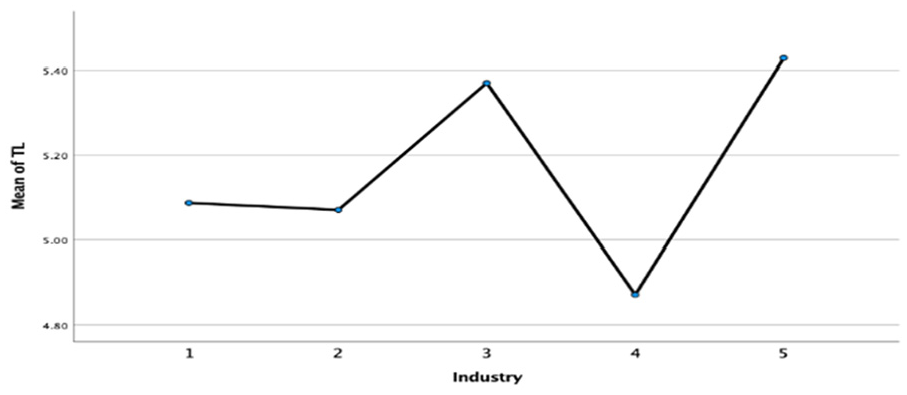
ANOVA of TL based on industry**.

ANOVA of ITeDC based on industry**.

ANOVA of DBMI based on industry*.
Measurement Model Analysis
We analyzed the measurement model for all research variables. Validity and reliability analysis of the measurement model of this study were evaluated. Research variables TL, ITeDC, and DBMI were calculated using SFL, CR, and GFI, respectively, while ORDI follows the Ping (2010) measurement because it contains formative dimensions. Table 6 presents the breakdown, and the findings indicate that the overall model fit for all variables is good.
Measurement Model.

To transform ORDI formative dimensions into an ORDI latent variable score (ORDIFS), a principal component analysis is used to determine a factor score of ORDIFS from seven formative dimensions. As suggested by Ping (2010), ORDIFS is then transformed to be a single reflective indicator of the ORDI measurement model. Figure 4 shows the component factor score of each dimension of ORDIFS
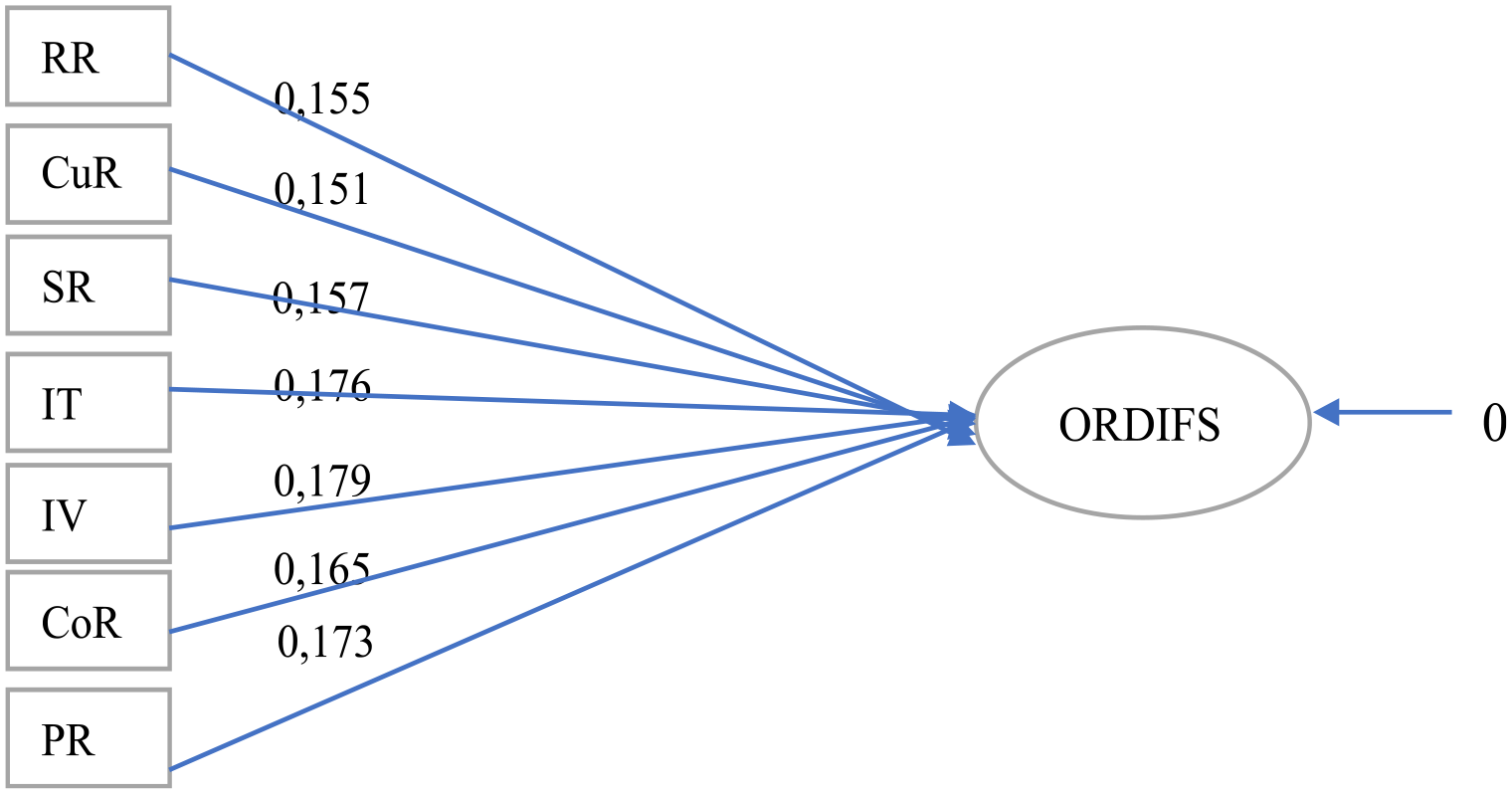
Principal component analysis for ORDIFS.
As seen from the above analysis, all standardized loading factors (SLF) range from 0.56 to 1.00, exceeding the suggested value of 0.5 (Hair, 2011). The factor loadings of seven dimensions of ORDIFS also exceed the threshold value of 0.5. The CR for all items is higher than the suggested minimum value of 0.70 (Hair, 2011), which varied from 0.66 to 0.95. Average variance extracted (AVE) varied from 0.4 to 0.84; it is higher than the suggested value of 0.5 (Fornell & Larcker, 1981; Hair et al., 2014). These findings suggest that the measurement model exhibits satisfactory evidence; hence, further structural model analysis can be performed.
Structural Model Analysis
We analyzed the measurement model from three research variables models, namely TL, ITeDC, and DBMI, which are second-order CFAs, and the theoretical model is presented in Figure 5.

Hypothesized model.
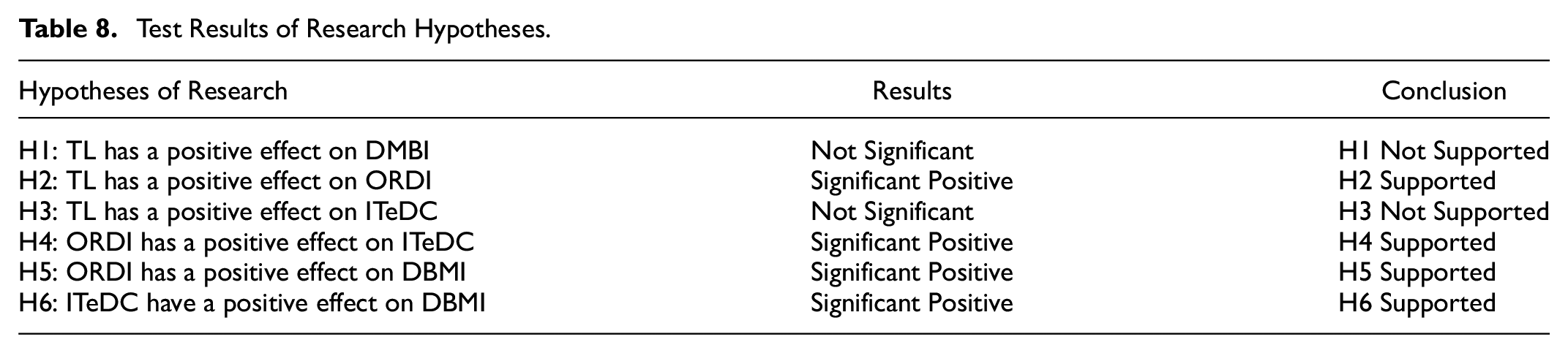
Altogether, the data support four of the six hypotheses. Table 7 summarizes the outcomes of the hypothesis testing and describes the research hypotheses, where H2, H4, H5, and H6 have significant positive results. Therefore, it can be concluded that they supported the hypotheses.
Summary of Estimation Results and Overall Model Fit.

From Tables 7 and 8, it can be concluded that TL does not positively affect DBMI (t = −0.44, p > .05); thus, H1 is not supported. TL positively affects ORDI (t = 2.94, p < .05). Therefore, H2 is supported. TL does not positively affect ITeDC (t = 1.14, p > .05); therefore, H3 is not supported. ORDI positively affects ITeDC (t = 9.77, p < .05); hence, H4 is supported. ORDI positively affects DBMI (t = 2.49, p < .05). Thus, H5 is supported. ITeDC positively affect DBMI (t = 3.68, p < .05); hence, H6 is supported. From the results above, four of six hypotheses are supported (H2, H4, H5, and H6), while two hypotheses are not supported (H1 and H3)
Test Results of Research Hypotheses.
Discussion
This study examines the relationship between DBMI and the TL behaviors of senior management. We claim that a company’s potential to attain DBMI is contingent on top management’s TL actions, which have developed as the preferred leadership style over the previous two decades (Kearney et al., 2009). In this study, as a factor that influences the work environment of the whole organization, we observed that the leadership style of top management fosters the effective and efficient adoption of DBMI throughout the organization.
Several noteworthy empirical findings are extracted from the current study. First, this study confirms the significant relationship between TL and ORDI. The findings indicate that during organizational adaptation to the digital transformation, the leaders need to demonstrate TL characteristics as they enable followers to influence change via persuasion and emphatic engagement (Shanker & Sayeed, 2012), which empower the readiness of an organization to deliver or enable innovation with digital technologies and reduces resistance to change. For incumbent firms, competent leaders are needed to balance the competing concern between the utilization of current capabilities while simultaneously developing new digital capabilities that are consistent with historical path dependencies (Svahn et al., 2017).
Second, our statistical evidence also aligns with the previous logic, confirming that the role of transformational leaders in the digital transformation context does not directly impact both DBMI and ITeDC. This notion contrasts with the common business-as-usual dynamic capabilities, mainly because digital innovation requires a new set of organizational readiness. Thus, in this condition, any strong transformational leader joining an incumbent firm has a very low chance of success in immediately developing dynamic capabilities or innovating the digital business model without adapting to the existing culture, improving IT capabilities/competencies, enabling access to cloud computing (resources), opening partnerships, improving cognitive aspects, and innovation valance.
Third, although transformational leadership does not directly impact DBMI, ORDI moderates the relationship between TL and DBMI. This outcome is consistent with Lokuge et al. (2019) who suggest that innovation can only advance if the company is willing to continually modify its innovation strategy and that change readiness is a prerequisite for the effective execution of complex change (e.g., DBMI).
Fourth, the firms’ readiness for digital innovation directly impacts ITeDC. Although organizations can now achieve agility and scalability (e.g., with hyperscale cloud platform) at a speed, cost, and simplicity that was not possible a decade ago, previous studies has demonstrated that technology is simply one piece of the complicated jigsaw that firms must solve to be successful in the digital age. Strategy (Bharadwaj et al., 2013; Matt et al., 2015), as well as alterations to an organization, including its processes (Carlo et al., 2012), culture (Karimi & Walter, 2015), and structure (Selander & Jarvenpaa, 2016) are essentials for the capability to establish new paths for value creation (Svahn et al., 2017). Additionally, established companies with low levels of digital maturity will find digital technology to be a particularly intriguing contradiction to their existing state (Vial, 2019). Thus, an organization readiness construct is required as the precursor condition to enable sensing, coordination, learning, integration, and reconfiguration using information technology.
As opposed to non-digital strategic transformation, we posit that the increasing prevalence of emergence digital technologies is altering the fundamental aspects and function of dynamic capabilities. New digital technologies, such as blockchain, cloud, and Internet of Things (IoT) platforms, are transforming the nature of dynamic capabilities since enterprises can now scale up or down operations with unprecedented speed, convenience, and cost that wasn’t accessible only a decade ago. Also, the convergence and innovative nature of ubiquitous digital technologies have made the development of dynamic capabilities a priority for a broader spectrum of companies. In accordance to the recent finding (Autio et al., 2018), digitalization is convincing established firms to be more entrepreneurial when given the strategic imperative to build a system with ITeDC that addresses the unprecedented threats posed by the decoupling and disintermediation of existing value chains in order to create new DBMI. Therefore, ITeDC are significantly impacting DBMI.
Conclusion and Recommendation
Our research offers scholars with important findings and recommendation. First, our finding indicates that most established firms in Indonesia, particularly B2B2C and B2C industries, have started to innovate their digital business model and all of them already developed a certain degree of organizational readiness for digital innovation (such as digital talent resources, cultural, strategic, IT, Cognitive, Partnership readiness, and innovation valance). Most importantly, based on our path analysis the presence of ORDI is a pre-condition for an effective DBMI of established firms. Without ORDI, ITeDC will not be able to be effectively implemented and TL alone may not be able to effectuate DBMI.
Second, during pandemic the situation was quite challenging for these leaders as most of the companies were in a work-from-home situation. They are thrived through kindness and empathy, promoting changes with their intellectual stimulation, creative inquiry, determination, and inspiration-motivation. Transformation leadership has important role to play in influencing established firms to change and have a certain degree of organizational readiness for the successful development and implementation of DBMI. This notion is aligned with Engelen et al. (2014) whose finding indicates that transformational leaders, who are characterized by inspirational leadership that intrinsically motivates and stimulates employees, are crucial for innovation. Moreover, also consistent with previous research stating that leadership can indirectly influence business model innovation (Kreutzer et al., 2018; Wasono et al., 2018). The results also reveal that for the context of established firms, transformational leadership positively impacts ORDI to drive ITeDC and DBMI, hence making a powerful case for the importance of an established organization to deeply connect its strategic thinking with its IT architecture and structure for innovation.
Lastly, the study indicates that established firms have access to the same digital technology and infrastructure platform used by startups disruptors (with the availability of global hyperscale cloud computing providers data analytics, AI/ML, infrastructure modernization and scalability as a-services solution). What makes it different is how they can quickly adapt their organizational key innovation readiness to allow them harnessing dynamic capabilities enabled by digital technology that will allow them to sustain their competitive advantage by continuously innovate their digital business model. Therefore, successful DBMI practice begins with organizational adaptation by improving its readiness to outpace its competitors.
Research Limitations and Future Direction
There are some limitations of this study. First, the research only convers Indonesia companies, which is one of the fastest-growing emerging country and the timing coincided with the peak of the pandemic when most of the population was in quarantine. Thus, this unique context may not be applicable to the other emerging and developed countries. Second, the context of this study only includes well-established firms (listed on the Indonesian Stock Exchange); therefore, future research should involve established small-medium enterprises to understand the different characteristics.
Third, this study is not comparing transactional and transformational leadership approach, including this in the future research will enrich the insight and finding. Fourth, this is a firm-level/organizational level study which may missing some of the important nuance on the micro level, for example the correlation between leadership and self-efficacy during digital transformation. This limitation is an opportunity to address it in the future study. Lastly digital transformation is an evolving process of business model adaptation and internal adaptation, therefore, future studies should incorporate longitudinal research to better understand the dynamics.
Footnotes
Declaration of Conflicting Interests
The author(s) declared no potential conflicts of interest with respect to the research, authorship, and/or publication of this article.
Funding
The author(s) received no financial support for the research, authorship, and/or publication of this article.
