




Abstract
Written corrective feedback in Second Language Writing is one of the most important parts in L2 Acquisition and Language Teaching. CiteSpace is a convenient and effective bibliometric analysis tool which is widely used by researchers to explore the development tends of a certain field. The Web of Science core collection database was used as the primary source for data collection. There were 272 effective articles were selected from 2001 to 2021. The hot research topics in recent 20 years and emerging trends were showed. It was found that the research of written corrective feedback has entered a period of rapid development after the accumulation of basic knowledge in the early stage. Many empirical studies have been carried out. The distribution, cooperation, development trends and hotpots of current research are presented through visual map analysis in this study. In the future, the written corrective feedback research could try to concentrate on the psychological process and feedback providers, and it is also suggested to combine interdisciplinary knowledge such as education, psychology, neurology, etc., and use new research and measurement methods to promote the development of written corrective feedback.
Introduction
Research on written corrective feedback (WCF) in second language writing as a key interface between second language acquisition and language teaching practice has attracted much attention from researchers. Since Truscott (1996) proposed that error correction feedback is invalid, Ferris (1997) claimed that the evidence for this conclusion is insufficient and then a series of empirical studies were carried out to confirm the effectiveness of corrective feedback (Benson & DeKeyser, 2019; Bonilla López et al., 2018; Ekanayaka & Ellis, 2020; Ferris et al., 2013; Kang & Han, 2015). However, Truscott insisted on his original view that written corrective feedback is ineffective, and objected to the subsequent empirical research that written corrective feedback is effective. He also advocated that teachers should directly give up written corrective feedback in writing class, and spend more time on other aspects (Mohebbi, 2021). Yu et al. (2021) believed that written corrective feedback can improve the accuracy of writing, but it is bad for students’ emotion, motivation and social relationship. Due to the intricate influencing factors involved in corrective feedback, the effectiveness of corrective feedback and the difference among different feedback types have not yet reached a consensus (Lee, 2014). Written corrective feedback or error correction in second language writing has been developed for more than 20 years and has made great progress in many aspects. Therefore, it is necessary to summarize and analyze the research progress of the past 20 years in order to better guide the future development.
There are some reviews of written corrective feedback in second language writing, but the reviews mainly focused on specific and detailed aspects. From the perspective of macro research, the published empirical studies were reviewed and analyzed through five macro aspects of corrective feedback research, including sample characteristics, research design, data processing, data reporting, and changes in research over time Liu and Brown (2015). Kang et al. (2019), Mao and Lee (2020) and other researchers used classification summary, meta-analysis and other methods to review and analyze the existing references. Reinders and Mohebbi (2018) integrated the problems existing in empirical research on written corrective feedback over the past 30 years, and puts forward suggestions for improvement in research design, variable control, etc. From a micro research perspective, many scholars have also integrated the specific empirical studies to analyze the effectiveness of feedback, compare the difference of feedback types and feedback attitudes (Bahari, 2021; Karim & Nassaji, 2020; Zhang, 2020; Zheng & Yu, 2018).
These reviews are mostly based on the content itself and ignore other information. Therefore, current research lacks comprehensive research that combines macro and micro levels. This study try to fill this gap and contribute to the future research in the following way: (1) This study provided a panoramic picture of the WFC in the past 20 years and predicted the future direction; (2) Based on the current research, this study gave some possible suggestions for future WCF researchers.
This study used bibliometrics to review and depict the whole landscape of written corrective feedback. In order to give more information about WCF and direction for future research, this study is guided by the following questions:
What is the trend of publication outputs in WCF?
What is the distribution of the current WCF research?
What are the hotpots of WCF?
What will be the research prospect of WCF?
Bibliometrics is the use of mathematical and statistical methods to describe, evaluate and predict the status quo and development trend of a certain field. The most essential feature is quantitative analysis. Because bibliometrics is supported by databases, classification and visualization, it will present objective, systematic and repeatable research results, greatly reduce the subjectivity and personal bias brought by traditional declarative reviews.
Methods and Data Collection
In present research we collected data from Web of Science core collection database (WOS). The search formula was: TS = Topic: “written corrective feedback” OR “error correction” OR “CF” OR “grammar correction” AND “second language writing (L2 writing).” The time span is set from January 1, 2001 to May 30, 2021. The document type was set as “Article,” and the publication language was set as “English.” Finally, the result obtained a total of 272 PTG-related references. We downloaded all articles and stored them as TXT format files. These files included titles, authors, abstracts, keywords, identifiers, descriptors, etc. The software package was CiteSpace, which was used for the bibliometric analysis (Chen, 2006). CiteSpace software created the visualization knowledge maps that mainly were comprised of nodes and links. The time slice was set to 1 year, and the term source was the title, abstract, author, keywords, and supplementary keywords. The node types, including country, institution, journal, author, keyword and reference were respectively selected according to the research needs. Author, institution cooperation network analysis keyword co-occurrence analysis and reference co-citation analysis were the core of this study. The connection strength was the default value Cosine, and the threshold value was set to the Top 50 or Top 30 in each time slice according to the needs of each node. The visualization results of the cooperative network and the co-occurrence network are tailored by Pathfinder and Pruning the merged network to make the maps more prominent.
Results
Analysis of Time and Publication Outputs
The amount of publications in a certain research field and its changing trend in a certain period can well reflect the accumulation of basic knowledge and predict the future development of this field. Therefore, this paper used the bibliometric method to conduct a statistical analysis of the 272 effective articles retrieved from the researches on written corrective feedback in second language writing (Figure 1). On the whole, the number of articles in this field showed a linear growth trend, indicating that the study of corrective feedback in second language writing in the past 20 years has received continuous attention from scholars. The theoretical and practical values will continuously attract scholars to do further research. Thus there is still huge room for breakthrough development in corrective feedback in second language writing. Specifically, the evolution of publications could be divided into two periods. The first period developed slowly during the 2001 to 2009, and there were not many related articles, but most of them that appeared in this period were highly cited, which indicating this period is in the early stage of formation and development of theoretical basis for the study of written corrective feedback in second language writing. After 2010, the number of articles published increased significantly, and reached a peak in the past 20 years in 2019 (except 2021 for the lack of data). It can be seen that after the accumulation of knowledge in the previous period, the research on written corrective feedback in second language writing entered into a rapid development period. The scholars in this field are deeply concerned and continue to incorporate new research perspectives and inject new vitality. In summary, the research on written corrective feedback in second language writing will still attract more and more attention and be the research hotspot in the future academic community.

The annual output of corrective feedback in L2 writing.
Analysis of Journals, Countries, Institutions and Authors
About the source of the literature, the top five journals in terms of the number of articles published on written corrective feedback in second language writing are given below (Table 1), among which JOURNAL OF SECOND LANGUAGE WRITING in the United States and SYSTEM in the United Kingdom are the most representative, accounting for more than 30% of the total number of articles published. The number of papers published in LANGUAGE TEACHING RESEARCH, COMPUTER ASSISTED LANGUAGE LEARNING and STUDIES IN SECOND LANGUAGE ACQUISITION is also high. The number of papers published in these five journals reached nearly half of the literature volume of this study. In addition, these five journals have a central position in the field of second language acquisition and second language writing, and thus are recognized internationally as authoritative and high-quality journals. Most of these journals are from the United States, indicating that the research on written corrective feedback in second language writing has been more mature in the United States. Other countries are suggested to accelerate the pace of research and create relevant academic journals to promote influence.
Top 5 Most Productive Journals of Written Corrective Feedback in L2 Writing.

The centrality of the authors in a certain field and their cooperation can reflect the core scholars in this field and the cooperation between them. The distribution of research institutions and countries can show the research centers and the cooperation of them can provide readers with information about the distribution of major scholars and major research institutions in this field. Select Author, Institution, and Country as the analysis node type and use Citespace to analyze the collaborative network map of the authors, institutions and countries (Figures 2 and 3).

The cooperation network of country and institution.

The cooperation network of author.
From a macro point of view, researches on written corrective feedback in second language writing initially began in the United States and then gradually developed in other countries. The United States is at the center of all participating countries which including China, Australia, North Korea, the United Kingdom, Canada etc. From the size of the nodes in the figure, it can be seen that the United States has the highest amount of publications. By checking the detailed information of each node, it was found that the amount of published documents in China, the United Kingdom, Australia, Japan and other countries has increased rapidly in recent years. This showed that the research on WCF in second language writing has formed a development situation led by the United States and developed in parallel with many other countries.
From the perspective of the distribution and cooperation between micro institutions and scholars, the main research institutions in this field are the University of Auckland, the University of Melbourne, the University of Michigan, Georgetown University, Nanyang Technological University, the University of California, the University of Macau, and Brigham Young University, Hong Kong Chinese University, Shanghai International Studies University, Beijing Normal University and Chongqing University. From the perspective of the collaboration among the research institutions, there are two major cooperation centers in the University of Oakland and the University of Michigan. The universities in China have formed a relatively close relationship with many foreign and native research institutions, such as Shanghai International Studies University, the University of Oakland, Beijing Normal University, Beijing Institute of Technology and Chongqing University.
There are many famous productive researchers on written corrective feedback in L2 Writing, such as Rod Ellis, John Bitchener, John Truscott, Dana R Ferris, Ice Lee and many other famous and academic linguists, these well-known linguists have collaborated in books (Bitchener & Ferris, 2012). And in 2019, Dana Ferris and Icy Lee co-presented on the symposium on Second Language Writing, which promote the development of written error correction feedback research. However, the literature type retrieved in this study is article, which failed to show a clear cooperative relationship. Therefore, scholars are hoped to strengthen cooperation in papers.
Analysis of Key References
The key information of a research field can be quickly learned by analyzing the key node reference. Highly cited references and highly co-cited references can reflect the research hotspots, future development trends and the basic knowledge of this research field. Truscott (1996) proposed that grammatical correction is not only useless to improving the grammar accuracy of learners’ second language writing, but will bring adverse effects at the same time. Therefore, grammatical error correction in second language writing should be abandoned. After the publication of this research, many debates on the validity and effectiveness of written corrective feedback in second language writing appeared continuously. Numerous empirical studies in feedback types, feedback providers, and feedback time and so on facilitate the quick development of this field.
Analysis of Highly-Cited References
Through bibliometrics and CiteSpace co-cited network visualization map analysis, the highly cited and co-cited references of the on written corrective feedback in second language writing are listed respectively. Based on the WOS database, the top five most cited papers in the research on written corrective feedback in second language writing in the past 20 years are listed in the following table (Table 2). The reason why highly cited empirical researches are recognized by scholars is the rationality and scientificity of experimental design in addition to the value of research questions and methods. Bitchener published an article in 2008 which integrated the empirical researches of written corrective feedback and found that some studies did not have a control group; some studies of writing experimental tasks are only the modification of errors, which means the limitations in research design. The highly-cited references have control groups in their research design, and the test task is subject to the influence of the new writing tasks rather than just the modification of the errors in original texts. Thus it is considered more scientific and reasonable. In addition, most of the researches are concerned with the comparison of effects of explicit and implicit error correction or the verification of the six concrete feedback types of written corrective feedback. These are the most attractive and important research points of written corrective feedback in second language writing, so they were cited many times.
Top 5 Highly-cited References and Their Authors.

Analysis of Co-citation References
The analysis of co-citation network mapping revealed that the key nodes with high co-citation frequency and high mediating centrality are Bitchener (2008, 2012a, 2012b), Bitchener and Knoch (2008, 2010a, 2010b), Kakh and Bitchener (2016), Ellis et al. (2008), Ferris (2010), Kang and Han (2015), Liu and Brown (2015), Zheng and Yu (2018) (Figure 4). Most of Bitchener’s studies are empirical studies comparing experimental and control groups. He often use definite articles and indefinite articles as linguistic points for written corrective feedback in English; He also summarized the development of written corrective feedback in the context of the theories in terms of Krashen’s monitoring theory, McLaughlin’s skill acquisition theory and Vygotsky’s sociocultural theory. The debate between Ferris and Truscott is the most intense and can be understood as a debate between language performance and language competence or “learning” and “acquisition.” Beuningen’s study found that written corrective feedback was effective and further noted that direct feedback was effective for grammatical correction and indirect feedback for non-grammatical correction. This challenges Truscott’s view that error correction feedback is only effective for ungrammatical errors. And a study of Zheng and Yu (2018) is based on Ellis (2010) proposal of students’ responses to corrective feedback, including affective responses, behavioral responses, and cognitive responses. Through the empirical study the lower level second language learners had high emotional responses to teachers’ error correction feedback, but poor behavioral and cognitive responses. It was found that the lower level second language learners had high emotional responses to teachers’ written correction feedback, but poor behavioral and cognitive responses. To a certain extent, this suggests that students are willing to accept teachers’ feedback, but the effectiveness of the feedback needs more empirical researches due to individual student differences and the characteristics of the language itself (Ene & Kosobucki, 2016).
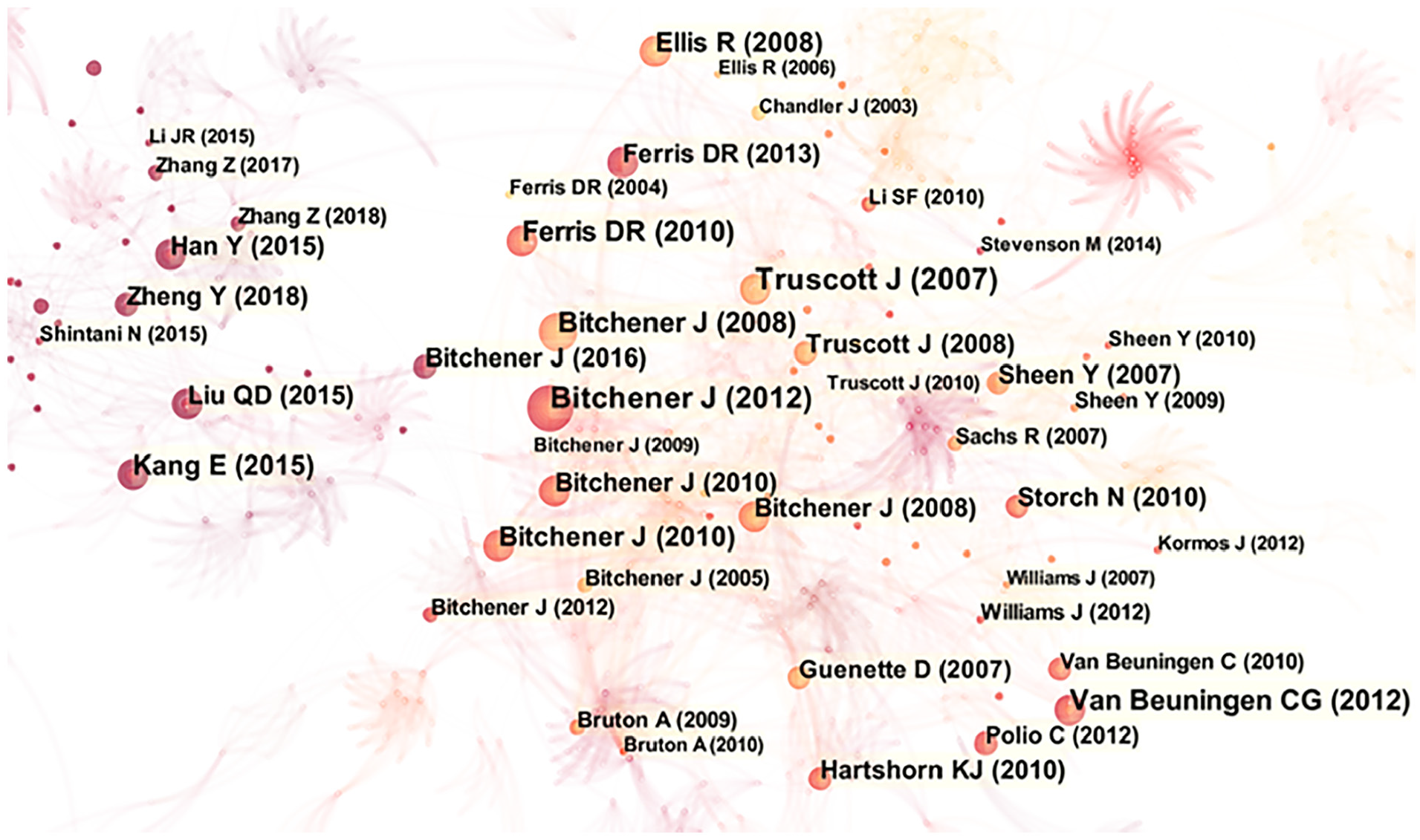
The visualization mapping of co-citation references.
Hot Research Topics and Emerging Trends
Analysis of keywords
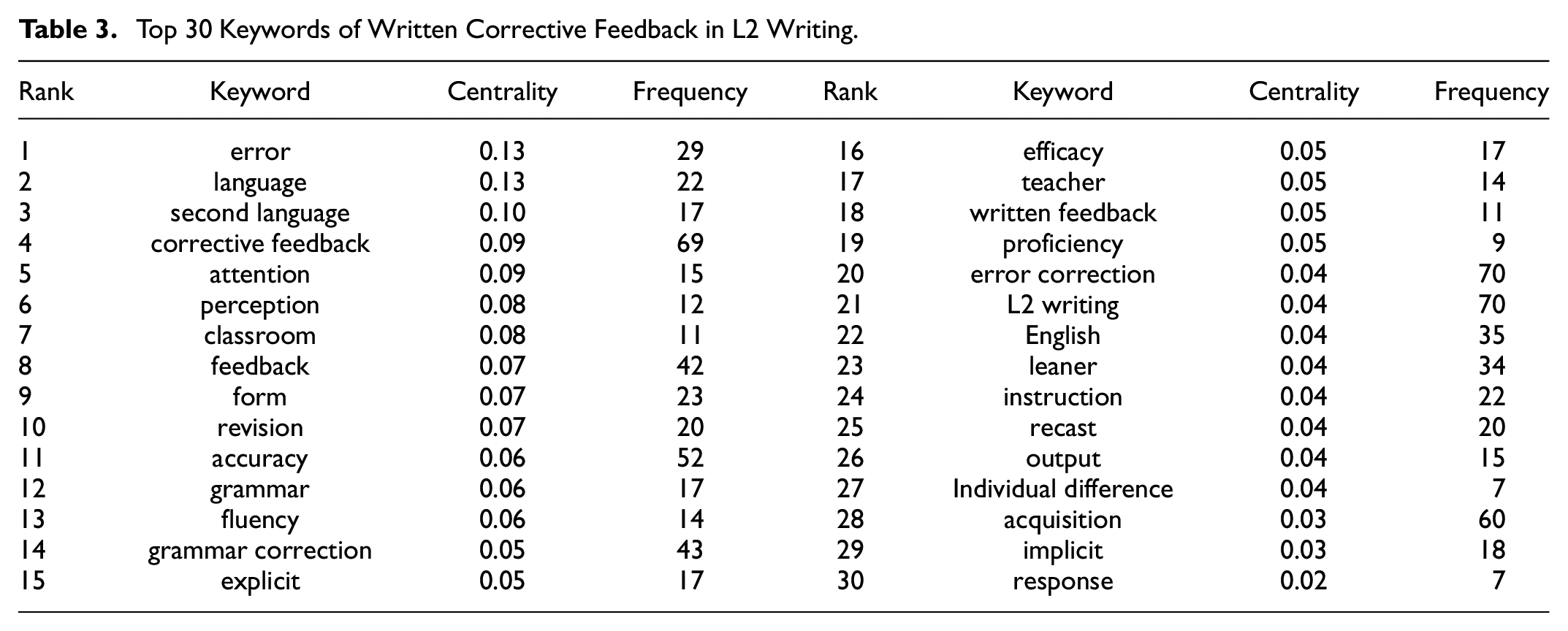
Keywords can reflect the core theme and central content of the text, so the keyword co-occurrence analysis can be used to explore the hotspots of research related to written corrective feedback in second language writing and to reveal the relationship between the hotspots. The frequency and centrality of the keywords (Table 3) show that the high frequency keywords are “second language writing,” “corrective feedback,” “error correction,” “grammar correction” and so on. The keywords with high centrality (Centrality refers to the number of times a node acts as the shortest bridge between two other nodes) are “error,” “language,” “second language,” “error correction,” “grammar correction,” etc. However, frequency and centrality are not necessarily correlated; for example, the keyword “fluency” has a relatively low frequency, but its centrality is high; the keyword “acquisition” has a quite high frequency, but a low centrality. The analysis shows that the keywords with high centrality are generalized, macroscopic topics in that research field and have strong links with other specific brands. The specific feedback types such as “implicit,” “explicit,” and “restatement” only reflect one aspect of the research on corrective feedback and are the controlled variables in empirical research, and therefore cannot be closely related to the other keywords. However, representative research hotspots take both the frequency and centrality into consideration.
Top 30 Keywords of Written Corrective Feedback in L2 Writing.
The keywords were extracted from the 272 valid articles through Citespace to form a keyword co-occurrence network knowledge map (Figure 5). The keyword co-occurrence analysis provides a clear indication of where current research has been more richly developed. It is clear from the figure that a large number of studies have focused on the effectiveness of written corrective feedback in second language writing (Lee, 2019, 2020): The comparison of two major corrective feedback types, direct and indirect feedback types; The main content of error correction is the correction of grammar in writing (Kang & Han, 2015; Kim et al., 2020); Repetition and prompting are settled as the most common specific methods according to the statistics; Fluency and accuracy (Kim & Emeliyanova, 2021) as the common criteria for judging the effectiveness of feedback; Teacher feedback as the most common source of feedback; And the influence of individual differences on error correction feedback are also been studied.
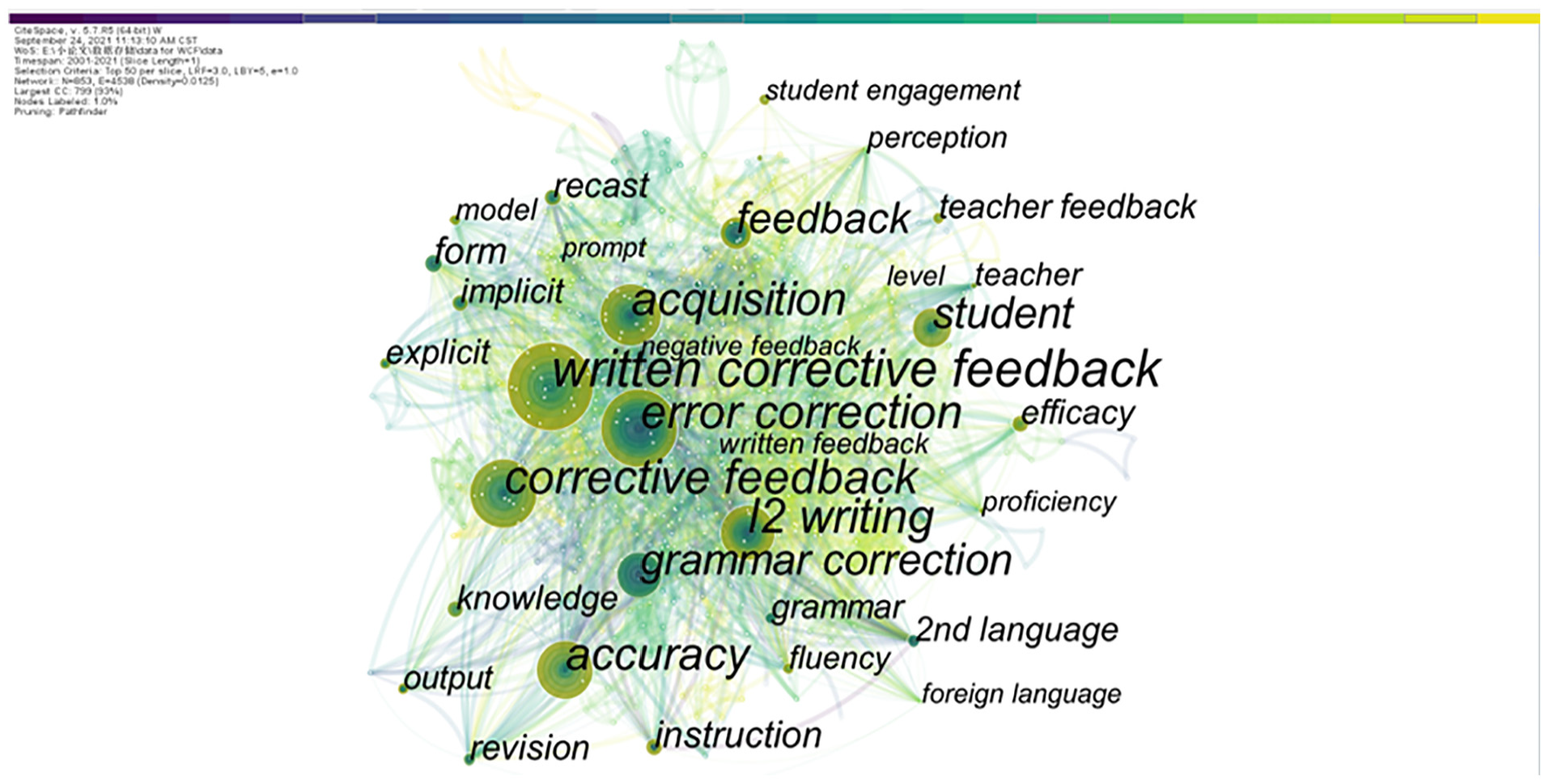
The visualization mapping of keywords co-occurrence network.
The keyword co-occurrence knowledge map also reflects the weaknesses in the research on written corrective feedback in second language writing. With the development of computer-assisted language learning and teaching, online automatic corrective feedback should be further developed in this field. There is still a lack of research on online automatic corrective feedback and the research approach is relatively homogeneous, with only some scholars conducting preliminary explorations of online automatic corrective feedback (Koltovskaia, 2020; Ranalli, 2018; Shintani, 2016; Zhang & Hyland, 2018; Ziegler, 2016). The source of feedback is primarily teacher feedback, with few studies on peer feedback or a combination of teacher and peer feedback (Boggs, 2019). Some scholars have examined students’ affective attitudes and responses to error correction feedback, but the relative researches are quite few. And even fewer studies on teachers’ affective attitudes as providers of corrective feedback (Han, 2017; Han & Hyland, 2019; Junqueira & Payant, 2015; Yu et al., 2019); Corrective feedback contents are mainly focus on the grammatical errors, such as how to use articles, prepositions, tenses etc., and few studies are on ungrammatical errors. So these studies have limitations to consider the impact of language complexity to corrective feedback. There is also a lack of research that combines theories of second language acquisition and teaching with written corrective feedback in second language writing (Storch, 2018); The research on written corrective feedback in second language writing is relatively homogeneous and lacks the study of multimodal feedback (Elola & Oskoz, 2016). There is also a lack of interdisciplinary research that combines written error correction feedback in second language writing with high-tech measures such as neurology (El Ebyary & Windeatt, 2019). In addition, written corrective feedback in second language writing as an interface between second language acquisition and language teaching has not been adequately studied in conjunction with theories of second language acquisition and pedagogy.
Overall, there are 876 nodes and 4,613 links in the keyword co-occurrence network map, but the density is only 0.012, which shows that the co-occurrence network is loosely structured and poorly connected. Future research should not only focus more on the aspects that lack attention in the existing studies mentioned above to broaden the research width, but also delve deeper into the existing studies to increase the depth and avoid superficiality.
Analysis of developing trends
During the period of 2001 to 2021, the timezone distribution of keywords in the research on written corrective feedback in second language writing is shown in Figure 6. Through the analysis we can roughly divide the research in this field into three stages, the first stage is in the initial period of research (2001–2006), the number of relevant articles in this stage is small, written corrective feedback research is mainly based on two representative figures Truscott and Ferris’ views on whether written corrective feedback is beneficial to improving students’ writing ability. In the following years, scholars began to explore the effectiveness of corrective feedback in relation to their views. In terms of key words, the focus of research during this period was on whether error correction and language repair could improve “accuracy” and “fluency” in writing; The second stage was a period of rapid research development (2007–2012), during which empirical research developed rapidly, shifting from the first phase of whether it was effective to the second phase of differences in effectiveness caused by different types of feedback, individual differences and other factors. The key words from this stage are mainly “explicit,” “implicit,” “individual differences” etc. A large number of empirical studies have been conducted by scholars in this stage, but there are still shortcomings in experimental design and variable control, making the conclusions of numerous studies inconsistent; The third stage is the period of research transformation and development (2013–2021), after the accumulation of the previous studies, the research in the third stage begins to break through the way of a single empirical study, and the research perspective continues to expand and begins to emerge with the second language acquisition theory, the computer technology, psychology, neuroscience and so on. However, the development of comprehensive research on written corrective feedback in second language writing is still slow. The future research needs to use science and technology to assist written corrective feedback research.

The timezone view of keywords.
Discussion and Implication
Based on the findings of the visualization, we provide a discussion and explanation of the existing researches on written corrective feedback.
First, the current research has formed a relatively clear research trend: the transition from basic research to extended research (Figure 7). Basic research in written corrective feedback mainly includes quantitative and empirical researches in terms of feedback effectiveness, the comparison of different feedback types and the time of feedback and so on. Extended research expands the research scope on the basis of basic research. Extended research shifts from the effectiveness of written corrective feedback to the mechanism of feedback process. In other words, how the written corrective feedback impact students writing ability. Extended research introduces many theories to explain the intrinsic mechanisms of written corrective feedback. Many researchers use learning engagement to explain the inner process of written corrective feedback for students’ writing ability (Ellis, 2010; Fredricks et al., 2004; Han & Hyland, 2015). Working memory, which belongs to psychology and neuroscience, has also been used to explain the effect of written corrective feedback (Boggs, 2019). From the perspective of sociocultural linguistics, some researchers use the zone of proximal development to explain the reasons why written corrective feedback can improve writing ability (Xiao, 2017). During the past 20 years, empirical and quantitative researches have accumulated a wealth of knowledge for written corrective feedback. However, written corrective feedback is a very complex and intricate process, the previous studies focusing on control variables did not reach a consensus on the effectiveness of written corrective feedback (Lee, 2014). Therefore, in order to provide an in-depth explanation for the intrinsic mechanism, the basic research gradually expands the research content, methods and relevant theories.

The framework for research on written corrective feedback in L2 writing.
Second, the debate on the effectiveness of written corrective feedback is ambiguous in definition. The most controversial aspect of written corrective feedback is the debate over the effectiveness and this debate has never ceased since Truscott proposed it in 1996. Truscott once explained that it is not reliable to use accuracy and fluency as the standard to measure the improvement of students’ second language writing ability and the effectiveness of written corrective feedback (Truscott, 2007). In the 2021 interview, Truscott insisted on the point that written corrective feedback, raised many years ago, is not helpful for improving L2 writing (Mohebbi, 2021). But researchers represented by Bitchener, Ellis, Ferris and the following researchers believed that written corrective feedback is effective (Sarré et al., 2021). The debate on this question has similarities with Krashen’s “learning” and “acquisition,” Chomsky’s “competence” and “performance,” and DeKeyser’s “declarative and procedural knowledge,” and the interface between implicit and explicit knowledge. However, in the field of second language acquisition, there is no unanimous conclusion as to whether “learning” can be converted into “acquisition” and to what extent “performance” reflect “competence.” As a result, the lack of clarity in the research terms in this field can lead to ambiguity in the interpretation of research findings.
Third, written corrective feedback research is gradually developing from a single discipline to interdisciplinary and comprehensive research. Linguistics, education and psychology, as three closely related disciplines, play an important role in the research on written corrective feedback. Many of previous researches on written corrective feedback are linguistic explanation. According to structural linguistics or behaviorism, error correction cannot improve students’ writing ability. But cognitive linguistics believes that the process of corrective feedback is a process of strengthening students’ attention (Hanaoka & Izumi, 2012), while the ZPD in sociocultural theory believes that corrective feedback can fill the gap between the current writing ability and the future progress in students’ writing (Storch, 2018). At the same time, with the development of computer-assisted language teaching and learning, the development and application of online automatic corrective feedback software will provide more data support for the research of written corrective feedback (Xu, 2021; Zhang, 2020). With the cooperation of linguistics and psychological research, researchers began to analyze the psychological changes of students when receiving feedback from an ecological perspective (Han, 2019). Studies have shown that written corrective feedback can improve the accuracy of students’ second language writing, but the process of feedback can also damage students’ emotions, motivation, and social relationships (Yu, Geng et al., 2021). This is very similar to Brown and Levinson’s Face Theory, providing feedback is a face threatening act for both the provider and the receivers. These all reflect the development of written corrective feedback research from a single linguistics to multidisciplinary integration development. We also present some future research prospects on written corrective feedback to expand current research and spur further research.
(1) Future research should pay more attention to the psychological process of students in the process of written corrective feedback. Students’ response to feedback is approximately considered to be the process of learner engagement (Yu & Yang, 2021), which mainly includes three dimensions: emotional or affective engagement, cognitive engagement and behavioral engagement. Specifically, affective engagement means students attitude or positive/negative feelings toward feedback, whether students are willing to accept feedback or what types feedback they prefer; cognitive engagement means students perception or views of written corrective feedback; behavioral engagement means students’ concrete revision on their writing (Han & Hyland, 2015; Zhang & Hyland, 2018; Zheng & Yu, 2018). Researchers can use questionnaires and in-depth interviews to understand the psychological feelings of students in the process of written corrective feedback, rather than just evaluating the test scores or new writing task performance after feedback. Paying attention to the psychological process of the receivers can also reflect individual differences, such as age, gender, language levels and other aspects of written corrective feedback. Individual differences can affect students’ psychological feelings in the process of written corrective feedback.
(2) Future research should continue to expend methods and theories. From the perspective of research methods, more qualitative researches are needed. Researchers can use case analysis, in-depth interviews, classroom observation and other qualitative research methods to collect data. They can use meta-analysis, grounded theory and other methods to deeply explore the inherent nature and mechanism of written corrective feedback in second language writing. In terms of experimental measurement, scientific medical imaging technology can be used to measure the internal and psychological change of students. By using objective measurement methods such as eye-tracking, think-aloud, fMRI and ERP (event-related potentials) imaging technology, the measurement result will be more scientific and can reduce the bias caused by subjective methods (El Ebyary & Windeatt, 2019; Suh, 2020). From a theoretical point of view, future research should combine more theories form linguistics, education and psychology to expend the research scope and dive into the deep layer to provide scientific explanation for the effectiveness of written corrective feedback. Future research needs further exploration on the intrinsic connection of written corrective feedback and learning engagement, working memory, zone of proximal development, scaffolding, noticing hypothesis, ecological psychology and positive psychology (Boggs, 2019; Goo, 2012; Hanaoka & Izumi, 2012; Li & Roshan, 2019; Xiao, 2017; Yu, Zheng et al., 2021). These will be powerful tools for exploring the internal mechanisms.
(3) Future research should pay more attention to the providers of written corrective feedback and the cooperation of feedback providers. In previous research, the objects of written corrective feedback were mainly students in foreign language classroom. The performance of students after feedback attracted more attention. Due to the different languages, cultural backgrounds and social relations of the providers, different feedback providers may make difference in the final results and second language writing ability. Research shows that native language and non-native language teacher pay different attention to students’ error. Native language teachers tend to provide a full range of feedback, not only grammatical errors, but also the organizational structure of writing. Non-native teachers tend to focus more on grammatical errors (Bal-Gezegin, 2015; Cheng & Zhang, 2021). Teacher feedback, peer feedback and online automatic feedback should be deeply integrated. Online automatic corrective feedback can correct students’ grammatical errors in time and protect students’ face at the same time. Compared with teacher feedback, peer feedback is a two-way feedback that can enhance negotiation among students. Teachers are still the main provider of written corrective feedback and teachers can give different feedbacks according to different writing tasks and students’ English level (Lee, 2017; Ruegg, 2015). Therefore, future research should further explore the feedback providers and seek cooperation and combination in order to promote the development of written corrective feedback research.
Conclusion
This study reviewed 272 written corrective feedback articles in the past 20 years. Through the bibliometrics and visualization, the publication outputs, research distribution, current hotpots and research trends were objectively and systematically presented. According to the results of this review, researchers may be encouraged to do more qualitative researches and use more scientific and convincing measurement approach. Language teachers can have a better understanding on written corrective feedback and adjust their feedback strategies in second language writing. Therefore, future research should continue to explore written corrective feedback to provide academic support for second or foreign language learners, educators, and the development of education. There are also some limitations in this study. We retrieved articles in the core database of WOS and did not include other databases, conferences, books, etc., the following research can expand the database and include other kinds of reference types. According to research needs, this study did not visualize all aspects in CiteSpace, such as keyword burst, clustering, etc., so future research can continue to explore these areas. However, this study still provides a panoramic presentation and analysis of the current research and provides some possible suggestions on the future written corrective feedback research.
Footnotes
Declaration of Conflicting Interests
The author(s) declared no potential conflicts of interest with respect to the research, authorship, and/or publication of this article.
Funding
The author(s) disclosed receipt of the following financial support for the research, authorship, and/or publication of this article: This research was funded by the Humanities and Social Science Youth Fund of the Ministry of Education in China grant number 17YJCZH130.
Ethics Statement
The studies involving human participants were reviewed and approved by Tianjin Normal University Ethics Committee. The participants provided their written informed consent to participate in their study. Written informed consent was obtained from the individuals for the publication of any potentially identifiable images or data included in this article.
