




Abstract
In order to reduce the environmental pollution of economic development, countries around the world pursue high-quality economic development model. However, the relationship between R&D investment agglomeration and high-quality economic development has not been thoroughly revealed in existing studies. Taking 30 provincial-level regions in China from 2009 to 2018 as research samples, this paper empirically examines the relationship between regional R&D investment agglomeration and high-quality economic development by using system GMM method and spatial econometric model. Theoretical analysis shows that regional R&D investment agglomeration promotes regional high-quality economic development by increasing regional knowledge capital, improving innovation efficiency, and promoting knowledge spillovers through scale effect, synergy effect, and spillover effect, respectively. The empirical results show that regional R&D investment agglomeration can significantly promote regional high-quality economic development. The degree of regional integrated innovation can positively adjust the promotion effect of regional R&D investment agglomeration on regional high-quality economic development. Regional R&D investment agglomeration can effectively promote the high-quality economic development of surrounding regions.
Keywords
Introduction
China’s rapid economic growth has led to environmental pollution, climate warming, and other problems, which have greatly reduced people’s quality of life. In order to meet the people’s growing needs for a better life and address the problem of unbalanced and inadequate development, China’s economy has shifted from a stage of high-speed growth to a stage of high-quality development from 2017. According to the report on the Work of the Chinese Government in 2022, China relies on innovation to improve the quality of development, supports local governments to increase investment in science and technology, and carry out regional innovation with their own characteristics. The in-depth implementation of regional development strategies, for example, the development of the Guangdong-Hong Kong-Macao Greater Bay Area, the development of the Yangtze River Economic Belt, and the coordinated development of the Beijing-Tianjin-Hebei region, highlights the important role of element agglomeration in economic development (Lu et al., 2021; Shao et al., 2019). In recent years, strengthening element agglomeration, especially innovation element agglomeration, has gradually become the focus of attention in various regions, and strengthening the agglomeration of regional innovation elements is a key measure to promote high-quality economic development. R&D investment is an important kind of innovation element, no other innovation element works without R&D investment. How does regional R&D investment agglomeration play a role in high-quality economic development? What is the relationship between the two? Clarifying the above issues will help to provide theoretical basis for the successful implementation of innovation-driven development strategy from the perspective of innovation elements.
On the relationship between element agglomeration and economic development, based on the data of 578 manufacturing enterprises, Lee et al. (2013) found that industrial agglomeration has a positive effect on enterprise productivity. Castells-Quintana and Royuela (2014) pointed out that agglomeration processes can be associated with economic growth, at least in countries at early stages of development. Camagni et al. (2016) believe that factor agglomeration can cause agglomeration economic effect, and the constant interaction of different factors in a certain region can improve innovation performance and economic development level. Lai et al. (2016) believed that innovation element agglomeration varies from region to region, and innovation resource agglomeration can promote sustainable economic growth by improving regional innovation capacity and promoting the development of high-tech enterprises. Wahl (2016) found that there is a robust connection between medieval city growth and contemporary regional agglomeration and industry concentration. Hao and Zhang (2018) pointed out that element agglomeration is the long-term driving force of regional economic growth and plays an important role in regional economic growth and economic structure adjustment. S. Q. Zhang (2018) found that factor agglomeration can improve factor allocation and utilization efficiency, thus promoting regional economic development. W. Wei et al. (2020) explored the effect of industrial agglomeration on total factor productivity through the smooth transition model, and found that high agglomeration does not always promote the growth of total factor productivity, and moderate agglomeration in various regions is conducive to promoting economic development. Wang et al. (2021) found that innovation capital agglomeration can positively promote the high-quality economic development of the region, but will inhibit the high-quality economic development of surrounding regions. Hardjoko et al. (2021) found that the combination of industrial agglomeration policies coupled with accelerated sectoral growth, hard infrastructure development, and soft infrastructure provided the best policy outcome, improving regional inequality and accelerating economic growth in East Java. Cui and Chai (2022) believed that the agglomeration of innovative talents has nonlinear influence on the high-quality development of urban economy.
Existing researches mainly focus on exploring the impact of industrial agglomeration and innovation element agglomeration on economic growth, and do not fully reveal the impact of regional R&D investment agglomeration on high-quality economic development. In addition, in the regional innovation system, improving the degree of regional integrated innovation can continuously promote the integration and creation of regional knowledge, accelerate the transformation of innovation achievements, and improve the quality of economic development. Existing studies have not revealed whether the effect of regional R&D investment agglomeration on high-quality economic development will be affected by the degree of regional integrated innovation. Therefore, based on panel data of 30 provincial-level regions in China from 2009 to 2018, this paper empirically examines the impact of regional R&D investment agglomeration on high-quality economic development and the moderating effect of regional integrated innovation degree by using system GMM method. Besides, spatial econometric model is used to verify the spillover effect of regional R&D investment agglomeration on high-quality economic development.
The contributions of this research are as follows. First, this paper analyzes the effect path of regional R&D investment agglomeration on high-quality economic development from three aspects of scale effect, synergistic effect, and spillover effect, and reveals the influence mechanism of regional R&D investment agglomeration on high-quality economic development of the region and its surrounding regions. Second, the measure index of regional integrated innovation degree is constructed, and the moderating effect of regional integrated innovation degree on the relationship between regional R&D investment agglomeration and high-quality economic development is clarified. Third, the spatial spillover effect of regional R&D investment agglomeration on high-quality economic development is empirically analyzed by using spatial econometric model. The conclusions will complement the existing theory and provide theoretical basis for regional policy makers.
Theoretical Basis and Hypothesis Presentation
Theoretical Basis
High-quality development of regional economy is a state of high-quality development in social, ecological, and cultural aspects under the premise of ensuring stable economic growth. High-quality development of regional economy is a high-level development state that aims at meeting the growing needs of people for a better life in terms of economy, society, culture, and ecology, and makes regional economic operation better, resource utilization more efficient, and ecological environment better (B. Z. Li & Zhang, 2022). Therefore, this paper describes the high-quality development of regional economy from four aspects: satisfying people’s needs, good economic operation, efficient utilization of resources, and beautiful ecological environment.
According to the theory of new economic geography, the agglomeration of R&D investment in a region has the effect of increasing returns to scale. The spatial agglomeration of regional R&D investment can save transportation cost and time cost, and is more conducive to the flow, absorption, integration, and optimization of R&D funds among different innovation subjects (Krugman, 1991). The spatial agglomeration of R&D investment in a region means that the scale of R&D investment per unit area is large. According to the endogenous growth model of R&D, with the continuous increase of regional R&D investment scale, regional knowledge capital will increase, which will improve regional technological innovation ability and institutional innovation ability (Romer, 1990). With the continuous expansion of regional R&D investment in scale, regional innovation activities are stimulated to carry out effectively, so as to improve regional technological innovation capacity, which is specifically manifested in product innovation and process innovation (Y. B. Zhang & Zeng, 2005). Creative products and services are good for economic growth (Goel, 2022). Besides, the region constantly increases the investment in R&D activities, which will provide rich financial support for the construction of regional science and technology think tanks and the publication of policy papers, promote the optimization of regional management policies, and then improve regional institutional innovation ability. The region formulates policies that are more in line with the law of economic development, so as to promote the coordinated and stable operation of regional economy and high-quality development of the whole region’s economy. According to the theory of innovation and development, technological innovation and institutional innovation interact to promote innovation performance and economic development (Sui, 2019). Technological innovation ability and institutional innovation ability gradually improve, promote regional product innovation and process innovation, constantly meet the needs of the people, promote good economic operation, improve the efficiency of resource utilization and improve the ecological environment, and then promote the high-quality economic development of the whole region.
The geographical proximity of R&D investment can save transportation costs, provide favorable conditions for enterprises, universities, and research institutes to carry out collaborative innovation, and effectively promote the flow of R&D resources among different innovation subjects. Therefore, R&D investment agglomeration can produce synergistic effect, improve the utilization efficiency of R&D resources and regional innovation efficiency, thus accelerating the high-quality development of regional economy (Zhou & Tao, 2019). In addition, R&D investment agglomeration not only promotes the high-quality economic development of the region, but also produces spillover effects on the high-quality economic development of surrounding regions through knowledge spillover (Marshall, 1890). Regional R&D investment agglomeration takes the form of agglomeration of innovation subjects such as regional enterprises, universities, and research institutes. According to MAR externalities, the agglomeration of innovation subjects in the same research field or in the same industrial chain can produce positive externalities to other innovation subjects through the exchange and cooperation of professional knowledge and the spillover of tacit knowledge. According to Jacobs externality, the spatial agglomeration of innovation subjects in different disciplines or in different industrial chains is conducive to the integration of complementary knowledge and the generation of new knowledge (Scitovsky, 1954). Due to the proximity of geographical location, regional R&D investment agglomeration has a positive externality to the high-quality economic development of the surrounding regions through the explicit knowledge exchange and tacit knowledge spillover between the innovation subjects in the adjacent regions.
According to the theory of regional innovation system, regional innovation is a process in which the government, enterprises, universities, and research institutes use innovation resources to create knowledge and transform economic value (Hu & Su, 1999; M. L. Zhang et al., 2020). The Fifth Plenary Session of the 19th Central Committee of the Communist Party of China (CPC) pointed out that China should promote the integrated innovation of enterprises in the upper, middle, and lower reaches of the industrial chain. Integrated innovation plays an important role in promoting enterprise innovation transformation, improving innovation capability, and driving high-quality economic development (Y. H. Li, 2021). Integrated innovation can promote the integration and complementarity of different innovation subjects and innovation factors, which is an important innovation paradigm to promote the deep integration of industrial chain and innovation chain, and solve the “bottleneck” problem of key core technologies (Chen & Yang, 2021). In the regional innovation system, the degree of regional integrated innovation is a key factor determining the utilization efficiency of R&D resources and the realization of regional innovation performance, which can affect the strength of the effect of regional R&D investment agglomeration on high-quality economic development.
Hypothesis Presentation
(1) Regional R&D investment agglomeration can promote high-quality economic development
Regional R&D investment agglomeration has scale effect and synergistic effect. The improvement of the degree of R&D investment agglomeration means the geographical proximity of different innovation subjects, which can effectively shorten the transportation cost and time cost, and improve the utilization efficiency of regional R&D resources. Besides, the improvement of the degree of regional R&D investment agglomeration means that the knowledge cooperation between enterprises, universities, research institutions, and other innovative subjects or different enterprises in the same industrial chain is more efficient. In this case, the demand of users, the research and development of universities and research institutions and the production of enterprises can be efficiently matched. The agglomeration of R&D investment in a region enables enterprises in the region to share labor resources and infrastructure, which can improve resource utilization and economic operation efficiency (Krugman, 1991). Therefore, the agglomeration of R&D investment can effectively promote the high-quality development of regional economy. Based on this, hypothesis 1 is proposed in this paper.
Hypothesis 1: Regional R&D investment agglomeration can significantly promote the high-quality development of the regional economy.
(2) The moderating effect of the degree of regional integrated innovation
In this paper, the degree of regional integrated innovation refers to the degree of integrated sharing of factors and resources and knowledge interaction, cooperation, sharing, and co-creation among regional government, enterprises, universities, and research institutes in order to realize value co-creation and revenue sharing (Chen & Yang, 2021). Regional integrated innovation can integrate different innovation subjects and various innovation elements in the region to complete the research and development and commercial transformation of a new technology, which is conducive to improving the utilization rate of R&D resources. The improvement of the degree of regional integrated innovation means that the mechanism of R&D resources sharing and knowledge co-creation among enterprises, universities, and research institutions is more perfect, which is conducive to the basic research results of universities and research institutions to be more effectively translated into the practical application value of enterprises. Therefore, the improvement of the degree of regional integrated innovation can enhance the promoting effect of regional R&D investment agglomeration on the high-quality development of regional economy. Based on this, hypothesis 2 is proposed in this paper.
Hypothesis 2: The degree of regional integrated innovation can positively moderate the promoting effect of regional R&D investment agglomeration on the high-quality development of regional economy.
(3) Spatial spillover effect of regional R&D investment agglomeration on high-quality economic development.
Regional R&D investment agglomeration can not only promote the high-quality development of regional economy through scale effect and synergy effect, but also has spatial spillover effect, which can produce positive externalities to the high-quality economic development of surrounding regions through knowledge spillover. The agglomeration of R&D investment takes the agglomeration of innovation subjects such as enterprises, universities, and research institutes as the carrier. The specialized agglomeration and diversified agglomeration can promote the technological progress and economic development of the surrounding regions through the spillover of professional knowledge and complementary knowledge (Liu & Yang, 2020). The advanced development experience of the R&D investment agglomeration area is the precious wealth of the surrounding area to improve the quality of economic development. Knowledge spillover provides continuous theoretical support for high-quality economic development. Learning from the advantageous development strategies can make the surrounding area realize high-quality economic development quickly. Based on the above analysis, hypothesis 3 is proposed in this paper.
Hypothesis 3: Regional R&D investment agglomeration has a spatial spillover effect on high-quality economic development and can effectively promote high-quality economic development in the surrounding regions.
Construction of Theoretical Model
According to the theoretical analysis and research hypothesis above, this paper summarizes that regional R&D investment agglomeration can increase knowledge capital, improve innovation efficiency, and promote knowledge spillover through three paths of scale effect, synergy effect, and spillover effect to promote high-quality economic development of the region and surrounding regions. In this region, R&D investment agglomeration mainly promotes the high-quality development of regional economy through scale effect and synergy effect. In the surrounding region, R&D investment agglomeration mainly promotes the high-quality development of regional economy through spillover effect. Based on the above analysis, the theoretical model of this paper is shown in Figure 1.

Theoretical model.
Variable selection and data source
Variable Selection
(1) Explained variable
High-quality development of regional economy is the explained variable in this study. Referring to the research of B. Z. Li and Zhang (2022), this study measures regional high-quality economic development from four dimensions of meeting people’s needs, good economic operation, efficient utilization of resources, and beautiful ecological environment. In this study, the index system for measuring regional high-quality economic development includes four dimensions, 19 second-level indicators and 33 third-level indicators. Specific indicators and their measurement are shown in Table 1. In the aspect of index weighting, the vertical and horizontal scatter degree method which is suitable for panel data weighting is used for objective weighting (Guo, 2002). The calculation process of the vertical and horizontal scatter degree method is shown below.
Regional High-Quality Economic Development Measurement Index System.

Note. The data in the rightmost column of the table is the index weight determined by the horizontal and horizontal pull level method.
Suppose that there are n evaluation objects
s.t.
Finally, according to the determined index weight coefficient and index value, the linear weighting method is used to calculate the comprehensive evaluation index of high-quality economic development of each province in different years.
The specific calculation explanation of the indicators in Table 1 is as follows. Regional income sharing is expressed by the ratio of each province’s per capita GDP to the national per capita GDP. Regional consumption sharing is measured by the ratio between the consumption level of residents in each province and that of the whole country. Urban-rural income coordination and urban-rural consumption coordination are measured by urban-rural income ratio and urban-rural consumption ratio respectively (M. Wei & Li, 2018). Referring to the study of Gan et al. (2011), Taylor index is used to calculate the industrial structure rationalization index based on the output value of the three industries and the number of employed people in each province, advanced index of industrial structure is expressed by the ratio of added value of tertiary industry to added value of secondary industry. Total factor productivity is measured by Malmquist index method, with material capital stock and labor input as input indicators, and gross regional product as output indicators (Zhou & Tao, 2019). Referring to IPCC (2006) and the research of Du et al. (2012), the study calculates carbon emissions from both fossil fuel burning and industrial production processes. Fossil fuels include coal, coke, gasoline, kerosene, diesel, fuel oil, and natural gas. Industrial production processes mainly refer to cement production processes.
We further explain the positives and negatives of some indicators of high-quality economic development. In terms of unemployment rate and consumer price index, the lower the regional unemployment rate and the lower the consumer price index indicates that the people’s job is stable, the price is stable, and the society is stable and harmonious. Therefore, both the unemployment rate and the consumer price index are negative indicators. About the ratio of per capita disposable income to per capita GDP, the higher the ratio of per capita disposable income to per capita GDP indicates that the higher the income level of the people, the happier the life and the higher the level of high-quality economic development. Therefore, the ratio of per capita disposable income to per capita GDP is a positive indicator. The industrial structure rationalization index is measured by the Taylor index (Gan et al., 2011). The Taylor index is zero, indicating that the industrial structure is in balance and the industrial structure is reasonable. The larger the Taylor index is, the farther away the industrial structure is from the equilibrium state and the more irrational the industrial structure is. Therefore, the industrial structure rationalization index is an inverse index. Urban-rural income coordination and urban-rural consumption coordination are respectively measured by urban-rural income ratio and urban-rural consumption le ratio. A bigger ratio means a bigger gap between urban and rural incomes and consumption levels; therefore, these two indicators are inverse indicators.
(2) Explanatory variable
In this paper, the degree of regional R&D investment agglomeration is explanatory variable. Referring to the research of Tian et al. (2021), this paper adopts the location quotient method to measure the degree of regional R&D investment agglomeration, and the calculation formula is as follows.

where j represents the region (j = 1, 2, ……, n). In this paper, j refers to 30 provincial-level regions in China (excluding Tibet, Macao, Hong Kong, and Taiwan, because of missing data).
(3) Moderator variable
The degree of regional integrated innovation is the moderator variable. Regional integrated innovation is the behavior of integrating personnel, capital and technology among different innovative subjects such as regional governments, enterprises, universities, and research institutes for knowledge sharing and value co-creation. Therefore, this paper mainly selects regional governments, enterprises, universities, and research institutes as the subjects of regional integrated innovation. The capital exchange between different innovation subjects can reflect the degree of regional collaborative innovation and the cooperation intensity of different innovation subjects. Drawing on the research of Bai and Jiang (2015) and Su and Li (2021), this paper measures the degree of regional integrated innovation by using the financial exchanges among governments, enterprises, universities, and research institutes in the region, and the specific measurement indicators are shown in Table 2.
Measurement Index of Regional Integrated Innovation Degree.

The contribution of each innovative subject to regional integrated innovation is quite different. For example, the capital exchange of regional governments and enterprises to other innovation subjects is far greater than that of universities and research institutes. If the simple addition will make the degree of integrated innovation with a certain innovation subject represent the degree of integrated innovation in the whole region, it will cause a large error in measuring the degree of regional integrated innovation. Referring to the research of Su and Li (2021), this paper takes the natural logarithm of the funds from different innovation subjects and then adds the sum to measure the degree of regional integrated innovation. The larger the value after the sum is, the higher the degree of regional integrated innovation will be.
(4) Control variable
In this paper, material capital, labor quantity, government support, environmental regulation, and transportation infrastructure are selected as control variables. Material capital provides material guarantee for high-quality economic development and is a necessary condition for improving the quality of economic development. Material capital is measured by the stock of investment in fixed assets of the whole society, which is measured by the perpetual inventory method (Zhuo & Deng, 2020). The quantity of labor force is measured by the total number of people employed in the whole society, including those employed in urban units, private enterprises, and individuals. Government support can promote economic development in public services, education, medical care, employment, and transportation, which is an important guarantee for the improvement of economic development quality in less developed areas. Government support is measured by general budget expenditure as a percentage of gross regional product (J. L. Li et al., 2022). Environmental regulation is an essential policy tool for the development of green economy. This paper measures the level of regional environmental regulation from the point of the final effect of environmental regulation, and environmental regulation is measured by the rate of harmless disposal of domestic waste (Yuan et al., 2020). Referring to the research of Zhu et al. (2021), transportation infrastructure is measured by road and railway density, namely miles of road and railway per square kilometer. Descriptive statistics of each variable are shown in Table 3.
Descriptive Statistics of Variables.

Data Source
In this paper, 30 provincial-level regions in China are selected as the research objects (due to the lack of data in Tibet, Hong Kong, Macao, and Taiwan, they are not considered). The original data are obtained from China Statistical Yearbook, China High-tech Industry Statistical Yearbook, China Science and Technology Statistical Yearbook, China Energy Statistical Yearbook, and statistical yearbooks of each province from 2010 to 2019. As for the processing of missing values, this paper mainly uses the linear interpolation of data in adjacent years to replace. In addition, in order to avoid the influence of price factors, the indicators related to price measurement in this paper are deflated by GDP index, taking 2009 as the base period.
Research Methods
System GMM Model
Based on the system GMM method, the econometric model of the effect of regional R&D investment agglomeration on high-quality economic development is constructed as shown in equation (2).

In order to verify the moderating effect of regional integrated innovation degree on the effect of regional R&D investment agglomeration on high-quality economic development, this paper added the interaction term between regional R&D investment agglomeration and regional integrated innovation degree into equation (2), and constructed an econometric model to test the moderating effect, as shown in equation (3).

where i represents region, t represents time, HQ represents high-quality economic development, and FIA represents regional R&D investment agglomeration. RT represents the degree of regional integrated innovation, MAT represents Material capital, LAB represents labor quantity, GOV represents government support, ENV represents environmental regulation, and INF represents transportation infrastructure.
Spatial Econometrics Model
The commonly used models of spatial econometrics include spatial lag model (SLM), spatial error model (SEM), and spatial Dubin model (SDM). This paper constructs the above three models respectively, and then selects the appropriate model through empirical test. The constructed spatial lag model is shown in equation (4) (Shen & Yu, 2019).

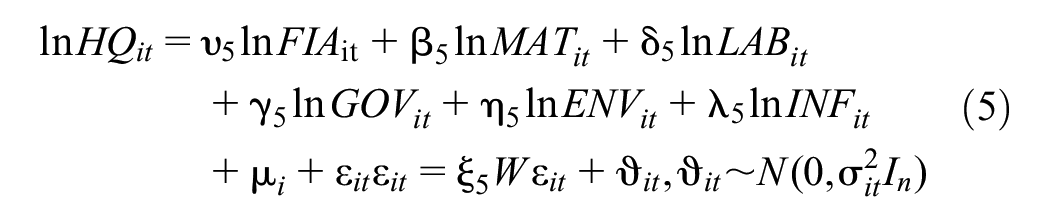
The spatial error model is shown in equation (5):
The spatial Dubin model is shown in equation (6):

where w is the spatial weight matrix, and other symbols have the same meaning as equation (2). Since the regression coefficients in the spatial lag model and the spatial Dubin model cannot truly reflect the actual influence of explanatory variable on explained variable, this paper decomposed them into direct effects, indirect effects and total effects according to the analytical method proposed by Lesage and Pace (2009).
Spatial Correlation Test
This paper uses the most commonly used Moran’s I index to examine the spatial autocorrelation of regional R&D investment agglomeration and high-quality economic development. Moran’s I index is calculated as follows (Moran, 1950).

where
According to the characteristics of the adjacency of each region in China, this paper uses the Rook adjacency method to define the spatial weight matrix, and its expression form is shown in equation (8). In particular, the spatial weight between Hainan and Guangdong is set to 1.

When verifying the spillover effect of regional R&D investment agglomeration on high-quality economic development, this paper sets the lag period of the effect of regional R&D investment agglomeration on high-quality economic development as 2 years. In addition, in the calculation process, it is found that regional R&D investment agglomeration has significant spatial autocorrelation only since 2012. Therefore, the sample investigation period in this part is set as 2012–2018.
Empirical Results and Analysis
Verification of Hypothesis 1 and Hypothesis 2
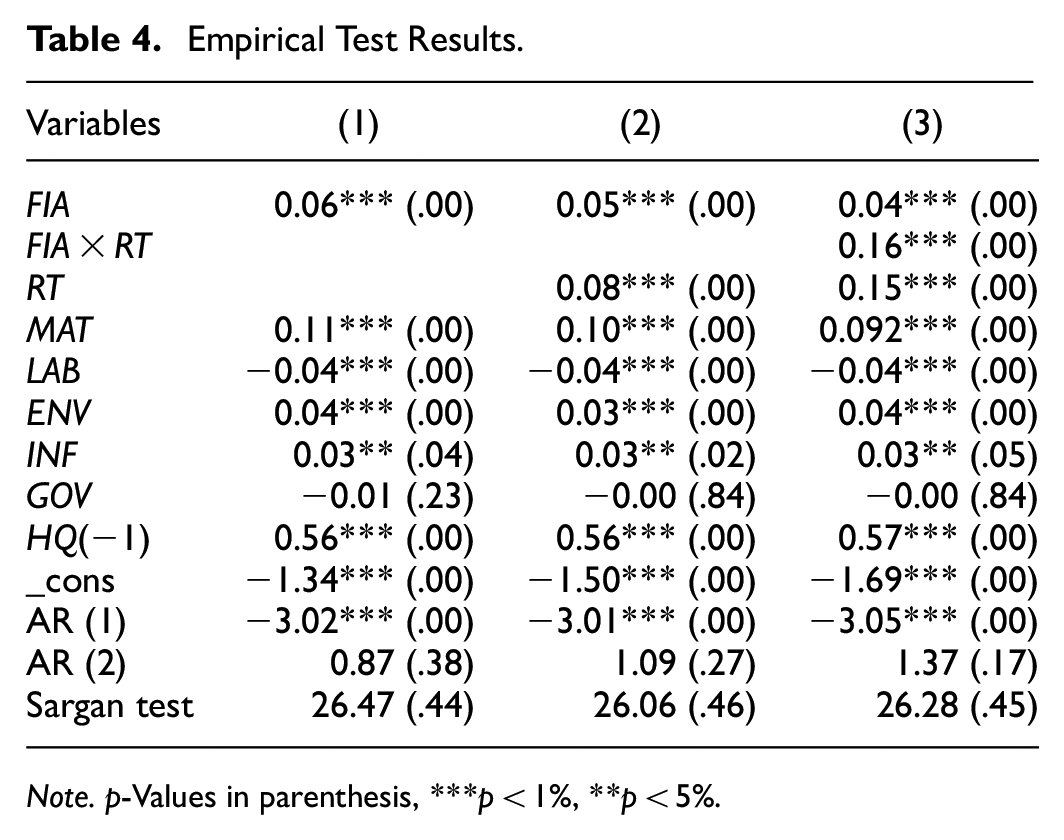
The system GMM method is used to verify the promoting effect of regional R&D investment agglomeration on high-quality economic development and the moderating effect of regional integrated innovation degree. The empirical test results are shown in Table 4.
Empirical Test Results.
Note. p-Values in parenthesis, ***p < 1%, **p < 5%.
Model (1) tests the impact of regional R&D investment agglomeration on high-quality economic development when material capital, labor quantity, government support, environmental regulation, and transportation infrastructure are used as control variables. In model (2), the moderating variable—regional integrated innovation degree is added to the model, and on this basis, the impact of regional R&D investment agglomeration on high-quality economic development is verified again. In model (3), the interaction term between regional R&D investment agglomeration and regional integrated innovation degree is added to the model to verify the moderating effect of regional integrated innovation degree.
As can be seen from Table 4, the empirical results of model (1) show that regional R&D investment agglomeration has a significant positive role in promoting high-quality economic development, with an influence coefficient of 0.06 and passing the 1% significance test. This indicates that hypothesis 1 in this paper is correct. After adding the moderating variable-regional integrated innovation degree into the model, the results of model (2) show that regional R&D investment agglomeration can significantly promote high-quality economic development, which again verifies that hypothesis 1 is correct. In model (3), the coefficient of the interaction term between regional R&D investment agglomeration and regional integrated innovation degree is 0.16, which passes the significance test of 1%. It shows that the degree of regional integrated innovation can significantly positively regulate the promoting effect of regional R&D investment agglomeration on high-quality economic development, which indicates that hypothesis 2 in this paper is correct.
In order to clarify the moderating effect of the degree of regional integrated innovation more clearly, this paper draws the moderating effect of the degree of regional integrated innovation, as shown in Figure 2. As can be seen from the slope of the line in Figure 2, the moderating effect of regional integrated innovation degree on the impact of regional R&D investment agglomeration on high-quality economic development is very obvious. Therefore, it can be more scientifically demonstrated that the degree of regional integrated innovation can positively regulate the promoting effect of regional R&D investment agglomeration on high-quality economic development.

The moderating effect of the degree of regional integrated innovation.
Results of Spatial Correlation Analysis
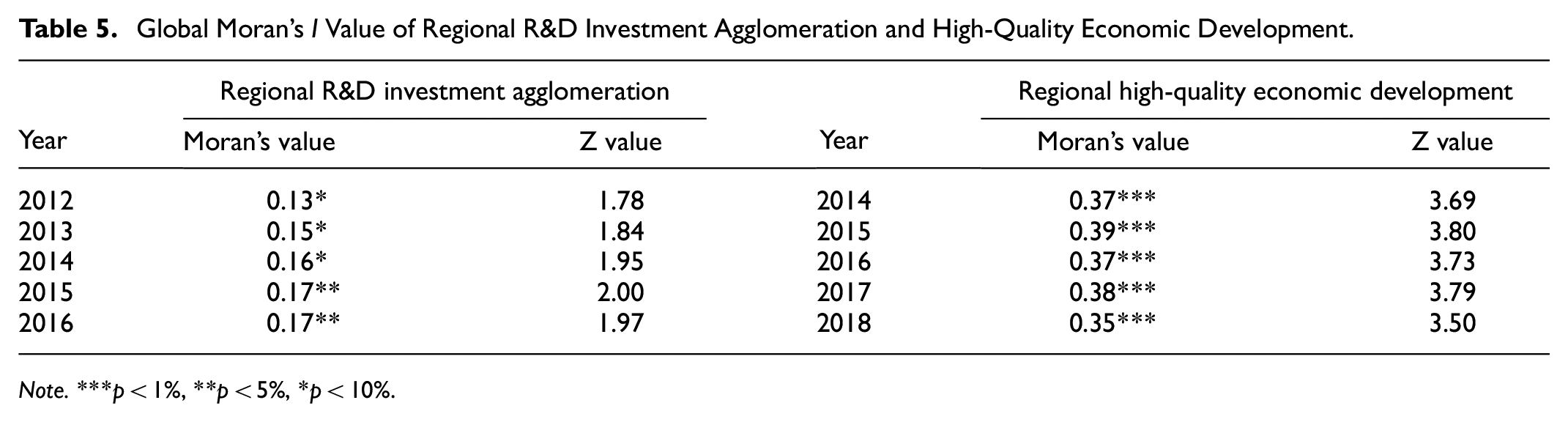
Based on the established spatial weight matrix, Stata15 software is used to calculate the global Moran’s I value of regional R&D investment agglomeration and regional high-quality economic development. The calculation results are shown in Table 5. As can be seen from Table 5, both regional R&D investment agglomeration and high-quality economic development present significant spatial positive correlation during the investigation period. The significance of the spatial positive correlation of regional R&D investment agglomeration is increasing year by year, and the spatial positive correlation of high-quality economic development is significant at the level of 1%.
Global Moran’s I Value of Regional R&D Investment Agglomeration and High-Quality Economic Development.
Note.***p < 1%, **p < 5%, *p < 10%.
Spillover Effects
In this study, Hausman test was used to determine whether to choose the fixed-effect model or the random effect model. Besides, in order to improve the accuracy of the test, the Lagrange multiplier (LM) test, likelihood ratio (LR) test and Ward test were used to select from the above three models in this paper. The test results are shown in Table 6.
Test Results of Spatial Model Selection.
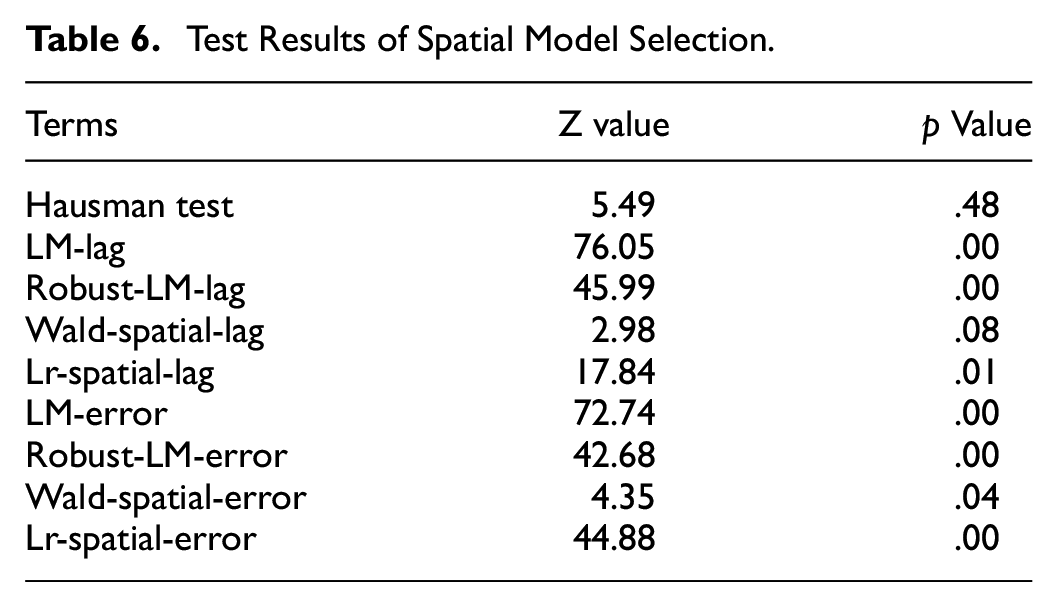
As shown in Table 6, the Hausman test results show that the p value is .48, so the null hypothesis “H0:
Furthermore, Ward test and likelihood ratio (LR) test are used to determine whether the spatial Dubin model is the most suitable model. The p values of Wald-spatial-Lag test and Wald-spatial-Error test are .08 and .04, respectively, which both pass the 10% significance level. In addition, the p-values of LR-spatial-Lag test and LR-spatial-Error test are .01 and 0.00, respectively, which pass the 1% significance level. This proves that the spatial Dubin model is the most suitable model in comparison with the spatial lag model and the spatial error model. Therefore, this study uses the maximum likelihood method to empirically test the spatial spillover effect of regional R&D investment agglomeration on high-quality economic development by using the spatial Dubin model. The maximum likelihood method can effectively solve the endogeneity problem caused by the correlation between the spatial lag term and the random disturbance term (Anselin et al., 2008). The results are shown in Table 7.
Effect Decomposition Results Based on SDM Model.

Note.***p < 1%, **p < 5%, *p < 10%.
As can be seen from Table 7, from the direct effect, the effect coefficient of regional R&D investment agglomeration on the high-quality development of regional economy is 0.07, which passes the significance level test of 5%. This indicates that regional R&D investment agglomeration can significantly promote the high-quality development of regional economy, which is consistent with the above empirical test results without considering the spatial effect, and again proves the correctness of hypothesis 1. It can be seen from the indirect effect that the effect coefficient of R&D investment agglomeration in other regions on the high-quality economic development of this region is 0.30, which passes the significance level test of 5%. This indicates that regional R&D investment agglomeration has spillover effect and can significantly promote the high-quality economic development of surrounding regions, which proves that hypothesis 3 in this paper is correct. From the comparison of the effect coefficients, it can be found that the effect intensity of R&D investment agglomeration in all surrounding regions on the high-quality economic development of the region is far greater than that of the regional R&D investment agglomeration on the high-quality economic development. This indicates that the spillover effect of regional R&D investment agglomeration cannot be ignored. The agglomeration of R&D investment in all neighboring regions has a stronger effect on promoting the high-quality development of the regional economy through heterogeneous knowledge spillovers than the agglomeration of R&D investment in this region. This is not consistent with the research conclusion of Wang et al. (2021), which found that the agglomeration of innovative capital had a restraining effect on the high-quality development of the surrounding regional economy with taking 2009 as the starting point. The reason may be that innovation capital agglomeration has a siphon effect in the initial stage, which can attract the superior resources of the surrounding region to the region, thus inhibiting the high-quality development of the surrounding regional economy. In addition, the empirical results show that the promoting coefficient of R&D investment agglomeration in all regions on high-quality economic development is 0.37, which indicates that every 1% increase in the agglomeration degree of R&D investment in this region and its surrounding regions will increase the high-quality economic development of this region by 0.37%.
Robustness Tests
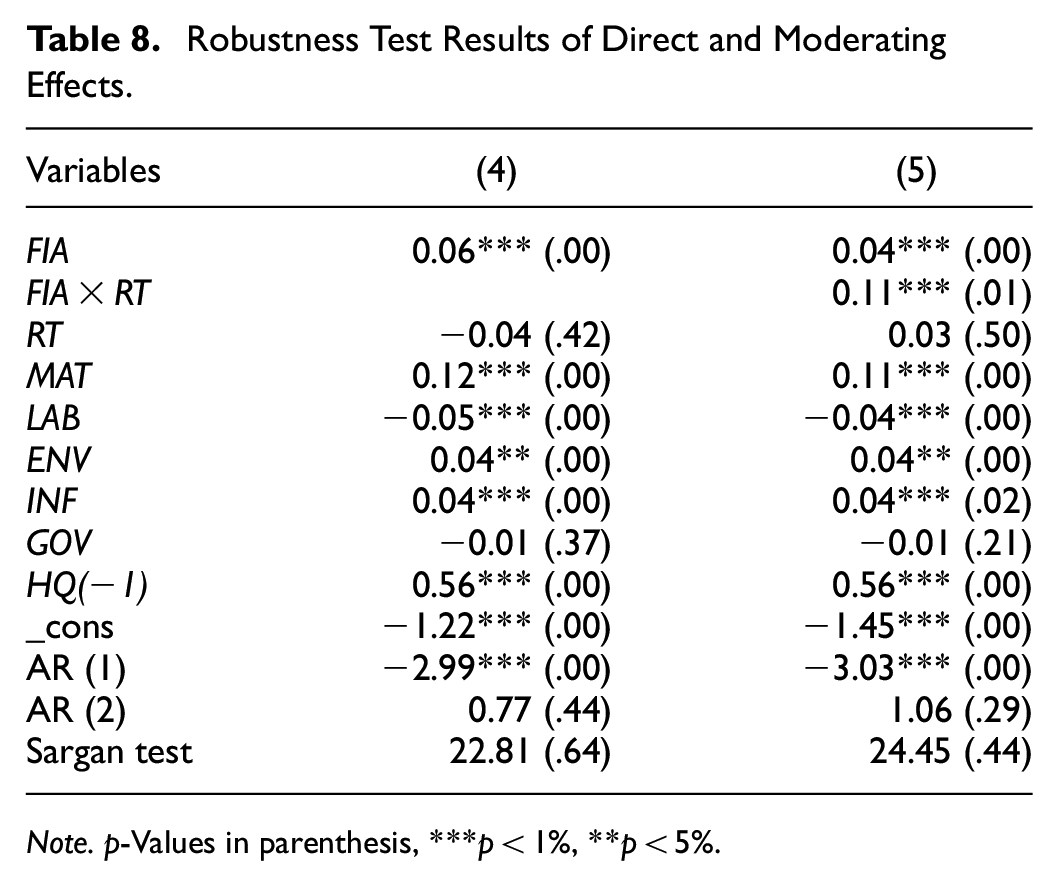
Considering that regional integrated innovation and regional R&D investment agglomeration together play a role in high-quality economic development in reality, the degree of regional integrated innovation is delayed by two years for robustness test. The test results are shown in Table 8.
Robustness Test Results of Direct and Moderating Effects.
Note. p-Values in parenthesis, ***p < 1%, **p < 5%.
As can be seen from Table 8, the promoting effect of regional R&D investment agglomeration on high-quality economic development and the moderating effect of regional integrated innovation degree are both positive and have passed the significance test. The difference from the above empirical result is only coefficient and significance level. This indicates that the empirical test results of this paper about the promoting effect of regional R&D investment agglomeration on high-quality economic development and the moderating effect of regional integrated innovation degree are robust.
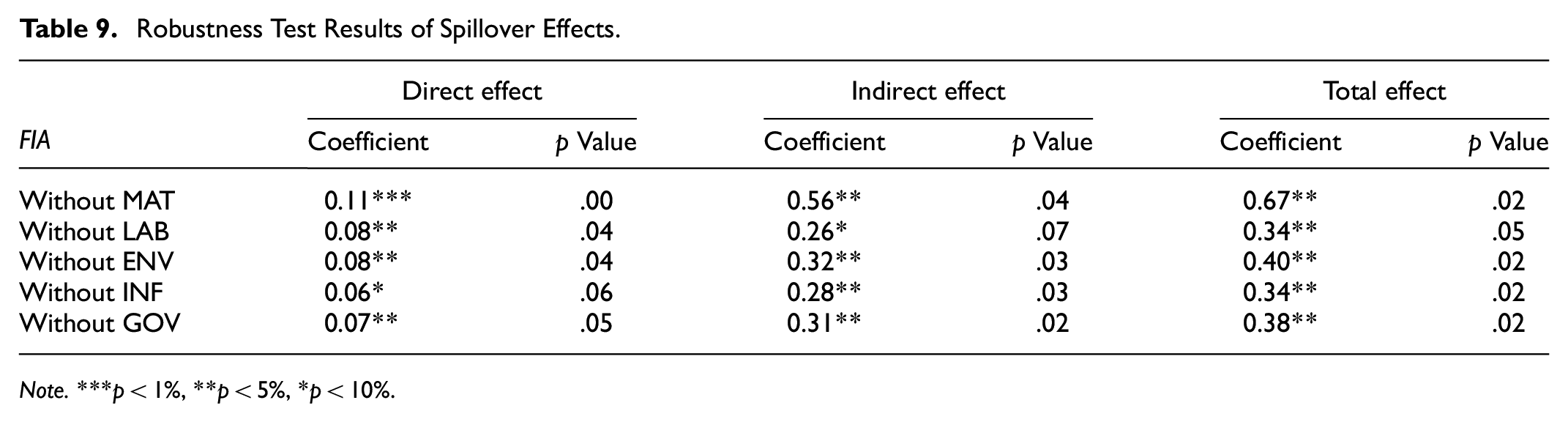
In order to verify the robustness of the positive spillover effect of regional R&D investment agglomeration on the high-quality development of the surrounding regional economy, this paper takes the method of removing each control variable to conduct the robustness test. Since the parameters directly estimated by the spatial Dubin model have no practical meaning, this paper only lists the coefficients and significance of the direct effect, indirect effect and total effect determined by the analytical method of spatial effect. In addition, this paper does not list the coefficients of the control variables, but only describes the coefficient changes of regional R&D investment agglomeration after each control variable is removed. The test results are shown in Table 9.
Robustness Test Results of Spillover Effects.
Note.***p < 1%, **p < 5%, *p < 10%.
Compared with the results in Table 7, it can be seen from Table 9 that after removing each control variable, the coefficient and significance of the promoting effect of regional R&D investment agglomeration on the high-quality economic development of the region and its surrounding regions have changed slightly. However, regional R&D investment agglomeration plays a positive role in promoting the high-quality economic development of the region and its surrounding regions. And the effect intensity of R&D investment agglomeration in all surrounding regions on the high-quality economic development of the region is far greater than that of the regional R&D investment agglomeration on the high-quality economic development. This is consistent with the above test results, indicating that the conclusion of this paper about the spillover effect of regional R&D investment agglomeration on high-quality economic development has strong robustness.
Conclusion and Policy Suggestions
Conclusion
Based on the theoretical analysis of the impact mechanism of regional R&D investment agglomeration on high-quality economic development, this paper takes 30 provincial-level regions in China as research samples, and uses the system GMM method and the spatial Dubin model to empirically test the impact of regional R&D investment agglomeration on high-quality economic development and the moderating effect of the degree of regional integrated innovation. This study has achieved several findings as follows. First, theoretical analysis shows that regional R&D investment agglomeration can promote the high-quality economic development of the region and surrounding regions by increasing regional knowledge capital, improving innovation efficiency, and promoting knowledge spillovers through scale effect, synergy effect, and spillover effect, respectively. Second, the empirical results show that regional R&D investment agglomeration can significantly promote the high-quality development of regional economy, and the degree of regional integrated innovation can positively regulate the promoting effect of regional R&D investment agglomeration on the high-quality development of regional economy. Third, regional R&D investment agglomeration has a spatial spillover effect on high-quality economic development, which can effectively promote the high-quality economic development of the surrounding regions.
Policy Suggestions
Based on the above research conclusions, this paper puts forward the following policy suggestions.
First, strengthen the construction and management of science city. Regional R&D investment agglomeration is presented in the form of the agglomeration of innovation subjects such as enterprises, universities, and research institutes. Science city is a park where different innovation subjects are centrally distributed and centrally managed. Each region should establish a high-level science city in a suitable location, and strengthen the management and optimization of science city. Each region should strengthen the construction of infrastructure in science city, introduce famous enterprises to settle in science city, and attract universities and research institutes to establish branch campuses or technology enterprises in science city. In addition, a number of intermediary service institutions such as financial institutions, intellectual property protection centers, and logistics centers have been introduced to provide all-round high-quality services for the development of science city. More importantly, regional governments should provide preferential policies such as rent concessions and tax reductions for the long-term development of enterprises, universities, research institutes, and service institutions.
Second, deepen regional integrated innovation. The region should take measures to minimize the technological barriers, strengthen technological cooperation, and promote value co-creation between industrial chain and innovation chain. Each region should strengthen the dominant position of enterprises in innovation, and encourage enterprises to issue technical requirements for bidding, while other enterprises, universities, and research institutes should bid to meet the technology needs of enterprises. Digital platforms should be used to improve the matching degree between the demand side and the supply side of innovation resources. A platform for the transfer and transformation of research achievements should be established to promote the successful transformation of the research achievements of universities and research institutes into the productive forces of enterprises, so as to efficiently match the research achievements with the market demand.
Limitations and Future Research
This paper has several limitations which future research could address. First, the measure of innovation degree of regional integration is only based on the funds among innovation entities. The exchange of knowledge between innovation agents will be more suitable than the exchange of funds. On the premise of data availability, future research will adopt the knowledge flow among innovation agents to measure integration innovation degree. Second, this study only explored the spillover effect of regional R&D investment agglomeration on high-quality economic development of spatially adjacent regions. Future research will try to explore the spillover effect of regional R&D investment agglomeration on high-quality economic development of economically neighboring regions.
Footnotes
Acknowledgements
We are very grateful to the anonymous reviewers and editors for their comments and help.
Author Contributions
Conceptualization: Meili Zhang and Baizhou Li; Methodology: Meili Zhang, Formal analysis and investigation: Meili Zhang and Baizhou Li, Writing—original draft preparation: Meili Zhang; Writing—review and editing: Baizhou Li; Resources: Meili Zhang, Supervision: Baizhou Li.
Declaration of Conflicting Interests
The author(s) declared no potential conflicts of interest with respect to the research, authorship, and/or publication of this article.
Funding
The author(s) disclosed receipt of the following financial support for the research, authorship, and/or publication of this article: 2023-2024 Social Science Fund Project of Hebei Province (HB23YJ037) and 2023 Hebei Province Social Science Development Research Topic (20230302027).
Ethics Approval and Consent to Participate
Not applicable
Consent for Publication
All authors have read and agreed to the published version of the manuscript.

Availability of Data and Materials
The data in this study come from China Statistical Yearbook, China High-tech Industry Statistical Yearbook, China Science and Technology Statistical Yearbook, China Energy Statistical Yearbook published by National Bureau of Statistics of China. The data can be publicly downloaded from the bureau’s website.