



Abstract
Along with reducing traffic congestion, electric car-sharing (ECS) can also solve travel demand, utilize idle resources, and enhance forms of transportation. Accordingly, university students are identified in Guangzhou, China as a promising customer group for ECS companies. Although university students in Guangzhou, China are unique in the context of ECS, few researchers have studied the factors that influence their willingness to use such services. Hence, this paper investigates the key determinants that affect university students’ behavioral intention (BI) to use ECS in Guangzhou, China. Based on an extension of the unified theory of acceptance and use of technology (UTAUT), this paper examines the effects of the constructs on BI to use ECS and the moderating role of trust in ECS. Based on results from a questionnaire of 486 university students in Guangzhou, China, conditional value (CV) was the most critical driver of BI, followed by personal attitude (PA) and sustainability (SUST). The moderating analysis showed that taking gender, education, and driving experience of university students as control variables, trust was found to have a significant positive moderating impact on the relationship between PA and BI to use ECS, and a significant negative moderating effect of trust on the relationship between CV and BI to use ECS. The implications of these findings are discussed.
Introduction
The proliferation of globalization and digitization has paved the way for the emergence of novel economic structures, such as the sharing economy, which may give rise to new business forms (Chivite Cebolla et al., 2021). In particular, the sharing economy has capitalized on the advancements in information and communications technology (ICT) and network platforms, enabling efficient data matching and offering economic benefits and convenience to customers (Hamari et al., 2016). The sharing economy may potentially address societal issues such as overconsumption, pollution, and poverty. The overarching objective of the sharing economy and transportation demand management techniques is to enhance productivity, minimize costs, extend accessibility to goods and services, and optimize resource utilization. One aspect of the sharing economy is shared mobility, which enables multiple users to utilize a vehicle simultaneously (e.g., van, car, bicycle, scooter). Car-sharing services (CS), as a pioneering option of shared mobility, provide passengers with temporary access to transportation as and when needed, by paying a one-time registration fee and a recurring membership charge. Such a fleet of shared vehicles can be conveniently distributed around a city (Safdar et al., 2022).
Shared mobility can provide alternative transportation options for users who do not have access to private automobiles while simultaneously reducing transportation costs and expanding possibilities for car owners by improving vehicle occupancy and reducing the need for car ownership (Huang et al., 2020; Nienaber et al., 2021). In densely populated urban areas where traffic, parking, and pollution are significant concerns, CS businesses have thrived, offering various sharing models such as one-way, two-way, round-trip, and free-floating CS that allow passengers to be charged hourly or by kilometer (Akyelken et al., 2018; Greenblatt et al., 2015; Lempert et al., 2019). Despite an increase in users, CS companies have struggled to generate profits since their fixed service costs determine their revenue, which can only be offset by subscribers willing to incur higher monthly bills (Prieto et al., 2017). The practice of CS has been identified as an effective means of reducing traffic volume and greenhouse gas emissions, as demonstrated by Caulfield’s (2009) study of carpoolers in Dublin. Both station-based and free-floating CS systems are available to users, and fees are based on membership fees, deposits, and time- or distance-based rental fees (Jin et al., 2020; S. A. Shaheen et al., 2015). The Car Sharing Market Size Industry Report by Global Market Insights indicates that the worldwide CS market size was over $2.5 billion in 2019, with a projected Compound Annual Growth Rate (CAGR) of more than 24% from 2020 to 2026, with CS and electric car-sharing services (ECS) potentially reducing automobile ownership rates (Q. Li & Liao, 2020).
In the face of urban mobility issues such as traffic, parking, and air quality concerns, policymakers and service providers are striving to offer alternatives to carbon-fueled private automobiles (Curtale et al., 2021). Electric vehicles (EVs) present a more environmentally friendly and cost-effective option than traditional fossil fuel-powered cars, with EVs costing only 2 cents per mile compared to 12 cents or more for conventional vehicles (Abouee-Mehrizi et al., 2021). The adoption of EVs has the potential to reduce carbon dioxide emissions from transportation by 45 to 55% for households using ECS (Namazu & Dowlatabadi, 2015).
However, the success of widespread EV adoption hinges on customer receptivity to innovative products (F. P. Wang et al., 2017). Understanding how individuals will react to a new mode of transportation and what motivates their behavioral intention (BI) is crucial to successful implementation. Two widely recognized models for comprehending BI (Robles-Gómez et al., 2021) are the Technology Acceptance Model (TAM; Davis et al., 1989) and the UTAUT (Venkatesh et al., 2003). Factors such as expectations, perceived advantages, ease of use (in TAM and UTAUT), and the social impact of technology implementation (in UTAUT) have been shown to explain BI. Additionally, the demographic environment in which the technology is presented plays a critical role in understanding people’s propensity to adjust mobility behavior (Curtale et al., 2021; Martínez-Díaz et al., 2018).
Despite the growing body of research on ECS in China, there is still a lack of theoretical guidance and practical experience regarding the provision of ECS services (Min & Xing-Fu, 2020; Zhang & Li, 2020). To promote the wider adoption and growth of ECS in China, it is important to understand the factors that influence consumer behavior and their BI toward ECS (L. Li & Zhang, 2023; Zhang & Li, 2020). University students, in particular, are a significant and potentially lucrative market for ECS services, as they are generally open to the idea of the sharing economy and often have limited incomes and fewer cars than the general population (Bojković et al., 2019; Mensah et al., 2019). Furthermore, having a car of one’s own has long been considered a sign of affluence and success in China (Martin et al., 2011), and ECS provides a more adaptable and relaxing alternative to using public transportation (S. Shaheen et al., 2016).
Therefore, it is crucial to conduct independent research tailored to this specific demographic to shed light on the significant factors that influence the adoption of ECS among university students (Z. Chen et al., 2020). This study aims to investigate the most influential factors shaping Chinese university students’ decision to begin using ECS, which takes into account the unique characteristics of this population, such as their lifestyle, cultural values, and attitudes toward ECS (Curtale et al., 2021; L. Li & Zhang, 2023; Zhang & Li, 2020). Finally, given the nascent stage of ECS in China, there is plenty of room for improvement in the quality of services, content diversity, applicable laws and regulations, and security guarantees (Sun et al., 2021). Hence, the present study aims to investigate the factors that influence the BI of university students toward using the ECS in Guangzhou, China. To achieve this goal, three research questions are formulated as follows:
Research Question 1: What are the determinants influencing the university students’ BI to use the ECS in Guangzhou, China?
Research Question 2: To what extent do the factors explain the university students’ BI to use the ECS in Guangzhou, China?
Research Question 3: To what extent does consumer trust moderate the impact of performance expectancy (PE), effort expectancy (EE), social influence (SI), anxiety-free experience (AE), personal attitude (PA), sustainability (SUST), functional value (FV), and conditional value (CV) on the BI to use the ECS?
To address the research questions, the present study proposes an extension of the UTAUT model and consumption values to investigate the interrelationships that influence the university students’ BI to use ECS in Guangzhou, China. Drawing on previous research, this study aims to achieve two main objectives. Firstly, the study seeks to incorporate three psychological constructs, namely PA, AE, and SUST, which have been overlooked in earlier studies on ECS (J. W. Hu et al., 2021; Tran et al., 2019). Secondly, the study aims to apply the theory of consumption values to university students and explore how various dimensions of consumer motivation, such as FV and CV, relate to the use of ECS. The ultimate goal of the study is to examine whether university students’ trust moderates the impact of key determinants such as PE, EE, SI, AE, PA, SUST, FV, and CV, on the BI to use ECS.
Literature Review
UTAUT Applied to Transportation Research and ECS
The Theory of Reasoned Action (TRA) and the Theory of Planned Behavior (TPB) are two of the most widely used theories for explaining human behavior. The TRA posits that attitudes toward behavior and subjective norms are key determinants in explaining human behavior. The TPB extends the TRA by incorporating one’s sense of behavioral agency to predict BI. The Technology Acceptance Model (TAM), developed by Davis et al. (1989) based on the TRA, predicts individuals’ attitudes toward adopting new technologies. TAM has been applied to various contexts, including digital technology in education (Scherer et al., 2019), IoT cloud platforms (Robles-Gómez et al., 2021), online shopping (Gefen et al., 2003), mobile payments (Sleiman et al., 2021), and virtual reality/augmented reality sports experiences (K. Lee & Oh, 2022).
The UTAUT was developed based on TAM and considers four key drivers of BI: PE, EE, SI, and FC (facilitating conditions). Structural equation modeling (SEM) has been used to verify the accuracy of UTAUT’s measurement and structural models by analyzing the connections between latent variables. The UTAUT has been shown to outperform other theories that attempt to explain consumers’ BI toward new technologies. Variants of the original UTAUT, such as UTAUT2, have been developed to further expand its application by adding variables such as hedonic motivation, price value, and habit. The UTAUT2 model not only integrates the explanatory variables of existing classical models but also includes variables that comprehensively describe the influencing factors of the consumption behavior of ECS.
The UTAUT model, owing to its adaptable design, has been widely utilized across various transportation contexts, encompassing automated driving systems (Ghandriz et al., 2020; Guo et al., 2019; Madigan et al., 2017; Wu et al., 2021; Z. Yu et al., 2022), car navigation systems (X. Liu et al., 2021; Vörös et al., 2022), corporate CS (Fleury et al., 2017), hyper-connected vehicles (Schipor & Vatavu, 2021), highly automated driving (Cooley et al., 2022; Hartwich et al., 2019), autonomous cars (H. K. Chen & Yan, 2019; Dos Santos et al., 2022; Leicht et al., 2018; Ro & Ha, 2019; Van den Berg & Verhoef, 2016), ECS (Curtale et al., 2021; Kapser & Abdelrahman, 2020; Tran et al., 2019), and autonomous ECS (Curtale et al., 2022).
The UTAUT2 framework has demonstrated its efficacy in identifying innovative potential designs and offering valuable behavioral insights, albeit with technological nuances, as stated by Curtale et al. (2021). Foroughi et al. (2023) have extended the UTAUT2 model to investigate the influence of TR, HM, SI, compatibility, and EE on the BI to use autonomous vehicles. Madigan et al. (2017) report that HM is the most significant determinant of individuals’ willingness to use automated driving systems, followed by PE, SI, and FC, while EE does not seem to have a substantial effect. Fleury et al. (2017) conducted a study on the drivers of corporate CS among employees of a Paris-based telecommunications company and found that EE serves as a significant motivator despite the limited scope of the perceived environmental friendliness of the service. Curtale et al. (2022) found that, in contrast to safety concerns, HM is a more substantial predictor of the BI to use autonomous ECS, while PE and SI are stronger antecedents with indirect impacts on the BI to use autonomous ECS.
To the best of our knowledge, the UTAUT has not been utilized for CS until Tran et al.’s (2019) study. To gain a deeper understanding of the adoption of ECS by users in Dalian, China, Tran et al. (2019) utilized UTAUT2 to examine the impact of HM and familiarity with ECS on BI. Their findings shed light on why residents in Dalian have accepted ECS so readily, indicating that HM and familiarity had a positive effect on BI, while SI measured by the original version of UTAUT did not. However, it should be noted that the unique characteristics of the Chinese market prevent the generalization of these findings to other socio-demographic settings. In a survey of 656 respondents in the Netherlands, Curtale et al. (2021) employed SEM to demonstrate that SI was the most significant factor, followed by PE and PA. These findings provide further insights into the motivations of consumers regarding their adoption of ECS.
In summary, the UTAUT is an important tool for investigating the cognitive factors that influence individuals’ inclination to adopt new technologies and services. Although the transportation sector has primarily employed the original UTAUT model to elucidate users’ BI, the findings have been inconsistent or incomplete. The UTAUT2, with its ability to incorporate additional psychological constructs, has demonstrated practical applications and offers a viable means to expand our comprehension of BI. Thus, this study employs the UTAUT2 as the fundamental theoretical framework to examine the BI of university students toward ECS.
The Theory of Consumption Values and ECS
The theory of consumption values, which was initially proposed by Sheth et al. (1991), is a valuable theoretical framework that concentrates on the behavior of consumers and is founded on value judgments. The theory aims to clarify why consumers choose to purchase or not purchase, use or not use particular products, as well as why they opt for one product category over another. It is frequently utilized for predicting and explaining consumer behavior patterns. Sheth et al. (1991) divide the further perceived value of consumers into the following five dimensions: FV, social value, emotional value, epistemic value, and CV, which have been utilized by scholars and industry practitioners to investigate the various components of consumption values leading to the mindset and user behavior of collaborative consumption (Acheampong & Siiba, 2020; H. Kim & Jan, 2021; H. Li & Wen, 2019; Y. Zhu et al., 2022). The theory has been extensively applied in research studies related to sustainable consumption (Bhattacharyya et al., 2023; Hwang & Yeo, 2022), low-carbon consumption (Jiang et al., 2019), green consumption (Liang et al., 2022; Tan et al., 2022), shared consumption (Roos & Hahn, 2017), and other forms of consumption (Tandon et al., 2021).
Recently, the application of the theory of consumption values in predicting the behaviors of ECS organizations has increased. Joo (2017) investigates the influence of consumption values on the BI to use CS and discovers that the value of time and convenience strongly predicts that individuals will follow through with their BI to use. L. Wang et al. (2022) examine the link between TPB, pro-environmental value, and consumption value toward the BI to purchase green automobiles among young Chinese consumers. Hence, the theory of consumption values can be utilized to investigate the determinants to positively influence the BI to use ECS among university students.
Overview of the Previous Studies
When compared to driving a private vehicle powered by carbon, ECS represents two forms of innovation. The first describes the kind of electric automobile, while the second describes the nature of car ownership (public vs. individual). Gradually, both innovations (electric vs. carbon-fueled) are represented by ECS. The launch of ECS may draw a market that is made up of those who are interested in CS as well as individuals who are interested in EVs but are hesitant to acquire them. A few research have investigated the user profiles of CS, EVs, and ECS, respectively. When it comes to the adoption of ECS, studies have shown that the most frequent users are men, younger generations, highly educated individuals, and residents of the city (Acheampong & Siiba, 2020; Burkhardt & Millard-Ball, 2006; Cartenì et al., 2016; Curtale et al., 2021, 2022; Efthymiou et al., 2013; H. Kim & Jan, 2021; Prieto et al., 2017). As for EVs, even though they are generally regarded as a solution to the problem of green mobility, the market penetration of EVs is still relatively low (Illgen & Höck, 2018). Because EVs in their present state are inferior to vehicles driven by carbon-based fuels in several different application situations (Thøgersen & Ebsen, 2019). According to Burghard and Dütschke (2019) and Clewlow (2016), the personalities of individuals who are interested in EV and CS seem to be similar. Compared to non-users of ECS, those who have used ECS have more tendency to obtain EVs (Cartenì et al., 2016), and ECS is more appealing to users, especially young people than the conventional CS, which employs autos fueled by carbon-based fuels (Burghard & Dütschke, 2019; Clewlow, 2016; Haustein & Jensen, 2018). This is particularly true for young couples who do not own a car or who want to use ECS in place of a second vehicle. Environmental friendliness is identified as ECS’s most attractive feature in a study conducted by De Luca and Di Pace (2015) in Italy. On the contrary, Burghard and Dütschke (2019) have discovered that the most influential factors in BI adoption in Germany were conformity to social norms and compatibility with other individuals’ values. Both results speak to the mental aspects that have a role in whether an ECS is adopted. Users of ECS have claimed that social and economic factors, such as concerns about the environment, savings on travel expenses, less maintenance, and the desire to create a good impression on others, are the most crucial variables making them utilize the system (D. Kim et al., 2015). Based on UTAUT2, Tran et al. (2019) identify the significance of the determinants of the BI to adopt ECS in China. Besides, they discover that familiarity is a greater predictor of BI for young males, but EE is a stronger predictor of BI for females. Most notably, they discover that both age and gender play a role in modulating the significance of certain psychological factors. On the other hand, they ignored all transport- and the demographic-related context in their study. In conclusion, it seems that people who are interested in ECS have many of the same traits as early adopters of other technologies (Moore, 1995). In the context of the technology adoption life cycle, early adopters tend to be young, well-educated, and technologically savvy. Despite this, there is a dearth of empirical studies that investigate in depth the effects of psychological elements in conjunction with socio-demographic and transportation-related aspects from the perspective of university students.
Table 1 presents the findings derived from several comprehensive studies that have meticulously examined the intricate influence of diverse psychological factors on the BI to engage with ECS or CS. While extant research on ECS has predominantly centered on the broader consumer demographic, encapsulated by studies by Burghard and Dütschke (2019), Curtale et al. (2021, 2022), J. W. Hu et al. (2021), and D. Kim et al. (2015), the scholarly landscape has been modestly enriched by a limited number of inquiries that have delved into the salient factors that positively resonate with the inclination to utilize ECS within the domain of university students. Prior academic inquiries have explored the inclination of university students toward adopting CS practices, as demonstrated by works such as Rotaris et al. (2019) and the investigation undertaken by Zhang and Li (2020). However, it is imperative to acknowledge that the domain of ECS, which presents itself as a more ecologically mindful and economical alternative (Abouee-Mehrizi et al., 2021), has thus far remained relatively unexplored through the specific lens of university students in Guangzhou, China. In particular, while several preceding studies have drawn upon the UTAUT or the UTAUT2 to explicate relationships (Curtale et al., 2021, 2022; Fleury et al., 2017; Mensah et al., 2019; Tran et al., 2019), a significant gap persists wherein the exploration of consumer behavior and sustainability aspects, contextualized by the theory of consumption values, has been relatively understated in investigating the intricate interdependencies that shape the BI of ECS among university students in Guangzhou, China. In light of this void, the primary objective of this study resides in the meticulous examination of a spectrum of variables impacting the BI about ECS, rooted within the perspectives of university students in Guangzhou, China. This endeavor is achieved through the integrated application of the extended UTAUT model in conjunction with the underpinning theoretical framework of consumption values.
Studies Investigating Psychological Drivers of ECS/CS.

Note. Framework: DOI = diffusion of innovation; TPB = theory of planned behavior; UTAUT = unified theory of acceptance and use of technology; UTAUT2 = extended unified theory of acceptance and use of technology. Main factors studies: AE = anxiety-free experience; AS = application self-efficacy; AT/ATT = attitude; BEN = benefit; BFP = booking & fee & payment; CAP = capability; CO = comparative value; COM = compatibility; DIS = distance; DS = driving self-efficacy; EA = environmental attitudes; EE = effort expectancy; EC = environmental concern; EC* = economic value; EF = efficiency; EM = emotional value; EP = epistemic value,; ES = essential conditions; FAM = familiarity; FC = facilitating conditions; FV = functional value; HM = hedonic motivation; OS = other-based self-efficacy; PB = perceived (direct) benefits; PBC = perceived behavioral control; PE = performance expectancy; PEF = perceived environmental friendliness; PI = personal innovativeness; PV = perceived value; RE = reliability; RCD = renting & charging & driving; SCTM = satisfaction with current travel mode; SE = self-efficacy of FFCS; SEP = social and economic perspective; SEV = shared EVs; SC = safety concern; SI = social influence; SN = subjective norms; SO = social value; SP = security and privacy; SS = self-based self-efficacy; TI = trust in the Internet; TIA = technology & innovation attitudes; TMCCE = travel mode choice considerations and expectations; TR = trust; TS = trust of stewardship; TRI = trialability. Main findings: +/− = positive or negative impact.
Development of Hypotheses
As discussed in Section 2.1, the literature on transportation research, particularly on ECS, has demonstrated the usefulness of the UTAUT framework in explaining BI in various contexts. Against this backdrop, the present study aims to investigate the determinants of BI to use ECS among university students in Guangzhou, China, drawing on the UTAUT. The UTAUT has been extensively applied to transportation research, including ECS (Curtale et al., 2021, 2022; Fleury et al., 2017; Hartwich et al., 2019; Kapser & Abdelrahman, 2020; Leicht et al., 2018; Madigan et al., 2017; Manutworakit & Choocharukul, 2022; Mensah et al., 2019; Ye et al., 2020). Consistent with prior scholarly investigations, our findings substantiate the notable influence of PE, EE, and SI on BI. In contrast, the dimension of FC, originating from the foundational UTAUT framework, emerges as displaying a minimal effect on BI within the context of transportation-focused studies (Curtale et al., 2021, 2022; Fleury et al., 2017; Madigan et al., 2017; Mensah et al., 2019; Tran et al., 2019). As a consequence, the inclusion of FC in our theoretical framework is deemed unnecessary and therefore omitted.
Building on the original UTAUT, the current version of the model developed for ECS incorporates three additional constructs that are relevant to the characteristics of ECS: AE, PA, and SUST (Curtale et al., 2021, 2022; Tran et al., 2019). In line with prior studies, we hypothesize that these three psychological factors will each positively influence the BI.
In addition to the UTAUT, we also draw on the theory of consumption values to investigate the determinants of BI to use ECS. Previous research has shown that both FV and CV positively influence consumers’ BI to adopt ECS and bicycle-sharing programs (H. Kim & Jan, 2021; Y. Wang et al., 2018) as discussed in Section 2.2. Therefore, we formulate hypotheses about the relationships between PE, EE, SI, AE, PA, SUST, FV, CV, and trust based on prior evidence.
Performance Expectancy
As defined by Venkatesh et al. (2003), PE refers to a user’s sense of confidence that new information technology and its associated applications may contribute positively to their performance at work. According to Venkatesh et al. (2003), PE is the alignment between the features of ECS systems and users’ expectations, resulting in perceived benefits from sharing cars. According to previous research (De Luca & Di Pace, 2015; Tran et al., 2019), ECS systems can assist travelers with travel planning, save time, meet automobile needs, and ultimately improve job performance. Furthermore, a transition from conventional cars to EVs has been linked to numerous other benefits, including lowering emissions, reducing traffic congestion, and reducing energy consumption (Cruz-Jesus et al., 2023; Nijland & van Meerkerk, 2017; Tran et al., 2019), which has consistently shown that PE is a significant predictor of the BI to use ECS (Curtale et al., 2021, 2022; Fleury et al., 2017; Mensah et al., 2019; Tran et al., 2019). Therefore, this study proposes:
Hypothesis 1(H1). PE positively affects BI.
Effort Expectancy
Users’ perceptions of the ease of use of a new technology (Venkatesh et al., 2003) are defined as EE, which means using a technology will be easy and effortless for individuals. Consumers need to be able to navigate and use new technology services without difficulty or challenges so that their BI can be used as effectively as possible (K. Lee & Oh, 2022; Mensah et al., 2019). This construct includes factors such as the user interface, complexity of the system, and level of technical competence required to use the technology (Venkatesh et al., 2003). Technology is more likely to be adopted and used by individuals if they perceive it to be easy to use and require little effort to use (Davis et al., 1989; Venkatesh et al., 2003). According to previous research (Davis et al., 1989; Jewer, 2018), EE of new technology influences both adoption as well as mobility behavior (Adnan et al., 2018; Tran et al., 2019). Some scholars have also demonstrated a significant and positive impact of EE on the use of ECS by BI (Curtale et al., 2021, 2022; Fleury et al., 2017; Mensah et al., 2019; Tran et al., 2019). Therefore, hypothesis two is proposed.
Hypothesis 2 (H2). EE positively affects BI.
Social Influence
As defined by Venkatesh et al. (2003), SI is the extent to which people believe one should use new technology. Some studies have found an insignificant relationship between SI and BI to use new technology (Chauhan et al., 2016; Fleury et al., 2017), despite previous research showing a positive association between SI and BI to use new technology (Hoque et al., 2017; Madigan et al., 2017; Venkatesh et al., 2012). Moreover, Venkatesh et al. (2003) suggested that the effect of SI might only be relevant to certain groups, such as older workers and women. The relationship between SI and acceptance of transportation-related alternatives, such as mode use, has been systematically studied in several transportation studies (Madigan et al., 2017; Simsekoglu & Klöckner, 2019). When it comes to EC systems, an individual’s behavior may be influenced by how much his colleagues, friends, or family value its use. As well, Algesheimer et al. (2005) point out that user engagement and recommendations are influenced by interaction between users and others. Consequently, we hypothesize:
Hypothesis 3 (H3). SI positively affects BI.
Anxiety-Free Experience
AE refers to an experience in which an individual is free from anxiety or stress. In technology, AE may refer to the design of user interfaces and user experiences that minimize stress and frustration among users (Tsai et al., 2019). Designers can incorporate elements such as simplicity, clarity, and ease of use into their products to create a more positive AE for users (Jiao et al., 2017). AE is a cause of anxiety and decreased use of ECS, particularly concerning driving range and return worries (Curtale et al., 2021; Jiao et al., 2017; Tsai et al., 2019). AE can be applied in the context of ECS to improve user satisfaction and increase adoption rates. Providing real-time information about the availability of charging stations and the estimated range of the vehicle can significantly reduce range anxiety and increase the likelihood of using ECS (Curtale et al., 2021). Additionally, the study highlights the importance of designing user-friendly interfaces and providing clear instructions for charging and using the vehicle to further enhance the AE for users. Hence, experiencing less anxiety or having the perception that the journey will be free of anxiety could make it easier to accept ECS. Therefore, the fourth hypothesis is as follows:
Hypothesis 4 (H4). AE positively affects BI.
Personal Attitude
PA can be used to predict whether he or she will act based on the expression of the attitude toward a specific behavior (Ajzen & Fishbein, 1980). An individual forms behavioral beliefs based on how likely it is that a certain behavior will result in certain outcomes and how subjectively he/she evaluates them (Ajzen & Fishbein, 1980). A consumer’s PA is defined as his/her assessment of a certain behavior (Belanche et al., 2020). PA toward ECS refers to how consumers perceive BI to employ ECS, whether they are positive or negative in their judgment. According to previous studies (Cook et al., 2002; Gallagher & Updegraff, 2013; Lo et al., 2016; T. Yu et al., 2023), PA is an important antecedent variable of BI. Positive PA toward behaviors is associated with higher BI (Beck & Ajzen, 1991). PA plays a significant role in people’s BI to use ECS (J. Kim et al., 2017). The use of ECS is more likely among users with positive PA toward it (Haldar & Goel, 2019; D. Kim et al., 2015). Users with PA toward environmentally friendly behavior are more likely to have BI regarding ECS (Curtale et al., 2021; Fleury et al., 2017; D. Kim et al., 2015; L. Li & Zhang, 2023; Zhang & Li, 2020); thus, PA positively influences ECS adoption among university students (Zhang & Li, 2020). Therefore, H5 is proposed.
Hypothesis 5 (H5). AE positively affects BI.
Sustainability
In alternative transportation studies, SUST has been identified as a precursor to BI (Hamari et al., 2016; H. Li & Wen, 2019). Eco-sustainable consumption is driven by a concern for green ecological resources and the effective use of underutilized resources (Fang et al., 2023; Lampo et al., 2023; J. Li et al., 2023). The utilization of ECS is significantly enhanced by SUST, and the perception of resource utilization efficiency also plays a role. Ninety-six percent of respondents cite the desire to obtain seldom-used items as the primary motivation for participating in the sharing economy (Edbring et al., 2016). According to Heinrichs (2013), the sharing economy, as a new way of consumption, could positively influence the environment. Scholars (Benoit et al., 2017; Botsman & Rogers, 2010) have identified environmental factors as contributing factors to engaging in the sharing economy. Through sharing platforms, SUST has a positive and significant effect on consumption, according to Hamari et al. (2016). It is therefore imperative that ECS operators implement SUST to ensure travelers do not suffer negative consequences during the COVID-19 pandemic. Accordingly, H6 has been proposed.
Hypothesis 6 (H6). SUST positively affects BI.
Functional Value
As defined by Sheth et al. (1991), FV refers to consumer perceptions of practical benefits associated with products and services. These benefits are the result of the product’s functionality, utility, and physical performance (Suki, 2013). Han et al. (2017) distinguish consumers’ value judgments of EVs into FV, such as economic, productivity, and convenience values, and non-functional values using consumption value theory (emotional, social, and epistemic values). In a similar study, Paundra et al. (2017) examined the key attributes of CS and found that price, parking convenience, and vehicle type influence BI to use ECS positively. A product’s FV was traditionally determined based on factors like price, dependability, and durability (Sheth et al., 1991). According to H. Kim and Jan (2021), the FV of ECS can be defined as the perceived benefit of using ECS over other alternatives. These characteristics are linked to the range of the product or service, as well as its desirable, appropriate, and beneficial features, which contribute to its operation and environment (C. F. Chen et al., 2021). If the FV of a product or service is realized, it can strengthen the BI to utilize eco-friendly transport, such as EVs or ECS (Chakraborty et al., 2022). Moreover, the price, reliability, and convenience of the service are significant characteristics in this regard (Eboli & Mazzulla, 2010). Hence, we hypothesize:
Hypothesis 7 (H7). FV positively affects BI.
Conditional Value
Sheth et al. (1991) found that consumers derive CV from the conditions that encourage them to purchase products. As Sweeney (2001) explains, CV arises because of particular circumstances consumers encounter. However, our study does not consider CV as an essential factor since it is seen as a special case of other consumption values. As stated by H. Y. Wang et al. (2013), prevailing conditions often determine how much benefit a purchase will bring. H. Kim and Jan (2021) note that previous research has examined the CVs of a variety of goods and services in various settings to predict consumer attitudes and actions. According to Ramos et al. (2020), the attitude of users toward the environment influenced their adoption of ECS in Europe. According to Chakraborty et al. (2022), an individual’s perception of favorable or unfavorable conditions can influence their decision to use ECS. Park and Lee (2011) suggest that subsidized ECS offers can also influence BI decision-making to use ECS. Based on these findings, we propose the following hypotheses:
Hypothesis 8 (H8). CV positively affects BI.
Moderating Effect of Trust
According to Morgan and Hunt (1994), trust is the result of reliability between parties, when one party is reliable and the other is truthful. A consumer’s trust is determined by his or her positive belief that another party will treat them fairly and honestly. In general, trust is characterized by three components: integrity, capability, and generosity (Y. Chen et al., 2015; Zhou, 2012). In previous studies (Curtale et al., 2021; Hartl & Hofmann, 2022; Möhlmann, 2015; G. Zhu & Kubickova, 2022), trust has been demonstrated to be a major factor in understanding the BI to use ECS. According to Du et al. (2020), trust in the Internet charity platform moderated PE and EE on BI to be used. In addition, Rehman et al. (2022) have found that trust moderates the effect of perceived risk on customer satisfaction and repurchase intentions. Besides, trust has been shown to moderate ECS adoption (Mensah et al., 2019). Thus, this study aims to investigate the moderating effect of the factors included in the UTAUT model and additional constructs (AE, PA, and SUST) on the BI to use ECS, with trust as a moderator.
Since consumers are unable to verify the authenticity of a product, trust is especially important in the context of sustainable consumption (Janssen & Hamm, 2012). The rapid evolution of the business environment and its impact on socio-cultural factors (Leng et al., 2017) makes it important to examine how trust influences consumption values, especially FV and CV, and business intelligence in the digital age. Hence, the purpose of this study is to examine the moderating effect of trust on the impact of PE, EE, SI, AE, PA, SUST, FV, and CV on the BI to use ECS. Several studies have demonstrated that incentives motivate people to adopt positive attitudes and moderate the effect of institutional trust on vaccination attitudes (Zimand-Sheiner et al., 2021). Accordingly, the following hypotheses are presented in this study.
Hypothesis 9a (H9a). Trust moderates the relationship between PE and BI to use ECS.
Hypothesis 9b (H9b). Trust moderates the relationship between EE and BI to use ECS.
Hypothesis 9c (H9c). Trust moderates the relationship between SI and BI to use ECS.
Hypothesis 9d (H9d). Trust moderates the relationship between AE and BI to use ECS.
Hypothesis 9e (H9e). Trust moderates the relationship between PA and BI to use ECS.
Hypothesis 9f (H9f). Trust moderates the relationship between SUST and BI to use ECS.
Hypothesis 9g (H9g). Trust moderates the relationship between FV and BI to use ECS.
Hypothesis 9h (H9h). Trust moderates the relationship between CV and BI to use ECS.
Figure 1 presents the theoretical framework of the current study, integrating UTAUT (Venkatesh et al., 2003), the theory of consumption values (Sheth et al., 1991), and additional constructs.

Theoretical framework.
Research Methodology
The purpose of this section is to examine how psychological, socioeconomic, and transportation factors influence the BI of university students to adopt ECS in Guangzhou, China. Using factor analysis, we determined the psychological factors’ influence on BI, and then used SEM to estimate their influence. In the subsequent subsections, the survey, sample, and estimation methodology will be discussed in greater detail.
Survey
The research hypotheses were assessed through a questionnaire survey method, enabling effective data collection. The questionnaire was thoughtfully divided into two sections. The first section adeptly employed multiple-choice questions to gather sociodemographic information, ensuring efficient data collection. In contrast, the subsequent section comprised a meticulously crafted series of measurement items designed to capture the intricate psychological constructs influencing the behavioral intention to engage with ECS. As depicted in Table 2, these ten psychological constructs were evaluated using a 7-point Likert scale, involving 35 measurement items. Participants rated their level of agreement on a scale ranging from 1 (representing “totally disagree”) to 7 (representing “totally agree”), with neutral as the midpoint.
List of Questions.

The questionnaire survey took place in universities located in Guangzhou, China, during June 2022. For the online data collection process, the widely employed Wenjuanxing platform (https://www.wjx.cn/) was utilized. To ensure the reliability of the research, this study adopted an Internet-based snowball sampling technique through social media. This approach expanded the geographic scope, identified potential respondents, and bolstered the sample size and representativeness (C. L. Lin et al., 2021). This method commenced with the initial random selection of participants who subsequently recruited others who met the established criteria (Baltar & Brunet, 2012; Biernacki & Waldorf, 1981). Collaborative assistance was sought from lecturers and students across the chosen Chinese universities, who actively participated in the distribution of the online questionnaire. Additionally, students were encouraged to not only complete the questionnaire themselves but also share the survey link within their peer networks through communication platforms like QQ, Weibo, WeChat, Xiaohongshu, Douyin, Zhihu, and other relevant software. Before survey participation, participants provided their consent by completing a permission form.
Sample Description
Due to the extensive historical presence of ECS and the current context of their utilization, China serves as a fitting context to offer empirical validation for the proposed model. The prolonged existence of ECS across time ensures a high level of public familiarity with the system. Simultaneously, the constrained usage of ECS facilitates the identification of a distinct subset of users characterized by well-defined socio-demographic attributes. In the context of conducting market research in Guangzhou, China, survey participants were drawn from university students, enabling the collection of a sample that accurately mirrors the larger population. The term “target population” in this context refers to university students in Guangzhou, China, who possess valid driver’s licenses.
Following established research methodologies, all survey participants received comprehensive instructions on completing the questionnaire, accompanied by a detailed explanation of the one-way ECS model. In this model, EVs can be retrieved and returned to various locations within a specified operational area, rendering them highly suitable for one-way trips (Cheng et al., 2018; Jin et al., 2020; Sun et al., 2021). To determine the requisite sample size, the G*Power software was employed, guided by the rule of thumb proposed by Harris (2001). Following Cohen’s (1988) suggestion of a modest effect size (0.15) and a power of 0.80, the established minimum sample size was set at 143 respondents. Participant selection was based on two distinct criteria. Firstly, inclusion was limited to individuals without prior ECS experience. Secondly, the study exclusively focused on university students in Guangzhou, China who have not yet completed their studies. These criteria were meticulously refined through the incorporation of two screening questions within the questionnaire.
The survey received responses from 508 participants; however, data from 22 respondents were excluded due to a lack of response variance on the Likert scale. Consequently, the analysis was based on 486 valid observations, surpassing the minimum sample size requirement. The final sample (refer to Table 3) aptly represents university students in Guangzhou, China concerning gender distribution, degree levels, and prior driving experience. Table 3 illustrates that approximately 46.71% of respondents were male, while 53.29% were female. The majority of the sample (69.55%) consisted of undergraduate students. Despite ECS’s longstanding presence, its market remains notably underdeveloped (Nijland & van Meerkerk, 2017), a circumstance in harmony with the prevailing situation in China (CROW, 2020). Extensive research underscores the impact of individual characteristics such as gender, age, and experience on Behavioral Intention (BI) toward information systems use (C. D. Chen et al., 2020; Gefen et al., 2003; C. L. Lin et al., 2021). Therefore, in our exploration of BI, controlling factors encompassed gender, educational level, and prior driving experience.
Demographics of Respondents (n = 486).

Method
To explore whether ECS is accepted in China by users, factor analysis and SEM were used. A confirmatory factor analysis (CFA) was used to derive psychological factors, after testing the validity and reliability of psychological indicators. Cronbach’s alpha was used to evaluate the reliability of the factors. Following the conceptual framework, SEM was used to estimate the routes to the BI from the other components. Using this method, several interdependent relationships were assessed within a single study between latent constructs and measured variables. Additionally, hierarchical regression analysis was conducted with SPSS version 27 to determine whether trust in ECS moderated the relationship between the constructs (PE, EE, SI, AE, PA, SUST, FV, and CV) and the BI to use ECS. To avoid the issue of multicollinearity, a common mean of zero was established for all variables. Furthermore, the regression model included covariates to account for the differences between male and female respondents, as well as driving experience and university degrees.
Results
The path analysis, SEM, and hypothesis testing used in this study were carried out using IBM AMOS 28 software. Shah and Goldstein (2006) suggest that a conceptual framework and its relationship with outlier outcomes can be validated using an SEM approach, and statistical data are used to test their validity (Rosseel, 2012). In Figure 2, regression weights are shown as arrows to represent the results of hypothesis testing. A summary of the hypotheses presented in the study is shown in Table 7.

Path diagram.
Based on the findings presented in Figure 2 and Table 7, this study confirms six of the eight hypothesized relationships in the framework, specifically: PE→BI, EE→BI, AE→BI, PA→BI, SUST→BI, and CV→BI, accounting for 75.8% of the variance. In contrast, the SI and FV variables did not support the assumptions of the study. Moreover, the analysis revealed that CV had the most significant positive impact on BI (β = .581, p < .001). The validity of the results was further verified using control variables to account for differences in sample characteristics. These variables did not affect the statistical outcomes, indicating that the results of the study were robust to potential sample biases (C. L. Lin et al., 2021).
Before evaluating the measurement model, it is essential to establish the validity and reliability of the questionnaire. The three metrics commonly used to assess test performance are CR (Composition reliability), AVE (Average variance extracted), and VIF (Variance Inflation Factor). Confirmatory studies using established theories often have CR values greater than 0.7, AVE values above 0.5, and VIF values around 3 or below (Hair et al., 2009). SPSS 27.0 and Amos 28.0 software packages, both developed by IBM in Armonk, were employed to calculate these indicators. The obtained results reveal that CR exceeds 0.7, AVE is higher than 0.5, and VIF is less than 3 (refer to Table 4). Based on the results shown in Table 4, it appears that the proposed model satisfies the convergent validity criterion for all nine constructs.
Measurement Model (Convergent Validity and Reliability).

Note. SE = standard error; C.R. = critical ratio; p = p-value; SMC = squared multiple correlations; CR = composition reliability; AVE = average variance extracted; VIF = variance information factor; DV = dependent variance.
p < .001.
During a validity test, the primary objective is to determine whether two latent variables have discriminant validity if their correlation is low, and their difference is large. A comparison of the square root (SQR) of the AVE with the correlation coefficient can be used to assess the quality of the measurement model. The correlation coefficient between two variables with Fornell and Larcker (1981) must be lower than the SQR of the AVE for a variable to have strong discriminant validity. In Table 5, bolded values represent the SQR of the AVE, which is much higher than the other values in the table. Therefore, these results demonstrate the measurement model’s discriminant validity as satisfactory.
Analysis of Discriminant Validity (Fornell–Larcker Criterion).
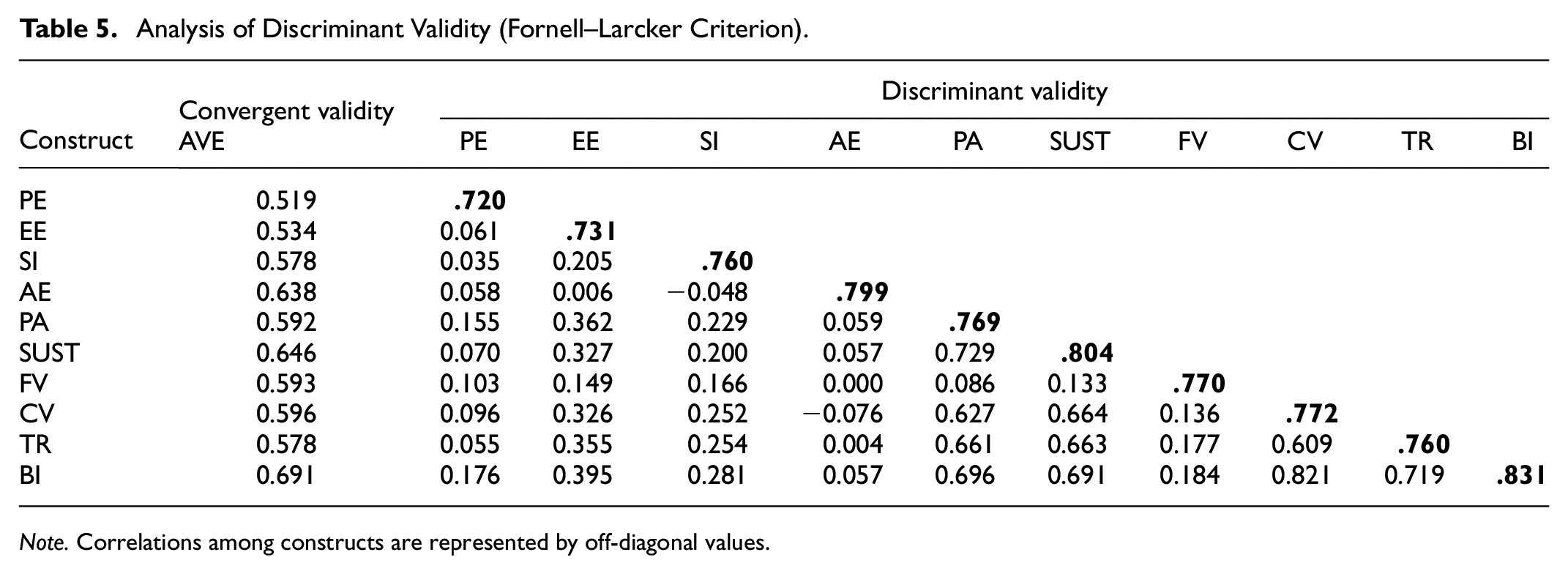
Note. Correlations among constructs are represented by off-diagonal values.
In contrast to ANOVA and regression, SEM lacks its reliable assessment indicator, making it common practice to compare the sample covariance matrix to the theoretical model’s covariance matrix to evaluate the model’s fit. While AMOS can generate up to 25 fit indices, not all of them need to be reported. Among the indices most used to evaluate SEM fit is the Goodness of Fit Index (GFI), Adjusted Goodness of Fit Index (AGFI), Comparative Fit Index (CFI), Non-normed Fit Index (TLI/NNFI), Root Mean Square Error of Approximation (RMSEA), and Standardized Root Mean Square Residual (RMSR). Therefore, we will evaluate the SEM fitness of this research according to the same criteria.
The determination of a fit index benchmark is not a straightforward task as the reference value of the chi-squared statistic is influenced by the sample size, despite the need for the statistic to be minimized. Consequently, a set of chi-square value-based indicators has been developed to address this issue. Additionally, the type of study being conducted has a significant impact on the fitting index’s quality. Exploratory and confirmatory studies require different fit index standards, with the former typically having a lower requirement than the latter. Thus, researchers often refer to suggestions made by leading scholars in the structural equations field, such as Hayduk (1987), Bagozzi and Yi (1988), L. T. Hu and Bentler (1998), and Hair et al. (2017). Table 6 presents the index results and suggested values for the proposed model, indicating that the model is sufficiently flexible to work with the given data since the goodness index is higher than the minimum value.
Model Fit Indices.
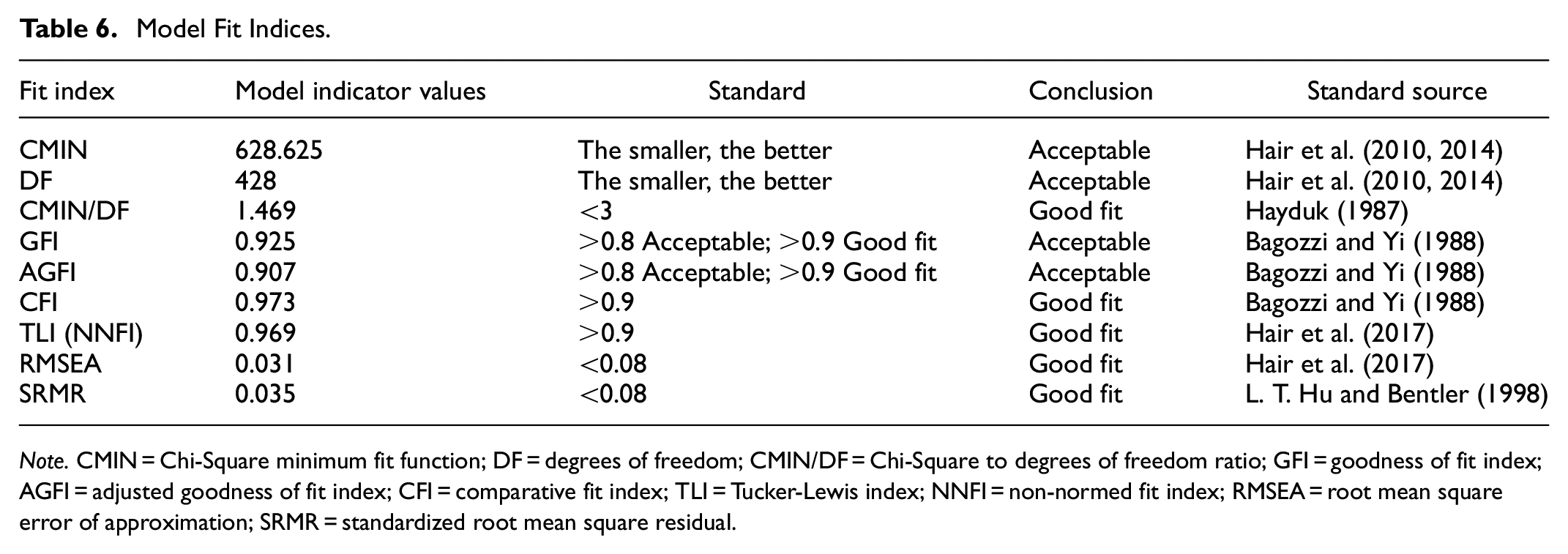
Note. CMIN = Chi-Square minimum fit function; DF = degrees of freedom; CMIN/DF = Chi-Square to degrees of freedom ratio; GFI = goodness of fit index; AGFI = adjusted goodness of fit index; CFI = comparative fit index; TLI = Tucker-Lewis index; NNFI = non-normed fit index; RMSEA = root mean square error of approximation; SRMR = standardized root mean square residual.
To sum up, the findings of this study suggest that several factors, including PE, EE, AE, PA, SUST, and CV, have a positive impact on BI. As illustrated in Figure 3 and Table 7, the path coefficient for CV to BI was the highest among all predictors, indicating that it has the strongest influence on BI with a coefficient of 0.581. This means that a unit change in the CV of the ECS results in a 0.581-unit change in their BI. PA and SUST were found to be the second and third most influential factors on BI, respectively, with path coefficients of 0.188 and 0.118.

Structural model test and hypotheses test results.
Discussion
The findings show that university students in Guangzhou, China are particularly interested in receiving discounts on ECS or promotional events if they are offered a CV. To put it simply, most university students in Guangzhou, China don’t have to worry about paying for transportation. The reason why PA is important is because ECS will help ease traffic and enhance air quality. In the context of the sharing economy, ECS is a novel service. Besides, there are several ways in which SUST contributes to the success of the BI to ECS transition. Because it will enhance PA’s attitude about BI and its acceptability by reducing waste and saving natural resources. As an additional benefit, ECS is efficient in its use of energy and contributes to the preservation of the natural world. Accordingly, in line with prior studies on technology acceptance (e.g., Davis et al., 1989; Venkatesh & Bala, 2008), this study confirmed that CV, PA, and SUST are significant in establishing BI to ECS. The effects of PE and EE on ECS are consistent with the hypothesis put out by M. C. Lee (2010), which is supported by evidence from previous investigations. University students in this study believed that ECS would enhance accessibility and security. Since time is another valuable commodity that can be saved, Chinese university students are available to transfer to other means of transportation with the aid of ECS. At the same time, ECS provides a straightforward and intuitive interface for the driver.
In contrast, SI and FV showed no significant impact on BI. The result of SI is quite different from that of Curtale et al. (2021), who found that SI was an important factor in determining the BI to use ECS. Nevertheless, Tran et al. (2019) had a similar finding that SI didn’t positively influence the BI to use ECS. The lack of significant impact of SI on BI to use ECS among university students may be due to several reasons. Firstly, university students may have different attitudes and preferences toward transportation modes compared to the general population, which may affect the importance of SI in shaping their behavior. For instance, university students may prioritize factors such as cost, convenience, and flexibility over social norms or peer pressure when making transportation choices (Sun et al., 2021). Secondly, the social networks and reference groups of university students may not be strong enough to influence their behavior regarding ECS. University students often have diverse social circles and may not be strongly influenced by the behavior or opinions of their peers. Moreover, the use of ECS may not be a salient or prevalent behavior among their social networks, which may weaken the impact of SI on their BI. Finally, university students may be more informed and conscious about environmental issues and SUST than the general population (Curtale et al., 2021; L. Li & Zhang, 2023; Zhang & Li, 2020), which may make them more likely to form positive attitudes and BI toward ECS based on environmental concerns rather than SI. Likewise, the lack of significant impact of FV on BI to use ECS among university students may be due to several reasons. Firstly, university students may prioritize other factors such as cost, convenience, and flexibility over FV when making transportation choices. For instance, if the ECS is not easily accessible or if the rental process is complex and time-consuming, students may not consider it as a viable transportation option, regardless of its FV. Moreover, the perceived FV of the ECS may be similar to other transportation modes available to university students. For example, if public transportation or cycling options are readily available and efficient, students may not perceive the FV of the ECS as significantly different or superior. Besides, university students may have limited experience and knowledge about the features and benefits of ECS, which may impact their perceptions of FV. Lack of information or experience with ECS may lead to a lack of perceived FV, which in turn may weaken the impact of this factor on their BI. Overall, these factors suggest that the impact of SI and FV on BI to use ECS among university students may be limited. Instead, other factors such as PE, EE, AE, PA, SUST, and CV may have a stronger influence on their BI (see Table 7 and Figure 3).
Hypothesizes Testing.

p < .001.
The impact of several control variables on the BI to use ECS among university students was investigated in the present study. Specifically, the effects of gender, education, and driving experience on BI were examined. Our analysis revealed that none of these control variables had a statistically significant impact on BI, as demonstrated in Figure 3. These findings suggest that these control variables are not significant determinants of BI to use ECS among university students.
Table 8 presents the key findings related to moderating variables. Our analysis revealed a significant positive moderating effect of trust on the association between PA and the BI to use ECS after controlling for gender, education level, and driving experience among university students. In contrast, we found a significant negative moderating effect of trust on the relationship between CV and BI. A meta-analysis of the correlations between PE, EE, SI, AE, PA, SUST, FV, CV, and BI to utilize ECS showed that trust did not have a significant moderating role. Our results suggest that if university students have a positive PA or favorable impression of ECS operators, it may enhance the relationship between their positive perceptions of ECS and their BI to use the service. Conversely, CV may have less influence on university students’ BI to utilize ECS due to the trust they have in ECS operators. A lack of trust in ECS operators could potentially hinder the route from perceived personal advantages to the desire to use ECS.
Moderating Effect Results Hypotheses.

Note: PE = performance expectancy; EE = effort expectancy; SI = social influence; AE = anxiety-free experience; PA = personal attitude; SUST = sustainability; FV = functional value; CV = conditional value; TR = trust; BI = behavior intention.
Implications
The findings of this study have significant implications for further investigations on how BI indicators could encourage university students to adopt ECS.
Theoretical Implication
From a theoretical perspective, the sharing economy represents an innovative economic model that promotes the efficient utilization of resources and balanced development of the regional economy, as noted by G. Zhu et al. (2017) and Y. Liu and Yang (2018). This highlights the need for a comprehensive investigation of factors that affect the sharing economy. This paper incorporates the theoretical foundation of the original UTAUT, as well as several novel factors (AE, PA, SUST) and the consumption value theory (FV and CV). The research project concludes by examining the influencing mechanism of the sharing economy and investigating the potential moderating effect of trust in ECS operators, as outlined by Mensah et al. (2019). The hypothesis model proposed in this paper is found to be accurate, providing a new theoretical reference for future quantitative research on the growth of the sharing economy.
The findings of this study offer valuable insights into the development of ECS, particularly for university students in Guangzhou, China. The results suggest that BI is positively influenced by PE, EE, AE, PA, SUST, and CV, with CV being the most significant predictor of BI, followed by PA and AE. This comprehensive finding resonates with several established theories, such as the TPB, the UTAUT, the UTAUT2, and the theory of consumption values. By recognizing the intricate interplay of various psychological, attitudinal, and situational factors, this discovery underscores the complexity of consumer decision-making processes. This holistic perspective underscores the need to consider a diverse array of influences in predicting and explaining behavioral intentions, enhancing the theoretical discourse on consumer behavior. The study controlled for gender, education, and driving experience of university students and found that trust had a significant moderating effect on the relationship between PA and BI as well as between CV and BI. Trust had a positive impact on the association between PA and BI, whereas it had a negative impact on the relationship between CV and BI. The significant moderating role of trust further enhances the theoretical landscape by emphasizing the dynamic nature of relationships between constructs. This finding aligns with prior research highlighting trust as a crucial component in technology adoption and behavioral intention (Curtale et al., 2021; Hartl & Hofmann, 2022; Mensah et al., 2019; Möhlmann, 2015; Rehman et al., 2022; G. Zhu & Kubickova, 2022). The identification of trust as a moderator underlines its pivotal role in shaping the strength and direction of relationships between psychological factors (such as personal attitude and conditional values) and behavioral intentions. This insight deepens the understanding of how trust acts as a lens through which consumers evaluate and respond to various motivational and attitudinal factors. Building on this theoretical foundation, the study offers practical recommendations for the development of ECS.
Practical Implication
From a practical perspective, the growth of the sharing economy can be attributed to the development of ICT and network platforms that facilitate information matching. University students, among other consumers, are motivated to engage in the sharing economy through the economic and convenience benefits it offers. The sharing economy has the potential to alleviate a range of societal issues, such as pollution, excessive consumerism, and poverty. The practical implications of these findings are particularly relevant for policymakers, CS companies, and universities seeking to promote sustainable transportation options. Specifically, the study’s results indicate that improving factors such as PE, EE, AE, PA, SUST, and CV is critical in promoting ECS among university students in Guangzhou, China. This can be achieved through a variety of measures, including providing training and education on how to use ECS technology, improving the accessibility and reliability of the service, and addressing concerns around safety and security. Moreover, the findings suggest that promoting sustainable transportation among university students should emphasize the environmental and social benefits of ECS, and can be achieved through targeted marketing campaigns, incentives, and partnerships with local businesses and organizations that promote sustainable practices. Overall, this study provides valuable insights into the factors that influence university students’ BI to use ECS and offers practical recommendations for promoting sustainable transportation options. As such, this research is of great value in the real world in understanding the elements that impact university students’ decision to use ECS.
Based on the analysis of the data, several countermeasures can be proposed to improve the utilization of ECS in the sharing economy. Firstly, understanding that CV plays a positive role in shaping BI equips marketers with the insight to tailor their messaging and offerings to resonate with the specific circumstances and conditions of university students in Guangzhou, China. By aligning their products or services with the contextual needs and situational considerations of their target audience, marketers can enhance the appeal and relevance of their offerings, such as discounts or subsidies. To address PA and SUST, educational institutions can adapt these findings to create supportive and engaging environments for students. It is recommended to enhance the sense of responsibility among individuals to protect the environment, as ECS can be perceived as a status symbol for environmentalists, thereby increasing the willingness to use them (White & Sintov, 2017). This can be achieved by releasing timely reports on environmental pollution in the media and using professional and authoritative data to emphasize the contribution of EVs to reducing air pollution. Additionally, to address PE, EE, and AE, marketers can create comprehensive messaging that resonates with consumers on multiple levels. EV manufacturers and shared travel platform companies should focus on improving PE and reducing car rental prices to improve the cost performance of using shared EVs. It is also essential to improve the endurance of EVs, deploy charging piles at optimal locations, ensure effective vehicle scheduling, and implement efficient car condition monitoring and maintenance to provide a pleasant travel experience for university students. Moreover, recognizing the role of trust as a moderator underscores the importance of building and maintaining consumer trust through transparent communication and reliable services. Businesses can leverage these insights to enhance product development and customer experiences. By addressing multiple dimensions that influence behavioral intention, businesses can create offerings that align with diverse consumer motivations. Trust, as a moderator, highlights the importance of fostering trust-building initiatives to enhance the impact of other positive influences on behavioral intentions. By addressing psychological factors, sustainability concerns, and trust-building efforts, institutions can foster positive behavioral intentions among university students. Power grid companies can leverage the ubiquitous power Internet of Things to support the operation of ECS and reduce perceived risk among residents. By analyzing charging behavior data and the operation data of charging equipment, power grid companies can plan the charging and replacement service network, coordinate with shared travel platforms, and improve the convenience and availability of charging and replacement services. Overall, these measures can effectively promote the growth of the sharing economy and help realize the goal of sustainable transportation.
In summary, the identification of diverse positive influences and the moderating role of trust offer a comprehensive framework for strategic interventions across sectors. By integrating these factors, stakeholders can create more impactful strategies that resonate with consumers’ multifaceted motivations and considerations while recognizing the critical role of trust in shaping these relationships.
Conclusion
In a situation where widespread auto ownership and contentment with existing transportation options may function as a barrier to the adoption and usage of ECS, very few research have explored the psychological aspects and consumer values driving its adoption. This research not only elucidates the mental process behind the decision to utilize ECS, but also offers empirical support for a conceptual model based on an expanded UTAUT. According to data collected from a statistically valid sample of the Dutch population, BI may be predicted with some degree of accuracy by the original UTAUT’s psychological elements, the newly indicated variables, transport-related traits, and consumption values. The data suggests that all things considered, ECS is competitive in China. Operators of ECS systems may use this as motivation to research comparable markets. We find that CV, followed by PA, SUST, EE, PE, and AE, is the strongest predictor of future ECS use intent. The findings are crucial because they provide the foundation for effective policymaking and marketing initiatives aimed at expanding the use of ECS. Users place a high value on subsidies, discount rates for ECS services, and promotional activities, as shown by the fact that CV has the highest predicted path coefficient. When the result is better, more people are more likely to utilize it. Companies should pay close attention to user trust building in ECS operators since it mitigates the predictive value of CV to the desire to utilize ECS. Comprehensive research and domestic reports show that the network layout, inadequate vehicle supply, vehicle failure, and untimely maintenance are the top problems criticized by consumers ever since the sharing car was introduced into the market. The user’s perspective is negatively impacted, and in turn, their desire to utilize the product is diminished, when they experience discontent. To truly serve users and make them feel that shared vehicles can well meet the demand of transportation, and have innate advantages in using funds and resources, optimizing the social environment, using, and maintaining vehicles, and so on, focus on reasonable vehicle scheduling, optimizing network layout, strengthening vehicle management, ensuring timely and effective maintenance and cleaning, and so on.
In the context of widespread auto ownership and satisfaction with existing transportation options, the adoption and use of ECS may be impeded, and the psychological factors and consumer values that drive its adoption have not been adequately studied. This research contributes to filling this knowledge gap by shedding light on the decision-making process underlying the use of ECS and by providing empirical support for a conceptual model based on an expanded UTAUT. Using data collected from a statistically representative sample of the Dutch population, the study shows that BI to use ECS can be predicted with some degree of accuracy by the psychological elements of the original UTAUT model, as well as by newly identified variables such as transport-related traits and consumption values. The findings suggest that ECS is competitive in China, motivating operators of ECS systems to explore comparable markets. In addition, the study shows that CV is the strongest predictor of future ECS use intent, followed by PA, SUST, EE, PE, and AE. These findings have significant implications for policymaking and marketing initiatives aimed at expanding the use of ECS, highlighting the importance of subsidies, discount rates for ECS services, and promotional activities in increasing user adoption. Moreover, companies should pay attention to building user trust in ECS operators, as this can mitigate the negative impact of CV on users’ desire to utilize ECS. Finally, to maximize the social environment and upkeep of shared vehicles, while simultaneously improving user satisfaction, attention must be focused on prioritizing reasonable vehicular scheduling, optimizing network layouts, strengthening vehicular management, conducting maintenance and sanitation on a prompt and efficient basis, as well as addressing user apprehensions regarding vehicular supply and upkeep.
Limitations and Future Research
Although this study was conducted with rigorous methods and has produced interesting findings, it is important to acknowledge and address its limitations. Future research should aim to overcome these limitations to build upon the insights gained in this research. Firstly, this study fails to take into account the impact of other transportation-related characteristics, such as the number of available vehicles, cost structure, and accessibility of charging infrastructure, which are important considerations when examining this phenomenon. Moreover, the context of ECS is unpredictable and the elements that affect consumers’ usage of shared automobiles due to uncertainty and danger should be considered when presenting customers with diverse use contexts. Previous research has also shown that perceived danger and uncertainty affect propensity to use. Additionally, this study takes a consumer-centric approach to identify the variables that contribute to the growing popularity of ECS, while the supply-side usage of shared vehicles is an important aspect of the sharing economy that will require greater emphasis in future studies. Consumers and platforms that impact how people utilize the sharing economy may be brought together under a new paradigm. Cultural issues are also an important consideration for future research. Prior research has demonstrated that cultural influences regulate how information systems are used, and future research should use empirical methodologies to demonstrate that the growth of the sharing economy in China necessitates consideration of regional cultural diversity. Hofstede’s work on the five aspects of culture is an example of a cross-cultural study that can inform this research. Some studies have suggested that the direction of cultural differences impact on the sharing economy and collaborative consumption remains unclear and requires further empirical evidence. Moreover, cultural characteristics have been shown to have moderating effects on the link between marketing and consumer behavior. Further research on the moderating influence of uncertainty avoidance on consumers’ acceptance of ECS is needed in future work. Finally, the sharing economy has varying impacts on regional economies, and future studies on the adoption of ECS among university students will benefit from using a larger data set. The sample size should be revised and increased across universities or regions in future studies.
Footnotes
Author Contributions
TY: design of the work, data collection, analysis, and interpretation, drafting the article, and final approval. CW: data interpretation, drafting the article, critical revision of the article. YZ: data analysis and interpretation. AT & AW: editing and formatting. All authors contributed to the article and approved the submitted version.
Declaration of Conflicting Interests
The author(s) declared no potential conflicts of interest with respect to the research, authorship, and/or publication of this article.
Funding
The author(s) disclosed receipt of the following financial support for the research, authorship, and/or publication of this article: This work was supported by the planning fund for humanities and social sciences projects of the Ministry of Education (Grant number: 22YJAZH001) and the 2022 Guangdong Education Science Planning Project (Special Project of Higher Education, Grant number: 2022GXJK369).

Data Availability Statement
The original contributions presented in the study are included in the article/supplementary material, further inquiries can be directed to the corresponding author.