




Abstract
The aim of this study was to derive determinants that affect the behavior associated with using self-order kiosks among fast-food restaurant consumers through the Unified Theory of Acceptance and Use of Technology model, and to analyze the moderating effect of consumers’ difference age (difference between individuals’ cognitive age and chronological age) among the variables. From December 1 to 30, 2019, a survey was conducted on 316 customers using four different fast-food restaurants in the Seoul Station. The results showed that the higher the price value, social influence, performance expectancy, and hedonic motivation, the higher the behavioral intention of ordering through the kiosk; furthermore, the higher the difference age, the higher the behavioral intention of using a kiosk. Therefore, fast-food restaurant operators need to ensure that customers who are unfamiliar with using kiosks can order and make payments through kiosks with minimal effort and reasonable price value.
Introduction
The evolution of information and communication technology has brought many changes to the service industry. Personal services are now being replaced by technology-based self-service (TBSS) through the use of technical interfaces without the involvement of service personnel (Dabholkar & Bagozzi, 2002; H. J. Yang & Lee, 2008). The food service industry, which relies heavily on labor force, is no exception to this phenomenon. As of 2020, South Korea’s minimum hourly pay is 8,590 Won (US $7.43), which has increased by 2.9% from last year, after the government implemented the minimum wage hike policy. As a result, TBSS, such as self-order kiosks, is becoming more popular due to the increased burden of labor cost on the restaurant industry (Kang, 2018; K. M. Kim & Kim, 2019).
TBSS provides consumers with benefits such as ease of use and reduced waiting time. Moreover, from the corporate perspective, implementing TBSS can result in reducing labor costs, providing standardized services, reducing staff, and increasing customer satisfaction (M. K. Kim, 2019; Susskind & Curry, 2016). However, forcing the use of TBSS, while completely excluding the option of face-to-face contact services, can cause pessimistic attitudes toward the service as well as TBSS, and some customers may avoid the service space altogether if TBSS has been applied there (J. M. Lee et al., 2019b; Reinders et al., 2008). In particular, those who are vulnerable to experiencing a cultural lag (e.g., the elderly and the disabled) in this period of fast technological information development are reluctant to use new and unfamiliar technologies and prefer the traditional form of face-to-face contact services (Choe & Lee, 2011; S. Y. Hong & Choe, 2019). Thus, as prior studies have suggested, consumers’ assessment of TBSS and their intention to use it may be affected by individual traits such as being unable to adapt to the rapid development of technology (F. Q. Meng et al., 2017; Venkatesh et al., 2012).
Among them, the consumer’s age is a very important variable that causes the digital divide—a phenomenon of economic and social inequality between people who easily adapt to new information technology and people who have difficulty adapting doing the same (Choi et al., 2018). The age group of fast-food consumers, who are the main focus of this study, is expanding due to social changes, such as aging and an increase in single-person households (S. H. Hong, 2019). In the case of the elderly, their acceptance or use of information and communication technology is greatly influenced by their inactivity and lifelong habits (W. K. Lee, 2013). Therefore, the determinants affecting their acceptance or use of information and communication technology will be different compared with that of younger consumers. In this context, if fast-food restaurant operators are aware of how TBSS is perceived and evaluated by consumers of different age groups, they can benefit from it to a greater extent. However, most of the research on acceptance of technology in the food service industry has been conducted without considering the distinction between younger and older consumers (Abu et al., 2015; S. W. Lee et al., 2019). Various methods have been developed to measure a consumer’s age to address the problem that consumers’ cognitive age may not match their actual age when studying consumer attitudes and behavioral patterns (Y. Y. Hwang et al., 2017), but most studies are still based on the actual age of consumers (Khalilzadeh et al., 2017; Morris & Venkatesh, 2000; Palau-Saumell et al., 2019). Therefore, this study seeks to determine how cognitive age, rather than chronological age, plays a role in the acceptance or use of information and communication technology of middle-aged and older consumers.
Research on consumers’ acceptance of new technologies and the derivation of influential factors is being developed by integrating or expanding existing theories based on Davis’s (1989) Technology Acceptance Model (TAM). Among them, the Unified Theory of Acceptance and Use of Technology (UTAUT) model has a more extensive explanation than other theories regarding information technology acceptance (J. G. Kim et al., 2013). In this study, by applying the UTAUT model, we aimed to derive factors that affect the behavioral intention of using a self-order kiosk in fast-food restaurants and verify the moderating effect of “difference age” (the difference between a person’s actual chronological age and their perceived cognitive age) among the variables. The results of this study will suggest marketing implications for restaurant operators that have already introduced or are planning to introduce self-order kiosks in the future.
Literature Review
TBSS and Self-Order Kiosks
TBSS was first presented by Dabholkar (1994) and is often used interchangeably with SST (Self-Service Technology; F. Q. Meng et al., 2017). Although TBSS is conceptualized in various ways depending on its type, it is based on customers performing their own services by replacing the people who used to provide them with advanced information and communication technologies (J. M. Lee et al., 2019b). The TBSS type—the use of which has been rapidly increasing in South Korea—is a self-order kiosk, which is an unmanned payment system that allows customers to search through the menus, order, and make payments directly (M. K. Kim, 2019). In particular, fast-food restaurants have introduced kiosks most actively in South Korea. As of 2018, 61.2% of all Lotteria stores—one of South Korea’s leading fast-food restaurant chains—installed kiosks, and it is estimated that the share of unmanned sales reached 60% in 2019 compared with the 8.6% noted in 2015 (J. M. Lee et al., 2019b). With the recent increase in the use of TBSS in the food industry in South Korea, research related to consumer acceptance is being actively carried out. It is mainly focused on analyzing the factors influencing technology acceptance following the introduction of new technology (S. W. Hwang & Kim, 2019; D. B. Kim & Namkung, 2019; H. Y. Meng, 2019) and the design of touchscreen-based self-order service (Heo et al., 2010; S. Y. Hong & Choe, 2019; Park, 2018). However, most studies have derived factors influencing technology acceptance without considering personal traits such as the age and gender of food service consumers.
The UTAUT Model and Its Variations
The UTAUT model presented by Venkatesh et al. (2003) is a new TAM that incorporates eight different social and psychological theories (H. G. Lee & Han, 2019).
The initial UTAUT model consisted of four basic factors: performance expectancy, effort expectancy, social influence, and facilitating conditions. These factors, as independent variables, have been shown to be affected by behavioral intention or use behavior with variables such as gender, age, experience, and voluntariness of use acting as moderator variables (Venkatesh et al., 2003). In this context, performance expectancy is the extent to which an individual perceives that utilizing the system will help them work efficiently, while effort expectancy is the degree to which a consumer expects ease when utilizing the new system. On the contrary, social influence is the extent to which people around you use a new system thereby affecting you. Finally, facilitating conditions are perceived barriers or enablers in the environment that influence an individual’s perception of ease or difficulty regarding the performing of tasks.
According to prior studies, performance expectancy has been verified as a leading variable affecting behavior (H. M. Jeon & Choi, 2017; J. M. Lee et al., 2019a; San Martín & Herrero, 2012). Effort expectancy has been shown to have a positive effect on the behavior of the adopter (Jeong, 2019; San Martín & Herrero, 2012), but some studies disagree with this finding (H. M. Jeon & Choi, 2017). Some prior studies found that social influence has a positive effect on the adopters’ behavioral intention (H. M. Jeon & Choi, 2017; Khalilzadeh et al., 2017); however, a study by Jang and Koh (2017) analyzed the factors affecting the elderly’s smartphone utilization behavior and showed that social influence did not affect their behavioral intention. Moreover, studies also found that facilitating conditions have a positive effect on the behavior of the adopters (H. M. Jeon & Choi, 2017; Jeong, 2019; J. M. Lee et al., 2019a), but Khalilzadeh et al. (2017) refuted this claim when they found that they do not affect behavioral intentions.
Meanwhile, Venkatesh et al. (2012) was able to create an advanced version of the UTAUT model from the existing UTAUT model. It is considered more logical in that past behavior experiences are included as influencing factors in future behavioral intentions, which were overlooked in the basic UTAUT model (Fong et al., 2017). In their model, the following factors were included. First, hedonic motivation refers to the influence of an individual’s pleasure on using technology (Escobar-Rodríguez & Carvajal-Trujillo, 2014) and positively affects behavioral intention (Jeong, 2019; Khalilzadeh et al., 2017). Second, price value is the consumers’ degree of satisfaction with the monetary costs paid to use the system (Escobar-Rodríguez & Carvajal-Trujillo, 2014). Previous studies have shown that price-saving orientation has a positive and significant influence on attitudes toward using new technology (Palau-Saumell et al., 2019). Third, a habit is the degree to which people act reflexively because of prior learning (Limayem et al., 2007). Consumer habit has been regarded as a predictor of the use of technology in numerous studies (H. M. Jeon & Choi, 2017; S. W. Lee et al., 2019). Considering the fact that the factors affecting information technology acceptance depend on the type of information technology, research subjects, and so on, the following hypotheses were established to analyze the factors affecting the behavior of using self-order kiosks in fast-food restaurants in South Korea:
Difference Age
In general, age refers to the chronological age as the age of a person as measured from birth to a given date, and it is the most objective concept that can be easily measured as a demographic variable (Settersten & Mayer, 1997). This chronological age has been shown to play a moderating role in the relationship between information technology acceptance and determinants, and behavioral intention (Khalilzadeh et al., 2017; Morris & Venkatesh, 2000; Wang & Shih, 2009).
However, considering the global trend of population aging and discrepancy between self-perceived age and chronological age (S. J. Hong et al., 2013), it is worth investigating factors that determine the acceptance and use of information technology in people whose perceived age and chronological age differ. A person’s self-perceived age is referred to in literature as cognitive age (S. T. Hong et al., 2007). This concept was first used by Barak and Schiffman (1981) in the early 1980s in place of chronological age. Since then, many scholars have argued that cognitive age can explain consumer behavior better than chronological age (Barak & Gould, 1985; Bu, 2005; Moschis & Mathur, 2006). According to previous studies on consumer cognitive age, as people get older, they tend to perceive their cognitive age as lower than their chronological age (C. H. Oh et al., 2015; M. J. Oh & Hwang, 2015). K. C. Yang and Shih (2020) found that the effect of perceived usefulness on behavioral intention to continue using smartphones in groups with lower cognitive age than their chronological age was greater than that of groups with higher cognitive age than their chronological age. Meanwhile, S. J. Hong et al. (2013) found that the effect of subjective norms on behavioral intention was higher in the groups where the cognitive age is the same as the chronological age than in the groups with lower cognitive age.
The use of difference age is increasing as an alternative to explaining consumer behavior of middle-aged and older consumers with regard to rapidly developing information and communication technologies (K. H. Hong, 2010; E. Y. Kim et al., 2018; Suh & Ryu, 2008). The difference age is calculated by subtracting the cognitive age from the chronological age (K. H. Hong, 2010). Therefore, this study will analyze whether the difference age plays a moderating role in the relationship between the influencing factors and behavioral intention of acceptance of fast-food restaurants’ self-order kiosks among middle-aged and older consumers. Based on this, we propose the last hypothesis of the present study as follows:
Method
Measurement Model
Based on the expanded UTAUT model proposed by Venkatesh et al. (2012), the following research model (see Figure 1) was designed to identify the factors affecting the self-order kiosk use behavior in fast-food restaurants.
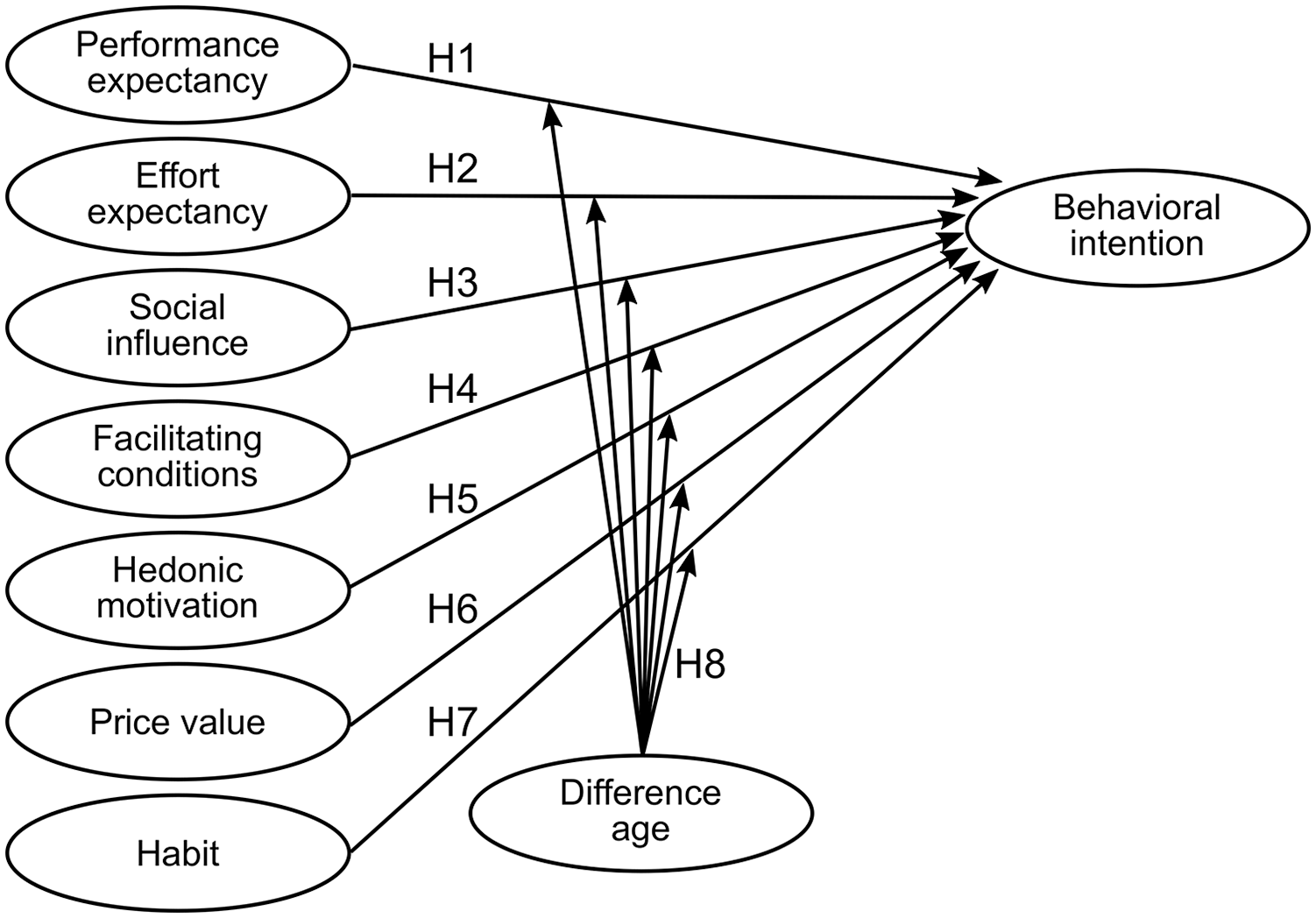
Research model.
As mentioned earlier in the text, the difference age is effective in studying the purchasing behavior of middle-aged and old-aged consumers, so we will investigate it to verify its moderating effect among the variables. As it is difficult to observe the use behavior of middle-aged and old-aged consumers who have experienced using kiosks in fast-food restaurants, only behavioral intention was chosen as a dependent variable.
Measures
UTAUT
The factors influencing the behavior of using a self-order kiosk use were derived from 23 measurement items proposed by Venkatesh et al. (2012), and some of the items were modified for this study. For example, the item “I find mobile Internet useful in my daily life” was used to measure performance expectancy by modifying it to “I find the self-order kiosk is useful in ordering the menu items that I want.” However, measurement items such as “Using mobile Internet increase my chances of achieving things that are important to me,” and “I have the resources necessary to use mobile internet” were not used in this study because they were less relevant to the environment of a fast-food restaurant. To measure the behavioral intention, three measurement items were included based on Wang and Shih’s (2009) study. All items were measured on a 5-point Likert-type scale comprising options ranging from 1 = “strongly disagree” to 5 = “strongly agree.”
Difference age
To calculate the difference age, the age subjectively perceived by the individuals was examined in four dimensions (Barak & Schiffman, 1981): feeling, looks, behavior, and interests. For example, if the respondent whose chronological age was 58 years old answered the items asking about their cognitive age in the order of 52, 48, 50, 55, the cognitive age of this respondent would be calculated as the mean of all these items; in this case, it would be 51.3 years old (52+48+50+55/4). The difference age of this respondent is 6.7 years, which is the chronological age minus the cognitive age (58 – 51.3). After calculating the difference age, it was divided into the following groups: Group 1 (n = 145, difference age > 4.89), which perceives themselves as younger than their chronological age, and Group 2 (n = 171, difference age ≤ 4.89), which recognizes their age as higher than the chronological age, based on the average of the difference age of all respondents (M = 4.89, SD = 4.74).
Data Collection
The survey was conducted on a non-probability sampling method basis for customers at four fast-food restaurants located in Seoul Station, South Korea, from December 1 to 30, 2019. We verbally explained the purpose of the survey to customers who came out after eating at the restaurant, and conducted the survey on site for customers who agreed to participate in the survey. They were first introduced to the self-order kiosks, and then they filled out a self-administered paper questionnaire by circling the responses. A total of 400 customers participated; 11 were excluded because of incomplete answers, and 73 were excluded because they were in the 20–39 age bracket. The final valid sample included 316 participants.
Data Analysis
We used SPSS Version 18.0 to conduct a frequency analysis of the respondents’ demographic profile. Exploratory factor analysis and reliability analysis were conducted to verify the validity and reliability of measurement items. In addition, correlation analysis was conducted to analyze the correlation between variables, and a hierarchical regression analysis was conducted as proposed by Baron and Kenny (1986) to analyze the moderating effect of difference. Prior to the hierarchical regression analysis, the independent and moderator variables were mean-centered to avoid multicollinearity issues between variables.
Results
Participant Characteristics
Table 1 includes the attributes of those who participated in the survey; 61.1% of them were male and 84.8% were married. In the case of frequency of using a self-order kiosk during a week, 110 respondents (34.8%) used it twice or thrice a week, 98 (31.0%), less than once a week, 92 (29.1%), between 4 and 6 times a week, and 16 (5.1%), more than 7 times a week.
Participant Characteristics.

Results of Reliability and Validity Analyses
The results of the exploratory factor analysis on 26 questions aiming to determine the factors influencing the self-order kiosk use behavioral intention in fast-food restaurants are shown in Table 2. The factor analysis extracted eight factors with an eigenvalue of 1.0 or higher; these were named as follows: The first factor was called “habit,” the second factor, “facilitating conditions,” the third, “hedonic motivation,” the fourth, “effort expectancy,” the fifth, “performance expectancy,” the sixth, “behavioral Intention,” the seventh, “social influence,” and the eighth, “price value,” in accordance with the main concepts of the items that make up each factor. In addition, all eight of the derived factors had Cronbach’s alpha values that were .714 or higher, indicating that the internal consistency of the measured items was reliable.
Results of the Reliability and Validity Analysis.

Note. KMO = .717, Bartlett’s sphericity test = 4,963.595, df = 325, p < .000. KMO = Kaiser–Meyer–Olkin; df = degrees of freedom.
Correlation Analysis
The results of a correlation analysis to identify the correlations between each factor before the hypothesis test are shown in Table 3. Behavioral intention was found to have a positive correlation with facilitating conditions (r = .195), hedonic motivation (r = .228), performance expectancy (r = .272), social influence (r = .236), price value (r = .122), and difference age (r = .168), but not with habit and effort expectancy. The coefficient of correlation of each variable was not higher than .8, which makes the occurrence of multicollinearity unlikely.
Correlation Analysis Between the Variables.
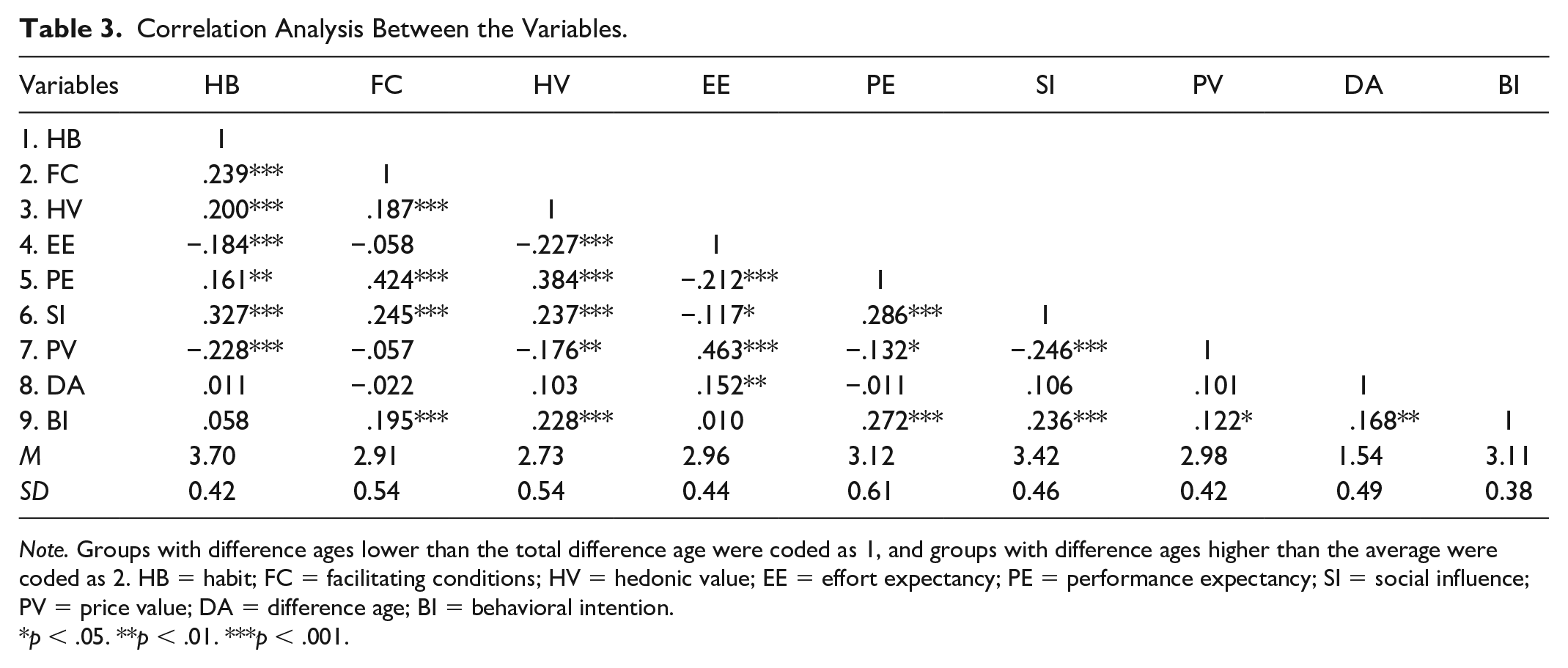
Note. Groups with difference ages lower than the total difference age were coded as 1, and groups with difference ages higher than the average were coded as 2. HB = habit; FC = facilitating conditions; HV = hedonic value; EE = effort expectancy; PE = performance expectancy; SI = social influence; PV = price value; DA = difference age; BI = behavioral intention.
p < .05. **p < .01. ***p < .001.
Results of Hypothesis Testing
Table 4 shows the results of the moderating effect of the difference age in the relationship between technology acceptance determinants and behavioral intentions of using a self-order kiosk for fast-food restaurant consumers.
The Result of the Moderating Effect.

Note. Durbin–Watson = 1.799. HB = habit; FC = facilitating conditions; HV = hedonic value; EE = effort expectancy; PE = performance expectancy; SI = social influence; PV = price value; DA = difference age.
p < .05. **p < .01. ***p < .001.
First, the R2 value of Model 1 was found to be 14.4% in terms of examining the effect of fast-food restaurant self-order kiosk technology acceptance determinants on behavioral intention, and the regression model was statistically significant (F = 8.569, p < .000). Among the determinants of the self-order kiosk technology acceptance, price value (β = .216, p < .000) was found to have the greatest influence on behavioral intention, followed by a statistically significant influence on behavioral intention in the order of social influence (β= .200, p < .001), performance expectancy (β = .160, p < .05), and hedonic motivation (β = .149, p < .05). These findings support H1, H3, H5, and H6. However, H2, H4, and H7 were rejected because habit, facilitating conditions, and effort expectancy did not have a statistically significant effect on behavioral intention.
Second, the R2 value of Model 2, which consists of the self-order kiosk technology acceptance determinants and the difference age—which is the moderating variable—was found to be 15.5%; this means that the regression model was statistically significant (F = 8.241, p < .000). The difference age, which is a moderating variable, has been confirmed to have a positive effect on behavioral intention (β = .121, p < .05).
Finally, the R2 value of Model 3, in which interaction factors use difference age and decision factors for accepting kiosk technology in fast-food restaurants, was 19.4%; there is an increase of 0.056% compared with Model 2. Furthermore, only price value (β = .348, p < .01) and performance expectancy (β = .174, p < .05) interaction factors among the determinants of kiosk technology acceptance showed a moderating effect on behavioral intention. The results of a simple slope test using regression equation to verify how the price value and performance expectancy depend on the difference age in influencing behavioral intention are shown in Figure 2. As shown in the graph, the group with the individuals’ difference age lower than the average showed that the behavioral intention decreased slightly as the performance expectancy and price value increased, while the group with the individuals’ difference age higher than the overall average increased as the performance expectancy and price value increased.
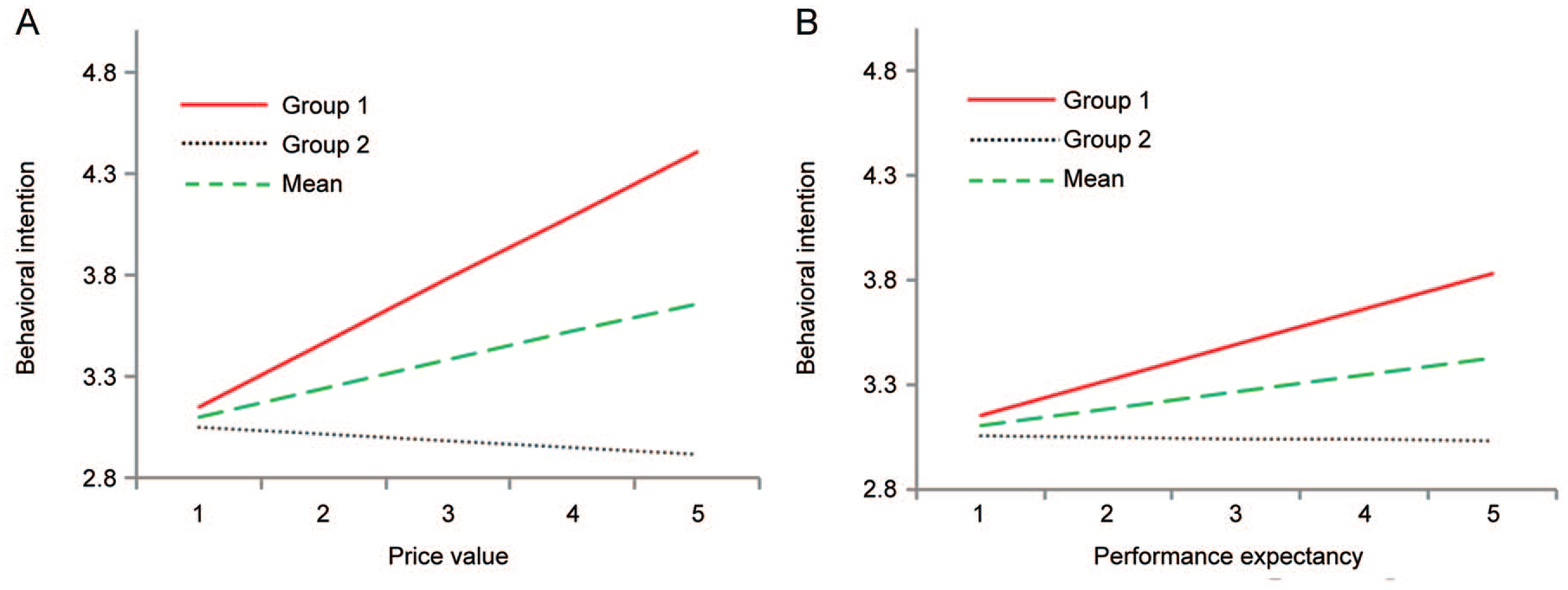
The results of a simple slope test using (A) regression equation of price value and (B) regression equation of performance expectancy.
Discussion
In this study, we tried to identify the moderating effect of the difference age in the relationship between determinants of technology acceptance and behavioral intention of self-order kiosks in fast-food restaurant consumers through the UTAUT model. The results of the analysis are as follows. First, the higher the price value, social influence, performance expectancy, and hedonic motivation associated with using the kiosk installed in fast-food restaurants, the higher the behavioral intention of ordering menu items through the kiosk. In particular, it was confirmed that price value has the highest influence on behavioral intention. This finding is consistent with the results of previous studies (Byun, 2019; H. A. Jeon et al., 2018; Palau-Saumell et al., 2019; Sung, 2019), suggesting that the consumers’ economic benefits or price-saving orientation associated with using TBSS have a positive effect on consumer satisfaction and intention to continuously use it. Second, effort expectancy, facilitating conditions, and habit factors do not affect behavioral intention. This finding is partially consistent with previous studies (S. W. Lee et al., 2019; Morosan & DeFranco, 2016), suggesting that consumers’ effort expectancy or facilitating conditions in accepting delivery applications or NFC mobile payments in the hospitality industry do not affect behavioral intention. Third, the greater the difference between cognitive age and chronological age, the higher the behavioral intention of self-order kiosk use. In addition, in groups that perceived themselves as younger than their chronological age, their awareness of price value and performance expectancy increased. Meanwhile, kiosk behavioral intention increased more in groups that perceived their age as equal to or higher than their chronological age. These results are partially consistent with a previous study showing that the perceived usefulness of a smartphone or government mobile data service (MDS) by a group that perceives themselves to be younger than their chronological age has a greater impact on behavioral intention than a group that has the same cognitive age as their chronological age (S. J. Hong et al., 2013; K. C. Yang & Shih, 2020).
Based on these analysis results, the following suggestions were presented in terms of academic and practical implications. From an academic perspective, even in a situation where aging is accelerating globally, previous studies related to information technology have mainly analyzed the moderating effect of biological age. On the contrary, this study will be useful in establishing various marketing strategies related to self-order kiosk use by analyzing the moderating effect of difference age rather than the biological age of the elderly, who are new potential customers of fast-food restaurants. We present three practical suggestions as follows.
First, S. H. Hong’s (2019) research on the fast-food consumption in Korea found that there is a high demand for improvement in fast-food prices from customers in their 40s or older. In other words, if a customer determines that using a self-order payment service through a kiosk is more cost-effective than using a traditional face-to-face ordering system, the behavioral intention of using a kiosk will be higher. However, because the overall average of the price value was not high in this study, it is estimated that the cost-effective value is low when customers currently use fast-food restaurants to order a menu item from the kiosk. Therefore, fast-food restaurant operators should consider implementing self-order kiosks to reduce the cost of the products, but above all, it is important to increase the cost-effective value by offering a differentiated price strategy when ordering and paying for menu items through kiosks.
Second, for middle-aged and older people with low cognitive ability to accept new information, even if they order and pay for a menu quickly with minimal effort through a kiosk, the behavioral intention related to the kiosk is reduced due to the inconvenience caused by graphic factors such as pressing buttons. Therefore, in line with M. J. Kim’s (2018) research, operators of fast-food restaurants need to continuously manage the speed at which customers use kiosks to order menu items.
Third, it is necessary to design kiosk menus and interfaces for the elderly, such as in S. Y. Hong and Choe’s (2019) study, and additionally to develop kiosks with voice recognition technology so that the elderly can order and pay for fast-food menus as quickly as possible with minimal effort as suggested by D. H. Kim et al.’s (2019) study.
Following the limitations of the research, the future research directions are as follows. First, because the most active users of self-order kiosks in Korea are fast-food restaurants, we studied only customers who had experience with fast-food restaurants. Therefore, it is difficult to guarantee that the same results will be achieved when these results are applied to the entire restaurant industry. Recently, many restaurant industries, other than the fast-food industry, are introducing unmanned kiosks, and other variations of TBSS are expanding throughout the service process. Therefore, in future studies, it is necessary to conduct research by diversifying the samples and types of TBSS. Second, in this study, we set the seven determinants presented using the existing UTAUT model. However, future studies should develop more diverse factors. A more sophisticated research model can be created if the factors affecting TBSS behavioral intention are diversified along with advances in technology.
Footnotes
Declaration of Conflicting Interests
The author(s) declared no potential conflicts of interest with respect to the research, authorship, and/or publication of this article.
Funding
The author(s) received no financial support for the research, authorship, and/or publication of this article.
Ethical Statement and Informed Consent
This study is one of the areas where Institutional Review Board (IRB) approval is generally not required.
