




Abstract
This quantitative study examines the effects of internationalization practices on university quality service and students’ loyalty as perceived by international students in Malaysian public universities. A total of 1,575 international students from 10 different public universities in Malaysia and from different home countries participated in this study. Stratified sampling was used to select the international students by dividing the population into continents. Data were collected using questionnaires and analyzed using SmartPLS Structural Equation Model (PLS-SEM). The findings of PLS-SEM confirmed the effect of internationalization of higher education practice and university quality service on international student loyalty in Malaysia. It was also found the effect of internationalization of higher education practice on university quality service. The research reported here adds to the growing body of knowledge on foreign student satisfaction and perceptions of quality, internationalization of education, and student mobility. It also helps provide some insights for the education industry in Malaysia and beyond in their effort to gain global recognition in the field of academic teaching, research, and professional development.
Keywords
Introduction
The swift socio-economic growth in the developing nations of the world and the changing nature of higher education services has impacted the reality of young people in those nations who are looking outside their home countries for higher education. Changes in the socio-political landscape have also increased the level of competition in low-cost tertiary institutions with advanced teaching techniques. In its 2015 report, the Organisation for Economic Co-operation and Development (OECD) indicated that international education was growing rapidly and becoming a veritable global sector (OECD, 2015). Countries face fierce competition with the increased interest in the internationalization of higher education. As a result, they must develop education sectors and services to meet world-class standards (Jibeen & Khan, 2015; Sanders, 2020). The 2016 political leadership change in the United States, with the election of Donald Trump, and the Brexit movement in the United Kingdom, have made many international students reluctant to choose these two countries as their education destination (Hou, 2020). This has paved the way for Asian countries to lead international students’ mobility markets. Moreover, massive investment in Asian countries, such as China, South Korea and Singapore, has improved their tertiary institutions and academic services, which now look more attractive to international students.
Malaysia has become another one of the strong players in this new global marketplace and is recognized as an education hub in Southeast Asia. From the Malaysian perspective, higher education internationalization brings more international students into the country, driven by its vision for national development and economic growth. The Ministry of Higher Education (MOE) in 2019 announced that the country made an average of RM7.2 billion per year from revenue sources like tuition fees, living expenses, and other services accessed by foreign students. According to the Education Ministry secretary-general, Datuk Mohd Ghazali Abas, the average expenditure of a foreign student in Malaysia per annum is about RM46,000, which increases to RM88,000 if the international students are accompanied by their families (MalayMail, 2019).
Moreover, various studies (Azam, 2018; Giner & Peralt Rillo, 2016) have all signified the importance of quality education services in satisfying students and securing their loyalty. This is especially true for institutions seeking the students’ continuing patronage. The enormous profits from international students in Malaysia also mean that a need exists to focus on delivering top-notch service to generate and maintain loyal and satisfied students who, based on trust and commitment in the service already received, may recommend the institution to their peers. This also makes quality service a tool for higher education institutions to meet their customers’ needs and measure expectations (Govender et al., 2014), while their satisfaction is a main factor influencing institutional reputation (Moslehpour et al., 2020).
Malaysia has improved its educational system in recent years, allocating more money to important education subsectors, introducing education blueprints and policies, and keeping an eye on improving universities (Ministry of Higher Education Malaysia, 2011; Padlee & Yaakob, 2013). The country’s leaders also see that providing high-quality services to international students is among the marketing strategies to actualize Malaysia’s internationalization agenda and move it toward its goal of becoming a world-class education provider (Sultana & Momen, 2017). Moreover, this policy has significantly helped Malaysia become a country that moved from sending to receiving students and from aid seeking to an equal collaborator and an education hub (Wan & Abdullah, 2021).
However, international networking and cooperation are vital to improving further the internalization strategy in Malaysia. Besides, a comprehensive internalization policy and mobility are needed to maintain the education hub strategy and attract more international students (Munusamy & Hashim, 2021). Undoubtedly, it is essential to study the impact of the internationalization of higher education on university quality service and student loyalty, which can be done by examining international students’ perceptions and the components of the internationalization policy. This is the aim of the study reported here. Doing so will help the academic and non-academic sectors adjust and improve the internationalization policy.
Regarding university quality in Malaysia, there are numerous studies from public and private universities on service quality using SERVQUAL. The majority of these studies have reported physical facilities as the main factors in improving the services (Farooq et al., 2019). For example, Hossain and Islam (2012) and Sajna and Mohamed Haneefa (2018) reported physical facilities such as libraries as the main factors for service quality (Farooq et al., 2019). Husin et al. (2016) found all SERVQUAL dimensions were significantly related to students’ satisfaction, but tangible dimensions representing physical facilities were the highest and most significant for students’ satisfaction. For the international students in Malaysia, Ali et al. (2016) found that all the five dimensions of higher education service influenced international students’ satisfaction, reflected university image, and student loyalty.
In this study, the SERVQUAL method to quality service was used, taking into account the importance of foreign students’ opinions of the quality service provided by the university using Parasuraman et al. (1985) service quality dimensions (Amzat et al., 2023). The instrument and approach have been used by different researchers and still proves its validity, reliability and suitability to measure organizational quality service over the decades.
Furthermore, the application of the Push-Pull theory serves a different factor. It serves as a motivational theory that drives students’ mobility. Furthermore, Push-Pull theory explains the factors that forced international students to leave their countries and study abroad. Therefore, in this study, Push-Pull theory of motivation was used to investigate the reasons behind international students choosing Malaysia as their final study destination. Eventually, using this theory could help the public universities in Malaysia to know the international students’ expectations in coming to Malaysia while striving to meet the expectations for more students to come in the future.
In light of this, the findings from numerous studies have helped the higher institutions in Malaysia improve their services for students in general and international students specifically. However, the majority of these findings reported physical facilities (tangibles) as the main factors. At the same time, intangible aspects (emotional), such as empathy, courtesy and assurance, have been complained about by international students in Malaysia and have received little attention (Najimdeen, Amzat, & Ali, 2021). Thus, in general, Malaysian universities have attempted to improve their services to satisfy their customers (students) when it comes to physical facilities, infrastructure, academic labs and materials.
To examine where the process stands, this current study investigates whether public universities have maintained or improved their quality service to international students and examines the emotional aspects. Furthermore, a scarcity of research and studies are found on how Malaysia’s internalization policy has contributed to the university service quality and student loyalty. Therefore, these are seen as gaps that this study aims to bridge.
Literature Review
Quality Service Model and Theory
Many researchers studying quality service in higher education have used the gap model and the SERVQUAL approach Parasuraman et al. (1985) developed. The SERVQUAL methodology was drawn out of the “Perception Gap.” Its original ten service quality dimensions were reduced to five dimensions after empirical studies over the following decades. Considering the importance of the connections among university quality service, international student loyalty, and the internationalization processes, the current study was based on the SERVQUAL dimensions and the consumers’ (international students) perceptions of higher education in Malaysia. This study used this model to bridge the gaps between the university and customers (students) in meeting student expectations. The model and its questionnaire have become dominant in measuring service quality and management in organizations. In addition, it is used as the model to measure both physical and non-physical facilities (tangibles and intangibles). The model was applied, and a questionnaire was used to determine to what extent Malaysian public universities have maintained and improved their quality service for international students and how far they have come in creating satisfaction and developing loyalty.
University Quality Service
The concept of quality service could be traced back to Grönroos (1984) and Parasuraman et al. (1985). The efforts to improve products and services made quality a crucial issue in the marketing field. In the following five decades, scholars developed theories, including the Gap Model of Parasuraman et al. (1985), based on customer’s perceptions and expectations of quality and different dimensions of what constitutes service quality (Najimdeen, Amzat, & Ali, 2021). Most of these studies are conducted within a certain service (Huang et al., 2017), and quality in education is viewed from either the perspectives of stakeholders or clients ( Najimdeen, Amzat, & Badrasawi, 2021). However, there is no generally accepted method to measure quality service in educational institutions, and there is no unified tool to verify students’ satisfaction with their educational choice. As students are regarded as the primary consumers of higher education services, they must be the main focus of educational products and services (Husin et al., 2016). The Gap model and its instrument, known as SERVQUAL by Parasuraman et al. (1985), have been the most widely used in this regard to study their level of satisfaction.
The findings of various studies also have established the Gap Model’s usefulness in higher education research for investigating performance and agreement between the administrators’ (providers) and students’ (consumer) views on ways to improve quality of service in a tertiary institution based on the SERVQUAL dimensions, namely.
Tangibility: The facilities’ appearance, buildings and equipment, as well as the demeanor of the people of the organization/institution. Empathy: Caring and specialized service that the business offers to its clients. Reliability: The capacity to accurately and dependably provide the promised or advertised service. Assurance: This has to do with communication, competence, credibility, courtesy, and security. Hence, the employees’ politeness, knowledge, and capacity to foster trust and confidence. Responsiveness: The readiness to assist clients and offer fast service.
In a study on the role of service quality in universities, Sunarsih (2018) noted that providers must identify the key determinants of service quality because the satisfaction and behavioral intentions of students are affected by the level of service they receive, and this will affect their feelings of satisfaction and loyalty to the institutions or providers. While this makes quality service an important tool of gaining loyalty, it also gives the institutions of high education competitive advantages and increases the likelihood that they will be able to meet government requirements and public expectations (Cahyono et al., 2020).
Yousapronpaiboon (2014) and Azam (2018) affirmed that the dimensions of SERVQUAL are important for students. They are also vital for higher education institutions to actively monitor the quality of services offered to customers and protect stakeholders’ interests by fulfilling their real needs and wants. Shekarchizadeh et al. (2011) also showed that the SERVQUAL dimensions could be used to assess the perceptions and international students’ expectations of university service, as these dimensions were able to reveal the positive level of satisfaction or dissatisfaction among students.
Due to its complexity, there are several conceptualizations of quality service in higher education (Chen et al., 2017). Quality service can be defined as an overall verdict in the form of perspective toward a service/product. It is generally accepted as a predecessor of customer satisfaction (Kiran & Diljit, 2017; Parasuraman et al., 1988). The difference between customer expectations of service and perceived service is its quality, which is seen as an antecedent of student satisfaction (Subrahmanyam, 2017).
Internationalization Model and Theory
The Push and Pull theory of the motivation behind academic migration is relevant to international education. The theory was introduced in 1998 by Altbach, who performed research to discover the major factors that influence students from Third World nations to study abroad. The Push factors are the motivation behind studying abroad, and the Pull factors are those that draw talent to a nation. The Push reasons Altbach (1998, 2004) put forward included the students’ failure to pass school admissions exams and the “advantages of foreign degrees,” while the Pull reasons included “advanced educational facilities,”“high educational standards,” and the “experience of living abroad.”
Based on the Push and Pull theory, Mazzarol and Soutar (2002) theorized that the “push-pull” factors that influence international students’ destination choice are driven by the expectations of rising to a higher economic and social status after graduation. In choosing their study destination, international students look at the historical or colonial connections, the commonality of language (official/local), availability of science and technology-based courses, good image branding and quality education, the reputation of its institutions, lower tuition fees, high employment prospects, and cross-border research collaborations. Students also consider the opportunity the host country may present in experiencing its culture, which may be different from the students’ home country (Mazzarol & Soutar, 2002; Wen & Hu, 2019).
Studies of international students’ mobility (Levent, 2016; Wadhwa, 2018) and motivations to attend a foreign university (Hou, 2020; Zhai et al., 2019), particularly in the United States, Australia, Europe, and China, have also relied on Push and Pull theory. The best-known study in this regard is Mazzarol and Soutar (2002), which focuses on students from Indonesia, Taiwan, India, and China; it was carried out between 1996 and 2000 by the Education International in Australia (AEI). Other subsequent findings have backed up the conclusions of Mazzarol and Soutar’s study, as they all show that the Push-Pull factors have a link to international students’ destination choices and internationalization practices (Hou, 2020; Wen & Hu, 2019; Zhai et al., 2019). The significance of Push and Pull theory in internationalization is that it helps in understanding the motivations that led students to migrate willingly to another nation and also aids in the quest to improve the Pull elements in the host nation, which entice students to come over (or pull out of their own country). Hence, to enjoy the full benefits of internationalization, the Push and Pull factors need to align with the national and academic rationales behind the internationalization of higher education.
Internationalization of High Education
Scholars have used several terms to describe student mobility. These include international education, international studies, cross-border education, transnational education, and globalization of higher education (de Wit, 2002; Shepherd & Björk, 2019). Because of this, the Association of Universities and Colleges of Canada (AUCC) noted that “there is no simple, unique or all-encompassing definition of internationalization of the university” (Association of Universities and Canadian Colleges [AUCC], 1993, p. 2). de Wit (2002) acknowledged that internationalization “is still a phenomenon with a lot of question marks regarding its historical dimension; its meaning, concept and strategic aspects; its relationship to developments in society and higher education in general” (p. 215). Yet, internationalization has been seen as a tool or practice to elevate the standard and quality of education. The various policies around the globe on internationalization in education also reflect these differences, based on the preferences of each country/region’s approach and its national strategy and rationale.
Whatever name has been used, it is clear that interest and participation in academic internationalization have been growing for years (Sanderson, 2005), as the movement of people and ideas has been the education sector’s response to globalization (Akinbode et al., 2017). Universities’ urge to seek further afield for students drives administrators to engage in actions that enhance student mobility (Amzat et al., 2023; Knight, 2003, 2006; de Wit, 2002).
For Malaysia, the rationale behind the internationalization of higher education is to contribute to the country’s economic, academic, and social development (Ministry of Higher Education Malaysia, 2011). The thrusts of the Malaysia National Strategic Plan of Higher Education (2007-2020) are to build a global presence and reputation, produce marketable graduates from inside and outside of Malaysia, attract international students, and generate profits and innovation through research and development (Chong, 2014).
The Internationalization Policy Book (2011) contains the input, ideas, and practices for the policy on internationalization of higher education and the aspects to be focused on, with the approach to actualize them. The policy elaborates on six core components involved in the process of internationalization in higher education: (1) student mobility, (2) staff mobility, (3) academic programs, (4) research and development, (5) governance and autonomy, and (6) social integration and involving the community. With this, Malaysia has evolved from sending local students to other nations to receiving students from abroad. (Wu & Zha, 2018). Based on the literature above, it could be said that the internationalization of higher education is essential, not only for nations that want to benefit from the advantages of globalization but also for educational institutions that are willing to maximize the quality of academic and research outputs to achieve innovation and economic objectives.
Student Loyalty
Customer loyalty has received increasing attention in marketing literature. Most of this literature indicates that service quality and customer satisfaction are the antecedents of customer loyalty. In contrast, customer loyalty is the strength of the relationship between an individual’s relative attitude and his continuous patronage of the organization’s product (Khadka & Maharjan, 2017). In terms of student loyalty, Aritonang’s model (2014) has been favored recently because it encompasses the key factors in the studies of satisfaction and fidelity in a school setting. Research conducted by Tinto (1975, 1993) describes the connection between students and tertiary institutions in terms of the student’s background, assurance and assimilation constructs concerning student’s commitment to the institution with/without influence from outsiders. Additionally, studies on student loyalty have favored Tinto’s model of student dropout behavior in the United States due to its foundations for future studies on loyalty policies for tertiary institutions (Aljohani, 2016). It also paved the way for other studies in student loyalty and satisfaction, among which is Aritonang’s (2014) empirical model.
Aritonang (2014) draws some of its theoretical underpinnings from Sirdeshmukh et al. (2002) of consumer trust, value, and loyalty, and he links student loyalty to student satisfaction, student trust, and student social identification to the institution. The model visualizes three main determinants of loyalty, which are:
Aritonang (2014) showed that social identification, trust, and satisfaction are positive and significant predictors of loyalty. A student’s loyalty to his or her educational institution also must involve a positive emotional attitude toward the institution, which gives the fundamental motive for the student’s behavior (Heffernan et al., 2018; Najimdeen, Amzat, & Badrasawi, 2021). Student loyalty is also one of the major goals of colleges and universities because it provides a competitive advantage by helping the institution recruit new students, retain those they already have, and increase their demand for additional educational services. Satisfied loyal international students, who trust and have a sense of belonging to their institution, also tend to promote internationalization practices, influence learning/teaching quality, and enhance the institution’s global reputation. On a practical level, loyalty can help to increase student enrollment by advertising the university’s services to friends and classmates in their home countries (Giner & Peralt Rillo, 2016; Sultana & Momen, 2017).
Hypothesized Model
Figure 1 presents the hypothesized model of this study. Constructing a predictive model for effective internationalization practices, service quality, and student loyalty can be daunting. This is especially true when the model is based on international students’ perceptions as what they see as the elements may be different, and their definition of internationalization may vary with their country and region.

Research hypothetical model.
The gap model (and SERVQUAUL approach) is based on finding the gaps and the consumers’ (international students) perceptions of quality of service. The dimensions of ServQual are critical for international students and institutions of higher education to actively evaluate the quality of services provided and protect stakeholders’ interests by fulfilling these students’ actual needs and wishes. Also, Aritonang’s student loyalty model (2014) theorized that a student’s loyalty to his educational institution must be accompanied by a favorable and positive emotional attitude toward the institution, which serves as the primary motivation for his actions. This means that their satisfaction toward the educational service must be achieved first to achieve international students’ loyalty. Meanwhile, satisfaction cannot be achieved without quality of service (Najimdeen, Amzat, & Badrasawi, 2021). High quality of higher educational service is also among the push and pull factors that can enhance student loyalty and increase international student mobility, which is considered one of the main components of internationalization (Edrak et al., 2015; Wadhwa, 2018).
Drawing on the theories and models discussed above, the theoretical framework for this current research includes components of internationalization of higher education, dimensions of service quality, and the key determinants of student loyalty. These are crucial elements for two reasons. First, there is an empirical link between quality higher education services and international students’ loyalty. Second, internationalization strategies will raise the standard of education and the quality services provided which as a result will enhance international students’ satisfaction. In return, these will reveal areas in need of improvement. Moreover, perceptions of internationalization will also help in practice evaluation.
In light of this, the theoretical framework, as seen in Figure 1, envisions that both internationalization practices and university quality service will lead to the loyalty of international students, and, if gained, loyalty will lead to continuous patronage from students and will also foster a strong relationship between students and the institutions. This is important because of the competitiveness of modern educational programs, most of which are dictated by the nature of new technologies, market trends, and world politics. Therefore, this research aims to test the following hypotheses:
H1: Internationalization of higher education practices will have a significant direct effect on student loyalty.
H2: Quality university service will have a significant direct effect on student loyalty.
H3: Internationalization of higher education practices will have a significant direct effect on university quality service.
Methods
This study used a survey to collect the data and Partial Least Squares Structural Equation Modelling (PLS-SEM) to answer the research hypotheses.
Population and Sample
The Asia-Pacific Association for International Education (APAIE, 2018) reported 33,095 international students in Malaysian public universities in 2018. Due to the difficulty of obtaining the entire list of the international student population in Malaysia, to determine the sample size, this study applies the general assumption and practice of taking 5% or less sample sizes from the population. This is referenced to Gay and Diehl (1992) rule of thumb that says 10% of the population are adequate for social science research (Gay & Diehl, 1992) while Nwana (1981) and Hill (1998) recommended 5% or less of the population for social and behavioral sciences (Hashim, 2010; Joseph & Eleojo, 2019).
A significance level of 5% has been established as a generally acceptable level of confidence in most behavioral sciences (Hill, 1998).Therefore, the sample sizes were based on these assumptions and recommendations by taking 5% from 33,095 international students’ population in Malaysia.
In terms of the sampling procedure, a two-stage random sampling approach was adopted. The first stage was a random sampling, which chose 10 of the 20 public universities known to have the highest population of international students in Malaysia. The second stage was the stratified random sampling. Stratified sampling can be used by dividing the population into subhomogeneous known as strata or stratum (e.g., gender, age, race, location, educational level, etc). In light of this, the researchers stratified the respondents based on their continents (Asia, Africa, Europe and Americans) (stratum), year of study and academic qualifications. This resulted in the participation of 1,575 international students in this study.
Instrument
The SERVQUAL questionnaire was adapted from Parasuraman et al. (1985). Questions on student loyalty were adapted from Aritonang (2014). Internationalization questions were based on the literature on international students’ mobility and on components from Malaysia’s policy (2011), designed to overcome the lack of a tool to evaluate the internationalization of high education. The SERVQUAL survey in this study initially had 23 items with five factors: Tangibles (five items), Empathy (four items), Reliability (five items), Assurance (five items), and Responsiveness (four items). The student loyalty component had 22 items under four factors: Satisfaction (6), Trust (5), Student Identification (6) and Loyalty (5), while the Internationalization had 24 items with four factors: Mobility (seven items), Internationalizing Academic Program (six items), Research and Development (5), Social Integration and Community Engagement (6).
The questionnaire was submitted to experts in educational psychology, management and marketing strategies in three different universities. Their recommendations were followed, and the researchers proceeded to determine its reliability through the PLS measurement model.
All the survey constructs had high factor loadings while determining the item’s reliability and construct validity under the PLS measurement model. Some items that loaded below 0.5 were deleted to avoid the issues that might arise during the reliability and validity processes. Thus the final items and constructs are; for Quality Service: 17 items with five factors, namely: Tangibles (three items), Empathy (three items), Reliability (four items), Assurance (four items), and Responsiveness (three items); for student loyalty: 16 items with four factors: Satisfaction (4), Trust (4), Student Identification (4) and Loyalty (4); and for Internationalization: 16 items with four factors namely: Mobility (four items), Internationalizing Academic Program (four items), Research and Development (4), Social Integration and Community Engagement (4).
Data were collected by distributing questionnaires to the international students at the selected university campuses, targeting areas, such as postgraduate labs, hostels, buildings mostly occupied by international students, cultural centers and libraries. The data analyzed using SmartPLS (PLS-SEM) to determine the effect and predictions for each variable.
Findings
Demographic Data
In this study, the participants consisted of international students in 10 Malaysian public universities. Of these, 32% (n = 514) of the respondents were from Africa, 1% (n = 15) were from the Americas, 65.3% (n = 1028) were from Asia, 0.3% (n = 4) were from Australia, and 0.9% (n = 14) were from Europe. Also, 69.3% (n = 1091) of the participants were males while 30.7% (n = 484) were females. The high percentage of male students was due to the larger population of male international students at public universities in Malaysia.
Measurement Model
The structural equation model (SEM) was adopted in this study to determine the effects of the internationalization of higher education, university quality service, and international student loyalty through partial least squares (PLS) as a statistical tool with SmartPLS software. PLS-SEM combines principal components analysis (PCA) with ordinary least squares regressions. It was used in this study because of its predicting nature and the quest to extend existing theories (Hair et al., 2019). Also, a two-step process was used in the PLS assessment to create the (1) measurement model and (2) structural model.
The first assessment of the measurement model involves investigating the reliability of the items, the internal consistency reliability, and checking the discriminant validity. The second assessment of the structural model involves evaluating the significance of the path coefficient, level of R-squared values, and determining the effect size and the predictive relevance. As explained above, the deletion of low-loading items below the threshold of 0.50 was carried out to determine the item reliability. Cronbach’s alpha and composite coefficient were used to determine the internal consistency reliability, as Barclay et al. (1995) and Götz et al. (2010) recommended.
In terms of item reliability, the outer loadings of all constructs met the rule of thumb of retaining items with loadings between 0.40 and 0.80, as suggested by Hair et al. (2019). After the deletion of items as explained above, the loadings of items remaining in this study ranged from 0.70 to 0.867. As shown in Figure 2 and Table 1, the construct loadings are considered high and acceptable. For the internal consistency reliability, Table 1 shows that the results of Cronbach’s alpha, the constructs between the recommended value of .6 and .9 or above (Taber, 2018). The Composite Reliability (CR), as presented in Table 1, also indicates that the constructs are reliable and acceptable for the model, as they are above the threshold of 0.7, ranging from 0.803 to 0.914.
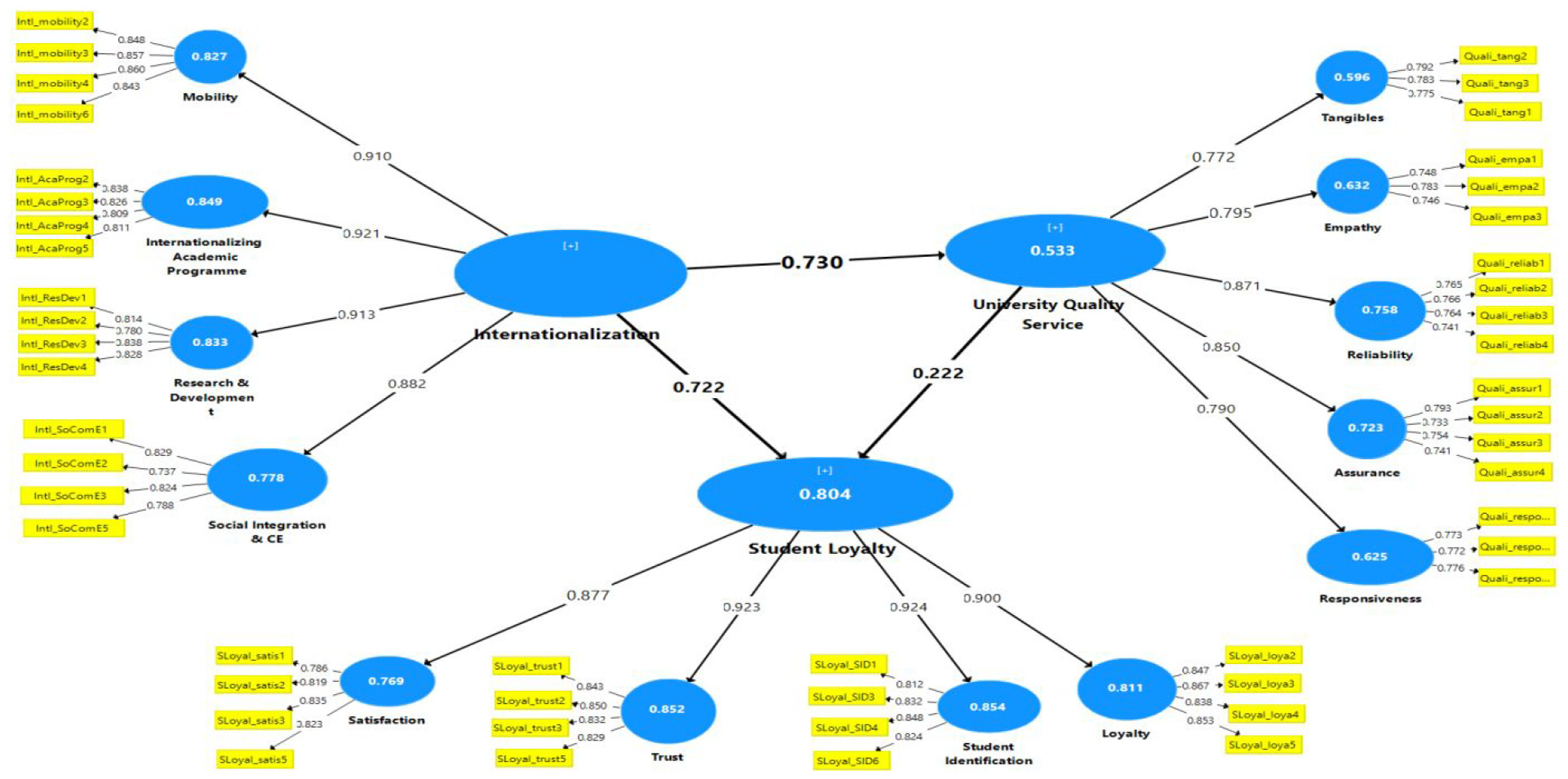
SmartPLS algorithm value of the measurement model.
Formative Outer Measurement Model Assessment (Factor Loading, Reliability & Validity).

The convergent validity was also checked to determine the degree to which constructs measure the elements to which they are related theoretically and which indicators represent the intended latent construct (Chin & Yao, 2014). To estimate this, the Average Variance Extracted (AVE) of every latent construct was assessed. As shown in Table 1, the AVE of each construct in this study was above 0.5, ranging from 0.571 to 0.726. Thus, adequate convergent validity was achieved (Ab Hamid et al., 2017).
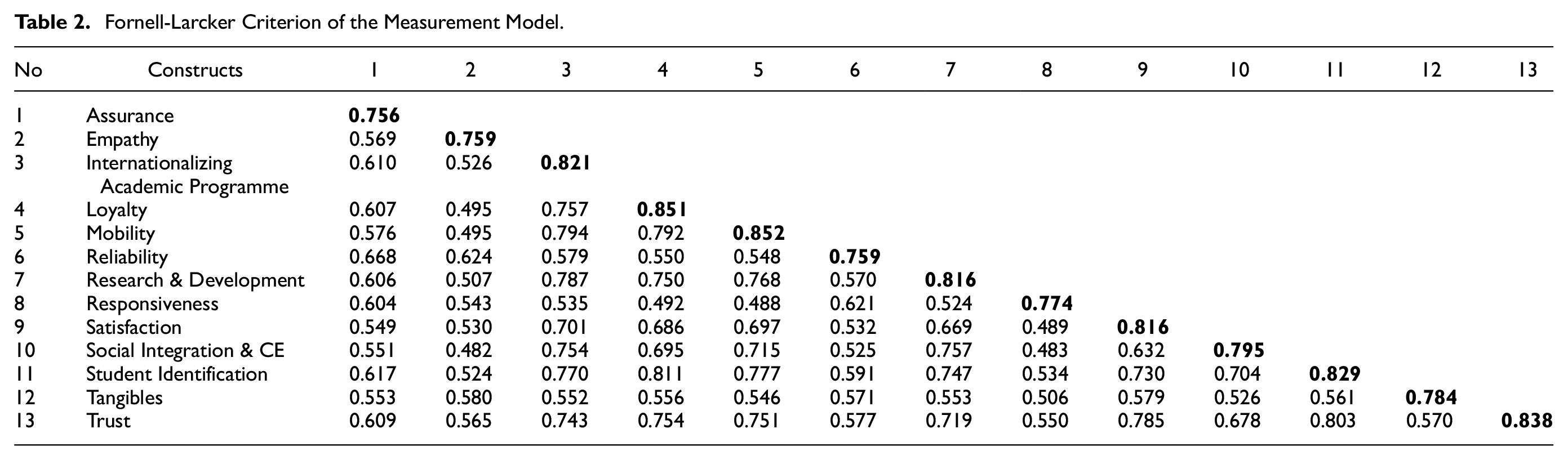
In addition, the discriminant validity in this study was assessed to determine the extent to which each latent variable is different from others, by examining the AVE and through the Fornell-Larcker Criterion. According to this criterion, discriminant validity is achieved if the square root of average variance extracted (AVE) for the constructs is greater than any of the bivariate correlations involving the construct in the model (Ab Hamid et al., 2017; Fornell & Larcker, 1981). As shown in Table 1, the AVE of each construct in this study was above the value of 0.50, and the Fornell-Larcker Criterion, as shown in Table 2, also was achieved with the minumum value of 0.756 to the maximum 0.852.
Fornell-Larcker Criterion of the Measurement Model.
Assessment of Significance of Structural Model
The significant direct effects existing between the independent variable (Internationalization) and the dependent variables (Quality Service & Student Loyalty) were determined by checking standardized path coefficients through the R square (R2) values. Figure 3 also shows the bootstrapping re-sampling procedure (with 500 samples) that the researchers ran to estimate the significance of the paths in the model. The results of the R2 of the model, as shown in Figure 3, indicate that the exogenous (independent) variance, explained by the model (R2) on endogenous (dependent) variables, have a value of 0.0.533 for university quality service and 0.804 for student loyalty. These values are equivalent to 53% and 80% variance, respectively, which are significant and higher than the 10% threshold recommended by Qin et al. (2021).
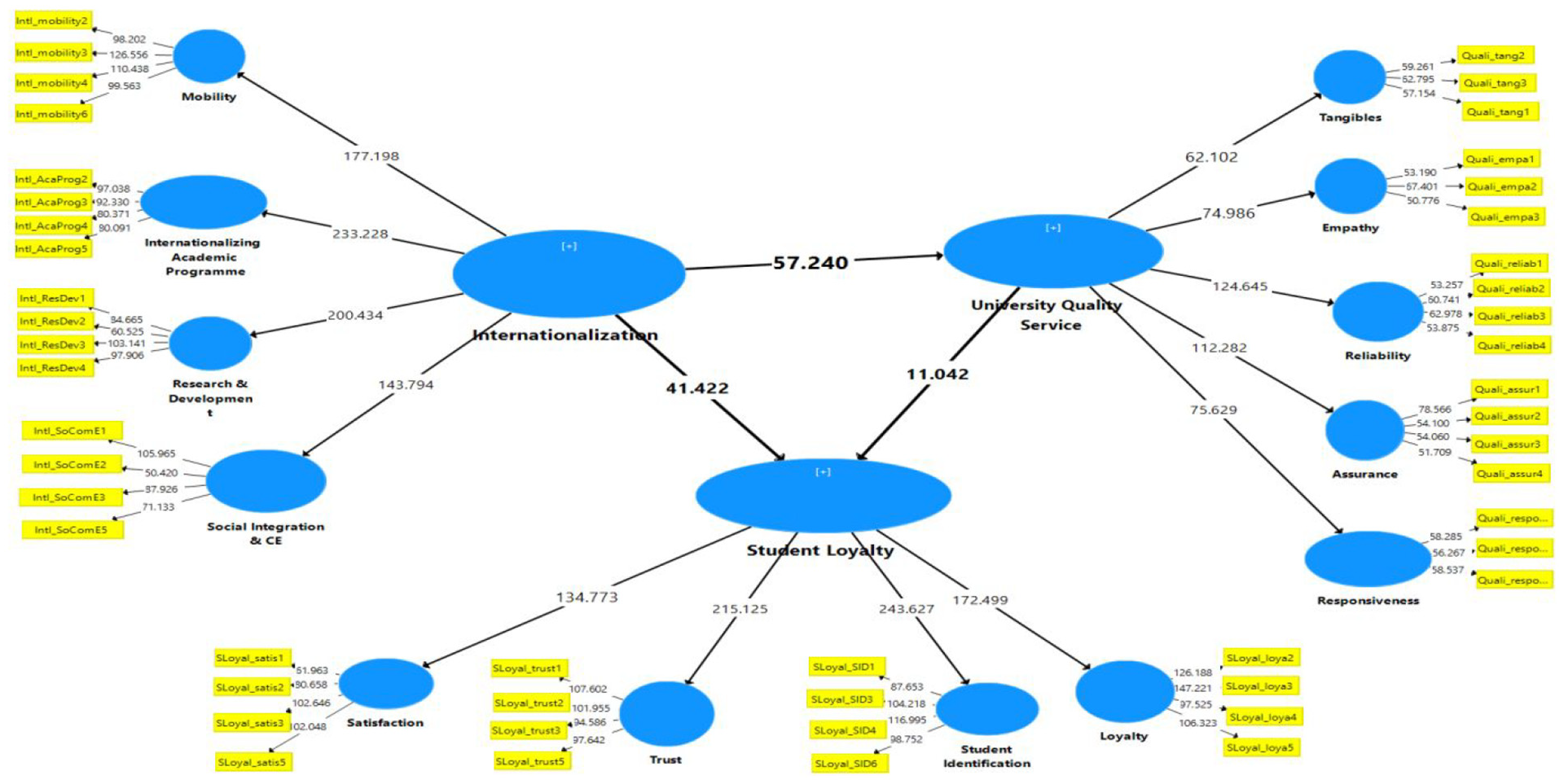
SmartPLS output of bootstrapping model.
Figure 2 and Table 3 also show that all the path coefficients of internationalization of higher education, university quality service, and student loyalty are significant using Second Order Approach (SOA); reflective first-order and reflective second-order. SOA was used to confirm whether the thoerised construct loads under its underlying sub-constructs. Hence, it helps to show the estimation of the factor loading related to the main construct on its sub-constructs (Awang, 2012). Internationalization has a significant direct effect on quality service (β = .730, T = 57.240, p < .000); internationalization has a significant direct effect on student loyalty (β = .722, T = 41.422, p < .000); and university quality service has a significant direct effect on student loyalty (β = .222, T = 11.042, p < .000).
T Statistics & Path Coefficients.
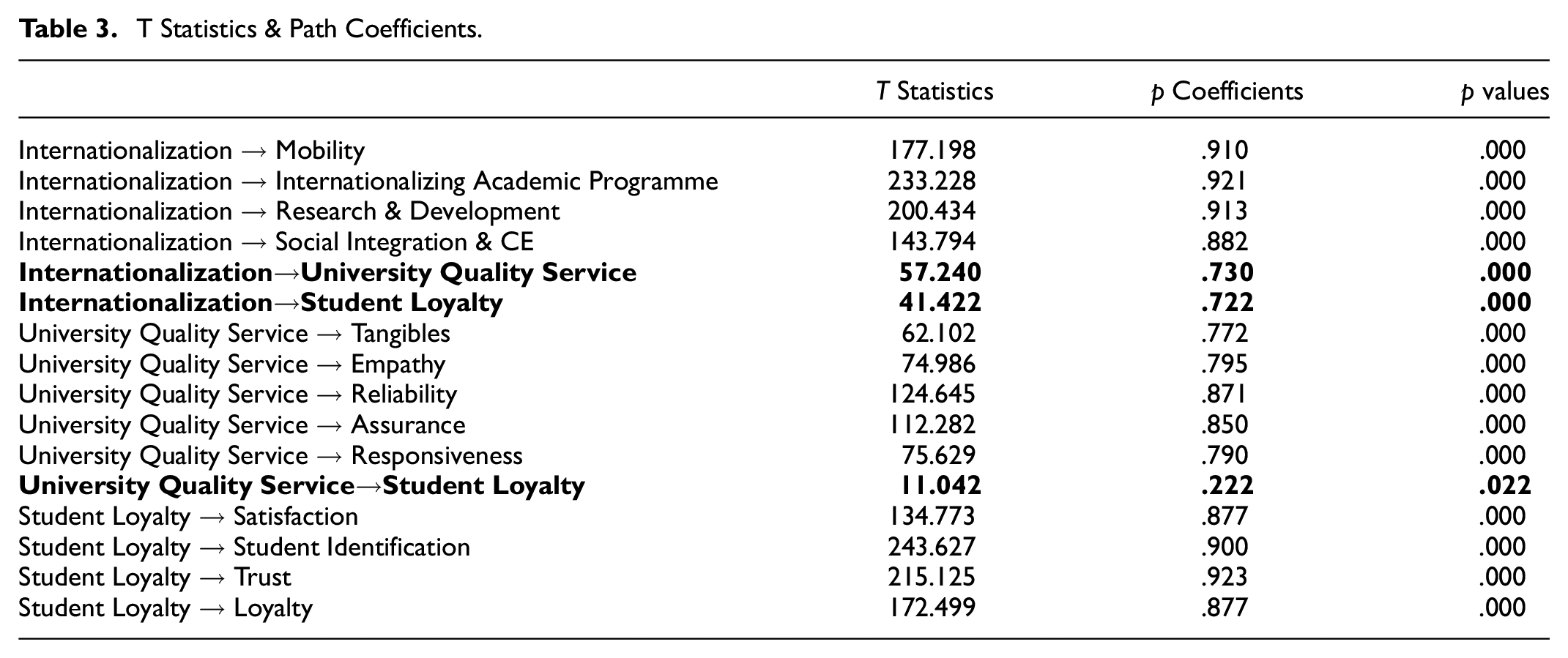
In addition, internationalization of higher education has a significant direct effect on mobility (β = .910, T = 177.198, p < .000), internationalizing academic programme (β = .921, T = 233.228, p < .000), research and development (β = .913, T = 200.434, p < .000), and social integration and community engagement (β = .882, T = 143.794, p < .000). University quality service has a significant direct effect on tangibles (β = .772, T = 62.102, p < 0.000), empathy (β = .795, T = 74.986, p < .000), reliability (β = .871, T = 124.645, p < .000), assurance (β = .850, T = 112.282, p < .000), and responsiveness (β = .790, T = 75.629, p < .000).
Notably, while all the effects are significant, the effect of university quality service on student loyalty in this model had the lowest direct effect, even though the effect of internationalization on student loyalty is considered high.
The hypotheses findings can be seen in Tables 3 and 4. As predicted in hypothesis 1, internationalization of higher education has a significant direct effect on university quality service (0.730, at a .000 p-value); hence, hypothesis 1 is supported. Internationalization of higher education has a significant direct effect on student loyalty (0.722, at a .000 p-value); hence, hypothesis 2 is supported. Also, university quality service has a significant direct effect on student loyalty (0.222, at a .022 p-value) with the hypothesis 3 supported.
Hypotheses Presentation and Conclusion.

Discussion
This study relied on the international university students’ perceptions in Malaysia. It shows that quality service dimensions are important to achieve students’ satisfaction and to gain their loyalty. However, the findings reveal that what counts most to the international students are the aspects of internationalization practices, that is, trust and student identification, which are under student loyalty, internationalization academic program, research and development, and mobility under internationalization. These have the highest items loadings and path coefficients alongside student loyalty factors. The internationalization components used in this study should be effective and worthy subjects for further studies.
To continue inspiring confidence and trust in the education provider and deepen the student’s commitment to and identification with his/her school, tertiary institutions must ensure that the administrators, faculty and non-academic staff can perform the promised/advertised service knowledgeably, reliably, and courteously. Also, the ease of academic and non-academic mobility is crucial to international students because studying abroad can be a complicated process, involving academic enrollment, transferring credits and degrees, obtaining an entry pass, renewing the visa annually, as well as the difficulties associated with adapting to the culture of the host country and institution. The push-pull factors of internationalized academic programs and research and development also are essential to foreign students due to the global dimension of the degree programs and their marketability in the students’ home countries. These current findings are in line with Chuah and Singh (2016), Edrak et al. (2015), and the Global Survey of the International Association of Universities (Egron-Polak & Hudson, 2014). They also support the EAIE (2015), which reiterated the need for cultural diversity, integration between local and international students, and platforms to learn about the host nations’ cultures.
In addition, the findings of this study show that more internationalization practices will lead to higher quality university services and student loyalty. The significant effect of quality service on student loyalty in the second model (Figures 2 and 3) could be seen as an affirmation of the efforts of Malaysia’s colleges and universities in the last decade. However, the weak effect of quality service on student loyalty in the first model (Figures 2 and 3) signals the need for improvements in the services offered to international students. This is especially true of the experience of these students, who are mostly pursuing their postgraduate degrees, as what they might perceive to be an essential service may be different from that of their undergraduate, local peers. International students’ positive perceptions of similar education services outside Malaysia and European countries might also contribute.
These findings are in line with those of Shepherd and Björk (2019), who found that the quality of service was the most important factor contributing to customer satisfaction. Service quality was found to significantly influence student satisfaction, which, in turn, influenced student loyalty (Chandra et al., 2019). The research reported here supported the findings of Wulandari and Suryani (2017) and Najimdeen, Amzat, & Badrasawi (2021), who examined the impact of service quality and satisfaction on student loyalty in Malaysia and Indonesia, and Ali et al. (2016), who stressed the importance of looking for new ways to add value to the service being offered to international students, with a focus on academic issues, living aspects, and other dimensions international students perceive as important determinants of service quality.
While the research reported here supports previous empirical studies that show that quality service can lead to satisfaction and loyalty, it also indicates that a positive perception of service quality might not necessarily translate into student loyalty. Quality service is not the only way to gain the loyalty of international students; internationalization practices can also be instrumental due to their pivotal role in motivating student mobility from other countries to the host nations.
Implications
This study calls for the attention of the Ministry of Education (MOE) in Malaysia, in general, and university administrators, in particular, to international students’ welfare and wellbeing in the country. The internationalization policy in Malaysia should focus on what international students can bring to the country in terms of economic value and what the country can offer to international students in terms of their perceived needs. Public universities in Malaysia are advised to be proactive in researching customer satisfaction, that is, their international students, in the living and learning opportunities afforded them in Malaysia. In addition, due to globalization, the competition between universities worldwide has intensified, and internationalization has become a business strategy to attract more international students.
With the 127.583 international students studying in Malaysia, the country’s internationalization strategy has helped the Malaysian government generate 15.6 billion Malaysia Ringgit. However, caution needs to be taken as this internationalization strategy has become a common strategy and tool to attract more international students from all countries around the world. Southeast Asian countries like Singapore, Thailand, Indonesia and Vietnam have highly invested in education and international student mobility, making them strong competitors. Besides, Covid-19 has posed challenges for everyone, which has led to the financial crisis for the host and the international students around the globe. The fees hike at higher institutions in Malaysia for international students will pose a big threat for Malaysia to achieve the aim of the country’s education blueprint to attract 250,000 international students by 2025.
Even before the Covid-19 pandemic, some research findings reported that international student enrollment had begun to drop at Malaysian higher institutions due to international students’ fees hikes and dissatisfaction with university services. These are the serious and vital issues that must be addressed if Malaysia aims to remain an education hub for Southeast Asia countries. Customer service should be highly improved, and international student loyalty and satisfaction should receive a great deal more attention.
Conclusion
The research reported here adds to the growing body of knowledge on foreign student satisfaction and perceptions of quality, internationalization of education, and student mobility. It also helps provide insights for the education industry in Malaysia and beyond to gain global recognition in academic teaching, research, and professional development. An analysis of the findings reveals some strategies on how to increase the number of foreign students to meet the goal of enrolling 250,000 yearly by 2025, as proposed in the Malaysia Education Blueprint. Thus, Malaysian universities must attempt to internationalize the curriculum, develop research capabilities, and improve services to gain and retain foreign students. Universities also must try to regularly and frequently assess their internationalization process to encourage further development and improvement in campus internationalization. The universities should be reminded that dealing with students from other countries, with differences in culture, language and experiences of life and learning, is not the same as dealing with the local students.
This research, which covered 10 public universities, has the advantage over previous studies in that earlier research tended to focus on one institution at a particular time. However, this study is limited to government-supported universities. Future research should include private universities in Malaysia, as they tend to have the largest enrollment of international students. Data from both public and private universities, using the same variables, would give a more complete picture of international students’ satisfaction and loyalty.
One should not forget that the internationalization of higher education policy and international students’ enrollment have contributed tremendously to economic growth in Malaysia, the expansion of Malaysian higher institutions’ capacities, and their place in the university world rankings. However, the impact of the Covid-19 pandemic, increasing university tuition, the introduction of insurance bonds, viva progression, and other new policies could render the target of 2025 unachievable, as some international students might opt for other countries that they perceive as more academically and financially attractive. In light of this, more studies need to be carried out to determine the implication of these new policies on foreign students, their attitudes and behaviors.
Another complicating factor is the dramatic increase in competition in the internationalization of higher education in Southeast Asia and the greater number of players who have entered the fray. Countries like Singapore, Thailand, and Indonesia are working hard to bring foreign students to their universities and have invested heavily in promoting and improving their services. As a result, they have experienced increased enrollment of international students in their tertiary institutions. Therefore, Malaysia’s leaders and educators must constantly evaluate their policies and strategies while improving their quality services to attract more international students to their colleges and universities.
Research Survey

Footnotes
Declaration of Conflicting Interests
The author(s) declared no potential conflicts of interest with respect to the research, authorship, and/or publication of this article.
Funding
The author(s) disclosed receipt of the following financial support for the research, authorship, and/or publication of this article: This research is Fundamental Research Grant Scheme (FRGS) funded by MOHE Malaysia. Therefore, we thank MOHE Malaysia for the research grant and all the international students that participated in this study.

Data Availability Statement
Data sharing not applicable to this article as no datasets were generated or analyzed during the current study.