




Abstract
Education-job match is known to affect employee job satisfaction, as well as their intention to leave the role. Job satisfaction is a critical part of an employee’s motivation to remain loyal to and employed within a company. However, ICT sector faces significant skill gaps, driven by college education lagging behind ICT employers’ expectations of job skills and experience needed in practice. This article hypothesizes that perceived effectiveness of ICT education in learning job skills (“education-job transferability”) in ICT industries can enhance employee job satisfaction and reduce employee turnover. Using a unique dataset extracted from the Labor Force Survey of ICT Workers in South Korea, this article empirically examines the status quo of education-job transferability in ICT industries and its impact on job satisfaction. This article reveals that ICT education is perceived as less effective for learning job skills than other disciplines’ education. Moreover, a significant stake of ICT graduates plan to do vocational training, suggesting that higher education is not enough to secure ICT-specialized jobs. Consistent with our hypotheses, we found that an education-job transferability enhances employees’ job satisfaction and reduces their intention to leave their current jobs. This article suggests that education-job transferability in Information, Communication and Technology (ICT) industries has a long-lasting effect on both employees and employers, by enhancing employee job satisfaction and potentially mitigating employee turnover.
Keywords
Introduction
Almost nine in ten executives and managers globally say that either their organizations face skill gaps already or that they expect gaps to develop in the near future (Agrawal et al., 2020). These skill gaps are particularly evident in the Information, Communication and Technology (ICT) sector, due to the lack of alignment between college education and employers’ expectations about professional competencies (International Labour Organization, 2020). Because most employers do not have sufficient resources to train employees, education-job mismatch imposes significant costs arising from poor job performance and high levels of employee turnover. Moreover, education-job mismatch undermines employees’ job satisfaction and their commitment to their employer (Ross & Reskin, 1992). This article focuses on an important aspect of education-job match—transferability of college programs to employment—to examine its impact on job satisfaction and employee turnover. We focus on the education-job transferability because its consequences have been an important research topic in the literature (Montt, 2017; Salas-Velasco, 2021; Verhaest et al., 2017).
Research Objectives
Education-job transferability refers to the degree to which the knowledge, skills, and abilities gained through education can be applied to a particular job or occupation. While education-job transferability is closely related to the concept of education-job match, it specifically refers to the ability to transfer the skills and knowledge to their job, whereas education-job match often refers to the extent to which an individual’s education level matches the difficulty of job requirements (Fabra & Camisón, 2009; Lee & Sabharwal, 2016; Robst, 2007; Vila & García-Mora, 2007; Wolniak & Pascarella, 2005). For example, a person with a Bachelor’s degree in computer science who works as a software developer would have high education-job transferability, as they can apply the skills and knowledge gained from their education to their job. However, if the job requirements for a software developer position include a Master’s or PhD degree, the education-job match would be low, even if the person has high education-job transferability. We focus on education-job transferability because it is important in the context of fast-changing technological environments because it allows individuals to adapt to new roles and industries, learn new skills more quickly, and remain competitive in the labor market. It leads to an employee’s job satisfaction by providing a sense of competence, opportunities for career advancement and professional development, and job security.
Research Hypotheses
Using novel survey data from the Labor Force Survey of ICT Workers in South Korea, this article (1) describes the labor market and college education of the ICT sector and (2) empirically examines the effect of education-job transferability on employee job satisfaction and intentions to leave. This study first hypothesizes that education-job transferability is positively associated with an employee’s job satisfaction. The study also hypothesizes that education-job transferability is negatively associated with an employee’s intention to leave. This study extends the existing body of literature on education-job match and job satisfaction. Prior studies have focused on either the match between years of schooling and schooling level required for the job, or the match between college majors and occupations Fabra & Camisón, 2009; Lee & Sabharwal, 2016; Robst, 2007; (Vila & García-Mora, 2007; Wolniak & Pascarella, 2005). On the other hand, our study focuses on the transferability (or applicability) of skills and knowledge learned in college to those needed in jobs (hereafter, “education-job transferability”). When employees’ skillsets do not align with the skills needed to perform in their jobs, employees often suffer stress and there is a consequential decrease in work quality (Laschinger et al., 2006). To improve the education-job transferability, many educational institutions are seeking effective education programs to foster ICT specialists (International Labour Organization, 2020). In this regard, our study generates important implications about how college programs can better equip their students with job-oriented and practical curriculums, which in turn will reduce the skills gap in the ICT sector.
Data
The Labor Force Survey provides us with timely data to examine our research questions. The survey was conducted in 2019 among over 5,028 college graduates (including 2,775 ICT graduates and 2,253 non-ICT graduates) in South Korea. The survey comprised of a wide range of questions about the respondents’ employment status, the industrial sectors they work for (e.g., ICT industries versus non-ICT industries), educational background (e.g., the highest degree level and college majors), education-job transferability (the extent to which the skills learned through college programs match with the skills required to do their jobs), overall job satisfaction, as well as their intention to leave their current positions. The survey was conducted in 2019, which mitigates any concerns around response bias due to the pandemic’s effects.
Empirical Results
Our univariate test results suggest that ICT graduates rate their college courses lower on average than non-ICT graduates. Compared to their non-ICT counterparts, ICT graduates gave significantly lower ratings for five out of the survey’s nine dimensions of education quality (incorporating latest technology, applicability to practice, quality of experimental courses, quality of self-directed learning, and usefulness of internships during college programs). Moreover, a significant proportion of ICT graduates (40%) planned to undertake vocational training to attain ICT jobs. Collectively, these provide supporting evidence of “skill gaps” in ICT sectors, which echoes employers’ concerns about ICT education quality (International Labour Organization, 2020).
To examine our hypothesis that education-job transferability increases job satisfaction, we proposed an ordered logit model. Education-job transferability is measured through the principal component of the respondents’ ratings on their education quality (nine dimensions of education-job skills alignment). Our empirical results suggest that, after controlling for other factors, the education-job transferability bears a positive association to employee job satisfaction. When we use the intention to leave the job as the dependent variable, the logit estimation result suggests that education-job transferability eventually reduces respondents’ intention to leave.
Collectively, our findings emphasize the importance of college education in efficient labor management in ICT industries. Although many firms address their skill shortage as a business priority, few have sufficient resources to train their workforce by themselves (Agrawal et al., 2020). Our empirical results show that education-job transferability positively affects employee job satisfaction, as well as leading to a lower propensity of employee turnover. High employee turnover is detrimental to workforce productivity because it consumes employers’ hiring costs and time, as well as discouraging the retained employees.
We propose several ways to bridge the gap between the college education and job skills needed in the ICT sector. ICT educational institutions can better equip students with job skills by incorporating state-of-the-art technologies in their courses so that students can directly apply those skills in practice. In addition, colleges should improve the quality of experimental courses and internship programs, which lag behind the programs of other majors. Colleges should also maintain high-quality on-site experience programs in cooperation with partner companies, and encourage their students to participate in more team-based ICT-related competitions. In this way, ICT educational institutions can help reduce the gap between college education and employers’ expectations of ICT graduates.
Contributions
Our contributions to the literature in this field are twofold. First, we add to the existing body of studies on the relationship between education and job satisfaction. Prior studies focus on schooling level or major-occupation match, remaining silent on the alignment between the specific college courses and job skills needed (Fabra & Camisón, 2009; Lee & Sabharwal, 2016; Montt, 2017; Robst, 2007; Salas-Velasco, 2021; Verhaest et al., 2017; Vila & García-Mora, 2007; Wolniak & Pascarella, 2005). Our study—based on detailed survey questionnaires about the perceived effectiveness of specific courses (programs)—explores the opportunity to bridge educational gaps to help increase job satisfaction and reduce turnover risks.
Second, we add to engineering management literature by empirically examining the skill gaps and their impact on human resource management. The existing literature mainly focuses on internal firm factors that influence employee behavior, such as managerial engagement (Linder & Torp, 2017), self-leadership (Marvel & Patel, 2018), and top management heterogeneity (Su et al., 2022). Our study extends the understanding of determinants of managerial behavior by focusing on factors outside the firm—education quality of college programs. We suggest that the quality of college education (measured by the education-job skills match) has a profound effect on graduates, as it partly shapes employees’ job satisfaction and organizational climate.
The rest of our study proceeds as follows. In Section 2, we describe the labor market and education level in the ICT sector, based on the Labor Force Survey of ICT Workers. Section 3 reviews related literature and develops the hypotheses. Section 4 describes the research design, including sample selection, variable measurement, and empirical model. Section 5 presents empirical results and discusses our findings. Section 6 concludes our study.
Labor Market and Education of ICT Sector
Labor Market and Higher Education of ICT Sector
The global ICT sector faces a large gap between the supply and demand for skilled ICT workers (International Labour Organization, 2020). The skills shortage in the ICT sector is highly damaging to the global economy; the “digital economy” accounts for 6% of the total value added of OECD countries in 2011 (Organisation for Economic Co-operation and Development, 2023) and 6.9% of the U.S. GDP in 2017 (U.S. Bureau of Economic Analysis, 2019). Lack of skilled labor will constrain economic growth and job creation in the ICT sector globally.
The ICT sector has been a growth driver of South Korean economy, contributing 10.8% to the country’s gross domestic product (GDP) in 2019 (Ahn, 2021). The skills shortage is even more serious among developing countries because skilled labor is migrating to developed countries (e.g., U.S. and Canada) (Docquier & Rapoport, 2004; Lowell, 2002). South Korea is also facing a significant gap between the supply and demand of ICT skilled workers as the college graduates (bachelors or higher) with ICT skills cover only about 5% of annual labor demand from the ICT sector (Software Industrial Skills Council of Korea, 2021).
Over 70% of high school graduates in South Korea go on to attend university, recording the sixth highest enrollment rate among countries (Ministry of Gender Equality & Family, 2023). The average tuition for a year per student is about 5,950 (3,340) USD in private (public) universities, which is about 17% (10%) of annual income per capita (Ministry of Education, 2022). South Korea provides high quality university programs, as seven Korean universities rank in the top 200 in the QS World University Rankings. Despite the high enrollment rate and quality programs, South Korea faces a skills gap due to the disconnection between college education and industrial skills. Recent changes from heavy manufacturing to ICT industries result in asymmetry in supply and demand for tech talents.
A skills gap refers to a situation wherein workers do not have the skills required to perform job tasks. One of the most critical factors that create skills gaps is the education system. The education system does not produce enough qualified ICT specialists, such that the young people graduating from the ICT-related majors do not have the skills level needed. Even though ICT specialists have more advanced degrees from higher educational institutions than the average worker, many employers express the view that ICT workers lack necessary job skills (International Labour Organization, 2020).
Higher degrees may close the vertical gaps (which refers to an educational level that is either lower than or higher than the level required), but the traditional education at universities is not closing the horizontal gaps (which refers to a field of study that is not appropriate for the job) (International Labour Organization, 2020; McGuinness et al., 2018). As technological complexity and the adoption of digital technologies continue to evolve, university education is running behind the new technologies needed in the workplace.
Labor Force Survey of ICT Workers
The ICT sector has been at the forefront of the South Korean economy. South Korea’s ICT exports hit a record high of $227 billion in 2021, mostly driven by global demand for semiconductor chips, displays, and rechargeable batteries (Yonhap, 2022). Digital transformation is accelerating across all sectors, causing increased demand for ICT talents. As in the U.S., the demand for ICT specialists in South Korea exceeds the supply of ICT talents (Kan, 2021).
In 2019, the Ministry of Science and ICT of Korea surveyed college graduates, covering topics including their employment status and satisfaction with their college education. The Labor Force Survey of ICT Workers is comprised of comprehensive questionnaires about the respondents’ employment status, career development efforts, job satisfaction, and their perceptions about the effectiveness of higher education (i.e., bachelors or higher). The respondents are some 5,000 college graduates, half of which graduated from ICT-related majors (e.g., telecommunication engineering, electric engineering, electronic engineering, control sensor engineering, semiconductor engineering, computer science, software engineering).
Potential survey respondents were selected from recent university graduates (i.e., graduates during the past 1 year), using the two-stage sampling method. In the first stage, stratified random sampling involves dividing the entire population into strata based on their college disciplines and majors, and selecting random observations from each stratum. In the second stage, about 9,000 graduates are selected from the first stage sample, using systematic sampling. The response rate is 58%, resulting in 5,028 respondents.
The Labor Force Survey of ICT Workers provides timely information about labor force supplies in the ICT sector. In addition, the survey provides unique information about how useful the higher education is in equipping the students with requisite job skills for ICT-related tasks, as well as about how satisfied the ICT workers are with their ICT jobs. Using this novel data, we can perform a quantitative analysis on the education quality and resulting outcomes in workplaces. The following paragraphs depict the current state of ICT labor supplies.
Panel A of Table 1 shows the responding workers’ perceptions about higher education (higher education includes both undergraduate and graduate programs). The survey questionnaires ask about the nine sub-dimensions of the education-job alignment. The respondents rate the extent to which (1) the college education incorporates the latest technologies and skills in practice, (2) the college education is applicable to task performance in practice, (3) experimental courses are helpful in obtaining job skills, (4) interdisciplinary courses are helpful in obtaining job skills, (5) self-directed learning is helpful in obtaining job skills, (6) team projects are helpful in learning job skills needed, (7) participation in ICT skills competitions is helpful in learning job skills, (8) internships are helpful in learning job skills, (9) cooperating with companies during college years is helpful in learning job skills. The survey items use 5-point Likert-type scales ranging from 1 (strongly disagree) to 5 (strongly agree).
Education-Job Transferability of College Education

Note. Panel A compares descriptive statistics between graduates (who are currently holding their jobs) from ICT-related major firms and graduates from non-ICT-related majors. Observations vary across nine dimensions of education quality, because some respondents were not qualified to answer each question (e.g., some respondents could not rate the “Experimental courses” because they have not taken any experimental courses during their college years).
, ***Indicate the significance at 5% and 1%, respectively.
Panel B. ICT graduates’ perceived alignment between college courses and jobs in practice

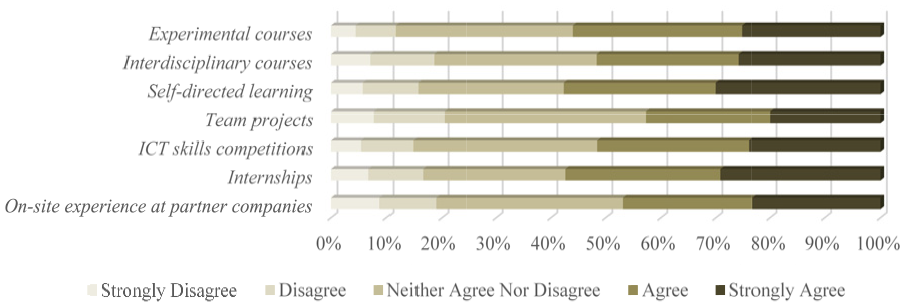
Note. Panel B presents the ICT graduates’ perceived match between education and job tasks. The respondents’ rate between 1 (strongly disagree) and 5 (strongly agree) over the question “How strongly do you agree that the college program (or course) match the job you perform in the workplace?”
Our univariate test results suggest that ICT graduates on average respond more negatively about the quality of their college education than non-ICT graduates. For instance, the average rating on “Overall—Latest technology” (the extent to which college courses in general incorporate the latest technologies and skills in practice) is 3.614 (3.698) among ICT (non-ICT) graduates (the difference is significant at 1%). These negative responses indicate that ICT education is disconnected from job practices. While the job skills needed in the workplace are evolving rapidly, the college education for ICT students are lagging behind.
Panel B presents the ICT graduates’ perceptions of the alignment between education and job tasks across the nine dimensions. The respondents (who are currently holding their jobs) choose a rating between 1 and 5 over the question “How strongly do you agree that the college program (or course) matches the job you perform in the workplace?” The figure suggests that ICT graduates have varying perceptions about their own education-job transferability. Experimental courses, self-directed learning, and internships are perceived as most useful in learning job skills, as those courses were undertaken by a large proportion of respondents who “strongly agree” or “agree.”
Figure 1 shows that ICT jobseekers plan to undertake vocational training to secure jobs in the ICT sector. The total number of jobseekers in the ICT sector is 265, of which 200 (65) are graduating from ICT (non-ICT) majors in college. 46% of total jobseekers plan to do vocational training. Although a lower proportion of ICT graduates (41.5%) plan to do vocational training to attain ICT jobs than non-ICT counterparts (60%), there is still a high proportion of ICT graduates who need additional vocational training to get ICT jobs. ICT graduates perceive that their college education is far from sufficient to provide them with the necessary skills that employers expect. Combined with the figures in Table 1, Figure 1 suggests that ICT education in college is lagging behind the technologies and job skills needed in practice.

Needs for vocational training.
ICT Workers’ Job Satisfaction and Intention to Leave
Panel A of Table 2 shows the respondents’ overall job satisfaction. The survey item uses a 5-point Likert-style scale ranging from 1 (strongly dissatisfied) to 5 (strongly satisfied). We found no significant difference in job satisfaction between workers at non-ICT companies (average rating of 3.698) and those at ICT companies (3.947). When we further divided each group into ICT graduates and non-ICT graduates, we still did not find any significant difference in job satisfaction between ICT and non-ICT graduates.
ICT Workers’ Job Satisfaction and Intention to Leave.
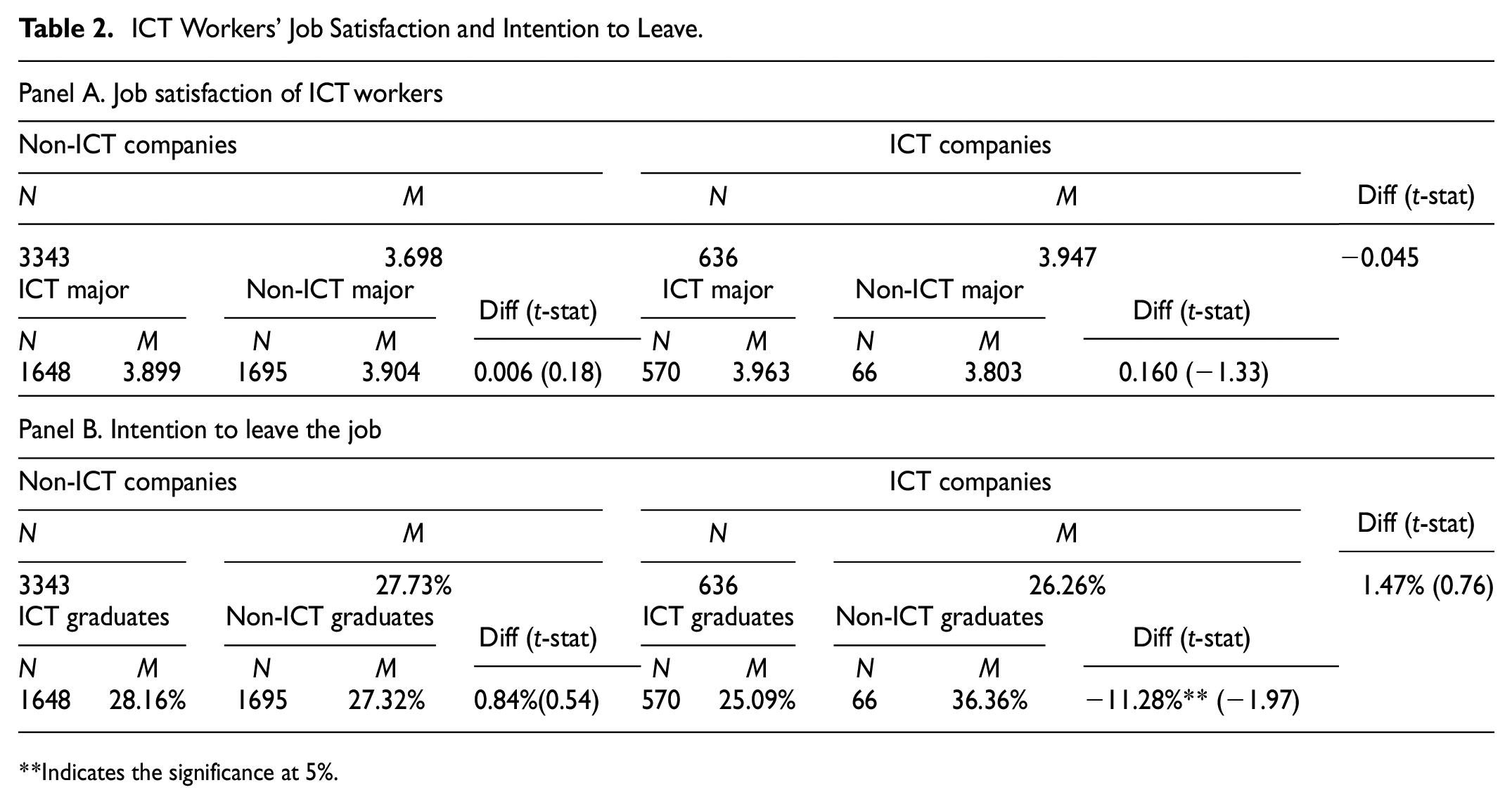
Indicates the significance at 5%.
Panel B of Table 2 shows the respondents’ intention to leave their current employers. We found no significant difference in the intention to leave between workers at non-ICT companies (27.73%) and those at ICT companies (26.26%). We further divided each group into ICT graduates and non-ICT graduates. Among the workers in non-ICT companies, we still did not find any significant difference in their intention to leave. Interestingly, among the workers in ICT companies, non-ICT graduates composed a much higher proportion of those respondents with an intention to leave (36.36%), as opposed to ICT graduates, who represented a much lower proportion (25.09%) (the difference is significant at 5%). A stronger intention to leave ICT jobs among non-ICT graduates may reflect non-ICT graduates’ lack of expertise and necessary job skills in performing ICT jobs. Because they are less trained, they are more likely to exhibit poor performance and to have less control over their work, resulting in a higher intention to leave.
Related Work and Hypotheses Development
An employer’s goal in employee selection is to hire those applicants who have the skills and abilities necessary to fulfill the job role offered. Selecting the right person for the right job not only increases the workers’ job performance but improves their well-being, because well-being correlates with job contentment (Warr & Inceoglu, 2012). Theories on person-environment (PE) fit have suggested that incompatibility between a worker and his/her environment creates significant stress. The mismatch between the person and the environment leads to “psychological, physiological, behavioral strains, such as dissatisfaction, boredom, anxiety, depression and elevated serum cholesterol, smoking, and so on” (Edwards & Van Harrison, 1993).
Person-job (PJ) fit, a specific form of PE fit, refers to the discrepancy between the abilities of a person and the demands of a job (Kristof, 1996). Job demands are knowledge, skills, and abilities (KSAs) required to perform at the acceptable level in the job (Caldwell & O’Reilly, 1990; Wilk & Sackett, 1996). Individuals’ abilities include education, experience, and employee aptitudes or KSAs (Caldwell & O’Reilly, 1990; Dawis & Lofquist, 1984; French et al., 1982). During the employee selection process, employers use a variety of strategies to assess PJ fit, such as resumes, entry tests, interviews, reference checks, and so on (Werbel & Gilliland, 1999).
PJ fit is known to have positive effect on job satisfaction and employee retention (Edwards, 1991; Truxillo et al. 2012; Jutras and Mathieu 2016). Because those workers with better PJ fit have greater control over their own work, control over people, and control over their remuneration, they have stronger belief in their capacity to execute behaviors necessary to attain the acceptable level of performance. Empirical studies support that PJ fit covaries with a number of positive outcomes including job performance and satisfaction (Caldwell & O’Reilly, 1990; Oh et al. 2014). Workers who are mismatched by field suffer a wage penalty as well if they are overqualified (Montt, 2017). In particular, the self-efficacy of employees acts as a mediator, as the employees who have a better match with their jobs feel higher self-efficacy, which in turn increases (reduces) their job satisfaction (intention to leave) (Peng & Mao, 2015).
While PJ fit covaries with various positive outcomes, selecting candidates with a high level of PJ fit is not always viable. Both horizontal and vertical mismatch can differ across fields of study (Verhaest, Sellami, & Van der Velden, 2017). Engineering graduates experience education-job mismatch until they find right positions after the turnovers (Salas-Velasco, 2021). Even though ICT specialists have more advanced degrees from higher educational institutions than the average worker, many employers express the view that ICT graduates lack requisite skills (International Labour Organization, 2020). Horizontal mismatch (a mismatch between the attended field of the education and the job) can cause poor PJ match (Somers, Cabus, Groot, & van den Brink, 2019). Employees who cannot fully utilize what they have learned during their college education can suffer from wage penalties and low job satisfaction (Robst, 2007), (Somers, Cabus, Groot, & van den Brink, 2019), (Zhu, 2014). Low job satisfaction is detrimental to long-term productivity because dissatisfied workers exhibit low motivation at work and foster a poor organizational climate.
As shown in Panel B of Table 2, ICT workers have varying perceptions about education-job transferability. Those workers who rated high on their education-job transferability are expected to be more satisfied with their jobs, while those who rated lower are expected to be less satisfied. Prior studies that link education-job match and job satisfaction suggest that both vertical mismatch (mismatch between the schooling level and job requirements) and horizontal mismatch cause job stress and dissatisfaction (Groot & van den Brink, 2000; McGuinness & Sloane, 2011;
Allen & Van der Velden, 2001; Béduwé & Giret, 2001). Educational institutions aim to equip students with field-specific skills that are essential for the jobs to be performed (Somers, Cabus, Groot, & van den Brink, 2019). Failure to prepare students for a range of occupations will have a negative impact on their job satisfaction after employment, increasing their intention to leave the job.
Hypothesis 1: Education-job transferability is positively associated with an employee’s job satisfaction.
Hypothesis 2: Education-job transferability is negatively associated with an employee’s intention to leave.
Methodology
Data and Sample Selection
To examine our hypotheses, we used the Labor Force Survey of ICT Workers in 2019. The total number of survey respondents is 5,028 college graduates, including both jobseekers and workers. Because our hypotheses are to examine the effect of education-job transferability on the ICT workers’ job satisfaction and intention to leave, we limited our sample to the workers in ICT industries (N = 636). We further excluded the observations with missing responses to education-job transferability questions, because our variable of interest is the principal component of the perceived education-job match (of nine dimensions). This reduced our sample to 388 observations. Table 3 shows the sample selection procedure.
Sample Selection.

Empirical Model
To examine H1, we regressed the following ordered logit regression with the survey responses of 388 ICT sector workers:

where Yi is Job Satisfactioni measured by the worker i’s response to survey item “How satisfied are you with the current job?” that ranges from 1 (strongly dissatisfied) to 5 (strongly satisfied). αk is the vector of regression coefficients which we wish to estimate. Xki is the vector of explanatory variables that are expected to affect an employee’s job satisfaction.

Education-Job Transferi is the principal component of nine survey items about education-job transferability (so that the variable increases with transferability). The survey items include responses to questions about the extent to which (1) the college education incorporates the latest technologies and skills in practice, (2) the college education is applicable to task performance in practice, (3) experimental courses are helpful in obtaining job skills, (4) interdisciplinary courses are helpful in obtaining job skills, (5) self-directed learning is helpful in obtaining job skills, (6) team projects are helpful in learning job skills needed, (7) participation in ICT skills competitions is helpful in learning job skills, (8) internships are helpful in learning job skills, (9) cooperating with companies during college years is helpful in learning job skills. For the principal component analysis (PCA), we first standardized the survey items and then entered unit-weighted standardized items into the analysis (Abernethy, Bouwens, and Van Lent 2004). PCA reveals one factor (Education-Job Transferi) with an eigenvalue greater than 1. The single factor explains 66% of nine items’ variation. The Cronbach αamong the items was .93 (see Appendix A for details of survey instrument). Because H1 predicts that education-job transferability is positively associated with the employee’s job satisfaction, we expected that α1 should be positive (α1 > 0).
Large Companyi is the indicator that takes on 1 if the respondent works at large companies (i.e., companies with 100 employees or more), and takes on 0 otherwise. Because large companies provide better pay packages and working environments than small companies, workers at large companies were expected to exhibit higher job satisfaction (α2 > 0). Regular Employeei is the indicator that takes on 1 if the respondent is the regular employee, as opposed to temporary employee, and takes on 0 otherwise. Regular employees have higher job security and pay, therefore they are expected to exhibit higher job satisfaction than temporary employees (α3 > 0). For female technologists, the career path to the top is more difficult than for their male counterparts, which can reduce female workers’ job satisfaction. Femalei is the indicator that takes on 1 if the respondent is female, and 0 otherwise (α4 < 0). Pre- and post-employment vocational training help the employees learn the art of working and explore career development opportunities, increasing their job satisfaction. Job Trainingi (Employee Trainingi) is the indicator that takes on 1 if the respondent participated in training programs before (after) their employment (α5 > 0, α6 > 0). ICT Graduatei is the indicator that takes on 1 if the respondent graduated from ICT-related majors, and 0 otherwise. ICT graduates are likely to be better-positioned than non-ICT graduates because they have more technological knowledge and skills (α7 > 0). By controlling for ICT Graduatei in the model, the coefficient estimates on Education-Job Transferi (α1) captures the effect of education-job transferability (based on specific dimensions of college courses) that is incremental to the effect of major-job mismatch. α8, …, α11 are the intercepts when worker i’s Job Satisfaction is 2, 3, 4, and 5, respectively.
To test H2, we regressed the following logit regression with the survey responses of 388 ICT sector workers:

where Yi is Intention to Leavei is measured by the worker i’s response to survey item “Are you planning to leave your current job?” that takes on 1 (“Yes”), and 0 (“No”) otherwise. βj is the vector of regression coefficients, and Xji is the vector of explanatory variables that are expected to affect an employee’s intention to leave.

Under H2, we expected higher Education-Job Transferi would lead to higher Intention to Leavei . We therefore predicted a significantly negative relationship between Education-Job Transferi and Intention to Leavei (α1 < 0).
Descriptive Statistics
Panel A of Table 4 presents the descriptive statistics of variables. The average Job Satisfactioni of our sample respondents was 3.969, which is close to 4 (i.e., satisfied). This suggests that ICT workers are on average satisfied with their jobs. Among our sample respondents, 24% intend to leave their current jobs (Intention to Leavei). Education-Job Transferi showed a minimum value of −3.073 and maximum of 1.384 (by construct, the principal component has the mean value of 0 and standard deviation of 1). Around 58% of responding ICT workers worked at large companies (Large Companyi), and 89.9% of the respondents were regular workers (Regular Employeei). Only 21.1% were female workers, supporting the notion that women are not entering the ICT sector at the same rate as men (Femalei). While 31.7% have experience of pre-employment job training, only 22.9% have undertaken post-employment training, indicating that few ICT employers provide training programs for their employees. Most of the sample respondents (90.7%) have graduated from ICT-related majors (ICT Graduatei).
Descriptive Statistics.

Note. The first row of each cell presents the correlation coefficients between two variables, and the second row presents the p-value of the correlation. Bolded figures show significance at a 5% level.
Panel B presents the correlation coefficients among variables used in our analyses. Job Satisfactioni is strongly and negatively correlated with Intention to Leavei, suggesting that dissatisfied employees are highly likely to leave their jobs (ρ = −.560, p < .01). Job Satisfactioni is positively correlated with Education-Job Transferabilityi, consistent with our H1 that job satisfaction increases with a greater transferability between the knowledge and skills learned from college education and the job tasks to perform in practice. In addition, working at large companies (Large Companyi) tends to make employees more satisfied, while working as regular employees (Regular Employeei) makes them less satisfied. The negative correlation between Job Satisfaction and Regular Employee seems to be counterintuitive, but it may reflect the excessive workload and poor work-life balance for regular employees in the ICT sector. Intention to Leavei is negatively correlated with Education-Job Transferabilityi, consistent with our H2. Intention to Leavei has a positive correlation with Large Companyi. While the Panel B of Table 4 lends a support to our hypotheses, we provide detailed discussion about our hypotheses testing in Section V, based on multivariate tests that control for other factors that may influence the job satisfaction and the intention to leave.
Empirical Results
Column (1) of Table 5 presents the estimation result of the ordered logit regression of Equation (1). We found that Education-Job Transferi has a significantly positive loading on Job Satisfactioni (β1 = .636, p < .01), supporting H1. When employees perceive their job tasks to be keenly connected from the knowledge and skills they learned from college programs, it indicates a higher level of PJ fit. As a result, employees with better PJ fit tend to feel more in control of their work, responsibilities, and compensation, as they believe they possess the necessary skills and abilities to perform well in their roles. This, in turn, leads to a greater sense of self-efficacy (Peng & Mao, 2015). Higher self-efficacy is associated with increased job satisfaction and a reduced intention to leave the job, consistent with PE theory (Edwards, 1991; Truxillo et al. 2012; Jutras and Mathieu 2016). Human resource managers in ICT companies face skills gaps already or expect gaps to develop in the near future (Agrawal, Smet, Poplawski, & Reich, 2020). Our findings in Column (1) imply that education-job transferability has long-term consequences such as high motivation at work and tonic organizational climate (driven by satisfied workers). As expected, the coefficient on Large Companyi is significantly positive (β2 = .333, p < .1), suggesting that employees at large companies are more satisfied than those at small businesses.
Effect of Education-Job Transferability on Job Satisfaction and Intention to Leave.
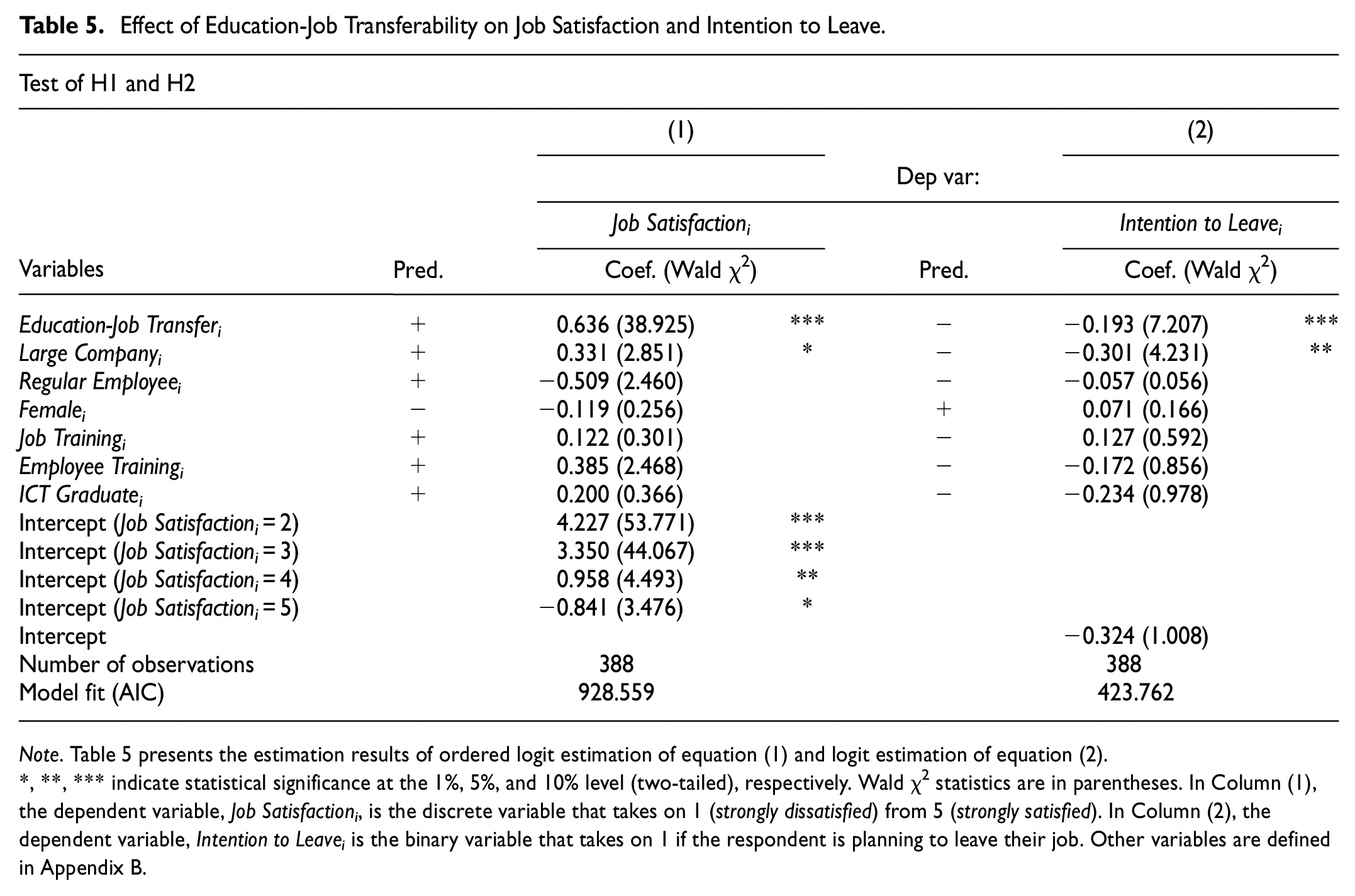
Note. Table 5 presents the estimation results of ordered logit estimation of equation (1) and logit estimation of equation (2).
, **, *** indicate statistical significance at the 1%, 5%, and 10% level (two-tailed), respectively. Wald χ2 statistics are in parentheses. In Column (1), the dependent variable, Job Satisfactioni, is the discrete variable that takes on 1 (strongly dissatisfied) from 5 (strongly satisfied). In Column (2), the dependent variable, Intention to Leavei is the binary variable that takes on 1 if the respondent is planning to leave their job. Other variables are defined in Appendix B.
Column (2) reports the estimation result of logit regression of equation (2). We find that Education-Job Transferi has a significantly negative loading on Intention to Leavei (β1 = −.193, p < .01), supporting H2. This result supports our prediction that if employees perceive their higher education to be more connected with the jobs they must perform, they have a less intention to leave their current jobs. Those who perceive a strong match between their education and skills and the requirements of their job are less likely to consider leaving because this positive alignment creates higher job satisfaction, reduced job stress, and a sense of career advancement, leading to stronger commitment to the organization and lower turnover intentions, according to PE theory (Edwards, 1991; Truxillo et al. 2012; Jutras and Mathieu 2016). In other words, high employee turnover, driven by education-job mismatch, will incur significant operational costs, such as recruiting and re-training. The coefficient on Large Companyi is significantly negative (β2 = .301, p < .05), suggesting that the workers at large companies are less likely to leave their jobs.
Among the controls variables in columns (1) and (2) of Table 5, a worker’s gender (Female) does not have a significant relationship with either job satisfaction or intention to leave. In other words, being female does not appear to have a meaningful impact on job satisfaction or the likelihood of considering leaving the job. This suggests that gender, in this particular context, does not play a significant role in influencing employees’ job satisfaction and intention to leave the organization.
Collectively, our findings in Table 5 suggest that the transferability between the knowledge learned in classes and the jobs to perform mitigates work stress and job dissatisfaction. We extend prior studies on the relationship between education and job satisfaction (Groot and Maassen van den Brink, 2000; McGuinness and Sloane, 2011; Allen and Van der Velden, 2001; Beduwe and Giret, 2011) by operationalizing the education-job match based on the “content” of education, above and beyond a match based on schooling level or the field of a major. Using the novel measure of education-job transferability, we suggest that college education should focus on practical skills needed in the workplace. Well-practiced students are likely to feel more satisfied with their jobs and are less likely to leave for other jobs, to the benefit of both the employers and the economy. Better education-job transferability increases an employer’s labor management efficiency, as well as enhancing the return-to-education-investment of the economy.
Conclusion and Discussion
To close the skills gaps in the ICT sector, targeted investments in quality education and skills training in the digital economy are needed. In this paper, we analyze whether graduates from ICT majors suffer from a skills gap when they seek for and perform their jobs. Using novel survey data of the ICT workforce in South Korea, we provide empirical evidence supporting the existence of a significant skills gap in the ICT sector. ICT graduates perceive that their college education is less effective in helping them perform in their jobs than the education of other disciplines. Moreover, more than 40% of ICT graduates plan to undertake vocational training to obtain ICT jobs, suggesting that college education lags behind the requisite job skills.
Theoretical Implications
We focus on an important aspect of education-job match—transferability of knowledge learned in school to skills needed in workplaces. We operationalize the education-job transferability based on ICT workers’ perceptions of the match between educational content (learned in college) and their job tasks. Using the unique measure of education-job skills match based on education content, we find that education-job transferability leads to lower job satisfaction and higher intention to leave. Failure to prepare students for a range of occupations will have long-term consequences on their careers, by reducing their post-employment satisfaction and increasing the searching costs for new jobs.
Our paper adds to existing studies on the relationship between education and job satisfaction by proposing a new dimension of education-job match, which is based on the applicability of educational content of college programs to job skills. We also add to engineering management literature by empirically examining skills gaps and their impact on human resource management. Our study extends the literature (which focus mostly on internal firm factors) by examining the factors outside the firm—education quality of college programs.
Practical Implications
This study is especially relevant for education policymakers who aim to solve the serious skills gaps in the ICT sector. Universities and vocational institutions should provide programs to bridge the gap between college education and job skills needed in the ICT sector. ICT educational institutions can better equip their students with job skills by teaching state-of-the-art technologies in their courses so that their students can directly apply those skills in practice. In addition, the quality of experimental courses and internship programs should improve; they are lagging behind those of other majors. High-quality on-site experience programs and team projects should be maintained, along with the promotion of ICT skills competitions. In this way, ICT education can reduce the gap between college education and employers’ expectations about ICT graduates.
Limitations of This Study
Despite the valuable contributions of this study, several limitations should be acknowledged. Firstly, the study relies on self-reported data, which may introduce common method bias and potential inaccuracies in respondents’ perceptions of education quality and job satisfaction. Secondly, the survey data was collected in 2019, and the fast-changing nature of the ICT industry may lead to potential shifts in skill requirements and job demands, making the results subject to time-sensitive validity. Thirdly, the study focuses on the South Korean context, and generalizability to other countries or industries may be limited due to variations in education systems and labor market dynamics. The identified limitations open up avenues for future research, including exploring objective measures, examining recent contexts, extending the investigation to different industries to gain a deeper understanding of education-job transferability’s impact on job satisfaction and employee turnover.
Footnotes
Appendix A
Appendix B
Declaration of Conflicting Interests
The author(s) declared no potential conflicts of interest with respect to the research, authorship, and/or publication of this article.
Funding
The author(s) disclosed receipt of the following financial support for the research, authorship, and/or publication of this article: This work was supported by the Hongik University new faculty research support fund.
Ethics Statement
This study involved the use of survey data collected from ICT industry workers. The data used in this research were obtained from a third-party source and were completely anonymized before being accessed by the researchers. No personally identifiable information was included in the dataset, ensuring the privacy and confidentiality of the individuals involved. The research adhered to the ethical guidelines for data collection and utilization, and all applicable legal and ethical requirements were followed. As the data were anonymized, the study did not require ethical approval or informed consent from participants. The findings of this research are reported in an aggregate and de-identified manner to further protect the confidentiality of the participants.

Data Availability Statement
The data that support the findings of this study are available from the corresponding author upon reasonable request.