




Abstract
Mastering clinical practice is one of the hardest tasks of nursing school. It is necessary to combine professional theoretical courses with clinical nursing practice in order to qualify competent and qualified nurses. The connection between the theoretical training and clinical nursing practice, however, has not been the subject of any research. Therefore, the aim of this study was to ascertain the connection between obstetrics and gynecology theoretical courses and obstetrics and gynecology clinical practice. To assess theoretical and Clinical Practice Correlations of Comprehensive nursing students’ performance in an Obstetrics and Gynecology Nursing Course at Woldia University, Ethiopia. A retrospective cross-sectional study employing a quantitative data collection method was carried out. The data was obtained using a data extraction checklist between September 01/2022 and September 20/2022. A total of 252 people were involved in the study, including 136 regular nursing students, 93 summer nursing students, and 23 post-basic students. Data was gathered by three nursing department academic staff members. EPI data was used to enter the obtained data, which was then exported to SPSS version 22 for analysis. Bivariate and multivariable analyses were performed, and the Spearman’s rho correlation (rs) and coefficient of determination (coef) were declared significant at a p-value of .05 and a 95% confidence interval (CI). A total of 252 study participants comprised 174 (69.1%) male and 74 (30.9%) female nursing students included in the current study Clinical success in obstetrics and gynecology was strongly and favorably correlated with academic success in obstetrics and gynecology theoretical courses (rs = 0.7–0.89), p < .05. moreover, linear regression results revealed 37.45% to coefficient determination for regular students, 38.2% to 47.3% for summer nursing students and 18.1% to 33% post-basic nursing students. To sum up, a significant positive association existed between students’ achievements in theoretical and clinical practice of obstetrics and gynecology nursing courses. Improving students’ academic performance in obstetrics and gynecology can also enhance their performance in clinical obstetrics and gynecology. However, the variance in performance in obstetrics and gynecology clinical practice was explained by academic achievement in obstetrics and gynecology theoretical courses by 22.35%.
Introduction
An area of medicine called obstetrics and gynecology is dedicated to the care of women during pregnancy and childbirth as well as the identification and treatment of conditions affecting the female reproductive system (Jones, 2013; Chan et al., 2014). Both theoretical and practical applications are included in nursing education. Student at nursing school is required to learn fundamental skills in patient-centered care, cooperation; validation-based practices; quality improvement; protection; and informatics (Jones, 2013; O. Lee & Gu, 2018). Nonetheless, nursing students currently obtain a theoretical understanding of these concepts in their syllabus and begin clinical training after limited class practice for most professional programs. However, this method does not offer enough opportunities for practice, which makes students anxious and insecure (Chan et al., 2014; Dolansky & Moore, 2013; Jones, 2013).
There is now a global shortage of qualified nurses in the healthcare industry. As a result, there have been many large government inquiries examining concerns with nurse recruitment and retention. These investigations have also aimed to comprehend the relationship between educational procedures and advancements of nursing skills. Moreover, Students benefit from unique teaching possibilities in which theoretical information is integrated into practical settings through clinical practice training. It serves numerous functions, including boosting students’ education, increasing their sense of commitment, bridging the academic-practice divide, and giving students an excellent opportunity to demonstrate nursing abilities (Blackman et al., 2007; Kim, 2016; Santoro & Bennett, 2018).
Professional and accurate performance of nursing skills, a good relationship with clients, a fundamental understanding of clinical practice processes, the capacity to identify and prioritize clients’ concerns, and the implementation of critical thinking must be included in the clinical practice performance evaluation (Kapinga & Amani, 2016; Khosrsvi et al., 2012). When patients, their families, and their healthcare practitioners disagree on medical decisions and care plans that have an impact on personal values and moral norms, an ethical quandary frequently arises (Pazargadi et al., 2012; Seo & Park, 2014). A study conducted in the United States revealed theoretical course as an important student trait that is strongly associated with clinical performance and defines professional behaviors for practice (Renaud et al., 2012).
Maternity nursing care is typically difficult for many women, as well as many midwifery practitioners, due to its nature. In this situation, higher in theoretical courses with good emotional intelligence also makes it possible for nurses to be more skilled in a few areas that can help them build a rapport of trust with patients (Dante et al., 2011; Dillon, 2021). general, having good knowledge on theoretical courses, certify nurses at the time of clinical attachment and professional work to make better decisions, providing care to the patient more effectively, enhance connection, and favorably improve the quality of nursing care received by patients and their families. In addition clinical abilities and knowledge were appreciated more than a holistic approach to nursing care, which incorporates broader characteristics such as communication skills, attitudes, and the ability to think laterally when necessary. Furthermore, this has created an environment in which expertise is more narrowly focused on controlling technology or performing a specific activity (Belay & Kassie, 2021; Tafazoli et al., 2012).
The finding suggests that assisting students in theoretical nursing education courses increases the students’ clinical practice skills. Furthermore, a skill that is dependent on acquiring the necessary professional theoretical knowledge and expertise (Hatlevik & Hatlevik, 2012). Despite the importance of good clinical practice as a fundamental for appropriate and peculiar nursing care service, no research has been conducted in our country to investigate the connection between students’ theoretical achievements in a professional course of obstetrics and gynecology nursing theory and obstetrics and gynecology nursing clinical practice. Hence, the aim of this study was to examine the correlation between students’ performance in a professional course in obstetrics and gynecology nursing theory and obstetrics and gynecology nursing clinical practice in Ethiopia’s Amhara region.
Methods and Materials
Study Design, Study Period and Study Setting
A retrospective cross-sectional study design was conducted using the accomplishment of Woldia University nursing students in a course on obstetrics and gynecology nursing theory and obstetrics and gynecology nursing clinical practice was used in The WDU College of Health Science is located in the Amhara region, 720 km from Addis Ababa. The information was gathered between September 01/2022 to 20/2022.
Study Population and Source Population
The source population comprised four recent batches of regular (2018 and 2019), summer (2015), and post-basic (2019) nursing students. The sampled population was made up of students who met the inclusion criteria.
Inclusion and Exclusion Criteria
All students with paired scores for obstetrics and gynecology theory and clinical practice achievement were included. Students who received only one of the results and were either dropped or added to another batch were excluded.
Data Source and Measurement of Variables
WDU, the College of Health Science, and the School of Nursing granted permission for data access. The data obtained were a carbon copy (CC) of the final performance of students submitted to the school of nursing and the registrar’s office. The student’s performance in both the obstetrics and gynecology theory and clinical practice courses, which were graded out of 100%, were treated as continuous variables. As categorical variables, the batch (2015–2019), admission type (regular, summer, and post-basic), and gender (male and female) of students were investigated. Furthermore, course written exams are used to examine the outcome variable of obstetrics and gynecology nursing theory, and clinical course assessment tools are used to assess obstetrics and gynecology practice, as specified in the obstetrics and gynecology practice course syllabus. Moreover, using our harmonized curriculum standards, we evaluated the obstetrics and gynecology clinical and theoretical course and awarded a score ranking of A if they scored 85 or more out of 100. Scored an A– if they got (80–84.9), a B+ if they got (77–79.9), a B if they got (70–74.9), a B– if they got (65–69.9), a C+ if they got (60–64.9), a C if they got (55–59.9), and failed if they got less than this.
Sample Size Determination
All the recent batches of 2018 and 2019 regular nursing students, one batch of 2017 and summer nursing students, and one batch of 2018 post-basic students who fulfilled the inclusion criteria were included. Accordingly, the study employed a total of 252 individuals, including 136 regular nursing students, 93 summer nursing students and 23 post-basic students.
Sampling Procedure
A survey of all four batches of 2018 and 2019 regular nursing students, one batch of 2017 and summer nursing students, and one batch of 2018 post-basic students was purposefully selected as these batches were all taught by experienced and expert nurse educators.
Data Collection Tool
Data were collected using a data extraction checklist presented as a Supplemental File.
Data Collection and Data Collectors
Three nursing department academic staff members collected data. Prior to the data collection process, approximately 6 hr of training were provided.
Data Processing and Analysis
The collected data were entered into Epi Data 4.2.2 and imported to SPSS version 23.0 for analysis. After checking for all necessary assumptions, the analysis was conducted. Descriptive statistics (frequency and mean) were calculated for students’ performance based on sex, batch, and mode of admission. A Spearman rho correlation (rs) was computed to identify the association between students’ achievement at a professional course in obstetrics and gynecology theory and obstetrics and gynecology clinical practice. To identify the percentage of variation in obstetrics and gynecology clinical practice that explained a professional course in obstetrics and gynecology theory, a coefficient of regression was calculated. The prediction equations for linear regression were also derived as required. The statistical significance was determined using p ≤ 05.
Results
Characteristics of Study Participants
The study was conducted on the performance (paired theory and practice results) of 252 students in Obstetrics and Gynecology nursing course. Likewise, the performance of the recent two regular batches of 2017 and 2018 and one batches of 2017 summer nursing and one batches of 2019 post basic students were analyzed. Accordingly, there were a total of 136 regular students, 93 summer students and 23 post basic students. The admission of summer students was high in 2017 and this accounted for 93 (36.9%). There were only 23 (9.12%) post basic students admitted during 2019. In general, male students were dominant in all batches included in this study (Table 1).
Characteristics of Nursing Students at a WDU Amhara Region Academic Course in Obstetrics and Gynecology Theory and Obstetrics and Gynecology Clinical Practice.

Performance of Students and Comparisons According to Batch, Admission Type and Sex of Students
In all batches of regular, summer and post basic nursing students, based on the admission type, the accomplishment of post basic students was better than regular and summer students. But, when we see based on year of entry, the performance of regular students of the batch 2017 was better than any other regular and summer batches included in the current study (Figure 1).
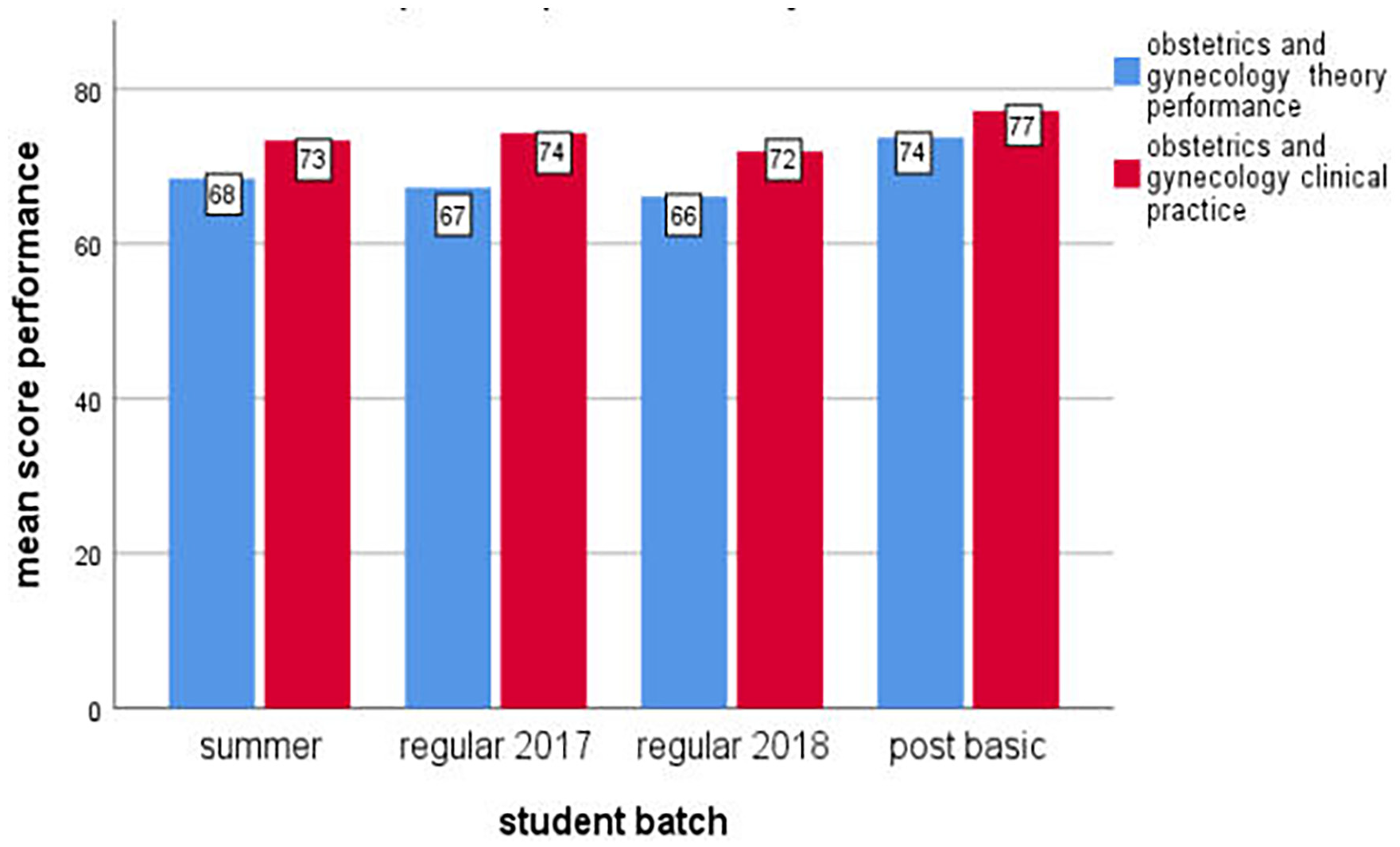
Performance of nursing students in academic course of obstetrics and gynecology theory and obstetrics and gynecology clinical practices.
Correlation Between Academic and Clinical Practice Performance
The Spearman’s rho test result showed a significant and strong positive correlation between theoretical and practice achievement for 2017 (rs (252) = .79, p < .001), and 2018 (rs (252) = .77, p < .001) batches of regular students and 2016 (rs (252) = .78, p < .001) and 2019 (rs (252) = .89, p < .001) of summer and post basic students respectively (Table 2).
Spearman’s Rho Correlation Between Obstetrics and Gynecology Theory Course and Clinical Practice Results of Students in Obstetrics and Gynecology Nursing Course at Woldia University, Amhara Region, Ethiopia.

Note. Rs = coefficient of determination.
The result of linear regression analysis showed that for all regular, summer and post basic students’ theoretical achievement explained 60% to 90% of the variability in the clinical practice achievement. The corresponding prediction equation model was also derived (Table 3).
Linear Regression Analysis Results of Students’ Performance at Obstetrics and Gynecology Theory Course and Clinical Practice Results of Students at Obstetrics and Gynecology at Woldia University, Amhara Region, Ethiopia.

Note. B = constant; Y = practice result; X = theory result; R2 = R-square.
Discussion
As far as the author’s knowledge, this was the first study in Ethiopia on the connection between the practical and theoretical achievement of obstetrics and gynecology nursing students. This study discovered a considerably favorable link between the theoretical course of obstetrics and gynecology and student clinical practice performance. Other research discovered a positive correlation between students’ theoretical courses and clinical practice performance (Chan et al., 2014; Hatlevik & Hatlevik, 2012; Jones, 2013; Rahkar Farshi et al., 2015). The data support the notion that a theoretical course is essential for improving student nurses’ clinical practice accomplishment. As a result, colleagues of the nursing faculty (clinical supervisors) must assist students in developing higher theoretical courses in the achievement of the nursing program in order to boost the success rate of clinical skill.
The clinical practice achievement of undergraduate nursing students found in this study was in line with the study findings in Jordan (O. S. Lee & Gu, 2013). Nevertheless, it was lower than the study’s conducted in Iran (Akhu-Zaheya et al., 2015). The difference might be due to difference accessibility of education material, tool differences used to measure clinical practice achievement between the two studies. Another possible explanation might be that the study in Iran included only female students because male students were not allowed to have actual practical training due to cultural and religious aspects of maternal care services, but in our study.
This study summarized the correlation between students’ academic achievement in the theoretical course of obstetrics and gynecology and obstetrics and gynecology clinical practice. As far as knowledge goes, this was the first study on the connection of these courses to integrate theory with practice in the process of preparing skillful and deserved nurse practitioners. This study showed a strong (rs = 0.7–0.89) and positive association between nursing students’ achievement in courses in obstetrics and gynecology theory and obstetrics and gynecology clinical practice achievement. This finding was similar to the findings of different studies conducted in related fields (Abdel-Fatah Ibrahim et al., 2016; Alzayyat & Al-Gamal, 2014; Chewaka Gamtessa, 2021; Hassanian et al., 2021). This revealed that an increase in the academic achievement of theoretical course of obstetrics and gynecology and increased students’ obstetrics and gynecology clinical practice. Furthermore, in all batches of regular, summer, and post-basic nursing students, post-basic students outperformed regular and summer students (Gamtessa, 2021). This may be due to the fact that post-basic students already have some knowledge and skill in obstetrics and gynecology.
Conclusion
The correlation of nursing students’ academic achievement in theoretical course of obstetrics and gynecology was strongly and positively associated with their obstetrics and gynecology clinical achievement. For that reason, increasing student’s achievement in theoretical course of obstetrics and gynecology can further improve their achievements in obstetrics and gynecology clinical practice. Despite this, students’ achievement in the theoretical course of obstetrics and gynecology explained 66% to 90% (on average 78% of the variability in obstetrics and gynecology clinical practice). Other factors accounted for 34% to 10% of the variations (average of 22). This merits further research.
Strength and Limitation
This was the only study to examine the association between nursing students’ performance in gynecology and obstetrics theoretical courses and clinical practice. Because the harmonized nursing curriculum, admission criteria, and hospital setting for practice are largely identical, the findings can be extrapolated to other Ethiopian universities with caution. The study’s main drawback was that additional variables such as nurse educator credentials, students’ pre-university academic achievement, and socio-demographic characteristics were not adjusted for. Furthermore, no students who did not take an obstetrics and gynecology theory course served as a control group.
Supplemental Material
sj-docx-1-sgo-10.1177_21582440231209728 – Supplemental material for Correlation of Academic and Clinical Practice Performance of Nursing Students in an Obstetrics and Gynecology Nursing Course; at Woldia University, Ethiopia
Supplemental material, sj-docx-1-sgo-10.1177_21582440231209728 for Correlation of Academic and Clinical Practice Performance of Nursing Students in an Obstetrics and Gynecology Nursing Course; at Woldia University, Ethiopia by Gizachew Yilak in SAGE Open
Footnotes
Acknowledgements
I am grateful to Woldia University, the College of Health Sciences, and the School of Nursing for providing the necessary assistance. My thanks also go to my data collectors, without whom this work would not have been possible.
Author Contributions
GY: Solely dependable for conceptualization, design, software, data acquisition, and analysis and revising the article, gave final approval of the version to be published, an responsible for all aspects of the work.
Declaration of Conflicting Interests
The author(s) declared no potential conflicts of interest with respect to the research, authorship, and/or publication of this article.
Funding
The author(s) received no financial support for the research, authorship, and/or publication of this article.
Permission for Publication
There is no publication consent to report.
Ethical Approval
This study was carried out after gaining permission letter with ethical reference number (wldu /01/09/2022) from the concerned body and the research was carried out in line with the Helsinki Declaration (Chewaka Gamtessa, 2021). Nonetheless, secondary data was obtained, and agreement to participate was not required. Furthermore, for this work, no identifiable data was accessed or reported.

Data Sharing Statement
Data analyzed and used for this manuscript can be accessed on reasonable request from GY at
Supplemental Material
This article’s supplemental material is available online.
References
Supplementary Material
Please find the following supplemental material available below.
For Open Access articles published under a Creative Commons License, all supplemental material carries the same license as the article it is associated with.
For non-Open Access articles published, all supplemental material carries a non-exclusive license, and permission requests for re-use of supplemental material or any part of supplemental material shall be sent directly to the copyright owner as specified in the copyright notice associated with the article.
