




Abstract
This study aimed to explore the level of perceived clinical competence among undergraduate nursing students. This was a cross-sectional, comparative, study. Data were collected using the Clinical Competence Questionnaire. Study participants included fourth year and internship nursing students attending 1 of 39 public and private nursing programs in Saudi Arabia. A total of 244 nursing students completed the clinical competence questionnaire. Students reported the ability to perform some clinical skills in clinical settings under supervision. Intern students had higher clinical competence than fourth year students (t = 2.792, p < .01). Year of education (β = .148, p < .05) and gender (β = .190, p < .01) were statistically significant to the prediction of perceived clinical competence level. The internship year facilitates the translation of theory into practice, which eventually may improve students’ clinical competence skills. Improving perceived clinical competencies might improve actual clinical competencies. Lastly, more qualitative research studies are needed to investigate the decreased perceived clinical competencies among male students compared female students.
The goal of the nursing education curriculum is to develop professional nurses who can combine theory and practice to deliver high-quality nursing care in the real world (Lee & Sim, 2020). The transition from student to practicing nurse must be facilitated through clinical experience (Solvik & Struksnes, 2018). Therefore, nursing programs have increased their clinical requirements to ensure that students have a higher and appropriate level of clinical competence before entering the workforce.
The length of nursing education programs and graduation requirements vary from one country to another. For example, in the U.S, nursing students are required to complete a 4-year course to earn the degree of Bachelor of Science in Nursing (BSN; Al-Alawi et al., 2020). In Saudi Arabia, however, nursing students must study a 4-year course works plus a 1-year internship to earn the same degree. During the first 4 years of the BSN program in Saudi Arabia, students must study theoretical and practical courses where clinical sessions are provided in hospitals and simulation labs. Also, students are exposed to clinical environment in most nursing courses, which are significant elements of nursing curricula (Aboshaiqah et al., 2018).
The internship year aims to improve nursing students’ clinical competency by allowing them to provide direct patient care under a preceptor supervision (Aboshaiqah et al., 2018). In contrast to the first four academic years, during which students only watch registered nurses perform clinical skills in hospitals and may help them perform simple procedures, the internship year helps students explore the real practical world. Students need a transition period before becoming RNs and taking on significant responsibilities. Internationally, programs similar to the internship year (e.g., residencies or orientation programs) are implemented in different countries to help nursing students transition to practice. In the U.S., Singapore, Australia, and other countries, transition to practice programs serve the same purpose as the internship year: to enhance students’ clinical competencies under supervision. The only difference is that these programs are monitored by hospitals rather than nursing colleges.
Perceived clinical competency is a subjective feeling where a person considers himself or herself having the essential attributes to succeed (Kremer et al., 2012). The actual clinical competency is the ability of a person to perform certain skills and procedures and it could be evaluated with specific rubrics or checklists (Notarnicola et al., 2016). Therefore, the perceived clinical competency may affect positively or negatively the actual clinical competency (Dymek et al., 2022).
The purpose of this study is two-fold. The primary purpose was to compare the level of perceived clinical competence among undergraduate nursing students before and after completing the internship year. The secondary purpose was to explore the relationship between the participants’ characteristics (including age, gender, marital status, GPA, and university types) and perceived clinical competence level. Specifically, the study answered the following research questions:
RQ1: Is there any significant difference in perceived clinical competence between fourth year and internship-year nursing students?
RQ2: How does demographic characteristics influence students’ perceived clinical competence level?
We hypothesized that there is no difference in perceived clinical competence between the fourth-year nursing students and nursing interns. We also hypothesized that there are no statistically significant influence of students’ characteristics on perceived clinical competence.
Literature Review
Nursing Internship Year
The internship year is the final clinical year in which students receive hands-on training providing patient care in a healthcare setting. The internship year is a requirement of the Saudi Commission for Health Specialties (SCFHS), which is the scientific commission that regulates healthcare-related practices and accreditation at all levels in Saudi Arabia (Aljohani, 2020). During the internship year, nursing students must complete a rigorous clinical practicum in hospitals in order to register and sit for the SCFHS board examination (Alharbi & Alhosis, 2019). Intern students undertake their rotations in numerous areas, such as emergency, medical-surgical departments, pediatric, and maternity (Aljohani, 2020).
Nursing Perceived Clinical Competence
The healthcare field seeks out nurses whose skills align with the requirements of practice settings and who can effectively work in multidisciplinary teams in various healthcare settings (Fawaz et al., 2018). Therefore, nursing programs aim to prepare nurses with high levels of clinical competence (Fawaz et al., 2018; Fukada, 2018). Most nursing literature describes clinical competence as a set of knowledge, skills, and attitudes exhibited by nurses during their practical period (Nabizadeh-Gharghozar et al., 2021). Additionally, clinical competence can be further explained as nurses’ capacity to carry out a nursing task or produce and achieve intended results in a clinical context (Willman et al., 2020). During the nursing program, students must move through several phases to reach the highest level of clinical competence. A combination of laboratory-based experiences and directed and supervised clinical learning opportunities in a range of health care settings comprise the experiential learning required to prepare competent new graduate nurses (Mancini et al., 2019). According to many studies, nursing students must have a high level of perceived competence in order to achieve their learning outcomes (Utvær et al., 2022). The perception of being competent is important because it helps nursing students to achieve their goals and enhance their sense of satisfaction and engagement in clinical experiences (Bouffard, 2017; Deci & Ryan, 2000). Nursing student reported that the social support, types of institution, year of study, attending the theoretical classes, and clinical environment all influenced their perception of being competent.
In Saudi Arabia, only one study has measured fourth year nursing students’ perceived clinical competence. Albagawi et al. (2019) conducted a study that aimed to measure the perceived clinical competence of fourth year nursing students in Saudi Arabia using the research the clinical competence questionnaire (CCQ), which ranged between 1 and 5. Students reported having the highest competence in the core nursing skills subscale (M = 3.58), followed by general performance (M = 3.57), advanced nursing skills (M = 3.46), and nursing professional behaviors (M = 3.39; Albagawi et al., 2019). According to the study, the total clinical competence among fourth year nursing students was high (M = 3.50; Albagawi et al., 2019). Little research has focused on assessing nursing students’ clinical competence during their internship year. Indeed, only one study in Saudi Arabia has measured the level of perceived clinical competence among nursing students enrolled in their internship year (Aboshaiqah & Qasim, 2018). The study quantified the levels of perceived clinical competence among internship year students using the CCQ. Students’ highest reported competence was in the general performance subscale (M = 4.57), followed by core nursing skills (M = 4.12; Aboshaiqah & Qasim, 2018).
Comparing the two abovementioned studies, nursing interns reported higher clinical competence than fourth-year nursing students. However, there is no evidence that this difference is statistically significant. To our knowledge, few studies have measured nursing students’ perceived clinical competence while considering the difference between fourth year students and students who are about to complete their internship year. Consequently, it is difficult to determine whether undergraduate nursing students need to complete a 1-year internship to achieve sufficient perceived clinical competence. Nursing educators must make efforts to bridge the gap between theoretical and practical knowledge (Alnajjar, 2019). A single study that measures perceived clinical competence and includes a comparison between the perceptions of fourth year and internship year nursing students is needed to help educators bridge this gap.
Theoretical Framework
Nursing theorists play an important role in nurse education and practice because they lay the foundation for nursing practice and guide educators and leaders, providing them with the knowledge of how to manage the skill development and transition process of new nursing students (Murray et al., 2019). This study was guided by Benner’s novice to expert theory since it focuses on nurses’ development at the professional and clinical skills levels (Benner, 1984; Butts & Rich, 2022). Benner’s theory recognizes five stages of clinical competence and is aligned with experiential learning in that it recognizes that an individual develops by spending time in a scenario in order to adjust to that situation and adapt the necessary skills before transferring to the next stage (Benner, 1984; Graf et al., 2020). Therefore, in this study, students in year 4 are considered novices (Stage 1) due to their limited clinical experience, while internship students are advanced beginners (Stage 2) since they have spent time in clinical settings. Accordingly, clinical nursing competencies are different throughout Benner’s novice to expert stages (Benner, 1984; Quinn, 2020).
Methods
Design
This study used a cross-sectional, comparative design. Data were collected at a single point in time using an online survey.
Sample
In Saudi Arabia there are 39 nursing college, 13 out of the 39 college are privet colleges (Aljohani, 2020). The total number of undergraduate nursing student in all nursing programs in Saudi Arabia is 17,085 and male students are 4,084 (Saudi Health Commission for Health Specialities, 2018). In this study used a convenience sample of 244 undergraduate nursing students, each enrolled in 1 of the 39 undergraduate universities across Saudi Arabia. The inclusion criteria included nursing bachelor’s students either in the last period of their fourth year or in the last 3 months of their internship year. These inclusion criteria were made clear to study participants before they completed the online survey. Nursing students enrolled in the bridging program (RN to BSN) and faculty members were excluded from participating in this study.
Data Collection Procedure
Data were collected through an electronic self-reported survey containing questions assessing perception of competency in nursing clinical practice. The online survey was distributed through nursing colleges’ websites between August 2020 and January 2021. Recruitment statements, provided in the same online link as the survey, contained specific information regarding the purpose of the study, potential risks and benefits, and participant confidentiality. Participants were informed that access to their data would be limited to the study’s principal investigator. The researchers did not collect identifying information from participants, and the data were reported in aggregate form.
Measurement
This study utilized a standardized questionnaire, which the authors received permission to use. Part I collected the students’ demographic information, including year of study, age, gender, marital status, grade point average (GPA), and type of nursing school. The type of nursing school was assessed by asking students to identify their nursing school, and then the variable was categorized as public or private. From the collected data, we determined that participants were enrolled in 13 public or private nursing schools in the country.
The Clinical Competence Questionnaire (CCQ) was used to measure students’ perceived clinical competency (Liou & Cheng, 2013). The CCQ was originally developed to evaluate nursing students’ competence in the areas of safe care, ethics, fundamental and technical nursing skills, collaboration, and communication skills. It consists of 47 items measured on a 5-point Likert scale ranging from 1 (do not have a clue) to 5 (known in theory, competent in practice without supervision). Total scores range from 47 to 235, and higher scores indicate a greater level of competence (Liou & Cheng, 2013).
The questionnaire categorizes competence into two major categories: nursing professional behaviors (16 items) and skill competence (31 items). The skill competence category consists of three subscales: 13 items on general performance, 12 items on core nursing skills, and 6 items on advanced nursing skills. The validity of the CCQ has been established by the authors of the instrument using content and known-groups validity (Liou & Cheng, 2013). It has demonstrated excellent reliability (Cronbach’s α = .98). To our knowledge, this scale has been used only once in undergraduate nursing students with an Arabic background, but the study did not report on the reliability and validity of the scale (Aboshaiqah & Qasim, 2018). The advanced language used in this questionnaire may not be easy for participants to understand. Therefore, pilot testing was carried out among ten nursing students to evaluate the applicability of the questionnaire to the selected respondents. The results revealed that the tool is suitable for the intended target group. The Cronbach’s alpha of the subscales ranged from .77 for the advanced nursing skills subscale to .92 for the general performance subscale. The reliability of the overall scale was acceptable (Cronbach’s α = .88), indicating that the scale could be used with undergraduate students from an Arabic background. Questionnaires were distributed during the final week of the second semester of the academic year, without any modifications to the CCQ as the instrument utilized.
Ethical Considerations
Ethical approval was obtained from [King Saud University] before collecting data. This study adhered to the Declaration of Helsinki. Participants were informed that their participation was completely voluntary and that they had the right to withdraw at any time during the process of filling out the questionnaire without any potential consequences. Participants were asked to sign the consent form after reading the recruitment statement. The permission to use the CCQ was obtained from its authors prior to data collection.
Data Analysis
SPSS version 28 was used for data analysis. Descriptive statistics were used to describe the characteristics of participants. The bivariate analyses, comprising the t test and one-way analysis of variance, were used to determine differences in nursing students’ levels of clinical competence based on demographic characteristics. All demographic variables associated with the outcome variable at p < .2 were considered for entry in the regression model (Jewell, 2004). Multiple linear regression analysis was used to determine the relationship between the nursing students’ characteristics and clinical competence level. The minimum sample size required to run the independent sample t test and multiple linear regression was calculated using G-power software 3.1. For a significance level of p < .05, a power of .80, an effect size of .15, and four predictors, a minimum sample of 85 participants was needed to run the selected statistical analysis.
Results
Demographic Characteristics
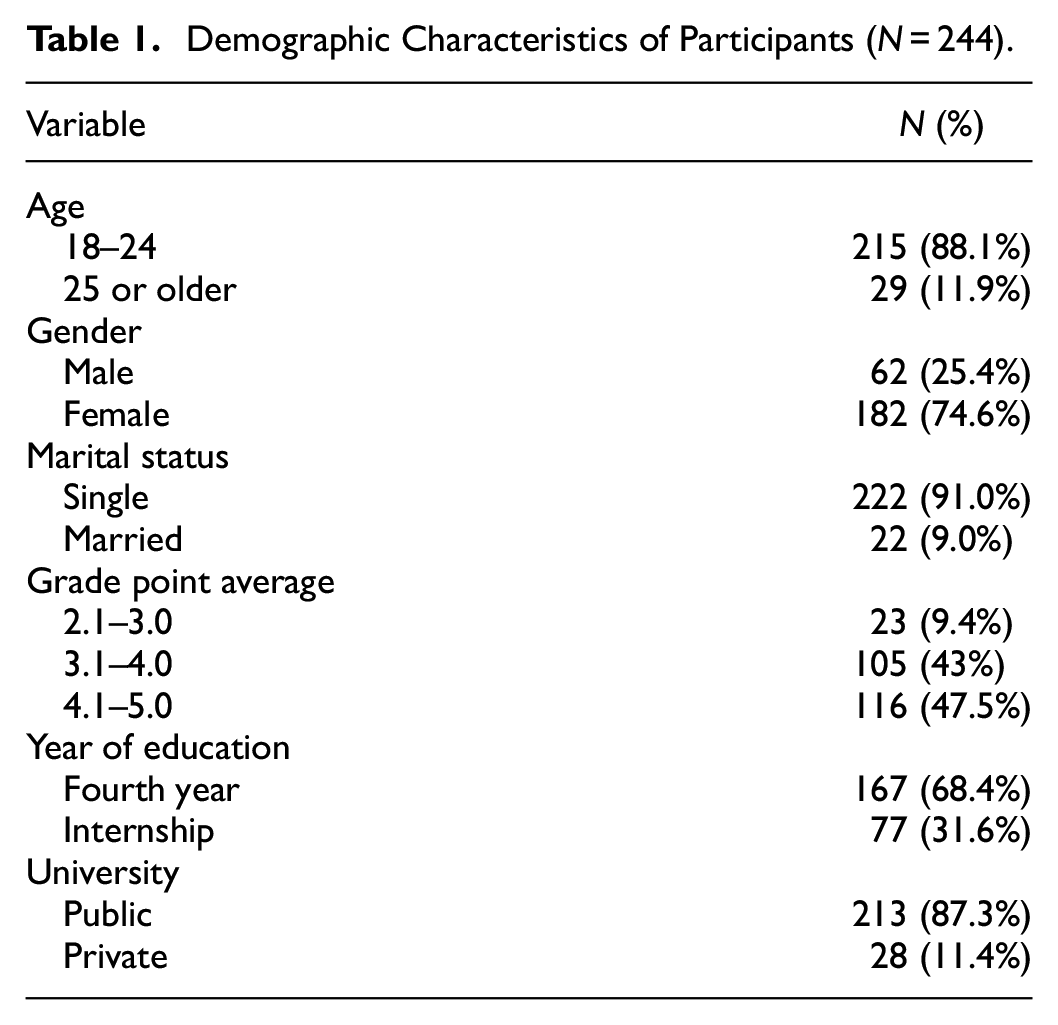
Table 1 displays the characteristics of study participants. A total of 244 undergraduate nursing students participated in the study. The majority of the students (88.1%) were between 18 and 24 years of age. Female participants represented 74.6% of the sample. The majority of students were single (91%). Participants’ GPA ranged from 2.0 to 5.0, with almost half having a GPA of 4.1 to 5.0 (n = 116). Participants were enrolled in either the fourth year (n = 165) or internship year (n = 77), and the majority of participants (87.3%) were enrolled in public universities.
Demographic Characteristics of Participants (N = 244).
Perceived Clinical Competence among Nursing Students
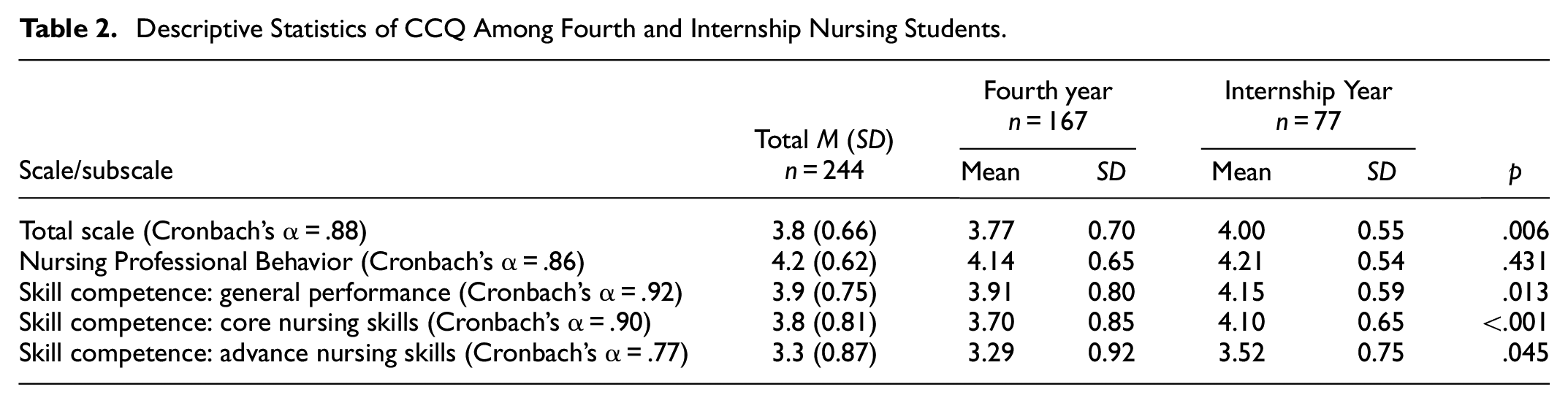
As shown in Table 2, the mean scores on the CCQ for nursing professional behavior (M = 4.2, SD = 0.62) and general performance (M = 3.9, SD = 0.75) were higher than the other subscales. The mean score for students’ levels of competence was 3.8 (SD = 0.66), indicating that students can perform some skills in clinical settings independently but need some form of supervision. The mean score for advanced nursing skills was lower than the rest of the subscales (M = 3.3, SD = 0.77), indicating that students perceived themselves as less competent in performing advanced skills without supervision.
Descriptive Statistics of CCQ Among Fourth and Internship Nursing Students.
Differences Between Fourth Year and Internship Year Nursing Students
A statistically significant difference in the total average of perceived clinical competence score was found between fourth year and internship students (t = 2.792, p < .01; Table 2). All skill competence subscales revealed statistically significant differences between fourth year and internship nursing students. Students in their internship year had higher clinical competence compared to fourth year students, indicating that exposure to the actual clinical practice has a positive impact on students’ perceived clinical competencies.
Factors Associated With Perceived Clinical Competence Among Nursing Students
A statistically significant difference was found in mean clinical competence scores between male and female students (Table 3). The average score for clinical competence was higher for female students than for male students (t = 2.732, p < .01). As shown in Table 3, only gender and year of education were correlated with clinical competence at p < .2. Therefore, among the demographic variables, only gender and year of education were entered in the regression model. Table 4 displays that the model was significant (F[2,241] = 7.988, p < .001, R2 = .062). Year of education and gender were statistically significantly associated with clinical competence and explained 6.2% of the variance in clinical competence. Internship nursing students perceived themselves as more competent in performing nursing skills without supervision than fourth year nursing students (β = .148, t = 2.371, p < .05). Female students perceived that they had higher competence compared with male students (β = .190, t = 3.039, p < .01). In other words, female nursing students who were in their internship year were more clinically competent when compared with their counterparts.
Mean Differences in Nursing Students’ Demographic Variables and Clinical Competence (N = 244).

Note. Independent sample t test and one-way ANOVA were used.
p < .01.
Relationship Between Participants’ Characteristics and Level of Clinical Competence.

Reference group: Fourth year students.
Reference group: females.
Discussion
The current study identified Saudi undergraduate nursing students’ perceived clinical competence levels. Specifically, it aimed to investigate differences in perceived clinical competence between fourth year and internship year nursing students and to explore the relationship between the participants’ characteristics and their perceived clinical competence levels. A total of 244 nursing students completed the Clinical Competence Questionnaire during the period between August 2020 and January 2021.
The results indicated that Saudi nursing students feel they have clinical competence in performing some skills independently; however, they also feel they need supervision and guidance. The CCQ subscale results revealed positive responses in the students’ ratings of their nursing professional behavior skills, which had the highest mean, followed by general performance and core nursing skills. However, students reported feeling less competent in advanced nursing skills. Similar findings regarding nursing professional behavior skills have been reported in a study on Saudi nursing interns after completion of their internship program (Aboshaiqah & Qasim, 2018). However, in the study by Aboshaiqah and Qasim (2018), general performance had the highest mean, followed by core nursing skills and nursing professional behavior, while results for advanced nursing skills were not reported. The inconsistency between our findings and the findings of Aboshaiqah and Qasim (2018) might be related to differences in the samples, as all of their study’s participants had completed the internship year. In our study, the level of perceived clinical competence among nursing students was higher than that found in the study by Albagawi et al. (2019) mentioned above. This finding indicates that nursing students have a higher perceived clinical competence compared to the fourth-year nursing students in Albagawi et al.’s (2019) study. The core nursing skills subscale was the highest competence reported by Albagawi et al. (2019), followed by general performance, whereas in our study, behavior skills and general performance were both higher than core nursing skills. One possible explanation for the difference is that our study recruited participants from different nursing programs across Saudi Arabia, whereas Albagawi et al. (2019) only examined one program site. Finally, the level of perceived clinical competence among the nursing students in our study was higher than that in a study conducted in Saudi Arabia that measured senior nursing students’ perceived clinical competence after a simulation-based learning experience (Fawaz & Alsalamah, 2022).
From an international perspective, the overall clinical competence level found in our study was consistent with studies conducted in several European countries (Kajander-Unkuri et al., 2021), Thailand (Sawaengdee et al., 2016), Taiwan (Cheng & Liou, 2013), Italy (Notarnicola et al., 2018), and Ethiopia (Bifftu et al., 2016). The findings of our study support previous studies and highlight the need to assess and improve nursing students’ clinical competence before graduation. In our study, advanced nursing skills had the lowest perceived competence reported by nursing students. This is consistent with the findings for newly graduated registered nurses working in Sweden (Willman et al., 2020). Based on these results, Saudi nursing students’ general performance skills, core nursing skills, and advanced nursing skills must be reinforced before graduation. Strengthening nursing students’ clinical competence will improve their clinical skills and reduce their stress, fear of making mistakes, anxiety while being observed by instructors, and apprehension about their initial clinical experience (Wang et al., 2019).
The current study provides valuable evidence of the effectiveness and importance of an internship year for nursing students before graduation. The internship required by the SCFHS has proven its efficacy in improving nursing students’ clinical competence, enhancing the delivery of health care services, and increasing students’ readiness for the SCFHS board examination (Alharbi & Alhosis, 2019; Althaqafi et al., 2019). In our study, nursing students enrolled in the internship year reported feeling more clinically competent than fourth year students. This indicates that nursing interns are most likely more competent than fourth year nursing students. This is consistent with the theoretical framework used in this study. Nursing students in the internship program showed higher clinical competence, which could rank them in stage two (beginners) according to Benner’s novice to expert theory (Graf et al., 2020).
In the clinical environment, students’ experience and exposure to actual patient care during the internship year play a significant role in developing their clinical competence (AlThiga et al., 2017). In addition, students’ perception of the effectiveness of the preceptorship, provided during the internship year, has been linked to clinical competence in a study conducted in Saudi Arabia (Aboshaiqah & Qasim, 2018). During the internship year, students are mentored by nurse preceptors in the hospital to ensure an effective clinical learning experience (Alnajjar, 2019). Previous researchers have stated that instructors who are trustworthy, highly experienced, knowledgeable, and act as coaches can enhance students’ knowledge, critical thinking ability, and confidence (Niederriter et al., 2017). Moreover, one of the preceptor roles is to encourage interns to actively engage as members of the healthcare team. Nursing interns have emphasized that preceptors helped them to assume a professional nursing role and to build confidence in clinical practice (Aboshaiqah & Qasim, 2018). An intern’s satisfaction with their internship would thus support their attainment of excellent levels of clinical competence (Alnajjar, 2019; Dorgham et al., 2013). Nursing interns’ completion of all theoretical courses and full-time attendance at their clinical placement at the time of our survey might have influenced their clinical competence levels as compared to the fourth year students, who were still taking theoretical and clinical classes. Therefore, the findings of this study emphasize the importance of the internship year in improving clinical competence before graduation.
The bivariate and multivariate analyses revealed consistent findings that gender influenced nursing students’ clinical competence level. Female nursing student interns perceived themselves as more clinically competent than did male student interns. Similar results have been previously reported among female nursing interns in Saudi Arabia, who demonstrated an improvement in clinical knowledge and skills after their internship program (Al-Neami et al., 2014). This could be related to perceived barriers to performance in the clinical environment. Cultural barrier might played a significant role in female scoring higher perceived competence than male students (Almarwani, 2022; Aynaci, 2021). Many hospitals in Saudi Arabia forbade male students from practicing in female departments, especially maternity and pediatric, due to religious and cultural factors (Almarwani, 2022). Therefore, this might be one factor contributing to female nursing students reporting higher perceived competence. Another study reported that the most frequently perceived clinical challenges in terms of competency development include insufficient preparation, the theory practice gap, and difficulty in planning patient care (Aboshaiqah & Qasim, 2018). A previous study indicated that male nursing students reported an unsupportive environment as a barrier to clinical practice more often than female students (Gemuhay et al., 2019). Thus, future studies are recommended to explore the challenges and barriers related to clinical practice among Saudi nursing students.
Finally, our study revealed that students enrolled in private universities showed better clinical competence than students in public universities. This finding is consistent with the conclusions of a study conducted in Thailand, where nursing students at private universities reported a high level of clinical competence (Sawaengdee et al., 2016). In Saudi Arabia, there are approximately 13 private nursing colleges with graduate and undergraduate nursing programs (Aljohani, 2020). An explanation for this finding might be that private nursing colleges provide flexible schedules and a curriculum that fits nursing students’ needs. Some private colleges limit the number of nursing seats to ensure a high quality nursing education. It is recommended that future studies focus on comparing the nursing education curricula and teaching methods provided in private and public universities.
Implications for Practice
In our study, nursing interns are monitored by nursing colleges. More attention needs to be devoted to fourth year nursing students to improve their ability to meet a satisfactory perceived clinical competence level. For example, clinical sessions with actual practice in hospitals during practical courses might increase the perceived clinical competencies for undergraduate nursing students before enrolling in the internship year. The internship year can then facilitate the translation of theory into practice, thereby enhancing students’ clinical competence skills. Constant evaluation of the internship program is also suggested. Future studies need to compare students’ perceive clinical competence during the first 6 months of the internship year with the second 6 months. Such results might help future decisions to reduce the length of the internship year.
Study Limitations
Although the study sample was collected from different universities and the researchers used robust statistical methods to analyze the data, several limitations were faced. Students’ perceptions toward their clinical competence may not reflect the actual clinical competence in clinical settings. Therefore, future researchers are recommended to use such an objective measure as objective structured clinical examination. Also, the use of a cross-sectional design prevented the researchers from determining causality. It is recommended that future researchers use a longitudinal design to determine change over time in participants’ clinical competence and qualitative research to identify the factors that influence students’ perception of clinical competences.
Moreover, using a convenience sampling method may have negatively influenced the generalizability of the findings to other settings. However, the homogeneous sample from specific nursing programs may have provided more in-depth details regarding the clinical competencies of nursing students within those institutions. Further, participants’ responses could be influenced by social desirability, as the researchers utilized an objective measure to interpret the results of the study. However, participants were informed that no identifying information would be collected to minimize social desirability, and their responses remained anonymous.
Conclusion
This study determined the importance of perceived clinical competence and the associated factors among Saudi undergraduate nursing students. Students enrolled in the internship year demonstrated significantly higher levels of perceived clinical competence than fourth year nursing students. Gender was associated with perceived clinical competence, with female students reporting higher perceived competence than male students. In summary, the internship year facilitates the translation of theory into practice, which eventually may improve students’ clinical competence skills. Lastly, more qualitative research studies are needed to investigate the decreased perceived clinical competencies among male students compared female students.
Footnotes
Acknowledgements
The authors extend their appreciation to the Deanship of Scientific Research at King Saud University for logistically supporting this study through the Research Assistant Internship Program.
Author Contributions
Adnan Innab: Data curation; Investigation; Methodology; Supervision; Roles/Writing—original draft; Writing—review & editing. Monirah Albloushi: Funding acquisition; Project administration; Writing—review & editing; Resources; Roles/Writing—original draft. Abdulaziz Al-Marwani: Writing—review & editing; Resources; Roles/Writing—original draft, Formal Analysis. Naji Alqahtani: Formal Analysis; Visualization; Methodology; Writing—review & editing. Maryam Anazi: Formal Analysis; Validation; Writing—review & editing. Irene Roco: Software; Writing—review & editing; followed the guidelines of the journal. Naif Al-Zahrani: Writing—review & editing; Resources.
Data Availability
The data that support the findings of this study are available from the corresponding author, [MA], upon reasonable request.
Declaration of Conflicting Interests
The author(s) declared no potential conflicts of interest with respect to the research, authorship, and/or publication of this article.
Funding
The author(s) disclosed receipt of the following financial support for the research, authorship, and/or publication of this article: This study was funded by the Researchers Supporting Project (number: RSPD2023R837) of King Saud University, Riyadh, Saudi Arabia.
Ethical Approval
The Institutional Review Board approval was obtained from King Saud University (Ref E-19-3845). The study was performed following the Declaration of Helsinki.
