




Abstract
Student nurses are exposed to hazards in terms of occupational health and safety (OHS) problems in Turkey. Researching these problems in the clinical setting, improving the health and safety of student nurses is an issue that needs to be investigated. The aim of this study is to present OHS-related impressions and OHS experiences of nursing students in relation to the risk assessment process and from an educational perspective. A descriptive and cross-sectional study was conducted with 140 students at a nursing school. The study indicated that almost all of the students’ OHS knowledge and awareness level were low, were exposed to contact with blood and body fluids as most dangerous situations, have difficulties in the provision of personnel protective equipment (PPE), were subjected to verbal assault, and experienced anxiety and irritability. They encountered dangerous situations applying treatment in the clinic, preparing drugs, following vital signs, giving general care, and during the intervention in the emergency room, and experienced back pain, headache, increased tendency to sleep, fatigue, and forearm, wrist, hand, and finger injuries. Because of contact with hand antiseptic/latex, skin irritation, and burning eyes, nose, and throat, allergy symptoms were detected. Carelessness and intensive work tempo were the most common causes of workplace accidents. The clinical practice areas are limited in terms of OHS; students are exposed to physical, psychological, and chemical risks with respect to OHS, and they are most psychologically affected by experiencing anxiety and irritability, as well as physiologically, and have symptoms similar to burnout syndrome; they are at risk of getting burnout syndrome.
Keywords
Introduction
As the health sector is one of the most risky groups in terms of occupational accidents and diseases, the World Health Organization emphasizes that hospitals are the primary priority in preventing workplace hazards (Cheah et al., 2012; Elewa & Sahar Banan, 2016). To draw attention to the importance of the occupational safety in hospitals, the International Council of Nurses published themes of the week for nurses as “Positive Work Environments, Quality Workplaces = Quality Patient Care” (International Council of Nurses, 2016). Clinical environments in hospitals consist of intense work hazards and risky environments, complex business processes, and the intensive use of technology (Cebeci, 2013; Ulutaşdemir et al., 2015). The unit and characteristics of the clinic also affect the possibility of encountering hazards (Parlar, 2008). Surgical clinics are environments with high-risk closed units such as operating rooms and intensive care units (ICUs), where critical thinking, quick decision making, and urgent interventions are intensive (Erdağı & Özer, 2015). Nurses, who are the most important members of the health care team, who provide direct care to the patient in surgical units, are exposed to numerous occupational hazards, such as drugs, chemicals, infectious agents, lack of materials and ergonomic conditions, heavy working, and excessive workload, and also they have physical (needle stinging, penetrating stab injuries, musculoskeletal disorders and pain, cancer resulting from night work, hearing loss, and varicose veins), chemical (skin problems, latex allergies), biological (infectious diseases), and psychological (stress, burnout syndrome, mental health problems, sleep disorders) problems (Anandh et al., 2015; Attar, 2014; Attarchi et al., 2014; Bernal et al., 2015; Broadwater & Brueck, 2017; Elewa & Sahar Banan, 2016; Hamnerius et al., 2018; Rathore et al., 2017; Samulin Erdem et al., 2017; Xiong et al., 2017).
Literature shows that nursing students face numerous occupational health hazards as qualified nurses face during their work (Boucaut & Cusack, 2016). In particular, nursing students may be experiencing stress and anxiety (Taşdelen & Zaybak, 2013; N. Yıldırım et al., 2017) and exposed to occupational hazards due to their underdeveloped abilities, lack of knowledge, and other professional health professionals in the clinical setting (Cheung et al., 2015). Like qualified nurses, nursing students are exposed to violence from verbal/nonverbal to physical violence by fellow students, faculty or hospital staff, patients, and patients’ relatives in surgical clinical settings (Seibel, 2014). It is also reported in the literature that nursing students are exposed to patient infections as a result of stab wounds and needle stinging (Scaggiante et al., 2013). Dermatitis, often caused by washing hands and wearing gloves, is another occupational situation experienced by nursing students (Akan et al., 2012; Visser et al., 2014). Nursing students, like qualified nurses, face difficulties with transport, carry of patient and equipment and musculoskeletal disorders. Researchers in the United Kingdom and Australia suggest that students face difficulties in safe handling practices in clinical situations; some nursing students have experienced severe low back pain due to lifting and bending characteristics (Cornish & Jones, 2010; Kneafsey et al., 2012; Mitchell et al., 2008). Nursing education in universities in Turkey requires 4 years of full-time university study and 4,600 hr; 50% includes theoretical training, and 50% includes clinical practice training. Clinical practice, which covers an important part of education, is an intensive part of the contemporary nursing curriculum and is an essential element of nursing education. This training is conducted in a variety of clinical settings that provide the basis for the continuous development of students’ critical thinking and decision-making skills; it also improves professional practice competence (Ören & Zengin, 2019). In Turkey, during the first year of university programs (consisting of a year of two semesters), students take lessons in basic science courses (anatomy, including physiology and biochemistry) and “Basic Principles and Practices of Nursing Courses.”
In the second and third years, there are 8 hr of theoretical courses and 14 hr of clinical practice for Surgical Nursing, Internal Medicine Nursing, Obstetrics and Gynecology, and Pediatric Nursing. For these clinical courses, students attend formal clinical practice in surgical clinics/areas of hospitals 2 or 3 days a week (16–24 hr). For this reason, in the second and third years of their education, students are actively involved in clinical practice in surgical units. Students can participate in clinical practice under the supervision of academicians. The number of nursing schools studying in Turkey has increased in recent years. Unfortunately, the number of academicians has not increased at the same level. This raises the risk of students being exposed to occupational hazards in clinical practice due to lack of instructors (Council of Higher Education, 2018). Student nurses are at risk because of diseases and injuries resulting from clinical applications especially in surgical clinics such as operating rooms and ICUs, where critical thinking, quick decision making, and emergency interventions are intensive. Besides, some nursing students who do not have a good economic situation face financial pressures to work in paid work during the time they have left their classes and this causes them to experience fatigue. In the literature, it is stated that this fatigue affects the academic achievement of students, and they are not prepared enough for the nursing profession (Rella et al., 2009); it is also reported in the literature that nursing students are prone to experience stress in their clinical training and theoretical training (Pulido-Martos et al., 2012). The fatigue and stress of the students cause accidents to increase, and the safety of the patients remains under threat. The occupational health and safety (OHS) issue is an important component of clinical practice skills, which reflects what student nurses have learned in theoretical practice and theoretical knowledge. Therefore, it is vital that student nurses work safely during clinical practice. Besides, academicians and educators have responsibilities for students, including the OHS risks that their students may face in clinical practice.
As a result of the reviewed literature, in summary, the fact that nursing students are more weighted in surgical clinical applications and take a more active role in clinical applications especially in their second and third years of education period clearly shows OHS is a matter of importance and serious concern.
In this study, it is aimed to present the views and experiences of the student nurses about the OHS and OHS experiences in surgical units in relation to the risk assessment and to evaluate them from an educational perspective.
Study Aim
The aim of this study is to gather information about occupational accidents, occupational diseases, and problems related to OHS during clinical practices in the second and third years of the education in which the surgical clinical applications are more weighted and the students have more active role in the clinical practices; to provide information about nursing students’ level of knowledge and awareness about OHS, to determine the status of compliance with OHS measures in relation to the risk assessment; and to evaluate them from an educational perspective. The research questions are as follows:
Method
Survey Design
This was a descriptive design that used a self-administered questionnaire, developed specifically for this study.
Sample Group
Students enrolled in a health college consisted of the population of the study. A questionnaire was applied with a sample of nursing students performing hospital clinical rotations. The population of the study consisted of 140 students studying in the second and third years of the nursing department. As the whole population was taken as a sample group, no sampling method was used. The first-grade students who take university basic science courses (including anatomy, physiology, and biochemistry) and “Basic Principles and Practices of Nursing” and fourth-grade students who take Public Health Nursing and Mental Health Nursing courses were excluded from the study because they did not attend clinical practice in surgical units.
Data Collection and Measurement Tool
The researchers developed a questionnaire based on the research knowledge in the literature and the experience of the researchers (in consultation with the nursing teacher, academician, hospital nurse, and OHS specialist). There are 29 questions in the questionnaire: four questions to determine students’ demographic characteristics and 25 questions to measure their attitudes and awareness about OHS in which they explain the problems they face in the clinical practice environment, and the answers given are classified under four subheadings (identifying threats, detection of OHS situation in nursing students, evaluation of risk control, and assessment) (Table 1).
Questionnaire With Research Subheadings.

Note. OHS = occupational health and safety; IM = intramuscular; IV = intravenous; SC = subcutaneous; PPE = personnel protective equipment.
Expert opinion was obtained to determine whether the questions were appropriate for the study and whether the information requested was sufficient. All questions were analyzed and coded in such a way that each author independently identified the risk within the scope of risk assessment, categorizing them under identifying threats, detection of OHS situation in nursing students, evaluation of risk control, and assessment subheadings. Risk assessment, as Boucaut and Cusack (2016) point out, allows students to link the Nursing Process and the risk assessment process, help them incorporate OHS risk management into their clinical logic, and extend students’ patient care to self-care. The first stage of the Nursing Process involves collecting, organizing, verifying, and documenting data; this stage is similar to the hazard identification of the risk assessment process. The “Planning” and “Implementation of Interventions” stages of the Nursing Process include both the risk assessment and control stages of Risk Management to prevent or reduce harm to both itself and staff. The final stage of both models is “Assessment.” Comparing the similarities between the Nursing Process model and the risk assessment process can facilitate nursing students to consider their safety, particularly by encouraging students to consider self-care and patient care as part of their clinical logic processes (Boucaut & Cusack, 2016).
Then, 10 students who did not participate in the study were given a questionnaire, and questions that were not understood in this pilot test were rewritten. The questionnaires were given to the students on the first day of their visit to the hospital between February and June 2018, and collected on the last day of clinical rotations (clinical rotations are totally 11 weeks).
The questionnaires were distributed by academicians who were not part of the research, and explained the purpose of the study and how to complete the form.
Data Analysis
The data were analyzed using the SPSS 21 computer software package (SPSS, Chicago, IL, USA). Percentages and the chi-square test were used in the evaluation. The p value of <.05 was considered to be statistically significant.
Ethical Considerations
The required written permission was received from the facilities for conducting the study (October 12, 2017, No. 33505391-044-E.167490). All participants provided informed written consent after the research aim had been explained to them. Before starting the survey, the students were informed about the research topic and given instructions about form. The students were informed that participation in the research was voluntary, that they were free to complete the form without any limitations, that they would not be rewarded or punished for participating in the study, and that this research would have no impact on their grade. It was also said that data obtained from the questionnaire would not be used anywhere else from research and would remain confidential.
Results
The findings were handled within the framework of risk assessment, identifying threats, detection of OHS situation nursing students, risk control assessment, and evaluation subheadings.
Characteristics of the Participants
Of the participants, 68.9% were female and 31.4% male; 14.3% of students stated that they work in another job. Some students had been vaccinated in the hospital before beginning clinical practice (Table 2).
Students Identifying Characteristics and Vaccine Status.

Note. DaBT = diphtheria, pertussis, tetanus; DTaP = diphtheria, tetanus, and acellular pertussis.
Identifying threats
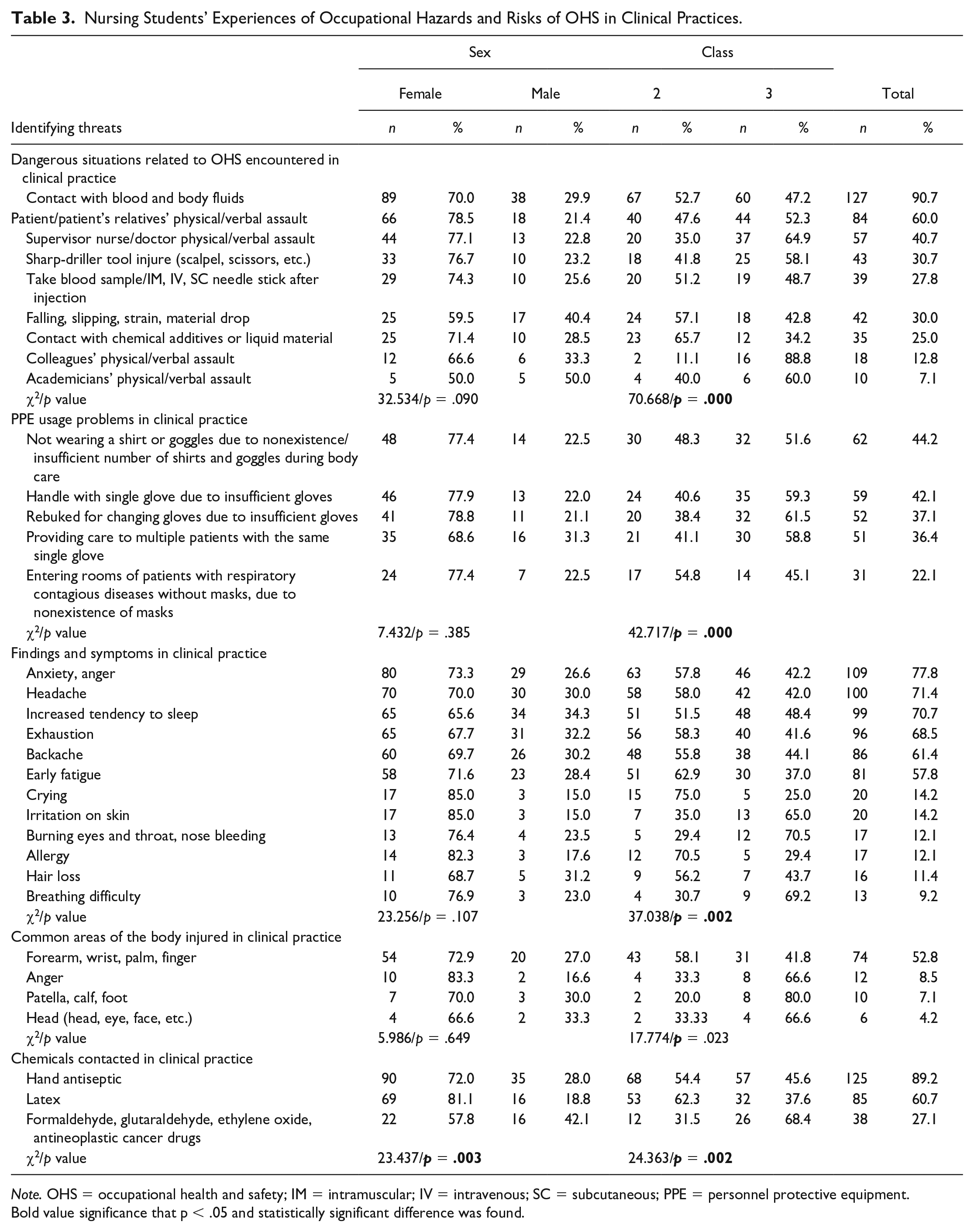
To identify threats, the students were asked the questions shown in Table 1. Students were exposed to hazards related to OHS in clinical practice such as contacting blood and body fluids (90.7%), physical/verbal assault by patients/patients’ relatives (60%), nurses and doctors (40.7%), sharp injuries (scalpel, scissors; 30.7%), and needle stick injuries (27.8%). Students who contacted blood, body fluids, chemicals, or other fluids and who experienced slipping, falling, strain, and material fall were female and in the second class, whereas students who experienced physical/verbal assault by patients/patients’ relatives/nurses/doctors, sharp injuries (scalpel, scissor), and needle stick injuries were female but in the third class. The difference in problems encountered based on sex was not statistically significant (p > .05), while the difference between classes was statistically significant (p < .05).
They identified the following problems with PPE usage: Students did not wear protective gowns or use goggles during body care of patients (44.2%), either because gowns/goggles were unavailable or their availability was limited. They had to use a single glove due to insufficient supply of gloves (42.1%) or because they were reprimanded for changing gloves (37.1%), they had to care for more than one patient with a single glove (36.4%), and they had to enter the rooms of patients with respiratory contagious diseases without masks, due to the nonexistence of masks (22.1%). As shown in Table 3, most students who faced these problems were females in their third year. While no statistically significant difference was found for these problems based on sex (p > .05), the difference between classes was statistically significant (p < .05).
Nursing Students’ Experiences of Occupational Hazards and Risks of OHS in Clinical Practices.
Note. OHS = occupational health and safety; IM = intramuscular; IV = intravenous; SC = subcutaneous; PPE = personnel protective equipment.
Bold value significance that p < .05 and statistically significant difference was found.
Proportionate with the problems they faced, students mostly experienced anxiety, anger (77.8%), headache (71.4%), increased tendency to sleep (70.7%), exhaustion (68.5%), backache (61.4%), and early fatigue (57.8%) during clinical practice. The most commonly injured body areas were forearms, palms, wrists, and fingers (52.8%). Most students who experienced these symptoms were in the second class and female (Table 3); no statistically significant difference for injuries was found based on sex (p >.05), but the difference based on class was significant (p < .05).
Hand sanitizer (89.2%) and latex (60.7%) were the chemicals most used by students. Most students who reported using these chemicals were female and in the second class, and a statistically significant difference was found between both sexes and classes (p < .05).
Detection of OHS situation in nursing students
To measure nursing students’ OHS knowledge and awareness, subtitled “Detection of OHS situation in nursing students,” all students provided positive responses to the fact that OHS relates to and affects their profession. Regarding sociodemographic characteristics, most were female and in the second class, but this was not statistically significant (p > .05). Almost all students (95.7%) reported having some knowledge of OHS, from sources such as OHS courses (52.8%), experts’ information meetings (48.5%), classes (37.1%), academicians (37.1%), media (20.7%), and friends (15%). The difference between OHS information sources between sex and classes was statistically significant (p < .05). Students knew the definition of occupational diseases (90.7%), the national OHS regulations/laws (43.5%), the hazard classification of hospital services in OHS (32.1%), and rights and legal commitments (30.7%) that might result from workers and patients encountering dangerous OHS incidents. A total of 79.2% of students wanted separate classes regarding OHS as part of the curriculum. Although students reported having knowledge of OHS and thought that it relates to their profession, only 7.1% were aware of new OHS regulations/laws. The difference between sexes and classes with regard to knowledge of OHS and regulations, desiring an OHS class as part of the curriculum and knowing the hazard classification of hospital services, was not significant (p > .05). A statistical difference was found for sex in resources of OHS knowledge, new OHS regulations, and knowing the definition of occupational illness, while a significant difference was found for classes in terms of legal commitments and rights resulting from dangerous incidents in OHS (p < .05; Table 4).
Nursing Students’ OHS Knowledge and Awareness.

Note. OHS = occupational health and safety.
Bold value significance that p < .05 and statistically significant difference was found.
Evaluation of risk control
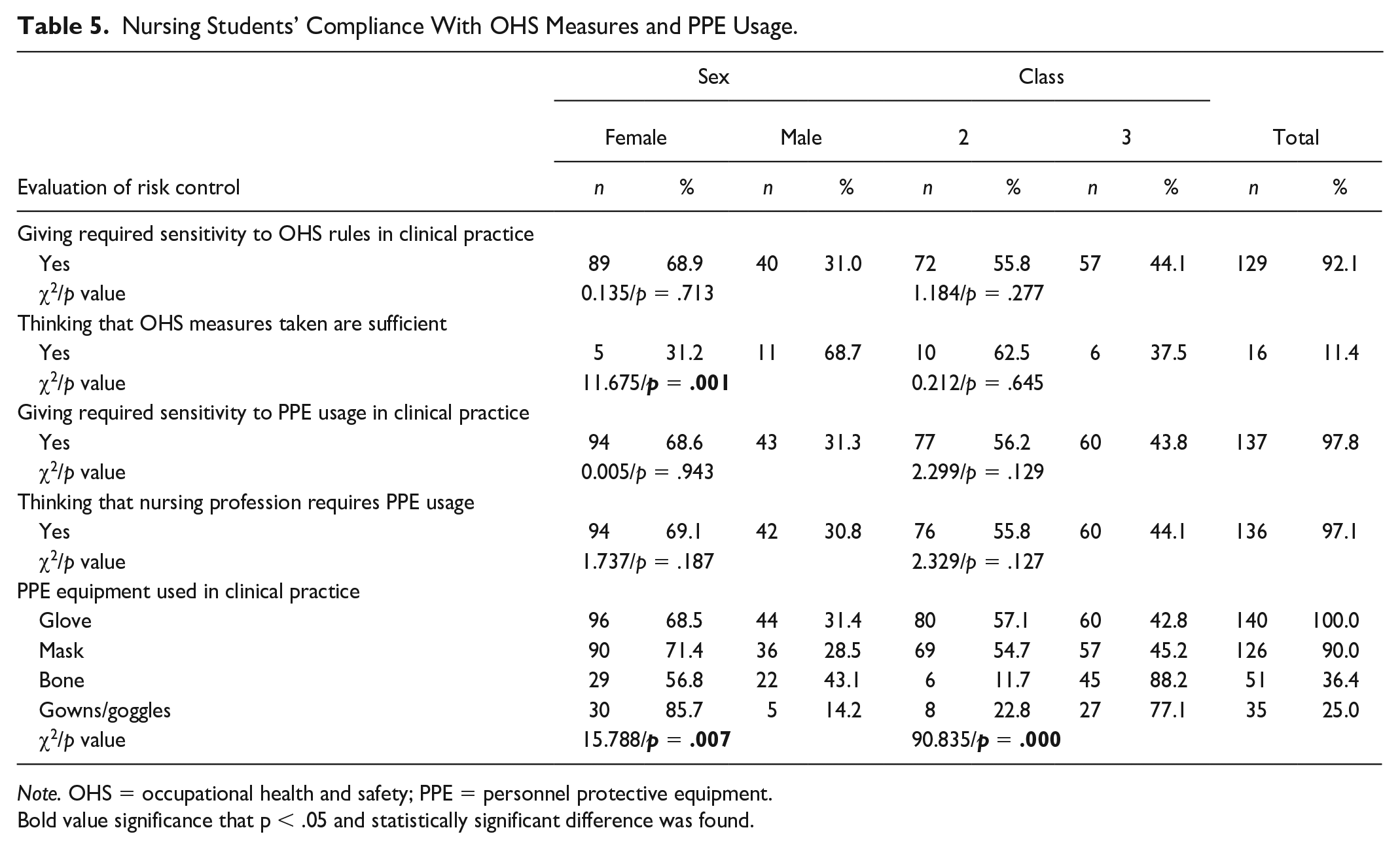
Table 5 shows to evaluate risk control measures. In total, 92.1% of students stated that they gave the required sensitivity to OHS rules. Most students thought that their profession required PPE usage (97.1%) and that they were sensitive enough to use PPE (97.8%). The difference between sex and classes in this respect was not significant (p > .05). When asked what kind of PPE they used in clinical practice, most reported using gloves (100%), masks (90%), and bone (36.4%). As seen in Table 4, a significant difference was found between classes and sex with regard to the scope of PPE that was used (p < .005). The percentage (11.4%) of students who felt that OHS precautions were sufficient for the problems they faced was very low. No significant difference was found between classes in terms of considering “OHS precautions sufficient” (p > .005), but a significant difference was found between sexes (p < .005).
Nursing Students’ Compliance With OHS Measures and PPE Usage.
Note. OHS = occupational health and safety; PPE = personnel protective equipment.
Bold value significance that p < .05 and statistically significant difference was found.
Assessment
The students mostly encountered occupational hazards while executing treatment in clinics (54.2%), preparing drugs for treatment (41.4%), tracking fire-pulse-blood pressure (25%), maintaining general care (22.1%), during intervention in emergency services (22.1%), and recapping needles (20.7%). No significant difference was found between sexes for work during dangerous situations (p > .005), but the difference for classes was significant (p < .005). Most students reported incidents related to occupational hazards to supervisor nurses (54.3%), and supervisor nurses showed instant interest. Students stated that occupational accidents were caused by lack of attention (84.2%) and intensive work tempo (81.4%). They reported that when they face hazardous situations, they give priority to their health first (65%). No significant difference was found for sex or classes in taking rest leave, the person to whom incidents were reported, documentation of incident, or practice type in which they were exposed to hazards (p > .05; Table 6).
Nursing Students’ Thoughts on Hazard Sources and Compliance With OHS Precautions.

Note. OHS = occupational health and safety; PPE = personnel protective equipment.
Bold value significance that p < .05 and statistically significant difference was found.
Discussion
The discussion is handled within the framework of the risk assessment process based on the findings, within the framework of the identifying threats, detection of OHS situation in nursing students, evaluation of risk control, and assessment subheadings, and presented in Table 7 in comparison with the relevant literature.
Discussion.

Note. OHS = occupational health and safety; ELISA = enzyme-linked immunosorbent assay; DaBT = diphtheria, pertussis, tetanus; IM = intramuscular; IV = intravenous; SC = subcutaneous; PPE = personnel protective equipment. ILO = International Labour Organization.
Conclusion
This study has demonstrated that the conditions of OHS in clinical practice areas are very limited for students. Students in this study were exposed to physical, chemical, and physiological risks, and were mainly affected psychologically, followed by physically. It was concluded that the students were at risk of getting burnout syndrome before they start the nursing profession by experiencing similar symptoms to burnout syndrome (anxiety and irritability, low back and back pain, headache, increased tendency to sleep, exhaustion, early fatigue). Although nearly all students reported having knowledge of OHS at the end of their study, their knowledge and awareness of OHS were revealed to be very low. Moreover, in terms of OHS-related hazardous incidents, students were mostly exposed to contact with blood and body fluids and had serious problems accessing PPE, which comprises a protective measure against exposure to physical/verbal assault. They experienced anxiety and irritability in clinical practice. Most students also reported symptoms of backache, headache, increasing tendency to sleep, exhaustion, and fatigue. The chemicals with which students had most contact were latex and hand antiseptic, which they reported to have caused skin irritation, burning eyes and throat, nose bleeds, and allergy. Students faced hazardous incidents when applying treatments in clinics, preparing drugs, tracking fire-pulse-blood pressure, recapping needles, and making interventions in emergency services. Most such injuries occurred to their forearms, wrists, palms, and fingers. The most frequently cited reasons for occupational accidents were lack of attention and heavy/intensive work tempo. This study is limited as the study sample came from a single center; thus, the results cannot be compared with other centers and the findings cannot be generalized to all nursing schools.
Recommendations
Despite these limitations, we have provided several recommendations below. Because nurses and other medical workers face common occupational risks, it may be possible to apply these recommendations to other medical students as well. To prevent occupational exposure and its effects on nursing students, burning out syndrome, and other occupational harms before entering the nursing profession, it is recommended that all students take OHS training. This study and relevant literature reveals that nursing students have two main platform working area and learning area, that is, the college and hospital setting. To protect students from occupational hazards and to acquire an occupational safety culture in students, students have to be trained in both college and hospital settings. In college, nursing students should take an extra class for OHS especially for health care workers, and after clinical practice, students could discuss the work environment in the class and increase their awareness. In hospital settings and in clinical practice, it should be given OHS pretraining before starting any clinical practice by a responsible OHS person, and nursing students should be monitored and checked. It is recommended that all students take OHS training, including the wide concepts of the recommended OHS education before and after clinical practice. Both the previous literature and our study reveal that there is a lack of common understanding of OHS for health students, regarding how to educate students in OHS and how to apply a professional approach to OHS in medical areas. It is also recommended that amendments be added to the required legal regulations in schools and clinical practice areas and that students’ OHS situations be tracked.
Limitations of the Study
The present study is a pilot study with small focus group numbers. However, the participating students provided valuable information about their impressions and experiences on various OHS issues. We recognize that the views presented in small numbers may not represent the views of the wider student population. Although the results are not generalized to other nursing students, the findings provide useful materials for consideration by other nursing schools and health sciences faculty who have students in clinical placement. Findings and related literature support the need for further studies in this field.
Footnotes
Acknowledgements

Authors’ Note
This study was submitted as oral presentation in the Union of Thrace Universities 2nd International Health Sciences Congress in Tekirdağ/Turkey on November 15–17, 2018.
Declaration of Conflicting Interests
The author(s) declared no potential conflicts of interest with respect to the research, authorship, and/or publication of this article.
Funding
The author(s) received no financial support for the research, authorship, and/or publication of this article.