




Abstract
This study investigates the influence of game elements on active learning intentions within digital learning platforms. Drawing from a situational perspective, we developed a model and validated it using data from 492 respondents collected via questionnaires. Our findings suggest that while social elements enhance active learning intentions, both achievement and immersive elements tend to weaken them. Notably, the spirituality of the learning place serves as a mediator in the relationship between game elements and active learning intentions. Furthermore, we emphasize the moderating effects of different game behavior patterns. This research enriches our comprehension of game elements’ role in shaping active learning intentions on digital platforms, offering valuable insights for educators and platform developers.
Keywords
Introduction
With the rapid expansion of digital learning platforms, there is a growing imperative to tailor these platforms to meet the diverse needs and preferences of a global audience (Aseervatham & Dananjayan, 2023; Soreny et al., 2022). Recognizing this, many institutions and businesses are tapping into the potential of game elements as a pivotal strategy to boost user engagement and learning outcomes (Jayawardena et al., 2021). While drawing inspiration from the video gaming industry, these game elements are not mere replicas. Instead, they are meticulously designed to encourage active learning by offering learners enjoyable and meaningful experiences (Saleem et al., 2022). With the “gamer generation” now accustomed to interactive and immersive experiences (Szymkowiak et al., 2021), comprehending the nuanced impacts of various game elements has become indispensable for educational innovators.
However, incorporating game elements into digital learning platforms is still emerging (Pasca et al., 2021). Concepts like “game experience” have gained traction (Gonzalez et al., 2013), but synthesizing these concepts within learning contexts and their theoretical foundations remains a fertile ground for exploration (Zhyhadlo, 2022). While theories like self-determination theory, flow theory, and goal-setting theory offer insights into the influence of game elements, they often focus narrowly on specific gaming aspects or need more depth in addressing the complexities of gamified learning environments (Orlovskyi & Yuskovych-Zhukovska, 2023). This highlights the exigency for research methods that provide a comprehensive view, bridging the gap between gaming mechanics and pedagogical principles.
Acknowledging the existing research voids, our study is anchored in a situational perspective rooted in sociological paradigms (Sandi Sukandi, 2022). This approach underscores the interplay between situational determinants and individual experiences (Tetiana Kuznietsova, 2023). Guided by this perspective, our research pursues three primary objectives: illuminating the impact of game elements on active learning in digital platforms, unraveling the mechanisms driving these effects, and examining the significant influence of situational factors. This dual-focused approach builds upon existing theoretical frameworks and integrates novel empirical findings (Kodalle, 2022). By emphasizing specific game elements over a broader gamification lens, we aim to foster a nuanced understanding, setting the foundation for more impactful digital learning experiences (Mini et al., 2022).
Theoretical Background and Research Hypotheses
The situational perspective, rooted in the foundational works of Thomas and Znaniecki (1927) and Goffman (1956), delves deep into the understanding of “situation” as a distinct topic within the vast realm of sociological constructs. This perspective seeks to unravel the complexities of human behavior by delving into the socially constructed systems they inhabit, asking the pivotal question: “Why do people do what they do?” (Greeno, 2015). At its core, it emphasizes the significance of face-to-face interactions and the exchange of information, driven by a framework of shared meanings, rules, and institutions—aptly termed the “definition of the situation” (Goffman, 1956). External and obligatory definitions in nature usher in “social structure effects,” guiding individuals in their constant quest to redefine and interpret their surroundings. This intertwined mesh of situational interpretation and individual factors, such as desires, needs, and motivations, is pivotal in shaping behavior within interactions (Thomas & Znaniecki, 1927).
In the realm of digital learning platforms, the gamification process emerges as a formidable tool, crafting new interactive scenarios and situations. This study explores the incentive effects of game elements on users’ active learning intentions, drawing inspiration from the situational perspective. At its essence, gamification harnesses game elements as symbolic carriers, fostering user associations and shared meanings (Blohm & Leimeister, 2013; Krath et al., 2021). This intricately crafted game experience, underpinned by a robust game mechanics framework, instills a sense of association among users, enhancing their engagement and forging deeper connections (Yee, 2006). Such heightened associations, in turn, imbue actions with profound meanings, motivating users and stimulating their intrinsic desires and behavioral motivations.
Gamification and Users’ Active Learning Intention
The ascendancy of digital technology has spotlighted the integration of game elements, commonly termed “gamification,” into various domains, notably in digital learning platforms. Gamification, as conceptualized by Hamari et al. (2014), is not merely the introduction of game-like elements but the strategic incorporation of these elements to evoke game-like experiences and behaviors in traditionally non-gaming contexts. Within the universe of digital learning platforms, the ultimate aim is to foster active learning—a purposeful, transformative approach characterized by enriched interactions, personalized experiences, and well-structured reward mechanisms (Howell, 2021). Herein lies the significance of game elements. While game elements might have their roots in video games, their infusion into learning platforms targets a pivotal goal: to catalyze active learning intentions. This is achieved by crafting dynamic experiences that balance enjoyment and purpose, thus aligning with the inclinations of today’s “gamer generation” (Szymkowiak et al., 2021). As this study delves deeper into the spectrum of game elements and their influence on active learning intentions, this section sets the foundational understanding of how gamification, with its myriad elements, shapes and potentially transforms the learning experiences on digital platforms.
Game Elements and Their Influence on Active Learning Intention
Game elements are the backbone of gamification, with each type having distinct attributes and effects on user behavior. By integrating Yee’s (2006) classification with contemporary academic discussions, we categorize these elements into achievement, immersion, and social. Each type shapes user experiences and interactions in different ways. Empirical research underscores the effectiveness of these game elements in heightening user engagement, kindling creativity, and cultivating a sense of ownership (H. Kumar & Raghavendran, 2015; Sarangi & Shah, 2015). Among these, achievement elements—characterized by feedback, recognition, and rewards—stand out. Features like trophies, leaderboards, points, and virtual currency cater to users’ achievement desires, kindling their curiosity and prompting deeper engagement with learning. Leaderboards and challenges, for example, introduce competition, bolstering active learning and fostering innovative behaviors (S. Lam et al., 2016; Landers & Landers, 2014).
On the other hand, immersive game elements, including narratives, simulated realities, and virtual characters, craft immersive experiences (Agogué et al., 2015) and foster a sense of ownership (Sarangi & Shah, 2015). Such elements enhance learners’ attentiveness to the dynamics between peers and educators, boosting active learning intentions. Lastly, social game elements are pivotal in fostering a collaborative learning atmosphere. Elements promoting group collaboration and team-based competition, for instance, are known to enhance brainstorming sessions, active participation in discussions, and the cultivation of team-centric active learning behaviors. Building on these insights, we propose:
H1: Game elements positively influence users’ active learning intention. Specifically, the more (1a) achievement elements, (1b) immersion elements, and (1c) social elements adopted by digital learning platforms, the more they will promote users’ active learning intention.
Mediating Role of Spirituality in Learning Places
The concept of spirituality in learning places has gained traction in educational research. As articulated by Rahman et al. (2015) and Zaidi et al. (2019), it represents a transcendent experience, enabling learners to delve into deeper meanings of learning and fostering a sense of interconnectedness among them. Such spiritual dimensions underpin holistic development and cultivate an atmosphere of empowerment and harmony (McGhee & Grant, 2008). Recent literature has underscored the significance of mediating and moderating effects in educational models (Abredu et al., 2019). Within this paradigm, game elements, when interwoven with these interactional factors, provide richer insights into the dynamics of the learning process. Incorporating game elements into learning environments amplifies the organizational cultural fabric, drawing users closer to their learning contexts (Busel & Polupan, 2022). Such profound connections augment the meaning behind user behaviors, propelling active learning endeavors (Rhema & Miliszewska, 2014). Diving deeper into the interplay between game elements and users’ inherent behavior patterns, it is evident that users exhibit varied responses based on their behavioral inclinations. For instance, highly competitive users, such as strivers and slayers, exhibit a stronger affinity toward achievement elements like leaderboards and points, seeking recognition and engagement (Kocadere & Çağlar, 2018; Robson et al., 2016).
On the contrary, those with a lesser competitive drive, such as free spirits, resonate more with immersion elements, drawing them deeper into the learning narrative (Koivisto & Hamari, 2019). Similarly, users with a pronounced social orientation, like socializers, find themselves more engaged with elements promoting teamwork and collaboration (Kocadere & Çağlar, 2018; Robson et al., 2016). In light of these insights, the study posits the following hypotheses:
H2: The spirituality of the learning place plays a mediating role in the influence of game elements on active learning intention. Specifically, a sense of learning meaning, group feeling, and inner experience have mediating effects on the following aspects: (2a) the influence of achievement elements on active learning intentions, (2b) the influence of immersion elements on active learning intentions, and (2c) the influence of social elements on active learning intentions.
Moderating Role of Users’ Game Behavior Patterns
Users on digital learning platforms display a diverse range of behavior patterns, introducing the concept of learner types. Drawing from Bartle’s (1996) model and its subsequent refinement by Robson et al. (2016), users can be categorized into strivers, scholars, slayers, and socialites based on their competitive tendencies and orientation. These varied behavior patterns influence how users react to different game elements. Highly competitive users, for instance, tend to gravitate toward achievement elements. In contrast, users with a less competitive nature are more drawn to immersion elements (Ardito & Czerkawski, 2021; DeSmet et al., 2016). Delving deeper into specific user traits, studies show that high competitive characteristics, such as strivers and slayers, resonate strongly with achievement elements like leaderboards and points (Kocadere & Çağlar, 2018; Robson et al., 2016).
On the other hand, individuals with traits leaning toward relative orientation, like players and destroyers, also exhibit a significant positive association with achievement elements, including badges and status (Kochukalam & Srampickal, 2018; Tondello et al., 2017). Given these findings, digital platforms incorporating achievement elements can effectively cater to highly competitive users, enhancing their engagement and sense of connection. Such platforms are aptly positioned to cultivate community and stimulate active learning intentions.
Furthermore, research points out that individuals with a lower competitive orientation, termed “free spirits,” align well with immersion-oriented elements, such as virtual roles and unlocking content (Koivisto & Hamari, 2019). Consequently, platforms emphasizing these elements can better engage and foster community among these users. Lastly, individuals with a pronounced social orientation, like socializers, exhibit a positive inclination toward social elements like teamwork (Kocadere & Çağlar, 2018; Robson et al., 2016). Similarly, altruistic individuals, like philanthropists, connect well with elements oriented toward altruism (Tondello et al., 2017). Such insights underscore that digital platforms emphasizing social elements can particularly resonate with socially-oriented users, nurturing their sense of community and active learning intentions. Informed by the above discussions, the study posits the following hypotheses:
H3: Users’ game behavior patterns moderate the relationship between game elements and the spirituality of learning place. Specifically, competition-orientation has a positive moderating role in the effect of achievement elements on (3a) a sense of learning meaning, (3b) group feeling, and (3c) inner experience; competition-orientation has a negative moderating role in the effect of immersion elements on (3d) a sense of learning meaning, (3e) group feeling, and (3f) inner experience; others-orientation has a negative moderating role in the effect of social elements on (3g) a sense of learning meaning, (3 hr) group feeling, and (3i) inner experience.
H4: Users’ game behavior patterns moderate the relationship between game elements and users’ active learning intentions. Specifically, competition-orientation has a positive moderating role in the effect of (4a) achievement elements and (4b) immersion elements on active learning intention, and (4c) others-orientation has a positive moderating role in the effects of social elements on active learning intention.
Theoretical Model
Building on the above discussions, this study develops a theoretical model for the gamification of digital learning platforms to stimulate users’ active learning intention, as represented in Figure 1.

A model of the predictors of the active learning intention of digital learning platforms.
Methods
Questionnaire Design
We meticulously designed a questionnaire to gain a deeper understanding of how game elements influence active learning intentions on digital learning platforms. To minimize social desirability bias, all items were evaluated using a 5-point Likert scale, with one indicating “completely inconsistent” and five denoting “completely consistent.” To ensure the reliability and validity of the questionnaire, the “translation-back translation” method was rigorously utilized.
Game Elements
Drawing from Yee’s (2006) methodology, we categorized game elements into three groups: achievement-oriented, social-oriented, and immersion-oriented, each reflecting specific motivational underpinnings. This framework was selected to align closely with our research focus—understanding active learning intentions in gamified digital platforms. We furnished comprehensive descriptions for 11 prevalent game elements to facilitate clarity and comprehension among participants. The delineation of these elements, with their respective descriptions, can be found in Table 1. Participants were prompted to identify the game elements that their respective platforms incorporated. Platforms with less than three selected elements were considered to be in the early stages of gamification, leading to the termination of the survey for that respondent.
Classification and Description of Common Game Elements of Digital Learning Platforms.

Conversely, respondents indicating three or more elements proceeded with the survey. Subsequently, we derived scores for the three-game element categories based on these selections. A higher score in a specific category indicated a dominant presence of game elements associated with that category within the platform.
Active Learning Intention
In this study, we utilized the questionnaire Frese et al. (1997) developed to assess the active learning intentions of digital learning platform users in a gamified environment. The seven questionnaire questions concentrate on users’ spontaneity, creativity, and foresight in completing learning tasks and achieving learning objectives. Examples include, “I typically complete more tasks than required in my learning” and “I am proactive and motivated in my learning, even if others are not.” Through these questions, we aimed to examine the influence of digital learning platform game elements on users’ active learning intentions.
Spirituality of Learning Place
In this study, we employed the scale developed by Sheng and Chen (2012) within the context of Eastern culture to evaluate the spirituality of learning places for digital learning platform users in a gamified environment. The scale divided the spirituality of learning places into three dimensions: Inner experience, group feeling, and a sense of learning meaning. A sense of learning meaning dimension consists of nine items: “My learning platform offers diverse interaction and development opportunities.” The group feeling dimension includes eight items, like “I feel acknowledged by others during the learning process”; the inner experience dimension features 10 items, for instance, “During the learning process, I am willing to influence others with care and concern positively.” Through these questions, we aimed to understand how the expression of spirituality in users’ learning places is affected by the game elements in digital learning platforms.
Users’ Game Behavior Patterns
User game behavior patterns comprise two dimensions: competition-oriented and other-oriented. In this study, we adopted Robson et al. (2016) method for measuring this variable, categorizing users into four types based on the dimensions of competition-orientation and other-orientation: strivers, scholars, slayers, and socialites. Strivers aim for personal development by achieving high scores; slayers strive to outperform others and elevate their status; scholars prefer learning from the platform; and socialites prioritize building relationships and collaborating with others. Respondents were asked to select a critical characteristic type that best represented their recent digital learning platform behavior patterns. Choosing the strivers or slayers type indicated high competition-orientation, whereas selecting the scholars or socialites type suggested low competition-orientation; opting for the strivers or scholars type implied low other-orientation, and choosing the slayers or socialites type denoted high other-orientation. The categorization and description of the key variables in this study are shown in Table 2.
Overview of Key Variables, Categorizations, and Descriptions.

Data Analysis
Our data analysis was conducted using the Statistical Package for the Social Sciences (SPSS) and SmartPLS software. The procedure began with preliminary analyses where we addressed missing data, outliers and ensured assumptions of normality. This foundational stage set the ground for more intricate analyses. In the measurement model assessment, we evaluated the internal consistency of scales through Cronbach’s alpha and confirmed the construct validity using Confirmatory Factor Analysis (CFA) in SmartPLS. Discriminant validity was then assessed to confirm the distinctiveness of each construct, followed by a correlation analysis to understand initial relationships and check for multicollinearity. The core of our analysis revolved around Structural Equation Modeling (SEM). Here, the significance of path coefficients was studied to evaluate hypothesized relationships and potential moderating effects were examined to grasp how certain variables might influence the relationships between others. This systematic approach ensured comprehensive and robust findings to address our research questions.
Sample Characteristics
In June 2022, a cross-sectional study collected data from 512 Chinese students and teachers at a public university via convenience sampling. An anonymous Qualtrics survey was conducted, excluding 20 responses for incompleteness or duplication. Participation was voluntary, with assurances of anonymity, confidentiality, and no consequence for withdrawal. Ethics approval was obtained from the research ethics committee. The study examined gamification’s impact on active learning intentions in 492 participants. Gender distribution was balanced (46.545% males, 53.455% females). Most participants were between 21 and 26, predominantly 24 and 26 (43.293%) and 21 to 23 (35.366%). Participants came from various academic majors, mainly Literature (40.447%) and Arts (34.756%). Digital platform usage varied; most had used it for 1 to 2 years (39.634%) or 6 months to 1 year (36.992%). Educational levels were mainly undergraduate (77.236%), with other education levels also represented, as shown in Table 2. Sungkyunkwan University’s Academic Ethics Committee approved in April 2022, as shown in Table 3.
Descriptive Statistics of Sociodemographic Variables (N = 492).

Results
Measurement Model Assessment
Results of the Reliability and Validity Test
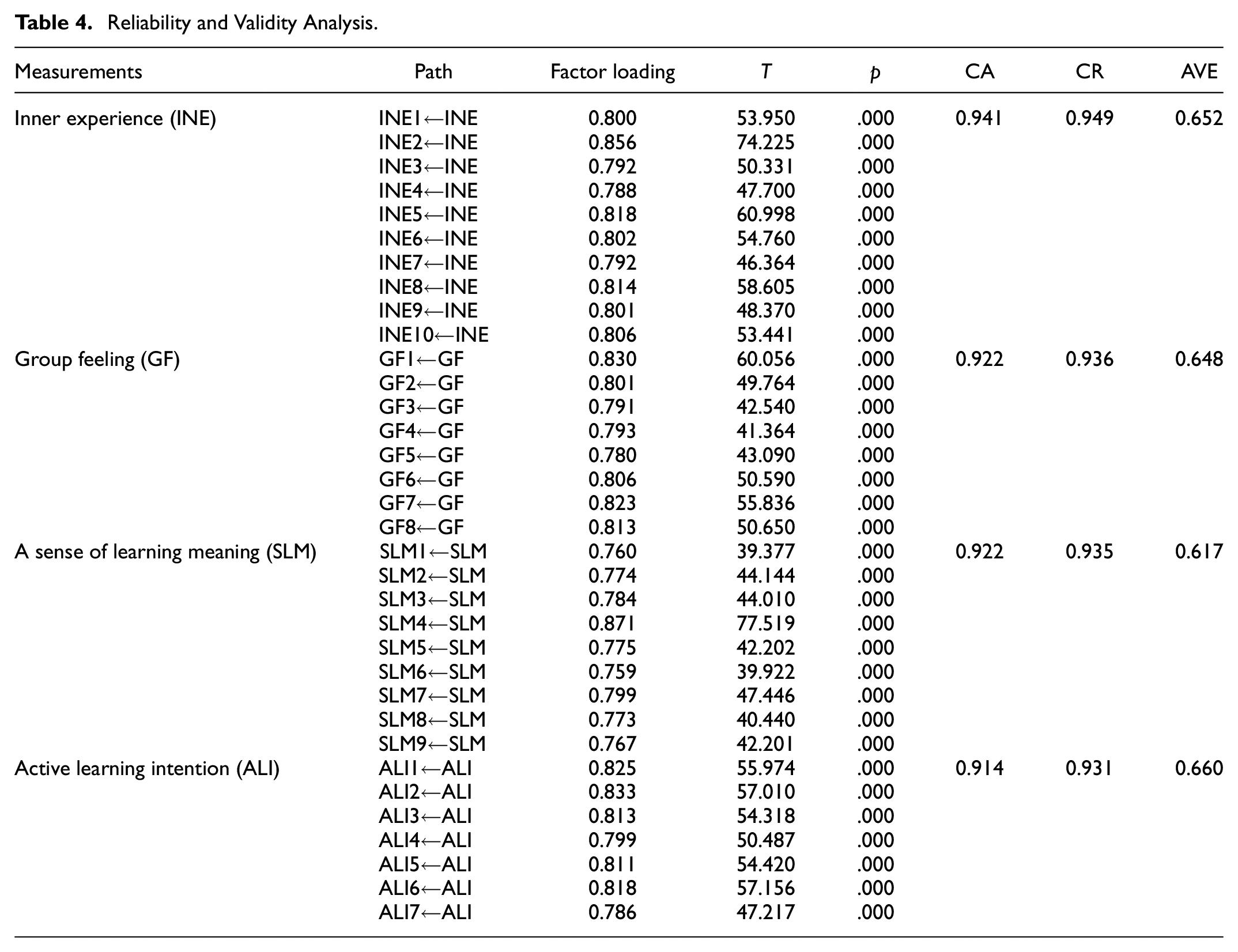
In research, internal consistency reliability evaluates test outcomes, assessing error impacts and instability. It maintains measurement independence from external influences. Cronbach’s Alpha (CA) and construct reliability (CR) measure this reliability. This study uses CA as a pre-test for questionnaire reliability, assessing consistency. The α coefficient ranges from 0 to 1, with above 0.7 being highly credible and above 0.9 being extremely credible.
Construct reliability comprises the reliability of all measurement variables, reflecting the internal consistency of construct indicators. Greater reliability denotes increased internal consistency within the model’s objectives. 0.7 is deemed an acceptable threshold (Hair, Sarstedt, Ringle, & Gudergan, 2017), while Fornell and Larcker (1981) suggest values a bove 0.6. The study analyzes factor loadings, representing the correlation between individual variables and factors. Factor loadings vary between −1 and 1, with the square of the factor loadings signifying the percentage of variance explained by the factor. Generally, factor loadings must be equal to or greater than 0.708, as the square of 0.708 is equivalent to 0.50, suggesting that the factor accounts for approximately 50% of the variance. In research, 0.7 is typically used as a standard, with values higher than this deemed acceptable (Hair, Sarstedt, Hopkins, & Kuppelwieser, 2014).
The study uses average variance extracted (AVE) to assess convergent validity, indicating latent variables’ portion is measurable by observed variables. AVE helps evaluate reliability, discriminant validity, and construct commonality. It’s calculated from squared factor loadings and total error variance. AVE ≥ 0.5 means the latent construct explains over half of the variance in its indicators, while AVE < 0.5 suggests higher error variance (Hair, Sarstedt, Hopkins, & Kuppelwieser, 2014). Thus, AVE = 0.5 is a key standard, with values >0.5 denoting satisfactory composite validity, as shown in Table 4.
Reliability and Validity Analysis.
Discriminant Validity
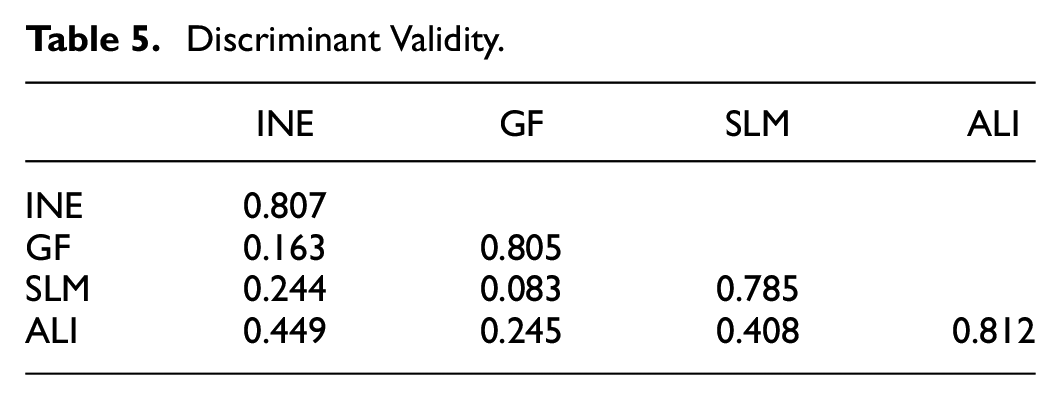
Discriminant validity analysis checks for significant differences in correlations between two separate constructs. High correlations (>0.85) between items from different constructs suggest they measure the same concept due to overlapping definitions. This study uses the AVE method for discriminant validity. According to Fornell and Larcker (1981), the square root of a factor’s AVE should exceed its correlation coefficients with other variables, indicating discriminant validity. The study exhibits discriminant validity as diagonal elements (square root of AVEs) are larger than off-diagonal standardized correlation coefficients. The lower triangular matrix represents these coefficients, as shown in Table 5.
Discriminant Validity.
Correlation Analysis
Achievement elements in learning negatively correlate with inner experience, group feeling, and sense of learning meaning. In contrast, social and immersive elements have a positive correlation with these factors. Active learning intention significantly correlates with six factors: achievement, social, immersive elements, inner experience, group feeling, and sense of learning meaning. It negatively correlates with achievement elements and positively with the other five factors, as shown in Table 6.
Correlation Analysis

p < .05 ***p < .001.
Structural Equation Model
Path Size Significance
Path coefficients, ranging from −1 to 1, are used to assess relationships in research hypotheses. Closer to 1 indicates a stronger positive correlation, and nearer to −1 shows a stronger negative correlation. The T-value, calculated by dividing the path coefficient by the standard deviation, determines the significance of these relationships. Common critical values for significance are 1.96 (5%), 2.57 (1%), and 3.29 (0.1%). This study uses the bootstrapping method to calculate path coefficients and T-values, with 5,000 bootstrap cases for computation. The structural model’s path coefficients are shown in Figure 2 and explained in Table 6.

The effects of predictors of the active learning intention of digital learning platforms.
Table 7 reveals that Achievement elements negatively influence Inner experience (β = −.326, p < .001), Group feeling (β = −.218, p < .001), A sense of learning meaning (β = −.305, p < .001), and Active learning intention (β = −.099, p < .01). In contrast, Social and Immersive elements significantly impact these variables, with coefficients ranging from .114 to .257 (p < .001). The mediators, Inner experience (0.171, p < .001), Group feeling (0.138, p < .001), and A sense of learning meaning (0.240, p < .001), positively affect Active learning intention. Therefore, hypotheses H1c, H2a, H2b, and H2c are supported, while H1a and H1b are not.
Path Coefficients of the PLS Structural Equation Model.

Moderating Effect
From Table 8 above, it can be inferred that in this study, the significant moderating variable AE×CO has a significant positive impact on A Sense of Learning Meaning (β = .118, p < .01). This indicates that the moderating effect is established, as shown in Figure 3 below.
Moderating Effect.

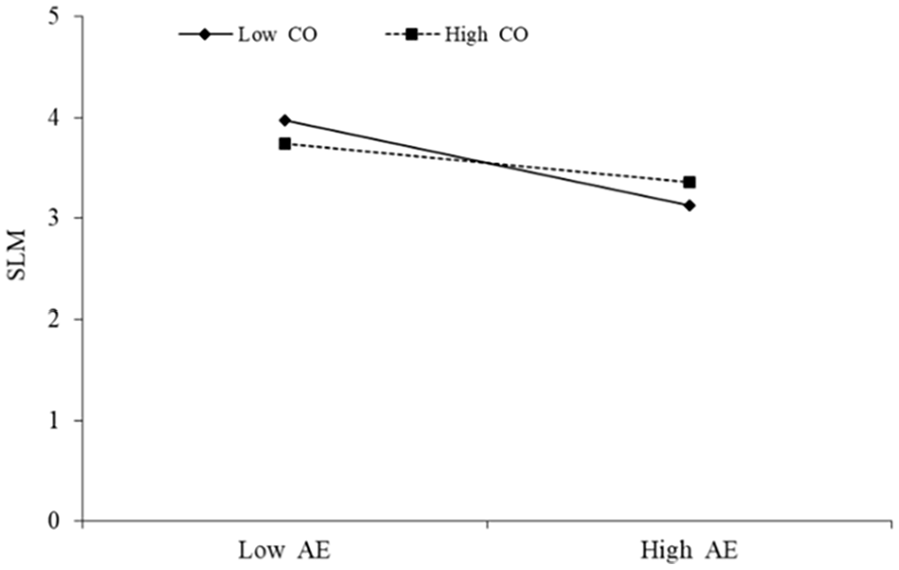
Moderating effect of AE×CO→SLM.
From Table 8 above, it can be inferred that in this study, the significant moderating variable AE×CO has a significant positive impact on Active Learning Intention (β = .096, p < .01). This indicates that the moderating effect is established, as shown in Figure 4 below.

Moderating effect of AE×CO→ALI.
From Table 8 above, it can be inferred that in this study, the significant moderating variable SE×OO has a significant positive impact on Inner Experience (β = .257, p < .001). This indicates that the moderating effect is established, as shown in Figure 5 below.

Moderating effect of SE×OO→INE.
From Table 8 above, it can be inferred that in this study, the significant moderating variable SE×OO has a significant positive impact on Active Learning Intention (β = .379, p < .001). This indicates that the moderating effect is established, as shown in Figure 6 below. Hence, hypotheses H3a, H3i, H4a, and H4c are confirmed, whereas H3b, H3b, H3c, H3d, H3e, H3f, H3g, H3h, and H4b remain unestablished.

Moderating effect of SE×OO→ALI.
Analytical Summary
This research initiated an assessment of the questionnaire’s reliability and validity. The resulting Cronbach’s Alpha values for all variables exceeded .7, the Composite Reliability (CR) was more significant than .5, and the Average Variance Extracted (AVE) also surpassed .5. These results confirm the robust reliability and validity of our questionnaire. Moreover, we demonstrated good discriminant validity between variables using the Fornell and Larcker (1981) criterion and the HTMT method. We proceeded with the Structural Equation Modeling (SEM) analysis using the PLS (Partial Least Squares) approach. Through this analysis, it was determined that the achievement elements, social elements, and immersion elements had significant effects on inner experience, group feeling, and a sense of learning meaning, significantly and positively influencing active learning intention. This underscores the mediating roles of inner experience, group feeling, and a sense of learning meaning. Finally, the model fit diagnostics revealed an R2 value of .482, indicating a moderate level of variance explanation, and a predictive Q2 value of 0.313, signifying a robust predictive strength. These results further validate the appropriateness of our model construction, and the hypotheses have been corroborated.
Discussion
Key Findings
First, this study focuses on how game elements affect the active learning intentions of users on digital learning platforms. Results show that games’ social elements, including emotional aspects like emotional sensitization and value appeals, can enhance active learning intentions (Riedmann et al., 2022). Gamified information systems serve as unique, learning-focused motivational tools that stimulate users’ social and spiritual needs, thus driving intrinsic motivation (Khaldi et al., 2023). However, not all game elements are beneficial. Immersive elements and achievement elements, which represent the reward-based attributes of games, do not promote active learning and can even be counterproductive. There are two reasons for this: Firstly, digital learning platforms provide a more controlled environment than other gamification contexts. Here, administrators who implement gamification have more control, making achievement components feel forceful and manipulative to users. This leads to negative reactions, reducing learning intentions and potentially encouraging cheating (Mula-Falcón et al., 2022). Secondly, achievement components may cause users to prioritize in-game goals over real-life objectives. The game’s penalty system and low voluntary participation in such elements may contribute to these negative results.
Second, the research investigates the role of spirituality within digital learning platforms and how game elements influence it. Findings show that game elements affect users’ active learning intentions through their spirituality. Achievement elements can hinder active learning by reducing the sense of learning meaning, while social elements enhance it. Immersion elements promote active learning by influencing users’ inner experiences. These elements help actualize users’ value ideals and provide spiritual support. The results suggest that gamification, which promotes playfulness and emotional engagement, can offset feelings of isolation common in industrialized societies. Gamification can help address emotional exhaustion and learning fatigue, offering a humanistic experience and meaning system. As society revisits humanistic thoughts and meaning theory, games—a throwback to pre-industrial spiritual traditions—are seen as tools for imparting values and ideals and promoting meaningful learning experiences.
Third, the study explores the moderating role of game behavior patterns. Empirical findings demonstrate that users with distinct game behavior patterns exhibit different responses to various game elements, consequently influencing the motivational effects of game elements within digital learning platforms (Csikszentmihalyi & Csikszentmihalyi, 2014; Ryan & Deci, 2000). Implementing achievement elements for users with low competition orientation may significantly diminish their sense of learning meaning and impede active learning intentions (Koivisto & Hamari, 2014). However, this moderating effect is insignificant for highly competition-oriented users (Koivisto & Hamari, 2014). Social elements for highly others-oriented users can enhance their inner experience and stimulate active learning intentions. Conversely, applying social elements for low others-oriented users may produce counterproductive results, akin to spoiling things with excessive enthusiasm, deteriorating users’ inner experience, and obstructing active learning intentions. This implies negative interaction effects between low competition orientation and achievement elements, as well as between low others orientation and social elements, and positive interaction effects between high others orientation and social elements. Nonetheless, this does not suggest that users must be deemed “suitable” or “unsuitable” for gamification systems. In line with player-centered design theory, the notion of “good players” has evolved from the Aristotelian concept of “skilled players” to encompass “all players” (Malone, 1981). This universality implies that “almost everyone can experience and complete the game” (J. Kumar et al., 2013). In other words, every individual qualifies as a user of a digital learning platform and can derive positive experiences from a gamified system, provided there is an appropriate match between game elements and user types.
Theoretical Implications
This study offers a significant leap in understanding the intricacies of gamified digital learning platforms, mainly focusing on the driving factors that influence active learning intentions through game elements. Rooted in a situational perspective, our findings bridge the gap between gamification theory and the real-world implications of digital learning platforms. By intertwining game elements with situational constructs, we shed light on the evolving dynamics of incentives in the digital learning realm.
Historically, numerous theories, including prospect theory, optimal stimulus theory, and self-determination theory, have sought to decipher the motivational aspects of gamification across various arenas (Krath et al., 2021). Our research, however, underscores the pivotal role of game elements in digital learning platforms, emphasizing their potential to reshape the essence of information content, influencing motivation and behavior. Delving further, our study enriches the current understanding of gamification in digital learning platforms by highlighting the multifaceted nature of “game elements +.” Rather than merely focusing on managerial aspects, as seen in much of the existing literature (Al-Dosakee & Ozdamli, 2021), we present a comprehensive framework that intricately binds game elements with users’ motivational drivers in digital learning contexts. This comprehensive approach, backed by robust data collection and analytical methodologies, provides profound insights into the operational dynamics of gamification within digital learning platforms.
Lastly, our empirical findings unravel the nuanced interplay between specific game elements and their influence on active learning intentions. Amidst the myriad of opinions surrounding gamification, our research reinforces the notion that the efficacy of gamification is intrinsically tied to the particular game elements employed (Xu et al., 2022). This revelation carries significant weight, especially when juxtaposed against the ethical debates prevalent in some gamification discussions. Furthermore, exploring user behavior patterns within gamified environments offers a fresh perspective, moving past traditional demographic categorizations. Our research illuminates the diverse motivational responses elicited by gamification incentives across varied user types by focusing on game behavior patterns (Shrestha et al., 2021). This deep dive augments the gamification literature and accentuates the imperative for a more bespoke approach to crafting gamified learning experiences.
Implications for Practice
First, to foster spontaneous learning intentions, digital learning platforms should prioritize creating rich, meaningful gamification experiences. As users increasingly expect intricate and humanistic gaming environments, platforms must introduce scenarios that resonate with learning content or non-utilitarian meaning systems. This can amplify users’ active learning intentions (P. Lam & Tse, 2022). Additionally, given that the primary objective is knowledge mastery, game rules should remain clear and straightforward. Overcomplicating the rules can deter user engagement by raising the learning curve (Pramana et al., 2018).
Second, platforms should prioritize user enjoyment and reduce overt competition when integrating game elements. Gamification nuances can profoundly impact users’ experiences and behaviors, warranting careful selection of game elements. In a structured learning environment, it is prudent to minimize competitive achievement elements and instead focus on immersive and social elements that foster enjoyment and community. For example, while confrontational elements like leaderboards and player-versus-player (PvP) setups can drive competition, collaborative elements such as project-based learning (PBL) can cultivate teamwork. Collaborative tasks can be divided among student groups in programing games, culminating in a shared project achievement. Similarly, dual-teacher online courses can leverage confrontational and collaborative gamified strategies to optimize learning outcomes.
Third, when embedding gamification, it is imperative for platforms to ensure that game elements resonate with users’ gaming behavior patterns. Platforms can offer various game elements for users to choose from or even allow users to partake in the design process, ensuring the game elements align with individual needs. This fosters positive interaction and mitigates the pitfalls of forced participation. Furthermore, platforms can strategically utilize game elements to guide user learning behaviors aligned with educational goals. Immediate feedback, for instance, is crucial. As learning is a long-haul process, instant feedback shortens the gap between effort and outcome, amplifying users’ sense of achievement. Such feedback also allows users to quickly identify areas of improvement, establishing a positive feedback loop. Whether through rewards or hints, consistent and prompt feedback can keep learners engaged and counteract potential negative feedback from educators.
Research Limitations and Future Research Directions
Despite its contributions, this study has limitations. The findings pertain to a specific digital learning platform. However, their applicability to other contexts, such as online education or MOOCs, remains an open question that warrants further exploration. In terms of game elements, while this research emphasizes three game elements affecting active learning intentions, the scope of gamification is vast. Future research should delve more profound into considering other game elements and assessing their comprehensive influence on learning. Firstly, our data collection method relies on questionnaires, which might introduce biases. To enhance the reliability and depth of findings, subsequent studies could incorporate more varied data sources, including user behavior logs and interviews. Secondly, in the relationship between game elements and learning, our study sheds light on the mediating role of the spirituality of learning places and the moderating effects of game behavior patterns. Nonetheless, this relationship can be influenced by multiple factors. Therefore, it is imperative for future research to probe into other potential mediators and moderators. Thirdly, considering the broader perspective on the effects of game elements, our findings resonate with the ongoing discourse in the academic community (Arnab et al., 2015). There is an urgent need to discern the precise circumstances where game elements yield positive learning results. While game elements hold promise, it is essential to note certain studies pointing out potential downsides, like “exploitation” or “compulsory pleasure” (Takaoka et al., 2012). This underscores the importance of a balanced view, weighing the pros and cons of game elements. Lastly, our research provides preliminary insights into the differential effects of game elements based on distinct user profiles. Building on this foundation, it is pivotal for future investigations to dissect how variations in user demographics, motivations, or game-related behaviors influence their experiences and benefits from digital learning platforms. Such detailed understanding would pave the way for crafting strategies involving game elements tailored to cater to a spectrum of learner personas.
Conclusions
The digital age has brought forth a multitude of platforms and strategies designed to enhance the educational experience. Among these innovations, integrating game elements into digital learning platforms stands out as a promising avenue. This study explored this integration, focusing on the intricate interplay of game elements and their influence on active learning intentions. Our research findings underscore the significance of game elements in shaping user engagement and promoting active learning. Drawing inspiration from the gaming industry, these elements, when meticulously tailored to the educational context, can foster an environment where learning is both enjoyable and meaningful. Furthermore, our study introduced a situational perspective rooted in sociological paradigms, emphasizing the complex relationship between situational determinants and individual experiences. This perspective provided a fresh lens through which we could scrutinize the impact of game elements on digital learning platforms. It became evident that situational factors are pivotal in modulating learning outcomes, calling for more personalized and context-aware design strategies in future digital learning platforms. It is also worth noting the limitations of existing theories when applied to the gamified learning environment. While they offer valuable insights, there is a clear need for a more comprehensive approach that captures learning nuances in a gamified context. In closing, assimilating game elements into digital learning platforms is not merely a trend but a transformative approach that can redefine the educational landscape. As the “gamer generation” becomes a dominant demographic, understanding and leveraging these elements will be paramount for educators and platform designers. This study serves as a stepping stone, laying the groundwork for future research and practical applications in this exciting intersection of gaming and education.
Footnotes
Declaration of Conflicting Interests
The author(s) declared no potential conflicts of interest with respect to the research, authorship, and/or publication of this article.
Funding
The author(s) received no financial support for the research, authorship, and/or publication of this article.
