



Abstract
Using a descriptive cross-sectional survey design, this study investigates how different player types—achiever, explorer, killer, and socializer—engage with gamified learning elements in higher education. Grounded in Self-Determination Theory—which emphasizes autonomy, competence, and relatedness in fostering intrinsic motivation—the research analyzes 481 business students in Spain, focusing on pure player profiles within the Mechanics, Dynamics, and Components (MDC) framework. The findings underscore the importance of a personalized approach to gamification, moving beyond standardized designs to better align game elements with individual player characteristics and gender. By tailoring strategies to distinct profiles, educators can foster deeper student engagement and motivation. These insights contribute to the academic discourse on adaptive gamification and support policy development aimed at creating more effective, context-sensitive learning environments in higher education.
Plain Language Summary
This study looks at how different types of students respond to game-like features in educational settings, especially in higher education. The research aims to improve the use of gamification—adding game-like elements to learning—by making it more personalized. It is based on Self-Determination Theory, which emphasizes the importance of feeling in control, capable, and connected to others for motivation. The researchers surveyed 481 business students in Spain, focusing on four main types of players: achievers, explorers, killers, and socializers. Each type of player prefers different game elements like competition, exploration, or social interaction. The study found that students respond better when the game elements match their personal preferences. This means that rather than using a one-size-fits-all approach, educational games should be customized to fit each student’s style, making them more engaging and motivating. These findings can help improve how gamification is used in education around the world and lead to better learning experiences.
Keywords
Introduction
The contemporary business landscape requires individuals to possess exceptional skills and capabilities (Andrews & Higson, 2008), making it imperative for Higher Education (HE) institutions to contribute by developing employable graduates (Billett, 2009; Römgens et al., 2020). Addressing this demand necessitates a strong commitment from both students and educators, which can be achieved through innovative educational methodologies aimed at improving learning outcomes and promoting active participation in the classroom. In this context, the scholarly discourse of HE increasingly advocates for active and meaningful learning experiences (Damianakis et al., 2020; Scheuring & Thompson, 2025). One method that has gained significant attention is gamification (Hanus & Fox, 2015; Murillo-Zamorano et al., 2021), as games have proven to effectively engage learners (Bilro et al., 2022; Bouchrika et al., 2021). This is particularly relevant in business studies, where gamification is advancing rapidly (Sharma et al., 2024; Wünderlich et al., 2020).
Gamification applies the principles, design, and components of games in no-game environments to enhance user motivation and engagement, with the objective of solving problems or achieving specific goals (Kapp, 2012; Manzano-León et al., 2023). Two key aspects in gamification are the game elements and player profiles. Game elements typically include points, badges, and leaderboards (Sailer et al., 2013; Werbach & Hunter, 2012), widely recognized mechanisms in gamification (Dahalan et al., 2023). Player profiles, on the other hand, can be categorized by behaviors (Bartle, 1996; Fullerton, 2014; Kallio et al., 2011), which classify players based on their interaction with games, or by psychographic traits focusing on motivations (Nacke et al., 2014; Zackariasson et al., 2010). Bartle’s (1996) pioneering typology of player types—achiever, explorer, killer, and socializer—originated in online role-playing games but is now applied across a wide range of games (Kahila et al., 2025).
Research has increasingly focused on analyzing individual and combined game design elements in gamification (Mazarakis, 2021). Dichev and Dicheva (2017) emphasize the need for more research on how specific game elements impact motivation. Importantly, game elements tailored to player profiles significantly enhance motivation (Rahmi et al., 2025), whereas poorly matched elements can lead to demotivation (Hallifax, Serna, Marty, & Lavoué 2019; Hallifax, Serna, Marty, Lavoué, & Lavoué, 2019). However, a gap remains in the empirical literature, as many studies fail to justify the selection of game elements or their combinations in gamified learning systems (Khaldi et al., 2023). Behl et al. (2022) and Oliveira et al. (2022) highlight the lack of personalization in gamification, noting that most studies adapt systems solely based on player types. While some research explores the relationship between player types and gamification variables—focusing on temperament and decision-making (Herbert et al., 2014), or player personality types with specific game elements (Tondello et al., 2017)—empirical evidence remains scarce. Klock et al. (2020) emphasize the need for further exploration of adaptive gamification strategies, including personalization, adaptation methods, and recommendations. In addition, Alsofyani (2023) examines female students’ motivations and preferences in gamified learning, but this work was limited to a single institution in Saudi Arabia and lacked comparisons with male students.
This study aims to address these gaps by posing several research questions: Is adaptive gamification beneficial in HE, particularly in business studies? How should business educators adapt their gamification strategies considering player profiles and gender? Which game elements should be prioritized based on these factors? Drawing on the work of Rodríguez et al. (2022), the primary requirements identified from the literature include improving learner models, investigating diverse adaptation strategies (particularly dynamic adjustments), and evaluating the long-term impact of gamification on learner performance and motivation. Based on the belief that adaptive gamification is essential for achieving meaningful learning (Madero-Gonzalez et al., 2025; Naik & Kamat, 2015), this study seeks to explore gamification systems in HE by highlighting the importance of aligning game elements with player profiles, including gender.
Theoretical Background and Development of Hypotheses
The static and impersonal nature of traditional gamification has driven researchers and designers to explore more personalized, adaptive approaches to gamified learning. Such approaches, grounded in Self-Determination Theory (SDT), have the potential to foster deeper intrinsic motivation (Bezzina & Dingli, 2023). Developed by Deci and Ryan (1980), SDT emphasizes the importance of autonomy, competence, and relatedness in promoting intrinsic motivation, making it particularly relevant in educational contexts (Reeve, 2002). Research by Niemiec and Ryan (2009) suggests that applying SDT principles to course design enhances students’ sense of personal agency in academic tasks. An SDT-based strategy known as gameful learning promotes intrinsic motivation by increasing learner autonomy (Kam & Umar, 2018).
Complementary to the SDT, Flow Theory (Beard, 2015; Csikszentmihalyi, 1990) underscores how tasks that are both challenging and attainable foster an immersive flow state, while Expectancy-Value Theory (Eccles & Wigfield, 2025; Wigfield & Eccles, 2000) clarifies how perceptions of success and task relevance shape learners’ motivation. The integration of these three theoretical perspectives can inform adaptive gamification designs that address learners’ needs for autonomy, competence, and relevance, thereby meaningfully enriching their educational experience. In this regard, SDT highlights the significance of intrinsic motivation and autonomy, both of which can be nurtured in gamified settings through varied choices and constructive feedback (Howard et al., 2021). Concurrently, crafting immersive experiences grounded in Flow Theory is associated with enhanced satisfaction and deeper conceptual understanding (Rachmatullah et al., 2021). Finally, Expectancy-Value Theory emphasizes how aligning success expectations with the perceived value of a task can bolster learner engagement, suggesting that integrating these theories into gamification provides a robust framework for personalizing and optimizing student motivation (Schweder & Raufelder, 2022).
Jones et al. (2023) compared gamified classrooms—where students were given flexible assignment choices with more tasks than necessary to pass—to traditional classrooms with mandatory assignments. Their findings revealed that students in gamified classrooms reported higher perceptions of autonomy and competence, indicating that gamification may be an effective tool for improving student motivation and engagement.
However, most current gamification strategies follow a one-size-fits-all (OSFA) model, assuming all participants respond uniformly to game elements. Individuals engage with gamified systems differently, leading to significant variations in gamification outcomes (Barata et al., 2017; Fitz-Walter et al., 2017; Rodrigues et al., 2024). This realization has prompted researchers to explore models that incorporate player types, providing better insights into individual preferences in personalized gamification applications (Ferro et al., 2013).
Adaptive gamification aims to meet the specific needs and preferences of individuals to maximize engagement and outcomes (Codish & Ravid, 2014). Therefore, gamified systems should be adaptable to individual users, rather than assuming uniformity (Dalponte Ayastuy et al., 2021). Personalized interactive systems, which tailor game elements to participants’ needs (Sanmugam & Mohamed, 2017), have been shown to be more effective (Tondello et al., 2017). Furthermore, it is essential to recognize that the effectiveness of gamification, like other educational innovations, depends on its design and implementation (Hung, 2017). For example, Seaborn and Fels (2015) found negative learning outcomes when gamification was applied incorrectly, a challenge particularly relevant in HE (Khaldi et al., 2023).
While gamification has the potential to enhance motivation and performance (Hanus & Fox, 2015; Kwon et al., 2021), it can also have negative effects, such as increased user anxiety (Albuquerque et al., 2017). Oliveira et al. (2022) critique the personalization of gamification, citing cases where overly intrusive systems failed to align with user preferences (Liu et al., 2017). The varying effects of gamification may result from interactions between different game design elements, which can either reinforce or counterbalance each other (Mazarakis & Bräuer, 2023). However, understanding these interactions is challenging due to the diversity of game elements and player characteristics studied, complicating efforts to formulate cohesive recommendations for tailored gamified experiences.
To address this gap, this study employs well-established gamification typologies and classifications to generate easily interpretable results. We contribute to the field of personalized gamification by providing explicit guidelines and justifications for integrating game elements with individual player profiles and gender. Through statistical analyses, we aim to validate the selection and combination of game elements based on player types and gender, thus enhancing gamification strategies for improving student engagement and participation (Kaya & Ercag, 2023).
Several prominent game design frameworks, such as the MDC (Mechanics, Dynamics, Components) model (Werbach & Hunter, 2012), provide designers with a structured approach to gamification. Common game elements such as customization, badges, challenges, levels, competition, and leaderboards are frequently referenced in the literature (Klock et al., 2020). Figure 1 shows the most studied game elements within the MDC model, illustrating the frequency with which these elements are used to motivate players.

Most studied game elements of the MDC model.
Building on Bartle’s (1996) player typology, we hypothesize that the relationship between player profiles and game element preferences can be statistically demonstrated. Bartle’s classification identifies four player types: achievers, explorers, killers, and socializers, each driven by distinct motivations and engagement patterns. By tailoring game design to match these motivations, we can optimize the effectiveness of gamification strategies (Klock et al., 2020; Werbach & Hunter, 2012).
To summarize, the first hypothesis of this study is:
H1. Significant statistical disparities exist in game element preferences across player type.
Additionally, gender differences emerge as an important consideration in gamified learning environments (Busch et al., 2016). However, there is limited research on gender-specific preferences for gamification elements (Alsofyani, 2023). Notably, Yee (2006) found that male players tend to exhibit higher levels of achievement and manipulation, while female players score higher in relationship, immersion, and escapism factors. Busch et al. (2016) suggest that gamification elements such as competition, consequences, customization, feedback, prizes, signposting, and social status are particularly effective for women. Similarly, Tondello et al. (2017) found that women consistently outperform men in key gamification aspects such as immersion, personalization, and incentives, whereas men excel in socialization and altruism. These findings suggest that men are more sociable and collaborative in gaming environments, while women show a stronger preference for narrative engagement, frequent personalization, and helping others (Figure 2).

Most recommended MDC game elements for each type of player.
Toda et al. (2019) emphasize men’s inclination toward social interactions, favoring elements like progression and choice, while women prefer user experience and rewards, especially recognition and progression. However, Zahedi et al. (2021) found that virtual points and leaderboards may not effectively engage or motivate most women. Highlighting the importance of gender in adaptive gamification, Figure 3 illustrates the divergent preferences between men and women in gamified experiences.

Optimal MDC game elements for respective player genders.
This figure is based on prior research by Werbach and Hunter (2012) and Klock et al. (2020), reflecting how gender influences preferences for certain game element. Each one is scored on a scale from 0 to 1, where 0 indicates minimal appeal and 1 indicates a strong preference for a particular gender.
Women tend to prefer game elements that allow for progression (e.g., collections, levels, and points) and social interaction (e.g., social graphs and virtual goods). This suggests that women may be more motivated by personal achievement, collaboration, and tangible outcomes in games. Their lower interest in competition aligns with research suggesting that women favor cooperative rather than combative gameplay. In contrast, men show a higher preference for competition and teams, indicating a focus on rivalry and teamwork. This aligns with literature linking male players to competitive gaming styles, where outperforming others is a key motivator. Men’s lower ratings for challenges, levels, and collections suggest a focus on winning over progression, reflecting a more outcome-oriented approach.
Based on these precedents, the second hypothesis is:
H2. Significant statistical disparities exist in preferred game elements based on gender.
Finally, Bartle’s classification outlines distinct characteristics for each player profile, raising questions about potential associations between player type and gender. This leads to our third hypothesis:
H3. Significant statistical disparities exist between player type and gender.
The following sections describe the study conducted in a higher education context to empirically assess these hypotheses in the field of business studies.
Materials and Methods
Research Design and Conceptual Model
Our research model posits that player profiles (achiever, explorer, killer, socializer) and gender significantly influence preferences for specific game elements (e.g., points, badges, challenges). Grounded in Self-Determination Theory, Flow Theory, and Expectancy-Value Theory, this model provides a structured lens to investigate how individual motivations shape engagement in gamified learning. This study adopted a descriptive cross-sectional survey design to capture the preferences and perceptions of a large student cohort at a single point in time. This design was chosen for its efficiency in identifying patterns across different player profiles and its applicability to educational contexts seeking immediate, data-driven insights into gamification efficacy.
The conceptual model posits those two main independent variables—player type and gender—influence student preferences for gamification elements, thereby affecting engagement levels in HE contexts. Specifically, Bartle’s classification serves as one independent variable, while gender (male, female) functions as the second. The dependent variable comprises preferences for game elements rooted in the MDC framework.
Instrument: Development, Validity, and Reliability
To collect data, we designed the Gamification Personalized Experiences Questionnaire (GPEQ), comprising three main sections and totaling 74 items:
- Sociodemographic and Gaming Habits (10 items): Elicits information regarding course enrollment, university affiliation, gender, age, class attendance, entrance scores, degree satisfaction, and frequency of engagement with various game genres and styles.
- Bartle’s Player Profiles (39 items): Includes the Bartle test to classify respondents as achievers, explorers, killers, or socializers.
- Game Elements in the MDC Framework (25 items): Mechanics (10 items), investigating processes such as points, quests, or rules that drive player engagement; Dynamics (five items), addressing the broader structures (e.g., progression systems, cooperation vs. competition); Components (15 items) examining tangible features like badges, leaderboards, or virtual goods.
Respondents rated items on a 5-point Likert scale, indicating the perceived importance or relevance of each game element. To assess instrument validity and reliability we followed these steps: (i) Pre-Test, where the questionnaire was piloted with 47 students to assess clarity and item relevance. Based on feedback, minor wording adjustments were made; (ii) Reliability Testing, for assessing the internal consistency by using Cronbach’s alpha that yielded values above .80 for each section, indicating robust reliability across the questionnaire.
Procedure and Data Collection
Students were recruited from the Faculty of Economics and Business Studies at the public university of Extremadura (Spain). We use a purposive sampling to ensure participants had prior experience with gamified activities, only those exposed to at least two gamified academic courses were eligible. This criterion enhanced comparability by reducing discrepancies related to varied gaming backgrounds.
The survey was administered online during designated class sessions. Participation was voluntary, and all data were anonymized in accordance with institutional ethical standards and data protection policies. An introduction to the study’s objectives and the concept of gamification was provided by a researcher. As an incentive, consenting participants received 0.1 additional grade points in their final course assessment (approved by the instructors involved).
Of the approximately 800 students who initially participated, incomplete responses reduced the sample to 662 valid submissions. To maintain clarity in classifying Bartle’s player types, participants showing substantial alignment with more than one profile were excluded—acknowledging that this method may oversimplify certain overlapping motivations. Future research could employ mixed method approaches or more granular typologies to capture hybrid profiles. After this filtering, the final dataset included 481 valid questionnaires. In line with open science principles, the data supporting this study is publicly available on Figshare (https://figshare.com) and can be accessed upon request.
Sample Characterization
The resulting sample had an average age of 21.1 years, with 54% identifying as female and 46% as male. Class attendance patterns varied, with 58% reporting consistent attendance. The distribution of Bartle’s player types—based on single-dominant profiles—was as follows: Achievers (13.93%): 43 women, 24 men; Socializers (17.05%): 46 women, 36 men; Killers (29.11%): 50 women, 90 men; Explorers (39.92%): 123 women, 69 men.
Notably, men represented approximately double the number of female killers, while women were predominant among achievers, socializers, and explorers. These details are summarized in Table 1, which also shows the definition of elements and mean scores for each game element by player type and gender.
Means by Game Element, Player Type and Gender.

Source. Own.
Note. (1) Mean scores for each game element are displayed by player type (achiever, explorer, killer, socializer) and gender (male, female). (2) In this study, progression refers to the player’s perceived growth and development over time (dynamic), while levels denote predefined stages or milestones within the game structure (component).
Statistical Analysis
All statistical analyses were performed using SPSS v. 27. A Kolmogorov-Smirnov test for a single sample, Runs test, and Levene’s test (homogeneity of variance test) as a combined approach confirmed non-normal data distribution (p < .05), justifying the use of Kruskal-Wallis and Chi-square tests for group comparisons. A significance threshold of α = .05 was employed throughout, with Bonferroni corrections applied to multiple comparisons to mitigate Type I error
Results
Hypothesis Testing
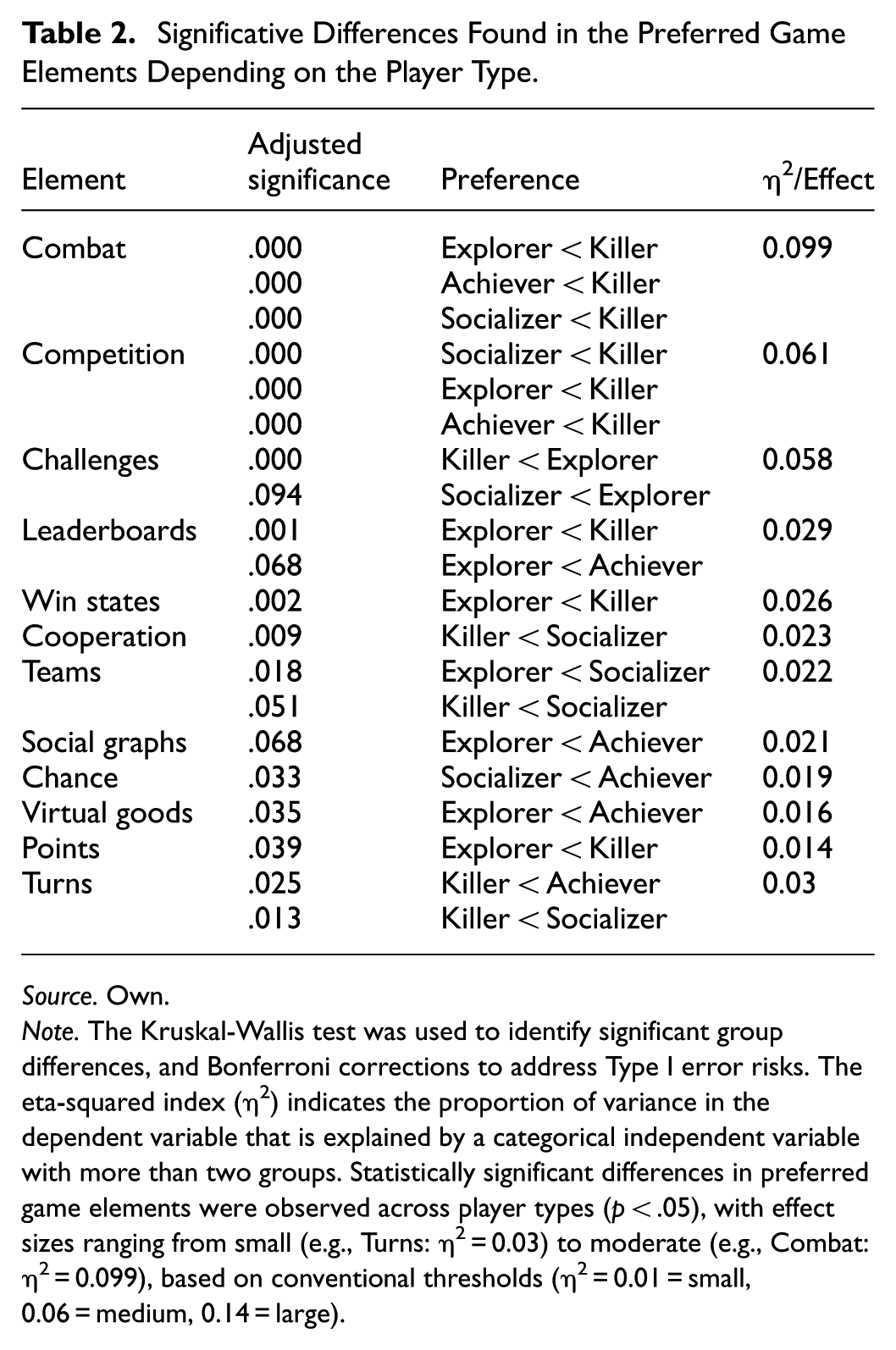
The Kruskal-Wallis test employed to identify significant differences in preferred game elements across Bartle’s player types revealed notable disparities in preferences for several game elements among the player profiles. To further investigate these results, a detailed pairwise comparison was conducted to identify specific player types exhibiting preference differences. Table 2 highlights the game elements where significant discrepancies were found, along with the results of the pairwise comparisons. We conducted the eta-squared (η2) test to determine the practical significance of the observed variations through effect size analysis. In this study, the key aspect is the existence of differences because the fact that the effect size is greater for some elements than for others should not be interpreted solely based on mathematical criteria, as even small effects may have significant consequences for students’ learning. The results can be found in Table 2.
Significative Differences Found in the Preferred Game Elements Depending on the Player Type.
Source. Own.
Note. The Kruskal-Wallis test was used to identify significant group differences, and Bonferroni corrections to address Type I error risks. The eta-squared index (η2) indicates the proportion of variance in the dependent variable that is explained by a categorical independent variable with more than two groups. Statistically significant differences in preferred game elements were observed across player types (p < .05), with effect sizes ranging from small (e.g., Turns: η2 = 0.03) to moderate (e.g., Combat: η2 = 0.099), based on conventional thresholds (η2 = 0.01 = small, 0.06 = medium, 0.14 = large).
Our findings indicate that explorers show a significantly stronger preference for challenges, as they are motivated by the desire for new experiences and complex tasks. They also demonstrate a broad interest in win states, suggesting a motivation to discover hidden aspects of the game world. In contrast, socializers exhibit a lower preference for chance-based elements, as they prioritize social interactions and collaborative gameplay over randomness. Their inclination toward team-based activities underscores their focus on cooperation and social networking within game environments.
Killers favor competitive elements, thriving in adversarial scenarios where they can outperform others. Their preference for combat-related features highlights their desire to engage in confrontations and defeat opponents. They also show a notable affinity for leaderboards and points, reinforcing their pursuit of recognition and achievement. Meanwhile, achievers differ from killers by valuing cooperation and turns, indicating a preference for strategic and collaborative gameplay. Additionally, achievers place greater importance on virtual goods, reflecting their focus on accumulating in-game assets and reaching milestones. Based on these results, H1 is supported, as there are significant differences in preferred game elements depending on player type.
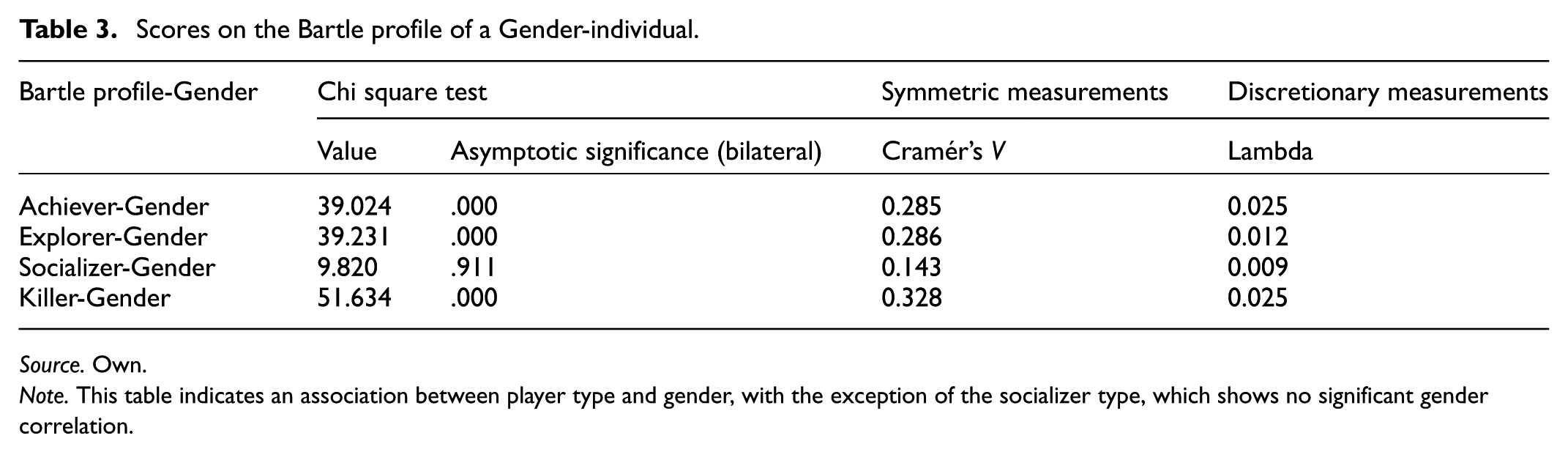
To examine differences by gender and player type, a chi-squared test was conducted. The analysis revealed a statistically significant association between gender and player profiles (χ2 = 29.616, p < .001), with a moderate effect size indicated by Cramér’s V (V = 0.248). A more detailed analysis of gender-based differences within Bartle’s player profiles was performed using individual scores for each player type. Table 3 presents the results of this gender-individual analysis.
Scores on the Bartle profile of a Gender-individual.
Source. Own.
Note. This table indicates an association between player type and gender, with the exception of the socializer type, which shows no significant gender correlation.
The results of the chi-squared test and the gender-individual analysis confirm a significant but moderate association between the achiever, explorer, and killer player types and gender. No statistically significant association was found between the socializer player type and gender. These results provide evidence for the acceptance of H2.
Lastly, Table 4 summarizes the significant differences in preferences for game elements between men and women, based on the T test results. Only game elements with significant gender-based differences are included in the table, while non-significant differences have been omitted. Except for one element (challenges), in all elements with significant differences, men have higher means than women. The effect size is calculated by using Cohen’s test. These findings support the acceptance of H3.
Gender-Based Differences in Reference for Game Elements: T-Test.

Source. Own.
Note. Cohen’s d test is a way to measure the size of the difference between the two groups, men (M) and women (W). It tells us how much one group differs from another in terms of standard deviations. In the context of effect size measures the conventional benchmarks categorize effect sizes as small (0.2), medium (0.5), and large (0.8). Game elements range from the highest effect (Combat: Cohen’s d = 1,021) to the lowest effect (Narrative: Cohen’s d = 0.161).
Discussion
This study investigates the intrinsic motivational power of games and their capacity to foster a state of “gameful engagement,” where students feel challenged, empowered, and motivated to achieve their objectives. Through empirical research conducted in the HE business context, our findings demonstrate the effectiveness of personalized gamification strategies, revealing significant variations in game element preferences across different player types. Furthermore, gender has emerged as a critical variable in adapting gamification strategies to meet the diverse needs of student profiles.
Our results indicate a general acceptance of common game elements across all player profiles, with points, badges, and leaderboards standing out as the most widely adopted elements, consistent with the academic literature (Dahalan et al., 2023). In particular, points and leaderboards were key differentiators between killers and explorers, providing a nuanced extension to the findings of Klock et al. (2020).
In examining the relationship between gamification strategies and gender, we observed statistically significant differences in preferences for 40% of the dynamics, 40% of the mechanics, and over half (53.3%) of the components. Men demonstrated a tendency to engage more in social and collaborative aspects of game systems, while women were more immersed in narrative-driven experiences, frequently personalizing their interactions and showing a higher openness to receiving assistance. These findings are consistent with those of Tondello et al. (2017) and suggest that tailoring gamification elements based on both player type and gender can enhance student engagement and motivation in business education. For example, men showed a stronger preference for competitive mechanisms, while women were more inclined toward challenge-based mechanics. Interestingly, our study does not support previous findings on female preferences for leaderboards, levels, and social graphs, as these elements were significantly favored by males in this context.
One of the notable contributions of this study is its challenge to the relevance of the “dynamics” dimension in adaptive gamification strategies, as none of the original game dynamics exhibited significant differences across player profiles. This insight opens a new avenue for exploring the role of dynamics in gamified learning environments and calls for a re-evaluation of their impact in future adaptive strategies.
Additionally, the results show that achievers demonstrate a clear preference for rewards and transactions, distinguishing themselves from socializers, who show less inclination toward these elements. Achievers also stand out for their greater use of chance-based game mechanics. Explorers, on the other hand, prefer challenges, driven by their desire to explore new experiences and tackle complex tasks. Killers are differentiated by their strong preference for win states and competitions, setting them apart from explorers. Their engagement with competition also sets them apart from socializers, who prefer cooperative elements. Killers further distinguish themselves through a notable preference for points, leaderboards, and combat, especially in comparison to explorers and socializers.
Meanwhile, socializers prioritize cooperation and transactions, favoring these game elements over the competitive nature of killers. Socializers are also set apart by their stronger preference for turns, further differentiating them from killers. Moreover, socializers tend to prefer heroic missions, team-based activities, and emblems, particularly in contrast to explorers, whose focus remains on individual achievements and exploration.
These findings provide practical guidelines for aligning player profiles with specific game elements, supporting the creation of more personalized and effective gamification strategies in educational settings. Instructors in HE can employ targeted game elements—such as point systems, badges, or narrative hooks—by emphasizing those best suited to different player profiles. For example, killers may respond well to competitive leaderboards, whereas explorers could benefit from open-ended projects or inquiry-based tasks. By adjusting the complexity of these elements according to the course level and discipline, educators can create a dynamic, motivating, and inclusive learning environment that accommodates a range of learner needs.
While the findings of this study offer valuable insights into adaptive gamification, their generalizability beyond the Spanish context warrants careful discussion. Cultural dimensions, such as individualism versus collectivism, power distance, or uncertainty avoidance (Hofstede, 2025), can significantly influence how students perceive and engage with gamified learning environments in HE (Cronjé, 2011; Dennehy, 2015). For instance, Spain’s relatively high collectivist orientation (Higueras-Castillo et al., 2019) compared to that of the Nordic European countries, may partly explain the strong preferences for cooperative and social elements among certain player types, particularly socializers. In contrast, students in more individualistic cultures might prioritize competitive or achievement-based elements differently, potentially altering the effectiveness of tailored gamification strategies.
Moreover, Spain’s moderate-to-high score on power distance (Sacristán-Navarro et al., 2022) suggests that hierarchical structures may be more accepted in educational settings, which could influence how students respond to authority-driven game mechanics such as leaderboards or instructor-controlled rewards. In cultures with lower power distance, such elements might be perceived as overly controlling or demotivating. Spain also scores relatively high on uncertainty avoidance (Broeder, 2022), indicating a cultural preference for structured environments and clear rules. This may explain why Spanish students might respond more positively to gamification elements that provide clear feedback, predictable outcomes, and well-defined progression systems. In contrast, students from cultures with lower uncertainty avoidance might be more open to exploratory or risk-based game mechanics, such as open-ended challenges or surprise rewards. Spain’s orientation toward nurturing values (Oliver et al., 2022)—emphasizing cooperation, social support, and quality of life over assertiveness and competition—may further reinforce the appeal of collaborative and socially meaningful gamification elements. This reflects Spain’s position on the updated achievement–nurturing dimension of Hofstede’s model, formerly referred to as masculinity–femininity (Hofstede, 2025). Additionally, Spain’s intermediate score on long-term orientation (Chun et al., 2021) suggests a balance between respect for tradition and openness to change. This may influence how students value immediate versus delayed rewards in gamified systems, with potential implications for the design of progression mechanics and goal-setting features. Finally, the intersection of player type, gender, and cultural background is a valuable direction for future research.
Conclusions
Gamification strategies can enhance student engagement, motivation, and learning outcomes by leveraging the intrinsic motivational appeal of game-based elements. In business courses, these strategies encourage the development of crucial competencies such as collaboration, strategic thinking, and problem-solving, thus preparing students for success in professional environments.
A key contribution of this study is demonstrating that both player profiles and gender influence how students interact with different game elements. By tailoring gamification designs to distinguish motivations and preferences, educators can create more inclusive and effective learning environments. The refined focus on single-dominant player profiles helps ensure alignment between game design and learner characteristics, reducing the risk of demotivation caused by mismatched elements.
Despite its insights, the study has limitations. While our findings reveal certain gender-based preferences for specific game elements, these inclinations are likely shaped by a combination of cultural, contextual, and individual factors. Recent research highlights both the potential of gamification to enhance motivation and learning and the contradictions that arise due to differences in learner profiles (Mellado et al., 2024; Zahedi et al., 2021). For instance, women may benefit more from detailed feedback and collaborative dynamics, whereas men tend to respond more favorably to competitive elements. However, some studies suggest that gamification can improve outcomes for both genders without necessarily increasing female learners’ intrinsic motivation, emphasizing the need for a nuanced interpretation of these findings (Zahedi et al., 2021).
A further limitation of this study concerns the treatment of dynamics within the MDC model. It is plausible that dynamics, by their very nature, function at a more implicit or systemic level than the more immediately perceptible mechanics or components. As such, they may be less susceptible to conscious player preferences or awareness, which could explain the limited differentiation observed across player profiles. Alternatively, the definitions and operationalization of dynamics employed in this study may have lacked sufficient granularity to capture subtle, player-specific variations. This limitation suggests the need for more refined conceptual and methodological approaches in future research, either through enhancements to the MDC model or by exploring alternative frameworks better suited to capturing the layered and often tacit nature of gamified learning experiences.
Another limitation concerns the conceptual treatment of player profiles. While the exclusion of participants with hybrid or overlapping Bartle types is methodologically justified to ensure statistical clarity, this decision introduces a degree of artificial rigidity. Emerging literature increasingly acknowledges that player identities are not fixed; individuals may exhibit traits of multiple player types—such as explorers and achievers—depending on the learning context, task structure, or even temporal factors. For example, Guimarães Santos et al. (2021) found that user orientations often overlap and shift depending on the gamification design and context, challenging the assumption of static typologies. Similarly, recent work by Guimarães Santos et al. (2025) emphasizes the need to move beyond dominant typologies and consider a broader range of user attributes and evolving identities. Future research should explicitly address hybrid and evolving player typologies, drawing on recent work in game studies and educational psychology that emphasizes the dynamic nature of player identity.
In addition, the reliance on a purposive sampling of Spanish business students constrains the generalizability of the present findings. Although this demographic provides a valuable lens, future research should broaden the sample to encompass diverse academic disciplines and multiple cultural contexts, thereby facilitating a deeper understanding of adaptive gamification’s applicability across educational settings. Future research should replicate this study across diverse educational and cultural settings. Comparative studies involving students from Northern Europe, East Asia, or North America could reveal whether the observed gender-based and player-type preferences hold consistently or vary significantly across regions. Such cross-national analyses would also help disentangle cultural influences from gender and personality traits, offering a more nuanced understanding of how gamification can be effectively adapted in global educational contexts.
The cross-sectional design and reliance on self-reported data require also caution when generalizing the findings. While self-report measures capture subjective experiences effectively, they may also be prone to social desirability bias and recall inaccuracies. Future investigations might employ complementary methods—such as observational data, system logs, or controlled experiments—to mitigate these potential biases and provide more robust assessments of gamification outcomes. Additionally, the sample lacked diversity in terms of age and motivational profiles. Future research should broaden the scope to include a wider range of typologies, incorporating both behavioral and psychographic dimensions. This expansion would enable more comprehensive comparative analyses and enhance the efficacy of gamification strategies. Moreover, further investigation into the direct relationship between gamification strategies and student engagement levels presents a promising avenue for future research.
Footnotes
ORCID iDs

Ethical Considerations
All data were anonymized in accordance with institutional ethical standards and data protection policies. This study was approved by the Ethics Committe of the University of Extremadura (Ethics Code: 66//2025 on Month 03, 2025).
Consent to Participate
The survey was administered online during designated class sessions. Participation was voluntary and all participants provided online informed consent prior to enrollment in the study.
Funding
The authors disclosed receipt of the following financial support for the research, authorship, and/or publication of this article: This research was funded by the Regional Government of Extremadura (Junta de Extremadura) with the support of the Department of Business Management and Sociology, University of Extremadura (Spain).
Declaration of Conflicting Interests
The authors declared no potential conflicts of interest with respect to the research, authorship, and/or publication of this article.
