



Abstract
Integrating traditional visual elements into game art design not only enriches the connotation of the game but is also an important adoption to localise the game. However, many games featuring traditional visual elements have sparked widespread controversy and criticism. This study uses Grounded Theory to encode existing literature, and data collected from experts and users through interviews. It summarises the key elements and practical logic of integrating traditional visual elements into game art design to construct a corresponding theoretical framework. The study identified 29 key elements under 7 main categories. These include process elements of design practice such as “extracting visual elements,”“integration and combination,”“objective restoration,”“adaptation and innovation,” and “artistic design,” as well as factors of limitations and outcomes. This study obtains the opinions and suggestions of experts and players on the restoration and adaptation of traditional visual elements in game art, and outlines an integration approach. Overall, this study contributes to understanding the theoretical logic that determines the success or failure of integrating traditional visual elements into game art design, providing both theoretical foundations and practical insights for design practice.
Keywords
Research Introduction
Nowadays, digital gaming is one of the fastest-growing entertainment industries. In 2023, the number of players worldwide has reached 3.31 billion and is expected to reach 3.6 billion by 2025. The game market in 2023 has contributed $183.9B in revenue (Newzoo, 2024). Game products aimed at commercial profit require “localisation” to suit local users’ demands (He, 2021a). When localising digital games for the local audience, it’s crucial to ensure that the game’s background and content are suitable or align with the local cultural context, including specific customs, traditions, and beliefs. This ultimately helps to improve players’ engagement and enjoyment of the gaming experience (Pyae, 2018). Incorporating traditional visual elements into game graphics is a part of localising game content (Di Marco, 2007; Skoog, 2012).
Traditional visual elements are cultural resources that carry deep heritage and national characteristics (S. Li & Jongbin, 2024). The traditional visual elements are the compositions, patterns, colours and texts from cultural heritage (Lu, 2022). Currently, the integration of traditional visual elements into game art design mainly includes the following two ways (Ye & Tan, 2019): The first way is to apply shapes, colours, graphic patterns, and other traditional elements to game art design. It not only includes traditional character images, clothing accessories, and architectural styles, but it also includes items, props, text, and so on. Another approach is to apply traditional art forms to game art design. For example, traditional oil painting, ink painting techniques, or Paper Cuttings, puppets and other art forms. The design and application of traditional visual elements include simplification, deconstruction and reorganisation, replacement and isomorphism of traditional visual elements (Lu, 2022). To sum up, the integration of traditional visual elements can be the direct presentation of visual elements in game art design or the reorganisation, processing and re-creation of traditional visual elements, so as to adapt traditional visual elements to the art style or story background of the game.
Adding traditional visual elements will increase the appeal or acceptance of the game to local players (He, 2021b). It has an important role in preserving and spreading traditional culture (Harmaningsih et al., 2024; Sari & Kurniawan, 2024), and enhancing users’ learning about traditional culture (Shofiyannajah & Prasetyo, 2021). It also increases users’ satisfaction with the game (Cui, Zhao, et al., 2021). The significant applications of traditional visual elements are evident in the following three aspects (H. Chen & Zheng, 2021): (a) Interdependence and integration between traditional and modern elements. (b) Enhanced audience acceptance. (c) Enhanced visual effects and experience. In addition, adding unique traditional visual elements can effectively differentiate game products of the same type. It also provides a new direction for game art design choices, adding unique national characteristics (Lu, 2022).
For example, the design of the Liyue Harbor made extensive use of Chinese traditional visual elements in “Genshin Impact,” which won the Best Mobile Game of the Year at the 2021 TGA (The Game Awards, 2021). The architectural design of the Bureaucracy Hub (see Figure 1) in Liyue Harbor draws inspiration from the structure and form of the Xuankong Temple (see Figure 2) in Datong, Shanxi. The character Yun Jin (see Figure 3), was a famous opera singer in the game. Her headdress was designed to incorporate the Velvet Ball of the Dao Ma Dan, which was characterised by high martial arts skills, elaborate costumes, and performances involving weapons and acrobatics in Chinese opera. Also, the skirt of Yun Jin incorporated traditional motifs such as the Cloud pattern and the Fangsheng pattern. The skirts, however, were adapted to use a Lolita Clothing rather than the traditional costume designs of Chinese opera. These designs in the “Genshin Impact” promoted the integration of culture and tourism online and offline (Y. Zhang et al, 2021; He, 2021b). It has also created a craze among overseas users to explore Chinese cultural background (Yang & Wang, 2022; B. Zhang et al., 2024).
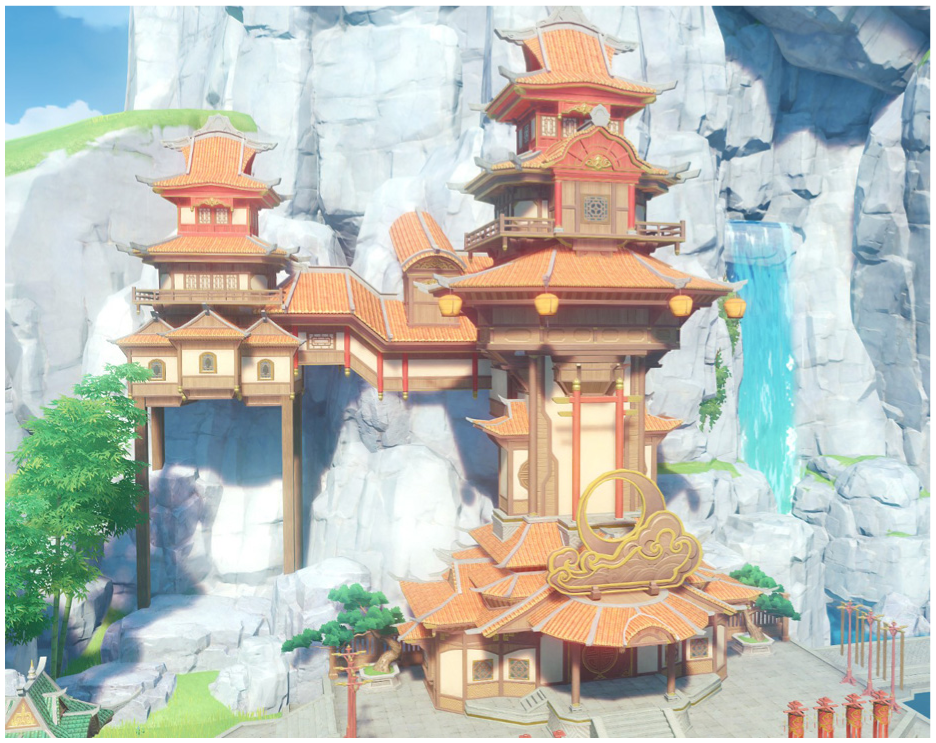
Bureaucracy Hub 月海亭 (screenshot from “Genshin Impact”).

Xuankong Temple 悬空寺 (searched from Internet).

Yun Jin (searched from MIHOYO).
Nevertheless, the traditional visual elements used in the art and design of some games that are available in the market have sparked widespread controversy/criticism. Based on the existing research literature, the main issues can be summarised as the following four perspectives. Firstly, the traditional visual elements integrated into games are often inaccurate or misleading, causing players’ misunderstandings of historical facts (López, 2021; Šisler et al., 2022; Song & Wu, 2021). Secondly, the traditional visual elements incorporated into game art design are sometimes adapted and innovated, but failed to appropriately reflect traditional culture (Hu et al., 2025; Liu, 2024; Wang, 2021). Thirdly, the traditional visual elements applied in games are found to exhibit prejudice, discrimination, or stereotypes against certain races (Kuk & Tézli, 2019; Liboriussen & Martin, 2020). Lastly, there has been controversy over whether the application of traditional visual elements has a positive or negative impact on game players (W. He & Li, 2020; Sari & Kurniawan, 2024; Zuo, 2021).
Misapplication and improper adaptation of traditional visual elements in games can negatively impact the representation of traditional cultures and foster cognitive biases among players (W. He & Li, 2020; Qiu, 2020). Additionally, such games may spark controversy or be criticised. Based on the above issues, this study applies Grounded Theory to explore the key elements and practical logic of integrating traditional visual elements into game art design. It concludes by constructing a theoretical framework to guide game art design practice.
Literature Review
Based on an extensive literature review, literature related to traditional visual elements and game art design can be mainly divided into the following two categories.
Firstly, it covers research that explores the creation of new games with extensive and significant integration of traditional visual elements into the game graphics. These studies showcase and disseminate a specific traditional culture by creating new game projects by incorporating an extensive scale of traditional visual elements into game graphics (Roy et al., 2021; Yu & Zhang, 2017). The findings from these studies somehow conclude that those games enabled players to gain an understanding of the cultural context or knowledge contained or embedded in the games through the game’s visual presentation while playing. This meets the requirements of education and teaching through games (Abdillah et al., 2023). For example, Cui, Dai, et al. (2021) applied elements from the murals of the Yungang Grottoes in China, including character images, graphics, patterns, colours, and etc., into game graphics, allowing players to experience the beauty of the Yungang Grottoes through the visuals and music or sound effect in the game. Furthermore, the game incorporates traditional Chinese landscape paintings to create game scenes and applies elements such as bamboo leaves from traditional ink-wash paintings into the design of particle effects on the game graphics (Z. Chen et al., 2022). This game presents unique visual effects, which enabled it to win second place in the Global Game Jam (GGJ) China at Chongqing site.
Secondly, the review covers studies that have empirically investigated and analysed the visual designs of some games available in the market. These studies look into the effectiveness or practicality of the game designs in presenting the connotations of traditional culture. In addition, those studies particularly explore the positive or negative impacts of the existing practices of integrating traditional visual elements into game designs. For example, the game of “Assassin’s Creed Unity,” which portrays the Paris Revolution, has been widely criticised for its inaccurate portrayal of historical facts (Brædder et al., 2017). López (2021) pointed out the “Assassin’s Creed Valhalla” misapplies architectural elements from different culture. Champion (2020) also mentioned the “Assassin’s Creed: Odyssey-Discovery Tour” should increase cultural and platial awareness of NPCs (Non-Playing Characters).
“Honor of Kings,” a game that consistently ranks first worldwide in annual revenue (Mobilegamer.biz, 2023), incorporates a lot of traditional Chinese elements into its visual design, creating a blend that is both impactful and, at times, contradictory. While some of these designs have received widespread acclaim, many scholars believe that the incorporation of traditional visual elements in the game, including the application of historical and mythological character depictions plays a significant role in attracting players and promoting Chinese classical culture (Fu & Liang, 2022; Zuo, 2021). Han (2021) also pointed out that “Honor of Kings” incorporates various folk handicrafts in character designs, including embroidery, Chinese New Year paintings, theatrical facial makeup, and others, vividly depicting characters and objects with strong ethnic identities. The ancient-style clothing of game characters effectively conveys emotional nuances through symbolic costumes, creating meaningful interactions with players. This approach not only caters to players’ aesthetic preferences but also enhances their sense of immersion in gameplay (Jia, 2020).
Nonetheless, some controversial examples within the game sparked widespread debate in Chinese society. For instance, the character Li Bai, who was originally a famous poet in history, was reimagined as an assassin in the game. Also, the famous male assassin Jing Ke was designed as a female character in the game. Liu (2024) claimed that this is a distortion of historical facts. The skin for warrior Guan Yu on a motorcycle has been removed after critical complaints from players (Baidu, 2022). These designs have sparked criticism and discussion among numerous players and scholars. A public interest litigation was filed against “Honor of Kings” for distorting history, trampling on traditional culture, and guiding juveniles to form wrong historical perceptions (J. Chen, 2023). Besides, “Nü wa,” an ancient deity in Chinese mythology, who was known as the first Goddess of creation and the mother of humanity, was featured irrelevantly in the game. The costume design of “Nü wa” in the game does not conform to historical allusions and mythological descriptions (Fu, 2019). Wang (2021) also argues that the portrayal of “Nü wa” in the game deviates significantly from her traditional image as “Mother Earth.”
Moreover, many similar popular games, such as “League of Legends” (Hu et al., 2025; Kuk & Tézli, 2019), “Tomb Raider” (Kimmel & Holler, 2017), and “Jiangnan Baijingtu” (Song & Wu, 2021), have encountered intense criticism from scholars for inappropriately applying traditional visual elements within their games.
In summary, the primary goal of the first category of research is often to promote traditional culture through the integration or application of traditional visual elements in game design. Thus, the studies mostly investigate the degree of representation of the game in correspondence with the historical narration. Also, the studies look into the game styles applied, such as cartoonisation (Cui, Zhao, et al., 2021). However, the second category of research mostly investigates or evaluates commercial games that are available on the market. These games often feature fictional worlds or chaotic battles, incorporating several elements from traditional cultures. In such games, traditional visual elements usually need to be extensively adapted and recreated to meet the needs of the game’s narrative or gameplay requirements. Consequently, the first category of research tends to focus only on the authenticity and restoration of traditional elements in the games, with little emphasis on adaptation or innovation (Que et al., 2025). On the other hand, the second category of research primarily critiques the inappropriate game visual designs without offering constructive findings or practical solutions to guide better designs with effective incorporation of traditional elements in games.
Besides, some studies have constructed theoretical models to provide ideas and references for presenting traditional visual elements in games. For example, in Tresnadi and Sachari’s (2015) study, batik visual elements applied in “Nitiki Game” games were analysed, and the findings have subsequently proposed the concept of “Model of the Batik Art and Cultural Values in the Nitiki Game.” This model presents several dimensions of the art and cultural values of batik, providing a reference for game designers to comprehend the content values within batik. However, this model focuses more on the value of batik art and does not provide recommendations for game art design. Gao and Lee’s (2021) study analysed the application of traditional elements on characters in “Honor of Kings.” They proposed “A Model for the Propagation of Intangible Cultural Heritage through Featured Character Design.” The model emphasises that incorporating intangible cultural heritage into games requires “symbolisation” and the adaptation of traditional elements to fit “game styles,” as well as the dissemination of traditional culture through both online and offline channels.This model focuses more on the dissemination channels and the effectiveness of promoting traditional elements within games. However, these research results have not provided a comprehensive practical framework or logic for integrating traditional visual elements into game art design, nor have they provided any guidance or reference for the adaptation and restoration of traditional visual elements in games.
There remains a gap between the theory and practice of integrating traditional visual elements into game art design. Currently, a systematic theoretical framework is lacking to guide subsequent practice. Additionally, researchers need to clarify further the dimensions of design practice involved in incorporating traditional visual elements into game art design.
Building on this foundation, this study explores the requirements for restoring and adapting traditional visual elements in game art design and the overall design approach and process. It proposes a model framework for integrating traditional visual elements into game art design. It provides specific theoretical guidance and recommendations to serve as a reference for future game art design projects.
Research Design
Methodology
The purpose of this study is to identify the dimensions of traditional visual elements integrated into game art design and to develop a theoretical model that can be used to guide the game art design. The Grounded Theory allows researchers to encode and analyse collected qualitative data and ultimately synthesise the findings to construct a coherent and practical theoretical framework. Many scholars have pointed out that Grounded Theory is a suitable method for theory generation and has become one of the more scientifically rigorous methodologies in qualitative research (Shah & Corley, 2006; Suddaby, 2006). Therefore, the purpose of adopting Grounded Theory is to generate an evolutionarily theory (Corbin & Strauss, 2014).
As shown in the research flowchart (see Figure 4), the compiled text material was analysed in three steps: (a) Open Coding, (b) Axial Coding, and (c) Selective Coding. At the open coding stage, all the filtered text material was encoded, word by word, sentence by sentence, or event by event to identify and sort out the relevant terms, subjects or topics. Next, at the axial encoding stage, the encoding from the previous stage was sorted accordingly in order to extract the emerging categories or themes. Finally, the main emerging categories or key themes were then identified organically, and a theoretical model was constructed.

Grounded Theory research pathway.
Data Collection and Sample Selection
There are two data sources of this study, namely literature and interviews.
The data sources for the Grounded Theory include focus groups, questionnaires, surveys, transcripts, letters, government reports, documents, grey literature, music artefacts, videos, blogs and memos (Mills et al., 2014). Data collected from the literature can be used to narrow down the study before further data collection (Makri & Neely, 2021). Therefore, relevant literature was first collected for this study as pre-coding information, with the following collection steps (see Supplemental Material 1 for inclusion/exclusion criteria for literature):
The search for published academic articles and references was conducted using keywords such as “game visual design,”“game art design,”“traditional visual elements,”“traditional culture,”“character design,” and “game design.” Articles and other relevant publications were collected from multiple platforms including Google Scholar, WOS (Web of Science), and CNKI (China National Knowledge Infrastructure). In addition to academic articles, relevant qualitative secondary data, including players’ discussions/forums, public posts, videos, game reviews and other relevant online materials were gathered from social media platforms such as YouTube, Twitter, and other game websites. These sources were transcribed into text before proceeding with qualitative analysis. After assessing the authenticity and content integrity of all gathered information including images and text materials, a total of 56 effective materials (including Chinese and English materials of “Honor of Kings,”“Genshin Impact,”“Assassin’s Creed,” and “League of Legends”) were selected. Sixteen of the total were randomly chosen and set aside for theoretical saturation testing. The remaining 40 materials were then subjected to exploratory analysis using Grounded Theory.
As the research develops, the coded data in the literature is not sufficient for constructing the theoretical model. Further opinions from relevant experts and users needed to be collected. Therefore, semi-structured interviews, a type of in-depth interview was adopted in this research. In-depth interview is case-specific and allows respondents to provide detailed and rich descriptions (Ary et al., 2010; Creswell & Creswell, 2017). Moreover, semi-structured interviews give the researcher the flexibility to refine them or change direction as new themes emerge and research progresses (Makri & Neely, 2021).
According to the requirements of Grounded Theory, interviews were conducted using theoretical sampling (Corbin & Strauss, 2014). The theoretical sampling should involve purposeful sampling, selecting organisations and participants with expertise in the subject matter or direct involvement in the research problem (Saunders et al., 2009; Silverman, 2010). The sample size was not determined at the beginning of the study, but by the codes generated during the study. Sampling continues until data saturation is reached (Corbin & Strauss, 2014), meaning no new concepts, themes, or patterns emerge from the coded data.
Since this study involves three key groups—game art designers, traditional culture experts, and players—sampling was planned in advance, ensuring alignment with the principle of triangulation (Trent, 2012; van den Broek et al., 2013). During data collection, interviewees were selected, and questions were refined based on emerging concepts and identified gaps. For instance, in response to the concept of “Appropriate innovation without subverting tradition,” game designers with over ten years of experience across diverse regional projects were selected to share their adaptation experiences. Additionally, players were interviewed to examine their attitudes toward different levels of adaptation in games. Likewise, traditional culture experts were selected based on the concepts of “Accurate representation of traditional cultural connotations” and “Traditional visual elements,” providing insights into their understanding of traditional elements and perspectives on adaptation.
A total of seven rounds of interview sessions were conducted in sequence. Each round of interviews, the researcher interviewed 2 to 4 interviewees and the collected data were promptly organised and analysed, followed by the writing of memos. The concepts and categories generated from the analysis were then used to determine the next round of interviewees and to adjust the interview questions. The same steps were repeated after each round until the sixth round, data saturation were observed. However, the last round of interviews was conducted to ensure no new concept was found. The semi-structured interviews were conducted with a set of seven guiding open-ended questions (see Supplemental Material 1).
A total of 20 relevant individuals were interviewed, including (a) seven experts with over 10 years of experience in game art design, all of whom have participated in large-scale game project development home and abroad, including realistic and cartoon styles; (b) three designers with 2 to 7 years of work experience; (c) three experts with over 10 years of work experience in traditional culture-related research. Among them, two focus on the protection and inheritance of traditional culture, and one focuses on the innovative development of traditional painting; (d) two graphic designers who have extensively integrated traditional visual elements into their works; (e) five players, that is, two college students majoring in game art and design and three common game players, without game-related education background. Also, the participants were selected from diverse regions (in terms of birthplace and workplace) and ethnic backgrounds to ensure that they had firsthand experience with traditional cultures from different areas. Efforts were made to ensure sample diversity to improve the comprehensiveness of the research. The interview times were determined through negotiation with each interviewee, with each session lasting approximately 50 min. The sample source and their profile information is shown in Table 1. After each interview, the recordings were transcribed, coded and organised sequentially from 01 to 20. Memos were promptly written to document insights and reflections.
Summary of Interview Participant Profiles.

Ethical Review
This study is a non-interventional study. The interviewees have all signed an informed consent form individually. The interview questions are specifically formulated to avoid any personal privacy concerns and ensure that no one is offended. Prior to the interview, the interviewees were provided with a clear understanding of the purpose of the interview. Additionally, the interviewees have the option to pause or terminate the phone interview at any point if they wish to do so.
Theoretical Model Construction
As outlined in the methodology section, the coding process primarily includes Open Coding, Axial Coding, and Selective Coding.
Coding
During the open coding process, excerpts from the raw data (sourced from literature and interviews) were labelled with a word or phrase, compactly representing the research themes. This process involved progressively conceptualising and categorising qualitative data by repeatedly comparing, leading to the formation of additional concepts and categories (Corbin & Strauss, 2014). Ultimately, this study identified and organised 90 concepts, as presented in Supplemental Material 2.
Axial coding aims to refine further and reorganise the categories identified during open coding. It involves clustering analysis to establish connections between different categories and to develop core categories (Corbin & Strauss, 2014). Specifically, this process involves defining the properties and dimensions of categories to make them more precise, linking independent categories, and discovering and establishing potential logical relationships between them. The study ultimately identified 29 sub-categories and 7 core categories through axial coding, as shown in Table 2.
Main Categories and Subcategories.

Selective coding is the stage of conducting in-depth research on core categories, analysing their internal relationships, and sorting out a “storyline” to organically link fragmented concepts (Corbin & Strauss, 2014; Lyu, 2024). Through selective coding, we have identified a clear thread for the integration of traditional visual elements into game art design, such as “Understanding, Retrieving & Screening,”“Integration and Combination,”“Objective Restoration,”“Innovation and Adaptation,”“Artistic Design,” and “Constraints.” These elements can individually or collectively influence the integration of traditional visual elements into game graphics. Among them, the understanding, extraction, and screening of traditional visual elements, as well as the classification of levels based on their relevance, are the early elements of design. Integration and combination, objective restoration, innovation and adaptation, and artistic design are the elements of the design practice process. The entire practical process was influenced by players and designers, as well as restrictions on gameplay, policies, and regulations. As a result, appropriate or inappropriate integration will produce corresponding positive or negative outcomes and consequences. Meanwhile, these impacts will also have a ripple effect on the subsequent development practices of the game product. The constructed model is shown in Figure 5.
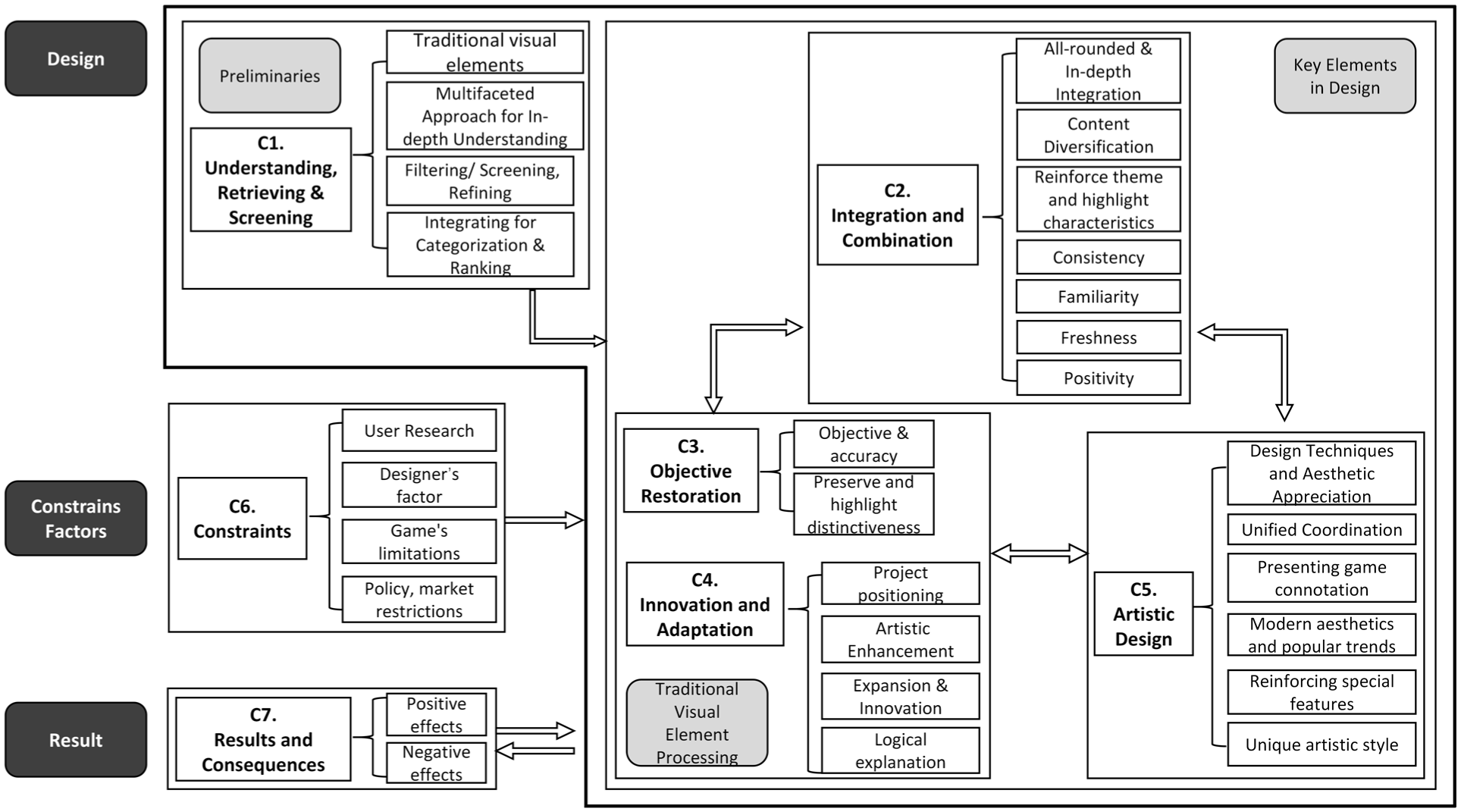
Theoretical framework for integrating traditional visual elements into game art design.
Theoretical Model Saturation Test
When no new concepts, themes, or structures emerge from the coded data, saturation is reached (Corbin & Strauss, 2014). Saturation is a debated term (Zargar & Rynne, 2023), but the key focus is achieving what Hennink et al. (2017) describe as “meaning saturation.” As previously mentioned, by the sixth round of interviews, no new concepts were identified. The seventh round was conducted to confirm theoretical saturation. Additionally, this study performed a saturation test. Sixteen reserved raw materials were re-encoded according to the steps as described earlier, including open coding, axial coding, and selective coding (Y. Li et al., 2018). After analysis, no other new main categories or new relationships between the categories were discovered. This indicates that the theoretical model shown in Figure 5 has passed the theoretical saturation test.
Results
Through the above coding and analysis, based on the process and chronology of the game visual design production process, a design model for the integration of traditional visual elements into game art design has been established.
Understanding, Retriving & Screening
Understanding, screening, refining, integrating, categorising, and grading traditional visual elements is the preliminary work for integrating them into game art design.
At present, the inappropriate application of traditional visual elements is partly due to designers’ lack of diverse and in-depth understanding of visual elements. Understanding traditional visual elements should be approached through multiple channels, including a combination of personal knowledge, first-hand experience, and second-hand information. Expert F mentioned that different patterns and designs not only have specific meanings but may also have restrictions on their usage class. In addition, the extracted traditional visual elements need to be filtered and refined based on the game’s worldview and story background. Extract the essence from the dross and filter out elements that are prone to controversy. For example, many characters in Japanese video games often wear accessories with Chinese patterns, which are misunderstood in Europe as the cross symbol used by the Nazi Party (Di Marco, 2007). Players C and D both stated if a classic element appears in other famous works, it is needed to be used carefully in new projects, considering the audience’s perception.
Finally, based on their relevance to the game theme, worldview, and story background, the extracted traditional visual elements shall be integrated through classification by levels. In the subsequent design, priority should be given to integrating elements that match the respective category, especially those with a high matching degree and have a strong correlation.
Integration and Combination
The integration of traditional visual elements into game graphics is influenced by the following aspects.
All-rounded & In-depth Integration: Traditional elements are integrated into game art design, from the whole to the details, rather than just being applied locally. Traditional elements need to be added to all aspects of the game graphics. Priority should be on important elements that are fit and relevantly applied in the game. For example, in the Legend of Zelda series of games, bird portraits are applied to areas or items directly related to the goddess (Ovalle, 2016). In addition to traditional visual art expression methods and the integration of visible elements such as graphics, colours, and text, it is also necessary to incorporate the content and themes of traditional culture into game art design. Interviewees unanimously agreed that integrating traditional elements should not be limited to visual or on surface-level incorporation. Instead, it should convey traditional culture’s underlying philosophical and cultural content through the imagery, allowing players to experience its deeper significance. Design that only focuses on appearance is considered inadequate.
Content Diversification: In games, the combination of multiple cultures often occurs, blending cross-cultural conflicts and traditional cultural diversity to both enrich the gaming world and enhance its authenticity. For example, in “Final Fantasy XV,” various religious and cultural heritages are fused, while in “Shin Megami Tensei,” various myths and legends are freely incorporated (de Wildt & Aupers, 2021). Similarly, in Japan’s “Pok é mon,” many monsters designs draw not only Japanese legends, myths, folk heroes, but also from Buddhism and classical Chinese novels (Sumilang-Engracia, 2018). The contradictions and conflicts arising from the combination of different traditional cultures, as well as the way they blend in together, are also what designers need to seriously consider during the early stage of design.
Reinforce Theme and Highlight Characteristics: On the one hand, it is necessary to enhance the unique features of the game graphics by combining traditional visual elements. On the other hand, it is necessary to preserve the core of traditional visual elements, highlight the characteristics of traditional elements themselves, and thus showcase the differences between different cultures. Designer D believes that, at present, game design should retain the core of traditional culture and highlight as well as strengthen the characteristics of traditional culture rather than blindly referencing Hollywood-style design patterns and Western fashion, which has become today’s trend in game design. He gave an example of an animation called “Zhen Dao Ge.” It is an animation with the theme of ancient Chinese martial arts. The application of many traditional elements in this animation is very objective and rigorous. For example, the clothing designs in the animation followed the style and wearing format as per the actual situation during the Ming Dynasty in China. The patterns and weapon shapes applied in the design are consistent with the historical practices during Ming Dynasty. Nevertheless, there are some minor adjustments, such as designing characters’ faces with a more realistical approach instead of following the style of traditional Chinese painting. Designer D initially had concerns during the production process about whether players would accept a design that did not incorporate many fashion or trendy elements. However, subsequent feedback and positive reviews from players demonstrated that this design approach was, in fact, feasible and acceptable.
Consistency: The consistency between traditional visual elements and game art includes two aspects, that is, artistic design and game content (Liang, 2018). On one hand, traditional visual elements must be consistent with the style of game art. When the game’s art style is unique and independent, traditional visual elements need to be artistically processed and handled to make them harmonious and coordinated with the game graphics. On the other hand, the connotation of the traditional visual elements applied should be consistent with the game’s content, including worldview, story background, region, culture, tribal information, etc.
Familiarity: By applying well-known traditional visual elements in the game graphics, the game world is widely recognised by players. For example, images of historical celebrities or famous landscapes and architectural heritage can be applied to game design. This increases players’ sense of identity, making it easier for them to become familiar with and accept the game’s virtual world, and better participate in the game.
Freshness: As a virtual world, the game’s characteristics shall satisfy players’ curiosity and provide a fresh gaming experience. When designing, imaginative ideas can be added to differentiate the game world from the real world. Exploring niche and unknown traditional elements and applying them to game design is also possible, providing players with fresh sensory experiences. Expert F believes that uncommon traditional cultures and unknown fields are attractive and can arouse people’s interest. Although it has been mentioned earlier that some scholars believe that games are mainly for entertainment purposes, and thus, the authenticity of the content presented in games is not important (Chapman, 2012), Player D highlights that understanding the traditional culture and logic behind the game design was, in fact, surprising and enlightening his overall gameplay experience.
Positivity: A positive, healthy, and upward design attitude is reflected in the design of game art. Designers discard the less significant or less relevant elements of traditional culture while preserving and promoting its valuable aspects and elements. Experts F, L, and M noted that explanations or plot descriptions are essential for the integration of controversial and niche elements in games, to provide players with a correct understanding. Players C, D, and E stated that the games serve a dissemination function and need to take consideration of young players, in guiding them to view and understand traditional culture accurately.
Objective Restoration
Today, much of the debate surrounding the application of traditional visual elements in games stems from the difficulty in effectively reproducing these elements. When integrating traditional visual elements, the following two perspectives should be considered as much as possible:
Objective & Accuracy: Refers to the objective and accuracy of interpretation and application of traditional visual elements in the design process covering both their appearance and connotation. Expert F emphasised that traditional visual elements should not only accurately represent their stylistic features but also accurately reflect their underlying connotations and cultural significance. In addition, it is necessary to avoid historical inaccuracies, misinterpretation, and appropriation. Interviewees unanimously agreed that the historical facts presented in the game should remain unchanged, and the traditional visual elements contained therein should be displayed accurately.
Preserve and Highlight Distinctiveness: Although sometimes it is necessary to adapt and adjust traditional visual elements, it is crucial to conform to the public’s basic impression of traditional culture. When designing, retaining traditional visual elements’ iconic and most famous features and highlighting the original recognition is necessary. For example, “Cassiopeia in League of Legends” retains two distinct features of Medusa in mythology: the snake’s body and the ability to petrify enemies. The Egyptian Nemes-like crown on Cassiopeia’s head is consistent with her background in the game, which comes from the desert (H. Park & Seo, 2019). Also, in “Sword of the Sky,” the Goddess harp’s design has been altered to resemble a lyre, even though the number of strings aligns with Western cultural classifications (Ovalle, 2016). Similarly, Guan Yu in “Honor of Kings,” a well-known historical figure among Chinese players is depicted as a famous military general from the Three Kingdoms period. Guan Yu is traditionally characterised by his red face, long beard, holding the Green Dragon Crescent Blade, and mounted on a Red Hare Horse. However, one of Guan Yu’s skins in “Honor of Kings” was designed as Guan Yu mounted on a motorcycle, which many players have found unacceptable (Baidu, 2022). Player E argues that replacing the Red Hare Horse, an essential feature of Guan Yu, with a motorcycle is inappropriate. Instead, if a modern or mechanical style is desired, a mechanical horse would be a more fitting alternative.
While retaining the secondary features of traditional elements, changing the primary features can easily cause controversy. For example, Li Bai, as a famous poet of the Tang Dynasty in China, being a poet is his most famous identity attribute. However, in “Honor of Kings,” he was designed as an assassin. The opinions of the interviewees on this particular design vary. Player B believes it is acceptable because player B learned from the unofficial historical documentation that Li Bai’s swordsmanship is excellent. Therefore, in the game, Li Bai’s weapon designed as a sword is feasible. However, player A believes that such a design is unnecessary, as it completely altered Li Bai’s most defining characteristic as a poet, using only his name to capture players’ recognition and identification. Player D believes that adaptations based on unofficial history are less accepted because such histories are not widely known to the public. On the other hand, Player E can accept it, noting that Li Bai lived in an era associated with swords and wrote many poems related to swords. This reflects that different players may have different views on the adaptation of Li Bai. However, the interviewees unanimously agreed that adaptation should never result in a complete subversion of tradition.
Innovation and Adaptation
Given the differences in aesthetics and culture between modern and ancient times, along with evolving user preferences and tastes, the application of traditional elements in games often undergoes some level of adaptation and adjustment. However, these adaptations, when carried out inappropriately, are among the primary factors criticised by both players and society.
Project Positioning: Adaptation requires exploring and determining the degree of innovation and restoration based on the project positioning. Designers B and D believe that different project styles have varying degrees of adaptation and realism. Meanwhile, the adapted content also needs to conform to the story background set in the game. Designer B and Player C also noted that when the game’s style involves brawls (battles or action-oriented) or includes a significant amount of fictional content, the intensity of adaptation can be greater. When a game project is designed and produced based on real-life themes, especially with the goal of achieving realism, it is necessary to try to restore or recreate traditional elements as accurately as possible. Designer E stated that games like “Assassin’s Creed,” which aims for high degree of realism, must realistically recreate the real world and traditional elements in order to ensure a sense of immersion. Therefore, the positioning of the game project is the main factor determining the degree of adaptation.
Artistic Enhancement: Designers need to process traditional visual elements according to modern aesthetics, making them more appealing and acceptable to players in the contemporary era. Traditional visual elements can also be transformed using game stylisation to match the overall game style and design. This can be achieved through artistic techniques such as symbolisation, simplification, and exaggeration. When innovating, it is vital to elevate the design to an acceptable level of aesthetic appeal. Player E mentioned that qualities such as looking good, handsome, or cool are important criteria for a successful adaptation. Designer E believes that in games with fictional themes, as long as the original recognition and aesthetic integrity are maintained, the adaptation is acceptable.
Expansion & Innovation: Designers’ innovation in adaptation should be encouraged. Feedback emphasises that when designers incorporate their own imaginative ideas into their designs, they need to build upon the existing foundation. The virtual world of the game is a recreation based on real history and life. In addition, differentiated adaptations can be made to the original design, and real-life materials can be enhanced in terms of colour, size, decoration, and other aspects to enrich the overall richness and immersion of the game world.
Logical Explanation: The adaptation and innovation of traditional elements must take note of their rationality and ensure logical consistency. This is particularly crucial when the adaptations are significant. Providing explanations through text, plot, or other means can effectively prevent misunderstandings among players. Players C, D, and E all expressed that when making large-scale adaptations, it is necessary to explain and align with the logic of the game so that players can understand the reasons behind it. Expert F mentioned that when game design requires extensive adaptations, it is essential to include a disclaimer within the game, clearly stating that “the adaptation of the work is significant, with some elements may not align with historical facts.”
Artistic Design
The design of game graphics has specific artistic requirements. The integration of traditional visual elements is also influenced by these design standards.
Design Techniques and Aesthetic Appreciation: Designers must apply design aesthetics and principles to guide their game art design to ensure the acceptable level of aesthetic quality presented in games. At the same time, it is necessary to integrate current design trends, keep up with the times, innovate, and avoid inherent repetitive patterned designs. Generally, highlighting the unique characteristics of the design subject, achieving overall harmony and paying attention to detailed differentiation are the key aspects of effective design.
Unified Coordination: The game design should ensure the unity and coordination of the overall art style of the game. It is particularly necessary to ensure the unity and coordination between the graphics, game background, and cultural connotations. In addition, combining and applying multiple elements must be well coordinated too.
Presenting Game Connotation: While the visual integration of the game and the game content should complement each other, the reflected connotation within must be carefully considered in the design process. It is crucial to reflect the game worldview and the symbolism behind traditional elements through game graphics. Simply incorporating traditional elements solely for their visual appeal effects is not advisable. Designer D mentioned that during the design process, they incorporated some traditional Chinese patterns, such as the highly recognisable auspicious cloud pattern or some circular motifs, in a superficial manner in the game. He believes that this approach is flawed and could potentially lead to public criticism or disapproval.
Modern Aesthetics and Popular Trends: The development of modern electronic technology has made game art design inevitably different from traditional art forms. Thus, it is important to combine modern techniques and improve traditional artistic expression methods in game design. In addition, traditional elements can be re-created with fun, cartoonish, exaggerated, and deformed elements, to enable the game graphics to meet the aesthetic preferences of modern players.
Reinforcing Special Features: Game visual design should highlight the most distinctive features of traditional elements, enabling players to intuitively grasp their characteristics. Additionally, incorporating traditional elements related to festivals and cultural events can enhance the game world’s atmosphere and immersion.
Unique Artistic Style: As an art form, games demand exceptional visual design skills and innovative techniques create a memorable gameplay experience (Smuts, 2005). Simply mimicking Hollywood’s aesthetic standards is not advisable.
Constraints
In practicing integration or incorporation of traditional visual elements into game graphics generally encountered several limitations and restrictive conditions including the followings.
User Research: The culture, preferences, and taste of game users seriously affect the development and sale of game products. The interviewed designer emphasised that in many cases, user preferences have a significant impact on the designer’s design process and decision-making process. Different users have varying levels of acceptance towards the application, adaptation, and innovation of traditional elements. The localisation of games requires designers to tailor the game to the target audience, making it acceptable, practical, and in line with their cultural habits (Pyae, 2018). Due to regional differences, the same traditional element may be applied differently in different countries and regions. Pippin (2014) studied Oni characters from “Inuyasha” and “The Legend of Zelda” and found that Oni from different regional cultures have different characteristics. Thus, without understanding users’ preferences or acceptance, to achieve effective or practical integration of traditional elements into game design may be challenging.
In addition, gender and racial discrimination, along with design stereotypes are also significant issues that need attention. For instance, the female characters in “League of Legends” often face underrepresentation, sexualisation, and unnecessary sexual exposure (Kuk & Tézli, 2019). Similarly, the protagonist of “Tomb Raider,” Laura Croft, is portrayed as a charming and voluptuous figure, a depiction that has been criticised by feminists for reflecting a “male gaze” (Kimmel & Holler, 2017). Furthermore, “Assassin’s Creed” has been noted for its stereotypical portrayals of Arabs.
Therefore, during game project production and visual design, it is necessary to take into account the preferences and perspectives of different groups of players. Conduction regular player surveys can be helpful. Surveys should be administered both prior to and throughout the development process to gather ongoing feedback. Designer D mentioned that in some of the projects he participated in, when designing the appearance of a new character, he would first create a few sketches and then use them to interview a group of players to determine which design option resonates best with users. This approach of incorporating user experience into the design process aligns with the principles of “user-centered design” theory.
Designer’s Factor: In addition to differences in professional design abilities, issues such as one-sided understanding, biases, stereotypes, and inability to objectively view traditional culture, especially traditional culture of other ethnic groups, can affect the integration of traditional visual elements into game art design. Therefore, designers should strive to avoid these biases during the design process. In addition to deepening their understanding of traditional cultures through diverse sources, employing designers from various regions and ethnic backgrounds can help create a more inclusive and well-rounded design team. Expert F emphasised that accurately and sensitively presenting traditional elements reflects a designer’s cultural confidence and self-awareness, as well as their sense of responsibility in representing cultural elements appropriately.
In addition to user preferences and subjective factors of designers, there are also some objective factors that affect the visual design of games.
Game’s Limitations: On the one hand, there are limitations within the game itself, including gameplay mechanics, aesthetics, and other aspects. Game design should prioritise gameplay to provide optimal gaming experience for players (McCall, 2016), therefore, designers may need to make necessary adaptations or adjustments to ensure integrated traditional elements are align with the game’s mechanics. However, such adaptations may sometimes lead to issues related to misrepresentation of traditional culture (Balela & Mundy, 2016). In terms of aesthetics, game design is influenced by contemporary aesthetics, trends, and other factors. Designer D mentioned that if the character’s fashion design is not released until six months later, the players’ reactions might be less predictable due to the evolving tastes and trends.
Market Demand and Project Positioning: In addition, local policies, laws and regulations, as well as market demands and game project positioning, are also issues that designers must consider. These restrictions will limit the development and production of the game project, which designers must understand in advance.
Results and Consequences
The integration of traditional elements into game art design can yield both positive and negative outcomes. When done correctly, it offers numerous benefits, enhancing the game itself, enriching player experiences, and fostering the preservation of traditional culture. Properly incorporating these elements can help players understand historical contexts, spark their interest, and appreciate both the visual and spiritual beauty inherent in cultural traditions (Liang, 2018). It also serves to promote and sustain traditional culture through the gaming medium. According to flow theory, well-designed games can create a sense of immersion where players feel a deep connection with the virtual world, leading to greater enjoyment and engagement (J. Park et al., 2013). This immersive experience not only improves the overall game engagement and user satisfaction but also enhances player retention and loyalty to games (Wu et al., 2010).
Conversely, improper application or adaptation of traditional elements can negatively affect the perception of traditional culture and contribute to players’ cognitive biases (Qiu, 2020). Misrepresentation or superficial treatment of cultural elements may even lead to cultural desecration and provoke controversy or criticism surrounding the game.
Interpretation of Logical Relationships
This study conducted Grounded Theory on secondary data gathered from multiple sources and primary data from interviews. The findings were used to construct a model for integrating traditional visual elements into game art design (as shown in Figure 5), which involves the requirements of integration and combination, as well as the key elements of restoration, adaptation, and artistic design. The logical relationship within is as follows:
(1) The “Constraints” include internal factors from designers and gameplay itself, as well as external factors from users, markets, and regulatory policies. Internal and external factors can individually affect the integration of traditional visual elements, as well as overlap to produce a joint impact. The factors related to designers, in particular, have a significant impact on the entire design process.
(2) “Understanding, Retrieving & Screening,”“Integration and Combination,”“Objective Restoration,”“Innovation and Adaptation,” and “Artistic Design” are all relevant processes involved in the design. (a) Among them, “Understanding, Retrieving & Screening” is the preliminary stage of the design process. The depth and breadth of understanding traditional visual elements determine the suitability and rationality of subsequent applications. (b) The findings show that the design practice is generally influenced by four key factors: “Integration and Combination,”“Objective Restoration,”“Innovation and Adaptation,” and “Artistic Design.” The concept of “Integration and Combination” reflects the overall basic requirements for integrating traditional visual elements into game art design. It followed by “Objective Restoration” and “Innovation and Adaptation” which provide suggestions for designers on how to handle traditional visual elements. Lastly, the “Artistic Design” focuses on game art design. These four factors are interdependent and mutually supportive, and individually or collectively affect design practice and creation.
(3) “Results and Consequences”: The result and consequence of a game design can have corresponding reactions to the design practice of game projects. Positive outcomes can pique players’ interest, allowing them to experience the spirit and cultural connotations conveyed by the game, and appreciate the beauty of the game graphics. This can attract and retain more players, leading to positive reviews and feedback, thereby promoting the game’s design and development.
Discussion
This study adopts the method of evolutionary Grounded Theory to gradually encode and systematically analyse the collected literature, other compiled materials and interview transcriptions, towards drawing the following conclusions:
(1) A hypothetical model of the content dimensions related to the path of integration visual elements into game art design is identified and constructed. This model outlined how the three dimensions of “design process,”“constrains factors,” and “result” are interconnected. The integration of traditional visual elements into game art design involves understanding and screening traditional elements; processing traditional elements in the context of game art design, and addressing influencing and limiting factors. First, designers must extract and filter traditional elements based on project requirements. This necessitates a comprehensive understanding of the traditional visual elements and an objective extraction of their essence and most prominent features. Subsequently, the suitable traditional elements for the game project need to be determined and categorised. Secondly, in terms of design practice, in order to ensure the aesthetic quality of game graphics, designers need to master some common design techniques and concepts. This involves integrating traditional elements into the visual design, incorporating diverse combinations, and meeting the application requirements of traditional elements while managing the scale of restoration and adaptation. The entire process was influenced by players and designers, as well as market, policy, and gameplay limitations. Key points include conducting user research to understand players’ preferences, enhancing designers’ design abilities, abandoning subjective biases, complying with local policies and laws, as well as restrictions on gameplay. These dimensions are interrelated and interact with each other, ultimately resulting in the integration of traditional visual elements into game art design.
(2) As for the accurate application of traditional visual elements, compared to Tara Jane Copplestone’s (2017) research, the findings from this study show that players are more concerned about the authenticity and accuracy of traditional visual elements, especially concerned about the authenticity and accuracy of traditional visual elements in one’s own country. Therefore, designers need to have a corresponding sense of cultural responsibility when incorporating traditional elements, following the norms and requirements while understanding traditional elements. It is important to present traditional elements correctly and showcase their positive aspects while eliminating subjective biases, discrimination, and stereotypes. Some traditional elements have specific cultural meanings, usage levels, and contexts, thus, designers need a deep and comprehensive understanding of these elements in order to have a positive impact when incorporating them into applications.
(3) Along with authenticity and accuracy, adaptation and innovation are key discussion points (Gao & Lee, 2021; Lin, 2018). Achieving a balance between restoration and innovation is vital in integrating traditional visual elements into game art design. It is crucial to focus on the most significant features when restoring these traditional elements. The games that incorporate common or well-known traditional elements that players are familiar with could make it easy for players to understand. However, by including niche and lesser-known traditional elements, the game provides a unique and fresh experience for players. Furthermore, this is a helpful step to promote awareness and encourage the preservation of traditional cultures, particularly those on the brink of extinction. In terms of adaptation, it is necessary to set standards for adaptation and restoration based on the project’s positioning. Incorporating contemporary aesthetics and innovative concepts can enhance the game’s distinctiveness and offer players a refreshing experience. However, it is crucial to maintain logical coherence between different elements and ensure consistency in style. This imparts a sense of believability and reliability to the game’s virtual world.
Conclusion
The significance of this research lies in its contributions to both theoretical and practical domains. Theoretically, this study develops a comprehensive path model for integrating traditional visual elements into game art by synthesising insights from literature and interview data. While prior research mainly focuses on analysing and critiquing individual game cases, this study takes a broader approach by incorporating diverse literature and supplementary materials. The proposed model provides a robust theoretical framework to support and inform future research in this field.
The practical significance of this study is demonstrated in the following aspects:
(a) Enhancing Cultural Expression: This study identifies the core elements and design logic of traditional visual elements in game art, helping designers incorporate traditional cultural symbols with greater accuracy and depth. By facilitating the modernisation and innovation of cultural heritage, this approach revitalises traditional elements within contemporary game art. Additionally, it contributes to the preservation and dissemination of traditional culture through artistic game design. (b) Informing Game Art Design Practices: The theoretical model serves as a valuable reference for game developers, offering a structured methodology for selecting, integrating, and presenting traditional visual elements. This approach enhances the scientific rigour and practical feasibility of game art design.
Although this research has specific theoretical contributions and practical implications, it also has shortcomings. First, this study relies on qualitative research, and potential variations in participants’ expressions and recollections may affect the reliability of the data. Second, although the interviews included designers, players, and experts in traditional culture and considered factors such as the types of projects designers were involved in, the sample size remains relatively small, with participants limited to China. These are common constraints in qualitative research. Thus, in future research, it would be valuable to explore in-depth interaction mechanisms between the main categories and subcategories of emerging themes of factors, in greater depth. Additionally, conducting a quantitative survey on game players’ perspectives could eventually validate the developed model statistically. That relevantly helps to provide a stronger theoretical basis and decision-making references for designers and developers of games in their innovation practices.
Supplemental Material
sj-docx-1-sgo-10.1177_21582440251395586 – Supplemental material for Key Elements and Practical Logic of Integrating Traditional Visual Elements into Game Art Design: An Exploratory Study Based on Grounded Theory
Supplemental material, sj-docx-1-sgo-10.1177_21582440251395586 for Key Elements and Practical Logic of Integrating Traditional Visual Elements into Game Art Design: An Exploratory Study Based on Grounded Theory by Yingfan Fu, Julina Binti Ismail, Tao Shen and Yaxiong Li in SAGE Open
Supplemental Material
sj-docx-2-sgo-10.1177_21582440251395586 – Supplemental material for Key Elements and Practical Logic of Integrating Traditional Visual Elements into Game Art Design: An Exploratory Study Based on Grounded Theory
Supplemental material, sj-docx-2-sgo-10.1177_21582440251395586 for Key Elements and Practical Logic of Integrating Traditional Visual Elements into Game Art Design: An Exploratory Study Based on Grounded Theory by Yingfan Fu, Julina Binti Ismail, Tao Shen and Yaxiong Li in SAGE Open
Footnotes
Acknowledgements
Many thanks to the game visual designers, traditional culture experts, and players who provided assistance in completing this research. And thanks to my school. Thanks to all who participated in this study.

Funding
The authors received no financial support for the research, authorship, and/or publication of this article.
Declaration of Conflicting Interests
The authors declared no potential conflicts of interest with respect to the research, authorship, and/or publication of this article.
Data Availability Statement
Data sharing not applicable to this article as no datasets were generated or analysed during the current study.
Supplemental Material
Supplemental material for this article is available online.
References
Supplementary Material
Please find the following supplemental material available below.
For Open Access articles published under a Creative Commons License, all supplemental material carries the same license as the article it is associated with.
For non-Open Access articles published, all supplemental material carries a non-exclusive license, and permission requests for re-use of supplemental material or any part of supplemental material shall be sent directly to the copyright owner as specified in the copyright notice associated with the article.
