



Abstract
The integration of digitalization in higher education is a key to increasing the number of students getting access to education in the developing world. Inspired by the fast digitalization in higher education institutes and the lack of relevant empirical studies about the impact of this rapid digitalization on the learning behavior of students, we investigated: how does digital competence, along with personal innovativeness and attitudes toward digital learning, affect the learning behavior of students in China? This study also aims to examine the moderating role of the level of digitization at higher educational institutions between students’ personality traits and their learning behavior. For this purpose, cross sectional data were collected from 1,569 Chinese students through purposive and random sampling through a face-to-face survey. The data were analyzed using the partially least square structural equation model. The findings indicate that digital competence (β = .688, p < .01) exerts a robust positive influence on students’ learning behavior. The personal innovativeness had a significant impact on learning behavior (β = .720, p < .01). The study found that the attitude toward digital learning had a significant impact on students’ learning behavior (β = .573, p < .01). The results also indicated that digitalization at higher education institutes moderated positively between student personality traits and their learning behavior. Thus, the enables individuals to cultivate creativity, explore novel concepts, and acquire fresh insights that enhance their intellectual skills. Ultimately, DHEI also cultivates their attitude toward formal as well as informal digital learning, which significantly influences their learning behavior.
Keywords
Introduction
Students’ use of digital technology has become an integral aspect of their everyday lives. This tendency reflects a revolutionary approach to learning and studying, both within and outside of the institution. However, digital technologies remain underutilized in education and training institutions. Learners in higher education increasingly anticipate more individualized, collaborative, and well-managed connections between formal and informal learning (Dabbagh & Kitsantas, 2012; Margaryan et al., 2011). Teaching and learning at universities are evolving in revolutionary ways as a consequence of digitization (Castro, 2019). Knowledge transmission and evaluation, as well as student aid and administrative operations, are all digitalized. The goal of digitalization is to provide possibilities for positive learning. Digitalization alters access to learning resources, communication, and collaboration among various interest groups. Digitalization is a trend that many higher educational institutions worldwide are following.
Digitalization expands learning materials and aid in the assessment of learning objectives (Vogelsang et al., 2019). Furthermore, digitalized procedures speed up service delivery. When lecturers and administration are integrated via technology, instruction and student outcomes become more visible and transferable. Furthermore, technology has the ability to intertwine the teaching and administrative capabilities of institutions. Universities must pursue efficient procedures as they operate in an increasingly competitive world (Adler & Harzing, 2017). Faculty and administrative personnel face challenges as a result of widespread digital access (Proserpio & Gioia, 2007).
According to the recent studies, the quick transition from traditional to digital learning has affected students’ intrinsic and extrinsic motivation (Gustiani, 2020). Higher education institutions strive hard to increase students’ professional knowledge, comprehension, and capacities (Sun & Pan, 2021). The study of Rippa and Secundo (2019) adds to the evolving notion of digital academic entrepreneurship, while the research of Díaz-Noguera et al. (2022) presents a development model of students’ adaptation abilities to the digital revolution in university education. The study reveals important skills and information from studies that complement one another and help students teach more deeply (Makani et al., 2016). This research investigated how tourism and hospitality students think sharing economic platforms helps them learn and improve their ideas and attitudes (Horng et al., 2022). The majority of students reported being engaged in class and having excellent time management skills while attending online courses, according to the findings of a study that looked at students’ motivation for online learning (Cabansag et al., 2020).
Recent research studies are paying greater attention to digital informal learning in higher education institutions (Chan et al., 2015). Other studies looked at establishing a framework of digital informal learning for university students’ professional growth based on their early college experiences (Huang & Oh, 2016). Students are able to expand their learning experiences by utilizing digital technologies in digital informal learning, and digital informal learners learn more as they go further along in the curation process (Song & Lee, 2014; Ungerer, 2016). This is because digital informal learners are able to extend their learning experiences through the use of digital technology. Informal learning in the digital realm provides a setting that is enriched by digital media. However, if we want to expand our understanding of the nature and extent of digitally facilitated informal learning, we need to do empirical research (Huang & Oh, 2016). This is due to the fact that online education and learning through digital platforms are becoming more popular.
There is a wide variety in both the application and dissemination of digital assets in higher education. In the past, research has often concentrated on the analysis of different types of educational environments. Studies either test the acceptability of systems (Tselios et al., 2011) or focus on the consequences of the individual learning achievement of students (Janson et al., 2014).
Additionally, young people are developing digital competence that is consistent with key cognitive processes of digital learning in informal learning environments. As digital competence develops, these broad theoretical frameworks will no longer be enough, despite the fact that there are now a lot of frameworks and discourses around it (Calvani et al., 2012; Janssen et al., 2013). We thus need more advanced assessment methods to determine digital competency. Additionally, prior studies (Littlejohn et al., 2012; Meyers et al., 2013) suggest that digital competence may influence how well users succeed with digital technology in structured learning circumstances. It is crucial to comprehend how digital proficiency affects students’ formal and informal digital learning.
Studies have found that students’ personal trait factors have a major influence on mobile media for formal learning in higher education, especially personal innovativeness (Cheng, 2014). As an additional personal factor, attitude toward technology usage has shown a significant impact on university students’ learning with technology (Lai et al., 2012). Thus, digital competence, attitude, and personal innovativeness may directly influence digital informal learning of young people (Meyers et al., 2013; Ungerer, 2016)
There have been a few studies that have tried to conceptualize the relationships between personal components from the perspective of the learner and how these elements interact in digital formal learning. The central question that guided this study is: how does digital competence, along with personal innovativeness and attitudes toward digital informal learning, enable the learning behavior of university students in China? Thus, the aim of this study is to investigate the factors affecting the digital learning behavior of university students. Another goal of the present research was to examine the moderating role of the level of digitization between students’ personality traits (digital competence (DC), personal innovation (PI), and attitude toward digital informal learning (ATDL)) as well as learning behaviors in higher education institutions.
The literature only provides information on how DC matters in online learning (Kallas & Pedaste, 2022; Vishnu et al., 2022), DC of instructors and online teaching (Røkenes & Krumsvik, 2014; Wannapiroon et al., 2022), and DC and technology expectancy (He & Li, 2019). Similarly, PI in literature, only entails the role of PI of students toward using mobile applications (Ayub et al., 2017; Yorulmaz et al., 2017), the impact of demographic factors on PI toward technology acceptance (Noh et al., 2016), and the relationship between social entrepreneurship and PI of teachers (Gur-Erdogan et al., 2014). Moreover, many studies have only focused on the ATDL environment and its determinants (Akcil & Bastas, 2021; Hamutoğlu et al., 2019; Morze et al., 2019; Olmes et al., 2021). The majority of these studies have been conducted in other countries ignoring the world’s largest populated country. Moreover, the current plethora of studies does not provide enough information on the interactions between DC, PI, and ATDL in determining the learning behavior of students, mainly about the moderating effect of digitization in higher education institutions in China. This highlights a significant research gap in understanding the dynamics of learning behaviors in higher education contexts in China.
Thus, the central question that guided this study is: how do DC, PI, and ATDL enable the learning behavior of higher education students in China? The first objective of the study was to investigate the effect of DC, PI, and ATDL on the learning behavior of higher education students in China. Another goal of the present research was to examine the moderating effect of the level of digitization at higher education institutions between DC, PI, ATDL and the learning behaviors of students.
Review of Literature and Hypothesis Development
Technology integration in education for students’ learning highlights the important role of digital competency (DC) in facilitating students’ learning behavior. Sun and Feng (2007) in China, they launched an intelligent tutoring system for writing the Chinese characters by the school students over the internet. They focused on how this tutoring system assisted primary school students in learning the correct order of strokes to write Chinese characters. This integration of technology in the learning of Chinese characters by primary schools resulted in significant improvements in their learning behavior. Morgan et al. (2012) also explored how a remote Field programmable gate array laboratory contributes to the understanding of students in digital systems. They found that this web-based technology improved students’ engagement level and learning by visualizing and animating hardware behavior. Andayani (2019) explored the role of English student teachers’ engagement in improving young learners’ language learning. They found a positive role for their engagement in language learning as well as creativity in designing the creativity of learners. Kim et al. (2018) analyzed the data collected form 381 university students, and described that prior digital experience have significant impact on their digital competence. Moreover, they determined that family had a strong impact on students’ digital competence. Focusing on teachers’ preparation for the digital age, Starkey (2020) highlighted three different types of digital competence: professional, generic, and digital teaching competence. They concluded that the adoption of digital technologies contributes significantly to educational research. Moreover, Ibañez et al. (2020) and Noor et al. (2022) identified the importance of digital platforms in the learning and accompanying of students and how these platforms affect students’ motivation and knowledge. Furthermore, Rafi et al. (2019) found that the integration of technologies into libraries contributes significantly to digital skills. Therefore, the following hypothesis is established:
H1: Digitalization has a positive impact on students’ LB.
In the context of technology adoption, first time, Agarwal and Prasad (1998) have proposed the concept of PI. This highlights the importance of the individual’s perception to use a technology, and this perception is highly linked with their personal characteristics. Therefore, the highly innovative individuals are more likely to seek the information about the new concepts and ideas. They may be able to face different challenges, and also more intend to adopt a technology. Since last decades, many studies have analyzed the impact of personal traits on the technology adoption (Lu et al., 2005; Mahat et al., 2012). They considered these personal traits as internal motivation stimulus in their studies. Agarwal and Prasad (1998) have emphasized that when a person use a variety of media and collect the information, they develop a belief about that technology. Similarly, when a person with higher PI has similar experience with the different types of media, they are more likely to develop positive belief about the target technology. They also believed the PI is a risk-taking personal trait that may exist in some persons and not in others. The adoption and use of newly evolved technology is one of the major factors that contributes significantly to the learning behavior of an individual. Therefore, personal Innovativeness (PI) entails acquiring the skills and knowledge of an individual to effectively control their life. Therefore, PI describes the adaptability and resilience of a technology (Lu et al., 2005). PI significantly facilitates learning behavior, and those who have a strong sense of PI are more likely to learn more confidently with high determination. Cracolici et al. (2019) have explored the positive impact of visual art on medicine concept learning by the students. Wolff and Skarstein (2020) found that the identification skills of the students really matter in their learning. Rejón-Guardia et al. (2020) highlighted the role of Google application-based personal learning environments in the learning behavior of students. Similarly, Kirby (2021) focused on the framework of socioeconomic issues education framework in the context of student learning of different concepts. Therefore, a PI generates the ability to face obstacles effectively, which is based on personal involvement in performing a project task (Malkova & Kiselyova, 2014). The PI of students in digital technology is in high demand by skilled and literate people to update themselves in the continuously evolving online and technology learning environment. Therefore, students’ innovativeness in digital technology highly depends on their daily life experience in the digital environment, which develops their digital mindset in the context of their learning in education (Martzoukou et al., 2020). Students’ interaction with their teachers and peers is promoted by technology-enhanced learning. Thus, without the integration of technology in the learning process, digital technologies may be ineffective (Becker et al., 2017). Thus, the following hypothesis was developed:
H2: Personal Innovativeness (PI) contributes positively to the learning behavior (LB) of the students
Attitudes toward digital learning may have a strong impact on behavior by developing the intentions of learners toward accepting a technology. Changes in the attitude of an individual take place over a longer time period and are highly affected by individuals’ emotions and thoughts. Therefore, the use of a technology is also influenced by the perceived benefits and level of user friendliness, which in turn develops an individual’s attitude (Hamutoğlu et al., 2019). A positive attitude toward digital learning (ATDL) has a strong impact on students’ learning behavior. ATDL develops self-directed learning among students. It also promotes adaptability and engagement with digital technologies and tools for learning new concepts. ATDL also creates learning motivation in students to seek concepts out of resources independently. Jusriadi (2020) also highlighted the importance of learning motivation in resolving the challenges faced by students in their online academic learning during the pandemic, and it also enables them to explore new ideas. Akcil and Bastas (2021) described that who had the positive interest in technology, were more successful in e-learning. Lee (2021) have explored the Spanish language students and found that they have good attitude toward the flipped model because it supports them over their learning behavior. Similarly, Aboobaker and Ka (2021) found a significant impact of students’ digital learning orientation on their innovative behavior. Thus, the following hypothesis is established:
H3; Attitude toward informal digital learning (ATDL) promote the students’ learning behavior (LB)
As technologies evolve over time and in the education sector, the integration of digitalized technologies plays a crucial role in improving students’ learning behavior around the world. Therefore, digitalization at higher education institutions (DHEI) may moderate the relationship between students’ DC and their LB. DC describes students’ ability to understand and utilize digital technology effectively (Falloon, 2020; McGarr & McDonagh, 2019). Therefore, students with high DC are more likely to use online learning materials (Guillén-Gámez et al., 2022). They can easily collaborate with their peers using digital tools (Castaño Muñoz et al., 2023). Digital tools can be used to independently understand complex concepts. Thus, when they use digital tools and technologies, they may improve their digital skills, which directly affects their LB (Pagani et al., 2016), and this behavior increases their active participation in their academic activities. In addition, the students become independent learners. Therefore, the following hypothesis was formulated:
H4: DHEI moderate the relationship between DC and LB
Where DHEI moderates the relationship between DC and LB, and it is also expected that DHEI may moderate the link between PI and students’ LB. PI enables individuals to generate new ideas and promote their adoption (Marcati et al., 2008). This innovativeness makes them more creative (Çekmecelioğlu & Günsel, 2013), and they begin to use digital technology effectively (Bouwman et al., 2019), which further affects their LB (Wang & Lin, 2021). They began to try new tools and applications. They utilize these digital tools in a way that they think differently (Fazylzianova & Balalov, 2020) and learn new concepts and things during their academic activities. Therefore, digitalization provides students with a way to enhance their experimentation in the context of academic activities. Thus, they enable us to find an alternative way to resolve these problems. Similarly, they use digitalization for innovative projects (Vasilev et al., 2020). Therefore, PI propels students to utilize digitalization to expand their intellectual abilities, leading them to actively engage with digital tools to learn new ideas and concepts. Therefore, the following hypothesis is established:
H5: The DHEI moderates the relationship between PI and LB among students.
Continuously changing technologies and the attitude of students toward their digital learning matters in their LB. Within the context of the educational environment, digitalization has become a basic element of academic activities (Jaakkola et al., 2016), and at the same time, the intentions and attitudes of students also evolve toward digital learning. Therefore, positive ATDL of the students describes that they are ready to embrace digital tools (Bennett, 2014). ATDL increases the value of digitalization in educational LB. Therefore, the following hypothesis was formulated:
H6: DHEI moderates the relationship between the ATDL and LB of students.
Materials and Methods
Study Participant Selection and Data Collection
China has more than 400 million young people, and its educational system is still developing. The gross enrolment rate for higher education in China has been continuously growing since 2016, and it reached 54.4% in 2020. For the gross enrolment rate in higher education, the plan’s aim of more than 50% was met sooner than projected in 2019 (China Daily, 2023). This youth bulge will have a substantial impact on the economic structure of the country over the next several years and has the potential to act as a driving force in attaining sustainable development. There are more than 200 adult colleges in addition to the nation’s total of 2,759 general institutions of higher education. These include 1,270 universities, 1,489 higher vocational colleges and academies, and more than 200 general colleges. Thus, the population of this study was all the students enrolled in these higher education institutions. The top four cities with the highest number of higher educational institutes are: Beijing (92), Wuhan (83), Guangzhou (83), and Zhengzhou (68) (China Daily, 2022). Therefore, these four cities with the highest number of institutions were purposefully selected for the current study. Then 40 higher educational institutions were selected from a total of 325 institutions through random sampling method. A team of well-trained enumerators consisting of eight members including both males and females collected data from the 40 students of each selected higher education institution through face to face survey irrespective of the degree programs, semesters, or degrees of education they were pursuing in March 20, 2023 to May 23, 2023. All these samples were collected through convenience sampling method. In this way, data were gathered from a total of 1,600 students. Only 1,569 complete questionnaires were used for analysis purpose and remaining incomplete survey instruments were removed from the study analysis.
Moreover, prior sampling estimation procedure was adopted in this study to avoid type I and type II errors (Beck, 2013; She et al., 2021). The sample size of 1,569 also fulfills the basic requirement of sample size for the application of SEM used to analyze in this study (Cohen, 2013; Wolf et al., 2013).
The average age of the students was 21.08 years. There were 58.78% female and 41.22% were male students. Majority of students (48.14%) participating in this study were from social sciences, followed by information technology students (20.33%), engineering students (17.49%), and others (14.04 %). Moreover, majority of students (73.09%) participating in this were undergraduate students. Similarly, more than 60% of the students in this study were urban residents.
Even though the data were analyzed anonymously, the study has received approval from the ethics committee of Nanjing University of Aeronautics and Astronautics, China. Informed verbal consent was obtained from the study participants. For this purpose, a statement about the purpose of the study was written at the beginning of the survey questionnaire and read to the study participants before beginning the survey. Thus, the survey questionnaire was completed only after getting their consent to participate and publish the collected data.
Questionnaire Design
A well designed survey questionnaire was developed to collect cross-sectional data from the students. The questionnaire was first developed in English and then translated into Chinese, and both forward and backward translated versions were validated. The questionnaire was divided into different sections. The first section contained information about the study background and ensured respondents that their information will solely used their information for research purposes. The second section comprised basic questions regarding students’ sociodemographic characteristics. The third section contained the measurement scales and items used to measure the latent variables (DC, PI, ATDL, LB, and DHEI). DC items were adopted from previous studies of Calvani et al. (2008) and Lai et al. (2012). To measure personal innovativeness, the measurement items were adopted directly from Agarwal and Prasad (1998), which is widely adopted by researchers (Brink et al., 2020; Erdmann et al., 2021). Similarly, attitudes toward digital informal learning (ATDL) and dihgitalization at higher education institution (DHEI) items were developed from the previous literature (Plotnikova, 2019). Similarly, measurement items for students’ LB were developed by reviewing relevant literature. All these measures in the third section were measured on 5-point Likert Scale. Where 1 indicated that the items were completely inconsistent with the feelings of the respondents (i.e., strongly disagree) and 5 is fully consistent with their feelings (i.e., strongly agree).
In order to determine whether or not the questions were appropriate for the purpose of the study, a two-step process was carried out in advance of the actual final survey. To begin, four experts in the disciplines of digitization analyzed the recommended constructs to verify that they were supported by relevant literature and technical language. This step was performed so that the data collection instrument could be used effectively. In order to be ready for the actual data collection, the questionnaire was then refined and pre-tested on 60 students in 10 different types of institutes.
Econometric Analysis
There are several reasons for using SEM as a prominent model of analysis in the current study. For example, SEM is a statistical approach that integrates various analytical methods to investigate the associations and interlinks between various effects and latent variables (Byrne & Stewart, 2006; Hair et al., 2006). SEM is a widely accepted methodology for analyzing the interconnectedness among latent variables (Byrne, 2013; Kline, 2023). Therefore, SEM is suitable in the current study because all observed variables exhibit interrelationships either as latent variables or through their interactions. PLS-SEM is a second-generation approach that verifies item validity during the process of reducing the items to construct a validated construct before constructing the final structural equation. Additionally, SEM has been continuously used in behavioral studies in recent decades (Al Kurdi et al., 2020; Ma et al., 2023; Schnoll et al., 2004; Tan et al., 2014; Topa & Moriano, 2010).
Due to its improved capability to evaluate the constructs’ reliability and validity and verify the structural connection, structural equation modeling (SEM) has recently emerged as a new application and significantly increased the number of applications it receives (Wang et al., 2022). Covariance (CB) and partial least squares (PLS) SEM are the two primary methods of SEM (Shahzadi et al., 2021). The derived ideas are validated using CB-SEM. However, PLS-SEM is a prediction-oriented method used in both confirmatory and explanatory research (casual associations; Bhatti et al., 2020). In order to reduce the discrepancy between the estimated and observed sample co-variance matrix, the model parameters are calculated using the CB-SEM model (Taheri et al., 2019). The PLS-SEM model, a composite model, is used to increase the variance of the response variable. The estimations are given a significance level using the parametric CB-SEM model. PLS-SEM, on the other hand, is a non-parametric method that offers just estimates rather than significant levels and a full boost. The standard errors that give the significance tests are measured via trapping at 5,000 subsamples (Vafaei et al., 2021).
To evaluate both the inner (structural) model and the outer (measurement) model, the SEM method employs two statistical methods: explanatory factor analysis and structural path analysis ((Vafaei et al., 2021). A structural model depicts causal relationships between constructs, whereas a measurement model shows how latent variables relate to observable outcomes (Hourneaux et al., 2018). The measurement model (outer model) and structural model (inner model) are shown in Figure 1.
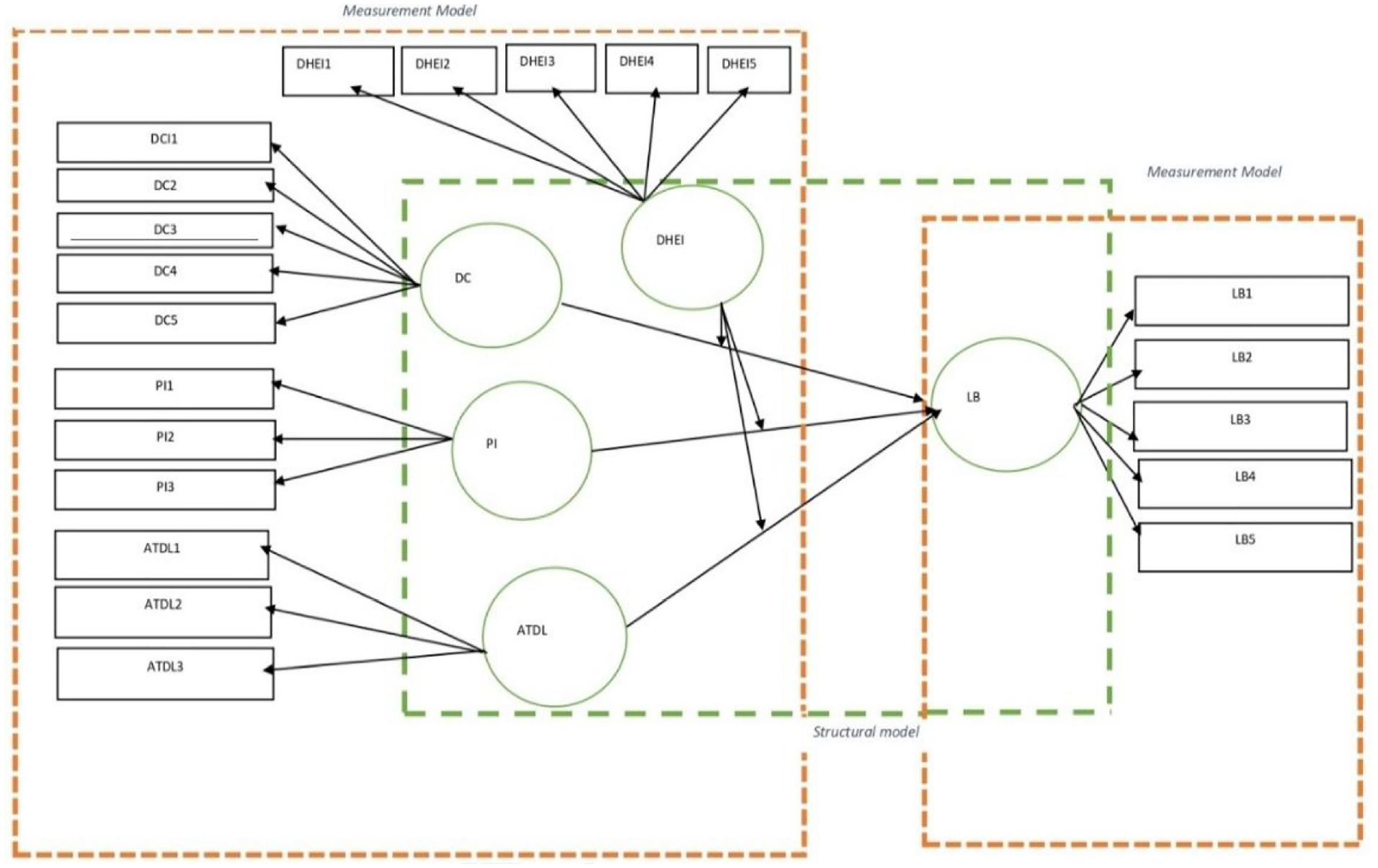
Measurement and structural model of the study.
Results
Description and Model Testing
The findings indicate that the students exhibited a commendable degree of digital competence within their academic institution. Based on the data pertaining to learning behavior (M = 4.51, SD = 1.336), the participants reported the manifestation of suitable learning behaviors within their university classroom. These behaviors foster a secure, tranquil, and supportive learning milieu that facilitates student success. Likewise, a significant proportion of the participants exhibited a high level of digital competence, with an average score of 4.124 across all the individual items. The majority of the students exhibited a high level of competency in conducting online searches and utilizing specific databases, as evidenced by a mode of 5 and a mean of 4.94. Furthermore, the majority of the students self-reported proficient use of social media and photo/video sharing tools and applications (mode = 5; mean = 4.78). The students exhibited a high degree of skill in utilizing the operating system. The participants exhibited a moderate level of awareness regarding the reliability and credibility of information when conducting online searches. According to the data collected, the students self-reported a mean score of 4.58 with a standard deviation of 1.31 when describing themselves as innovative. The majority of the students exhibited a greater inclination toward utilizing novel digital technologies as a means of enhancing their educational experience. The students exhibited a highly favorable attitude toward digital learning, whether in formal or informal settings. The individuals demonstrate a proactive approach to exploring novel technological advancements to cater to their educational requirements, encompassing both formal and informal learning environments.
The assessment of the measurement model fit was carried out through the administration of discriminant validity and convergent tests. The assessment of a model’s convergent validity often involves the utilization of two coefficients, one is composite reliability (CR), and second is average variance extracted (AVE), which have gained widespread adoption in the field. The assessment of convergent validity is a crucial aspect of empirically examining formative measurement models in PLS-SEM. Convergent validity is the term used to describe the extent to which a particular measure is correlated with other measures of the same phenomenon, as stated in reference (Chen et al., 2020). The factor loading of each item utilized for the purpose of measuring latent variables or constructs was examined and juxtaposed against the predetermined threshold value in order to assess convergent validity. According to scholarly literature, in order for a construct to be considered convergent, it is necessary for the factor loading to exceed 0.70, as documented in sources (Cheah et al., 2018; Hair et al., 2011). All individual item loadings in the constructs exceed the threshold level that is 0.7. The metric of average variance described pertains to the extent to which a given construct captures variance in comparison to the variance that arises from measurement error. Typically, under the assumption of convergent validity, whereby the loadings are deemed satisfactory, it is expected that a value of 0.80 or greater for a route would indicate the attainment of a satisfactory and all-inclusive collection of formative measures (Chin, 2010). Table 1 displays the factor loadings, indicating that the items are appropriately aligned with the corresponding construct. The study model’s convergent validity was confirmed by the absence of any item with a factor loading below 0.80.
Descriptive Analysis and Measurement Model’s Testing.

The validity of the construct was assessed by computing the composite reliability (CR) coefficient. The objective of conducting a coefficient CR is to evaluate the reliability and internal consistency of the measures. This involves characterizing the combined reliability of the latent variables that underlie a given scale (Cheah et al., 2018; Chin, 2010; Geldhof et al., 2014). The coefficient of reliability (CR) is a reliability measure that is derived from the factor loadings, and it is considered to provide more precise estimates of reliability compared to Cronbach’s alpha (Singh & Prasad, 2018). In order to establish the construct validity of the model, it is recommended that the coefficient of composite reliability (CR) not fall below 0.60, as suggested by previous studies (Chin, 1998; Sher et al., 2019). Furthermore, it should be noted that a CR coefficient exceeding 0.70 (Hock et al., 2010) is indicative of the sufficiency of the model. Additionally, in order to confirm the adequacy of the model, a CR value of 0.80 or higher is necessary (Chin, 2010). The stipulation of a CR value of 0.85 for all constructs surpassing the threshold level provides justification for additional investigation. Furthermore, it was confirmed that the AVE exhibited convergent validity as each construct’s AVE values exceeded the minimum threshold of 0.50 (Hair et al., 1998; Sheng & He, 2016). When the variance that is accounted for by the model is larger than the variance that is due to measurement error, the average variance extracted (AVE) is greater than 0.50 (Henseler et al., 2015). The findings indicate that the measurement model exhibits sound construct validity and convergent validity. It is necessary for the Cronbach’s alpha value of the latent variable to exceed 0.70 (threshold value; Daskalakis & Mantas, 2008; Ringle et al., 2014). Cronbach’s alpha, a widely recognized statistical measure, is commonly employed in scholarly works to evaluate the reliability of research instruments. The aforementioned statistic has been bestowed with the distinction of being regarded as one of the most crucial and prevalent metrics that is regularly disclosed in the context of designing scales intended to evaluate affective constructs (Rouf & Akhtaruddin, 2018; Taber, 2018). The process aims to determine the internal consistency among the variables of the questionnaire and ascertain the reliability of said dynamics. The value of Cronbach’s alpha is constrained to a range of values from 0 to 1. A higher alpha coefficient indicates a higher degree of internal consistency and reliability in the measurement scale. It is imperative that the Cronbach’s alpha value of the latent variable exceed the threshold of 0.70, as established in previous studies (Bentler & Bonett, 1980; Rahman et al., 2021). The value of Cronbach’s alpha for all latent variables fell within the range of 0.82 to 0.87. The study’s findings indicate that the Cronbach’s alpha values of all constructions were above 0.80, indicating a standard level of internal reliability. The aforementioned statement implies that the measurement scale holds considerable importance, thereby rendering it fitting and pertinent for subsequent analysis.
Validity analysis
The confirmation of discriminant validity (DV) pertains to the distinctiveness of each construct within the model from all other constructs in the same model. In order to achieve the intended objective, two distinct methodologies were employed, namely the Fornell-Larcker Criterion (FLC) and the Heterotrait-Monotrait Ratio (HMR). As per the FLC approach, the square root of the average variance extracted (AVE) can serve as a suitable indicator for the discriminant validity (DV) of a latent variable. For this purpose, we compared the correlation coefficients of one latent variable with the correlation coefficients of the other latent variables. According to Rahman et al. (2021), It is imperative that the correlation coefficients between a latent variable and all other latent variables remain below the square root of AVE for that specific variable. The diagonal elements of the correlation matrix indicate that the latent variable exhibits greater variability with its own measures than with other measures. The diagonal results of the findings in Table 2 show that discriminant validity is present. Likewise, the outcomes of the HMR analysis provided confirmation of the discriminant’s validity. The observation that HMR is below 0.90 provides support for discriminant validity (Henseler et al., 2015; Rouf & Akhtaruddin, 2018).
Discriminant Validity.

Testing Goodness of Fit of Model
Prior to hypothesis testing, the structural model indices were employed to evaluate the overall goodness-of-fit of the models. A high value of the goodness-of-fit index (GFI) implies that the proposed covariance structure of the model is closely aligned with the structure of covariance of the sample data. The determination of appropriate fit is commonly ascertained by the acceptance of the null hypothesis, which proposes that the assumed covariance matrix is equal to the observed covariance matrix, as determined by the chi-square (χ2) test of significance. The problem lies in the fact that the functionality of the statistic is contingent upon the value of N. The chi-squared statistic offers a robust statistical assessment of model adequacy for large sample sizes, though with limited practical significance. As a result, several GFIs have been proposed as feasible replacements for chi-square statistics. Several widely used metrics include the normed fit index (NFI) (Bentler & Bonett, 1980), the comparative fit index (CFI; Cheung & Rensvold, 2002), and the root mean squared error of approximation (RMSEA) (Steiger, 1989). The model’s goodness of fit was indicated by all indices falling within the cutoff range, namely GFI = 0.971 (>0.90), CFI = 0.930 (>0.90), χ2/df = 2.07 (<3.0), NFI = 0.921 (>0.90), AGFI = 0.937 (>0.90), and RMSEA = 0.051 (<0.08) (as presented in Table 3). The outcomes of all measures provided support for conducting further analyses. The current method utilized in prior literature, including Su et al. (2023) and Ma et al. (2023) works, to assess the model framework.
Goodness of Fit of Model.

Structural Model’s Outcomes
The coefficient R2, commonly referred to as the “explained variance,” was utilized to assess the predictive accuracy of the structural model with respect to future outcomes. All the hypotheses exhibit R2 values greater than 0.50, as presented in Table 4. The nonparametric bootstrapping method was utilized to investigate the association between the latent variables postulated, as per what was found in Wetzels et al. (2009). All of the proposed hypotheses were found to be valid and accepted. The findings indicate that digital competence (DC) (β = .688, p < .01) exerts a robust positive influence on students’ learning behavior, as evidenced by a t-value exceeding the critical threshold (2.32). Additionally, the results indicated that personal innovativeness (PI) had a significant impact on learning behavior (β = .720, p < .01). The study found that the attitude toward digital informal learning (ATDL) had a significant impact on students’ learning behavior (β = .573, p < .01).
Structural Model Outcomes.

Note. p < .01 when t-value is greater than 2.32.
The f2 value was utilized to quantify the effect size of the variables on the learning behavior of students. A value of f2 greater than 0.02 indicates a small effect size, while a value greater than 0.15 represents a medium effect size, and a value greater than 0.35 indicates a large effect size (Cohen, 2013). The results indicate that DC (f2 = 0.774), PI (f2 = 0.709), and ATDL (f2 = 0.454) exhibit large effect sizes for all hypotheses. Moreover, Q2 was estimated to confirm the predictive relevance of all hypotheses. A Q2 value greater than zero (Fornell & Cha, 1994) was found to ensure the predictive relevance of all constructs.
The Moderating Role of DHEI Between DC and LB
Prior to analyzing the moderating effect of DHEI on the relationship between their DC, PI, and ATDL and the learning behavior of the students (LB), all variables were subjected to normalization. The methodology suggested by Preacher and Hayes (2004) was implemented. Table 5 reveals that there is a significant and direct influence of DC (β = .243, p < .01) on the learning behavior of the students (LB). Furthermore, it was observed that the students’ LB was significantly influenced by DHEI (beta = .191, p < .01). The predictive effect of the interaction between DHEI and DC on LB was found to be significant and positive (beta value = 0.533, p < .01). This research offers empirical substantiation that the digitalization at universities serves as a moderator for the influence of DC on LB.
Moderating Effect of DHEI Between DC and LB.

*shows significance level at 1%.
Moderating role of DHEI between PI and LB
The beta coefficient of 0.199 (p < .01) supports the findings presented in Table 6 that there is a statistically significant and favorable relationship between PI and LB. Additionally, it was noted that the LB of the students was significantly impacted by DHEI, with a beta coefficient of .201 and a p-value of less than .01. The study revealed a statistically significant and positive predictive impact of the interaction between DHEI and PI on LB, with a beta coefficient of 0.482 and a p-value of less than .01. The present study provides empirical evidence that the degree of digitalization implemented in higher education institutions functions as a moderating variable in the relationship between PI and LB.
Moderating Role of DHEI Between PI and LB.

*shows significance level at 1%.
Moderating Role of DHEI between ATDL and LB
The beta coefficient of 0.121 (p < .01) in Table 7 presents findings indicating a statistically significant and positive correlation between ATDL and LB. Furthermore, it was observed that the students’ LB was considerably influenced by DHEI (β = 0.109, p < 0.01). The findings of the research indicate that there is a noteworthy and favorable predictive influence of the interaction between DHEI and ATDL on the learning behavior of students. The beta coefficient of this relationship is 0.378, and the p-value is less than 0.01, which is statistically significant. This study presents empirical evidence indicating that the level of digitalization in higher education institutions serves as a moderating factor in the relationship between ATDL and LB.
Moderating Role of DHEI Between ATDL and LB.

*shows significance level at 1%.
Discussion
The present study presents a theoretical framework that examines the impact of digital competence (DC), personal innovativeness (PI), and attitude to digital informal learning (ATDL) on students’ learning behavior (LB). Additionally, the study explores the potential moderating influence of digitalization at higher education institutes (DHEI) on this learning process. The findings of the study indicate that the proposed model yielded significant path coefficients in all cases when analyzed for structural results. The present study highlights the positive and significant influence of DC on students’ learning behavior, indicating that students possess the capacity to utilize technology for the purpose of information retrieval and usage. In addition, they possess the ability to effectively utilize technology for the purpose of processing, obtaining, and assessing collected data. This empirical evidence to support the hypothesis that there exists a positive relationship between the digital competence of university students and their learning behavior (LB). Specifically, individuals who exhibit a higher degree of digital competence are more likely to display stronger LB. Previous research has indicated that the digital literacy of students does not exert a significant impact on their utilization of technology for educational purposes. Moreover, it has been suggested that basic technological competence is no longer a significant impediment for most university students in the realm of education (Lai et al., 2012). This study demonstrates that digital competence has a substantial impact on students’ LB. This is due to the fact that digital informal and formal learning characteristics are centered around the learner, and digital competence remains relevant even in a personal context that is controlled by the learner. Similarly, He and Zhu (2017) also described the similar results regarding the DC students learning behavior. According to He and Li’s (2019) findings, Chinese students exhibited a greater positive relationship between digital competence and learning behavior compared to Belgian students. Furthermore, the authors explained that digital competence exerts a greater impact on students’ learning behavior in comparison to technical expectancy.
The learning behavior of students is positively influenced by their personal innovativeness (PI). Hence, the students exhibit a proactive approach toward acquiring novel concepts and are inclined toward fostering a favorable attitude and inclination toward embracing technology. Furthermore, a high level of PI among students has been found to decrease anxiety related to computer usage. This is due to the development of an open mindset toward change, which in turn leads to an increased inclination toward utilizing technology in virtual environments (van Raaij & Schepers, 2008). Numerous scholarly inquiries have demonstrated that personal traits of students significantly impact the utilization of mobile media for informal learning in higher education, particularly PI (Cheng, 2014; Liu et al., 2010). The influence of personal innovativeness, a personal characteristic, on user satisfaction and intentions to continue using mobile learning has been found to be significant in prior research (Within the context of informal learning, students engage in self-directed learning activities, and PI are a significant factor in facilitating digital learning behavior, as noted by He and Zhu (2017). According to Liu et al. (2010), individuals exhibiting elevated levels of personal innovativeness may exhibit a propensity for risk-taking behavior, leading them to priorities the evaluation of novel technological advancements. According to Wang and Lin’s (2021) and Joo et al. (2014) research, student’s priorities their preferred learning pathways as they believe that such PI facilitate diverse experiences and foster changes in their learning behaviors.
The concept of attitude toward behavior pertains to an individual’s inclination toward a particular behavior, accompanied by either positive or negative emotions. In the context of investigating the adoption of digital technology in e-learning, mobile learning, and online learning, an individual’s attitude toward technology use is a crucial personal factor to consider (Celik & Yesilyurt, 2013). In the context of informal learning, the learning process is not predetermined, as learners are afforded the opportunity to discover and potentially create environments that align with their unique requirements and assumptions. The role of attitude toward digital technology is significant in terms of its acceptance and success. The impact of ATDLS on the LB of students has been observed to be significantly positive. It has been suggested that attitudes toward digital learning play a crucial role in informal learning settings, particularly in the voluntary adoption of technology by students (Lai et al., 2012; Saadé & Galloway, 2005). The current investigation suggests that students who exhibit favorable attitudes toward digital formal and informal learning are more likely to possess a greater degree of intrinsic motivation to engage in digital learning activities. The results of this study align with prior research that has demonstrated the importance of attitude toward technology usage as a significant predictor of students’ adoption of technology for learning purposes (Lai et al., 2012; Park et al., 2012).
The current study analyzed the significant moderating role of digitalization at the university between digital competence (DC), personal innovativeness (PI), attitude to digital informal learning (ATDL), and students learning behavior (LB). The results revealed that the digitalization of universities may strengthen the relationship between DC, PI, ATDL, and students’ LB. This describes how the integration of technology-based pedagogical tools and digital subject matter, coupled with the provision of enhanced sensory experiences and digital exercises and activities, can facilitate the transition of students from a state of inactivity to a higher level of engagement, thereby promoting improved learning outcomes. While certain evidence suggests that digitalization could potentially serve as a source of distraction within the classroom, the solution may not necessarily involve rejecting technology altogether but rather adopting a more receptive attitude toward it. The prevalence of digital technology is enduring and is not expected to diminish. The use of digital communication has become an integral aspect of the cognitive and social development of contemporary youth, shaping their perspectives on the world and self-identity. The process of digitalization is rapidly transforming the educational experience, and learning environments that restrict students’ access to and use of digital devices can potentially disrupt the learning process. According to Athanassiou et al. (2003), technology can be viewed as an extension of students’ identities, and its conceptual richness is most appreciated when it is utilized in accordance with a sound learning taxonomy. In addition, instructors who incorporate technology into their educational practices act as exemplars, and modeling behavior is a crucial element of social learning theory. According to Cauley et al. (2009), teachers who adopt digital tools and incorporate opportunities for digital activities can improve the students’ overall learning experience and foster the development of skill-based approaches. Given the persistent transformations observed in digitalization and the extensive accessibility of information, it is imperative that contemporary educational practices facilitate students’ assuming accountability for perpetual learning, cultivating self-regulation, and acquiring suitable skills for information inquiry, synthesis, and critique, as stated by Crittenden et al. (2019).
Conclusions
Formal education or informal learning greatly aids the process of facilitating students’ learning, with digitalization playing a significant role in this context. Their effective learning systems are the result of the amalgamation of the student, their learning environment, and a collection of knowledge. The acquisition of necessary knowledge and skills is primarily the responsibility of students themselves, rendering them the true architects of the learning process. Their learning situation refers to the factors that facilitate or hinder the process of learning. The facilities encompass digitized classrooms, the library, and designated areas for studying. The current study is planned to explore the direct effect of digital competence (DC), Personal innovativeness (PI) and attitude to digital informal learning (ATDL) on the students ‘learning behavior (LB) at university. Moreover, the moderating effect of the Digitalization at higher education institutes (DHEI) between DC, PI, ATDL, and LB of the students.
The students exhibited competence in digital literacy and demonstrated a high degree of personal inventiveness. They exhibit a positive attitude toward both formal and informal modes of digital learning. The universities have commendable resources for digitalization, according to the students’ feedback. Furthermore, a significant and favorable impact of the DC, PI, and ATDL on the LB of college students was observed. The digitalization at the university (DHEI) played a noteworthy moderating function among the DC, PI, ATDL, and the students’ learning behavior (LB). Drawing from these results, it can be inferred that students enrolled in Chinese universities possess the ability to utilize technology for the purpose of acquiring and retrieving information. Likewise, there exists a notable inclination toward embracing novel technological advancements and a favorable attitude toward digital learning among the aforementioned individuals. Consequently, the digitalization of universities has the potential to augment or temper their capacity to leverage novel technologies for the purpose of acquiring and analyzing data (referred to as DC) to facilitate continued education, productivity, and the dissemination of information through digital means. Likewise, the DHEI enables individuals to cultivate creativity, explore novel concepts, and acquire fresh insights that enhance their intellectual skills. Ultimately, DHEI also cultivates their attitude toward formal as well as informal digital learning, which significantly influences their learning behavior.
A significant obstacle lies in the development of interactive digital platforms and activities that effectively engage students in meaningful ways while also enabling the assessment of learning outcomes in accordance with a particular framework or taxonomy. Furthermore, it is imperative to inform students about the importance of cultivating individual self-regulation when utilizing digital technologies. Therefore, the implementation of certain technological resources in educational programs necessitates a certain degree of financial stability. Universities have the potential to leverage the digitalization process through the utilization of cost-effective or freely available technologies for students, including but not limited to virtual reality, artificial intelligence, and machine learning. In addition to the characteristics of learning objectives and the technology employed, it is advisable for faculty to take into account the compatibility of their teaching style. The incorporation of digital technology into the educational framework necessitates a well-defined strategy to prevent overburdening and diverting the attention of students. It is imperative to provide a clear articulation of the intended purpose of the technology to students and to utilize it as a tool to facilitate the attainment of specific learning objectives and outcomes.
Therefore, the following policy implications are suggested based on the significant relationships between the students’ personal traits and learning behavior. As DC significantly influences students’ LB, higher education institutions must incorporate courses on digital skills development in their curriculum from the first day of enrolment of students. Educational policies must be revised to include digital literacy as a core subject in curriculum. Moreover, financial and training facilities for educators must be provided to effectively teach digital skills to students. Similarly, the adoption of innovative and modern digital technologies should be encouraged at the higher education institutions. For this purpose, teachers must use digital tools and resources during lectures. This is possible by providing them with incentives to use technology during lecture delivery, which increases interactive learning behavior at higher education institutions. Moreover, the attitude of students toward digital learning may also be enhanced by providing assistance to students at the university level with easy access to address any problems and issues that may arise during the use of digital tools and resources. Digitalization plays a moderating role among the above relationships of variables, the provision of digital infrastructure such as Internet access, and the provision of updated digital tools and applications.
The current study may be limited by its unique sample size, as it comprised higher educational institutional students. Future studies may focus on the diversity of sample sizes by including students from lower-grade institutions. Moreover, the cross-sectional research design may not describe the full causal relationship between the students’ personal traits and learning behavior, and longitudinal studies are required to understand the long-run dynamic relationships between the students’ personal traits and learning behavior. Moreover, the study did not focus on cultural diversity, which may have changed the causal relationship of the students’ personal traits and learning behavior. Therefore, it is imperative to focus on cultural and institutional diversity to explore the causal relationships among the students’ personal traits and learning behavior.
Despite the above limitations, this study highlights the importance of student engagement with the newly evolved digital technologies, tools, and applications in academic learning. To promote digital learning at the higher education institutes, it is crucial to foster students’ digital understanding. The current study is expected to facilitate an understanding of how students’ DC, PI, and ATDL affect their LB, which may assist in developing an effective way to design and implement effective digital interventions according to the needs and preferences of students.
Footnotes
Author Contributions
All authors contributed equally in this work.
Declaration of Conflicting Interests
The author(s) declared no potential conflicts of interest with respect to the research, authorship, and/or publication of this article.
Funding
The author(s) disclosed receipt of the following financial support for the research, authorship, and/or publication of this article: The study was funded by Key Research Project on Education and Teaching Reform in Higher Education Institutions in Hainan Province “Model Construction of High-Quality Resources Co construction and sharing in Hainan Higher Vocational Education under Game Theory Thinking” Research Achievements of “Building Research” (No. Hnjg2023ZD-60).
Ethical Approval
The study was approved by the Nanjing University of Aeronautics and astronautics, Nanjing China (2023-1038).

Data Availability Statement
The data can be obtained from the corresponding author on request.