




Abstract
The interest in entrepreneurship is growing, due to its relationship with competitiveness, growth, employment, and innovation. In fact, there are numerous studies trying to identify factors influencing entrepreneurial intentions among university students, especially among young people, and in those countries with declining growth rates. Using the Entrepreneurial Event Model, we try to understand the role played by the perceived opportunity in explanatory models of EI development. To this end, we analyze the moderating effect of educational active learning methods on the link between perceived opportunity and entrepreneurial intentions. Partial Least Square-Structural Equation Modeling was used, with a sample of 333 first-year Spanish higher education students. Findings suggest that visual thinking, flipped classroom, visitor’s and teacher’s role model, brainstorming, cooperative case studies, learning by problems, debate, and improving communication skills moderate the relationship between the perceived opportunity, and thus on the entrepreneurial intentions. The results contribute to universities and practitioners as well as to the growth of entrepreneurship.
Keywords
Introduction
“A high level of entrepreneurial activity (…) contribute to foster competition, innovation, economic growth, job creation and well-being of citizens” ( Raposo & Do Paço, 2011, p. 453). This phrase stimulates the desire to want to identify which factors stimulate entrepreneurial intentions (EI) (Gough, 2018; Muñoz et al., 2020; Raposo & Do Paço, 2011), this being one of the best predictors of entrepreneurship (Kautonen et al., 2015). This is particularly relevant in contexts of high unemployment such as Spain, where the unemployment rate ranks 36th (14.1%) out of 37 OECD countries (OECD, 2019a), especially among young people; and in those countries with declining growth rates (Hassan et al., 2020). It therefore becomes necessary to seek solutions that generate employment, produce innovation, and improve the efficiency of many industries to become more competitive, and entrepreneurship emerges as a good option. This is one of the reasons why, in their fight to reduce the youth unemployment rate, the Action Plan for Youth Employment and the European Strategy 2020 have promoted entrepreneurship as one of their main objectives (European Commission, 2010; SEPE, 2019). To do so, it is therefore necessary to reinforce measures, not only through education but also through universities (Cotoi et al., 2011; Naz et al. 2020). This is why higher education as a whole, and universities and their members in particular, play a fundamental role in societies (Martínez-Gregorio et al., 2021). On the one hand, by shaping EI, equipping students with entrepreneurial skills and capabilities rather than just entrepreneurial knowledge (Feder & Niţu-Antonie, 2017; González-López et al., 2019; Naz et al., 2020; Padilla-Melendez et al., 2014) through more active learning methodologies. On the other hand, through inspiration and motivation (Trivedi, 2016).
Although some authors mention that entrepreneurial education is a “powerful engine of social and economic transformation” (Fayolle et al., 2016, p. 896), there is no consensus of its effect on EI (Fiet, 2000; Hassan et al., 2020; Oftedal et al., 2018). Some authors defend its positive effect (G. Anwar & Abdullah, 2021; Feder & Niţu-Antonie, 2017; Souitaris et al., 2007), while others find no effect (Bae et al., 2014) or a negative effect on EI (Oosterbeek et al., 2010; Von Graevenitz et al., 2010). Furthermore, despite the various factors analyzed that influence EI, the study in entrepreneurial education “[…] has not advanced at the same level of scholarship when compared to general entrepreneurship research” (Liguori et al., 2019, p. 4). Specifically, a gap has been identified because there are few studies that focus on the effect that educational innovation, its active learning methods, such as experiential learning, and pedagogical intervention, have on EI (Fayolle et al., 2016: Gough, 2018; Martínez-Gregorio et al., 2021; Sukavejworakit et al., 2018). Indeed, Nabi et al. (2017) call for further research showing the lack of studies linking EI to different pedagogical methods. Furthermore, there is a need “to explore diversity to extrapolate new meanings that enrich teaching practices” (Loi et at., 2021, p. 2). This is all despite the importance that such learning methodologies may have on EI (I. Anwar et al., 2022; García-Rodríguez et al. 2016; Thuy, 2017). This is because more active student learning can help to convert students’ ideas into business opportunities and transform these into EI (Hassan et al., 2020; Sukavejworakit et al., 2018). In fact, the European Commission (2011) states that entrepreneurial skills “are best acquired through people-led enquiry and discovery that enable students to turn ideas into action” (p. 2). This is also because active learning methods facilitate the development of critical thinking and an improvement in problem solving skills that can enhance entrepreneurial behaviors (G. Anwar & Abdullah, 2021; Chong et al., 2008; Farhangmehr et al., 2016; Martínez-Gregorio et al., 2021; Naz et al., 2020). Similarly, they help the students to be more innovative and develop entrepreneurial ideas through simulations, case studies, role-plays, or teamwork (G. Anwar & Abdullah, 2021; Sukavejworakit et al., 2018; Wagner, 2012). This means that greater exposure to entrepreneurship education can lead to the acquisition of entrepreneurial skills, capabilities, and knowledge amongst students and therefore an increase in their EI through improved PO (González-López et al., 2019; Hassan et al., 2020; Nabi et al., 2017).
As a result, taking into account that an entrepreneur is created from: (a) the individual’s intention to carry out the action of starting a new venture, with EI being understood as the individual’s behaviors toward starting a new business in the near future (Thompson, 2009); and (b) his/her ability to perceive entrepreneurial opportunities (PO), by balancing risks (Alonso et al., 2016). PO is understood as an individual’s ability to identify, discover, or create patterns (Hassan et al., 2020). It therefore seems reasonable to answer the following question: Do active learning methodologies help to enhance the perception of opportunities and increase EIs?
This is because to understand the business process it is necessary to study the individual’s intention, the PO, and the link between these two concepts (Shane, 2000). That is why in order to provide answers to governments for improving the levels of entrepreneurial activity, authors are requested to study active learning methods which increase individuals’ EI and factors that enhance PO (Gough, 2018; Gregoire et al., 2010; Liguori et al. 2019), and carry out more studies considering education as a moderator (Ertuna et al., 2011; Fernández-Pérez et al., 2017) between EI and PO, especially those that are focused on educational innovation. The main objective of this study is to deepen the knowledge of PO and its relationship with EI, introducing active learning methodologies as a moderator among 333 first-year university students from Spain, following the advice of Nabi et al. (2018). Partial Least Square-Structural Equation Modeling (PLS-SEM) is used for the analysis, and the Entrepreneurial Event Model (Shapero & Sokol, 1982) is used as a framework, based on considerations from other authors (Dissanayake, 2013; Guerrero et al., 2008; Solesvik et al., 2012).
The results obtained will provide insight into the extent to which these active learning methods will facilitate the development of certain skills and capabilities that enhance the PO, and thus the development of greater EI (Gough, 2018). This will provide the knowledge to create a proposal of necessary measures and adjustments to improve traditional teaching methods and create effective teaching to boost entrepreneurship. The idea is to achieve an educational approach that facilitates the development of entrepreneurial skills and capabilities. As Fiet (2000) stated: “If researchers do no conduct theoretically rigorous research, the content of entrepreneurship courses will suffer” (p. 4).
This paper is structured as follows. Section 2 contains the theoretical background. In section 3 the theoretical model and the hypothesis are proposed. Section 4 describes the measurement instruments, the data, the evaluation of the measurement model, and the structural model. Section 5 presents the results and the discussion, and the final section includes the conclusion, contributions, limitations and future lines of research.
Theoretical Background
Our economic future depends partly on entrepreneurs because their activities have a high impact on economic development (Hassan et al., 2020; Vaicekauskaite & Valackiene, 2018). Thus, considering the role that entrepreneurs play in economic development, it becomes necessary to find ways to enhance people’s EI, with the relevance of acquiring entrepreneurial competences becoming a key factor (García-Rodríguez et al., 2016). Authors such as Bell (2015), claim that entrepreneurship is a teachable discipline or at least some aspects of it are. Similarly, Anderson and Jack (2008) and Farhangmehr et al. (2016) demonstrate that the basic competencies required for entrepreneurial behavior such as creativity, problem-solving, or teamwork, among others (Loi et al., 2021) can be developed in environments regulated by education. To this end, the support of universities and their members (G. Anwar & Abdullah, 2021; Piperopoulos & Dimov, 2015) plays an increasingly important social and economic role, associated with EI (Oftedal et al., 2018).
On one hand, universities can transfer the entrepreneurial “know-how” and help students to develop skills and competences enabling them to easily navigate an increasingly complex world (Naz et al., 2020; Vaicekauskaite & Valackiene, 2018). As a result, they are essential for strengthening students’ entrepreneurial behaviors (Anderson & Jack, 2008; G. Anwar & Abdullah, 2021; Arranz et al., 2017; Susilo et al., 2019), inspiring, motivating (Trivedi, 2016), and facilitating the identification of entrepreneurial opportunities (Raposo & Do Paço, 2011). On the other hand, teachers are able to transfer the “know-why” and have to find and explore initiatives that facilitate the introduction of active learning methods, which enable the development of skills and competences for the entrepreneurial process such as creativity, problem-solving, individual and group initiative, and risk-taking and risk-assessment, among others (Bell, 2015; García-Rodríguez et al., 2016; Susilo et al., 2019). All of these, combined with theoretical training, play a central role in facilitating learning (Piperopoulos & Dimov, 2015). For example, through the use of critical thinking, learning by doing, or collaborative work; promoting and enabling the identification of opportunities (Anderson & Jack, 2008; Canavati et al., 2016; Ertuna et al., 2011), and facilitating the development of competences associated with increasing motivation for entrepreneurship (Farhangmehr et al., 2016).
For an entrepreneur to be born, the individual must have the ability to perceive the opportunities (PO), the intention to exploit this opportunity, and the capabilities (skills and knowledge) to exploit those opportunities (Fayolle & Liñán, 2014; Ikebuaku & Dinbabo, 2018). This means that the opportunities influence the entrepreneurial behavior, but they do not determine it (Shane et al., 2012). Therefore, in addition to EI, PO is important for the individual entrepreneurship decision-making process (Canavati et al., 2016; Hassan et al., 2020; Puni et al., 2018; Shane, 2000; Zhang et al. 2014), as the ideas often arise from the identification of entrepreneurial opportunities (Ozgen & Baron, 2007).
The detection of such opportunities will be possible thanks to the possession of certain skills and knowledge (Canavati et al., 2016; Ikebuaku & Dinbabo, 2018). This is because the opportunity is both discovered and created (Ding, 2019). That is, we see opportunities from the creation point of view where opportunities depend on human action and are endogenously formed through cognitive skills (Ding, 2019) such as the ones developed through active learning methods. In fact, along these lines, studies such as Piperopoulos and Dimov (2015) discuss how entrepreneurship-based education is being promoted because it facilitates the development of favorable attitudes, skills, and abilities, as well as the discovery of new opportunities, which can increase EI. Therefore, Puni et al. (2018) and García-Rodríguez et al. (2016) demonstrate that through entrepreneurship education and its more active methodologies, new entrepreneurial skills are developed and greater opportunities are perceived, which can increase EI. Similarly, Zhang et al. (2014) found that knowledge and skills acquired through education can facilitate the recognition of opportunities and therefore EI. For his part, Shane (2000), establishes that prior knowledge acquired through education or other means such as experience allows them to recognize certain entrepreneurial opportunities, enhancing their EI, while others cannot detect them due to their lack of education or experience.
This makes identifying opportunities key to the entrepreneurial process (Canavati et al., 2016; Hassan et al. 2020) as it will facilitate choosing the right idea before it can be carried out, as well as adopting and working on all the skills required for the entrepreneurial process. Consequently, studying which factors can enhance PO (Gregoire et al., 2010), and which educational methodologies can increase IE amongst first-year university students (Gough, 2018; Nabi et al., 2018) becomes somewhat relevant.
However, although active learning methods can improve PO (Canavati et al., 2016) and increase EI, there are others who have not found this connection (Teixeira et al., 2018). This suggests that the active learning methods can perhaps contribute to increasing EI, moderating the relationship between PO and EI.
The moderator role that educational active learning methods play in EI and some of its main predecessors to the EI models, such as PO, have not really been studied even though active learning methods can change EI and therefore the individuals’ attitude and perceptions toward carrying out an entrepreneurial activity (García-Rodríguez et al., 2016; Thuy, 2017; Von Graevenitz et al., 2010). Not being able to perceive the opportunities, which could translate into higher EIs (Akolgo et al., 2018), may therefore be due to the lack of skills (Ireland & Barringer, 2015) that can be acquired through these active learning methods (G. Anwar & Abdullah, 2021; Farhangmehr et al., 2016).
Active learning methods enable the development of certain skills relating to entrepreneurs, such as: (a) autonomy or self-realization (Feder & Niţu-Antonie, 2017; Sesen & Pruett, 2014); (b) visual thinking (Gismera et al., 2021; Mohedano-Suanes & Benítez, 2018); (c) design thinking (González-López et al. 2019; Kodrat, 2018); or (d) critical thinking and improving communication or interaction skills, thanks to active learning methods such as cooperative learning through the use of case studies (Bell, 2015; Farhangmehr et al., 2016; Martínez-Gregorio et al., 2021). Therefore, the use of these methodologies can facilitate not only the development of these skills but also an improvement in PO amongst students whose teachers use them (Hytti et al., 2010; Kodrat, 2018), thus boosting individuals’ EI (Canavati et al., 2016; Ertuna et al., 2011), This overturns “the traditional conception that entrepreneurial acumen can only be honed outside a classroom environment” (Ding, 2019; p. 11). EI is primarily achieved through a teaching style that facilitates the development of psychological and social abilities (G. Anwar & Abdullah, 2021; Farhangmehr et al., 2016). This is because they allow the student to have greater commitment toward entrepreneurship (Ikebuaku & Dinbabo, 2018), thanks to the existence of active learning methods, which can improve the perception and exploitation of opportunities (Chell, 2013; García-Rodríguez et al., 2016; Von Graevenitz et al., 2010).
Research Model and Hypothesis
Research Model
Intention is “a state of mind directing a person’s attention (and therefore experience and action) toward a specific object (goal) or a path in order to achieve something (means)” (Bird, 1988, p. 442). Thus, EI can be defined as a person’s desire to own and be responsible for their own business. The predictive power of intentions in individuals’ behavior has been analyzed (Bae et al., 2014; Kautonen et al., 2015). As a result, EI is the prerequisite for entrepreneurial actions, and one of the best predictors of future entrepreneurship (Kautonen et al., 2015).
The Entrepreneurial Event Model (Shapero & Sokol, 1982) is one of the most commonly used for the analysis of EI (Singh et al., 2012). Therefore, the framework of this study focuses on this model considering different contributions (Dissanayake, 2013; Guerrero et al., 2008; Solesvik et al., 2012), from which a new base model is established (Figure 1).

Conceptual model.
Perception of feasibility (PF) and the perception of desirability (PD) are established to have a direct impact on EI (Dissanayake, 2013; Esfandiar et al., 2017; Krueger, 2009). Given that the PD and PF determine the relative credibility of the behaviors (Shapero & Sokol, 1982); and credibility depends on the perceptions of how feasible or desirable it is to start a business (Krueger & Carsrud, 1993), a single unobservable construct referred to as credibility is used, measured using the observable constructs PF and PD and with a direct impact on EI (Dissanayake, 2013; Guerrero et al., 2008; Zhang et al., 2014).
PO is incorporated, given that EI can only be understood in those theoretical frameworks that consider PO (Canavati et al., 2016; Hassan et al., 2020; Shane, 2000). If this is not the case, only a very limited view of the entrepreneurial process is provided (Gregoire et al., 2010). Thus, it seems important to study the role of the antecedents of EI, but also of PO, to be able to then focus on the moderation of active learning methodologies between these two constructs (see 3.2).
In contrast, we do not believe that active learning methodologies are considered to moderate the relationship between credibility->EI amongst first-year students. As a result, the following have not been included in the proposed model. Although credibility can be learnt and changed more easily than personality traits, this is achieved through education (Von Graevenitz et al., 2010). These changes require time and stimuli, as they do not develop as immediately as external perceptions. Therefore, considering the period from the start of the academic year until when the questionnaire was completed (4 months), it is not believed that the different active learning methodologies stimuli could have had an impact on the first-year students’credibility.
Therefore, the following hypothesis is proposed:
H1: Credibility directly affects EI
The Role of PO: Its Antecedents and Consequences
It is important to understand which antecedents are predicting PO (Gregoire et al., 2010). In this respect, it is key to understand that “entrepreneurship is fundamentally personal” (Baum et al., 2007, p. 1). That is why studying the antecedents of the PO and EI (see 3.1), partly of a cognitive nature, play a key role in the PO (Alonso et al., 2016) and EIs.
PO depends on the person’s credibility; that is, how desirable or feasible they perceive entrepreneurship to be, and how this affects EI (Esfandiar et al., 2017; Zhang et al. 2014). There is evidence that the PO can significantly stimulate the entrepreneurial process (Akolgo et al., 2018; I. Anwar et al., 2022; Hassan et al. 2020). In this sense, Hassan et al. (2020) establish that when individuals are able to better recognize potential business opportunities, they will show a greater inclination toward entrepreneurship. In fact, authors such as Bird (1988) demonstrate that the strong connection between EI and PO is created when the entrepreneur feels prepared to be able to start a new undertaking, that his/her credibility and therefore his/her PO increases (Ireland & Barringer, 2015). In this sense, education seems to strengthen self-efficacy and credibility, helping an individual to develop an initial interest in a specific career (Hassan et al. 2020; Ikebuaku & Dinbabo, 2018; Zhang et al. 2014), such as entrepreneurship. Thus, this credibility will influence the perception of greater opportunities (Esfandiar et al., 2017; Zhang et al., 2014) and therefore EI. Considering the above, the following hypotheses are proposed:
H2: Credibility directly affects PO
H3: PO directly affects EI
Despite these proposals, we should not lose sight of the objective of this study, which is to test the moderating effect of certain active learning methodologies. This is partly because few authors have considered their possible moderator effect (Ertuna et al., 2011), when the PO is expected to be reinforced by EI when students are exposed to some active learning (Hassan et al., 2020).
Active Learning Methods: Their Moderator Role Between PO and EI
PO is one of the more significant aspects to explore the interaction between the environment and the cognitive process (Pérez-Alonso et al., 2016). Therefore, in order to understand the role of active learning methods used by universities and the effect these may have between OP and EI, it seems that this construct (active learning methods) should be used as a moderator based on: the claims relating to the need to find new moderations (Ertuna et al., 2011; Fernández-Pérez et al., 2017); of carrying out more studies that analyze the influence that other teaching methods such as active learning methods have on first-year university students’ EI (Fayolle & Liñán, 2014; Fayolle et al., 2016; Gough, 2018; Loi et al., 2021; Nabi et al., 2017, 2018; Sukavejworakit et al., 2018), and that “the role of course content and the role of teaching methods remains unclear” (Thuy, 2017, p. 85).
Active learning methods, such as cooperative case studies, visual thinking, brainstorming, or learning based on problems amongst others (Bell, 2015; Hytti et al., 2010; Kodrat, 2018; Mohedano-Suanes & Benítez, 2018; Rasmussen & Sorheim, 2006), are heavily focused on the development of entrepreneurial skills and competences (Farhangmehr et al., 2016; Gismera et al., 2021). These are developed by each individual and can vary from one person to another in terms of the active learning methods used. They can also affect PO in different ways (Chell, 2013). This is because active learning methods can cause the person who perceives an opportunity to generate a greater EI.
If we consider that the students who are subjected to active learning methodologies develop skills and competences such as creativity, critical thinking, communication skills, conflict resolution, amongst others, this will positively impact their motivation (Anderson & Jack, 2008; Farhangmehr et al., 2016), their PO (Chell, 2013) and development of ideas (Rasmussen & Sorheim, 2006), thus driving their EI (Hytti et al., 2010; Kodrat, 2018).
Active learning methods can be important in the development of EI (García-Rodríguez et al., 2016; Hassan et al., 2020; Piperopoulos & Dimov, 2015; Thuy, 2017), especially in the creation view perspective, where opportunities arise thanks to cognitive factors that are formed endogenously (Ding, 2019; Puni et al., 2018) because there is a need for skills and knowledge to be able to perceive and recognize opportunities (Akolgo et al., 2018; Zhang et al., 2014)
Therefore, taking all of this into account, we believe that:
a. Cooperative work, such as case studies, enables us to observe how people work with each other to overcome problems (Ikebuaku & Dinbabo, 2018). This can help them reach agreement, and also supports critical thinking and problem solving (Anderson & Jack, 2008; Bell, 2015; Safapour et al., 2019). This critical thinking and cognitive ability are key for being able to create and exploit new ideas and for these to materialize into PO (Anderson & Jack, 2008; Wagner, 2012) and EI at the same time.
b. The improvement in communication skills, can support the development of certain skills and capabilities that are required for starting a business, such as communication and presenting ideas to others (Anderson & Jack, 2008; Shane et al., 2012; Susilo et al., 2019). These arise in the use of case studies, debates, or presentations in the classroom that improve counterfactual thinking, supporting the transfer of knowledge and ideas and leading to the discovery of new business opportunities (Krueger, 2007; Pérez-Macías et al., 2020). It also improves confidence, thus reducing fear and facilitating the ability to see new opportunities (Nabi et al., 2018).
c. Furthermore, teacher’s role model and visitor’s role model can help students to acquire the skills and abilities required to start a business: through motivation and inspiration with real-life examples and with the “Know-why” instead of the “Know-how” (González-López et al., 2019; Kautonen et al., 2015; Souitaris et al., 2007), as long as they are positive (Anderson & Jack, 2008; Nabi et al., 2018), and supporting the development of students’ creativity that strengthens their imagination (Anderson & Jack, 2008). This is because although knowledge, skills and experience are important, other inspirational factors are necessary in order to shape EI (Puni et al., 2018).
d. Learning based on active learning methods is more practical, such as problem-based learning which supports the generation of EI (Susilo et al., 2019), as the knowledge previously obtained through training or experiential learning improves the PO (Canavati et al., 2016; Von Graevenitz et al., 2010). Similarly, it enables students to face real cases and ask questions about an entrepreneur’s daily life (Krueger, 2007). Problem-based learning also facilitates critical thinking learning (Anderson & Jack, 2008) and the development of design thinking skills (Kodrat, 2018), which can be a tool for PO and therefore influence EI.
e. Creativity and visual thinking are important characteristics in entrepreneurs, as they allow them to perceive new market opportunities that have not been exploited (Anderson & Jack, 2008; Gismera et al., 2021; Mohedano-Suanes & Benítez, 2018). To start a business, it is important to have knowledge of the environment and this can be achieved by study, creativity and visual thinking, putting into practice brain storming, design thinking (González-López et al., 2019) and mind mapping, supporting PO and EI.
f. Flipped classroom allows them to think for themselves, as the lesson takes place outside of the classroom, through the use of videos, podcasts, or literature on the subject matter, amongst others. This promotes interaction, proactivity, critical thinking, and seeking opportunities (Arranz et al., 2017; Bell, 2015). It can therefore increase the exchange of opinions (Safapour et al., 2019), supporting PO (Pérez-Macias et al., 2020) and EI at the same time.
H4: Active learning methods moderate the relationship between PO and EI
Methodology
Measures
Items included in the questionnaire were taken from validated scales using a 7-point Likert scale (1 = strongly disagree; 7 = strongly agree): EI (Liñán et al., 2011); perceived desirability and perceived feasibility that form credibility as Guerrero et al. (2008) did, using Shapero and Sokol (1982) and Shook and Bratianu (2010); and finally, PO (GEM, 2017). We have used several moderating variables (see Figure 1), using questions such as: “Answer sincerely to what extent your teachers use the following methodologies and learning resources from 1 (Never) to 7 (Many times): (a) Collaborative case studies; (b) Problem-based learning: for example, raising a problem through, for example, newspaper news or a video; (c) Visual thinking1: Images to visualize examples”; and (d) Visual thinking2: videos to visualize examples.
Sample
Data collection from first-year undergraduate students at a Spanish university took place during January and February 2020, through an online questionnaire limited to one response per student. The questionnaire was sent widely to these students. The reason for choosing the sample of students is based on the fact that samples of university students are the most commonly used in studies of entrepreneurial intention (Liñán et al., 2011; Pérez-Macías et al., 2022). The total number of responses obtained was 335, although after analysis of the data, 2 were eliminated because the responses were not complete. Thus, the final sample consisted of 333 Spanish students (Table 1 statistical analysis). The proposed model was tested using partial least squares (SmartPLS 3.2.7.)
Sample Characteristics.

Evaluation of the Measurement Model
The reliability analysis is carried out using loading criterion (deleting those that were below .707); Composite Reliability (CR) and Average Variance Extracted (AVE) are used to measure internal consistency. CR values should be over.7 and AVE values over .5. All the constructs that are included meet both criteria (see Table 2).
Composite Reliability, Convergent Validity.

Discriminant validity was confirmed by using the heterotrait-monotrait (HTMT) ratio (Henseler et al., 2015). Values were below 0.90. To ensure that there were no problems with the correlation between [EI-Credibility-> (0.891)]; as their HTMT was between 0.85 and 0.90, we checked that their confidence interval was between 0 and 1 and not greater than 1. Table 3 shows that this interval does not include 1, meaning that discriminant validity is confirmed.
Discriminant Validity Criteria.
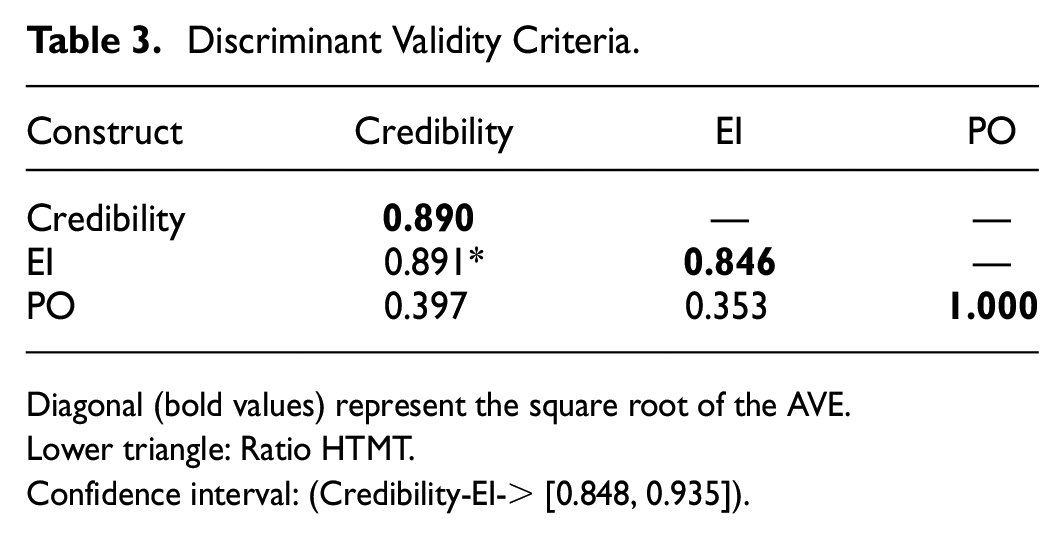
Diagonal (bold values) represent the square root of the AVE.
Lower triangle: Ratio HTMT.
Confidence interval: (Credibility-EI-> [0.848, 0.935]).
Evaluation of the Structural Model
To assess the adequacy of the structural model we use: (a) the coefficient of determination showing that the model explains a high percentage of the variance in EI and its high level of prediction (see Figure 2). R2 values greater than .75 are considered as a high success driver study, over .5 moderate and over .25 weak. Our model has a 79.8% for EI and 15.7% for PO; and (b) the model fit, using both Standardized Root Mean-Square (SRMR)—where values lower than 0.08 indicate a good fit and closer to 0 indicate a better fit-, and the Normed Fit Index (NFI)—where values above 0.9 are acceptable—SRMR: 0.029 and NFI: 0.940 meaning that our model is well specified. Consistent Bootstrapping (5,000 samples) has been used to generate standard errors and t-statistics that allow us to verify our hypothesis. Figure 2 presents the results.
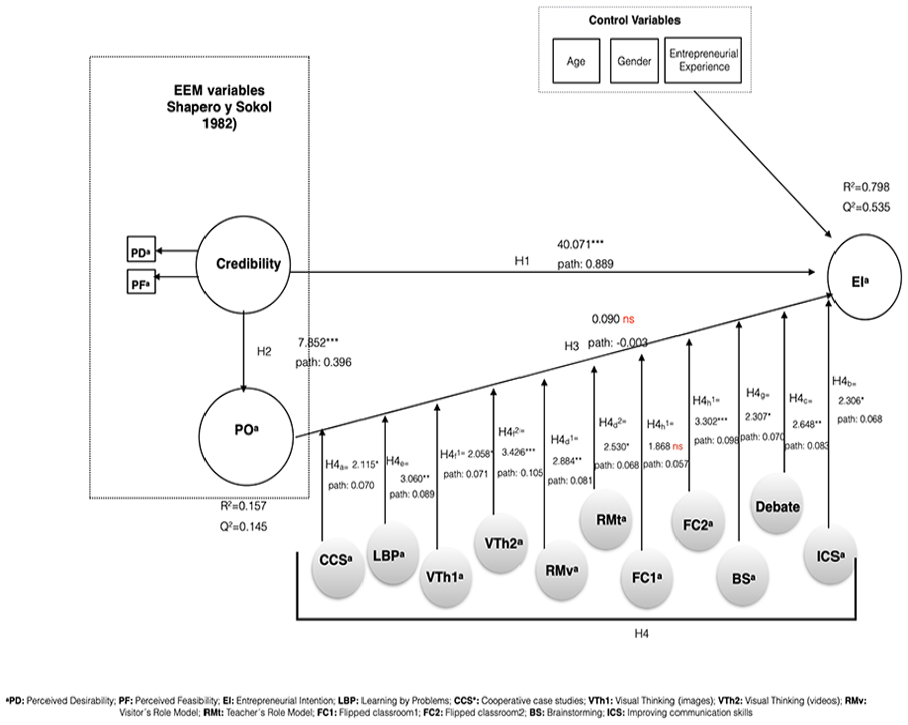
Final structural model results.
Results and Discussion
Figure 2 shows the results obtained. The model shows a variance in EI of 79.8%. The hypotheses of the principal model (H1, H2) are accepted, in line with other studies (Dissanayake, 2013; Guerrero et al., 2008; Solesvik et al., 2012), except for the effect of PO->EI (H3) as obtained by others (Teixeira et al., 2018). The latter, whilst interesting due to the importance of PO on the development of EI (Dohse & Walter, 2012; Esfandiar et al., 2017; Hassan et al., 2020; Puni et al., 2018), can be due to the fact that first-year students have less idiosyncratic knowledge, and this is what facilitates creativity and the PO to develop EI. Furthermore, it should be noted that the network of contacts of the first-year students will be smaller than that of seniors. As a result, the quality and quantity (Pérez-Macías et al., 2020), make it harder to develop EI.
The moderating effects can be seen in Figure 2 and Table 4. Those confirm that the active learning methods analyzed moderate the relationship between PO->EI (H4), except for the flipped classroom 1 (H4h1) which does not act as moderator currently, meaning that H4 can be partially accepted (see Table 4). Therefore, those students whose teachers use active learning methods such as improvement in communication skills, debates, cooperative case studies and teacher’s role model, visitor’s role model, problem-based learning, visual thinking with images or videos, or brainstorming or flipped classroom, will be capable of developing certain skills and competences such as communication, creativity, negotiation, and problem solving skills among others (Chell, 2013; Farhangmehr et al., 2016; Gismera et al., 2021; González-López et al., 2019) to discover and support the PO and improve EI. This coincides with Arranz et al. (2017), who demonstrate that active learning methods support the development of essential skills and knowledge that are critical for starting a business. Likewise, Puni et al. (2018) state that entrepreneurial education helps and teaches the necessary skills to develop EI.
Structural Model: Moderating Effects.

Note. Based on a one-tailed Student’s t-distribution.
(499): t(0.05; 499) = 1.6479, t(0.01; 499) = 2.3338, t(0.001; 499) = 3.1066.
p < .05. **p < .01. ***p < .001
Thus, cooperative case studies can support the exploitation of new ideas thanks to cooperation and exchanges between one another (Wagner, 2012), these ideas and PO often arise through experience, resources and knowledge acquired over time, supporting PO and therefore EI (Canavati et al., 2016). As a result, the cooperative case studies moderate the relationship (H4d2) amongst these students.
Debates and improvement in communication skills through presentations do moderate the relationship between PO->EI (H4b; H4c). This validates that having communication skills and knowing how to interact with others is critical for being able to start a business (Pérez-Macías et al., 2020; Shane et al., 2012). This is the case because they support individuals’ communication, influencing skills, counterfactual thinking and confidence, supporting the PO and the entrepreneurial process (Krueger, 2007; Nabi et al., 2018; Susilo et al., 2019).
The importance of role models for EI has been widely validated (González-López et al., 2019; Thuy, 2017). Thus, we observe that visitor’s role model moderates the relationship between PO->EI (H4d1), because as well as providing real-life experiences from outside the world of teaching (Arranz et al., 2017), it provides networks of contacts and this can affect the PO (Pérez-Macías et al., 2020; Thuy, 2017) and EI (Dohse & Walter, 2012). In addition, teacher’s role model moderates the relationship between PO->EI (H4d2). This is not surprising, because teachers have a great ability to motivate and inspire students (Souitaris et al., 2007), and support the development of skills required to start a business (Bell, 2015; Cotoi et al., 2011; González-López et al., 2019; Susilo et al., 2019).
Problem-based Learning, visual thinking (both with images as well as videos) and brainstorming do moderate the relationship between PO->EI (H4e; H4f1; H4f2; and H4g). Critical thinking and the use of design thinking developed through the use of active learning methods such as problem-based learning, support the students’PO and therefore increase their EI (Anderson & Jack, 2008; Kodrat, 2018; Krueger, 2007; Martínez-Gregorio et al., 2021). Similarly, the use of active learning methods such as brainstorming or visual thinking support creativity. This creativity, which is partly made up of these tools which lead to an explosion of ideas, creation of mind maps, and design thinking (Gismera et al., 2021; Mohedano-Suanes & Benítez, 2018), is necessary in order to learn and perceive opportunities (Anderson & Jack, 2008).
Finally, flipped classroom 2 moderates the relationship between PO->EI (H4h2) while flipped classroom 1 does not moderate PO->EI (H4h1). First-year students are different from students in other years, this is because they face great challenges that make it necessary for teachers to be alert since their adaptation to the university world will require a gradual and multidimensional process of adaptation, it being necessary to establish different strategies to address the different educational objectives and university demands (García et al., 2016). In a flipped classroom, the students acquire a proactive attitude as they are responsible for watching videos or listening to podcasts, or even reading about the subject outside of the classroom. This will enable them to be have more time in class to have interaction between the students themselves and with the teacher being more curious and improving their PO. This supports the exchange of opinions (Safapour et al., 2019) and leads to a greater number of ideas and PO. However, the individual work of watching videos and reading about the subject will allow them to develop greater PO (Arranz et al., 2017), but this happens over time because as we said they are first-year students and at the beginning they will need to be guided more by the teachers.
Conclusion, Contributions, Limitations, and Future Lines
As young people are identified as a priority for employment policies within the Europe 2020 Strategy in many European countries, including Spain, it must be said that although several changes have been made in order to promote entrepreneurship, such as in Spain: the 2017 Law of Urgent Self-employment Work Reforms; or the policies and laws (Entrepreneurs’ Law, 2013) to reinforce the quality of education Law 8/2013 “The Organic Law for improving the quality of education” (December 2013), which focuses on improving abilities and competencies and the development of entrepreneurial skills, there is still a long way to go, and the strengthening of entrepreneurial skills is necessary (OECD, 2019b).
In this context, the present research plays a crucial role in considering how education is key for transforming societies and increasing entrepreneurial interest (Martínez-Gregorio et al., 2021). Using the Entrepreneurial Event Model as a framework in a group of 333 first-year university students, this study advances the study of the relationship between PO and EI, as well as the critical role played by active learning methodologies and their impact on student’s EI, whilst also uncovering how to enrich teaching practices to enhance EI (Loi et at., 2021). This is because these allow students to develop entrepreneurial skills and abilities (Chong et al., 2008), becoming an important working force to increase their PO in higher education classrooms, helping improve their EIs (Arranz et al., 2017), within the framework of the Europe 2020 strategy.
The principal theoretical contribution of this study is the demonstration of the role played by active learning methods in the relationship between PO and EI. This is because these active learning methods help develop the necessary skills required to perceive opportunities that can be transformed in EI. This will give wisdom to: (a) governments to activate more effective programs to stimulate entrepreneurship throughout all education levels; (b) also, to authors demanding more studies involving the knowledge of which active learning methods have an impact on EI (Fayolle et al., 2016: Gough, 2018; Nabi et al., 2017; Sukavejworakit et al., 2018); (c) finally, to the ones requiring studies in first-year university students (Nabi et al., 2018), and contemplating the moderating effect of education (Ertuna et al., 2011; Fernández-Pérez et al., 2017).
Firstly, the practical contributions are the requirement of a paradigm shift by universities and governments toward a more functional and innovative learning method (Susilo et al., 2019; González-López et al., 2019). Governments must support applying these active learning methods in all educational settings, counting on universities and academic centers from primary schools, to be the catalysts for this change. This could boost the number of entrepreneurs, contributing to the social and economic development of countries and social cohesion (Muñoz et al., 2020), especially in developing economies or those with high unemployment rates. Secondly, the design of how these subjects should be taught has to be improved to achieve educational environments that promote our economies’ competitiveness and increase the students’ engagement. In this sense, although master classes and what we know as the “Know-how” continue to be significant (González-López et al., 2019), EI is influenced by attitudes and perceptions. Therefore, the most active learning methods that are designed to create debate, improve participation and skills, critical thinking, and that also take emotions into account, should be present in our classrooms (Thuy, 2017) from elementary school continuing through to all education levels (Cotoi et al., 2011). All of this will facilitate the construction of mind maps that support the identification of new market opportunities. Also, it is necessary to improve problem-based learning to make students think outside the box, as this type of teaching is where new creative and innovative ideas can emerge which support PO, and also EI, and to design visual lessons using visual thinking or flipped classroom as this can support students’ autonomy, and also lead to greater interaction in lessons. Thirdly, it is important that the different agents involved ensure that these methodologies are applied not only during the first year, but throughout the entire career. This is because, as is the case with entrepreneurship education programs, the effect of these programs on EI is greater when their duration is longer (Martínez-Gregorio et al., 2021).
Fourthly, considering the role played by the teachers motivating and inspiring students (Souitaris et al., 2007), them being social actors in continuous interaction with the students, and that they are key change agents (González-López et al., 2019), it is necessary for universities to take responsibility for training all of them at all levels of education, through seminars presented by entrepreneurs, and by showing them the importance of the role that these people play in our society, regardless of the subject they teach, as entrepreneurship is a multidisciplinary matter. Equally, they must understand the role they play as teachers when it comes to inspiring students to start a business, whilst at the same time, not losing sight of the importance of visitors’role models and thus making them mandatory in classrooms.
Nevertheless, this study has limitations. On the one hand, it is based on first-year students from a single Spanish university. Therefore, it would be interesting to extend this study to other universities and academic years to reach conclusions that can be applied to other countries and samples. In addition, given that it is only implemented in 1 year, it would be important to relate the short- and long-term results to identify the effect of active learning methodologies after 5 years at university on EI, as well as the effect of PO on EI. Similarly, in the future, it would be necessary to analyze whether active learning methods and in particular cooperative case studies moderate the relationship between PO->EI amongst final year students. Thus, considering that there are authors who conclude that case studies and teamwork favor the development of analytical skills, leadership, problem-solving, and decision-making (Arranz et al., 2017), whilst also supporting entrepreneurial PO and greater EI. Furthermore, we should verify whether instead of exclusively moderating PO, in time it would also moderate attitudes, perceived behavioral control, and credibility.
Footnotes
Declaration of Conflicting Interests
The author(s) declared no potential conflicts of interest with respect to the research, authorship, and/or publication of this article.
Funding
The author(s) received no financial support for the research, authorship, and/or publication of this article.
