




Abstract
Following the relevant literature on higher education services, the objective of this study explores how the higher education perceived value outlines students’ satisfaction with the service and their migration intentions. Data from1,150 university students in Macedonia was collected and analyzed using Partial Least Squares Structural Equation Modeling. The results showed that functional, emotional, conditional and image value perceived about the degree are significant incitements of overall satisfaction, while social influence by reference groups minimizes satisfaction. In turn, students’ satisfaction decreases their intentions to leave the country. Moreover, the year of study acts as a moderator by delivering higher satisfaction, hence reducing brain drain intentions, for students in higher courses. The conclusions of this research emphasize the need for universities to increase appreciation of the higher education system’s quality, efficiency, and reputation. Since the beginning of their studies, students should be able to recognize and experience their education as beneficial for their professional future in the country, reducing in this way one of the major concerns in Western Balkans, the brain drain intentions.
Introduction
For several years, Balkan countries have been experiencing a vast brain drain of young individuals building their careers abroad (Dragan & Milosavljevic, 2018). Macedonia has been facing a vast human resource flow, particularly amongst younger generations who increasingly decide to continue their studies or acquire work experience, usually in the European Union. This tendency, known as brain drain, demands addressing the obstacles discouraging young people from living and prospering in their country. In the current literature, brain drain has been observed in the sense of describing migration patterns and choices of destination, modeling the socio-demographic and economic reasons that push students toward turnover or analyzing policies addressing external migration (Fitzpatrick & Jones, 2016; Liu et al., 2017; McGill, 2018). The fundamental reasons for people’s choice to leave, focus on the difficulties of achieving a high quality of life, which has been often argued from an economic perspective.
Nevertheless, lately, the brain drain intentions have been increasingly related to poor institutional quality and critical social infrastructure, among which education is considered an eroding element (Council of Europe Development Bank, 2021). Therefore, given that most of the brain drain in Western Balkan consists of students or recent graduates (WFD, 2019), it is essential to explore if the problem arises in the higher education system, which has not been studied so far. In fact, higher education institutions are considered some of the primary ones responsible for diverting highly qualified professionals toward foreign countries, significantly contributing to a greater brain drain (Naumovski, 2021). Consequently, the general research question of this study challenges the observation of higher education as perceived by students. In addition, it pinpoints the necessity to identify crucial factors affecting their intentions to leave the country. The relevant background on the educational service provision claims that future intentions are best described by the perceived values of and the satisfaction with the service (Santini et al., 2017). The adaptation of young people is interpreted from the observations and orientations, indicating students’ goals, plans, and values. That is, the perception of the educational opportunities, which would offer value and opportunities for the youth, is essential for their satisfaction with the education received and their future professional intentions (Naumovski & Naumovska, 2019). Thus, the objective here is to explore if the perceived functional, epistemic, social, emotional, conditional and image value act as antecedents of students’ satisfaction with the higher education service and the latter’s contribution to a diminished intention toward brain drain. Moreover, the goal follows the need to examine these relations over the progress through the studies, analyzing the potential variations among students in lower or higher courses. The development of the model proposed for the case of the higher education field is built on the reasoning that perceived value and service satisfaction form part of students’ decision-making related to the received education (Ledden & Kalafatis, 2010).
The contributions of this study enclose an innovative perspective for determining higher education services as the foundation for reducing brain drain trends, primarily focused on Western Balkans. Among the implications is the finding that students’ satisfaction acts as a necessary influence for controlling the intention to leave the country. Moreover, the year of study has a decisive role in moderating satisfaction levels and migratory tendencies.
The remaining study continues with the theoretical background in Section 2, where the perceived value and satisfaction theory gives the foundation for the hypotheses’ reasoning and formulation. Next, the methodology is explained in Section 3, and the results of the empirical analyses are shown in Section 4. The research is discussed in Section 5 through the findings, the academic and managerial implications, the study’s limitations, and the proposition for future research. Finally, the general outcomes are concluded in Section 6.
Theoretical Background
Building Students’ Satisfaction Through Value Perception
Given the ongoing rising competition among universities, in the later research of higher education services, students’ satisfaction has gained attention as the condition for students’ loyalty behaviors and their retention at universities (Mulyono et al., 2020). Students’ satisfaction with the quality of the service and content, the enrollment and studying process, and the relationship with the professors and the institution are some aspects of the literature (Pedro et al., 2020; Schlesinger et al., 2015). It has been depicted as an individual’s reaction to the experience of obtaining and consuming the service (Spreng et al., 1993). Students’ satisfaction precisely is related to “the favorability of a student’s appraisal of a range of upshots and experiences associated with the services of education provided by the tertiary education institutions” (Halimatussakdiah et al., 2020, p. 615). Satisfaction substantially predicts students’ lasting commitment to the institution and the education system (Shahsavar & Sudzina, 2017). Moreover, among the variety of factors impacting students’ satisfaction, perceived value is found to be one of the most relevant elements (Leonnard, 2021).
Individuals’ perceived value and resulting satisfaction have been widely recognized as significant indicators of the success of an organization, its quality and competitiveness (Santini et al., 2017; Schlesinger et al., 2015). They have been deemed as prominent drivers of long-term behavioral intentions. The perceived value impact on satisfaction is identified in various sectors, including its positive effect in higher education. It describes the perception of educational quality, reputation, academics’ or institutions characteristics (Halimatussakdiah et al., 2020; Turkyilmaz et al., 2018). Precisely, the relationship between perceived value and satisfaction has been regarded as the evaluation of the service observed through the value assessment that delivers a fulfilment response designating satisfaction with the consumption (Chen & Fu, 2018).
The perceived value has been described on various occasions. The definitions are based on the understanding that it reflects the evaluation of the service utility and the sacrifices one must make to receive the good (Doña-Toledo et al., 2017). In the higher education service, students’ perceived value has been outlined as “the overall assessment of the utility of services received and given by the university” (Halimatussakdiah et al., 2020, p. 615). Students’ perceived value of the service, the innovativeness of the content, the perceived skills improvement, tuition fee, or learning resources are some of the aspects observed in the previous research on value perception (Doña-Toledo et al., 2017; Granitz et al., 2021). Therefore, the perception of the different benefits gained in the consumption of the higher education service will reveal the level of students’ fulfilment by the worth of the same service (Shahsavar & Sudzina, 2017). As noticed, the previous relationship has been evidenced in the higher education service. However, the perceived value was typically considered one general construct, despite considerable literature categorizing it into several consumption values that determine behavioral responses (Graham et al., 2020). Recognizing the need to distinguish between different value elements that operate independently, according to individual preferences and current needs (Marbach et al., 2016), this study proposes to explore the influence of separate value elements on students’ satisfaction.
Considering the foregoing, the fundamental division of perceived value is widely made between hedonic and utilitarian values, restricting the perception to functional and emotional aspects of the evaluated good (Cao et al., 2019; Chen & Fu, 2018). Nevertheless, given that different individuals might have diverse stimuli for using a particular product or service, more comprehensive than merely functional or emotional motivation, the need to tackle a more integrated view of the value had risen. A more meticulous division was recognized to differentiate between social, epistemic and conditional, in addition to the functional and emotional value (Chang, 2013; Pura, 2005; Sheth et al., 1991; Stafford, 1994). Furthermore, the monetary dimension was likewise identified as relevant to assess the overall value of a service, presenting the service users’ financial sacrifice (Pura, 2005). However, sacrifice is not always measured solely in monetary terms, particularly in the case of education services, which are often provided free of charge or at a nominal cost that does not serve as the determining factor (Martin et al., 2017). As a matter of fact, in the same way that consumers’ perceptions are dissimilar about the importance of the received (e.g., service quality, service quantity, convenience), their opinions regarding the sacrifice might also be disparate (e.g., money, time, or effort) (Ledden & Kalafatis, 2010; Zeithaml, 1988).
Besides these levels of perceived value, an additional element has often been circumvented. It is the image value related to the reputation of the organization providing the service, which encompasses how well the company’s offer is positioned compared to the competition (Chang, 2013; Doña-Toledo et al., 2017). This component of the perceived value could be decisive when making learning choices, such as selecting a higher education institution or degree (Salgado & Vela, 2019).
Considering the separate elements of the perceived value, it is clear that a decision could be influenced independently and individually by each of the consumption values with a different contribution to the choice. The latter can be driven by entirely different values or a combination, depending on the good’s characteristics, the provider, and the sector (Chakraborty et al., 2022). The higher education service has different purposes that fulfill various users’ demands, such as the quality of the institution or degree, the professors’ performance, the studying resources and materials, and the social expectations, which is why the role of the different values can vary. This is why, in this research, the attention has been focused separately on the functional, epistemic, social, emotional, conditional and image values, explained subsequently.
The functional value has been associated with the value obtained due to the service’s functionality and performance (Sheth et al., 1991). Higher education’s functional value characterizes the institution’s ability to provide features that enhance students’ future development (Stafford, 1994). The functional value represents the benefits that students receive from the chosen degree in the sense of career advancement, and it equips them with the necessary capacities and knowledge to achieve professional success (de Moura et al., 2021; Ledden et al., 2011; McClung & Werner, 2008).
The epistemic value accounts for the product/service capability to arouse interest and curiosity and provide knowledge and freshness (Sheth et al., 1991). The perceived epistemic value of higher education evaluates educational services as stimulating and students’ desire for valuable content as fulfilled (Ledden et al., 2011). The significance of this value rests in students’ requirements for knowledge (Fatima et al., 2017; Ledden et al., 2007; Stafford, 1994).
The social value denotes certain status derived from using the service, as perceived by the users of the service or their relevant social groups (Kim & Han, 2009). Higher education’s social value reflects the perception that individuals and groups form regarding the importance of the degree and the acknowledgment of service users’ choices (Ledden et al., 2007; Park et al., 2021; Stafford, 1994). Students might prefer a certain degree because of their friends and family’s persuasive opinion, the possibility for social interaction or a previous positive experience with reference groups (Fazal-e-Hasan et al., 2021; Ledden et al., 2011; Stafford, 1994).
The emotional value reflects affective implications associated with the product or service consumption (Sheth et al., 1991; Stafford, 1994). In higher education, it describes the system’s capability to stimulate emotional arousal and students’ feelings associated with the gratification and pride of studying the degree, together with the sense of improved self-achievement and fulfilled ambition (Aburub & Alnawas, 2019; Ledden et al., 2007, 2011).
The conditional value is the benefit provided by the conditions of the precise situation or the user’s circumstances to realize the precise task (Sheth et al., 1991). Tangible and intangible benefits from the context of action required for the degree or institution, in terms of teaching materials, assignment development management or institutions’ characteristics, appraising the alternative as appropriate, is what determines the conditional value in higher education services (Cavallone et al., 2022; Ledden et al., 2007, 2011; Stafford, 1994).
The image value presents the global impression that the public has made about the organization’s characteristics, performance, and quality (Nguyen & LeBlanc, 2001). Students’ perceptions about the status and reputation of the organization in the form of added value gained from studying at that precise institution are how image value is designated in higher education (Ledden et al., 2007, 2011; Santini et al., 2017; Schlesinger et al., 2015).
In the higher education literature, there are several studies exploring students’ perceived value, yet usually, they investigate the perceived value as a whole or a portion of its components as an antecedent of loyalty, satisfaction or word-of-mouth specific to one subject, the choice of a program or a particular study approach solely (Köse & Özgen, 2020; Mostafa, 2019). As far as the authors know, no research measures the perceived value of and satisfaction with the higher education system as drivers to mitigate brain drain intentions. The necessity to address the latter arises from a vast youth migration from the Western Balkans region, due to insufficient access to quality education and limited economic circumstances (King & Oruc, 2019). In order to diminish brain drain intentions, the enhancement of the education system is emphasized as critical. Higher education with high quality is perceived to deliver valuable and fulfilling service, creating the long-term potential for sustained social and economic development necessary for developing countries such as Macedonia (Council of Europe Development Bank, 2021).
Hypotheses Development
The perceived value was considered the immediate contributor toward retention behaviors, especially describing the negative relationship, meaning that when the perceived value decreases, retention is hindered (Eid, 2015). Nevertheless, it has been suggested in the literature that the integration of satisfaction in the equation between perceived value and retention might better explain the evaluation of the higher education service and the consequences on students’ actions, while determining how to improve satisfaction and positive outcomes by providing increased value for students (Mostafa, 2019). It is necessary for satisfaction to be observed through the perceived value of all aspects of the service, maximizing the service value effect on satisfaction and establishing various alternatives to enhance satisfaction effectively (Zhou et al., 2021).
The direct positive effect of the perceived value on satisfaction is broadly confirmed in the extant research (Sands et al., 2015; Turkyilmaz et al., 2018). The value perceived in the university services highly determines students’ satisfaction (Mostafa, 2019). The perceived value has often been observed as a unidimensional construct, although its multidimensional nature has been widely accepted, considering it presents a greater comprehensiveness of the perceived values (Chakraborty et al., 2022; Marbach et al., 2016). In this sense, it is expected that the different dimensions of the perceived value can exert an individual impact on satisfaction.
In line with this, students are believed to evaluate the degree and the institution in agreement with their plans for future progress. Thus, the functional quality of the education service designating elements of the degree environment, productive knowledge transfer and enhanced future performance is deemed the fundamental component for a satisfactory evaluation of the service delivery (de Moura et al., 2021; Paul & Pradhan, 2019). Likewise, considering innovative content and applicable education as the epistemic relevance of the degree reveals the cognitive needs that impact positive observation of higher education (Fatima et al., 2017). Students’ perception of enhanced, informative and guided service contributes to the desire for knowledge and satisfaction with the choice (Magsayo, 2021). Similarly, social influences offer relevant insights into the value students’ personal and professional relations have for their experience, typically evidencing a positive impact on educational observations (Park et al., 2021). The social value is perceived through the level of individual interactions with friends and family, meaning that the individual is prone to perceive the service as satisfactory, if the relevant groups think positively of the experience of using the service (Fazal-e-Hasan et al., 2021; Gilal et al., 2018).
Furthermore, the recognized personal gratification of higher education, translated through a hedonic sensation about the particular education service, students’ determination and intrinsic motivation, emphasizes the emotional value perceived in higher education as a positive influence on satisfaction (Aburub & Alnawas, 2019). In a similar view, the studying environment, the learning resources and the institutional structure lead students to identify the capacity of the university and the educational circumstances and recognize its conditional value as contributing to the general benefit of the attended higher education (Cavallone et al., 2022). Finally, the institution’s reputation delivers an image of the institution generated by the perception of the status of the service and the environment. A prestigious higher education is a symbol of respect, which positions the institution as relevant among the competition while significantly affecting students’ perception of advantage from studying at that university (Santini et al., 2017).
Therefore, students’ satisfaction will not only depend on the mere educational service offered by the higher education institution. Yet, it will likewise revolve around several different elements, encompassing efficiency, interaction, and even personal factors perceived throughout their involvement at the university (Paul & Pradhan, 2019). Consequently, students who have positively estimated their complete experience at the university, considering the multidimensional value aspects of the service provided, are prone to perceive higher levels of satisfaction with their choice to attend the precise education (Schlesinger et al., 2015; Tanrikulu, 2021). Correspondingly, the greater the value that students recognize in higher education services, the higher the satisfaction with their proficiency at the university (Preedy et al., 2020), leading to the proposition of the following hypotheses:
H1: Students’ perceived functional value will enhance satisfaction with higher education.
H2: Students’ perceived epistemic value will enhance satisfaction with higher education.
H3: Students’ perceived social value will enhance satisfaction with higher education.
H4: Students’ perceived emotional value will enhance satisfaction with higher education.
H5: Students’ perceived conditional value will enhance satisfaction with higher education.
H6: Students’ perceived image value will enhance satisfaction with higher education.
Satisfied consumers are known to be involved in further building a stable and enduring relationship with the organization or the performance environment (Río-Rama et al., 2021). One of the critical issues of students’ continuation tendency is their potential intention to leave the country searching for an enhanced professional opportunity, designated as brain drain. This trend shows a lack of intellectual capital, and the region’s loss of skilled, highly educated and competent students and workers due to permanent emigration (Council of Europe Development Bank, 2021). Brain drain intentions are closely related to educational quality and future career expectations, evident in countries with unemployment problems. It appears as a result of dissatisfaction with the individual’s fundamental needs for self-accomplishment and discontent with the perceived values of the socio-cultural environment (Naumovski, 2021). Therefore, students who recognize that they gain value from the higher education system and show satisfaction with the educational service are expected to develop positive responses reflected by permanence actions (Mostafa, 2019). Satisfied students, encouraged by the value they perceive in the higher education system, are susceptible to establishing favorable behavioral intentions related to their future (Gagliardi et al., 2021). Students satisfied with the higher education service will remain at the university until graduation (Mostafa, 2019). Therefore, students feeling fulfilled with higher education tend to have a continuing intention regarding their professional future and employment opportunities. That translates into decreased intention to leave their country for better socio-economic living conditions (Naumovski, 2021; Preedy et al., 2020). Given that greater rates of higher education satisfaction imply fewer dropout intentions (Guilbault, 2018), the next hypothesis suggests that:
H7: Students satisfied with the education service will show less intention to leave the country.
In the previous literature, the perceived value and satisfaction have been considered in contexts of behavioral intentions or concrete actions, meaning that the user must have had an interaction with the product or service to facilitate value assessment, identify personal satisfaction, and provide a related response (Ledden & Kalafatis, 2010; Lei & Yin, 2020). However, these observations might have a temporal connection, meaning they could change throughout the consumption process (Chandler & Lusch, 2015). As a result, the responses could transform, making the service consumption gradually influence consumers’ perceptions, which in turn will exert a more significant impact on their continuous commitment intentions (Ledden & Kalafatis, 2010; Razmdoost et al., 2019). This situation occurs in the higher education service, where we observe continuous users who, over time, build experience with the service throughout their progress in the degree. Indeed, students in earlier years of the degree might have an initial understanding of the higher education environment, which can later vary due to the ensuing experience with the provided educational service. The interaction with the service and the interpretation of the opportunities can be different for students in higher courses, because of adequate guidance and relationship quality thorough the degree, which positively influences students’ engagement and loyalty behaviors (Snijders et al., 2022). Hence, students might not have the same insights at the beginning of their studies, and once they have advanced toward higher courses, which can cause changes in the satisfaction, they show with higher education services (Burgess et al., 2018; Ledden & Kalafatis, 2010; Woodall, 2003). Given this, the final hypothesis indicates that:
H8: The year of study in which students are enrolled will moderate the relationship between students’ satisfaction and their intentions toward leaving the country.
The above-reasoned hypotheses are presented in Figure 1, where the direct relationships and the moderating effect are encompassed.

Proposed research model.
Methodology
Procedure
Following the survey’s goal, first, a review of the existing literature on higher education was conducted. It helped to identify the elements of the educational system deemed as critical for students’ future intentions in terms of continuance or dropout tendency, loyalty or the potential brain drain intentions. In view of this, the variables to be observed in the research model were selected, and the relationships were hypothesized, implying enhancement of higher education according to students’ perceptions. The review included studies and reports observing, likewise, brain drain issues in the Western Balkan (Dragan & Milosavljevic, 2018; WFD, 2019). The theoretical background gave the foundation for the scales’ development and creation of the data collection instrument, the questionnaire. The questionnaire respondents need to understand the questions and instructions correctly. Therefore, to secure its validity, a pre-test was conducted with 20 contributors with knowledge of the higher education field. Ten university professors from the education sciences were chosen for their clear perspectives and excellent expertise in the topic of research, as well as the fact that their job resides in the educational system. Likewise, ten university students in their final year of the degree participated to ensure comprehension of the questions. The pre-test was conducted through a debriefing session, in which, after fulfilling the questionnaire, the participants revealed the issues they considered critical. The pre-test results helped identify and modify problematic questions, as well as delete a few that could provoke confusion. To ensure no dimension was overlooked, each statement was carefully discussed to complete the final set of well-defined queries (Presser et al., 2004).
During the last trimester of 2020, a survey was conducted to investigate students’ perceptions of the higher education services in Macedonia, providing the questionnaire to universities around the country. Public universities in Macedonia were approached, and each was asked to distribute the questionnaire internally via institutional portals and emails. The survey was conducted in Macedonian. In order to avoid misconceptions, the translation from English was produced by professional interpreters, professors of English and Macedonian. The questionnaire was double-checked with the pre-test participants to prevent confusion in respondents and guarantee clarity of the inquiries. The students were invited to express their opinions regarding the higher education service offered at their current degree, including perceptions about the institution. The survey encompassed the exploration of nine constructs and additional socio-demographic variables. By not obtaining any personal information, such as names, emails, or addresses, the student’s confidentiality was maintained.
Sample
The study’s target population were Macedonian youngsters enrolled in the country’s universities. Of the total enrolled students, 87.7% study at public universities, while 12.2% are enrolled in private institutions. In 2019, 57.2% of recent graduates in Macedonia were employed, a substantially lower percentage than in the European Union, where over 80% of recent graduates are working (State Statistical Office of the Republic of Macedonia, n.d.). This situation implies a lack of access to employment, predominantly associated with brain drain trends in the country (Petreski, 2021).
Given that this investigation sought to explore the higher education students as a predefined group specific to the study’s objective, the approach of non-probabilistic sampling method was employed for the recruitment of respondents, precisely the purposive sampling, as the most suitable to reach the targeted sample (Tashakkori & Teddlie, 2010).
The questionnaire (Appendix) was distributed to students during the last trimester of 2020, where participants agreed to participate voluntarily and anonymously. In those 3 months, a total of1,150 students responded to the survey by answering the questionnaire based on their own experiences regarding the evaluated constructs. At a 95% confidence level, it was calculated ±2.89% sampling error. The appropriateness of the obtained sample size was validated, by power analysis, using the software G*Power. For six predictors, f2 = 0.15 effect size and α = .05 standard level of significance, a 99.99% power level was obtained, considerably exceeding the recommended threshold of 80%. Identifying an adequate sample size allowed it to continue the data analyses (Cohen, 1988).
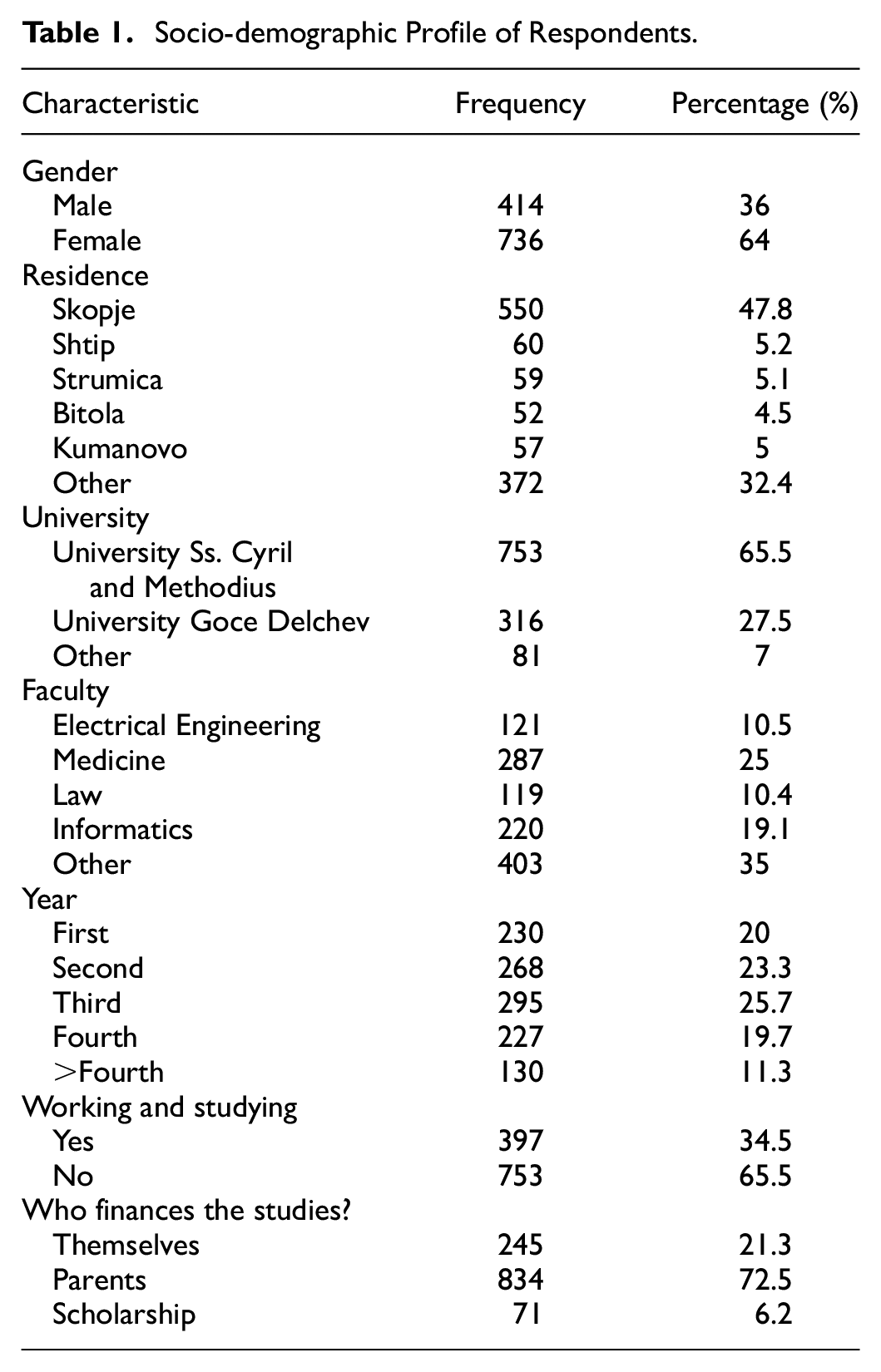
The participants’ profile of socio-demographic characteristics, presented in Table 1, shows that respondents were mainly women (64%), residents in Skopje (47.8%) and studying at the University Ss. Cyril and Methodius (65.5). Most representatives are dedicated exclusively to studying (65.5%) and economically dependent on their parents (72.5%). This study’s population consists of students from Macedonia’s public universities. Most students attend university in Skopje, the capital city, where the major university is located.
Socio-demographic Profile of Respondents.
Measures and Analyses
The observed constructs were built on scales validated in the previous literature for perceived value (Ledden et al., 2007), satisfaction (Lai et al., 2012), and intention to leave the country (Barrett & Yates, 2002; Kizito et al., 2015). The variables were measured through multiple items, using a 5-point Likert scale (ranging from 1 = “Strongly Disagree” to 5 = “Strongly Agree”). The model consists of 31 items grouped into nine variables (functional value, epistemic value, social value, emotional value, conditional value, image value, satisfaction, intention to leave the county, year of study) and an additional socio-demographic description (Appendix). The components under functional value are concerned with how the degree contributes to students’ growth and how it will help them achieve their professional objectives. The epistemic value illustrates students’ views regarding the novelty and usefulness of the degree content, while the social value describes how referent groups regard the degree and the student graduating with it. The emotional value refers to the level of students’ sensation of accomplishment, and the conditional value includes the physical resources and organizational aspects of the environment. The image value depicts the faculty’s reputation. Additionally, the satisfaction variable represents students’ personal gratification with their experience, while the intention to leave the country reveals the degree to which students contemplate leaving the country. The year of study is a single-item variable, designating the year of the degree in which the student is enrolled.
The methodology chosen for the analyses was PLS-SEM (Partial Least Squares Structural Equation Modeling), matching the recommended criteria for its implementation (Hair et al., 2017). Adhering to the standard procedure, the measurement model and the structural model had to be validated. First, the relationships between latent variables and their corresponding observed indicators were specified, assessing the reliability and validity. After that, the relations concerning exogenous and endogenous variables were estimated to determine model’s explanatory power (Henseler et al., 2016). The analyses were executed using a high-level SEM tool for R (4.0.5) statistical package. Previously, the construct validity was confirmed by factor analysis. The findings revealed that the nine factors were adequate, and all of the generated indices had a satisfactory fit. The factor analysis was performed with R (4.0.5), as well. The descriptive statistics, particularly the mean and standard deviation, outlined in Table 2, were calculated with Python 3.7
Mean and Standard Deviation.

Note. FV = functional value; EV = epistemic value; SV = social value; EmV = emotional value; CV = conditional value; IV = image value; S = satisfaction; ILC = intention to leave the country.
Results
Measurement Model Assessment
The measurement model estimation began with scale refinement, deleting five items, one from each construct representing epistemic, social, emotional, conditional and image value, because of low or insignificant loadings. The use of standardized loadings (λ) for evaluating individual items’ reliability is proposed by researchers, defining the threshold of 0.6 as the desired value for the item to be considered pertinent (Hair et al., 2016). Then, scales’ reliability and internal consistency were corroborated (Table 3), confirming sufficient coefficients for all items, significant at a 99% confidence level (t > 2.57), and verifying adequate values for Cronbach’s alpha (α > .7) and Dijkstra-Henseler’s rhoA (rhoA > .7). The suitable values of the Average Variance Extracted (AVE > 0.5) evidenced the convergent validity (Bagozzi & Yi, 1988).
Measurement Model Valuation.

Note. All loadings are significant at a confidence level p < .001; All scales adapted from previous studies (perceived value—Ledden et al., 2007; satisfaction—Lai et al., 2012; intention to leave the country—Barrett & Yates, 2002; Kizito et al., 2015).
Then, discriminant validity had to be assessed to estimate how one construct of the structural model differentiates from another. Henseler et al. (2015) suggested using the Heterotrait-Monotrait ratio (HTMT) to evaluate the correlations, explaining that a factor with HTMT lower than 0.85 or 0.90 presents discriminant validity. Table 4 presents HTMT correlations to confirm the model’s discriminant validity with values lower than 0.90.
Heterotrait-Monotrait Ratio.

Note. FV = functional value; EV = epistemic value; SV = social value; EmV = emotional value; CV = conditional value; IV = image value; S = satisfaction; ILC = intention to leave the country.
Structural Model Assessment
After validating the model, we confirmed that the R2 of the dependent constructs surpassed the .1 threshold. The adjusted R2 value of this structural model is .7 for satisfaction and .1 for intention to leave the country, indicating that the model can explain 70% of the satisfaction and 10% of the brain-drain intention. Following Sarstedt et al. (2017), path coefficients (β) and bootstrapping confidence intervals of standardized regression coefficients were employed to sustain the proposed hypotheses (Table 5).
Structural Model Valuation.

Note. FV = functional value; EV = epistemic value; SV = social value; EmV = emotional value; CV = conditional value; IV = image value; S = satisfaction; ILC = intention to leave the country.
p < .001. **p < .01. *p < .05. ns—not significant.
The results disclose that all the paths are statistically significant, except for the link between epistemic value and satisfaction (Figure 2). Thus, seven of the eight proposed hypotheses have been confirmed by the results (Table 5). Functional value, social value, emotional value, conditional value and image value, all have significant effects on satisfaction: β = .24, p < .05, β = −.31, p < .001, β = .16, p < .005, β = .20, p < .05, β = .35, p < .001, respectively. Social value negatively affects satisfaction, meaning the reference groups’ opinions can decrease students’ satisfaction levels. Satisfaction also has a significant and negatively related effect on the intention to leave the country: β = −.26, p < .001. This result implies that the higher the students’ satisfaction, the lower their intention to involve in brain drain behavior. Hence, it can be concluded that six of the seven direct relationships are confirmed, although one has the opposite effect (social value impact on satisfaction). As observed from the results, the path between image value and satisfaction has the largest standard coefficient among all direct paths to satisfaction, suggesting that image value is the most influential variable affecting satisfaction. The negative coefficient on the path from student satisfaction to intention to leave the country supports the hypothesis of satisfaction directly mitigating students’ brain drain intentions. The epistemic value does not significantly impact students’ satisfaction, while social value negatively influences the same.

Calculated research model.
The analysis shows that the year of study in which the students are enrolled at the survey time plays a moderating role, confirming the eighth hypothesis. The findings of the moderating effect of the year of study contemplated on the relationship between satisfaction and intention to leave the country (β = −.06, p < .05) show that students in higher courses present greater satisfaction, thus less intention to leave.
Sharma et al. (2021) have contrasted the effectiveness of metrics used for model comparison. They concluded that Schwarz’s (Schwarz, 2007) BIC achieves “a sound trade-off between model fit and predictive power in the estimation of PLS path models.” The model that minimizes the value of BIC should be selected. In the final research model proposed in this study, the BIC value for satisfaction is −1211, and for intention to leave the country is −50.
Furthermore, considering the proposed model’s structure, a post hoc measure of student satisfaction’s mediating role might affect the relationships. Mediation analysis was performed, and indirect paths were observed (Table 6). The significance of indirect paths is required for verifying the moderating effect. The results reveal that the relationship between the students’ perceived values and their intentions to leave the country is indeed mediated by their satisfaction, positioning satisfaction as a necessary component to battle migration intentions.
Indirect Effects.

To summarize, students’ perceived value substantially impacts students’ satisfaction, where a pleased and satisfied student is less likely to seek to continue their studies or work options abroad. Students’ satisfaction plays a moderating role between their perceived values and intention to leave the country, indicating a detrimental impact on brain drain intentions.
Finally, additional analysis was performed to determine the possible effect of a specific set of control variables. Gender, university, the employment situation of students, and financial support for the studies were considered control variables, following previous literature claiming their potential impact (Hornstein Tomić et al., 2018; Yavuz et al., 2017). Each of the control variables was included as additional variables connected to the dependent variable intention to leave the country, to explore if they alter, in any way, the validity of the model. The control analyses reveal the following results for gender (β = −.018, p = .285), university (β = −.033, p = .134), employment situation of the students (β = .019, p = .280), financial support for the studies (β = .034, p = .149). None of the control variables manifested a significant impact on the proposed relationships.
Discussion
Discussion of Findings
As shown in the study results, six out of the eight proposed relationships had been fully supported, and one hypothesis was partly confirmed. Namely, it was proved that the students’ satisfaction is highly triggered by functional (H1), emotional (H4), conditional (H5), and image value (H6). This finding is consistent with the previous literature (Preedy et al., 2020; Schlesinger et al., 2015), which underlines the value perceived by higher education students as vital for their satisfaction with the service. Therefore, the greater the appreciation of the degree’s future opportunities, gratification from studying the degree, institution and program implementation conditions, and the status related to the institutions’ image, the higher the students’ overall satisfaction with higher education services. Investments in an enhanced education system infrastructure, which would highlight the excellence and positioning of the higher education resources in the Western Balkans, is decisive for long-term education planning and actions. If featured effectively, those value elements will improve the increased opportunities for students, further improving professional prospects.
However, the epistemic value (H2) turned out to be an insignificant predictor of students’ satisfaction. Thus, they do not consider the value added by the content’s novelty or related interest for a fulfilling service evaluation. This effect is found to be contradictory to previous research (Haaz, 2019), claiming that the elements of innovation and an enriched education are essential to students’ satisfaction. The reason why our results do not comply with the previous might lie in the fact that students are already familiar with the program since the mare beginning of the degree and even earlier. So, as they progress through their studies, they are not surprised by the content or the potential novelties, as they already have their expectations positioned high. Furthermore, due to the generation z’s continuous exposure to innovativeness, as the digital natives, it might result difficult for them to perceive the epistemic nature of the learning experiences (Kuleto et al., 2021).
Furthermore, the results reveal that social value (H3) negatively affects students’ satisfaction. Opposed to the general higher education literature (Ledden et al., 2011), which describes the surroundings as having a positive influence on students, the results of this research suggest that reference groups’ views about the degree’s importance and potential for future achievements might be perceived by students as unfavorable. As such, what their close ones think about the education they attend could be considered as additional pressure on students’ observations and satisfaction. The reason for this could be found in the propensity of people from Western Balkan countries to underestimate the social and cultural circumstances of Balkan societies, which leads to evaluating the occasion to leave the country as a better professional opportunity and possibility for an enhanced quality of life (King & Oruc, 2019).
As observed in the study, the value might be perceived differently and operate with a fluctuating impact. The finding that some value elements have less importance for students has been founded in the related literature. This inequality of the perceived value elements is justified by considering that different consumption values are independent and function individually, depending on the user’s personal preferences (Marbach et al., 2016; McDougall & Levesque, 2000; Zeithaml, 1988). It is claimed that, although it is desirable to maximize all value aspects, sometimes it might not be feasible, as users are inclined to choose a significant portion of a relevant value for a precise situation while giving up on less important ones (Sheth et al., 1991). Nonetheless, this supposes no problem for the students’ satisfaction, given the likelihood to perceive high levels of satisfaction only through those values that they believe are essential for higher education.
Withal, students’ satisfaction correlates negatively with their intention to leave the country for a better professional opportunity. It implies that students more satisfied with their studies are less prone to engage in brain drain actions (H7). This inference puts the focus on the students’ satisfaction as the necessary condition to be fulfilled for mitigating intentions to leave the country. Furthermore, students’ satisfaction is automatically motivated by the value they perceive in the higher education system, underpinning the cruciality of its mediating role.
Finally, the year of study students are enrolled in seems to be a significant moderator of the relationship between satisfaction and intention to leave the country (H8). In compliance with the literature (Burgess et al., 2018; Ledden & Kalafatis, 2010), it is expected that students’ perception of the value of the degree they study and their satisfaction with the overall higher education service would vary over time, as the student progresses through the studies. Here, a positive inclination was concluded, indicating that students in more advanced courses show higher appreciation of and gratification in favor of their studies, further diminishing their intention to leave the country.
Academic and Managerial Implications
This study provides several significant implications for the theory of service consumption and higher education. First and foremost, although several aspects of higher education have already been observed in the literature, the general higher education system integrating different degrees, faculties and universities, as perceived by the students, has not been an object of research, as far as authors’ knowledge. Therefore, this research contributes to a broader understanding of the higher education system in a Western Balkan country, identifying it as a crucial pillar in tackling one of the biggest concerns in the region, the brain drain intention. Second, by observing the opinion of a large sample of current students at Macedonian universities, the investigation adds to the body of knowledge of higher education in developing countries, giving the possibility to recognize forms for improving higher education on its path toward sustainable education and equal working opportunities, which in the long run are responsible for the economic and social enhancement of the region (Churski et al., 2021). With this in mind, input is made to support educational policies that help hinder students’ intentions to leave the country and overcome the economic breach between Balkan countries and the European Union. Third, up until now, the authors have not found evidence of exploring the antecedents of brain drain out of the very financial and socio-demographic reasons as the motives to migrate (McGill, 2018). In this study, brain drain is observed from the lens of higher education, aiming to avoid considering the conditions for working abroad as more valuable, since the beginning of students’ professional choice. The generation of perceptions that international migration could be a better option than continuing professional life in their own country is also a socio-cultural condition, highly fomented by the surroundings. That is why it is of substantial importance for students to recognize and appreciate by themselves the higher education system and understand Macedonian educational quality and potential. Fourth, this study contemplated satisfaction as the straightforward determinant of students’ intention to leave the country yet did not miss exploring how the perceived value influences this tendency indirectly, as suggested in related research (Ledden et al., 2011). Evaluating the indirect effects of the perceived value, along with the direct impact of satisfaction, explains students’ future intentions more effectively. In this way, the interaction with the service through the actual experience of consumption is contemplated more systematically, enabling to explore more meticulously the causal relationships among actual students’ observations and practices (Giantari et al., 2021). With all this in mind, this study makes a notable contribution by enhancing the limited understanding of researchers and managers on the antecedents of the brain drain propensity of students in Western Balkans. Finally, the implications here exemplify the intention to leave the country with regard to diminishing the risk of losing educated people as the primary source of developing countries’ progress and transition.
Apart from the contributions to the abovementioned theory, few managerial insights can be derived from this study’s findings. The strong connection between the perceived value and students’ satisfaction, as the regulator of students’ intention to leave the country, requires an emphasis on (a) the usefulness and practicality of the degree for realizing career goals—“functional value,” (b) self-confidence and achievement acquired upon personal effort and ambition - “emotional value”, (c) tangible and intangible infrastructure and materials facilitating the learning process “conditional value,” and (d) positive image and reputation that the institution enjoys, as the triggers of students’ overall satisfaction. Higher education institutions must pay special attention to increasing current and potential future students’ awareness about the value of Macedonian universities and the offered degrees. Developing an effective framework for offering practical, convenient, accessible, and prominent learning at Macedonian universities will deliver institutional organization, encouragement, student gratification and fulfilment. A helpful strategy could be to organize events, such as open days, to present working possibilities and collaborations with companies stationed in Macedonia. Professionals from various fields could explain how the different degree programs match the market and motivate students by offering internships or job positions where students could employ the capacities accomplished at the university. The institutions must invest in infrastructure and current materials to enable special access to knowledge and consolidate education growth. With time, this will ultimately provide valuable professional opportunities for students and recent graduates, leading to augmented economic prospects and positive expectations and standards (Council of Europe Development Bank, 2021).
Further, considering how family and close friends’ perception of the importance of pursuing the precise degree -social value- could harm students’ fulfilment with their choice, underlines the risk of burden for students, a sense of responsibility they might feel due to the institution’s status. Hence, the general public should be educated on the value of the Macedonian higher education system. Universities must sustain the educational quality of the service and the personal and professional benefits that students could enjoy if they remain in Macedonia, not only to current students but to prospective students and their reference groups, likewise. This is expected to provide students with their own, not biased, choice about the degree, the institution and their worth. The knowledge and awareness about Macedonian higher education potential can soften the negative social influence and will further reduce students’ intention to leave the country. Subsequently, highly educated people equipped with relevant and unique skills manage to contribute to the economic growth and social progress of the country (Naumovski, 2021).
Finally, the findings that students in higher courses present higher satisfaction, thus less intention to leave, mean that as students advance through the studies, they value the elements characterizing the degree and the institution better. An increased knowledge, capacity recognition and competent experience, which are gained during higher education, strengthen the benefits for social, capital and technological innovation, otherwise limited by emigration (Leitner, 2021). Therefore, it is considered crucial for higher institutions to highlight the excellence of the higher education system from the beginning of their studies, so that students can experience and appreciate its value throughout the process of schooling. Additionally, continuous measurement of student satisfaction by institutional managers will ensure that students’ expectations and progress are met (Burgess et al., 2018). Through the collected information, students can benefit from success stories, proving capacities or professional experiences. A transition toward higher value-added growth activities and a productive working future in the country will be visible, and a reduction in brain drain intentions can be expected. In this way, one of the main problems in Western Balkans in the last decade could be hindered.
Limitations and Future Research
This study presents a few limitations that could be overcome in future research. First, the restriction of the investigation to only one country makes it difficult to generalize the result and implications for a wider area. Therefore, it could be useful to broaden the survey and replicate the research in more Western Balkan countries to explore the intentions to leave the country, generally for the whole Western Balkan region. Moreover, from a methodological perspective, it can be observed that R2 presents lower values for students’ intention to leave the country. Although those values are expected and considered acceptable in social sciences (Hair et al., 2019), the result points out the necessity to include more antecedents, which would better explain brain drain tendencies. In fact, satisfaction literature claims that service satisfaction is indispensable, yet not necessarily the unique requirement for future intentions (de Oliveira Silva et al., 2020). That suggests the need to explore a more exhaustive model, integrating antecedents related to the higher education service quality, institutional support, or instructors’ characteristics while likewise addressing professors’ perceptions in comparison to the students’ (Hora & Smolarek, 2018; Prodanova & Kocarev, 2023; Qiwang & Xiaorui, 2020) and even labor market issues, such as youth unemployment or wage rates (Abler et al., 2023). Furthermore, given the signs of circular migration of highly educated individuals going back to their original countries, called “brain gain” (Đorđević, 2021), it can be beneficial to perform a longitudinal study, where the change in migration patterns could be observed to determine the motives for brain gain tendency in contrast to those of the brain drain.
Conclusions
Given the later years’ tendency of youth to look for a more fruitful future in international migration, it has been deemed indispensable to tackle the ways of mitigating brain drain intentions (McGill, 2018). In the extant literature, this trend has been contemplated from a more general perspective, where the antecedents of intentions to leave the country have been focused mainly on economic and social reasons (Fitzpatrick & Jones, 2016; Okoro et al., 2014). However, provided that in Western Balkans, external migration is pronounced mainly by graduates wishing to continue their education or gain working experience abroad (WFD, 2019), it was considered crucial to observe how the higher education system determines these intentions. Therefore, the study’s objective has distinctively focused on exploring students’ perceived value of and satisfaction with the higher education service, as the predecessors of commitment indications, such as students’ intentions to leave the country. The model was constructed to address the means of competitive positioning of educational institutions as drivers for the continuous commitment behaviors of students (Ledden & Kalafatis, 2010; Mostafa, 2019). The outcomes from the analysis of the opinion of1,150 university students in Macedonia recognized the perceived value as the actual condition for accomplishing students’ satisfaction, indispensable for resisting the brain drain tendency. It was likewise evidenced that these trends maintain a stronger position as the students advance through the degree, emphasizing the need to address education quality from the beginning of their academic careers. These findings have enhanced the understanding of the current that university students follow, in the search for a prosperous professional future, enabling higher education institutions to trace the generation of perceptions determining students’ turnover behavior. Additionally, the results have revealed the intense power of the reference groups, indicating their responsibility for students’ decision-making.
The related conclusions summarize the suggestions for the universities’ environment to develop an efficient action plan for promoting Macedonian higher education among the wider public. This trend might also be applicable in other countries in the Western Balkan region, given the similarity of the social and economic systems. Conclusively, informed and qualified people are the requirement for developing countries to reach, manage and control the advanced processes that will create a productive economic system, innovative development and improved everyday wellbeing, essential for the deployment of reforms (Council of Europe Development Bank, 2021; Naumovski, 2021).
Footnotes
Appendix
Questionnaire for Students in Higher Education.

| Dear students! This questionnaire was created in order to get your opinion about the studies you attend, the professors who teach you and the faculty and university to which you belong. Please answer the questions honestly and objectively, based on your personal experience. We mention that we are interested in your own opinion, which means there are no right and wrong answers. Thank you for your cooperation! |
|||||
| Express your agreement with the following statements (from 1 = strongly disagree to 5 = strongly agree): | |||||
| This degree will allow me to achieve my career goals. This degree will allow me to earn a good/better salary. The knowledge I will have acquired on this degree will enable me to do my current/future job better. This degree will lead to a promotion in my current/future job. This degree is a good investment in my future. This degree has contributed to my personal development. |
1 1 1 1 1 |
2 2 2 2 2 |
3 3 3 3 3 |
4 4 4 4 4 |
5 5 5 5 5 |
| Express your agreement with the following statements (from 1 = strongly disagree to 5 = strongly agree): | |||||
| I learn new things in this degree. I am interested in the content of this degree. This degree content contributes to the high value of my education. The academic guidance I receive from the teachers has enhanced the value of this degree. |
1 1 1 1 |
2 2 2 2 |
3 3 3 3 |
4 4 4 4 |
5 5 5 5 |
| Express your agreement with the following statements (from 1 = strongly disagree to 5 = strongly agree): | |||||
| People who are important to me think that taking this degree is a good thing to do. People who influence what I do think that taking this degree is a good idea. My current/future employer will see me in a better light when I have finished my degree. My family and friends will see me in a better light when I have finished my degree. The social interaction with fellow students on my degree makes my studies more interesting. The support of my friends and family is important for me to pass this degree. |
1 1 1 1 1 1 |
2 2 2 2 2 2 |
3 3 3 3 3 3 |
4 4 4 4 4 4 |
5 5 5 5 5 5 |
| Express your agreement with the following statements (from 1 = strongly disagree to 5 = strongly agree): | |||||
| I feel proud that I am taking this degree. Taking this degree has boosted my self-confidence. Taking this degree has fulfilled an ambition. My performance in this degree depends on my personal effort. Taking this degree has given me a sense of self-achievement. |
1 1 1 1 1 |
2 2 2 2 2 |
3 3 3 3 3 |
4 4 4 4 4 |
5 5 5 5 5 |
| Express your agreement with the following statements (from 1 = strongly disagree to 5 = strongly agree): | |||||
| The support materials supplied to me in this degree (e.g., study packs/texts) have helped my learning. Study-group work has been a beneficial part of this degree. The campus and its facilities have contributed to the value of this degree. The location of the faculty contributes to the value of this degree. |
1 1 1 1 |
2 2 2 2 |
3 3 3 3 |
4 4 4 4 |
5 5 5 5 |
| Express your agreement with the following statements (from 1 = strongly disagree to 5 = strongly agree): | |||||
| The reputation of the faculty influences the value of this degree. The image displayed by the faculty has an impact on the value of this degree. I believe that employers of the faculty would have positive things to say about it. I have heard positive things about the faculty. I believe that the faculty has a good reputation. |
1 1 1 1 1 |
2 2 2 2 2 |
3 3 3 3 3 |
4 4 4 4 4 |
5 5 5 5 5 |
| Express your agreement with the following statements (from 1 = strongly disagree to 5 = strongly agree): | |||||
| Based on all of my experience, I am very satisfied with the quality of the program and courses. My overall evaluation of the services provided by this university is very good. Overall, I am very satisfied with the decision to choose this university. |
1 1 1 |
2 2 2 |
3 3 3 |
4 4 4 |
5 5 5 |
| Express your agreement with the following statements (from 1 = strongly disagree to 5 = strongly agree): | |||||
| I will move abroad in the near future. I often think about leaving the country. |
1 1 |
2 2 |
3 3 |
4 4 |
5 5 |
| Year of study | 1 | 2 | 3 | 4 | 5 6 |
| Socio-demographic and economic aspects: | |||||
| Gender Residence University Faculty Working and studying Who finances the studies? |
Male/Female Open question Open question Open question Yes No Self/Family/Scholarship |
||||
Note. The questionnaire was built based on scales validated in the previous literature for perceived value (Ledden et al., 2007), satisfaction (Lai et al., 2012), and intention to leave the country (Barrett & Yates, 2002; Kizito et al., 2015).
Acknowledgements
All contributors meet the criteria for authorship. Many thanks to the potential reviewers.
Declaration of Conflicting Interests
The author(s) declared no potential conflicts of interest with respect to the research, authorship, and/or publication of this article.
Funding
The author(s) disclosed receipt of the following financial support for the research, authorship, and/or publication of this article: This work was supported by the European Union’s Horizon 2020 research and innovation program under grant agreement No 101006279.
Ethics Statement
Not applicable.

Data Availability Statement
The data that support the findings of this study are available from the corresponding author upon reasonable request.