




Abstract
This study’s research aim is to discover how the COVID-19 pandemic impacts early career researchers’ work lives, prospects, and scholarly communication behavior. Early career researchers (ECRs), including doctoral students, post-docs, and pre-tenure faculty, are the next generation of scientists, researchers, scholars, teachers, and academic leaders, and are considered “vulnerable” when compared to their more senior colleagues. Part of an eight-country study, we present findings from long semi-structured interviews of 22 ECRs within the sciences and social sciences from a variety of regions in the United States. Transcripts were approved by the participants and responses were coded into a project-approved spreadsheet for analysis. The coding sheets were multi-faceted, containing both quantitative and qualitative data. Key findings include loss of research productivity due to lab closures and/or human subject research. The most recurring negative impact is the loss of formal and informal in-person meetings. For the majority, the pandemic has not deterred ECRs to deviate from their chosen academic career paths.
Introduction
The COVID-19 pandemic has created much disruption in the scientific community around the world. In addition to health issues, there have been institutional lockdowns, conference cancellations, lab closures, border closures, travel bans, social distancing, childcare issues, mental health issues, and hiring freezes that created much disruption of pre-pandemic research work life.
The early career researcher (ECR) cohort—a subset of the overall scientific community, generally doctoral students, post-doctoral researchers, and junior professors—have been exposed to the same sickness and disruptions as the overall community. However, ECRs are often considered “vulnerable” (Hunt, 2020; Paula, 2020) when compared to their more senior colleagues. For example, most tenured professors would typically have more job security than would ECRs. With the pandemic, some scholars express concern academia would suffer a “lost generation” (Nicholas, 2021; Harrop et al., 2021) and others remind us of the traditional negative impacts that ECRs experience (e.g., uncertainty, lack of available opportunities, low funding, and job insecurity) would be exacerbated by the pandemic (López-Vergès et al., 2021; Woolston, 2020b, 2020a). Interest in and research of ECRs is important due to the fact that ECRs are the next generation of scientists, researchers, scholars, teachers, and academic leaders (Inouye et al., 2020).
In the United States, over 1,300 colleges and universities canceled classes or moved to online instruction during the 2020 spring semester (Smalley, 2022); however by the 2020 fall semester, several states resumed in-person instruction mainly due to politics and budget concerns (Felson & Adamczyk, 2021). In 2020, over 350,000 people died from COVID-19 as the underlying cause of death in the US (Murphy et al., 2021). The Alpha variant began its US wave in early 2021 and the Delta variant began in the summer of 2021 (Centers for Disease Control and Prevention, 2022). During 2021, another 460,000 people in the US died from COVID-19 as the underlying cause or contributing to death (Ahmad et al., 2022). The US, as with most of the rest of the world, was still in the throes of the pandemic in 2021.
It is against this backdrop that an international research project started in late 2020 to explore ECRs and the pandemic. The University of Tennessee, Knoxville in the United States and CIBER Research LTD in the United Kingdom assembled an international team including researchers from China, France, Malaysia, Poland, Russia, Spain, the United Kingdom, and the United States. The research aim was to learn pandemic impacts of ECRs’ work lives, prospects, and scholarly communication behavior from scientists and social scientists with a series of long interviews. Herman et al. (2021) provides background literature for the overall project. Other project articles and reports are available at http://ciber-research.com/harbingers-2/.
Although the above refers to the international project, this article relates only to the attitudes and practices of the US ECRs, which enables an in-depth insight rather than a more general comparative one.
The COVID-19 pandemic was unique for ECRs. The pandemic led to widespread disruptions in academic activities, including lab shutdowns, conference cancellations, and travel restrictions, which impacted ECRs’ ability to conduct experiments, network with colleagues, and disseminate their findings. Furthermore, the pandemic led to economic uncertainty, which had a bearing on job prospects and funding opportunities for ECRs. The pandemic also coincided with existing challenges in academia, such as the hyper-competitive job market and limited funding opportunities, which were exacerbated by the pandemic.
Types of ECR Pandemic Research Topics and Findings
Because of the uniqueness of the pandemic and our broad research aim, the literature presented below is only to give the reader a brief illustration of types of research topics and findings rather than a traditional critique to show gaps in the literature. To cover a broad range of research, some of the researchers investigated topics we did not cover in our research, such as mental health, well-being, and coping strategies.
Overview
ECRs in this review include PhD students, postdoctoral researchers, and the equivalent of assistant professors. Academic areas of ECRs cover a wide range including various sciences, technology, engineering, mathematics, social sciences, art, humanities, medical-related science, and education. These studies include ECRs from the United States, the United Kingdom, Japan, Sweden, and one survey study having participants from numerous countries.
There is also a wide range of research focus including knowledge production, dissertation writing, neuropsychology trainees, negative impact with nurse researchers, faculty of color in biomedical research, benefits/challenges with lockdowns, postgraduate research students, supervision/mentorship, mental health, and doctoral students’ careers.
Themes presented in this literature summary include mental health and wellbeing; coping and persevering; not abandoning pre-pandemic trajectory; supervisors, mentors, and institutions; disruptions; and work from home.
Mental Health and Wellbeing
Mental health and wellbeing are prevalent research topics in the ECR pandemic literature. Types of mental health issues reported include reduced levels of concentration and motivation, stress, anxiety, burnout, and depression (Doyle et al., 2021; Guidotti et al., 2020). Sources of these mental health issues include professional and personal impacts. Impacts on the professional side include changes to research productivity, interruptions of PhD progress, forced adaptation to research, supervisor change, financial stress due to hiring freezes, and concern for their future employment and careers (Doyle et al., 2021; Jackman et al., 2022; Sideropoulos et al., 2022). Issues on the personal side include childcare, health and safety, and in particular, the disease itself, either directly (e.g., positive tests) or indirectly (e.g., someone close to them tested positive) and less social contact and/or more isolation (Goldstone & Zhang, 2022; Guidotti et al., 2020). Research also indicates both higher levels of depression and anxiety with doctoral students who encounter multiple stressful events. And though more social contact is often considered wellbeing support, respondents reported adequate social support, but also increases in anxiety, depression, and difficulty with work life at home. (Guidotti et al., 2020; Sideropoulos et al., 2022).
Coping and Persevering
By nature, ECRs are resilient. They reach the “early career research” level with many years of perseverance. Subsequently, researchers have explored how ECRs’ coped during the pandemic. Coping strategies in literature include changing work times around a partner’s schedule, taking small breaks, getting outdoors and exercising, and connecting with advisors, human research subjects, friends, and family online, watching more television, reading, and sleeping. Maladaptive strategies are also reported, such as eating more unhealthy food, drinking more alcohol, and exercising less. To keep them persevering, ECRs report maintaining good eating/sleeping habits, getting at least some work done, having advisors who push or help with planning, and utilizing stress resources from their institutions (Guidotti et al., 2020; Lee et al., 2022). Furthermore, more anxiety is associated with low coping skills and low attentional ability (Sideropoulos et al., 2022).
Not Abandoning Pre-Pandemic Trajectory
Some researchers wondered if ECRs are likely to make major career changes during the pandemic. Somewhat related to resilience and perseverance, ECRs are not more likely to abandon academia or change their research direction, and they also did not expect reductions in their funding (Beverstock & Pickersgill, 2022; Guidotti et al., 2020; Haas et al., 2022).
The lack of abandoning academia or changing research direction is not necessarily unexpected. Prior to the pandemic, PhD students knew of difficulties with academic job markets, and it did not deter them from leaving academia. Therefore, the pandemic may not have been enough of a deterrent for older PhD students. As for younger PhD students, knowing that a pandemic would eventually be mitigated and life will eventually return to normal, they may have seen the pandemic as a temporary setback and their long-term prospects are unaffected. Another possibility is that the actions taken by universities and/or their academic departments to mitigate the impact of the pandemic may have been enough to reduce students’ concerns (Haas et al., 2022).
Regarding the lack of ECRs changing their research direction, in science fields, it is customary to prioritize expertise in a specific area and establish a coherent academic path to advance professionally (Beverstock & Pickersgill, 2022). So changing research direction toward Covid may not be in the best interest of the ECRs.
Supervisors, Mentors, and Institutions
Because of the ECR status (i.e., being an early career researcher), the support of supervisors, mentors, and institutions likely have the most impacts on ECRs. ECRs mention supervisors and institutions conducting effective communications during the pandemic. Supervisors are mentioned as being good models and ECRs feel comfortable discussing personal health and safety concerns with supervisors (Guidotti et al., 2020). Though ECRs state improved or unchanged mentorship/supervision during the pandemic, others have suggested worse or less mentorship/supervision (Börgeson et al., 2021; Goldstone & Zhang, 2022). Evidence of the institution meeting the needs of the ECRs, thereby suggesting better handling of student stress, is also present in literature (Haas et al., 2022). However, authors also suggest some institutions’ responses to the pandemic were more effective than other institutions (Goldstone & Zhang, 2022).
Disruptions
Disruptions are found in both professional and personal lives of ECRs. Disruptions with work are common and include lab closures and social distancing forcing researchers to make changes to labs and/or conduct research at home (Beverstock & Pickersgill, 2022; Doyle et al., 2021). Negative impacts in research activities include data collection, data analysis, discussions of ideas and findings, dissemination of research findings, writing, and working on funding applications (Byrom, 2020). Negative impacts related to research management include difficulty with access to equipment and data, and difficulty with using assistants (Goldstone & Zhang, 2022; Kazawa et al., 2022). ECRs who teach mention negative impacts related to student education and organizational management (e.g., increased time for research supervision, lecture preparation, and meetings). Some student ECRs express issues with their course instruction changing from in-person to online and reduced training for study support (Goldstone & Zhang, 2022; Guidotti et al., 2020; Kazawa et al., 2022).
Work From Home
With the shift to “work from home” (WFH), research findings indicate both pros and cons with WFH and distorting boundaries between home and work life. WFH is more difficult with caring responsibilities and loneliness from lack of in-person activities. Productivity has dropped due to procrastination, childcare disruptions at home, extra work of moving teaching online, and health issues (Doyle et al., 2021; Jackman et al., 2022; Lee et al., 2022). On the positive side, ECRs benefit from less commuting, which enables more efficient use of time and subsequent productivity gains and even better work-life balances. Some ECRs can transition from lab work to writing manuscripts or proposals, thereby maintaining productivity. And ECRs working with human subjects have shifted to video, phone, or both for seeing patients (Doyle et al., 2021; Guidotti et al., 2020; Jackman et al., 2022).
Final Remarks
The takeaway from this section is that ECRs are very much impacted by the pandemic, but they are resilient and adaptive. Even with mental health issues, ECRs find ways to cope, persevere, and keep focusing on their career path. This may be partly because many supervisors, mentors, and institutions are providing the support ECRs need. There is an abundance of disruptions from both work life (e.g., lab/institution shutdowns) and home life (e.g., the transition to “work from home”), which taken together is a struggle for many. But ECRs find ways to continue moving forward.
Method
Study Design
This US study article represents one part of a larger, longitudinal international project. To achieve the project’s research aim—that is, to learn as much about the pandemic impacts of ECRs’ work lives, prospects, and scholarly communication behavior from scientists and social scientists—the design for the international project was based on a previous 4-year international project named Harbingers (see http://ciber-research.com/harbingers.html). The design included long semi-structured interviews with a longitudinal element to study change (i.e., repeat interviewing), and a slightly unusual element whereby closed and open questions were asked. This method was selected due to the multi-language nature of the project, so the ECRs’ answers could be cross-checked/triangulated. Also included was an initial comprehensive literature review (Herman et al., 2021), which helped formulate some of the interview questions, the responses of which fed into the design of an international survey.
A long semi-structured interview schedule was developed for the international pandemic impact project and interviews were conducted roughly 6 months apart. For this US research article, we use the first of the three interviews, which began January 19, 2021 and ended March 2, 2021. This period is important because ECRs had been working with the pandemic for nearly a year and were able to reflect and provide sentiments based on their actual impact of the pandemic while they were coming to grips with their “new normal.” In other words, enough time had passed such that ECRs could clearly see and feel the pandemic’s impact.
Ethics Approval
The overall international interview study was approved by the University of Tennessee, Knoxville’s Institutional Review Board under identification number UTK IRB-20-06132-XP.
Recruiting
This project defines ECRs as non-tenured, under the age of 45 years, and who meet one of the following requirements:
received their doctorate and are currently working on a research project, or
currently undertaking a doctorate and working on a research project, or
have been in a research position and are now undertaking a doctorate.
Twenty-two ECRs were recruited by email for the US interviews. Sources for potential US ECRs included those who participated in a previous study with CIBER Research LTD, known as Harbingers (see http://ciber-research.com/harbingers.html) who met the recruiting requirements; college/university doctoral, post-doctoral, and assistant professor websites; social organizations of doctoral students and young scientists; and referrals from older researchers in specific fields. Recruits were provided the study’s informed consent for review/signature before the first interview.
Participants
The 22 US ECRs are from flagship universities, regional universities, private universities, a private college, a research institution, and one in industry. The institutions are from diverse areas of the US, including east coast, mid-west, southeast, south central, and west coast. The titles or roles of ECRs include doctoral students, post docs, researchers, assistant professors, and an industry scientist. ECR ages range from 26 to 41 years, with an average of 33 and median 32. There are 12 females and 10 males. Broad disciplines of the ECRs are presented in Table 1 along with the number of ECRs within those disciplines and genders. This is followed by Table 2 which provides the pseudonyms for each participant along with their institution types.
Broad Disciplines, Number of Participants per Disciplines, and Genders of US ECR Cohort.

Pseudonyms for Each Participant With Institution Types.
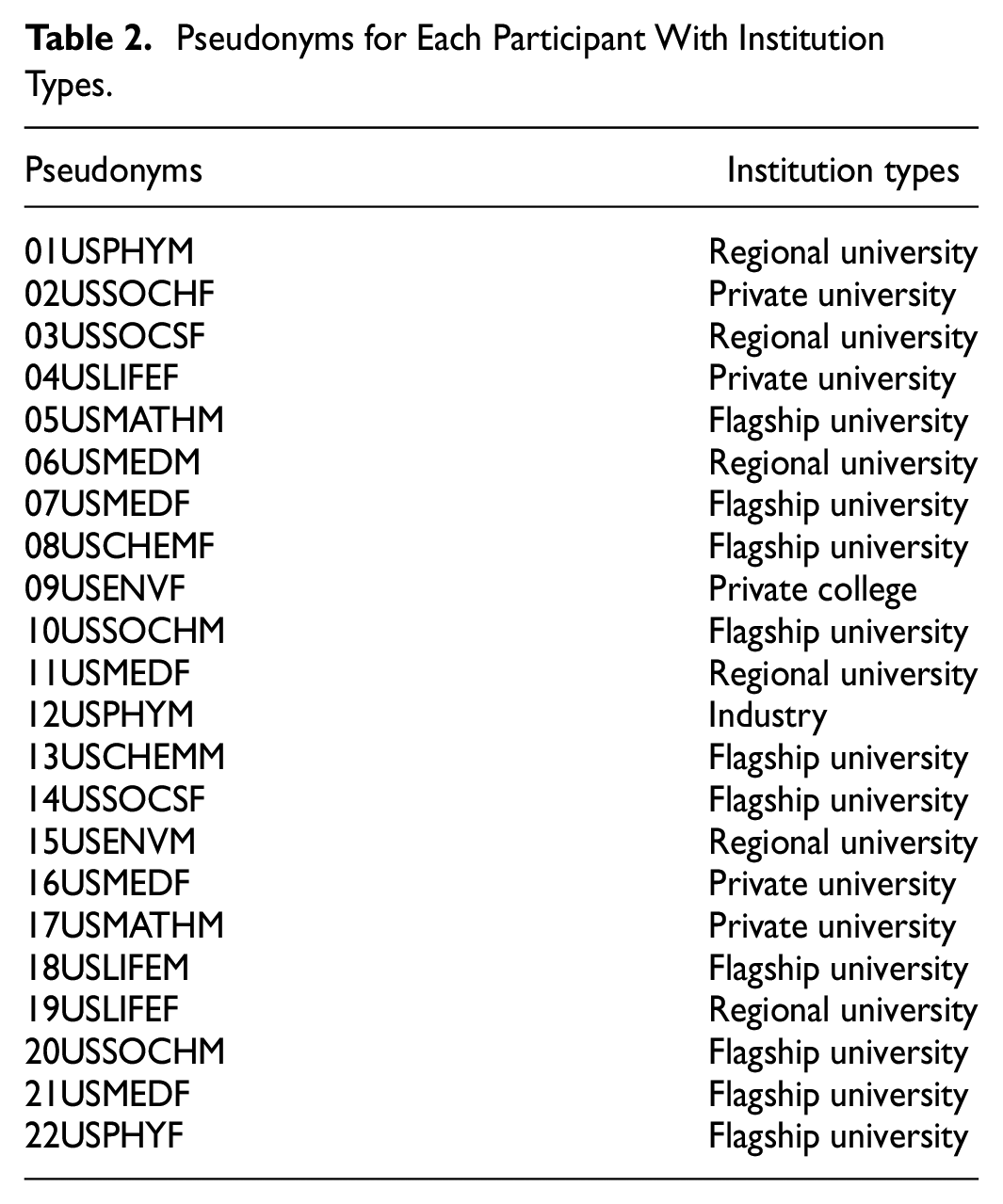
For confidentiality, we created pseudonyms for each of the 22 ECRs using the following guide:
• ECR number: 01 to 22
• ISO Country Code (in which they work): US
• Discipline codes (see Table 1)
• Gender: F/M
Example 1: A male ECR from the US in physical sciences = 01USPHYM
Example 2: A female ECR from the US in physical sciences = 22USPHYF
Data Collection
Pilot interviews were conducted by the international teams to refine the final interview schedule. The overall interview schedule contains over 50 questions, a mix of closed, open, and hybrid questions, and the interviewer could explore as needed for understanding. The interview questions for this US article are provided in Supplemental Material. The entire international interview instrument is available at http://ciber-research.com/harbingers-2/20201202-H2-Interview_schedule-1.pdf. The average time for the first US interviews was about an hour and 40 minutes in length.
The Zoom conferencing platform (Zoom Video Communications, Inc., San Jose, California, USA, www.zoom.us) was used for recording both audio and video. By early 2021, all US ECRs were very familiar with Zoom and by all appearances, they express themselves as if the interviewer was in the rooms with them. Both Zoom auto-transcription and replay of recorded interviews were used to complete draft transcripts which were sent to ECRs for any edits, additions, and final approval.
Data Analysis
With the approved transcripts from ECRs, responses were coded into a project-approved spreadsheet for analysis. The interviewer populated the coding sheet to maintain consistency between the interviews and the transcript analyses.
The coding sheet, which closely matched the questions of the original interview schedule, left room for information derived from additional inquiries or clarifications during the interview process. A mapping was maintained so that same, revised, and new questions could be matched between schedule, coding, and the three rounds of interviews. The coding sheets were multi-faceted, containing both quantitative and qualitative data, and often a question generated both. For each question, the code sheet captured the interviewee’s response in three ways: (1) as a code (e.g., Y/N); (2) as a quotation; and (3) as an explanatory comment from the interviewer. We refer to (2) and (3) as being free-text data. Not all responses were encoded, as some sought a more extensive explanation, which is recoded only as quotation and commentary. Quotations and commentary were “at will,” they vary in extent and quality and, often for coded responses, may be omitted. Free-text data were analyzed using thematic coding, based on themes from the questions and any new themes emerging from the data. In addition, a third party checked the data for consistency and errors.
Though the overall interview schedule contains over 50 questions, for this US study, the analysis is limited to most of the pandemic impact questions (i.e., typically having the word “pandemic” in the question). The 22 US coded spreadsheets were used to create the results below.
Results
The results are rich in content due to our attempts to include most all summarized responses related to pandemic impacts rather than selecting majority responses or focusing on a narrow topic. We provide this to capture viewpoints and sentiments of as many respondents as possible with the assumption that even a small number of responses from interviewees can be the same or similar experiences of thousands of ECRs, which we believe will ultimately help academic policy researchers studying pandemic/catastrophic events.
With the large number of results presented below, we created four tables of information to give the reader a general understanding of the primary responses provided by the ECRs in the three main subsections below, which are work lives, prospects, and scholarly communication behavior. Table 3 provides the primary percentages from all three subsections, and Tables 4 to 6 provide primary responses from the three main subsections in separate tables.
Primary Percentages in Results.

Primary Responses in Work Lives Results.

Primary Responses in Prospects Results.

Primary Responses in Scholarly Communication Behavior Results.

Reporting Structure
Below are result summaries from responses of US interview questions, which directly asked about the pandemic’s impact during early 2021 as the pandemic was in full force. The summaries are separated into the three main research aims of the study, which are the pandemic impacts of ECRs’ work lives, prospects, and scholarly communication behavior.
Generally, in each topic below, we report answers/sentiments most mentioned first, followed by answers/sentiments mentioned second, etc. and declining to answers/sentiments least mentioned.
Work Lives
Research Related to the Pandemic
Most ECRs’ (77%) research is not directly involved with the pandemic. The few with research projects related to the pandemic also have other non-pandemic research projects. For those with pandemic-related research, research benefits expressed mostly include additional grant funding, new research projects that would not have happened, and more time to strengthen connections with other collaborators. As stated by a doctoral student in mathematics sciences: “[The pandemic] has given us an opportunity to do research in additional topics or events” (17USMATHM). ECRs also mention the speed at which COVID-related manuscripts are being reviewed, which are much faster than normal.
Impacts to Non-pandemic Research
As for other research not directly related to the pandemic, both negative and positive impacts are mentioned, with several ECRs expressing both sentiment types. ECRs mention much more negative impacts of the pandemic than positives. An assistant researcher in life sciences captures not only a pandemic impact to an ECR’s career but also the resilience and perseverance that so many ECRs seem to have: The pandemic completely derailed the career trajectory I was on, but it’s also probably opening a new door, new opportunity as well. I think I agreed to do this [interview] because when I agreed, I was still feeling like it had changed everything. But I’ve been coming to terms with the new reality, trying to move forward (18USLIFEM).
In the extreme cases of the pandemic’s impact to research are the severe health issues. One doctoral student experiences severe mental health issues due to isolation. Another ECR has “long Covid” with the first 3 months “very draining” with impacts of low energy, lack of focus, breathing difficulty (and subsequent physical therapy), and pain in various places in the body.
By far, loss of research productivity due to lab closures and/or human subject research are the primary losses expressed by ECRs. Research productivity has slowed dramatically due to lab closures with two ECRs being 6 months behind in research. As labs start reopening, additional impediments to research emerge. There are limits to the number of lab personnel who could be in the lab, and if someone is sick, they must get tested before returning to the lab. One ECR states not all assistants returned, thereby creating longer waiting periods for things to happen. Student assistants graduating creates a lab infrastructure loss, and a lack of continuity of lab personnel is also mentioned as increasing delays. Related to research delays, one ECR expresses concern that research funds may not “rollover” into the next year.
Two ECRs mention field work with human subjects was canceled. ECRs who could continue with human participants express delays with research such as humans in lab studies being limited to small amounts of lab time (e.g., 15 minutes) to minimize their risk. And due to not being able to have human subjects in the lab, an assistant professor in hard social sciences shifts to different formats, which are costly and inconvenient. Other ECRs who require human subjects for their research mention data collection slowing due to challenges with recruiting participants for research. For example, some recruiting agencies are closed during the pandemic and others are completely overwhelmed. One ECR mentions their research partners’ data collecting is poor and likely due to transition to online work.
Other reported research delays include lab supplies routing to different places and departmental staff not returning, which increases administrative challenges. A post-doctoral lab researcher changes to another department as labs are reopening, requiring him to learn a new position while all management is still working remotely, though he is still expected by management to make progress on the project. One ECR mentions a long delay in getting a lab renovated. Another mentions spending more time adjusting to an online format for teaching, which takes away from research time. Due to lab and office closures, a doctoral student encounters difficulty in communications with professors and difficulty defending his thesis due to not being in person. The student and advising professor are also in different time zones, so “quick calls” are difficult.
In addition to research delays, ECRs mention additional areas of stress due to the pandemic. Several female ECRs have children at home due to closings of daycare and schools, which adds to the list of stressors that other ECRs do not experience. An assistant professor in life sciences summarizes this way: For the first part of the pandemic, [my children] were here 24-7 and I was going crazy… [I] had to navigate how to handle my children and teaching and other responsibilities and not have all those things explode (19USLIFEF).
Another stressor includes absence of in-person discussions and meetings. Due to no informal, in-person meetings, one ECR notices an increase in volume of emails as well as the number and length of meetings. Other ECRs mention difficulty with Zoom for use of the whiteboard for detailed conversations/explanations, difficulty when trying to write grant proposals with other researchers, difficulty with joining a new collaboration without meeting colleagues in-person, difficulty in recruiting students, and difficulty in staying in touch with colleagues and networking due to conferences going virtual.
Research changes due to the pandemic are sometimes found to be rewarding. On the extreme positive side, one assistant professor in physical sciences states: What an amazing time for me—staying at home doing the stuff that I love, focusing on research, being productive—this was the most rewarding year ever! I know it’s a strange answer, but I’m confessing it was fabulous for me. It’s like stress, either you die or you just recover again and move on. [My productivity] almost doubled from 2019 levels in terms of research [proposals and output] (01USPHYM).
For some, it is easier to schedule and communicate with human subjects for research due to no need for travel and better online communications technologies. One ECR mentions expanding research beyond local populations, which would not have happened without the pandemic. ECRs also express communication technologies helping with collaborations. For example, an assistant professor in life sciences states, “There’s a little bit less of a barrier to set up meetings with some people now that everything is over Zoom, and it’s just as easy now to collaborate with somebody from another institution verses someone that is here, right next to my office…” (19USLIFEF).
More time to write (both review articles and research articles) is expressed by some ECRs, and for one ECR, the pandemic may lead to a new branch of research. For another, a new analysis (that would not have been done without the pandemic) enables not only an early paper, but also makes for a more interesting experiment. Similarly, some ECRs mention they can continue research with data collection and/or data analysis or by being flexible and innovative.
A few researchers state no commuting time enables more time for work, more participation in online workshops and training, and more time for family. And understanding that some ECRs are alone and removed from their research work during lab shutdowns, one ECR is thankful she was able to stay in the same city and research institution with her partner and in the same time zone when she was switching research jobs.
Future Grant Funding and Change in Research Direction
When asking if their grant funding would become more or less difficult to obtain in the future, a little under a half (46%) say more difficult, 29% say less difficult, and 25% say there would be no change, or they did not know. ECRs mention several possibilities which could impact funding. For example, shifting to virus research could make funding easier to obtain, specific fields (e.g., petroleum engineering) will continue to become more difficult over time and other fields (e.g., computational biology) will become less difficult over time, and a few mentioned federal administrations (i.e., politics) would most influence their future grant funding.
Asked if the pandemic will lead to any significant changes in their research directions, most (82%) say “no.” Of those who say “yes,” one is a recent PhD graduate in the physical sciences who cannot not find an academic job due to pandemic hiring freezes and takes a job in industry. He states “yeah, I’m the living example [of a significant change]” (12USPHYM). Another is a doctoral student who is not able to continue field work and is contemplating how to move forward. An older ECR shifts to telehealth for data collection during the pandemic, noting data collection of that type is increasing. And a younger ECR mentions the possibility of a shift toward virology for some of his research.
Pandemic-led Re-Organization in Work
We ask if the pandemic is leading to any re-organization in the ECRs’ workplaces or their roles. Most (62%) say “yes.” Some ECRs mention specific re-organizations pertaining to teaching, research, shift work in the lab, mentoring, departmental meetings changing from monthly to weekly, classes going online, and the institution changing duration of classes from full semester to 6-week classes. Of those who say “no” (23%), most either obtained a job during the pandemic (so their experiences are difficult to compare/contrast with pre-pandemic times) or are doctoral students.
For those who answer “yes” for pandemic-led re-organizations, we ask if they are experiencing being overworked, feeling undervalued, or possibly the complete opposite of those. Of ECRs who provide answers other than “no,” or the question is not applicable to them, five feel overworked, four feel the complete opposite, and one feels undervalued. Below are some aspects that lead them to their given answers.
Overworked
Changes with research methods (e.g., human subject research) is one source of over work. Much energy is also spent on online teaching. Keeping people motivated and on track and the burning of emotional energy of mentoring is mentioned, as well as creative energy being spent on academic identity visibility due to no conference networking. Service work related to the student body also requires more energy. A couple of assistant professors mention having to work into the night. One is due to a 6-hour time zone difference between the research project location and the university’s location. The other in health sciences said this: There’s now this blurring between personal and professional time. It’s very common for me to have Zoom meetings at 9pm because it’s other faculty moms and everybody’s getting their kid to bed and then trying to cram in one more meeting. That probably happens multiple nights a week. That’s not something that would normally happen—no one’s going to ask you to come back to the office [at 9pm] (16USMEDF).
As with other questions in the interviews which could have advantageous or disadvantageous answers, the same is also found in this small section of the interviews. For example, even though one ECR has several projects that have been re-organized, she feels more valued by her department due to funded projects that have been awarded during the pandemic. Two assistant professors feel very appreciated. One is the ECR with long-Covid who attributes the sentiment to his academic department, the other attributes the sentiment to her students as both their teacher and mentor. And a doctoral student is very pleased that re-organization led to discontinuation of mentoring meetings with her advisor, which had become a very frustrating experience before the pandemic.
Undervalued
Only one ECR expresses feeling undervalued. In contrast to the above appreciation from students, a soft social sciences assistant professor’s students have different expectations for online learning, which makes her feel undervalued from student complaints about her not doing any work. As she states: I’m teaching classes online, which is difficult… In this sense, it’s not my fellow faculty members or our administration that’s giving me a rough time, but the students that are giving us rough times… [My students] felt like I was doing no work because the assignments are all online and automated, and I wasn’t posting videos of me lecturing (03USSOCSF).
Working Remotely
We ask if ECRs are working remotely more, less, or about the same. As might be expected, most (87%) say “more” and (13%) say “the same,” and none say “less.” For those who say they are working more remotely, we ask if it was advantageous or disadvantageous. There are slightly more disadvantageous comments than advantageous.
Disadvantages of Remote Work
An assistant professor in physical sciences outlines her remote work experience that touched on several disadvantageous issues other ECRs mention: First 2 months was reduced efficiency due to adjusting to remote work. That was followed by normal working patterns, and that was followed by working more hours. Remote work also caused “meeting bloat” due to opening meetings to more people, which eventually caused a decline in meetings of the type where useful one-on-one conversations would happen. “In terms of my personal productivity it’s been a little all over the place… I think it’ll settle in at a little bit below average, but not a lot below average” (22USPHYF).
Too Many Meetings of Low Quality
Within the disadvantageous comments, slightly more comments are issues with meetings—both too many meetings and the diminishing quality of meetings. An assistant professor in environmental sciences states “It’s a lot to manage work remotely… Because everyone is willing to meet remotely, there’s a higher expectation for meeting regularly” (09USENVF). In addition to more meetings, another ECR experiences increase in emails.
ECRs mention quality of meetings declining, mainly due to not being able to meet in person. One suggests meetings are a waste of time. More specifically, a hard social sciences doctoral student’s research work includes “building computer models and developing computational tasks” (10USSOCHM), which is normally difficult to share with an interdisciplinary team in face-to-face meetings. This is even more difficult during the pandemic due to being limited to Zoom meetings. Similarly, an assistant professor in life sciences states “We can’t get into as much depth in our conversations over Zoom as we were able to get into when we’re right next to a whiteboard and in person” (19USLIFEF). A soft social science doctoral student engaging in community-based research expresses difficulty “to engage with the community or to build relationships…” (14USSOCSF). Similarly, another ECR is not able to share ideas or network for new collaborations due to travel restrictions. And though most focus on quality of meetings, another ECR suggests the loss of walking to and from meetings decreases creative thinking that happens with those kinds of breaks during a day.
Blurring of Home-Life and Work-Life
Close behind the meeting complaints, several ECRs are experiencing blurring of home-life and work-life, mostly related to distractions. A few mention children at home (one used the word “chaotic”) and one mentions a pet being distracting. A doctoral student in mathematical sciences states it is difficult to stay focused and keep motivated: “It’s easy when you’re fully remote just to do something else instead of actually focusing on work—very easy” (17USMATHM).
Loss of Lab Time
For some ECRs, the shift to remote work equates to loss of lab time. One assistant professor states lab research is the primary work and people are not doing many experiments. Another ECR mentions the loss of experimental output from a student who could not finish before the funding contract ended, and another mentions burning time to create different research methods.
Advantages of Remote Work
Most advantageous answers are related to more time. Less commuting, which is mainly from home to office, gets most mentions of the cause of extra time. However, one assistant professor has more time by not walking to and from meetings on campus, and a doctoral student comments how easier it is to work around roommates’ schedules rather than 15 to 20 office mates coming and going. Another ECR expresses more time due to asynchronous teaching. And close behind “time” as an advantageous property of remote work is having more flexibility with workdays.
What did these ECRs do with more time and flexibility? Most say they had more time for work and/or research. A couple of ECRs mention more time with family. A soft social science doctoral student spends more time in reading, understanding, and absorbing information and explored “how to collect data using alternative forms—online tools and technology…” (14USSOCSF). Similarly, another ECR states time is spent learning new remote research methods, which could be advantageous in the long-term.
Other advantageous remarks include a couple of ECRs connecting with more collaborators—one stating going outside the institution and the other including both academics and non-academics—due to more people being more comfortable with Zoom. Remote work is suggested as advantageous by an ECR who was able to get speakers for the department—speakers who in non-pandemic times would not have been available. Finally, remote work pushes an ECR to conduct a different type of experiment that produced an unexpected, very interesting outcome, resulting in a journal manuscript earlier than expected.
Prospects
Job Security in Pandemic Times
We ask how secure the ECRs feel in their job compared to pre-pandemic times. The majority (42%) of the answers are “the same,” 29% of the answers are “less secure,” and 25% of the answers are “more secure” (one ECR did not believe the question was applicable due to having a new job).
Most of the ECRs stating “the same” are assistant professors, but there are also a couple of doctoral students, an assistant researcher, and a postdoctoral researcher associate. Those who are “less secure” include three assistant professors and three doctoral students. An assistant professor and industry scientist both state “more secure” because they (finally) obtained jobs. And three ECRs state they are both more and less secure: (1) a doctoral student looking for postdoc positions is more secure about an industry job due to work-from-home flexibility but less secure about a job in academia due to perceived funding and resource decreases; (2) an assistant professor is more secure with one of the institutions of employment but less secure with another institution of employment; and (3) another assistant professor has a several-year appointment (i.e., more secure in the short term) but is also very concerned about the future with increasing research delays from the pandemic and how that could impact tenure (i.e., less secure about the long term). Here is a comment from a chemical sciences assistant professor that not only reflects the latter concern but also suggests underlying perseverance: I still expect for myself to hit the same standards that I would hit, even without [the pandemic] happening, and so there’s a lot of anxiety about can I really do this; am I going to be able to marshal our resources and get everything on the trajectory that I imagined and that is necessary for success and the standards of tenure that have been laid before us (08USCHEMF).
Pandemic Impact of Employment Prospects Compared With Senior Colleagues
When asking about impact of ECRs’ employment prospects comparing with their senior colleagues, most (46%) responses are “the same” and 36% of ECRs being “more impacted.” Two doctoral students (9%) state they are “less impacted” and two doctoral students (9%) did not know.
Most who state “the same” as their senior colleagues are tenure-track assistant professors, with two doctoral students suggesting they are about “the same” when comparing those who are ahead of them trying to get a job, and one post doc states he is about the same due to him not pursuing an academic career now.
Most who state being impacted “more” than their seniors are also tenure-track assistant professors, along with an assistant researcher and an industry scientist. Comments to support “more impact” are mostly about senior professors having tenure, grants, and productive track records. An assistant researcher in life sciences assesses it this way: “My senior colleagues are all tenured. They can work from home. They don’t have to go to the lab anymore” (18USLIFEM). ECRs also mention senior colleagues typically not having young children at home and not having to find an academic job during a pandemic.
Those who state being “less impacted” are doctoral students. One states she has more flexibility for jobs, but her seniors are looking at tenure, promotion, and hiring freezes, and they are somewhat stuck. The other student still has a few more years as a doctoral student and he believes academic job opportunities will be better once the pandemic is over.
Mentoring During Pandemic
When asking if ECRs’ are being mentored, and if so, is mentoring continuing as before or had mentoring declined during the pandemic, most ECRs (77%) are being mentored and of those ECRs, most (88%) state mentoring is continuing as before. The level of mentoring ranges from formal to informal. One doctoral student reports mentoring being less during the pandemic, but that was a positive change due to frustrations with her mentor. Another ECR mentions a switch from informal to formal meetings.
Assessment During Pandemic
Generally, for most assistant professors, research (measured by grants, publications, and talks), teaching, and service (in that order) are the main assessment criteria, with grants and publications being most important. Student evaluations of teaching are also important with some institutions. Doctoral students typically have course work, aims for thesis, and publications.
During the pandemic, most (73%) ECRs state no change in assessment criteria other than 1-year extensions for tenure-track ECRs and more leniency for non-tenure track ECRs. For those mentioning other changes (23%), doctoral student changes include student assessments being based on 2019 activity (not 2020 activity) and weekly research progress reports being sent to a department at the institution (rather than to the students’ advisors). An assistant professor said student evaluations of teachers were not going to have the same impact in the 2020 to 2021 academic year. One ECR did not have anything to compare due to being recently hired. And a “not applicable” response represents 4% of ECRs.
Pandemic Impact on Collaborations
When asking if the pandemic has made a difference in their (or their group’s) capability to set up or pursue collaborative undertakings, we extract sentiments from their answers to understand whether their collaborations are strengthened, weakened, or had no material difference from the pandemic. Most (60%) comments are related to weakened collaborations, followed by no material difference (24%), and strengthened collaborations are 16%. Although most responses provide a single sentiment, five ECRs express a combination of two different sentiments (i.e., weakened and no material different, weakened, and strengthened).
Weakened Collaborations
In general, the inability to have in-person meetings during the pandemic weakens collaborations at all ECR social gathering levels: conferences, institutional meetings and training, international meetings, and local partners for human subject research. The main catalyst for future collaborations is informal discussions that emerge from these in-person meetings. A life sciences assistant professor’s comment summarizes this sentiment: A lot of the best collaborations have come up through these informal interactions, and there’s just a lot less opportunity to do these informal, chit-chatty interactions with people now that everything is remote (19USLIFEF).
And because of the loss of these informal discussions, a few ECRs suggest new collaborations would decrease over the next few years. This mathematical sciences assistant professor’s comment supports this assertion: I’ve had good, brand new collaborations in the middle of this pandemic. But a lot of those people I had met at conferences well before the pandemic…I haven’t made any new connections that I didn’t make before, even if they’re new collaborations (05USMATHM).
Weakening of collaborations from virtual conferences is most mentioned because those decrease networking opportunities. Most ECRs do not like virtual conferences, and a health sciences postdoctoral research associate’s comment captures the mood in a somewhat comedic manner: We went to [a virtual conference] here that was at [the institution] and that was the stupidest [thing]. It’s hard to go to these conferences anyway and sit there and listen to talking. But it makes it twice as difficult when I’m sitting here in my living room. I could just mute these people and play video games. And then what blew me away, they did an online virtual meet-and-greet, food-and-drink session. You sit in front of your computer, and you drank your beer, and you ate your food. It was the weirdest thing I’ve ever been a part of. It was very bizarre. And at the very end, the last 30 minutes [they said] “we’re going to put some music on, and you guys can mingle.” I’m like, what do you mean ‘mingle’? (06USMEDM).
ECRs also mention weakened collaborations due to not meeting in person at their institutions, which leads to fewer informal discussions. They cannot interact informally (e.g., over coffee, or in meetings). It is also harder to get questions answered due to no in-person meetings, and it is harder to train students due to limiting interactions and keeping distance with people.
And travel restrictions, both home and abroad, prevent ECRs to attend periodic meetings within the US (including local partners), obtain new skills (e.g., a postdoc could not travel to another country to learn a specific method), engage in collaborative field work in another country, and conduct international teaching events.
No Material Differences
A few ECRs simply mention the pandemic collaborations have been mostly the same. A soft social science doctoral student said: I have been working well with my team that I have always been working with, and I really don’t think it has impacted my capacity to collaborate with other researchers, because we can always Zoom or do other collaborations over the internet (14USSOCSF).
Similarly, a couple of ECRs with international collaborations are continuing as before the pandemic due to online conference platforms.
Strengthened Collaborations
Though most express weakened collaborations, and as with some of the other questions where we hear complete opposite sentiments or activities, the same applies in this question. ECRs mention strengthened collaborations due to improved technology for collaborations and familiarity of Zoom, which enables more willingness of people to collaborate on both national and international fronts. And due to more online interactions, a PhD graduate in physical sciences said finding collaborators is “maybe a little bit easier as long as it doesn’t involve too much money because people have been doing things online… so finding collaborations that way with people that you know, it’s easier” (12USPHYM). A few ECRs state they started new collaborations and research opportunities during pandemic. An environmental assistant professor involved with organizing a virtual international conference stated: “The opportunity to engage with people who might not have been able to attend that conference was higher than it has been in the past” (09USENVF).
Still Aiming for an Academic Career
Most ECRs (82%) are still aiming for a permanent academic career (e.g., a professor) in a university or similar research organization (with several already in a tenure-track position). The few who are not aiming for a permanent academic career made that choice mostly to continue research-only work (at a university or other similar research organization) without the requirement of obtaining grant funding and/or teaching. One ECR accepted a job in industry due to the inability to get an acceptable academic position from pandemic hiring freezes.
Scholarly Communication Behavior
Visibility Changes During the Pandemic
Asking if the pandemic is changing ECRs’ visibility activities (i.e., publications, conference presentations, and social media activity), most responses are “yes” (65%) with “no” at 35%. Following-up with those stating “yes,” we asked what changed. Because most ECRs view conferences as their primary visibility activity, it is not surprising the single most reason for change by far is reducing visibility due to loss of in-person conferences or refusal to attend online conferences. Two comments from assistant professors (the first in health sciences and the second in chemical sciences) capture the sentiment: [Virtual conferences] are not really exciting or appealing… I’d rather save up all the good stuff for when we can go back to in-person conferences (07USMEDF). I can’t go to the conferences or interact with people face-to-face or have dinner with them after seminar, so that’s huge. [Now] you just tweet at them (08USCHEMF).
Similarly, another assistant professor in health sciences states having “a lot of canceled talks.” Her remote presentations are not satisfying. She also recorded a couple of presentations and states “I’m not even part of it [but] from a CV perspective, it’s all still on there. But I missed all the benefit of actually doing it” (16USMEDF). Another ECR mentions less talking with practitioners. One ECR states she “pushed” herself to meet remotely with people who could be important for her career because making connections is not as easy as compared with face-to-face meetings. Due to no in-person meetings coupled with difficulty of explaining computational models remotely, one ECR states he created an interactive platform so his team could more easily understand and use his models. Other comments about changes to visibility include more time to check social media platforms, attending and participating in online journal clubs, and research not getting attention due to so many Covid-related publications.
Sharing or Disseminating Ideas and Early-Stage Results
Asking ECRs if sharing or disseminating their ideas and early-stage results changed after the pandemic, most (64%) said “yes.” By far, most of the responses are related to the shift from in-person gatherings to online meetings. Most of those comments specifically include ECRs’ nonparticipation in and dislike of virtual conferences. One states the experience of conferences is to meet and talk with people. Another suggests when being on Zoom all week, it is hard to get motivated for a virtual conference.
Two ECRs specifically mention social media, but with opposite sentiments. One is more active on social media due to not meeting in person, and the other is keeping things more private rather than using social media due to potential for ideas getting scooped. In contrast with those who dislike virtual conferences, one ECR attended a virtual conference and had a good experience with it.
Forming and Maintaining Ties With Fellow Researchers
Asking ECRs if forming and maintaining ties with fellow researchers changed during the pandemic, all responses are “yes.” By far, the loss of in-person discussions is the most mentioned pandemic change that impacts forming and maintaining those ties. Cancelation of in-person events and conferences are often mentioned along with formal meetings turning into Zoom/remote meetings. There are also mentions of less people on campus for interactions, and people not visiting the campus for seminars.
A few ECRs mention the loss of informal, in-person discussions. Here is how a hard social science assistant professor describes his experience: The more informal, freeform stuff is much reduced… [and] I see that as a negative. That kind of freeform interaction can be very useful, especially early stage to help with design and also to just hear about things. Nowadays I’m not hearing about as much research indirectly because I’m not going to go to tea with someone who heard something from someone else. Only if I look for someone’s paper am I going to see the paper (20USSOCHM).
A couple of ECRs mention the inability to have informal discussions over coffee with other researchers on campus, but a doctoral student states she could use Zoom for those kinds of discussions. In contrast, an assistant professor states even if she wanted to talk over coffee on Zoom, her feeling is everyone is just too busy and overwhelmed.
Other changes that impact forming and maintaining ties with fellow researchers include two ECRs expressing difficulty with emails not being returned or fully answered. One ECR mentions the limitations on lab hours are not helpful for forming or maintaining ties. Another states no new connections have been made with researchers during the pandemic.
On a positive note, a couple of ECRs state they reached out to different people more than they did before the pandemic. One starts new collaborations with people he knew from conferences but had never engaged with them. An assistant researcher in life sciences engages with more people outside his institution: “I’ve actually had more Zoom conversations with people to talk about an idea than ever before…” (18USLIFEM).
Effectiveness of New Ways of Forming and Maintaining Ties
Asking if new ways of forming and maintaining ties with their fellow researchers (i.e., online) are as effective, most agree they are not, and those who elaborated cite the reduction of in-person/informal communications and meetings. A few say some ways are just as effective as before the pandemic, such as presenting research online, working with distant collaborators, and sharing ideas and data online. And two ECRs said the new ways are more effective, citing gains in productivity with online meetings and engagement with more people outside the institution via Zoom.
Bad Science or Questionable Practices Subsequently Published and More Prevalent
Asking ECRs if they are aware of bad science or questionable practices being undertaken in their field and subsequently published, 13 ECRs (∼60%) said “yes.” Following up, we ask if they believe this has become a more prevalent behavior during and because of the pandemic. Eight ECRs say “no,” four say “yes,” and one does not know. Of those saying “No” who add comments, two mention they did not hear or see evidence of that, one said it is more due to the push for transparency, and an assistant professor in life sciences said “I think there’s always a pressure. People want to get their results in the really high impact journals… so sometimes [there are] some questionable practices to overhype results that maybe aren’t that statistically significant… But I think that’s always been there.” (19USLIFEF).
Of the four (4) ECRs who said “yes,” all provide different answers. One assistant professor in hard social sciences said it is probably due to “competing attention, priorities, and not being in the best of circumstances in which we’re doing our science” (02USSOCHF). Another suggests it was more noticeable due to people having time to read more during the pandemic. Another suggests any “hot topic” (such as Covid) tends to produce an uptick in questionable practices. Regarding Covid research, an assistant researcher in life sciences said “the fancy journals are fast-tracking all the Covid papers, rushing that peer review because it will get them on the cover of the New York Times. I think that’s definitely worse than ever” (18USLIFEM).
Pandemic and Peer Review
Asking if the pandemic is changing the peer review process in any way, most respondents (55%) say “yes” peer review is impacted by the pandemic and the most cited outcome is slower peer reviews. A few gave reasons including difficulty in finding reviewers, and a couple of ECRs who do reviews suggest there is no time for optional or extra responsibilities (including peer reviews) during the pandemic. Another says some editors are being more flexible with reviewer’s time, which is likely slowing the process. An assistant professor in health sciences says in her most recent reviews the reviewers had gotten “very snarky and more negative” since the pandemic (07USMEDF). An assistant professor in chemical sciences states, “I think the biggest influence of the pandemic on peer review is the number of people trying to circumvent peer review” (13USCHEMM).
Opposite sentiments are expressed with several ECRs having more positive changes. A couple of ECRs cite much faster reviews for Covid-related papers, and another states there is more time for reviews. Three ECRs mention reviewers being a bit more lenient with reviews, with two suggesting reviewers are not asking for as many new experiments to support papers’ conclusions.
Thoughts on Pandemic Initiatives for Quicker/More Efficient Peer Review
We follow-up asking if ECRs are aware of initiatives for quicker, more efficient peer review developed for Covid-related research dissemination. Not being aware of those initiatives is the most common answer. The next most common sentiment is quick peer review is great, but quality needs to remain. A few of those ECRs also mention rapid reviews are warranted when there is a need (e.g., lives are at stake, as with Covid), but most papers will not have that level of interest. Another couple of ECRs mention rapid reviews are neither necessary nor feasible for many fields. Two ECRs question review quality of some Covid-related papers by stating not all researchers or reviewers are experienced in Covid or related topics. And an assistant professor in chemical sciences states, “I think [the initiatives] have largely failed us” (13USCHEMM).
Summaries of Results
This study is to provide results of 22 long interviews of Early Career Researchers (ECRs) in the United States from early 2021, while still working through the distress of the pandemic. Below contains both summaries of our results and citations of others who found similar results, which bolsters our findings.
The pandemic negatively impacts ECRs with loss of research productivity, especially those ECRs working in labs or conducting human subject research as with other research findings (Beverstock & Pickersgill, 2022; Goldstone & Zhang, 2022; Jackman et al., 2022). As with other research, we also find female ECRs who have children at home experience additional negative impact to their research (Beverstock & Pickersgill, 2022; Jackman et al., 2022; Myers et al., 2020).
As labs reopen, research management disruptions such as limits to number of lab personnel, sickness, and departure of previous assistants leads to a lack of continuity of lab personnel and continuing loss of research productivity. Similar research management disruptions are also found with Kazawa et al. (2022).
Some ECRs have positive research impacts such as new funding related to the pandemic, shifting to communication technologies for research, and less travel/commuting enabling more time for work, training, and family (Jackman et al., 2022; Jamali et al., 2023)
Work re-organizations due to the pandemic also greatly impact ECRs’ workplaces (e.g., labs, offices, and departments) and/or their roles (e.g., research, teaching, and lab assistant) due to re-organizations with several ECRs being overworked (Goldstone & Zhang, 2022; Jackman et al., 2022). In contrast, a few felt more appreciated by their departments or students (Jamali et al., 2023).
As similar with Jackman et al. (2022), more ECRs are working remotely due to the pandemic citing more disadvantages (e.g., more meetings, reduced quality of meetings, and distractions with home- and work-life) than advantages (e.g., more time from less commuting, more flexibility with workdays, and engaging with collaborators) although our participants expressed more disadvantages with remote meetings. Schadeberg et al. (2022) also found remote work advantageous for some ECRs, specifically more time from less commuting and more flexibility with workdays.
As for the pandemic’s impact on ECRs’ collaborations, professional visibility, sharing and disseminating ideas and early-stage results, and forming/maintaining ties with fellow researchers, the most cited negative impact to ECRs is their inability to engage in various in-person social gatherings as mentioned by Jackman et al. (2022), especially the informal gatherings. The virtual conferences were the most mentioned culprit of their decreased networking opportunities, as Remmel (2021) found as well. For most, there is strong dislike of virtual-only conferences due to the lack of in-person networking. This is supported by Brucks and Levav (2022) suggesting a reduction of creative ideas when using videoconferencing rather than in-person meetings. Contrasting positive impact from a few ECRs includes virtual conferences possibly enabling more collaboration opportunities due to more people potentially attending as supported by Houston (2020). Another positive impact is improved and familiarity of online communication technologies enabling more willingness of people to reach out and collaborate (Korbel & Stegle, 2020) with some ECRs citing gains in productivity and engagement outside the institution.
ECRs’ job security and pandemic impact on employment prospects is somewhat impacted with younger doctoral students tending to be less secure about job security, but they also feel less impacted about employment prospects when compared with doctoral students graduating during the pandemic. Other researchers have also found evidence of job security concerns with early career researchers (Doyle et al., 2021; Jackman et al., 2022; Woolston, 2020b).ECRs’ thoughts on future grant funding (Guidotti et al., 2020), research direction, planned academic career (Beverstock & Pickersgill, 2022; Haas et al., 2022), and mentoring (Börgeson et al., 2021) and assessments all have minimal-to-no impact from the pandemic. This could be due to both the perseverance and resilience traits of ECRs (Guidotti et al., 2020; Lee et al., 2022), along with their institutions implementing supportive actions as suggested by Haas et al. (2022) as we found with 1-year extensions for tenure-track ECRs and more leniency for non-tenure track ECR.
Though slower peer reviews are attributed to the pandemic (Jamali et al., 2023), many ECRs do not seem overly annoyed, with some mentioning peer review should always maintain quality and others suggesting rapid reviews of papers are reasonable when there is a true need to get the research out as soon as possible. And though some ECRs question the quality of Covid-related papers’ rapid peer reviews (Chirico et al., 2020; Horbach, 2020), most ECRs do not believe the pandemic increased publications of flawed science or questionable practices.
Final Thoughts
The most recurring negative impact from the interviews is the loss of in-person gatherings, both formal and informal. As with most all humans, ECRs are social beings and when the ability to socialize is taken away (e.g., meetings, classes, conferences, coffee breaks, dinner, and hallway discussions), it can be harmful to their careers with the possibility of delays in research activity, decreases in future collaboration, and even mental health issues. As mentioned by several ECRs, the beginning of nascent research or collaboration often occurs with informal discussions when ECRs engage with colleagues. We have learned that even though online conferencing platforms (e.g., Zoom) enable ECRs to work remotely, those platforms cannot take the place of some in-person interactions. In other words, for future research and collaborations, in-person, informal meetings need to happen.
And as with so many opposite sentiments expressed in many of the answers, we should also remember not all ECRs have all negative impacts. Some ECRs have negative impacts in some areas of the interviews and positive impacts in other areas. Some ECRs are more productive and more comfortable working from home and engaging with online technologies for teaching and meetings while others need to be engaging with people in-person to be productive and comfortable. It seems a couple of benefits of the pandemic might be that ECRs are more aware of what they like and dislike about their careers and the variety of ways they can now conduct their research, teaching, and communications.
Limitations
From our Types of ECR Pandemic Research Topics and Findings section, several other researchers investigated mental health and wellbeing and coping strategies (Doyle et al., 2021; Guidotti et al., 2020; Jackman et al., 2022; Lee et al., 2022; Sideropoulos et al., 2022). These were not topics we covered, though there were mentions of stress, anxiety, and illness in various areas of our interviews. Also, our study cannot be generalized to a larger population due to our convenience sampling recruiting.
Supplemental Material
sj-docx-1-sgo-10.1177_21582440231194394 – Supplemental material for Pandemic Impact on Early Career Researchers in the United States
Supplemental material, sj-docx-1-sgo-10.1177_21582440231194394 for Pandemic Impact on Early Career Researchers in the United States by David Sims, David Nicholas, Carol Tenopir, Suzie Allard and Anthony Watkinson in SAGE Open
Footnotes
Acknowledgements
We thank Erika Fitzpatrick and Leah Cannon for their assistance with transcriptions of interviews.
Declaration of Conflicting Interests
The author(s) declared no potential conflicts of interest with respect to the research, authorship, and/or publication of this article.
Funding
The author(s) disclosed receipt of the following financial support for the research, authorship, and/or publication of this article: This research was possible by a grant from the Alfred P. Sloan Foundation, which is a philanthropic, not-for-profit grant-making institution based in New York City [grant number G-2020-14034].
Ethics Statement
This study was part of an overall international interview study, which was approved by the University of Tennessee, Knoxville’s Institutional Review Board under identification number UTK IRB-20-06132-XP.

Supplemental Material
Supplemental material for this article is available online.
References
Supplementary Material
Please find the following supplemental material available below.
For Open Access articles published under a Creative Commons License, all supplemental material carries the same license as the article it is associated with.
For non-Open Access articles published, all supplemental material carries a non-exclusive license, and permission requests for re-use of supplemental material or any part of supplemental material shall be sent directly to the copyright owner as specified in the copyright notice associated with the article.
