




Abstract
For decades, abundant studies have illustrated the vast scholarly publication disparity between male and women academics. Exhaustingly, in 21st-century higher education, women’s academic research participation is below the world average, except in a few countries that comprehensively studied their faculties and personal and institutional agencies to restore parity. Higher education is widely discussed in Vietnam as incompetent academics with a shred of scholarly publications and venerable gender disparities. Hence, the current study sought to contribute robust policy and practical implications for stakeholders by inspecting women’s faculties solely to shed light on the root hindrances of their scholarly share. Remarkably, the findings of the study demonstrate that women faculty members have promising scholarly contributions in disciplines where women scientists are marginalized, that having children becomes a notable motivator for mothers in academia, and that there is genuine support from a husband who understands the worth of his wife’s research contribution to the institution and family.
Introduction
It is well documented that academic staff (male or women) in research-intensive or research-oriented universities ought to teach, research, and execute their administrative responsibilities (Jung, 2014; Khalid & Tadesse, 2022; Kwiek & Roszka, 2021; Quimbo & Sulabo, 2014). Accordingly, many studies have been performed to show the research productivity disparity between male and women faculties (e.g., Dehdarirad et al., 2015; Lariviere et al., 2013; Opesade et al., 2017; Stack, 2004). Except for a few studies (e.g., Quimbo & Sulabo, 2014), a large volume of this literature worldwide indicates that male faculties determine research publications, and women faculties have less research productivity (Baloch et al., 2020; Gallardo, 2021; Hancock et al., 2013; Hunter & Leahey, 2010; Knepper et al., 2020), particularly in soft sciences (Ogbogu, 2009; UNESCO, 2015). Consequently, women academics are considered disadvantaged due to gender-led scenarios, which results in the wrong impression of women academics about the research contribution to higher education (Aiston & Jung, 2015; Madison & Fahlman, 2021; Ogbogu, 2009) and makes them minorities (Gallardo, 2021; Isfandyari-Moghaddam & Hasanzadeh, 2013; Tahsildar & Hasani, 2021). Subsequently, women’s underrepresentation in significant journals depicts their selection to go for lower-ranking journals (Mayer & Rathmann, 2018; Opesade et al., 2017) and their scarcer experiences of international collaboration and co-authorship (Isfandyari-Moghaddam & Hasanzadeh, 2013; Kwiek & Roszka, 2022; Lariviere et al., 2013; M. H. Nguyen et al., 2022; Stack, 2004). Hence, women faculty cannot acquire high academic ranks, tenure, and promotions through low-ranking publications (Bentley, 2012; Gallardo, 2021; Padilla-Gonzalez et al., 2011; Peng & Gao, 2019; Rothausen-Vange et al., 2005). Thus, most high academic ranks (associate and full professorship) are dominated by male academics (Hancock et al., 2013). Moreover, women faculty experience difficulty obtaining full professorship, although they work in women’s universities where none of the faculty is male (Khalid & Tadesse, 2022). This evidence highlights that women faculties who obtained associate and full professorship are less productive (Knepper et al., 2020), or there is no difference (Padilla-Gonzalez et al., 2011; Ryazanova & Jaskiene, 2022) from their equivalent-rank male faculties who extensively published.
Therefore, to maintain harmonious higher education faculty productivity among women and males, it is essential to provide more robust evidence (Fox, 2005). An emerging question has been growing: why do women faculty members have lower research outputs than their male colleagues (Hancock et al., 2013; Hunter & Leahey, 2010)? Likewise, most studies comparing the two groups obtain a homogeneous finding of male faculty research output dominance. Thus, unlike the preceding evidence, the present study aimed to extend the knowledge by solely investigating academic research performance amid women’s faculties across their corresponding personal, academic traits, and working disciplines. Subsequently, such findings have a substantial endowment of solid evidence that explicitly determine research productive women faculty identities that perhaps able to shed some light on the “productivity puzzle” (Leahey, 2006. P. 23) and formulate strategies to support the majority of women faculties who are struggling with “publish or perish” higher education policy forces. Accordingly, Vietnam is one of the model countries in East Asia, where women have a load of family burden, which emerged from centuries of the country’s socio-cultural stereotype (T. H. T. Nguyen et al., 2020; Q. H. Vuong et al., 2017). The women’s workforce has always correlated with the nuclear family, marriage, and domestic lifestyle (Khalid & Tadesse, 2022).
Research Productivity and Women Researchers
Women faculty comprise only 28% of researchers in global higher institutions, where South Asian countries take a minimal share (UNESCO, 2015). Many studies argued that women faculty had to compete with their male counterparts while being responsible for numerous tasks outside of work, such as old parenting care, motherhood, and taking care of their spouse (Fox, 2005; Hunter & Leahey, 2010; Khalid & Tadesse, 2022; Sax et al., 2002; Stack, 2004). These heavy duties cut into their research time and productivity and make them focus only on teaching, which pays the bill (Aiston & Jung, 2015; Gallardo, 2021; Larivière et al., 2011; Ogbogu, 2009) and entitles them to “academic mommies” (Khalid & Tadesse, 2022). The literature highlighted the fundamental priorities in the work-life makes women’s faculties more teaching-oriented while giving more opportunities to male academics to take the title of being more productive in research (Baloch et al., 2020; Bartels et al., 2021; Bentley, 2012; Sabharwal, 2013; Scutelnicu et al., 2018).
The extensive literature on familiar women facts demonstrates that getting married and having children have no adverse impact on the research productivity of women faculties, particularly those who marry an academic husband who exhibits a more promising academic career (Aiston & Jung, 2015; Albert et al., 2016; Jöns, 2011; Leahey, 2006; Padilla-Gonzalez et al., 2011; Rothausen-Vange et al., 2005). Moreover, a survey study comprising over 1000 academic faculties demonstrates that single women academic scientists are extensively less research productive than married ones (Fox, 2005). Surprisingly, Fox’s study also highlighted that women academics married to a nonacademic professional are more research productive than those married to academic husbands within the same or another discipline (Fox, 2005). A holistic study that used an international Changing Academic Profession (CAP) survey argued that married women academics with children did not damage their research output velocity because full access to remote domestic support was easy for them (Aiston & Jung, 2015; Bentley, 2012; Padilla-Gonzalez et al., 2011).
Remarkably, a recent study shed some light on the finding that women faculties had fewer responsibilities from family-related duties or were entirely free from it since they either had supportive family members or kept themselves from marriage (Khalid & Tadesse, 2022). In addition, Fox’s study mentioned that the number of children and domestic obligations is not associated with undermining the research performance of women (Fox, 2005). Similarly, male colleagues published more than their equivalent women counterparts due to the number of children instead of the nature of children and family (Fox, 2005). Surprisingly, the following study confirmed that research productivity increases when a faculty member has more children (Stack, 2004). Faculty with more children maintain or boost their research productivity to obtain a remunerated monetary and non-monetarily remittance that supports the quality of life of their family (Stack, 2004).
Nevertheless, such coincidences or phenomena may rarely occur in countries where women are undermined or marginalized from pursuing their professional careers with higher achievement (Khalid & Tadesse, 2022; T. L. H. Nguyen, 2013). Vietnam is a typical Asian country where women are disadvantaged in higher education participation and performance (Aiston & Jung, 2015; Barrot, 2017; Hien, 2010; Isfandyari-Moghaddam & Hasanzadeh, 2013; Q. H. Vuong et al., 2017). Likewise, this argument is underpinned by a preceding report that claimed that disparities in higher education participation in South Asian countries were disturbing (T. L. H. Nguyen, 2013; T. H. T. Nguyen et al., 2020; UNESCO, 2015). Higher education has been mending the harmony of faculties’ research output from the implications of existing and emerging evidence, despite the need for more studies in developing countries that made their universities fall behind (Heng et al., 2020). On top of that, most studies conducted in Vietnam unfold institutional and management factors that determine the research productivity of faculty members; thus, recent arguments have emerged to investigate the individual level (cf., T. H. T. Nguyen et al., 2020). Therefore, the present paper sought to shed light on the research publication productivity of women faculty members in Vietnam, considering their intensive family-related roles and the emerging phenomena associated with the disciplines in which women faculty members are speculated to be less productive. In the history of Vietnamese higher education, the present paper employed the CAP survey to grasp detailed faculty individual information for the analysis (e.g., Aiston & Jung, 2015; Bentley, 2012; Kyvik & Aksnes, 2015; Padilla-Gonzalez et al., 2011).
Women Research Productivity and Academic Disciplines
Research productivity predicts the effect of academics’ performance and knowledge diffusion in diverse disciplines (Hunter & Leahey, 2010; Jung, 2014; Myers et al., 2020; Stack, 2004). Generally, studies claim that women faculties prioritize soft sciences (social science and humanities) more than hard sciences (engineering, technology, and mathematics) (Gallardo, 2021; Madison & Fahlman, 2021; Martinez et al., 2007; Murphy et al., 2007; Opesade et al., 2017; UNESCO, 2015). Furthermore, for academic women, the signaling threat increases in math, science, and engineering because more women pursue academic careers in social science (Gallardo, 2021; Murphy et al., 2007). Although many women do not become faculty members in science and engineering disciplines, the report indicates that those who establish their academic profession in those disciplines have a short academic life due to family-related reasons (UNESCO, 2015, P. 102). Astonishingly, the disparity between the hard and soft science research publication shares of male and women academics in Western countries is becoming narrow (e.g., Bentley, 2012; Dehdarirad et al., 2015; Madison & Fahlman, 2021; UNESCO, 2015).
However, it has been argued that in science and engineering disciplines, faculties are busy with only research article publications, whereas in humanities and social science, academics are primarily focused on book and monograph publications (Baloch et al., 2020; Heng et al., 2020; Sabharwal, 2013). Traditional book publications are the scholarly output of humanities and social sciences; nevertheless, in recent articles, the publication is the only measurement for faculty promotion and tenure (Sabharwal, 2013), which overwhelms academics in humanities and social science (Lariviere et al., 2006). There is evidence that social and humanity faculties publish books in the middle of their academic career, whereas natural science and engineering researchers write and publish many books in their mid and later academic years (Hancock et al., 2013; Heng et al., 2020; Jung, 2014; Sabharwal, 2013). When the faculty discipline is controlled, as time goes by, gender parity in book publication is restored, but the disparity in article publication is not (Bentley, 2012).
Likewise, regarding the growing tide of women’s faculties in social sciences, a Quebec study claims that difference in disciplines still occurs, and the social sciences attract more women than other disciplines. The women’s ratio in national science and engineering was 14%. In the health sciences, the ratio was 30%, and the likelihood in the social sciences was 36% (Larivière et al., 2011). This scenario is also observed in Sweden’s higher institutions, where women’s faculties are concentrated in social science disciplines (Madison & Fahlman, 2021). Furthermore, scientific research and home duties are both “greedy institutions” that take up all their time on their own, which makes women academics decide on one or balance between the two (Isfandyari-Moghaddam & Hasanzadeh, 2013). The recent case study of Khalid and Tadesse at a women’s university clearly showed that the research publication of science and engineering women’s faculties depended on their life preferences or choice (Khalid & Tadesse, 2022).
In contrast, women faculties more attracted to social sciences and humanities may become familiar with traditional obligations and time allocation (Fox, 2005; Gallardo, 2021; Khalid & Tadesse, 2022; Sax et al., 2002; Stack, 2004). Although Mary Frank Fox indicated that the number of children has an adverse effect on the research output of women faculty members, it is positively correlated with women scientist research publications in science and engineering (Fox, 2005). Similarly, a web-based survey in USA higher institutions aimed at sociology and linguistic (SSH) academics pronounced that women’s faculties had increased research productivity with time once they had a child (Hunter & Leahey, 2010). Similarly, although a large body of evidence noted that women researchers are more significant in the social sciences, they have lower research productivity and performance than their male counterparts (Larivière et al., 2011; Stack, 2004; Vuong, La, et al., 2020), which results in women having low academic ranks (Bentley, 2012; Pham & Hayden, 2019) and less aspiration to be productive in research to acquire high ranks (Gallardo, 2021; Sax et al., 2002; Stack, 2004).
Research Context
Academics’ Research Productivity in Vietnam Higher Education
Recently, Vietnamese universities have struggled to join the marathon of world-ranking universities, which extensively require academics to have substantial and quality scientific research publications (e.g., Barrot, 2017; Q. H. Nguyen, 2015; Q. H. Nguyen & Klopper, 2014; Peng & Gao, 2019; Ryazanova & Jaskiene, 2022; Tahsildar & Hasani, 2021). Emerging evidence of the international journal research publication output of Asian countries stresses that Southeast Asian countries are at the bottom compared to Eastern, South-central, and Western-middle East Asian countries (Gautam & Mishra, 2018; Hien, 2010). Consequently, the establishment of the Higher Education Reform Agenda (HERA) in 2005 placed more emphasis on enhancing academic research productivity and quality of research by fostering research-intensive higher education in Vietnam (An, 2022; Heng et al., 2020; Q. H. Nguyen, 2015; Nguyen, Klopper, et al., 2016). These universities are mainly two national research-oriented universities to show the extent of transforming faculty into a research-based economy (Q. H. Nguyen, 2015; Nguyen, Hamid, et al., 2016; Q. H. Nguyen & Klopper, 2014; T. H. T. Nguyen et al., 2020; Võ & Laking, 2020). Many leading scientific research institutions in Vietnam are absent from international scientific journals (Hien, 2010). Furthermore, the Ministry of Education and training policies emphasize prestigious journal publications that incorporate both academics and doctoral students in higher education (Q. H. Nguyen & Klopper, 2014; H. T. L. Nguyen & Meek, 2016; Peng & Gao, 2019; Pho & Tran, 2016; Tien et al., 2019; Q. H. Vuong & Tran, 2019; Q. H. Vuong et al., 2018). Thus, the ministry ordered high-ranking faculty members to dedicate substantial working hours to research instead of teaching to promote research performance and output (An, 2022; Q. H. Nguyen, 2015; T. H. T. Nguyen et al., 2020).
Likewise, emerging evidence claims that to obtain promotion and tenure, more weight is given to international-indexed faculty publications (N. D. Nguyen et al., 2021; Trinh et al., 2020; UNESCO, 2015; Vuong, Do, et al., 2020). A piece of evidence from the neighboring country Korea indicates that age mediated this relationship due to tenure and research publication (Q. H. Nguyen, 2015). The study illustrates that faculty members in the early stage of maturity at Korean higher education institutions show marked productivity because these academics secure their tenure at this stage (Jung, 2014). Fortunately, policy implementation led to massive growth rates in the academic research productivity of academic faculties in Vietnam (Manh, 2015), and the most radical jump has been observed in the social sciences and humanities (SSH) (Vu, 2021; Vuong, Do et al., 2020). Although several Vietnamese universities have shown a radical improvement in their research output performance from 2015 to 2019, in the remaining years, they are exhibiting substandard performance (An, 2022). As a result, among ASEAN countries, research productivity reports indicate that Vietnamese academics remain behind even compared to other East Asian countries (Singapore, Thailand, and Malaysia) in terms of the quantity and citation of publications (An, 2022; Gautam & Mishra, 2018; T. H. T. Nguyen et al., 2020). Currently, no single research institution in Vietnam has been a top-ranking university worldwide (Q. H. Nguyen, 2015; T. H. T. Nguyen et al., 2020; Pham & Hayden, 2019; Q. Vuong, 2019).
A large volume of literature has explored the reasons and factors related to the inadequate research productivity of Vietnamese academics, including insufficient research capabilities and research skills (H. T. L. Nguyen & Meek, 2016; Nguyen, Hamid, et al., 2016; Pham & Hayden, 2019; Pho & Tran, 2016; Tien et al., 2019; Trinh et al., 2020; Q. H. Vuong & Tran, 2019), more teaching-oriented faculties (Hayden & Thiep, 2010; Tien et al., 2019), scarce funding (Hien, 2010; N. D. Nguyen et al., 2021; Pham & Hayden, 2019; Tien et al., 2019; UNESCO, 2015; Võ & Laking, 2020), incompetent institutional management factors (Q. H. Nguyen & Klopper, 2014; N. D. Nguyen et al., 2021), deficient international collaboration, and lack of research publication journal knowledge (Q. H. Nguyen, 2015; Nguyen, Klopper, et al., 2016; H. T. L. Nguyen & Meek, 2016; N. D. Nguyen et al., 2021; Pham & Hayden, 2019; Pho & Tran, 2016; Tien et al., 2019; Trinh et al., 2020; Q. H. Vuong & Tran, 2019; Vuong, La, et al., 2020). Accordingly, academic faculty members in the Vietnam higher education system have less research engagement, performance, and output in research productivity (Q. H. Nguyen & Klopper, 2014; N. D. Nguyen et al., 2021; H. T. L. Nguyen & Meek, 2016; Tien et al., 2019). Thus, laying down high trait rules is not enough to promote stable academic research productivity unless the root causes for the weak research output are identified to achieve effective and robust intervention in higher education (Trinh et al., 2020).
Gender and Academic Discipline in Vietnamese Higher Education
Gender remains a significant predictor of productivity after children and numerous other determinants. Nevertheless, in the 21st Century, gender alone can predict the faculty research performance and output unless we control the life status and people dependent on them (Rothausen-Vange et al., 2005). The recent Social Sciences and Humanities Peer Awards (SSHPA) 2017-2018 reflected that the research productivity of Vietnamese SSH faculty had shown a two-fold increase (Vuong, Do, et al., 2020). In addition, a recent study that extracted faculty research output data in Southeast Asia found that Malaysia, Singapore, Thailand, and Vietnam have shown a radical improvement in social science research output during 1990 to 2015 (Barrot, 2017; Q. H. Nguyen & Klopper, 2014; Pho & Tran, 2016). Astonishingly, among these rising landscapes, a prominent share belongs to women’s faculties (Q. Vuong, 2019). Recent national evidence in research journal databases showed that women researchers in SSH are on par with male faculty members (Q. H. Vuong et al., 2017). Although women faculty members from the SSH have recently shown research productivity growth, the studies highlight women’s underrepresentation in research productivity compared to their male counterparts (T. L. H. Nguyen, 2013; Q. H. Vuong et al., 2018). Vietnamese research on gender differences among academic studies claimed that males outperformed women in prestige publications in economics, education, medicine, and others.
Furthermore, young women researchers had a rapid growth rate in the social medicine and education disciplines (Van Thanh, 2016; Q. H. Vuong et al., 2018). Notably, studies have noted that women faculty members, the lower academic research performers are typical in natural science disciplines (Opesade et al., 2017; Vuong, Do, et al., 2020). Another study reported that Vietnamese women’s faculties struggle to detach their representation titles in research performance and increase the research performance rate of women academics observed in SSH and lead authorship (Q. H. Vuong et al., 2018). Perhaps the current trends of “publish or perish” pressure make women academics more engaged in research outputs, which results in their high research performance in SSH (Q. H. Nguyen & Klopper, 2014; Nguyen, Hamid, et al., 2016; Santos et al., 2022; Vu, 2021; Q. Vuong, 2019), but why do women faculties not perform as well as long as they are under the same higher education policy bound? This result makes us curious to understand the research publication of women’s faculties, including the nature of family. Relatively few studies have explored the women’s faculty experience in Vietnamese higher education institutions (Van Thanh, 2016, P.1).
Arguably, the dichotomy of facts regarding gender research productivity reveals vague realities in Vietnam. Despite these facts, Pham and Hayden claimed that, by default, there needs to be more research publication output of academics from SSH (Pham & Hayden, 2019). Furthermore, evidence mentioned that impeding factors (personal and research status) that most directly affect the lower academic research performance in social sciences and humanities are the academic age and rank of faculties (Heng et al., 2020; Isfandyari-Moghaddam & Hasanzadeh, 2013; Tahsildar & Hasani, 2021; Q. H. Vuong et al., 2017) and the incompetence in writing an international readership article (T. H. T. Nguyen et al., 2020; Pho & Tran, 2016). Generally, Vietnam’s Ministry of Science and Technology focuses on natural and applied sciences and invests more funding for far-reaching industrial benefits (Pham & Hayden, 2019). Thus, social sciences and humanities need more means to secure sufficient research funding (T. H. T. Nguyen et al., 2020; Pham & Hayden, 2019; Pho & Tran, 2016). Because women obtain lower academic ranks and have fewer research publication outputs than their male counterparts, it is hard for them to reach the research funding chamber crowded with senior faculties (Ryazanova & Jaskiene, 2022; UNESCO, 2015; Võ & Laking, 2020). Accordingly, women’s faculties appear to have severe occupational stress due to the notable dominance of their male counterparts (T. L. H. Nguyen, 2013; Van Thanh, 2016).
The current literature reveals that in Vietnam, more women academics prevail in social sciences and humanities than in the natural sciences (Martinez et al., 2007; 53; 50). In addition, a preceding study that considered only SSH faculties negated the traditional women faculty family responsibilities (Martinez et al., 2007; Q. Vuong, 2019; Q. H. Vuong et al., 2018) and found that in modern Vietnamese culture, higher education families and marital responsibilities do not hinder the women scientific publication output (Q. H. Vuong et al., 2017). However, a body of literature illustrates that Vietnamese women are more engaged with their conservative role by taking care of family, husbands, and children, which drives their attention away from professional goals (e.g., Martinez et al., 2007; Q. Vuong, 2019; Q. H. Vuong et al., 2018). Thus, familial obligations and cultural constraints still cause the underrepresentation of Vietnamese women’s faculties in natural sciences (Q. H. Nguyen, 2015). However, due to the sensitivity of women’s research participation parity at the global and national levels of higher education, there is evidence in Vietnam that encourages policymakers to implement a feasible affirmative policy in higher education to restore faculty research publication parity in Vietnam.
Furthermore, the current policies put more pressure on publications in Vietnam, which limits the chance of promoting social sciences faculty members (T. L. H. Nguyen, 2016; M. H. Nguyen et al., 2022; Vuong & Duong, 2013), where books and monographs are the most crucial predictors of their research productivity (Jung, 2014; Sabharwal, 2013). Meanwhile, in STEM disciplines, the research performance of women scientists worldwide remains high compared to SSH (Q. H. Vuong & Tran, 2019). In the 2008 to 2018 Vietnamese research productivity report, natural science researchers overtook research publications in SCIE compared to social science publications in SSCI/SCI, but the growth rate of the SSCI index (23.0%) appeared higher than that of the SCIE index (18.3%) (Trinh et al., 2020).
Recently, the literature described that women faculty members performed surprisingly well (Q. Vuong, 2019; Q. H. Vuong et al., 2017; Vuong, Do, et al., 2020). Studies in this line of research have mixed results in Vietnam. On the one hand, Q. H. Vuong et al. (2017) claimed that young women’s faculties break the ceiling and are as productive as males in research. On the other hand, Vuong, Do, et al. (2020) explored the difference in research productivity among Vietnamese faculties and found that women faculties were less productive than males. In addition, most studies adopted SSH (Social Science and Humanities) database reviews to investigate the research productivity of faculties. Women faculties in the SSH may promptly respond to government policies (Q. Vuong, 2019).
The Present Study
The primary purpose of the present study is to throw light on the most unstudied phenomenon in higher education that promisingly forward robust national and international practice and policy implications. Explicitly, the current study only aims to investigate women’s academics so that the finding would enlighten the personal factors that would promote women’s academic research productive across SSH and NSE disciplines. In the meantime, the co-current aim is to identify adverse factors (personal and academic identities) of women’s academics in Vietnamese higher education so that universities implement feasible interventions to eliminate such hurdles and bring a harmonious research environment for academics. Accordingly, after a comprehensive and intensive review of national (Vietnamese) and international literature, we have noted that there is a substantial evidence gap in unfolding the noteworthy personal or individual attributes of women faculties that leads them to consider research productivity amid women academics, which the present study sought to address that aimed to furnish vital practical and policy implication. Hence, this paper is guided by the following research questions.
What is the association between women faculties’ demographic information and academic discipline?
Which individual attributes of women faculties potentially influence their overall research productivity across SSH and NSE?
Which attributes of women faculties have the most considerable impact on each research productivity indicator amid SSH and NSE?
Methodology
Participants
The present study adopted a cross-sectional research design, allowing us to analyze the data across a sample population at a specific point in time gathered from the survey instrument. All private and public universities in Vietnam are under the Ministry of Education; national and regional universities are the key universities that ought to be research-intensive higher education institutions by 2020 (Q. H. Nguyen, 2015; N. D. Nguyen et al., 2021). Hence, we randomly recruit and approach faculty members who have worked for at least 3 years at Vietnam National universities in Ha Noi and Ho Chi Minh, the country’s capital city and industrial municipalities, respectively (Q. H. Nguyen, 2015). Initially, we obtained the consent and preference of survey language and medium to be sent from over 750 participants through email. Subsequently, we sent a paper and online-based survey with Vietnamese and English versions. Finally, we acquired the responses to the questionnaire of 542 participants after a reminder email was sent after 2 weeks. Surprisingly, our data set showed more women faculty members than their male counterparts (61.8%). In addition, over half of the total participants (57.9%) worked in social science- and humanities-related departments, and 42.1% worked in natural science- and engineering-related departments. The dataset showed that male faculties had a significantly higher age than their women counterparts (Mm = 39, Mf = 35, p < .001).
Measurements
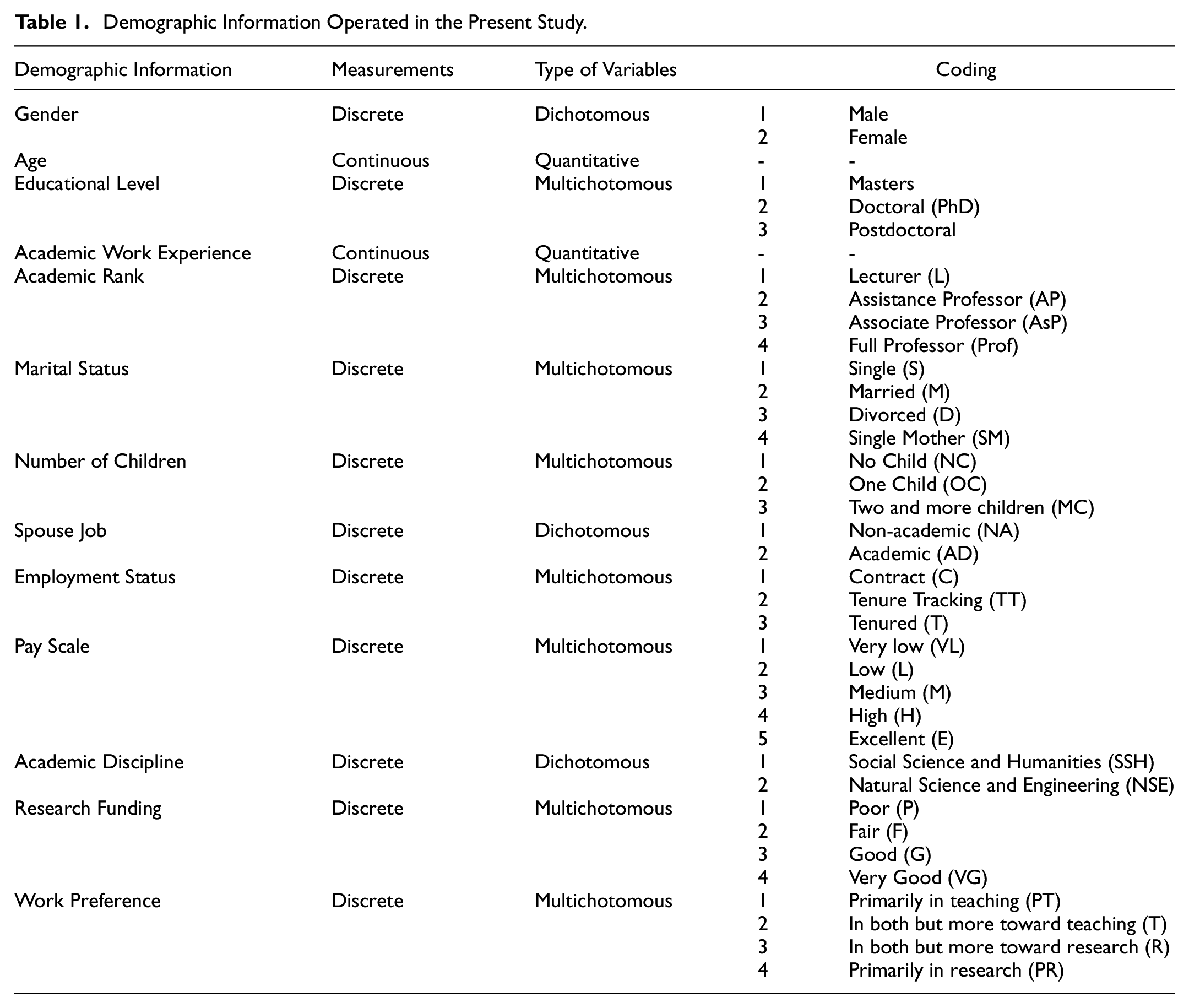
Research productivity: Teodorescu stated that the research output of a faculty member must be assessed by the number of self-reported journal articles and books published in the last three academic working years (Heng et al., 2020; Teodorescu, 2000). Likewise, a recently adopted measurement considers the country higher education context related to faculty research publications (Baloch et al., 2020). Thus, the current study used seven items (indicators) from the Changing Academic Profession (CAP) survey, which has been used since the 19th Century at the international and national levels and requires faculty members to state their rigor personal and academic information along with their academic research article and book publications they have obtained in the last 3 years of their academic position through different agencies (See Tables 1 and 2). Subsequently, to conceptualize the research productivity of faculties, scholarly publication productivity must be obtained from the national and international publishing outputs (Nygaard, 2017). In sum, the instrument furnishes the present study to assess distinct indicators of academics’ research productivity, providing a comprehensive understanding of the research purpose or aim. Considering the objective of this paper and the higher education context of Vietnamese higher education, necessary modifications and adjustments were made to maintain the trustworthiness and validity of the current study, which showed that the internal consistency of Cronbach’s alpha value was .763.
Demographic Information Operated in the Present Study.
Indicators of Faculty Research Productivity According to the CAP.

Research Finding
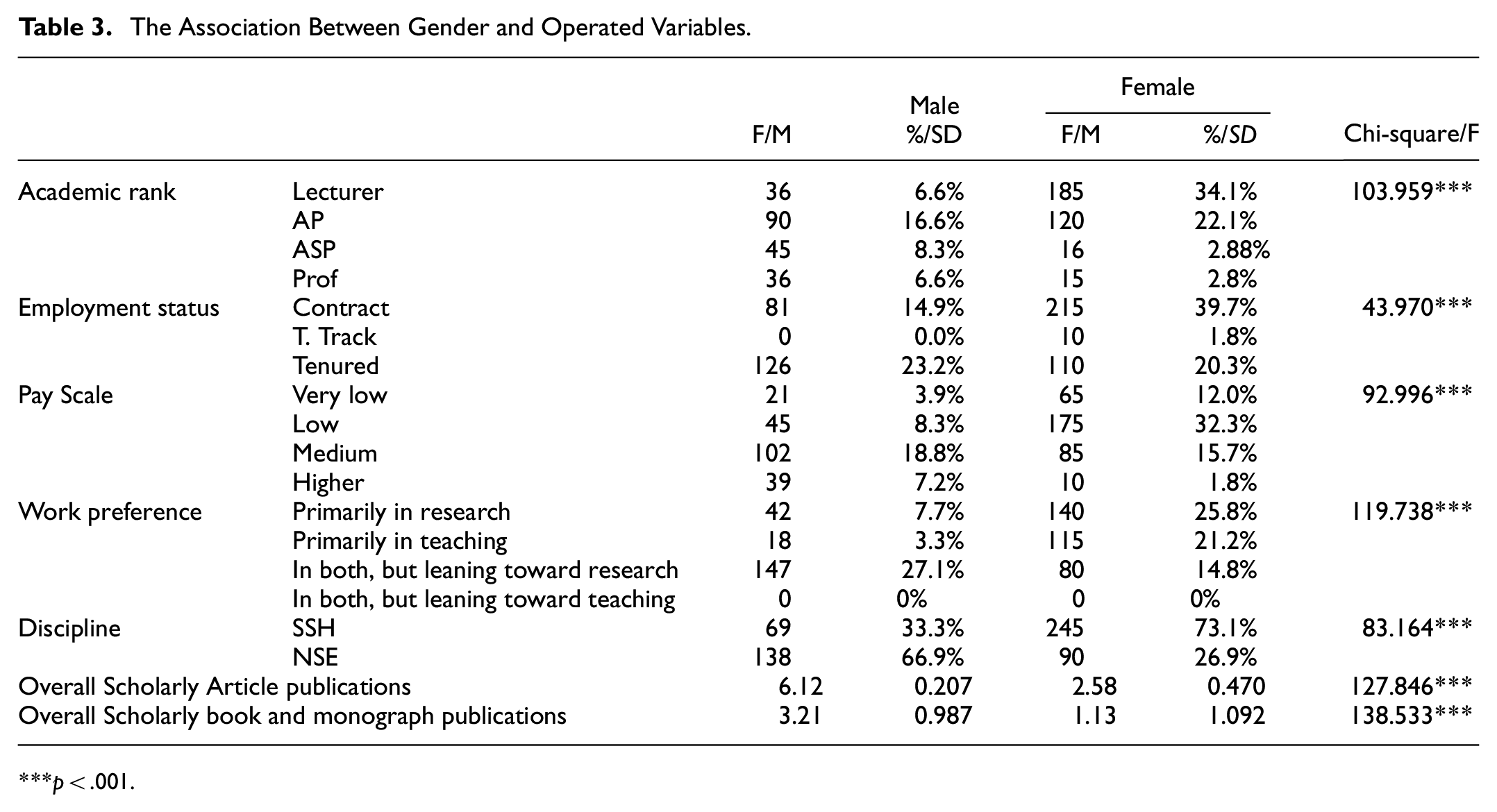
Unsurprisingly, the cross-tabulation result presented in Table 3 reflects that only one-fifth of women participants are in science and engineering departments, whereas male faculties account for one-third of social science and humanity department sites (χ2(1) = 83.164, p < .001). In the Pearson chi-square analysis, we observed a significant association between gender and academic rank (χ2(3) = 103.959, p < .001), which explains the striking effect of gender on the faculty member pay scale (χ2(3) = 92.996, p < .001). However, as we speculate, the results in Table 3 do not show a substantial difference in research funding between male and women faculties. Furthermore, the results show that no male faculty member is on the tenure track, while over half of women faculty members are hired as contract academics (χ2 (2) = 43.970, p < .001). This paper predicts a significant work preference difference between male and women faculty members in Vietnamese national universities. The chi-square value was 119.738 with a considerable probability level of .001, demonstrating that almost half (41%) of women faculty members claimed that only teaching was their work preference.
The Association Between Gender and Operated Variables.
p < .001.
Meanwhile, although over 70% of male faculties choose a work habit that entertains teaching and research, they favor research-related tasks. Because this study does not aim to compare male and women faculty members, we assessed their research publication differences by considering the total number of scholarly articles and book publications. Hence, the result shows that male academics produced more scholarly articles (F = 99.193, p < .001) and books (F = 126.330, p < .001) than their women equivalents.
Subsequently, the study targeted the overall women faculties in Vietnamese national universities to answer the first research question of the present study. As we suspected, women academics in the social science and humanity departments cover nearly three-fourths of our women faculty member respondents. Table 4 shows no significant relationship between the field or discipline of work and the women’s faculty tenure status (χ2 = 5.227, p = .073). Moreover, the cross-tabulation result shows marital issues, which asserts that women faculty members from the SSH have a significantly higher probability of being divorced, and there were no divorced NSE faculty members. In contrast, the type of discipline of women academics at Vietnamese national universities has no significant association with their probability of having a spouse working in the academic sector (χ2 = 2.212, p = .137)
The Association Between Female Faculty Discipline and Operated Variables.

p < .05. **p < .01. ***p < .001.
Moreover, the results in Table 4 demonstrate that there is no single women scientist from social science and humanities who obtained a professorship, which confirms that the women faculty’s discipline can predict the chance of getting more women professors (χ2 (3) = 118.263, p < .001). Excitingly, the results in Table 4 show that only 5.6% of women academics in natural science and engineering valued only teaching. In comparison, 44.9% of their colleagues in social science and humanities preferred only teaching, so the discipline of women scientists predicts the tendency of teaching and research (χ2 (2) = 81.628, p < .001). No SSH women faculty members responded that the research funding was excellent, and no NSH women academics rated the sufficiency of research funding as poor, which implies that the funding of research in national universities in Vietnam is inadequate across SSH disciplines (χ2 (4) = 75.629, p < .001).
Furthermore, a bivariate Pearson correlation was performed to attain the second objective of the current study, which is to assess the relationship between Vietnamese women faculties’ traits with their overall scholarly publications among women faculties in the SSH and NSE disciplines in the last three academic years, as presented in Table 5. The results reveal that for SSH women academics, unlike a number of children, work preferences, and likelihood of having an academic husband, total scholarly published output was significantly positively associated with their education level (r = .731, p < .001), academic rank (r = .699, p < .001), and research funding (r = .513, p < .001). Meanwhile, a number of academic publications (articles and books) of SSH women faculty members as authors or coauthors with national and international colleagues were negatively influenced by age (r = −.368, p < .001). Moreover, the aging of SSH academics has a substantial adverse effect on the academic level (r = −.334, p < .001), academic rank (r = −.174, p < .01), research funds (r = −.196, p < .01), and a number of children (r = −.293, p < .01). Astonishingly, Pearson’s correlation results indicate that the SSH tenure status cannot predict any correlated variables, including the number of their overall scholarly article and book publications (r = .027, p = .071).
Bivariate Correlation Between Female Faculties Operated Variables.
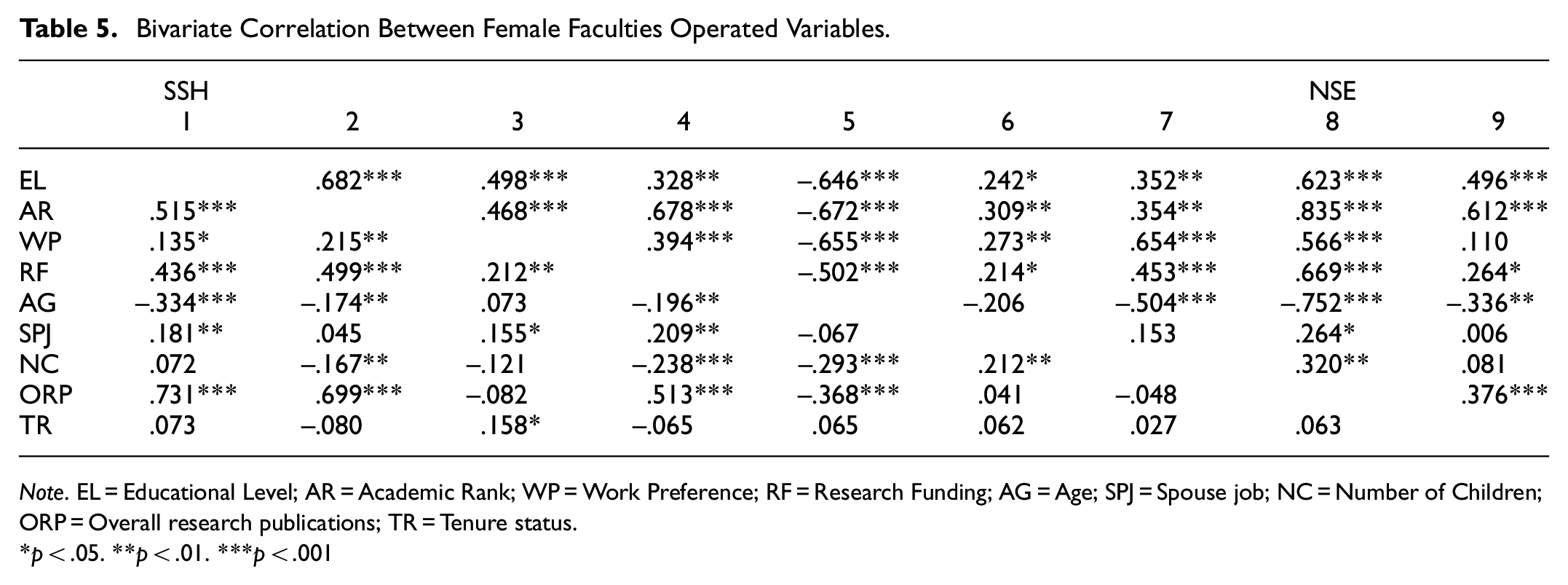
Note. EL = Educational Level; AR = Academic Rank; WP = Work Preference; RF = Research Funding; AG = Age; SPJ = Spouse job; NC = Number of Children; ORP = Overall research publications; TR = Tenure status.
p < .05. **p < .01. ***p < .001
The academic rank of SSH women faculty members may have a robust positive relation with having the highest education level or a doctoral degree (r = .515, p < .001), being satisfied with the research fund (r = .436, p < .001), and having an academic partner (r = .181, p < .001). In contrast, faculty members having a superior academic rank in SSH disciplines only focus on research-related works (r = .135, p < .05). In regard to NSE women’s academics, the bivariate outcome indicates that similar to SSH academics, except for the age of academics (r = −.752, p < .001), higher educational level (r = .623, p < .001), academic rank (r = .835, p < .001), satisfying research funding (0.669, p < .001), marrying an academic husband (r = .264, p < .05), or having multiple children (r = .320, p < .01) leads to the prominent scholarly article and book publication productivity. Nevertheless, our results reveal that the work preference of NSE faculty members toward teaching leads to more scholarly publications (r = −.566, p < .001). In this analysis, aging was one of the most dominant variables and showed a uniform adverse effect on the number of women faculty publications and supportive variables.
Ultimately, the present study sought to shed light on the association between Vietnamese women’s academic’ professional, and personal profiles with each scholarly research productivity indicator utilized in this study from the CAP (See Table 6). Therefore, a two-way multivariate analysis of variance (MANOVA) was administered, which reveals that the number of books published by women academics in the NSE was not predicted by any variables since none of the faculty members published books. Meanwhile, the number of SSH women faculty members that author or coauthor scholarly published books was significantly determined by being single without a child (F = 3.573, t = 2.10, p < .05), possessing an academic husband (F = 7.560, t = 3.019, p < .01), and focusing on teaching (F = 14.490, t = 2.323, p < .001). However, having children did not correlate with the scholarly book publications of mother academics (F = 0.330, p = .803). Regarding the number of research articles presented at national and international conferences, having an academic husband (FNSE = 2.240, t = −3.697, p < .001), spousal status (FNSE = 8.778, t = 3.53, p < .01; FSSH = 15.160, t = −2.69, p < .01), number of children (FNSE = 7.265, t = 3.536, p < .001; FSSH = 13.753, t = −3.506, p < .01) and work preference (FNSE = 20.465, t = 7.438, p < .001; FSSH = 95.290, t = 3.629, p < .001) were significant determinants of the output of research article presentations in international and national conferences by women faculty members.
Multivariate Analysis of the Effect of Female Faculties Personal Factors on Their Scholarly Publication Productivity.

Note. SM = Marital Status (Single Mothers); MC = Number of Children (More than 2); AD = Spouse job is from academic; PR = work Preference (primarily research).
p < .05. **p < .01. ***p < .001.
Furthermore, the two-way MANOVA result presented in Table 6 suggested that in both fields, women faculties had a significant influence on their scholarly publication output; explicitly, the regression showed that the number of first-authored international journal article publications by SSH and NSE women faculties was strongly determined by work preference (FNSE = 34.594, t = 2.416, p < .001; FSSH = 54.154, t = 3.69, p < .001). Accordingly, the regression results showed that only the faculties’ work choice (FSSH = 12.159, t = 5.055, p < .001) and husband’s career type (FNSE = 12.243, t = −2.695, p < .01) had a noticeable effect on the number of scholarly article publications of women academics with national colleagues. Similarly, the number of scholarly articles published by SSH and NSE academics with international colleagues was predicted by single status (FNSE = 92.870, t = 8.948, p < .001, FSSH = 10.232, t = −2.075, p < .01), having more children (FNSE = 11.266, t = −25.26, p < .001), not being married to an academic husband (FNSE = 14.793, t = −18.69, p < .001), and being a research-oriented faculty member (FNSE = 292.91, t = 25.074, p < .001). Additionally, the results in Table 6 show that the number of scholarly articles recognized by Vietnamese higher education with an impact factor was significantly predicted by marital status (FNSE = 14.040, t = 4.698, p < .001), number of children (FNSE = 14.981, t = −6.495, p < .001, FSSH = 2.648, t = 2.093, p < .01), partner with an academic spouse (FNSE = 10.504, t = −7.572, p < .001), and work preference (FNSE = 106.914, t = 6.108, p < .001, FSSH = 21.888, t = 4.766, p < .001) of women faculty. Finally, the regression showed the significant predictors of the overall scholarly publication output of women faculties in SSH and NSE disciplines in Vietnamese national universities. The multivariate results showed that the overall scholarly publication productivity was markedly associated with the marital status of women faculty (FNSE = 12.089, t = 4. 032, p < .001), number of children (FNSE = 15.967, t = −6.363, p < .001), being married to an academic husband (FNSE = 31.365, t = −6.847, p < .001, FNSE = 6.975, t = −2.303, p < .05), and working habits (FNSE = 69.186, t = 3.395, p < .01, FNSE = 51.395, t = 2.441, p < .05).
Discussion
Initially, the current study shed light on the scholarly publication contributions of women faculty members concerning their male counterparts at Vietnamese national universities using the CAP survey. As expected, unlike in Western countries (Bentley, 2012; Madison & Fahlman, 2021; UNESCO, 2015), the findings confirm that women faculty members are more concentrated in SSH disciplinary departments than in the NSE (Gallardo, 2021; Madison & Fahlman, 2021; Martinez et al., 2007; Murphy et al., 2007; Opesade et al., 2017; Stack, 2004; UNESCO, 2015; Q. Vuong, 2019; Q. H. Vuong et al., 2017, 2018). Although women are studying “hard science” disciplines at higher education institutions worldwide, millions of them who sought to be in academia by obtaining their doctoral degree began to lose interest in science (leaky pipeline) and gave up on their dream (Gallardo, 2021; Hancock et al., 2013; M. H. Nguyen et al., 2022; UNESCO, 2015; Q. Vuong, 2019), which resulted in the low number of women faculty with high academic ranks (Gallardo, 2021; Madison & Fahlman, 2021), and more doctoral women faculty doubting their productivity (c.f. Bentley, 2012; Padilla-Gonzalez et al., 2011). Studies illustrate that in SSH, women surpass or are on par with male faculties, which determines the cultural influence of Vietnam societies and indicates that SSH fields belong to women (Q. H. Nguyen, 2015; M. H. Nguyen et al., 2022; Q. H. Vuong et al., 2017, 2018). In addition, the present study result confirms that women faculties are highly engaged or prefer to be in teaching-related tasks (Aiston & Jung, 2015; Baloch et al., 2020; Gallardo, 2021; Larivière et al., 2011; Ogbogu, 2009), which results in a significant disparity in publications (e.g., Baloch et al., 2020; Bartels et al., 2021; Bentley, 2012; Leahey, 2006; Scutelnicu et al., 2018) and academic rank (e.g., Gallardo, 2021; Khalid & Tadesse, 2022; Knepper et al., 2020; Rothausen-Vange et al., 2005). Unfortunately, there is a significant disparity in scholarly publications in both SSH and NSE departments (Kyvik & Aksnes, 2015; M. H. Nguyen et al., 2022). Likewise, the present study’s finding contradicts recent literature, which claimed no differences in the number of scholarly book publications among male and women faculties (Mayer & Rathmann, 2018; Santos et al., 2022). Nonetheless, the total scholarly publication of Vietnamese women faculty in international journals is far behind that in contextual or neighboring counties (Gautam & Mishra, 2018).
According to the core purpose of the study, the results of the analysis demonstrate that only one-third of women faculties in Vietnamese national universities are working or teaching in NSE discipline departments, which indicates the increase in the number of women SSH discipline faculties in Vietnamese universities (Vuong, Do, et al., 2020). According to the cross-tabulation result, the finding supports Vietnamese literature (e.g., Q. H. Nguyen, 2015; Nguyen, Hamid, et al., 2016; H. T. L. Nguyen & Meek, 2016; N. D. Nguyen et al., 2021; Nguyen & Tue, 2020; N. D. Nguyen et al., 2021; Pham & Hayden, 2019; Pho & Tran, 2016; Tien et al., 2019) and international literature (e.g., Jung, 2014; Rothausen-Vange et al., 2005; Sabharwal, 2013) that SSH faculties suffer from inadequate research funding. A recent report stated that women’s scholarly publication shares in the Vietnam SSH field showed a radical improvement (Q. Vuong, 2019; Q. H. Vuong et al., 2018; Vuong, La, et al., 2020). Nonetheless, this paper shows that SSH women faculty members have fewer research publications than their women equivalents in the NSE (Isfandyari-Moghaddam & Hasanzadeh, 2013; Lariviere et al., 2006; Sabharwal, 2013; Vuong, Do, et al., 2020), which makes them obtain low academic rank (Jung, 2014; Rothausen-Vange et al., 2005; Sabharwal, 2013; Q. H. Vuong et al., 2017) and fewer first-authorship publications (Q. H. Vuong et al., 2018), which negates the Vietnamese studies that undermine the research performance of NSE women faculty (Opesade et al., 2017; Vuong, La, et al., 2020). This paper underlines the bibliometric study of Dehdarirad and colleagues that stated the radical improvement in research participation of NSE women academics in 67 countries (Dehdarirad et al., 2015). A possible explanation is that SSH faculty members in Vietnamese higher education institutions have severe English language incompetency in writing scholarly publications in English for reputed international journals (Nguyen, Klopper, et al., 2016; Pho & Tran, 2016). Such scenarios are being considered in higher institutions in nonnative English countries (Nygaard, 2017). We also strengthen this finding through a former ground theory study that claimed the occupation stress and low productivity of women faculties due to male faculty supremacy; this reality is noteworthy in SSH departments (Van Thanh, 2016).
Certainly, faculties with higher academic ranks have a solid research network that can acquire much research funding (Isfandyari-Moghaddam & Hasanzadeh, 2013; Kwiek & Roszka, 2022; Rothausen-Vange et al., 2005; Ryazanova & Jaskiene, 2022; Võ & Laking, 2020). Then, academics in SSH give up applying for research funding to conduct research (Kyvik & Aksnes, 2015; Nguyen, Klopper, et al., 2016), so they have no choice but to teach to pay the bill (Khalid & Tadesse, 2022). Moreover, an earlier Vietnamese study demonstrates that SSH faculty age is associated with their scholarly publication output (Q. H. Vuong et al., 2017). Although this paper is consistent with this evidence, the scholarly publication production of NSE and SSH academics weakens with aging, which contradicts the forgoing literature (Bentley, 2012; Jung, 2014; Q. H. Nguyen, 2015; Tahsildar & Hasani, 2021) and supports (Henry et al., 2020; Isfandyari-Moghaddam & Hasanzadeh, 2013). Even though later evidence argues that age does not influence faculties’ research productivity in foreign language and literature under the umbrella of SSH disciplines (Peng & Gao, 2019), Peng and Gao explained the possible explanation of this finding might be given that the preponderance of faculties in this discipline are women. However, we perceive that such a dramatic adverse effect of age emerges in the later stage of faculties (Albert et al., 2016; Heng et al., 2020; Kyvik & Aksnes, 2015).
Meanwhile, the correlation does not show any significant association of operating variables with tenure status except a moderate effect by research-centered faculties. Arguably, the possible explanation for this finding is that more than half of the women participants from both fields are contract employees. Perhaps Vietnamese higher education institutions have no adequate faculty members or a low teacher retention rate, which makes the government desperate to hire contract academics. A preceding quantitative study in Spanish universities stressed that faculties with temporary working agreements have little research output due to a loss of seriousness in their job agreement (Albert et al., 2016).
Then, this paper performs a multivariate analysis that shows rigorous results that negate and support previous literature on women’s faculties. Among many findings of this study, in the last three academic years, none of the NSE women faculties has published a single scholarly book as first author or coauthor, whereas SSH academics had 73 scholarly international published books, which is consistent with the previous evidence that faculties from “soft science” disciplines utter scholarly books (Baloch et al., 2020; Heng et al., 2020; Lariviere et al., 2006; Sabharwal, 2013) and contradicts the results in (Hancock et al., 2013; Jung, 2014). A possible explanation is that NSE faculty members have solid research skills and performance to focus on writing scholarly articles (Quimbo & Sulabo, 2014; Q. H. Vuong & Tran, 2019). However, SSH women academics who focus on teaching and are single or married with nonacademic husbands produce more nationally and internationally published academic books. By maintaining NSE, women academics have higher scholarly research publication productivity (except for academic books) than their SSH counterparts.
Furthermore, it is well documented that Vietnamese women’s faculties showed a typical Asian women’s tradition of being married and making a nuclear family (Khalid & Tadesse, 2022; Peng & Gao, 2019). Even so, the Turkey post hoc test finding demonstrates that SSH and NSE single-mother faculties have more experience presenting at international and national conferences than their women colleagues (Fox, 2005; Ogbogu, 2009). Remarkably, more single mother faculties with two or more children presented in several conferences in the last 3 years than women in academics with fewer or no children. A recent study in Pakistan demonstrates that single and single mother women faculties cannot travel due to family responsibility and sociocultural influence, although they sought to expand their research capacity and network through conferences (Khalid & Tadesse, 2022). Nonetheless, this finding confirms that Vietnamese women scientists with more children and academic husbands are motivated to strengthen their professional and life status (Aiston & Jung, 2015; Bentley, 2012; Fox, 2005; Hunter & Leahey, 2010; Jöns, 2011; Leahey, 2006; Padilla-Gonzalez et al., 2011; Rothausen-Vange et al., 2005; Sax et al., 2002) and disputes the evidence that stated that due to children, mother academics lag in research publication (Baloch et al., 2020; Larivière et al., 2011; T. L. H. Nguyen, 2013; Stack, 2004) and robust research publication collaboration (Baloch et al., 2020; Isfandyari-Moghaddam & Hasanzadeh, 2013; Leahey, 2006; Stack, 2004). Perceptibly, single mother women faculties are the only immediate person in charge of the children, so being an extensive researcher is a scientific method to provide favorable living conditions for children by hitting two birds with one stone: a higher academic rank and a handsome remittance. However, according to the overall women faculty publications with national and international colleagues, it is possible to regard women faculty as needing a stronger culture of research collaboration with both sexes of academics (Isfandyari-Moghaddam & Hasanzadeh, 2013). The potential explanation is that male faculties could obtain tenure or promotion for publishing sole or collaborative research publications, though women counterparts may not acquire merit credit from collaborative publication expertly with men faculty; hence, they abscond from research collaboration (Kwiek & Roszka, 2022). On the second thought, perhaps male faculties are not in favor of collaborating with women faculties for the sake of their underestimated research efficacy and busy schedule due to work and life balance.
Although this paper shows that children energize the research productivity of women faculties, these results only apply to single mothers or NSE married women faculties with academic husbands, which contradicts Fox’s claim about the research productivity of women faculties married with nonacademic husbands (Fox, 2005). Likewise, this study contravenes typical Asian women’s duties to look after children, parents, and spouses, regardless of their profession (Khalid & Tadesse, 2022; Q. Vuong, 2019; Q. H. Vuong et al., 2018). A female faculty member married to an academic husband can improve her research skill and capacity, or the husband can perform domestic chores whenever she is busy with academic or research duties (Isfandyari-Moghaddam & Hasanzadeh, 2013). Alternatively, it is applicable to speculate that these women’s faculties depend on their scientist husbands. The study shows that such women’s faculties have excellent research publications with national and international colleagues. Thus, this should be investigated in future studies. However, such faculties have acquired many scholarly publications with national and international colleagues whom we speculate they met during conferences or academic activities (Nguyen, Hamid, et al., 2016; Peng & Gao, 2019). This finding partially contradicts a large body of literature that claims that getting married and having children have unfortunate consequences (Aiston & Jung, 2015; Bentley, 2012; Hunter & Leahey, 2010; Jöns, 2011; Padilla-Gonzalez et al., 2011; Rothausen-Vange et al., 2005; Sax et al., 2002).
For Vietnamese women faculties, the type of spouse affects the extent to which they engage and produce scholarly publications, explicitly for women faculties in the NSE. Consequently, explicitly single mothers with two children or married women with academic husbands, who motivate them to be research-oriented academics, contribute the most to scholarly article publications from Vietnamese higher education institutions. Alternatively, this finding correlates with a prior study in Norwegian universities, where older faculty members have robust academic collaboration (Kyvik & Aksnes, 2015), and these more senior faculty members in the Vietnamese context are expected to be married with numerous children. The other possible explanation for such productive women faculties is that with school-age children, the women faculties can manage and balance time for their research-related activities (Fox, 2005). Few women academics strive to balance their research output with their house chores since they know its worth (Gallardo, 2021; Khalid & Tadesse, 2022; Tahsildar & Hasani, 2021). Accordingly, the research output of women faculty degrades during maternity and the child’s early years (Gallardo, 2021; Hunter & Leahey, 2010). Our study shows that SSH women faculty members are tangled in teaching-related tasks, which takes up their research time (An, 2022). Thus, only those who push themselves to be research-oriented become scholars. Though the government of Vietnam emphasizes national universities as research-oriented universities, the current study did not observe remarkable or promising research performance by women faculties, as stated in earlier studies (Nguyen, Klopper, et al., 2016; Q. Vuong, 2019). However, unquestionably, this study illuminates that Vietnamese women’s potential is appreciated by their families and spouse, which can be a promising clue for gender parity in the future.
Implications, Limitations, and Future Research Directions
To increase gender parity in Vietnamese higher education, which fully involves genuine women’s academic research participation, policymakers, higher education institution administrations, and academics should support the following policy and practical implications. Concerning policy implications, the study observed that most female faculty members are in contract job status, making them less enthusiastic. Thus, Vietnamese universities ought to build a structured faculty recruitment system that only entertains permanent academics through a tenure tracking system to enhance the scholarly publication participation of women academics. In addition, after a rigorous staffing process, there should be an organized and written policy that states the research, teaching, and administrative time allocation of faculty members considering their disciplines, employment status, academic rank, and age for effectual scholarly publication output without jeopardizing the teaching quality since teaching is the primary mission of academics (Quimbo & Sulabo, 2014); alternatively, the integration of research into teaching can be conceptualized (Peng & Gao, 2019; Tadesse & Khalid, 2023; Vu, 2021). Regarding practical implications, Vietnamese universities provide professional development for women faculties; in particular, SSH women faculties need training to develop their research efficacy and English language (Heng et al., 2020; Tahsildar & Hasani, 2021). The study also suggests that the government should allocate adequate research funding without discipline biases to include lower-rank women faculties and motivate early researchers (N. D. Nguyen et al., 2021). Higher education institutions should work with external enterprises that work on women’s empowerment (Q. H. Nguyen & Klopper, 2014). Apart from research funding, the present study implies that Vietnamese universities and ministers of education should build a culture of hosting national conferences and motivating women faculties to attend international conferences (An, 2022; Ryazanova & Jaskiene, 2022), which requires minor expenses so that all women faculties can be part of the conference that enables them to form a research collaboration network with national and international male or women scholars (Peng & Gao, 2019). In sum, universities were and are still highly advocated to support and motivate their women faculty to cherish the international academic world like any other academics (Bentley, 2012; Henry et al., 2020; Nguyen, Hamid, et al., 2016) since motivation strongly signifies faculty research productivity (Myers et al., 2020; Peng & Gao, 2019). If mother faculty members are motivated to become research productive because of the quality of life of their children, the same motivation must be initiated for unmarried women faculty members. Correspondingly, a contemporary cross-sectional study involving 309 foreign language and literature university teachers stipulates that the institutional policies and regulations motivate faculty research productivity more than built-in (Peng & Gao, 2019).
The present cross-sectional study targeting two Vietnamese national universities has two main limitations. According to the Vietnamese government’s plan to make the two national universities research-intensive by 2020, this paper surveyed only these two universities to understand the women faculty participation and determine the key factors that influenced exceptional women academics to become competent in scholarly publications as their colleagues. Although the study’s findings cannot be generalized to other universities, this study stimulates future scholars to adopt the CAP survey to underline such a conclusion to make the implication more robust and feasible. Moreover, our study findings inspire future studies in universities in Vietnam and other countries. Evidence has claimed that women faculty members who are married to academic husbands are scholarly productive in investigating the truth behind women faculty members regarding whether those publications are genuine. The second limitation of the study emerged from the research design, which needs to provide an in-depth understanding of how those factors determine women’s academic scholarly research productivity. Hence, this study proposes a qualitative interview study to explore the reasons for the poor publication share of single women faculties in Vietnamese higher institutions, while they likely have no or fewer domestic responsibilities.
Conclusions
To sum up, although a large body of international and Vietnamese literature discloses the present study strived to unfold the weakened scholarly publication share of women academics compared to male counterparts, the present study shed light on reaching research productivity of solely women academics in SSH and NSE disciplines taking into account of their unique features. According to the finding of central study findings of the study, it is possible to conclude that, like most Asian countries, Vietnamese higher education possesses rare women academics in natural science and engineering-related disciplines, which utters the linking pipe (Gallardo, 2021; M. H. Nguyen et al., 2022; UNESCO, 2015; Q. Vuong, 2019). Moreover, from the result of the analysis, it is possible to suggest that even though there is a scarcity of women academics from NSE departments, they have exceedingly obtained higher academic ranks as contrasted with their SSH counterparts since the Vietnamese government has been giving an enormous research funding and support for NSE disciplines. Likewise, it is perceived that women who have become higher education academics in NSE disciplines are known for being academically strong since they went through an academic environment that requires an intensive research engagement. Ultimately, the study elucidates that alternatively, women who are married to academic husbands, have more children, or are entirely devoted to research-related work than teaching are highly likely to publish a surplus of academic papers.
Footnotes
Declaration of Conflicting Interests
The author(s) declared no potential conflicts of interest with respect to the research, authorship, and/or publication of this article.
Funding
The author(s) received no financial support for the research, authorship, and/or publication of this article.
