




Abstract
This study employed an explanatory sequential mixed-methods design to investigate the roles of agro-dealers in supporting smallholder agriculture in Central Zambia. The research integrated surveys of 180 farmers and 65 agro-dealers with qualitative data from focus group discussions and key informant interviews. The findings establish that agro-dealers are the sole source of agricultural inputs for all smallholder farmers surveyed, partially filling the void left by the contraction of public agricultural extension services. However, significant deficiencies were identified, with 73% of agro-dealers demonstrating limited knowledge of agricultural inputs and 68% of farmers expressing dissatisfaction with the quality of advice received. The analysis revealed pronounced gender disparities, as male farmers had better access to services and visited agro-dealers more frequently than their female counterparts, primarily due to their greater access to household income and fewer household responsibilities. Regression analysis further demonstrated that the number of visits to agrodealers in a farming season was determined by access to trucks, farmer experience and income (p < .05). Results from the ordinal logistic regression analysis show that farmers who reported being satisfied with the advice were significantly more likely to rate the services as good or very good. Further, the perceived qualifications of agrodealers also increased the chances of receiving a higher rating. More frequent interaction with agrodealers was generally linked to more positive ratings. The study recommends that policymakers prioritise mandatory training and certification for agro-dealers, address gender inequalities through targeted subsidies for female farmers, and reform the Farmer Input Support Programme (FISP) to ensure equitable and high-quality service delivery. These interventions are crucial for unlocking the full potential of agro-dealer networks to enhance agricultural productivity and foster inclusive rural development in Zambia.
Plain Language Summary
This study examined how agro-dealers (people or businesses that sell farm supplies) assist small-scale farmers in Central Zambia. Researchers utilised surveys and group discussions with 180 farmers and 65 agro-dealers. They discovered that most agro-dealers (73%) lacked adequate knowledge about the farm products they sold. Men had better access to these services than women. Just over half of the farmers consulted agro-dealers for advice, but most felt the dealers weren’t well trained. Very few agro-dealers helped connect farmers to larger agricultural businesses, and most failed to provide support after harvest. The study suggests that agro-dealers require improved training to support farmers more effectively.
Introduction
Agriculture plays a vital role in Zambia’s economy, as most of its rural population depends on it for their livelihood as smallholder farmers (Namoobe et al., 2022). These farmers mostly practice mixed crop and livestock farming, which relies heavily on rain and involves seasonal purchases of agricultural inputs from agro-dealers. Agro-dealers are crucial in supplying inputs such as seeds, implements, parts, and chemicals to smallholder farmers in remote areas, and they are increasingly acting as market agents for agricultural produce and offering advice on agricultural practices (Mwanza et al., 2023). They have filled the gap left by the decline of public sector agricultural extension services that occurred following major economic policy changes in the early 1990s. These rural enterprises provide agricultural inputs and information, including guidance on the safe use of plant protection products (Bamigboye & Adeniyi, 2022; Mtisi et al., 2017; Reddy et al., 2019).
Prior to the 1990s, Zambia had followed a state-led, centralised agricultural development system. It had entailed state provision of highly subsidised agricultural inputs to smallholder farmers across the country and provision of markets for produce. Smallholder farmers obtained the inputs and dropped off the produce at depots within their localities, managed by parastatals. Major policy shifts in the early 1990s saw the privatisation of the parastatals, a contraction in agricultural services to smallholder farmers by the state, and liberalisation of the agricultural sector (Saari et al., 2013). This liberal turn meant the participation of private agricultural input suppliers, commonly known as agro-dealers, in providing agricultural inputs and services to smallholder rural farmers who had previously entirely depended on the public sector.
Between 1992 and 2018, the number of agro-dealers rose exponentially, and both small and large agro-shops became a common feature in small towns in Zambia. Agro-dealers supply inputs and offer extension services through their contacts with the farmers (Kasoma et al., 2018; Machina et al., 2017). Thus, they have a potentially important role in creating and strengthening backwards and forward linkages in the smallholder farming sector. Backwards and forward linkages of a system represent the transfer of inputs and outputs between the different production processes and the selling of the final products (Albay et al., 1995). We follow this definition and conceptualise the backwards and forward linkages of agro-dealers to the smallholder farming sector, as well as their participation in the input and output sides and their contribution to both. A sector is linked to other sectors through direct and indirect purchases and sales. A sector’s linkage through its direct and indirect purchases is called its backwards linkage. A sector is forward linked to other sectors through its direct and indirect sales to them (Cai & Leung, 2002). Thus, in our study, agro-dealers have forward linkages with the smallholder farming sector through their sales of inputs to farmers and backwards linkages through their purchases of agricultural produce from them.
Agro-dealers provide advisory services to farmers and linkages to other services such as livestock vaccinations and weed and pest management (Bamigboye & Adeniyi, 2022). They utilise their networks to link farmers to markets for their produce (International Fertilizer Association, 2019). These linkages have the potential to improve farmers’ agricultural productivity and incomes. These linkages are illustrated in the conceptual framework presented in Figure 1.
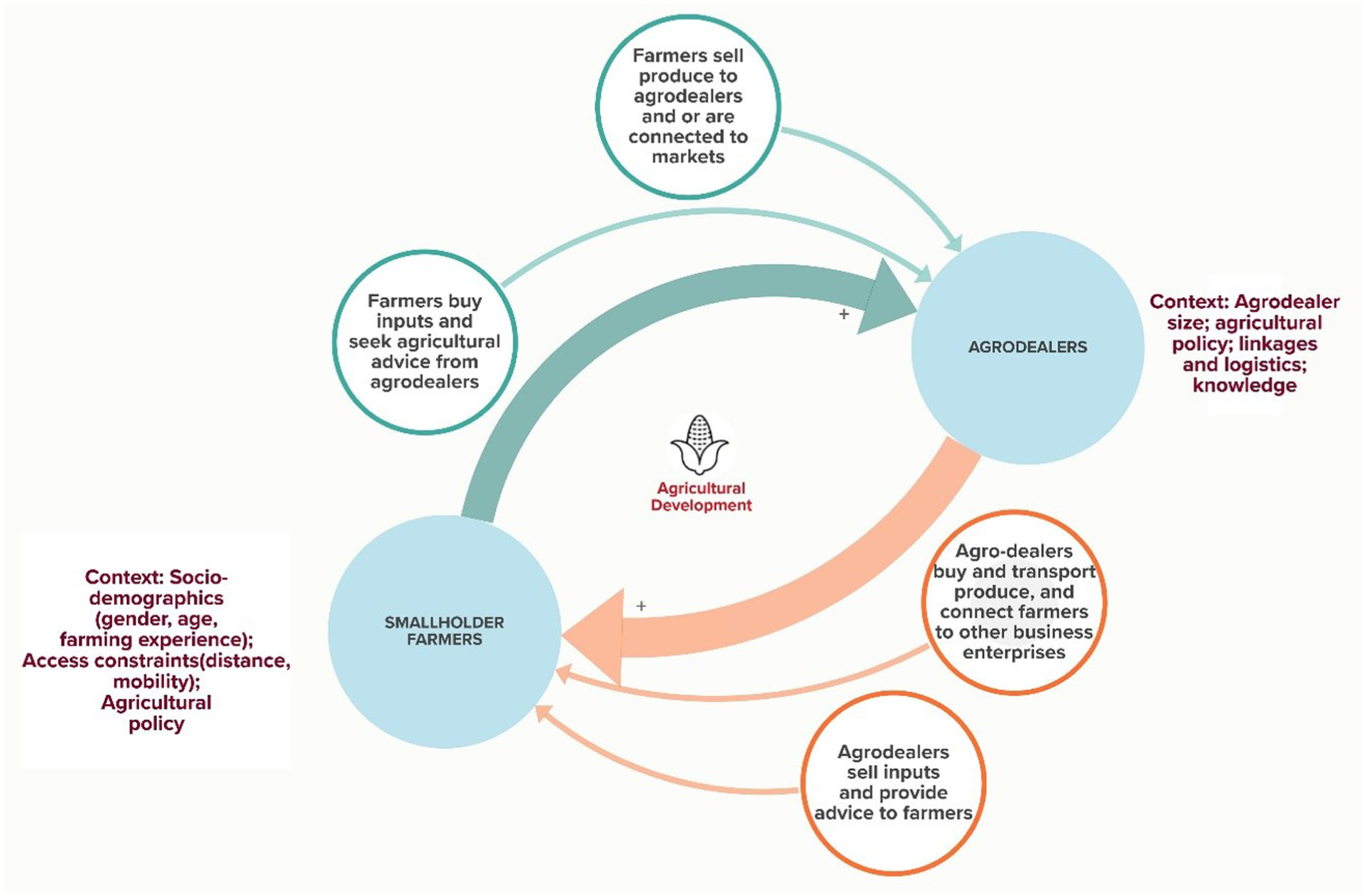
Forward and backwards linkages between agro dealers and smallholder farmers.
The conceptual framework illustrates the dynamic and reciprocal connections between smallholder farmers and agrodealers within the broader institutional, socio-economic, and policy environment. Smallholder farmers rely on agrodealers for agricultural inputs and advisory services, while also supplying them with produce and accessing wider markets through these intermediaries. In return, agrodealers not only sell inputs and offer advice but also purchase and transport produce, establishing linkages with other enterprises and increasing farmers’ market participation. These interactions are influenced by contextual factors: for farmers, socio-demographic characteristics such as age, gender, education, and farming experience, alongside access constraints like distance and mobility, shape their engagement. For agrodealers, their capacity to provide services depends on business size, knowledge, logistics, and agricultural policies. The framework demonstrates that agricultural development is driven by these feedback loops, where stronger linkages and supportive policies foster more productive and market-oriented farming systems, whereas weak connections and barriers restrict growth opportunities.
A study by Ogunlade et al. (2012) found that 72% of the agro dealers they interviewed performed extension activities, most especially on seed management and appropriate choice of agro chemicals but seldom advised farmers on the use of farming equipment. Argades et al. (2015) reported that in India, the role of agro dealers in transferring agricultural technology was notable and acclaimed by farmers for their accessibility. Elakkiya and Asokhan (2021) recommended that agro dealers could be used to transfer technology to farmers as they were close to them. Apart from engaging in backwards linkages, such as the supply of inputs and agricultural extension, agro-dealers engage in forward linkages through their diversification efforts. They diversify their businesses by buying produce and agro-processing to ensure they are in business throughout the year (Chinsinga, 2011). In Mozambique, agro-dealers buy produce such as maize, beans and other commodities from farmers who are mainly their clients as they purchase inputs from them (Nagarajan, 2015). Namoobe et al. (2022) concluded that agro-dealers in Chibombo, Zambia, were key players in advancing agricultural diversification among smallholder farmers through increased farmers’ access to crop and livestock inputs, thereby boosting agricultural productivity.
Mumbwa district in central Zambia has had more agro-dealers than agricultural extension officers since the 2015/2016 agricultural season, mainly because of the national agricultural subsidy programme (Chapoto et al., 2018; GRZ, 2018a). The subsidy programme, the Farmer Input Support Programme (FISP), was revised to allow smallholder farmers to redeem vouchers from selected agro-dealers in exchange for agricultural inputs. This boosted demand for agro-dealer services, including advisory support. Agro-dealers benefited from increased sales as subsidy beneficiaries acquired inputs from them, rather than receiving inputs directly from the state. This development led to an increase in the number of agro-dealers, some of whom possessed little agricultural knowledge. Notably, there is no requirement to demonstrate agricultural expertise to become an agro-dealer. This regulatory gap has allowed anyone to register as an agro-dealer, resulting in some dealers having minimal knowledge of the products they sell (GRZ, 2018a; Mulenga et al., 2020; Staudacher et al., 2021).
Therefore, this study aimed to evaluate the role of agro-dealers in creating backwards and forward linkages with the smallholder agriculture sector. It has three research objectives as follows: To (a) investigate the use of agro-dealerships by smallholder farmers in Mumbwa District (b) assess the knowledge levels among agro-dealers in Mumbwa District on the products they sell (c) establish the contribution of agro-dealers to the backwards and forward agricultural linkages of the smallholder farming sector in Mumbwa District. The rationale was to examine the extent to which agro dealers enable male and female farmers to access inputs and advisory services, and to sell their produce, which is crucial for improving agricultural productivity and its attendant trickle-down effects. The study is novel in that it utilises a gender-responsive approach by analysing the results using a gender lens so as not to mask any gender differences in farmers’ access to agro-dealers. Such nuances could provide insights for more inclusive interventions that would not privilege one gender.
Material and Methods
This section provides succinct details on the study area and how the data for the study were collected and analysed.
Study Area
This study took place in Mumbwa district, located about 150 km on the western side of Lusaka, the capital city of Zambia (Figure 2). The study area is a high plateau with an altitude of about 1,200 m above sea level. The red-brown loam soils are suitable for crops such as cotton and maize (GRZ, 2018a). Mumbwa was chosen as the study area because smallholder agriculture is its primary activity, and it has several agro-dealers selling agricultural inputs and purchasing produce from smallholder farmers.

Location of the study area, Mumbwa.
Mumbwa is classified into five agricultural blocks by the Ministry of Agriculture for administrative purposes. Each block is further divided into agricultural camps. An agricultural camp is overseen by a camp officer responsible for providing advisory services to farmers in their area. Each block has an average of five extension officers, which is insufficient given the number of farmers in the blocks (GRZ 2018b). Due to several challenges, including limited resources for routine training, camp officers are unable to meet the farmers’ demand for extension services. As a result, most smallholder farmers rely on agro-dealers and non-governmental organisations with development projects in their localities for agricultural information.
Mumbwa district has three main economic activities: mining, tourism, and agriculture. Agriculture is the dominant activity, with most smallholder farmers (44,747) owning less than 5 hectares of land (GRZ 2020). The primary crops cultivated are maize, cotton, soya beans, groundnuts, and sunflower (Joala et al., 2016). Recently, crop production has declined due to droughts, increased pests, and over-reliance on the national subsidy programme. The district faces shortages of crops such as sorghum, beans, and cassava because fewer farmers are growing them. Regarding livestock, chickens are the most reared, followed by cattle, goats, pigs, and sheep. Livestock is predominantly kept by men, except for chickens, which are kept by women (Mumbwa District Council, 2020). Additionally, the district has two cotton ginneries and a milling plant, employing some residents. The district also boasts rich mineral deposits like copper, gold, and amethyst. The Kafue National Park, Zambia’s largest protected area, is partly located in Mumbwa and serves as an important tourism site (Connect Africa, 2009).
Data Collection
The study’s data were collected using an explanatory sequential mixed methods approach from June to July 2020. In this regard, 180 questionnaires were administered to smallholder farmers in all five agricultural blocks, as shown in Table 1. This sample size was determined through a power analysis, using the software G*Power 3.1.9.7 (Faul et al., 2009). This sample size provided 95% statistical power to detect a moderate effect size at a (one-tailed) 0.05 level of significance (Erdfelder et al., 1996). A stratified sampling method was employed to select respondents from each of the five agricultural blocks, ensuring representation of all blocks. Systematic sampling was subsequently used to choose smallholder farming households from each block.
Distribution of Respondents in Agricultural Blocks, Mumbwa.

Data for the first study objective on investigating the use of agro-dealerships by smallholder farmers in Mumbwa District was collected through a survey of smallholder farming households and two focus group discussions. For objective two, which assessed knowledge levels among agro-dealers, a questionnaire was administered to all 65 agro-dealers in Mumbwa district. Data for the third objective, which aims to establish the contribution of agro-dealers to the backwards and forward agricultural linkages of the smallholder farming sector in Mumbwa District, was based on the data collected for the first two objectives, in addition to key informant interviews.
The first author administered the questionnaires in the local dialects and English. The respondents were asked the questions, and their answers were recorded by the researcher. This minimised the risk of non-responses, common when self-administered questionnaires are used. The two focus group discussions, each comprising eight members, were selected purposively from two agricultural blocks and were conducted with smallholder farmers to get insights into their experiences with agro-dealers. Finally, interviews were conducted with 12 key informants who were purposefully sampled to provide expert views and clarify any issues arising from the questionnaire survey and the focus group discussions.
Data Analysis
Qualitative data was analysed using thematic analysis. Thematic analysis was conducted with the qualitative data analysis software QDA Miner 4.3 (Provalis Research, 2011). This involved identifying patterns in the responses. The patterns were organised into themes. The quantitative data from the questionnaires were analysed using the Chi-square test, two independent sample t-tests, and regression analysis with the statistical software, Minitab 18 (Minitab Inc., 2017). The Levene test was used to determine whether the assumption of equal variance for the men and women’s groups was valid. The results (p = .453) confirmed that there were no significant differences between the variances, and the two independent sample t-test assumption of equal variance was met.
The study investigated the factors influencing the number of visits smallholder farmers make to agro dealers during the farming season. The dependent variable was the “Number of visits to agro dealer.” Two regression methods were employed: (a) Multiple Linear Regression (OLS) to establish baseline relationships, and (b) Poisson Regression, which is more appropriate for count data. Independent variables included farmer demographics (age, gender, education, and years in farming), socioeconomic factors (annual income and farming expenditure), access factors (distance to agro dealer and mode of transport), and perceptions of agro dealers (service ratings and satisfaction with advice). Interaction terms between education and income were also examined. The Poisson regression was chosen because it provided a better fit for the analysis, which used counts as a dependent variable.
In addition to modelling the number of visits to agro dealers, we also examined the factors influencing farmers’ ratings of the services provided by agro dealers. Ratings were measured on an ordinal scale: very poor, poor, fair, good, and very good. An ordinal logistic regression was utilised to identify factors affecting farmers’ ratings, distinguishing between higher and lower ratings. Propensity score matching was conducted to evaluate the effect of a farmer’s gender on the number of visits to agro-dealers, using gender as the treatment variable and number of visits to agrodealer as the outcome. The analysis matched 45 male farmers to 45 female farmers based on their propensity scores. Propensity scores represent the probability of being male based on a range of factors like age, years in farming, income, and others.
The stability of the regression results was systematically assessed through a series of sub-sample and alternative specification analyses. The coefficients for transport access, farming experience, and income proved to be robust, showing consistent direction and significance when the models were re-estimated for different demographic and economic groups (male/female, high/low income). Additionally, the core findings were substantively reproduced using alternative modelling approaches, specifically the Negative Binomial and log-linear OLS specifications. Furthermore, an investigation into the interaction effects revealed that the benefits of transport access were more pronounced for male farmers, while interactions involving education and income were not statistically significant. The overall robustness was further confirmed by sensitivity tests demonstrating that the results were unaffected by the exclusion of potential outliers. Results are included as Supplemental Files.
Ethical Considerations
Approval for the study was granted by the [anonymised for review purposes] Permission to conduct research was sort from the University of Zambia Ethics Committee. Informed consent was obtained from all participants. They were informed that they could withdraw from the study at any time without repercussions. The raw data was stored in an encrypted file, accessible only to the research team. It was later anonymised by removing all identifying information and stored in formats consistent with FAIR data-sharing principles.
Results and Discussion
Characteristics of Respondents
The farmers surveyed had an average age of 44 years and possessed 17 years of farming experience (Table 2).
Characteristics of Smallholder Farmer Respondents.
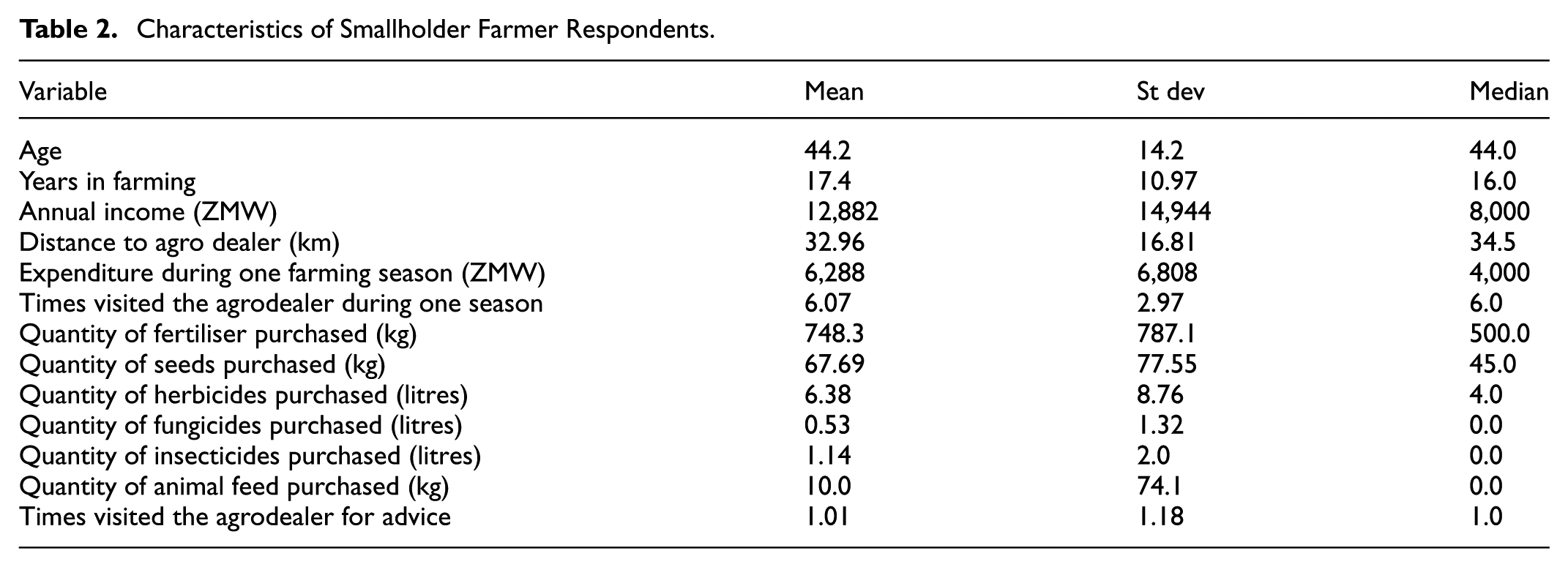
Household annual income varied widely, with a mean of ZMW 12,882 and a median of ZMW 8,000, while seasonal farming expenditures averaged ZMW 6,288 (median ZMW 4,000). Farmers typically travelled about 33 km to reach an agro-dealer and made roughly six visits per season, although visits for advisory services were rare (a mean of approximately 1). Fertiliser was the main input purchased, with an average of 748 kg and a median of 500 kg, followed by seeds (mean 68 kg; median 45 kg) and herbicides (mean 6.4 l; median 4 l). In contrast, fungicides, insecticides, and animal feed were bought by relatively few farmers, as shown by median values of zero for these inputs.
Turning to agro-dealers, 66% of respondents were men, while 34% were women. From these results, it can be inferred that men dominate smallholder farming and agro-dealerships in Mumbwa. Additionally, one of the key informants stated that men dominate smallholder farming and agro-dealerships in Mumbwa district more than women do. During focus group discussions, the men noted that it was uncomfortable for their wives to interact with male agro-dealers. Women discussants similarly reported discomfort interacting with male agro-dealers. This aligns with Argades et al. (2015) research conducted in Maharashtra state of India, which revealed that male input dealers dominated the business. Odame and Muange’s (2010) study on whether agro-dealers delivered the green revolution in Kenya also revealed that about 70% of agro-dealerships were run by men. A high number of male agro-dealers hinders women smallholder farmers from accessing agro-dealers.
Knowledge Levels of Products Sold Among Agro-Dealers
About 85% of the agro-dealers and all the smallholder farmers interviewed reported that farmers visited agro-dealers to obtain inputs. However, most agro-dealers (73%) claimed to have only partial knowledge about the inputs they stocked. Focus group participants similarly noted that some agro-dealers merely read instructions from the packages, while others could not explain why certain agrochemicals failed to work. Key informant interviews also highlighted that several dealers entered the business with limited agricultural experience but learnt by reading supplier brochures. The knowledge gap mainly concerned the agrochemicals they stocked. Although key informants noted that most agrochemical manufacturers had made efforts to educate agro-dealers through workshops, the information provided was insufficient for them to effectively pass on to smallholder farmers. Consequently, they relied heavily on brochures, which lacked the comprehensive information needed. The problem of inadequate knowledge of inputs escalated because most agro-dealers were new to the business, with an average of 4 years and a minimum of a year and were still learning about agro-products. In addition, agro-dealers stocked about 20 different types of chemicals, making it difficult to master them all.
Moreover, one key informant observed that agrochemicals were updated annually and not clearly labelled, especially regarding use instructions. As a result, it was challenging to understand them fully. He also mentioned that most sales representatives in agro-shops had limited knowledge, as most had only completed an ordinary level of education. The questionnaire survey of agro-dealers in this study found that 68% had only 12 years of formal education and lacked specialised agricultural training, while 29% had tertiary-level education. One agro-dealer acknowledged their limited knowledge and shared the following: “I find it difficult to understand most agrochemicals, so I do not explain many things to farmers when selling them agrochemicals.” Through focus group discussions, smallholder farmers noted that most agro-dealers did not explain the use of most agro-chemicals. Hence, they relied on agricultural extension officers. These findings align with those of Chinsinga (2011), who noted that most agro-dealers, especially those involved in the subsidy programme, FISP, had not received formal training and lacked sufficient knowledge to advise farmers.
A Chi-square test revealed an association between education levels and the type of information agro-dealers provided to smallholder farmers (χ2 = 36.6, df = 20). These results could be because most agro-dealers had secondary education; therefore, their knowledge levels were similar. Slightly over half (52%) of the agro-dealer respondents reported attending training. The training was offered by hybrid seed and agrochemical companies on the use of agrochemicals and soil suitability for selected crops. One key informant noted that the international non-governmental organisation, World Vision had been very active in training agro-dealers in entrepreneurship, and 57% of the agro-dealer respondents had attended training workshops organised by World Vision. However, shop attendants in the agro-shops complained that most participants in these training sessions were agro-business owners rather than the employees who were routinely found in the agro shops and regularly engaged with smallholder farmers as part of their daily operations.
Use of Agro-Dealers by Smallholder Farmers
All the smallholder farmers interviewed during this study purchased their agricultural inputs from agro-dealers. These findings contradict the results of CARE (2010), Nagarajan (2015), IFDC (2009), and Gerstenmier (2015), who, in their respective studies, observed low utilisation of agro-dealers by smallholder farmers, especially those not participating in subsidy programmes. However, the current study shows that smallholder farmers frequently relied on agro-dealers, whether or not they took part in the subsidy programme. Machina et al. (2017) also observed that the introduction of the electronic voucher system by the subsidy programme increased farmers’ contact with agro-dealers.
Most (81%) of the smallholder farmer respondents noted that agricultural inputs sold by agro-dealers were expensive. One agro-dealer attributed the high cost of agricultural inputs to high transport costs. Estimates from this study suggested that most smallholder farmers travelled an average of 33 km (standard deviation of 16.8 km) to access agricultural inputs from agro-dealers, with a maximum of 70 km. According to the focus group discussions, the most expensive input was mineral fertiliser, while hybrid seeds and agrochemicals were reasonably priced. Furthermore, smallholder farmers disclosed that agro-dealers tended to increase prices for those using electronic vouchers. In response, some agro-dealers explained that this was done due to delays in government payments for the inputs they provided to farmers under the subsidy programme. Arguably, these challenges did not stop smallholder farmers in Mumbwa from going to agro-dealers.
A smallholder farmer in Mumbwa visited an agro-dealer an average of six times (standard deviation = 3) during an agricultural season to purchase various inputs. The number of visits ranged from one to 20. There were no statistically significant differences (p = .174) in the mean number of visits made to agro dealers by men (x = 6.19, std = 3.09) and women (x = 5.71, std = 2.56). The focus group discussions explained these results. Discussants narrated that they had to make several visits to agroshops during an agricultural season. As one discussant put it, “there is always a shortage of inputs, so we need to travel many times to ensure that we buy all the inputs we need.”
Results from the Poisson regression analysis indicate that access to trucks, farming experience, and annual household income influence the number of visits to agro-dealers in a season (Table 3). Transport access, particularly trucks, emerges as the strongest predictor. Smallholder farmers who used trucks made significantly more visits compared to those who used other types of transportation. Annual income has a positive but modest effect: wealthier farmers tend to make slightly more visits. Years spent on farming negatively affect visits: more experienced farmers rely less on agro-dealers. One respondent said,” I have been farming for many years, so I know what products to use. I don’t rely on information from agro-dealers because those are just after business.” Experienced farmers rationally decrease reliance on a service sector that lacks the expertise to advise them effectively. Education and the (education × income) interactions were not significant once multicollinearity was addressed. Other factors such as age, gender, distance, satisfaction with advice, and service ratings did not demonstrate meaningful independent effects. However, results from the qualitative part of the study reveal perceptions that more men visited agro dealers than women. Focus group discussions indicated that male household members were primarily responsible for travelling to agro-dealers to procure inputs. One male focus group discussant explained, “When I send my wife to buy chemicals, she usually buys different products from what I told her after being convinced by the agro-dealer that they are just the same, hence I prefer travelling myself.” Women contended that they knew what they needed, but they always waited for their husbands to go to town.” This finding was reinforced by agro-dealers who reported that most of their clientele were men.
Determinants of the Number of Farmer Visits to Agrodealers.

Note. Model fit: McFadden’s Pseudo R2 ≈ .30; Log-Likelihood = −407.26 (N = 180).
Interviews with agro-dealers indicated that men sought advice more often than women. Additionally, the most visits occurred during the planting season (October to December), followed by the marketing season (May to August), and the fewest during the weeding season (December to February), when smallholder farmers seldom visited agro-dealerships unless they ran out of agrochemicals or the purchased chemicals proved ineffective. These findings contradict the results of Okello et al. (2016), who observed that women accessed agro-dealers in greater numbers in their study in Western Kenya. They align with Adam’s (2018) research in Northwest Nigeria, which showed that about 70% of agro-dealer customers were men. In their study, women faced limitations due to resource constraints and mobility restrictions.
Slightly over half (55%) of smallholder farmers listed agro-dealers among their sources of advice. Smallholder farmers visited an agro-dealer at least once during the agricultural season solely for agricultural advice. One focus group discussant narrated that “the agriculture extension officers are very few and are not always present so we have to rely on agro-dealers for advice.” Key informant interviews also confirmed the observation that the number of extension officers is inadequate to meet all the farmers’ needs. Recent studies describe limited government staffing capacity that constrains service coverage, particularly in rural areas where demand is rising (Siankwilimba, 2023). Reported farmer-to-extension worker ratios range from approximately 1:1,000 to 1:3,000, far above commonly recommended benchmarks for adequate advisory support (Ogunmodede et al., 2022). Policy analyses reinforce this picture, noting that such ratios limit outreach, technical follow-up, and the diffusion of innovation across farming communities in Zambia (Collier et al., 2024).
About 93% of smallholder farmer respondents reported receiving information on the use of agro-chemicals from agro-dealers, whereas only 7% obtained information on spraying crops with agro-chemicals. Only 7% reported purchasing agro-inputs on credit from agro-dealers. Furthermore, 48% rated services provided by agro-dealers as fair, while 22% rated them as poor. The rest (30%) rated the services as good. There was a link between being on the subsidy scheme, FISP, and perceptions of the quality of agro-dealer services (χ2 = 19.093, p = .0001). Responses show that 62% of smallholder farmers not on the subsidy scheme FISP rated the services provided by agro-dealers as good. In contrast, the same percentage of those on the scheme rated the services as fair.
One primary reason smallholder farmers cited for their dissatisfaction with agro-dealer services was poor delivery. This complaint was prevalent among smallholder farmer respondents on the FISP subsidy programme. Focus group discussants claimed that good quality products were given to clients who paid cash. Relatedly, one key informant explained that agro-dealers supplied low-quality agro-products to FISP smallholder farmers because the government delayed payment to the agro-dealers. Thus, they reserved better-quality products for customers who paid cash.
There were many negative perceptions of products sold by agro-dealers from smallholder farmers (Figure 3).

Smallholder farmers’ perceptions of agro products sold by agro-dealers.
The focus group discussants raised several concerns, including that some agro-products, particularly herbicides, were not working properly and proved ineffective against weeds. One discussant noted, “I bought a certain weed killer, but after applying it in my field, the weeds were still there.” Others stated that certain hybrid seed varieties failed to germinate. When such seeds were returned to the involved agro-dealers, some were exchanged, while others were refused. Some agro-dealers interviewed during this study attributed the herbicides’ inefficacy to weed resistance, while others blamed farmers’ failure to follow application instructions. Agro-dealers admitted to selling expired products but justified this by stating that even if a chemical had expired, it remained effective for some time. During fieldwork for this study, the first author observed an agro-dealer selling expired products to farmers, who were fully aware of their expired status. The most common problems smallholder farmers reported to agro-dealers were crop diseases and pests.
Half of the respondents stated that agro-dealers never provided helpful advice, while 30% reported being advised on which agrochemicals to use. Furthermore, about 57% of respondents were dissatisfied with the advice they received. Results from the ordinal logistic regression analysis indicated that farmers using buses were far less likely to think positively of agro dealer advice (β = −2.07, p = .0205) while distance to agro dealer showed a small but significant positive association (Table 4).
Determinants of Farmer Satisfaction With Agrodealers’ Advice.

Smallholder farmers who received advice from qualified agro dealers were more likely to be satisfied with it. The perceived qualifications of agrodealers also increased the likelihood of receiving a higher rating. More frequent engagement with agrodealers was generally associated with more positive ratings. Demographics (age, gender, education) and income had little independent impact on ratings after accounting for satisfaction and perceptions of qualifications. Focus group discussions showed that smallholder farmers who were generally satisfied with advice tended to be those who purchased products on a cash basis. One discussant narrated the following; “the agro dealer instructed me on the chemicals to use for armyworms and explained the dosage and when to spray.” Other discussants however, highlighted significant gaps in service quality. Some focus group discussants observed that agro-dealers either advised them to purchase an additional chemical or provided no guidance at all because they were occupied with other customers. One discussant who used public buses reported that “I have to take a bus for almost an hour to reach the shop.” Others noted, “Sometimes the bus delays, and I miss the day the agro dealer is open. It is expensive to carry fertiliser by bus, so I buy less.” These contrasting experiences help explain why advice from qualified agro-dealers showed a strong positive effect.
After matching, the average covariate values showed varying degrees of balance across the matched groups (Table 5). While some covariates, such as age, years in farming, and distance to agro dealer, still display noticeable differences between groups. The improved balance in annual income and farming expenditure suggests that group comparisons for these outcomes will likely be more reliable. In contrast, the remaining imbalances in other covariates should be considered when interpreting the results, as they may introduce bias or affect the validity of subsequent analyses.
Propensity Score Matching Results.
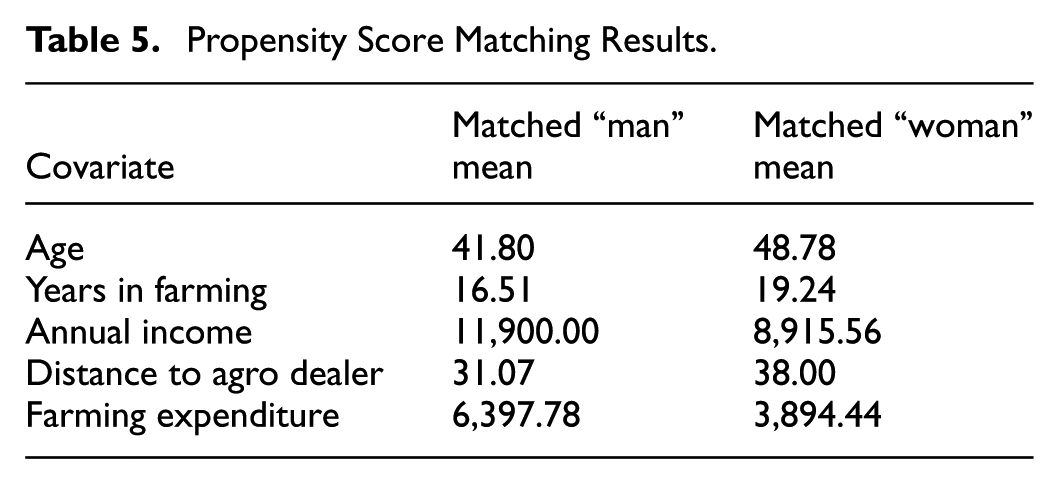
Women in the matched sample are, on average, older (48.78 vs. 41.80 years) and have been farming for a longer period (19.24 vs. 16.51 years). This indicates a slightly more experienced but older female farming group. Despite this experience, women reported lower annual income (ZMW 8,915 vs. 11,900), highlighting ongoing gender income gaps even after accounting for observable characteristics. Women also travelled further to agro-dealers (38 vs. 31 km), suggesting higher transaction costs and possibly reduced access to input and advisory services. Furthermore, women’s farming expenditure is lower (ZMW 3,894 vs. 6,397), indicating restrictions on purchasing inputs such as seed, fertiliser, or agrochemicals. The Average Treatment Effect on the Treated (ATT) was estimated to be 0.00. This was calculated by comparing the mean number of visits in the matched male group with that in the matched female group. The mean number of visits for matched male farmers and matched female farmers was the same, at 5.71. A t-test yielded a p-value > .05, showing no statistically significant difference in the number of visits to agro dealers between the two genders.
Contribution of Agro-Dealers to Agricultural Linkages
The major contribution of agro-dealerships in Mumbwa district to backwards linkages in the agriculture sector was through the provision of agro-inputs and advice on crop production. All smallholder farmers interviewed purchased agro-inputs from agro-dealers, and 55% sought advice. However, the district experienced a deficit in agro-input provision due to a persistent shortage of inputs. In addition, 57% of respondents reported dissatisfaction with the agricultural advice provided by agro-dealers. Forward linkages provided by agro-dealers were mainly through the purchase of produce, transportation, and connections to other enterprises (Figure 1). The involvement of agro-dealers and smallholder farmers in agricultural linkages is diverse and complex.
About 52% of the agro-dealers purchased produce from farmers, while 98% of smallholders sold their produce to agro-dealers. The main produce bought by agro-dealers from farmers was maize, and the least bought was groundnuts. Only 24% of respondents were satisfied with the way agro-dealers bought their produce. Focus group discussants argued that agro-dealers used uncalibrated scales and set low prices for produce. One said, “I am not happy with the way these agro-dealers are buying our maize, when you take your bag of maize to one agro-dealer, it will show different kilograms from the next one for the same bag, I wonder what type of scales they use.” Conversely, some agro-dealers defended their practices, arguing that transport costs are high and that government payment delays for subsidy inputs make it hard to offer fair prices. Mesko (2013) similarly observed that most smallholder farmers lacked sufficient power to negotiate the price of their produce and therefore accepted whatever the agro-dealer offered. Only 15% of agro-dealers connected smallholder farmers to other business enterprises.
Forward and backward linkages for the agricultural camps in Mumbwa districts were mapped as shown in Figure 4. The various shades of brown indicate forward linkages, while the green arrows and their shades show backwards linkages. The thicker the arrow, the stronger the linkage. Forward linkages were more prominent in Kamilambo camp, which sold more produce to agro-dealers. Chiwena camp appeared to have more advanced backwards linkages. The least in terms of backwards linkages are Mupona, which is in the central business district area, and Nalubanda. Conversely, Chikanda is the camp with the lowest sales to agro-dealers.

Involvement of agro-dealers in forward and backwards linkages to the agricultural sector.
Kaindu Agricultural Camp exhibited the most advanced forward and backwards linkages with agro-dealers, followed by Mumbwa Central, Nambela Nangoma, and Nalubanda, the latter being the most geographically isolated from agro-dealer networks.
Respondents had varied perceptions of the role of agro dealers in improving productivity. A slight majority of respondents (51%) characterised agro dealers as primarily motivated by profit, indicating limited trust in their developmental contribution. Conversely, 49% emphasised their positive influence through providing inputs, advisory services, produce marketing, and other forms of support. This divergence highlights the contested role of agro dealers in rural economies, where their dual identity as both commercial actors and potential development intermediaries generates mixed assessments. Unarguably, agro dealers play a crucial role in shaping adoption outcomes through both backwards and forward linkages. On one hand, they provide inputs, advice, and credit facilities that reduce barriers to adoption. On the other hand, their involvement in produce purchasing, market connections, and logistics ensures that implementation results in improvements in farmer income and market access. However, the quality of these services, as measured by knowledge dissemination, fairness in transactions, and compliance with regulations, determines whether farmers perceive agro-dealers as trusted partners or as gatekeepers reinforcing market inequalities.
Limitations and Strengths of the Study
The study employed a robust explanatory sequential mixed-methods approach, combining quantitative surveys (180 farmers and 65 agro-dealers) with qualitative data from focus group discussions and key informant interviews. This methodology offered a comprehensive understanding of the topic, using detailed qualitative insights to validate and enrich the quantitative findings. The approach generated results highly relevant to policymakers and practitioners in other Sub-Saharan African countries. Despite these strengths, the study had certain limitations. The COVID-19 pandemic severely restricted the qualitative component, permitting only two focus group discussions across two of the five agricultural blocks. Additionally, recall bias posed challenges, as some farmer respondents struggled to accurately remember details such as the number of visits to an agro-dealer or their annual income. This issue was partly mitigated by employing follow-up questions to prompt memory. During the discussions, outspoken participants occasionally risked overshadowing quieter voices; however, the facilitator actively managed the groups to ensure all participants had a chance to speak. While all agro-dealers in the area were interviewed, eliminating sampling bias for that group, the sampling design for farmers may not have perfectly captured all smallholder farmer subgroups. Despite all mitigation efforts, it is important to recognise that some biases could not be eliminated.
Conclusion
The findings of this study emphasise the vital role that agro-dealers play in supporting smallholder agriculture in Mumbwa District, Zambia. They have partly bridged the gap left by the understaffed public sector agricultural extension service. However, significant gaps in knowledge, capacity, and inclusion still need to be addressed. While agro-dealers are the main source of agricultural inputs for all smallholder farmers surveyed, their limited understanding, especially concerning agrochemicals, presents a major challenge. This deficiency in technical expertise not only impedes the dissemination of vital agricultural knowledge but also weakens the support that agro-dealers can effectively offer to farmers.
Agricultural camps located further from agro-dealers participated less in input purchases and produce sales. Therefore, location disparities restrict some smallholder farmers’ participation and productivity. Targeted interventions, like gender-sensitive training programmes for agro-dealers and increased outreach to women farmers, are necessary to close this gap. These efforts will help ensure that all farmers can benefit equally from the available services.
The study emphasises the vital role of agro-dealers in establishing both forward and backward linkages within the agricultural sector. These linkages, through the supply of inputs, advisory services, and the purchase of produce, significantly impact agricultural productivity and farmers’ access to markets. However, the inconsistent quality of services, especially for beneficiaries of the Farmer Input Support Programme (FISP), emphasises the urgent need for regulatory frameworks that guarantee fair and high-standard service delivery. Timely payments to agro-dealers involved in the government’s subsidy programme could change this situation. Furthermore, improving agro-dealers’ logistical capacity to ensure prompt, sufficient input supply is crucial to enhancing their role in agricultural development. A strong private sector, including well-equipped agro-dealers, is essential for sustainable agricultural growth. The government should focus on creating a supportive environment for these enterprises rather than relying solely on direct subsidies.
Finally, policymakers and researchers should focus on building a supportive ecosystem for agro-dealers to succeed while effectively addressing smallholder farmers’ needs. This includes designing incentive schemes to motivate agro-dealers to expand their post-harvest services such as transport and market linkages, and fostering public-private partnerships to bridge gaps in agricultural extension services. By doing so, agro-dealers can become essential to the transformation and sustainability of rural agriculture in Zambia. Further research should explore scalable models for integrating agro-dealer networks into broader agricultural development strategies while ensuring inclusivity and sustainability.
The study suggests that agro-input manufacturers should implement improved training programmes and establish compulsory certification requirements in agricultural sectors to enhance service delivery. It also advises that all companies supplying agro-inputs provide training to agro-dealers on how their products function and how to interpret the instructions on various products. At least one agro-shop attendant must hold certification in an agricultural field. Further research is necessary on the utilisation of agro-dealers by women smallholder farmers.
Supplemental Material
sj-docx-1-sgo-10.1177_21582440251407822 – Supplemental material for The Role of Agro-Dealers in Forward and Backward Linkages of the Smallholder Agriculture Sector in Central Zambia
Supplemental material, sj-docx-1-sgo-10.1177_21582440251407822 for The Role of Agro-Dealers in Forward and Backward Linkages of the Smallholder Agriculture Sector in Central Zambia by Henriettah Kandepu and Bridget Bwalya in SAGE Open
Footnotes

Funding
The authors received no financial support for the research, authorship, and/or publication of this article.
Declaration of Conflicting Interests
The authors declared no potential conflicts of interest with respect to the research, authorship, and/or publication of this article.
Data Availability Statement
Supplemental Material
Supplemental material for this article is available online.
References
Supplementary Material
Please find the following supplemental material available below.
For Open Access articles published under a Creative Commons License, all supplemental material carries the same license as the article it is associated with.
For non-Open Access articles published, all supplemental material carries a non-exclusive license, and permission requests for re-use of supplemental material or any part of supplemental material shall be sent directly to the copyright owner as specified in the copyright notice associated with the article.
